1. What Is a Generation License and Why Does It Matter?
In our previous exploration of The Survey License, we followed Nepal’s hydropower development pipeline through its first gate – the government’s permission to investigate whether a project is feasible. The generation license is the second and far more consequential gate. It is the legal instrument that authorizes a developer to actually build, own, operate, and ultimately transfer a hydropower project.
Formally known as the Electricity Generation License (विद्युत उत्पादनको अनुमतिपत्र), this document transforms a feasibility study into a legally binding commitment. Where the survey license asked “can we build this?”, the generation license declares “we will build this” – and binds the developer to an intricate web of technical specifications, financial obligations, environmental safeguards, construction timelines, and a multi-decade lifecycle that ends with the entire project being handed back to the state.
The generation license is not a simple permit. It is, in effect, a concession agreement between the developer and the Government of Nepal – a contract that allocates a public natural resource (a river) to a private entity for a fixed period, during which the entity must enter into Power Purchase Agreement, build the infrastructure, generate electricity, pay royalties, protect the environment, and eventually return everything to the nation. Understanding this license is understanding the legal side of every hydropower project in Nepal.
| From Survey to Generation The survey license grants permission to study. The generation license grants permission to build and operate. Between them lies the feasibility report, the Environmental Impact Assessment, and the grid connection agreement – all of which must be completed and approved before the generation license can be issued. The generation license is where desk studies and field data eventually converts into a binding national commitment. |
2. The Legal Foundation: Authority, Hierarchy, and Framework
Like the survey license, the generation license derives its authority from Nepal’s primary energy legislation. It is issued under Section 4, Sub-section (2) of the Electricity Act, 2049. However, while the survey license is governed by Rule 8 of the Electricity Rules, the generation license is issued under Rule 17 of the Electricity Rules, 2050, which prescribes the specific conditions that must accompany it.
A critical distinction from the survey license lies in the authorizing officer. While the survey license is signed at the Secretary level of the Ministry of Energy, the generation license is signed by the Director General of the Department of Electricity Development. This reflects the operational nature of the license – the Department, as the implementing arm of the Ministry, takes direct ownership of the project’s regulatory lifecycle from issuance through to the eventual handover decades later.
The generation license sits within a broader legal ecosystem. Beyond the Act and Rules, the project must comply with multiple intersecting laws and frameworks, including the Environment Protection Act, 2076 and its Rules 2077, the Foreign Investment and Technology Transfer Act (FITTA), 2075, prevailing labor laws, and operational guidelines issued by the Department for hydropower plants, substations, and transmission lines. The generation license explicitly binds the developer to all of these.
| The Legal Hierarchy for Generation Licenses Electricity Act, 2049 (Parent Law) → Electricity Rules, 2050, Rule 17 (Procedural Framework) → Environment Protection Act, 2076 & Rules, 2077 (Environmental Compliance) → FITTA, 2075 (Foreign Investment) → DOED Operational Guidelines (O&M Standards). The generation license weaves all of these into a single binding instrument. |
3. The BOOT Framework: Understanding the Project Lifecycle
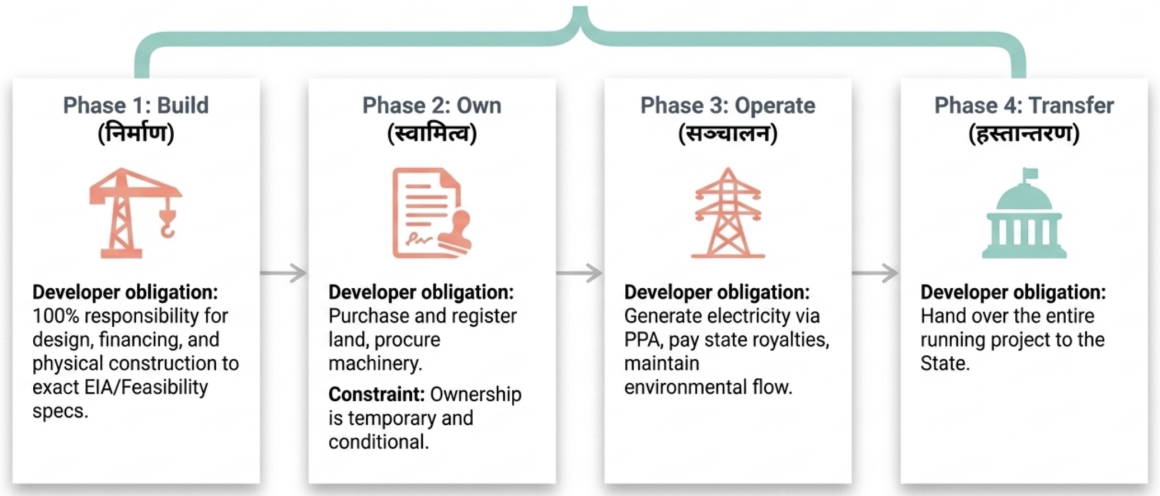
Although the acronym “BOOT” never appears in the license document itself, every generation license issued for hydropower in Nepal effectively structures the project as a Build-Own-Operate-Transfer (BOOT) concession. Understanding this framework is essential because it provides the mental model for everything that follows – every obligation, every timeline, every financial commitment flows from this four-stage lifecycle.
3.1 Build (निर्माण)
The license assigns complete responsibility for the construction of the project to the licensed institution. The developer must design, finance, and physically build all project infrastructure – from the dam and tunnels to the powerhouse and transmission lines – within the parameters specified in the approved feasibility report and the license conditions. The government does not build; it regulates, monitors, and assists.
3.2 Own (स्वामित्व)
During the license period, the developer effectively owns the project. They purchase and register private land in the company’s name, procure and install all machinery and equipment, and hold operational control over the facility. However, this ownership is conditional and temporary – the developer cannot sell project land, and the license itself cannot be transferred without explicit government approval.
3.3 Operate (सञ्चालन/सम्भार)
The developer operates and maintains the project for the duration of the license period – typically spanning several decades. During this phase, the developer generates and sells electricity (usually under a Power Purchase Agreement with the Nepal Electricity Authority), pays royalties to the government, maintains environmental compliance, and keeps the facility in good operating condition.
3.4 Transfer (हस्तान्तरण)
This is the defining feature. Upon the expiration of the license period, the entire project – including all constructed facilities, all purchased land, all machinery, equipment, and infrastructure – must be handed over to the Government of Nepal free of cost and in running, operational condition. The methods and procedures for this handover are determined by the government from time to time. This mandatory, free-of-cost transfer is what prevents a hydropower facility from becoming a permanent private asset, legally cementing its identity as a BOOT concession.
| Why BOOT Matters for Nepal The BOOT model allows Nepal to develop its vast hydropower potential using private capital and expertise, while ensuring that the nation’s rivers and the infrastructure built on them ultimately return to public ownership. The developer earns returns during the operating period; the nation inherits the asset. Every condition in the generation license – from construction timelines to maintenance standards to insurance requirements – serves this fundamental bargain. |
4. What the License Actually Contains
A typical generation license runs five to six pages of dense legal text, accompanied by an official topographical map. It is substantially more detailed than the survey license because it must serve as the regulatory blueprint for an entire multi-decade project lifecycle. Here is what a developer finds inside:
4.1 Applicant and Project Identification
The license identifies the licensed institution by name, registered address, phone, and email. It then specifies the project name, its type (Run-of-River, storage, etc.), and – critically – two numbers that define the project’s entire economic identity: the installed capacity in megawatts and the average annual energy production in gigawatt-hours. Every royalty, every penalty, every grid connection parameter flows from these two figures.
4.2 The Water Resource and Geographical Boundaries
As with the survey license, the generation license designates a precisely defined geographical area using administrative boundaries (province, district, municipality) and exact latitude/longitude coordinates. This area defines where the developer is legally permitted to utilize the water resource. Additionally, the license specifies the design discharge – the volume of water the system is designed to handle, measured in cubic meters per second – and the gross head – the total vertical drop from intake to turbine, measured in meters. Together, these two parameters represent the physical basis on which the project’s capacity was calculated.
4.3 Detailed Infrastructure Specifications
Unlike the survey license, which merely describes the area to be studied, the generation license provides a comprehensive technical blueprint of every major structure the developer must build – exact dimensions, materials, types of equipment, and precise locations. We will explore these in depth in the next section.
4.4 Grid Connection and Transmission Routing
The license specifies exactly how the generated electricity will be delivered to the National Transmission System. This includes the voltage levels at which power is generated and stepped up via transformers, the routing and length of transmission lines, the specific substation where the project will physically connect to the national grid operated by the Nepal Electricity Authority (NEA), and any shared transmission infrastructure with neighboring projects.
4.5 License Validity Period
The generation license specifies a fixed validity period – typically spanning 35 years from the date of issuance. This period is immovable: delays in construction, financing, or commissioning do not extend the end date. Every year spent resolving pre-construction hurdles is a year deducted from the developer’s operational revenue window.
4.6 License Fee
As with the survey license, obtaining the generation license requires payment of a license fee and deposit to the government. (The detailed fee framework will be covered in a separate blog post.)
4.7 Conditions
The bulk of the generation license – often running three to four full pages – is a comprehensive set of conditions covering everything from construction timelines and financial closure requirements to environmental obligations, royalty schedules, land acquisition rules, insurance mandates, community investment rights, and the eventual handover. These conditions are the subject of the remaining sections of this blog.
5. The Technical Blueprint: Infrastructure Specifications
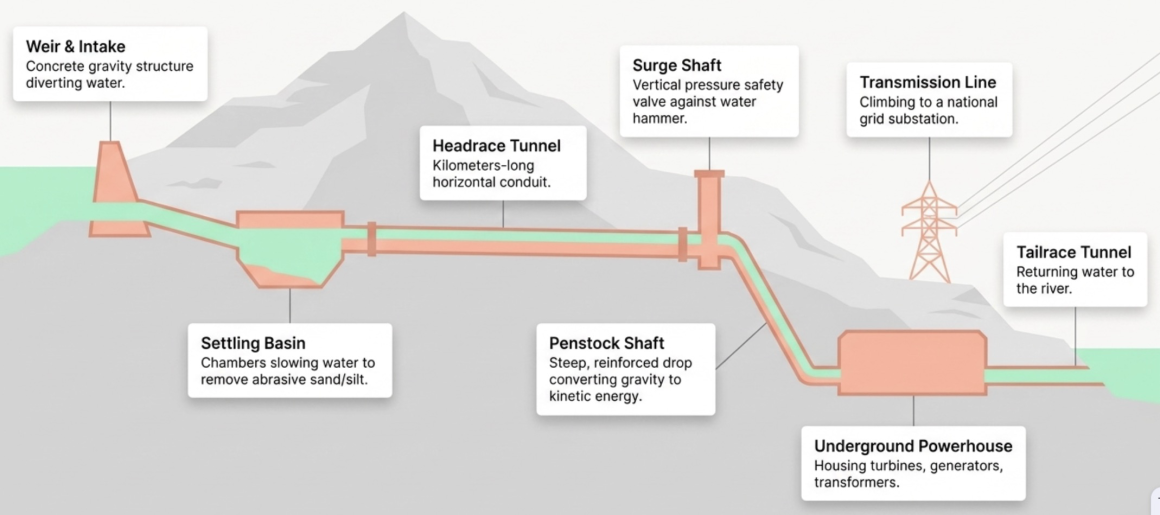
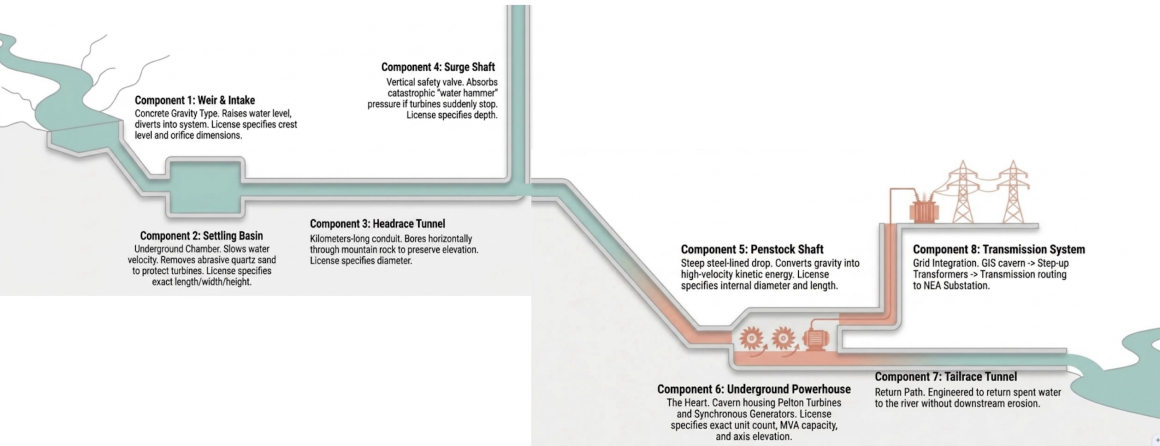
The generation license does not merely name the project’s structures – it dimensionally defines them. The license specifies the exact type, length, height, width, diameter, and capacity of every major structure, effectively locking the developer into a technical blueprint that cannot be altered without formal government approval. For a typical high-head, run-of-river hydropower project in Nepal’s mountainous terrain, the license specifies the following:
5.1 Weir and Intake (बाँध र इन्टेक)
The weir is a dam-like structure built across the river to raise the water level and divert it into the project’s conveyance system. In Nepal’s run-of-river projects, this is typically a Concrete Gravity Type weir – a structure that relies on its own massive weight to resist the force of the water. The license specifies its total length, height from foundation, and the crest level (the elevation of the weir’s top edge above sea level).
The intake is the entry point where diverted water is captured into the tunnel system. The license defines the intake type (typically a side intake on the river bank), the number and dimensions of the orifice openings, and the connecting tunnels that transport water from the intake to the next stage.
5.2 Settling Basin (बालुवा थिग्राउने पोखरी)
Water drawn from Himalayan rivers carries heavy loads of suspended sand, silt, and debris – particularly during the monsoon season. The settling basin / sand-settling pond is an underground chamber where the water velocity is deliberately slowed, allowing heavier particles to sink and settle at the bottom before the clean water proceeds further. The license specifies the chamber type (single or multi-chamber), its length, width, and height. This structure is critical because the abrasive quartz particles common in Nepal’s glacial rivers can rapidly erode steel turbine blades if not removed.
5.3 Headrace Tunnel (हेडरेस टनेल)
The headrace tunnel is the project’s main water conveyance conduit – a massive underground tunnel bored through the mountain at a very gentle gradient. Its purpose is to transport the desilted water from the settling basin toward the powerhouse while preserving the water’s high elevation. The license specifies the tunnel diameter and total length. In mountainous Nepal, headrace tunnels commonly stretch for several kilometers – a monumental feat of underground engineering.
5.4 Surge Shaft (सर्ज शाफ्ट)
Positioned at the downstream end of the headrace tunnel, the surge shaft is a deep, vertical cylindrical chamber that acts as a pressure safety valve. If the turbines suddenly stop accepting water (for example, during an emergency grid disconnection), the momentum of thousands of tons of water rushing through the headrace tunnel would create a catastrophic pressure spike – known as water hammer – that could rupture the tunnel lining. The surge shaft allows this water to safely surge upward into the vertical chamber, dissipating the destructive pressure. The license specifies its depth and diameter.
5.5 Penstock / Pressure Shaft (पेनस्टक शाफ्ट)
The penstock shaft (also called the pressure shaft or inclined pressure shaft) is where the project’s head – the vertical drop – is actually exploited. This is a heavily reinforced, steeply inclined tunnel or pipe that drops the water rapidly from the surge shaft elevation down to the powerhouse. As the water plunges through this shaft, gravity converts it into extremely high-pressure, high-velocity kinetic energy. The license specifies the shaft’s total length and internal diameter. In high-head projects, the penstock shaft can extend for over two kilometers.
5.6 Powerhouse (विद्युतगृह)
The underground powerhouse is the heart of the facility – a massive cavern excavated deep inside the mountain rock, housing all the electro-mechanical equipment. The license specifies the powerhouse dimensions (length, width, and height) and defines the exact equipment installed inside:
- Turbines: The type (such as Pelton turbines for high-head projects), the number of units, and their axis elevation above sea level.
- Generators: The type (typically synchronous generators), the number of units, their capacity in MVA, and the voltage at which power is initially generated (commonly 11 kV).
- Transformers: The step-up transformers that convert the generated voltage to the high-voltage level required for transmission (commonly 220 kV).
5.7 Tailrace Tunnel (टेलरेस सुरुंग)
After spinning the turbines, the spent water exits the powerhouse through the tailrace tunnel and is returned to the natural river channel downstream. The license specifies the tailrace tunnel’s length and diameter, ensuring the discharge is properly engineered to avoid downstream erosion or flooding.
5.8 Transmission System
The license details the complete electrical pathway from powerhouse to national grid: the GIS (Gas Insulated Switchgear) cavern where the generators connect, the transformer yard where voltage is stepped up, the transmission line routing (including voltage class, circuit type – typically double circuit – and approximate length in kilometers), and the specific substation where the project physically connects to the National Transmission System operated by the Nepal Electricity Authority.
| Why This Level of Detail Matters The generation license locks the developer into a specific technical blueprint. Significant changes to the design of any main structure require formal prior approval from the Department. The approved design also ties directly to the project’s financial and environmental framework: the turbine count determines royalties, the tunnel alignment determines environmental impact zones, and the transmission routing determines grid integration requirements. Every dimension in the license has regulatory consequences. |
6. Documents Tied to the License: The Regulatory Web
The generation license does not exist in isolation. It is the central node of a web of interconnected documents – some are declared integral parts of the license itself, some are mandatory milestones the developer must secure to keep the license valid, and some are compliance submissions required throughout the project’s life. Understanding these documents and how they relate to the license is essential.
6.1 Integral Parts of the License (अभिन्न अङ्ग)
Three foundational documents – and any future amendments to them – are explicitly declared integral parts of the generation license. This means their conditions, designs, and specifications carry the exact same legal weight as the license document itself:
The Updated Feasibility Report
This is the comprehensive engineering study – typically running to multiple volumes covering the main report, hydraulic drawings, and appendices – that was produced under the survey license and refined through detailed design. It serves as the project’s unchangeable technical blueprint. The developer cannot make significant alterations to the main structures’ design or capacity outlined in this report without formal prior approval from the Department.
The Approved Environmental Impact Assessment (EIA)
The EIA is a prerequisite document that must be approved by the Ministry of Forests and Environment before the generation license can be issued. It establishes the environmental impact mitigation, management, and monitoring plans that the developer is legally bound to implement throughout the project’s life. We will examine the EIA’s role in detail in a later section.
The Grid Connection Agreement (विद्युत जडान सम्झौता)
This agreement between the developer and the Nepal Electricity Authority (NEA) legally defines how the project’s generated power will physically integrate into the National Transmission System. It covers technical parameters like voltage levels, connection points, and transmission capacity.
A crucial provision: the license includes a blanket amendment clause stating that any amendments made to these three documents automatically remain as integral parts of the license, ensuring the license always enforces the most up-to-date versions of the approved plans.
6.2 Mandatory Milestone Documents
Several other documents are tied to the license as strict timeline milestones – the developer must secure and submit them within defined deadlines to keep the license valid:
- Power Purchase Agreement (PPA) and Financial Closure: Must be completed within two years of the license being issued, or the license faces automatic cancellation.
- Construction Contracts: Must explicitly embed the contractor’s legal liability to follow the approved EIA conditions. Copies must be submitted to the Department within one month of signing.
- Industry Registration (उद्योग दर्ता): Must be submitted to the Department within one year from the date the generation license decision was made.
- Insurance Policies (बीमालेख): Appropriate standard insurance covering both the construction and operational phases must be procured, and copies submitted to the Department.
6.3 Post-Construction Submissions
Once the project is built and begins commercial operation:
- Project Completion Report: A comprehensive report covering the technical and financial aspects of the completed project, along with construction-phase photographs, videos, and final as-built drawings of all structures – all submitted within three months of commercial operation.
- Insurance continuation: Insurance coverage must continue through the entire operational and maintenance period.
6.4 External Guiding Frameworks
Finally, the license binds the project to external government guidelines and policy documents:
- Operation & Maintenance Guidelines: The Department’s official “Operation & Maintenance Guidelines for Hydropower Plants, Sub-stations and Transmission Lines” must be adopted for all post-construction maintenance.
- National Energy Crisis Prevention Concept Paper, 2072: This policy document mandates the developer to establish and fund a Community Support Program (discussed in detail later).
7. The Environmental Impact Assessment: A Prerequisite and a Lifelong Obligation
The Environmental Impact Assessment (EIA) occupies a unique position in the regulatory framework. It is both a prerequisite that must be completed and government-approved before the generation license is issued, and a lifelong obligation that the developer must comply with throughout the entire construction and operational life of the project.
7.1 EIA as a Prerequisite
The timeline is unambiguous: the Ministry of Forests and Environment must review and approve the EIA study report before the Department of Electricity Development can issue the generation license. The generation license then explicitly references the approved EIA and the conditions in the Ministry’s approval letter, making compliance with those conditions a binding legal obligation.
7.2 Mandatory Mitigation and Monitoring
The developer must strictly execute the environmental impact mitigation, management, and monitoring plans exactly as laid out in the approved EIA. These are not guidelines – they are compulsory obligations enforceable under the license. If any modifications to these plans become necessary during the project’s life, the developer cannot change them unilaterally; amendments require the mutual consent of both the Department and the developer.
7.3 Protection of Aquatic Life
One of the most significant environmental obligations is the continuous preservation of the river’s aquatic ecosystem. This involves two primary mechanisms:
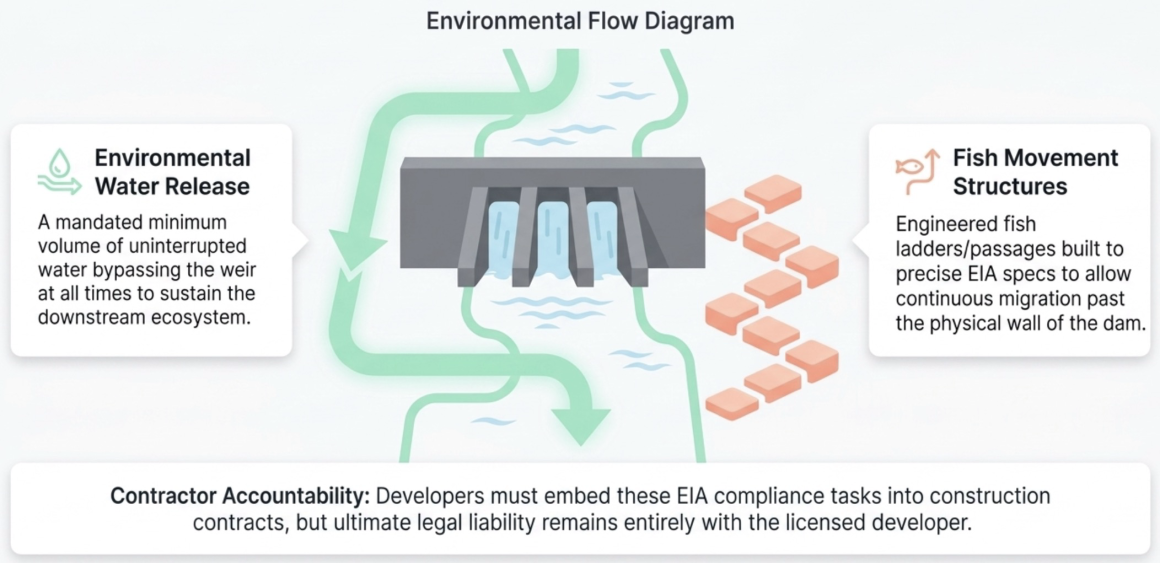
- Environmental Water Release (Environmental Flow): The developer must continuously release an uninterrupted, specified volume of water downstream from the weir at all times – even during peak generation hours. This ensures a minimum baseline of water always flows in the natural riverbed below the dam to sustain aquatic life and the broader riverine ecosystem.
- Fish Movement Structures: A dam acts as a massive physical wall that blocks the natural migration routes of fish. The developer must construct specific structures – such as fish ladders or fish passages – designed to facilitate the safe movement and migration of fish past the dam, built exactly to the technical specifications defined in the EIA. The Department of Electricity Development actively monitors compliance with these aquatic protections throughout the license period.
7.4 Contractor Accountability
The EIA’s reach extends directly to hired construction contractors. The developer must draft construction contracts that explicitly detail all EIA compliance tasks that the contractors must follow. Crucially, these contracts must also clearly define the contractor’s liability and consequences for failure to adhere to environmental rules. A copy of these construction agreements must be submitted to the Department within one month of signing. However, even though contractors carry the contractual burden of on-site compliance, the ultimate legal responsibility for all environmental mitigation rests entirely with the licensed institution.
7.5 Governing Environmental Laws
The environmental study and all related obligations must comply with the Environment Protection Act, 2076 and Environment Protection Rules, 2077, along with any other prevailing environmental legislation. These laws govern the project throughout its entire construction and operational lifecycle – not just during the initial study phase.
| The EIA’s Dual Role The EIA serves as both a gate and a guardrail. As a gate, it must be completed and approved before the generation license is issued. As a guardrail, its conditions travel with the project for its entire life – binding not just the developer but also their contractors to specific environmental performance standards, monitored by the government throughout. |
8. Project Timelines: The Ticking Clock
The generation license imposes a cascade of strict, legally binding timelines that begin ticking the moment the license is issued. Missing these deadlines carries consequences ranging from financial penalties to automatic cancellation.
8.1 The Immediate Deadlines
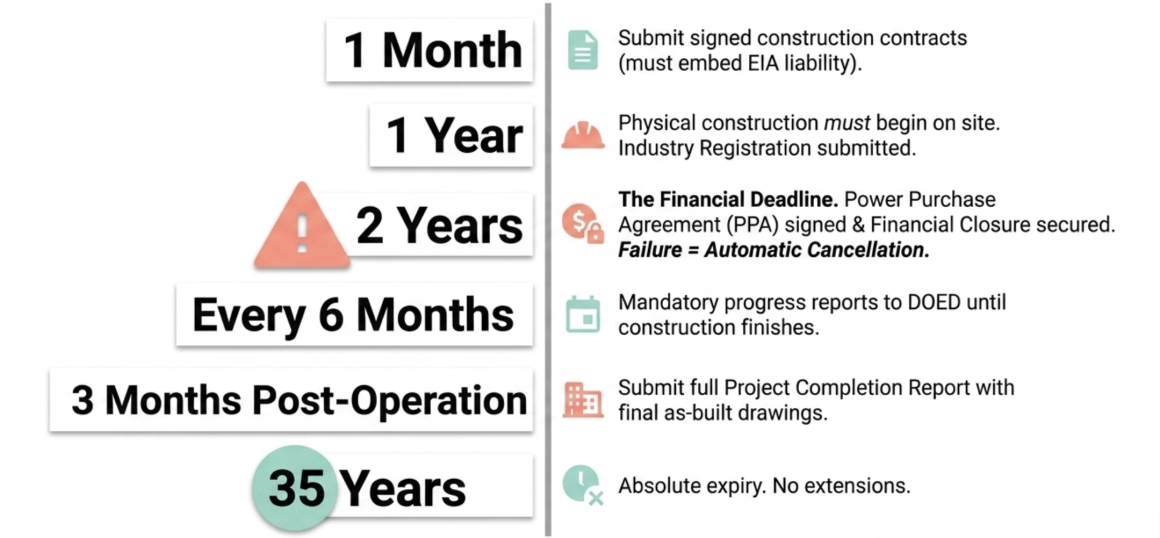
- Within 1 month: Submit copies of any signed construction contract (embedding EIA contractor liability) to the Department.
- Within 1 year: Begin physical construction on the project site. This is a hard deadline – the developer must break ground.
- Within 1 year: Submit the official industry registration for the project to the Department.
- Within 30 days of any corporate change: If the company’s name, shareholders, or share structure changes, notify the Department and submit updated documents.
- Every 6 months: Submit a detailed work progress report to the Department from the moment the license is issued until construction is completed.
8.2 The Two-Year Financial Deadline
Within two years of the license being issued, the developer must successfully complete two critical financial milestones:
- Financial Closure: Secure all necessary funding – equity commitments, bank loans, and other financing instruments.
- Power Purchase Agreement (PPA): Finalize the electricity purchase and sale agreement that guarantees the project’s revenue stream.
If both are not completed within two years, the government reserves the right to cancel the license. However, the license provides an escape valve: if the developer applies for an extension before the deadline expires, the government may grant:
- A first extension of up to one year, based on necessity and justification.
- If still unresolved after three years total, a further extension of six months to two years, based on demonstrated progress and efforts.
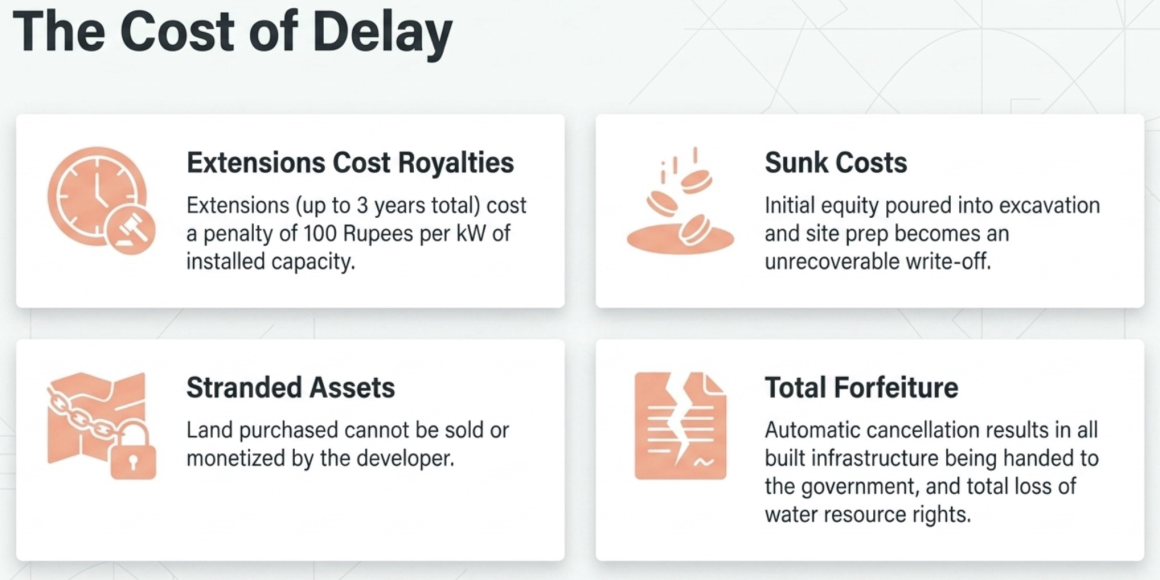
Extensions are not free. For any extended period, the developer must pay a capacity royalty penalty of 100 Rupees per Kilowatt of the project’s installed capacity.
| Automatic Cancellation If the developer fails to apply for an extension before the current deadline expires, or if the PPA and Financial Closure remain incomplete even after the maximum extension periods, the generation license is automatically cancelled. There is no appeal mechanism described in the license – the cancellation is self-executing. |
8.3 Post-Construction Deadlines
Within 3 months of commercial operation: Submit the comprehensive Project Completion Report, construction-phase photographs and videos, and final as-built drawings to the Department.
8.4 The Fixed License Period
The overarching timeline is the license’s fixed validity period – typically 35 years from the date of issuance. This end date is immovable. Extensions granted for the PPA or Financial Closure do not extend the overall license period. They simply eat into the developer’s operational revenue window. A developer who takes five years to complete construction and begin commercial operation has, in practical terms, a 30-year operating window – not 35.
9. The PPA Paradox: Construction Mandates, Financial Closure, and Bankability
One of the most consequential – and commercially challenging – aspects of Nepal’s generation license framework is the structural tension between the construction timeline and the financing timeline. Understanding this tension is critical for any developer or investor evaluating a hydropower project in Nepal.
9.1 The Timeline Mismatch
The license creates two parallel but misaligned deadlines:
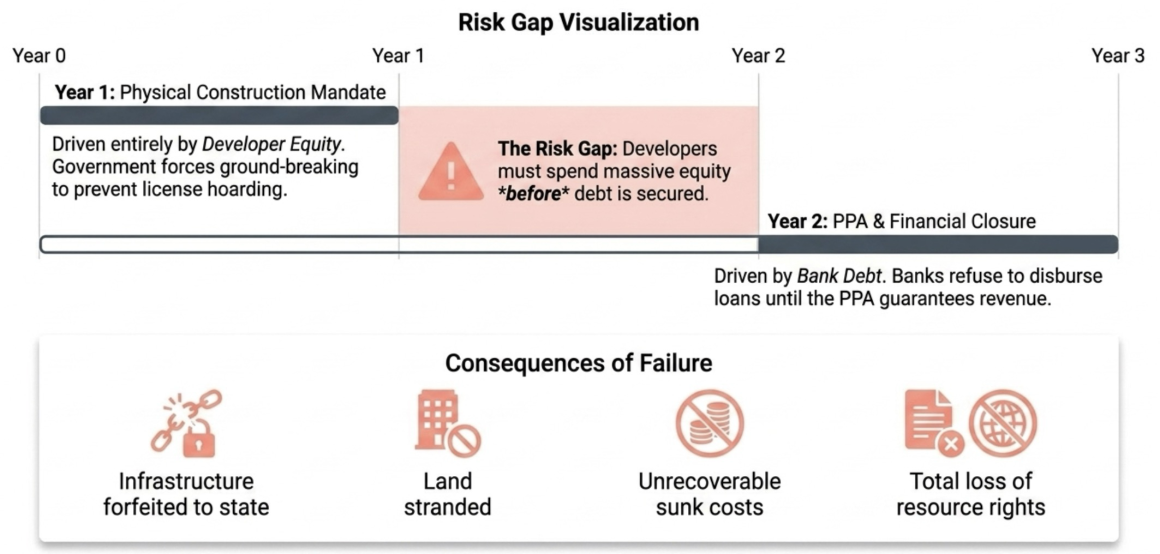
- Year 1: Physical construction must begin.
- Year 2: Power Purchase Agreement (PPA) and Financial Closure must be completed.
This means the developer is legally compelled to break ground and begin heavy construction – site preparation, excavation, access road building, contractor mobilization – before the financial underpinnings of the project are necessarily in place.
9.2 The Bankability Challenge
In standard project finance practice, a project is generally not considered “bankable” – meaning banks will not commit to disbursing loans – until a signed PPA exists. The PPA is the sole legal mechanism guaranteeing that the project will have a revenue stream to repay the debt. Without a PPA, there is no proven cash flow; without proven cash flow, banks do not lend.
Because the government forces the developer to begin physical construction by the end of Year 1, but allows up to Year 2 (or beyond, with costly extensions) to secure the PPA and bank financing, the developer is placed in a position where they must fund the initial phase of construction entirely out of their own equity – their promoter funds. Bank loan disbursements, which in most countries fund the bulk of construction, are typically unavailable until the PPA is signed.
9.3 The Risk of Total Loss
If the developer spends their own capital on Year 1 construction but ultimately fails to secure the PPA and Financial Closure within the extended deadlines, the consequences are devastating:
- Infrastructure forfeiture: All structures built during the initial construction phase must be handed to the government. The developer cannot sell or salvage them.
- Stranded land: Land purchased and registered for the project is legally prohibited from being sold or distributed by the developer. After cancellation, the developer holds land they cannot monetize.
- Total loss of resource rights: Cancellation immediately strips the company of the right to use the river or generate electricity at that site. The partially built project can never be completed by them.
- Unrecoverable sunk costs: The initial equity poured into excavation, labor, materials, land acquisition, and site preparation becomes a complete write-off.
9.4 The Regulatory Rationale
From the government’s perspective, this timeline mismatch is deliberately designed to prevent license holding – a chronic problem in Nepal’s hydropower sector where developers secure licenses but indefinitely delay actual development, effectively blocking other developers from utilizing the river resource. By forcing the developer to break ground within one year, the government ensures that only committed developers with sufficient initial capital are holding licenses.
The extension mechanism – allowing one to two additional years for the PPA and Financial Closure, subject to a capacity royalty penalty – provides a safety valve. But it is a costly one, and it does not eliminate the fundamental risk that the developer must invest heavily before the project’s revenue stream is contractually guaranteed.
| Practical Implication for Developers Any developer entering Nepal’s hydropower market must plan for a significant period of equity-funded construction before bank financing becomes available. The generation license’s timeline structure demands that promoters have substantial own-capital reserves or bridge financing arrangements, and a realistic PPA negotiation strategy that can close within two years. The license rewards swift, well-capitalized execution and severely penalizes delay. |
10. Liabilities and Obligations
The generation license creates a comprehensive web of financial, legal, operational, and environmental obligations. Here is the full picture:
10.1 Complete Financial Liability for Design and Construction
The detailed engineering design of the project, all necessary field investigations, safety arrangements, and the entire environmental impact mitigation – all of these responsibilities and costs rest entirely with the licensed institution. The government does not co-invest in or subsidize the project’s development.
10.2 Property Access, Damage, and Compensation
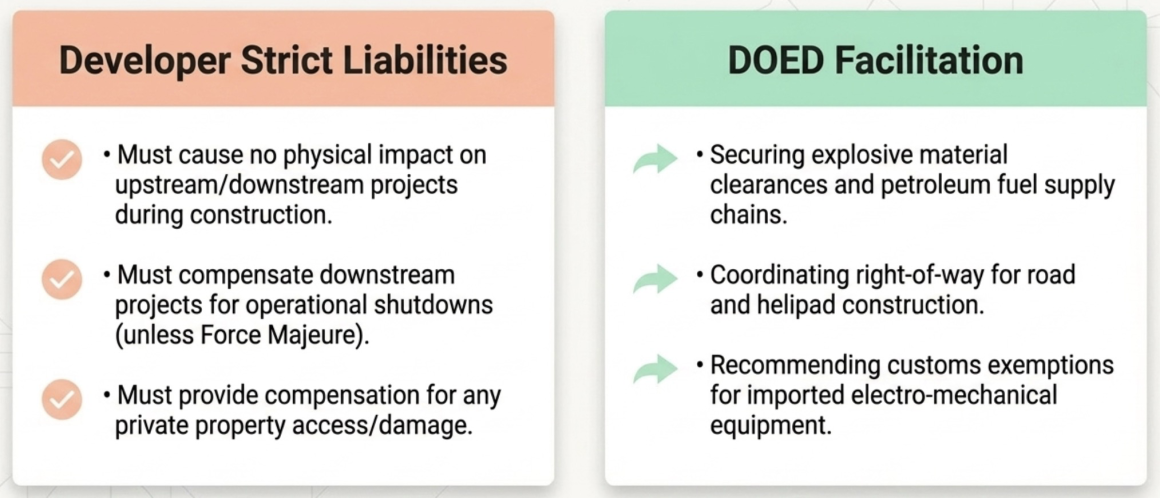
Throughout the license period, if project personnel need to enter private homes or land for any work, they may do so only after giving prior notice to the concerned individual. If any harm or loss occurs during this entry, the developer must provide compensation in accordance with prevailing law. This obligation extends broadly: if the project’s construction impacts any other project, physical structure, person, or land, the developer is liable to compensate.
10.3 The No-Sale, No-Transfer Rule
The generation license cannot be sold or transferred in any manner without the explicit prior approval of the Government of Nepal, Ministry of Energy, Department of Electricity Development. This applies to both direct license transfers and indirect transfers through corporate restructuring. If the company’s share structure or shareholders need to change, prior approval from the relevant regulatory bodies under prevailing law is required, and updated documents must be submitted to the Department within 30 days of the change.
10.4 Geographical Boundary Compliance
All project structures – including the backwater generated by the reservoir and the tailwater discharged downstream – must be built and contained within the geographical coordinates specified in the license. The developer cannot extend the project’s physical footprint beyond the approved boundaries.
10.5 Design Change Controls
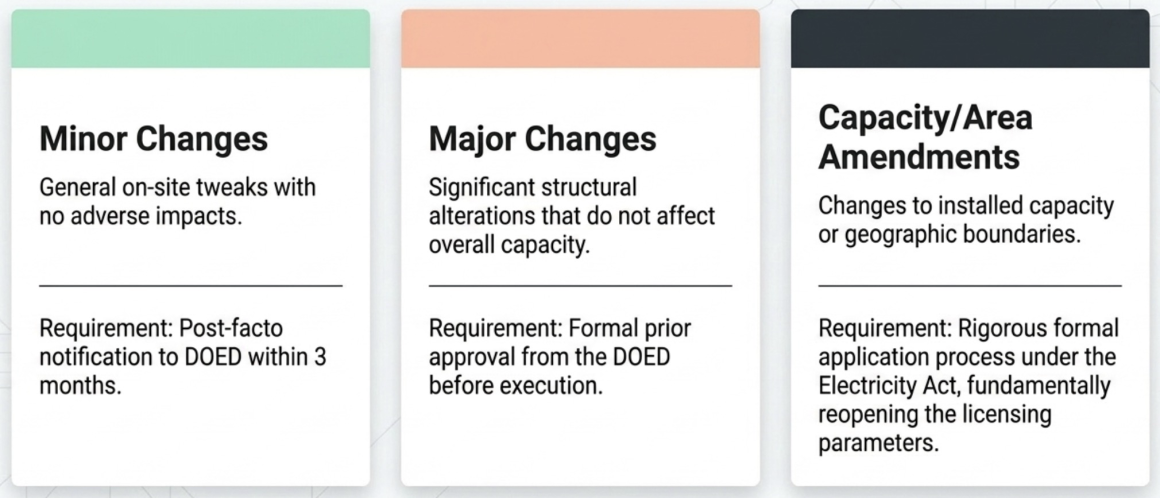
The license establishes a tiered system for managing changes to the approved project design:
- Major changes (significant structural design alterations, adding or removing structures) require formal prior approval from the Department – and must not affect the project’s approved generation capacity.
- Minor changes (general tweaks at the construction site that cause no environmental or adverse impacts) can proceed without prior approval, but the developer must notify the Department within three months.
- Capacity or area amendments require a formal application under the Electricity Act, 2049, the Electricity Rules, 2050, and the prevailing licensing guidelines – a fundamentally different and more rigorous process than a design change.
10.6 Insurance
The developer must maintain appropriate standard insurance throughout both the construction phase and the entire operation and maintenance period. Copies of all insurance policies must be submitted to the Department. While the license does not name specific policy types, “appropriate standard” for a hydropower project typically encompasses construction all-risks, machinery breakdown, third-party liability, and natural disaster coverage.
10.7 Local Labor and Materials
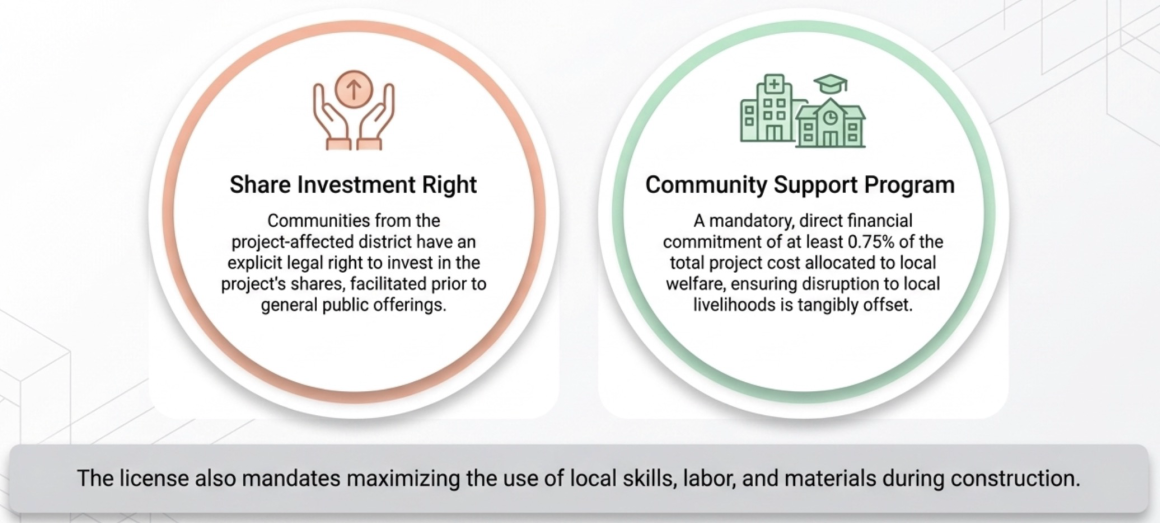
The developer is required – to the maximum extent possible – to employ local skills, labor, architecture, local institutions, experts, contractors, and construction materials, in compliance with prevailing labor laws. This provision ensures that the economic benefits of the project flow into the local economy.
10.8 Project Non-Operational Notification
If the project is not going to come into operation for any reason, the developer is legally obligated to inform the Department. This ensures the government can take action to reassign the resource if a project is abandoned.
11. Land Acquisition: Rules, Restrictions, and the Final Handover
Land acquisition under the generation license is not a single, broad-based clearance. The rules explicitly differentiate between how private land is handled versus how the government assists with other land needs, and they impose strict restrictions on what the developer can do with acquired land.
11.1 Direct Purchase of Private Land
Private land necessary for the project’s construction and operation must be purchased directly from the respective landowners and officially registered in the name of the promoter company. The developer must regularly submit updated information about these land transactions to the Department.
11.2 Government Assistance
Under Section 33(2) of the Electricity Act, 2049, the Government of Nepal will provide necessary assistance to the licensed institution to acquire the required land or to make it available on lease for the project’s purposes. The Department of Electricity Development is also obligated to assist the company, upon formal request, with land purchases, alongside other implementation tasks such as road construction, importing goods, and securing local permits.
11.3 The Critical Restrictions
Once acquired, the land is subject to two absolute rules:
- No resale: Any land purchased specifically for the project is strictly prohibited from being sold or distributed by the developer. Project land is a locked asset.
- Mandatory handover: Upon the expiration of the generation license, all land purchased for the project – along with all structures and equipment – must be handed over to the Government of Nepal free of cost.
| Land Acquisition and the BOOT Model The land restrictions reinforce the BOOT framework. The developer does not truly “own” the land in a permanent sense; they hold it in trust for the project’s operational life. When the license expires, the land returns to public ownership along with everything built on it. Developers must internalize this: project land is an operational asset, not a real estate investment. |
12. Upstream and Downstream Responsibilities
The generation license contains strict provisions governing the developer’s obligations toward the broader river ecosystem and other infrastructure sharing the same watercourse.
12.1 Coordination with Other Projects
If there are other hydropower projects located upstream or downstream – whether proposed, under construction, or already operating – the developer must ensure that their construction work causes no physical impact on these neighboring projects and must carry out construction in coordination with them.
12.2 Compensation for Construction Impacts
If the project’s construction does cause adverse impacts to any other project, physical structure, individual, or land, the developer must provide compensation in accordance with prevailing laws.
12.3 Compensation for Operational Shutdowns
Once the project is operating, a particularly important provision applies: if the developer shuts down their facility and this shutdown causes an adverse impact on downstream projects, the developer must compensate those downstream projects. The only exemption is if the shutdown was caused by Force Majeure – natural disasters or circumstances beyond the developer’s control. Critically, this compensation must be provided in the presence of the Department, ensuring government oversight of fairness and compliance.
13. Royalty Structure: The State’s Return on the River
The generation license establishes the financial obligations the developer owes to the Government of Nepal in exchange for the right to utilize a public water resource. These royalties are the primary mechanism through which the state earns a financial return on its natural resources during the operating phase of the BOOT lifecycle.
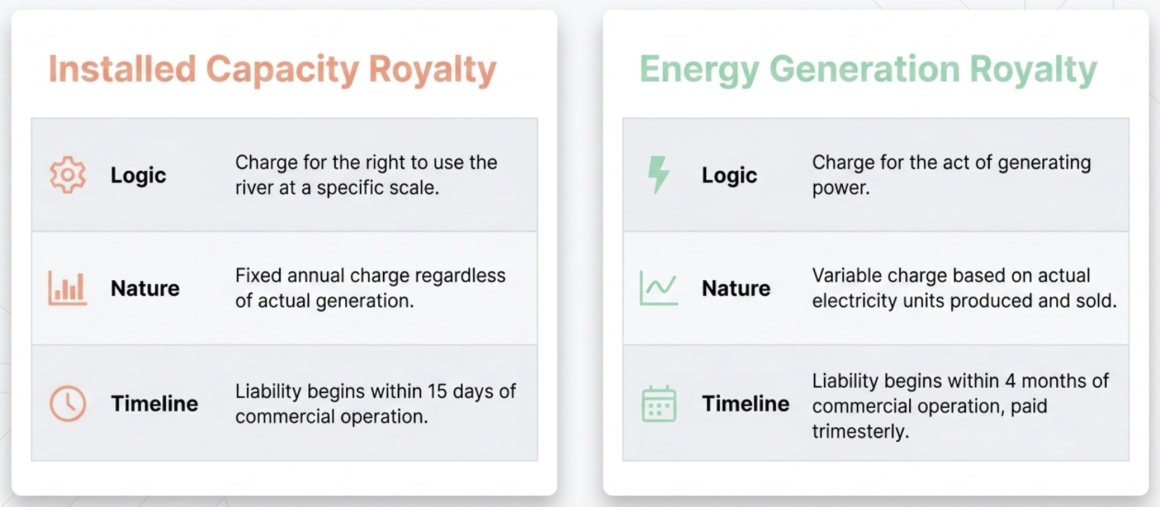
13.1 Installed Capacity Royalty (जडित किलोवाट बापत)
This is a royalty calculated based on the project’s installed capacity – the total megawatt rating of the turbine-generator units as specified in the license. It is essentially a fixed annual charge the developer pays regardless of how much electricity is actually generated. The liability kicks in within 15 days of the first turbine-generator unit entering commercial operation, and becomes an annual recurring payment thereafter.
Think of it as the developer’s “rent” for the right to occupy the river with a facility of a specific size. Even if the river runs dry in an extreme drought year and no power is generated, the capacity royalty is still owed – because the right to generate remains in effect.
13.2 Energy Generation Royalty (ऊर्जा बापत)
This is a royalty based on the actual energy produced – measured in the electricity units generated and sold. The first payment is due within four months of the first turbine-generator unit entering commercial operation. After this initial payment, the energy royalty becomes a recurring trimesterly (four-monthly) payment tied to Nepal’s fiscal calendar.
Think of this as the developer’s “usage fee.” While the capacity royalty charges for the right to generate, the energy royalty charges for the act of generating. The more electricity produced, the more the developer pays to the state.
| Two Royalties, Two Logics Installed Capacity Royalty = fixed charge for the right to use the river at a specific scale. Energy Generation Royalty = variable charge based on actual electricity production. Together, they ensure the government earns both a baseline return (capacity) and a performance-linked return (energy) from the project. |
13.3 The Penalty Royalty (Extension Period)
As discussed in the timeline section, if the developer fails to meet the two-year PPA and Financial Closure deadline and is granted an extension, they must pay a capacity royalty of 100 Rupees per Kilowatt of installed capacity for the duration of the extension. This penalty kicks in before the project is operational – it is the financial cost of delay.
14. DOED Monitoring Rights: The Government’s Eyes on the Project
The Department of Electricity Development (DOED) is not a passive regulator. The generation license grants it extensive, active monitoring and inspection rights throughout the project’s entire lifecycle:
14.1 On-Site Structural Inspection
Before the construction of any main project structure is completed, the developer is legally mandated to notify the Department. The DOED then has the right to deploy its technical staff for on-site monitoring and inspection of the construction work. This ensures the government can verify that the actual construction matches the approved design specifications.
14.2 Equipment Testing Witness
For the major tests of key construction equipment, the DOED will deploy at least one technical employee to serve as a witness on the observation team. This gives the government direct technical oversight over the quality and compliance of the machinery being installed.
14.3 Testing and Commissioning Oversight
The formal testing and commissioning of the completed project – the final step before commercial operation begins – must be conducted in the presence of DOED representatives.
14.4 Environmental and Aquatic Life Monitoring
The DOED specifically monitors the developer’s compliance with environmental obligations, particularly the continuous release of mandated water flow downstream for aquatic life protection and the proper construction and operation of fish movement structures.
14.5 Downstream Compensation Oversight
If the project’s shutdown causes adverse effects to downstream projects (outside of Force Majeure situations), any compensation to affected downstream facilities must be provided in the presence of the DOED.
14.6 Ongoing Administrative Monitoring
Beyond physical inspections, the DOED continuously monitors through mandatory document submissions: six-monthly progress reports during construction, copies of contractor agreements, insurance policies, corporate change notifications, and the post-construction completion report.
15. Community Rights and Local Investment
The generation license contains provisions specifically designed to ensure that the communities most affected by the project benefit from its development.
15.1 Right to Invest in Project Shares
Communities and individuals from the project-affected district who wish to invest in the project are explicitly given the right to make a share investment in the hydropower project. The developer is legally mandated to facilitate this opportunity in accordance with prevailing laws – which typically require a certain percentage of the company’s shares to be allocated to local affected communities, often before shares are offered to the general public.
15.2 The Community Support Program
Beyond share investment, the license mandates a direct financial commitment to community welfare. The developer must establish and fund a Community Support Program, allocating a minimum of 0.75% of the project’s total cost to this program. This requirement stems from the National Energy Crisis Prevention and Electricity Development Decade Concept Paper & Action Plan, 2072, and must align with the estimates provided in the approved EIA report.
The Community Support Program is the government’s mechanism for ensuring that the disruption caused by the project – to land, livelihoods, and local environments – is at least partially offset by tangible community investment. The program funding must not fall below the estimates outlined in the EIA, establishing a guaranteed minimum floor of community benefit.
16. Government Support: Where the DOED Assists the Developer
The generation license is not exclusively a document of obligations imposed on the developer. It also commits the Department of Electricity Development to provide necessary assistance in several practical areas critical to building infrastructure in Nepal’s remote mountainous terrain:
- Local permits and approvals: Helping navigate the multiple administrative bodies whose clearances are required for construction in remote areas.
- Communication facilities: Coordinating with telecommunication authorities to establish connectivity at remote project sites.
- Explosive materials: Facilitating the security clearances required to import, transport, and store explosives needed for tunnel excavation and underground construction.
- Petroleum products / Fuel: Helping secure fuel supply chains for heavy construction machinery in areas far from urban fuel distribution networks.
- Land purchase: Assisting with legal and administrative processes for acquiring private land and leasing government land.
- Water supply: Helping secure rights to local water sources for construction camp and batching plant operations, beyond the river water used for generation.
- Road construction: Facilitating right-of-way approvals and forest clearance permits for building access roads to transport heavy equipment.
- Educational and health facilities: Helping secure permissions for on-site medical clinics and other worker welfare infrastructure at long-term construction camps.
- Helipad construction: Coordinating with the Civil Aviation Authority for emergency landing zones in remote mountainous areas.
- Importing goods: Providing recommendation letters and facilitating customs clearance for specialized electro-mechanical equipment that must be imported from abroad.
In each case, the assistance is provided upon the developer’s formal request. The government acts as a facilitator and coordinator, not a co-developer.
17. Foreign Investment: Facilities and the Missing Guarantee
The generation license explicitly supports foreign investment. If there is foreign currency investment in the project, the developer is entitled to foreign exchange facilities in accordance with the Electricity Act, 2049 and the Foreign Investment and Technology Transfer Act (FITTA), 2075. Necessary approvals for foreign investment must be obtained under FITTA.
Additionally, the license provides that construction equipment, machinery, tools, and spare parts imported for the project’s construction and operation are eligible for the facilities prescribed under the Electricity Act and prevailing law – typically customs and duty exemptions granted to national infrastructure projects.
17.1 The Absence of a Stabilization Clause
A notable gap in the generation license – and one that foreign investors should pay careful attention to – is the complete absence of any guarantee against future changes in law. The license does not contain a “stabilization clause” that would freeze the legal and fiscal environment as it existed on the date the license was issued.
Instead, the license repeatedly subjects the developer to “prevailing laws” as they exist at any given time. Income tax rates, import regulations, environmental standards, labor laws – all can change during the project’s multi-decade life, and the developer is bound to comply with whatever version of the law is in force.
This does not mean developers are entirely unprotected. In practice, “change in law” guarantees and financial compensation mechanisms are typically negotiated and secured in separate commercial contracts – primarily the Power Purchase Agreement (PPA) with the utility company, or a bespoke Project Development Agreement (PDA) with the government’s investment board – rather than in the administrative generation license itself. Developers should not look to the generation license for fiscal stability; they should look to their commercial agreements.
18. Amendments: How the License Evolves Over 35 Years
A 35-year project inevitably encounters circumstances the original license could not foresee. The generation license provides several distinct amendment pathways, each calibrated to the scale and nature of the change:
18.1 Amending the License Conditions
If any conditions in the license itself need to be added, removed, or modified, this can only be done through mutual consent between the Government of Nepal (Ministry of Energy, Department of Electricity Development) and the developer. The change must be based on clear necessity and justification and must comply with prevailing laws. Neither party can unilaterally alter the license terms.
18.2 Amending the Project Design
As discussed in the liabilities section, a tiered system governs design changes: major structural changes need prior DOED approval, minor on-site tweaks need only post-facto notification within three months.
18.3 Amending the Project Capacity or Area
If the project’s installed generation capacity or its geographical boundaries need to be amended – or if the project requires strengthening or upgrading – the developer must follow a formal regulatory process by submitting an application under the Electricity Act, 2049, the Electricity Rules, 2050, and prevailing licensing guidelines. This is the most rigorous amendment pathway because capacity changes affect royalties, grid connection agreements, environmental assessments, and every other parameter linked to the project’s size.
18.4 Amending the EIA Plans
Amendments to the approved environmental mitigation, management, and monitoring plans require the mutual consent of both the Department and the developer – but not a formal application under the Act. This is a bilateral negotiation process.
19. Post-Construction: From Testing to Operation
Once physical construction is complete, the project enters a regulated transition from a construction site to a commercial electricity-generating facility.
19.1 Testing and Commissioning
The completed infrastructure and electro-mechanical equipment must undergo testing and commissioning to verify safe operation and compliance with approved design specifications. This must be conducted in the presence of DOED representatives – the government directly witnesses whether the facility works as designed before it is allowed to connect to the national grid commercially.
19.2 Project Completion Report
Within three months of the first turbine-generator unit beginning commercial operation, the developer must submit to the Department: a comprehensive Project Completion Report covering both technical and financial aspects, construction-phase photographs and videos, and final as-built drawings showing the structures exactly as they were actually built.
19.3 Adoption of O&M Guidelines
For ongoing maintenance and operation, the developer must adopt and follow the DOED’s official “Operation & Maintenance Guidelines for Hydropower Plants, Sub-stations and Transmission Lines.” This ensures that the long-term upkeep of the project meets national engineering and safety standards – a critical requirement given that the facility must eventually be handed over to the government in running condition.
19.4 Royalty Payments Begin
As detailed in Section 13, the installed capacity royalty kicks in within 15 days, and the energy generation royalty within four months, of the first unit entering commercial operation. These payments continue for the remaining life of the license.
20. The Final Act: Handover to the Government
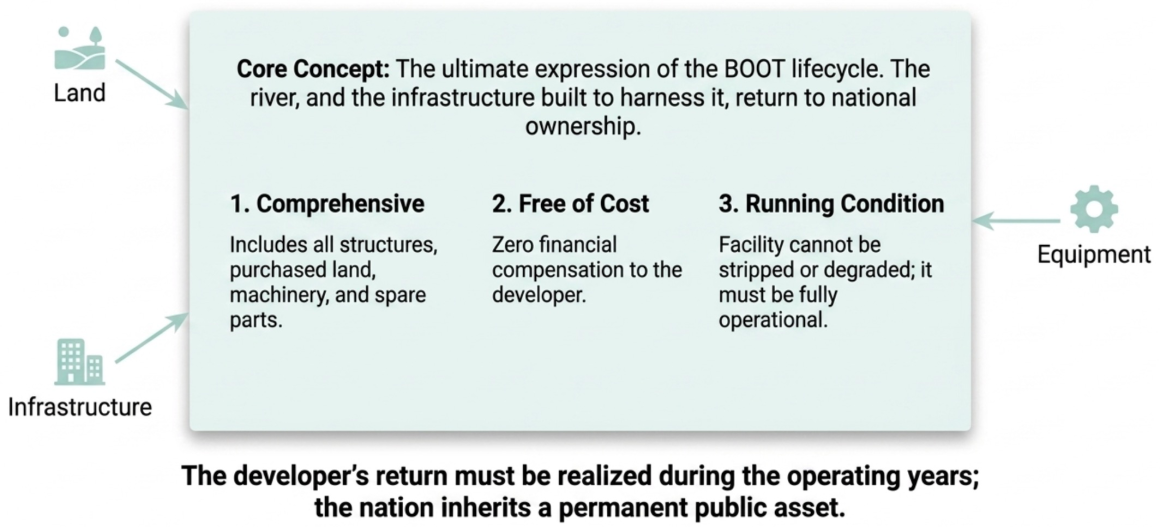
The generation license has a clear and unambiguous endpoint. Upon the expiration of the license period, the developer must hand over the entire project to the Government of Nepal. This handover is:
- Comprehensive: It includes all constructed facilities, all purchased land, all machinery, equipment, tools, and spare parts – the complete physical footprint of the project.
- Free of cost: The developer receives no compensation for the handover. The assets are transferred entirely without payment.
- In running condition: The project must be operational and functional at the time of transfer. The developer cannot strip the facility of equipment, allow it to deteriorate, or hand over a non-functional asset.
The methods and procedures for the handover are determined by the government from time to time. This flexibility allows the state to establish appropriate transfer protocols as the handover date approaches.
This provision is the final expression of the BOOT lifecycle. After decades of building, owning, and operating the facility, the developer’s rights expire and the public water resource – along with the infrastructure built to harness it – returns to national ownership. For the developer, the return on investment must be fully realized during the operating years. For Nepal, the river and its infrastructure become permanent public assets.
| The Circle Closes What began with a survey license to study a mountain river culminates in a national asset generating clean electricity. The survey license opened the investigation. The generation license authorized the construction and operation. The handover delivers the result to the nation. This is Nepal’s hydropower development pipeline from start to finish. |
21. Conclusion: The License as a National Contract
The generation license is the central legal instrument that governs the relationship between a private developer and the Nepalese state over a multi-decade horizon. It allocates a public resource, mandates a specific technical design, imposes environmental and social safeguards, creates a cascade of financial obligations, and ensures that the ultimate beneficiary of the entire enterprise is the nation.
For developers, it represents both the opportunity to build and the obligation to comply – with every condition, every deadline, every reporting requirement carrying real consequences. For the government, it is the primary tool for ensuring that Nepal’s immense hydropower potential is developed responsibly, that rivers are protected, that communities benefit, and that the infrastructure built on the nation’s mountains eventually returns to public ownership.
For anyone seeking to understand how a concrete dam, a kilometers-long tunnel through a Himalayan mountain, and a powerhouse cavern deep underground eventually become a functioning power plant connected to the national grid – the generation license is the document that makes it all legally possible.
Reference: Hydro Series