“Troika” captures the three-company model at the centre of NEA unbundling (generation, transmission and distribution – GTD). “Perestroika” captures the nature of what that actually requires – not a reorganisation chart, but a fundamental restructuring of law, institution, and political economy, with all the complexity that word has historically carried. The life philosophy here is to quote Gorbachev whenever you can.
Nepal’s electricity sector is entering a decisive reform phase. For nearly four decades, the Nepal Electricity Authority has functioned as a vertically integrated public utility responsible for generation, transmission, system operation, distribution, customer interface, bulk purchase, and electricity import/export. This structure was created by the Nepal Electricity Authority Act, 2041, which established NEA to supply electricity by generating, transmitting, and distributing electricity in an efficient and reliable manner, and gave NEA corporate powers, asset-holding powers, fee-collection powers, electricity purchase/sale powers, and project development functions.
The reform question is no longer whether Nepal should liberalize electricity generation. That policy direction was already adopted through the hydropower policy framework and the Electricity Act, 2049, which opened electricity development to domestic and foreign investment. The present question is deeper: whether a sector with multiple private generators, expanding cross-border trade, rising surplus and deficit seasonality, provincial and local constitutional jurisdictions, and new renewable-energy obligations can continue to rely on a single vertically integrated public utility as buyer, grid operator, system dispatcher, distributor, trader, and public service provider. The answer emerging from the legal and policy documents is that it cannot.
The Electricity Bills of 2077 and 2080 represent the clearest legislative turn toward functional unbundling. Both versions aim to improve licensing for generation, transmission, distribution, trade, and customer service; create legal arrangements for internal and cross-border electricity trade; and implement open access to the national transmission grid and distribution system. The 2080 Bill explicitly identifies the problem of one entity performing generation, transmission, and distribution as a barrier to fair competition, and it requires an existing entity performing generation, transmission, and distribution to form separate entities within five years of the Act’s commencement.
The Government’s latest fiscal and policy direction reinforces this legislative trajectory. The budget speech expressly states that the long-pending restructuring of NEA will be completed, and that NEA will be divided into three separate companies for electricity generation, transmission, and distribution/trade. It also announces arrangements to allow the private sector to trade electricity in international markets and to build transmission lines and earn wheeling charges. The annual policy and programme similarly emphasizes high-capacity national and cross-border transmission expansion, private-sector participation in transmission, and policy/regulatory arrangements for transmission and wheeling charges.
This report argues that NEA unbundling should not be treated as a narrow corporate split. It is a transition from a vertically integrated statutory utility model to a function-based, regulated, commercially accountable, and federal-compatible electricity sector. Unbundling must therefore address five linked reforms: corporate separation, neutral transmission access, independent or ring-fenced system operation, competitive electricity trading, and accountable distribution/customer service.
The recommended model is a staged mixed model. In the immediate phase, Nepal should create at least three successor companies from NEA: a generation company, a transmission/grid company, and a distribution-and-retail company. However, the design should not freeze the sector at only three companies. Trading should be ring-fenced from distribution and capable of later separation. The National Load Dispatch Centre should be ring-fenced from all commercial interests and placed on a path toward independent system operation. Distribution should be reorganized through financially viable regional or provincial companies, but not fragmented prematurely into weak local utilities. Federal, provincial, and local roles should be clarified through the Electricity Act, Water Resources Act/Bill, Renewable Energy and Energy Efficiency Act/Bill, tariff regulation, and intergovernmental fiscal arrangements.
The core conclusion is that NEA unbundling is legally justified, economically necessary, and politically feasible only if it is sequenced carefully. A rushed breakup could create fragile companies, stranded liabilities, tariff shocks, staff resistance, and supply disruption. A delayed or purely internal reform would preserve the structural conflict of interest that the proposed Electricity Bill is designed to solve. The practical path is phased legal unbundling, corporatization, asset and liability transfer, separate licensing, independent regulation, transparent subsidy, staff protection, and gradual market opening.
1. Purpose, Scope, and Research Approach
This report examines the unbundling of the Nepal Electricity Authority, meaning the separation of NEA’s vertically integrated functions into distinct institutional, corporate, or operational units. It considers unbundling not merely as a corporate restructuring exercise, but as a legal and political-economy transition affecting electricity generation, transmission, system operation, distribution, customer service, electricity trade, water-resource governance, renewable energy integration, and federal allocation of authority.
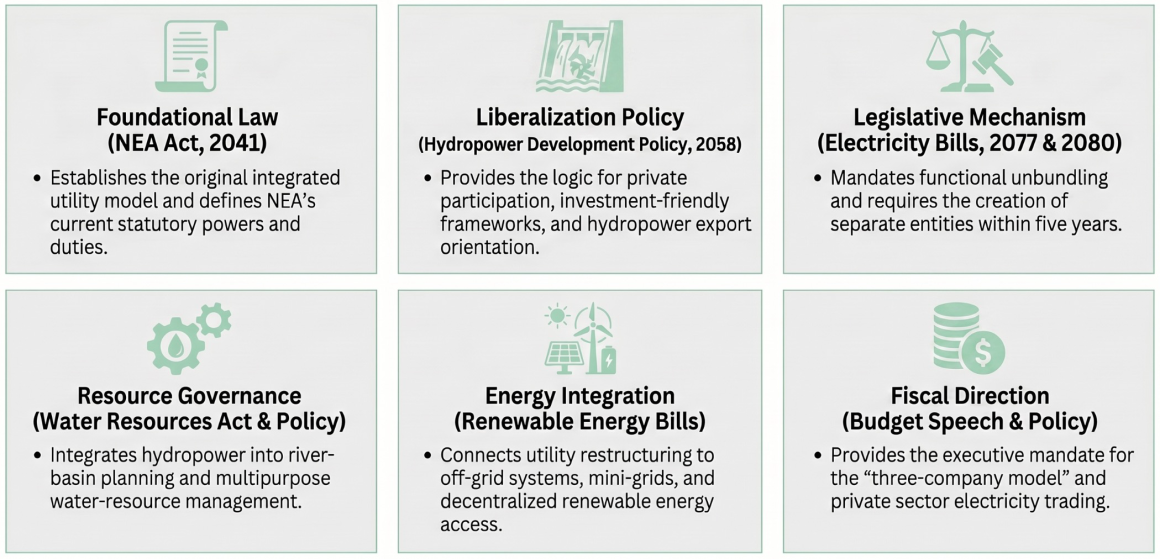
The report draws on the following categories of material:
| Source Category | Relevance to NEA Unbundling |
| Nepal Electricity Authority Act, 2041 | Establishes NEA as a vertically integrated utility and defines its powers, duties, assets, board structure, government control, and public-service obligations. |
| Hydropower Development Policy, 2058 | Provides the earlier liberalization logic: private participation, investment-friendly policy, hydropower export, rural electrification, demand-side management, and risk allocation. |
| Electricity Bills, 2077 and 2080 | Provide the core legislative mechanism for function-based licensing, open access, trading, national grid access, load dispatch, and separation of existing vertically integrated entities. |
| Water Resources Act, 2049; National Water Resources Policy, 2077; Water Resources Bill | Locate hydropower within integrated water resources management, river basin planning, water accounting, multipurpose storage, inter-basin transfer, and federal water governance. |
| Renewable Energy and Energy Efficiency Bills | Link NEA restructuring to off-grid systems, mini-grids, renewable-energy access, energy efficiency, audits, demand management, and the institutional transformation of AEPC into a statutory centre. |
| Budget Speech and Annual Policy/Programme | Provide the current political and fiscal direction: completion of NEA restructuring, three-company model, wheeling charges, private-sector electricity trading, high-capacity transmission, storage projects, and electric consumption growth. |
| Political-economy material | Provides stakeholder, sequencing, and feasibility analysis. |
The report is written for legal-policy readers, energy-sector decision makers, and institutional reform stakeholders. It is deliberately analytical rather than purely advocacy-oriented.
2. Central Thesis
The central thesis is:
NEA unbundling is necessary because Nepal’s legal and market framework has moved beyond a single-buyer, vertically integrated public utility model, but the institutional structure of NEA has not yet changed accordingly. The proper reform is not simple fragmentation or privatization, but staged functional separation under public-interest regulation, neutral grid access, transparent commercial accounts, and federal-compatible governance.
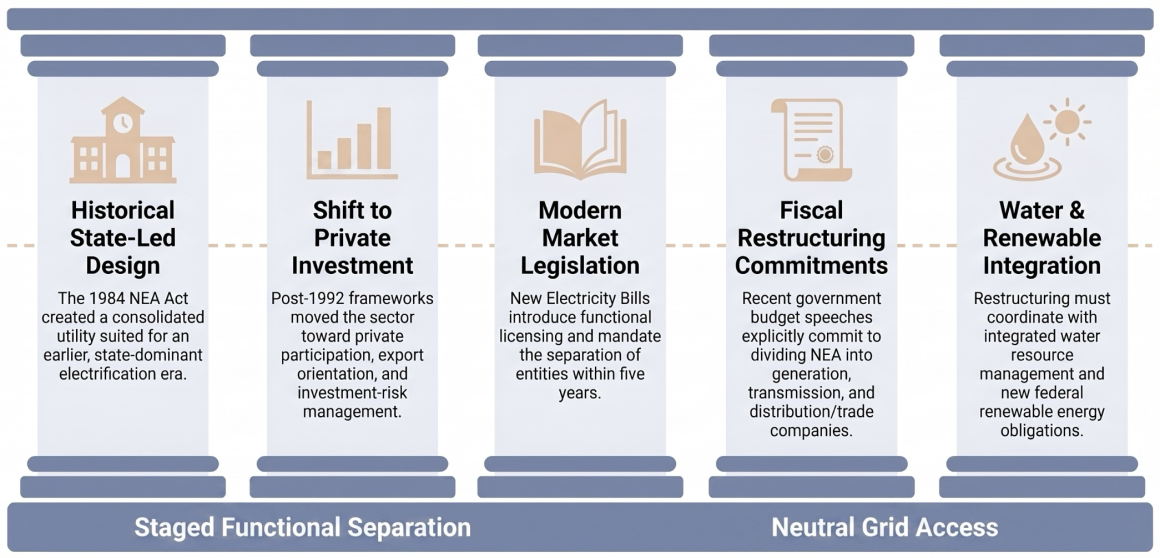
This thesis rests on five findings.
First, the NEA Act created a vertically integrated utility suited to a state-led electrification era. NEA was designed to generate, transmit, and distribute electricity, formulate power projects, build and operate generation centres, substations and distribution lines, collect tariffs, purchase private-sector electricity, and sell or purchase electricity from foreign countries with government approval.
Second, the hydropower policy and post-2049 electricity framework moved Nepal toward private investment, export orientation, rural electrification, and investment-risk management. Hydropower policy expressly emphasizes a clear, transparent, practical, and investment-friendly policy environment, and also supports domestic and foreign investment, rural electrification, demand-side management, and non-nationalization of private hydropower, transmission, and distribution systems during the license period.
Third, the new Electricity Bills introduce the legal language of a modern electricity market: generation, transmission, distribution, trade, customer service, open access, grid operation, load dispatch, and cross-border trade. The 2080 Bill defines open access as the right of generation, trade, or customer-service licensees to use the national transmission grid, distribution system, and related structures without discrimination.
Fourth, recent government policy and budget commitments have moved from general reform language to an explicit restructuring commitment. The budget speech states that NEA’s long-pending restructuring will be completed and that NEA will be divided into three companies for generation, transmission, and distribution/trade.
Fifth, unbundling must be coordinated with water-resource governance and renewable-energy policy. The National Water Resources Policy requires integrated water resources management and prioritizes multipurpose, reservoir, and inter-basin projects to reduce wet-season/dry-season hydropower imbalance. The Renewable Energy and Energy Efficiency Bill requires federal, provincial, and local collaboration to expand modern and renewable energy access and promote energy efficiency.
3. The Existing NEA Model: Legal Foundation and Institutional Character
3.1 NEA as a Statutory Vertically Integrated Utility
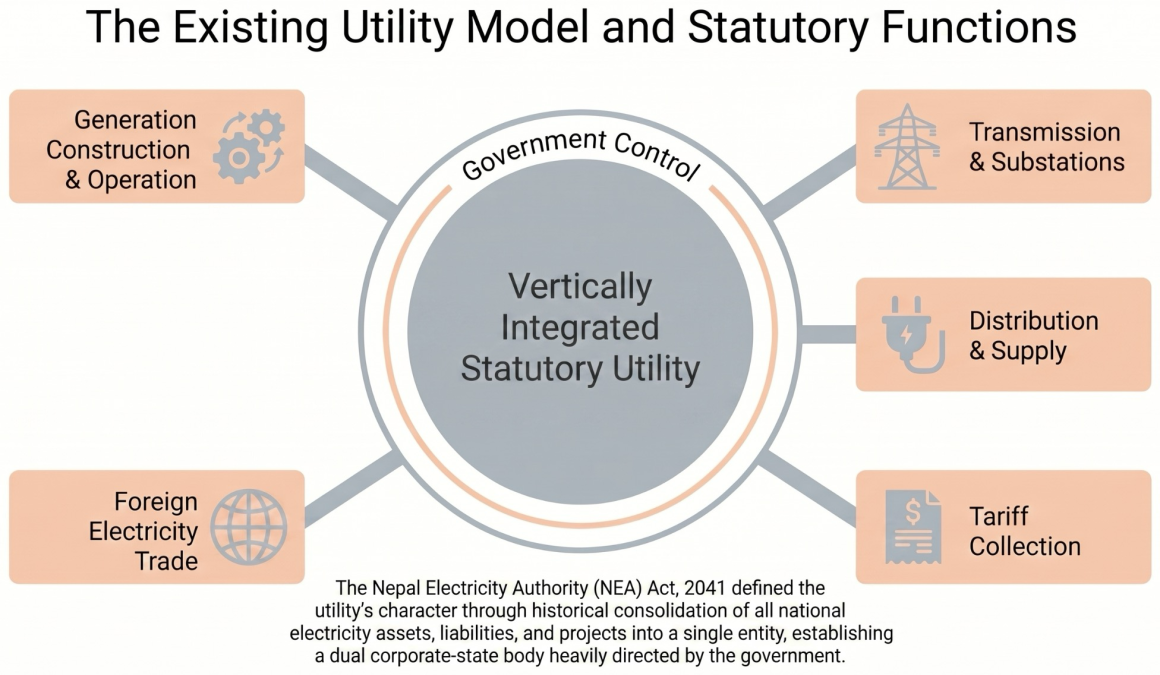
The NEA Act, 2041 was enacted to establish and manage NEA for power supply through generation, transmission, and distribution. Section 3 establishes NEA for the purpose of supplying power by generating, transmitting, and distributing electricity efficiently, reliably, and in a way that is available to all.
This design was appropriate for the historical context in which the state was the dominant developer of generation, transmission, and distribution infrastructure. It created a single national entity with legal capacity to hold assets, enter contracts, collect charges, raise loans, build power projects, acquire land through government processes, and deliver electricity as a public service.
NEA’s statutory functions include policy recommendation, electricity supply through generation/transmission/distribution, project formulation, construction and operation of generation centres and substations, arrangements for supply for industrial and agricultural development, tariff and service charge determination, research, training, and technical consultancy.
3.2 NEA as a Corporate Body under Government Control
The NEA Act makes NEA an autonomous corporate body with perpetual succession, a separate seal, power to acquire, possess, sell or dispose movable and immovable property, and capacity to sue and be sued. It also contains a share-capital structure, including the possibility of shares and limited shareholder liability.
However, NEA’s autonomy is strongly conditioned by government control. Its board structure includes government representation, and NEA must obtain government approval for its financing decisions and foreign electricity transactions. The government may issue directives to NEA, NEA must comply, and the government may compensate NEA for losses caused by certain directives.
This dual character — corporate body but state-directed public utility — is central to the unbundling debate. NEA is not a normal company under ordinary company law. It is a statutory utility with public-service duties, government-backed assets, legacy liabilities, land rights, customer relationships, employees, and tariff obligations. Any restructuring must therefore be done through a special legal transition, not by ordinary corporate reorganization alone.
3.3 Asset Consolidation under NEA
The NEA Act also consolidated earlier public electricity assets into NEA. It provided for the transfer of government or development-board projects to NEA after valuation, including projects built through loans, aid, or grants, and dissolved the earlier Nepal Electricity Corporation with its assets and liabilities accruing to NEA.
This history matters because unbundling will require the reverse of that historical consolidation. Assets, liabilities, contracts, employees, project rights, and public-service obligations that were once pooled into NEA must now be allocated to successor entities. The NEA Act explains how assets moved into NEA, but it does not provide mechanism for transferring NEA’s assets out to separate generation, transmission, distribution, trading, or system-operation companies.
4. Why Unbundling Has Become Necessary
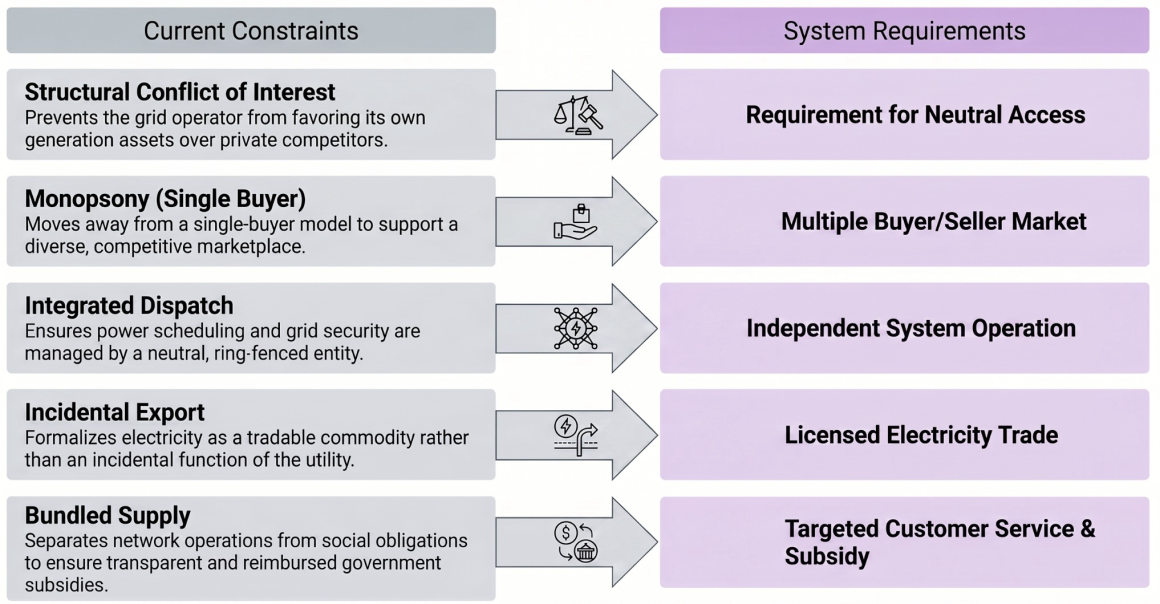
4.1 Structural Conflict of Interest
A vertically integrated electricity authority may be efficient during the early infrastructure-building stage, but it creates problems once private generation, open access, and electricity trade become policy objectives. If the same institution owns generation, controls transmission, dispatches power, buys from independent producers, sells to customers, and trades across borders, it can face structural conflicts of interest.
The proposed Electricity Bill itself recognizes this problem. The 2080 Bill’s statement of reasons identifies the condition where a single entity can perform generation, transmission, and distribution as one of the causes preventing fair competition among promoters. It also identifies the absence of adequate legal arrangements for electricity trade regulation as a problem requiring legislative correction.
The issue is not only actual discrimination. Even the perception that the grid operator, buyer, or dispatcher may favour its own generation assets can weaken investor confidence. A neutral grid and transparent dispatch are therefore prerequisites for credible private investment and competitive trade.
4.2 The Monopsony Problem
Nepal has already moved from a pure state monopoly toward a model where many independent producers generate electricity, but the dominant bulk purchaser remains NEA. This creates a monopsony: multiple sellers, one dominant buyer. In such a system, private producers depend on long-term power purchase agreements with NEA, while NEA bears system-balancing, offtake, and payment obligations.
This model helped attract private generation investment in an earlier phase. However, it is now becoming a constraint because Nepal’s power system must handle seasonal surplus, dry-season deficit, cross-border exports, industrial demand, open access, merchant or semi-merchant transactions, and private trading. A single-buyer model is poorly suited for a multi-buyer, multi-seller market.
4.3 Need for Neutral Transmission and System Operation
Transmission is a natural monopoly and must remain tightly regulated. But ownership and operation of the grid should be neutral between generators, traders, distribution companies, and large consumers. The 2080 Bill moves in this direction by recognizing national transmission grid access, transmission charges determined by the regulator, third-party use of transmission lines, and a National Load Dispatch Centre for scheduling and dispatch.
The Bill’s proposed National Load Dispatch Centre is especially important. It would schedule and dispatch electricity, monitor grid security and operation, account for electricity flowing through the grid, provide monthly data on production, demand, consumption, supply, import-export and trade, and coordinate with foreign load dispatch centres where cross-border systems are involved.
This is a foundation for independent or at least ring-fenced system operation. Without it, open access and trading will remain legal concepts without operational credibility.
4.4 Need for Electricity Trade and Market Development
Electricity is increasingly treated as a tradable commodity subject to demand, supply, contractual structure, and grid constraints. The 2080 Bill provides a separate chapter on electricity trade, allowing a trading licensee to buy power from generation licensees, trade with other trading licensees, sell purchased electricity wholesale or retail, and undertake cross-border trade.
The 2077 Bill similarly allowed licensed electricity traders to buy from generators, trade among themselves, sell wholesale or partially, and conduct cross-border trade. The evolution from 2077 to 2080 shows continuity in legislative intent: electricity trade is no longer incidental to NEA’s statutory power to import/export; it is becoming a licensed business function.
4.5 Need for Customer Choice and Distribution Reform
The Electricity Bills introduce the category of ‘customer service’ in addition to distribution. Under the 2077 Bill, a customer-service licensee may use a distribution licensee’s system, buy electricity from generation or trading licensees, and supply its own customers. This is a significant departure from the traditional bundled distribution model.
The 2080 Bill also imposes public-service obligations on distribution licensees, including safe, reliable, quality supply, tariff collection under regulatory determination, demand management, data submission, and relief or tariff discounts for poor, vulnerable, and marginalized households where decided by the relevant level of government. It also requires the deciding government to reimburse the distribution institution within six months.
This means distribution reform cannot be treated simply as commercial breakup. It must preserve universal service, social tariff, government subsidy, and consumer protection.
5. Policy and Legal Evolution Toward Unbundling
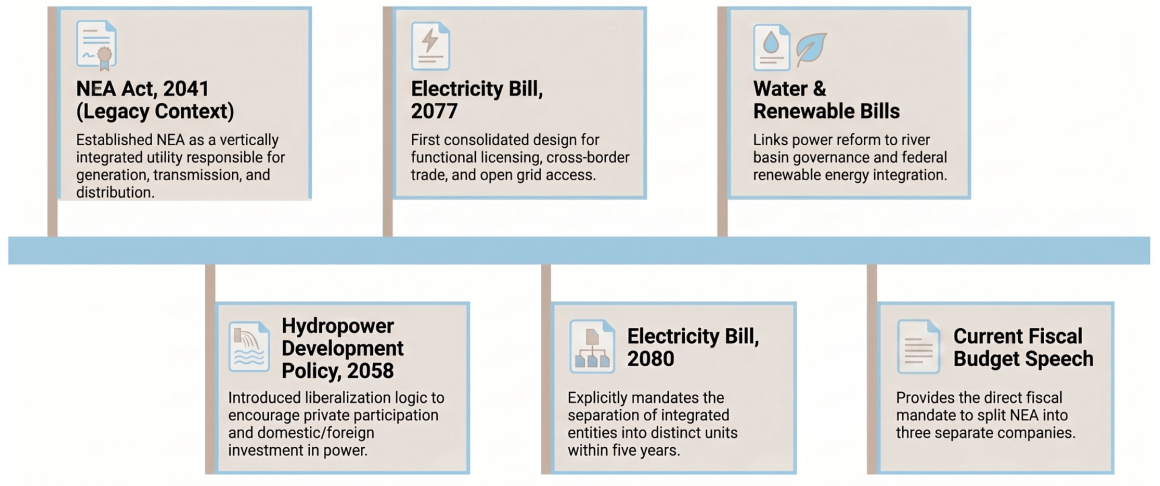
5.1 Hydropower Development Policy, 2058: Liberalization before Unbundling
The Hydropower Development Policy, 2058 predates the current unbundling debate but provides its foundation. It emphasizes low-cost electricity generation through Nepal’s water resources, private-sector participation, export potential, transparent and investment-friendly policy, and the need to mobilize domestic and foreign capital.
The policy also links hydropower development to rural electrification. It provides for rural electrification obligations, encouragement of electrification in project-affected rural areas, and use of royalty resources for rural electrification. It also promotes demand-side management and energy conservation.
The policy is important because it shows that Nepal’s policy objective has long been broader than a state-owned utility model. It supports private participation and investment protection, including non-nationalization of private hydropower, transmission, and distribution systems during the license period. But it did not itself create a modern unbundled market. That task falls to the new electricity legislation.
5.2 NEA Act, 2041: Integrated Utility Statute
The NEA Act is the legal foundation of the existing vertically integrated structure. It empowers NEA to perform generation, transmission, distribution, tariff collection, research, project development, power purchase, and foreign electricity transactions.
For unbundling, the Act creates three legal issues. First, NEA’s functions are integrated by design. Separation therefore requires either amendment, repeal, or a transitional override in the new Electricity Act. Second, Nepal’s electricity infrastructure’s assets and liabilities were historically consolidated into NEA. The law contains detailed provisions for transfer of assets into NEA, but not a comprehensive regime for transferring NEA assets out into successor companies. Third, NEA’s special public powers — land rights, disconnection powers, recovery of dues as government arrears, government directives, and local tax exemptions — must be allocated carefully. These powers cannot automatically follow every successor company without considering competition, consumer protection, and public accountability.
5.3 Electricity Bill, 2077: First Consolidated Unbundling Design
The 2077 Electricity Bill proposed to revise Nepal’s electricity law in line with constitutional federalism, competition, licensing reform, open access, domestic and cross-border trade, and separation of electricity functions. Its objectives included competitive development of generation projects, improved licensing for generation/transmission/distribution/trade/customer service, legal arrangements for internal and cross-border electricity trade, and open access to the national transmission grid and distribution system.
The 2077 Bill also recognized customer service as a function distinct from distribution and allowed customer-service licensees to use a distribution licensee’s system to supply customers. It further provided for electricity trading and import/export by trading licensees.
Its limitation was that the time and political economy of reform remained unresolved. The 2077 version identified the correct direction, but the sector remained institutionally dominated by NEA.
5.4 Electricity Bill, 2080: Sharper Transition Mechanism
The 2080 Bill repeats and sharpens the reform logic. It seeks to allocate electricity-related rights and responsibilities among federal units, provide clean, regular, reliable, quality, safe, and affordable electricity supply, create competitive development structures, improve licensing, enable internal and cross-border trade, and promote open access.
The Bill’s most important restructuring provision is that if, at the commencement of the Act, a single entity is performing electricity generation, transmission, and distribution, it must form separate entities for generation, transmission, and distribution within five years. The Bill also recognizes exceptions where the national grid has not reached an area or where supply through the grid is not possible because of load capacity or technical reasons.
This is the first clear statutory bridge from NEA’s integrated legal identity to separate corporate entities.
5.5 Water Resource Policy and Bill: Hydropower as Part of Basin Governance
NEA unbundling cannot be separated from water governance. Hydropower is not just electricity infrastructure; it is a use of a national water resource. The National Water Resources Policy, 2077 requires water-resource use and management according to integrated water resources management, with multipurpose use including drinking water, irrigation, electricity, tourism, water transport, industry, and fisheries. It prioritizes multipurpose, reservoir, and inter-basin transfer projects to reduce the gap between wet-season and dry-season hydropower production and to support year-round water availability.
The policy also calls for clear legal division of duties and work areas among federal, provincial, and local levels for water use, management, regulation, and conservation; coordination among water-related agencies and stakeholders; and distribution of income from commercial water use among communities and government bodies according to law.
The Water Resources Bill builds on this direction by requiring integrated, coordinated, sustainable water-resource development, river basin plans, sectoral master plans, water accounting, inter-basin transfer, groundwater management, pollution standards, early warning systems, disaster mapping, and electronic information systems.
For NEA unbundling, the implication is that the generation successor company cannot be designed only as a commercial power producer. It must operate within water allocation, river basin planning, storage benefit sharing, climate risk, and multipurpose project governance.
5.6 Renewable Energy and Energy Efficiency Legislation
The Renewable Energy and Energy Efficiency Bill aims to promote renewable energy, expand sustainable energy access, protect the environment, improve energy use, conserve energy, and support energy efficiency. It recognizes federal, provincial, and local responsibility for renewable energy promotion and access expansion, and requires coordination among the three levels.
The Bill also introduces energy efficiency measures, including efficiency standards, energy audits, efficient equipment, and measures for high energy-consuming industries and buildings. It provides for a renewable energy and energy efficiency institution, replacing the earlier alternative-energy institutional arrangement, and includes NEA representation in the governance structure.
The Bill is relevant because distribution companies after unbundling will not merely sell grid electricity. They will have to integrate rooftop solar, mini-grids, off-grid systems, demand response, energy efficiency, electric cooking, electric mobility, and customer-level data. The Bill also encourages grid connection of surplus electricity from captive or off-grid systems, which will require clear technical and commercial rules between mini-grid operators, distribution licensees, and the national grid.
5.7 Current Policy and Budget Direction
The annual policy and programme for 2083/84 states that modern and renewable energy access will be ensured for all citizens, the Energy Development Roadmap, 2081 will be implemented through legal, policy, institutional, and procedural reforms, and solar, wind, and hydrogen energy will be developed as alternative renewable sources. It also prioritizes multipurpose and reservoir hydropower projects for dry-season demand and energy security, and expansion of off-grid solar, wind, micro and small hydropower, and mini-grids in areas not reached by the national grid through cooperation among the three levels of government.
The budget speech for 2083/84 is more explicit on NEA. It states that the long-pending restructuring of NEA will be completed and that NEA will be divided into three separate companies for generation, transmission, and distribution/trade. It further provides for private-sector access to international electricity markets, legal arrangements for transmission line development and wheeling-charge-based electricity trade, and changes related to PPAs and hydropower project licensing.
This means NEA unbundling has moved from policy discussion to an announced fiscal and governance priority.
6. What the Proposed Electricity Bill Changes
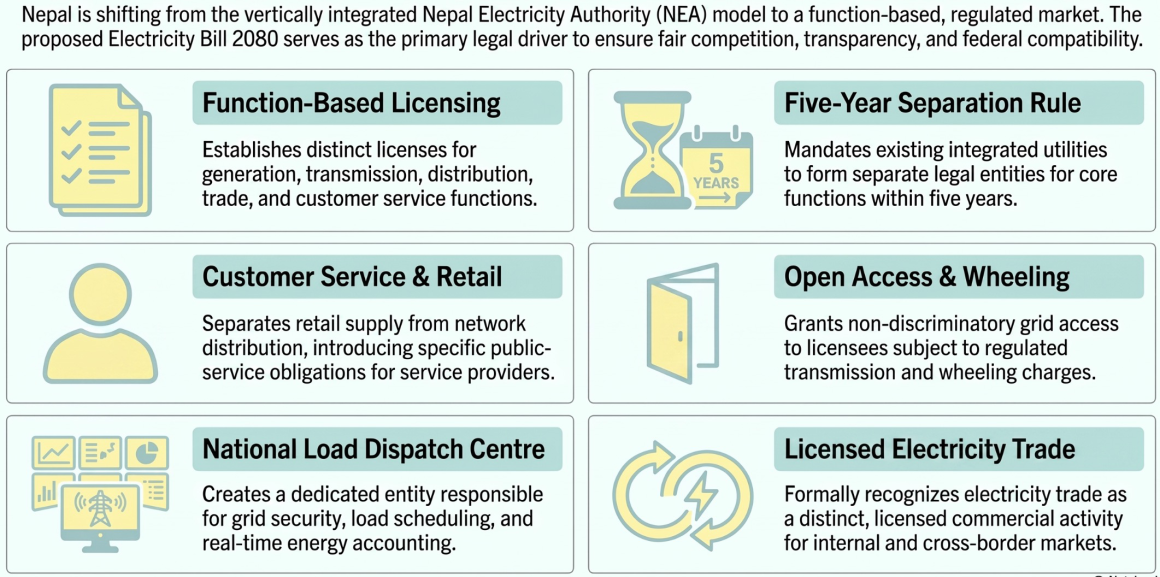
6.1 Function-Based Licensing
The proposed electricity law separates electricity-sector activities into distinct licensed functions: generation, transmission, distribution, trade, customer service, and development/operation of related structures. The 2080 Bill defines a license in relation to generation, transmission, distribution, trade, customer service, or development and operation of electricity-generating structures.
This is the foundation of unbundling. A market can only be regulated transparently if each function has defined rights, obligations, tariffs, technical standards, and accounts. The present integrated model makes cost allocation difficult: generation cost, transmission cost, distribution loss, subsidy, social obligation, import cost, and dispatch cost are blended within one institution.
6.2 Five-Year Separation Rule
The Bill requires an existing entity performing generation, transmission, and distribution to form separate entities for those functions within five years of the commencement of the Act.
This provision is directly aimed at vertically integrated utilities. In practice, it is the legal trigger for NEA restructuring. It does not automatically determine the final market design, but it requires institutional separation as a minimum.
6.3 Open Access
Open access means that eligible licensees should be able to use the national transmission grid, distribution system, and related structures without discrimination. The 2080 Bill defines open access in this manner.
Open access is the bridge between unbundling and market competition. Without open access, separate generation and trading companies would still depend on the incumbent grid owner’s discretion. With open access, grid use becomes a regulated right subject to technical capacity, grid code, scheduling, settlement, and payment of transmission or distribution charges. The Open Access Directive 2082 has also been issued by the ERC.
6.4 National Transmission Grid and Wheeling Charges
The Bill provides for access to the national transmission grid, approval by the grid operating/management entity, and payment of transmission charges and prescribed fees determined by the regulator. It also allows another entity to use a transmission line constructed or operated by a licensee by paying the transmission charge determined by the regulator.
The 2077 Bill similarly recognized wheeling charges for electricity flowing through the national transmission grid and third-party use of transmission lines. This confirms a consistent legislative direction: transmission is to become a regulated network service rather than a tool controlled only by a vertically integrated buyer-distributor.
6.5 National Load Dispatch Centre
The National Load Dispatch Centre is a critical reform. The 2080 Bill allows the Government to establish such a centre to schedule and dispatch electricity in appropriate quantities based on demand, availability, and transmission-line capacity for system security and stability.
The Centre’s proposed functions include load dispatch and scheduling, monitoring and inspection of national grid security and operation, accounting of electricity flowing through the grid, monthly reporting of generation, demand, consumption, supply, import-export and trade data, and coordination with relevant foreign load dispatch centres when connected with cross-border systems.
This provision should be treated as the foundation for a neutral system operator. In the transitional phase, the NLDC may be ring-fenced within a transmission company. In the mature phase, it should become institutionally independent or placed under a neutral transmission-system operator model.
6.6 Electricity Trade
The 2080 Bill recognizes electricity trade as a licensed activity. A trading licensee may buy electricity from generators, trade with other trading licensees, sell purchased electricity wholesale or retail, and conduct cross-border trade. The explanatory material links electricity trade to demand and supply, day-ahead or term-ahead/intraday arrangements, feed-in premium modalities, and cross-border trade.
This requires institutional separation because a trading entity that is also the grid operator or dispatch controller can distort competition. Similarly, a distribution company that controls retail customers and also dominates trading may restrict market access unless strong ring-fencing is imposed.
6.7 Customer Service and Retail Choice
The 2077 Bill’s customer-service provisions allow a customer-service licensee to use a distribution licensee’s network and purchase electricity from generation or trading licensees to serve customers. This points toward retail competition, at least for eligible customers in future phases.
The 2080 Bill’s distribution provisions also require distribution licensees to perform demand management, maintain data, and provide tariff relief where the government decides relief for poor, vulnerable, and marginalized customers, with reimbursement to the distribution institution within six months.
A distribution company after unbundling must therefore perform two roles: network operation and social service delivery. These roles should be separately accounted for, so that subsidy and network costs are visible.
7. Institutional Options for NEA Unbundling
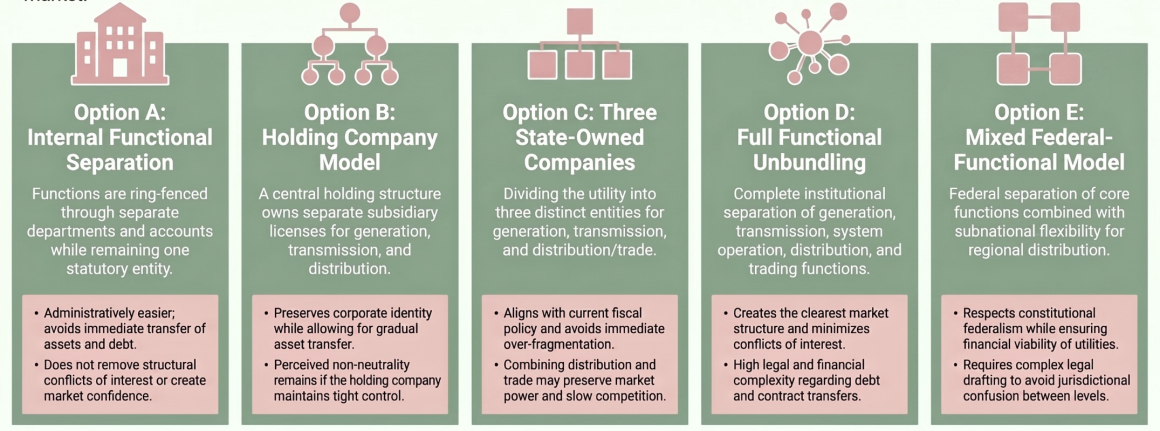
7.1 Option A: Internal Functional Separation within NEA
Under this model, NEA remains one statutory entity, but its generation, transmission, distribution, trading, and system-operation functions are internally separated through departments, accounts, management reporting, and regulatory ring-fencing.
Advantages: Internal separation is administratively easier. It avoids immediate transfer of assets, employees, pensions, debt, and contracts. It can be used as a preparatory phase.
Weaknesses: It does not remove structural conflicts of interest. NEA remains the same buyer, generator, grid owner, dispatcher, and distributor. It may improve accounting but does not create neutral access or market confidence.
Assessment: This should be a transitional step only. It is not sufficient as the final model.
7.2 Option B: NEA Holding Company with Subsidiaries
Under this model, NEA becomes a holding company owning separate subsidiaries for generation, transmission, distribution, and possibly trading. The subsidiaries hold separate licenses and maintain separate accounts.
Advantages: This model preserves NEA’s corporate identity, reduces staff anxiety, and allows gradual asset transfer. It may be politically easier than immediate full separation.
Weaknesses: If the holding company controls all subsidiaries, conflicts may remain. A transmission subsidiary under the same holding structure as generation and distribution may still be perceived as non-neutral. Trading may favour affiliated generation or distribution entities.
Assessment: This is feasible as a transition model, but it should include strict ring-fencing, independent boards for licensed subsidiaries, separate accounts, regulatory oversight, and a pathway to full operational independence.
7.3 Option C: Three State-Owned Companies
This model corresponds most closely to the budget announcement: NEA is divided into three separate companies for generation, transmission, and distribution/trade.
| Company | Core Function |
| Nepal Electricity Generation Company | Owns and operates NEA generation assets; develops new public generation projects; manages generation licenses. |
| Nepal Transmission Grid Company | Owns and operates transmission assets; provides open access; collects wheeling/transmission charges; hosts or coordinates NLDC. |
| Nepal Electricity Distribution and Trading Company | Owns distribution assets; supplies retail customers; manages customer service; handles bulk purchase and trade during transition. |
Advantages: This model is simple, politically announced, and legally aligned with the Bill’s generation/transmission/distribution separation requirement. It avoids immediate over-fragmentation.
Weaknesses: Combining distribution and trading can preserve market power. If the distribution-and-trade company remains the dominant buyer and seller, open access may be slow. If NLDC remains within a commercial transmission company without ring-fencing, neutrality concerns may persist.
Assessment: This model is practical for the first phase, but it should be designed with an evolutionary pathway: trading should be ring-fenced and later separated; system operation should be ring-fenced and later made independent; distribution may later be regionalized or provincialized where financially viable.
7.4 Option D: Full Functional Unbundling
This model separates NEA into distinct entities for generation, transmission ownership, system operation, distribution networks, retail supply/customer service, and electricity trading.
Advantages: This creates the clearest market structure. It minimizes conflict of interest and supports open access, wholesale competition, independent dispatch, retail choice, and private trading.
Weaknesses: It is legally, financially, and politically complex. It requires detailed asset valuation, debt allocation, PPA transfer, staff transfer, IT system separation, settlement systems, and strong regulation.
Assessment: This should be the medium- to long-term destination, not the immediate first step.
7.5 Option E: Mixed Federal-Functional Model
This model combines federal-level functional separation with subnational flexibility. At the federal level, generation, transmission, system operation, and trading are separated. Distribution may initially be organized into regional or provincial companies, but small local systems, off-grid systems, and community systems may remain bundled where necessary for viability.
Advantages: This model respects constitutional federalization while avoiding premature creation of financially weak provincial or municipal utilities. It allows national grid and cross-border trade to remain coordinated while enabling gradual devolution of distribution and local energy services.
Weaknesses: It requires careful legal drafting to avoid jurisdictional confusion among federal, provincial, and local governments.
Assessment: This is the recommended model.
8. Recommended Institutional Design
8.1 Generation Company
The generation successor company should own and operate NEA’s generation assets and develop new public generation projects. It should hold generation licenses and sell power through PPAs, competitive procurement mechanisms, bilateral contracts, or market arrangements as they evolve. Its mandate should include:
1. operation and maintenance of existing NEA hydropower plants;
2. development of strategic public generation, including storage and peaking projects;
3. coordination with water-resource and river-basin plans;
4. sale of electricity to trading companies, distribution companies, or eligible buyers;
5. compliance with dispatch instructions and grid code;
6. transparent accounting of generation cost by project;
7. eventual competition with private and public generators on equal terms.
The generation company should not own or operate the national transmission grid. It may build connection assets up to the grid connection point where permitted by law, as recognized in the Bill for joint transmission development by generators connecting to the national system.
8.2 Transmission Grid Company
The transmission company should own, plan, develop, maintain, and operate the national transmission network. It should provide non-discriminatory access to generators, traders, distribution companies, customer-service licensees, and eligible consumers. It should collect regulated transmission or wheeling charges.
The policy and programme supports national and cross-border high-capacity transmission expansion, including private-sector participation and regulatory arrangements for transmission and wheeling charges.
The transmission company should be prohibited from generation, distribution, retail supply, and trading, except for temporary transitional functions expressly authorized by law. It should have a regulated asset base, performance standards, loss targets, reliability standards, and investment-planning obligations.
8.3 National Load Dispatch Centre / System Operator
The NLDC should be the operational brain of the power system. It should schedule and dispatch electricity, monitor grid security, account for energy flows, coordinate with foreign load dispatch centres, maintain real-time data, and administer grid-code compliance.
In the first phase, the NLDC may be housed within the transmission company, but with:
1. separate management;
2. separate budget;
3. separate control room;
4. separate code of conduct;
5. publication of dispatch protocols;
6. regulatory oversight;
7. transparent data reporting;
8. no commercial trading function.
In the second phase, it should become an independent system operator or a legally ring-fenced transmission-system operator. This is essential for investor confidence, cross-border synchronization, and open access.
8.4 Distribution Companies
Distribution should be separated from transmission and generation. The immediate model may create one national distribution company, but the better medium-term design is regional or provincial distribution companies with financially viable service territories. Distribution companies should:
1. operate and maintain distribution networks;
2. connect customers;
3. reduce technical and commercial losses;
4. implement safety and reliability standards;
5. maintain customer data;
6. implement demand-side management;
7. administer targeted subsidies transparently;
8. integrate mini-grids and off-grid systems;
9. coordinate with provincial and local governments.
The 2080 Bill’s provisions on tariff relief for poor, vulnerable, and marginalized customers are crucial. If governments impose social discounts, the relevant government must reimburse distribution institutions within the specified period. This prevents hidden losses from accumulating inside distribution companies.
8.5 Trading Company
Trading should be treated as a separate commercial function. In the first phase, trading may remain combined with the distribution company because of legacy PPAs and payment obligations. However, it should be ring-fenced from distribution and placed on a path to separation. The trading function should include:
1. management of legacy PPAs during transition;
2. bulk procurement;
3. cross-border import/export;
4. surplus sale in wet season;
5. dry-season procurement;
6. contracting with generators and distribution companies;
7. market settlement;
8. payment security.
The budget speech’s commitment to allow private-sector participation in international electricity trade reinforces the need for a trading framework that is not controlled only by an NEA successor.
8.6 Regulator
The Electricity Regulatory Commission should regulate tariffs, wheeling charges, open-access terms, grid code, distribution code, quality standards, consumer protection, market rules, and dispute resolution. The new Electricity Act should remove overlapping regulatory provisions from older laws and place technical and economic regulation clearly under the regulator.
8.7 Planner and Policy Institutions
The Ministry should retain policy leadership. The Water and Energy Commission/Secretariat should be strengthened for integrated resource planning, demand forecasting, river-basin planning, energy-water coordination, and long-term system studies. The hydropower policy already envisioned water and energy planning, national demand forecasting, system planning, and policy research roles for the water and power planning institution.
The Water Resources Bill’s emphasis on river basin planning, water accounting, electronic information systems, and inter-basin transfer makes the planning function more important after unbundling.
9. Legal Architecture Required for Implementation
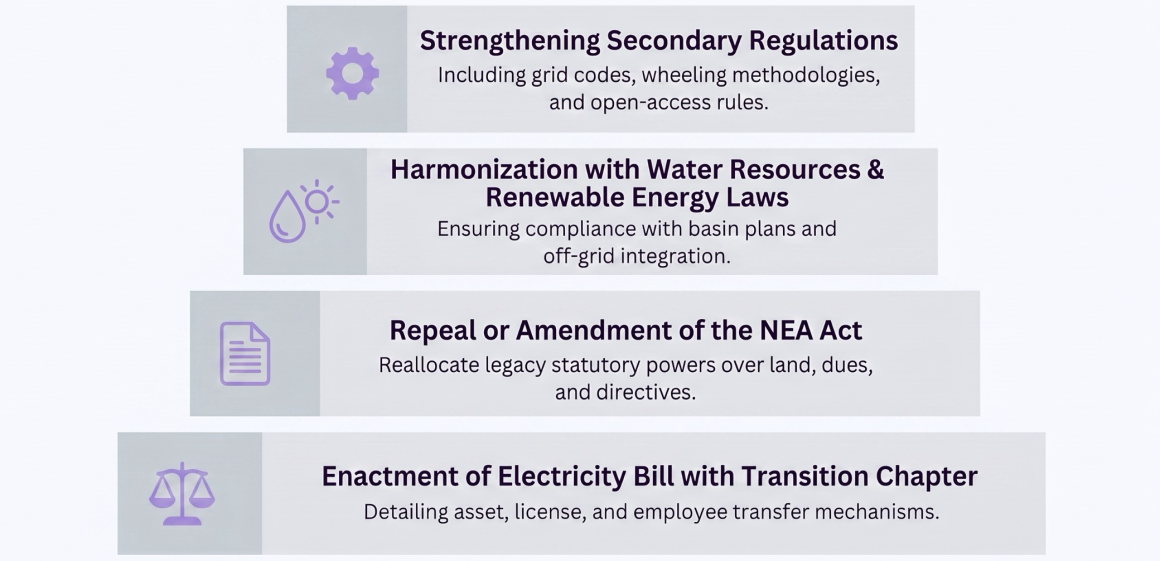
9.1 Enact the Electricity Bill with a Transition Chapter
The Electricity Bill should not only state that existing integrated entities must separate within five years. It should include a detailed transition chapter/separate rule covering:
1. identification of NEA successor companies;
2. transfer of licenses;
3. transfer of assets and liabilities;
3. valuation principles;
4. transfer of employees;
5. treatment of pensions and benefits;
6. assignment or novation of PPAs;
7. treatment of government guarantees;
8. treatment of donor-funded assets;
9. treatment of land, right of way, and easements;
10. preservation of customer rights;
11. universal service obligations;
12. interim tariff and bulk supply arrangements;
13. dispute resolution;
14. parliamentary and regulatory reporting.
The Bill already contains a five-year implementation measurement clause and repeal/savings provisions for the Electricity Act, 2049 and certain ERC Act provisions. Those provisions should be expanded into a comprehensive sector-transition framework.
9.2 Amend or Repeal the NEA Act
The NEA Act must be addressed directly. It cannot simply remain in force unchanged while a new Electricity Act requires separate generation, transmission, and distribution entities. There are three possible approaches:
| Approach | Description | Assessment |
| Amendment | Amend NEA Act to allow creation of successor companies and transfer of assets/liabilities. | Politically easier but may leave legal confusion. |
| Repeal with savings | Repeal NEA Act and transfer all rights/liabilities to successor entities under a transition schedule. | Cleaner but legally and politically heavier. |
| Transitional override in Electricity Act | New Electricity Act overrides inconsistent NEA Act provisions and authorizes restructuring. | Practical if drafted clearly, but should still specify NEA Act consequences. |
The best approach is repeal-with-savings or comprehensive amendment. NEA’s statutory powers over assets, land, dues, disconnection, government directives, and project transfer must be allocated to successor companies only where necessary and with regulatory safeguards.
9.3 Harmonize with Water Resources Law
The Water Resources Act and new Water Resources Bill should clarify the relationship between water rights and electricity licenses. Hydropower generation companies must comply with river basin plans, water allocation priorities, environmental flows, multipurpose project obligations, benefit sharing, water accounting, and disaster-risk management.
The Water Resources Bill’s river basin, water accounting, inter-basin transfer, groundwater, pollution, early-warning, and electronic information provisions should be cross-referenced in electricity licensing.
9.4 Harmonize with Renewable Energy and Energy Efficiency Law
The renewable-energy law should clarify how off-grid, mini-grid, captive, and distributed renewable systems interact with the national grid and distribution companies. The Renewable Energy and Energy Efficiency Bill encourages connection of surplus electricity from captive and off-grid systems to the national transmission system and sale according to prevailing law.
Distribution companies should therefore be required to publish interconnection procedures, technical standards, net-metering or settlement rules, and compensation arrangements for community and off-grid assets.
9.5 Strengthen Secondary Regulations
The unbundling law must be followed by regulations and directives, including:
1. licensing rules;
2. grid code;
3. distribution code;
4. open-access regulations;
5. wheeling-charge methodology;
6. congestion-management rules;
7. metering and settlement code;
8. PPA novation rules;
9. standard bulk supply agreement;
10. customer-service rules;
11. subsidy reimbursement rules;
12. data-reporting regulations;
13. dispute-resolution procedures;
14. transition accounting standards;
15. staff-transfer regulations.
Without these instruments, the legal separation of NEA may occur on paper but not in operational practice.
10. Asset, Liability, and Contract Transfer
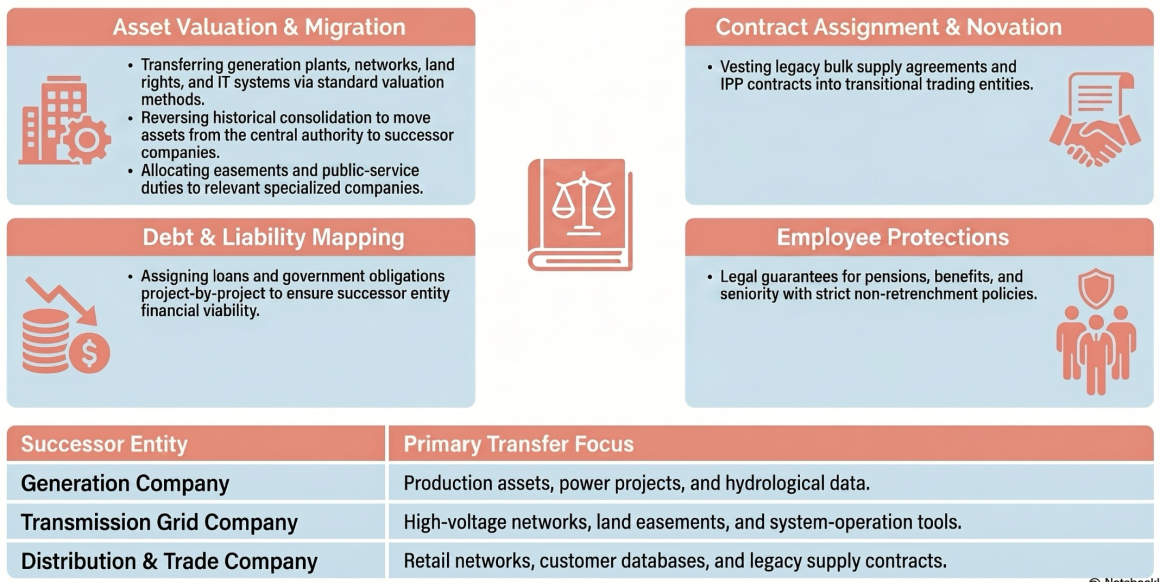
10.1 Asset Valuation
The first practical challenge is asset valuation. NEA’s assets include generation plants, transmission lines, substations, distribution networks, land, buildings, vehicles, IT systems, control centres, hydrological data, customer databases, stores, meters, and work-in-progress projects. The transition law should define:
1. valuation date;
2. valuation methodology;
3. treatment of depreciated assets;
4. treatment of donor-funded assets;
5. treatment of assets under construction;
6. allocation of common assets;
7. treatment of land and right-of-way rights;
8. treatment of intangible assets and software;
9. treatment of customer deposits;
10. treatment of receivables and payables.
Asset transfer must not produce artificially weak successor companies. If all profitable assets are transferred to one company and liabilities to another, the reform will fail.
10.2 Debt and Government Guarantees
NEA’s existing loans, donor-funded obligations, and government-guaranteed debts must be mapped project by project. Debt should generally follow the asset it financed, but only where the successor company can service it. Otherwise, the Government may need to refinance, convert debt to equity, or create a transition liability account.
10.3 PPAs and Bulk Supply Contracts
Legacy PPAs are central to the transition. They may be assigned to the generation company, if NEA is the seller under public generation contracts; a trading company, if NEA is the buyer from IPPs; distribution companies, if they directly procure power; or a special bulk supply entity during transition.
The safest initial approach is to vest legacy IPP PPAs in a ring-fenced bulk trader, backed by payment security and regulated pass-through to distribution companies. Over time, new PPAs can be procured competitively by distribution companies, traders, or eligible consumers.
10.4 Employees, Pensions, and Unions
Employee transition is politically decisive. NEA staff and unions may resist unbundling if they fear loss of employment security, pension rights, seniority, housing, medical benefits, promotion paths, or institutional identity. The transition law should guarantee:
1. no arbitrary retrenchment during transition;
2. continuity of salary, pension, provident fund, gratuity, and medical rights;
3. transparent staff allocation criteria;
4. option windows for transfer;
5. preservation of seniority;
6. retraining and mobility;
7. dispute-resolution mechanisms;
8. employee share participation, if adopted.
Unbundling should be framed as professional specialization, not punishment or privatization.
10.5 Customer and Community Assets
Distribution restructuring must protect community rural electrification entities, cooperatives, mini-grid operators, and local investments. Where local communities contributed capital or labour to distribution systems, those rights should be recognized in asset registers and compensation or integration mechanisms.
11. Tariff, Wheeling, and Market Design
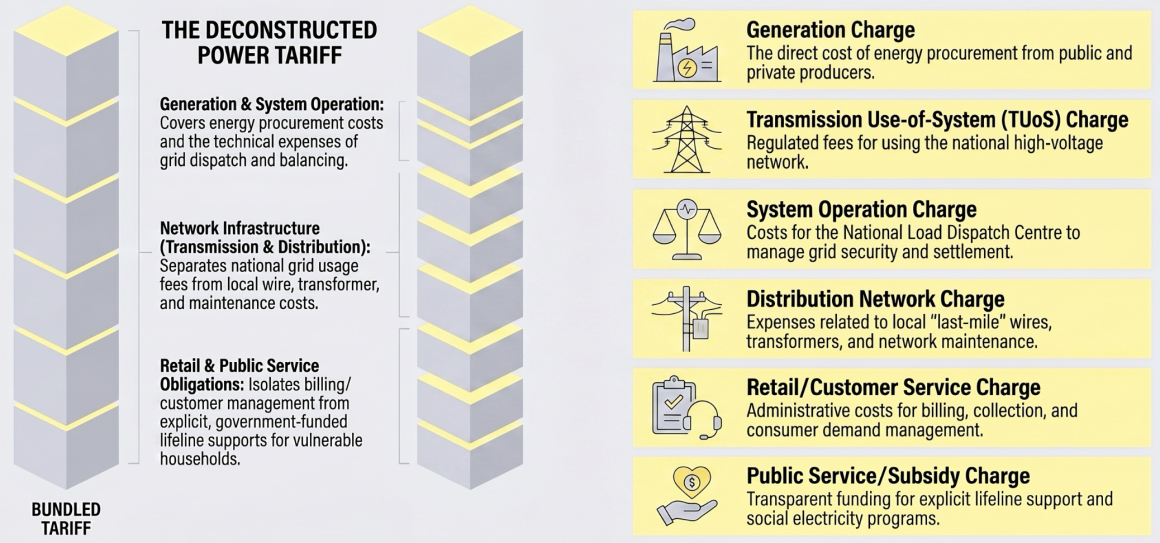
11.1 Tariff Unbundling
After NEA unbundling, tariffs should be separated into visible components:
| Tariff Component | Purpose |
| Generation charge | Cost of energy procurement or generation. |
| Transmission use-of-system charge | Cost of national transmission network. |
| System operation charge | Cost of dispatch, balancing, metering, settlement, and reliability services. |
| Distribution network charge | Cost of distribution wires, transformers, meters, operation, maintenance, and losses. |
| Retail/customer service charge | Billing, collection, customer care, demand management. |
| Public service/subsidy charge | Explicit subsidy or lifeline support funded by government or approved mechanism. |
This will improve transparency. It will also prevent hidden cross-subsidies from undermining the financial viability of successor companies.
11.2 Wheeling Charge Methodology
The proposed law and policy direction both require wheeling-charge arrangements. The annual policy and programme explicitly calls for policy and regulatory arrangements for transmission and wheeling charges, while the budget speech announces legal arrangements for transmission-line development and wheeling-charge-based electricity trade. A robust wheeling methodology should include:
1. postage-stamp charge for national backbone assets;
2. distance or MW-km charge for dedicated radial assets;
3. loss adjustment factors;
4. congestion charges where capacity is constrained;
5. reactive power and ancillary services charges;
6. connection charges;
7. penalties for deviation from schedule;
8. transparent publication of capacity availability.
11.3 Open Access Sequencing
Open access should be introduced in phases:
| Phase | Eligible Participants | Rationale |
| Phase 1 | Large generators, traders, distribution companies | Establish wholesale-level competition first. |
| Phase 2 | Large industrial consumers above a threshold | Introduce customer choice without destabilising small consumers. |
| Phase 3 | Aggregators, renewable developers, captive generators | Integrate distributed energy and demand response. |
| Phase 4 | Wider retail choice where distribution systems are ready | Avoid premature market opening. |
Open access must not allow only profitable consumers to leave public distribution companies while poor, rural, and low-consumption customers remain underfunded. A universal service mechanism is necessary.
11.4 Trading and Market Settlement
Electricity trading requires a settlement system. The trader, system operator, transmission company, distribution companies, and regulator must agree on:
1. metering points;
2. scheduling intervals;
3. deviation settlement;
4. imbalance charges;
4. payment security;
5. cross-border settlement;
6. congestion management;
7. curtailment rules;
8. data publication.
Without a settlement code, trading will depend on ad hoc bilateral arrangements and will not mature into a credible market.
12. Federalization and Distribution Reform
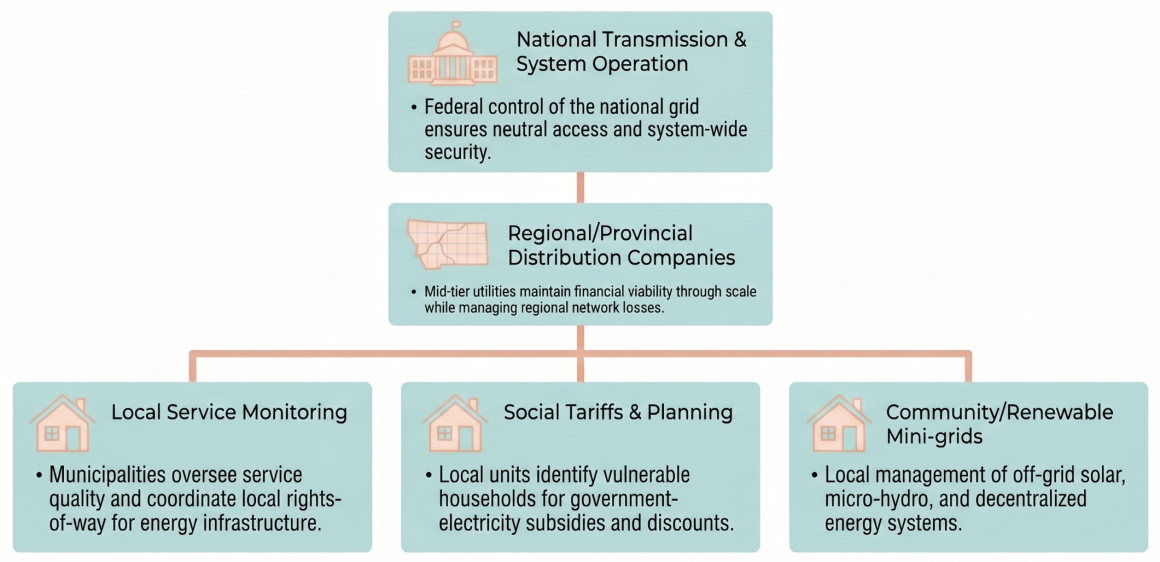
Nepal’s Constitution created federal, provincial, and local levels with their own powers and responsibilities. Electricity and water resources are not purely federal subjects. Generation scale, transmission reach, distribution area, local market management, small hydropower, alternative energy, and provincial electricity all interact with federalism. The Electricity Bills respond by allocating electricity development and licensing responsibilities among levels of government. The 2080 Bill’s objectives include allocating rights, obligations, and responsibilities among federal units for electricity project development and operation.
12.2 Avoiding Premature Fragmentation
Federalization should not mean immediate creation of dozens of financially weak utilities. Electricity distribution requires scale, technical expertise, IT systems, billing, loss reduction, emergency response, and financing capacity. Many local governments cannot immediately operate such systems. The recommended approach is:
1. federal ownership/control of national transmission and system operation;
2. regional or provincial distribution companies with financial viability;
3. local governments involved in planning, service monitoring, rights-of-way, social tariffs, local energy access, and renewable mini-grids;
4. community systems integrated through negotiated frameworks;
5. gradual devolution where capacity and viability exist.
Provincial distribution companies. A seven-province distribution model is politically attractive and compatible with federalism, but it must be financially tested. Some provincial distribution territories may have higher losses, lower customer density, or weaker revenue. A national equalization or universal service fund may be required.
Local and community energy systems. The Renewable Energy and Energy Efficiency Bill recognizes the role of federal, provincial, and local governments in expanding renewable energy access. It also provides for concessional loans in geographically remote, rural, backward, disaster-affected, traditional-energy-dependent, or energy-efficiency-potential areas. Unbundling should therefore preserve space for micro-hydro, mini-grids, solar mini-grids, community distribution, cooperative rural electrification, local energy enterprises, and grid interconnection of surplus off-grid power.
13. Water, Storage, and Climate Interface
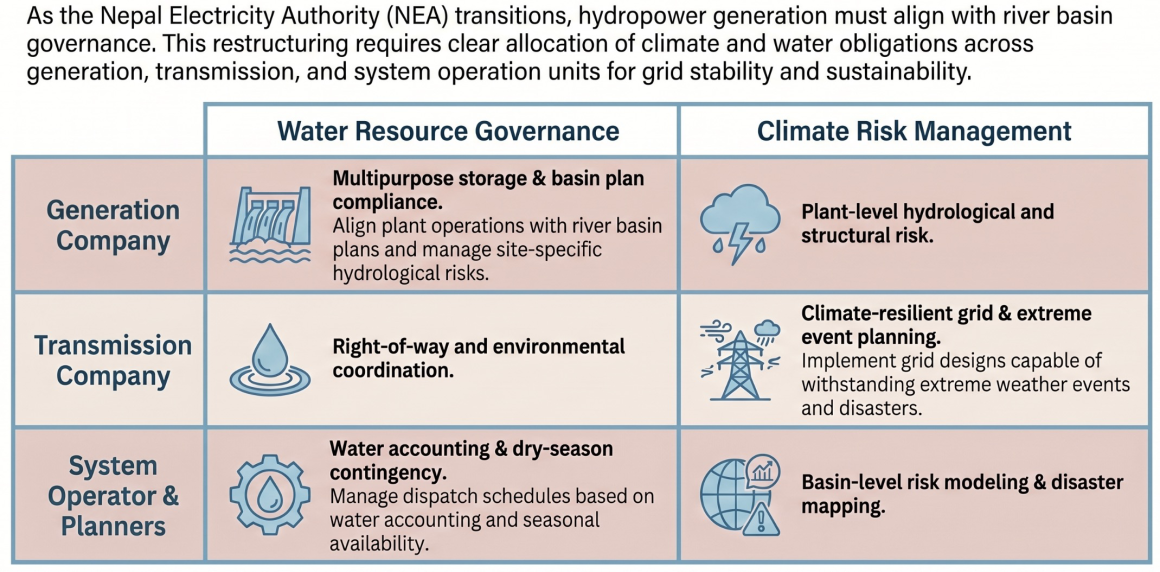
Hydropower depends on water availability, basin planning, environmental flows, sedimentation, climate variability, and competing water uses. A generation company cannot be allowed to treat rivers only as fuel sources. It must comply with water-resource policy and basin plans. The National Water Resources Policy requires integrated management and multipurpose use of water, including electricity alongside drinking water, irrigation, tourism, navigation, industry, and fisheries.
13.2 Storage and Multipurpose Projects
Nepal’s electricity system faces wet-season surplus and dry-season scarcity. The Water Resources Policy prioritizes multipurpose, reservoir, and inter-basin transfer projects partly to reduce the seasonal gap in hydropower generation. The annual policy and programme likewise prioritizes multipurpose and reservoir hydropower projects for dry-season demand and energy security.
Unbundling should therefore distinguish between dam ownership and reservoir operation; water storage benefits; downstream hydropower benefits; irrigation and flood-control benefits; generation plant operation; and energy sale and capacity payment.
The 2080 Electricity Bill’s recognition that multipurpose or storage projects may involve separate licensing for dam construction/management/operation and power generation is consistent with this approach. This should be developed into a clear regulatory framework.
Water accounting and data. The Water Resources Bill emphasizes water accounting, river basin planning, electronic information systems, and data management. These are essential for electricity planning. Generation dispatch, firm energy estimates, storage valuation, dry-season imports, and export commitments all depend on credible hydrological data.
13.4 Climate Risk
Climate change increases hydrological uncertainty, glacial risks, flood risks, sedimentation, and extreme events. The National Water Resources Policy calls for reliable hydrological and meteorological data systems and climate adaptation measures.
After unbundling, climate-risk responsibility should be allocated clearly:
1. generation company: plant-level hydrological and structural risk;
2. transmission company: climate-resilient grid design;
3. distribution companies: disaster-resilient local networks;
4. system operator: emergency dispatch and contingency planning;
5. water authority/planner: basin-level risk modelling;
6. regulator: prudence review of resilience investments.
14. Renewable Energy, Demand Growth, and Distribution Transformation
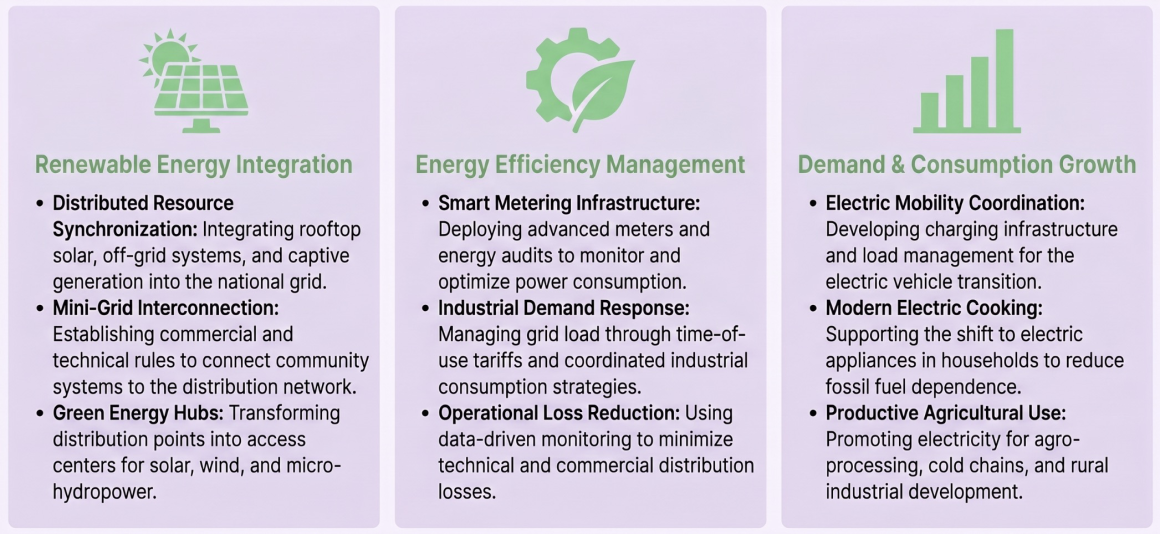
Renewable energy access. The renewable-energy legal framework seeks to expand sustainable energy access through federal, provincial, and local collaboration. The annual policy and programme also commits to modern and renewable energy access for all citizens and development of solar, wind, and hydrogen energy. This affects NEA unbundling because distribution companies will become the main interface for distributed energy integration. They must be able to connect rooftop solar, community solar, mini-grids, and captive systems while maintaining grid safety and commercial settlement.
Energy efficiency and demand-side management. The Hydropower Development Policy encouraged demand-side management and energy conservation. The Renewable Energy and Energy Efficiency Bill goes further by introducing energy-efficiency measures, energy audits, equipment standards, and institutional arrangements for energy conservation. Distribution companies should therefore be required to implement appliance efficiency programmes, smart metering, time-of-use tariffs, industrial demand response, electric cooking support, EV charging coordination, feeder-level loss monitoring, and targeted efficiency programmes for high-use consumers.
Electricity consumption growth. The annual policy and programme commits to promoting electric appliances in household, agricultural, industrial, commercial, tourism, and transport sectors under the Electricity Consumption Increase and Fossil Fuel Reduction Action Plan, 2080. This means unbundling should not focus only on supply-side competition. It must also support demand creation, especially productive electricity use, electric mobility, electric cooking, cold chains, agro-processing, tourism, and green industry.
15. Political Economy of Reform
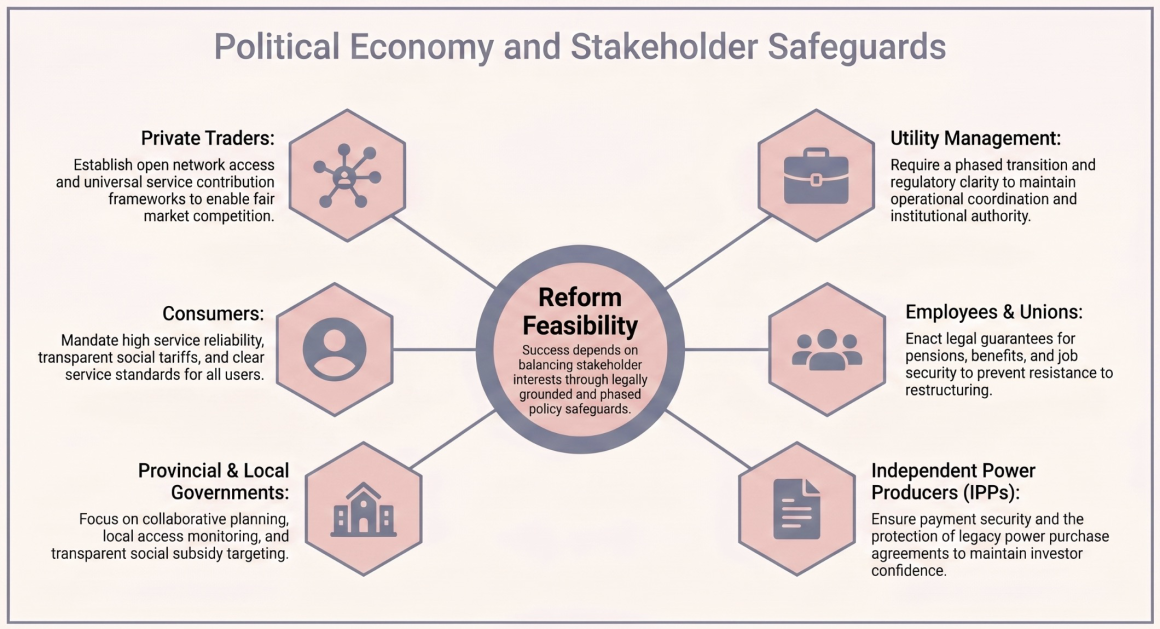
NEA management may see unbundling as a threat to institutional authority, asset control, and internal coordination. Reform must therefore distinguish between legitimate operational concerns and resistance to accountability. Management concerns can be addressed through phased transition, clear successor mandates, continuity of service obligations, professional boards, performance contracts, transparent asset allocation, regulatory clarity, and no sudden dismantling of technical coordination.
Employees and unions are among the most important stakeholders. Their core concerns are job security, pension, benefits, transfer location, promotion pathways, and institutional identity. Reform should avoid language suggesting that unbundling is equivalent to privatization or retrenchment. A legally binding staff protection framework should be enacted before asset transfer.
Independent power producers — private generators may support open access, neutral dispatch, and electricity trading, but may resist full market exposure if they currently benefit from long-term PPAs with payment security. The transition must therefore protect existing contractual rights while allowing new procurement models for future projects. A practical approach is to honour existing PPAs, create a payment-security mechanism, allow voluntary migration to market arrangements, introduce competitive procurement for new projects, and provide transparent curtailment and dispatch rules.
Provincial and local governments may support federalization but may not be ready to operate financially complex electricity utilities. Their role should initially focus on planning, local access, mini-grids, rights-of-way, local distribution monitoring, subsidy targeting, and renewable-energy programmes.
Consumers will support unbundling only if it improves reliability, quality, affordability, and service. They may resist if reform is associated with tariff increases. Therefore, public communication should explain tariff unbundling, subsidy protection, service standards, and accountability mechanisms.
Private traders and large consumers will seek open access and direct procurement. This can improve competition, but it may also create ‘cream-skimming’ if only high-paying consumers leave distribution companies. Open access should therefore be accompanied by network charges and universal service contributions.
16. Financial and Fiscal Strategy
16.1 Balance Sheet Sustainability
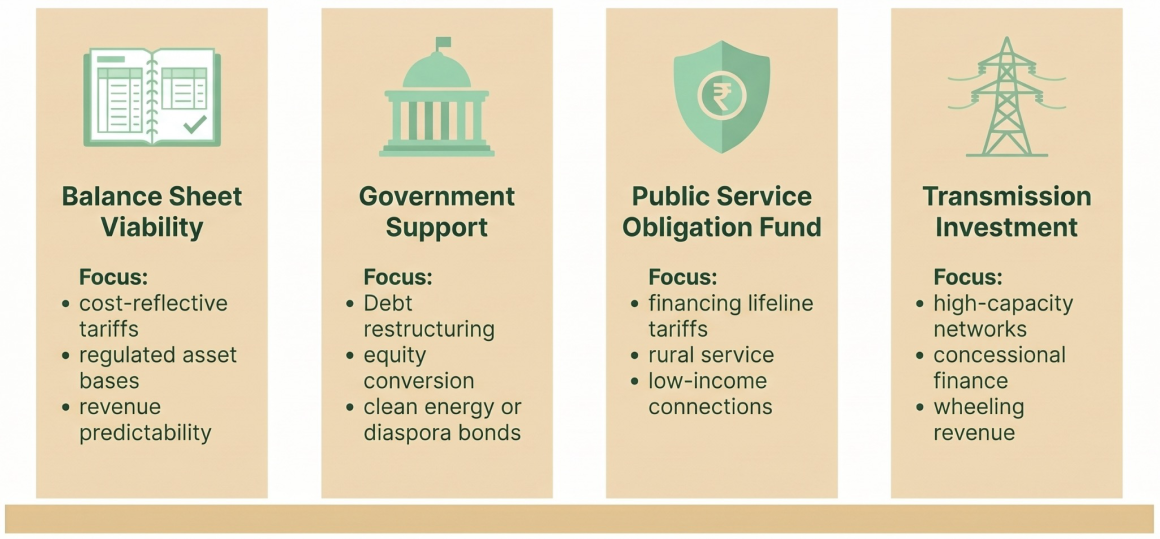
Each successor company must be financially viable. The generation company needs sufficient revenue to maintain plants and invest in rehabilitation. The transmission company needs a regulated asset base and predictable wheeling revenue. Distribution companies need cost-reflective tariffs, subsidy reimbursement, and loss-reduction incentives. Trading entities need payment security and risk-management capacity.
16.2 Government Support
Government may need to support transition through debt restructuring, equity injection, conversion of government loans to equity, a payment-security fund, a subsidy fund, climate finance, clean energy bonds, diaspora bonds, and concessional finance for transmission and storage.
The budget speech’s broader financing direction includes clean energy bonds, diaspora bonds, and use of climate funds. These instruments can support the investment needs of unbundled entities if tied to bankable corporate structures.
16.3 Public Service Obligation Fund
Distribution companies should not be forced to absorb social tariffs without reimbursement. The 2080 Bill’s provision requiring reimbursement for tariff relief to poor, vulnerable, and marginalized consumers is a strong starting point. A formal Public Service Obligation Fund should finance:
1. lifeline tariffs;
2. remote-area service;
3. low-income connection support;
4. community electrification;
5. grid extension where commercially nonviable;
6. disaster recovery for distribution networks.
16.4 Transmission Investment
Transmission is the backbone of market reform. Without adequate transmission capacity, unbundling will not deliver competition. The policy and programme’s emphasis on high-capacity national and cross-border transmission and wheeling charges should be treated as a central pillar of NEA restructuring, not as a separate infrastructure programme.
17. Implementation Roadmap
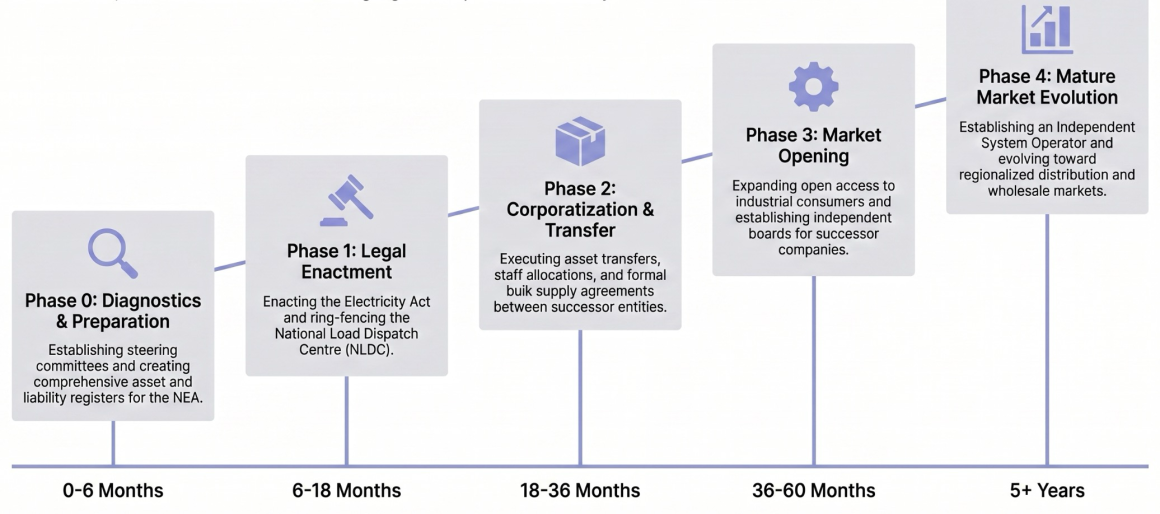
Phase 0: Political Decision and Diagnostic Preparation
Timeframe: 0–6 months
Key actions:
1. Cabinet-level decision on NEA restructuring model.
2. Establish a Power Sector Restructuring Steering Committee.
3. Create technical working groups on legal, financial, HR, asset, PPA, IT, and regulatory transition.
4. Prepare NEA asset and liability register.
5. Prepare PPA and power-purchase obligation inventory.
6. Prepare employee and pension liability inventory.
7. Begin separate accounts for generation, transmission, distribution, trading, and system operation.
8. Draft amendments to NEA Act and Electricity Bill transition provisions.
9. Consult unions, IPPs, provincial governments, local governments, consumers, and donors.
Phase 1: Legal Enactment and Ring-Fencing
Timeframe: 6–18 months
Key actions:
1. Enact Electricity Act.
2. Amend or repeal NEA Act with savings and transition provisions.
3. Establish successor companies under special transition order.
4. Issue provisional licenses to successor entities.
5. Ring-fence NLDC.
6. Publish open-access and grid-code regulations.
7. Establish interim wheeling charge methodology.
8. Prepare staff transfer scheme.
9. Prepare customer and subsidy protection rules.
10. Prepare PPA novation framework.
Phase 2: Corporatization and Asset Transfer
Timeframe: 18–36 months
Key actions:
1. Transfer generation assets to generation company.
2. Transfer transmission assets to transmission company.
3. Transfer distribution assets to distribution companies.
4. Vest trading and PPA obligations in transitional trading entity.
5. Execute bulk supply agreements.
6. Execute transmission service agreements.
7. Transfer employees with protected service conditions.
8. Implement separate IT, accounting, billing, and settlement systems.
9. Begin regulatory reporting by company.
10. Pilot open access for selected generators and bulk consumers.
Phase 3: Operational Autonomy and Market Opening
Timeframe: 36–60 months
Key actions:
1. Companies operate under independent boards and performance contracts.
2. NLDC operates under ring-fenced or independent governance.
3. Wheeling charge fully implemented.
4. Distribution service standards enforced.
5. Private traders licensed.
6. Cross-border trading framework operationalized.
7. Competitive procurement introduced for new generation.
8. Open access expanded to eligible industrial consumers.
9. Universal service fund operational.
10. Public reporting dashboard launched.
Phase 4: Mature Market Evolution
Timeframe: 5+ years
Key actions:
1. Independent system operator or transmission-system operator fully established.
2. Trading separated from distribution.
3. Distribution companies regionalized or provincialized where financially viable.
4. Wholesale market platform introduced.
5. Retail choice expanded gradually.
6. Market settlement and balancing mechanism strengthened.
7. Public offerings or strategic partnerships considered only after regulatory maturity.
8. Periodic parliamentary and regulatory review.
18. Risk Matrix and Safeguards
| Risk | Description | Safeguard |
| Legal uncertainty | NEA Act and new Electricity Act may conflict. | Clear repeal/amendment and transition provisions. |
| Asset-transfer dispute | Disagreement over asset valuation and allocation. | Independent valuation and statutory transfer scheme. |
| Debt unsustainability | Successor companies may inherit unserviceable debt. | Debt restructuring and government equity conversion. |
| Staff resistance | Employees fear loss of benefits. | Legal protection of employment, pension, seniority, and benefits. |
| Tariff shock | Unbundled tariffs reveal hidden costs. | Phased tariff reform and targeted subsidy. |
| Weak distribution companies | Provincial/local distribution may lack viability. | Regional clustering and universal service fund. |
| Open-access cream-skimming | Large consumers bypass distribution companies. | Network charges and universal service contribution. |
| Dispatch bias | System operator remains commercially influenced. | Ring-fenced or independent NLDC. |
| Trading concentration | NEA successor dominates trade. | Separate trading licenses and market rules. |
| Rural neglect | Commercial companies avoid remote areas. | Public service obligations and subsidy reimbursement. |
| Water-energy conflict | Generation decisions ignore basin priorities. | River basin planning and water accounting. |
| Climate risk | Hydrology and disasters disrupt generation and grid. | Climate-resilient planning and contingency standards. |
| Political reversal | Reform loses support after opposition. | Stakeholder compact and phased implementation. |
19. Recommended Legal Clauses for Consideration
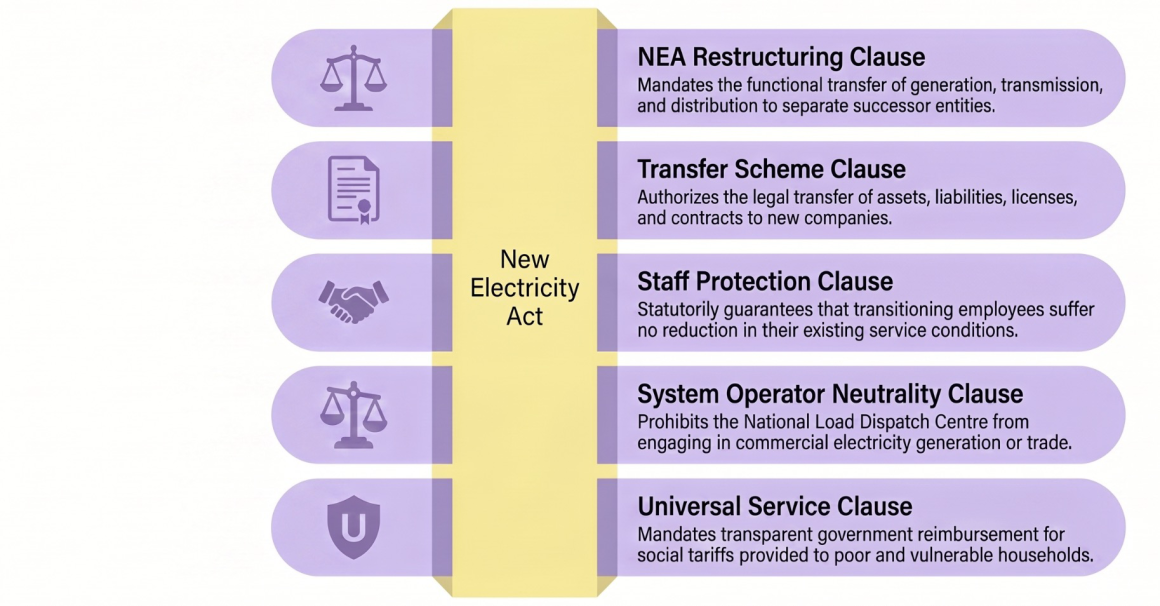
NEA Restructuring Clause
The new Electricity Act or NEA Act amendment should include a clause substantially covering:
The Government of Nepal shall, within a prescribed period, restructure the Nepal Electricity Authority by transferring its generation, transmission, distribution, electricity trading, customer service, and system-operation functions to one or more successor entities established under this Act, the Companies Act, or a special restructuring order. Such transfer shall include assets, liabilities, licenses, contracts, employees, rights, obligations, and proceedings as specified in a transfer scheme approved by the Government of Nepal.
Transfer Scheme Clause
The law should authorize the Government to issue a statutory transfer scheme covering: asset transfer; liability transfer; contract transfer; license transfer; employee transfer; legal proceedings; land and easements; tax neutrality; stamp duty and registration exemptions; continuation of service; dispute resolution.
Staff Protection Clause
No employee transferred to a successor entity under the restructuring scheme shall receive service conditions less favourable than those applicable immediately before transfer, unless voluntarily agreed by the employee or determined under a legally approved service harmonization scheme.
System Operator Neutrality Clause
The National Load Dispatch Centre shall perform scheduling, dispatch, grid monitoring, energy accounting, and coordination functions in a non-discriminatory manner. It shall not engage in electricity generation, distribution, or trading.
Open Access Clause
The national transmission grid and eligible distribution systems shall be available for non-discriminatory open access to licensees and eligible consumers subject to technical capacity, grid code compliance, scheduling, metering, settlement, and payment of regulated charges.
Universal Service Clause
Distribution licensees shall provide electricity service in accordance with universal service obligations prescribed by law. Any tariff relief, subsidy, or service obligation imposed by a level of government shall be reimbursed through a transparent mechanism within the prescribed period.
20. Strategic Recommendations
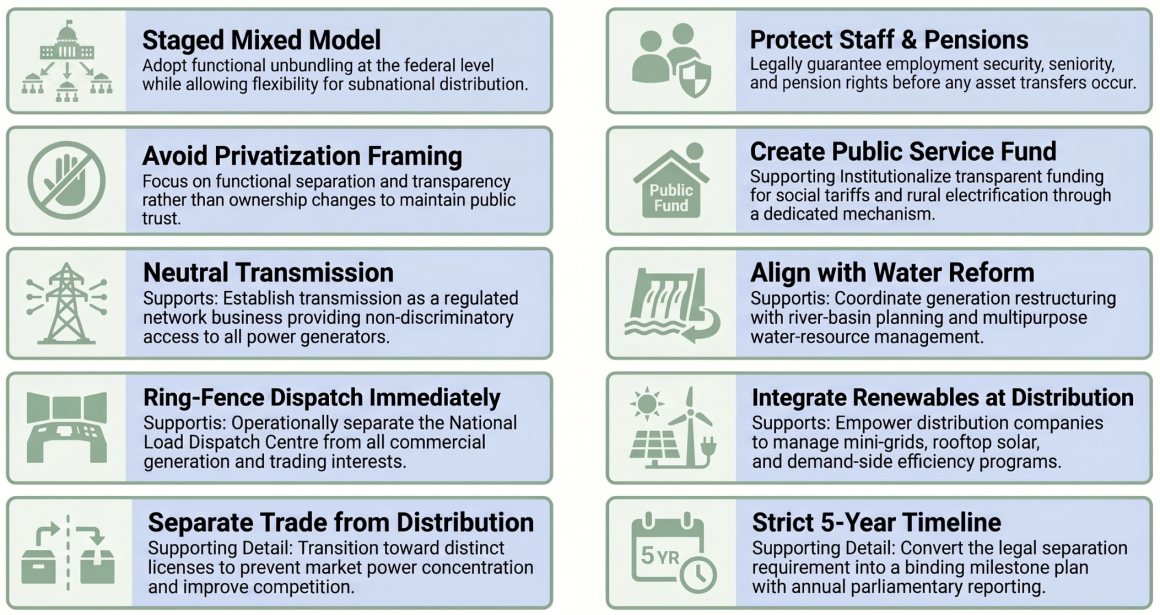
Recommendation 1: Adopt a staged mixed model. Nepal should adopt staged functional unbundling at the federal level while allowing subnational flexibility. The immediate structure may follow the budget’s three-company model, but the legal design should allow later separation of trading and independent system operation.
Recommendation 2: Do not treat unbundling as privatization. The reform should be communicated as separation of functions, accounts, responsibilities, and regulation. Ownership can remain public in the initial phase. The purpose is neutrality, efficiency, transparency, and investment readiness.
Recommendation 3: Make transmission neutral. Transmission must become a regulated network business with non-discriminatory access, published charges, grid code compliance, and no commercial conflict with generation or trading.
Recommendation 4: Ring-fence the National Load Dispatch Centre immediately. The NLDC should be separated operationally from generation, trading, and distribution interests. Its scheduling, dispatch, accounting, and cross-border coordination functions are too important to remain under commercial influence.
Recommendation 5: Separate trading from distribution over time. Because the budget proposes a distribution/trade company, the first phase may combine these functions. However, trading should be ring-fenced from the beginning and separated once settlement, open access, and market rules are ready.
Recommendation 6: Protect staff and pensions. No reform will succeed without staff confidence. Employment, pension, seniority, and benefit protections should be legally guaranteed before asset transfer.
Recommendation 7: Create a public service obligation fund. Social tariffs and rural service obligations should be funded transparently. The 2080 Bill’s reimbursement principle for tariff relief should be institutionalized through a dedicated mechanism.
Recommendation 8: Align electricity unbundling with water-resource reform. Generation restructuring must be coordinated with river basin planning, water accounting, multipurpose storage, inter-basin transfer, environmental flows, and benefit sharing.
Recommendation 9: Integrate renewable energy and efficiency into distribution reform. Distribution companies should be responsible not only for wires and billing, but also for distributed energy, mini-grid integration, energy efficiency, demand management, and electric consumption growth.
Recommendation 10: Use the five-year period as a binding transition timeline. The five-year separation requirement in the 2080 Bill should be converted into a detailed milestone plan with annual reporting to Parliament, regulator, and the public.
21. Proposed Final Sector Structure
The following structure is recommended as the target design for Nepal’s reformed electricity sector, showing the institutional hierarchy from policy to consumers:
| Tier | Entity | Key Functions / Flow to Next Tier |
| Policy | Government of Nepal / MoEWRI | Overall policy direction and legislative framework |
| Planning | Water and Energy Commission / Planning Body | River basin planning, energy planning, demand forecasts |
| Regulation | Electricity Regulatory Commission | Tariffs, wheeling, grid code, open access, quality, consumer protection |
| Generation | Public generation company Private IPPs Community / renewable generators Captive / co-generation where permitted | PPAs, bilateral contracts, market sale |
| Trading / Market | Transitional public trader Licensed private traders Cross-border trading entities | Schedules, contracts, settlement |
| Transmission | National Transmission Grid Company | Owns and develops grid; provides open access; collects regulated wheeling charges |
| Dispatch | Independent / Ring-fenced System Operator | Dispatch, scheduling, grid security, energy accounting, cross-border coordination |
| Distribution | Regional / Provincial Distribution Companies | Network operation, customer connections, loss reduction, subsidy implementation |
| Retail | Distribution-affiliated suppliers Future competitive suppliers for eligible customers | Metering, billing, customer service |
| Consumers | Households Industries Agriculture Transport Commercial users Public services | End users of the system |
22. Conclusion
NEA unbundling is no longer an isolated reform proposal. It is now embedded in Nepal’s legislative, policy, and fiscal trajectory. The NEA Act created a vertically integrated national utility for an earlier phase of electrification. The hydropower policy opened the door to private investment, export orientation, rural electrification, and demand management. The Electricity Bills of 2077 and 2080 provide the legal vocabulary of modern electricity markets: function-based licensing, open access, trading, customer service, national grid access, wheeling charges, and load dispatch. The Water Resources Policy and Bill require hydropower to be governed within integrated river-basin and multipurpose water management. The Renewable Energy and Energy Efficiency Bills expand the reform agenda to distributed energy, energy efficiency, and three-tier government responsibility. The annual policy/programme and budget speech now expressly commit to NEA restructuring and separation into generation, transmission, and distribution/trade companies.
The remaining task is implementation design. Nepal should avoid both extremes: preserving NEA’s integrated monopoly under the name of stability, or fragmenting it hastily under the name of reform. The correct path is staged, legally grounded, financially viable, staff-protective, regulator-led, and market-oriented unbundling.
The first milestone should be legal separation into successor companies. The second should be neutral transmission and ring-fenced system operation. The third should be transparent tariff and subsidy reform. The fourth should be gradual open access and trading. The fifth should be federal-compatible distribution reform integrated with renewable energy, mini-grids, and demand growth.
If properly sequenced, NEA unbundling can transform Nepal’s electricity sector from a vertically integrated public monopoly into a transparent, competitive, reliable, and regionally connected clean-energy system. If poorly sequenced, it can create financial fragmentation, labour conflict, tariff shock, and institutional confusion. The reform should therefore proceed — but with a detailed transition law, clear company design, protected public service obligations, and a credible implementation roadmap.
Appendix A: Legislative and Policy Matrix
| Instrument | Main Relevance to NEA Unbundling |
| NEA Act, 2041 | Creates vertically integrated NEA; gives generation, transmission, distribution, tariff, asset, land, borrowing, and foreign trade powers. |
| Hydropower Development Policy, 2058 | Supports private participation, investment protection, rural electrification, demand management, and hydropower export orientation. |
| Electricity Bill, 2077 | Introduces generation/transmission/distribution/trade/customer-service licensing, open access, trade, and customer-service competition. |
| Electricity Bill, 2080 | Requires existing integrated entity to form separate generation, transmission, and distribution entities within five years; strengthens grid, dispatch, trade, and open-access provisions. |
| Water Resources Act, 2049 | Treats hydropower as water-resource use and places it within state ownership, licensing, conservation, and environmental obligations. |
| National Water Resources Policy, 2077 | Requires integrated water-resource management, multipurpose use, storage, inter-basin transfer, benefit sharing, and federal role clarity. |
| Water Resources Bill | Creates modern basin-planning, water-accounting, electronic-data, groundwater, pollution, and climate/disaster governance framework. |
| Renewable Energy and Energy Efficiency Bill | Establishes renewable-energy access, energy efficiency, energy audits, equipment standards, off-grid/captive integration, and three-tier government responsibility. |
| Annual Policy and Programme | Prioritizes energy roadmap implementation, renewable energy, storage, mini-grids, high-capacity transmission, wheeling charges, and private participation. |
| Budget Speech | Expressly commits to completing NEA restructuring and dividing NEA into three companies for generation, transmission, and distribution/trade. |
Appendix B: Minimum Contents of an NEA Restructuring Plan
Five-year milestone schedule, Legal basis and transition authority, Successor company structure, Asset register and valuation, Liability and debt allocation, PPA transfer and payment security, Staff transfer and pension protection, License transfer, Land and right-of-way transfer, Tariff and subsidy framework, Grid-code and dispatch framework, Open-access and wheeling-charge framework, Distribution service standards, Rural electrification and community asset integration, Renewable-energy and mini-grid integration, IT – metering – settlement and data systems, Consumer protection framework, Regulatory approval process, Parliamentary reporting, Dispute resolution