Part 0 – What is development, construction and concession?
Q1. Development Models
The classification of infrastructure development structures is fundamentally based on how three core responsibilities are distributed between the public and private sectors: capital mobilization, asset control, and operational responsibility. These three dimensions collectively determine the degree of private participation in infrastructure development. As responsibilities shift from the public sector toward private entities, the structure moves from low-participation arrangements (eg. Public Delivery Model) to high-participation concession frameworks (eg. Concession Model). Financing responsibility indicates who provides and bears the financial risk of investment; ownership defines who holds legal and economic control over the asset during the project lifecycle; and operation & maintenance responsibility determines who manages the asset and derives operational control and revenue during the concession or service period.
These dimensions can be clearly understood through a comparative structure of development models as follows:
| Category | Includes | Financing Responsibility | Ownership Structure | O&M Responsibility |
| Public Delivery Model | Public Utility | Public sector (direct or indirect) | Public | Public |
| Transfer-Based Build Model | BT (Build–Transfer) | Private (temporary), repaid by public sector | Public (after completion) | Public |
| Concession-Based Private Operation Model | BOT, BOOT | Private sector | Private during concession / concession-based control | Private |
Viewed together, these structures represent a gradual transition in institutional responsibility. At one end, the public sector retains full control over financing, ownership, and operations, ensuring complete state dominance in infrastructure delivery. At the other end, private participation becomes dominant, with private entities assuming financial exposure, operational control, and temporary ownership rights, thereby enabling a fully commercialized infrastructure development and management framework.
Q2. Construction Models
The classification of infrastructure construction models is fundamentally based on how responsibilities for design, procurement, construction execution, and associated construction-stage risks are distributed between the public sector / developer and private contractors. Unlike development models, construction models do not determine ownership or long-term operational control; rather, they define how infrastructure is physically delivered and how construction-related risks such as time overruns, cost escalation, and performance failure are allocated.
As responsibilities shift from employer-driven execution to contractor-led integrated delivery, the structure moves from low-risk traditional contracting arrangements to high-risk turnkey EPC systems. Design responsibility indicates who prepares engineering designs; procurement responsibility defines who sources materials and equipment; construction responsibility determines who physically executes the works; and construction risk allocation defines who bears the consequences of delays, cost overruns, and performance failures during implementation. Reference: FIDIC Publications
These dimensions can be clearly understood through a comparative structure of construction models as follows:
| Category | Includes | Design Responsibility | Procurement Responsibility | Construction Responsibility | Construction Risk Allocation |
| Traditional Contracting Model | Item-rate / Unit-rate contracts | Public sector (Engineer/Employer) | Public sector | Contractor | Shared / measurement-based risk |
| Employer-Designed Construction Model | FIDIC Red Book | Public sector | Public sector | Contractor | Moderate contractor risk (quantity & execution risk) |
| Design–Build Model | FIDIC Yellow Book | Contractor | Contractor | Contractor | High contractor risk (design + execution integration risk) |
| EPC / Turnkey Model | FIDIC Silver Book | Contractor | Contractor | Contractor | Very high contractor risk (fixed price, time, performance) |
Viewed together, these structures represent a gradual transition in construction responsibility and risk allocation. At one end, the public sector / developer retains control over design and procurement while outsourcing execution to contractors under closely supervised conditions. At the other end, integrated EPC and turnkey arrangements transfer full responsibility for design, procurement, and construction to contractors, along with significant exposure to time, cost, and performance risks, thereby minimizing employer intervention during project execution while maximizing contractor accountability for delivery outcomes.
Q3. Concession Models
The classification of concession models is fundamentally based on how infrastructure projects generate revenue and how financial returns are recovered over the concession period. This dimension isolates the commercial logic of infrastructure, specifically focusing on whether revenue is derived from government payments, user-based tariffs, or market exposure. As revenue responsibility shifts from the public sector to private operators, the structure moves from fixed, availability-based payments to demand-driven and fully market-exposed revenue systems. The key differentiating parameter is the allocation of revenue risk, which determines whether cash flows are stable and government-backed or variable and market-dependent.
These dimensions can be clearly understood through a comparative structure of concession revenue models as follows:
| Category | Includes | Revenue Source | Revenue Risk Allocation | Payment Stability |
| Availability-Based Revenue Model | Availability Payment PPPs | Government / public authority pays for service availability | Public sector bears demand risk | High (fixed/annuity-based payments) |
| Regulated Tariff / Usage-Based Model | BOT, BOOT (regulated infrastructure) | User charges based on regulated tariffs (e.g., wheeling charges, tolls) | Private sector bears partial demand and operational risk | Medium (regulated but demand-linked) |
| Market-Based / Merchant Revenue Model | Merchant transmission / open market models | Direct market prices, congestion rents, or competitive trading revenues | Private sector bears full market and demand risk | Low (highly volatile revenues) |
These structures represent a progressive shift in revenue risk allocation within infrastructure concession systems. At one end, revenue is fully stabilized through government-backed availability payments, insulating private investors from demand uncertainty. In the middle, regulated tariff systems allow private recovery of investment through user-based charges under regulatory oversight, balancing stability and market exposure. At the most advanced level, merchant-based systems fully expose private investors to market volatility, where revenue depends entirely on real-time demand, pricing dynamics, and system congestion, thereby representing the highest degree of commercial risk in infrastructure financing structures.
Q4. Orientation: A typical PPP transmission line project in Nepal
Before handling the FAQs below, it helps to place a typical transmission line project precisely in three overlapping taxonomies – how it is developed, how it is built, and how it earns – because each axis carries a different risk allocation and the financial model lives at their intersection.
Development model. A BOOT line is a Concession-Based Private Operation Model: the private SPV finances the asset, holds concession-based control during the licence term, and operates and maintains it – then transfers it to the State. This is the high-private-participation end of the spectrum, distinct from a Build-Transfer (BT) arrangement (private builds, public repays and owns on completion) or a public-utility delivery model.
Construction model. Transmission SPVs in Nepal are typically delivered under an EPC / turnkey arrangement (FIDIC Silver Book): design, procurement and construction sit with the contractor at a fixed price, time and performance, transferring time – and cost-overrun risk away from the employer. This matters for the capex and contingency assumptions later.
Concession revenue model. This is where the Nepali framework is most distinctive, and where the central question of this article lives. A regulated transmission line is, in principle, a Regulated Tariff / Usage-Based Model – private recovery through regulated user charges, with the private side bearing partial demand and operational risk. But, as the revenue section shows below, the draft Nepali design for wheeling charges deliberately pushes a private line toward the Availability-Based Revenue Model – the licensee is paid for being available, not for throughput – which shifts demand risk back onto the system and the consumer base. The line is built like a merchant-era asset but paid like an availability asset. That hybrid is the single most important feature of the wheeling charge framework that ERC is yet to publish.
| Axis | This project | What it means for risk |
| Development | BOOT – Concession-Based Private Operation | Private finance + concession control + O&M; mandatory transfer to State at term end |
| Construction | EPC / turnkey (FIDIC Silver Book) | Fixed price/time/performance; overrun risk on contractor |
| Revenue | Regulated tariff in form, availability-based in substance | Demand/volume risk socialised; licensee bears availability & performance risk only |
Framing drawn from the development/construction/concession-model taxonomy; risk read-across is the author’s synthesis.
Part I – The revenue model: how a private transmission line earns in Nepal
These are the questions that move the transmission line’s financial model the most. They decide whether the line is paid an availability fee, a cost-of-service return, or a usage charge; who pays; and through what mechanism a non-utility licensee is actually settled.
Q1. What charge methodology will the ERC actually apply to a privately-developed transmission line – availability, ARR cost-of-service, or both? Is any instrument in force that mandates one?
Bottom line: The framework in contemplation is a hybrid – the total revenue pool is built on an Aggregate Revenue Requirement (ARR, cost-of-service) basis, but the individual payout to a private licensee is availability-linked. Neither leg is yet in force as a binding instrument: the governing provisions sit in draft directives and a draft discussion paper.
The operative text is Chapter 3, Section 11 (“Wheeling Charges for new transmission licensees”) of the Revised Draft Wheeling Charges Directives, 2024-05-15. Section 11.1 establishes that private lines carry their own revenue requirements:
“The transmission lines developed by transmission licensees other than NEA in the future (including JV projects developed under Special Purpose Vehicle) will have their own capital and operating costs, and therefore their own revenue requirements.” – Revised Draft Wheeling Charges Directives 2024, s. 11.1
Section 11.2 then sets out the four-step framework that fuses cost-of-service collection with availability payout: “The general framework for collection of Wheeling Charges for entities other than NEA is mentioned below: (a) Determine total revenue requirement of all transmission licensees (both regulated tariff and competitive tariff) (b) Determine Wheeling Charges based on total revenue requirement. (c) Set up a pool for collecting Wheeling Charges. (d) Pay to respective licensees from the pool, linked to their availability.” – Revised Draft Wheeling Charges Directives 2024, s. 11.2
Critically, Section 11.3 of the Directive defers the actual mechanics: “The detailed procedure for the same will be separately issued by the Commission.”
Is the carve-out directive for dedicated / radial / competitively-bid lines issued? No. It is still in study and consultation.
The RPGCL – West Seti 400 kV TL Legal Assessment Report, Chapter VII, confirms the gap directly: “While the ERC’s Annual Plan for FY 2082/83 indicates the preparation of a methodology for determining wheeling charge structures, no finalized standard or regulation appears to have been brought into effect as of date.”
The ERC Annual Plan and Programs for FY 2082/83 lists the work as a forward action item: to “Tariff Based Competitive Bidding प्रणालीमार्फत प्रसारण सेवा सुनिश्चित गर्न तथा Radial Line र राष्ट्रिय प्रसारण ग्रिडको प्रयोग वापत लाग्ने शुल्क तथा दस्तुर निर्धारणसम्बन्धी अध्ययन तथा अनुसन्धान गर्ने” (to conduct study and research on securing transmission service through tariff-based competitive bidding and on determining the charges for use of radial lines and the national grid).
For dedicated lines specifically, the Draft Sharing of Cost and Losses of Dedicated Transmission Lines carries a public notice dated BS 2082/07/30 inviting stakeholder feedback within 30 days, and its own disclaimer states the paper “does not represent the final position, decision, or directive of the Commission.” There is, therefore, no issued methodology, formula or review cycle for the carve-out as of late BS 2082.
So that means – Practically, this means ARR is the better-grounded engine for the pool (for revenue modeling), but its precise components for a private line – and the availability formula that converts the pool into a payout – are not yet codified. The model should treat both as provisional and rebuild them the moment the s.11.3 of the draft directives procedure issues.
Q2. Who is the lawful paying counterparty, and how is a non-utility licensee actually settled? The pool mechanism explained, with a worked example.
Bottom line: The counterparty is a regulated collection pool, not NEA paying out of its own budget and not the connected generators paying a direct toll. The pool is funded by consumers and cross-border traders through the uniform wheeling charge; the private licensee draws its approved ARR from the pool in proportion to availability. The pool administrator is not yet named.
The logic deliberately decouples collection from payout, so as to strip volume risk out of the private line. Reading Sections 8, 9, 10 and 11 of the draft directive together:
• Who funds the pool: consumers and grid users (this includes consumers, open access users, cross-border traders etc.). Section 2.1(g) defines wheeling charges as “the transmission and distribution tariff to be paid by the consumers as per Rule No. 10 and 13 of the Rules”; Section 10.1 adds cross-border traders – “The entities have to pay Wheeling Charges related to the lines being utilised for import/export of power in case of open access to cross border lines.”
• Who bills the end consumer: NEA, through its Distribution and Consumer Services Directorate, which the NEA Annual Report 2024/25 describes as responsible for “new connections, meter reading, billing, revenue collection.”
• Who manages the pool: undefined. Section 11.3 reserves the administrative design to a separate Commission procedure not yet issued.
Now the worked example. Take a national wheeling ARR of NPR 8,000 (units immaterial – read as “million” for realism) for NEA’s existing grid, and a new private 400 kV line whose own capital and operating costs are assessed by the regulator at an ARR of NPR 2,000.
| Step (s. 11.2) | What happens in the worked example |
| (a) Determine total revenue requirement | NEA ARR 8,000 + private-line ARR 2,000 = 10,000 aggregate national requirement. |
| (b) Determine wheeling charge | ERC sets one uniform national charge (NPR/MW/month) sized to recover the full 10,000. |
| (c) Set up a pool | Consumers and open-access/cross-border users pay that uniform charge into one central pool; nothing is paid line-by-line. |
| (d) Pay licensees, linked to availability | The private SPV draws its 2,000 from the pool – in full at 100% availability, regardless of how many MW the operator actually routed through its line. |
Two availability scenarios make the payout rule concrete:
• 100% availability: the SPV receives its full NPR 2,000, even if the system operator dispatched zero MW through the line that year.
• 80% availability (forced outages): the payout is reduced in proportion to availability – illustratively to NPR 1,600 – because compensation is “linked to their availability.”
This is why a West Seti-type SPV will not bill the hydropower plants connected to it. The Explanatory Note to the draft directives justifies socialising the cost: “A uniform postage stamp tariff is considered as it is a simpler method of revenue collection … as both generation planning and transmission planning are undertaken at a national level.” If the line instead charged the basin’s generators directly, a dry season would cut its receipts and threaten debt service; the pool plus availability payout removes exactly that risk.
Q3. For NEA’s shared backbone, what is the ARR formula and how is the per-MW charge derived? With a data-driven estimate of the charge.
In force? No – this is the draft methodology. But it is the most developed expression of how the ERC intends to price the backbone, and the Open Access Directive 2082 now codifies a structurally identical formula in Section 33.
Section 8 of the draft wheeling charges directives gives the charge: “Wheeling Charges = Total Wheeling ARR (NPR) / 12 * Previous year’s coincident peak demand on the transmission licensee’s system (MW)”, billed “on NPR/MW/Month basis.” Section 7.1 builds the ARR by allocating NEA’s corporate costs to the wheeling function using two ratios:
• X% – the ratio of transmission-and-distribution asset cost to NEA’s total asset cost – allocates interest, return on equity, depreciation, repair/maintenance, admin and other expenses.
• Y% – the ratio of T&D O&M employees (excluding meter readers) to total NEA employees – allocates employee cost.
• Generation and power purchase are assigned 0% – carved entirely out of the wheeling pool.
“Coincident peak demand” is not separately defined in the directive; in the formula it functions purely as the denominator – the system’s single highest simultaneous MW load in the previous year, across which the annual revenue requirement is spread to yield a per-MW-month rate.
A data-driven estimate of the NEA wheeling charge
The exact X% and Y% are not itemised in NEA’s published accounts, and the NEA White Paper 2025 concedes that fixed-asset reconciliation is incomplete (“स्थिर सम्पत्तिको AMS/CAIS को रिकन्सिलेसन नभएको”), so an exact statutory ratio cannot be computed with reliability. However, using triangulated proxies from the NEA Annual Reports, a defensible estimate can still be built. The most rigorous run uses the previous year’s peak (FY 2023/24: 2,467 MW) as the statutory formula demands, an employee-based Y% of 78.19% (T&D distribution + transmission staff over total), and a direct-operating-cost proxy for X% of 86.89%:
| ARR component (FY 2023/24 basis, NPR million) | Basis | Allocated |
| Personnel (× Y% 78.19%) | 6,388 | 4,995 |
| Depreciation & amortisation (× X% 86.89%) | 8,871 | 7,707 |
| Finance cost / interest (× X%) | 6,130 | 5,326 |
| Return on equity proxy = profit before tax (× X%) | 13,307 | 11,562 |
| General administration / other (× X%) | 765 | 665 |
| Direct T&D operating cost (transmission 2,376 + distribution 12,268) | – | 14,644 |
| Total computed T&D ARR | 44,899 |
Applying the Section 8 formula: œ ≈ NPR 1,516,662 per MW per month. A coarser run using only direct-T&D cost plus 60–80% of common costs brackets the figure between roughly NPR 1.01 million and NPR 1.21 million per MW per month. So the order of magnitude is around NPR 1.0–1.5 million/MW/month for the consolidated T&D wheeling charge.
Please note that – This is the author’s estimate, not an ERC-published rate. It depends on (i) proxying X% by an operating-cost ratio because the asset ratio is unreconciled, and (ii) using profit-before-tax as a return-on-equity proxy. It also conflates transmission and distribution, exactly as the draft does (“it is impractical to consider pricing for transmission and distribution services as separate components”), so it overstates the pure-transmission charge. Treat it as a sizing sanity-check, not a tariff.
Q4. Under the Open Access Directive 2082, what is the codified transmission-charge methodology – the formula, its components, and the capacity-versus-energy split?
In force? Yes – this is the most formalised, recent and binding statement of transmission-charge methodology in the corpus, and it largely confirms the draft directives’ approach while drawing a sharper line between a capacity charge and an energy charge.
The Directives on Open Access to Electricity Transmission and Distribution Systems, 2082 (2025), Chapter 8 (“परिच्छेद–८ खुल्ला पहुँच सम्बन्धी शुल्क”), Section 33 (“प्रसारण शुल्क” / Transmission Charge), gives the rate formula for long- and medium-term open access s. 33(2): “प्रसारण प्रणालीको कुल आवश्यक आय (“रूपैयाँ”) / सम्बन्धित वर्षको लागि प्रसारण प्रणालीमा प्रक्षेपित अधिकतम भार (“मेगावाट”) × १२” – Open Access Directive 2082, s. 33(2) – i.e. Total Required Income / (projected annual peak load in MW × 12)
“Total required income” is defined in the s. 33(2) explanation as the total amount the licensee submits and the Commission approves as necessary to run the transmission business – functionally the ARR. The monthly charge to a user s. 33(3) is then the rate in “रूपैयाँ प्रति मेगावाट प्रति महिना” (rupees per MW per month) multiplied by the user’s approved open-access capacity in MW.
Capacity versus energy. The directive draws a firm dichotomy. Long and medium-term reserved users pay a capacity charge (NPR/MW/month on approved capacities, s. 33(3)). Short-term users (“अल्पकालीन खुल्ला पहुँच”) pay an energy charge: the rate is derived by spreading total required income over the hours of the year (s. 33(5): “… / प्रक्षेपित अधिकतम भार (“किलोवाट”) × ८७६० × १०००”, where 8760 is the hours in a standard year), and billed (s. 33(6)) in “रूपैयाँ प्रति युनिट” (rupees per unit) on scheduled energy.
Postage-stamp versus MW-km. The charge is postage-stamp (capacity-based), not distance-based. The draft directives’ Explanatory Note acknowledges that Rule 13 of the ERC Rules 2075 lists distance and zonal pricing among the indicators, but reads it as optional: “the Rule mentions that the Commission ‘may’ and not ‘shall’. Therefore, it is interpreted that the Rule is of optional nature.” A uniform postage-stamp tariff is preferred “as both generation planning and transmission planning are undertaken at a national level by NEA.”
Beyond the text – The model’s optional MW-km adder has a colourable legal basis (Rule 13 lists distance) but no regulatory support in practice and no published rate – the ERC has chosen postage-stamp.
Note on terminology. The two terms are used inconsistently across the corpus. The English drafts merge them – “Wheeling Charges mean the transmission and distribution tariff” – because NEA is not yet unbundled. The Nepali Open Access Directive 2082 separates them: s. 33 is the Transmission Charge (“प्रसारण शुल्क”) and s. 34 is the Distribution Charge, parenthetically the “ह्विलिङ चार्ज” (Wheeling Charge). In that formal instrument, “wheeling charge” = distribution charge only, and is distinct from the transmission charge. The difference is: transmission charges and wheeling charges are both fees paid to use the electricity grid, but they apply to different parts of the network. Transmission charges cover moving high-voltage electricity from power plants to regional hubs, while wheeling charges apply when using specific third-party lines or distribution networks to move that power to the final consumer.
Q5. The 17% Return-on-Equity cap – its legal basis, computation, and whether it touches a transmission line at all.
Does it apply to transmission? No. The 17% ROE cap is a generation-tariff (Power Purchase Agreement) instrument for hydropower above 100 MW. A transmission line’s return is set through the ARR / wheeling framework, not this cap.
The legal basis is the Bylaws on Purchase and Sale of Electricity and Terms and Conditions to be Complied by Licensees, 2076 (2019), Section 8, sub-section (5). In corrected Nepali the provision reads: “(५) आयोगले एक सय मेगावाट भन्दा माथिका जलविद्युत आयोजनाहरुको हकमा अनुसूची (५) मा उल्लेख गरिएको दरको परिधिभित्र रही स्वपूँजीमा प्रतिफल (Return on Equity – ROE) सत्र प्रतिशत नबढ्ने गरी विद्युत खरिद दर तय गर्नेछ र उपविनियम (६) बमोजिम ROE सत्र प्रतिशत भन्दा बढी हुने देखिएमा विद्युत खरिद दर घट्ने गरी परिमार्जन गरिनेछ।” – Bylaws on Purchase and Sale of Electricity, 2076, s. 8(5).
In plain terms: for hydropower projects above 100 MW, the Commission fixes the purchase rate so ROE does not exceed 17%, and revises the rate down if the computed ROE would exceed 17%. The trigger word throughout is “जलविद्युत आयोजना” (hydropower projects) and “विद्युत खरिद दर” (electricity purchase rate) – a generation-PPA tool. It does not reach a transmission licensee.
Computation basis (s. 8(6)). The seller submits, and the Commission tests the 17% against, fifteen parameters: (a) estimated project cost; (b) source of debt and interest rate; (c) principal/interest repayment process; (d) construction/operation grants; (e) depreciation or advance depreciation; (f) return on equity; (g) general expenses; (h) operation cost; (i) maintenance cost; (j) working/operating expenses; (k) revenue, tax and service charges; (l) additional capitalisation; (m) debt-to-equity ratio; (n) GoN policies and laws; (o) other bases the Commission deems appropriate.
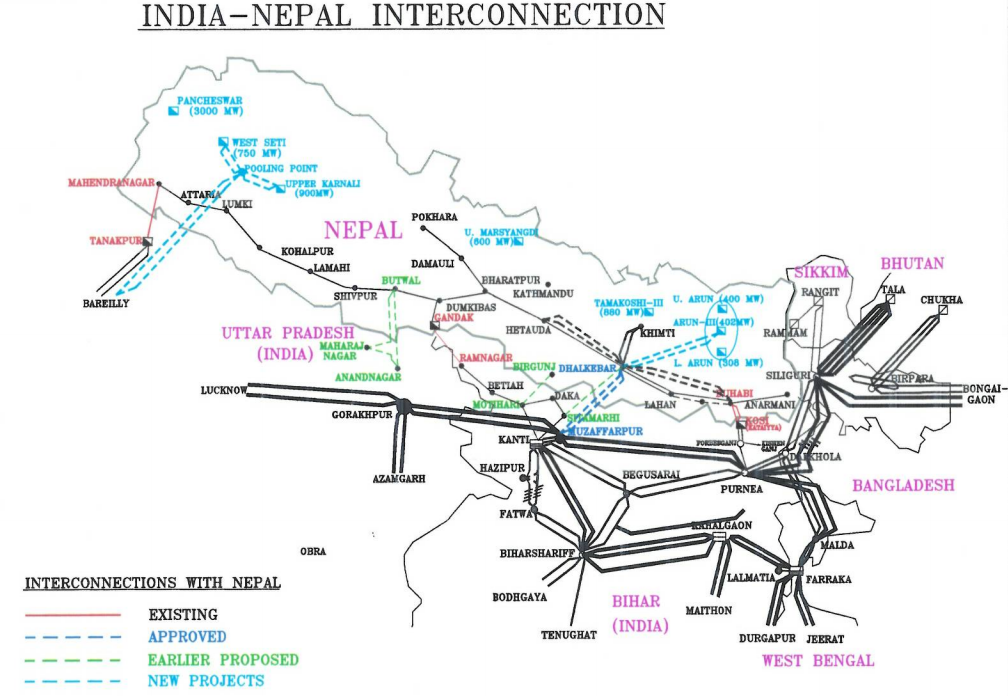
Confirmation that transmission is treated differently. For NEA’s transmission ARR, the draft wheeling charges directives compute return on equity simply “as per last tariff order X%” – no fixed 17% cap. And a real cross-border transmission precedent, the Nepal portion of the 400 kV Muzaffarpur–Dhalkebar line, was allowed an ROE of “15.5% + 2.5%, on post-tax basis” (effectively 18%) per the Nepal Wheeling Charges Directive Workshop – i.e. transmission ROE is structurally set through transmission-tariff principles, above the hydro cap.
Nominal/real, pre/post-tax, on what equity. The 2076 Bylaws do not specify. The ERC-facing modelling treats it as nominal, pre-tax: the Storage Hydro PPA Pricing Discussion Paper Table 8 proposes “Return on equity capped at 17.0% pre-tax … and can be negotiated lower,” and its sensitivity moves “from a nominal ROE of 13.8% to the cap of 17.0%.” It is applied against the actual financing mix (s. 8(6)(ड) requires the real debt-equity ratio), with guidance toward a minimum debt share (e.g. 50%) to stop developers loading costlier equity. The CERC reference the paper cites uses 17.0% post-tax; Nepal’s proposed approach separates tax to pass tax-holiday benefits to consumers.
However, the जलाशययुक्त विद्युत् उत्पादन केन्द्रको विद्युत् खरिद बिक्री सम्बन्धी निर्देशिका, २०८२ does establish detailed mechanisms for managing equity returns, specifically introducing a minimum guaranteed return threshold to protect developers. According to the document, if the internal rate of return (IRR) on equity drops below 10%, the tariff can be adjusted upwards to reach that minimum, provided it stays within the undefined upper cap. The exact relevant verbatim text states: “दफा १६(२)(ख): खण्ड (क) बमोजिम गणना गर्दा स्वपुँजीको इन्टर्नल रेट अफ रिटर्न (आई.आर.आर.) दश प्रतिशत भन्दा कम हुने अवस्था भएमा सोही डिस्काउण्ट रेट प्रयोग गरी उपदफा (१) मा तोकिएको वार्षिक प्रतिफल दरको सीमा भित्र रही आयोजना सञ्चालन अवधिभरिको स्वपुँजीको इन्टर्नल रेट अफ रिटर्न (आई.आर.आर.) दश प्रतिशतसम्म हुने गरी विद्युत् खरिद बिक्री दर वृद्धि हुने गरी पुनः निर्धारण वा पुनरावलोकन गर्न सकिनेछ”. This translates to a mechanism where, if the equity IRR falls below ten percent, the electricity purchase and sale rate can be re-determined or reviewed to increase the equity IRR up to ten percent, while strictly staying “within the limit of the annual return rate specified in Section 16(1)”.
Q6. For a cost-of-service (ARR) build: tax allowance, opex/royalty pass-through, the Regulated Asset Base, true-up cycle, availability penalties and loss treatment.
In short: The existing regulations supports a tax-allowance line and a depreciated-asset return, treats royalty as a separate line rather than buried opex, and confirms an availability-linked, penalty-bearing payout – but it does not codify a formal “Regulated Asset Base” definition, a fixed true-up cycle, or the exact availability percentages the model uses.
Tax allowance and pass-through
The generation methodology includes tax as a separate allowance rather than grossing-up ROE: the Storage Hydro PPA Pricing Discussion Paper Table 8 includes “Estimated taxes included in tariff calculation,” reasoning it “Allows for directly sharing benefit of tax holidays with customers … rather than upwardly adjusting the ROE.” The 2076 Bylaws s. 8(6)(ट) lists “revenue, tax and service charges” as a distinct basis. Royalty is consistently separated from O&M: the Storage Projects Paper splits “Royalties to Government” (capacity and energy) from O&M. Disallowed/non-pass-through items: generation and power purchase are 0% in the transmission ARR (s. 7.1); O&M is a fixed estimate with escalation, not actuals (“incentivising operational efficiencies”); and forex hedging pass-through is judged “unlikely to be applicable to Nepal.”
Regulated Asset Base, IDC and net-versus-gross return
No document codifies a formal “RAB” for transmission. But the cost build-up is supported: the Guidelines for Study of Hydropower Projects, 2018 s. 13.2 requires the financial/base cost to “include … interest during construction,” and s. 10.3 allows civil-works, equipment and transmission-line contingencies. Return is taken on a depreciated (net) base – NEA’s accounting practices observed from its Annual Reports carries assets at net book value, minimum NPR 1 (even after full depreciation) – consistent with the model’s depreciated-capex-plus-IDC RAB.
True-up / rebasing cycle
No rigid annual, 3-year or 5-year cycle is codified. The draft directives (s. 6.2) make a tariff order run “as may be specified in the tariff order” itself. The ERC Five-Year Roadmap 2081–2086 lists “True-ups of Different Tariff Determined” as a target activity, signalling periodic true-ups without fixing the interval.
Availability target and penalties
The mechanism is confirmed; the numbers are not. Section 11.2(d) of the draft directive ties payout to availability, and Section 12 (“Performance Based Incentives and Penalties”) s. 12.1 authorises the Commission to “adopt performance targets, and prescribe incentives and penalties for over or under achievement.” Generally, 98% target / penalty-below-97% are opted in practice but this metric has not been established in Nepal as of yet, the metrics await the s. 11.3 procedure for the draft directive.
Transmission losses
The grid owner bears losses against a hard cap rather than passing them through without limit. The Nepal Electricity Grid Code, 2080 s. 4.4.2.1 mandates: “The Grid Owner shall ensure that the Transmission Loss does not exceed 4.5% of the Received Energy,” with loss defined (s. 4.4.1.5) as (Received − Transmitted − Station Loss) / Received × 100. How the financial cost of losses is split in open access is the subject of the still-draft Dedicated Transmission Lines paper. So a private line should assume it carries loss risk up to 4.5%, not a clean pass-through.
Q7. Indexation and a take-or-pay floor – does any instrument support the CPI escalation or a 100%-must-pay-on-availability floor?
Indexation: No transmission-specific escalator is codified. The nearest grounded indexation comes from the generation-pricing paper.
The Storage Hydro PPA Pricing Discussion Paper Table 12 escalates O&M at “3.0% (in USD nominal terms)” and indexes tariff with weights “US CPI: 80%, Nepal CPI: 20%, Forex: 80%,” using long-term inflation of 2.1% (USA) and 5.4% (Nepal). No transmission directive specifies a fixed-% or CPI pass-through. The model’s 4%-fixed or 50%-CPI is therefore an input choice, not a regulated value – though a partial Nepal-CPI index in the 5% range is the better-supported assumption.
Unlike the discussion paper the official document on जलाशययुक्त विद्युत् उत्पादन केन्द्रको विद्युत् खरिद बिक्री सम्बन्धी निर्देशिका, २०८२ proposes a distinct, regulated escalation mechanism that completely anchors the tariff indexation to domestic economic indicators rather than relying on fixed percentages or foreign exchange weights. Under the clarification of Section 15(3) , the directive mandates that the annual escalation rate be calculated as a 70/30 weighted average of the Consumer Price Index and the Wholesale Price Index, establishing the exact mathematical formula: “वार्षिक वृद्धि दर = ०.७० X उपभोक्ता मूल्य सूचकाङ्क % + ०.३० X थोक मूल्य सूचकाङ्क %”. To ensure a smoothed, historical inflation average is applied rather than a volatile single-year rate, these indices are legally defined as a rolling five-year average issued by the Nepal Rastra Bank.
Take-or-pay floor: Supported in substance. The whole point of the s. 11.2(d) availability payout under draft wheeling charge directive is that the licensee is paid its approved requirement when the asset is available, regardless of flow. That is functionally a 100%-on-availability must-pay. The reservation logic is reinforced by Open Access 2082, which bills long/medium-term users on approved capacity (s. 33(3)), not on energy actually taken – a capacity reservation the user pays for whether or not it flows.
Q8. Does any in-force law impose a transmission royalty, or is the 5% purely a 2080 Electricity Bill’s creation?
In force: There is no transmission royalty in current law. The Electricity Act 2049 levies royalty only on commercial generation. A 5% transmission royalty is a prospective creation of the Electricity Bill 2080 – a future cost, not a present one.
The Electricity Act, 2049 (1992), Section 11 (“रोयल्टी बुझाउनु पर्ने”) ties royalty to installed kilowatts and energy sales from the date of commercial generation: “(१) अनुमतिपत्र प्राप्त व्यक्तिले जलविद्युतको व्यापारिक उत्पादन शुरु गरेको पन्ध्र वर्षसम्म प्रति जडित किलोवाट वार्षिक एकसय रुपैयाँ र प्रति युनिट (किलोवाट घण्टा) सरदर विक्री मूल्यको २ प्रतिशतका दरले नेपाल सरकारलाई रोयल्टी बुझाउनु पर्नेछ।” – Electricity Act 2049, s. 11(1) – NPR 100/kW/year + 2% of average sale price for the first 15 years from commercial generation.
Section 11(2) raises this after fifteen years to NPR 1,000/kW/year and 10% of average sale price. Both legs are computed on generation (installed capacity and energy sold). A transmission-only line transmits and sells no energy, so there is no computable royalty base under the present Act – the Act imposes no transmission royalty at all.
Under the Electricity Bill 2080, the draft bill confirms that a royalty regime is contemplated. The bill explicitly imposes a royalty obligation on transmission licensees based on the revenue they generate from transmission charges. According to Section 36(1) electricity generation and transmission licensees are required to pay royalties to the Government of Nepal. The exact royalty rate for transmission is defined in Section 36(1)(e) which sets the royalty at exactly 5 percent of the received transmission charges.
Part II – Licensing, tenure and asset hand-back
Q1. Is the transmission licence term 25 years or 50, and which governs a concession signed today?
Governing today: Under the current active legislative framework, a transmission concession signed today is strictly governed by the Electricity Act 2049, which allows a maximum statutory term of up to 50 years. However, despite this 50-year statutory maximum established by Section 5(2) of the Electricity Act 2049, the regulatory authority exercises discretion to award shorter terms generally for a period of 25 to 30 years.
Standard Maximum Term The bill officially establishes a baseline maximum tenure of 25 years for electricity transmission. According to Section 19(1)(ga) tenure of license for the electricity transmission, distribution, and trade has been set to a maximum of 25 years. The explanatory notes of the bill for Section 19, clarify that this maximum duration is determined based on the assessment of estimated benefits, costs, and risks.
Extension Matching and Grandfathering Under Section 19(4) the bill includes a specific statutory exception that requires the transmission license tenure to be extended beyond 25 years up to the duration of the generation license if the licensee also holds the generation license. The explanatory notes of the Bill also support the possibility of extending the transmission tenure through renewal based on the principle of necessity to match with the term of the generation license to facilitate project operations. For transmission concessions and licenses already issued before the commencement of this new bill, the tenure will be legally protected and will not be truncated to the new 25-year limit.
Q2. At term end, do the assets pass to the State for free? Any buy-back or compensation?
Yes – free transfer, no exceptions: All transmission infrastructure vests in the Government of Nepal at licence expiry, at no cost, with no buy-back right or compensation provision in either the current Act or the Bill.
Under Section 10 of the Electricity Act: “upon the expiry of the license period, the ownership of the electricity-related infrastructure, including transmission facilities, shall vest in the Government of Nepal,” and that this “applies irrespective of whether the Project was developed with domestic or foreign investment.” The developer “operates the Project within a concessionary framework … subject to … the obligation to transfer the asset to the State at the end of the term.”
The new bill also preserves this provision: Section 23(1) of the proposed bill also mandates that once the license period expires, the licensee must hand back the infrastructure in an operational condition and entirely free of cost. Section 23(1)(kha) also expressly identifies transmission infrastructure as an asset class completely subject to this free hand-back rule. Underlying Principle: The bill’s explanatory notes firmly justify this mechanism as a non-negotiable statutory principle because the developer is utilizing sovereign resources. This is the defining feature of the BOOT structure (Part 0 primer): the asset has zero terminal/residual value to equity. The model must depreciate the asset fully to the hand-back date and assign no salvage to shareholders.
Q3. The survey-licence regime, the documents a transmission application needs, the DoED process and fees, and licence transfer into an SPV.
Survey licence: Up to 5 years, covering feasibility, detailed engineering design and exploration. The Electricity Rules, 2050 (1993), r. 2(gha) defines “survey” as a feasibility study, detailed engineering design and the related exploration for generation, transmission and distribution.
Documents for the transmission (development) licence (Electricity Rules r. 13) include: a Detailed Project Report; route map, right-of-way and single-line diagram; voltage / capacity / conductor / insulator / construction details; a feasibility report with technical and financial analysis and consumer/sales details; financial details; land details; environmental-impact analysis; the PPA, if any; and a map of physical structures within 1.5 km of the line.
Process. Under Electricity Rules r. 16, the Director General investigates the r. 13 applications and forwards a recommendation to the Secretary; if the Secretary deems it appropriate, the licence issues in the Schedule-5 format. The Department of Electricity Development (DoED) is the processing body.
Transmission License Fees – The regulatory framework governing license fees is established in Electricity Rules, 2050 under Annexure 11. While this heading nominally groups survey, generation, transmission, and distribution licenses together, the statutory fee structure is structurally focused exclusively on the installed generation capacity rather than identifying specific parameters for transmission line structures. Consequently, the schedule completely omits a distinct fee framework or transmission-specific identifying metric (such as circuit kilometers or voltage level) for determining transmission licenses. Because the Rules lack a transmission-specific fee the upcoming rules under the new Electricity Bill are expected to bridge this regulatory gap.
Transferring license into an SPV: Permitted with regulatory approval; the license can be transferred to the SPV, even when initially promoted by another entity.
Section 4(5) of the Act and Rule 89 require the prescribed officer’s approval before transfer. Under the Directives on Licensing of Electricity Projects, 2075: a survey-licence transfer is a single-approval process, and if the initial promoter holds at least 25% of the SPV the licence may be transferred on minimal documents (incorporation, PAN, charter, tax clearance, update letters, SPV financial-capacity proof). A development-licence transfer is a two-step process – “in-principle” then “final” approval – requiring board decisions, the SPV shareholder registry, a not-blacklisted declaration, a no-adverse-effect board resolution and, for final approval, a net-worth certificate from a CA, the shareholders’ agreement, the PPA in the SPV’s name and lenders’ letters of interest.
Part III – PPP / BOOT structure, approvals and modalities
Q1. Which law recognises BOOT, and how are the modalities defined?
Basis: Section 17(2) of the Public-Private Partnership and Investment Act, 2076 (PPPIA) recognises BOOT among the permitted modalities. Section 17(2) of the PPPIA enumerates several implementation models … including Build-Transfer (BT), Build-Operate-Transfer (BOT), Build-Own-Operate-Transfer (BOOT), Build-Transfer-Operate (BTO), and other similar modalities,” each “characterized by a transfer requirement, whereby the private entity’s rights … are limited to a concessionary period, after which the project infrastructure must be transferred to the concerned public agency. Discussed principally in Part 0.
Q2. The IBN threshold, the lead agency for a transmission PDA, and competitive bidding.
Threshold: A project with total estimated cost above NPR 6 billion comes under the Investment Board Nepal (IBN), per PPPIA 2075 Section 3. Section 3 of the PPPIA which provides that “ … projects with a total estimated cost exceeding NPR 6 billion must obtain investment approval from the IBN”.
Lead agency: For an energy project, primacy sits with MoEWRI in mutual understanding with IBN; the PDA is signed with the Ministry of Energy.
Competitive bidding: Yes – ARR-based tariff competitive bidding for transmission is now official policy.
The Transmission Directorate 2082 foreword states NEA is “inviting capable investors to develop major high-voltage lines under the ARR-based competitive bidding process,” and the ERC Annual Plan FY 2082/83 sets out study of “Tariff Based Competitive Bidding” for transmission service. The bid parameter implied is the ARR (lowest revenue requirement). In a typical TBCB model, the front-end work of facilitating initial clearances, surveys, and preliminary land processes is expected to be completed by the state / state-promoted entity prior to the bidding handover.
Q3. PDA fees and the IBN application fee
Under the proper name of the source document “सार्वजनिक-निजी साझेदारी तथा लगानी नियमावली, २०७७.pdf” (Public-Private Partnership and Investment Rules, 2020), the statutory financial obligations and fees required for executing a Project Development Agreement (PDA) and obtaining investment approval are explicitly codified.
PDA Negotiation Fee (0.2%) The requirement to pay a 0.2% negotiation fee after conclusion of the agreement and before finalization of the PDA governed by Rule 35(6) of the PPPIR 2077.
PDA Signing Fee or Bank Guarantee (0.1%) Based on the exact statutory text provided in your query, under Rule 36(1) of PPPIR 2077, on arrangements relating to the implementation of the agreement, the investor is legally mandated to submit an amount equivalent to 0.1% of the total estimated project cost, or an equivalent bank guarantee, as a performance security before executing the agreement.
Investment Approval / License Fee (Addressing the Discrepancy) The actual statutory fee for obtaining the investment approval/license is strictly scaled based on the capital band of the project cost under the Annexure 5 of PPPIR 2077.
Q4. Government support, viability-gap funding, and the fast-track infrastructure bill.
PPPIA 2075’s Section 42 offers developers concessional or free government land (s. 42(1)(ga)), below-market loans (s. 42(1)(chha)), and tax exemptions beyond the ordinary (s. 42(1)(gha)). Viability Gap Funding (VGF) is referenced but not built out: the PPPIR 2077 r. 8(3) contemplates “Viability Gap Funding” and the Storage Hydro PPA Paper endorses “viability gap funding” as a concessional-finance mechanism.
Fast-track / Sunset Bill: Proposed, not enacted.
The राष्ट्रिय प्राथमिकता पूर्वाधार संरचना आयोजना विधेयक 2075 empowers a steering committee to select projects (s. 5), accommodates SPVs and joint ventures (s. 11(5)), and requires project time-schedules (s. 13).
Part IV – Taxation & Accounting
Q1. Corporate income-tax rate and the tax holiday for transmission – years, percentages, and the commencement cut-off
Industry Classification: Transmission line projects constitutes an Energy-Based Industry (ऊर्जामूलक उद्योग) under Section 17(2)(Ka) of the Industrial Enterprise Act, 2076. Section 17(2)(Ka) classifies as Energy-Based Industries those industries listed in Schedule 3, and Schedule 3, Item 2 expressly includes “विद्युत प्रसारण लाइन”.
While Schedule 5, Item 20 under IEA separately includes “ऊर्जा घर तथा ऊर्जा प्रसारण लाइनको पूर्वाधार निर्माण व्यवस्था तथा सञ्चालन” under the category of Infrastructure Industries (पूर्वाधार उद्योग), for income tax purposes the specific classification of electricity transmission activities under Schedule 3 remains relevant when interpreting the concessions available under Section 11 of the Income Tax Act, 2058.
Transmission Line Projects are not “Special Industries”: For purposes of the Income Tax Act, 2058, a transmission line project does not qualify as a “Special Industry” (विशेष उद्योग). Explanation (ग) to Section 11 defines a Special Industry as industries classified under Section 17(2) of the Industrial Enterprise Act, 2076 within the categories of Manufacturing Industries (उत्पादनमूलक उद्योग), Agriculture and Forest-Based Industries (कृषि तथा वन पैदावारमा आधारित उद्योग), and Mineral Industries (खनिज उद्योग), subject to specified exclusions. The definition does not include Energy-Based Industries under Section 17(2)(Ka). Since a transmission line project is expressly classified as an Energy-Based Industry under Schedule 3 of the Industrial Enterprise Act, it falls outside the statutory definition of a Special Industry for purposes of Section 11 of the Income Tax Act.
Basic Corporate Income Tax Rate: The starting point for determining the applicable income tax rate is Schedule 1, Paragraph 2(1) of the Income Tax Act, 2058, which provides that, subject to certain specified exceptions, the taxable income of a body corporate is taxed at the rate of 25%. Transmission line companies do not fall within any of the categories subject to the higher 30% rate under Schedule 1, Paragraph 2(2). Accordingly, the baseline corporate income tax rate applicable to a transmission line company is 25%.
Tax Holiday under Section 11(3gha): Section 11(3gha)(ka) provides a sector-specific tax holiday for persons licensed to undertake the commercial generation, transmission, or distribution of electricity. The provision expressly covers entities commencing “विद्युतको व्यापारिक उत्पादन, प्रसारण वा वितरण” within the prescribed statutory deadline and grants a 100% income tax exemption for the first ten years from commencement of commercial operation, followed by a 50% income tax exemption for the subsequent five years. Since the provision expressly includes electricity transmission, a transmission line project falls squarely within the scope of Section 11(3gha)(ka).
Additional Concession under Section 11(3tha): Section 11(3tha) provides that where a body corporate undertakes public infrastructure projects involving construction, operation and transfer to the Government of Nepal, as well as projects involving “विद्युत गृह निर्माण, उत्पादन र प्रसारण”, the entity is entitled to a 20% rebate on the tax otherwise payable on its taxable income. Applying this concession to the ordinary corporate tax rate of 25% results in an effective tax rate of 20%. The provision therefore creates a separate concession specifically available to qualifying electricity generation and transmission activities.
Restriction on Multiple Concessions: The interaction between Sections 11(3gha) and 11(3tha) is governed by Section 11(5) of the Income Tax Act. Section 11(5) provides that where the same income qualifies for more than one exemption or concession under Section 11, the taxpayer may claim only one concession of its choice, except for the concession available under Section 11(2kha). The statutory effect of Section 11(5) is that a transmission line project cannot simultaneously claim both the tax holiday under Section 11(3gha) and the tax rebate under Section 11(3tha) in respect of the same income.
Inapplicability of the Section 11(2kha) Exception: The exception contained in Section 11(5) does not assist a transmission line project. Section 11(2kha) applies only to Special Industries, Hotels, Resorts and Information Technology Industries. As discussed above, a transmission line project is classified as an Energy-Based Industry under Section 17(2)(ka) and Schedule 3 of the Industrial Enterprise Act, 2076 and therefore does not fall within any of the categories covered by Section 11(2kha). Consequently, a transmission line project remains fully subject to the restriction contained in Section 11(5) and cannot combine the concessions available under Sections 11(3gha) and 11(3tha).
Applicable Tax Rate During the First Ten Years: During the first ten years following commencement of commercial operation, the concession under Section 11(3gha)(ka) provides a complete income tax exemption. Since Section 11(5) permits only one concession to be claimed and the exemption under Section 11(3gha)(ka) is more beneficial than the concession available under Section 11(3tha), the project would elect to apply Section 11(3gha)(ka). Accordingly, the effective corporate income tax rate during Years 1–10 is 0%.
Applicable Tax Rate During Years Eleven to Fifteen: For the subsequent five years, Section 11(3gha)(ka) grants a 50% exemption from the otherwise applicable income tax. Applying the exemption to the baseline corporate tax rate of 25% produces an effective tax rate of 12.5%. Since this outcome remains more favourable than the 20% effective rate available under Section 11(3tha), the project would continue to rely on Section 11(3gha)(ka) during Years 11–15.
Applicable Tax Rate After Expiry of the Tax Holiday: Upon expiry of the fifteen-year concession period under Section 11(3gha)(ka), the tax holiday ceases to apply. Subject to continued qualification under Section 11(3tha), the project may thereafter avail itself of the 20% tax rebate available to electricity generation and transmission projects. Applying the Section 11(3tha) rebate to the ordinary corporate tax rate of 25% results in an effective corporate income tax rate of 20% from Year 16 onwards.
Conclusion: Based on Section 11(3gha), Section 11(3tha), Section 11(5), Explanation (ga) to Section 11 and Schedule 1 Paragraph 2(1) of the Income Tax Act, 2058, read together with Section 17(2)(ka) and Schedule 3 of the Industrial Enterprise Act, 2076, a transmission line project is properly classified as an Energy-Based Industry and not as a Special Industry. Accordingly, the project cannot rely on the exception contained in Section 11(2kha) and cannot simultaneously claim multiple concessions under Section 11. The resulting effective corporate income tax rates are therefore 0% during Years 1–10, 12.5% during Years 11–15, and 20% from Year 16 onwards, assuming continued eligibility under Section 11(3tha).
Q2. Financial Accounting and application of IFRIC 12
IFRIC 12 catches a public-to-private arrangement where:
a) the grantor controls or regulates what services the operator provides with the infrastructure, to whom, and at what price; and b) the grantor controls any significant residual interest in the asset at the end of the term.
Both conditions must be met. For the type of transmission line project we have established in Part 0: Q4 and have been discussing thereon:
- Limb (a) is satisfied here: the ERC sets the revenue the line may recover (the ARR) and the wheeling charge, the licensee transmits on a regulated basis rather than choosing its own customers, and grid access is controlled by the system operator/utility. Price and service are both regulated. Regulation through an independent regulator is enough – it doesn’t have to be written into the concession contract itself.
- Limb (b) is the decisive one, and the proposed transmission line project structure makes it straightforward. The project is BOOT, and Section 17(2) of the PPPIA defines BOOT precisely by its transfer requirement – the private entity’s rights are confined to a concession period, after which the asset reverts to the public agency. That is the grantor controlling the residual interest. A transmission line’s useful life (normally 40+ years) also comfortably exceeds a typical 25 year concession, so a real and significant residual interest is handed back at the end. Both limbs met means the arrangement is in scope.
The counterintuitive consequence: the transmission line is not the licensee’s PP&E: This is the part developers consistently get wrong, and Nepal is no exception – the standing practice in the Nepali power sector has been to book these assets as property, plant and equipment, which is not what the NFRS instructs. Despite the “Own” in BOOT and the licensee holding legal title during the concession, the arrangement does not convey the right to control the use of the public-service infrastructure, so it is not recognised as PP&E of the operator. Instead, during construction the licensee is in substance a contractor – it recognises construction revenue (plus a margin) under NFRS 15 and books the consideration as a financial asset and/or an intangible asset rather than capitalising a fixed asset; in the operating phase it recognises O&M revenue under NFRS 15, finance income on any financial asset, and amortisation of any intangible.
Which sub-model to apply and why the transmission line project’s revenue design points to the financial-asset one: IFRIC 12 produces one of three outcomes – financial asset, intangible asset, or a mix – and the choice turns entirely on who carries the risk on the cash. Our established description on transmission line assets – an ARR-built revenue pool with the individual licensee paid on availability – leans hard toward the financial-asset model. Availability payments are the classic case: the line earns for being available, not for MW actually flowing. The single fact that decides it is whether that availability entitlement is firm – a guaranteed, determinable amount the licensee is owed regardless of throughput, whether paid directly by NEA or topped up by the grantor (ie. grid owner) when the wheeling pool under-collects. If it’s firm, financial asset. If part of the payment is genuinely contingent on usage with no backstop, you bifurcate that portion as an intangible (the mixed model). This is also where a transmission line differs from the hydro-PPA commentary circulating in Nepal, which tends to land on intangible — that reflects a generator assuming the hydrology and therefore by extension the demand risk (deserves a separate discussion altogether), unlike in the transmission projects where the line is paid for availability.
What would flip the answer to “no” for IFRIC 12: Mostly the residual-interest limb. If the deal is finalised as BOO (no transfer) and the line is treated as a permanently owned, rate-regulated asset, it drops out of IFRIC 12 and back into ordinary PP&E plus rate-regulated-activity considerations – the standard mapping is BOOT to IFRIC 12, BOO to the PP&E standard. It would also fail if, implausibly here, the ERC didn’t genuinely control price and service, or if the line were a merchant asset rather than a regulated concession.
Two caveats worth stating: First, the classification discussed above for IFRIC 12 isn’t final until the documents are. We’ve already flagged above that the wheeling-charge directive and the discussion paper are drafts and that neither leg is yet binding – IFRIC 12 treatment turns on the executed PDA and tariff terms (set here through Transmission Service Agreement – TSA), so the above analysis is “very likely, subject to final terms,” not “settled.” Second, this isn’t a foreign import: NFRS 2018, including the IFRIC and SIC interpretations, was pronounced by ICAN for implementation, effective 16 July 2020, so the service-concession appendix is live in Nepal.
Q3. Financial Asset & Intangible Asset Model explained to a dummy
Refer to this link for the explanation.
Q4. The Implicit Cost or Gain from ARR Socialization
Core Principle: ARR socialization does not necessarily increase or decrease the private transmission licensee’s approved income. If the availability-payment right is firm, the licensee receives its approved ARR multiplied by availability. What socialization changes is the payer base: the cost of a specific private line is no longer recovered only from the direct users of that line, but from the wider transmission system through a uniform charge.
Collection versus Payout: The NPR/MW/month rate is a collection tariff, not the compensation formula for the transmission line project. The draft framework first determines the total revenue requirement of all transmission licensees, then determines the wheeling charge, sets up a pool, and pays each licensee from that pool linked to availability. In other words, users pay into the pool using the socialized tariff; the private licensee is paid out of the pool based on its approved ARR and actual availability.
Illustration: If the total wheeling ARR is NPR 44,899 million and the previous year’s coincident peak demand is 2,467 MW, the uniform charge is NPR 44,899 million ÷ (12 × 2,467 MW), or approximately NPR 1,516,662 per MW per month. If a West Seti-type transmission line has an approved ARR of NPR 4,489 million within that total, the SPV does not receive NPR 1,516,662 multiplied by the physical MW capacity of its line. At 100% availability, it receives NPR 4,489 million; at 80% availability, it receives NPR 3,591 million.
Socialized Cost of the Private Line: West Seti’s inclusion increases the national wheeling charge by NPR 4,489 million ÷ (12 × 2,467 MW), or approximately NPR 151,636 per MW per month. That is the implicit socialized cost of adding that line to the national pool. The line’s cost is spread across the system even if the direct benefit is concentrated in a particular corridor or group of connected generators.
Standalone versus Socialized Recovery: Under a standalone model, the line’s ARR would be recovered from its direct beneficiaries: for example, the hydropower projects or users connected to that corridor. Under socialization, the same ARR is spread over the national peak-demand denominator. If the national denominator is larger than the dedicated-line denominator (proportionally compared), the direct beneficiaries gain because their line-specific cost is diluted into the national tariff. The wider consumer base bears the corresponding cost, unless the line creates wider system benefits such as reliability, congestion relief, power evacuation, or cross-border trade capacity.
Why NPR/MW/month and not NPR/MWh: Transmission ARR is primarily a fixed-capacity cost, not an energy-volume cost. Towers, conductors, substations, protection systems, O&M readiness, debt service and return on capital are incurred because the network must be capable of carrying peak load. MW measures capacity that must be kept available; MWh measures actual energy transmitted. For long-term recovery, NPR/MW/month therefore better matches the cost driver. NPR/MWh is more suitable for short-term access, losses, or energy-linked charges – which is also the principle adopted in the Open Access Directive 2082 as well (NPR/MW for high voltage grid like 132 kV, 220 kV, 400 kV and NPR/MWh for low voltage Distribution lines like 33 kV and below).
Retail Consumer Impact: Ordinary retail consumers may not directly reserve MW, so they may not see a separate NPR/MW/month line on their bills. The transmission ARR would normally be recovered through NEA’s regulated retail tariff structure, including fixed charges, demand charges for larger users, energy charges, or cross-subsidy between consumer classes. Thus, NPR/MW/month is the upstream regulatory pricing unit; NPR/kWh may still be the downstream billing unit for many consumers.
Accounting and Bankability Implication: If the private SPV has a firm right to receive approved ARR when the line is available, the model supports financial-asset accounting under IFRIC 12 / NFRS because the operator has a determinable right to cash rather than exposure to actual line usage. However, if pool under-collection, delayed recovery, or user-payment default is passed through to the SPV without a backstop, the SPV still carries collection or demand risk. That would weaken the availability-payment logic and may require mixed-model analysis.
Conclusion: The implicit gain from ARR socialization is not that the private licensee automatically earns more than its approved ARR. The gain is that its recovery becomes broader, more stable, and less dependent on the actual users of the line. The implicit cost is borne by the wider grid users, who pay a higher socialized charge to fund a line whose direct benefits may be narrower. The key regulatory question is therefore not only the approved ARR, but also who bears any pool under-collection and whether the line’s system-wide benefits justify spreading its cost nationally.
Q5. Tax Accounting and Statutory depreciation
This is not a settled law so the interpretation is that: A privately developed transmission line built under a BOOT concession is, in the operator’s hands, characterised one way for financial reporting and the exact opposite way for tax. IFRIC 12’s principle is that – the operator owns no line – it owns a financing receivable from the State or an intangible asset representing the authority to charge the public users. Under the Income Tax Act, 2058 the operator is treated as the tax-owner of a depreciable asset. Same line, same cash, two mutually exclusive financial characterisations.
What follows below is even more interpretations: Our general instinct is to ask which one is “right” which is in fact a wrong question. NFRS and Tax Law are not competing to govern the accounting; they govern two different ledgers. The financial statements stay on NFRS/IFRIC 12. The computation of taxable income follows the tax law – and for that computation, the tax law wins, by force of the text of the law in act, rules in the regulations and the interpretations provided in the directive. And also, the difference between the two is not an error to be reconciled but something that is eventually bridged with deferred tax accounting.
So the note below sets out the conflict in three layers: the characterisation, the authority that resolves it, and the revenue corollary and deferred-tax bridge that follow.
Layer 1: One asset, two characterisations
The IFRIC 12 side. Because the regulator and the State control the service, the tariff mechanism and the residual interest at expiry, the operator does not recognise the line as property, plant and equipment. During development under the principle of IFRIC 12 the developer recognizes the assets as a financial asset, an intangible asset, or a mix, depending on the payment right. Given Nepal’s proposed ARR-based, availability-linked model for transmission line projects – where the operator has a contractual right to cash tied to approved revenue requirements rather than actual line usage – the financial-asset model under IFRIC 12 dominates. In operation it recognises availability revenue, O&M revenue and finance income (effective interest unwinding the financial asset), no depreciation, and a nil residual at transfer.
The Income Tax Act side. The Act runs in the opposite direction. Section 19(1) requires depreciation, per Schedule 2, on “the depreciable properties owned and used by that person” in earning business or investment income. However, this general regime is overridden by Section 19(2), which begins with a non-obstante clause and creates a special depreciation framework for infrastructure concession projects, including BOOT-type arrangements for public infrastructure and electricity generation and transmission projects. This provision reflects an underlying legislative assumption that such projects are still fundamentally depreciable-asset based structures under Section 19(1) that required more targeted reliefs under Section 19(2), despite eventual transfer to the Government of Nepal.
Key implications, direct and implied through Section 19(2) are:
1. Depreciation pooling remains the base treatment: Transmission assets are typically classified under Group “D”, and depreciated at Schedule 2 rates, with enhanced rates (commonly one-third higher) available for qualifying infrastructure projects.
2. Accelerated treatment for infrastructure-specific costs: Section 19(2) allows more flexible and accelerated write-off of capital expenditures, particularly for replacement and renewal of plant and equipment, reflecting the heavy maintenance profile of transmission infrastructure.
3. Terminal deduction at handover: Any remaining written-down value at the end of the concession may be fully written off, ensuring no stranded tax basis upon transfer to the State.
4. Land and right-of-way treatment: Land-use rights and ROW costs are generally treated as Group “E” assets, amortised over the concession period in line with administrative guidance (e.g., Income Tax Directive 2066, Example 18.6.21).
The structural implication from this is that: Unlike IFRIC 12, which replaces infrastructure with a financial asset or intangible right, Nepal’s tax law retains a modified tangible-asset model, supplemented by targeted concessions under Section 19(2). The result is a system that taxes BOOT projects through depreciation pools with accelerated and terminal reliefs, rather than through financial asset recognition logic.
Furthermore, under section 2(ka dha) of the Act “Property” expressly includes “a right to make income or acquire income in the future” – so a concession receivable is property. But under section 2 (ka ra) a depreciable asset is defined by deterioration “due to wear and tear, passage of time or… age,” and a receivable does not deteriorate. It therefore falls into the residual category – a “business asset,” which the Act under Section 2 (ka ta) defines as property used in an occupation but which “does not include… depreciable assets.” The categories are mutually exclusive. Since section 19(2) independently commands that the same infrastructure be treated as a depreciable asset, we can safely assume that the Act resolves the collision in favour of treating BOOT assets as modified tangible-asset models.
Layer 2: The objective and scope of tax law and reporting framework
We should not lose precision on the objective of the tax law: the Act does not rewrite the financial statements. NFRS/IFRIC 12 governs the books. The Act governs only the computation of taxable income. So the honest answer to “does tax law dictate the accounting of this asset differently from IFRIC 12” is – no for the accounts, yes for the tax base. And the gap between them is exactly why deferred tax exists.
The statutory provision is Section 22(1): The matter when any person gets any income or makes any expense shall be determined in accordance with the widely recognised accounting principle, subject to this Act.
The phrase subject to this Act (यस ऐनको अधीनमा रही) is the operative command. Generally accepted accounting principles set the default timing of income and expense, but they are strictly subordinate to any specific provision or intent of the Act. Rule 8 of the Income Tax Rules, 2059 then plugs in: Rule 8(1) directs that, for the purpose of tax accounting under Section 22, where a prevailing-law accounting standard exists it shall be followed; Rule 8(2) devolves to international principle or practice only where no such standard exists. Accounting standards / NRFS thus enter the tax computation as a subordinate, gap-filling default – not a primary authority that can override the Act.
The resulting hierarchy (also established in Income Tax Directive 2066’s para 8.2.2) is therefore:
1. Specific provisions of the Act (primary)
2. General provisions of the Act and the Rules (secondary)
3. Accounting standards / NFRS, via Rule 8(1) (tertiary)
4. International principles or practice, via Rule 8(2) (quaternary)
The Income Tax Directive sits below all of these – subordinate departmental guidance, automatically inactive to the extent it conflicts with the Act or Rules. It is useful as the IRD’s interpretation of “subject to this Act,” not as the source of the rule. The interpretations provided in para 4.2.2 of the directive also states that: “If this Act has an intent different from the generally accepted accounting principles, the provision of this Act shall apply” (लेखाको सर्वमान्य सिद्धान्त भन्दा फरक आशय यो ऐनमा भए यो ऐनको व्यवस्था नै लागू हुन्छ।) – which also although is not a standalone authority but confirms the supremacy of the specific provision of the act.
So the conclusion would be: where the Act carries specific rules – Section 19 on depreciation, Sections 7 and 24 on income, Schedule 2 on pooling – those displace the accounting treatment for the tax base. On BOOT infrastructure the Act is conspicuously not silent: it carries a purpose-built regime in Section 19(2), reinforced by the identical project language in the Section 20 loss-carry-forward proviso. IFRIC 12 therefore fills no gap – neither on the asset recognition nor the income recognition. Section 19(2) operates as lex specialis, overriding the IFRIC 12 characterisation for the computation of taxable income.
Layer 3: The revenue corollary
A tempting half-measure is to accept the Act’s depreciable-asset treatment but keep IFRIC 12’s revenue – construction margin during the build, finance income thereafter. That does not survive scrutiny, because IFRIC 12 is one integrated model. Its revenue recognition is a consequence of its asset characterisation, not a severable bolt-on. If we rule out the asset recognition under IFRIC 12 the revenue recognition should goes with it, for four linked reasons:
1. No financial asset, so no finance income. Finance income in IFRIC 12 is the effective-interest unwind of the financial asset. If the Act recognises no such asset, there is nothing to unwind – and the Act gives a non-financial operator no head of charge resembling “effective interest on a concession receivable.” That line disappears.
2. Self-construction is not a sale, so no construction margin. IFRIC 12 construction revenue exists because the operator is treated as selling construction services to the grantor in exchange for the asset. The Act treats the operator as building its own (deemed-owned) asset, and one does not book taxable revenue for building one’s own asset. The EPC and IDC spend is capitalised into the asset’s cost base under Section 38 and recovered only through depreciation; Section 21 confirms that capital expenditure is not separately deductible except via the specified deduction sections. Therefore the construction margin disappears too.
3. What remains taxable is the real money. Only the actual operating consideration – the availability fee / ARR-based tariff – is taxable, as business income under Section 7, recognised on the accrual basis under Section 24(1) “considering that any payment has been received immediately when the right to receive such payment is created.” That is the contractual entitlement under the tariff order, not the notional mathematical spreading of effective interest or the amortization of intangible assets.
4. The decisive rule. Rule 8 imports accounting standards only where the Act is silent. The Act is silent on neither leg – the asset side is governed by Section 19(2), the income side by Sections 7 and 24. Because both legs are covered, “subject to this Act” displaces the IFRIC 12 mechanism in its entirety. A hybrid – the Act’s asset with IFRIC 12’s revenue – is precisely what “subject to this Act” would be, therefore a cherry-picking gap-fill, and one that is not necessary either.
So the principle, stated cleanly: the Act through the specific provision of asset recognition and depreciation methods, does not merely substitute a different asset; it substitutes the accompanying income model as well. Taxable revenue reverts to ordinary business income on the actual tariff receipts when the right to receive arises, with cost recovered only through depreciation. Two caveats keep this defensible. First, this is the project-company-as-owner-builder case. In practice the SPV still prepares IFRIC 12 accounts, so the mechanism operates as a set of book-to-tax reversals – strip out construction revenue, margin, finance income (ie. standalone pricing delineation) and the financial-asset movements; substitute tax depreciation and business income on receipts – with the cumulative effect parked in deferred tax. Second, if the EPC is let to a separate contractor entity, that contractor genuinely earns construction revenue taxable under Section 26 (long-term-contract, percentage-of-completion). The “no construction revenue” point is about the concessionaire building its own asset, not about a third-party EPC contractor.
So what is the conclusion? Does the Income Tax Act guide the accounting of a BOOT transmission asset differently from IFRIC 12? It guides the tax accounting of the asset in a way that is fundamentally different – depreciable asset, business income, terminal write-off – while leaving the financial reporting untouched on IFRIC 12. Section 19(2) is lex specialis that overrides IFRIC 12 for the computation of taxable income, by force of the “subject to this Act” command in Section 22(1) and the gap-filling-only role of accounting standards under Rule 8. The operator must therefore carry two parallel characterisations of one line and bridge them, every year, with deferred tax. For a financial reporting purpose the implication is concrete. Build the NFRS layer on IFRIC 12 – financial asset, finance income, nil residual. Run a parallel tax layer – Schedule 2 pool at the accelerated rate, tariff receipts as business income, terminal write-off on transfer. Overlay deferred tax, and model the tax holiday and the transfer event explicitly. The construction margin and finance income that flatter the NFRS profit-and-loss are tax-irrelevant; the cash tax is driven by tariff receipts less depreciation. A model that conflates the two will misstate both the tax charge and the equity return.
Q6. Withholding tax, capital gains, indirect taxes and loss carry-forward.
Dividend withholding. Reported at 5% (Income Tax Act 2058, s. 88), a final tax on distributions (s. 92). The holiday on the SPV’s corporate income does not exempt the shareholder’s dividend tax.
Capital gains. Withholding tax applicable at 10% for a resident individual, 15% for a resident entity and 25% for others on disposal of an interest in a non-listed entity (Income Tax Act 2058, s. 95ka) – relevant to a future sale of SPV equity. Withholding responsibility under the act is on the entity whose interest is being disposed of.
Similarly, withholding tax applicable at 7.5% for a resident individual with holding period > 365 days, 10% for a resident individual with holding period ≤ 365 days, 10% for a resident entity and 25% for others on disposal of an interest in a listed entity (Income Tax Act 2058, s. 95ka) – relevant to a future sale of SPV equity. Withholding responsibility under the act is on the entity operating the securities exchange market – practically this responsibility is devolved to the brokers in the securities business.
Indicative Assessment on Indirect Tax Framework.
Yes. The previous version became too generic and lost the legal anchors. If this is for a financial model assumptions paper, it is better to retain the statutory references while still keeping it concise.
Indirect Taxes
For qualifying electricity generation, transmission, and distribution projects based on hydropower, solar, or wind energy, indirect tax concessions are principally derived from the PPPIR 2077, the IEA 2076, the VAT 2052, and the Integrated Customs Tariff issued under the Customs regime. Under Rule 44 of the PPP Rules, 2077, goods imported for project construction may be entitled to exemption from customs duties and other taxes and fees, subject to the prescribed recommendation and approval process, with a bank-guarantee mechanism available for temporary imports intended for re-export.
The IEA 2076 classifies electricity transmission as an Energy-Based Industry and, under Section 25 provides for customs duty on machinery and industrial equipment imported for industrial use at the minimum applicable rate. The VAT framework provides additional relief through Schedule 1, Group 11 (Item 11) of the Value Added Tax Act, 2052, under which specified imports and supplies of construction equipment, machinery, tools, spare parts, batteries, raw materials and related items for qualifying electricity production, distribution and transmission projects may be exempt from VAT, generally upon recommendation of the competent authority. In addition, Schedule 2, Item 6 provides a zero-rated VAT mechanism for certain locally manufactured machinery, tools, spare parts and construction materials supplied to such projects.
Further, the Integrated Customs Tariff, 2082/83 provides a concessional customs framework for qualifying electricity projects. Under Note 1 appearing across various tariff chapters (including Chapters 36, 72, 74, 76, 83, 84 and 85), eligible construction equipment, machinery, tools, spare parts, batteries and related items imported for the production, storage, transmission and distribution of hydro, solar and wind electricity may be subject to a 1% customs duty rate together with VAT exemption, subject to the required recommendations and project approvals. The concession generally extends to equipment classified under tariff headings relevant to transmission projects, including transformers (Heading 85.04), control systems and panels (Heading 85.37), and conductors and cables (Heading 85.44).
Note – VAT/customs and CGT/WHT figures are directionally correct but they need to be verified with the original source for certainty.
Q7. Transferring the licence into the SPV – is it a taxable disposal for the parent entity, and how is the charge avoided?
Yes, unless structured around it: Transferring a licence into the SPV is a disposal of an intangible/business asset under the Income Tax Act 2058 and can crystallise a taxable gain for the parent entity – but the associate-transfer rollover (s. 45) can defer it, and direct DoED issuance to the SPV avoids the disposal entirely (however the deemed economic transfer risk of characterization risk still prevails).
That default / deemed taxation method is displaced where the contribution qualifies for the associate-transfer rollover in s. 45(2). Because the project company is an associate of the promoter / parent entity and the promoter is contributing rather than selling, the disposal can be deemed to occur at tax base: incoming equals outgoing, no gain is recognised, and the company inherits the promoter’s cost base, carrying the latent gain forward to a later genuine disposal. The relief is not automatic. Section 45(6) requires that the licence remain a business asset in the company’s hands immediately after transfer; that both parties be resident and the company not tax-exempt; that there be continuity of underlying ownership of at least 50 per cent – in practice, that the promoter retain 50 per cent or more of the company after the contribution; and, easily overlooked, that both parties make a written election to the tax office. Absent that election the market-value default reapplies and the charge crystallises by operation of law, whatever the parties intended. The practical course for a promoter retaining control is therefore to contribute the licence in a way that satisfies s. 45 – 50 per cent-plus retained ownership and a filed joint election – not through a marked-up transfer; where a depreciable intangible rather than a business asset is in point, the parallel rule in s. 45(3) rolls it over at the pool’s written-down value, and where a clean disposal cannot be avoided, the valuation the tax authority will accept is the matter to confirm.
Q8. Cross-border withholding under the India DTA – interest and dividends
Cross-Border Withholding under the India DTAA
Under the Double Taxation Avoidance Agreement (DTAA) with India, the withholding tax rates for cross-border payments are capped as follows:
| Income Type | Treaty Provision | Maximum Withholding Tax |
| Dividends | Article 10 | 5 percent of the gross amount where the beneficial owner is a company owning at least 10 percent of the shares of the company paying the dividends; 10 percent in all other cases. |
| Interest | Article 11 | 10 percent of the gross amount of the interest. |
Comparison with Other Countries (DTAA Variation)
The provisions are not the same for all countries. Withholding caps vary significantly across Nepal’s DTAA partners as documented in the table below.
| Country | Dividend Withholding Cap |
| China, Qatar | Flat 10 percent cap regardless of shareholding. |
| Austria, Norway, South Korea | 5 percent where ownership is at least 25 percent; 10 percent where ownership is at least 10 percent; otherwise 15 percent. |
| Mauritius | 5 percent where ownership is at least 15 percent; 10 percent where ownership is at least 10 percent; otherwise 15 percent. |
| Thailand, Sri Lanka | Generally 15 percent. |
| Country | Interest Withholding Cap |
| India, China, South Korea, Qatar | 10 percent. |
| Austria, Norway, Bangladesh, Sri Lanka | General cap of 15 percent, reduced to 10 percent where the interest is paid to a bank. |
Specific Withholding Provisions in the Income Tax Act, 2058
The Income Tax Act, 2058 contains its own statutory withholding tax (TDS) provisions that interact with the treaty caps. Pursuant to the Protocol to the India DTAA, where domestic law provides a more favourable outcome to the non-resident, the domestic law rate applies.
| Payment Type | Provision | Rate | Remarks |
| Dividends | Section 88(2)(a) | 5 percent | Final withholding tax on dividend distributions by a resident company. |
| Interest (general) | Section 88 | 15 percent | Standard withholding rate on interest. |
| Interest on qualifying foreign currency loans for hydropower projects | Section 88(9a) | 5 percent | Applies to foreign currency loans obtained from foreign banks or financial institutions by eligible hydropower projects (above 200 MW, storage, or peaking run-of-river) achieving financial closure by specified date. |
| Interest on foreign currency loans for NRB-prescribed sectors | Section 88(9) | 5 percent | Applies to foreign currency loans obtained by resident banks or financial institutions for sectors prescribed by the Nepal Rastra Bank. |
Accordingly, while the India DTAA generally limits interest withholding to 10 percent, the domestic law concessions under Sections 88(9) and 88(9a) may reduce the applicable withholding tax to 5 percent, consistent with the Protocol’s more-beneficial-treatment rule.
Most Favoured Nation (MFN) Clause
Many of Nepal’s treaties, including those with India, Mauritius, South Korea, and Norway, contain a Most Favoured Nation (MFN) clause in their Protocols. These provisions ensure that if Nepal subsequently agrees to a lower withholding tax rate with a third state, that lower rate will automatically extend to the treaty partner benefiting from the MFN clause. For example, if a future treaty were to provide a lower royalty or interest withholding rate than the 15 percent or 10 percent rates contained in these treaties, the lower rate could become available to the existing treaty partners, subject to the terms of the relevant MFN provision.
Part V – Capital and operating cost benchmarks
Q1. Capital Cost Benchmarks
Source Document: Energy Development Roadmap 2081
Reporting Horizon: Benchmarks applicable for energy project development planning up to 2081 B.S. (≈ 2024/25 A.D.), with projections extending to 2035 A.D.
Project Cost Benchmarks: Roadmap’s Section 9.1 establishes the consolidated unit-cost baselines for generation, transmission, and distribution infrastructure across all standard voltage classes and project typologies.
1. Transmission Line Costs (per circuit-km, by voltage): The roadmap sets the per-circuit-kilometre unit cost for double-circuit transmission lines, scaled strictly by voltage level. A 400 kV line is benchmarked at USD 350,000 per circuit-km; a 220 kV line at USD 200,000 per circuit-km; and a 132 kV line at USD 125,000 per circuit-km. The same clause additionally specifies that for multi-circuit projects, the applicable cost is double the stated base figure – i.e., USD 700,000, USD 400,000, and USD 250,000 per circuit-km respectively.
2. Generation Project Costs (per MW, by typology): For hydropower generation, the roadmap standardises the average unit cost per installed megawatt across three typologies. Run-of-River (RoR) projects carry an average cost of USD 1,600,000 per MW; Peaking Run-of-River (PRoR) projects carry USD 1,800,000 per MW; and Storage / Pumped Storage projects carry USD 2,700,000 per MW – reflecting the progressively higher civil-works and reservoir complexity of the latter two categories.
3. Distribution Line Costs (per circuit-km, by voltage): Roadmap extends the per-circuit-kilometre framework down to the distribution tier. A 33 kV distribution line averages USD 13,000 per circuit-km; an 11 kV line averages USD 11,000 per circuit-km; and a 0.4 / 0.23 kV low-voltage line averages USD 9,500 per circuit-km.
4. Substation & Distribution Asset Costs: Roadmap also standardises discrete-asset costs. Substation capacity addition is set at an average of USD 80,000 per MVA. A complete 33/11 kV substation is benchmarked at an average of USD 925,000 per unit. A distribution transformer is benchmarked at an average of USD 4,000 per unit. Together these three line items cover the standard unit costs for grid-side assets in any distribution-network roll-out plan.
5. Land Acquisition Cost for Transmission Structures: Roadmap closes the cost block with a land-acquisition rule: approximately 30% of the average construction cost of the transmission structure is to be provisioned for land acquisition – a single multiplier that can be applied directly to any of the transmission unit costs above.
Construction Periods: Section 9.1 standardises the average construction duration for each hydropower typology. Run-of-River (RoR) projects are benchmarked at an average of 4 years from financial close to commercial operation; Peaking Run-of-River (PRoR) projects at 6 years; and Storage / Pumped Storage projects at 7 years. These durations drive the cash-disbursement and employment-generation profiles that follow.
Annual Cash Disbursement Schedules: Section 9.1 standardises how project capital is distributed across construction years, providing the cash-flow curves needed for reinvestment and financing models. The schedules are tabulated separately for generation and transmission because their construction profiles differ materially.
Hydropower Generation Projects: Per Section 9.1 the annual cash-disbursement schedule:
1. For a RoR project (4-year period) is Year 0 at 5%, Year 1 at 20%, Year 2 at 25%, Year 3 at 35%, and Year 4 at 15%.
2. For a PRoR project (6-year period), the schedule is Year 0 at 3%, Year 1 at 10%, Year 2 at 16%, Year 3 at 21%, Year 4 at 33%, and Year 5 at 17%.
3. For a Storage / Pumped Storage project (7-year period), the schedule is Year 0 at 2%, Year 1 at 9%, Year 2 at 14%, Year 3 at 18%, Year 4 at 28%, Year 5 at 14%, and Year 6 at 14%.
Across all three, the front-end years are deliberately lighter and the mid-construction peak shifts later as project complexity increases – a useful pattern for stress-testing refinancing windows.
Transmission Line Infrastructure: Per Section 9.1, the transmission-line disbursement schedule is keyed to the total build duration.
1. A 1-year build is 100% in Year 1.
2. A 2-year build is 50% / 50% across Years 1 and 2.
3. A 3-year build is 30% / 30% / 40% across Years 1–3.
4. A 4-year build is 10% / 30% / 30% / 30% across Years 1–4.
5. A 5-year build is 5% / 15% / 20% / 30% / 30% across Years 1–5.
Note that transmission disbursements are more front-loaded than generation, with meaningful spending beginning in Year 1 even on the longest builds.
Other standard references – such as energy generation benchmarks, financial and tariff benchmarks, government royalty structures, and employment generation – are also included in the roadmap, but since they are more relevant to generation plants, they are not covered in this post.
Q2. Per-circuit-km line costs by voltage – what recent Nepali projects actually show.
132 kV – recent double-circuit projects (from the NEA Annual Reports 2023–2025):
| Project (132 kV) | Length | Estimated / contract cost (line + substation) |
| Kaligandaki–Ridi (DC, ACSR Bear) + Kuseni substation + GIS bay | 22.45 km | NPR 1,450 million |
| Lalbandi–Salimpur (DC, ACSR Bear) + Chainpura substation | 20 km | NPR 1,258.71 million |
| Dhalkebar–Balganga (DC, ACSR Cardinal) + 2×63 MVA substation | 24 km | NPR 2,136 million |
| Kohalpur–Nepalgunj (DC, ACSR Bear) + 2×63 MVA substation | 9 km | USD 12 million |
| Raxaul–Parwanipur 2nd circuit (stringing on existing towers) | 22 km | USD 1.5 million |
Note the Raxaul–Parwanipur outlier: re-stringing a second circuit on existing towers is an order of magnitude cheaper – a useful sensitivity for brownfield corridors.
220 kV – double-circuit unless noted:
| Project (220 kV) | Length | Estimated / contract cost |
| Tumlingtar–Sitalpati (DC) + 220/132/33/11 kV hybrid substation | 14 km | NPR 4,482 million |
| Borang–Lapang–Ratmate (mixed 132/220 kV, GIS + AIS) | ~48 km | USD 39 million |
| Chilime–Trishuli + 2×160 MVA substation (line only) | 28 km / 72 ckm | USD 6.43 million + NPR 547 million |
| Koshi Corridor KC1 (single-circuit stringing on DC towers) | 106 km | USD 39.227 million |
| Lekhnath–Damauli (DC) + two GIS substations | 45 km | USD 90 million (with KfW) |
400 kV – the backbone projects:
| Project (400 kV) | Length | Estimated cost |
| Hetauda–Dhalkebar–Inaruwa (DC) + three substations | 288 km | ~USD 170 million |
| Inaruwa–Anarmani (DC) + 400/132 kV GIS (2×315 MVA) | 89.6 km | USD 121.88 million |
| Tamakoshi–Kathmandu (400/220/132 kV mix) + GIS | ~93 km | ~NPR 14 billion |
Q3. Contingencies, IDC and the West Seti capex reference.
Contingencies and IDC (CAP-5, CAP-6). The Guidelines for Study of Hydropower Projects, 2018 s. 10.3 requires physical and price contingencies and IDC in the cost build-up, but does not specify any fixed percentages. A practice of allocating 7%/8% towards contingencies is generally normal. What is also important to factor in is the overrun risk: the Storage Hydro PPA paper records the 456 MW Upper Tamakoshi rising “from an initial estimate of NPR 49 billion to NPR ~85 billion … a 73% cost overrun (including interest),” against an international average of ~33% for post-2000 hydro. That argues for generous contingency and an IDC stress. A similar standard for transmission line’s contingencies is yet to be established.
West Seti reference for cross checking. Applying the roadmap benchmark of USD 700,000 (USD 350,000 × 2) per circuit-km for a 400 kV double-circuit transmission line, the 213 km West Seti Corridor would have an estimated line cost of approximately USD 149.1 million – established in Q1 of this section. Compared to the project’s total estimated cost of USD 204.27 million (see this priority transmission project list), this implies a premium of about USD 55.2 million (37%), which is reasonable given that the project scope also includes two substations (315 MVA and 160 MVA transformer capacity) and associated infrastructure beyond the transmission line itself.
Q4. Technical parameters – conductor rating, power factor, losses, right-of-way, spans and substation sizing.
Capacity. The formula MW = √3 × kV × A ÷ 1000 × power factor × circuits is a standard three-phase AC power formula used to estimate the indicative evacuation capacity of a transmission line. In this formula, √3 is the three-phase system constant, kV is the transmission voltage, A is the effective current-carrying capacity per circuit, ÷ 1000 converts kV × amps into MW scale, power factor adjusts apparent power into real power, and circuits reflects whether the line is single-circuit or double-circuit.
For the West Seti Corridor. The project data provides a 400 kV voltage level and identifies the line as a double-circuit line with ACSR Quad Moose conductor, meaning four Moose sub-conductors are used per phase. If each Moose sub-conductor is conservatively taken at approximately 500 amps, the effective circuit current is approximately 2,000 amps per circuit. Using a 0.90 power factor as a reasonable engineering assumption, the estimated evacuation capacity is therefore 1.732 × 400 × 2,000 ÷ 1000 × 0.90 × 2, which equals approximately 2,494 MW, or about 2,500 MW.
Power factor means that the Nepal Electricity Grid Code 2080 Section 6.7 “Operational Requirements for Large Generators” – requires generating units to be capable of operating within a range of 0.85 lagging to 0.95 leading power factor. A model assumption of 0.90 power factor falls within that range, so it is reasonable for indicative calculation purposes. However, the Grid Code provision relates to generator reactive-power capability, not directly to the fixed transmission capacity of a line. Therefore, 0.90 is a reasonable modelling assumption, but it is not a legally prescribed parameter for calculating transmission-line capacity.
Transmission availability. No minimum design-availability benchmark has yet been prescribed under Nepal’s existing electricity regulatory framework. However the forthcoming wheeling charge directive or related transmission-tariff methodology has been modeled to consider the availability factor while compensating the transmission line projects based on their availability.
Transmission losses. Nepal Electricity Grid Code 2080, under Chapter 4 “Performance Standard for Grids”, in subsection 4.4.2 “Maximum Transmission Loss” contains the verbatim text: “The Grid Owner shall ensure that the Transmission Loss does not exceed 4.5% of the Received Energy.” This single ceiling target is further corroborated by the source document named PowerHouse Design Guidelines for Hydropower Projects 2018. In this document, under section 5.11 Power Evacuation and Transmission Line design the verbatim text mandates: “The Transmission line design shall be done taking into consideration that the Transmission loss does not exceed 4.5% of the Received Energy.”
Right-of-way. For right-of-way purposes, Nepal’s existing legal framework does not prescribe a single voltage-wise statutory RoW corridor width for all transmission lines. The legal basis is found in Section 33(3) of the Electricity Act 2049, which allows restrictions on the use of land and buildings within the prescribed distance for electricity infrastructure, and Rule 66(2) of the Electricity Rules 2050, which prohibits constructing houses or planting trees under an electricity transmission or distribution line and within the distances specified in Schedule-12 and Schedule-13. For vertical ground clearance, Rule 48 of the Electricity Rules 2050 read with Schedule-12 prescribes the minimum distance from ground to conductor, and for lines above 33,000 volts, the clearance is extended by adding 0.305 m for every additional 33,000 volts to the 33 kV base clearance. For lateral clearance from houses and trees, Rule 50 read with Schedule-13 applies the same approach: the 33 kV base clearance of 2.00 m is increased by 0.305 m for every additional 33,000 volts. For high-voltage road crossings, Rule 49 does not prescribe a fixed numerical distance; instead, it requires compliance with prevailing technical standards and safety requirements. The Nepal Electricity Grid Code, 2080, Section 5.3.3.2 confirms this approach by requiring overhead transmission and distribution clearances to be maintained in accordance with the Electricity Rules, 2050. Accordingly, the statutory framework codifies safety clearances, but not a universal RoW corridor width. For 400 kV lines, the verified practical benchmark is NEA’s project specification for the Dudhkoshi–Dhalkebar 400 kV line, which states a 46 m RoW, i.e., 23 m on either side from the centre line. The commonly cited 26 m for 220 kV and 18 m for 132 kV also prevail as working benchmarks in practice.
Part VI – Operating costs
Q1. O&M Benchmarking, insurance, overhead and escalation – grounded or assumed?
Nepal Transmission and Distribution Operational Expenditure Benchmarking Analysis
For operational expenditure benchmarking, the generally accepted 3-5% of capex assumption should be tested separately against three empirical benchmarks: transmission-only, distribution-only, and combined transmission and distribution (T&D) of the existing fleet of assets and operation of NEA.
No Nepal-specific regulation currently codifies a fixed O&M percentage for transmission or distribution assets. The nearest explicit percentage benchmark in the available corpus is the Storage Hydro PPA Pricing Discussion Paper, which uses 0.4% of capex for hydro O&M; however, that is a generation-sector benchmark and is not directly determinative for transmission or distribution network assets. For network assets, the more relevant framework is the Draft Wheeling Charges Directives 2024, which recognises employee cost, repair and maintenance cost, administrative and general expenses, and other expenses as separate ARR cost heads. Therefore, a fully loaded O&M benchmark should not be limited to direct transmission or distribution expenses alone; it should also include allocable personnel, administrative, and other operating costs.
The analysis uses NEA’s Annual Report 2024/25 as the current-year operating-cost base. NEA reports direct transmission expenses of NPR 3,242 million and direct distribution expenses of NPR 12,228 million, giving combined direct T&D expenses of NPR 15,470 million. Depreciation and amortisation of NPR 9,485 million is reported separately and is excluded from O&M because depreciation is a capital recovery item, not an operating-maintenance cost. Similarly, CWIP is excluded from the denominator because it represents assets not yet completed or ready for use and therefore does not yet generate ordinary operating and maintenance expenses.
For shared-cost allocation, the analysis follows the logic of the Revised Draft Wheeling Charges Directives, 2024. Employee cost is allocated using Y%, defined as the ratio of transmission and distribution O&M employees, excluding meter readers, to total NEA employees. Administrative and other operating expenses are allocated using X%, defined as the ratio of transmission and distribution asset cost to total NEA asset cost. For separate transmission and distribution benchmarking, the same allocation logic is disaggregated into transmission-only and distribution-only ratios.
| Allocation item | Transmission-only | Distribution-only | Combined T&D |
| Employee allocation basis, Y% | 948 transmission employees / 8,448 total NEA staff = 11.22% | 5,680 distribution employees / 8,448 total NEA staff = 67.23% | 6,628 T&D employees / 8,448 total NEA staff = 78.46% |
| Asset-cost allocation basis, X% | NPR 53,488.957m transmission assets / NPR 224,064.968m total assets = 23.87% | NPR 59,478.832m distribution assets / NPR 224,064.968m total assets = 26.55% | NPR 112,967.789m T&D assets / NPR 224,064.968m total assets = 50.42% |
| Methodological note | Transmission-only allocation strips out distribution payroll and distribution assets. | Distribution-only allocation captures the more labour-intensive retail/distribution network. | Combined T&D allocation follows the draft wheeling directive’s broader pooled methodology. |
The denominator is estimated on a gross capex / gross asset cost basis rather than a net PPE basis. This is important because O&M as a percentage of capex should be measured against the original physical asset base, not against a depreciated accounting value that declines over time. Since NEA’s FY 2024/25 Annual Report provides consolidated net PPE but does not directly provide a fully disaggregated current gross transmission and distribution capex figure, an indirect estimation method is used. First, the detailed tariff asset registry in शुल्क आदेश (पूर्ण विस्तृत शुल्क) (Link 1, Link 2, Link 3) provides historical aggregate gross asset cost of NPR 224,064 million. Second, this is compared against NEA’s corresponding net PPE of NPR 180,483 million from the Annual Report 2021/22 for the same period, producing a gross-to-net multiplier of approximately 1.2415. Third, this multiplier is applied to NEA’s FY 2024/25 net PPE of NPR 242,066 million, giving estimated total gross capex of approximately NPR 300,519 million. Finally, the relevant asset-cost allocation ratio is applied to estimate the gross capex base for transmission, distribution, and combined T&D.
| Gross capex estimation | Transmission-only | Distribution-only | Combined T&D |
| Estimated total gross capex, FY 2024/25 | NPR 300,519m | NPR 300,519m | NPR 300,519m |
| Applicable asset-cost ratio | 23.87% | 26.55% | 50.42% |
| Estimated gross capex denominator | NPR 71,740m | NPR 79,774m | NPR 151,514m |
The fully loaded O&M numerator is then built by starting with the direct operating expenses and adding allocated personnel, administrative, and other operating expenses. Personnel expense is allocated using the relevant Y% employee ratio, while administrative and other operating expenses are allocated using the relevant X% asset-cost ratio.
| O&M cost build-up | Transmission-only | Distribution-only | Combined T&D |
| Direct operating expense | NPR 3,242m | NPR 12,228m | NPR 15,470m |
| Allocated personnel expense | NPR 762m | NPR 4,564m | NPR 5,326m |
| Allocated general administration expense | NPR 140m | NPR 156m | NPR 295m |
| Allocated other operating expense | NPR 49m | NPR 54m | NPR 103m |
| Fully loaded O&M cost base | NPR 4,192m | NPR 17,002m | NPR 21,194m |
| Gross capex denominator | NPR 71,740m | NPR 79,774m | NPR 151,514m |
| Fully loaded O&M ratio | 5.84% | 21.31% | 13.99% |
On this basis, NEA’s empirical transmission-only fully loaded O&M ratio is approximately 5.84% of gross capex, while the distribution-only ratio is approximately 21.31% of gross capex. The combined T&D ratio is approximately 13.99% of gross capex. The distribution ratio is materially higher because distribution is substantially more labour-intensive and customer-facing than high-voltage transmission, as reflected in the much larger distribution employee base and direct operating cost burden. By contrast, transmission is relatively more capital-intensive and less labour-intensive, resulting in a lower O&M ratio.
Accordingly, the typical assumption of 3-5% opex ratio benchmarked against NEA’s actual network operating-cost profile tentatively makes sense but this is only a secondary research – needs to be verified with hard numbers from the NEA’s system data.
Q2. Insurance Cost Benchmarking
For insurance-cost benchmarking, Nepal’s Property Insurance Directive, 2080 provides a direct base-rate reference for transmission-line infrastructure.
For property insurance under Schedule-15 of the Directive, which prescribes the premium rate for insured property, Hi-Tension Line, Pole and Tower is classified under Risk Code No. 120 as a Medium Risk property, with a base premium rate of NPR 3 per NPR 1,000 of sum insured, equivalent to 0.30% of the insured value. In addition to this base property-damage premium, supplementary risk coverage for non-residential infrastructure such as transmission lines is chargeable under Section 30(2) and Section 30(3) of the Directive.
For riot, strike and malicious damage, the additional rate is NPR 0.40 per NPR 1,000, and the additional rate for terrorism and sabotage is NPR 0.10 per NPR 1,000, giving a combined supplementary-risk rate of NPR 0.50 per NPR 1,000, or 0.05% of the insured value. Accordingly, the estimated base insurance cost for a transmission-line asset, including the principal property cover and these supplementary risks, is NPR 3.50 per NPR 1,000 of sum insured, equivalent to approximately 0.35% of the insured value. This should be treated as a regulated base-rate estimate only; the final premium may vary depending on the insured sum, deductible, insurer underwriting adjustments, policy exclusions, taxes/levies, reinsurance loading, and any additional project-specific covers required by lenders or concession documents.
Q3. Overhead and Escalations
Under the Draft Directives for Wheeling Charges 2081, the wheeling Aggregate Revenue Requirement (“ARR”) for NEA is computed by allocating the cost heads already approved in the most recent tariff order. Section 7 on “Determination of Wheeling Aggregate Revenue Requirement (ARR) for NEA” identifies the ARR components as
1. generation and power purchase,
2. interest charges,
3. return on equity,
4. depreciation,
5. employee cost,
6. repair and maintenance costs,
7. administrative and general expenses, and
8. other expenses.
For wheeling purposes, these approved costs are then allocated to the wheeling function using the prescribed allocation ratios: X%, being the ratio of transmission and distribution asset cost to total asset cost of NEA, and Y%, being the ratio of transmission and distribution O&M employees, excluding meter readers, to total employees of NEA. In that sense, the ARR is not a fresh self-declared cost build-up by NEA; it is a regulatory allocation of costs already recognised in the last approved tariff order.
The phrase “as per last approved tariff order” should therefore be read as an anti-inflation and anti-overstatement control. It means that the wheeling charge calculation does not automatically accept new forward-looking cost claims or ad hoc inflation assumptions submitted by the licensee. Instead, each ARR cost head is drawn from the latest tariff order already scrutinised and approved by the Commission. This is also consistent with the explanatory logic of the draft directive: until NEA functionally or structurally separates generation, transmission and distribution assets and costs, it is impractical to determine transmission and distribution charges from a fully unbundled cost base. The directive therefore uses the last approved tariff order as the starting point and applies allocation ratios to extract the wheeling portion.
The draft directive does not prescribe an annual ARR revision cycle, nor does it provide an automatic CPI-based or fixed-percentage escalation mechanism for wheeling charges. Section 6.2 on “Guiding Principles” provides that the tariff order will continue in force, unless amended or revoked, for the period specified in the tariff order itself. Accordingly, wheeling ARR is not automatically reset every year. Cost escalation and inflation are expected to enter the framework through the broader tariff-review process: when NEA’s costs increase due to inflation, new assets, financing costs or other operational changes, those costs would need to be reflected in a fresh or amended general tariff order, and only then would the updated approved amounts feed into the wheeling ARR. This is different from generation-side tariff mechanisms embedded in the Power Purchase Agreements, where fixed escalation clauses are expressly prescribed; the draft wheeling directive does not itself replicate such automatic escalation for transmission or distribution wheeling charges.
Normal profit is included in the ARR, but it appears under the regulatory heading “Return on Equity”, not as a separate profit mark-up. Under Section 7, Return on Equity is taken from the approved amount in the last tariff order and allocated to the wheeling function using X%, the ratio of transmission and distribution asset cost to NEA’s total asset cost. Therefore, the profit element in the wheeling ARR is not an independently negotiated margin; it is the wheeling share of the Commission-approved return on equity embedded in NEA’s wider tariff order.
The draft directive also contains several safeguards against inflated or inefficient cost claims. Section 6.3 requires the Commission to apply principles that encourage efficiency, economy, competition, good performance, optimum investment, cost reduction and consumer protection, while still allowing reasonable cost recovery. Section 6.4 gives the Commission power to undertake detailed prudence checks on revenues, costs and other tariff parameters, including through widely accepted regulatory practices. Section 12.1 permits performance targets, incentives and penalties for over or under-achievement, which gives the Commission a mechanism to discipline inefficient performance. Section 15.1 further requires licensees to compile a fixed asset register in a format acceptable to the Commission and expressly allows the Commission to adopt alternatives and assumptions to protect consumer interests if an acceptable fixed asset register is not available. These provisions collectively mean that the ARR mechanism is not intended to be a pass-through of whatever costs the licensee claims.
For new transmission licensees other than NEA, including SPV or JV-developed lines, the position is less settled. Section 11.1 on “Wheeling Charges for new transmission licensees” recognises that transmission lines developed by licensees other than NEA will have their own capital and operating costs and therefore their own revenue requirements. Section 11.2 sets out the high-level framework: determine the total revenue requirement of all transmission licensees, determine wheeling charges based on that total revenue requirement, set up a pool for collecting wheeling charges, and pay respective licensees from the pool linked to availability. However, Section 11.3 expressly states that the detailed procedure will be separately issued by the Commission. Therefore, for private or standalone transmission lines, the exact method for cost escalation, inflation adjustment, rebasing, true-up and availability-linked payout remains to be clarified in a future Commission procedure. The defensible modelling position is that escalation should not be assumed as automatically codified in the current draft directive, but may reasonably be expected to be addressed in the separate procedure for new transmission licensees.
Part VII – Land acquisition, right-of-way, forest and environment
This is the part of the financial cost of the transmission line project that is most exposed to legal change, because a recent Supreme Court judgment has unsettled the long-standing assumption that a transmission line pays only a token for its right-of-way.
Q1. The right-of-way “10% rule”, tower-pad acquisition, and the Chhatra Mani Acharya judgment.
The area to be acquired for tower footing and the path of transmission line is derived from the project’s engineering design, tower type, foundation design, voltage level, terrain, soil condition and geotechnical investigation. The Guidelines for Study of Hydropower Projects, 2018 support this approach by requiring the number, type and location of transmission towers to be determined during detailed design, and by requiring transmission-tower foundation design to consider geology, geotechnical conditions and socio-environmental assessment.
For private land permanently acquired for tower pads, the compensation should be treated differently from ordinary RoW restriction compensation. Tower-pad land is permanently acquired because the owner loses practical control over the physical footprint occupied by the tower foundation. Under the Land Acquisition Act 2034, compensation is determined by the statutory Compensation Determination Committee under Section 13 and the private land acquisition must comply with the statutory compensation process.
For private RoW land, Nepal’s electricity framework does not codify a fixed statutory percentage of land value that must be paid as RoW compensation. The legal basis is Section 33(3) of the Electricity Act 2049 which allows restrictions on the use of land and buildings within the prescribed distance around electricity infrastructure, with compensation payable for the loss caused by such restriction. Rule 66(2) of the Electricity Rules 2050 restricts construction of houses and planting of trees under and alongside electricity lines within the prescribed distances, and Rule 87 provides for compensation determination. Therefore, RoW compensation is committee-determined and impact-based, not a fixed statutory percentage. In practice, however, RoW compensation for private land is commonly benchmarked at around 10% to 20% of the determined land value where ownership remains with the landowner but use is restricted. But this is only a prevailing practice not as a codified legal rule.
The compensation exposure for RoW land should also be reviewed in context of the decision handed down from the Supreme Court in the context of Chhatra Mani Aacharya v. Nepal Government 080-WO-0877. In that case, the Supreme Court accepted the distinction between tower-pad land, which may be acquired, and land under the transmission line, which may remain in private ownership but be subject to use restrictions. However, the Court held that compensation cannot be limited only to the tower-footing area where the line creates broader loss or restriction. For high-voltage lines, compensation must also consider the line capacity, health and safety risks, displacement from homes or land use, and other project-specific impacts. Accordingly, the financing cost of RoW land should not treat the 10%–20% as a hard ceiling; for a 400 kV line, higher or additional compensation may be required depending on the actual restriction and impact.
For national forest land, the compensation framework is distinct from private-land acquisition and private RoW compensation. Section 42(4) of the Forest Act, 2076 requires a project using national forest land to arrange private land at least equivalent in area to the forest land used, carry out plantation on that replacement land, nurture and maintain the plantation for five years, and undertake compensatory plantation at five times the number of trees removed. However, electricity transmission and distribution projects are subject to a specific carve-out under Section 42(6), which begins with a “notwithstanding Section 42(4)” formulation and establishes a separate regime for transmission and distribution lines. Under Section 42(6), where a tower is placed on national forest land, the developer is required to deposit 10% of the amount determined under Section 42(4) for the physical area occupied by the tower pad.
For the transmission line or electricity-route RoW in national forest land, the developer must bear the cost of plantation over an area equivalent to the RoW and must also undertake compensatory plantation at five times the number of trees removed, together with the cost of nurturing and maintaining those trees for five years. This framework is operationalised by Rule 93(3) of the Forest Rules, 2079, which requires the applicable amounts to be deposited into the prescribed fund linked to Section 45 of the Forest Act, i.e., the Forest Development Fund / prescribed government fund mechanism. Schedule 51A to the Forest Rules prescribes the amount to be deposited for plantation, natural regeneration, and five-year care, maintenance and management of such plantation. Schedule 51 prescribes the amount payable by a project using forest land. In addition, Section 42(12) requires appropriate compensation where any person or community suffers loss or damage as a result of approval for the use of forest land. Rule 103(7) requires additional payment into the fund where trees or plants beyond those approved for removal are incidentally damaged. Rule 105 further requires a project using national forest land to deposit 1% of profit into the fund as an environmental service charge after the project begins earning profit.
The Chhatra Mani Acharya Judgement and the Acquisition and RoW workflow
| Taking Chhatra Mani Aacharya v. Nepal Government, 080-WO-0877 into account, the acquisition and RoW framework for transmission lines in Nepal works broadly as follows: Tower-footing land is acquired; RoW land is usually restricted, not acquired. For a transmission project, the land required for tower construction is normally acquired under the Land Acquisition Act, 2034, because ownership/control of that specific tower land passes for project use. By contrast, land under the conductor route or within the right of way generally remains in the landowner’s name, but its use may be restricted. The project/company in the case made this distinction expressly: tower land is acquired and compensated as acquisition, while land under the wire/RoW remains with the landowner but is subject to restrictions, for which compensation may be payable. The Supreme Court accepted the distinction but held that tower-land compensation alone is not necessarily sufficient. The legal basis for acquiring land comes from the Land Acquisition Act, 2034. Under Section 3, the Government may acquire land for a public purpose upon payment of compensation. After the decision to acquire land, Section 5 allows designation of a preliminary action officer, and Section 6 allows preliminary investigation/action in respect of the land to be acquired. After the preliminary report, Section 9 requires notice to be issued by the local authority. If landowners object to the acquisition notice, Section 11 allows objection/complaint to be made through the local authority to the Ministry of Home Affairs. Once the objection period expires, or objections are decided, Section 12 allows the local authority to take possession and hand over the land to the project authority. The Court treated these as the core due-process steps for lawful acquisition. Compensation for acquired land is determined by the statutory Compensation Determination Committee. Under Section 13 of the Land Acquisition Act, 2034, compensation is determined by a committee chaired by the Chief District Officer/local authority, with relevant land administration, project and local-level representation. In the Arun-3 case, the petitioners argued that the compensation was invalid because a subcommittee was used. The Supreme Court held that the subcommittee was not itself the decision-maker; it merely assisted the statutory committee by collecting local valuation inputs. Since the final decision was made by the legally constituted Compensation Determination Committee, there was no jurisdictional defect. The compensation assessment may consider market and local valuation factors. In this case, the compensation process considered factors such as local prevailing market value, geographical condition of the land, productivity, current use, access to roads, Malpot registration values, bank collateral valuation, ward-level recommendations, previous compensation rates in the district, and comparable nearby acquisitions. The Supreme Court held that these were objective and legally relevant bases and therefore did not quash the tower-land compensation decision. For electricity projects, the Electricity Act, 2049 gives additional authority to acquire or restrict land. Section 33(1) supports the use/acquisition of land for electricity generation, transmission or distribution works. Section 33(2) allows the Government, after necessary inquiry, to make land available to a licensee in the same manner as land acquisition for an organised institution. Most importantly for RoW, Section 33(3) allows the Government to prohibit certain uses of land and buildings within a prescribed distance around electricity works, and requires compensation for loss caused by that restriction. The Court characterised this not as full acquisition under eminent domain, but as regulation/restriction of property use under the State’s police power. RoW compensation is not optional merely because ownership does not transfer. The key holding of the Supreme Court is that compensation cannot be limited only to tower-footing land. Even if RoW land is not acquired and remains legally owned by the landowner, the restrictions under the transmission line can reduce the owner’s usable rights. The Court therefore directed that compensation must also be considered for land under the wires and within the relevant RoW/restricted zone. The RoW compensation framework must consider broader project-specific harm. The Supreme Court ordered that, before expanding the 400 kV transmission line, the authorities must provide just compensation not only for tower land but also for the land/property falling under the wires and within the relevant distance. In doing so, the authorities must consider not only the normal valuation factors used for land compensation, but also the capacity of the transmission line, possible health and safety risks, whether the RoW causes displacement from the owner’s home/place, and other reasonable project-specific impacts. This materially expands the compensation analysis for high-voltage transmission lines. Appeal/remedy routes exist, but writ jurisdiction may still be relevant for legality and due process. The opposing parties argued that if landowners are dissatisfied with compensation, they should use the statutory appeal/remedy route, including under the Land Acquisition Act and, for electricity-related compensation, Section 39 of the Electricity Act, 2049, which provides for appeal to the High Court in respect of compensation under Section 33. The Supreme Court nevertheless examined whether due process and fair compensation principles were followed, especially because property rights are protected under Article 25 of the Constitution. In short, for a Nepal transmission line, the project should model two compensation streams: first, full acquisition compensation for tower-footing land under the Land Acquisition Act; and second, RoW/restriction compensation under Electricity Act Section 33(3) for land that remains privately owned but becomes restricted due to the transmission line. |
Q2. Crop and tree compensation, the compensation committee, and land valuation.
The existing compensation framework under Land Acquisition Act, Electricity Act, Forest Act doesn’t contain the compensation of crops and agriculture. Therefore, for crop and private tree losses, the project-level entitlement framework is the guiding document. In NEA’s Draft Environmental and Social Management System (yet to be approved by NEA’s Board), Annex 17, Section 2.1 – “Loss of Private Trees & Perennial Crops” provides the specific valuation approach: affected persons should receive advance notice to harvest crops; where harvesting is not possible, compensation should be paid for the net value of existing crops; short-duration crops should be compensated based on one year’s output value; fruit and fodder trees should be compensated based on five years’ annual net production; and timber/fuelwood trees and other perennial crops should be compensated based on three years’ annual net production. In addition, Annex 17, Section 7 – “Damages Caused during Construction” requires immediate compensation where construction activities cause damage to crops, trees, land or other private/public property.
It can also be expected that under the same just principle of property acquisition that the same entitlement matrix provides that crop, tree and bamboo market values are to be determined by the Compensation Determination Committee in consultation with the District Agriculture and Forestry Offices, while the valuation section confirms that crop and tree rates should follow the replacement-cost principle using district rates determined by competent authorities – especially given the context of the decision handed down in the case of Chhatra Mani Acharya.
Compensation committee. Nepal’s transmission-line compensation framework operates on two parallel tracks: full acquisition compensation and RoW/restriction compensation.
1. Full Acquisition Compensation: Land permanently required for tower pads, substations or other fixed infrastructure is acquired through the formal land-acquisition process under the Land Acquisition Act, 2034, with compensation determined by the Section 13 Compensation Determination Committee, comprising the Chief District Officer, Land Revenue/Malpot representative, project representative and relevant local-level representative; the proposed consolidated land-acquisition bill follows the same CDO-chaired structure under Section 50(1) and provides a 15-day review/appeal window under Section 62(1).
2. RoW/restriction compensation: By contrast – land under the transmission corridor is generally not acquired; ownership remains with the landowner, but use is restricted under the electricity-law framework, particularly for construction, trees and other activities within the RoW. Compensation for such RoW-related loss, damage or restriction is determined under the Electricity Rules, 2050, Rule 87 framework, read with Sections 32 and 33 of the Electricity Act, 2049, with the affected landowner or representative and the relevant Land Revenue Office representative included in the compensation process.
Practically, the two tracks typically overlap because the same landowner may lose one portion permanently for a tower pad while the remaining land falls under RoW restrictions. After Chhatra Mani Aacharya v. Nepal Government, RoW compensation should not be limited narrowly to the physical tower site; it should also consider the transmission-line capacity, health and safety risks, displacement, land-use restrictions and other project-specific impacts.
Land valuation. Within the existing acts and rules guiding the full acquisition compensation and RoW/restriction compensation – there is no detailed, codified compensation – determination framework that prescribes a fixed formula, fixed percentage, or “highest-of” valuation test for private land or RoW compensation. The framework is mainly committee-based and discretion-driven: the law creates the compensation committee and empowers it to determine compensation, but it does not prescribe a detailed valuation matrix for land, crops, structures, livelihood loss, or RoW impact. For permanent acquisition, the committee determines compensation case by case; for transmission-line RoW and related damage, compensation is also determined based on the actual loss or damage caused by restriction of land use. Therefore, the defensible position is that Nepal’s existing Acts and Rules establish the institutional mechanism for compensation determination, but not a comprehensive valuation methodology. Any use of market value, district rates, comparable transactions, crop/tree valuation, or replacement-cost logic is therefore best presented as committee practice / project-level entitlement methodology, not as a fixed statutory formula, except where a specific law separately provides numerical treatment, such as the forest-land framework.
Q3. Protected and Conservation Areas
For projects intersecting national parks, wildlife reserves, conservation areas or buffer zones, Nepal’s framework is approval-based and in-kind, rather than a simple published monetary compensation rate. The starting restriction is National Parks and Wildlife Conservation Act 2029, Section 5(1), which prohibits, without written approval, occupying, clearing, cultivating or using land inside a national park or reserve, and also prohibits cutting, removing, damaging or transporting trees, plants, shrubs or other forest products. For conservation areas, the same control logic appears in the Conservation Area Management Rules 2053, Rule 16, which restricts tree cutting, removal of forest products, quarrying, mining and extraction of stone, soil or similar materials without permission, and Rule 32(1), which requires permission before starting any commercial or other work using or affecting natural resources inside a conservation area. The Conservation Area Government Management Rules, 2057, Rule 28 and Buffer Zone Management Rules 2052, Rule 17 similarly prohibit land occupation, forest clearing, tree cutting, extraction of minerals/soil/stone and environmentally adverse works without the written approval of the competent park/conservation authority.
Where infrastructure land is to be used inside a protected area, the applicable mechanism is the Procedure for Providing Land for Infrastructural Construction in Protected Areas 2080. The procedure requires a two-stage approval process: first, approval to conduct survey, feasibility and environmental studies; and second, approval to utilize the protected-area land if the project is found feasible. For study approval, the application must include the GPS coordinates of the proposed area or route alignment, project features, structural details, layout and GPS coordinates of main structures; for utilization approval, the application must include the feasibility study, approved environmental study, project licences, tree-felling registry, DPR/design and related approvals. Once land use is approved, compensation is in kind: the project must provide equal and similar land to the Government of Nepal, plant and nurture trees for five years at 600 trees per hectare, and separately carry out compensatory afforestation at ten times the number of trees used for the project, ensuring growth and handover to the protected-area office. After the compensatory land is provided, an agreement must be executed with the Department of National Parks and Wildlife Conservation, which then issues the certificate under Schedule 3 of the Procedure. The protected-area land is made available only for project use; ownership is not transferred to the project entity.
For sensitive watershed areas, the Soil and Watershed Conservation Act 2039, Section 10 adds a separate control layer by prohibiting specified activities on lands within a protected watershed area that are identified by the Watershed Conservation Officer as flood-prone, landslide-prone, erosion-prone or susceptible to land cutting, unless prior approval is obtained. The Soil and Watershed Conservation Rules 2042, Rule 10(1) supports this by requiring the Watershed Conservation Officer to demarcate the area and boundaries of such vulnerable lands. Accordingly, where a transmission corridor or associated infrastructure crosses protected areas, conservation areas, buffer zones or protected watershed land, the cost exposure is not limited to cash compensation; it includes prior approvals, land-for-land replacement, five-year plantation/nurturing obligations, ten-times tree replacement, authority agreements, certification, and potential design or routing constraints.
Q4. EIA versus IEE
Determined by Sensitivity Threshold. For transmission-line projects, the environmental-assessment route is determined by the screening thresholds and sensitivity triggers under the Environment Protection Act 2076 and Environment Protection Rules 2077. A transmission line will ordinarily proceed through an Initial Environmental Examination (IEE) where it falls within the IEE threshold; however, it escalates to a full Environmental Impact Assessment (EIA) where the project falls within the higher-risk schedule category, including routes through or affecting conservation areas, national parks, wildlife reserves or other protected landscapes. This position is consistent with the Guidelines for Study of Hydropower Projects 2018, Section 12.3, which states that an EIA is required where the project falls under the higher environmental schedule, including where the project area lies within a conservation area, national park or wildlife reserve. By contrast, Section 12.2 treats IEE as the ordinary approval route and requires the IEE report to be approved by the Ministry of Energy, Water Resources and Irrigation.
The approval authority also differs by assessment type. Under the Environment Protection Rules 2077, Rule 8(1), a proponent submits a brief environmental study or IEE to the concerned Government ministry, while an EIA is submitted to the Ministry of Forests and Environment through the concerned sectoral ministry. For transmission projects, this means the IEE track is handled through MoEWRI, whereas the EIA track is ultimately approved by MoFE. The EIA route carries additional public-notice and consultation steps: under the Guidelines for Study of Hydropower Projects 2018, Section 12.3, the scoping / ToR stage requires publication of a 15-day public notice in a national daily newspaper, and after preparation of the draft EIA and public hearing, a further 30-day public notice must be published to seek comments and suggestions, with the draft EIA placed in public offices and affected local bodies. Where the corridor touches protected-area land, the sequencing is even stricter: under the National Parks and Wildlife Conservation Act 2029, Section 5, and the Procedure for Providing Land for Infrastructural Construction in Protected Areas 2080, Section 4, prior approval is required before survey, study or environmental-assessment activities are undertaken inside protected-area land. Accordingly, any corridor alignment affecting a protected landscape should be treated as an EIA-track route with additional protected-area approval time built into the project schedule.
Part VIII – Financing, security and foreign exchange
The financing answers turn on one structural fact the corpus makes unavoidable: a single Nepali bank cannot fund a NPR 20 billion line on its own balance sheet, because regulatory exposure limits and a deposit base skewed to short tenors force a consortium-plus-DFI structure. The macro and security questions flow from that.
Q1. Debt-to-equity, the lending-rates and exposure limits
For financing structure, a 70:30 debt-to-equity ratio is a reasonable working assumption for a privately developed transmission-line SPV; however, this is not based on any specific statutory debt-to-equity rule. The relevant policy steer comes from the generation-tariff framework rather than from transmission law: the Bylaws on Purchase and Sale of Electricity and Terms and Conditions to be Complied by Licensees 2076, Section 8(6)(da) treats the actual debt-to-equity ratio as one of the inputs for testing hydropower tariff and return assumptions, and the Storage Hydro PPA Pricing Discussion Paper, Table 8 discusses return-on-equity discipline and a minimum-debt concept, including a possible 50% minimum debt share, to avoid developers over-equitising projects and inflating tariff requirements. That guidance is consultation-based and generation-focused, and it has not been adopted as a binding transmission-specific D:E ratio.
NRB exposure limits. The binding financing constraint is more likely to arise from NRB prudential exposure limits than from electricity-sector law. Under the NRB Unified Directives, Directive No. 3 – Single Obligor Limit / Large Exposure provisions, a bank’s funded exposure to a single borrower or group is generally constrained at 25% of core capital, with a higher allowance of up to 50% for hydropower, electricity transmission and renewable-energy projects, subject to the prescribed project-finance conditions, including PPA / bankability requirements where exposure exceeds the ordinary 25% threshold. In addition, large facilities above 2 billion NPR are subject to consortium-financing requirements under the NRB Unified Directives, Directive No. 11 – Consortium Financing provisions, meaning that a large 400 kV transmission-line SPV cannot practically be financed by one bank alone. Sectoral concentration constraints and directed-lending requirements also matter: under the NRB Unified Directives, sectoral / directed-lending provisions, energy is treated as a priority sector, with commercial banks required to maintain a minimum energy-sector lending of 10% share by mid 2027.
For domestic rupee borrowing. The specific concessional premium caps identified in the corpus under the NRB Unified Directives 2081/82, Directive No. 15/081, Section 3(3) apply to specified electricity-generation categories: electricity projects that have constructed infrastructure and started exporting electricity are limited to base rate + 1% for the first five years of export, and reservoir / storage hydropower projects are limited to base rate + 1% for the entire loan tenor. However those caps are not framed as a general transmission-line lending cap and are not applicable to transmission line projects. Separately, NRB’s interest-rate spread framework caps the overall spread of Class A commercial banks, with the spread limit at 4.0% from Ashadh-end 2080. Therefore, a base rate + 2-3% domestic commercial-debt tranche remains a defensible modelling assumption, but it should be presented as a bank-pricing assumption rather than a statutory tariff or lending cap.
For foreign borrowing, the relevant caps are contained in the Nepal Rastra Bank Foreign Investment and Foreign Loan Management Bylaw, 2078, as amended. Under Schedule 10, Row 1, ordinary foreign loans from eligible foreign banks, financial institutions or DFIs are capped at up to one-year benchmark interest rate + 6.0% p.a. for convertible foreign-currency loans, one-year MCLR + 2.0% p.a. for INR loans from India, and one-year LPR + 2.0% p.a. for CNY loans from China. Under Schedule 10, Row 5, where an infrastructure development construction project or its supplier / contractor borrows from its parent company or group company, the loan must be interest-free. Under Other Conditions, Point 9, where foreign currency is brought in but the loan is denominated in NPR and the exchange-rate risk is borne by the foreign lender, the maximum interest rate is generally capped by reference to the weighted average lending rate of NRB-licensed commercial banks, with an additional 2 percentage-point allowance for infrastructure and energy industries. Under Other Conditions, Point 8, loan-related expenses, fees, commissions and charges must also remain within the applicable interest-rate ceiling.
For foreign-currency debt. Under Rule 3(1) of Hedging Regulation 2079, hedging is available for eligible transmission-line projects of 220 kV or above. The regulation allows hedging of foreign-loan principal and interest, with the hedging rate fixed by reference to the exchange rate on the deposit / conversion date and with a maximum hedging tenor of up to 7 years for eligible transmission projects. The cost-sharing framework distinguishes between the Government of Nepal, the relevant business entity and the project / investor. Rule 2(e) defines the “business entity” to include the government-owned authority, corporation, institution, company or fund that approves or permits the project, and for PPP projects includes the Investment Board Nepal. Rule 5(6) allows the Government’s contribution to be recovered from fees, royalties or duties receivable from the project. For 220 kV+ transmission projects, the prescribed hedging-cost allocation is 20% Government of Nepal, 35% business entity and 45% project / investor; for infrastructure projects above NPR 2 billion, the separate illustrative allocation is 10% Government of Nepal, 20% business entity and 70% investor.
Imported-versus-local split. The National Water Plan, Section 5.5, Table 5.2 indicates a foreign-exchange share of approximately 60.8% of total cost and 69.5% of capital cost, while Section 5.1.2 — “Breakdown of Local and Foreign Exchange Components” shows that foreign-cost shares vary materially by sector, including approximately 75% for hydropower. This higher imported-capital intensity is also reflected in the Guideline for Power System Optimization of Hydropower Projects 2015, Section 6.7 – “Data and parameters for different modules of WASP”and Section 6.7.1.5, which use a 25% domestic / 75% foreign capital-cost split for hydro-plant optimisation inputs. For classification of the cost categories, the Guidelines for Study of Hydropower Projects 2018, Section 10.4 – “Local and Foreign Currency Breakdown” provides the relevant framework: local currency costs include local labour, local materials, government costs, tax, VAT, royalties, customs duties, land acquisition, resettlement, mitigation and management of adverse socioeconomic impacts, and bank interest, while foreign currency costs include imported materials and equipment and foreign experts. Applied to a transmission-line model, this supports treating civil works, labour, land/RoW, taxes, duties and local financing costs as the local component, and imported conductors, transformers, GIS/switchgear, protection/control systems and specialist foreign services as the foreign component.
Q2. The community/public 10%-at-IPO obligation, the progress gate, eligibility, pricing and listing governance.
Public issuance by electricity-related companies in Nepal is governed by both the general securities framework and the sector-specific ERC pre-approval framework. Under the Securities Registration and Issuance Regulations 2073, Rule 9(1), an organised institution must generally issue not less than 10% and not more than 49% of issued capital to the public, while Rule 9(4) permits up to 10% of issued capital to be reserved for residents of the industry or project-affected area. Shares issued to project-affected locals are subject to a three-year lock-in under Rule 9(6). In addition, Rule 9(6a) requires 10% of the public issue to be reserved for Nepalese citizens working abroad with labour approval, Rule 46(6) permits up to 5% of the public issue to be reserved for employees, and Collective Investment Fund Regulations 2067, Rule 46(1) requires at least 5% of the public issue to be set aside for mutual funds. Accordingly, project-affected local shares, foreign-employment worker shares, employee shares and mutual-fund allocations are separate reserved tranches within the broader public-issuance framework.
For electricity-sector issuers, an additional ERC approval layer applies under the Directive Relating to Pre-approval and Regulation of Public Issuance of Shares of Electricity Related Companies 2078. Under Section 3, electricity companies engaged in generation, transmission, distribution or trading must obtain the Electricity Regulatory Commission’s prior approval before public issuance. Section 3(2) requires submission of a financial plan, and Section 3(3) requires the board to obtain ERC consent before placing right-share proposals before the general meeting. For IPOs, Section 4 applies to companies under construction or in operation and requires supporting financial and project documents, including audited financial statements, current-year unaudited financials, and five-year financial projections and work schedules. For under-construction electricity projects, Section 4(5)(u) establishes a 50% physical-progress gate, certified by the technical and financial consultants of the lending bank or financial institution, together with evidence that the necessary grid-connection infrastructure will be available upon completion.
Regarding permissible public issue size. The sector-specific ERC directive also links the permissible public issue size to the project’s equity share in total project cost. Where equity is up to 30% of total project cost, public issuance may be up to 49% of paid-up capital; where equity is more than 30% and up to 40%, the public issuance ceiling is 40%; and where equity is more than 40%, the ceiling is 30%. This ERC framework is distinct from the hydropower-specific progress-linked share-call mechanism under Securities Registration and Issuance Regulations, 2073, Rule 46A. Rule 46A applies only to hydropower companies covered by Rule 9A, i.e., hydropower companies with at least 51% Government of Nepal ownership that are permitted to raise public capital for hydropower project construction under a Government-approved programme, subject to project-development conditions such as DPR/cost estimate, promoter contribution and financial closure or letter of intent. Rule 46A(1) permits only 10% of paid-up value to be collected at application, and Rule 46A(5) allows the remaining call only after promoters have paid 100% of their committed shares and the project has achieved at least 50% physical progress. Therefore, the Rule 46A partly-paid share-call mechanism is hydropower-specific, while ERC pre-approval under the 2078 directive is the broader electricity-sector approval layer.
IPO eligibility and pricing are separately governed by the Securities Registration and Issuance Regulations 2073. Rule 9(3)(a) generally requires ordinary public companies to have completed at least one full fiscal year of operations before public issuance, while Rule 9(2) sets separate operating-history, audit and AGM conditions for banking, financial and insurance institutions. Rule 9A(1) creates a special early-issuance route for hydropower companies with at least 51% Government of Nepal ownership, subject to project-development conditions such as a detailed design report, promoter contribution and financial closure or letter of intent. For pricing, premium issuance is governed by Rule 25, including profit-history, net-worth and credit-rating conditions, and Rule 25A(2) caps the premium-inclusive price at the lower of the average valuation price and two times net worth per share based on the latest audited financial statements approved by the AGM. Book-building is governed by Rule 25C, requiring stricter eligibility conditions and price discovery through qualified institutional investors.
Once listed, an issuer is subject to continuing disclosure and governance obligations. Under Securities Registration and Issuance Regulations 2073, Rule 26(1), quarterly financial information must be submitted and published within 30 days of quarter-end, and under Rule 26(2) the audited annual report must be submitted within five months of fiscal year-end. Rule 26(5) and Schedule 16 require prompt disclosure of material events, including material business agreements, material asset purchases or sales, dividend declarations and capital-structure changes. The Corporate Governance Guidelines for Listed Organized Institutions 2074 require shareholder-representative board composition under Section 5(1), independent directors under Section 5(4), separation of chairperson and chief executive under Section 12(1), an audit committee under Section 26(1), and a compliance officer under Section 20(1). Related-party matters are also disclosure-sensitive: Schedule 5, Item 27 of the securities-registration framework requires prospectus disclosure of related-party transactions, and Section 30 of the Corporate Governance Guidelines restricts use of company property by persons with financial interest.
Part IX – Institutional questions
Q1. RPGCL’s objects – can it be the paying TSA counterparty? And the Nepal Power Trading Company.
The nuance: RPGCL’s charter does contemplate a collection role – its objects expressly include collecting wheeling charges from grid users and royalties fixed by the regulator – but RPGCL holds no power-trading licence, and the pool/settlement administrator remains undefined. So the charter permits the role even though no operational mechanism yet exists to make RPGCL the settling counterparty.
RPGCL (Rastriya Prasaran Grid Company Limited) was incorporated on 12 July 2015. Its stated objects include developing transmission infrastructure and – importantly for this model – the “collection of wheeling charge with transmission grid users” and the “collection of other royalties fixed by the regulator.” That is a materially different finding from “development-only”: the charter foresees RPGCL collecting wheeling charges and regulator-set royalties, which is exactly the pool-collection function the draft wheeling charges directives leave to a future administrator.
The countervailing facts: RPGCL is not a licensed power trader, and the entity created to trade – the Nepal Power Trading Company, incorporated 7 March 2017, which received a trading licence from MoEWRI on 2 Magh 2078. RPGCL itself holds no trading licence. And the draft directives expressly defer the pool administrator’s identity and mechanics (“separately issued by the Commission”). So the position is: RPGCL is the natural and charter-authorised candidate to be the collecting/settling counterparty for the transmission & distribution services, but the settlement pool that would pay a non-utility licensee is not yet constituted, and no entity is yet operationally designated to run it.
Q2. The unbundling roadmap and the system operator that will sign TSAs.
Unbundling – separating generation, transmission, distribution and system operation within NEA – is a long-standing policy agenda, and the unbuilding alternatives treats a future System Operator as the entity that will ultimately contract with transmission licensees. The Electricity Bill 2080 is understood to carry the unbundling requirement. The practical implication for the unbundled market is a counterparty-formation risk: the institution that will sign and honour the TSA (an unbundled System Operator, or RPGCL acting as collector) does not yet exist in operational form.