The power purchase agreement as the economy’s only bankable receivable: how prudential regulation and bank credit policy codify, rather than create, a hydropower lending monopoly
October 2026
The answer in brief
Hydropower dominates Nepali project finance chiefly because the Nepal Electricity Authority power purchase agreement (PPA) is the only instrument in the economy that converts construction and operating risk into a contracted, collectible receivable – and that receivable is the one asset Nepal’s lending architecture can absorb. The prevailing view, that Nepal Rastra Bank engineered the concentration, has the backward causality. Five propositions follow, each developed in the sections indicated:
- Regulation codifies rather than creates the preference. The 50 percent single-obligor ceiling switches on, for hydropower, only when a PPA exists; identical concessions given to cable cars produced no comparable lending (§3, §5).
- Banks’ internal credit policies score the PPA as the decisive risk mitigant and let it substitute for collateral, while setting exposure limits stricter than the regulator’s (§6).
- Nepal’s lending architecture makes contracted cash flow indispensable: short-tenor deposits, recourse-based underwriting, asset-enforcement law that can force a bank to buy unsold collateral, and open-ended criminal exposure for bankers (§7, §8).
- Non-hydro sectors lack an equivalent off-take or availability instrument, so PPP and development-finance channels have not reached financial closure (§3.3, §11).
- Hydropower’s own bankability is weaker than assumed, so directed lending targets amplify – and forbearance masks – a concentration they did not cause (§9, §10).
The policy consequence is constructive rather than subtractive: stripping hydropower of its concessions would shrink infrastructure lending, not redirect it. What is needed are PPA-equivalents – availability payments backed by multi-year appropriations and escrowed payment security – for roads, hospitals and urban services, and a more honest allocation of volume risk in hydropower PPAs (§11).
1. What does “project finance” mean in Nepal?
In Nepali commercial banking practice, the phrase “project finance” means, almost exclusively, concrete dams and turbines: it is close to a synonym for hydropower lending. This section establishes the size, persistence and reach of that pattern – the thing the rest of the report sets out to explain.
1.1 How much of the banking system’s credit now goes to energy?
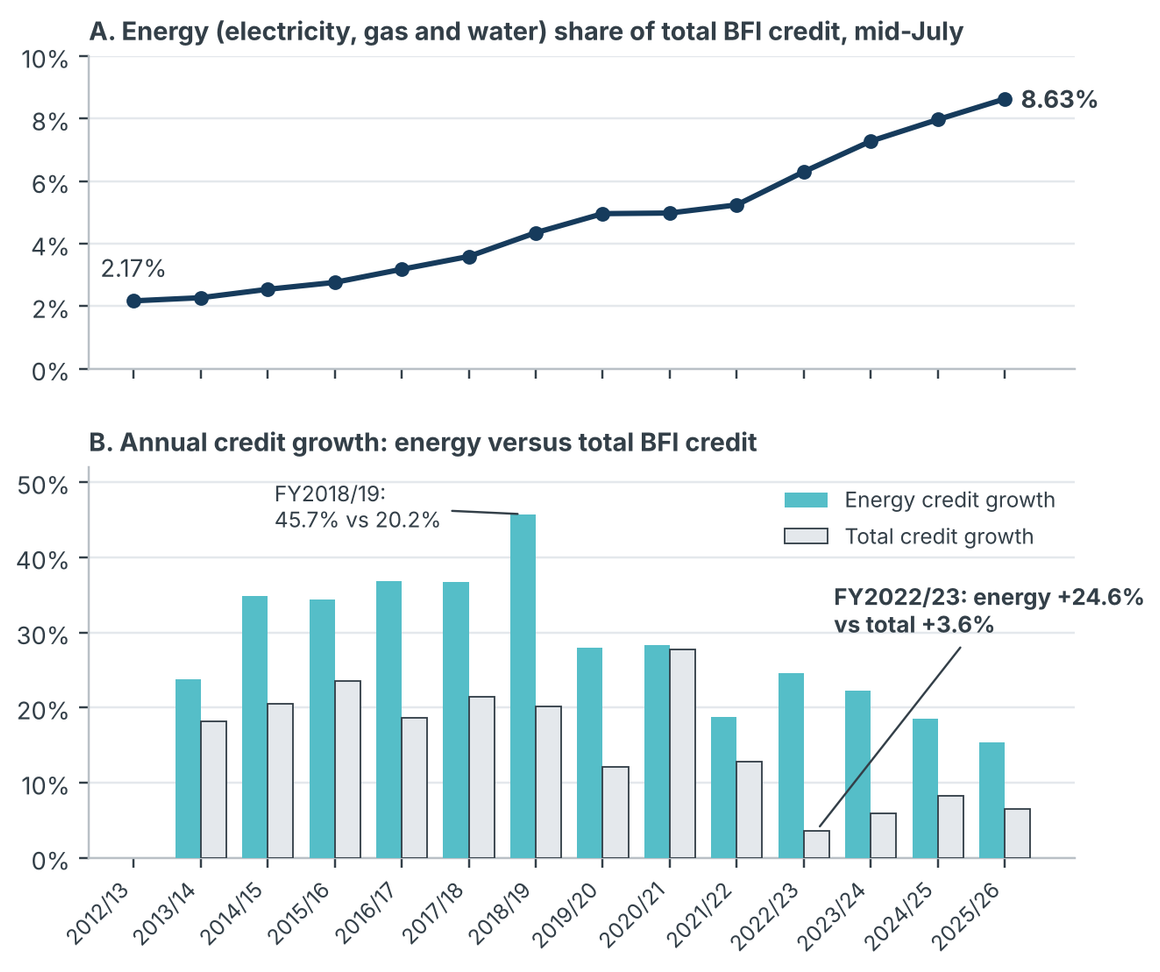
Credit from banks and financial institutions (BFIs) to the electricity, gas and water sector stood at NPR 20,694.25 million, or 2.17 percent of total BFI credit, in mid-July 2013. By mid-July 2026 it had reached NPR 513,999 million, or 8.63 percent of total BFI credit NPR 5,954,594 million. The share rose in every year of the series.
Energy (electricity, gas and water) credit share and growth versus total BFI credit, FY2012/13–FY2025/26
| Fiscal year (mid-July) | Energy share of BFI credit (%) | Energy credit growth (%) | Total credit growth (%) | Differential (pp) |
|---|---|---|---|---|
| 2012/13 | 2.17 | – | – | – |
| 2013/14 | 2.27 | 23.74 | 18.21 | 5.53 |
| 2014/15 | 2.54 | 34.89 | 20.49 | 14.40 |
| 2015/16 | 2.76 | 34.39 | 23.54 | 10.85 |
| 2016/17 | 3.18 | 36.85 | 18.60 | 18.25 |
| 2017/18 | 3.59 | 36.75 | 21.47 | 15.28 |
| 2018/19 | 4.35 | 45.74 | 20.18 | 25.56 |
| 2019/20 | 4.96 | 27.95 | 12.16 | 15.79 |
| 2020/21 | 4.98 | 28.29 | 27.76 | 0.53 |
| 2021/22 | 5.24 | 18.79 | 12.85 | 5.94 |
| 2022/23 | 6.30 | 24.56 | 3.63 | 20.93 |
| 2023/24 | 7.28 | 22.30 | 5.89 | 16.41 |
| 2024/25 | 7.97 | 18.51 | 8.21 | 10.30 |
| 2025/26 | 8.63 | 15.35 | 6.49 | 8.86 |
Source: NRB Financial Stability Reports, Annex IV (sectoral credit, mid-July positions, FY2012/13–FY2018/19); NRB monthly banking and financial statistics, mid-July positions (FY2019/20–FY2025/26).
1.2 Is this a credit-cycle effect, or something structural?
The growth differential is the more telling statistic. In each of the thirteen fiscal years from FY2013/14 to FY2025/26, energy credit grew faster than total credit. The gap was widest in FY2018/19 (45.74 percent against 20.18 percent) and, strikingly, in FY2022/23, when total credit grew by only 3.63 percent but energy credit grew by 24.56 percent – almost seven times the system rate while the rest of the market stalled. A sector that keeps expanding at roughly four to seven times the system rate while aggregate credit stagnates is not merely riding a credit cycle; something about it makes it fundable when other sectors are not.
Energy credit share has quadrupled since 2013, and energy credit outgrew total credit every year
1.3 Does the pattern show up outside the banks’ balance sheets?
It does. Investment Board Nepal’s large-project pipeline has produced financial closure only in hydropower – Arun-3 reached financial closure on 6 February 2020 and Upper Trishuli-1 signed its loan agreements on 28 October 2019 – and reports no non-hydro PPP financial closure across 2021–2023 (IBN progress reports, 2021–2023). Large-scale public-private partnerships outside hydropower achieved exactly zero financial closures in that period. Capital in Nepal is, in effect, held in a hydroelectric monoculture. Even the lender created specifically to diversify infrastructure finance ended up majority-hydro (§3.3).
2. Is the concentration a natural market outcome or an artificial one?
To fix the infrastructure deficit, policymakers first have to determine whether hydropower’s dominance is a natural market outcome or an artificial one. The question this report addresses is whether Nepal Rastra Bank’s prudential and sectoral lending framework, together with banks’ internal credit policies, structurally favours hydropower over other infrastructure and productive sectors – or whether hydropower simply possesses commercial attributes (a power purchase agreement, predictable cash flows, construction moratoria, collateral, a clear allocation of risk) that other sectors lack.
2.1 Why does it matter which explanation is right?
If the concentration is a regulatory creation, the remedy is subtractive: remove or neutralise the preferences and credit will diversify. If it is a bankability outcome, removing preferences would simply shrink infrastructure lending, because nothing would take hydropower’s place; the remedy is constructive – building, for roads, hospitals, urban services and industry, the contracted-revenue instruments that hydropower already has.
The two diagnoses also carry opposite risk messages. Under the first, hydropower risk is overstated by the regulator’s enthusiasm. Under the second, the system’s exposure is only as good as one off-taker’s contracts and solvency.
2.2 What does the prevailing professional consensus say?
The prevailing explanation is straightforward: the central bank engineered a monopoly, by setting strict lending quotas and handing hydropower developers exclusive concessions. It deserves its strongest statement. On this view, NRB has for a decade told banks to lend to energy, rewarded them for doing so and shielded them from the consequences. The evidence for it is substantial:
- Directed targets with teeth. Banks faced dated energy lending floors enforced by a penalty at the maximum lending rate on any shortfall (§2.4).
- Larger deal sizes. The single-obligor limit allows banks to write single hydropower exposures twice the size permitted to other borrowers (§2.3).
- Forbearance that suppresses recognised losses. Instalment-level classification and grace extensions keep stressed hydropower loans out of non-performing categories (§3.1).
- The regulator’s own warning. NRB’s Financial Stability Report for FY2015/16 cautioned that concentration in hydropower could crowd out credit to other productive sectors (NRB, Financial Stability Report FY2015/16, sectoral concentration discussion).
- The FY2022/23 divergence. When total credit grew only 3.63 percent, energy credit grew 24.56 percent – consistent with banks reallocating scarce lending capacity to meet targets.
2.3 What is the single-obligor limit – the centrepiece of the consensus case?
The general single-obligor limit (SOL) for commercial banks is 25 percent of core capital for fund-based and non-fund-based exposure combined (NRB Unified Directive 3/082, cl. 2). The directive raises the ceiling to 30 percent for specified priority sectors and to 50 percent for hydropower, other renewable energy, electricity transmission lines and cable car projects (NRB Unified Directive 3/082, cl. 3). This is the provision most often cited as evidence of a regulatory preference for hydropower, and on its face it is one: a single hydropower sponsor group can borrow twice what a manufacturing group can from the same bank. Whether that reading survives the full text of the clause is the subject of §5.
2.4 Are the lending quotas law, and what do they require?
Since the late 2010s, NRB’s monetary policy and implementing circulars have required commercial banks to direct minimum shares of their loan portfolios to designated sectors, including energy. The latest dated schedule required energy lending of 6.5, 7, 8 and 10 percent of total loans by the end of Ashad 2081, 2082, 2083 and 2084 respectively. Shortfalls are penalised under section 81 of the Nepal Rastra Bank Act, 2058, through a charge on the shortfall at the maximum lending rate.
Two qualifications matter. First, the energy target is a monetary-policy instrument, adopted by circular, revised annually and repeatedly re-dated: an earlier deadline of mid-July 2024 for 10 percent energy lending was replaced by the phased schedule ending FY2026/27 (NRB monetary policy statements, successive years). Second, the targets are being restructured. NRB Circular 12/2082-83 replaces the standalone energy target, from the end of Poush 2083, with a 10 percent agriculture floor and a combined 20 percent floor for specified productive sectors – energy, tourism, micro/small/medium enterprises, information technology and export industries. Under the combined floor, energy lending no longer needs to reach 10 percent on its own; it competes with tourism, MSME, IT and export lending to fill a shared quota.
Bond instruments also count toward the targets: investments in energy bonds and agriculture bonds by the banks may be counted toward the respective floors. Their negligible uptake is discussed in §7.4.
2.5 What does this report argue instead?
That the consensus has backward causality. Central bank regulation did not create hydropower lending. Regulators looked at the only commercially viable risk model operating in the country – lending against a contracted, assignable receivable from a state-owned buyer – and wrote it into the rulebook. To understand why commercial banks fund almost nothing but water, one has to set aside the central bank’s mandates and look closely at the legal mechanics of a receivable.
The rest of the report tests that claim in the order a skeptic would. §3 runs a control experiment: a sector given the same concessions. §4 identifies the variable that differs. §5 finds that variable written into the regulation itself. §6 shows that banks’ own scoring is built around it. §7 and §8 explain why Nepal’s funding base and enforcement law make it indispensable. §9 asks whether the hydropower model is as safe as it looks. §10 returns to the consensus and delivers a verdict, and §11 sets out what should be done.
3. What happens when another sector gets the same regulatory treatment?
The regulatory-creation hypothesis can be tested against a control group inside the Nepali economy: the cable car sector. If regulatory concessions were sufficient to create a project-finance market, a sector that receives the same concessions as hydropower should attract proportionate bank credit.
3.1 Which concessions does hydropower share with cable cars and other sectors?
Cable cars share the 50 percent single-obligor ceiling (§2.3). They also share the construction-phase forbearance that is the second element most often read as preferential. NRB permits the grace period of a hydropower loan to be extended where the required commercial operation date (RCOD) slips because of transmission-line delays, without the extension being treated as a restructuring (NRB Unified Directive 2/082, loan classification and rescheduling provisions). Interest capitalisation is partly permitted where transmission infrastructure is incomplete, loan loss provisioning may be spread proportionally across the grace period, and for energy projects, the Interest Capitalised Reserve (ICR) associated with an ICTL facility may be released back into Retained Earnings once construction reaches 60 percent (NRB Unified Directive 2/082, project-loan provisions). Most distinctively, overdue instalments are classified in isolation:
NRB Unified Directive 2/082 (loan classification and provisioning), clause 4(2)
| ORIGINAL LANGUAGE | (२) जलविद्युत परियोजना, विद्युत प्रसारण लाइन (Transmission Line), केवलकार निर्माण परियोजना र नवीकरणीय उर्जा परियोजनामा प्रवाह भएका कर्जाको हकमा कुनै किस्ताले ९० दिनभन्दा बढीले भाखा नाघेमा त्यस्तो किस्ताको साँवा रकमलाई खराब वर्गमा वर्गीकरण गरी किस्ताको शतप्रतिशत कर्जा नोक्सानी व्यवस्था कायम गर्नु पर्नेछ। |
| TRANSLATION | (2) In respect of loans extended to hydropower projects, electricity transmission lines, cable car construction projects and renewable energy projects, where any instalment is overdue by more than 90 days, the principal amount of that instalment shall be classified as loss and a loan loss provision of one hundred percent of the instalment shall be maintained. |
The effect of clause 4(2) is that, for these four project types, an overdue instalment does not drag the entire outstanding loan into a non-performing category; only the overdue instalment is classified as loss and fully provisioned. For long-tenor project loans this matters enormously, because a single missed payment on a general loan would otherwise put the whole exposure into a high-provision bucket and destroy the bank’s capital and profit. It is a genuine sector-specific concession – but it extends to transmission, cable cars and all renewable energy, and its function is to make long-tenor amortising project credit administrable at all.
Cable cars also receive a 40 percent income tax concession for ten years (Income Tax Act, 2058, s. 11(3ch)), structurally matching hydropower’s incentives, though hydropower’s own holiday – 100 percent for ten years followed by 50 percent for five (s. 11(3gh)) – is the most generous. The table below sets out the full matrix.
Regulatory treatment of hydropower compared with cable cars, transmission and other sectors
| Provision | Hydropower / renewable energy | Transmission / cable car | Other infrastructure and productive sectors | Hydro-specific? |
|---|---|---|---|---|
| Single-obligor limit | 50% of core capital; above 25% only with executed PPA (3/082 cl. 3(a)) | 50% of core capital (3/082 cl. 3) | 25% general; 30% specified priority sectors (3/082 cl. 2–3) | No – conditioned on PPA; shared |
| Overdue instalment classification | Only overdue instalment to Loss (2/082 cl. 4(2)) | Same (2/082 cl. 4(2)) | Whole loan classified by ageing | No – shared |
| Grace extension for transmission delay | Not treated as restructuring | Transmission projects: same | Not available | Largely yes |
| ICTL / interest capitalisation | Release at 60% construction; partial capitalisation | Applicable | Also cement, hospitals, star hotels, pharma | No |
| Capital risk weight | Corporate scale; unrated 100% | Corporate scale | SME manufacturing/agri/IT ≤ NPR 3 crore: 60% | No (if anything, the reverse) |
| Minimum DSCR | None prescribed | None | None | No |
| Directed lending floor | Energy 6.5→10% (Ashad 2081–84); folded into combined 20% from Poush 2083 | Within energy | Agriculture 10%; tourism, MSME, IT, export within combined 20% | Yes, until restructured |
| Income tax holiday | 100% for 10 years, 50% for 5 years (s. 11(3gh)) | Cable cars: 40% for 10 years (s. 11(3ch)) | Roads: 50% rebate (s. 11(3ch)) | Yes (most generous) |
Source: NRB Unified Directives 2082: Directive 2/082 (classification, forbearance, ICTL); Directive 3/082 (single obligor), cl. 2, 3, 3(a), 3(d); NRB Capital Adequacy Framework (risk weights); Income Tax Act, 2058, s. 11. Capital risk weights and DSCR are discussed in §5.3.
3.2 Did identical treatment produce identical credit outcomes?
No. Credit rating agencies operating in Nepal rank hydropower companies above most other project-type borrowers. Hydropower projects under construction typically sit in the BB band, rising to BBB- – the bottom of investment grade – once operational (ICRA Nepal and CARE Ratings Nepal, issuer rating rationales for hydropower companies). Cable car companies cluster at B+ to BB, in junk territory: Annapurna Cable Car was rated CARE-NP B+ (CARE Ratings Nepal, rating rationale, Annapurna Cable Car). Hotels sit at BB to BB+ (CARE Ratings Nepal and ICRA Nepal, hotel-sector rationales). Cable cars enjoy the same 50 percent SOL and the same instalment-level classification as hydropower, and they rate two to three notches lower.
Same regulatory treatment, different credit grades
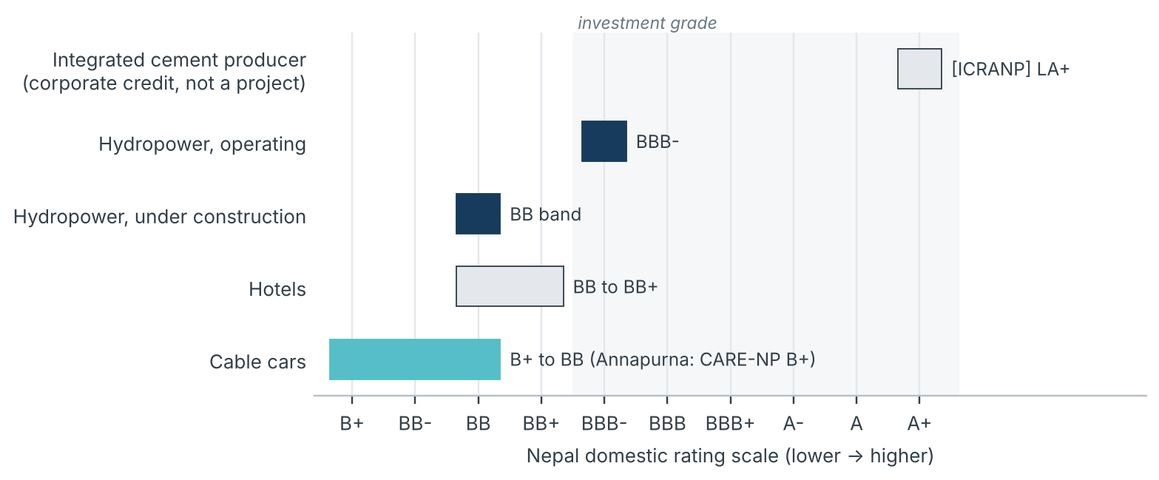
Source: ICRA Nepal and CARE Ratings Nepal issuer rating rationales for hydropower, cable car, hotel and cement issuers. Bands are typical ranges described in the rationales; the cement rating is ICRA Nepal’s rating of Hongshi Shivam Cement on its long-term scale.
| CASE STUDY 1 – Cable cars: identical regulatory preference, different bankability Cable car projects receive every major prudential concession that hydropower receives: the 50 percent single-obligor ceiling, instalment-level classification of overdue loans and a ten-year income tax concession. If regulatory preference were sufficient to create a project-finance market, cable cars should have attracted proportionate bank interest. They have not, and they rate at B+ to BB against BB to BBB- for hydropower. What the case shows: an identical regulatory preference produced very different credit outcomes. The binding constraint is the absence of an off-take or availability instrument, not the absence of regulatory concessions. Why that is so is the subject of §4. |
3.3 Do other natural experiments point the same way?
Three more comparisons give the same answer.
Construction forbearance given to other industries. The ICTL facility is not hydro-exclusive, as interest capitalization during construction extends to cement, hospitals, star-category hotels, pharmaceutical manufacturing, and other productive sectors (NRB Unified Directive 2/082, ICTL eligible-sector list). However, while these sectors receive construction-phase interest capitalization, they do not qualify for energy’s early Interest Capitalised Reserve (ICR) release at 60 percent construction completion – their reserves remain locked until commercial operation or cash recovery. Nonetheless, these industries received construction-phase forbearance without generating anything like hydropower’s rapid credit growth.
A sector-neutral infrastructure bank. The Nepal Infrastructure Bank (NIFRA) was created to supply long-tenor infrastructure finance under a distinct, uniform regime: a 50 percent SOL for all infrastructure, a 50 percent single-sector cap, and a minimum loan size of NPR 30 crore (NPR 3 crore for PPP projects) (NRB directives to Nepal Infrastructure Bank Ltd., single obligor and sectoral provisions). It is the clearest test of whether a sector-neutral prudential framework diversifies lending on its own. It does not. NIFRA’s USD 161.7 million portfolio at July 2024 was 53 percent hydropower (Figure 3; Sustainable Fitch, Second-Party Opinion on NIFRA, 5 May 2025). NIFRA itself is rated [ICRANP-IR] BBB (ICRA Nepal, issuer rating, 3 January 2025). That a specialised, sector-neutral infrastructure bank ends up majority-hydro is strong evidence that the concentration is driven by the supply of bankable projects rather than by commercial-bank regulation. Its non-hydro book, moreover, consists largely of corporate-type borrowers (hospitals, hotels, internet service providers) rather than PPP infrastructure.
A sector-neutral infrastructure lender is still majority hydropower
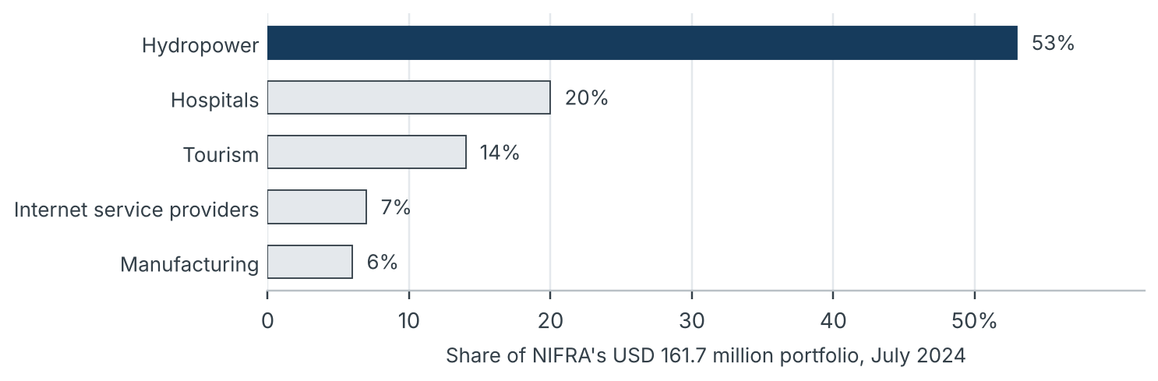
Source: Sustainable Fitch, Second-Party Opinion on NIFRA, 5 May 2025, portfolio breakdown (July 2024).
Currency-hedging support that favours non-hydro projects. Foreign-currency debt could lengthen tenor, but currency risk must then be allocated. The Hedging Rules, 2079 assign hedging-cost shares by project type: for hydropower of 100 MW or more, 55 percent to the Government & Implementing Unit and 45 percent to the borrowing entity; for transmission, metro, road and airport projects, 70 percent and 30 percent; and for other projects exceeding NPR 2 billion, 80 percent and 20 percent (Hedging Rules, 2079, r. 5(2)). The non-hydro split is, on its face, more generous to the borrower than the hydro split – again inconsistent with a regulatory-preference story – yet on available evidence the facility has not enabled a non-hydro financial closure.
4. If not regulation, what separates hydropower from the rest?
4.1 How do the two sectors generate cash?
The missing variable is how each sector is paid. A cable car operator sells tickets to individual tourists at a price it must defend in the market, and retains all the seasonal, competitive and tourist-arrival risk. A hydropower project sells electricity to a single state-owned utility at a tariff fixed in a contract running 25 to 35 years. Without a contracted buyer, a cable car’s credit grade rests on sponsor strength and collateral – exactly the corporate-lending logic that limits loan size and tenor.
Regulatory concessions cannot synthesise bankability out of thin air. They can only amplify the borrowing power of sectors that have already secured a guaranteed buyer.
4.2 Then why does a cement producer out-rate hydropower?
Because it is rated as a corporate, not a project. The highest non-hydro ratings go to established corporates with sponsor strength rather than contracted revenue: an integrated cement producer was rated up to [ICRANP] LA+ (ICRA Nepal, rating rationale, Hongshi Shivam Cement). Its rating rests on diversified sales and balance-sheet support – a form of credit Nepali banks already provide well – not on a ring-fenced project’s cash flows. The ratings pattern as a whole is the cleanest evidence that, for project-type borrowers, the differentiator is contracted revenue.
4.3 Which attributes, side by side, make the difference?
The table below isolates the attributes banks weigh. The PPA – a contracted buyer and tariff – is the attribute other sectors lack, while hydropower’s own volume and counterparty protections are incomplete (developed in §9). The scoring, tenor and loss rows are drawn from the bank evidence in §6.
Bankability attributes of hydropower with a PPA compared with leading non-hydro project types
| Attribute | Hydropower with NEA PPA | Cable car / hotel / tourism | Roads, hospitals, urban services |
|---|---|---|---|
| Revenue counterparty | Single state-owned buyer (NEA) | Dispersed customers | Users or government; no executed payment instrument in practice |
| Price risk | Fixed tariff with escalation in PPA | Market pricing | Tariff or toll subject to political approval |
| Volume risk | Partly retained: no deemed generation; take-and-pay in contingency | Fully retained | Fully retained unless availability payment exists |
| Bank scoring of buyer | Full marks: “confirmed buyer” | Market assessment | Market assessment |
| Typical rating | BB (construction) to BBB- (operation) | B+ to BB+ | No rated project-finance borrowers identified |
| Maximum internal tenor | Up to 15 years | 7–10 years | 7–10 years |
| Observed loss experience | Nabil 0.00% NPA; Kumari ≈3.8% Stage 3 (FY2023/24) | Not separately disclosed | Construction sector 15.16% NPA (Nabil) |
Source: Nabil Bank and Kumari Bank Annual Reports FY2023/24; ICRA Nepal and CARE Ratings Nepal rating rationales.
5. Where does the rulebook itself show that the contract, not the sector, is privileged?
The proof that regulators codified an existing risk model, rather than inventing one, is printed in the central bank’s own directive.
5.1 What condition unlocks the 50 percent ceiling?
For hydropower and other renewable energy, lending above the general 25 percent ceiling is permitted only where a power purchase agreement has been concluded with the relevant body:
NRB Unified Directive 3/082 (single obligor limit), clause 3(a), proviso
| ORIGINAL LANGUAGE | तर, जलविद्युत लगायत नवीकरणीय उर्जा परियोजनाको हकमा प्राथमिक पुँजीको २५ प्रतिशतभन्दा बढी कर्जा प्रवाह गर्नु पर्ने अवस्थामा सम्बन्धित निकायसँग अनिवार्य रुपमा विद्युत खरिद सम्झौता (Power Purchase Agreement) भएको हुनु पर्नेछ। |
| TRANSLATION | Provided that, in the case of renewable energy projects including hydropower, where credit in excess of 25 percent of core capital is to be extended, a power purchase agreement must mandatorily have been concluded with the concerned body. |
Read with the proviso, the enlarged ceiling is not a sector preference in the ordinary sense. It is a preference for a particular contractual condition – an executed off-take agreement with a creditworthy counterparty – which in Nepal only the Nepal Electricity Authority (NEA) offers at scale. The regulation does not tell banks that hydropower is safe; it tells them that hydropower with a PPA may be lent to in larger amounts. Without the PPA, a hydropower project is subject to the same 25 percent ceiling as any other borrower – and an infrastructure project such as a toll road or hospital, which has no equivalent contract to offer, stays at the standard 25 percent.
The enlarged single-obligor ceiling is unlocked by the contract, not the sector
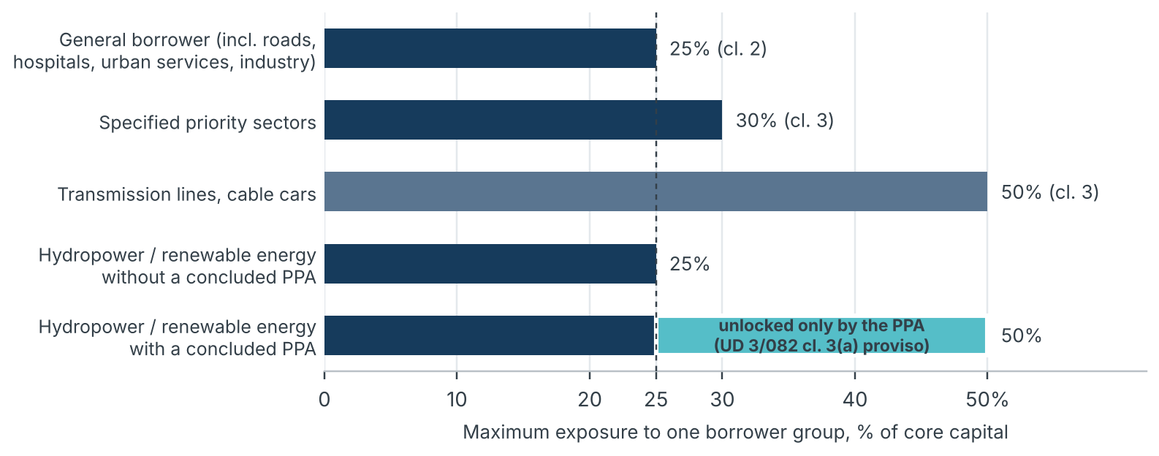
Source: NRB Unified Directive 3/082, cl. 2, 3 and 3(a) proviso. Ceilings apply to fund-based and non-fund-based exposure combined. The 30 percent tier applies only to sectors the directive specifies.
5.2 What else in the clause confirms that reading?
Two further features of clause 3. First, the 50 percent ceiling is shared with cable cars and transmission lines, which are not generation projects; regulation is not hydro-exclusive, and §3 has shown that cable cars, despite equal treatment, have not attracted comparable credit. Second, where an exposure under the enlarged ceiling is used for non-energy purposes, those non-energy exposures must stay within the general 25 percent limit, and any excess attracts a 100 percent provision (NRB Unified Directive 3/082, cl. 3(d)). The ceiling is ring-fenced to the contracted project.
5.3 What does the rulebook not privilege?
The omissions are as revealing as the provisions.
- Capital risk weights give hydropower no preference. Project and corporate exposures are weighted on the corporate scale, with unrated exposures at 100 percent, while small loans of up to NPR 3 crore to manufacturing SMEs, agriculture and IT receive a 60 percent weight (NRB Capital Adequacy Framework, risk-weight schedule). If capital regulation favours anything, it favours small productive-sector loans over large projects.
- The leverage rule is neutral or tighter. Borrowers exceeding an 80:20 debt-to-equity ratio must be placed on the watch list, with an exemption for projects under construction until three fiscal years after commercial operation (NRB Unified Directive 2/082, watch-list criteria).
- No minimum debt service coverage ratio is prescribed for project loans. The underwriting standards that actually govern hydropower lending are therefore set by banks, not by NRB (§6).
- The sector cap does not bind. Class A banks face a single-sector exposure cap of 40 percent of total loans (NRB Unified Directives, sectoral concentration provision), which does not bite on energy at the present 8–9 percent share.
- The consortium rule is sector-neutral. Exposures of NPR 2 billion or more to a single borrower must be financed through a consortium (NRB Unified Directive 11/082). But because hydropower is the only sector that routinely produces single projects of this size with an executed off-take contract, consortium machinery – lead-bank appraisal, shared security trustee arrangements, standard term sheets – has in practice been built around hydropower deals.
| PRACTICE ASSERTED BY BANKS IN ADDITION TO THE REGULATORY REQUIREMENT Two practices asserted by banks in addition to the regulatory requirement are: (i) a requirement that banks monitor a minimum DSCR for project loans, and (ii) a regulatory requirement for escrow accounts giving lenders “absolute revenue certainty” over PPA proceeds. Both are better understood as market practice embedded in bank credit policies and consortium term sheets. |
5.4 So what is the net effect of the regulatory framework?
The framework contains real preferences: the energy lending floor, the transmission-delay grace extension and the most generous income tax holiday are hydro- or energy-specific. But the provision with the largest effect on deal size – the 50 percent SOL – is conditioned on the PPA, and the provision with the largest effect on a bank’s ability to carry long-tenor loans – instalment-level classification – is shared with transmission and cable cars. The regulator has written the PPA into the rulebook; it has not substituted for it.
6. How do banks’ own credit policies value the power purchase agreement?
If regulatory preference were the driver, banks’ internal credit policies would mirror the regulatory ceilings and do little more. A commercial bank’s internal credit policy and credit risk grading guideline suggest the opposite: the bank sets limits tighter than NRB permits, yet scores hydropower projects favourably on the strength of the PPA.
6.1 Are banks looser or stricter than the regulator?
Stricter. Most bank classifies hydropower under “Project and Infrastructure” with an internal sectoral cap of 30 percent (against the 40 percent regulatory sector cap), and limits single-group exposure to hydropower, cable car and transmission projects to 35 percent of core capital – against the 50 percent regulatory ceiling (Credit Policy, sectoral and single-obligor limits set internally by most banks).
One bank’s credit policy: tighter limits than the regulator, but collateral matters less for projects
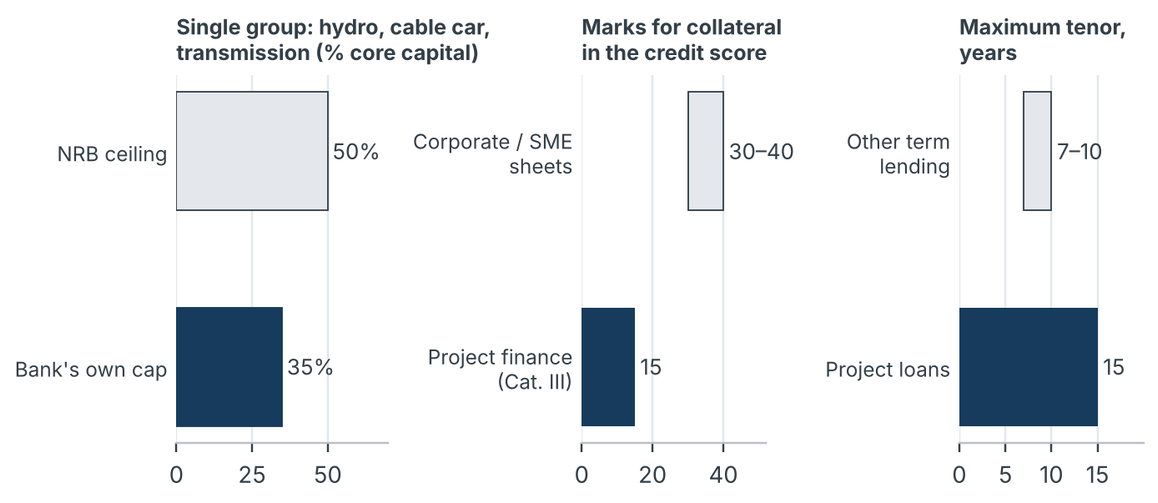
Source: A commercial Bank, Credit Policy (sectoral and single-obligor limits; tenor provisions) and Internal Credit Risk Grading Guideline (ICRGG).
6.2 What does the bank’s credit score actually reward?
- Collateral is de-emphasised for projects. In the Category III (project finance) scoring sheet, collateral carries 15 marks, against 30–40 marks in the corporate and SME sheets (A commercial Bank, ICRGG, Category III).
- The PPA is scored as a confirmed buyer. A signed PPA earns the full 5 marks under the market/buyer criterion as a “confirmed buyer” (ICRGG, Category III, market risk criterion).
- Cash-flow cover is scored directly. A projected DSCR of 2.0 or more earns full marks (ICRGG, Category III, financial risk criterion).
- Tenor and documentation adapt to the project. Project loans may run up to 15 years against 7–10 years for other term lending, and project offer letters are exempt from the bank’s standard 90-day lapse rule (A commercial Bank, Credit Policy, tenor and offer-letter provisions).
The scoring architecture is the heart of the matter. For a manufacturing or hotel borrower, the bank’s grade depends heavily on how much land and buildings it can take as security. For a hydropower project, the grade depends heavily on the existence of a single document that names a buyer, a tariff and a quantity. The PPA substitutes for collateral in the bank’s own risk model. No regulation requires that substitution; the bank makes it because the PPA is what turns a construction site into a future flow of payments from a state-owned counterparty. For both the regulator and the loan officer, the PPA is the real collateral: a piece of paper setting out a future cash flow from the state is worth more to the lender than the concrete of the dam.
6.3 Do pricing and loss experience bear out the bank’s view?
Broadly, yes. In mid-December 2018 the weighted average lending rate on energy loans was 11.42 percent, below the system average of 12.32 percent and the construction-sector rate of 12.26 percent (NRB, sectoral weighted average lending rates, mid-December 2018). Large banks’ disclosures show very low recognised impairment: Nabil Bank reported a 0.00 percent non-performing ratio on NPR 31,014 million of power-sector loans against 15.16 percent for construction in FY2023/24 (Nabil Bank, Annual Report FY2023/24, sector-wise NPA note); Kumari Bank reported NPR 1,418 million of Stage 3 power-sector loans out of NPR 37,095 million (Kumari Bank, Annual Report FY2023/24, sector-wise staging note), a ratio of about 3.8 percent computed for this report.
These figures need a caveat. Instalment-level classification (UD 2/082, cl. 4(2)) and construction-phase grace extensions mechanically reduce recognised non-performing loans in hydropower relative to sectors whose whole loan is classified by ageing, so low reported impairment is partly a product of the classification rule (§9.3). Even so, the gap with construction lending is too large to be wholly an artefact.
7. How can a bank underwrite a 15-year loan on short-term deposits?
A deeper question sits beneath the scoring: how can a commercial bank in a developing market safely underwrite a highly leveraged, 15-year infrastructure loan at all? The answer lies in the extreme maturity mismatch of the Nepali banking system – and in what it takes to survive it.
7.1 How large is the maturity mismatch?
A project loan is a long-dated asset; Nepali banks fund themselves overwhelmingly with short- and medium-dated deposits. In mid-February 2025, fixed deposits made up 52.4 percent of BFI deposits, savings deposits 34.8 percent and demand deposits 5.2 percent (NRB, Current Macroeconomic and Financial Situation, mid-February 2025, deposit composition table); the fixed-deposit share had been 58.8 percent in 2023 (same series). Most fixed deposits carry maturities of one to three years. Term loans nevertheless rose to 37.32 percent of commercial bank loans by mid-July 2024, up from 25.11 percent in 2022 (NRB, Banking and Financial Statistics, loans by product, mid-July 2024). Over the life of a single 15-year loan, the bank must therefore raise new deposits and repay existing depositors many times over (Figure 6).
Bank funding is short-dated while project lending is long-dated
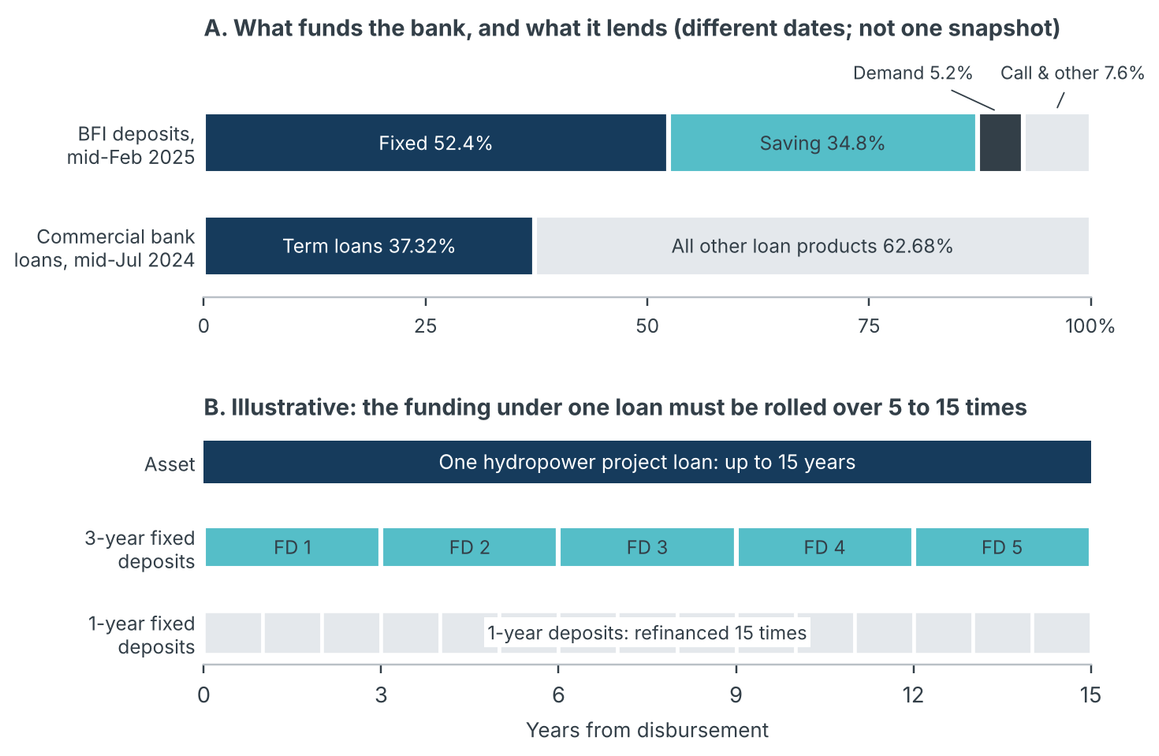
Source: NRB, Current Macroeconomic and Financial Situation (mid-February 2025); NRB Banking and Financial Statistics (mid-July 2022, mid-July 2024); Sanima Bank Credit Policy (tenor limits). Residual deposit share of 7.6% computed (100 − 52.4 − 34.8 − 5.2). Panel B is illustrative arithmetic, not data.
7.2 What limits how far banks can stretch?
Liquidity regulation bounds the maturity transformation. Banks operate within a credit-to-deposit ratio of 90 percent (NRB Unified Directive on CD ratio), a net stable funding ratio of at least 100 percent, and a cumulative negative maturity gap limit; one bank’s policy caps the cumulative negative gap at 15 percent, with an internal risk appetite of 14 percent (A commercial Bank, Asset-Liability Management policy, NSFR and gap limits). Within these constraints, a long-tenor loan is affordable only if its cash flows are highly predictable – which, in Nepal, means contracted. For a bank’s own liquidity, guaranteed revenue is not a nice-to-have; it is a precondition.
7.3 Why don’t insurers and other long-term investors fill the tenor gap?
In most systems, long-dated infrastructure debt is held by insurers and pension funds. In Nepal, insurers may invest up to 10 percent of their investable funds in infrastructure, with a limit of 5 percent per project (Nepal Insurance Authority, Investment Directive, 2082, infrastructure investment provisions). Actual allocations are far below the cap: life insurers held 0.855 percent in FY2079/80 and non-life insurers 1.848 percent in FY2081/82, while reinsurers held none (Nepal Insurance Authority, annual insurance sector reports). The constraint is not the cap but the absence of investable, rated, contracted infrastructure instruments – the same deficit that limits banks.
7.4 Could bonds lengthen the funding tenor?
In principle. The energy and agriculture bonds that count toward lending floors (§2.4) are exactly the instrument that could lengthen funding tenor for infrastructure. Uptake has been negligible: only three energy bonds and four agriculture bonds had been issued by 2024 (NRB, Nepal Green Finance Taxonomy, 2024, p. 16). The instrument has scarcely been used.
8. What happens to the bank when an infrastructure project defaults?
Consider the worst case: a large non-hydro infrastructure project with no guaranteed state buyer defaults on its debt. What the bank can recover, and how, determines what it is willing to lend against in the first place.
8.1 Do banks take project risk or sponsor risk?
Sponsor risk. Nepali project finance is not non-recourse. Bank credit policies make no provision for non-recourse lending and require personal and corporate guarantees from promoters. Regulation reinforces recourse: loans secured only by personal guarantees or by third-party collateral attract an additional 20 percent provision (NRB Unified Directive 2/082, cl. 1(10)–(11)). Courts have upheld the durability of guarantees: in Timilsina v. Sanima Bank (Writ No. 076-WO-0726, decided 2082-02-12), the Supreme Court held that a guarantor’s liability survives the transfer of the guarantor’s shares in the borrower, and in the Melamchi water supply litigation the courts affirmed the autonomy of bank guarantees from the underlying contract dispute (Supreme Court of Nepal, Melamchi guarantee decision).
A recourse-based system can still lend to hydropower at scale because hydropower combines both supports: sponsors give guarantees and the project brings a contracted receivable. For non-hydro projects, the absence of a contracted receivable means recourse is the only support, and the sponsor’s balance sheet, not the project, sets the loan size. That is corporate lending, which Nepali banks already practise – not project finance.
8.2 Why is seizing specialised infrastructure a trap for the lender?
In ordinary corporate lending, banks rely on seizing and auctioning physical collateral – usually urban land or commercial buildings with an active, liquid market. Specialised infrastructure is different: a half-excavated mountain tunnel or a specialised hospital wing has almost no immediate auction value. Under the debt recovery rules, if collateral cannot be sold at auction for the determined value after three attempts, the bank must itself take the property over:
Debt Recovery of Banks and Financial Institutions Rules, 2059, rule 29(5)
| ORIGINAL LANGUAGE | तेस्रो पटक लिलाम बिक्री गर्दा पनि उपनियम (३) बमोजिमको मूल्यभन्दा कम मूल्य प्राप्त हुन आएमा त्यस्तो चल अचल सम्पत्ति सम्बन्धित बैंक वा वित्तीय संस्थाले निर्धारित मूल्यमा सकार गर्नु पर्नेछ । त्यसरी बैंक वा वित्तीय संस्थाले चल अचल सम्पत्ति सकारेपछि त्यस्तो बैंक वा वित्तीय संस्थाको ऋण चुक्ता भएको मानी हिसाब मिलान गरिनेछ। |
| CONVENIENCE TRANSLATION – NOT OFFICIAL | If, even at the third auction sale, a price lower than the value under sub-rule (3) is obtained, the concerned bank or financial institution shall take over such movable or immovable property at the determined value. Once the bank or financial institution has taken over the property, the loan of that bank or financial institution shall be deemed repaid and the accounts shall be settled. |
For a lender secured on land or a building with a ready market, this compulsory buy-in is tolerable. For a lender secured on a half-built tunnel, a specialised plant or a hospital, it is a trap: the bank becomes the owner of an illiquid, single-purpose asset at a deemed value, the loan is deemed repaid, and the bank must write off the difference against its own capital.
8.3 Is there a way around the auction?
Only through receivables. The Secured Transactions Act, 2063 enables secured creditors to collect assigned receivables directly from the account debtor without court proceedings (Secured Transactions Act, 2063, s. 42ka and s. 48). A PPA payable by the NEA into a project account is exactly such a receivable; a road’s future tolls or a hospital’s future fees, uncontracted and dispersed, are not. Punitive enforcement law therefore pushes lenders away from asset-based security on specialised infrastructure and toward legally assigned cash flows.
Two routes to recovery after default – and why lenders prefer the second
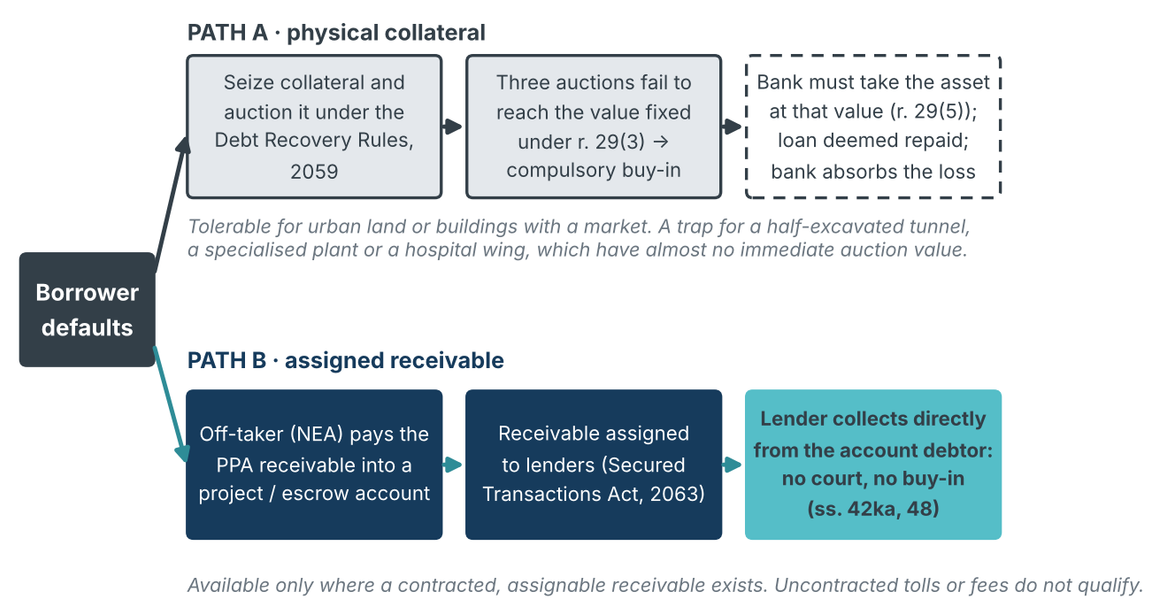
Source: Debt Recovery of Banks and Financial Institutions Rules, 2059, r. 29(3) and 29(5); Secured Transactions Act, 2063, ss. 42ka and 48.
8.4 How do these pieces fit together?
Figure below assembles §5 to §8 into one mechanism. In hydropower, a chain of instruments carries project risk to the bank as a contracted, assignable receivable: the PPA fixes the buyer and tariff, NEA pays into a project account, the Secured Transactions Act makes the receivable collectible, the bank’s scoring treats it as a confirmed buyer, and the directive unlocks the 50 percent ceiling. For a road, hospital or urban PPP, the chain breaks at the revenue step: with no payment instrument there is no assignable receivable, and the bank falls back on collateral and sponsor guarantees – a corporate-size loan at 7–10 years.
Hydropower converts project risk into a bank-eligible receivable; non-hydro projects stop at the revenue step
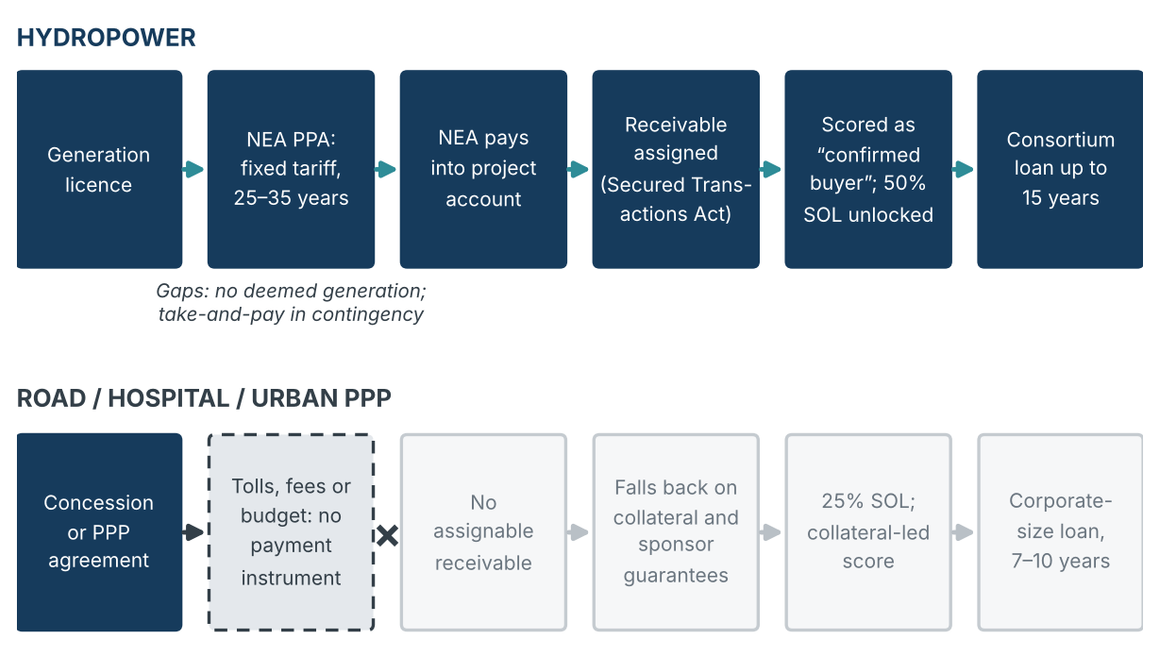
Source: NRB Unified Directive 3/082, cl. 3(a); Secured Transactions Act, 2063, ss. 42ka, 48; Bank ICRGG and Credit Policy; rating agency PPA analyses. Conceptual diagram; the only figures shown (tenors of 15 and 7–10 years; the 50% and 25% SOL) are fixed by the sources.
9. Is hydropower really the safe harbour it appears to be?
The banking system’s reliance on the PPA assumes that hydropower is a safe harbour. But the system’s exposure is only as reliable as the contracts’ terms and the state off-taker’s solvency.
9.1 What does the PPA actually contract?
Less than is commonly assumed. NEA PPAs typically do contain a “Non-offtake / Undelivered Energy Compensation” but not a robust “deemed-generation clause”. The current form of this “take-or-pay” clause generally fails to compensate the developer when the NEA cannot evacuate or absorb energy; energy within a 10 percent reserve margin is purchased on take-and-pay terms; and during declared contingency periods the agreement reverts to take-and-pay, so that the buyer pays only for energy actually taken (ICRA Nepal and CARE Ratings Nepal, hydropower rating rationales, PPA terms sections). In FY2024/25 one operating project, Nyadi, was paid for only about 65 percent of its contracted energy under contingency provisions (CARE Ratings Nepal / ICRA Nepal, rating rationale for Nyadi Hydropower, FY2024/25 performance section). The Office of the Auditor General reports that NEA for practical purposes stopped/slowed concluding take-or-pay PPAs for run-of-river projects reasoning that it is going to bring unsustainable financial stress to NEA (OAG, Annual Report 2077, p. 104).
In practical terms the PPA transfers price risk and buyer-identity risk to the NEA, but not for all volume or evacuation risks. In many cases, if the grid cannot physically absorb the electricity, the private developer is not paid.
9.2 Can the off-taker and the grid carry the system’s concentration?
The PPA template is only as strong as the NEA. The Public Debt Management Office reports contingent and unfunded liabilities of the NEA of NPR 115.70 billion for FY2080/81 (PDMO, Annual Report FY2080/81, contingent liabilities section). The OAG’s audit of a sample of 18 independent power producers found 95.61 GWh of energy spilled because it could not be evacuated or absorbed, costing producers NPR 1.147 billion (OAG, annual report, energy-sector audit findings). As more capacity is commissioned ahead of transmission and demand, the volume risk that the PPA does not transfer is crystallising. Physical risk is rising too: floods have damaged projects and created repayment stress at Panchakanya Mai, Chirkhwa and Upper Lohore Khola (rating agency rationales and company disclosures for those projects). Figure below traces where, along the physical flow of power and the return flow of revenue, each of these stresses enters.
Where stress enters the flow of power and revenue
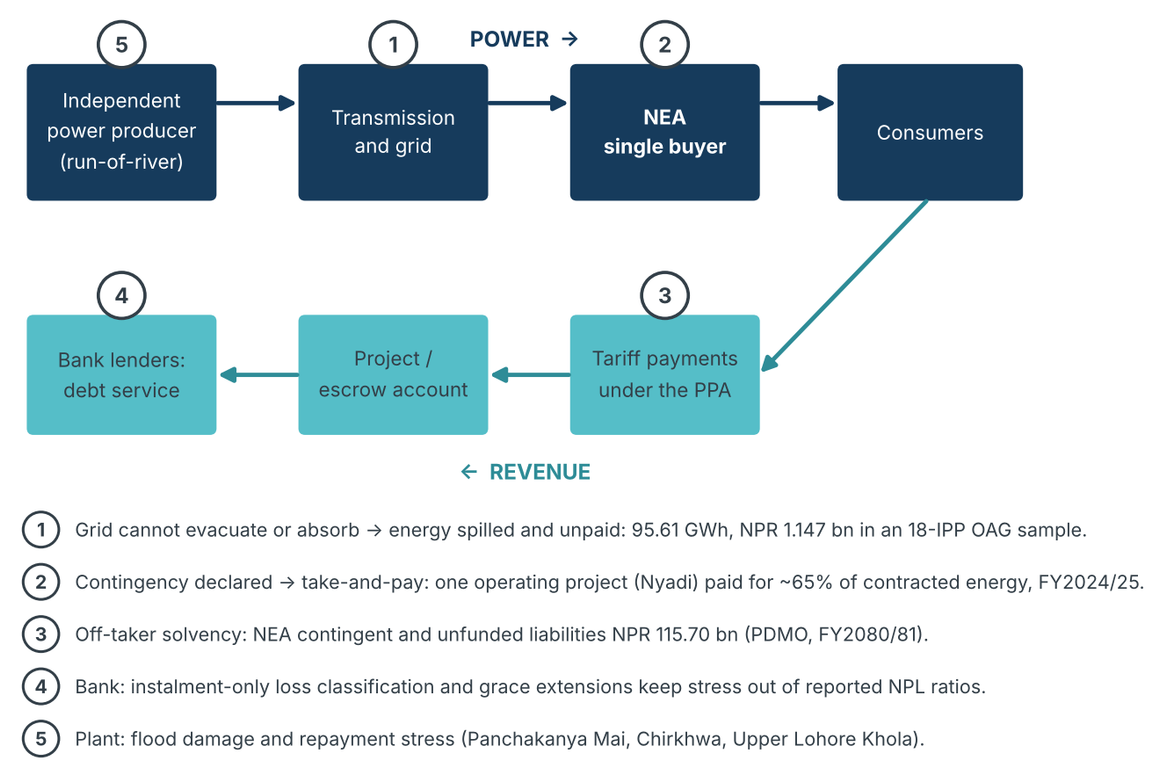
Source: OAG annual report (energy-sector audit, 18-IPP sample); CARE Ratings Nepal / ICRA Nepal rationale for Nyadi Hydropower (FY2024/25); PDMO Annual Report FY2080/81; NRB Unified Directive 2/082; rating agency rationales and company disclosures for the named projects.
9.3 Why doesn’t this stress show up in reported bad loans?
Because forbearance masks it. Instalment-level classification means a bank books only the single overdue instalment as a loss rather than the whole loan (UD 2/082, cl. 4(2)), and grace extensions for transmission delay are not treated as restructurings. Together they keep physical and financial stress out of the system’s reported non-performing loan ratios, so that the regulatory framework makes the sector look safer than it is. System-wide volumes of restructured or forborne hydropower loans are not published.
10. Would more quotas, or fewer hydropower privileges, fix the problem?
With the mechanism and its fragility established, the competing interpretation set out in §2.2 can be judged, and the two standard policy responses – push more credit in, or strip hydropower’s privileges out – assessed.
10.1 How does the regulatory-creation view hold up against the evidence?
It fails as a primary explanation on six counts (listed in the table below). Two are new to this section. Timing: energy credit was already growing at 23.74 to 45.74 percent a year from FY2013/14 to FY2018/19, before the phased energy floors of Ashad 2081–2084 applied. Targets followed capacity, not the reverse: banks did not meet the original 10 percent target by mid-July 2024 – the BFI energy share then was 7.28 percent – and NRB responded by re-dating and phasing the target (NRB monetary policy statements). A regulator that repeatedly lowers the bar to match achievable lending is tracking the supply of bankable projects, not creating it.
Testing the regulatory-creation view
| Test | What the evidence shows | Where shown |
|---|---|---|
| Timing | Energy credit grew 23.74–45.74% a year in FY2013/14–FY2018/19, before the phased floors applied | §1, Table 1 |
| Targets vs capacity | 10% target missed (7.28% in mid-July 2024); NRB re-dated and phased it, then folded it into a combined floor | §2.4, §10.1 |
| Conditionality | The enlarged SOL is available above 25% only with an executed PPA: the rule rewards the contract, not the sector | §5.1, Legal Text |
| Bank behaviour | Bank’s internal single-group cap (35%) sits well below the 50% ceiling, while its scoring rewards the PPA | §6 |
| Shared concessions | Cable cars share SOL and classification; cement, hospitals, star hotels and pharma share ICTL. None saw hydro-scale growth | §3 |
| Sector-neutral lender | NIFRA, under uniform rules, is 53% hydropower | §3.3 |
10.2 If so, what can be credited / blamed to regulator?
Three things:
- Acceleration. The targets plausibly accelerated energy lending in FY2022/23 to FY2024/25, when aggregate credit demand was weak and banks needed to show compliance. The evidence cannot separate the target effect from the supply of newly commissioned PPA projects in those years, but the size of the differential makes some target effect likely.
- Masking. Forbearance makes reported hydropower impairment understate economic stress (§9.3).
- Amplification of a fragile exposure. The concentration is becoming fragile – flood damage, contingency-reduced payments and audited curtailment losses (§9). In this setting, a regulatory target that pushes more credit into the sector through blunt quotas does not mitigate systemic risk; it amplifies a concentration it did not cause.
10.3 Why would stripping hydropower’s privileges not redirect credit?
The standard levelling remedy – remove hydropower’s enlarged single-obligor limit or its tax holiday so that other sectors can compete – rests on the regulatory-creation diagnosis, and fails with it. Banks would still be funding long loans with one-to-three-year deposits (§7), still be exposed to compulsory buy-in on specialised collateral (§8.2), and still be lending on sponsor recourse to projects with no assignable receivable (§8.1). Hospitals and toll roads would not suddenly become fundable. Tax holidays do improve equity returns and debt-service cover, and so contribute to bankability at the margin; but they do not create a counterparty, as the cable car case shows (§3). Removing hydropower’s concessions on their own would shrink aggregate infrastructure lending, not redirect it.
11. What would make roads, hospitals and urban services bankable?
Because the concentration is a bankability outcome, the policy priority is constructive: create PPA-equivalent instruments for other sectors, while making hydropower’s own risk transparent.
11.1 Why hasn’t Nepal’s PPP framework produced a PPA-equivalent?
Nepal has the legal scaffolding for non-hydro project finance. The Public-Private Partnership and Investment Act, 2075 provides for PPP modalities and viability gap funding, and the Bank and Financial Institutions Act, 2073 allows lenders to exercise step-in rights over PPP projects (BAFIA, 2073, s. 55(3ka)). What the scaffolding has not produced is a bankable payment instrument for projects whose users cannot be charged a cost-recovering tariff – that is, an availability payment backed by a binding budget appropriation or payment-security mechanism. IBN’s two flagship financial closures were hydropower projects with export or domestic PPAs (§1.3), and no non-hydro PPP has closed since.
| CASE STUDY 2 – Two transport PPPs that never reached financial closure Kathmandu–Kulekhani–Hetauda tunnel road. The PPP agreement for the tunnel highway was signed on 2070/01/31 with an estimated cost of NPR 34.88 billion; the project never commenced construction (Office of the Auditor General, annual report findings on PPP projects). Kathmandu–Terai/Madhesh Fast Track. Originally pursued as a PPP, the arrangement was cancelled on 2074/01/21 and the road was handed to the Nepal Army as a public project; its cost estimate rose from roughly NPR 120 billion to NPR 213.95 billion (Office of the Auditor General, annual report findings on the Fast Track).In neither case did the concession offer lenders what the PPA offers in hydropower: a creditworthy counterparty obliged to pay a defined amount on a defined schedule. A toll road’s revenue rests on traffic forecasts and political tolerance of tolls; without an availability payment or minimum revenue guarantee, banks would have to lend on sponsor recourse, which no sponsor could provide at that scale. What the cases show: a PPP law without a payment instrument does not create bankability; the contract structure, not the authorising statute, determines whether projects close. |
A recent statutory framework for alternative development finance (the Alternative Development Finance Mobilisation Act, 2082) may widen the instruments available for infrastructure, but its implementing rules and effect on lending are untested and it is described here only.
11.2 Where exactly does each alternative channel fall short?
Non-hydro financing channels and why they have not replicated the hydropower template
| Channel | What exists | Observed outcome | Missing element |
|---|---|---|---|
| PPP and viability gap funding | PPP Act 2075; VGF; lender step-in (BAFIA s. 55(3ka)) | No non-hydro PPP financial closure 2021–2023; tunnel road and Fast Track stalled/cancelled | Availability payment or minimum-revenue instrument backed by appropriation and payment security |
| NIFRA | Sector-neutral 50% SOL; NPR 30 crore floor (3 crore PPP) | 53% hydro of USD 161.7m portfolio; non-hydro mostly corporate borrowers | Pipeline of contracted non-hydro projects |
| Insurers | 10% cap; 5% per project | Life 0.855%; non-life 1.848%; reinsurers 0% | Rated, tradable infrastructure debt |
| Energy/agri bonds | Count toward lending floors; 3-year deployment | 3 energy and 4 agri bonds issued (to 2024) | Investor base and pricing benchmark |
| FX hedging | Government/Implementing Agency share 55–80% by project type | No non-hydro closure attributable | Underlying bankable project |
| Tax incentives | Roads 50%; cable cars 40% for 10 years | Cable cars rated B+ to BB | Contracted revenue |
11.3 What would a PPA-equivalent for other sectors look like?
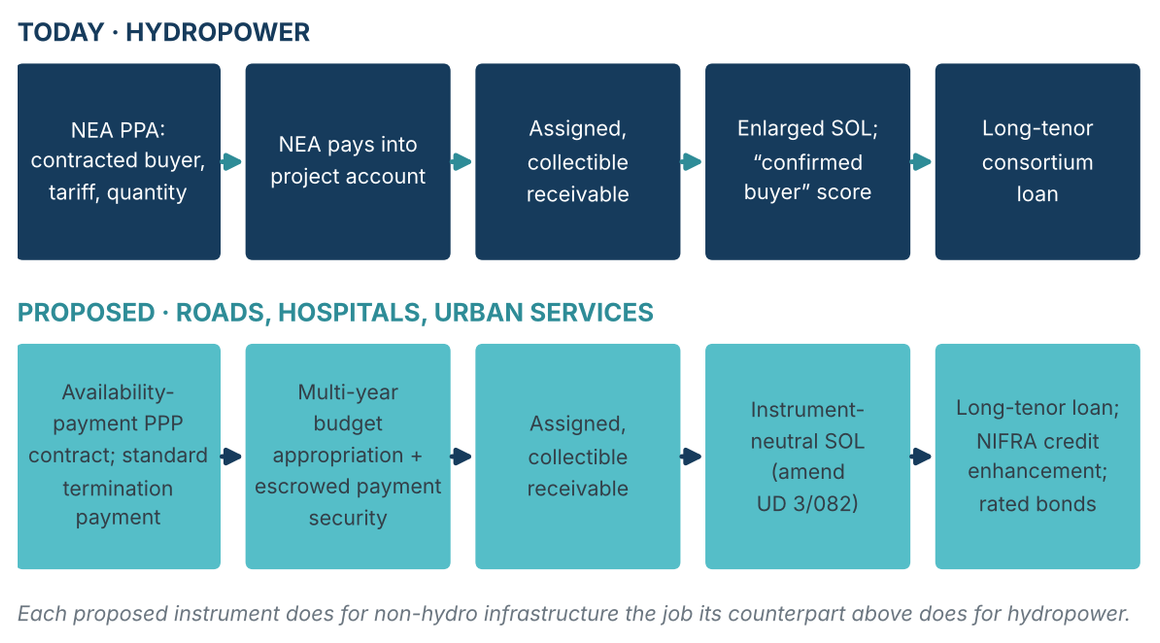
It would reproduce, instrument by instrument, the chain in Availability payments – fixed periodic payments from the state for a road, hospital or urban service kept available to a defined standard – take the place of the PPA tariff. A multi-year budget appropriation and an escrowed payment-security mechanism take the place of NEA’s payment into the project account. A standard termination-payment regime protects lenders if the contract ends early. The resulting receivable is assignable and collectible under the Secured Transactions Act, and an instrument-neutral SOL lets banks lend against it at the same scale as a PPA. Until the government packages transport and urban risk into contracted, collectible receivables, true project finance in Nepal will remain a monopoly of rivers.
The PPA-equivalent: rebuilding the hydropower chain for other sectors
11.4 Reforms that could be effective?
- Disclose forborne hydropower loans. Require banks to disclose the stock of hydropower loans benefiting from grace extensions, ICTL and instalment-level classification, so that reported impairment can be read against forbearance.
- Calibrate the combined productive-sector floor. In implementing Circular 12/2082-83, NRB should avoid penalising banks that fall short because bankable non-hydro projects are unavailable, and should monitor whether energy lending continues to absorb most of the combined floor.
- Create an availability-payment PPP template for roads, hospitals and urban services, backed by multi-year budget appropriation, an escrowed payment-security mechanism and a standard termination-payment regime, with model contracts approved by the Ministry of Finance and IBN.
- Strengthen the hydropower PPA. NEA, the Ministry of Energy, Water Resources and Irrigation and the Electricity Regulatory Commission should introduce deemed-generation compensation for transmission-caused curtailment in new PPAs and publish contingency declarations, and the Ministry of Finance should address the NEA’s contingent liabilities.
- Build long-tenor funding. Develop rated infrastructure bonds eligible for insurer investment and for favourable NSFR treatment; reconsider the energy/agriculture bond design given minimal uptake.
- Reform the enforcement and liability environment. Review the compulsory buy-in rule (Debt Recovery Rules, 2059, r. 29(5)) for specialised infrastructure assets; operationalise lender step-in under BAFIAs through a specialized Asset Management Company.