On 16 October 2026 the Cabinet approved the Directive on Use and Promotion of Domestic Products in Public Procurement, 2083, issued under Section 74A of the Public Procurement Act, 2063. In one line: government bodies must use Nepali goods, local materials and domestic technologies wherever these meet the required quality. The policy has been read as a windfall for domestic industry, cement above all. The numbers suggest something more modest and more uneven.
1. What does the Directive actually require?
It covers three things: local materials produced or processed in Nepal from resources available here, domestic technologies applied with Nepali manpower and skills, and domestic alternatives that meet the required quality, safety and durability standards. It applies at every stage of a public purchase, from the first design drawing to the final payment.
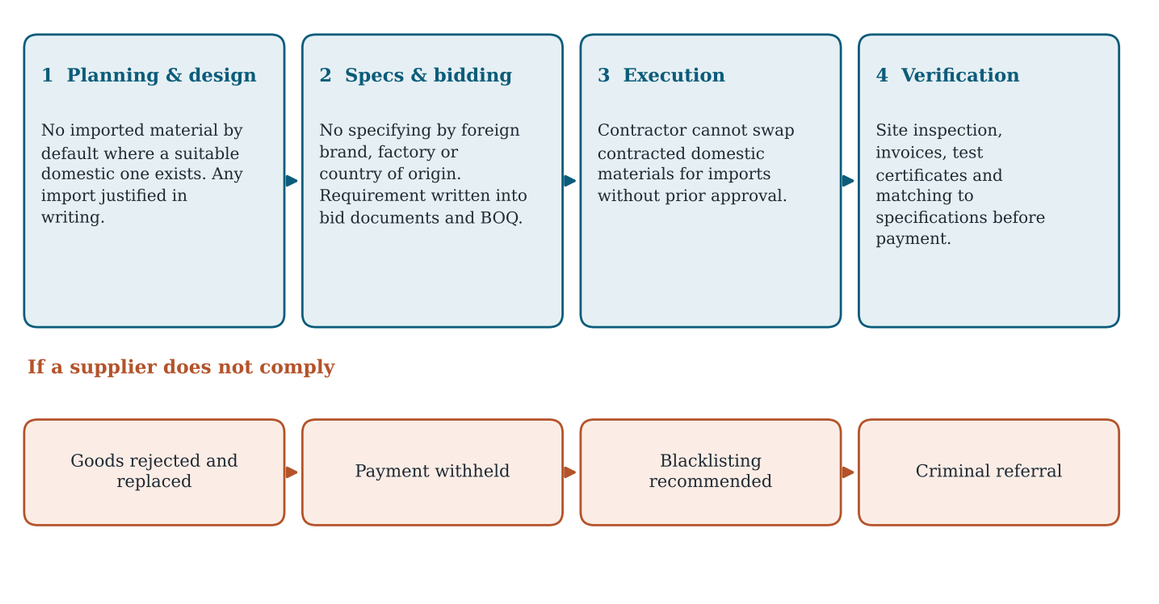
What each stage of procurement must now do, and the consequences of non-compliance
Designers can no longer default to imported materials. The Directive’s own examples are concrete roads with domestic cement in place of imported bitumen, and Nepali marble, stone and slate in place of imported granite. Before costing a project, the public body must check domestic supply, including through the government’s e-marketplace.
Two companion rules (recently amended) give it financial weight. The Public Procurement Act Section 2(na1) counts a product as domestic only if at least 30% of its value is added in Nepal. The Public Procurement Rules Rule 17(1) oblige public bodies to buy domestic goods even when they cost up to 15% more than imports.
The head of the public entity is accountable overall. Consultants and engineers must build domestic alternatives into designs and cost estimates. One limit matters for timing: the Directive does not touch procurement already under way or contracts already signed, so its effect will build gradually over FY 2083/84 and FY 2084/85.
2. How much business could move to domestic producers?
I looked at nine industries that sell heavily to the government. Together they face about NPR 153 billion of public demand a year. If the Directive were fully implemented, about NPR 33 billion of that, roughly 22%, could move from imports to domestic suppliers. A realistic base case is half of that.
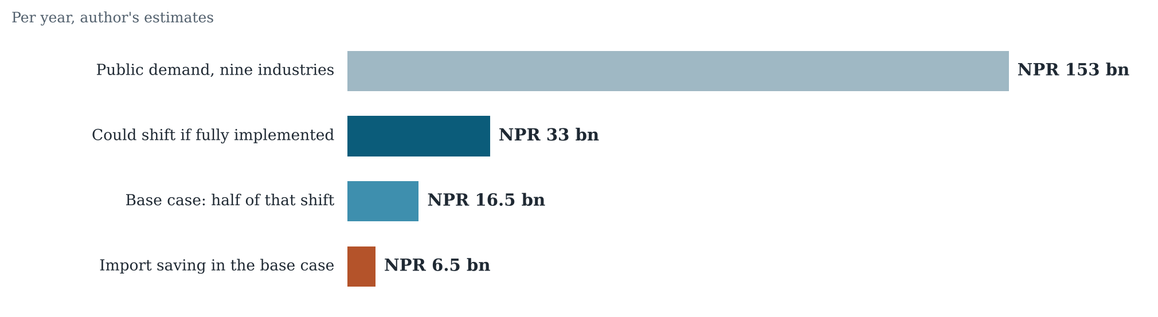
From total public demand to the import saving, per year
A caution on these figures. Public demand is built up product by product across all three tiers of government and public enterprises, largely from published reports and news sources, because official data at this level mostly does not exist. For each product I set the domestic share today and the share achievable once specifications stop favouring imports and the 15% preference applies. The shift is demand multiplied by the difference. Treat the results as orders of magnitude.
3. Which industries gain the most?
Two of them account for 57% of the potential shift.
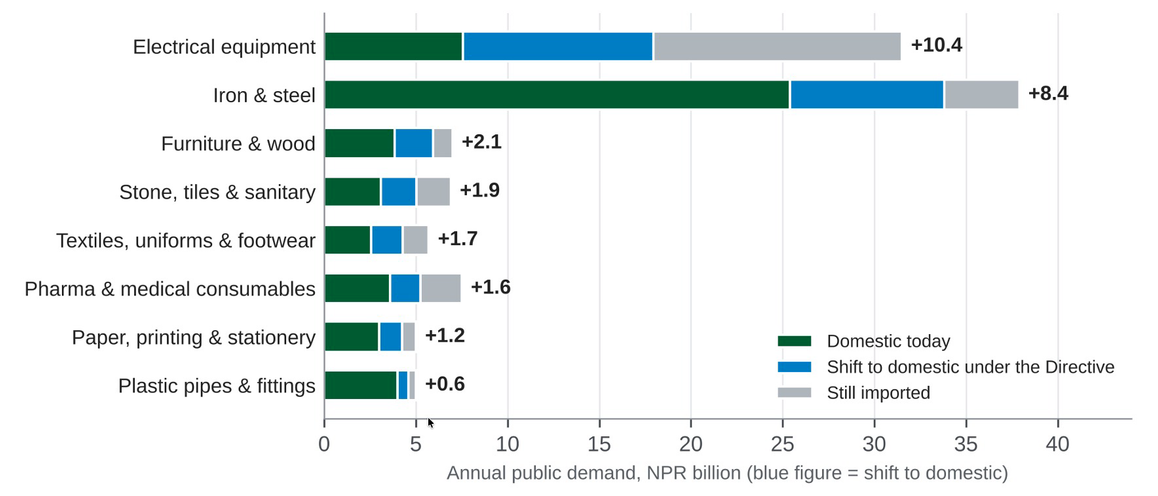
Where the NPR 33 billion comes from. Percentages show the domestic share of public demand today and what is achievable
Electrical equipment is the largest, at NPR 10.4 billion on public demand of NPR 31.5 billion. The electricity utility and building agencies can no longer write specifications around a brand or a country, which opens cables, conductors and distribution transformers up to 33 kV to domestic makers such as Litmus, Nepal Wire & Cables, NEEK and Transweld. Gaps remain in larger transformers, switchgear and type-testing, and turnkey contracts and donor-funded international tenders keep part of the spending out of reach.
Iron and steel follows at NPR 8.4 billion. Rebar, the reinforcing bar used in concrete, is already about 90% domestic. The gain is in structural sections, pipes and fabricated items such as transmission towers and bridge girders that now arrive finished. Capacity is not the issue: 3.58 million tonnes installed, running at about 45%.
The remaining industries are each small:
| Industry | Public demand | Potential shift | What to know |
|---|---|---|---|
| Furniture & wood | NPR 7.0 bn | NPR 2.1 bn | Keeps about 65% of each rupee in Nepal, the highest of the nine. Small workshops may struggle to document the 30% test. |
| Stone, tiles & sanitary | NPR 6.9 bn | NPR 1.9 bn | Tiles are already about 80% domestic; the gain is stone replacing imported granite. Quarry licensing is the bottleneck. |
| Textiles, uniforms & footwear | NPR 5.7 bn | NPR 1.7 bn | Garment factories are already running at 95.7% of capacity, so new orders need new investment. |
| Pharma & medical consumables | NPR 7.5 bn | NPR 1.6 bn | 83 domestic makers at roughly half capacity. Price ceilings unrevised for years are the main risk. |
| Paper & printing | NPR 5.0 bn | NPR 1.3 bn | Textbooks, forms and stationery. |
| Plastic pipes | NPR 5.0 bn | NPR 0.6 bn | Already about 80% domestic; little left to shift. |
Tile makers such as Laminar, Kajaria Ramesh, Nepovit and Prime illustrate the point about already-high domestic shares: where local producers have won the market, a preference rule adds little.
4. Why does cement gain so little?
Cement is the industry most often named as the winner, because the Directive favours concrete roads. Assume 40% of about 1,500 km of new paving each year moves to concrete. At 420 tonnes of cement per kilometre, 600 km adds about 0.25 million tonnes of demand. Installed capacity is 25 million tonnes against consumption of 7 to 8.5 million. The uplift is about 1% of capacity, and even converting all new paving would add only 0.63 million tonnes.
The real beneficiaries are concrete-road contractors and aggregate suppliers, who take most of the roughly NPR 4.9 billion of new demand, and the trade balance, which saves about NPR 2.3 billion of bitumen. Maintenance overlays still use bitumen, so only about 15% of bitumen imports are avoided. And concrete costs NPR 25 to 35 million per kilometre against about NPR 20 million for asphalt, which tight budgets may resist.
5. Will it cut the import bill?
Less than the sales figures imply. Domestic manufacturers import their own inputs: steel billets, copper and aluminium rod, plastic resin, active pharmaceutical ingredients, fabric and yarn. Only about 39% of each new rupee of domestic sales stays in Nepal as value added. In the base case, NPR 16.5 billion of new domestic sales saves about NPR 6.5 billion of imports, which is 0.3% of the FY 2082/83 import bill. This is an industrial policy with a small trade effect, not a fix for the trade deficit.
6. What could hold it back?
Not factory capacity. Average industrial utilisation was 42.1% in the first half of FY 2082/83, according to Nepal Rastra Bank, so most industries can absorb new orders without building anything. The constraint is on the buying side. The federal government spent only 46.8% of its capital budget that year, NPR 190 billion of NPR 407.9 billion. A preference rule applies only to money that is actually spent, and only to new procurement.
Three further frictions are worth watching: turnkey and donor-funded tenders that sit outside the preference, the paperwork burden of proving 30% value addition for small firms that face blacklisting if they get it wrong, and the temptation to pass off imports as domestic, which the Directive bans but someone must police.
In Short
The Directive changes who can bid more than how much is bought. Electrical equipment and steel fabrication have the most to gain, cement the least relative to the expectation, and the import saving is real but small. Its success depends on capital budgets being spent.
Figures are the author’s estimates built from public sources, including Nepal Rastra Bank, the Department of Customs, budget documents, industry associations and national news reports. Institutional food, IT and engineering services are also covered by the Directive but are not assessed here for lack of reliable data. This post is not investment advice.