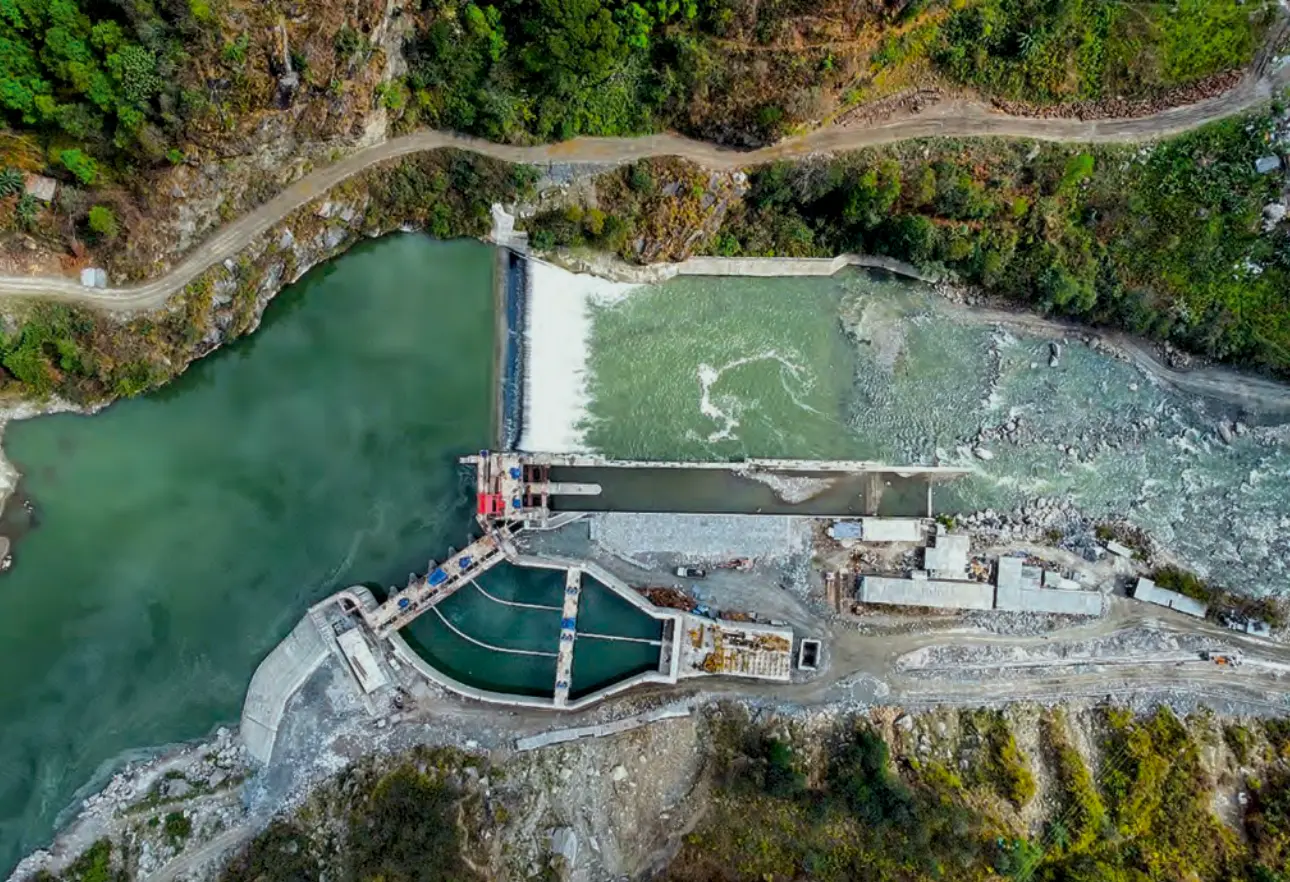
An analysis of whether Nepal should build its hydropower under Build-Own-Operate-Transfer (BOOT) and other transfer-based models: the legal and institutional framework, the project record, financing and risk allocation, and the alternatives.
Evidence base (October 2026): Investment Board Nepal, PDMO, Nepal Rastra Bank, the Office of the Auditor General, the Supreme Court and Revenue Tribunal, the Nepal Law Commission, the Nepal Gazette, SEBON, the Nepal Insurance Authority, NIFRA, credit-rating agencies, ICAN and commercial-bank documents.
What is this analysis about?
The question is “should we even build hydropower in Nepal under Build-Own-Operate-Transfer (BOOT) or similar transfer-based models, so that every privately financed plant eventually returns to the state?”
The answer is Yes – for large storage and export projects – but not the way we do it now, and not for every river. The devil either dwells in details (or the tailrace tunnels, if you like).
BOOT already exists in Nepali hydropower: every PPP concession under the PPP and Investment Act ends in transfer, and the Electricity Act makes foreign-majority plants transfer at licence expiry. What the record shows failing is not the BOOT model itself but the conditions that make a transfer worth having – prepared projects, a bankable offtake, transmission that arrives on time, domestic long-term finance, visible fiscal liabilities, and a public side able to receive and run an asset at term-end.
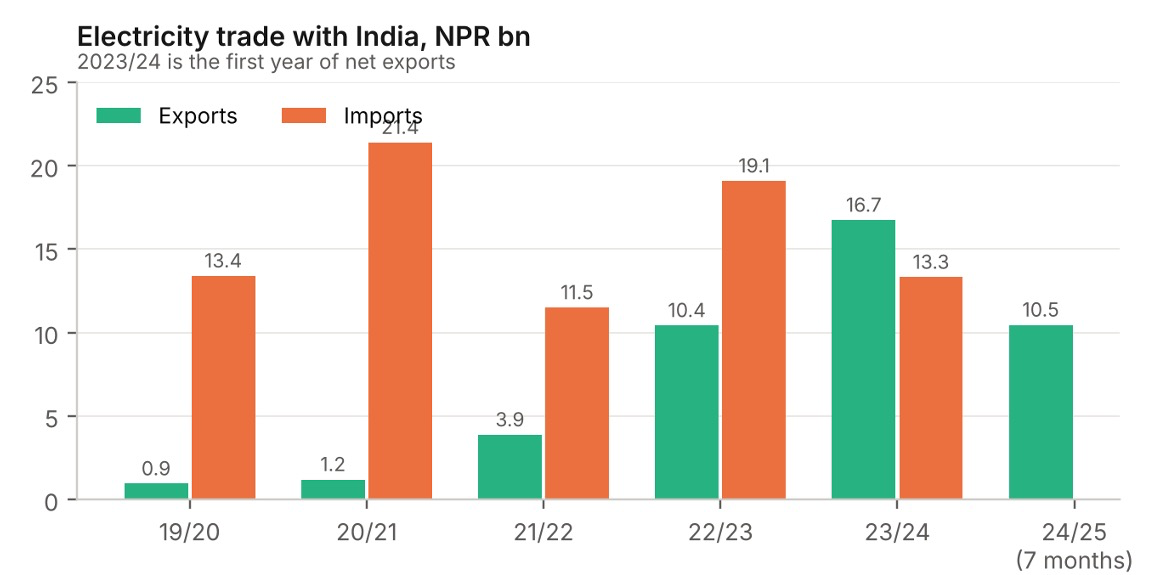
| Key findings 1. Hydropower BOOT already exists, but the transfer rule depends on which law you read. The PPP and Investment Act 2075 (PPPIA) lists ten modalities, every one ending in transfer (S17(2), S55–56), and does not list BOO. The Electricity Act 2049 (S10) and Telecommunications Act 2053 (S33) instead make transfer automatic only where foreign investment exceeds 50%; domestic or minority-foreign projects continue under agreement. Private Investment Approvals under PPPIA S32 carry no transfer at all. 2. Hydropower’s success story is not a PPP story. Private hydropower – licensed IPPs on NEA power purchase agreements, not PPPIA concessions – drove installed capacity from roughly 1,250 MW (2018/19) to 3,157 MW (2023/24), bank credit to energy from NPR 14.4 bn (2013) to NPR 364.0 bn (2024), and 103 listed hydropower companies by 2026. Nepal became a net electricity exporter in 2023/24 (exports NPR 16.7 bn, imports NPR 13.3 bn). 3. Large hydropower BOOTs have been slow, and PPPs in other sectors have mostly stalled. Upper Karnali (900 MW, PDA 2014) has not reached financial close; the Kathmandu–Terai Fast Track concession was cancelled and handed to the Nepal Army (revised cost NPR 211.53 bn); the Kathmandu–Kulekhani–Hetauda tunnel PPP (NPR 34.88 bn, signed 2012) never started; Nijgadh airport’s only shortlisted bidder dropped out. At the 2019 investment summit, 15 of 49 projects failed pre-qualification and 20 drew no interest; in 2024, EoIs for 19 projects drew responses for two. 4. Where transfer has fallen due, the public side was not ready. Khimti’s 1994 PPA gave NEA 50% ownership for NPR 1 after 20 years (July 2020); NEA was late forming the vehicle and had not recognised the stake (understatement NPR 9.47–12.58 bn per OAG). Seven Chitwan National Park resort concessions expired in 2012 with no takeover mechanism; the assets sat idle. 5. In hydropower the binding constraints are offtake, transmission, finance and preparation. Federal capital spending executed 46–81% of budget across the decade; 7,215 projects sat in the National Project Bank with 422 lacking a DPR; National Pride Project costs escalated 27% to 1,253%. Rated hydropower projects show overruns of 18–167%, most tied to late NEA substations or lines, with interest during construction reaching ~37% of cost at Upper Tamakoshi. Hedging under the Hedging Rules has seen effectively zero use. 6. Fiscal exposure is real and largely invisible. Public debt rose from 25.3% of GDP (2014/15) to 43.8% (2024/25). PDMO estimates SOE contingent liabilities at roughly NPR 2.1 trillion (about 37% of GDP); government accounts are cash-based (NPSAS 2079), so PPP commitments do not appear until cash moves. The PDM Act 2079 does not authorise guarantees for purely private PPP companies. 7. The answer for hydropower. Build large storage and export hydropower (above about 100 MW) under BOOT, with a power-sale agreement before financial close, a handback regime and a named public operator. Build domestic run-of-river plants under licences that end in buy-back at fair value or re-tender rather than free transfer, whatever the share of foreign money. Keep solar and other short-lived plant private on leased land, and build evacuation lines under BOOT or availability payments with compensation for delay. Outside hydropower, the same tests point to transfer for toll roads, airports and bulk water, and to public or availability-based delivery for services without a creditworthy payer. |
1. What exactly are we asking about hydropower, and why?
What is being claimed?
Generally, it is understood that, because infrastructure uses national resources, land and public authority, any private investor who builds it should own it only for a fixed term, after which it must transfer to the government, free or for a nominal sum. BOOT (Build-Own-Operate-Transfer) and BOT are the archetypes. The argument has intuitive force in Nepal, where the Constitution vests natural resources in the state, Article 51(g)(2) asks that multipurpose water projects prioritise domestic investment, and Article 279 requires a two-thirds parliamentary vote for treaties on natural resources with pervasive, long-term effects.
For hydropower the argument is at its strongest. Rivers belong to the state (Water Resources Act 2049, S3), hydropower royalty is shared 50:25:25 between federal, provincial and local governments, and the largest schemes – Upper Karnali, Arun-3, West Seti – are export projects built by foreign, often state-owned, companies. This article therefore narrows the question to hydropower: should Nepal build its hydropower under BOOT at all, and if so, which hydropower? Evidence from roads, airports, water and other sectors is kept where it shows what hydropower can expect from the same laws and institutions.
The research objective set four conceptual categories, which this article uses throughout:
- A – Mandatory transfer: the asset must return to the state at term-end.
- B – Conditional transfer: transfer, buy-back or re-tender depending on residual value, performance or policy at term-end.
- C – Continued private ownership: the asset stays private under licence, regulation and tax (BOO-type).
- D – Public ownership or procurement: the state owns from the start and procures construction or services (EPC, design-and-build, management contracts, availability payments).
Why do we even discuss the transfer of assets to the government?
A transfer obligation is only as valuable as the asset that arrives and the institution that receives it. It also prices itself into the deal: a finite asset life shortens the period over which equity is repaid, raises the required tariff or subsidy, and complicates financing when lenders, equity markets and hedging instruments are short-dated. The article therefore asks four questions in turn: what the law already requires; what the project record shows; whether transfer works when it falls due; and whether the real constraints lie elsewhere.
Which modalities are in play in Nepal?
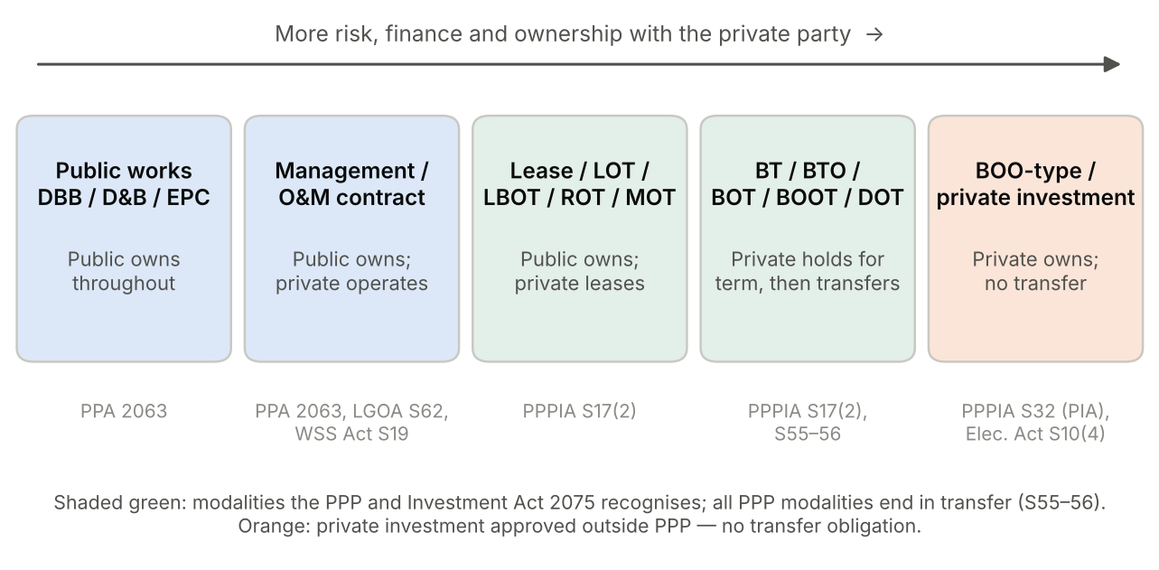
Delivery modalities and their legal home in Nepal
| Modality | What the private party does | Legal basis | Ownership at end of term |
|---|---|---|---|
| Design-bid-build, D&B, EPC, turnkey | Builds to public design or own design; EPC can include an O&M period; paid from budget | Public Procurement Act 2063 / Rules 2064 (D&B, EPC, turnkey defined in 14th amendment, 28 Apr 2025) | Public throughout (Category D) |
| EPCF (engineering, procurement, construction, finance) | Builds and arranges finance; repaid by the state | Treated as procurement – Supreme Court, Budhi Gandaki (2023) | Public (Category D) |
| Management / O&M contract | Operates a public asset for a fee | PPA 2063; LGOA 2074 S62(3); Water Supply & Sanitation Act 2079 S19; Development Board orders | Public (D) |
| Lease / LOT / LBOT / ROT / MOT | Leases, rehabilitates or modernises an existing public asset | PPPIA S17(2) | Public; returns at lease end (A) |
| BT / BTO | Builds and transfers at completion (BTO: then operates) | PPPIA S17(2) | Public from completion (A) |
| BOT / BOOT / DOT | Builds, finances, owns or holds, operates, then transfers | PPPIA S17(2), S55–56; Rule 43 | Transferred to the state (A) |
| Hybrid annuity (HAM) | Builds with ~40% public capital grants in milestones; recovered through annuity plus O&M | Investment Board transport profiles; VGF under PPPIA S43 | Public (A/D) |
| BOO / private investment approval (PIA) | Builds and owns indefinitely under licence | PPPIA S32; Electricity Act S10(4); Telecom Act S33(4); Industrial Enterprises Act | Private (C) |
| Joint venture / G2G | State entity co-invests with a private or foreign state-owned company | PPPIA S29(2) direct negotiation; HIDCL, NEA subsidiaries; CAAN Act S12; Railway Act S75 | Per agreement |
Sources: PPPIA 2075 and Rules 2077; PPA 2063 and PPR 2064 as amended; sector Acts.
The delivery-modality spectrum and where Nepali law places each model
2. What does Nepali law already require of hydropower?
What does the PPP and Investment Act require?
The PPP and Investment Act 2075 (gazetted 27 March 2019) recognises ten modalities in S17(2): BT, BOT, BOOT, BTO, LOT, LBOT, DOT, MOT, ROT and ‘other similar’ forms. BOO is not among them. S55(1) requires that a project implemented under PPP be transferred to the concerned agency as provided in the agreement; S55(2) requires plant and machinery to be handed over in running condition (chalu halat); S56 vests ownership in the agency. Rule 43(1) adds that transfer includes skills and technology, and Rules 43(3)–(4) let the government re-engage the investor under an operation agreement after transfer. The project development agreement must specify technical quality and condition at transfer (S37(2)(f), (t)).
Concession terms run up to 30 years, extendable to 50 for priority projects, with five further years in special cases (Rule 40). A performance guarantee of 0.1% of project cost and a PDA fee of 0.2% are the main financial assurances (Rule 36). The Act also says what PPP is not for (S18): arrangements that buy work or services from the private sector without transferring financial, technical or operational risk, national security projects, and anything else the Board excludes.
Inference. Within the PPP channel, there is no lawful BOO concession under PPPIA. The live question is therefore not whether to make transfer compulsory but which projects should be routed into the PPP channel at all, and whether the transfer that the Act mandates is enforceable in practice.
Does the Electricity Act agree?
They do not. Several sector statutes tie transfer not to the modality but to the source of finance. Under the Electricity Act 2049, S10(1), a project with more than 50% foreign investment transfers automatically to the government at licence expiry; S10(2)–(3) let the former licensee buy it back at a price set by a valuation committee of at least five members; but S10(4) provides that a project with 50% or less foreign investment, or domestic investment, continues to be operated by the former licensee under an agreement with the government. The Telecommunications Act 2053 S33 uses the same 50% test. Generation, transmission and distribution licences can run up to 50 years (S5(2)); the Hydropower Development Policy 2058 set 35 years for domestic supply and 30 for export.
Statutory transfer rules by sector
| Law | Transfer rule | Implication for the premise |
|---|---|---|
| PPPIA 2075, S17(2), S55–56 | All PPP modalities end in transfer; running condition; skills and technology (R43) | Compulsion exists for PPP; no statutory residual-life test or maintenance reserve beyond a 0.1% guarantee |
| PPPIA S32, Rule 33(8) | Private investment approvals (e.g. cement plants) – no transfer | BOO-type investment exists outside PPP |
| Electricity Act 2049, S10 | >50% foreign: automatic free transfer at licence end, with buy-back option; ≤50% foreign or domestic: continued operation under agreement | Transfer depends on who financed, not on the asset; creates incentive to structure foreign shares around 50% |
| Telecommunications Act 2053, S33 | Same 50% foreign-investment test; licence up to 25 years | Same inconsistency |
| Water Supply & Sanitation Act 2079, S13, S17 | Licence up to 25 years; assets built by licensee revert automatically | Clean Category A rule for water |
| Nepal Railway Act 2079, S76(4) | Mandatory reversion of assets at contract expiry | Category A |
| SEZ Act 2073, S10(6)–(7) | Licence up to 30 years (+10); on cancellation, one year to dispose, then immovables revert | Reversion of land-bound assets; private plants retained |
| Industrial Enterprises Act 2076, S30A | Government land leased to industries reverts on closure | Land reverts; plant does not |
| Development Board Act 2013, S8(2) | On dissolution, board assets vest in government | Public bodies, not private concessions |
| FITTA 2075, S33 | No nationalisation; expropriation only for public purpose with due process | Contractual transfer is distinct from expropriation (FIP 2071 cl. 12.7.2) |
Inference. The legal system holds two incompatible theories of why assets should return to the state: PPPIA’s theory that the mode of delivery creates a public claim, and the Electricity and Telecom Acts’ theory that foreign control does. A domestic 900 MW scheme on a licence would not have to transfer; the same scheme as a PPPIA concession would. Neither theory is grounded in the asset’s residual life or the public interest in its continued operation.
Is there a rule for choosing the modality?
No single rule exists. The Executive Procedure (Transaction of Business) Rules send modality changes for national-priority projects to the Cabinet (Schedule 1, items 14–17) and require Ministry of Finance consent for liabilities, guarantees and tax waivers (R11). The Investment Board’s standard operating procedures run solicited projects through four gates – strategic fit, prefeasibility, prioritisation with a qualitative value-for-money test, and appraisal using a PPP screening and appraisal tool (PSAT) – before entry into the project bank. Since the 2081 Investment Facilitation amendments, S68ka requires the Ministry of Finance’s prior concurrence before the Board takes decisions creating financial liabilities, and the Finance Secretary sits on the Monitoring and Facilitation Committee.
Thresholds route projects: the Investment Board handles projects above NPR 6 bn or energy projects above 200 MW; line ministries handle smaller ones; provinces and local levels implement PPPs ‘in accordance with this Act’ (S51), so the same modalities and transfer rule apply sub-nationally. Direct negotiation is permitted under S29(2) where competition is not feasible, technology is new, a project is a national priority or other procedures are inappropriate; unsolicited proposals face a Swiss challenge (S28) but no statutory right-to-match margin.
Selected procedural parameters for PPP projects
| Parameter | Value |
|---|---|
| EOI period / evaluation | ≥30 days (R16) / 45 days; weights technical 30–50%, financial 20–40%, experience 10–30% |
| RFP period / technical evaluation | ≥45 days (R21) / 90 days; pass mark 60%; shortlist up to 6 |
| Fees and guarantees | Proposal fee NPR 150,000 (solicited), 250,000 (unsolicited); 0.5% performance guarantee at MoU; PDA fee 0.2% + 0.1% guarantee |
| Survey licence fees | Energy NPR 10,000/MW/yr; NPR 5 m/yr for 200–500 MW, 6 m for >500 MW; West Seti NPR 60 m/yr, SR6 50 m/yr |
| Concession term | Up to 30 years; up to 50 for priority projects; +5 special (R40) |
| Royalty (hydro) | Years 1–15: NPR 100/kW/yr + 2% of average sales; after 15: NPR 1,000/kW + 10% (Electricity Act S11; PPPIR Sch. 2) |
| Free energy / equity | Arun-3, Lower Arun, West Seti: 21.9% free energy; Upper Karnali: 12% free energy (108 MW) and 27.5% free equity |
| Viability gap funding | S43 fund for capital or operating grants or loans; no statutory cap; eligibility R45(4)–(5) |
| Hedging cost-share (PPP national priority/pride) | Government side bears a fixed share by category, e.g. storage hydro ≥100 MW 45%, 220 kV+ lines 55% (Hedge Rules R5(2)) |
Sources: PPPIA 2075, PPPIR 2077, IBN SOPs and annual reports, Hedge Rules 2079.
3. What has BOOT delivered in Nepali hydropower so far?
Which hydropower BOOTs has the Investment Board advanced?
The Investment Board’s cumulative investment approvals reached NPR 1,040.25 bn for 27 projects by 2021/22 (energy NPR 725.17 bn, non-energy NPR 315.08 bn) and NPR 1,207.84 bn by 2022/23. FY2022/23 added NPR 167.59 bn across five hydropower projects; the 57th Board meeting (4 April 2024) approved four energy projects worth NPR 99.18 bn. The headline projects are almost all hydropower BOOTs with Indian state-owned developers or G2G-style partners.
Major Investment Board projects and their terms
| Project | MW | Cost | Developer | Modality / term | Status and notes |
|---|---|---|---|---|---|
| Upper Karnali | 900 | USD 1,049.9 m → 1,223.3 m | GMR (India) | BOOT, 25 yrs post-COD | PDA 19 Sep 2014; financial close repeatedly extended; SC interim order 3 Nov 2022, vacated 7 May 2023; 500 MW sale to Bangladesh via NVVN (subsidiary of NTPC). OAG: PDA omitted a clause requiring a PPA before financial close |
| Arun-3 | 900 | NPR 144 bn (85 bn + 62.26 bn added 2021) | SJVN (India) | BOOT, 25 yrs | PDA 25 Nov 2014; FC 6 Feb 2020; ~74% complete early 2024; 217 km 400 kV line; 4,019 GWh; upheld by Supreme Court |
| Lower Arun | 669 | NPR 92.68 bn | SJVN | BOOT, 25 yrs | Investment approval 13 Apr 2023; PDA 1 Jun 2023 |
| West Seti + SR6 | 750 + 450 | NPR 270.13 bn (USD 2.12 bn) | NHPC (India) | BOOT, direct negotiation S29(2) | China Three Gorges deal cancelled June 2021; NHPC MoU 18 Aug 2022; performance bonds NPR 840.97 m and 509.68 m |
| Upper Marsyangdi-2 | 327 | USD 647.16 m | Himtal (BPC + Chinese) | BOOT, 30 yrs | Investment approved 19 May 2021; PDA negotiation 2024 |
| Upper Trishuli-1 | 216 | USD 647.4 m | NWEDC (Korea/IFC) | BOOT, 30 yrs | PDA 29 Dec 2016; lending agreements Oct 2019; USD-denominated PPA with NEA |
| Tamor storage | 756 | USD 1.2 bn | HIDCL + PowerChina | BOOT, 30 yrs | MoU 19 Jan 2020; disputes |
| China–Nepal Friendship Industrial Park, Damak | – | USD 586.09 m | Chinese developer | PPP, 30 yrs | MoU 3 Oct 2019; PDA pending |
| Muktinath cable car | – | USD 439.34 m | – | PPP, 30 yrs | 80.16 km; MoU 12 Sep 2018; EIA stage |
| Cement plants (Hongshi-Shivam, Huaxin, Dang, Samrat, Suryatara) | – | NPR 14.3–37.4 bn each | Chinese and domestic | Private investment approval – no transfer | Hongshi operating from May 2018; Huaxin COD 29 Aug 2022; delays from roads, power and land |
Sources: IBN annual reports 2021/22–2022/23 and project profiles; OAG Reports.
What do PPP concessions outside hydropower warn us about?
- Kathmandu–Terai Fast Track (76.2 km). Initiated 2007/08 under BOOT/PPP with a minimum revenue guarantee; the Indian developer’s letter of intent (2014) was cancelled in 2016/17 and the project handed to the Nepal Army on 4 May 2017. Revised cost NPR 211.53 bn; completion pushed to 2026/27; progress 38.8–42.1%. The Supreme Court (072-WO-0283, 2016) held that public commitments such as revenue guarantees require competitive tendering, fiscal risk audit and disclosure, and upheld the switch to public delivery.
- Kathmandu–Kulekhani–Hetauda tunnel. A 30-year PPP signed 9 April 2012 with Nepal Infrastructure Development Co. for NPR 34.88 bn (80% debt, NPR 4.2 bn promoter equity, NPR 2.8 bn public equity). Financial close was due in 12 months; it never came, and the agreement was extended to December 2022 without construction.
- Nijgadh international airport. USD 3.45 bn, planned as PPP; Zurich Airport was the only shortlisted bidder and failed to submit by 30 September 2020; the Board cancelled the process on 10 April 2022. The Supreme Court on 26 May 2022 (076-WF-0006 and 076-WF-0007, heard together with 076-WO-0223 and 076-WO-0480) quashed the allocation of 8,045.79 ha of forest and the EIA approval, ordering study of alternative sites.
- Investment summits. Of 49 projects offered in 2019, 15 failed pre-qualification and 20 attracted no interest; 14 qualified. For 19 projects offered for EoIs in 2024, only two drew responses (a heritage hotel and Babarmahal plaza), and both failed.
- Urban PPPs. The Kathmandu valley solid-waste BOOT (1,200 tonnes/day, 20–25 years) awaited PDA finalisation after the 57th Board meeting; the Electric Bus Rapid Transit eBRT EOI (Nov 2022) was cancelled in Feb 2023; the 72 km outer ring road (USD 1.871 bn) has consumed NPR 108–148 m over 22 years without a DPR.
Inference. The transfer obligation was not what stopped these projects. They stalled on demand risk without a creditworthy payer, land and forest clearance, missing preparatory studies and the absence of a public counterpart able to make and keep commitments. Making BOOT compulsory would not have changed any of those facts.
What did work in hydropower, and under which modality?
And that too under a BOOT determined by generation license – not a PDA under PPPIA.
Private hydropower under the Electricity Act – licensed independent power producers selling to NEA under PPAs – is the clearest scaling story. Private IPPs supplied an estimated 70–75% of installed capacity by 2024, and in 2079/80 IPPs generated 7,606 GWh against NEA’s own 2,930 GWh. These projects are mostly domestically financed and therefore, under S10(4), not subject to automatic transfer at licence expiry – strictkly under any law. However, their transfer to the government is ensured under the licensing term of their generation license, singed by the Director General of DOED – discussed in detail here.
Bank credit to the energy sector, 2013–2024 (NRB Sectoral Credit Statistics)
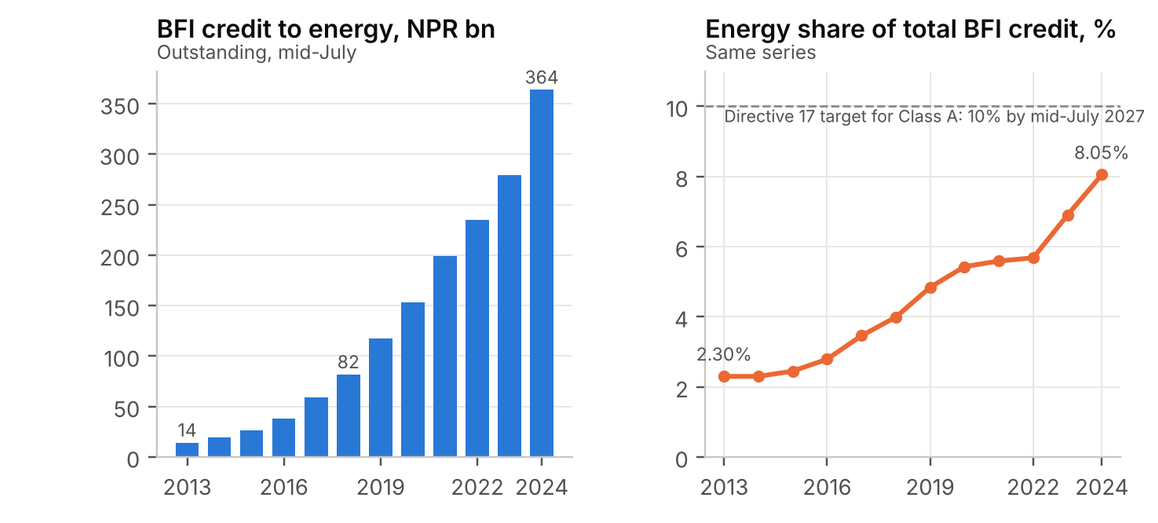
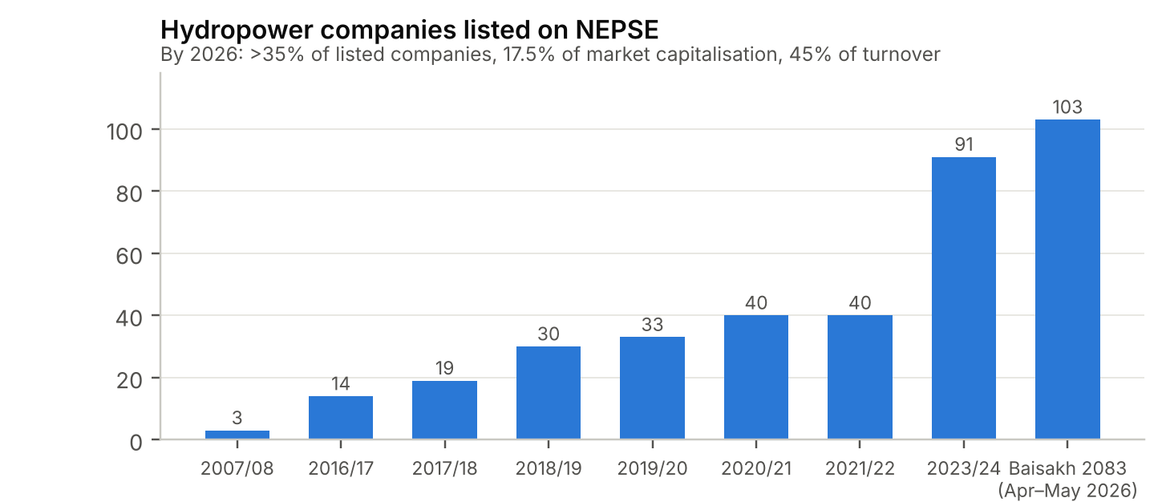
Credit to energy rose 25-fold in eleven years, to 8.05% of total BFI credit in mid-July 2024, against a Class A target of 10% by mid-July 2027. Other NRB series put outstanding credit to electricity at NPR 367.1 bn in mid-July 2024 and NPR 389.7 bn by mid-December 2024. Capital markets followed: hydropower companies listed on NEPSE grew from three in 2007/08 to 103 by Baisakh 2083, accounting for more than 35% of listed companies, 17.48% of market capitalisation (NPR 813.99 bn) and 45.2% of turnover; hydropower IPOs approved since 2060/61 total NPR 50.86 bn.
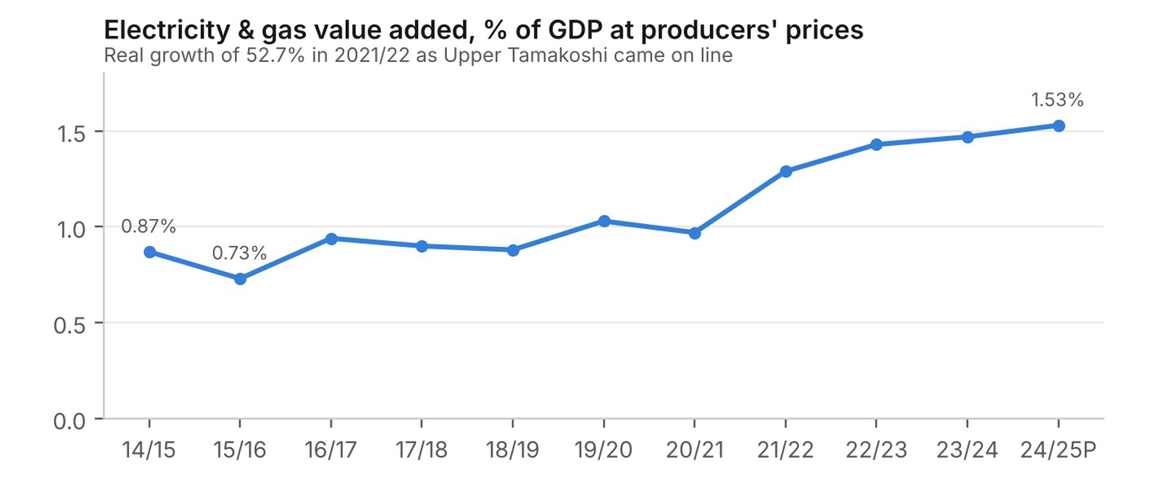
The macroeconomic payoff is visible. Electricity and gas value added rose from 0.73% of GDP at producers’ prices in 2015/16 to 1.53% in 2024/25, with 52.7% real growth in 2021/22 as Upper Tamakoshi (456 MW, an NEA subsidiary financed domestically) came online. Per-capita consumption rose from 304 to 415 kWh and transmission lines from 3,977 km (2020/21) to 6,207 km (March 2024). A 10,000 MW, ten-year Long-Term Power Trade Agreement with India was upheld by the Supreme Court in October 2024 as a commercial agreement rather than an Article 279 treaty.
Electricity’s share of GDP: NRB Economic Bulletin Vol 58
4. Will a hydropower plant actually transfer when its term expires?
What happened at Khimti, Nepal’s first major BOOT-type IPP?
Khimti (60 MW) operated under a 1994 PPA that gave NEA 50% ownership for NPR 1 twenty years after commercial operation, which fell due on 12 July 2020, with full transfer at the end of the licence. The Supreme Court (Himal Power Limited v. the Nepal Electricity Authority Case No. 070-WO-0888) upheld the PPA’s royalty-reimbursement clause as part of an integrated commercial risk allocation. When the 50% transfer date arrived, the Office of the Auditor General found that NEA was late forming the joint vehicle, agreed an interim tariff of NPR 2 per unit (including NPR 1.50 for O&M) worth at least NPR 1.273 bn to NEA, and had not recognised its 50% ownership in its books – an understatement of NPR 9.466–12.578 bn across FY2079/80–2080/81.
What do leases and concessions on public land teach hydropower?
- Chitwan National Park: seven resort concessions of 20 years expired in Asar 2069 (2012) with no takeover mechanism; the assets sat idle (OAG).
- Kathmandu Plaza (Kamaladi): a 27-year BOOT lease expired; the Supreme Court held the developer had no vested right to extension, and the building passed to Kathmandu Metropolitan City – a functioning reversion, but to a different use.
- Gongabu bus park: a 54-year BOT (2056/12/29) built with a ¥786 m JICA grant; royalty NPR 5.1 m/yr with arrears of NPR 21.84 m and NPR 70.25 m uncollected in total; the developer replaced passenger waiting halls with shops. The Supreme Court required enforcement or re-tendering.
- Gokarna: a 30-year lease (1995, USD 5 m) extended by 25 years six years early without competition (USD 8.904 m).
- Pathibhara cable car: an 80-year (40+40) lease without a contract; Pokhara siltation BOOT: 24 years against a legal maximum of 20, with the royalty escalator cut from 3% to 2% (loss NPR 66.95 m).
- Taragaon/Hyatt: government land (150 ropani) and structures (NPR 170 m) contributed for 39.77% equity, diluted to about 9.01%.
Is the handback regime fit for purpose?
PPPIA requires ‘running condition’ but sets no residual-life standard, no maintenance or major-overhaul reserve account, no independent handback survey and no joint-operation period before expiry; the only financial lever is the 0.1% performance guarantee and the government’s power to halt, revoke or take control (S64). The ICAN Valuation Manual 2083 tells valuers that for concession assets ‘residual equity at end of concession may be zero or minimal’ and that ‘asset reversion value drives the terminal value’ – confirming that the market prices a transfer as worth little to the private side and leaves the public side to realise its value.
On the public side, NPSAS 2079 (approved 6 December 2022) is cash-based: BOT/BOOT assets and the liabilities that accompany them are not recognised during construction, availability payments and guarantee calls appear only when paid, and a transfer at expiry registers nothing in the cash statements. OAG found that NEA had not applied IFRIC 12 (NPR 30.08 bn misclassified). Tax law treats concession assets as Group ‘E’ intangibles amortised over the concession period (Supreme Court, LTO v Siddhartha Bank, 072-RB-0493).
| Assessment: transfer readiness Inference. Every observed transfer or reversion – Khimti, the Chitwan resorts, Kathmandu Plaza, Gongabu – exposed either an unprepared recipient or weak contract management. None shows a transferred asset generating better public value than continued private operation would have. Judgment. A compulsory-transfer rule without a handback regime (residual-life tests, reserves, independent engineers, a named operator, and accrual accounting for the reversionary asset) is mostly symbolic; with one, it is valuable for long-lived, resource-based assets. |
5. Is BOOT the problem in hydropower, or the conditions around it?
If compulsion is already law and the record shows stalls rather than abuses, the next test is whether the obstacles lie in the conditions any modality needs. Five sets of evidence point that way: public project preparation and execution; offtake and transmission; domestic finance; fiscal and contingent liabilities; and foreign-exchange and foreign-investment flows.
For hydropower the order of importance differs from other sectors: offtake and transmission come first, then finance, fiscal exposure and foreign exchange. The public side’s capacity to prepare and execute projects is examined first because it is the same capacity that must one day receive the plants.
Can the public side prepare, execute and later receive projects?
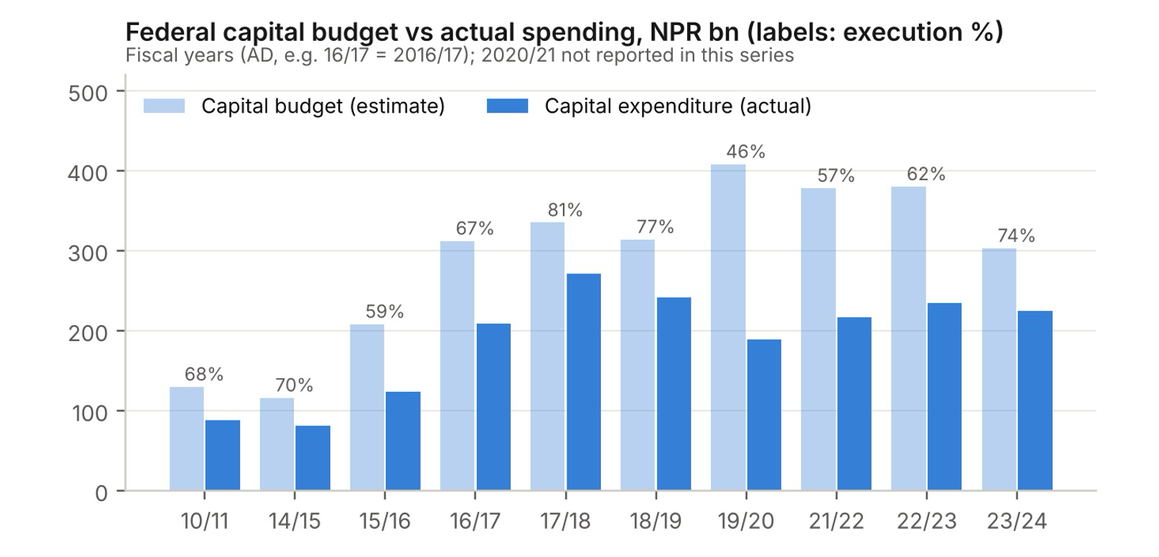
Capital spending has never matched the budget. Execution ranged from 46% (2019/20, the first COVID year) to 81% (2017/18) on the NRB annual-report series. Capital spending fell from about 7.8% of GDP in 2017/18 to 4.3–4.5% in 2021/22–2022/23 and 3.4–4.3% in 2023/24, depending on the NRB measure. Spending is back-loaded: under 15% of capital spending occurs in the first six months and 35–40% in Asar, the final month; in 2015/16 only 4.1% of the capital budget had been spent after five months. In 2023/24 eleven-month ‘financial management’ spending (debt service) of NPR 223.51 bn exceeded capital spending of NPR 134.98 bn, and domestic borrowing has roughly equalled federal capital spending since 2020/21 (e.g. NPR 252.12 bn against NPR 234.62 bn in 2022/23).
Execution failures documented by the Auditor General and CIAA
| Indicator | Value |
|---|---|
| National Project Bank (2079 performance audit) | 7,215 projects; 422 without a DPR, of which 270 already under implementation (incl. Ratamate–Rasuwagadhi–Kerung and Karnali corridor 400 kV lines) |
| National Pride Project cost escalation | 27% to 1,253% after 10–15-year delays; no re-appraisal of viability |
| Department of Roads contracts | 3,830–3,860 contracts worth NPR 1,101.36 bn; 807–841 (NPR 35.50 bn) incomplete beyond term; 2022/23: 509 contracts (NPR 59.44 bn) incomplete despite extensions up to 400% / nine times; 2024/25: 364 of 2,106 (NPR 81.58 bn) incomplete, 19 over ten years late |
| Sick contracts (CIAA) | Dec 2018: 1,848 contracts, NPR 135.02 bn; Poush 2076: 1,202 contracts, NPR 86.44 bn (DoR 701; CAAN 4 worth NPR 24.36 bn; NEA 43 worth NPR 11.43 bn) |
| Contract timing (2077/78) | 2,989 federal contracts worth NPR 67.99 bn; 80% signed in the second and third trimesters; 623 (NPR 16 bn) signed in Asar; 20,125 time extensions, 6,226 of them above 100% |
| Water supply (DWSS) | 3,422 of 3,835 projects incomplete; estimated cost NPR 128.94 bn, spent NPR 22.92 bn |
| Local DPRs (2082 audit) | 4,103 prepared; only 1,406 (34.27%) funded |
| Liquidated damages | Unrecovered NPR 409.54 m (44 offices); NPR 1.75 bn across 24 entities |
| Sikta irrigation | NPR 7.448 bn (2002/03) → NPR 52.64 bn (seven-fold); completion 2012/13 → 2032/33; canal collapses 2016 and 2018 |
| Melamchi water | USD 317 m → 355 m; contractor terminated 2012 and 7 Feb 2019 (CMC di Ravenna, NPR 7.723 bn); ICC award NPR 382.7 m; June 2021 flood destroyed headworks |
Sources: OAG annual reports 55th–62nd and performance audits; CIAA.
Publicly built airports show what happens when demand risk sits with an unprepared public operator. Pokhara international airport (China EXIM loan CNY 1.379 bn; cost NPR 21.6–22.1 bn; on-lent to CAAN at 5%) opened on 1 January 2023; the feasibility study projected 89,856 international passengers in 2020 and 289,000 in 2025, but only two international charters operated in January–July 2023. Gautam Buddha airport (NPR 30.91 bn after five extensions) handled 31,618 international passengers in 2022/23 against the same 89,856 projection; 19–20 domestic airports built for NPR 50.19 bn are non-operational.
Inference. The state’s weakness in preparation is the strongest argument for private participation – and the strongest argument against making transfer compulsory without first fixing preparation, because the same institutions that cannot complete projects are the ones that must receive them at term-end.
Is offtake and transmission the real risk in hydropower?
NEA is the sole offtaker. Standard PPAs pay NPR 4.80/kWh in the wet season and NPR 8.40/kWh in the dry season, with 3% annual escalation for five to nine years; peaking run-of-river projects earn NPR 8.50–10.55/kWh for dry-season peak hours. PPAs lack a explicit deemed-generation clause (despite the arrangement being structured as “take or pay”); require dry-season energy of at least 30% of the annual total; allow NEA to refuse up to 10% of contract energy in wet months without liability; and convert to take-and-pay ‘contingency’ terms when evacuation lines are late. A project that misses its required commercial operation date by more than six months loses one 3% escalation per year of delay and faces a penalty of about 5% of potential revenue. Because licences of about 35 years count from issuance, delays cut operating life – in extreme cases from 30 years to 19–23.
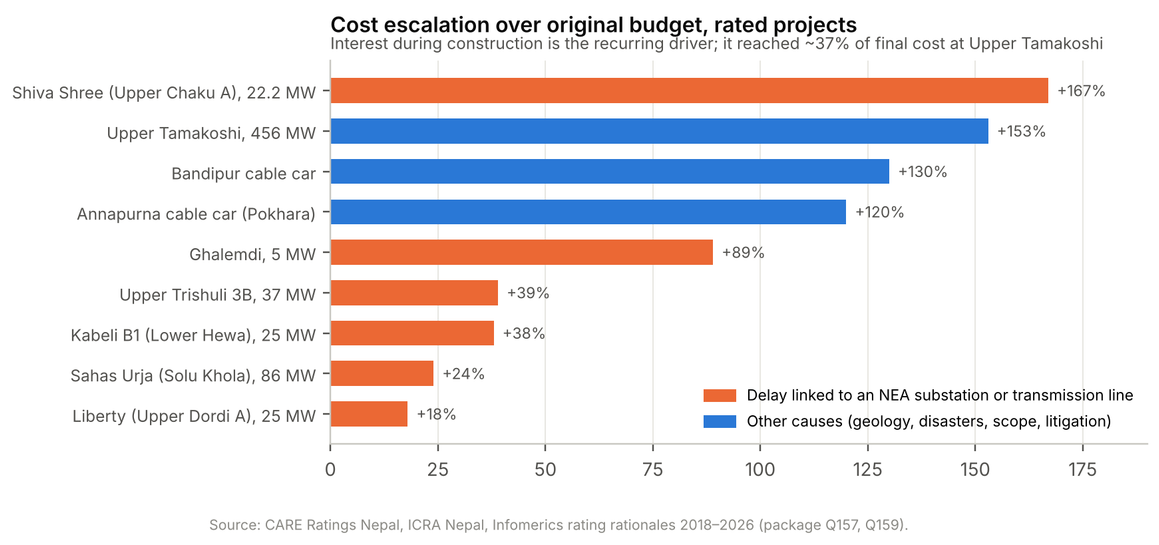
Transmission-linked delays and their cost
| Project | Original, NPR m | Final, NPR m | Evacuation problem |
|---|---|---|---|
| Shiva Shree (Upper Chaku A) | 4,795 | 12,821 | NEA Singati–Lamosangu 132 kV line (due Nov 2011, nine extensions over eight years); >12-year delay; ~NPR 321 m/MW |
| Sahas Urja (Solu Khola, 86 MW) | 11,860 | 14,699 | NEA Tingla substation; NPR 2,549 m of extra debt untied |
| Liberty Energy (Upper Dordi A, 25 MW) | 4,760 | 5,616 | Udipur substation and 132 kV Kirtipur–Udipur line; interest capitalised during idle period |
| Ghalemdi (5 MW) | 714 | 1,351 | Dana substation; 17-month delay; NPR 270 m/MW |
| Mountain Hydro (Kabeli B1, 25 MW) | 4,000 | 5,529 | Kabeli corridor line |
| Trishuli Jal Vidhyut (Upper Trishuli 3B, 37 MW) | 8,227 | 11,466 | Trishuli 3B hub substation; EPC contractor terminated Dec 2023; licence life cut to ~20 years |
| Upper Tamakoshi (456 MW) | 35,294 | 89,420 | Not primarily transmission: earthquake, blockade, floods, FX on imported equipment; IDC ~37% of cost; D:E 88:12; PPA tariff NPR 3.63/6.96, unrevised for 15+ years |
Sources: ICRA Nepal, CARE Ratings Nepal and Infomerics rationales.
The Auditor General’s sample of 18 IPPs found 95.61 GWh a year spilled for want of lines – NPR 382.46 m of lost IPP revenue at NPR 4/kWh plus NPR 764.92 m of replacement imports at NPR 8/kWh, a combined NPR 1.147 bn burden. Ten IPPs paid NEA NPR 86.01 m in RCOD penalties while NEA’s own lines were late. NRB has had to write project-finance rules around the problem: grace-period extensions caused by revised RCODs or missing lines are not treated as restructuring, and interest exceeding net sales may be capitalised until the line is ready (Directive 2/082 cl. 45).
The Supreme Court has recognised the state’s share of the blame. In Ambeshwer Engineering (Kaligandaki Koban, 400 MW; 19 November 2024) (Writ numbers: 076-WO-0331 and 076-WO-0610) it quashed a licence cancellation for failure to reach financial close because the government had not issued the hedging-fund guidelines and foreign-currency PPA templates it had promised: the state ‘cannot take advantage of its own default’. But in Himalayan Hydropower (2022) it held PPAs to be commercial contracts under the Contract Act 2056 that courts will not rewrite through writs.
Inference. In energy the decisive risk is the public counterparty’s performance – NEA’s grid build-out and payment – not the private developer’s ownership horizon. A transfer obligation lengthens nothing and fixes nothing here; a bankable PPA and a transmission plan with compensation for NEA delay would.
Can domestic finance carry long-tenor hydropower BOOTs?
Nepal’s infrastructure finance is overwhelmingly bank finance with short liabilities. Commercial-bank deposits reached NPR 5,756.81 bn in 2024, 55.2% of them fixed deposits, against loans of NPR 4,491.86 bn and a capital fund of NPR 713.72 bn; CET1 fell from 10.73% to 9.68% and CAR from 13.53% to 12.40% between 2022 and 2024, while loan-loss provisions rose from 2.28% to 4.83% of loans and NPLs from 1.20% to 3.94%. The regulator has stretched prudential rules to accommodate hydropower:
NRB prudential treatment of hydropower and infrastructure lending (Unified Directive 2082)
| Rule | Provision |
|---|---|
| Single obligor limit | 25% of core capital (30% productive sectors); up to 50% for hydropower, renewables, transmission and cable cars – beyond 25% requires a signed PPA; non-hydro exposure within the 50% capped at 25% (Dir. 3) |
| Consortium | Multi-bank exposure above NPR 2 bn must be syndicated, else Watchlist (Dir. 11; Dir. 2 cl. 39) |
| Debt-equity | Loans above 80:20 go to Watchlist (Dir. 2 cl. 1) |
| Grace period and provisioning | Grace ≤1 year normally; general provision phased 0.25/0.50/0.75/1.00% over a four-year grace; operating hydro: only the overdue instalment is classified Loss after 90 days |
| Interest capitalisation | Allowed pre-COD for hydropower, transmission, cement, hospitals, star hotels and other long-gestation sectors; ICTL and Interest Capitalised Reserve; released at 60% construction for hydro and solar |
| Pricing | Hydropower exporting power: premium ≤1 pp over base rate for five years; reservoir projects ≤1 pp for the whole tenor |
| Directed lending | Class A: energy ≥10% by mid-July 2027 (path 6/7/8/9/10%); from Poush 2083, agriculture ≥10% plus 20% in a specified-sector basket; energy bonds count; tradable ‘reporting rights’ up to one-third of the target |
| Risk weights | Corporate/project 100% (unrated or BBB); AAA 50%; GoN or MDB-guaranteed 0%; past-due 150% |
Sources: NRB Unified Directive 2082 and circulars 11–19.
The Infrastructure development bank is small. NIFRA (operations from 6 March 2019) had assets of NPR 29.50 bn in mid-July 2024 – 0.37% of banking assets – with paid-up capital of NPR 21.60 bn, loans and investments of NPR 21.14 bn and a CRAR of 78–92% because it remains mostly equity-funded. Its portfolio is 53% hydro and renewables, 20% hospitals, 14% tourism. It cannot lend under NPR 300 m per project (NPR 30 m for provincial or local PPPs in seven social sectors), may hold no more than 20% of a project’s equity, and targets NPR 250 bn of sanctions by 2029/30. ICRA upgraded it to BBB+ in December 2025. Its 2025 green bond (6%, NPR 5 bn, seven years) was four times subscribed, whereas its 2023 energy bond was only 46% subscribed when rates were high.
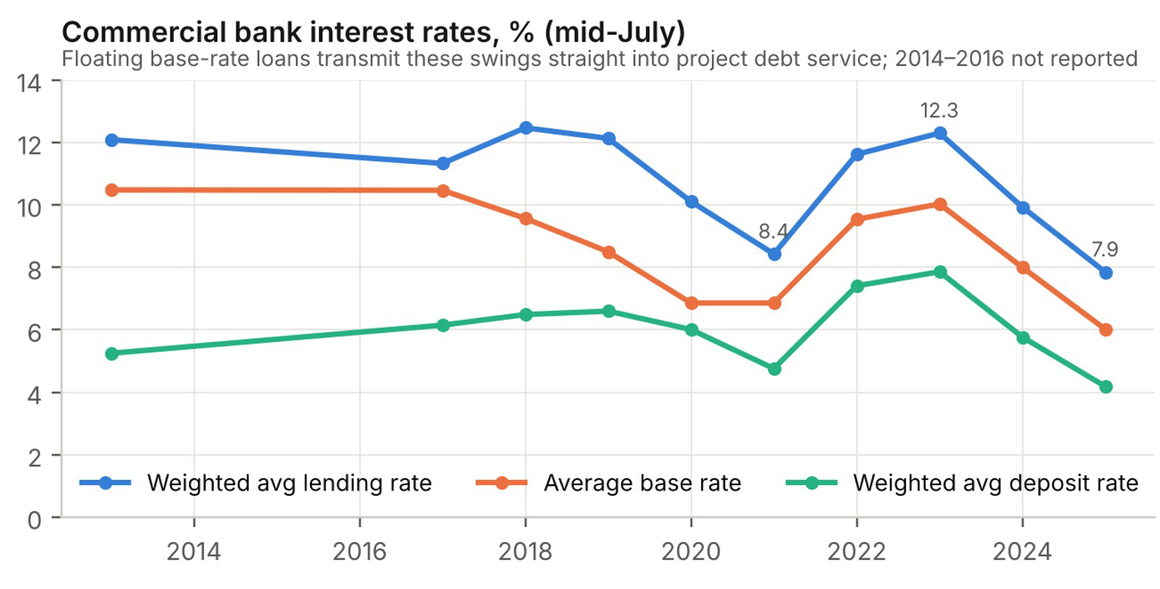
Other long-term pools barely touch infrastructure. Insurers must keep at least 30% of total investment in bank and infrastructure-bank deposits and may put at most 10% into infrastructure (5% per project) under the 2082 directive; actual life-insurer direct infrastructure investments were NPR 17–74 crore a year, non-life insurers placed NPR 125.53 crore in infrastructure-bank deposits in 2081/82, and reinsurers’ direct infrastructure exposure was zero in 2080/81. Foreign-employment bonds sold only 4.9% of NPR 15.57 bn offered over 25 issues. The Hydroelectricity Investment and Development Company (HIDCL) held 52.92% of its funds in term deposits.
Foreign debt is capped and unhedged. The Foreign Investment and Foreign Loan Management Bylaw (fifth amendment, 29 December 2025) caps all-in costs at one-year SOFR + 6.0% for project loans from foreign banks and DFIs, + 3.5% for shareholder loans and + 4.5% for banks or NIFRA borrowing to on-lend, with tenors of up to 15 years for on-lending; contractor-affiliate construction loans must be interest-free. The Hedge Rules (2075, revised 2079) let a designated state-linked bank lock exchange rates for eligible projects (storage hydro ≥100 MW, 220 kV+ lines over 30 km, expressways over 50 km, airports, other infrastructure over NPR 2 bn) with a government cost-share for PPP priority projects; reported usage is effectively zero, attributed to cost and tenor mismatch (ten years against 15–25-year loans) and to dollar-denominated PPAs as an alternative.
How large are the fiscal and contingent liabilities behind hydropower deals?
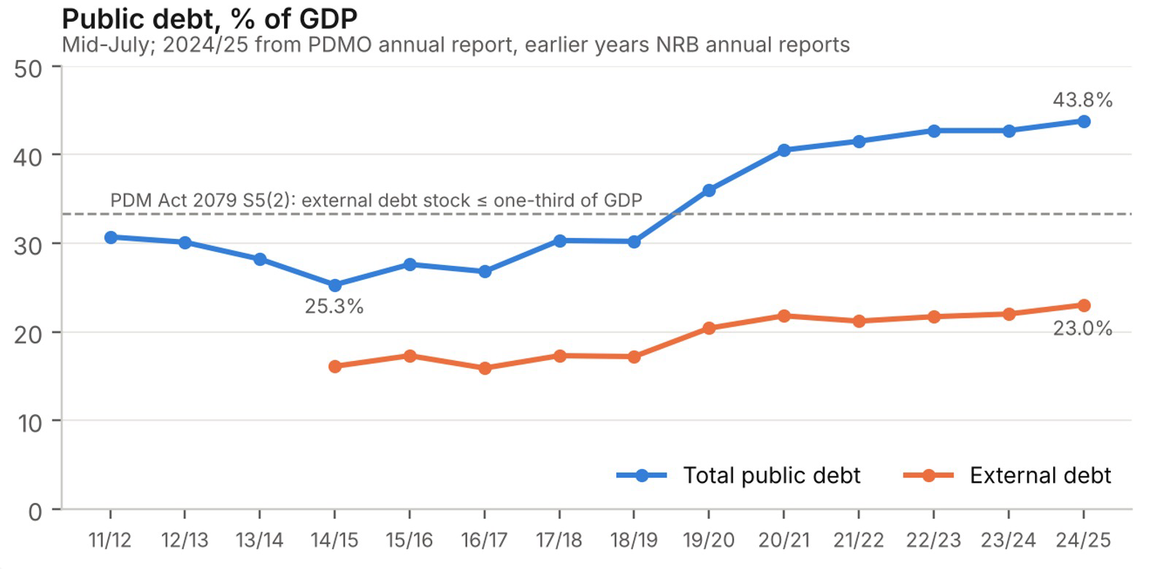
Public debt reached NPR 2,674.05 bn (43.79% of GDP) in 2024/25: external NPR 1,405.82 bn (23.02%, USD 10.22 bn) and domestic NPR 1,268.22 bn. Multilateral creditors hold 90.09% of external debt (IDA 49.09%, ADB 33.07%). Debt service rose to NPR 361.65 bn (5.92% of GDP). The external stock remains below the PDM Act’s one-third-of-GDP cap, and new guarantees are limited to 1% of the previous year’s GDP per year (PDM Rules R36(5)).
Fiscal-risk evidence relevant to PPP commitments
| Item | Evidence |
|---|---|
| SOE contingent liabilities | PDMO guidelines 2082: about NPR 2.1 trillion (‘21 kharab’), ≈37% of GDP; deposit/credit guarantees ~81% of financial exposure; 45 SOEs >50% government-owned (package figures inconsistent in units; magnitude as stated) |
| Guarantee authority | PDM Act 2079 S14: guarantees for government projects and for public institutions’ foreign loans; counter-guarantees for sub-national loans; no express power for purely private PPP companies |
| Guarantee overshoot | Nepal Airlines aircraft loans: NPR 34 bn approved ceiling; NPR 44–52.5 bn outstanding with capitalised interest (EPF NPR 31.34 bn, CIT NPR 19.39 bn by Ashadh 2082) |
| Government investment | NPR 827.52 bn in 150 entities (2080/81); dividends NPR 8.84 bn (~2.2%); 103–105 of 113–118 entities paid no dividend |
| NEA exposure | GoN loans NPR 272.58 bn (PDMO says under-booked by NPR 74.48 bn); overdue interest NPR 35.44 bn (PDMO: 67.54 bn); defaulted dues to GoN NPR 106.58 bn |
| PPP disclosure | No PPPIA requirement to record or report PPP contingent liabilities; S68a MoF concurrence (2081) is the only fiscal gate; cash-basis NPSAS 2079 hides commitments until paid |
| New vehicle | Alternative Development Finance Mobilisation Act (gazetted 25 June 2026): Fund with NPR 100 bn authorised, NPR 25 bn paid-up, ≥51% GoN; may guarantee projects ≥NPR 1 bn; guarantees must be registered with PDMO within 15 days; statutory first charge on project collateral; GoN-guaranteed Fund bonds rank with development bonds |
Sources: PDMO annual reports 2080/81–2081/82 and contingent-liability guidelines 2082; OAG; ADFM Act.
Inference. A compulsory-BOOT policy that relies on viability-gap funding, revenue guarantees, hedging subsidies or availability payments would add to obligations that the accounting system cannot see and the guarantee law does not clearly authorise. The Fast Track’s revenue guarantee is the warning case the Supreme Court has already named.
Do foreign investors and the exchange regime fit long hydropower concessions?
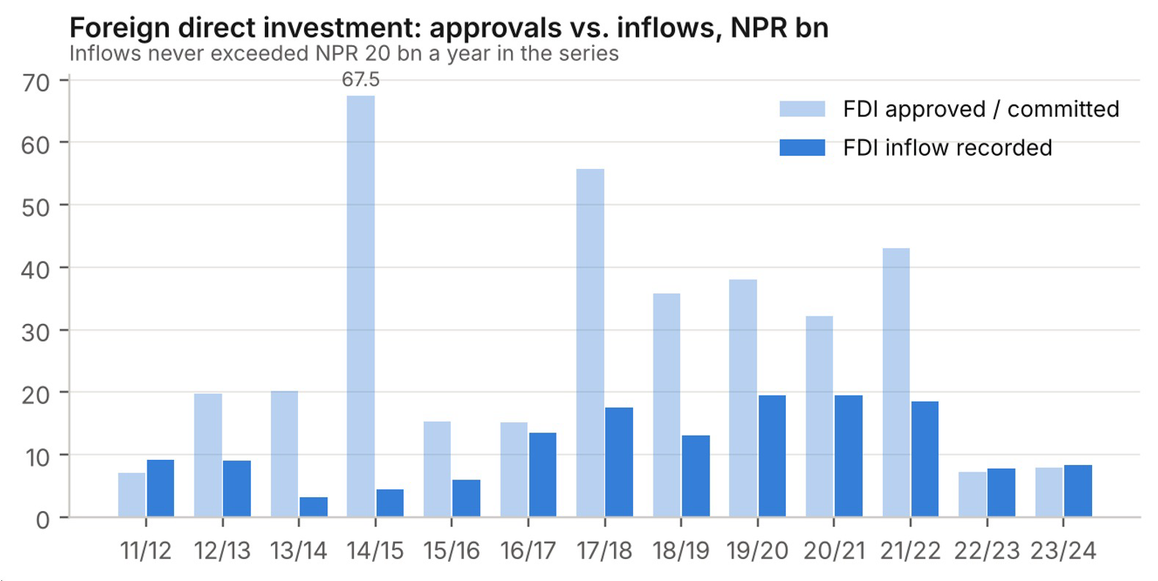
FDI approvals have consistently outrun inflows: NRB records NPR 67.46 bn approved in 2014/15 against NPR 4.38 bn received, and inflows never exceeded NPR 20 bn a year in the series; net equity FDI was NPR 3.65 bn in 2023/24 on the macro-report measure (NPR 8.40 bn in the annual report). FDI stock reached NPR 295.5 bn in 2022/23, about 30% in electricity. Dividend repatriation by the electricity sector fell from NPR 3.82 bn (2020/21) to NPR 0.13–0.39 bn a year in 2022/23–2024/25, while FDI-enterprise foreign loans to electricity rose to NPR 52.82 bn in 2025 (69.7% of the total).
The legal protections are conventional – no nationalisation (FITTA S33), repatriation within 15 working days (S20), UNCITRAL arbitration seated in Nepal (S40), FX convertibility under PPPIA S45(4) – and the Supreme Court has enforced guarantee autonomy against a Chinese court injunction Melamchi headworks, 2018 (071-WO-0866 heard with 071-WO-0836 and 071-WO-0869). But an Indian promoter of the 70 MW Dudhkoshi project was forced by Reserve Bank of India rules to divest entirely, and Nepali residents may not invest abroad in cross-border energy assets without a gazette exemption. Most large BOOTs have therefore gone to Indian state-owned companies by direct negotiation or MoU, which the Supreme Court has repeatedly scrutinised.
6. Who pays for transferring hydropower, and who benefits?
How does a finite licence life affect hydropower investors and markets?
SEBON’s 34th-anniversary special issue (2026) identifies a ‘theoretical conflict’ between BOOT licence life and the perpetuity assumption behind equity: hydropower shares are ‘equity of limited life’ with uncertain cash flows after transfer. The High-Level Economic Reform Recommendation Commission 2081/82 warned that retail investors are unaware of the BOOT effect on long-term value and that speculation in negative-net-worth hydropower stocks could produce a crisis worse than the cooperative failures. Hydropower turnover was 45.2% of NEPSE trading; per-MW costs in approved prospectuses ranged from NPR 13.43 to 31.03 crore.
Valuation practice agrees: the ICAN Valuation Manual 2083 rules out perpetuity growth beyond a concession or PPA term and directs valuers to residual asset value or zero growth. The insurance regulator’s risk-free curve offers the only published long-tenor NPR rate – 5.36% at ten years and about 5.43% at 15–50 years – that could anchor public-sector comparators.
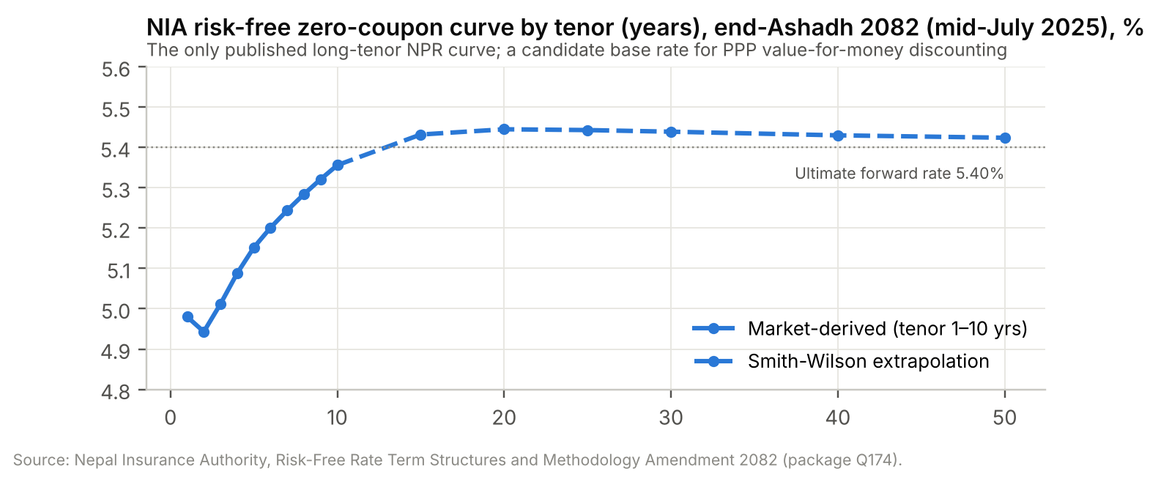
Inference. Transfer is not free to the state. Its cost is embedded in higher tariffs (or subsidies) during the concession and in investor risk premia. Whether the reversionary asset is worth that cost depends on residual life and public operating capacity.
How are hydropower benefits shared with the state and localities today?
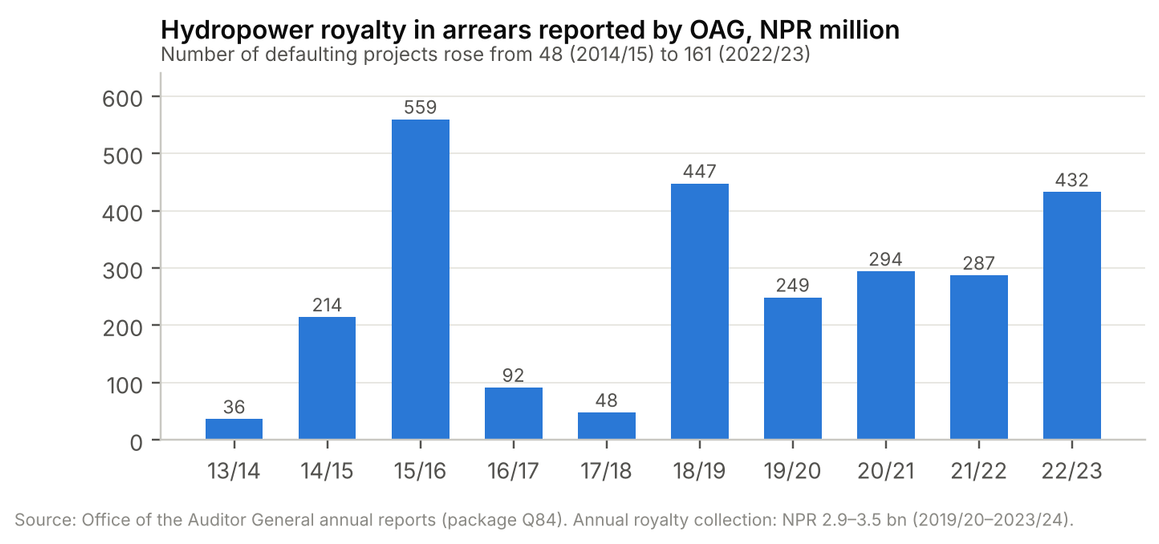
The Constitution (Art. 59(4)–(5)) entitles project-affected areas to a share of benefits and local communities to priority in investment. Hydropower royalty (NPR 100/kW plus 2% for 15 years, then NPR 1,000/kW plus 10%) is split 50% federal, 25% provincial and 25% local under the Intergovernmental Fiscal Management Act. Annual royalty collections were NPR 2.88–3.45 bn in 2019/20–2023/24, yet NPR 5.4–8.2 bn of divisible royalty has sat undistributed at year-end. Project-affected residents may receive up to 10% of a company’s issued capital (three-year lock-in), and Arun-3 offered NPR 800 m of shares to locals at par before COD. In Upper Karnali the Supreme Court (079-WC-0057 with 079-WC-0058 to 079-WC-0062 and 081-WO-0705) directed that a share of revenues, free power and dividends be channelled through local governments to watershed communities.
Inference. Free energy (21.9% at Arun-3), free equity (27% at Upper Karnali), royalties and local shares already deliver public benefits during the concession rather than only at its end. They are arguably a better instrument of resource sovereignty than reversion, because they arrive while the asset is young and do not depend on the state’s capacity to run it decades later.
7. What do the courts and auditors require of hydropower deals?
Nepal’s courts have not ruled that BOOT is compulsory; they have ruled on how modalities are chosen and enforced. Their principles apply equally to public procurement, PPP and private licensing.
Supreme Court principles relevant to modality choice
| Case | Holding and principle |
|---|---|
| Budhi Gandaki (074-WO-0189, 18 Jun 2023) | Direct award of the 1,200 MW storage project to CGGC under EPCF (Cabinet 2074/02/18) – EPCF is ‘procurement’ under PPA 2063 S2(a) and requires competitive bidding |
| West Seti (068-WO-0827; 080-WO-0581) | State as public trustee of natural resources; intergenerational equity; caution against non-competitive direct negotiation; any modality must maximise public return |
| Arun-3 (080-WO-0877, 2024) | Upheld BOOT to SJVN: competitive RFP (2006), NPR 450 m study-cost reimbursement, free energy, reversion |
| Upper Karnali (079-WC-0057 et al.) | Design, capacity and commercial terms are executive choices; benefits must reach local communities; BOOT valid if IBN and Electricity Act procedures are followed |
| Fast Track (072-WO-0283, 2016) | Minimum revenue guarantees require competition, fiscal risk audit and disclosure; switch to Army/public delivery upheld |
| Upper Trishuli-1 069-WO-0156 (along with related Writ No. 070-WO-0328) | Electricity Act S35 allows direct agreements notwithstanding other provisions – upheld |
| Nijgadh airport (26 May 2022) | Forest allocation and EIA quashed; alternatives analysis mandatory; public-trust doctrine bars clearing forest for an ‘airport city’ |
| Pokhara cable car / Basundhara Park (2018) 071-WO-1034 (along with 072-WO-0127) | 20-year lease of 54,937 sq m of lakeshore and forest quashed |
| Kathmandu Plaza; Ratna Park | No vested right to extension at concession end; re-tender required Kathmandu Plaza: Case No. 076-WO-1078, 077-WO-0286, 077-WO-1045 Ratna Park: 073-CI-1073 |
| Ambeshwer, Kaligandaki Koban (19 Nov 2024) | State cannot cancel a licence for missed financial close it caused by not issuing hedging guidelines (Writ numbers: 076-WO-0331 and 076-WO-0610) |
| Himalayan Hydropower (2022) | PPAs are commercial contracts; no writ modification of tariffs or penalties |
| Melamchi guarantees (071-WO-0866, 2018) | Demand guarantees are autonomous; a foreign injunction does not excuse the local issuing bank (071-WO-0866 heard with 071-WO-0836 and 071-WO-0869) |
| MCA-Nepal 400 kV lines (2024) Case No. 080-WO-0548 | Rejecting all bids 60–83% above estimates upheld on value-for-money grounds |
| Janakpur Cigarette Factory (2022) Case No. 071-WO-0125 (with 071-WO-0369) | On closure of a public enterprise, land and buildings revert to the state rather than private developers |
The Auditor General adds an operational lesson: where public bodies built and ran commercial assets they bore 100% of demand risk, and separating design, construction and operation allowed blame-shifting. OAG recommends DBFO, BOT or O&M leases for commercial assets, EPCF or design-and-build for single-point responsibility, standard PPP and BOOT documents from the Public Procurement Monitoring Office, and pre-tender gates (land, trees, utilities, EIA, source assurance) – the gates that the Public Procurement (Second Amendment) Act 2083 now makes mandatory for construction tenders.
Inference. The jurisprudence requires competition, transparency, fiscal disclosure and protection of public-trust assets, and it holds both the state and investors to their contracts. It is modality-neutral. A rule that every project must be BOOT would not satisfy these principles by itself; a transparent modality-selection process would.
8. Which hydropower projects should be BOOT, and which should not?
What tests decide whether a hydropower project should be BOOT?
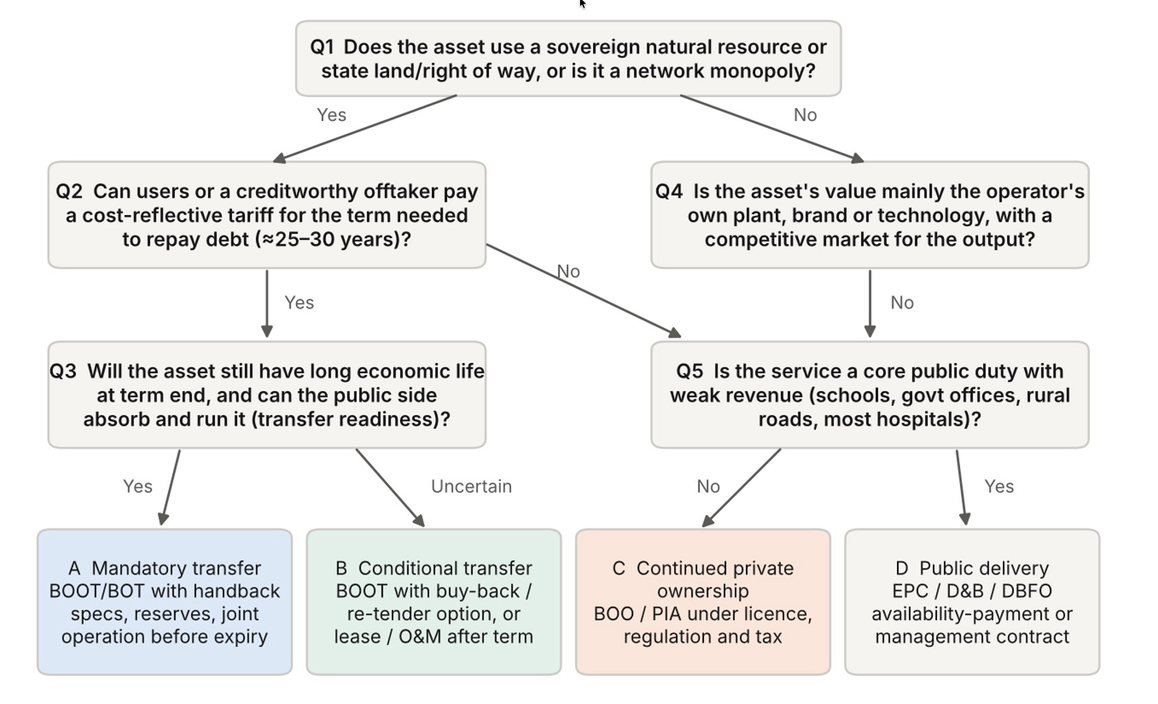
Judgment. The evidence supports allocating transfer obligations by the characteristics of the asset and the payer, not by the nationality of the financier (Electricity and Telecom Acts) or by the mere fact of using the PPP channel (PPPIA). Five tests do most of the work:
- Sovereign input. Does the asset depend on a natural resource, state land, right of way or a statutory monopoly? (Water, river head, airport land, road corridor.) If yes, the public claim on the asset is strong.
- Payer. Is there a creditworthy offtaker or a user base able to pay cost-reflective tariffs for 25–30 years? If not, demand-risk concessions fail (Fast Track, tunnel, Nijgadh) and the project belongs in public delivery or availability-based contracts.
- Residual life. Will the asset still have decades of useful life at term-end (dams, tunnels, civil works, transmission corridors), or will it be obsolete (data-centre equipment, buses, solar modules after 25 years)?
- Transfer readiness. Is there a named public operator with the capacity, accounts and budget to receive and run it? Khimti and the Chitwan resorts show the cost of answering this too late.
- Market structure. Is the output sold in a competitive market where the operator’s own technology, brand or plant drives value (cement, hotels, manufacturing)? Then reversion adds little and BOO under licence and tax is cleaner.
For hydropower the first test is always met – every plant uses a sovereign river – so the decision turns on the payer (NEA or an export buyer), on residual life (dams and tunnels outlast turbines, and both outlast solar modules), and on whether NEA or another public operator can take the plant over.
A proposed screening logic for assigning delivery categories
How does hydropower fall out by project type?
Hydropower by project type: should it be BOOT?
| Project type | Key evidence | BOOT? | Conditions |
|---|---|---|---|
| Storage and multipurpose (>100 MW), e.g. Tamor 756 MW, West Seti 750 MW, Budhi Gandaki 1,200 MW | Sovereign water with 50+ years of civil life; Art. 279 sensitivity; Supreme Court required competitive bidding for the Budhi Gandaki EPCF award and cautioned against direct negotiation at West Seti | Yes – BOOT (A), or public / G2G ownership | Competitive or transparent award; PPA or power-sale agreement before close; handback regime; free energy and equity |
| Large export run-of-river / PRoR (>100 MW), e.g. Arun-3, Lower Arun, Upper Karnali | Arun-3 reached financial close on 6 Feb 2020 and was ~74% complete by early 2024; Upper Karnali has not closed since its 2014 PDA; 21.9% free energy; 25-year terms after COD | Yes – BOOT (A) | Power-sale agreement as a condition precedent; transmission to the border; term counted from COD |
| Domestic run-of-river IPPs (≤100 MW) | Scaled under generation licences; 103 listed companies; ~35-year licences counted from issuance, so delays cut operating life to 19–23 years; ‘limited-life equity’ risk flagged by SEBON | Conditional (B): licence ending in buy-back at valuation or re-tender, not free transfer | Same rule whatever the foreign share; licence clock from COD; disclosure of the transfer effect to investors |
| Foreign-majority plants of any size | Electricity Act S10(1) forces free transfer only above 50% foreign investment; Khimti’s 50% transfer in 2020 found NEA unprepared | Decide by asset type, not by who financed it | Replace the 50% test with an asset-based test |
| Evacuation lines (≥220 kV) | NEA line delays behind 18–167% overruns; 95.61 GWh a year spilled in the OAG’s 18-IPP sample | Yes – BOOT or availability-based (A) | Ring-fenced transmission charges; compensation for delay |
| Solar and wind (for comparison) | ~25-year asset life; Kohalpur 250 MWp and Dang 245 MWp BOOTs; equipment obsolescence | No – BOO on leased land (C) | Land reverts at lease end; competitive auctions |
Category letters follow the research objective: A mandatory transfer, B conditional transfer, C continued private ownership. Assignments are judgments drawn from the evidence in this article.
How do other sectors compare?
Sector framework: recommended category and modalities
| Sector | Key evidence | Category | Preferred modalities | Conditions for success |
|---|---|---|---|---|
| Storage and large hydropower (>100 MW) | Sovereign water; 50+ yr civil life; Arun-3, Upper Karnali, West Seti BOOTs; export PPAs; Art. 279 sensitivity | A | BOOT 25–30 yrs post-COD, competitive or transparent G2G; free energy/equity | PPA or PSA before financial close (Upper Karnali defect); handback regime; NEA/transmission commitments |
| Run-of-river IPPs (<100 MW, domestic) | Scaled privately under Electricity Act S10(4); 103 listed companies; 35-yr licences; limited-life equity risk | B | Licence + PPA; at expiry buy-back at valuation or re-tender for O&M | Disclose BOOT effect to investors; uniform rule regardless of foreign share; deemed-generation or curtailment compensation |
| Solar and wind | Short asset life (~25 yrs); Kohalpur 250 MWp, Dang 245 MWp BOOTs; equipment obsolescence | C (land reverts) | BOO on leased land; land returns at lease end | Transparent auctions; storage requirements; grid access |
| Transmission (≥220 kV, cross-border) | Monopoly network; NEA delays drove overruns of 18–167%; Butwal–Gorakhpur 50:50 NEA–PGCIL; 10 lines offered to private investors in 2024 | A | BOOT or availability-based ‘build-own-operate-transfer’ with transmission service charge; JV with NEA/RPGCL | Payment security for transmission charges; VAT clarity (Revenue Tribunal quashed VAT on transmission charges Case No. 082-RB-0382) |
| Distribution | NEA monopoly; losses 12.8–15.4% | D | Public with management or loss-reduction contracts | Regulatory accounts; ERC tariff discipline |
| Expressways, tunnels, national highways | Fast Track MRG failure; tunnel PPP never reached close; Nagdhunga tunnel utilisation 30–54% | A (if tolled) / D | HAM or availability-based DBFO; toll BOT only where traffic is proven | Traffic studies; budgeted annuities in MTEF; fiscal-risk disclosure |
| Local roads and bridges | DoR contract failures; user-committee abuses | D | D&B, EPC, performance-based maintenance | Pre-tender gates; LD enforcement |
| International airports | Pokhara and GBIA demand shortfalls; Nijgadh PPP failed; CAAN owns airports | A or D | Public build + concession for terminals/O&M; BOT only with traffic evidence | Air-route access; realistic demand; CAAN separation of regulator and operator |
| Urban transit (BRT, metro) | BRT EOI cancelled 2023; metro USD 5.5 bn | D (A for O&M) | Public capital + operations concession or availability payment | Fare policy; KV Public Transport Authority |
| Bulk water and treatment | WSS Act S17 automatic reversion; Melamchi overruns; KUKL tariffs unrevised since 2013 | A | BOT/DBFO for treatment plants with take-or-pay from a utility | Tariff Fixation Commission; utility creditworthiness |
| Water distribution, wastewater, solid waste | KUKL losses; valley waste BOOT stalled; Dharan WtE 30 TPD operating | A or D | Management contracts; BOOT for waste-to-energy with tipping fees | Municipal payment security; tipping-fee collection |
| Hospitals | 196 private hospitals provide 67% of admissions; PHSA 10% free beds; Art. 35 health rights | D (C for private) | Public hospitals with PPP for diagnostics/services; private BOO under licence | Empanelment under Health Insurance Act; free-bed enforcement |
| Schools, government buildings | No user revenue | D | D&B, EPC, availability-based DBFM where budgeted | Multi-year source assurance |
| Industrial parks and SEZs | SEZ land reverts; Damak park PDA pending; SEZ lease NPR 20/m²/month | B | Land lease + private developer; plants stay private | Off-site infrastructure by the state; reversion of land only |
| Cement, mining, manufacturing | PIAs with no transfer; mining licences 10–30 yrs | C | Private investment under licence and royalty | Mines Act royalties; environmental compliance |
| Hotels, cable cars, tourism | Cable-car overruns 120–130%; public-land leases quashed (Pokhara); Chitwan resorts | C on private land / A on public land | BOO on private land; lease-transfer on park or public land | Competitive leases; no automatic extensions |
| Digital (data centres, IT parks, fibre) | 53.1% of firms rely on foreign data infrastructure; rapid obsolescence; GIDC public | C (B for state land) | BOO/licence; public data under contract | Data-protection law; sovereignty clauses rather than reversion |
| Irrigation | Sikta seven-fold overrun; public good | D | EPC/D&B; O&M by users | Water-user associations (WRA S11) |
| Dry ports, logistics, parking, markets | Terminal SPV leases (NITDB lease liability NPR 1,041 m); municipal BOTs with royalty arrears | A (lease-transfer) | LOT/BOT with revenue share | Royalty enforcement; re-tender at expiry |
Category letters follow the research objective: A mandatory transfer, B conditional transfer, C continued private ownership, D public ownership/procurement. Assignments are judgments drawn from the evidence cited in this article.
9. So, should we build hydropower in BOOT?
Yes – for the projects where transfer is worth having, and only once the conditions that make it work are in place. Large storage and export projects use a sovereign river, will still have decades of civil life at term-end, and sell to NEA or an export buyer: they should be BOOT, awarded competitively, with a power-sale agreement before financial close, a handback regime and a public operator named well before expiry. Domestic run-of-river plants built by Nepali IPPs – the part of the sector that actually scaled – should operate under licences that end in buy-back at fair value or re-tender, rather than a free transfer the state is not ready to receive and that turns their shares into limited-life equity. Solar and other short-lived plant should stay private on leased land.
No hydropower model, BOOT or otherwise, will work until NEA’s lines arrive on time, PPAs share hydrology and curtailment risk fairly, long-term domestic finance exists, and the fiscal commitments behind these deals are visible. The same lessons hold beyond hydropower: transfer for toll roads, airports and bulk water where a payer exists, and public or availability-based delivery for services without one.