Reviewing 18 “take-or-pay” PPAs executed with NEA to test whether it contains “deemed-generation clause” and if yes, how strong is it?
Scope: This article reviewed 18 executed NEA PPAs and their connection minutes, Six model PPAs, NEA annual reports (FY 2003/04 to FY 2025/26)
| Summary: The “missing clause” is a myth. All 18 executed PPA agreements reviewed contain a written promise to pay for energy NEA does not take. 17 do it through Article 10.1 and a standard Schedule 3 “undelivered energy” formula. The one English-language, foreign-loan-priced agreement (Manang Marshyangdi, 135 MW) uses an express “Deemed Generation” clause in Article 7.2. The money disappears at three gates. The loss to developer actually sits in the arithmetic and the exceptions. Gate 1: forced-outage compensation stops at 80% of the month’s contracted or declared energy. Gate 2: partial curtailment is counted at the depth of the cut, so a 50% cut is paid at half the physical loss. Gate 3: nothing is paid until 72 pro-rated hours have accrued in the fiscal year. Behind the gates sit trap doors. The largest exposure is not in the formula at all. In 14 of the 18 agreements, the payment clause switches off when the Load Dispatch Centre (LDC) curtails because a named state transmission line is overloaded, faulted or unbuilt. Several of these windows have no end date. Even a valid claim needs proof that rarely exists. No PPA requires advance notice for a dispatch instruction, and none creates a jointly verified event record. The hours, set-points and reasons that decide payment sit in one party’s logbook. This is a problem of risk allocation, not villainy. Curtailment is driven by physics: in FY 2025/26 installed capacity was 4,120 MW against a 3,226 MW system peak. The contracts decide who bears the cost of that surplus. As written, a headline take-or-pay PPA is not an unconditional revenue hedge. |
This article takes neither the developers’ side nor NEA’s. It lets three things speak: the executed contract texts, the physics of the grid, and the arithmetic.
Technical terms used in this article:
| Term | Plain meaning |
| kW / MW; kWh / MWh | Capacity (how fast a plant can produce) versus energy (how much it produces over time). 10 MW running for 10 hours = 100 MWh. |
| Take-or-pay | The buyer either takes the power and pays for it, or pays anyway if it cannot or will not take it. “Take-and-pay” means the buyer pays only for what it actually takes. |
| Contract Energy (CE) | Monthly kWh the developer commits to deliver, fixed in Schedule 2 of the PPA. |
| Availability Declaration (AD) | The developer’s monthly statement, filed at least 30 days ahead, of the power and energy it expects to have available. NEA’s purchase obligation runs to the smaller of AD and CE. |
| Dispatch Instruction | An order from NEA’s Load Dispatch Centre (LDC), its grid control room, to start, raise, lower or stop output. |
| Forced Outage | NEA cannot take power because of a fault or unscheduled works on its own network. |
| UE, UC, PT, ME | Schedule 3 terms: Undelivered Energy, Undelivered Capacity, Prorated Time, Metered Energy.Metered Energy (ME): the energy (kWh) the plant actually delivered to NEA in the month, as recorded by the meter.Undelivered Capacity (UC): the megawatts the plant could have sent but was held back from sending because of NEA’s line failure or a dispatch order. It is what the plant could produce minus what it was allowed to send (or did send, if higher).Prorated Time (PT): the hours of the event scaled down by how deep the cut was: (UC ÷ Schedule 2 monthly capacity) × hours.Undelivered Energy (UE): the energy NEA compensates for, calculated as UC × PT. It equals the actual lost energy only when the plant is shut down completely. |
| MoM 12.1.2 | Item 12.1.2 of the grid-connection Minutes of Meeting signed between NEA’s Grid Operation Department and the developer. It lists the transmission conditions under which the developer must follow LDC curtailment. |
| SCADA | Supervisory control and data acquisition: the real-time monitoring system that lets the LDC see and log each plant’s output. |
| RCOD / COD | Required (contractual target) and actual Commercial Operation Date. |
| Fiscal year (BS) | Shrawan to Ashadh, roughly mid-July to mid-July. |
1. When water goes over the weir, who pays for it?
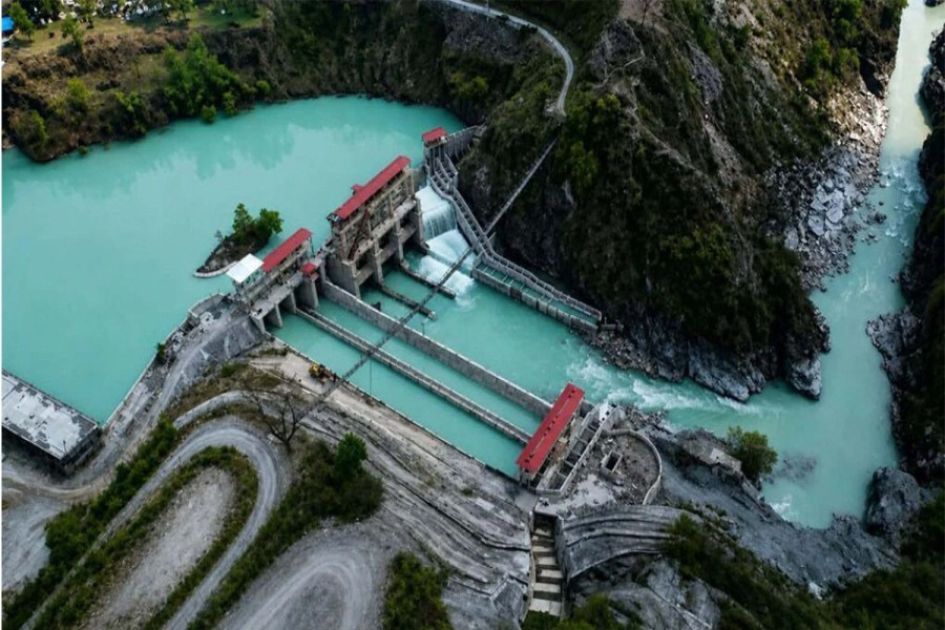
Picture a steep valley at the height of the monsoon, with water thundering through the open spillway gates of a run-of-river plant. It is a striking sight. Financially, it can be money being burned. Water that goes over the weir instead of through the turbines earns nothing that day. The interest clock on the loans that built the plant keeps running.
The stakes are large. NEA’s FY 2025/26 review counts 213 projects with 6,472 MW under construction after financial closure, and 545 PPAs with independent power producers covering 12,135 MW. The capacity under construction alone is twice Nepal’s 3,226 MW system peak demand. Most of it is debt-financed, making this one of South Asia’s most capital-intensive sectors.
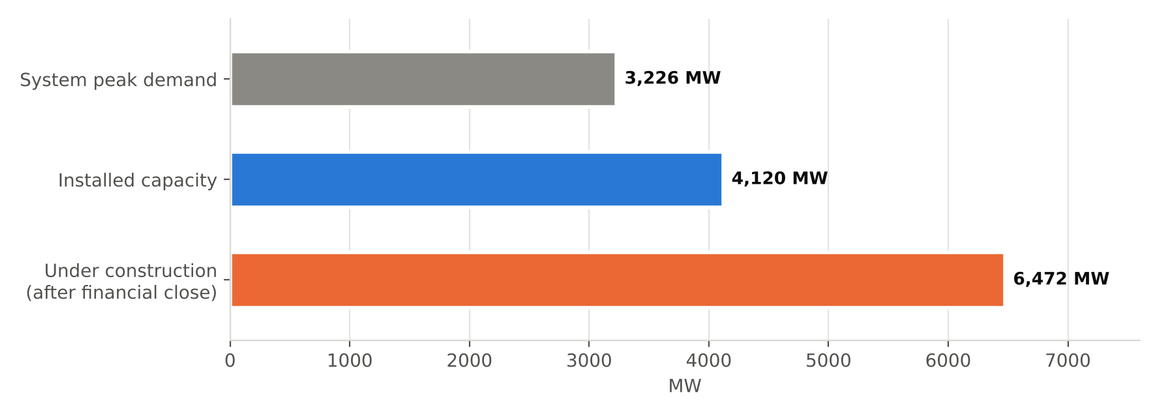
Capacity being built set against what the system already has and what it needs at its peak, FY 2025/26.
So the question for this article is simple: when water spills because the grid cannot take the power, who pays for the lost energy? The way to answer it is to read the documents: the executed agreements, the connection minutes that sit behind them, and two decades of NEA operating data.
2. What did the policy promise, and why did it trigger a rush?
The expectation has a policy source. The 2018 (2075 BS) White Paper of the Ministry of Energy, Water Resources and Irrigation targeted about 15,000 MW in ten years. To attract the private capital this needed, it committed NEA to take-or-pay PPAs. In plain words, the promise to a developer was: if you build the plant and generate, NEA will either take your power and pay for it, or pay you anyway if its grid cannot take it. That moves market risk away from the developer, and to a lender it sounds close to a government bond.
The guarantee was rationed by technology, in an indicative mix of 30–35% storage, 25–30% peaking run-of-river (PRoR), 30–35% run-of-river (RoR) and 5–10% other sources. The RoR cap was 35%, or 5,250 MW. NEA’s FY 2019/20 review still reported take-or-pay limits of 5,250 MW (RoR), 4,500 MW (PRoR) and 5,250 MW (storage). A 2022 Cabinet revision moved ten percentage points from storage to RoR, lifting the RoR ceiling to 45%, or 6,750 MW. In February 2023, after a pause of about three years, NEA reopened take-or-pay PPAs for a further 1,500 MW of RoR at Rs 4.80 (wet) and Rs 8.40 (dry) per kWh.
Developers rushed in. By NEA’s FY 2025/26 figures, signed RoR PPAs total 6,743 MW, just 7 MW short of the 6,750 MW ceiling, and another 4,394 MW of RoR is still being processed. The RoR quota is effectively exhausted. In that year NEA signed only five hydropower PPAs, totalling 28.6 MW. The FY 2025/26 budget first proposed take-and-pay terms for RoR projects. After industry protest, Parliament revised the provision on 24 June 2025: PPAs would instead be signed where domestic consumption or export is confirmed, subject to a financial-risk assessment of NEA’s capacity to pay.
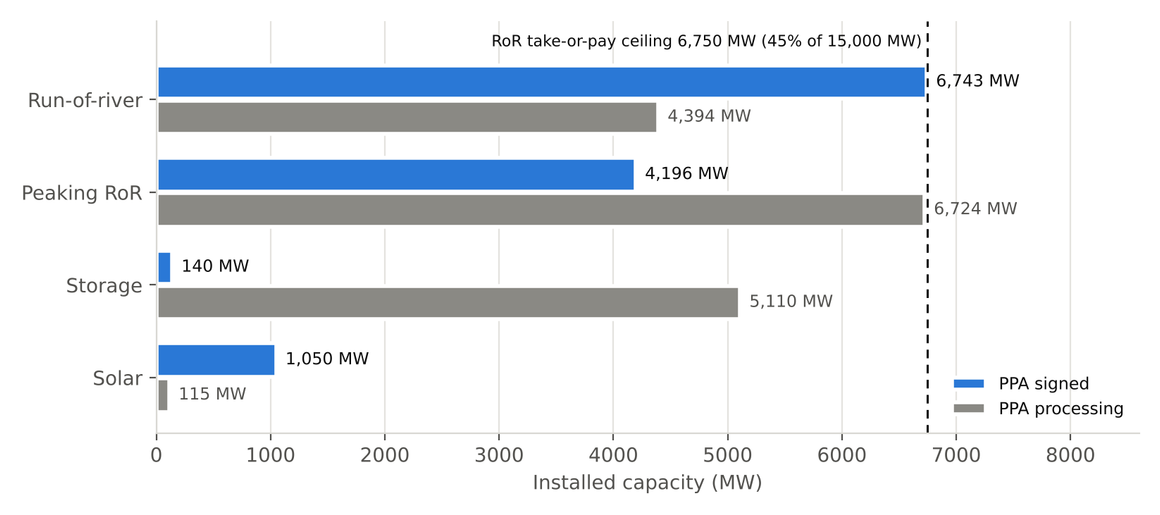
PPAs signed and in process by technology, as of FY 2025/26. Signed RoR capacity has reached the 6,750 MW take-or-pay ceiling.
Then the monsoons came, as they do. Rivers rose and turbines spun up, but there was not always room on the wires. Water spilled, and many developers found they were not being paid for it.
3. Is a missing deemed-generation clause really the cause?
Ask developers why they are not paid for spilled water and most give the same answer. Nepali PPAs, they say, lack a robust deemed-generation clause, and NEA treats its non-offtake or undelivered-energy compensation as discretionary. If that were right, the fix would be a drafting exercise: insert a standard deemed-generation paragraph into future PPAs. The question put to this study is therefore: is the missing clause even a problem?
The question breaks into four parts and this article tries to answer them:
- How the foreign-investment PPA defines Deemed Generation, including its link to spilled water.
- Whether the domestic PPA’s take-or-pay formula guarantees full compensation.
- Whether take-or-pay protection is conditional, falling away if commercial operation is not reached by a set date.
- Whether the LDC curtails without proper notice, as a practical rather than legal grievance.
3.1 Do the executed PPAs contain the “take-or-pay” protection?
Yes, all 18 of them. The developers’ complaint is a little like a homeowner blaming rain damage on a missing roof when the roof is there; the leak is in how it was built. The compilation holds 17 agreements on NEA’s domestic Nepali-language form. The eighteenth, Manang Marshyangdi, is in English, and its tariff clause adjusts for “the percentage of foreign loan in total investment” (Article 7.10(ii)), which marks it as the foreign-investment variant.
In the domestic form the operative words are in Article 10.1, which is near-identical across all 17 agreements. The executed 22.9 MW Middle Hongu Khola B PPA (NEA and Gaurishankar Power Development, Chaitra 2074) is the baseline:
१०.१ प्राधिकरणले प्रत्येक महिना आयोजनाबाट कन्ट्रयाक्ट इनर्जीको परिमाण सम्मको Availability Declaration अनुसारको इनर्जी खरीद गरी लिनेछ । यस अनुसार प्राधिकरणले लिनु पर्ने उर्जा Forced Outage को कारणले लिन नसकेमा वा Dispatch Instruction को कारणले नलिएमा अनुसूचि ३ को प्रावधान अनुसार प्राधिकरणले कम्पनीलाई क्षतिपूर्ति तिर्नु पर्नेछ ।
— Middle Hongu Khola B PPA, Article 10.1
Translation: “10.1 The Authority shall each month purchase from the Project energy according to the Availability Declaration up to the quantity of Contract Energy. If the Authority cannot take the energy it is required to take because of a Forced Outage, or does not take it because of a Dispatch Instruction, the Authority shall pay compensation to the Company in accordance with Schedule 3.”
The words “deemed generation” do not appear. However, functionally, Article 10.1 promises to buy up to the contracted amount and moves all the mechanics of payment into a formula appendix, Schedule 3. That schedule is identical in every operative particular across all 17 domestic agreements: the 80% forced-outage ceiling, the pro-rated time formula and an annual threshold of N = 72 hours.
The foreign-investment form uses the term itself. Manang Marshyangdi (135 MW PRoR, signed 22 March 2021) defines it and pays for it:
“Deemed Generation” shall mean the energy, which a generating station is capable of generating but cannot generate due to the conditions of the grid or power system beyond the control of the generating station resulting in spillage of water.
— Manang Marshyangdi PPA, Article 1, Definitions
7.2 Deemed Generation. If any reduction or interruption occurs in the delivery of electric energy at the Delivery Point (at the maximum net electrical output which the Project is capable of delivering at such time) during any Contract Month, then, in addition to the amounts payable by NEA pursuant to Article 7.1 (Electrical Output) NEA shall pay to Company for such Contract Month an amount equal to the product of: (a) the aggregate Deemed Generation during the reduction or interruption … multiplied by (b) the applicable Purchase Price …
— Manang Marshyangdi PPA, Article 7.2
The definition has the four elements: (A) the plant is capable of generating; (B) the cause lies in the grid or power system; (C) the cause is beyond the generator’s control; and (D) the result is spilled water. The spillage element matters. It makes the test physical, so the developer must show that water which could have become energy went over the weir. For a run-of-river plant in the wet season this is usually so. For a peaking plant that can hold water in its pondage for later hours, a reduction that only shifts generation in time may produce no deemed generation at all.
From a contract-law point of view, the domestic form’s lack of the label changes little: it still creates an enforceable obligation to compensate for non-offtake. The industry diagnosis of a missing clause is therefore a misdiagnosis. To find where the money goes, one has to follow the water through the formula.
3.2 How do all 18 agreements compare?
| Executed agreement (developer; date) | Route | Annual threshold | Grid or timing exception in Art. 10.1 / 7.2 | Status FY 2025/26 |
| Middle Hongu Khola B, 22.9 MW (Gaurishankar; Chaitra 2074) | Art 10.1 + Sch 3 | 72 PT h | MoM 12.1.2(ii) during FY 2022/23–2024/25; MoM 12.1.2(iii), no end date | Under construction |
| Manang Marshyangdi, 135 MW PRoR (MMHC; 22 Mar 2021) | Art 7.2 Deemed Generation | 168 h (NEA-system outage) + 168 h (NEA works, Art 6.11(c)) | 90/10 reserve margin Ashadh–Kartik if COD by FY 2084/85; MoM 12.1.2 dispatch excluded if not | Under construction |
| Myagdi Khola, 57.3 MW (Hydro Village; Ashwin 2075) | Art 10.1 + Sch 3 | 72 PT h | (a) D–M circuit fault and (b) D–M overload, FY 2022/23–2024/25; (c) from FY 2025/26 until New Butwal–Gorakhpur operates | Under construction |
| Bhotekoshi-1, 40 MW (Shailung; 2075) | Art 10.1 + Sch 3 | 72 PT h | (a)–(c) as Myagdi; (d) Khimti–Dhalkebar 220 kV circuit fault from FY 2022/23 “until resolved” | Under construction |
| Nupche Likhu, 57.5 MW (Vision Energy; Falgun 2074) | Art 10.1 + Sch 3 | 72 PT h | (a)–(c) as Myagdi | Under construction |
| Upper Suri, 7 MW (Makar Jitumaya; Shrawan 2075) | Art 10.1 + Sch 3 | 72 PT h | D–M circuit fault FY 2021/22–2033/34; D–M overload from FY 2021/22 until a second cross-border 400 kV line is built | Operating |
| Lower Jogmai, 6.2 MW (Asian Hydropower; Chaitra 2074) | Art 10.1 + Sch 3 | 72 PT h | D–M fault/overload FY 2021/22–2024/25; until New Butwal–Gorakhpur; Godak–Damak 132 kV circuit fault from FY 2021/22, no end | Operating |
| Ilep (Tatopani), 23.675 MW (Jalshakti; 2075) | Art 10.1 + Sch 3 | 72 PT h | D–M fault FY 2020/21–2033/34; D–M overload, then until second cross-border line; Trishuli 3B–Matatirtha 220 kV fault “until resolved” | Under construction |
| Super Mai A, 9.6 MW (Sagarmatha Jalabidhyut; Falgun 2074) | Art 10.1 + Sch 3 | 72 PT h | No compensation for any LDC-directed operation FY 2019/20–2032/33 (MoM 11.1.2) | Operating |
| Mai Beni, 9.008 → 9.51 MW (Samling; 2073, amended) | Art 10.1 + Sch 3(a)/(b) | 72 PT h | For the added 502 kW: D–M fault FY 2020/21–2027/28; overload to 2024/25; until New Butwal–Gorakhpur | Operating |
| Middle Mewa, 49 MW PRoR (Mewa Developers; Bhadra 2075) | Art 10.1 + Sch 3 (peaking variant) | 72 PT h | 90/10 reserve if COD by FY 2082/83; if not, D–M windows and until New Butwal–Gorakhpur | Under construction: deadline passed |
| Upper Madi-0, 43 MW (Annapurna Power; Bhadra 2080) | Art 10.1 + Sch 3 | 72 PT h | If COD by FY 2089/90: 90/10 reserve, dispatch compensated incl. MoM 12.1.2; if not, no compensation for LDC dispatch in any situation incl. MoM 12.1.2 | Under construction |
| Upper Kabeli, 28.1 MW (Peace Energy; Shrawan 2080) | Art 10.1 + Sch 3 | 72 PT h | As Upper Madi-0 | Under construction |
| Tamakoshi V, 86.067 MW PRoR (Tamakoshi Jalvidyut; 2079) | Art 10.1 + Sch 3 | 72 PT h | If COD by FY 2089/90: 90/10 reserve; if not, no compensation for any LDC dispatch | Under construction |
| Lower Solu, 82 MW (Essel Clean Solu; Kartik 2070) | Art 10.1 + Sch 3 | 72 PT h | None | Operating |
| Solu, 23.5 MW (Upper Solu HEC; Kartik 2070) | Art 10.1 + Sch 3 | 72 PT h | None | Operating |
| Mistri Khola, 42 MW (Robust Energy; Magh 2067) | Art 10.1 + Sch 3 | 72 PT h | None | Operating |
| Likhu IV fall-back, 52.4 MW (Green Ventures; Magh 2067 / Feb 2011) | Art 10.1 + Sch 3 | 72 PT h | None, but NEA’s later amendments to Schedule 3 in other PPAs apply automatically | Operating |
Non-offtake provisions in every executed agreement in the compilation. D–M = Dhalkebar–Muzaffarpur 400 kV cross-border line.
The protection is present in all 18, but it is not uniform. Four agreements, all signed in 2067–2070 BS, carry no grid exception. Nine carry fixed or open-ended windows, several running into the 2030s; one of these, Super Mai A, is a 14-year blanket exclusion. Five make protection depend on a COD deadline and, if it is met, trade a 10% wet-season reserve margin for fuller cover. A label such as “take-or-pay PPA” covers all of these.
3.3 Do the model PPAs point to a single standard?
No. The model PPA templates show how much the same heading can conceal:
| Model PPA | Compensation design | Threshold N |
|---|---|---|
| RoR | Section 10.1 + Schedule 3; adds “if the Connection Agreement has condition related to the transmission line, such condition shall be applied” | 72 / 144 / 216 PT h for 220–132 / 33 / 11 kV delivery |
| Peaking RoR | As RoR | 72 / 144 / 216 PT h by voltage |
| Storage | Section 10.1 + Schedule 3 | 36 PT h |
| Solar | Schedule 3 × 0.75 | 144 PT h |
| RoR below 1 MW | 0.75 × undelivered energy, for Dispatch Instructions only; Section 10.2: no compensation “for any reason other than” that | None stated |
| Bagasse | No NEA compensation clause; purchase per Availability Declaration, pro rata under force majeure | n/a |
The RoR model’s bracketed proviso stands out. It would import any transmission condition in a connection agreement into the payment clause by general reference. The executed agreements of 2074–2080 reach a similar result one by one, as Section 5 shows.
4. If the protection exists, where does the money disappear?
The answer lies in Schedule 3’s arithmetic. Follow the water from the spillway to the bank account and it passes a cap, three gates, a set of trap doors and, finally, a test of proof. Each step can only reduce what is carried forward.
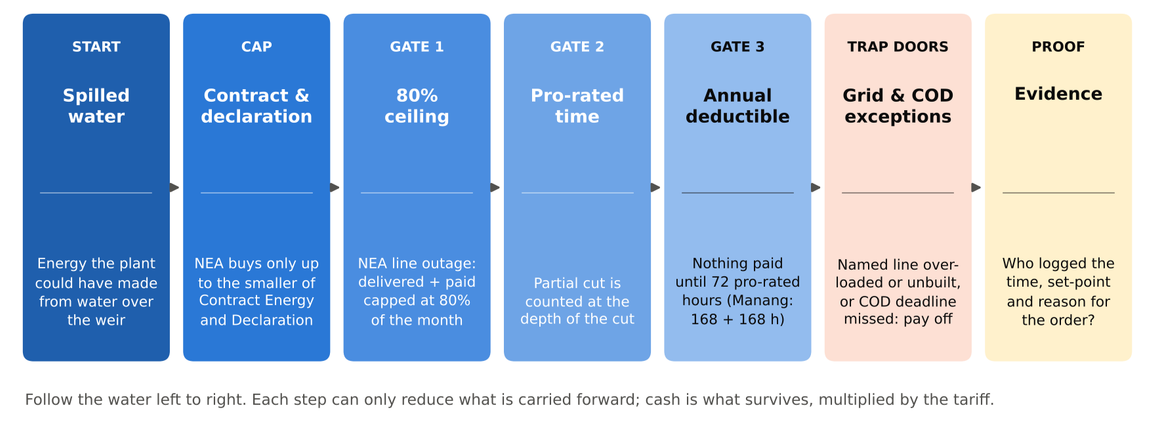
The journey from spilled water to cash under the executed domestic form. The cap follows from Article 10.1 (purchase “up to” CE per AD); Gates 1–3 from Schedule 3; the trap doors from the Article 10.1 provisos; the proof problem from the absence of any joint event record [1]–[18].
To make the arithmetic concrete, this section follows a fictional plant, Mountain Energy: a 10 MW run-of-river project on the domestic form, with a Schedule 2 monthly capacity of 10 MW in the wet months. Its figures are constructed for illustration; the formulas are the executed ones.
The cap applies before any outage happens. NEA’s obligation never exceeds the smaller of Contract Energy and the Availability Declaration. Whatever the river could deliver above that line is outside the bargain from the start.
4.1 Gate 1: does a forced outage on NEA’s line get paid in full?
No. Schedule 3 Case I covers a Forced Outage of NEA lines: the plant is fully available, the water is there, and NEA’s network fails (a tower falls, a transformer trips). A reasonable reader would expect the developer to be paid for everything the outage blocked. The formula says otherwise:
Case I: Forced Outage of NEA line(s) occurs which prevent the Project from generating & delivering according to the Available Capacity: UE = Σ (UC × PT) to the extent that (ME+UE) is equal to or less than 80% of the smaller of Contract Energy and the energy according to Availability Declaration for the Month …
— Schedule 3, identical in all 17 domestic PPAs
The ceiling applies to delivered energy plus compensated energy together. Take a dry month in which Mountain Energy’s Contract Energy and Declaration are both 1,000 MWh, so the ceiling is 800 MWh. By the third week the plant had delivered 700 MWh. Then NEA’s line fails and blocks another 200 MWh. Only 100 MWh fits under the ceiling; the other 100 MWh is lost even though NEA caused the outage. If the plant had already delivered 820 MWh when the line failed, blocking 120 MWh, compensation would be zero. A plant that delivers strongly early in the month uses up its own headroom.
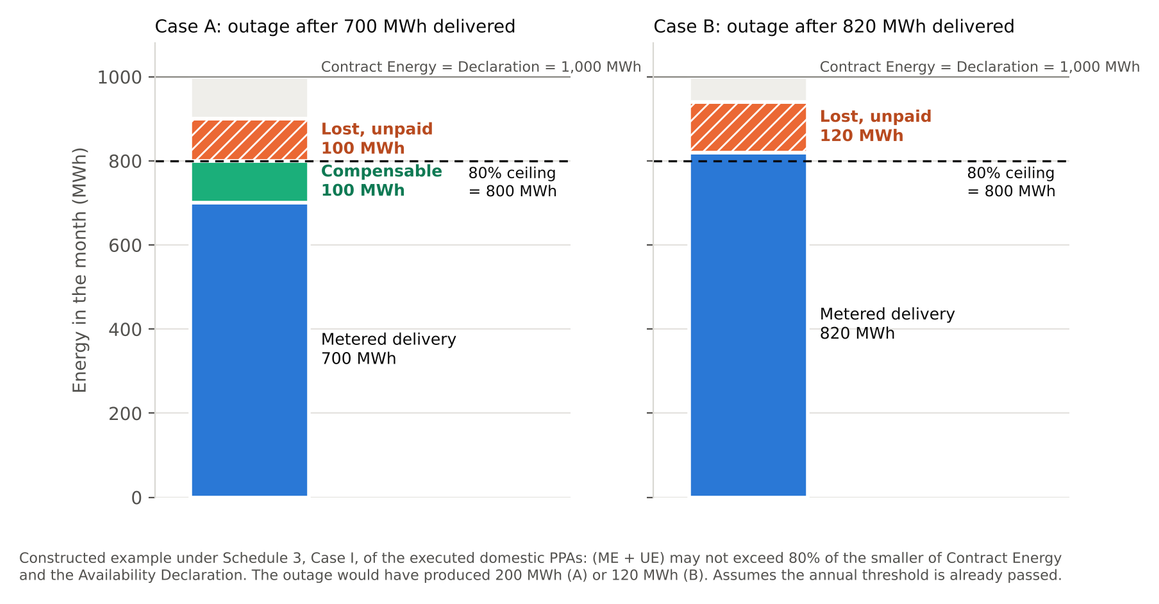
Gate 1: the 80% ceiling in Schedule 3, Case I. Constructed example for Mountain Energy.
| Step | Case A | Case B |
|---|---|---|
| Metered delivery before outage (ME) | 700 MWh | 820 MWh |
| Energy blocked by NEA line outage | 200 MWh | 120 MWh |
| Ceiling: 80% × min(CE, AD) | 800 MWh | 800 MWh |
| Compensable UE = max(0, 800 − ME), capped at physical loss | 100 MWh | 0 MWh |
| Value at Rs 8.40/kWh (base dry-season rate) | Rs 840,000 paid; Rs 840,000 lost | Rs 0 paid; Rs 1,008,000 lost |
Why 80%? The number is not arbitrary. Article 10.2 of every domestic agreement obliges the company to deliver at least 80% of the smaller of CE and AD each month, or pay liquidated damages of 0.8 × the shortfall × tariff, excusing shortfalls caused by NEA, scheduled outages, emergency maintenance or force majeure. The 80% line is therefore the developer’s delivery floor and also NEA’s compensation ceiling. Above it, the developer neither owes NEA for under-delivery nor receives compensation for NEA’s outages. The band between 80% and 100% is an uncompensated corridor: the contract protects the plant’s minimum, not its full output. The ceiling appears only under Case I. It does not apply to Dispatch Instructions, and it should not be read into Case II.
A second condition can remove compensation under either case. Schedule 3 deems Forced Outage Hours and Nondispatched Hours to be zero if “the dispatched and delivered energy in the month is equal to or greater than 100% of the smaller of Contract Energy and the energy according to Availability Declaration”. A plant curtailed early in a month that catches up later and reaches its contracted energy recovers the volume but gets no compensation. Since Article 9.7 already requires a plant to keep generating after reaching its contract energy, this mainly affects plants with water to spare.
Manang has no 80% ceiling. Its deemed generation is limited instead by excluding “Reduced Output” (a reduction not caused by NEA or the NEA system), scheduled and maintenance outages, company-caused outages and force majeure (Article 7.2(i)). It is also measured against the lower of declared capacity and Schedule 8 capacity (Article 7.3). On outages, the foreign-investment form is materially stronger.
4.2 Gate 2: does a partial curtailment order get paid in full?
Only a total shutdown is counted one-for-one. Schedule 3 Case II covers the situation in which the grid is healthy but the LDC calls the plant and orders it to run below its available capacity, usually because there is more power than the system can use or move:
Case II: NEA issues Dispatch Instructions to Project to generate less than the Available Capacity: UE = Σ (UC × PT); Where, UC = (Available Capacity − the greater of Capacity Dispatched and Capacity Delivered); PT = [(Available Capacity − the greater of Capacity Dispatched and Capacity Delivered) ÷ Monthly Capacity as specified in Column E of Table II of Schedule 2] × Nondispatched Hours
— Schedule 3, Case II, all 17 domestic PPAs
Walk through it slowly with Mountain Energy. The LDC orders the 10 MW plant down to 5 MW for 10 hours. In the physical world the plant has lost 5 MW × 10 h = 50 MWh. The formula works in two steps:
- Pro-rated time. Divide the curtailed capacity by the monthly capacity (5 ÷ 10 = ½) and multiply by the clock hours: ½ × 10 h = 5 hours. The 10-hour event has shrunk to 5 hours.
- Undelivered Energy. Multiply the shrunken time by the curtailed capacity again: 5 MW × 5 h = 25 MWh.
| Pro-rated Time (PT) = Undelivered Capacity (UC) / Monthly Capacity (C) × Nondispatched Hours (H) = UC / C × H Undelivered Energy (UE) = UC × PT = UC² / C × H Undelivered Capacity (UC) = [Availability Declaration (AD) – MAX {Capacity Dispatched, Capacity Delivered}] Note: Capacity Dispatched is the output level the LDC tells the plant to run at. Capacity Delivered is the output the plant actually sent to NEA at the delivery point. Usually the two are the same, because the plant follows the LDC order. However, the formula still deals with over-delivery because it can happen briefly in practice. A plant takes time to ramp down, units have technical limits, and an order may arrive by phone after the plant has already moved. Taking “the greater of dispatched and delivered” just ensures NEA pays only for what was actually held back. It is not permission to exceed the order. |
Half of the lost energy disappears inside the definition. The formula takes the “half” twice: once to shorten the time, and again when it multiplies by the curtailed megawatts. At Rs 4.80/kWh the physical loss is worth Rs 240,000; the formula recognises Rs 120,000.
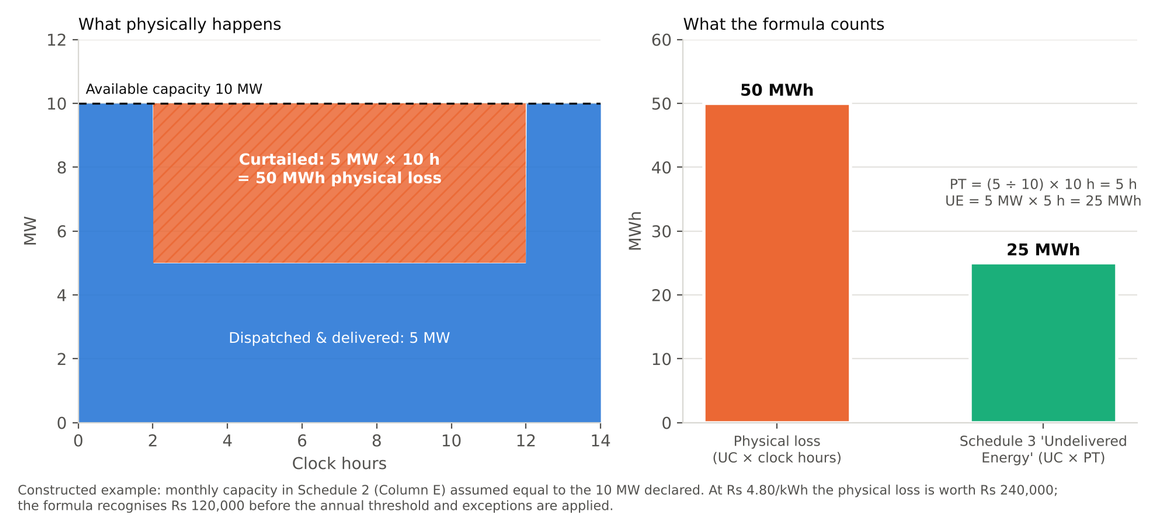
Gate 2: physical loss against Schedule 3’s Undelivered Energy for a 50% curtailment of Mountain Energy.
In general, UE = UC² ÷ C × H, while physical loss = UC × H. The share of physical loss that counts as UE therefore equals the curtailment depth UC ÷ C. A 25% cut is counted at 25% of its physical loss, so the developer loses 75% of the value of the spilled megawatt-hours; a 75% cut is counted at 75%; only a full stop is counted at 100% (Figure 6, left). C is the Schedule 2 monthly capacity, so the counted share also changes from month to month with the hydrology assumed in Schedule 2.
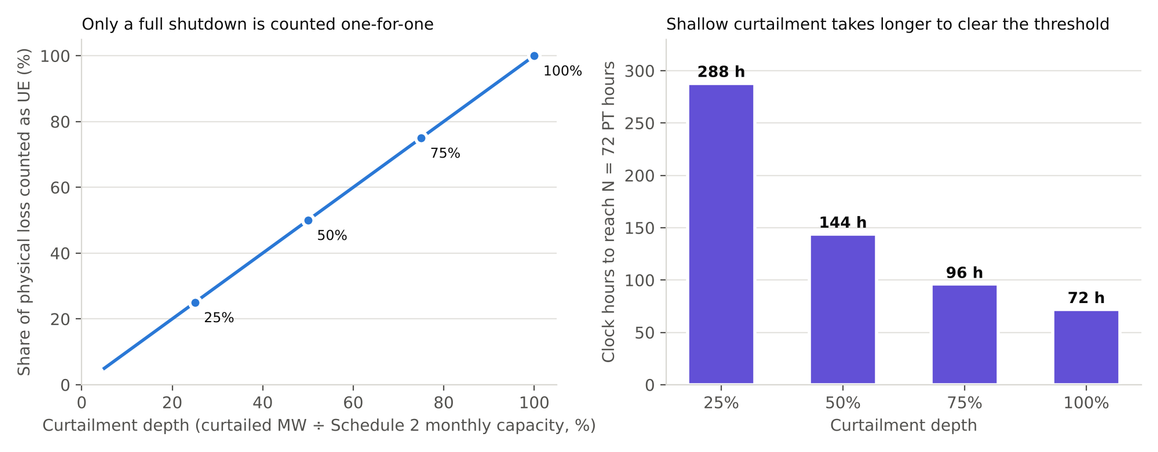
Left: share of physical loss recognised as UE, by curtailment depth. Right: clock hours needed to accumulate the 72 pro-rated hours of Gate 3, by depth. Derived algebraically from Schedule 3.
Why would anyone draft it this way? The text gives no reason, but one explanation fits. In utility practice, “pro-rated” or “equivalent” hours convert a partial outage into equivalent full-capacity hours, which is a sensible unit for counting toward an annual threshold (Gate 3). The step that went wrong is the final multiplication: multiplying by the total monthly capacity C (UE = C × PT) would have given the correct 50 MWh, while multiplying by the curtailed capacity UC gives 25 MWh. Whether this was a slip or a deliberate limit on NEA’s liability cannot be told. The result is the same either way: this is the signed text in all 17 agreements and in every recent model PPAs circulated. On a plain reading, which is how a lender or arbitrator will start, NEA may compute UE as written, and a developer arguing a drafting error would carry the burden. A financial model should use the literal result.
Manang’s Article 7.2 has no pro-rating. Deemed generation is the energy the station could have generated, at the applicable purchase price. On partial curtailment, too, the foreign-investment form protects more.
4.3 Gate 3: when does the payment right actually start?
Only after an annual deductible, much like health insurance that pays nothing until the policyholder has covered a set amount. Every domestic Schedule 3 ends with the same condition:
Notwithstanding the provisions under both cases given above in this Schedule, Compensation Amount shall be considered equal to zero if and so long as the following conditions hold true: – the cumulative of PT (Prorated Time) is equal to or less than ‘N’ hours in the Fiscal Year, where N = 72 …
— Schedule 3; identical N = 72 in almost all PPAs reviewed.
As a deductible, UE accrued while the counter is at or below 72 stays at zero permanently. Invoices are monthly (Article 13), and in each month the condition either “holds true” or does not. Schedule 3 has no mechanism to reopen months already invoiced at zero, and its words make the amount “equal to zero” for as long as the condition holds.
Because PT is pro-rated, the energy value of the deductible is fixed regardless of how deep the curtailment is. Since physical loss = C × PT, 72 PT hours equals 72 full-capacity hours of lost energy at the Schedule 2 monthly capacity: three days’ output at full capacity, every fiscal year. For Mountain Energy that is 720 MWh, about Rs 3.5 million at Rs 4.80/kWh. For the 22.9 MW Middle Hongu Khola B, if Schedule 2 capacity is at its installed level, it is about 1,649 MWh, roughly Rs 7.9 million, before the first rupee of compensation. Shallow curtailment takes longer to use up the deductible: at a 25% cut, 288 clock hours are needed (Figure 6, right).
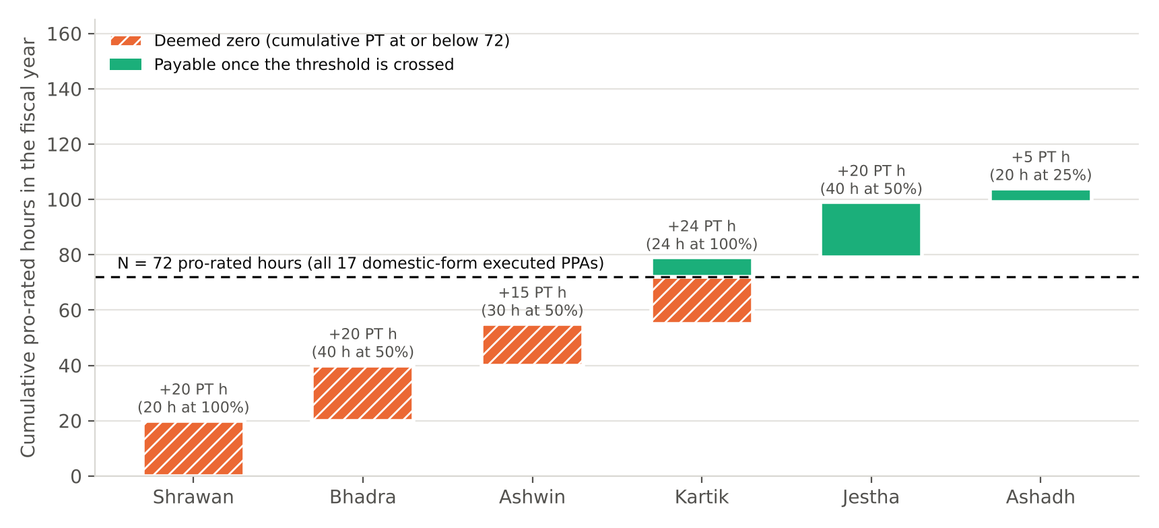
Gate 3: constructed fiscal-year ledger for Mountain Energy (10 MW monthly capacity) facing six Dispatch Instruction events. Physical loss: 1,040 MWh. Schedule 3 UE: 727.5 MWh. Payable after the deductible: 182.5 MWh, about 18% of the physical loss, or Rs 0.88 million of Rs 4.99 million at Rs 4.80/kWh.
Manang negotiated away Gates 1 and 2, but its deductibles are larger. Under Article 7.2(ii), NEA’s deemed-generation obligation for NEA-system outages “will not arise until greater than one hundred and sixty eight (168) hours of such reduction or interruption have occurred in any Contract Year”, calculated pro rata on installed capacity. Article 6.11(c) adds a further 168 hours for outages caused by NEA’s additions, modifications or replacements to its system, “in addition to the similar provisions elsewhere in the Agreement”. At 135 MW, each 168-hour allowance is about 22,680 MWh, worth about Rs 109 million at Rs 4.80/kWh. And the 168-hour thresholds apply to outages; Article 7.2 attaches no such threshold to dispatch-driven reductions. Manang’s dispatch exposure is governed instead by the reserve margin and the commissioning condition in Section 5.
| Instrument | Threshold before payment | Scope |
|---|---|---|
| 17 executed domestic PPAs | 72 PT hours per fiscal year | Forced outage and dispatch, cumulative |
| Manang Marshyangdi | 168 h + 168 h per Contract Year, pro rata on installed capacity | NEA-system outages (Art 7.2(ii)); NEA system works (Art 6.11(c)) |
| Model RoR / PRoR | 72 / 144 / 216 PT h by delivery voltage | As domestic |
| Model storage | 36 PT h | As domestic |
| Model solar | 144 PT h, then × 0.75 | As domestic |
4.4 What survives all three gates?
Put the gates together and the formula behaves like an obstacle course. In Mountain Energy’s constructed year, 1,040 MWh of physically spilled energy shrinks to 727.5 MWh at Gate 2 and to 182.5 MWh at Gate 3. The last bar shows what happens if a trap door is open: the remaining 182.5 MWh also goes to zero. That is the subject of the next section.
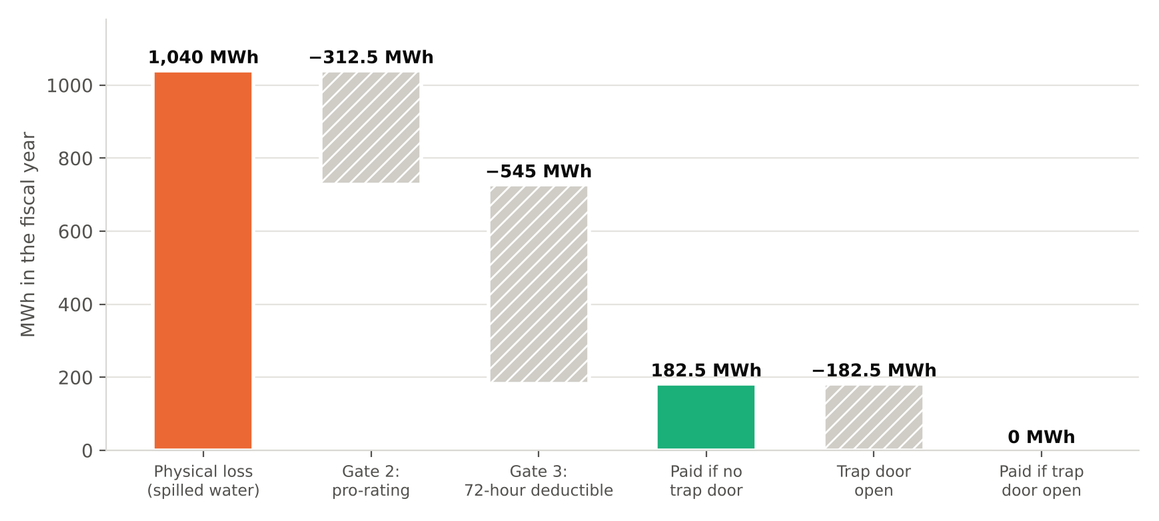
From spilled water to payable energy for Mountain Energy’s constructed fiscal year (dispatch events only, so Gate 1 does not bite).
5. Can the contract switch the protection off entirely?
Yes, and this is where the largest exposure lies. The gates trim a payment that still exists. A trap door removes the payment right altogether for every curtailment within its scope, for as long as a piece of state infrastructure stays unbuilt or a deadline stays missed.
5.1 What is MoM 12.1.2, and how did it get into the PPA?
Before a plant is connected, NEA’s System Planning Department runs a grid impact study, and NEA’s Grid Operation Department signs connection minutes with the developer. These Minutes of Meeting (MoM) form part of the Connection Agreement. Item 12.1.2 of the minutes records the developer’s agreement to follow LDC curtailment in named grid conditions, typically overloading of the Dhalkebar–Muzaffarpur (D–M) 400 kV cross-border line. Article 1.4 of the PPA makes the Connection Agreement an integral part of the PPA, and Article 10.1 then cross-refers to item 12.1.2 to switch compensation off. That is how operational meeting minutes became binding payment exceptions.
The executed Myagdi Khola PPA (57.3 MW, Ashwin 2075) is a representative example. After the standard compensation sentence, Article 10.1 continues:
तर कनेक्सन एग्रीमेन्टको Minutes of Meeting को बुँदा नं. १२ को १२.१.२ मा उल्लेखित अवस्था आइपरेमा प्राधिकरणको भार प्रेषण केन्द्रको निर्देशन बमोजिम आयोजना संचालन गर्नु पर्दा अनुसूची ३ को प्रावधान अनुसार प्राधिकरणले कम्पनीलाई क्षतिपूर्ति तिर्नु पर्ने छैन ।
ग) ईस्वी आ.व. २०२५।२६ सम्ममा दोस्रो क्रस वोर्डर न्यू बुटवल-गोरखपुर ४०० के.भी. डवल सर्किट प्रसारण लाइन निर्माण सम्पन्न भई संचालनमा नआएमा ईस्वी आ.व. २०२५।२६ देखि उक्त प्रसारण लाइन संचालनमा नआएसम्म
— Myagdi Khola PPA, Article 10.1, proviso and item (c)
Translation: “Provided that, if a situation stated in item 12.1.2 of point 12 of the Minutes of Meeting of the Connection Agreement arises, the Authority shall not be required to pay compensation under Schedule 3 when the Project has to be operated as instructed by the Authority’s Load Dispatch Centre: … (c) if the second cross-border New Butwal–Gorakhpur 400 kV double-circuit transmission line is not completed and brought into operation by FY 2025/26 AD, from FY 2025/26 until that line comes into operation.”
The connection minutes give the engineering reason:
GIS is carried out by assuming the Second Cross Border 400kV double circuit (New Butwal-Gorakhpur transmission line) will be completed by FY 2025/26. In case in the absence of Second Cross Border 400kV double circuit … the developer of Myagdi Khola Hydropower Project (57.3MW) shall agree to abide by dispatch instruction of NEA’s Load Dispatch Center from FY 2025/26 onwards in Wet Period as the loading of one circuit of 400kV Dhalkebar Muzaffarpur Transmission Line is beyond 120% and in wet off peak period in normal case.
— Myagdi Khola Connection MoU, minutes of 24 June 2018, item 12.1.2(iii)
Item 15 of the same minutes states the allocation directly: the financial impacts of “non/late commissioning of transmission line and associated substations” and of “system operation and power/energy dispatch issues shall be specified in the Power Purchase Agreement”. The PPA, in Article 10.1, allocates them to the developer.
5.2 How long do the windows stay open?
Three kinds of window appear across the agreements:
- Fixed windows suspend compensation for a named cross-border problem (D–M circuit fault or overload) over stated fiscal years. Some are short (FY 2022/23–2024/25). Others run to FY 2033/34 for Upper Suri and Ilep, far beyond the network study that justified them.
- Blanket windows remove compensation for all LDC-directed operation, whatever the reason: Super Mai A from FY 2019/20 to 2032/33, about half of a 30-year asset life, and Upper Madi-0, Upper Kabeli and Tamakoshi V if they miss their COD deadline.
- Open-ended windows end only when New Butwal–Gorakhpur “comes into operation”, a second cross-border line “is built”, or a named domestic line’s fault “is resolved” (Bhotekoshi-1, Ilep, Lower Jogmai). For a developer these are the most dangerous, because their length depends on a state construction schedule.
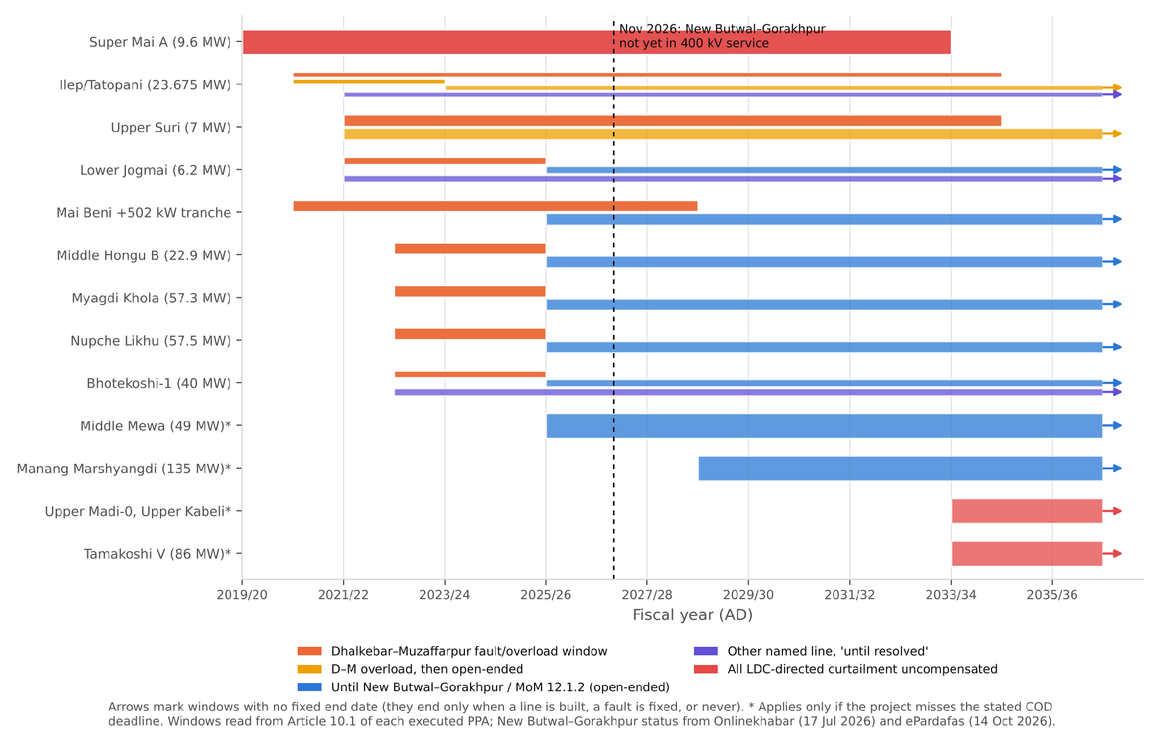
Compensation-exclusion windows written into Article 10.1 of each executed agreement (Manang: Article 7.2). The four agreements without exceptions (Lower Solu, Solu, Mistri Khola, Likhu IV) are omitted.
5.3 Where does New Butwal–Gorakhpur stand, and what does 220 kV mean?
The open-ended windows are live today. MCA-Nepal completed the 18 km Nepal-side section of New Butwal–Gorakhpur in September 2026. The two governments have agreed to run the line at 220 kV until the New Butwal 400 kV substation is ready, with a target of December 2027. As of October 2026 the line was still reported as under construction, not commissioned.
Running a 400 kV line at 220 kV is not a small step down. For the same conductors and current, the power a line can carry rises roughly in proportion to its voltage, so at 220 kV it carries something like half of what it could at 400 kV. The Ministry of Energy expects interim exports of up to 200 MW and imports of up to 130 MW on this basis. Picture a four-lane highway opened with only two lanes. Meanwhile NEA’s FY 2025/26 review names overloaded corridors, substation bottlenecks and the “absence of adequate N-1 contingency arrangements” among its operating constraints.
For Mountain Energy the consequence is stark. It can raise its finance, build on time and have every turbine ready. If its PPA carries clause (c), and the LDC curtails it because the cross-border corridor is constrained, it bears the cost of the spilled water until a line hundreds of kilometres away is in service. For that event, a take-or-pay contract operates as take-and-pay: the plant is paid only for what NEA physically takes.
Will 220 kV energisation end clause (c)? The PPA’s trigger is that the line “comes into operation” (संचालनमा आएमा). Under Article 1.4 the PPA prevails over the connection minutes where they conflict. On the text, energising the named line for commercial service, even at 220 kV, ends the exception, and this is the better reading. NEA could argue that the minutes’ premise, relief of D–M loading, is not met by a 200 MW interim path. The PPA does not adopt that premise as a condition, but the argument shows why the trigger should have been written as a measurable test, such as a named transfer capability. Open-ended triggers leave a project’s revenue tied to the state’s construction schedule.
5.4 Can missing a commissioning deadline switch the protection off?
Yes, it is observed in many of the 18 PPAs reviewed. Three separate clocks need to be kept apart:
| Clock | What it governs | Example from executed text |
|---|---|---|
| RCOD | Delay damages both ways: 0.05 × contract-energy equivalent of the delay × COD tariff (Article 4) | Middle Hongu B; Manang RCOD 31 March 2025 |
| Take-or-pay deadline | Whether dispatch compensation survives at all | Manang FY 2084/85; Middle Mewa FY 2082/83; Upper Madi-0, Upper Kabeli, Tamakoshi V FY 2089/90 |
| Grid-line commissioning | Whether a named contingency exception applies | New Butwal–Gorakhpur in: Myagdi Khola, Bhotekoshi-1, Nupche Likhu, Lower Jogmai, Mai Beni, Middle Mewa |
Three different deadlines that are often blurred together.
The RCOD penalty is the one developers mention most. They say NEA’s 5% delay compensation does not cover their bank interest. But it governs delay before COD, not curtailment after it. The take-or-pay deadline is what decides whether dispatch compensation exists at all.
The newer forms (Upper Madi-0 and Upper Kabeli, Bhadra and Shrawan 2080) state the trade-off openly. If COD occurs by FY 2089/90, NEA buys 90% of declared energy from Ashadh to Kartik and holds the other 10% as an uncompensated reserve margin. In return, it pays Schedule 3 compensation for dispatch “in any situation including item 12.1.2”. If COD occurs later, even by a day, NEA pays nothing when the plant is run on LDC instructions “in any situation including item 12.1.2”. That is effectively all dispatch, for the rest of the PPA’s life. Tamakoshi V reaches the same result more bluntly: its late-COD sentence simply says no compensation is due when the project is run on LDC instructions. Forced-outage compensation survives in all three. For dispatch, the description that “the take-or-pay clause falls off” is accurate.
Manang’s version is grammatically awkward but can be resolved. After listing exclusions (i) to (iii), Article 7.2 continues: “If the project is not commissioned by F/Y 2084/85 BS, A reduction in the delivery of generation/energy resulting from dispatch instructions of the Load Dispatch Center of NEA as per Minutes of Meeting, Sr. No. 12 (12.1.2), of Connection Agreement”. The sentence only works as a fourth item in the list of reductions for which “Deemed Generation shall not be earned”. Manang’s minutes (8 January 2019) list N-1 wet-peak dispatch for FY 2023/24–2024/25, wet off-peak for FY 2025/26–2026/27, and the open-ended New Butwal–Gorakhpur condition. This means the line being “overloaded beyond 120%… until FY 2027”. Part (iii) of those minutes still names “Lower Manang Marsyangdi Hydropower Project (104 MW)”, a template carry-over left after the 4 April 2019 amendment cut the project from 144 MW to 135 MW. It does not change the obligation, but it shows how much drafting care these exceptions received.
Middle Mewa shows what happens when the condition bites. Its Article 10.1(b) gave reserve-margin treatment and full dispatch compensation if COD came by FY 2082/83. FY 2082/83 ended in mid-July 2026, and NEA’s year-end appendix still lists Middle Mewa as under construction. The D–M windows in its fallback proviso have already expired. Clause (c), which runs until New Butwal–Gorakhpur operates, applies from the day it starts generating.
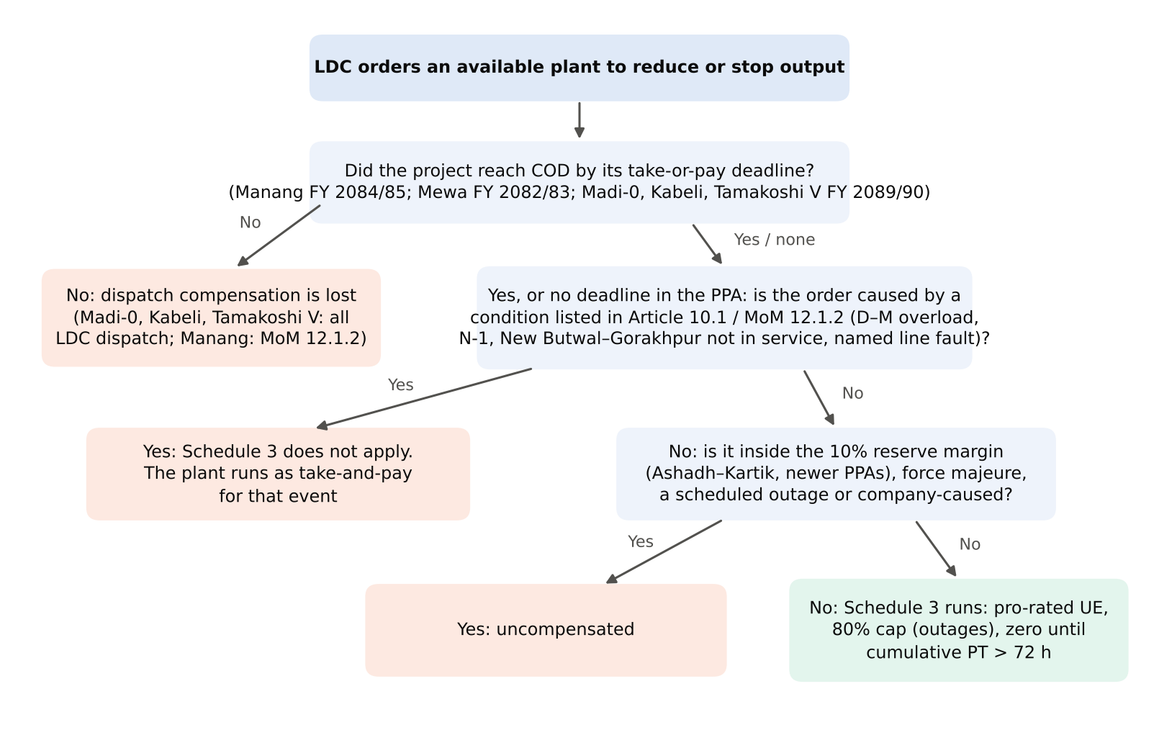
Decision path for a curtailment instruction under the executed agreements. Three of the four exits lead to no compensation.
5.5 Does an operating plant show the pattern?
Nyadi (30 MW, Lamjung), which is not in the 18 PPAs reviewed, is a documented example. Its sponsor reports that since construction was completed in May 2022 the plant has evacuated under a contingency plan pending the 220 kV Marsyangdi corridor and Khudi hub, and that LDC instructions have limited it to dispatching only part of its output, causing a “huge loss of revenue”. CARE Ratings Nepal’s November 2025 review states that the contingency arrangement changes the modality from take-or-pay to take-and-pay, and that generation was 60% and 65% of contracted energy in FY 2023/24 and FY 2024/25. On 1 July 2026 the Kathmandu Post reported 30–32 projects classed as “contingency”, Nyadi among them; the acting Managing Director warned that about 800 MW of monsoon generation could be spilled, and IPPAN’s president estimated up to 900 MW that the system could not absorb at times. These figures show the mechanism operating. They do not show how much compensation was due under a particular PPA, because annual generation shortfalls also reflect hydrology and plant availability.
6. Even with a valid claim, how does a developer prove it?
Suppose Mountain Energy clears every gate and no trap door is open. The water spilled and NEA owes money. To invoice, the plant must prove the start and end time of each order, the set-point it was given, what it could have generated, and why the order was made. This is where the system is weakest, and where the point about notice really belongs.
6.1 What notice do the agreements require?
Very little. The domestic form defines a Dispatch Instruction as a direction the Authority’s designated body gives the company “from time to time” (समय समयमा) concerning operation. It gives NEA power to raise or lower generation, stop it for a period, call a black start or require off-grid operation, “based on” system needs, the Availability Declaration and technical limits. No notice period applies. The seven-business-day written notice in the same definitions section applies only to NEA’s “regular repair and maintenance”. Applying that rule to real-time dispatch would be a category error.
Manang goes further but stops short of a shared record. NEA must give “prompt oral notification by telephone” of transmission emergencies, followed by written notice “using best efforts” by the close of the next business day (Article 5.5). It must give 30 days’ notice of system modifications “if the circumstances permit” (Article 6.11(b)). Each party must keep complete records for 60 months, with a right to inspect the other’s (Article 5.8). Reporting is otherwise one-way: the company supplies NEA with hourly kW and kWh data on request (Article 5.3).
6.2 What happens in practice?
Reporting from the 2026 monsoon describes LDC instructions issued “regularly, with no fixed schedule” from late May, with plants allowed to run for four to eight hours or fully depending on the day. NEA’s own FY 2025/26 review lists, among the LDC’s operating challenges, “inadequate data and voice communication infrastructure across several IPPs” and LDC manpower and infrastructure that grid growth has left “inadequate”. Only 23 IPPs were integrated into the LDC’s SCADA system in FY 2081/82 and 19 in FY 2082/83, under the SCADA Integration Directives 2081, against 545 IPP PPAs signed. For many plants, curtailment orders are still given by telephone to a control room whose output NEA cannot see in real time.
6.3 Why does that matter for payment?
Every Schedule 3 variable depends on timing and cause. Nondispatched Hours need a start and end time. UC needs the dispatched set-point. And the reason for the order decides the payout. If the LDC curtails Mountain Energy because the D–M corridor is overloaded under MoM 12.1.2, and the plant’s PPA carries that exception, compensation is zero. If the cause is a breaker tripping at a local NEA substation, the event may be a payable Forced Outage. A phone call leaves no record of which it was.
Available capacity is a second problem. During an outage it is not what the turbine could do. Under Article 9.6 it is “the average of normal-condition delivery in each clock hour for a period equal to the outage, immediately before and after it”, capped at the Schedule 2 capacity or the declared capacity, whichever is lower. The proxy is reasonable for a short trip. It fails for a long curtailment, because the hours before and after are themselves curtailed. The better reading is that curtailed hours are not “normal condition” and should be excluded, which pushes the reference window back to the last uncurtailed hours. The PPAs leave the point to the Operating Procedures, so it should be settled there in writing before the first wet season.
The only jointly witnessed data are the monthly main and check meter readings (Article 11.2). Everything else that decides eligibility sits in one party’s records. In a dispute, the developer says “you owe me”, NEA says “prove it”, and the developer may have only a logbook of call times. Manang offers some help, with a records-inspection right (Article 5.8) and an independent engineer for committee deadlock (Article 5.7), but the domestic form has neither.
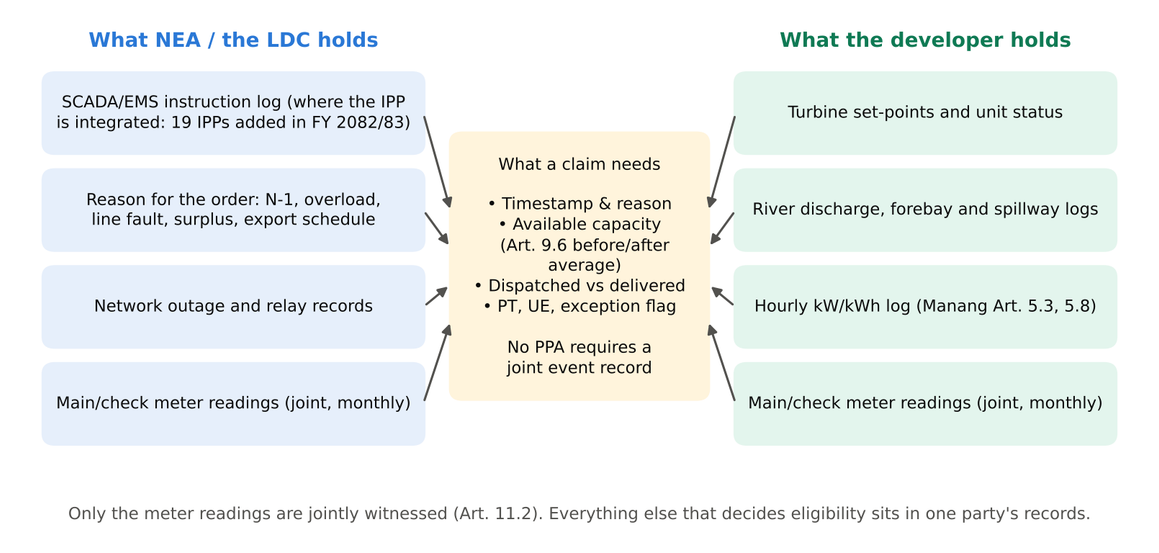
Two partial data streams, one claim. Schematic based on Articles 9.6, 11.2 (domestic) and 5.3, 5.8 (Manang) with SCADA coverage.
The Hydropower Development Policy 2058 expected this gap to be closed by regulation, not contract. It required “necessary grid-codes and basis for load dispatch” to be prepared (s. 6.12.12), and gave the regulator the functions “to prepare Grid Codes” and “to approve the criteria for load dispatch”. The connection minutes refer to the NEA Grid Code 2005 (as amended). None of the executed PPAs, however, requires the LDC to log a reason code against each instruction, or requires a joint monthly reconciliation of dispatch events before invoicing. The notice complaint is therefore best restated as a demand for a common, timestamped event record. Without one, the payment right in Sections 4 and 5 cannot be proven, whatever its size.
7. Is NEA simply the villain of this story?
With 80% caps, a formula that halves partial losses, trap doors and unrecorded phone calls, it would be easy to cast NEA as squeezing private developers. The evidence does not support that reading. Step away from contract law to the physics of the grid and a different picture appears.
- The constraint is physical and real. In FY 2025/26 Nepal had 4,120 MW installed against a system peak of 3,226 MW, so even at the moment of highest demand there was nearly 900 MW more capacity than the country could use. Nepal exported 3,965 GWh and recorded a net export of 2,794 GWh. But large annual exports do not mean every plant in every valley can be evacuated every hour. Electricity has to be consumed the moment it is generated; without storage, a grid that receives more than it can use or move must shed generation or risk frequency and voltage problems. NEA’s Managing Director expressly links further growth to domestic demand, export access and transmission investment “to minimize energy generation curtailment”. Curtailment on its own is not evidence that dispatch is arbitrary.
- NEA has carried curtailment risk itself. In FY 2003/04, NEA reported that the take-or-pay basis of its IPP purchases “severely constrained NEA’s production capability”; its own generation fell 8.03% that year, “mainly because of” its purchase terms with IPPs. When there is surplus, NEA’s own plants spill first. The reserve-margin and exception clauses of the newer PPAs can be read as NEA limiting that exposure for a quota it can no longer absorb.
- The exceptions were negotiated and grounded in studies. Each MoM 12.1.2 condition rests on a grid impact study that forecast which named circuits would overload as new plants connected. That does not make the resulting allocation fair or efficient, but it changes the legal question from arbitrary non-offtake to whether the agreed allocation, including its lack of an end date, is reasonable and was properly incorporated.
- The developer carries obligations too. The 80% delivery floor in Article 10.2 and the dry-season adjustment in Article 10.3 put real risk on the developer. And some protections are stronger than the critique assumes: Manang has no 80% ceiling and no pro-rating, and four domestic agreements have no grid exception.
- No claims data were available. The study shows a mechanism through which losses arise. It does not quantify unpaid claims, refusals, or how often instructions were wrongly classified. That remains an empirical question.
The core issue is therefore not that curtailment happens; physics makes some curtailment unavoidable. It is how the cost of that unavoidable limit is divided between the state and private developers, and on what evidence.
8. What should drafters, developers and lenders change?
Adding a “deemed generation” heading would change little if Schedule 3’s arithmetic stayed the same. The fixes have to be in the formula, the exceptions and the evidence.
| Issue | What the executed texts do | What a bankable version would say |
|---|---|---|
| Scope of the 80% ceiling | Caps forced-outage compensation at 80% − ME; silent on whether it should apply to dispatch | State expressly which events the ceiling covers; for NEA-caused outages, either remove it or price the 80–100% corridor into the tariff |
| Pro-rated energy | UE = UC × PT, so depth is counted twice | UE = UC × clock hours (equivalently C × PT): a 5 MW cut for 10 hours bills 50 MWh. Attach a worked example to Schedule 3 |
| Grid contingencies | Exceptions run “until the line comes into operation” or “until resolved”; some run to FY 2033/34 | Name the line and an objective exit test (e.g. a transfer capability in MW verified by an independent engineer), plus a long-stop date after which compensation resumes or the tariff is repriced; require NEA to report milestones |
| Take-or-pay deadline | Missing COD by a day can remove dispatch compensation for the life of the PPA | Link the consequence to the cause of delay; extend the deadline for NEA-side interconnection delay |
| Evidence | Only meter readings are joint; LDC reasons are not logged | Make SCADA integration a condition of COD; attach a standard reason code to every instruction, including voice back-up orders; require joint monthly reconciliation before invoicing and an independent engineer for disputes (as Manang Art 5.7 already provides for committee deadlock) |
For a lender’s risk officer, the diligence question changes. Seeing the words “take-or-pay” and ticking a box is not enough. The question is: which hours, which megawatts and which provable grid conditions are actually covered by a binding payment obligation, and for how long? Answering it needs the signed PPA, every amendment, the connection minutes, the status of each named line, and a debt-service case that applies Schedule 3 literally through a wet season with the exceptions switched on.
Conclusion: In Short
The domestic payment right is partial by design: it is capped at 80% for NEA outages, counts partial curtailment at the depth of the cut, and pays nothing until 72 pro-rated hours a year have accrued. More importantly, in 14 of the 18 PPAs reviewed for this article, it can be switched off for any curtailment attributed to named state transmission constraints, in several cases with no end date. In five of them this turns on reaching COD by a fixed fiscal year. The notice complaint matters less as a breach than as the reason these limits cannot be checked: no agreement requires a shared, timestamped record of why and when output was cut.
The most defensible framing is this: Nepal’s executed PPAs contain take-or-pay protection, but the protection is partial by formula and can be suspended indefinitely by grid conditions outside the developer’s control. A PPA with open-ended network exceptions and steep deductibles cannot be valued as an unconditional revenue hedge. In these contracts, as in most, the real allocation of risk sits in the arithmetic and the exceptions, not in the label.
NEA’s own reports say generation is growing faster than the wires that carry it, and that transmission and export access will decide how much is curtailed [25, pp. 1578, 1623]. If the contracts respond by moving that risk onto developers, the cost of capital for new hydropower rises, and some capital may go elsewhere. Whether the better answer lies in the PPA, in sequencing transmission ahead of generation, or in both, is a policy choice. It deserves to be made explicitly rather than left inside Schedule 3.
Annex: Reproducing the calculations
| Construct | Domestic Schedule 3 (17 executed PPAs) | Manang Art 7 (foreign-investment form) |
|---|---|---|
| Event types | Case I: Forced Outage of NEA lines. Case II: Dispatch Instruction below available capacity | Any reduction or interruption at the Delivery Point causing spillage |
| Capacity lost | Case I: UC = A − D. Case II: UC = A − max(S, D). Zero if negative | Capacity the station could deliver, capped at min(AD kW, Sch 8 Col E) (Art 7.3) |
| Time | PT = (UC ÷ C) × H; C = Sch 2 Col E monthly capacity | Clock time of the reduction |
| Energy | UE = Σ UC × PT (= UC² ÷ C × H) | Deemed Generation per Sch 8 |
| Monthly cap | Case I only: ME + UE ≤ 0.8 × min(CE, AD) | None; NEA need not buy above CE absent dispatch (Art 7.4) |
| Zero conditions | Cumulative PT ≤ 72 in fiscal year; dispatched + delivered ≥ 100% of min(CE, AD) | 168 h (NEA-system outages) and 168 h (NEA works), pro rata on installed capacity |
| Exclusions | Force majeure, scheduled outage, company or contractor; Art 10.1 provisos | Scheduled/maintenance outage, company-attributed outage, Reduced Output, force majeure; MoM 12.1.2 dispatch if no COD by FY 2084/85; 10% reserve margin Ashadh–Kartik |
| Payment | UE × Purchase Price | Deemed Generation × Purchase Price, in addition to Electrical Output |
A = Available Capacity (Art 9.6); D = Capacity Delivered; S = Capacity Dispatched; H = Forced Outage or Nondispatched Hours; ME = metered energy.
| Mountain Energy example | Inputs | Physical loss | Counted | Payable |
|---|---|---|---|---|
| Gate 1: forced outage (Fig. 4, A) | CE = AD = 1,000 MWh; ME = 700; outage blocks 200 MWh | 200 MWh | 100 MWh (80% cap) | 100 MWh, if PT > 72 already |
| Gate 2: partial dispatch (Fig. 5) | A = C = 10 MW; S = D = 5 MW; H = 10 h | 50 MWh | 25 MWh | 25 MWh, if PT > 72 already |
| Gate 3: annual ledger (Figs. 7–8) | C = 10 MW; six events (Shrawan–Ashadh) | 1,040 MWh | 727.5 MWh | 182.5 MWh |
| Trap door (Fig. 10) | Any event within an active exception, e.g. Myagdi (c) before New Butwal–Gorakhpur operates | Any | n/a | 0 |
Summary of the Mountain Energy examples. The figures are illustrations, not observed project data.