
How a margin trade in Nepal moves cash, shares and a bank’s funding, from end to end
An earlier post, Broker Margin Lending, asked the questions a bank has to settle before it funds a stockbroker’s margin book: how to price the line, what risk weight it carries, why the investors’ shares cannot be its security and how much control it has over the cash. This post is its companion piece. This follows one margin trade from start to finish and records, at every step, where the cash is, where the shares are, what protects the lender, and which rule makes it so.
The rules are the ones in force today: SEBON’s Margin Trading Facility Directive, 2082 (“the Directive”) and NEPSE’s Margin Trading Facility Procedure, 2082 (“the Procedure”). Margin trades settle through the ordinary market plumbing, so the ordinary rules apply as well: the Securities Act, 2063, the Securities Businessperson (Stock Broker, Securities Dealer and Market Maker) Regulations, 2064 (“Broker Regulations”), CDSC’s Securities Transaction Clearing and Settlement Byelaws, 2069 (“Clearing Byelaws”) and Central Depository Service Byelaws, 2068 (“Depository Byelaws”), and NEPSE’s Securities Trading Operation Byelaws, 2075 (“Trading Byelaws”). SEBON’s compiled edition carries the base texts and CDSC publishes its byelaws and amendments. SEBON has also published a fuller Margin Loan Regulation, 2083 in draft (its introductory note explains the intent). Where the draft would change something, it appears in a shaded box below, because it is not yet a law.
The example used throughout: An investor buys Rs 1,000,000 of an eligible share. The investor puts in Rs 300,000 (30%) and the broker lends Rs 700,000. The broker in turn borrows the Rs 700,000 from a commercial bank, which advances 100% of eligible margin receivables. The investor pays the broker 8% a year plus a 0.25% service fee; the broker pays the bank 5.5% a year. These prices are illustrative, but they sit inside the range brokers have announced: 7.5%, 7.99% and 8% with a 0.25% fee in October 2026 – with facility tenure of around 1 to 3 months from broker to the retail investor. Three loops of money run through every margin trade, and it helps to keep them apart from the start:
- Bank and broker. The bank lends to the broker, not to the investor. Its money goes into a lending bank’s control account in the broker’s name and comes back from the same account. Its security is the broker’s margin receivables, the amounts investors owe the broker.
- Broker and investor. The investor pays the 30% margin, the broker lends the 70%, and the investor pays interest and fees. The shares sit in the investor’s own name in a separate margin demat account, under the broker’s lien.
- Market settlement. Every rupee that pays for or comes from a trade moves only through the broker’s clearing account at a CDSC-designated bank, on the T+2 cycle. It never passes through the bank’s control account.
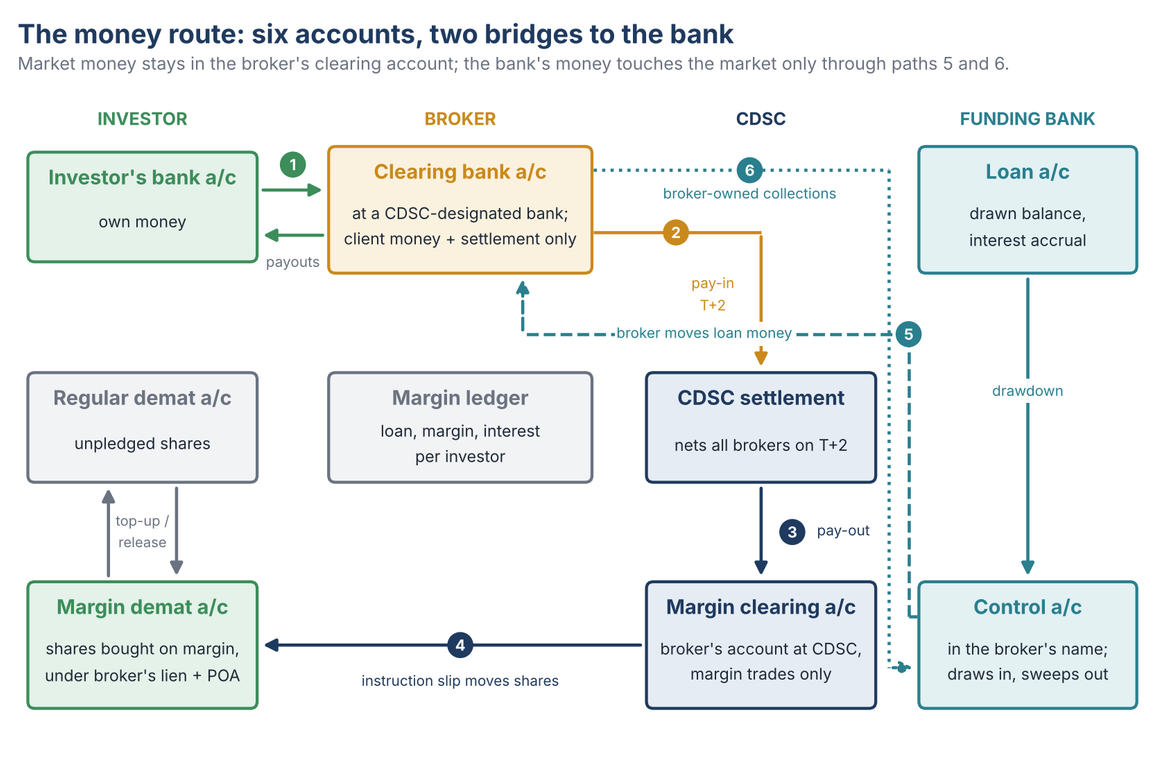
The six accounts involved and the paths between them. Paths 5 and 6, both moved by the broker, are the only links between the funding bank and the market.
Losses are absorbed in a fixed order. The investor’s own equity goes first: 30% at the start, a margin call when it falls to 20%, a sale when it reaches 15%. The broker’s net worth comes next, which is why the rules cap how far a broker can borrow and lend against it. The bank’s security is last. The rest of this post shows how each layer is built and when it is used.
1. Who may offer margin, and on which shares?
Not every broker may lend. Under Section 3 of the Procedure, a broker needs paid-up capital of at least Rs 20 crore, clearing membership at CDSC, and a depository participant licence held by itself, its parent or a company it holds shares in (Directive Section 4 sets the same entry test). The path to a licence has three stops:
- The broker’s board resolves to offer margin trading, and the broker applies to NEPSE with audited financial statements and the documents listed in Schedule 1 of the Procedure.
- NEPSE examines the file, issues a letter of intent, and recommends the broker to Nepal Rastra Bank under Section 76 of the Nepal Rastra Bank Act (Procedure Section 4).
- Once Nepal Rastra Bank approves, NEPSE issues the margin trading licence in Schedule 2 and informs SEBON (Procedure Section 5; Directive Section 5).
The licence must be renewed within three months of each fiscal year-end or it lapses, and a broker whose licence lapses cannot obtain one again for a year (Procedure Section 6). NEPSE can suspend or cancel a licence if investors are harmed, but the broker stays bound by its existing client contracts (Procedure Section 7). NEPSE granted the first 31 licences in June 2026.
Not every share can be bought on margin either. A company’s shares qualify only if at least 25 lakh shares have been issued to the public and listed, its net worth is at least equal to its paid-up capital, it made a net profit in at least two of the last three years, and at least two years have passed since its IPO shares were listed (Directive Section 3; Procedure Section 8). NEPSE publishes the list for each fiscal year and must update it within seven months of the year-end. A broker may lend on a narrower list of its own, but never on a wider one.
Lists change. If a share drops off, the broker must either settle those margin positions within 30 trading days or treat them as needing 100% margin (Procedure Section 9). For a lender this matters: the eligible list is the universe of collateral its money can end up financing, and a removal can force sales across many investors at once.
| UNDER THE DRAFT MARGIN LOAN REGULATION, 2083 (NOT YET IN FORCE) SEBON, not NEPSE, would license margin lenders (Rules 4 to 9). Brokers already offering margin would need a SEBON licence within one year (Rule 10).Eligibility would be set by the Board on market capitalisation, liquidity, free float, volatility and governance, and securities would be graded A (lowest risk) to D (not eligible) (Rules 20 to 22, Schedule 5). |
2. How does the bank’s facility get set up?
Before the broker can draw a rupee, the bank appraises it, sanctions a limit, perfects its security and opens the accounts its money will run through. Pricing, risk weights and the security question are covered in the earlier post; here the point is how the facility is built so that the bank can follow its money later.
Appraisal and sanction
A broker’s margin book is only as good as the broker running it, so banks screen brokers before they lend. A sensible screen looks at four things: whether the broker’s profits are durable (for example, a three-year average return on equity of 15% or more); whether it is already financing clients informally through receivables left unpaid beyond T+2; how much of its capital those informal receivables consume; and whether its client trading is crowded into one sector compared with the market. Banks typically turn the results into a score that sets the advance rate, up to 100% of eligible receivables for the best-rated brokers and nothing for the weakest.
The advance rate deserves attention. At 100%, the broker has no money of its own between the bank and a loss on the book. The investor’s 30% and the broker’s capital are then the only cushions, which is why the screening, and the strict use of the 20% and 15% margin rules later, carry most of the bank’s protection.
The sanction itself is usually a 12-month revolving limit, renewable on fresh appraisal, that may be used only to finance eligible margin loans to investors: not to fill T+2 settlement gaps, and not to fund informal client credit. The exposure is risk-weighted by the broker’s external rating under clause 3.3(d)(1) of Nepal Rastra Bank’s Capital Adequacy Framework, 2015: 50% for AAA, 70% for AA, 80% for A and 100% for BBB and below or unrated. The brokers in Nepal based on the historical ratings they have received can be expected to normally carry a 100% risk weight. The broker is normally asked to declare that it will not take further margin funding lines without the bank’s consent.
The broker’s own leverage caps
Whatever the bank sanctions, the rules cap how much borrowed money a broker can absorb. These caps apply across all of the broker’s lenders together:
| Cap | Limit | Rule |
|---|---|---|
| Borrowing for margin lending (banks and financial institutions, plus unsecured loans from shareholders or directors) | 4.5 times net worth | Directive 8(2); Procedure 14(2) |
| Total margin lending to investors | 5 times certified net worth | Directive 9(1); Procedure 14(4) |
| One investor with family and related entities | 10% of the margin book | Directive 9(2); Procedure 14(5) |
| Any one security | 10% of the margin book | Procedure 14(6) |
| Using one client’s cash or shares for another client | Prohibited | Directive 8(3); Procedure 14(3) |
Directive Section 8(1) lists the permitted funding sources: the broker’s own funds, loans from banks and financial institutions, and unsecured loans from shareholders or directors in line with company law. A broker that already borrows close to 4.5 times its net worth from other lenders has no room for a new line, whatever a sanction letter says.
Security, accounts and drawing power
As the earlier post explained, the bank cannot take the investors’ shares: the broker holds them only as a pledgee, and under Sections 566 and 588 of the National Civil Code, 2074 it cannot pass that pledge on without each investor’s express consent. The bank instead takes an assignment of the broker’s present and future margin receivables, including principal, interest, fees and accretions such as bonus shares, and registers it at the Secured Transactions Registry under the Secured Transactions Act, 2063 before the first draw. Guarantees, pledges of the broker’s own deposits and other collateral may be added. The bank’s claim therefore runs in a chain: bank, to the broker’s receivable, to the investor’s debt, to the shares under the broker’s lien. Every control that follows exists to keep that chain intact.
The bank then opens a control account in the broker’s name. Every drawdown is paid into it, and the broker signs a standing instruction letting the bank debit interest and principal from it. The control account is deliberately separate from the broker’s clearing account, because market settlement must stay with the CDSC-designated clearing bank (Clearing Byelaws 12 and 14(3)(ग)), and client money belongs to clients (Securities Act Section 78(2); Broker Regulations Rule 31(1)).
Each time the broker asks for money, and every day afterwards, the bank recomputes its drawing power: the lowest of eligible receivables multiplied by the advance rate, the broker’s remaining regulatory headroom, and the sanctioned limit.
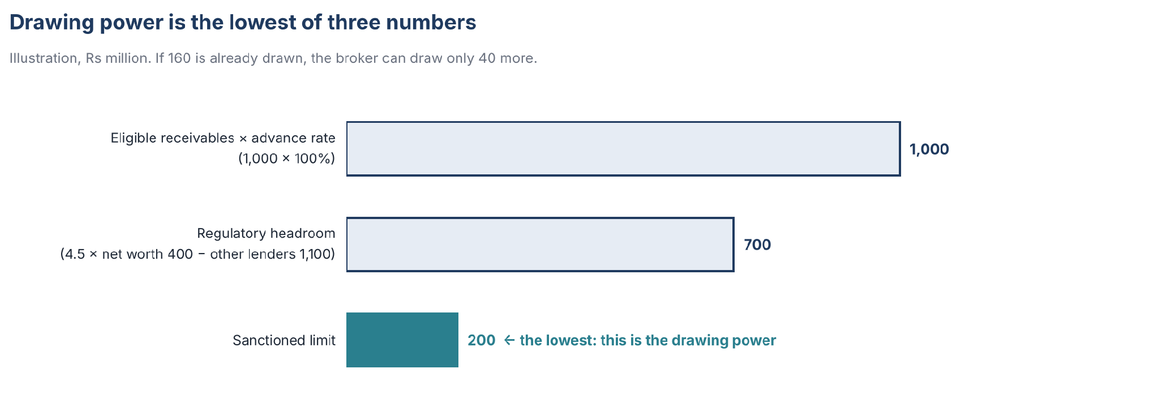
In this illustration the broker’s net worth is Rs 400 million, so its 4.5 times borrowing cap is Rs 1,800 million; other lenders already account for Rs 1,100 million. The 5 times lending cap (Rs 2,000 million) sits above all three numbers.
3. What must the investor do before the first trade?
The investor applies to the broker for a margin trading account. The broker collects KYC in SEBON’s format and assesses the investor’s credit standing under its own written procedure (Directive Section 13(1); Procedure Sections 10 and 16). Before any agreement is signed, the broker must give the investor an orientation on how margin trading works (Procedure Section 25), and the investor must declare any margin facility already taken from another broker (Procedure Section 15). That self-declaration is, for now, the only check against one investor borrowing from several brokers at once.
The margin agreement must cover, at a minimum, the initial and maintenance margin, how margin calls are made, the interest or service charge, the shares to be bought, the power of attorney, and the documents and promissory note to be provided (Directive Section 13(2); Procedure Schedule 3). The facility runs for at most one year and may be renewed (Directive Section 11). Each broker must publish its interest and fee rates on its website and update them monthly (Procedure Section 18). If a service fee is charged up front, money moves at this point: in our example, 0.25% of Rs 700,000 is Rs 1,750, paid by the investor to the broker.
The broker may take a power of attorney to operate the investor’s margin trading account and margin demat account. It is narrow: it may be used only to sell and settle when the investor fails to repay or to keep up the maintenance margin, and every use must be reported to NEPSE (Directive Section 10(5) and (6); Procedure Section 20(4) and (5)).
Finally the accounts are opened and linked. The investor gets a separate margin trading account with the broker and a separate margin demat account, which is linked to the broker’s margin trading dmat. clearing account at CDSC (Directive Section 10(2) to (4); Procedure Section 20(2) and (3); Depository Byelaws 21क). Trade money still runs only through the broker’s clearing bank account (Trading Byelaws 18(1) to (4)).
| UNDER THE DRAFT MARGIN LOAN REGULATION, 2083 (NOT YET IN FORCE) A suitability test covering income, assets, experience, knowledge, risk capacity, objectives and repayment capacity (Rule 17, Schedule 3), and a written risk disclosure (Rule 19).A list of people who may not borrow on margin: those barred from trading, those blacklisted at the Credit Information Bureau, earlier material margin defaulters, high-risk clients under anti-money-laundering rules, and anyone convicted of a securities offence in the last five years (Rule 15). A standard agreement (Schedule 4). |
4. What happens between T−1 and T+2?
This is where the money actually moves. The figure below sets the days side by side; the text below walks through them.
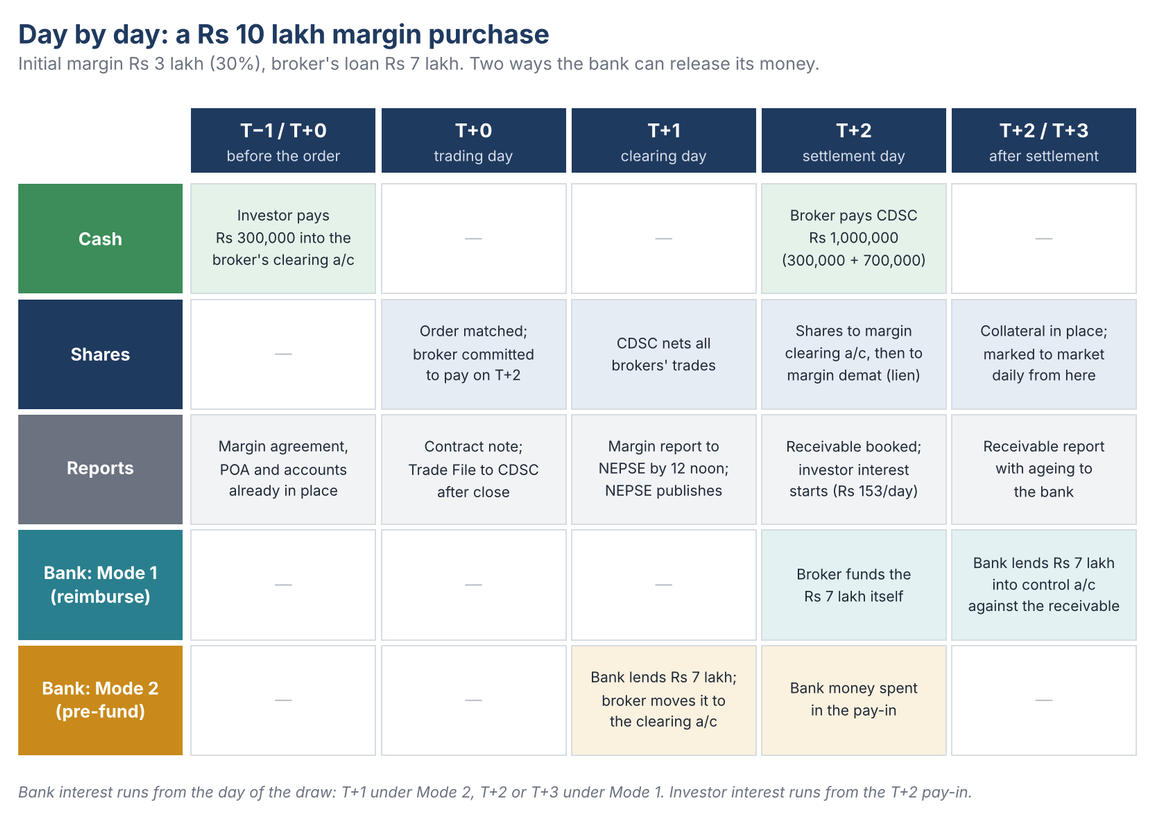
One margin purchase from the day before the order to the day after settlement, with the two ways a bank can release its money (Section 5).
T−1 or T+0, before the order: the investor’s 30%
The investor pays the initial margin of Rs 300,000 into the broker’s clearing bank account, by bank transfer or account-payee cheque, before the order is placed (Directive Sections 2(घ) and 6(1)). This also satisfies the ordinary rule that a buyer must advance at least 25% of an order before it is entered (Trading Byelaws 8(1)). The broker may ask for more than 30% based on the investor, the share or market conditions (Directive Section 6(4); Procedure Section 11(4)).
One drafting difference is worth knowing. The Directive measures the 30% on the share’s market value (Section 6(1)); the Procedure measures it on the purchase amount (Section 11(1)). On the day of purchase the two are the same; when margin is added to an existing position later, they can differ. But either way, the investor’s margin is computed/recomputed on the market value after on.
T+0: the trade
The broker / margin trader enters the order flagged as a margin trade. The flag must follow the trade through trading, post-trade processing and clearing (Directive Section 10(1); Procedure Section 20(1)). NEPSE matches the order by price and then time, and the broker issues a contract note. No money moves, but the broker is now legally bound to pay Rs 1,000,000 on T+2. After the close, NEPSE sends the day’s Trade File to CDSC (Clearing Byelaws 14(3)(क)). Margin trades settle exactly like ordinary trades, on the same cycle and under the same close-out rules (Procedure Section 20(6)).
T+1: clearing and reporting
CDSC nets each broker’s purchases and sales and works out each broker’s funds and securities obligations (Clearing Byelaws 14(3)(च)). By 12 noon the broker must report the previous day’s margin trades to NEPSE in the format of Schedule 4 of the Procedure: investor name and code, PAN, company, share type, quantity and the amount the broker financed. NEPSE then publishes scrip-wise totals across all brokers (Schedule 5; Procedure Section 21). The broker also reports margin trading to SEBON every month (Directive Section 12).
Two things follow for a lender. The Schedule 4 file is the most reliable record of a broker’s new receivables, so a bank should receive the same file every day. NEPSE’s published totals are aggregate by scrip and cannot be traced to one broker, so they are useful only as a check on the market as a whole.
T+2: pay-in, pay-out and the creation of security
By the pay-in deadline the broker must hold the full net amount in its clearing bank account: the investor’s Rs 300,000 plus Rs 700,000 of loan money, either already drawn from the bank or advanced from the broker’s own funds. CDSC instructs the clearing bank to debit the account and pays Rs 1,000,000 across (Clearing Byelaws 14(3)(ङ) and (ज)). Settlement must complete within T+2 (Clearing Byelaw 13(1)); a broker that is short is barred from trading for at least three days and its purchases face the close-out rules (Clearing Byelaw 15(2)).
In practice the Rs 1,000,000 is not paid on its own. CDSC does not run a separate funds settlement for margin trades. Procedure Section 20(6) says margin trades are settled like any other trade, and CDSC nets everything a broker bought and sold that day, for every client, margin or not, into a single funds figure (Clearing Byelaws 14(3)(च)). That one net amount is debited from, or credited to, the broker’s clearing bank account. If the broker’s other clients sold more than its clients bought, the broker may pay in less than Rs 1,000,000, or nothing at all, and the loan money becomes part of a net figure that cannot be traced inside the settlement.
On the securities side, CDSC credits the purchased shares to the broker’s margin trading clearing account (Clearing Byelaws 14(3)(ञ)), and the broker issues an instruction slip moving them into the investor’s margin demat account, not the regular one (Depository Byelaw 29; Directive Section 10(3) and (4)). At that moment the collateral exists: Rs 1,000,000 of shares in the investor’s name, under the broker’s lien and power of attorney. The investor owns them but cannot move them out without clearing the loan, and the broker can sell them only on default or a margin breach (Directive Section 10(6); Procedure Section 13(6)).
Margin trades are kept apart only on the share side. The margin trading clearing account is defined as a beneficiary account opened in CDSC’s system for clearing and settling shares bought through margin trading (Directive Sections 2(झ) and 10(3); Procedure Section 20(2)), so it holds shares, not money. What separates margin trades from ordinary ones is the broker’s duty to flag them at trading, after trading and at clearing (Directive Section 10(1); Procedure Section 20(1)), its investor-wise margin records (Procedure Section 19) and the Schedule 4 report. The margin portion can be identified on paper, not in the money flow. The rules do not say how CDSC’s system routes a margin purchase that has been netted against ordinary sales of the same share, whether straight to the margin clearing account or through the broker afterwards; that is an operating detail for CDSC to confirm.
The loan money is spent the instant the pay-in completes. From here it exists only as shares and as the investor’s debt. At the close of T+2 the three balance sheets look like this:
| Investor | Broker | Funding bank |
|---|---|---|
| Shares in margin demat: Rs 1,000,000 | Margin receivable: Rs 700,000 | Loan to broker: Rs 700,000 |
| Owes broker: Rs 700,000 | Owes bank: Rs 700,000 | Security: assigned receivable of Rs 700,000 |
| Equity: Rs 300,000 (30%) | Net: nil; earns the spread | Behind that: Rs 1,000,000 of shares under lien |
Two interest clocks are now running. The investor owes the broker Rs 153.42 a day (Rs 700,000 × 8% ÷ 365), counted from the T+2 pay-in, when the broker’s money is actually used, and on the amount used rather than the approved limit. The broker owes the bank Rs 105.48 a day (Rs 700,000 × 5.5% ÷ 365) from the day of the draw. The broker keeps the difference, about Rs 48 a day.
5. When does the bank actually release its money?
There are two ways to do it, and the choice decides how long the bank’s money is out of its sight.
Mode 1, reimbursement. The broker funds the T+2 pay-in from its own cash and then asks the bank to reimburse it. With the request it sends the receivable report with ageing, the Schedule 4 file it sent to NEPSE and the margin demat holding statement. The bank checks that the receivable exists, is undisputed, is backed by a valid agreement and relates to an eligible share; recomputes drawing power; and pays Rs 700,000 into the control account on T+2 or T+3. The money never enters the clearing account; it replaces broker cash already spent.
Mode 2, pre-funding. On T+1 the broker asks for Rs 700,000 against the trade report and contract note, which evidence a receivable that will exist once T+2 settles. The bank checks the request against drawing power, the eligible list and the 10% limits, and pays into the control account. The broker then moves the money by interbank transfer into its clearing bank account before the T+2 cut-off. For about a day the bank’s money sits with client money in an account the bank cannot see or debit.
| Mode 1: reimbursement after T+2 | Mode 2: pre-funding on T+1 | |
|---|---|---|
| What the bank lends against | A receivable that already exists, with shares already in the margin demat account | A trade report; the receivable does not exist until T+2 |
| Where the bank’s money goes first | Control account, where the bank can see and sweep it | Broker’s clearing account, where it cannot |
| Settlement risk to the bank | None; the trade has settled | If the broker fails on T+2 for any reason, the bank’s money is caught in a failed settlement |
| Broker’s liquidity need | Carries the 70% itself for one or two days | None |
| Timing risk | Low | The transfer must arrive before the pay-in cut-off |
| Interest | Starts on the reimbursement day | Starts a day earlier, about Rs 105 the broker bears |
How CDSC settles adds one more difference. Because the broker pays in a single net amount for all its clients (Section 4), its pay-in on T+2 can be smaller than the margin loans it made that day if its other clients were net sellers. Under Mode 2 the bank would then have lent Rs 700,000 that the settlement did not need, and the surplus would sit in the clearing account alongside client money, or end up covering other clients’ trades. Mode 1 avoids this, because the bank pays only against a receivable that already exists. Whichever mode is used, a broker that misses its T+2 pay-in fails on all its trades together, margin and ordinary alike (Clearing Byelaw 15(2)).
Mode 1 is safer for the bank and Mode 2 is easier for the broker. Either way the end point is the same: a loan to the broker, secured by an assigned receivable, which is in turn secured by shares under lien.
6. What is checked every day?
Every trading day after the close, the broker values each margin position at the closing price and recalculates the investor’s margin as (market value − loan − accrued interest) ÷ market value (Directive Section 6(3) and (5); Procedure Sections 11(3) and 12(1)). A rising price does not create extra borrowing power; a falling one can trigger a call. In our example the share must fall 12.5%, to a value of Rs 875,000, before the margin reaches 20%, and 17.6%, to Rs 823,529, before it reaches 15%.
The next morning the bank does its own check. It receives the broker’s daily margin report, receivables with ageing, margin calls issued and any failed sales, and it reconciles them against the Schedule 4 file, the CDSC margin demat holdings and the clearing account statements. It then recomputes drawing power. If the drawn balance is higher than the new drawing power, because calls went uncured, sales failed or receivables aged, no further draws are allowed and the broker must repay the excess from the control account.
What the bank looks at, line by line
Of the three numbers that set drawing power (Section 2), the sanctioned limit is fixed and the regulatory headroom moves only when the broker reports a new net worth or borrowing schedule. The one that moves every day is eligible receivables multiplied by the advance rate. In our example the limit and the headroom are both well above Rs 700,000, so the daily question is simply: how much eligible receivable is there today?
What counts as eligible is set by the facility terms, not by regulation. A typical definition:
- Counted: principal the investor still owes, under a signed margin agreement, for an eligible share that is actually in the margin demat account under lien; with the margin at 20% or more, or under a call still inside its cure window; within the 10% limits per investor and per share; and not past the loan’s expiry.
- Not counted: interest and fees, whether accrued or added to the loan; loans with a call left uncured past its deadline; anything above the 10% limits; and disputed or expired loans.
The rule is mechanical. If the drawn balance is higher than drawing power, the difference is repaid from the control account, and that difference is the principal sweep. Day by day, with the bank reimbursing under Mode 1 and the investor paying interest in cash:
| Day | What happened | Eligible receivable | Drawing power | Drawn | Bank’s action |
|---|---|---|---|---|---|
| T+2 / T+3 | Trade settled; shares under lien | 700,000 | 700,000 | 0 → 700,000 | Draw allowed |
| Day 10 | Price −10%; margin 22.2% | 700,000 | 700,000 | 700,000 | None |
| Month-end | Investor pays Rs 4,603 interest | 700,000 | 700,000 | 700,000 | No principal sweep; Rs 3,164 interest debited separately |
| Day M | Price −15%; margin 17.6%; call issued | 700,000 (call within cure window) | 700,000 | 700,000 | None; on watch |
| M+1 | Investor cures with Rs 20,000 cash | 680,000 | 680,000 | 700,000 | Sweep Rs 20,000 |
The sweep is triggered not by the price fall but by the principal the investor repaid: the Rs 20,000 reduced the receivable, so the bank’s draw falls by the same amount. Had the investor cured with shares instead (Rs 41,667 of A, B or G shares counted at 60%, Section 9), the loan would stay at Rs 700,000, remain eligible, and nothing would be swept. Had the call gone uncured past M+2, the Rs 700,000 would stop counting: drawing power for that loan falls to nil, and the broker must repay the excess from its own funds or force a sale (Section 11).
Interest added to the loan (method (b) in Section 7) changes nothing in this check. After the first month the investor owes Rs 704,603, but drawing power stays at Rs 700,000, because capitalised interest is not eligible. That is exactly why it cannot support more borrowing.
Some events stop drawings at once and escalate the account: loss or suspension of the margin licence, misuse of client funds, false reporting, a failure in the security, a breach of the leverage caps, or a missed payment.
| UNDER THE DRAFT MARGIN LOAN REGULATION, 2083 (NOT YET IN FORCE) Daily automated mark-to-market recomputing each client’s holdings, loan ratio, collateral value and margin requirement (Rules 30 and 31), and an automated early-warning system (Rule 49). |
7. How does the broker charge the investor interest?
On our example, interest at 8% on the amount actually used works out as follows:
| Item | Calculation | Amount |
|---|---|---|
| Daily interest | Rs 700,000 × 8% ÷ 365 | Rs 153.42 |
| A 30-day month | Rs 153.42 × 30 | Rs 4,603 |
| A full year | Rs 700,000 × 8% | Rs 56,000 |
| Service fee, once | 0.25% of Rs 700,000 | Rs 1,750 |
Published broker terms in late 2026 ranged from about 7% to 10% a year, with fees from nothing to 0.25% of the loan, or 0.20% of the approved limit. The rules leave the method of collection to each broker’s procedure and agreement (Directive Section 13(2); Procedure Sections 17 and 18), and none of the term sheets we have seen says which method it uses. There are two possibilities, and they have very different effects:
- (a) Cash. The investor pays Rs 4,603 into the broker’s clearing account each month. The loan stays at Rs 700,000 and the margin stays where the share price puts it.
- (b) Added to the loan. The broker debits the interest to the investor’s loan account. The loan becomes Rs 704,603 after the first month and keeps growing, and the margin falls even though the share price has not moved.
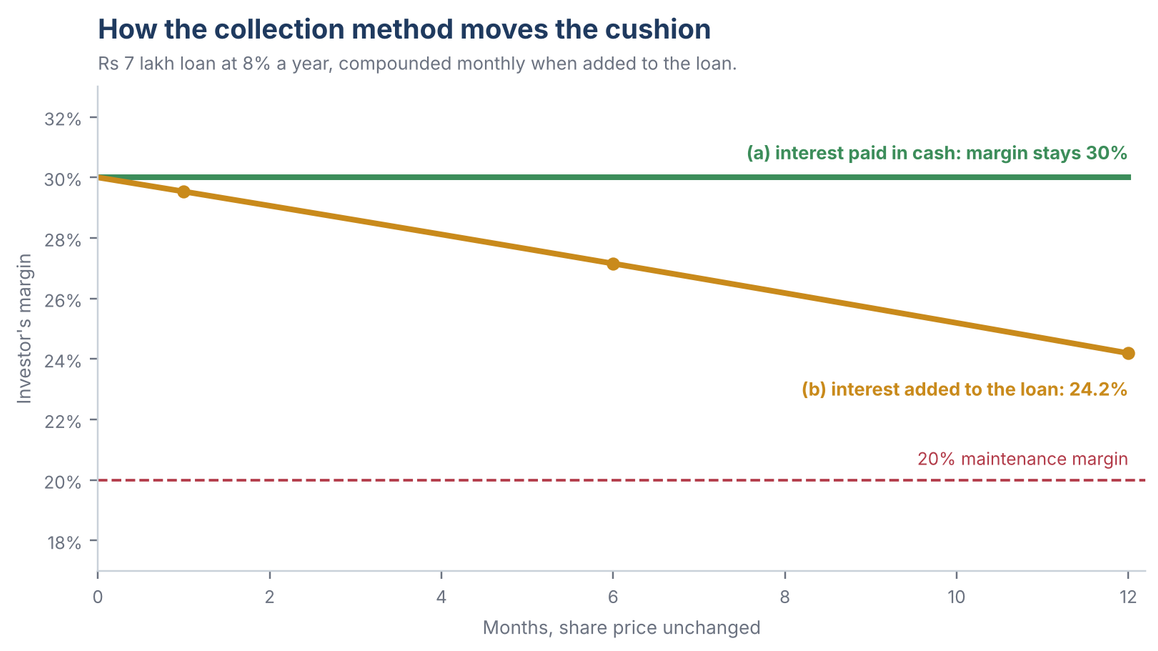
With interest added to the loan, a position bought at 30% margin is at 24.2% after a year at an unchanged price.
| Interest added to the loan | Loan | Margin at an unchanged price | Fall that now triggers a call |
|---|---|---|---|
| At purchase | Rs 700,000 | 30.0% | 12.5% |
| After 1 month | Rs 704,603 | 29.5% | 11.9% |
| After 6 months | Rs 728,471 | 27.2% | 8.9% |
| After 12 months | Rs 758,100 | 24.2% | 5.2% |
After a year under method (b), a 5% dip is enough for a margin call. The money is still owed, so the receivable grows, but the bank’s draw does not grow with it: capitalised interest is not new eligible principal and should not raise drawing power. The question a lender should put to every broker is which method it uses, and whether accrued interest is counted when margin is calculated.
| UNDER THE DRAFT MARGIN LOAN REGULATION, 2083 (NOT YET IN FORCE) Interest, fees and charges must be published in advance and written into the agreement; no hidden fees (Rules 18 and 39). |
8. How does the bank charge the broker, and who keeps what?
The bank accrues interest daily on the drawn balance at its base rate plus a premium, 5.5% in our example. At month-end it debits the control account under the standing instruction: on Rs 700,000 for 30 days, Rs 3,164. Principal is not due monthly; it falls as investors repay or positions are sold (Sections 11 and 12). Other charges agreed at sanction, such as processing, commitment on the undrawn limit, renewal and penal interest, are collected the same way.
The broker must fund the control account only with its own money: its share of investor interest and fees, and its own funds. Investor entitlements are settled first from the clearing account; only what then belongs to the broker moves across (Broker Regulations Rule 31(1); Trading Byelaws 18(4)). If the control account is short on the due date, the bank charges penal interest, suspends drawings and escalates. Under method (a), a month looks like this:
| From | To | Amount | Note |
|---|---|---|---|
| Investor | Broker’s clearing account | Rs 4,603 | Monthly interest |
| Broker’s clearing account | Control account | Rs 4,603 | After client entitlements are reconciled |
| Control account | Bank (interest income) | Rs 3,164 | Standing instruction |
Over a full year on Rs 700,000, the chain divides as follows:
| One year on Rs 700,000 | Amount | Rate |
|---|---|---|
| Investor pays the broker: interest | Rs 56,000 | 8.00% |
| Investor pays the broker: service fee | Rs 1,750 | 0.25% |
| Broker pays the bank: interest | Rs 38,500 | 5.50% |
| Broker keeps, before its own costs and losses | Rs 19,250 | 2.75% |
Brokerage commission on the trades is separate and not shown. The broker’s 2.75% is what stands between investor defaults and the broker’s capital, and the broker’s capital is what stands between investor defaults and the bank.
9. What happens when the share price falls?
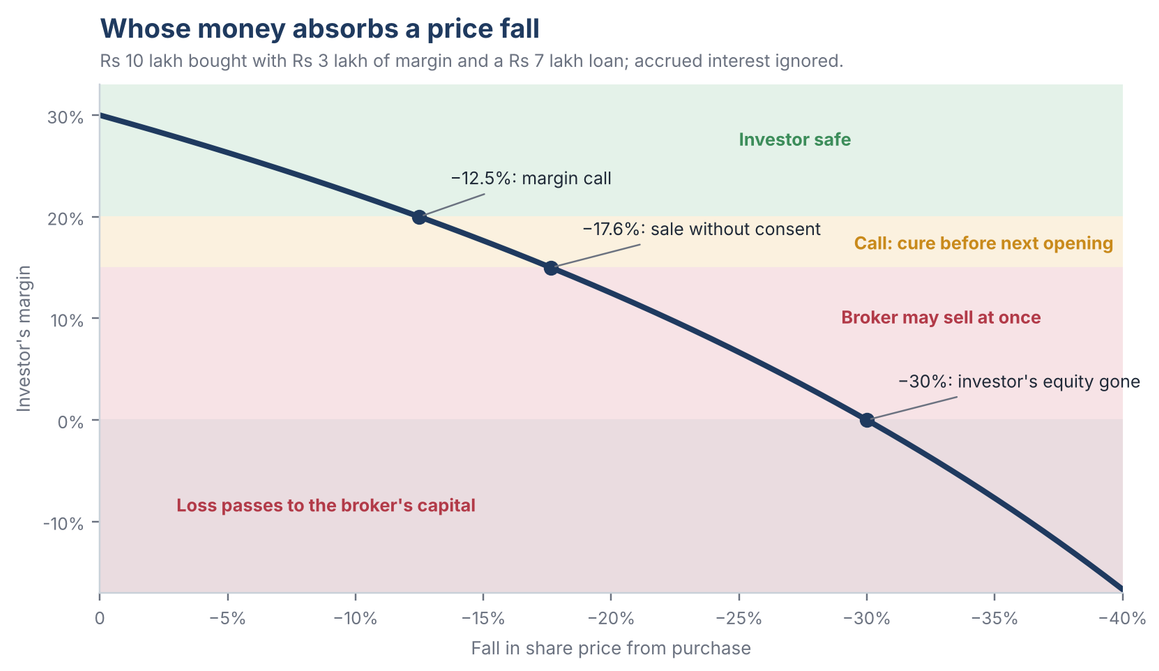
| Price change | Shares worth | Investor’s equity | Margin | Who bears it |
|---|---|---|---|---|
| −10% | Rs 900,000 | Rs 200,000 | 22.2% | Investor; position safe |
| −12.5% | Rs 875,000 | Rs 175,000 | 20.0% | Investor; at the call line |
| −15% | Rs 850,000 | Rs 150,000 | 17.6% | Investor; margin call |
| −17.6% | Rs 823,529 | Rs 123,529 | 15.0% | Investor; sale without consent |
| −25% | Rs 750,000 | Rs 50,000 | 6.7% | Investor; sale without consent |
| −30% | Rs 700,000 | nil | 0.0% | Investor’s equity gone |
| −35% | Rs 650,000 | −Rs 50,000 | −7.7% | Broker’s capital |
Down to a 30% fall the investor carries the entire loss. Beyond that, a gap through 15% that cannot be sold in time passes the loss to the broker’s capital. The bank is still owed the full Rs 700,000 by the broker in every row; the broker’s obligation does not fall with share prices. The bank is hurt only if the broker’s capital is also exhausted. NEPSE’s daily price band of 15% slows a fall, but it also means a share stuck at its lower limit with no buyers cannot be sold that day.
The margin call and the cure clock
The clock runs from day M, the day the margin first closes below 20%:
- Day M, after the close. The broker issues a margin call stating the shortfall (Directive Sections 2(च) and 7(1); Procedure Section 13(1) and (2)).
- Before trading opens on M+1. The investor must restore the margin to at least 20%, in cash or eligible shares (Procedure Section 13(3)).
- From the second trading day (M+2). If the margin is still below 20%, the broker may sell any shares in the margin account needed to restore it (Directive Section 7(2); Procedure Section 13(4)).
- At any time after a call, at 15% or below. The broker may sell at once, without the investor’s consent (Procedure Section 13(5)).
There is no other ground for a sale: only an uncured call, a margin at or below 15%, or a loan that has expired without renewal or repayment (Procedure Section 13(6)). Each broker must write its call procedure into its own rules (Directive Section 7(3)). Note that the cure restores 20%, not 30%, so after a call the cushion is thinner than the headline figure.
Curing in cash or in shares
Cash. At a 15% fall the shares are worth Rs 850,000 against a Rs 700,000 loan, a margin of 17.6%. A payment of Rs 20,000, applied to the loan, cuts it to Rs 680,000 and brings the margin back to exactly 20%.
Shares. The investor may instead pledge listed shares of companies in NEPSE’s “A”, “B” or “G” categories, which count at 60% of their market value (Directive Section 7(5); Procedure Section 13(7)). In the same case, pledging shares worth Rs 41,667 adds Rs 25,000 of counted value; collateral of Rs 875,000 against a Rs 700,000 loan is again 20%. The shares move from the regular demat account to the margin demat account, and CDSC’s transfer fee applies (Procedure Section 13(13)). They are released when prices recover, and any surplus above the initial margin can be withdrawn or sold as long as the margin stays at 30% or more (Directive Section 7(6); Procedure Section 13(12)).
Either way no bank money moves, but the collateral behind the bank’s receivable grows.
| UNDER THE DRAFT MARGIN LOAN REGULATION, 2083 (NOT YET IN FORCE) A standard margin-call notice stating the shortfall, deadline, payment method and consequences, with cure by cash, eligible securities or part-repayment (Rules 32 and 33, Schedule 6).Haircuts by risk grade instead of a flat 60%: 20% for grade A, 30% for B, 40% for C, nil for cash and 5% for government bonds, reviewed at least quarterly (Schedule 5). |
10. What about bonus shares, rights and dividends?
- Bonus shares. After book close, the margin is calculated including the bonus entitlement at market value, and the bonus shares are pledged automatically (Procedure Section 13(8) and (9)).
- Right shares. The broker may set a separate maintenance margin for a rights entitlement. If the investor is short, the broker gives seven trading days to top up and may then sell after the eighth day, or five days before book close (Procedure Section 13(10)).
- Cash dividends. These are paid to the investor as owner of the shares. They do not reduce the loan unless the agreement routes them to it.
- Mergers, acquisitions and trading halts. The broker may ask for additional security under its own procedure (Procedure Section 13(11)).
Bonus and right shares on a margin position remain security for the loan (Procedure Schedule 3). A lender’s registration at the Secured Transactions Registry should therefore name accretions such as bonus shares and conversions as part of the assigned rights.
11. How does a forced sale settle, and where do the proceeds go?
Suppose the share falls 12.5% on one day, a margin call goes out that evening, and the price keeps falling the next morning. By the time it is 20% below the purchase price the shares are worth Rs 800,000 and the investor’s equity is Rs 100,000, a margin of 12.5%. Because it is now below 15% after a call, the broker may sell without consent. It uses the power of attorney to sell only what is needed to bring the margin back to 20%, here about Rs 330,000 of shares from the margin demat account, through the normal market.
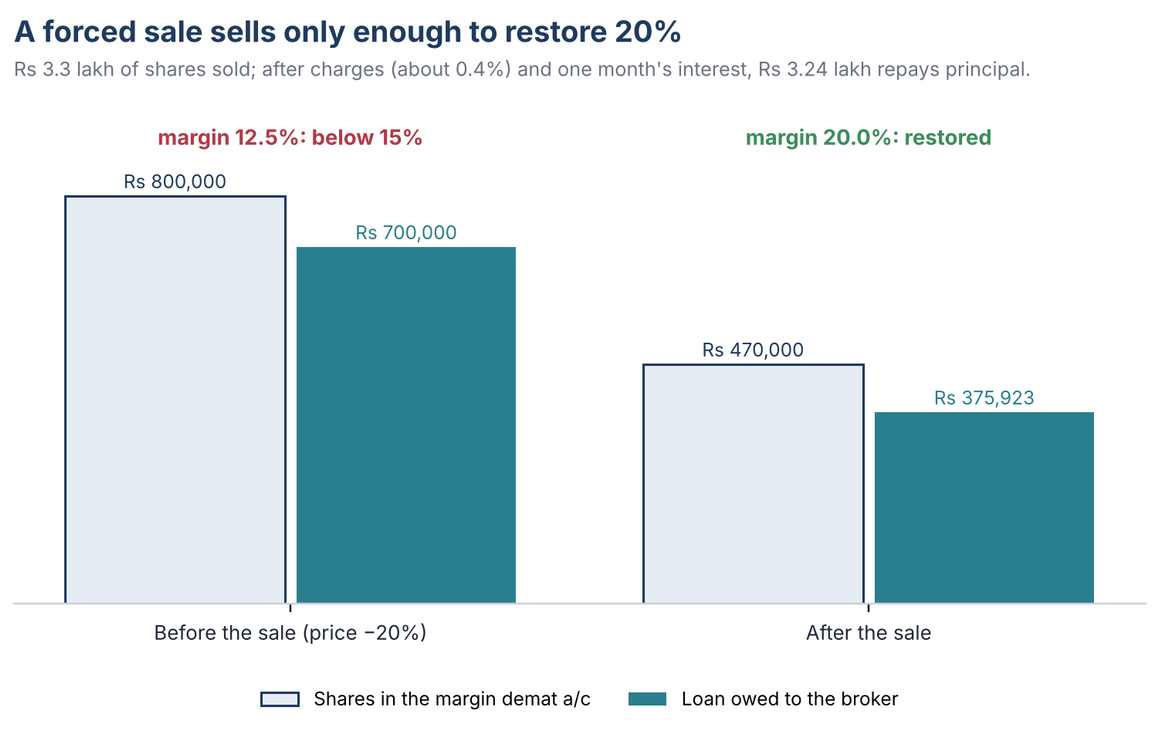
The sale settles on T+2 like any other. CDSC pays the proceeds, net of charges deducted at source, into the broker’s clearing account, and the broker applies them in order:
| Step | Amount |
|---|---|
| Sale value | Rs 330,000 |
| Less selling charges (brokerage, SEBON fee, DP charge; about 0.4%) | Rs 1,320 |
| Less one month’s accrued interest to the broker | Rs 4,603 |
| Applied to loan principal | Rs 324,077 |
| Remaining loan / remaining shares | Rs 375,923 / Rs 470,000 |
| Margin after the sale | 20.0% |
The investor’s receivable has fallen by Rs 324,077, so the bank’s borrowing base has fallen by the same amount. The broker moves the recovered principal, which is now its own money, from the clearing account to the control account, and the bank sweeps it against the loan. A broker that kept recovered principal and lent it again without telling the bank would be drawing against a receivable that no longer exists, which is why the daily drawing-power check matters. If a sale ever produced more than the investor owed, the balance would go straight to the investor’s bank account (Broker Regulations Rule 31(2); Clearing Byelaws 14(3)(ड) and 17(1)).
After the sale the broker settles the investor’s account and reports the sale to NEPSE (Directive Section 7(4); Procedure Section 13(14)).
The amount swept is the principal portion only, not the sale value. Selling charges go to the market, and the Rs 4,603 of interest is the broker’s income, which reaches the bank only through the monthly interest debit. The daily check records it this way:
| Day | What happened | Eligible receivable | Drawn | Sweep |
|---|---|---|---|---|
| S | Rs 330,000 of shares sold | 700,000 (proceeds not yet settled) | 700,000 | Nil |
| S+2 | Proceeds settle: Rs 4,603 to interest, Rs 324,077 to principal | 375,923 | 700,000 | Rs 324,077 |
When the investor later repays the remaining Rs 375,923, the receivable falls to nil and the bank sweeps the rest of the drawn balance. Over the life of the loan the sweeps add up to exactly the Rs 700,000 drawn.
Sweeps are measured on the whole book
Drawing power is computed across the broker’s entire margin book, not loan by loan. Suppose that on S+2 another investor, B, takes a new eligible margin loan of Rs 200,000. Eligible receivables are then Rs 375,923 + Rs 200,000 = Rs 575,923 against Rs 700,000 drawn, so the sweep is Rs 124,077, not Rs 324,077. Part of the first investor’s recovery has been re-lent to B inside the same revolving line. That is allowed, but the bank sees only one net number, much as CDSC sees one net pay-in.
A bank that wants a cleaner trail can agree a stricter covenant: all recovered principal is swept within one day, and new loans are drawn separately against fresh receivable evidence. Both legs then pass through the control account, and every recovery and every new loan can be matched to a named investor.
When the sale does not cover the debt
If the price gaps through the investor’s equity before the broker can sell, the investor still owes the shortfall under the agreement and promissory note. If the investor cannot pay, the broker absorbs the loss from its own capital. The bank is still owed the full drawn balance by the broker, but the unpaid receivable stops counting in drawing power, so the broker must repay the gap from its own funds. The bank can enforce only against what the broker validly charged to it: the assigned receivables, the broker’s own deposits, guarantees and other collateral.
| UNDER THE DRAFT MARGIN LOAN REGULATION, 2083 (NOT YET IN FORCE)Forced liquidation in four stages: final notice, the minimum necessary sale, loan adjustment, and refund of any balance; auction if the securities cannot be sold in time; and a pause in selling when the market or the share is suspended (Rule 112, Schedule 6). The investor remains liable for any shortfall (Rule 113), the lender’s priority over pledged securities continues until it is repaid (Rule 114), and repeat defaulters may be barred (Rule 115). |
12. How does a margin loan end?
Normally, the investor either repays in cash or sells the shares through the margin account. The broker applies the money to interest and then principal, releases its lien, and moves any remaining shares to the investor’s regular demat account. It then moves the recovered principal to the control account, the bank sweeps it, and the limit becomes available for the next loan. On our example, full repayment means Rs 700,000 plus accrued interest from the investor to the broker’s clearing account, and Rs 700,000 from the control account back to the bank.
Three other endings are built into the rules:
- Expiry. A facility lasts at most a year. At twelve months it is renewed on a fresh assessment or must be closed (Directive Section 11). An expired loan that is neither renewed nor repaid is a ground for sale (Procedure Section 13(6)).
- A share dropped from the eligible list. The position must be settled within 30 trading days, or carried at 100% margin (Procedure Section 9).
- Death of the investor. The liability passes to the heirs. If they do not settle it, the broker sells only enough to recover its dues and returns the rest (Procedure Section 24(4) and (5)).
The bank’s own facility renews in the same rhythm: every twelve months, on a fresh appraisal of the broker, its overdue settlements and its continuing regulatory eligibility.
13. What if the broker itself fails?
Failures unfold in a predictable order, and the bank stands in a different place in each:
| Who fails | What happens first | Who acts | Where the bank stands |
|---|---|---|---|
| The investor, to the broker | Margin call, cure deadline, then sale under the power of attorney | Broker | Untouched unless the sale falls short and the broker cannot cover the gap |
| The broker, to the bank | Drawings suspended; repayment demanded | Bank | Enforces the assigned receivables as investors repay, plus the broker’s own deposits, guarantees and other collateral |
| The broker, in T+2 settlement | Trading bar of at least three days; close-out rules | CDSC and NEPSE | Mode 2 money can be caught in a failed settlement; Mode 1 money cannot |
| The broker, suspended or insolvent | Licence action; client assets protected | NEPSE, SEBON, the bank’s legal team | Freezes use of the line and recovers through the receivables and guarantors; client shares and cash are not the broker’s assets |
Throughout, the bank lends to the broker. Its recourse is the broker’s balance sheet and the receivables assigned to it, never the investors’ shares directly.
| UNDER THE DRAFT MARGIN LOAN REGULATION, 2083 (NOT YET IN FORCE) In a licence suspension or insolvency, client assets would not count as the lender’s assets, and SEBON could appoint an administrator and transfer margin accounts to another licensed lender (Rules 74 and 75). Client assets could not be used as security for a third party’s obligation (Rule 71(2)). |
14. What will the draft 2083 Regulation change?
| Area | Now (Directive and Procedure, 2082) | Proposed (draft Regulation, 2083) |
|---|---|---|
| Who licenses | NEPSE, after Nepal Rastra Bank’s approval | SEBON; existing brokers re-licensed within a year |
| Eligible securities | NEPSE list on four fixed tests | Board criteria; grades A to D |
| Valuing extra collateral | A, B or G shares at 60% of market value | Haircut by grade: A 20%, B 30%, C 40%; cash nil; government bonds 5% |
| Investor checks | KYC, credit assessment, orientation | Full suitability test, risk disclosure, list of ineligible borrowers |
| Interest and fees | Published monthly by each broker | Published in advance, written into the agreement, no hidden fees |
| Risk management | Each broker’s own procedure | Risk committee, chief risk officer, stress tests, early warning, capital adequacy |
| Reporting | Daily to NEPSE, monthly to SEBON | Daily to annual returns to SEBON; incident reports within 24 hours |
| Client assets | Segregation under broker rules | A dedicated chapter; no use as third-party security; protection on insolvency |
For a bank, the practical consequence is that a facility signed today should survive a broker’s re-licensing under the new Regulation without a fresh sanction.
Every limit and deadline in one place
| Limit | Value | Deadline | Timing |
|---|---|---|---|
| Broker’s paid-up capital | Rs 20 crore or more | Initial margin | Before the order |
| Initial margin | 30% or more | Settlement | T+2 |
| Maintenance margin | 20% or more | Margin report to NEPSE | 12 noon, next trading day |
| Sale without consent | 15% or less | NEPSE publication | Next trading day |
| Extra collateral (A, B, G shares) | Counted at 60% | Cure of a margin call | Before next day’s opening |
| Broker’s borrowing | 4.5 × net worth | Sale if uncured | From the 2nd trading day |
| Broker’s lending | 5 × net worth | Rights-issue top-up | 7 trading days |
| One investor and related parties | 10% of the book | Share dropped from list | 30 trading days, or 100% margin |
| One security | 10% of the book | Licence renewal and audit | Within 3 months of year-end |
| Facility tenure | 1 year, renewable | Daily price band | ±15% |
The short version
A margin trade moves money through three loops that touch only at two points, both controlled by the broker. The investor’s 30% and the broker’s loan meet in the clearing account and leave it on T+2 as payment for shares. Those shares then sit in the investor’s margin demat account under the broker’s lien, and they are the real collateral behind everything. The bank’s money reaches the market only when the broker moves it from the control account, and comes back only when the broker moves recovered principal and its own income the other way.
For a lender, following the money comes down to a few things: knowing which release mode it uses and therefore where its money is on T+1; reading the same Schedule 4 file the broker sends NEPSE; recomputing drawing power every day; insisting that recovered principal comes back promptly; and knowing whether investor interest is collected in cash or quietly added to the loan.
The journal entries, book by book
The table below records the same trade in the books of all six parties: the buyer (the margin borrower), the buyer’s broker, the funding bank, CDSC, the seller’s broker and the seller. The two columns show the entries under each way of releasing the bank’s money (Section 5). Where both modes book the same entry it runs across both columns. A book that is not listed against a step has no entry at that step. The entries rest on a few simplifying assumptions:
- The buyer pays interest in cash (method (a)). The alternative entries for interest added to the loan are shown in step 8.
- Brokerage, SEBON and CDSC fees, depository charges and taxes are left out, except the selling charges in the forced sale. The seller is taken to carry the shares at Rs 1,000,000, so the original sale produces no gain or loss.
- CDSC’s lines are its settlement records: it runs the clearing, while the money moves between the brokers’ clearing bank accounts through the settlement bank. They are shown gross for this one trade. In practice CDSC and each broker post one net figure for all of the day’s trades (Section 4).
- Share movements are depository records rather than accounting entries, so they appear as memo lines.
| Book | Mode 1: bank reimburses after T+2 | Mode 2: bank pre-funds on T+1 |
|---|---|---|
| 1. Margin agreement signed; service fee charged up front | ||
| Buyer | Dr Service fee (expense) 1,750 Cr Bank 1,750 | |
| Buyer’s broker | Dr Operating bank account 1,750 Cr Fee income 1,750 | |
| 2. T−1: initial margin paid | ||
| Buyer | Dr Margin deposit with broker 300,000 Cr Bank 300,000 | |
| Buyer’s broker | Dr Clearing bank account (client money) 300,000 Cr Client payable: buyer’s margin deposit 300,000 | |
| 3. T+0: trade executed | ||
| Buyer | Dr Investment in shares 1,000,000 Cr Payable to broker: purchase 1,000,000 | |
| Buyer’s broker | Dr Receivable from buyer: purchase 1,000,000 Cr Payable to CDSC: settlement 1,000,000 | |
| CDSC | Dr Receivable from buyer’s broker 1,000,000 Cr Payable to seller’s broker 1,000,000 | |
| Seller’s broker | Dr Receivable from CDSC: settlement 1,000,000 Cr Payable to seller: sale proceeds 1,000,000 | |
| Seller | Dr Receivable from broker 1,000,000 Cr Investment in shares 1,000,000 | |
| 4. T+1: clearing, and the Mode 2 draw | ||
| Funding bank | No entry | Dr Loan to broker 700,000 Cr Control a/c deposit 700,000 Dr Control a/c deposit 700,000 Cr Interbank settlement 700,000 Money sent on to the broker’s clearing bank |
| Buyer’s broker | No entry | Dr Control account 700,000 Cr Borrowing from funding bank 700,000 Dr Clearing bank account 700,000 Cr Control account 700,000 |
| CDSC | No entry; CDSC nets each broker’s obligations | |
| 5. T+2: funds pay-in and securities pay-out | ||
| Buyer’s broker | Dr Clearing bank account 700,000 Cr Operating bank account 700,000 Broker’s own funds put in for the loan | No entry; the loan money is already in the clearing account |
| Buyer’s broker | Dr Payable to CDSC: settlement 1,000,000 Cr Clearing bank account 1,000,000 Dr Client payable: margin deposit 300,000 Dr Margin loan receivable 700,000 Cr Receivable from buyer: purchase 1,000,000 | |
| Buyer | Dr Payable to broker: purchase 1,000,000 Cr Margin deposit with broker 300,000 Cr Margin loan payable to broker 700,000 | |
| CDSC | Dr Settlement bank account 1,000,000 Cr Receivable from buyer’s broker 1,000,000 Dr Payable to seller’s broker 1,000,000 Cr Settlement bank account 1,000,000 | |
| Seller’s broker | Dr Clearing bank account 1,000,000 Cr Receivable from CDSC: settlement 1,000,000 | |
| Shares: seller’s demat account → buyer’s broker’s margin trading clearing account → buyer’s margin demat account, under the broker’s lien. Depository records, not journal entries. | ||
| 6. T+2 / T+3: payout to the seller | ||
| Seller’s broker | Dr Payable to seller: sale proceeds 1,000,000 Cr Clearing bank account 1,000,000 | |
| Seller | Dr Bank 1,000,000 Cr Receivable from broker 1,000,000 | |
| 7. T+3: the Mode 1 draw (reimbursement) | ||
| Funding bank | Dr Loan to broker 700,000 Cr Control a/c deposit 700,000 Dr Control a/c deposit 700,000 Cr Interbank settlement 700,000 If the broker moves the money to an operating account at another bank | No entry; already drawn on T+1 |
| Buyer’s broker | Dr Control account 700,000 Cr Borrowing from funding bank 700,000 Dr Operating bank account 700,000 Cr Control account 700,000 Restores the cash the broker put in on T+2 | No entry |
| 8. Month-end: interest | ||
| Buyer | Dr Interest expense 4,603 Cr Bank 4,603 | |
| Buyer’s broker | Dr Clearing bank account 4,603 Cr Interest income 4,603 Dr Control account 4,603 Cr Clearing bank account 4,603 | |
| Funding bank | Dr Interest receivable 3,164 Cr Interest income 3,164 Dr Control a/c deposit 3,164 Cr Interest receivable 3,164 30 days | Dr Interest receivable 3,270 Cr Interest income 3,270 Dr Control a/c deposit 3,270 Cr Interest receivable 3,270 31 days, because the draw was a day earlier |
| Buyer’s broker | Dr Interest expense 3,164 Cr Control account 3,164 | Dr Interest expense 3,270 Cr Control account 3,270 |
| Buyer (method b) | Dr Interest expense 4,603 Cr Margin loan payable to broker 4,603 Instead of paying in cash | |
| Buyer’s broker (method b) | Dr Margin loan receivable 4,603 Cr Interest income 4,603 Not eligible for drawing power | |
| 9. Price falls 20%: forced sale of Rs 330,000 of shares | ||
| Buyer | Dr Interest expense 4,603 Cr Interest payable to broker 4,603 The month’s interest, accrued and unpaid | |
| Buyer’s broker | Dr Interest receivable 4,603 Cr Interest income 4,603 | |
| Buyer (day S) | Dr Receivable from broker: sale 330,000 Dr Loss on sale 82,500 Cr Investment in shares 412,500 41.25% of the holding sold, at cost | |
| Buyer’s broker (day S) | Dr Receivable from CDSC: settlement 330,000 Cr Payable to buyer: sale proceeds 330,000 | |
| CDSC (S to S+2) | Dr Receivable from counter-buyer’s broker 330,000 Cr Payable to buyer’s broker 330,000 Dr Settlement bank account 330,000 Cr Receivable from counter-buyer’s broker 330,000 Dr Payable to buyer’s broker 330,000 Cr Settlement bank account 330,000 | |
| Buyer’s broker (S+2) | Dr Clearing bank account 330,000 Cr Receivable from CDSC: settlement 330,000 Dr Payable to buyer: sale proceeds 330,000 Cr Selling charges payable 1,320 Cr Interest receivable 4,603 Cr Margin loan receivable 324,077 Dr Control account (330,000 – 1,320) 328,680 Cr Clearing bank account 328,680 Dr Borrowing from funding bank (330,000 – 4,603 – 1,320) 324,077 Cr Control account 324,077 The last entry is the principal sweep | |
| Buyer (S+2) | Dr Selling charges 1,320 Dr Interest payable to broker 4,603 Dr Margin loan payable to broker 324,077 Cr Receivable from broker: sale 330,000 | |
| Funding bank (S+2) | Dr Control a/c deposit 324,077 Cr Loan to broker 324,077 | |
| Shares: Rs 330,000 of shares leave the buyer’s margin demat account; Rs 470,000 remain under lien. | ||
| 10. Exit: the buyer repays the remaining Rs 375,923 | ||
| Buyer | Dr Margin loan payable to broker 375,923 Cr Bank 375,923 | |
| Buyer’s broker | Dr Clearing bank account 375,923 Cr Margin loan receivable 375,923 Dr Control account 375,923 Cr Clearing bank account 375,923 Dr Borrowing from funding bank 375,923 Cr Control account 375,923 | |
| Funding bank | Dr Control a/c deposit 375,923 Cr Loan to broker 375,923 | |
| Shares: lien released; the remaining shares move to the buyer’s regular demat account. | ||
The two modes differ in only three places: when the bank’s Rs 700,000 is booked (T+3 under Mode 1, T+1 under Mode 2), where it goes first (the control account and then back to the broker’s own cash under Mode 1; straight on to the clearing account under Mode 2), and how many days of interest the first month carries. From T+2 onward the books are identical.
Read the funding bank’s lines on their own and the whole post is there in miniature: Rs 700,000 out, interest of about Rs 3,164 each month, Rs 324,077 back after the forced sale and Rs 375,923 back on exit. Every one of those entries passes through the broker’s control account, and none passes through CDSC. In the buyer’s broker’s books, the margin loan receivable and the borrowing from the funding bank both start at Rs 700,000 and end at nil together, which is the drawing-power relationship in its simplest form.
This post reflects the author’s reading of the rules and public sources as of November 2026. It is not legal or investment advice, and the draft Regulation may change before it is approved.