
Impossible to chew and digest: too long, didn’t read (TLDR)
In the Fiscal Year 2023/24, Nepal’s banking system held approximately NPR 5,076 billion (roughly USD 36 billion) in total commercial bank credit. Of that, somewhere between NPR 3,000 and 3,400 billion – depending on which reporting period you reference – was secured by land and buildings. That share has fluctuated between 60.8% and 68.0% for an entire decade, peaking at 68.0% in 2023 and still standing at 64.4% as of November 2025. This is not a recent trend. It is a structural constant that has persisted through credit booms, contractions, regulatory reforms, and repeated policy commitments to diversify the collateral base.
The prior post in this series, Land Locked Credit, diagnosed the five structural locks that produce this outcome and documented the economic cost: SME organic credit that has not grown in a decade, a software company with NPR 50 million in annual contracts that cannot access a working capital line from any commercial bank in Nepal, a manufacturing sector whose share of GDP has declined from 15.2% to 12.83% over the same period, and a credit expansion model now in structural exhaustion as remittance growth decouples from private sector credit growth.
Land Locked Credit identified Lock 1 as the non-functional movable asset registry. This article is the companion piece: a complete explanation of what the Secured Transactions Act, 2063 (2006) (hereinafter “the Act” or “STA”) – formally titled सुरक्षित कारोबार ऐन, २०७२ – actually does, how each of its sixty sections works, and what it was designed to achieve.
The Act is not obscure law. It is the legal infrastructure for everything Nepal’s financial system needs to build next: working capital loans against hypothecated inventory, securitization of banking and non-banking receivables, crop finance for landless farmers, share pledges for entrepreneurs without real estate, and the complex structured finance instruments that Nepal’s infrastructure investment pipeline demands. None of those instruments get built while the foundation sits unused.
Part I: Why This Law Exists
1.1 The Problem Before the Act
Before the Secured Transactions Act came into force, Nepal had no unified legal framework for movable asset security. Traditional instruments existed – pledge (dharauti), hypothecation (chal sampati mathiko dhito byabastha), hire purchase – but they operated under fragmented statutory provisions, primarily the Muluki Civil Code and various banking regulations, without a centralised system for establishing who held priority over any given asset.
The practical consequence was the problem the NRB Bank Supervision Report 2013 (Section 5.12) captured precisely: “double counting of assets” and “multiple banking against the same security without pari-passu agreements.” A business could hypothecate the same inventory to three different banks simultaneously, and none of the three banks had any reliable means of discovering the others’ claims. The rational institutional response was to demand land – because the Land Revenue Office’s Rokka (रोक्का, the administrative restriction on land transfer recorded under Land Revenue Act, 2034, Section 8kha) provided something no movable asset arrangement could match: a publicly searchable, same-day, administratively enforced record of prior claims. The same NRB finding continues to appear in Bank Supervision Reports through 2024 – eleven years later – for the same reason.
The Secured Transactions Act was the legislative solution to this problem. Its preamble states the purpose plainly: “to promote economic activity to the maximum extent for the country’s economic development” by establishing a unified, integrated legal framework for security interests in movable and intangible property. The Act was major reform to minimize the land concentration in form of credit security by building a registry system for everything that is not land.
1.2 The International Blueprint
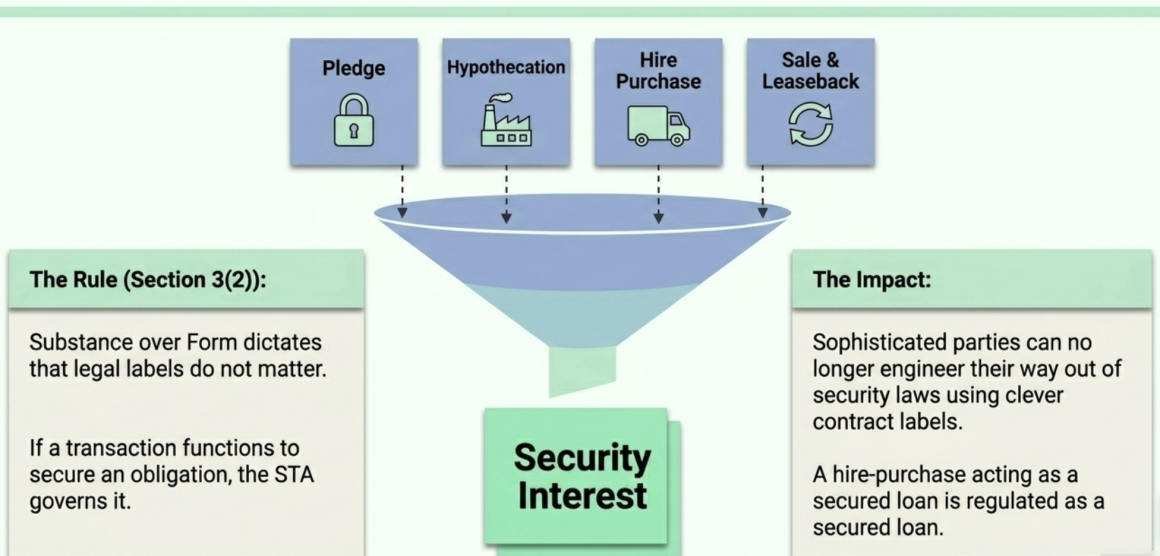
The Act is modelled on the UNCITRAL Legislative Guide on Secured Transactions and draws directly from Article 9 of the American Uniform Commercial Code (UCC) – the most widely replicated commercial law reform in the past century. Both the UNCITRAL model and Article 9 rest on a single foundational innovation: the “functional approach.” Instead of regulating pledges, hypothecations, hire purchases, and conditional sales as separate legal instruments under separate rules, the functional approach treats all transactions that have the substance of creating a security interest in an asset as the same legal thing – a “security interest” – and subjects them to the same registration, priority, and enforcement framework.
The reason this matters is straightforward. Before the functional approach, sophisticated parties could engineer around specific security law provisions by using different transaction labels. Under the functional approach codified in Section 3(2) of Nepal’s Act, the label is irrelevant. What the transaction actually does determines which law governs it. A hire purchase that is functionally a secured loan is regulated as a secured loan. A sale-and-leaseback that is functionally a security arrangement is regulated as a security arrangement. The legal form of the contract cannot override its economic substance.
A temporary precursor, the Secured Transactions Ordinance, 2062 (2005) was enacted first as a stopgap. The Act replaced it permanently. Section 60 of the Act confirms that the Ordinance’s expiry does not revive prior law, does not disturb ongoing matters, and does not affect rights, liabilities, or penalties that accrued while the Ordinance was in force. The transition was designed to be seamless.
Part II: Scope – What the Act Covers and What It Deliberately Does Not
2.1 The Three Transaction Categories
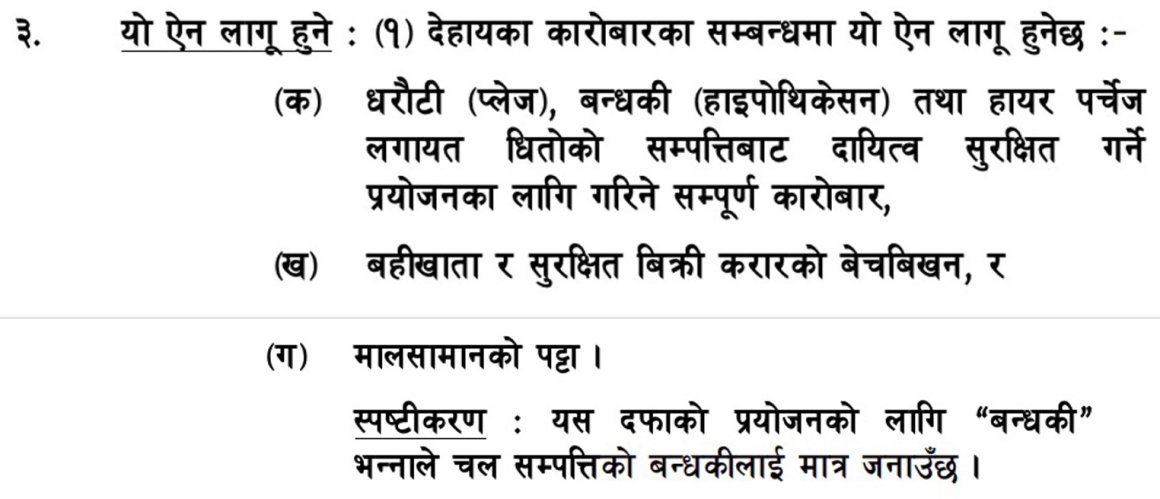
Section 3(1) of the Act establishes its scope by defining three categories of transactions to which it applies. Together, these categories cover virtually every commercial arrangement involving movable assets as security or as tradable financial rights.
Category 1: Secured Obligations – Section 3(1)(ka)
The Act applies to all transactions executed for the purpose of securing an obligation or liability using collateral property. This explicitly encompasses pledge, hypothecation, and hire purchase. The official explanation under Section 3 clarifies a critical boundary: “hypothecation” in the context of this Act means hypothecation of movable property only. Immovable property mortgages remain governed by the Land Revenue Act, 2034 and the National Civil Code, 2074. The Act does not compete with the land registry system – it creates an entirely separate system for everything that is not land.
A pledge, in this context, is the classical arrangement where the borrower physically transfers possession of the collateral to the lender until the debt is repaid. A bank holding gold bars in its vault against a loan, a pawnbroker holding a customer’s jewellery, or a cooperative physically holding share certificates all constitute pledges under this category. Hypothecation differs critically: the borrower retains physical possession of the asset and continues using it, while the lender registers a security interest that gives it enforcement rights on default. A garment factory hypothecating its industrial sewing machines to secure a term loan – where the machines remain on the factory floor and continue producing revenue – is the prototypical hypothecation. Hire purchase adds the dimension of ownership: the financier retains legal title to the asset as security until the final installment is paid, at which point ownership transfers to the buyer.
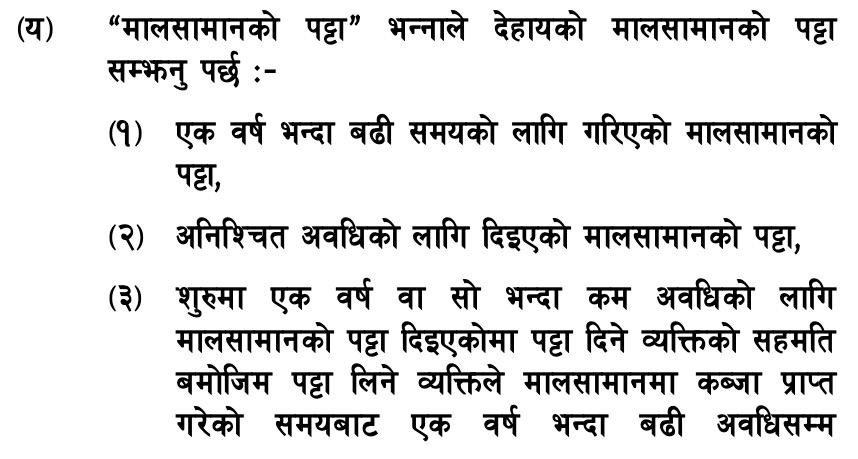
Category 2: Sale of Accounts and Secured Sales Contracts – Section 3(1)(kha)
The Act also governs the buying and selling of “accounts” (बहीखाता) and “secured sales contracts” (सुरक्षित बिक्री करार). An account is the right to receive payment created by selling goods, leasing goods, or providing services – essentially, an unpaid invoice. When a wholesale distributor sells its outstanding invoices to a financial factoring company to get immediate cash, that transaction is governed by this Act. A secured sales contract is an agreement that simultaneously creates both a debt obligation and a security interest in the goods being sold. Both categories are included because they are economically similar to secured lending: the “buyer” of accounts or a secured sales contract is in the position of a lender, and the Act’s registration, priority, and enforcement framework needs to apply to protect their investment.

Category 3: Lease of Goods – Section 3(1)(ga)
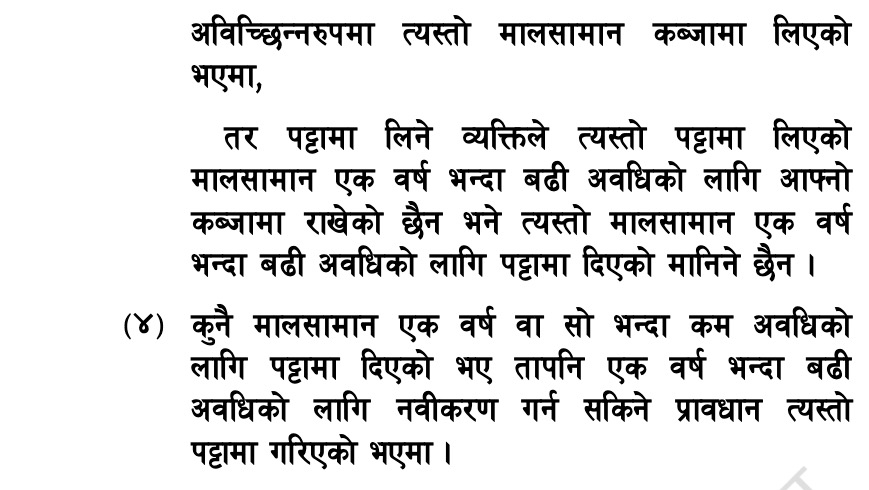
Long-term leases of goods are also governed by the Act. Section 2(ya) defines a “lease of goods” (मालसामानको पट्टा) as covering four scenarios: a lease for more than one year; a lease for an indefinite period; a lease initially for one year or less but where the lessee continuously retains possession for more than a year with the lessor’s consent; and a lease for one year or less but containing a contractual right to renew for a period exceeding one year. A lease that is purely short-term – under one year with no renewal option and where the lessee actually returns the goods within one year – is not a “lease of goods” under the Act and falls outside its scope.
The reason long-term leases are included is the “appearance of ownership” problem. When a hospital leases an MRI machine for three years, the machine sits in the hospital’s premises. To a bank or a judgment creditor looking at the hospital’s assets, that MRI machine appears to belong to the hospital. Without a publicly registered notice, the leasing company that actually owns the machine has no protection against the hospital’s creditors claiming it. The Act requires the leasing company to register its interest, making the true ownership visible to anyone who searches the registry before lending against it.
2.2 The Substance Over Form Principle – Section 3(2)
Section 3(2) is perhaps the most important single provision in the entire Act. It states that the Act applies to all transactions listed in Section 3(1) regardless of whatever terms the parties have written in their agreement, and regardless of whether ownership of the collateral property rests with the security holder or the security giver. This is the functional approach in direct statutory form: parties cannot contract out of the Act by labelling a security arrangement as something else.
A hire-purchase agreement where the financier “owns” the vehicle until the final installment is still governed by the Act, because the substance of the transaction is using the vehicle as security for a financing obligation. A sale-and-leaseback arrangement where a business “sells” its machinery to a financier and then “leases” it back is still governed by the Act if the economic substance is a secured loan. A lease that contains a bargain purchase option – allowing the lessee to buy at a nominal price at the end of the term – is likely a disguised hire-purchase and falls under Category 1 despite being labelled a “lease.”

2.3 What the Act Deliberately Excludes – Section 3(3)
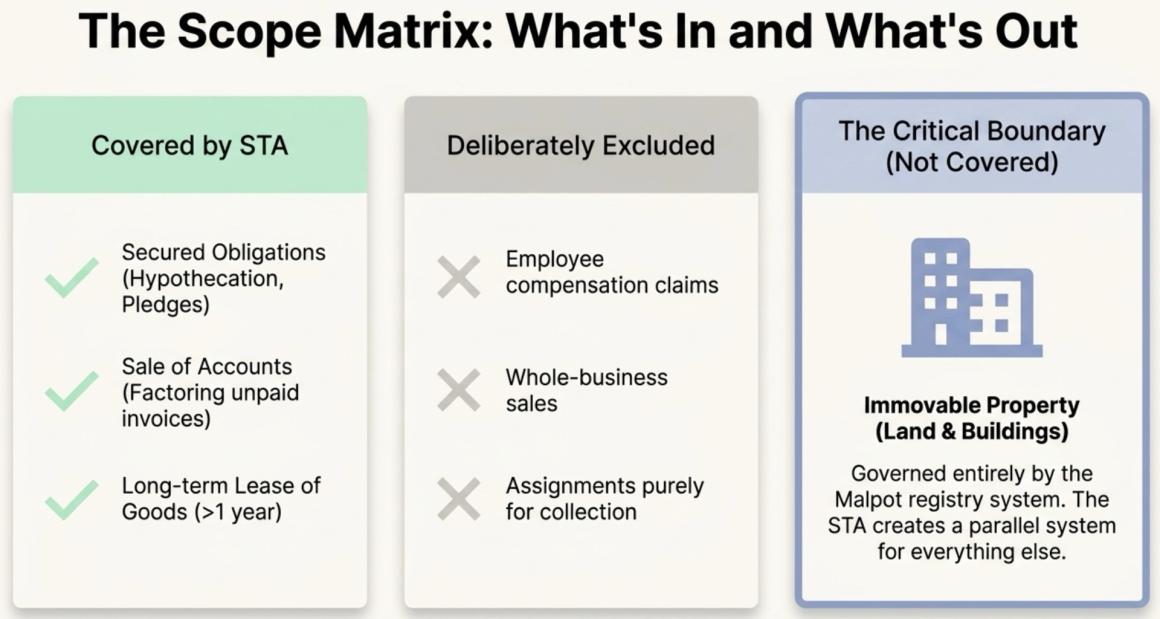
Section 3(3) carves out four specific transaction types from the Act’s scope, for reasons that reflect deliberate policy choices rather than technical omissions.
- Section 3(3)(ka): Transfer of employee compensation claims. Workers’ rights to wages, injury compensation, or severance are too fundamental to expose to commercial security arrangements. A worker cannot use their own compensation claim as collateral for a moneylender’s loan, and the Act ensures this.
- Section 3(3)(kha): Sale of accounts as part of a whole-business sale. When an entrepreneur sells an entire business, the outstanding invoices transfer as ordinary business assets to the new owner – not as a financing mechanism. Requiring individual STRO registration of every invoice in a corporate acquisition would create administrative paralysis for no meaningful purpose.
- Section 3(3)(ga): Assignments made purely for collection purposes. When a hospital transfers its overdue patient bills to a collection agency specifically so the agency can recover them on the hospital’s behalf – not to raise immediate financing – no security arrangement has been created. The collection agency is providing a service, not investing capital.
- Section 3(3)(gha): Assignment where the assignee also takes on the obligation to perform the contract. When a construction firm assigns both the right to be paid for completing a building project AND the obligation to actually complete the work to another contractor, this is a contractual substitution, not a financial security arrangement. The new party steps into the original contractor’s shoes entirely.
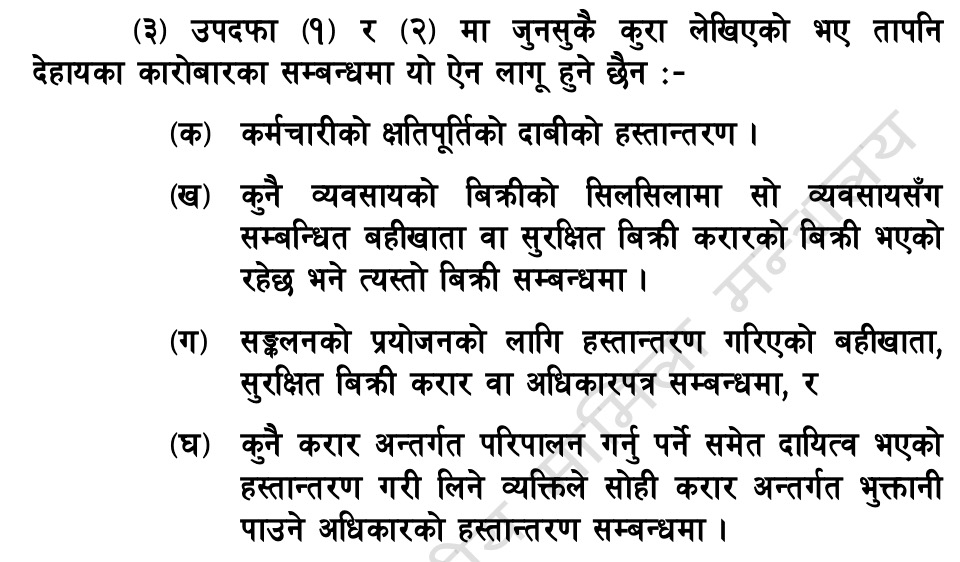
2.4 The Critical Boundary: What the Act Does Not Cover
The Act does not cover immovable property. Land and buildings remain governed by the Land Revenue Act, 2034, the Lands Act, 2021, and the National Civil Code, 2074. This is not an oversight – it is a deliberate architectural choice. Nepal’s land registry system (मालपोत) predates the Act by decades and operates through a well-established institutional infrastructure. The Act was designed to create an equivalent system for everything that is not land, not to displace the land registry.
The practical consequence of this boundary, as documented in the AMC article, is that Nepal has no equivalent of India’s SARFAESI Act – no statutory mechanism for a creditor to bypass judicial procedures and take possession of immovable collateral on default. The STA provides powerful enforcement tools (examined in Part VIII) but only for movable assets. For immovable collateral – which constitutes 64.4% of all BFI credit – enforcement still depends on the court system and the Land Revenue enforcement process, with all the delays that implies.
| Transaction Type | Category Under Act | Governing Section | STRO Registration Required? |
| Pledge of physical gold to cooperative | Secured Obligation | 3(1)(ka), 2(tha) | Optional if taking possession (Section 26(4)) |
| Hypothecation of factory machinery to bank | Secured Obligation | 3(1)(ka) | Yes – Section 26(2) |
| Hire purchase of delivery truck | Secured Obligation | 3(1)(ka) | Yes – Section 26(2) Optional if taking possession (Section 26(4)) |
| Sale of unpaid invoices to factoring company | Sale of Accounts | 3(1)(kha) | Yes – Section 26(2) |
| Three-year lease of MRI machine to hospital | Lease of Goods | 3(1)(ga) | Yes – Section 26(2) |
| Six-month equipment rental (no renewal option) | Not covered as lease | Not applicable | N/A |
| Transfer of employee injury compensation claim | Excluded | 3(3)(ka) | Not applicable |
| Land mortgage to bank | NOT COVERED by Act | Land Revenue Act, 2034 | Land Revenue Office (Malpot) |
Part III: The Cast of Characters – Key Definitions Under Section 2
The Act defines its terms with deliberate precision. Understanding these definitions is not an exercise in legal formalism – it is the foundation for understanding how the Act allocates rights, obligations, and priorities in every real-world transaction. What follows is an explanation of each major defined term under Section 2, with Nepal-specific examples.
3.1 The Core Parties
The Security Holder (धितो लिने व्यक्ति) – Section 2(dha)
The security holder is the person who acquires a security interest under a security agreement. This is the lender, the creditor, or the seller in whose favour the security interest is created. The definition is deliberately broad: it includes not only banks that make loans, but also the purchaser of accounts (a factoring company that buys invoices) and the lessor of goods under a long-term lease (a company that leases equipment for more than one year). In each case, the security holder holds a property right over the collateral that gives it priority over other creditors and enforcement rights on default.
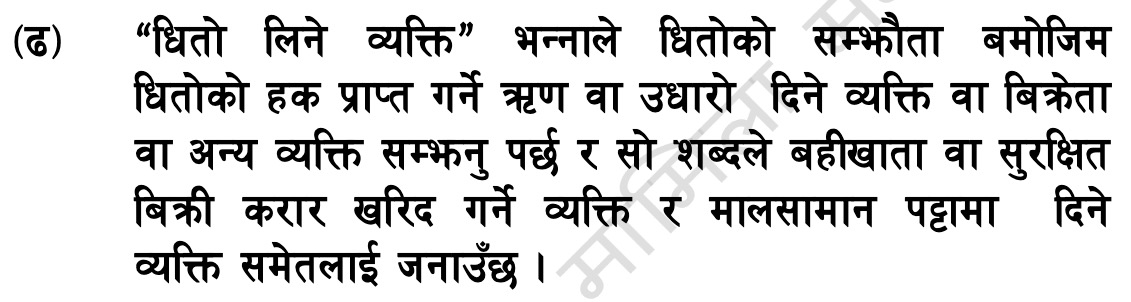
Example: Everest Bank Limited lends NPR 50 million to a Kathmandu-based printing company secured by the company’s two offset printing machines. The bank is the security holder. Separately, a financial factoring firm buys NPR 20 million in outstanding invoices from a wholesale garment distributor. The factoring firm is also a security holder under the Act – its purchased accounts are the collateral, and it is in the same legal position as the bank with respect to those financial rights.
The Security Giver (धितो दिने व्यक्ति) – Section 2(na)
The security giver is the person who has a duty to make a payment or fulfil a secured obligation. The Act makes a critical clarification: the security giver need not own the collateral. They only need to have rights over it or the power to transfer those rights to the security holder. This means a lessee can pledge their leasehold interest, a consignee can pledge goods held on consignment, and a business that does not technically own its equipment under a hire-purchase arrangement is still the security giver – because it bears the obligation the security interest secures.
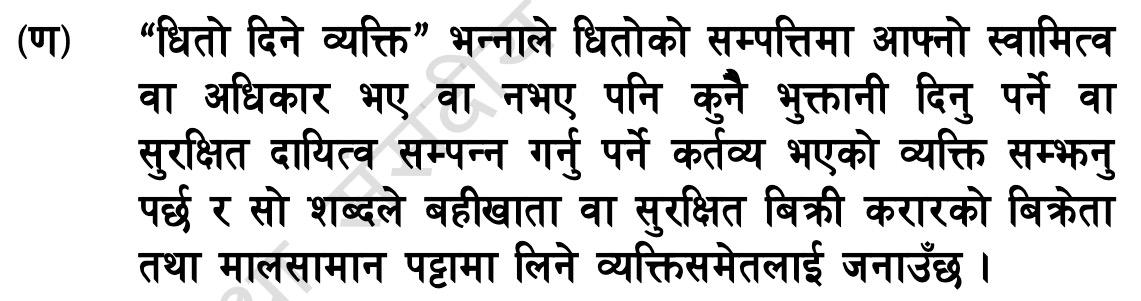
Example: A logistics company acquires a refrigerated truck under a three-year hire-purchase arrangement with a vehicle financing firm. The financing firm legally owns the truck until the final installment is paid. The logistics company has no legal title. Yet under the Act, the logistics company is the security giver – it is the party that owes the payment obligation that the truck secures. The Act does not care who holds the ownership certificate; it cares who carries the debt.
Collateral (धितोको सम्पत्ति) – Section 2(ta)
Collateral means any movable or intangible property of any nature that is subject to a security interest. The definition is deliberately expansive. It covers physical goods (machinery, inventory, livestock, vehicles), intangible property (accounts receivable, intellectual property, goodwill, digital rights), instruments (share certificates, bonds, bills of lading), and documents (warehouse receipts, delivery orders). Crucially, it also covers future collateral – assets that do not exist yet at the time the security agreement is signed. And it covers offshore collateral – property physically located outside Nepal.
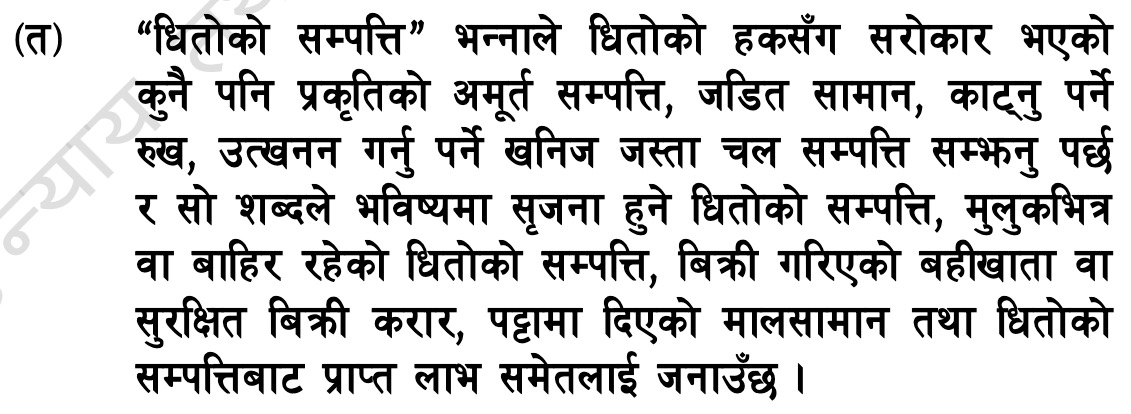
The explicit inclusion of future collateral is what makes the Act functionally equivalent to a floating charge: a business can grant a security interest in “all present and future inventory” today, and the security interest automatically attaches to every new item of inventory the business acquires in the future, from the moment it acquires rights to that item. This is examined in detail in Part V.
Security Interest (धितोको हक) – Section 2(da)
A security interest is a property right in collateral created to secure the performance or payment of an obligation. It is the actual legal claim that gives the creditor power over the asset if the debtor defaults. The security interest is distinct from the debt itself: the debt is the obligation to pay; the security interest is the right to seize and sell the collateral if the debt is not paid. Without a security interest, a creditor is unsecured and must queue behind all other creditors in enforcement. With a perfected security interest, the creditor has a legally recognised priority claim that can be enforced against the specific asset, regardless of what else happens to the debtor’s financial position.

Security Agreement (धितो सम्बन्धी समझौता) – Section 2(tha) and Section 23
A security agreement is the foundational contract that creates or provides for a security interest. Under Section 23(1), it must be in record form – written or electronic documentation. It can consist of one document or multiple documents taken together.

The security agreement does not need to be a standalone document labelled “security agreement” – a loan deed that describes the collateral and grants the bank enforcement rights is a security agreement. Under Section 23(2), the terms of the security agreement are binding not only on the original parties but also on transferees of the collateral, creditors of the security giver, and lien holders.
Obligor (दायित्व वहन गर्ने व्यक्ति) – Section 2(dha-2)
The obligor is the person who has the duty to fulfil an obligation on an account, a secured sales contract, or other intangible property. In accounts receivable transactions, the obligor is the underlying customer who owes the money: not the business that created the invoice, and not the factoring company that purchased it, but the third party whose payment obligation is the economic substance of the account. When the factoring company needs to collect, it collects from the obligor.

Example: A wholesale garment manufacturer sells NPR 1 million in outstanding invoices to a factoring company. Those invoices are for delivery to three retail chains. The manufacturer is the security giver; the factoring company is the security holder; and each retail chain is an obligor – because they are the parties who ultimately owe the money that makes the accounts valuable.
3.2 Property Type Definitions
Consumer Goods (उपभोग्य वस्तु) – Section 2(nga)
Consumer goods are any goods used or intended to be used for personal, family, or household purposes. The Act explicitly excludes serial-numbered vehicles from this category. The classification depends entirely on how the item is used – not on what it physically is. A refrigerator in a family kitchen is a consumer good. The identical refrigerator in a supermarket’s storage area is equipment or inventory. A washing machine at home is a consumer good. The same machine in a commercial laundry operation is equipment.
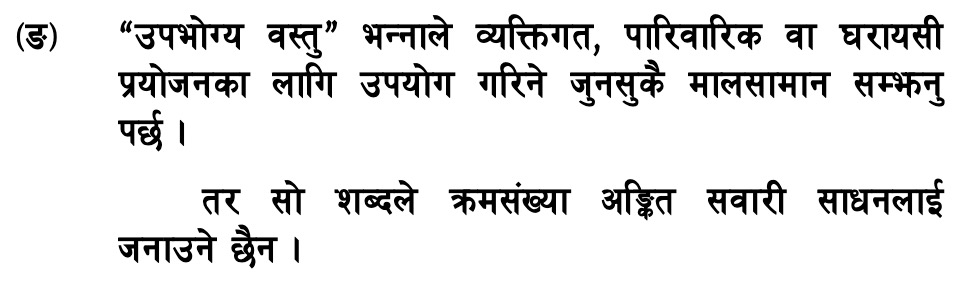
This distinction matters greatly for two reasons. First, Section 20(2) prohibits creating a standard security interest over consumer goods – only a Purchase Money Security Interest (PMSI) is permitted. This protects families from lenders taking general floating charges over all their household possessions. Second, as examined in Part VI, PMSIs in consumer goods perfect automatically on attachment without any registry filing – creating an invisible lien that a lender searching the STRO cannot detect.
Inventory (मौज्दातमा रहेको मालसामान) – Section 2(ba)
Inventory is goods held for sale or lease in a trade or business. The definition also covers raw materials, semi-processed goods, finished goods, and materials that are consumed in the course of a business. For a furniture manufacturer, inventory includes the raw timber, the half-built chairs, the completed dining sets ready for sale, and the sandpaper and varnish used in production. For a wholesale pharmaceutical distributor, inventory is the medicines held in the warehouse awaiting distribution. For a vehicle dealer, the cars in the showroom and the spare parts in the back are inventory – but the dealer’s own delivery van used to transport those cars is equipment.
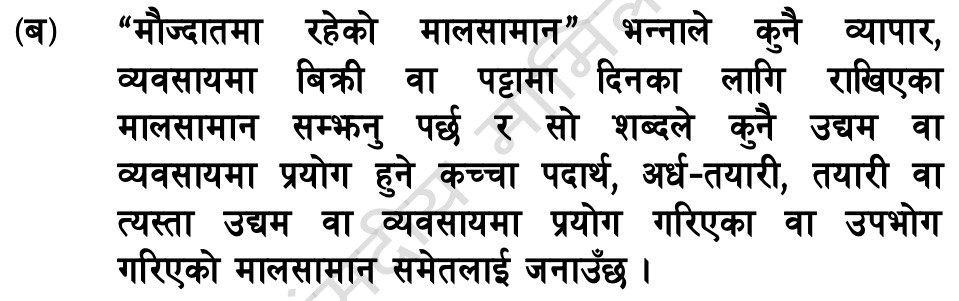
Equipment (उपकरण) – Section 2(cha)
Equipment is a residual category: goods that are neither farm products, inventory, nor consumer goods. Any commercial asset used in operating a business that is not held for sale falls here. A printing press’s offset printing machines, a hospital’s MRI scanner, a restaurant’s commercial kitchen equipment, a hotel’s elevator system – all equipment. The significance of this category emerges in priority disputes: a Purchase Money Security Interest in equipment earns super-priority with a simpler procedural requirement than the equivalent PMSI in inventory.

Farm Products (कृषिजन्य उत्पादन) – Section 2(ja)
Farm products are goods belonging to a person engaged in farming, excluding uncut trees. The definition covers: growing, growing up, or future crops; aquatic animals; domesticated livestock including unborn animals; goods used in farming or produced from farming; and unprocessed products derived from crops or livestock. A poultry farmer’s flock of chickens – including the eggs not yet hatched – and the chicken feed in the barn are farm products. The significance of this category is discussed in Part VII: a security interest in crops can take priority over the rights of the landowner or the mortgagee of the land on which those crops grow.
Serial Numbered Vehicle (क्रमसंख्या अंकित सवारी साधन) – Section 2(chha)
Serial numbered vehicles are motor vehicles (cars, trucks, motorcycles), trailers, aircraft, and motorised boats – but only when they are not held as inventory by the security giver. A delivery van in a logistics company’s fleet is a serial numbered vehicle. Twenty new cars on a dealer’s lot awaiting sale are inventory, not serial numbered vehicles. This distinction affects both how the security interest must be described in a STRO filing (specific serial/chassis number required for vehicles) and which buyer protections apply (examined in Part VII).
Fixtures (जडित सामान) – Section 2(nja)
Fixtures are movable goods that are attached – or intended to be attached – to immovable property in a manner that creates property rights under prevailing real estate law. The Act explicitly excludes easily removable factory machines, office machines, and household appliances from this category. A permanent central air-conditioning system built into the walls and ceiling of a commercial building is a fixture. A standard window air-conditioning unit that can be unscrewed and removed in an afternoon is not. Fixtures occupy the boundary between the STA’s movable property framework and the immovable property regime, and the Act has specific priority rules for this boundary – examined in Part VII.

Purchase Money Security Interest (PMSI) (खरिद मूल्य सम्बन्धी धितोको हक) – Section 2(jha)
A PMSI is a security interest where the collateral itself is what the financing was used to acquire. It arises in two scenarios: when a seller retains a security interest in goods sold to secure the payment of the purchase price, or when a financier (not the seller) provides the funds specifically to enable the buyer to acquire the goods and takes a security interest in those exact goods, with the funds actually used for the stated purpose. This “superpriority” interest allows the PMSI holder to leap ahead of a prior lender who holds a general “all assets” charge, under specific conditions examined in Part VII.
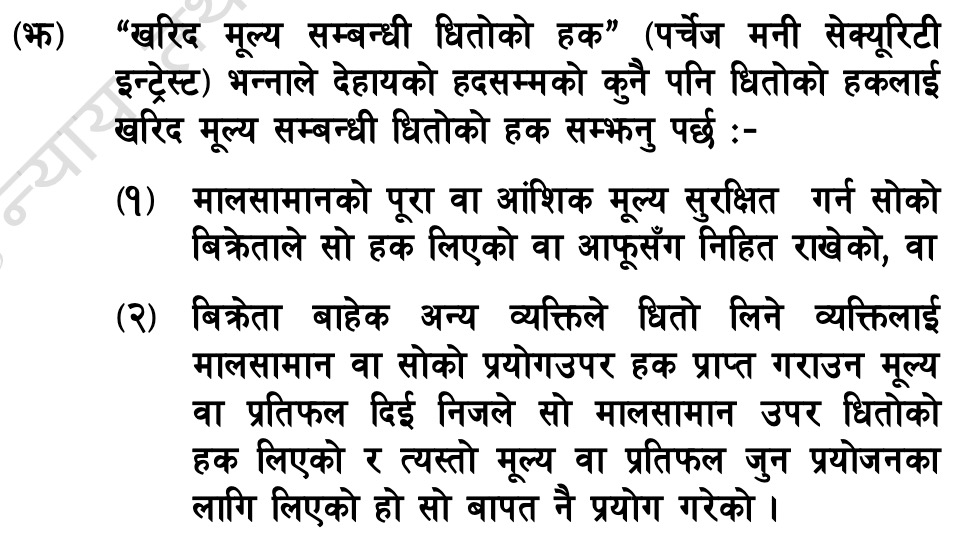
Example: A bakery wants to buy a commercial oven costing NPR 1.5 million but lacks cash. A bank pays the equipment supplier directly and takes a security interest in that specific oven. The bank holds a PMSI over the oven – even if a different bank already holds a general charge over all the bakery’s equipment.
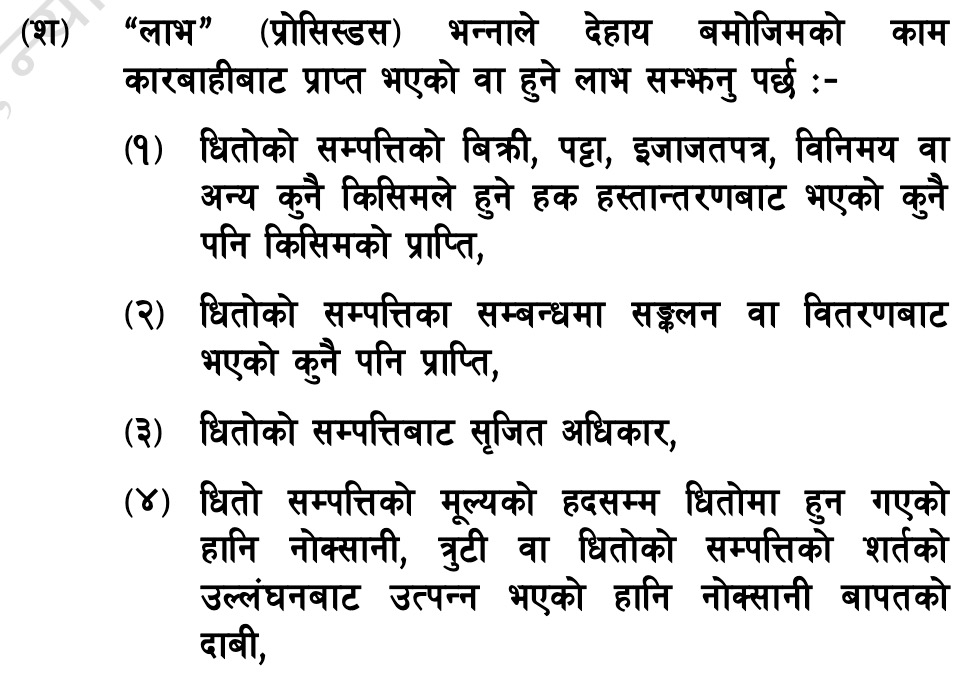
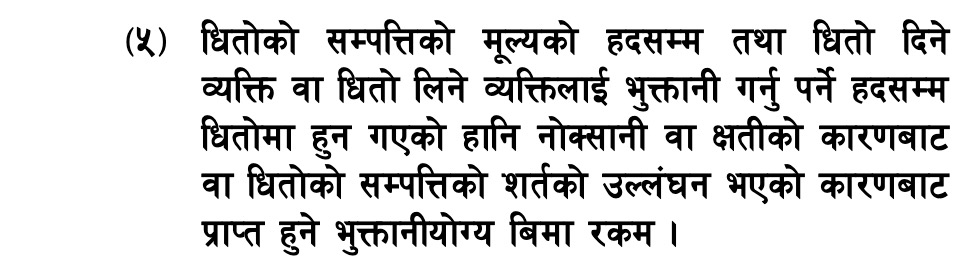
Proceeds (लाभ) – Section 2(sha)
Proceeds are anything acquired from dealing with the collateral. The Act’s definition is deliberately comprehensive: proceeds include anything received from the sale, lease, exchange, or transfer of the collateral; collections and distributions from the collateral; rights created out of the collateral; claims for loss or damage to the collateral; and insurance payouts resulting from loss, damage, or breach of conditions relating to the collateral. When a wholesale distributor pledges its inventory of laptops to a bank and then sells ten of those laptops for cash, that cash is proceeds. When the remainder of the inventory is destroyed in a fire, the insurance payout is also proceeds. The bank’s security interest automatically extends to both – without any new filing required.
| Other Important Definitions Goods – Section 2(ma) covers all physically movable objects at the time of attachment, explicitly including fixtures, timber to be cut, and agricultural products. The exclusion of accounts, currency, documents, and instruments is deliberate: each of those is a separately defined category with its own rules. A distributor pledging warehouse stock is pledging goods; the same distributor pledging the unpaid invoices from that stock’s sale is pledging accounts. Same commercial transaction, different legal category, different treatment.  Instruments – Section 2(kha) are documents or share certificates transferable by endorsement or delivery that prove a cash payment right. The Act explicitly excludes collateral agreements and lease agreements from this definition – because instruments circulate freely in the market as quasi-currency, while a collateral or lease agreement is a bilateral contract bound to specific parties and obligations that cannot be detached and traded. A bearer bond is an instrument; the loan deed in which a company pledges its machinery is not. Instruments perfect by possession under Section 26(4), not by STRO filing.  Documents- Section 2(wa) prove a right to possess goods rather than a right to receive cash. A warehouse receipt is the principal example: the holder presents it to take delivery of stored physical goods. Perfecting a security interest in the underlying goods requires first perfecting in the document itself under Section 26(8) – which is why a bank holding a warehouse receipt has, in a single act, perfected its interest in whatever commodity that receipt represents.  Intangible property is the residual category: any movable property creating a legal right that falls outside goods, accounts, secured sales agreements, documents, instruments, and currency. What this leaves inside the definition is commercially significant – trademarks, patents, software licences, franchise rights, concession rights. A technology company whose assets are primarily intellectual property and software can pledge them under this category, perfecting at the STRO under Section 26(2). An IFRIC 12 concession right – a private operator’s contractual right to charge users for operating public-service infrastructure – fits here: it is a movable legal right of economic value, non-physical, and excluded from none of the Act’s explicit carve-outs. A hydropower developer pledging its government concession to secure a project finance loan is pledging intangible property under the Act.  Lien holder – Section 2(la) is a person who acquires rights over collateral through legal compulsion rather than a consensual security agreement – specifically through a court order, an authorised official acting under law, or an insolvency practitioner under the Insolvency Act, 2063. The priority rule in Section 29 is unambiguous: a perfected security interest always defeats a lien holder unless the lien holder both filed before the security interest was perfected and before any STRO notice was filed. A bank with a registered STRO notice has priority over any subsequent court attachment order against the same collateral.  Transfer – Section 2(Gyan) under the Act means the full or partial movement of payment rights – specifically rights to receive cash embedded in an account, secured sales agreement, instrument, or document – from transferor to transferee. This narrow definition is precisely what makes factoring and receivables securitization work under the Act: the transfer of invoice payment rights from a seller to a factoring company is a transfer in this legal sense, and Section 43’s anti-assignment rule makes any contractual restriction on that transfer unenforceable against the buyer.  |
Part IV: The Registry – Nepal’s Public Warning System
The Secured Transactions Registration Office (STRO) (सुरक्षित कारोबार दर्ता कार्यालय) is the institutional centrepiece of the Act. Everything the Act promises – publicly verifiable priority, searchable prior claims, a functioning collateral market – depends on the registry working as designed. Part IV explains how the registry is structured, how each type of filing works, and what has happened in practice over the eight years since the STRO went live.
4.1 Establishment and Administration – Sections 4–5
Section 4(1) mandates the Government of Nepal to formally establish a dedicated registration office named the Secured Transactions Registration Office. Section 4(2) provides a practical interim measure: until the permanent office is established, the government may designate any existing government office to act in its place. Section 4(3) requires that the office be headed by a Registrar who must hold at least the rank of a Gazetted Class-2 officer (Under-Secretary level) or equivalent.
Section 5(2) contains a provision that determined how the STRO actually came to operate: the government may contract a private entity to run the electronic registry, provided that entity has adequate financial, technical, and human resources and can maintain the system to appropriate commercial standards. In practice, the contract was awarded to Karja Suchana Kendra Limited (KSKL), a company operating the registry at stro.org.np under Ministry of Finance oversight. The STRO went live in May 2017 – eleven years after the Act was enacted. The registry provides free public search with no login required, client account access for BFI filers, online notice-filing for all notice types, priority dating from filing timestamp, and a flat filing fee of NPR 500 per notice.
Section 5(1) establishes the STRO’s three core duties: operate and maintain an electronic registry; provide public search access to all registered notices; and publish an annual report within six months of each fiscal year end. Section 6 makes the public access obligation explicit: all registered notices, catalogue entries, and other records maintained by the STRO are public documents, and every person has the right to inspect and obtain copies.
4.2 The Initial Notice – Section 7
An initial notice (प्रारम्भिक सूचना) is the foundational filing that creates a public record of a security interest. Section 7(1) specifies the minimum content: the name, address, and other particulars of the security giver; the name, address, and other particulars of the security holder or their representative; and a description of the collateral. Where the collateral includes timber to be cut, minerals to be extracted, or fixtures attached to real estate, the notice must also describe the relevant immovable property.
Section 7(2) provides that the notice can be filed by the security giver or any person authorised by the security giver on their behalf. The written authorisation instrument itself does not need to be physically attached to the notice. Section 7(3) goes further: once the security giver has signed a security agreement, they are legally deemed to have authorised the filing of any initial notice, amendment, or continuation covering the collateral described in that agreement – regardless of whether the agreement explicitly says so. The bank or factoring company can file on the debtor’s behalf from the moment the security agreement is signed, without needing additional paperwork.
Two further provisions give initial notices unusual flexibility. Section 7(4) allows a notice to be filed before the security agreement is signed or before the security interest has attached to the collateral. A lender can “reserve its place in the priority queue” by filing a notice in advance of closing the loan, locking in an early priority date even if the transaction takes weeks to document. Section 7(5) provides that even an incomplete notice – missing some required content – is legally effective if it substantially complies with the Act’s requirements and is not seriously misleading.
4.3 Name Sufficiency – Section 8
Because the STRO is a searchable database, the name of the security giver must be recorded with enough precision to return accurate results when searched. Section 8(1) prescribes what constitutes a “sufficient” name for each category of security giver:
- Nepali individual: the citizenship certificate number from the Nepali citizenship certificate.
- Foreign individual: the name exactly as it appears on the passport, plus the passport number and the name of the issuing country.
- Nepali body corporate: the legally registered name and the registration certificate number.
- Foreign company authorised to operate in Nepal: the name as recognised under Nepali law.
- Foreign company not registered in Nepal: the name as recognised under the laws of its home country.
Section 8(2) makes a critical negative rule explicit: a notice that lists only a trade name (व्यापारिक नाम) – a shop’s operating name, a branded identity, a “doing business as” name – without the underlying legal identifier does NOT constitute a sufficient name. A notice filed against “Himalayan Bakery” without the owner’s citizenship number or the company’s registration number is legally deficient. This is not a technical nicety – it is what makes the database searchable. If a subsequent creditor searches for “Ram Bahadur Thapa, Citizenship No. 12345,” they will find the prior notice. If the prior notice was filed under “Ram’s Bakery,” it will not appear.
4.4 How Names and Collateral Change Over Time – Section 9
The Act recognises that the world changes after a notice is filed. Two important rules govern what happens to the notice when the underlying facts change.
Section 9(1): If the security giver sells, exchanges, leases, or otherwise transfers the collateral, the notice remains valid and effective against the transferee – even if the security giver knew about or consented to the transfer. A bank’s notice over a printing company’s machines does not evaporate when those machines are sold to another business. The bank’s security interest follows the asset.
Practical Example: Scenario: “Kathmandu Printers Pvt. Ltd.” takes a 5 million Rupee loan from Bank A, pledging a heavy offset printing press as collateral. Bank A registers this security interest. Two years later, Kathmandu Printers secretly sells the printing press to a rival business, “Lalitpur Press,” for cash. Application: Under Section 9(1), Bank A’s registered notice remains 100% valid and legally effective against Lalitpur Press. The bank’s security interest “attached” to the machine itself. Therefore, if Kathmandu Printers defaults on its loan, Bank A has the absolute legal right to seize the printing press directly from the factory floor of Lalitpur Press, even though Lalitpur Press paid for it. Lalitpur Press would then have to sue Kathmandu Printers for the loss, but they cannot defeat the bank’s property right.
Section 9(2): If the security giver changes their legal name in a way that makes the existing notice “seriously misleading,” the notice remains valid for collateral acquired before the name change and for collateral acquired within four months after the name change. But for collateral acquired after those four months, the notice only continues to protect the security holder if an amendment correcting the name is filed within that same four-month window. This creates a critical deadline for revolving credit facilities: if a corporate borrower changes its registered name and the bank misses the four-month correction window, any inventory or receivables the debtor acquires after that window is unprotected by the original notice. The amendment filed in Month 6 only establishes perfection from the date of amendment – leaving a gap in Month 5 during which any competing creditor who registers a claim will beat the bank to that specific collateral.
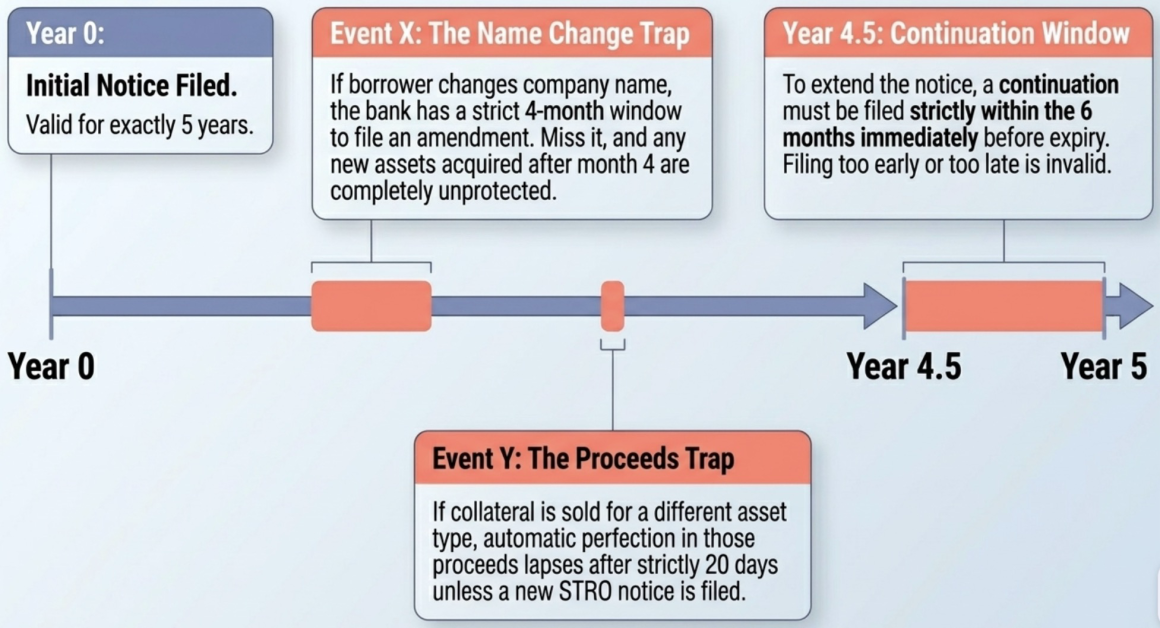
Practical Example: Scenario: “Himalayan Tech Pvt. Ltd.” has a revolving credit facility with Bank B, secured by a general description of “all present and future inventory.” Bank B successfully registers the notice. On January 1, the company officially changes its registered name at the Company Registrar to “Everest Electronics Pvt. Ltd.” Because searches are name-based, this change is seriously misleading.
Application:
- The 4-Month Grace Period: Bank B’s original notice perfectly protects all inventory the company owned before January 1, plus any new inventory the company purchases between January 1 and April 30 (the 4-month window).
- The “Gap” Month 5: Bank B’s compliance team is careless and forgets to file a name-change amendment by the April 30 deadline. In May (Month 5), Everest Electronics purchases a brand-new shipment of 500 laptops. Because the 4-month window has closed, Bank B’s original notice is legally blind to these new laptops; their security interest over this specific batch is instantly unperfected upon acquisition.
- The Consequence: During that same month of May, the company goes to a local financial cooperative, pledges those 500 laptops, and the cooperative registers a new notice under the new name “Everest Electronics.” In June (Month 6), Bank B finally realizes its mistake and files the amendment correcting the name. However, because an amendment adding collateral is only valid from the date it is filed, Bank B is permanently subordinated. If the company defaults, the cooperative gets first priority over the 500 laptops, and Bank B loses millions in collateral value due to missing the statutory window.
4.5 The Notice Lifecycle – Sections 10, 12–15
Every initial notice has a defined lifecycle from filing through termination. Understanding this lifecycle is essential for any lender relying on a registered security interest.
| Stage | Section | Filing Fee | Effective Period | Key Rule |
| Initial Notice filed | 7, 15 | NPR 500 | 5 years from filing date | Minimum content: security giver name, security holder name, collateral description |
| Amendment filed | 12 | NPR 500 | Does not extend validity period | Added collateral effective only from amendment date, not original notice date |
| Continuation filed | 13 | NPR 500 | +5 years from original expiry date | Must be filed within 6 months immediately before expiry; late filing is invalid |
| Termination filed | 14 | NPR 500 | Extinguishes notice immediately | Mandatory within 20 days when all secured obligations are discharged |
| Correction filed | 16 | NPR 500 | No effect on notice validity | Flags disputed/erroneous entry; does not amend legal effectiveness of notice |
| Notice lapses (no continuation) | 10(2) | N/A | Interest becomes unperfected | Any value-paying purchaser after lapse takes free of the security interest |
Continuation – Section 13
A notice is valid for exactly five years from the date of filing – Section 10(1). If the underlying debt has not been repaid within that period, the security holder must file a continuation statement (निरन्तरताको विवरण) to extend it. Section 13(2) prescribes a strict window: the continuation must be filed within the six months immediately before the five-year expiry. A continuation filed too early – more than six months before expiry – is not valid for this purpose. Section 13(3) confirms that a timely continuation extends the notice for another five years from the original expiry date, not from the date of filing, ensuring seamless continuity with no gap in the priority position.
Amendment – Section 12
An amendment to an initial notice must cite the original notice’s registration number, identify the authorising security holder, and clearly state what is being changed. Section 12(6) establishes the most important rule for revolving facilities: if an amendment adds new collateral to the covered description, that expanded coverage is effective only from the date the amendment is filed – not backdated to the original notice. A bank that amends its notice in Year 3 to add a new category of assets to its collateral description holds Year-3 priority over those assets, not Year-0 priority. Competing creditors who registered between Year 0 and Year 3 against those specific assets will have priority. Section 12(10) confirms that filing an amendment does not extend the validity period of the original notice.
Example: If “Bank A” registers an initial notice in 2020 for a company’s “excavators” (which is legally valid for 5 years until 2025) and a competing “Bank B” registers a notice for the same company’s “bulldozers” in 2022, Bank A cannot jump ahead in line by simply altering its old paperwork. If Bank A amends its original 2020 notice in 2023 to newly add “bulldozers” to its collateral description, Section 12(6) of the Act dictates that Bank A’s priority over those bulldozers is legally valid only from the exact date of that 2023 amendment, meaning Bank B’s 2022 claim retains absolute first priority over the bulldozers. Meaning, the competing creditor wins: if the construction company defaults, the local cooperative will have absolute first priority over the bulldozers. Because the cooperative perfected its interest in the bulldozers in Year 2, it legally beats Bank A’s Year 3 amendment. (Bank A, however, still retains its top priority over the excavators dating back to Year 0). Furthermore, under Section 12(10), the mere act of filing this 2023 amendment does not reset or extend the original notice’s lifespan; Bank A’s entire notice will still automatically expire in 2025.
Termination – Section 14
When the secured debt is fully repaid and the security holder has no further commitment to advance credit, the security holder must file a termination statement (सूचनाको समाप्ति) within twenty days of receiving a written demand from the security giver – Section 14(2). The security giver can demand termination where: all secured obligations have been paid and no future advance commitment exists; the security giver never authorised the initial notice; or, for sold accounts or secured sales contracts, the obligor has fully discharged their payment obligations. Once a termination statement is filed, the security holder’s rights under that notice are extinguished – Section 14(3).
4.6 Searching the Registry – Sections 18–19
Section 18(1) sets out what the STRO must provide on request: all active notices filed against a specified security giver; registration numbers and dates; security holder and giver names and addresses; collateral descriptions; and a listing of all related filings (amendments, continuations, corrections, terminations). Section 18(2) specifies the search parameters: a notice search can be conducted using the security giver’s citizenship certificate number, company registration number, vehicle serial number, or initial notice file number. Section 19(2) is commercially significant: electronic searches of the STRO database are entirely free of charge. Only physical filings and manual searches carry the NPR 500 per-filing fee under Section 19(1). This means any bank, lawyer, or individual can run a pre-lending STRO search at stro.org.np at zero cost.
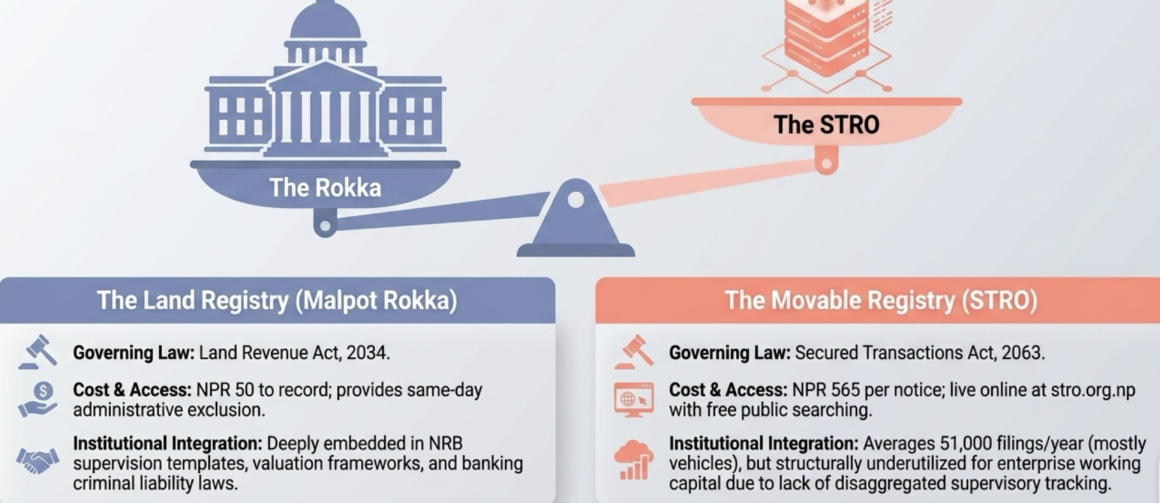
| The Rokka vs The STRO: Same Tool, Different Architecture The Land Revenue Office Rokka (रोक्का) – recorded in the Rokka Kitab under Land Revenue Act, 2034, Section 8kha – costs NPR 50 to record, provides same-day administrative exclusion of third parties, and is the backbone of every BFI’s collateral verification process for land. The STRO costs NPR 500 to register, provides equivalent legal priority protection for movable assets, and has been live and publicly searchable at stro.org.np since May 2017. The legal protection they provide is comparable. The institutional architecture around them is not. The Malpot Rokka is embedded in NRB supervision templates, criminal liability provisions under the Banking Offence and Punishment Act, 2064, valuation frameworks, and loan documentation checklists. Regarding STRO, NRB has embedded STRO use in its regulatory framework. Under the Working Capital Loan Guidelines, 2022 (integrated into the NRB Unified Directives), BFIs must obtain a STRO search report before accepting any movable property as collateral, to verify prior claims and establish priority. NRB Unified Directive 21/2081 mandates STRO filing at the time of loan disbursement or renewal for both hypothecation and pledge of current and movable assets. The Capital Adequacy Framework 2015, Clause 3.4 (Legal Certainty) requires that to claim credit risk mitigation capital relief, banks must take all necessary steps to fulfil “local contractual and statutory requirements” for enforceability – specifically listing “registering it with a registrar” as the operative step. Without STRO filing, movable collateral does not qualify for CRM capital relief. On paper, the system is complete: the registry is live, the mandate exists, and the capital incentive is written into the framework. |
4.7 The STRO in Practice: What the Data Shows
Since going live in May 2017, the STRO has recorded approximately 537,000 total entries, of which around 411,000 are initial notices of security interest – averaging roughly 51,000 new filings per year across Nepal. This is not a dormant registry. But it has not produced a structural shift in movable asset lending.
Land-backed credit peaked at 68.0% of total BFI credit in 2023 despite eight years of STRO operation. As of November 2025, it stands at 64.4%. NRB Bank Supervision Reports continue to identify “double counting of assets” and “multiple banking against the same security” as sector-wide problems in every year through 2024. The most probable explanation for this disconnect is that the bulk of STRO filings are concentrated in hire purchase and vehicle finance – where the asset is a discrete physical item and filing is straightforward – rather than in commercial bank working capital and enterprise lending, where the credit allocation impact would be largest. Without a publicly available breakdown of STRO filings by institution type and collateral category, this hypothesis cannot be confirmed. Requiring KSKL to publish quarterly disaggregated statistics – one of the three supervisory actions identified as Reform 1 in Land Locked Credit – would resolve this uncertainty.
Part V: Creating a Security Interest – Attachment
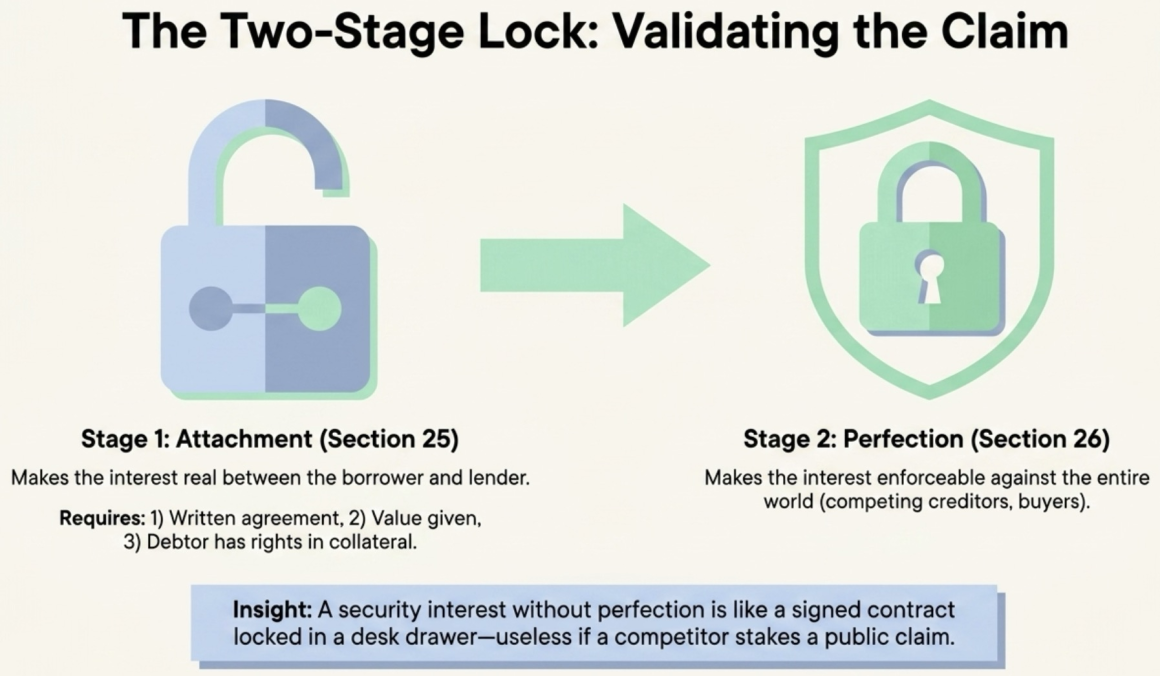
A security interest does not simply come into existence because the parties want it to. The Act establishes a specific legal threshold – called “attachment” (धितोको हकको आवद्धता) – which is the moment the security interest becomes legally enforceable between the security holder and the security giver. Attachment is to the security interest what signing a contract is to a contract: it brings the right into legal existence. Without attachment, the security holder has no claim over any specific asset, only a contractual promise from the debtor.
Attachment is conceptually distinct from perfection (examined in Part VI). Attachment creates the security interest between the parties. Perfection makes it enforceable against the entire world – third parties, competing creditors, buyers, and lien holders. In simple transactions, both happen simultaneously. In more complex arrangements, they may happen at different times, and the gap between them can have significant legal consequences.
5.1 The Three Conditions for Attachment – Section 25(1)
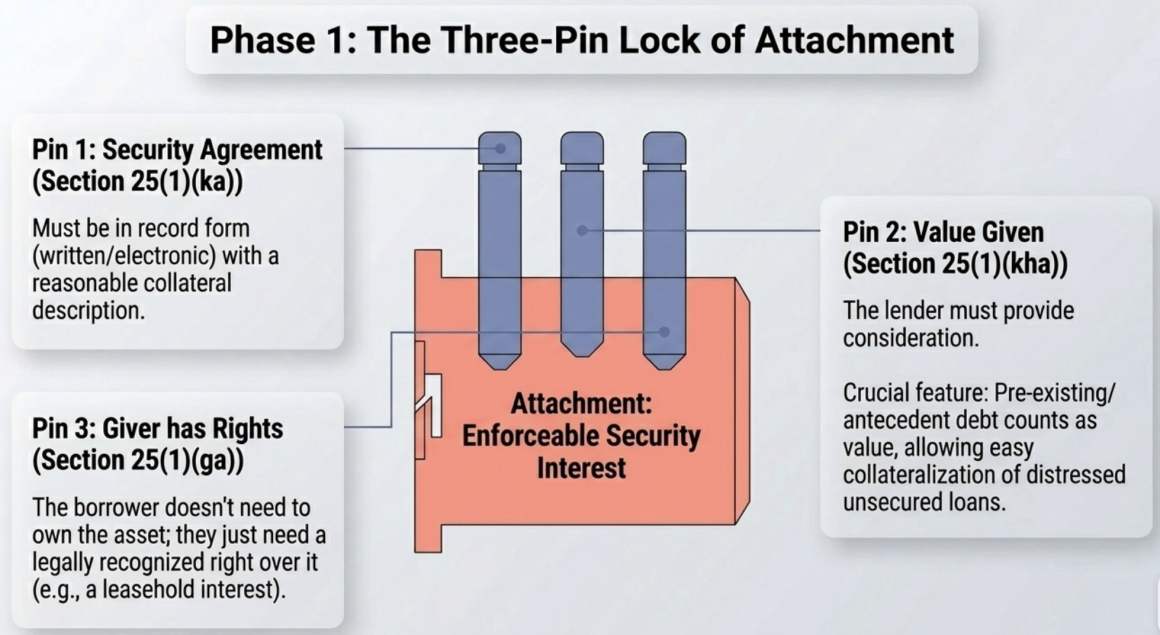
Section 25(1) establishes that a security interest attaches to collateral only when all three of the following conditions are simultaneously satisfied. Missing any one of them means the security interest has not legally come into existence.
Condition 1: A Security Agreement with a Collateral Description – Section 25(1)(ka)
There must be a valid security agreement that contains a description of the collateral property. The agreement must be in record form under Section 23(1) – written or electronic documentation is required; an oral pledge is not sufficient. The description need not be forensically precise. Section 22 establishes that a description is legally sufficient if it “reasonably identifies” what is being described. For most commercial collateral, this standard allows for general descriptions: a security agreement describing the collateral as “all current and future inventory” or “all movable property” of the debtor is legally sufficient, provided the debtor is not an individual consumer and the collateral is not a serial-numbered vehicle.
The Explanation to Section 22 specifically defines what “general manner” means in this context: phrases such as “all assets of the security giver” or “all movable property of the security giver” constitute a sufficient general description. This is the statutory equivalent of the floating charge: the security agreement can cover an entire fluctuating pool of assets without itemising each piece. The only exceptions requiring specific description are consumer goods (which cannot be covered by a general “all assets” description because they are personal household items that deserve individual identification) and serial-numbered vehicles (which must be identified by make, model, and chassis/serial number).
Condition 2: The Security Holder Has Given Value – Section 25(1)(kha)
The security holder must have actually provided “value” (मूल्य) to the security giver. Value is defined in Section 2(bha) as consideration given or to be given according to the agreement – it encompasses cash disbursements, credit extensions, delivery of goods, provision of services, or any other form of consideration. For a standard bank loan, value is given when the bank transfers the loan funds to the borrower’s account. For a hire-purchase arrangement, value is given when the financier delivers or pays for the asset. For a sale of accounts, value is given when the factoring company pays the discounted purchase price for the invoices.

Critically, Section 21(4) explicitly confirms that a pre-existing, antecedent debt constitutes value. This means a bank holding an unsecured loan that has become problematic can take new collateral to secure that old debt without disbursing any fresh cash. The act of agreeing to forbear – to not immediately demand repayment – or the act of modifying the terms of the existing debt, constitutes the consideration that satisfies the value requirement. This has significant practical implications for debt restructuring: a bank can collateralise a distressed unsecured loan by having the debtor execute a new security agreement covering movable assets, and the attachment will be legally valid from the moment of the restructuring agreement.
Condition 3: The Security Giver Has Rights in the Collateral – Section 25(1)(ga)
The security giver must have a legally recognised right over the collateral – ownership, a leasehold interest, a possessory right, a contractual entitlement – or must have the legal authority to transfer rights in the collateral to the security holder. The security giver does not need to be the owner. A lessee can pledge their right to use leased equipment. A consignee can pledge goods held on consignment up to the extent of their interest. A borrower under a hire-purchase arrangement can pledge their equitable interest in the financed asset.
What the security giver cannot do is pledge something they have no rights to at all. If a business owner attempts to pledge their neighbour’s machinery without the neighbour’s knowledge or authorisation, the security interest does not attach – there is nothing for it to attach to. The bank that takes such a pledge in good faith has no legal claim over the machinery; its remedy is only against the business owner personally for fraud or misrepresentation.
Practical Illustration: All Three Conditions in Action
A Kathmandu-based printing company, “Himalayas Press Pvt. Ltd.,” approaches Nepal Investment Mega Bank (NIMB) for a NPR 20 million working capital loan. On Monday, NIMB and the printing company sign a loan agreement that describes the collateral as “all current and future printing machinery and equipment of Himalayas Press Pvt. Ltd., together with all accounts receivable arising from printing contracts.” Condition 1 is met: a security agreement with a collateral description exists. The printing company owns two Heidelberg offset printers and has NPR 4 million in outstanding invoices from media clients. Condition 3 is met: the company has clear rights in both the machines and the receivables. But the loan is not disbursed until Wednesday, when NIMB transfers NPR 20 million to the company’s account. Condition 2 is met on Wednesday. The security interest attaches at the exact moment of disbursement on Wednesday – not when the agreement was signed on Monday.
5.2 After-Acquired Property and the Floating Charge Equivalent
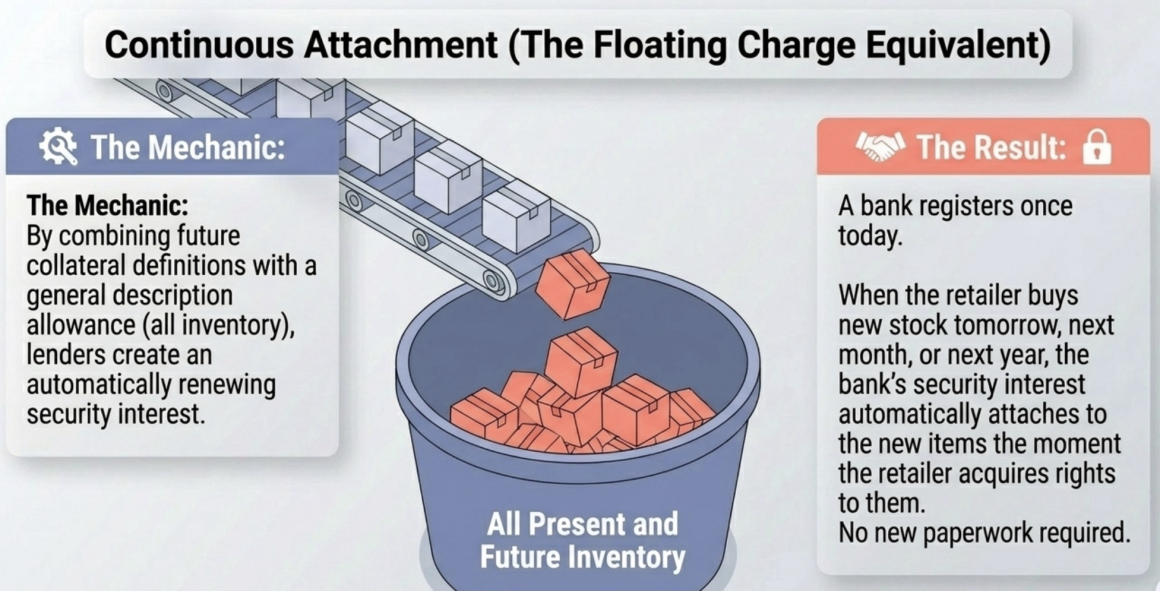
The combination of three Act provisions creates what common law systems call a “floating charge” – but with greater legal strength. Section 2(ta)’s definition of collateral includes future collateral (भविष्यमा सृजना हुने धितोको सम्पत्ति). Section 22’s permission for general descriptions allows a security agreement to cover “all present and future inventory.” And Section 20(3) confirms that a security interest is not invalidated merely because the security giver retains the right to use, sell, exchange, or mix the collateral.
Put together: a bank can take a security interest in a retailer’s entire present and future inventory, registered today against the general description “all inventory,” and that security interest automatically attaches to every new item of stock the retailer acquires tomorrow, next month, and next year – from the moment the retailer acquires rights in the new stock. No amendment to the notice is needed. No new agreement is required. The Act’s attachment mechanism is continuous and automatic for properly described future collateral.
The difference from a traditional floating charge is significant. Under English floating charge law, the charge “floats” until a triggering event (like default) causes it to “crystallise” – attaching to the specific assets existing at that moment. During the floating period, a floating charge can be defeated by certain unsecured creditors and by subsequent specific charges. Under Nepal’s Act, there is no crystallisation delay: the security interest is a fixed, attached, and (once filed) perfected property right from the moment each new item of collateral is acquired. There is no window of vulnerability in which a subsequent creditor can defeat it, provided the original notice was filed and remains current.
5.3 Secured Obligations – Section 21
Section 21 establishes the types of underlying obligations that a security interest can secure, and the range is deliberately broad:
Section 21(1): one or multiple obligations, described generally or specifically. A single security agreement can secure a term loan, a revolving line of credit, and a bank guarantee obligation simultaneously.
Section 21(2): monetary or non-monetary. A business can pledge its machinery to secure not only a cash debt but also its contractual obligation to deliver 1,000 units of goods under a supply agreement.
Section 21(3): future obligations – mandatory, conditional, or optional. A bank that commits to a NPR 100 million revolving credit facility need not worry that its security interest fails to attach to advances not yet made: the agreement covers future drawdowns.
Section 21(4): pre-existing obligations. Collateral pledged today can secure a debt incurred years ago. This is the antecedent debt rule discussed in Section 5.1.
Part VI: Making It Count – Perfection and Maturity (धितोको हकको परिपक्वता)
Attachment makes a security interest real between the two contracting parties. Perfection (परिपक्वता – literally “maturity”) makes it enforceable against the world. An unperfected security interest is vulnerable: a subsequent creditor who perfects their own interest first will take priority, regardless of who knew about what. A buyer who purchases the collateral for value without knowledge of the unperfected interest takes it free and clear. Even in insolvency, an unperfected interest ranks behind unsecured creditors in many circumstances. Perfection is not optional for a lender who wants to protect their investment.
6.1 The Methods of Perfection – Section 26
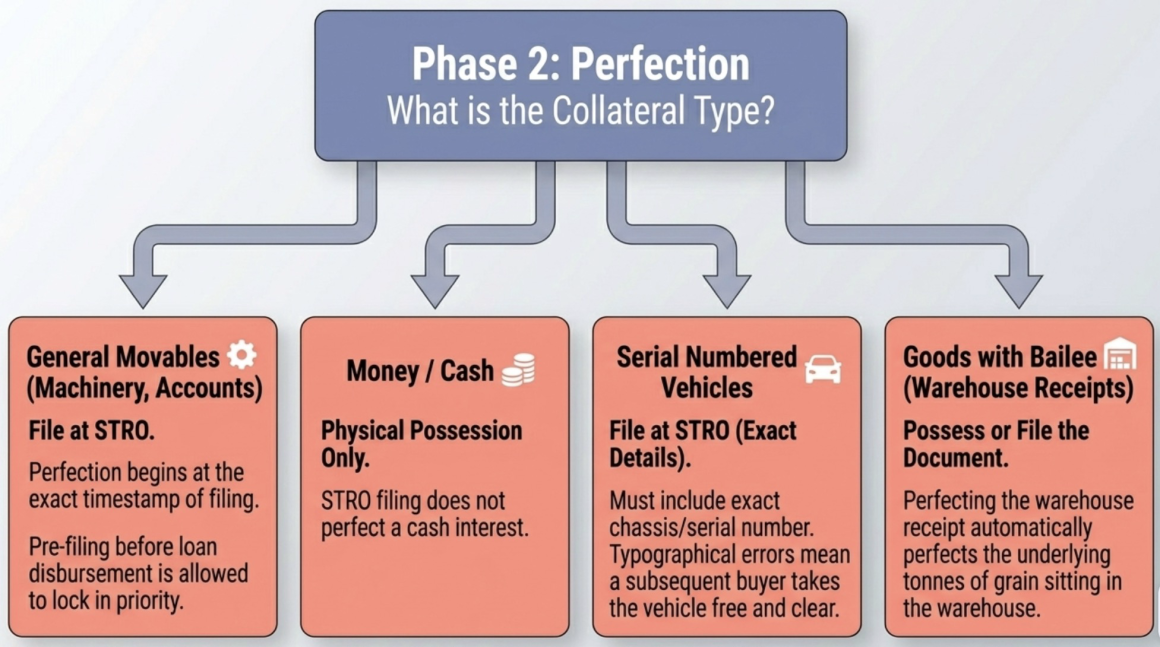
The Act provides different methods of perfection depending on the type of collateral. The general rule is filing a notice at the STRO. For specific collateral types, alternative methods – or mandatory variations – apply.
| Collateral Type | Method of Perfection | Section | Notes |
| General movable assets (machinery, inventory, accounts) | File notice at STRO | 26(2) | Default rule for all collateral not otherwise specified |
| Consumer goods (PMSI only) | Automatic on attachment; no filing required | 26(3) | Creates invisible lien; protects sellers but not subsequent lenders searching STRO |
| Goods, instruments, documents, secured sales contracts | Security holder takes possession | 26(4) | Filing optional but permitted before/during/after possession |
| Money / cash (non-proceeds) | Security holder takes physical possession only | 26(5) | STRO filing alone does NOT perfect a cash security interest |
| Serial numbered vehicle | File notice; must describe vehicle or provide serial number | 26(6) | Wrong or missing serial number in notice = buyer takes free – Section 30(2)(ga) |
| Proceeds from collateral sale/exchange | Automatic; no new filing required | 26(7), 33 | Lapses after 20 days for non-cash proceeds of a different type unless refiled |
| Guarantee supporting secured obligation | Automatic when underlying collateral is perfected | 26(9) | No separate filing required for the guarantee |
| Goods held by bailee who issued a document | Perfect interest in the document first | 26(8) | Possession of the document = perfection in the underlying goods |
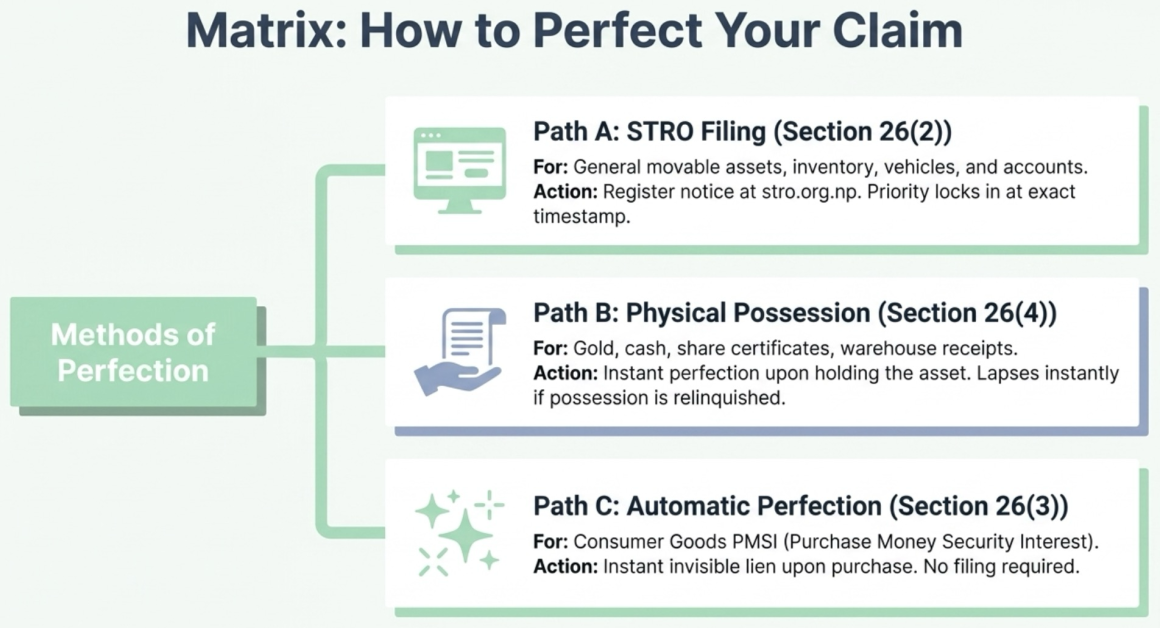
6.2 The General Rule: Filing at the STRO – Section 26(2)
For most movable commercial assets, the security interest is perfected by filing an initial notice at the STRO. The Act does not specify any minimum waiting period after filing: perfection is effective from the exact timestamp of filing. This is why the priority rule in Section 28(2) refers to the date and time of filing – in a closely contested priority dispute between two lenders, the sequence of filing within a single business day can matter.
Filing before attachment is both permitted and strategically important. Section 7(4) explicitly allows a lender to file a notice before the security agreement is signed or before the security interest has attached. This allows a bank to “lockin” its priority position during due diligence and documentation, so that even if closing the transaction takes several weeks, the bank’s priority date runs from the pre-closing filing, not from the disbursement date. In a competitive lending environment, this can be decisive.
6.3 Consumer Goods PMSI: Automatic Perfection – Section 26(3)
A Purchase Money Security Interest in consumer goods – the only type of security interest the Act permits over consumer goods – perfects automatically the moment it attaches. No STRO filing is required. When a consumer buys a television on an installment plan from an electronics retailer, the retailer’s PMSI perfects at the moment the consumer signs the agreement and takes the television home. No notice appears in any public registry.
| The Invisible Lien on Your Refrigerator When you buy a television, refrigerator, or washing machine on installment from any retailer in Nepal, the retailer holds a legally perfected security interest over that item from day one – invisible in the public STRO registry. This is deliberate under Section 26(3): consumer goods PMSIs perfect automatically on attachment, with no filing required. For consumers, this is largely irrelevant. For any cooperative or informal lender who later accepts that household item as collateral for a cash loan, it is a structural trap: 1. The lender searches the STRO registry and finds no prior notice against the item. 2. The lender concludes the item is unencumbered and disburses the loan. 3. The borrower defaults on both the installment plan and the new loan. 4. The retailer, holding a perfected PMSI from day one, has first priority. 5. The lender, whose filing post-dates the retailer’s automatic perfection, loses. The Act protects innocent buyers of consumer goods in private sales (Section 30(2)(kha)) but offers no equivalent protection to innocent lenders. The only defense is physical due diligence: asking for purchase receipts and financing documents before accepting household assets as collateral. The STRO cannot help you here. |
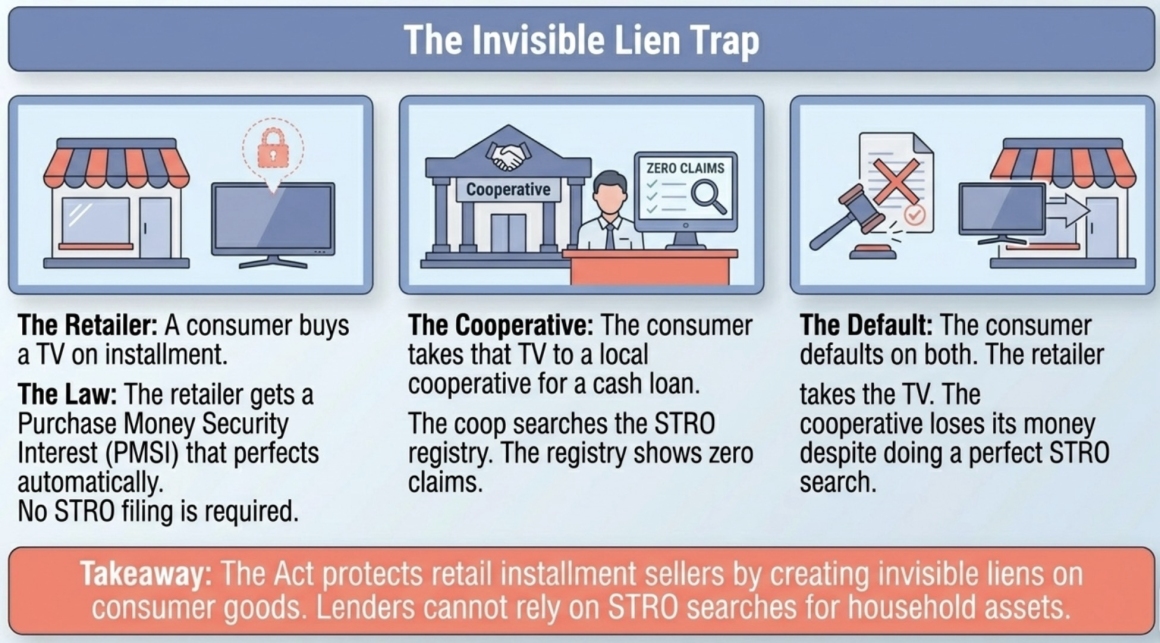
6.4 Possession as Perfection – Section 26(4)
For goods, instruments (including share certificates and bearer bonds), documents such as warehouse receipts, and secured sales contracts, the security interest perfects when the security holder takes physical possession of the collateral. No STRO filing is required, though filing is also permitted before, during, or after taking possession. The security interest is perfected from the moment possession is taken and remains perfected only as long as possession is maintained. If the security holder voluntarily returns the collateral to the debtor without filing a STRO notice to maintain perfection, the interest becomes unperfected.
This is the classical pledge in its modern legal form. A cooperative holding a borrower’s gold bars in its vault, or a bank holding share certificates pending repayment, is perfecting by possession under this provision. The practical advantage is speed and simplicity: no filing, no fee, instant perfection. The risk is that the security holder cannot allow the collateral to leave their physical control without either maintaining a STRO filing or accepting that their perfection lapses. Section 27(1) allows a smooth transition between possession and filing without loss of priority – provided there is no gap.
6.5 Serial Numbered Vehicles – Section 26(6)
For serial-numbered vehicles, perfection requires filing a STRO notice that either generally describes the vehicle or specifies its serial and chassis numbers. The specific number matters because Section 30(2)(ga) gives a buyer of a serial-numbered vehicle the right to take it free of any prior security interest if the filed notice failed to include the serial number, or included it incorrectly. A bank that finances a truck purchase and files a STRO notice with a typographical error in the chassis number has effectively no protection against a subsequent buyer of that truck who searches the registry and finds nothing. The notice is valid between the bank and the borrower, but the buyer takes the truck clean.
6.6 Proceeds and the 20-Day Window – Sections 26(7) and 33
When collateral is sold, exchanged, or destroyed, the security interest automatically continues in the proceeds – Section 33(1). No new filing is required. If a bank holds a perfected security interest over a distributor’s inventory of laptops and the distributor sells twenty of them for cash, the bank’s interest automatically extends to the cash proceeds without any additional action.
However, Section 33(3) introduces a 20-day grace period with teeth: the automatic perfection in proceeds lapses after twenty days from the date the debtor receives the proceeds, unless one of three conditions is met:
- The original notice already describes the proceeds by type (e.g., the original filing covers “inventory and all accounts arising from inventory sales” – the resulting accounts are covered by description and the interest in them continues beyond 20 days).
- The proceeds are identifiable cash – money deposited into a traceable bank account or physical currency – which continues automatically beyond 20 days under Section 33(5)(ka).
- The security holder files a new notice or amendment within the 20-day window specifically covering the type of proceeds received.
The practical implication: if a debtor sells collateral and receives a completely different type of asset as payment – trading inventory for a motor vehicle, or exchanging pledged machinery for equity in another company – the bank must act within twenty days. It must file an amendment to its original notice that adds the new asset type to the collateral description, or it loses its perfected status in those specific proceeds on day twenty-one. A creditor who then registers a claim against the vehicle or equity stake on day twenty-two will have priority.
6.7 The Goods-with-Bailee Rule – Section 26(8)
A bailee (नासोमा लिने व्यक्ति) is a third party – typically a warehouse operator – who holds goods for the benefit of the owner. When the bailee has issued a formal title document covering the stored goods, such as a warehouse receipt, that document itself represents the legal right to the underlying goods. The Act requires that before a security interest in those goods can be perfected, the security interest in the document itself must first be perfected – either by taking possession of the document or by filing a notice covering it.
This rule has significant practical importance for agricultural and commodity lending. When a rice trader stores 100 tonnes of rice in a licensed warehouse and receives a Warehouse Receipt, that single piece of paper concentrates the legal right to all 100 tonnes. A bank that takes possession of the Warehouse Receipt or files a STRO notice covering it has, in a single act, perfected its security interest in 100 tonnes of physically stored rice – rice it has never seen, in a warehouse it may never visit. The commodities framework under the Commodities Act, 2017 and the Central Depository Service Regulation, 2010 contemplates exactly this structure through dematerialised warehouse receipts through the CDSC system.
| Case Study: The Goods-with-Bailee Rule and STRO Registration Case Background Ram is a large-scale agricultural trader. To safely keep his inventory, he deposits 100 tonnes of rice into a commercial warehouse operated by Nepal Storage Pvt. Ltd. (the bailee). Upon receiving the rice, the warehouse operator issues Ram a formal “Warehouse Receipt.” Under the Secured Transactions Act, 2063, this warehouse receipt is legally defined as a “document”. At this stage, no money has been borrowed, and no financial institution is involved; it is purely a storage arrangement. The Core Question If a transaction is purely a bailment-where a warehouse operator merely stores goods and issues a warehouse receipt to the owner without any associated loan or credit-does this constitute a secured transaction, and can this standalone warehouse receipt be registered in the Secured Transactions Registration Office (STRO)? Or does STRO registration only apply when the owner subsequently pledges that warehouse receipt to a lender as collateral to secure a debt? Analysis and Answer A pure bailment arrangement (merely storing goods and receiving a receipt) is not a secured transaction, and the standalone warehouse receipt cannot be registered in the STRO unless it is actively being used as collateral for a debt. Here is how the law applies to this scenario in two distinct phases: Phase 1: The Pure Bailment (Outside STRO Jurisdiction) When Ram simply parks his rice in the warehouse and gets a receipt, this arrangement falls entirely outside the scope of the Secured Transactions Act. According to Section 3, Subsection (1), Clause (a), the Act only applies to transactions (like pledges, hypothecations, or hire-purchases) that are specifically executed for the purpose of securing an obligation with collateral. Because no one is lending money and no debt is being secured, this is a pure storage contract. Furthermore, STRO registration is legally impossible at this stage. Under Section 7, Subsection (1), a preliminary notice filed at the STRO must contain the details of both the “security giver” (the debtor/borrower) and the “security holder” (the creditor/lender). In Ram’s pure bailment, these roles do not exist, meaning the electronic registry cannot accept the filing. Phase 2: The Security Arrangement (Triggering STRO Registration) The legal rule outlined in Section 26, Subsection (8) only activates when the transaction transforms from a simple storage arrangement into a credit facility. Assume Ram now needs cash to buy more inventory. He takes his Warehouse Receipt to Bank A and pledges it as collateral for a 5 million Rupee loan. Now, a true lender-borrower security arrangement has been created. To protect its new investment, Bank A will log into the STRO and file a notice naming Ram as the security giver, Bank A as the security holder, and the warehouse receipt as the collateral. According to Section 26, Subsection (8), because the goods are in the custody of a bailee who has issued a document covering them, Bank A must perfect its security interest in the document itself. By taking possession of the Warehouse Receipt or filing a STRO notice covering it, Bank A legally perfects its security interest over the actual 100 tonnes of rice sitting in the warehouse. Conclusion The STRO is strictly a financial registry, not a property or storage registry. The warehouse receipt cannot be registered during the pure bailment phase; STRO registration only applies-and the Goods-with-Bailee rule only activates-once the borrower (Ram) furnishes that receipt to a lender (Bank A) to secure a financial obligation. |
6.8 Continuity of Perfection – Section 27
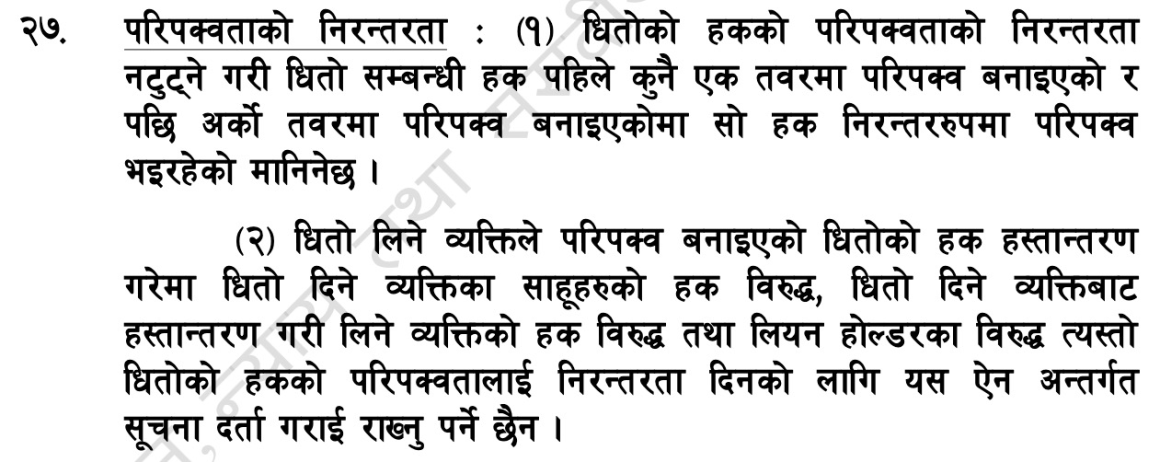
Section 27(1) addresses a potential gap that arises when a security holder switches from one method of perfection to another. If the interest is first perfected by one method and then later perfected by another method, with no interruption in between, the law treats the interest as continuously perfected from the original date. The priority position does not reset to the date of the change in method.
Section 27(2) extends this principle to transferred interests: when a perfected security interest is legally transferred from one security holder to another, the transferee does not need to re-file a new STRO notice to maintain the perfection against third parties. The original notice, filed by the original security holder, continues to serve as the public record of the security interest, and the priority date remains unchanged. This rule is critical for loan portfolio sales and for the AMC framework examined in the AMC article: when a bank sells a perfected secured loan to another entity, the buyer does not lose the bank’s priority position.
Part VII: The Priority Wars – Who Gets Paid First
Priority rules answer the question that matters most in a default: when multiple parties have claims against the same asset and the proceeds of sale are insufficient to satisfy everyone, who gets paid first and in what order? The Act’s priority framework is hierarchical, specific, and in several places, counterintuitive. This Part works through the framework systematically.
7.1 The General Rule: First to File or Perfect – Section 28
Section 28(1) establishes the foundational rule: a perfected security interest always beats an unperfected one. Among multiple perfected interests in the same collateral, priority goes to the one whose notice was first filed or whose interest was first perfected, whichever occurred earlier in time.
Section 28(2) defines this priority date precisely: it is the earlier of (a) the date the first notice covering that collateral was filed at the STRO, or (b) the date the security interest was first perfected by any other method (such as possession). The priority date runs from this earlier event, even if the security interest had not yet attached when the notice was filed. This is why pre-filing matters so much: a bank that files a STRO notice before the loan closes locks in a priority date before any subsequent creditor who files after the closing, regardless of when the security interest actually attached.
Section 28(3): the first-in-time rule applies to proceeds as well. The priority date for a security interest in proceeds is the same as the priority date for the original collateral from which those proceeds derived.
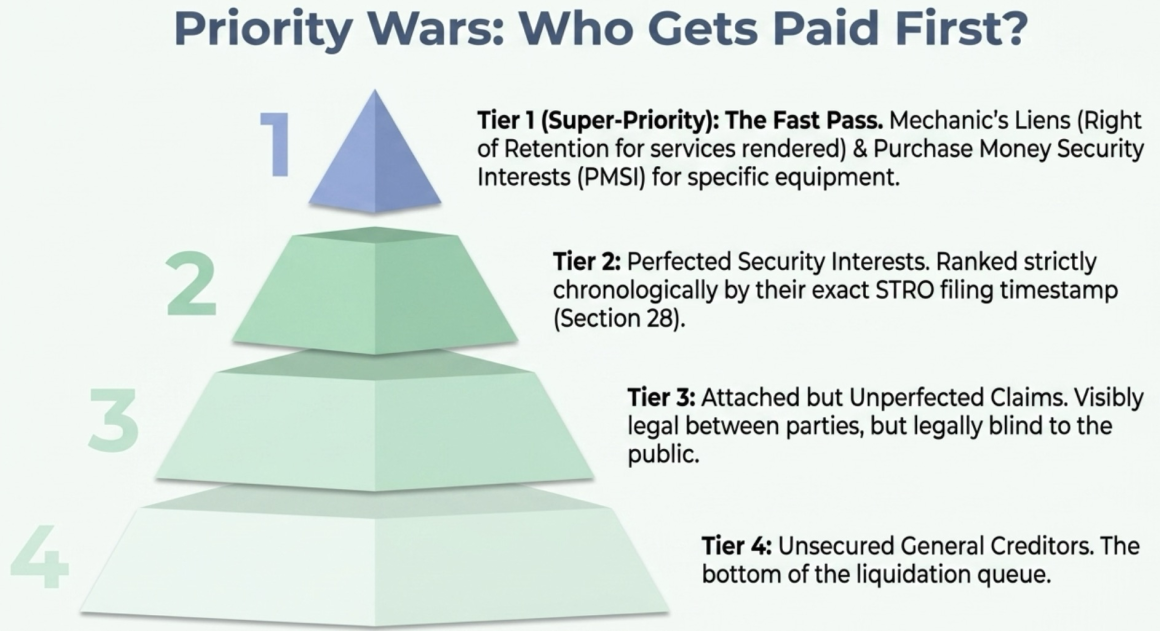
| Priority Rank | Type of Claim | Governing Section | Key Condition |
| 1st | Perfected security interest (filed first) | 28(1)(2) | Continuous coverage; no lapse in perfection |
| 2nd | Perfected security interest (filed second) | 28(1) | Must be perfected; loses only to earlier-dated perfected claim |
| 3rd | Attached but unperfected security interest | 28(3) | Loses to any perfected claim and to value-paying buyers |
| Special: 1st in class | PMSI in equipment (filed within 5 days) | 34 | Supersedes prior “all assets” claims in that specific equipment |
| Special: 1st in class | PMSI in inventory (filed with prior notice) | 35 | Requires notice to prior inventory lenders AND perfection on possession |
| Special: super-priority | Right of retention (possessory lien, services to goods) | 36 | Beats perfected interest for that specific asset, if in ordinary course of business |
| Last | Unsecured claims | N/A | No specific collateral right; general creditor only |
7.2 PMSI Super-Priority: Equipment – Section 34
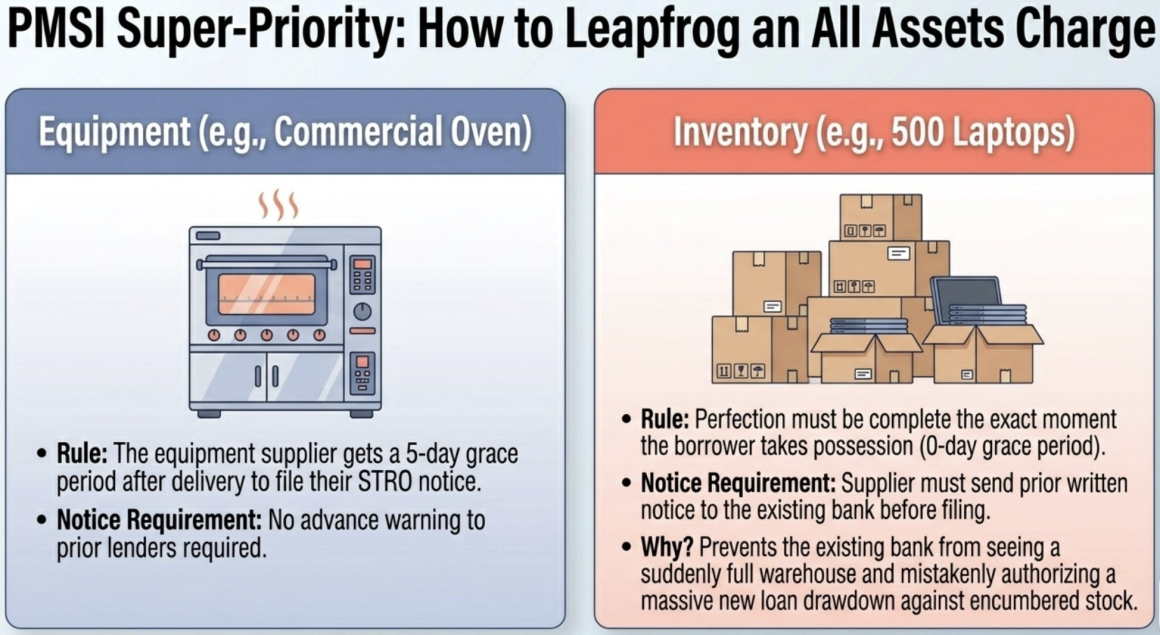
A Purchase Money Security Interest in equipment jumps ahead of any prior “all assets” charge if it is perfected at the moment the security giver receives possession of the equipment or within five days after. No advance notice to prior secured creditors is required.
Nepal Investment Mega Bank has a registered STRO notice against all assets of Himalayan Hotels Pvt. Ltd. The hotel buys a new commercial kitchen system on credit from Kitchen Equipment Nepal Ltd. Kitchen Equipment Nepal registers its PMSI notice at the STRO within five days of delivery. Result: Kitchen Equipment Nepal’s PMSI takes first priority over that specific kitchen system, ahead of the bank’s general charge – even though the bank filed years earlier. The bank retains its general priority over everything else the hotel owns; it simply cannot claim the specific kitchen system against the supplier’s PMSI.
The five-day window is strict. A PMSI lender who files on day six falls back to the general first-to-file rule and likely loses to the prior all-assets lender. This creates a practical obligation for equipment suppliers providing seller financing: the STRO notice must be filed before or on the day of delivery, or within the five-day window without exception.
7.3 PMSI Super-Priority: Inventory and Livestock – Section 35
For inventory and livestock, the Purchase Money Security Interest (PMSI) super-priority is harder to obtain because the procedural requirements are more demanding. Two conditions must both be met:
- First, the PMSI must be perfected by the time the security giver takes possession of the inventory or livestock.
- Second – and this is the critical additional requirement – if any prior secured creditor has already filed a notice covering the same type of inventory, the PMSI lender must give that prior creditor advance written notice before filing their own PMSI notice. This written notice must: identify the inventory by description or type; and explicitly state that the sender has, or expects to acquire, a PMSI in that specific inventory.
The reason the inventory rule is more demanding than the equipment rule lies in the economic mechanics of inventory financing. A bank providing a revolving credit line against a retailer’s stock makes ongoing advance decisions based on the total reported value of that stock. If a supplier can deliver PMSI-financed goods into the warehouse without warning, the bank might see the inflated stock figures and advance more money against what it incorrectly believes is unencumbered inventory. The advance written notice requirement forces the PMSI supplier to flag their entry into the borrower’s inventory pool before it happens, giving the bank the opportunity to adjust its advance rate or seek additional protection. Equipment does not create this problem because it sits in place and is not churned daily.
The legal consequence of missing the written notice requirement is significant: the PMSI holder loses the super-priority entirely and falls back to the general first-to-file rule of Section 28. The prior all-assets lender who registered first will have priority over that inventory.
| Case Study: PMSI Super-Priority for Inventory Case Background “Himalayan Electronics Pvt. Ltd.” operates a large retail chain. To finance its daily operations, it takes a revolving credit line from Bank A. Bank A logs into the STRO and successfully registers a security interest covering “all present and future inventory” of Himalayan Electronics. Six months later, Himalayan Electronics wants to stock a new line of high-end laptops. A supplier, “Tech Wholesale,” agrees to provide 500 laptops on credit (seller financing), retaining a Purchase Money Security Interest (PMSI) – legally known as a Kharid Mulya Sambandhi Dhitoko Hak – over those specific 500 laptops. The Core Question Since Bank A already has a registered claim over “all present and future inventory,” how can Tech Wholesale (the new supplier) legally ensure it gets first priority over the 500 laptops it is supplying? Furthermore, what happens if Tech Wholesale simply delivers the laptops and registers its own PMSI notice in the STRO without explicitly warning Bank A? Analysis and Answer Because inventory is constantly sold and replaced, the law imposes strict procedural hurdles to protect existing lenders. Under Section 35 of the Secured Transactions Act, 2063, Tech Wholesale can obtain “super-priority” over Bank A’s conflicting claim, but only if it strictly fulfills two conditions: Condition 1: Perfected upon possession Under Section 35, Clause (s) (Clause ‘a’ in English), Tech Wholesale’s PMSI must be fully matured (perfected) at the exact time Himalayan Electronics takes physical possession of the laptops.Condition 2: Prior written notice to existing creditors This is the critical additional hurdle. Under Section 35, Clause (b), because Bank A already has a prior registered notice covering the same type of collateral (inventory), Tech Wholesale must give Bank A prior written notice before it files its own PMSI notice in the STRO. This written notice must explicitly state that Tech Wholesale has, or expects to acquire, a PMSI in Himalayan Electronics’ inventory and must describe the specific laptops being provided. Economic Rationale (The “Why”): If Tech Wholesale could secretly drop 500 new laptops into the retailer’s warehouse, Bank A’s inspectors might see the suddenly inflated stock figures. Believing this new inventory is unencumbered, Bank A might authorize a massive new loan drawdown for the retailer. To prevent Bank A from being tricked into advancing money against collateral it doesn’t actually have first claim over, the law forces Tech Wholesale to “flag” their entry into the warehouse by sending a written warning directly to Bank A. Consequence of Failure: If Tech Wholesale simply delivers the laptops and registers its STRO notice without sending the required prior written notice to Bank A, Tech Wholesale completely loses its PMSI super-priority. The dispute then defaults to the general “first-to-file” rule under Section 28, Subsection (2). Because Bank A registered its “all inventory” notice six months earlier, Bank A will retain absolute first priority over the 500 laptops, and Tech Wholesale will be legally subordinated. Conclusion Unlike equipment (which gets a 5-day grace period without notice requirements), a PMSI in inventory demands aggressive proactive compliance. A supplier financing inventory must meticulously search the STRO, identify prior inventory lenders, formally notify them in writing, and register their own claim-all before the borrower unboxes the goods. |
7.4 Buyers and Lessees Taking Free of Security Interests – Sections 30–31
A purchaser or lessee who takes goods in normal commerce should not have to worry that the seller’s bank will later appear and repossess the goods. The Act’s buyer and lessee protection rules are designed to make commerce work: ordinary transactions in the market should not be disrupted by creditors of remote parties. The following rules apply.
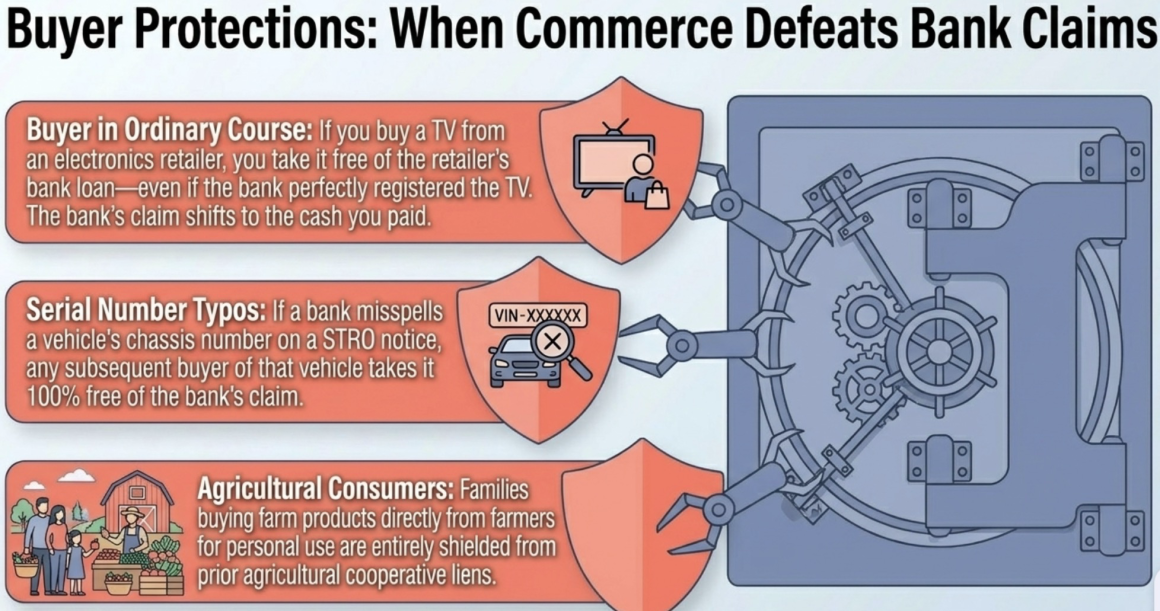
Buyer without knowledge before perfection – Section 30(1): A buyer who purchases collateral for value, without knowledge of the security interest, and takes possession before the interest is perfected (for tangible property) acquires the asset entirely free of the prior security interest. If a bank has not yet filed a STRO notice when a good-faith buyer purchases the collateral and takes delivery, that buyer wins.
Example: Hari buys a second-hand printing press from a local business, pays for it, and takes it to his own factory. The business had secretly pledged the press to Bank A, but Bank A had not yet filed its notice in the STRO. Why Hari wins: Because Hari bought the machine in good faith, without knowing about the bank’s claim, and took physical possession before the bank perfected its interest, the law completely clears the asset of the bank’s claim. The burden is on the bank to file its notice quickly; its delay protects the innocent buyer.
Buyer in ordinary course of business – Section 30(2)(ka): A person who buys goods from a seller who regularly deals in those types of goods takes them free of any security interest in the inventory – even if the interest is fully perfected and even if the buyer knew it existed. This is the consumer protection at the heart of inventory financing: banks lend against retailers’ stock on the understanding that the retailer will sell the stock in the ordinary course and the bank’s claim shifts to the proceeds.
Example: Sita walks into a retail electronics shop and buys a new television. The shop has a massive revolving loan with Bank B, and the bank holds a perfectly registered STRO notice covering all the shop’s inventory. Why Sita wins: Sita is buying from a seller who regularly deals in those goods (ordinary commerce). The law intentionally strips the bank’s security interest from the sold television so that everyday retail trade isn’t paralyzed. The bank doesn’t lose out entirely; its security interest simply shifts from the television to the cash Sita paid to the shop.
Serial numbered vehicle buyer – Section 30(2)(ga): A buyer of a serial-numbered vehicle takes it free of any security interest if the STRO notice covering that vehicle failed to include the serial number or included it incorrectly. This is a strict penalty for filing errors on vehicle notices.
Example: Ram buys a used delivery van from a logistics company. Bank C holds a registered security interest over the van, but when Bank C filed its STRO notice, the clerk accidentally typed the chassis/serial number incorrectly. Why Ram wins: The law strictly penalizes banks for typographical errors involving serial-numbered vehicles. Because public searches for vehicles rely entirely on exact serial numbers, the bank’s error made the notice effectively invisible. Therefore, Ram takes the van completely free of the bank’s claim.
Agricultural product buyer – Section 30(2)(gha): Agricultural products bought by a consumer for personal use are always free of a prior security interest. Agricultural products bought for non-consumer use are free if the buyer had no knowledge and took possession before the interest was perfected.
Example: A family buys 5 sacks of wheat directly from a farmer to use in their home kitchen. The farmer had previously pledged his entire wheat harvest to a local agricultural cooperative, which successfully registered its claim. Why the family wins: The law provides an absolute shield for consumers buying agricultural products for personal/household use. This ensures basic food security and allows local farm-to-consumer trade to operate smoothly without families needing to conduct complex STRO background checks for their groceries.
Lessee in ordinary course – Section 31(2): A person who rents goods in the ordinary course of business takes their lease right free of any prior security interest, even if perfected and known to the lessee. The rental transaction cannot be disrupted by the lessor’s creditor.
Example: A construction firm rents a bulldozer for three months from “Kathmandu Equipment Rentals.” The rental company defaults on its own bank loan, and the bank attempts to seize all equipment, including the bulldozer currently at the construction site. Why the construction firm wins: Because the firm rented the bulldozer in the “ordinary course of business” from a company whose business is renting equipment, their lease rights are protected. The law ensures that an innocent lessee’s active business operations are not suddenly disrupted by the landlord’s financial failures.
7.5 Security Interest vs Lien Holder – Section 29
A lien holder (लियन होल्डर) under the Act includes persons who acquire rights through court orders, judgment execution processes, and insolvency proceedings. A perfected security interest has priority over any lien holder’s claim, unless the lien holder both filed their notice before the security interest was perfected AND before any initial notice covering the collateral was filed. In practical terms: any bank or lender that has filed a STRO notice for its security interest before a creditor obtains a court judgment against the debtor will have priority over that judgment creditor in the collateral covered by the notice.
7.6 Right of Retention – Section 36
A possessory lien that arises by operation of law – where a person who provides materials or services on goods holds those goods pending payment – takes priority over an otherwise perfected security interest, provided two conditions are met: the lien was created to secure payment for materials or services provided with respect to those specific goods, and those materials or services were provided in the ordinary course of business.
The mechanic who repairs a hypothecated truck and holds it pending payment of the repair bill beats the bank’s registered security interest over the truck. The battery replacement technician who services a pledged generator has the same right. The economic logic is sound: the mechanic’s labour has preserved or enhanced the value of the asset that the bank is relying on; allowing the bank to take the asset without paying for that preservation would subsidise the bank at the service provider’s expense.
The right of retention is strictly limited to physical service providers who have applied labour or materials to specific tangible goods. It does not extend to professional service providers retaining client documents. A lawyer who retains a client’s contract files, or an accountant who retains financial certificates, cannot claim Section 36 super-priority. The reason: client documents are “documents” (लिखत) and “instruments” (अधिकारपत्र) under Sections 2(gha) and 2(kha) respectively, not “goods” (मालसामान) under Section 2(ma). The right of retention under Section 36 applies only where physical work or materials have been applied to tangible movable property.
7.7 Crops – Section 38
A perfected security interest in growing crops beats the rights of the land owner or any mortgagee of the land on which the crops are growing – provided the security giver’s possession of or rights in the immovable property are registered under prevailing law. This provision has transformative implications for agricultural finance.
Under the traditional collateral regime, a commercial bank holding the land mortgage had first claim over everything produced on that land. Under Section 38, a rural agricultural cooperative can issue a seasonal loan to a farmer, take a security interest in the growing wheat crop, register it at the STRO, and hold first-priority over the harvest proceeds – ahead of the commercial bank whose mortgage covers the land. The wheat farmer does not need to own the land; if they hold a registered agricultural tenancy, that is sufficient rights for the crop security interest to attach. This provision fundamentally decouples crop financing from land ownership and creates a legal basis for seasonal agricultural credit that does not require the borrower to be a landowner.
7.8 Fixtures – Section 37
Fixtures occupy the legal boundary between movable and immovable property. The general rule is Section 37(4): a security interest in fixtures is subordinate to all real property rights in the immovable property to which the fixture is attached. The building owner’s claim and the real estate mortgagee’s claim both beat a fixture security interest under the general rule.
The Act provides two exceptions. First, Section 37(5): if the STRO notice for the fixture was filed before the immovable property owner’s or mortgagee’s interest was registered, the fixture security interest wins. Second, Section 37(7): a PMSI in fixtures beats the real estate owner and any mortgagee if the PMSI notice was filed before the goods became fixtures OR within five days after. The Section 37(7) exception does not apply against construction mortgages – loans specifically given to finance the construction of the building – because the construction lender’s entire security is the building being constructed.
Where the fixture security holder wins and removes the fixture from the property, Section 37(8) imposes compensation obligations: the fixture lender must immediately reimburse the mortgagee or building owner for any physical damage caused by the removal, and must pay for any reduction in the property’s value resulting from the absence or displacement of the fixture.
| Fixtures in Real Estate and Law In legal and real estate terminology, a fixture is an item that originally began as personal property (chattel) but has become legally part of the real property because it is permanently or substantially attached to the land or building. Whether an item is considered a fixture matters during property sales, leases, taxation, inheritance, insurance, and landlord – tenant disputes. Generally, fixtures remain with the property when ownership changes, unless the parties agree otherwise in writing. The determination usually depends on: how the item is attached, whether it is specially adapted to the property, the intention behind installing it, and any agreement between the parties. Common Examples of Fixtures These are items commonly treated as part of a house or apartment and usually remain when the property is sold. Plumbing Fixtures: Sinks, Toilets, Bathtubs, Built-in faucetsElectrical and Lighting Fixtures: Chandeliers, Ceiling fans, Recessed lighting, Wall-mounted light fittings (Lightbulbs themselves are usually personal property)Built-in Installations: Custom kitchen cabinets, Bathroom vanities, Built-in bookshelves, Heating and Cooling Systems: Central air-conditioning systems, Furnaces, RadiatorsWindow Installations: Bolted curtain rods, Fixed blinds (Curtains are usually personal property because they can be removed easily)Landscaping Fixtures: Trees, Shrubs, Permanently planted vegetation Commercial and Industrial Fixtures In commercial settings, many fixtures are known as trade fixtures. These are items installed by tenants for business purposes and may sometimes be removed at the end of a lease if removal does not damage the property. Restaurant Fixtures: Walk-in refrigerators, Industrial ovens, Bolted dining boothsRetail Fixtures: Fixed shelving units, Attached display racks, Permanent checkout countersIndustrial Fixtures: Heavy machinery bolted to the floor, Equipment integrated into electrical systemsUtility Fixtures: Fuel pumps, Underground storage tanks The MARIA Test Courts often use the MARIA Test to determine whether an item is a fixture. M – Method of Attachment How firmly is the item attached? A ceiling fan screwed into the ceiling is likely a fixture. A – Adaptability Is the item specially designed for that property? Custom-made window shutters fitted to exact dimensions. R – Relationship of Parties Who is disputing ownership? Courts often favor tenants regarding trade fixtures. I – Intention Was the installation meant to be permanent? Installing built-in kitchen cabinets suggests permanence. A – Agreement What does the contract or lease say? A sale agreement may specifically exclude a chandelier. Among these factors, intention is often considered the most important. |
7.9 Commingled Goods – Section 40
When goods lose their individual identity by being physically mixed with other goods – wheat flour mixed into bread production, chemicals combined in a manufacturing process, metals melted together – they become “commingled goods” and the security interest continues in the resulting product or mass.
Section 40(5) establishes the priority rules when multiple creditors have security interests in ingredients that were commingled. The rules run in order of preference:
- A perfected security interest at the time of commingling beats any unperfected interest – regardless of the proportional contribution of each party’s ingredients to the final product.
- Among multiple perfected interests, the first to be perfected in the resulting product or mass takes priority over those not yet perfected.
- If multiple security interests are all perfected at the time of commingling, they share the final product proportionally, based on the value each party’s original contribution represented in the total commingled mass.
The counterintuitive consequence of the first rule: if Party A contributed 90% of the ingredient value but held an unperfected security interest, while Party B contributed 10% but held a perfected interest, Party B has first-priority claim over the entire product up to the amount of Party B’s debt. Party A recovers only from what remains after Party B is paid in full. Proportional sharing only applies when multiple interests are all perfected at the moment of commingling.
7.10 Future Advances and the 21-Day Rule – Section 44
Banks that provide revolving credit facilities face a specific priority challenge: new advances are made continuously, but a judgment creditor might file a lien against the debtor’s assets midway through the facility. Section 44 answers the question of how a bank’s future advances interact with an intervening lien.
The rule is: a bank’s perfected security interest retains priority over a subsequently-filed lien for future advances made until whichever of the following events occurs first: the bank acquires actual knowledge of the lien holder’s claim, or twenty-one days pass from the date the lien holder registered their notice at the STRO. After either event, any new advance the bank makes is subordinate to the lien.
The mechanics are precise. If the lien holder files on Day 1 and the bank disburses funds on Day 15 without having heard anything from the lien holder, the Day 15 advance beats the lien. If the bank disburses on Day 22, the lien beats the Day 22 advance. If the lien holder sends a direct written notification to the bank on Day 5, any advance from Day 6 onwards is subordinate to the lien – regardless of the twenty-one day clock. A bank operating a revolving facility should therefore: (i) search the STRO at least every twenty-one days and immediately before approving any significant new drawdown; and (ii) establish procedures for responding to any direct notification from parties claiming interests in the borrower’s collateral.
Suppose a factory has a continuous revolving credit line with Bank A, which holds a registered security interest over all of the factory’s assets. If a tax office registers an intervening lien against the factory for unpaid taxes on Day 1, Bank A’s future loan disbursements to the factory remain fully protected and hold first priority over the tax lien up until Day 21, provided the bank has no actual knowledge of the lien. Therefore, if the bank blindly approves a drawdown on Day 15, the bank beats the tax lien; however, any advance made on Day 22 (after the statutory clock expires), or any advance made after the tax office directly sends a formal notice of their claim to the bank, will be legally subordinate to the tax office’s claim.
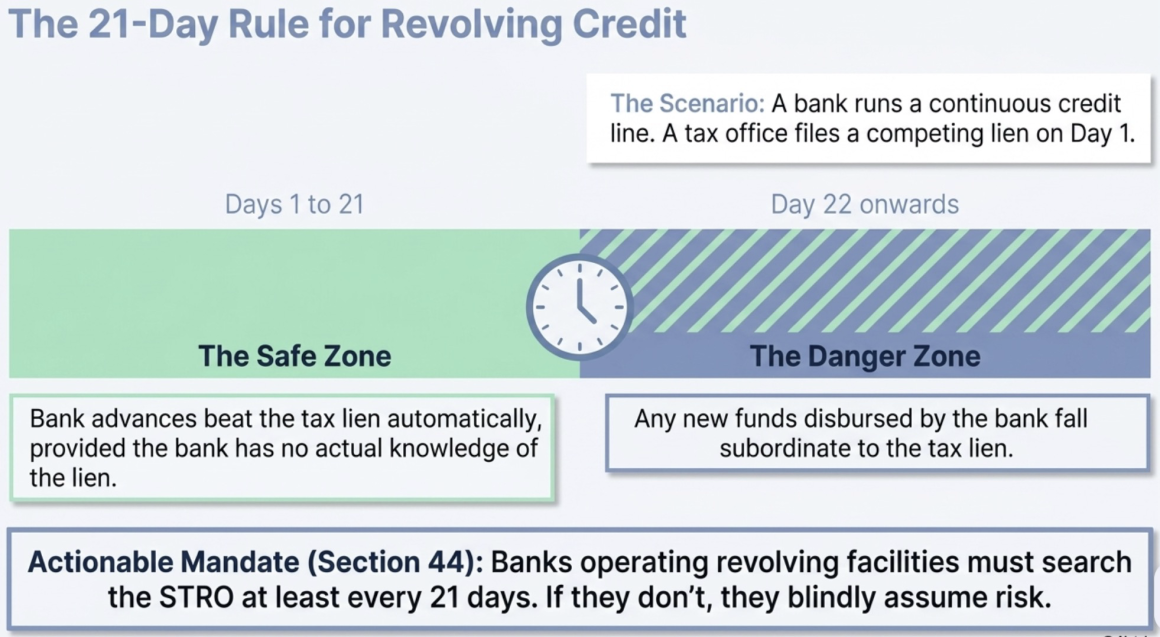
The 21-day rule under the Act is designed to balance banking practicality with creditor protection: it allows banks operating revolving credit facilities to continue routine loan disbursements without having to check the STRO every day, while also requiring them to periodically monitor for new competing claims. After 21 days from a lien registration, the risk shifts to the bank if it continues advancing funds without checking the registry. Yes, it is expected – and practically necessary – for a tax office or other statutory authority to register its lien at the STRO, because registration establishes its legal priority against secured lenders and triggers the statutory notice mechanism that can cut off a bank’s priority for future advances.
Part VIII: When the Borrower Defaults – Enforcement (Chapter 5: Sections 46–54)
The enforcement framework in Chapter 5 of the Act is where the law’s promise to creditors is either kept or broken. A security interest that cannot be enforced when a borrower defaults is not a security interest – it is an expensive piece of documentation. This Part examines what the Act gives a security holder on default, how it can be exercised, and what practical constraints exist in Nepal’s institutional environment.
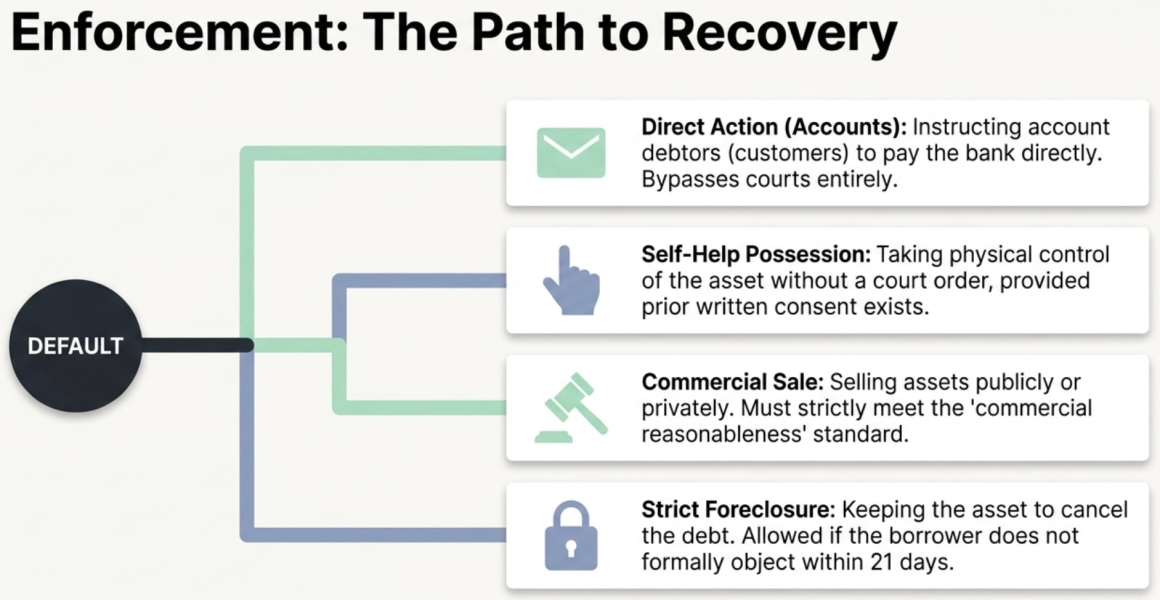
8.1 Default and the Menu of Remedies – Section 46
Section 46(1) allows the parties to define their own default triggers in the security agreement. Commercially, this typically includes: non-payment of any instalment; breach of financial covenants; insolvency proceedings; material misrepresentation; and cross-default clauses linking to other facility agreements with the same or other lenders.
On default, Section 46(2) gives the security holder five distinct rights:
- (ka) to take possession or control of the collateral;
- (kha) to sell, lease, or otherwise dispose of the collateral;
- (ga) to exercise rights provided under the Act;
- (gha) to exercise rights provided in the security agreement; and
- (nga) to exercise rights available under any other applicable law.
Section 46(3) confirms that all of these rights can be exercised simultaneously – a bank does not have to choose between taking possession and issuing a direct collection notice to the debtor’s customers.
For intangible collateral like accounts and secured sales contracts, Section 46(4) allows the security holder to enforce directly without any court action: the security holder can go straight to the debtors of those accounts and instruct them to pay, bypassing all civil procedure. This is the most commercially powerful provision for factoring and accounts receivable financing.
8.2 Direct Action Against Accounts – Section 47
Section 47(1) gives the security holder the right to notify obligors – the persons who owe money under the accounts – to pay directly to the security holder and to take control of all subsequent collections. This notification requires no court order and no advance warning period beyond the notification itself. A bank that has perfected its security interest in a company’s receivables can, upon default, write to all of that company’s customers instructing them to redirect their payments. The customers are legally obliged to comply once they receive such notification.
Section 47(2) sets out the financial accounting after collection: if the total collected exceeds the secured debt plus reasonable enforcement expenses, the surplus must be returned to the security giver. If the collected amount is insufficient, the security giver remains personally liable for the shortfall, unless the security agreement specifically provides otherwise.
8.3 Taking Possession – Section 48
Section 48(1) allows the security holder to take possession or control of the collateral without any court order – provided the security giver has given prior written consent in the security agreement. This is the “self-help” repossession right, borrowed from Article 9 of the UCC, and it is commercially powerful because it avoids the delay and cost of court proceedings.
If the security giver has not given written consent, or if the security giver physically resists repossession, Section 48(2) requires the security holder to obtain a court order. Section 48(2) specifies what the court must consider when issuing such an order: that the dispute relates to the collateral covered by the security agreement and to a default on the secured obligation. Section 48(3) gives the security giver the right to appeal a dispossession order directly to the Supreme Court. Section 48(4) allows the security holder to require the security giver to assemble scattered collateral and deliver it to a mutually convenient location. Section 48(5) allows the security holder to render equipment unusable in situ – by removing critical components – and conduct the sale from the debtor’s premises, avoiding the cost of physical relocation of heavy machinery.
In practice in Nepal, the self-help mechanism is most used for vehicle finance and gold loans, where the lender holds a power of attorney signed at origination and the asset is physically accessible. For hypothecated business assets – machinery, inventory, fixtures – BFIs typically invoke the BFI Debt Recovery Act rather than the STA’s self-help provisions, using a Debt Recovery Officer who prepares a Muchulka (मुचुल्का, inventory deed) in the presence of local witnesses before taking possession. Physical resistance by borrowers is common enough that lenders routinely request police and local administration assistance under BAFIA Section 57(13) rather than relying on the Act’s self-help right alone.
8.4 Sale and Disposal – Section 50
Section 50(1) gives the security holder broad authority: on default, it can sell, lease, license, or otherwise dispose of any or all collateral in any commercially reasonable manner. Section 50(2) allows the sale to be conducted publicly or privately, individually or as a package. Section 50(3) allows sale at any time, place, or on any conditions consistent with commercial reasonableness. Section 50(4) requires the security holder to give the security giver reasonable advance notice of the time and place of any public sale, or the time after which a private sale will proceed – except when the collateral is perishable, rapidly depreciating, or where giving notice would be practically impossible. Section 50(5) allows the security holder itself to purchase the collateral at either a public or private sale.
8.5 Distribution of Proceeds – Section 51
Section 51(1) establishes the mandatory priority order for distributing proceeds from collateral sale. This order is non-negotiable: the security agreement cannot vary it to the detriment of junior creditors who have submitted valid claims.
| Priority | Claim | Section | Notes |
| 1st | Reasonable enforcement expenses: repossession, storage, valuation, legal fees, sale preparation | 51(1)(ka) | Includes “reasonable” attorney fees, not unlimited |
| 2nd | The secured debt of the enforcing security holder | 51(1)(kha) | Full outstanding principal and interest |
| 3rd | Subordinate security interests: if written claim was submitted before proceeds were distributed | 51(1)(ga) | Junior lien holders must proactively assert their claims in writing |
| Surplus | Returned to the security giver | 51(2) | Security holder cannot retain surplus above debt + expenses |
| Deficiency | Security giver remains personally liable for shortfall | 51(2) | Unless security agreement explicitly states otherwise |
8.6 The Commercial Reasonableness Standard – Section 54
The security holder’s enforcement actions – the method of sale, the timing, the pricing, the procedures – must all conform to a standard of commercial reasonableness (व्यावसायिक मान्यता अनुरूप मनासिब तरिका). Section 54(2) establishes the obligation. Section 54(4) creates a critical safe harbour: the fact that a higher price might have been obtained by different timing or a different method does not, by itself, make the sale commercially unreasonable. A security holder who acts in a commercially defensible manner cannot be held liable merely because hindsight suggests an alternative approach might have generated more money.
Section 54(5) provides a second safe harbour: a sale conducted following the prevailing business practices of dealers in that type of property is deemed commercially reasonable. Section 54(6) provides the strongest safe harbour of all: any sale conducted pursuant to a court order or a court-supervised public auction is automatically deemed perfectly commercially reasonable. For this reason, many lenders in Nepal prefer to use the court-supervised auction process under BAFIA Section 57 rather than the Act’s private sale provisions, even where the Act’s provisions are faster – the court process insulates them from subsequent challenges by the debtor.
Section 54(3) sets out the remedy for breach of the commercial reasonableness standard: any person – the security giver, a subordinate lien holder who had submitted a written claim, or any other party who had notified the security holder of their interest before the sale – can recover damages from the security holder for losses caused by the breach. In practice, NRB’s mandatory requirement of independent valuation by approved evaluators before any collateral sale provides a regulatory floor for what constitutes “commercially reasonable” pricing in the Nepali context.
8.7 Strict Foreclosure: Keeping Rather Than Selling – Section 52
Sometimes a security holder prefers to retain the collateral in satisfaction of the debt rather than organise a sale. Section 52(1) allows this – called strict foreclosure or retention in satisfaction. The security holder must send a formal proposal to the security giver and to any other known security holders with claims in the collateral – Section 52(2). If any notified party submits a written objection within twenty-one days, the security holder must abandon the retention plan and proceed with a sale under Section 50 – Section 52(3). If no objection is received within twenty-one days, the security holder can retain the collateral and the debt is satisfied to the extent stated in the proposal – Section 52(4).
This provision creates a powerful negotiating tool. A lender holding NPR 500,000 in outstanding debt against gold worth NPR 800,000 can propose strict foreclosure – essentially offering to cancel the debt in exchange for keeping the gold permanently. If the borrower knows the gold is worth significantly more than the debt, they will object, forcing a sale from which they will receive the NPR 300,000 surplus. If the borrower does not respond, the lender keeps the gold and the NPR 300,000 difference becomes the borrower’s implicit loss.
8.8 The Security Giver’s Right of Redemption – Section 53
Until the security holder actually completes a sale or signs a binding sale contract, the security giver retains the absolute right to redeem the collateral by paying all outstanding secured obligations plus all reasonable enforcement expenses that the security holder has incurred – Section 53(1). This right cannot be waived in advance; it can only be waived in writing after default has occurred. A pre-default clause in the security agreement that attempts to waive the redemption right is void.
8.9 Deficiency Judgments in Practice
Section 51(2) confirms that if enforcement proceeds fall short of the outstanding debt, the security giver remains personally liable for the deficiency. The legal mechanism for pursuing this deficiency in Nepal runs through the Debt Recovery Tribunal (DRT), established under the Debt Recovery Act, 2058, which has exclusive jurisdiction over bank debt recovery claims above NPR 500,000. The DRT can, on a creditor’s petition, order the seizure and auction of any other assets belonging to the borrower or guarantor – even assets that were never pledged as collateral. The only DRT for the entire country operates in Kathmandu, with 451 pending cases as of mid-July 2024 and an average national contract enforcement timeline of 910 days.
The practical limitation of deficiency enforcement against a borrower who has genuinely exhausted all assets is that a deficiency judgment becomes a “paper judgment” – legally valid but operationally unenforceable in the short term. The real enforcement leverage in Nepal’s system operates through the Credit Information Bureau (CIB) blacklist: a borrower with an outstanding deficiency is blacklisted from all formal banking, barred from holding company directorships, and excluded from various government services. For most Nepali business owners, this operational exclusion from the formal financial system is a more immediate sanction than the prospect of additional civil execution proceedings.
Part IX: Nepal’s STA Against the International Blueprint
9.1 The Origins: UNCITRAL and UCC Article 9
The Secured Transactions Act is not an original Nepali legal creation. It is an adaptation of the global best-practice framework for movable asset security into Nepal’s legal and institutional context. Understanding what was taken from the international models, what was modified, and what was omitted is essential for understanding both the Act’s strengths and its gaps.
The Act draws primarily from the 1994 UNCITRAL legislative guide on security interests in goods (the precursor to the full 2016 UNCITRAL Model Law on Secured Transactions) and from Article 9 of the United States Uniform Commercial Code – the single most widely replicated commercial law reform instrument in the past century. Article 9 was introduced in the United States in 1952 and has been adopted, in varying forms, across over 100 jurisdictions. Its core innovation – the functional approach that treats all security arrangements over personal property under a single unified statute with a single public registration system – has been endorsed by the World Bank, the IMF, the Asian Development Bank, the International Finance Corporation, and UNCITRAL as a prerequisite for developing credit markets.
9.2 What Nepal’s Act Gets Right
The functional approach: Section 3(2)’s substance-over-form principle is textbook UCC Article 9 and is correctly implemented. This is the Act’s most important provision, and Nepal enacted it faithfully.
The notice-filing system: The STRO replicates the UCC’s filing office concept accurately. The STRO operates online, charges a flat fee, provides free public search, and registers notices rather than security agreement documents – exactly as the UCC model prescribes.
PMSI super-priority: Sections 34 and 35 directly and correctly parallel UCC Article 9-324’s super-priority for purchase money security interests. The distinction between equipment (simpler rule, five-day window) and inventory (advance notice requirement) reflects the original UCC policy rationale faithfully.
After-acquired property: The “future collateral” concept in Section 2(ta), combined with the general description permission in Section 22, creates the continuous-attachment mechanism that makes revolving facilities and floating charges function. This is correctly implemented.
The proceeds-tracking rule: Section 33’s automatic extension of a security interest to proceeds, subject to the twenty-day lapse rule for non-cash proceeds of a different type, mirrors the UCC’s approach accurately.
Anti-assignment unenforceability: Section 43’s rule that contractual restrictions on the transfer of accounts are unenforceable against third parties – examined further in Part X – is an important modernisation that directly follows the UCC model. It enables factoring and securitization markets to function.
9.3 What Nepal’s Act Omits or Simplifies
Missing: Perfection by Control
UCC Article 9 provides a third method of perfection – beyond filing and possession – called “perfection by control.” A secured party can perfect its interest in a deposit account (a bank account), investment property (electronic shares), electronic chattel paper, or letter-of-credit rights by entering into a “control agreement” with the account bank or intermediary. Under such an agreement, the secured party, the debtor, and the account bank agree that the secured party can direct the disposition of the account’s funds without further consent from the debtor. This is the primary mechanism for taking security over bank account balances in UCC jurisdictions.
Nepal’s Act has no equivalent. The Act’s provisions require either physical possession of cash (Section 26(5)) or STRO filing (Section 26(2)) for account balances. Neither works elegantly for a revolving bank account where the balance changes daily. The absence of control perfection means that securing bank account balances in Nepal – which would be the most liquid and reliable collateral for lenders – remains legally cumbersome. In practice, banks typically require fixed deposits (समयसीमा बचत) rather than operating accounts as cash collateral, because the fixed deposit can be physically “held” under the bank’s own systems.
For dematerialised share pledges, Nepal’s practical framework relies on Companies Act and CDSC procedures – the borrower instructs their Depository Participant to “freeze” the Demat account – rather than the STA’s provisions. The STA classifies share certificates as “instruments” under Section 2(kha) and perfects them by physical possession of the certificate under Section 26(4). This works for certificated shares but does not translate directly to dematerialised electronic holdings.
Missing: Detailed Conflict of Laws Rules
UCC Article 9 provides highly granular “choice of law” rules: the general rule is that the law of the jurisdiction where the debtor is located – typically their state of incorporation or principal place of business – governs perfection and priority of security interests in most types of personal property collateral. For specific collateral types (agricultural goods, real property fixtures, timber, minerals, and mobile goods), different rules apply. These rules allow parties in multi-state or multi-country financing transactions to determine with certainty which jurisdiction’s law governs their security interest.
Nepal’s Act is largely silent on these questions. Section 2(ta)’s definition of collateral explicitly includes offshore collateral – assets physically located outside Nepal. But the Act does not specify what happens when a Nepalese borrower pledges those assets to a Nepalese lender: which law governs perfection, which registry must be filed in, and how Nepali priority rules interact with the domestic law of the country where the asset is located. In the absence of explicit conflict of laws rules, Nepali courts would presumably apply lex situs – the law of the place where the asset is physically located – for tangible property, and the law of the debtor’s domicile or place of incorporation for intangible rights. But this is not specified in the Act and creates uncertainty for cross-border transactions.
The NRB has effectively resolved this uncertainty for the banking sector with a prohibition rather than a rule: NRB Unified Directive 2/2081, Clause 24 prohibits licensed BFIs from making loans against collateral located abroad if the institution cannot establish clear and enforceable legal rights in that jurisdiction. This is a practical regulatory solution that avoids the legal ambiguity – but it also closes off potentially legitimate cross-border secured lending that the Act’s broad collateral definition was designed to permit.
| Examples of Offshore Secured Transactions Offshore Receivables and Bank Accounts: A Nepalese IT exporting company pledges its USD funds held in a Singaporean bank account or its unpaid invoices (accounts receivable) from clients in the United States to a Nepalese bank to secure a local business loan. Cross-Border Equipment: A Nepalese construction company executing a project in India pledges its heavy machinery (such as excavators and bulldozers) that are physically located and operating at the Indian construction site to a commercial bank in Kathmandu. Transit Inventory and Offshore Warehouse Receipts: A Nepalese importing firm pledges the warehouse receipts for electronics that are temporarily sitting in a transit customs warehouse in Kolkata, India, to a Nepalese bank to secure financing for the shipment. Foreign Intellectual Property: A Nepalese software startup pledges its internationally registered trademarks or US-based patents (legally classified as intangible property) to a local Nepalese financial institution to secure expansion capital. |
Simplified Treatment of Accessions and Commingled Goods
UCC Article 9 has detailed rules for “accessions” – goods that are physically united with other goods while remaining identifiable, like a new engine bolted into an existing truck. Nepal’s Act handles combination of goods through Section 39 (सम्मिलन) in a more streamlined way, focusing primarily on fixtures (Section 37) and commingled goods (Section 40) without the detailed treatment of identifiable component-level security interests that Article 9 provides. In practice, disputes about specific components installed into larger industrial assets – specialised electronics integrated into aircraft avionics, or custom units built into large industrial machinery – would require judicial interpretation of the Act’s combination rules to resolve.
The “Muchulka” vs Pure Self-Help
Under UCC Article 9, self-help repossession by a secured party requires only that it can be done “without breach of the peace.” No witnesses are required, no inventory deed is mandated, and no local administration involvement is specified. In Nepal, the practical reality imposes additional procedural formality: the BFI Debt Recovery Rules require a Muchulka – an inventory deed prepared in the presence of at least two local witnesses – for business asset repossession. This requirement is not in the Act itself but emerges from the interaction between the Act’s self-help provision and Nepal’s broader institutional context. The Muchulka provides evidentiary protection for both parties and reduces subsequent disputes about what was taken – a practical adaptation to Nepal’s civil procedure environment.
9.4 Three Statutory Additions That Would Strengthen the Act
Three specific amendments to the STA would materially improve its functionality and bring it closer to the international standard:
First: Add perfection by control for deposit accounts and electronic investment property. This would allow a three-party control agreement among the secured party, the debtor, and the account bank – giving lenders a reliable, legally certain mechanism for taking security over bank account balances without the practical limitations of the current cash-possession rule.
Second: Add explicit conflict of laws rules. Specifying that the law of the debtor’s jurisdiction of organisation governs perfection and priority for most types of collateral (following the UCC model) would provide the legal certainty that cross-border secured lending requires.
Third: Add a true sale safe harbour for securitization transactions. The next Part examines this gap in detail.
Part X: The Advanced Application – PPA Receivables Securitization
The preceding nine Parts have built the legal architecture: what the Act covers, how a security interest is created, how it is perfected, how priority is determined, and how it is enforced. This final substantive Part applies that entire framework to one of the most complex and commercially significant transactions in Nepal’s financial landscape: the securitization of Power Purchase Agreement (PPA) receivables from a hydropower generation plant.
This capstone is not theoretical. Nepal requires approximately USD 46.5 billion in energy sector investment to reach its 2035 hydropower target of 28,500 MW, as documented in the Land Locked Credit article. Domestic commercial banking capacity – with total commercial bank assets of approximately NPR 5,500 billion (about USD 40.7 billion) and Single Obligor Limits (SOL, एकल ऋणी सीमा) of 25% of core capital – cannot finance this pipeline without foreign co-financing and structured finance instruments. Securitization of hydropower cash flows is one mechanism to bridge the gap. The Secured Transactions Act is the legal foundation for that mechanism.
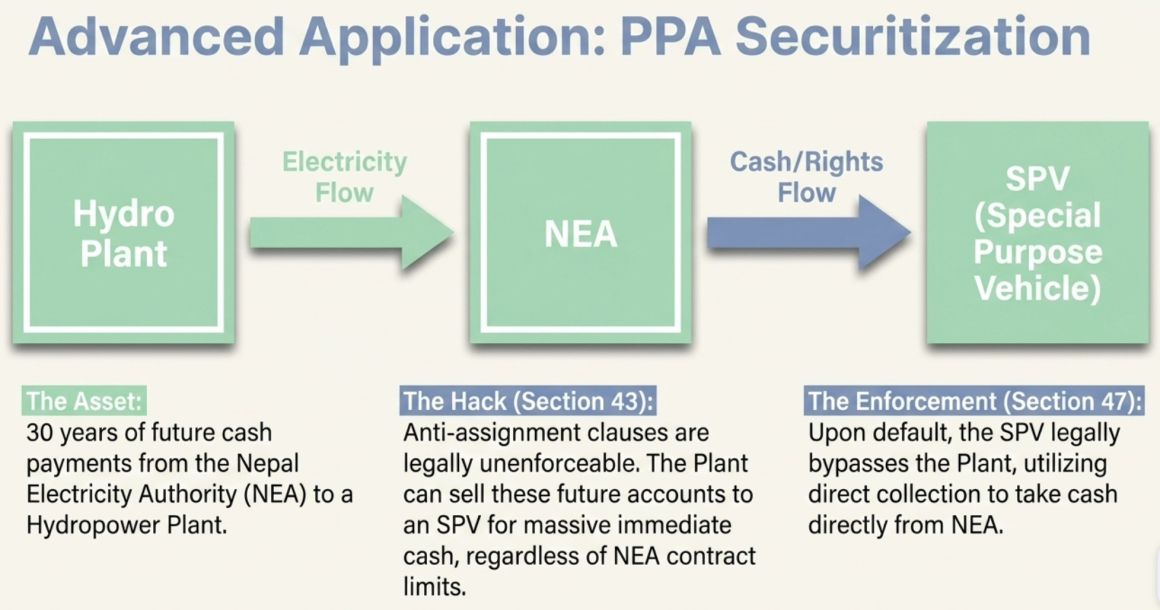
10.1 What Is a PPA Receivable?
A hydropower plant enters a Power Purchase Agreement with Nepal Electricity Authority (NEA). Under this contract, the plant agrees to generate and deliver electricity over a period of typically twenty-five to thirty-five years, and NEA agrees to pay a fixed tariff per unit of electricity delivered. The plant’s contractual right to receive those future payments is a “PPA receivable.”
Before the plant generates its first unit of electricity, PPA receivables are contingent: they will only materialise if the plant actually generates and delivers power as contracted. But the contractual right to receive payment already exists from the day the PPA is signed. That right – present, real, but dependent on future performance – is an asset with a quantifiable present value. In structured finance, the act of selling or pledging that right to raise immediate capital is called securitization of the receivables.
10.2 How the Act Classifies PPA Receivables
The classification question is foundational: what type of property are PPA receivables under the Act, and which provisions govern their creation, attachment, perfection, and enforcement? The answer requires careful application of Section 2.
Section 2(fa) defines an “account” (बहीखाता) as the right to receive payment created by the sale or lease of goods or the provision of services, where that right is not already evidenced by an “instrument” under Section 2(kha) or a “secured sales contract” under Section 2(tra).
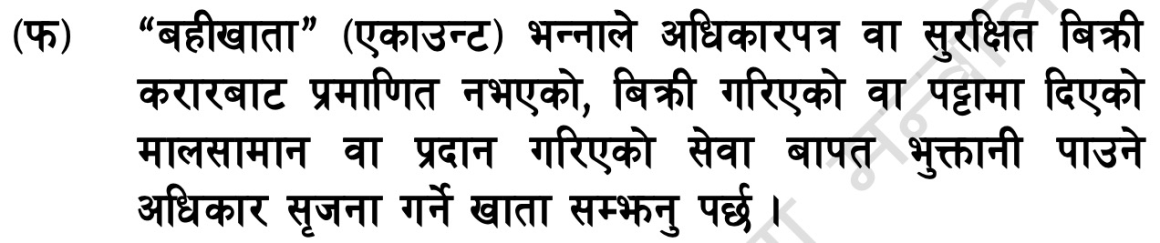
A hydropower plant generates and delivers electricity – this constitutes either the provision of a service or the sale of a commodity (electricity is generated, transmitted, and delivered as a commercial product). NEA pays for each unit delivered. The plant’s right to receive that payment is the right to receive payment for services rendered or goods sold. It is not evidenced by a formal instrument or secured sales contract in the Act’s defined senses. Therefore, PPA receivables are “accounts” under Section 2(fa).
The contingent and future nature of PPA receivables does not take them outside the Act’s scope. Section 2(ta)’s definition of collateral explicitly includes “collateral to be created in the future” (भविष्यमा सृजना हुने धितोको सम्पत्ति). A right to receive payment that will only materialise upon future electricity generation is a future account – expressly covered. The Act was designed for exactly this scenario: revolving credit against future receivables, supply chain finance against not-yet-earned service fees, and long-term structured finance against multi-year contract entitlements.
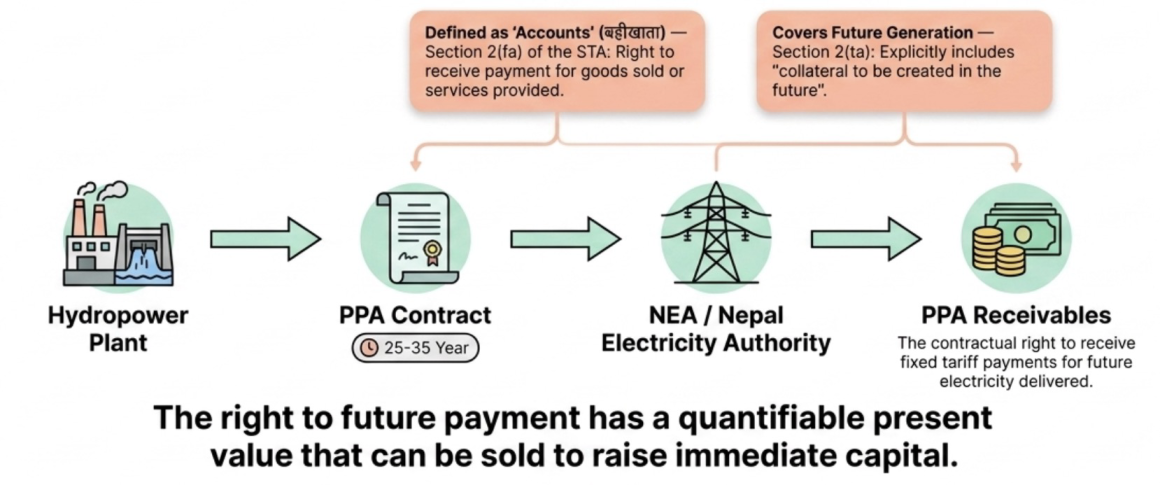
10.3 The Securitization Chain Under the Act
Step 1: The Security Agreement – Section 23
The hydropower plant (security giver / seller of accounts) and the securitization vehicle (security holder / buyer of accounts) enter a written security agreement. The agreement describes the collateral with the precision required by Section 22: “all present and future accounts arising from the Power Purchase Agreement dated [date] between [Plant Name] and Nepal Electricity Authority, including all amounts payable for electricity units generated and delivered thereunder throughout the term of the agreement.”
This description satisfies Section 22’s “reasonably identifies” standard without requiring a general “all assets” description: the collateral is identified by reference to a specific, named contract with a specific counterparty. Any person reading the STRO search result would know precisely which receivables are covered.
Step 2: Attachment – Section 25
The security interest attaches when all three conditions of Section 25(1) are simultaneously met. The security agreement with collateral description: satisfied. The security holder giving value: satisfied when the securitization vehicle pays the present value of the future cash flows to the plant. The plant having rights in the collateral: satisfied – the plant is the counterparty to the PPA and holds the contractual right to receive electricity payments. Attachment occurs at the moment of payment, which is typically the closing date of the securitization transaction.
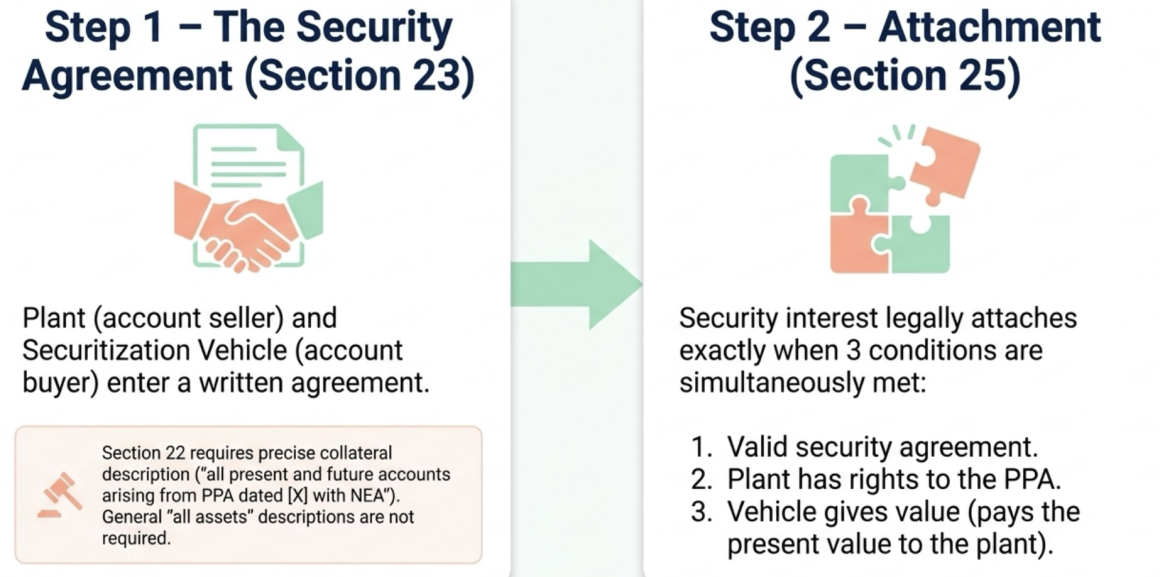
Step 3: Perfection – Section 26(2)
PPA receivables are accounts – intangible movable property. The general rule of Section 26(2) applies: perfection requires filing a notice at the STRO. The securitization vehicle files an initial notice describing the plant as security giver, itself as security holder, and the PPA receivables (specifically described by reference to the PPA) as collateral. The priority date is the exact filing timestamp. No other security holder who files after that moment can claim priority over those specific receivables.
Step 4: Anti-Assignment Clauses Are Unenforceable – Section 43
PPA agreements typically contain assignment restriction clauses requiring NEA’s prior written consent before the plant can assign or transfer its receivables. In conventional contract law, such a clause would prevent the plant from securitizing its receivables without NEA’s approval.
Section 43 changes this entirely. It explicitly states that any contractual agreement between a borrower and a secured party that prohibits or restricts the sale or transfer of accounts is legally unenforceable as between the account seller and the account buyer. The securitization vehicle can purchase the PPA receivables from the plant regardless of any consent requirement in the underlying PPA. While this may technically constitute a breach of the PPA’s consent provision by the plant (which could theoretically give NEA a contractual claim against the plant), it does not invalidate the transfer of the accounts to the securitization vehicle or create any right for NEA to refuse to pay the vehicle once properly notified.
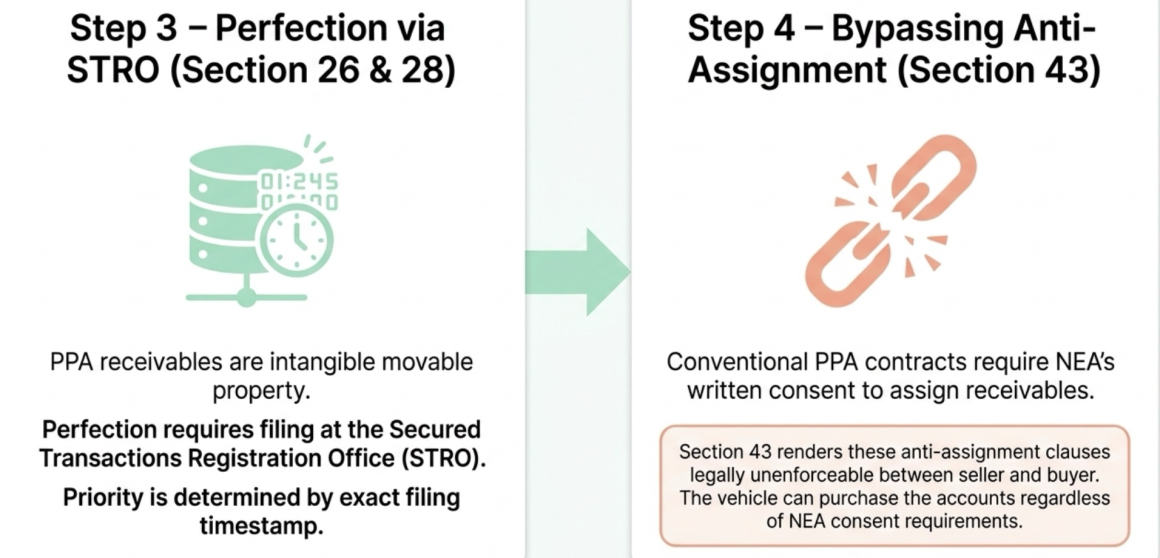
Step 5: Direct Collection from NEA – Section 47
Once the securitization vehicle holds a perfected security interest in the PPA receivables, and the plant defaults on its obligations under the securitization agreement, Section 47(1) gives the vehicle the right to notify NEA directly – as the obligor (दायित्व वहन गर्ने व्यक्ति) on the PPA accounts – and instruct it to remit all future electricity payments directly to the vehicle’s account rather than to the plant. No court order is required. A properly worded written notification is sufficient. NEA, having received this notification, is legally required to comply and to pay the vehicle. This is the enforcement mechanism that gives PPA securitization its practical power: the vehicle does not need to seize physical assets; it simply redirects a government-to-plant payment stream.
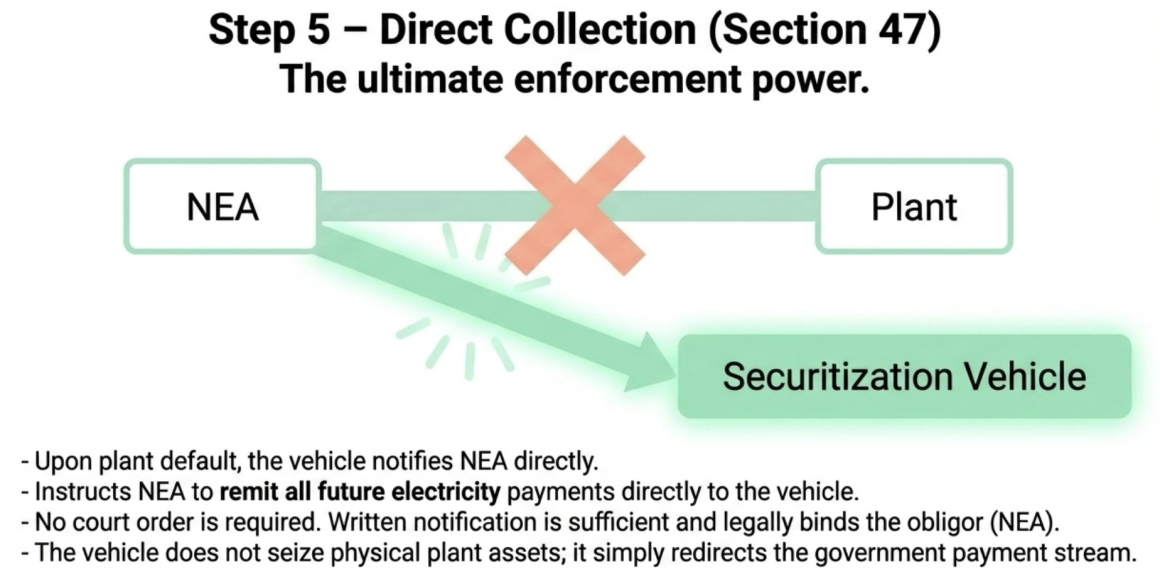
10.4 The True Sale Risk – Section 3(2)
For a securitization to achieve “off-balance-sheet” treatment – removing the receivables from the plant’s balance sheet and thereby insulating investors from the plant’s insolvency – the transfer of receivables must constitute a genuine sale, not a disguised secured loan.
This is where Section 3(2)’s substance-over-form principle creates legal risk. If the securitization retains significant recourse to the originator – for example, if the plant must buy back non-performing receivables, or if the vehicle’s investors are effectively guaranteed a return regardless of actual electricity generation – a Nepali court or the NRB could recharacterize the “sale” as a secured loan. The practical consequences of recharacterization are severe: the receivables would be treated as remaining on the plant’s balance sheet, the vehicle’s “ownership” would be reclassified as a security interest, and in the plant’s insolvency, the receivables could be swept into the general estate available to all creditors rather than being ring-fenced for the vehicle’s benefit.
Nepal’s STA does not provide an explicit “true sale” safe harbour – a statutory provision that defines the criteria under which an account sale is conclusively treated as a sale rather than a secured loan. The UCC provides clearer guidance through its treatment of account sales as a category distinct from secured loans. The NRB’s Capital Adequacy Framework addresses this from a regulatory perspective by requiring that risk transfer be “significant” for capital relief, but this is a prudential test, not a legal bright-line rule for recharacterization purposes.
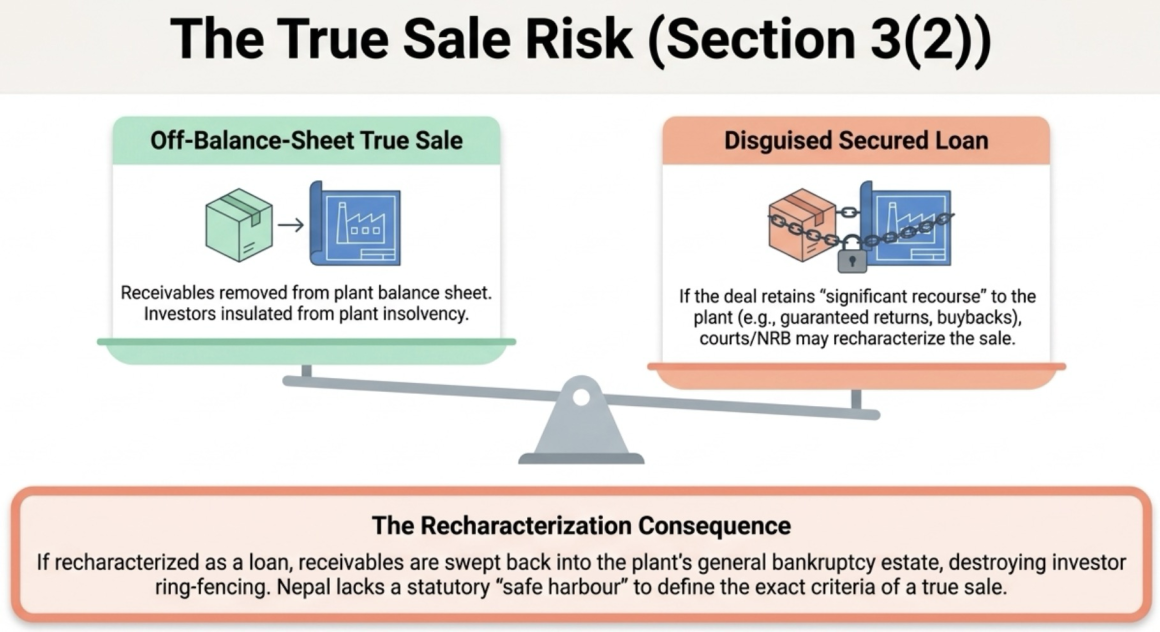
10.5 The SPV Problem
International securitization practice requires the receivables to be transferred to a Special Purpose Vehicle (SPV) that is “bankruptcy-remote” – structurally insulated from the originator’s insolvency so that the receivables cannot be swept into the originator’s estate if it fails. Bankruptcy remoteness is achieved through a combination of legal entity isolation (the SPV has no operations other than holding the securitised receivables), contractual protections (limits on the SPV’s ability to incur other debts or obligations), and statutory recognition (specific insolvency rules that protect SPV assets from consolidation with the originator’s estate).
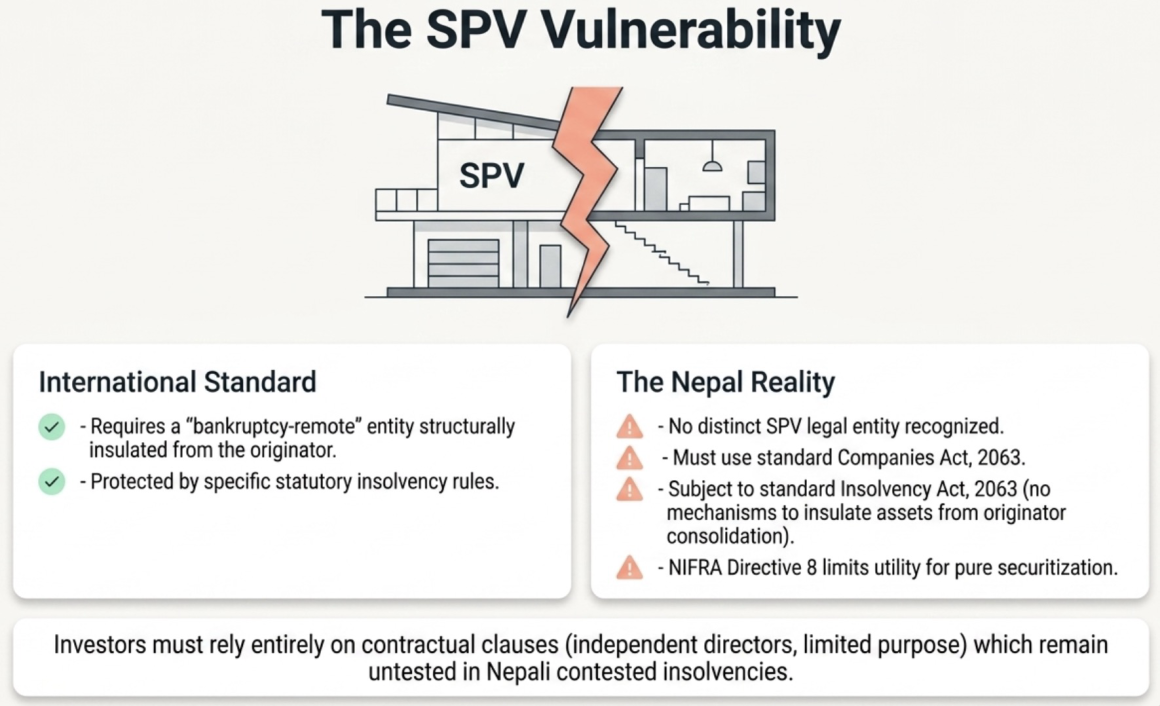
Nepal does not currently recognise SPVs as a distinct legal entity type. An SPV must be incorporated as a regular company under the Companies Act, 2063, which subjects it to the standard corporate governance, tax, and insolvency regime applicable to any Nepali company. The Insolvency Act, 2063 provides no specific mechanism for insulating an SPV’s assets from insolvency proceedings against the originator. NIFRA Unified Directive No. 8, Clause 3(nga) does contemplate infrastructure SPVs for project development, but with restrictions that limit their utility for pure securitization structures.
The practical consequence is that investors in a PPA securitization in Nepal must rely on contractual protections – limited-purpose clauses, independent director requirements, restrictions on other business, pledge of account arrangements – rather than statutory protection. These contractual protections are robust in normal conditions but may not survive a contested insolvency proceeding, particularly given Nepal’s limited judicial experience with complex structured finance disputes.
10.6 What the Act Provides and What It Needs
The STA provides the foundational legal architecture for PPA securitization:
- PPA receivables are “accounts” under Section 2(f
- a) – within the Act’s scope
- Security interest attaches on payment and agreement – Section 25
- Perfection by filing at the STRO – Section 26(2)
- First-to-file priority – Section 28
- Anti-assignment clauses unenforceable – Section 43
- Direct collection from NEA without court order – Section 47
- Future and contingent receivables covered – Section 2(ta)
What the Act needs for robust securitization infrastructure:
- A true sale safe harbour: statutory criteria distinguishing a genuine account sale from a disguised security interest
- Explicit conflict of laws rules: critical when the vehicle or investors are foreign
- Statutory recognition of bankruptcy-remote SPVs: possibly through amendment to the Insolvency Act or a standalone securitization statute
- Clarity on the tax treatment of account transfers: the Income Tax Act, 2058, Section 57’s ownership-change provisions create significant friction for debt-to-equity conversions and corporate restructuring, and similar clarity is needed for securitization transfers
These gaps explain why Nepal’s current structured finance activity relies on complex contractual engineering rather than statutory protection. Closing them is not merely a legal technicality – it is a prerequisite for accessing the international capital markets that Nepal’s energy investment pipeline requires.
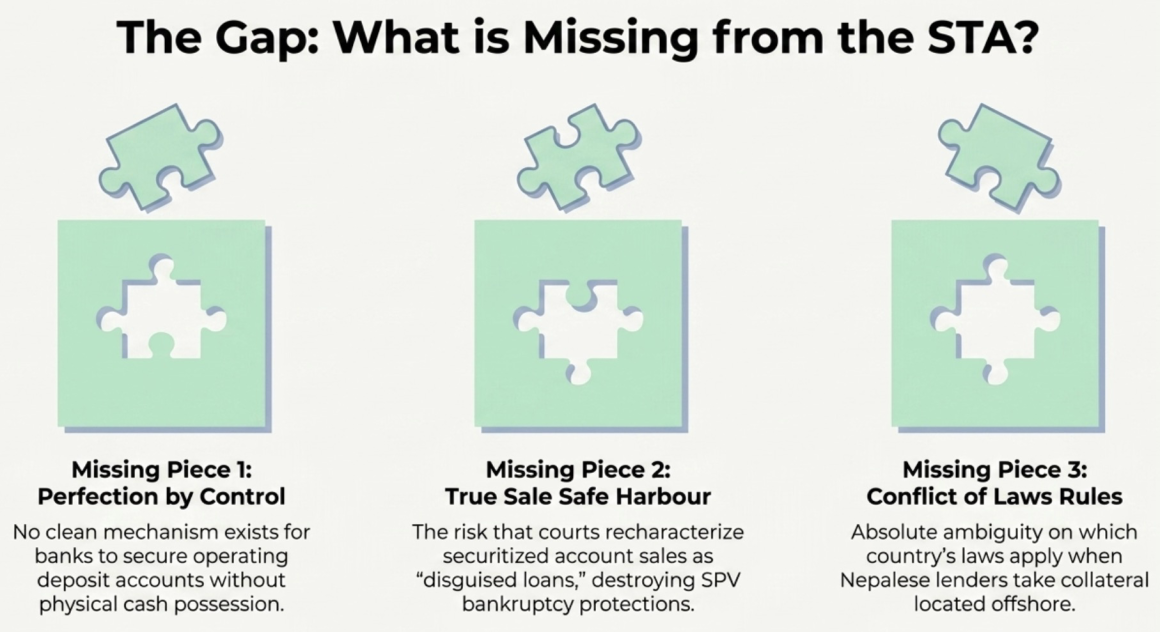
Part XI: The Reform Agenda
The Act is not the problem. The problem is the gap between what the Act provides on paper and what actually happens in Nepal’s credit markets. Closing that gap requires reform at three layers – supervisory enforcement, capital structure, and statutory amendment – in sequence. The second and third layers cannot be effective without the first. The first requires no new legislation.
11.1 Layer 1: Supervisory Enforcement (No New Legislation Required)
The STRO is already built and operational at stro.org.np. NRB has already mandated pre-lending STRO searches (Working Capital Loan Guidelines, 2079) and post-disbursement STRO filing (Unified Directive 21/2081). The Capital Adequacy Framework 2015, Clause 3.4 already withholds Credit Risk Mitigation capital relief for movable charges not registered with a registrar. Three specific NRB actions – all within existing authority under NRB Act, 2002, Section 79 – would transform the STRO from an available option to a functional component of the credit system.
First: Add STRO filing compliance as a mandatory, separately reported metric in NRB Bank Supervision Report templates and on-site inspection checklists. For every loan file involving movable collateral, the supervisor must verify that a STRO search was conducted before disbursement and a STRO notice was filed within the prescribed timeline. Non-compliance should be treated as a collateral documentation failure, triggering the same provisioning consequence as any other documentation deficiency.
Second: Issue explicit supervisory guidance operationalising CAF 2015, Clause 3.4: any movable asset collateral for which no STRO filing can be evidenced in the credit file is automatically excluded from Credit Risk Mitigation calculation, and the full counterparty risk weight (100% or 150%) applies. This guidance requires no amendment to the Capital Adequacy Framework – it operationalises what Clause 3.4 already says.
Third: Require KSKL to publish quarterly STRO aggregate statistics: number of initial notices filed, active notice count, search volume, and sectoral distribution by collateral type and BFI category. Without this transparency, neither NRB nor the banking sector can assess whether the mandate is being followed or where the compliance gaps are concentrated.
| Reform 1 from Land Locked Credit: The NPR 300–500 Billion Opportunity Land Locked Credit (April 2026) quantifies what enforced STRO compliance could unlock: NPR 300–500 billion (~USD 2.2–3.7 billion) in additional credit capacity within 24 months, by enabling verification and priority establishment for movable security without additional bank capitalisation. This number is not speculative. It reflects the credit gap created by the 40-percentage-point capital cost differential between land-backed lending (60% risk weight under CAF 2015) and movable-asset lending without CRM qualification (100% risk weight). Once STRO filing is consistently used, verified, and enforced – qualifying movable charges for CRM capital relief under CAF 2015, Clause 3.4 – that differential narrows. The capital freed from the risk-weight differential directly supports additional lending capacity. All three supervisory actions are within NRB’s existing authority under Section 79 of the NRB Act, 2002. None requires parliamentary legislation. The STRO exists. The mandate exists. The capital incentive exists. The reform required is enforcement, not construction. |
11.2 Layer 2: Capital Structure Reform (NRB Directive Amendment Required)
Once Layer 1 is operational and STRO filing is consistently enforced, the forty-percentage-point capital cost differential between land-backed and movable-asset lending loses its justification. The differential exists because movable collateral cannot be verified without a registry. Once verifiable and consistently filed, the information asymmetry is resolved and the capital penalty is an artifact of an earlier era of Nepal’s financial infrastructure.
Layer 2 requires NRB to amend the Capital Adequacy Framework 2015 to create a new category of eligible collateral: “Registered Movable Asset Charge – STRO-Perfected.” For security interests registered at the STRO within thirty days of creation and verified as first-priority through a current STRO search: apply a supervisory haircut (recommended: 20%, consistent with the haircut applied to other-BFI Fixed Deposits under NRB Unified Directive 2/2081); allow the net-of-haircut value to reduce credit exposure for risk-weighting purposes, producing a blended effective risk weight; set a minimum floor risk weight of 50% for the most liquid registered categories such as trade receivables from rated counterparties. This reform must follow, not precede, Layer 1. Reducing risk weights before the registry is consistently used creates incentives to assert unverifiable or inflated filings. The sequence is non-negotiable.
11.3 Layer 3: Statutory Amendments to the Act Itself (Parliamentary Legislation Required)
Three specific amendments to the STA would address the gaps identified in Part IX and close the structural legal deficiencies for structured finance identified in Part X.
Add perfection by control for deposit accounts and electronic investment property. This requires defining “control agreement” as a three-party arrangement among the secured party, the debtor, and the account-holding institution, where the secured party can direct the account without further debtor consent. This is the mechanism that makes bank account security commercially reliable and would enable lenders to take effective security over business’ operating accounts.
Add explicit conflict of laws rules. The amendment should specify that the law of the jurisdiction of the security giver’s principal place of business or registered office governs the perfection and priority of security interests in most categories of movable collateral, with specific rules for goods in transit, tangible assets in fixed locations, and intangible rights. This would give cross-border lenders the legal certainty they currently lack.
Add a true sale safe harbour for securitization transactions. The amendment should specify the criteria under which a transfer of accounts constitutes a genuine sale for all purposes under Nepali law, rather than a security interest disguised as a sale. These criteria would typically include: no recourse or limited defined recourse from buyer to seller; no ability of the seller to reacquire the transferred accounts; effective transfer of credit risk; and independence of the SPV from the originator’s insolvency. Establishing these criteria in statute would remove the legal uncertainty that currently makes PPA securitization and other structured finance transactions rely on contractual engineering rather than statutory protection.
Conclusion: The Foundation Is Already Laid
The Secured Transactions Act, 2063 is a technically sophisticated, internationally-grounded framework for movable asset security in Nepal. In its sixty sections, it covers every category of commercial lending against movable property: from a rural cooperative holding a farmer’s gold in its vault, to a commercial bank taking a floating charge over a manufacturer’s entire present and future inventory, to a securitization vehicle purchasing twenty-five years of electricity payment rights from a hydropower plant. The Act’s functional approach – treating all security arrangements by economic substance rather than legal form – eliminates the definitional games that allowed borrowers to circumvent protection before 2063.
Its core infrastructure innovation is the Secured Transactions Registration Office: a publicly searchable, electronically maintained, timestamp-prioritised database that allows any lender, anywhere, to verify in seconds and at zero cost whether a borrower’s movable assets are already encumbered. The Act’s priority rules, enforced through the STRO filing system, eliminate the double-pledging problem that the NRB Bank Supervision Report identified in 2013 and has continued to identify every year since. They do so not through criminal deterrence alone – though the Act does criminalise false filings under Section 55 – but through the simpler mechanism of making prior claims visible. You cannot double-pledge what a lender can check before disbursing.
The STRO has been live since May 2017. It has recorded 537,000 filings. It charges NPR 500 to register and provides free public search. The mandate for BFIs to use it exists in NRB Unified Directive 21/2081, the Working Capital Loan Guidelines 2079, and the Capital Adequacy Framework 2015. The law is complete. The registry is operational. The mandate exists.
And yet: land-backed credit stood at 64.4% of total BFI credit as of November 2025. NRB Bank Supervision Reports continue to identify double-pledging as a sector-wide problem. The software company with NPR 50 million in annual contracts still cannot access a working capital line from any commercial bank. The agricultural development bank nominally dedicated to rural credit holds 97.5% of its portfolio in land-secured loans.
The gap between the Act’s promise and Nepal’s credit market reality is not a gap in the law. It is a gap in the institutional infrastructure that makes law operational. The Malpot Rokka costs NPR 50 and works because it is embedded in every BFI’s supervision template, compliance checklist, loan documentation protocol, and credit culture. The STRO costs NPR 500, provides stronger legal protection, and does not work at scale because that embedding has not happened. Building it – through the three supervisory actions that Land Locked Credit identified as Reform 1 – requires no new legislation and no new institution. It requires supervisory will.
The reform agenda at Layer 2 and Layer 3 – capital structure adjustment and statutory amendment – follow from Layer 1. They cannot precede it. But when they do follow, the STA becomes the legal foundation for structured finance instruments that Nepal’s economy desperately needs: securitization of hydropower receivables to unlock international capital, warehouse receipt credit to give landless farmers access to working capital against their harvest, share pledge mechanisms for technology entrepreneurs, and movable-asset-backed SME loans for the manufacturers whose declining share of GDP documents the cost of the current collateral monoculture.
–
This article is part of a continuing series on Nepal’s financial and legal infrastructure. Related reading: