Link to another post containing FAQs: Link here
Nepal's Carbon Trading Legal and Policy Framework
I. Constitutional Foundation
- Article 30 (Right to Clean Environment): Guarantees every citizen’s right to live in a clean and healthy environment, with compensation rights for victims of environmental pollution. This provides the constitutional mandate for carbon trading as an emission reduction and environmental finance mechanism.
- Article 51 (State Policies): Directs sustainable use of biodiversity through forest conservation and prioritizes national investment in water resources and renewable energy—principles guiding subsequent laws including the National Climate Change Policy (2019).
II. Primary Policy Framework
National Climate Change Policy (2019)
- Section 8.12 (Climate Finance Management): Lists Carbon Trade alongside REDD+ and the Green Climate Fund as key international financial mechanisms; encourages private sector finance mobilization through Carbon Offset.
- Section 8.12(b): Mandates at least 80% of climate finance from international mechanisms be mobilized at the local level.
- Section 10 (Federal Responsibility): Assigns federal government responsibility to prepare the carbon registry and coordinate/facilitate carbon trade.
- Section 12 (Legal Provisions): Mandates formulation of a National Strategy for Carbon Trade and Low Carbon Economic Development Strategy. Status: The Low Carbon Economic Development Strategy is realized through the Long-term Strategy for Net-zero Emissions (2021); the Carbon Trade Strategy is operationalized through the National REDD+ Strategy and CDM mechanisms.
Environment Protection Act (2019)
Chapter 4, Section 28 (Provisions Relating to Climate Change):
- Section 28.1: Authorizes GoN to participate in carbon trading through mechanisms established by international treaties, foreign governments, institutions, or private sector for emission reduction and carbon sequestration.
- Section 28.2: Mandates benefit-sharing arrangements be determined by prescribed rules.
- Section 24: Empowers government to identify GHG-emitting sectors and determine national reference levels (technical baseline for trading).
Environment Protection Regulations (2020)
Note: Carbon trading chapters removed by Rule 36 of Carbon Trading Regulations 2082. Key remaining provisions:
- Rules 37 & 38 (Environment Protection Fund): Carbon trading revenues deposited into the Fund are authorized for environmental conservation, pollution control, heritage conservation, and environmental protection programs.
- Rule 3 & Schedules (Environmental Assessment): Mandates IEE/EIA for forestry and energy projects before generating carbon credits—applies to all “development proposals” including emission reduction projects to prevent local environmental harm.
III. Long-term Climate Strategy
Nepal’s Long-term Strategy for Net-zero Emissions (LTS, October 2021)
Submitted to UNFCCC under Article 4.19 of the Paris Agreement and COP decision 1/CP.21. Outlines pathway to net-zero by 2045.
Carbon Trading Provisions:
- Chapter 3 (Means of Implementation): States carbon market will play key role in GHG mitigation; identifies cross-border energy trade as opportunity for ITMOs under Article 6 and non-market mechanisms under Article 6.8.
- Executive Summary, Point 6 (Energy Trade Strategy): Notes significant emission reductions achievable outside Nepal through hydro/solar exports.
- Section 2.2.4 (Carbon Offsetting Potential): Analyzes clean energy trade implications; suggests Nepal could achieve net-zero earlier if carbon offset benefits from exports are shared by neighboring countries.
- Section 2.2.4 (Carbon Accounting): Highlights need for Article 6 agreements on carbon accounting to recognize Nepal’s global emission reduction contributions through exports.
The LTS fulfills the function of the mandated Low Carbon Economic Development Strategy and serves as Nepal’s roadmap for carbon-neutral, climate-resilient development.
IV. Forestry Sector
Forest Act (2019)
Chapter 13 (Environmental Services):
- Section 44(1): Grants GoN authority to manage environmental services from national forests.
- Section 44(1)(a): Specifically addresses carbon sequestration—GoN determines management of benefits from climate change adaptation, carbon sequestration, and emission reduction.
- Section 44(1)(b): Distinguishes carbon services from other environmental services; carbon-related services handled separately under clause (a) due to their link to international mechanisms.
National Forest Policy (2019)
- Section 6.2 (Objectives): Contribute to national goal of reducing carbon emissions from forest sector.
- Section 8.5 (REDD+): Strategy to receive payments from international mechanisms for emission reductions; develop accounting system for forest sector’s environmental and carbon sequestration contribution.
- Section 12 (Financial Aspects): Lists international carbon emission reduction payments as major funding source for forest conservation.
- Background: Recognizes carbon sequestration payments as key opportunity; emphasizes equitable benefit distribution.
National REDD+ Strategy (2018)
Key mechanisms:
- Equitable Benefit Sharing: Just distribution of carbon and non-carbon benefits; securing livelihoods of forest-dependent communities. Aligns with National Climate Change Policy Section 8.2(i) on just distribution of REDD+ and CDM benefits.
- Institutional Development: Developing REDD Implementation Centre as centre of excellence on mitigation and carbon trading; capacity building for international mechanism access.
- International Financing: Framework for accessing CDM and REDD+ resources; results-based payments under Warsaw Framework; REDD+ credits eligible under CORSIA.
- Eligible Activities: (a) Reducing deforestation emissions; (b) Reducing forest degradation emissions; (c) Conservation of forest carbon stocks; (d) Sustainable forest management; (e) Enhancement of forest carbon stocks.
Private and Community Forests
Private Forests (Environment Protection Regulations 2020):
- Private forest owners may include forests in carbon trading under Ministry-approved action plans.
- Trading definition: minimum 0.5 hectares, 10% canopy density, 5-meter tree height.
- GoN often acts as selling entity in national/international markets, or private sector sells directly as prescribed.
Community Forests:
- Governed under CBFM and REDD+ mechanisms.
- National Forest Policy (2019) targets increased carbon stocks with local community benefit access.
- Community forests recognized as successful model for carbon stock restoration.
- National Climate Change Policy mandates 80% of international climate finance reach local level.
Common Requirements:
- FPIC: Free, prior, and informed consent required from affected communities.
- Biodiversity Protection: Activities must not degrade biological diversity.
- Pricing: Unit price determined through mutual negotiation between GoN and purchasing entity.
- Documentation: Project Idea Note and Project Design Document required, evaluated by Technical Committee.
V. Energy Sector
Green Hydrogen Policy (2023)
- Strategy 9.3: Promote carbon trading by reducing emissions through green hydrogen and co-products.
- Working Policy 9.3: Implemented through (a) promoting hydrogen-powered vehicles; (b) commercial use in steel/cement industries; (c) replacing petroleum products with hydrogen-based fuels.
- Acknowledges green hydrogen supports Nepal’s zero carbon commitment and generates foreign currency.
Hydropower
Project Development Agreements (e.g., Upper Trishuli-1): Company has sole discretion to pursue GHG Reduction Benefits. GoN owns benefits; Company has exclusive marketing/sales rights. Revenue split: 50% to GoN, 50% to Company (after costs). Defines CDM as market-based mechanism under Kyoto Protocol.
Hydropower EIA Manual (2018): Section 8.1.8: Requires EIA to assess GHG emissions through project lifecycle; notes storage dams may release methane/CO2 affecting net carbon footprint and credit eligibility.
Rural Energy Policy (2006)
- Section 10.7: Mandates carbon revenue from rural energy GHG reductions be utilized for rural energy promotion and development—ring-fencing carbon finance for sector sustainability.
Environment Friendly Vehicle and Transport Policy (2014)
- Section 6(ङ): Policy aims to reduce transport emissions and promote carbon trading for poverty reduction and sustainable economic development.
- Section 9.6: Mandates Low Carbon Economic Development Strategy; links transport emission reductions to carbon trading for economic contribution.
Renewable Energy Subsidy Policy (2016)
While not explicitly mentioning “carbon trading,” establishes operational framework enabling it:
- Section 1 & 4 (Additionality): Documents financial barriers justifying carbon project additionality.
- Section 16 (Subsidy Delivery Mechanism): Mandates AEPC-prepared mechanism where carbon rights transfer is operationalized.
- Section 13.1 (AEPC Authority): Designates AEPC as coordinating entity bundling small projects into tradable assets.
- Section 5 (SDG Alignment): Supports high-quality credit standards requiring SDG alignment.
- Section 14 (MRV): Requires trimester and annual on-site monitoring plus third-party verification—essential for carbon credit verification.
VI. National Planning
16th Five-Year Plan (FY 2024/25–2028/29)
Financial Resource Mobilization:
- Lists carbon tax alongside green finance and green bonds as alternative investment sources.
- Climate finance strategy explicitly includes benefiting from carbon trade.
- Notes existing World Bank agreement for US $45 million carbon trade.
Forestry and Carbon:
- Strategic goal: sustainable forest management to increase carbon reserves.
- Major program: link forest management with carbon sequestration and entrepreneurship.
Fiscal Instruments:
- Environmental fees based on carbon emissions.
- Incentives for carbon emission reduction technologies.
Quantitative Targets (2028/29):
- NPR 100 million from payment for ecosystem services (carbon and others).
- 15,000 tons CO2e emission reductions through alternative energy (baseline: 2,100 tons).
Foreign Policy (2020)
- Section 8.7, Strategy 5: Adopts strategy to emphasize implementation of Carbon Trading provisions through international coordination for environmental conservation.
VII. Institutional Arrangements
Multi-tiered Framework:
- Apex Body: Environment Protection and Climate Change Management National Council (PM-chaired)—policy guidance and resource management.
- Coordination: Inter-Ministerial Climate Change Coordination Committee (IMCCCC), chaired by MoFE.
- Provincial: Provincial Climate Change Coordination Committees (PCCCC) for provincial integration.
- Implementation: REDD Implementation Centre (forestry carbon); AEPC (renewable energy credits).
Ministry of Forests and Environment (MoFE):
- UNFCCC focal point; coordinates international climate negotiations.
- Authorized to sell carbon emissions reductions in national/international markets.
- Climate Change Management Division coordinates NAP, NDCs, and carbon trading technical aspects.
- Formulates carbon trading laws, standards, and guidelines.
- Coordinates international climate finance access.
Designated National Authority (DNA):
- MoFE serves as DNA under Environment Protection Regulations (2020).
- Functions: Evaluates PINs and PDDs; facilitates private sector CDM participation; provides technical support; manages and regulates CDM activities; facilitates credit trade; maintains carbon registry.
VIII. NDC 3.0 (2025)
Article 6 Adoption:
- Prioritizes climate actions for carbon market under Articles 6.2 (bilateral/ITMOs) and 6.4 (centralized mechanism).
- Ensures no double counting and environmental integrity.
Institutional Infrastructure:
- National carbon registry for tracking credits.
- Regulations and comprehensive carbon marketing guidelines.
- Legal foundation: Environment Protection Act (2019) and Regulations (2020).
Sector-Specific Strategies:
- Forestry (LULUCF): Expand REDD+ coverage; promote private/family forest participation.
- Energy/Green Hydrogen: Carbon financing for green hydrogen and distributed renewable energy.
- Transportation: Mandate tourism transport carbon offset measures by 2030.
Carbon Pricing:
- Carbon tax as domestic revenue source alongside PPPs and venture capital.
- Carbon market participation to generate revenue for climate projects.
Funding Context: USD 62.9 billion required from international sources; carbon market framework designed to package Nepal’s achievements into tradable financial assets.
IX. Other Relevant Legislation
Solid Waste Management Act (2011): Establishes legal basis for resource recovery (energy/fertilizer) and private sector involvement—prerequisites for carbon projects like CDM biogas programs.
Hydropower Development Policy (2001): Does not address carbon trading.
Electricity Act (1992): Does not address carbon trading; regulates physical electricity generation and sale.
Who does Carbon Trading Regulation 2082 apply to?
The Carbon Trading Regulation, 2082 is applicable to various entities defined as “Proponents” (Prastawak) who wish to develop projects for carbon trading, as well as government bodies involved in the process.
Here is a breakdown of who the regulation applies to:
- Eligible Proponents (Participants) The regulation explicitly defines a “Proponent” as any of the following entities that develop a project to participate in carbon trade:
- Registered Companies: Any company registered within Nepal.
- Joint Ventures: A Joint Venture (JV) formed between a foreign company and a company registered in Nepal.
- Government and Statutory Bodies: Institutions established under prevailing federal laws, or government institutions and bodies owned by or under the Government of Nepal, Provincial Governments, or Local Levels.
- Government Entities The regulation grants specific authority to government levels to engage in carbon trading:
- The Government of Nepal: Can participate directly through international treaties, or bilateral agreements with foreign governments, institutions, or the private sector.
- Provincial and Local Governments: Agencies under these governments must obtain consent from their respective executive bodies/ministries to sell carbon credits.
- Non-Governmental Organizations (NGOs) and Private Sector
- Non-Market Projects: NGOs, the private sector, and government bodies can implement “Non-market based” carbon projects (focused on knowledge transfer or community benefit) after obtaining implementation permission from the Ministry. NGOs specifically require approval under the Social Welfare Act if receiving foreign aid for this purpose.
- Domestic Market: The private sector and government bodies can participate in Nepal’s internal voluntary carbon market.
- Existing Clean Development Mechanism (CDM) Projects The regulation applies to projects already licensed and operating under the Clean Development Mechanism (CDM) prior to the commencement of this regulation. These projects are considered approved under this new regulation but must pay prescribed fees and submit reports.
- Applicable Sectors The regulation applies to entities developing projects in the following sectors:
- Renewable Energy: Hydropower, solar, wind, and biogas.
- Energy Efficiency: Industrial efficiency and improved cooking stoves.
- Agriculture, Forestry, and Land Use: National/private forests, afforestation, and sustainable forest management.
- Waste Management: Waste-to-energy and landfill management.
- Transport: Electric vehicles and sustainable public transport.
- Adaptation and Resilience: Projects promoting a green economy and biodiversity conservation.
What mode of carbon trading is envisioned under the regulation?
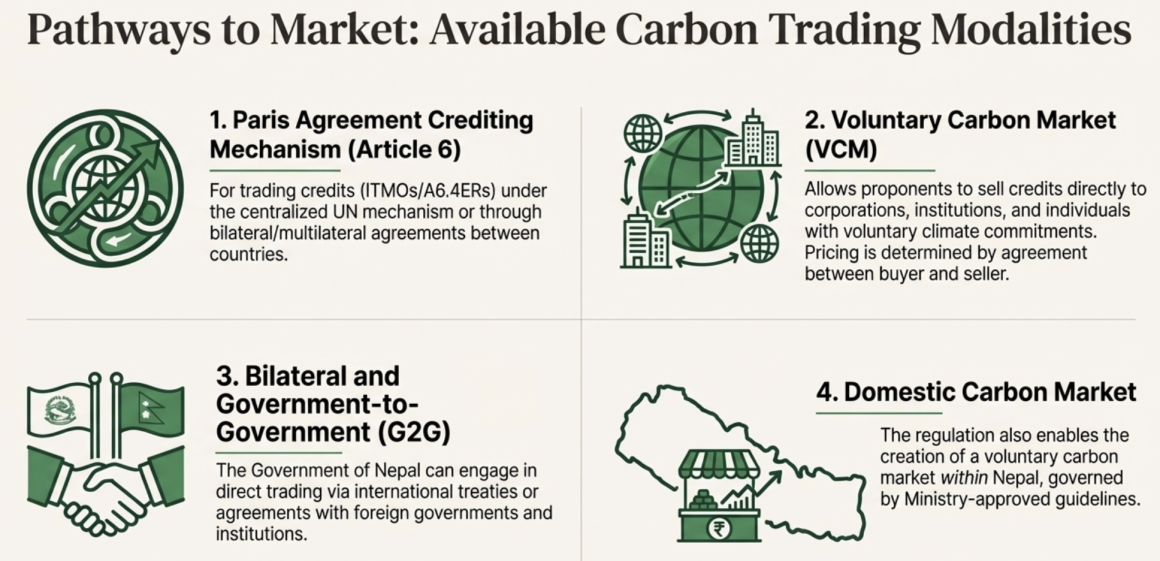
- Paris Agreement Crediting Mechanism The regulation explicitly defines carbon trading to include activities under the “Crediting Mechanism” of the Paris Agreement.
- Definition: Trading is conducted under the mechanisms established by the 2015 Paris Agreement.
- Voluntary Carbon Market (VCM) The regulation recognizes and regulates the Voluntary Carbon Market, allowing proponents to sell credits to entities outside of government compliance schemes.
- Scope: The definition of “Carbon Trading” explicitly includes the purchase and sale of carbon credits in the “Voluntary Carbon Market”.
- Pricing: For projects in the voluntary market, the price of carbon credits is determined by the agreement between the proponent (seller) and the buyer.
- Bilateral and Government-to-Government (G2G) Trading The regulation empowers the Government of Nepal to engage in direct trading through treaties and agreements.
- Modes of Agreement: The government can trade via:
- International treaties or mechanisms.
- Bilateral agreements with foreign governments.
- Agreements with foreign institutions or the private sector.
- B2B under G2G: If the Nepal government signs a bilateral agreement with a foreign government allowing commercial entities to trade, business-to-business (B2B) trade is permitted under those specific treaty terms.
- Domestic Carbon Market The regulation envisions the creation of an internal market within Nepal.
- Internal Trading: Government bodies, the private sector, and other entities can participate in a “Voluntary Carbon Market within Nepal”.
- Regulation: This internal market will be governed by specific guidelines approved by the Ministry.
- Non-Market Based Approaches While not “trading” in the commercial sense, the regulation allows for “Non-market based carbon projects.”
- Purpose: These projects focus on knowledge transfer, technology development, and community capacity building rather than selling credits for profit.
- Requirement: Entities must obtain implementation permission from the Ministry for these projects.
What is the entire process a proponent has to follow in order to engage in carbon trading? from start to the end?
The process for a proponent to engage in carbon trading is a structured, multi-stage procedure involving conceptualization, approval, implementation, verification, and trading. Here is the step-by-step process from start to end:
Phase 1: Project Concept and Preliminary Consent
- Preparation of Project Concept Note The proponent must first prepare a Project Concept Note following the format prescribed in Schedule-2 of the regulation. This must be done for a project within the eligible sectors (e.g., Energy, Forestry, Waste Management) listed in Schedule-1.
The Project Concept Note (Schedule 2) is the preliminary application submitted to obtain consent to proceed. It must include:
- Proponent Details: Name, address, type (Government/Private), company registration, and tax details.
- Project Overview: Name, major objectives, and a description (max 500 words).
- Financial & Trading Estimates: Estimated cost of the project and the estimated volume of carbon trading.
- Benefit Sharing: An estimated outline of the benefit-sharing plan.
- International Partners: Details of any international company involved (if applicable).
- Sector & Mechanism: The specific sector (e.g., Energy, Forestry) and the chosen mechanism (Paris Agreement Crediting Mechanism vs. Voluntary Carbon Market).
- Location: Proposed province, local level, and ward number.
- Attachments: Company registration, tax clearance, local level recommendation letter, and any documents required by the UN Framework Convention on Climate Change (UNFCCC).
Schedule 1 of the regulation lists the specific sectors eligible for developing carbon trading projects:
1. Renewable Energy Development: Projects related to hydropower, solar, wind, and biomass energy proposed for carbon emission reduction. It also includes small and medium energy systems initiated by rural communities not connected to the national grid.
2. Energy Utilization and Efficiency: Industrial energy efficiency programs aimed at reducing emissions during production/processing, and projects like improved cooking stoves for urban and rural energy saving.
3. Agriculture, Forestry, and Other Land Use (AFOLU): Projects based on agricultural promotion, afforestation on empty land, natural regeneration, and sustainable forest management aimed at increasing carbon storage in national forests, private forests, and agricultural lands.
4. Waste Management: Projects generating energy from waste or waste management systems designed to reduce emissions at landfill sites.
5. Transport Sector: Electric vehicles (EVs) and infrastructure, and sustainable public transport systems aimed at reducing fossil fuel use.
6. Adaptation and Resilient Benefits: Projects that support a green/circular economy while reducing carbon emissions, such as those enhancing food and water security, health security, biodiversity conservation, and sustainable natural resource management.
- Submission for Recommendation The proponent must submit the Concept Note along with required documents (company registration, tax clearance, local level recommendation, etc.) to the appropriate body for a recommendation:
- For Forestry Projects: Submit to the REDD Implementation Centre under the Ministry.
- For Other Projects: Submit to the relevant Sectoral Ministry.
- Obtaining Recommendation and Submission to Ministry The REDD Implementation Centre or the Sectoral Ministry must provide a recommendation letter within 15 days of receiving the application. Once the proponent receives this recommendation, they must submit the Concept Note and the recommendation to the Ministry of Forests and Environment (MoFE) to seek consent to prepare the full Project Document.
- Evaluation and Consent The Ministry forwards the Concept Note to the Management Committee for evaluation based on criteria like national commitments, geographical area, and socio-economic impacts. If improvements are needed, the proponent is given up to 15 days to revise the note. Upon successful evaluation and recommendation by the committee, the Ministry grants a Consent Letter to the proponent within 15 days to proceed with drafting the Project Document.
The Carbon Trade Management Committee is a technical body established under the Ministry to manage the operational aspects of carbon trading.
Composition: The committee is chaired by the Chief of the Climate Change Management Division. Members include Under-Secretaries from the Ministry of Finance, Law, the REDD Implementation Centre, the relevant Sectoral Ministry, the Alternative Energy Promotion Centre (AEPC), and a Deputy Director from Nepal Rastra Bank. The Under-Secretary looking after carbon trade functions as the Member-Secretary.
Functions and Duties:
1. Policy & Guidelines: Drafting guidelines related to carbon trade to submit to the Steering Committee.
2. Technical Support: Assisting the Designated National Authority (DNA) on technical matters.
3. Expert Roster: Preparing a roster of subject matter experts for approval.
4. Prioritization: Prioritizing carbon projects and conducting research/studies for policy reforms.
5. Evaluation: The committee is responsible for evaluating Project Concept Notes and Project Documents to ensure they meet national criteria and do not result in double counting.
Phase 2: Project Document and Final Approval
- Preparation of Project Document The proponent must prepare a detailed Project Document (following Schedule-3) within one year of receiving the Consent Letter.
- Extension: If unable to complete it in time, the proponent may request an extension. The Ministry can extend the deadline by up to one year based on justification. If not submitted by then, the consent is automatically cancelled.
The Project Document (Schedule 3) is the detailed proposal submitted after receiving consent. It requires:
1. Background & Methodology: Detailed project background, objectives, working procedure, and scope of work.
2. Beneficiaries: The number of beneficiaries and details of the working area.
3. Risk Mitigation: Measures adopted to minimize social, economic, and environmental risks.
4. Strategic Alignment: Details on how the project contributes to Sustainable Development Goals (SDGs) and Nepal’s Nationally Determined Contributions (NDC).
5. Implementation & Benefit Sharing: A concrete implementation framework and a detailed benefit-sharing plan.
6. MRV Plan: Methods for Measurement, Recording, Reporting, and Verification of carbon credits.
7. Exit Strategy: Strategy for project renewal and eventual exit.
8. Stakeholder Consultation: Evidence or documents showing discussions held with local stakeholders.
9. Trading Details: Estimated quantity of carbon credits to be traded and details of the international buyer.
- Submission for Final Recommendation Similar to the Concept Note phase, the Project Document must first be submitted to the REDD Implementation Centre (for forest projects) or the Sectoral Ministry (for others). They must provide a recommendation letter within 15 days.
- Final Submission and Evaluation The proponent submits the recommended Project Document to the Ministry. The Management Committee evaluates it to ensure no double counting and checks alignment with the Nationally Determined Contribution (NDC) and Sustainable Development Goals (SDGs). The committee may invite experts for independent evaluation.
- Payment of Fees and Issuance of Approval Once the Project Document is approved by the Ministry (within 15 days of committee recommendation), the proponent must pay a fee based on the project size:
- Small Projects (<20,000 tons/year): NRs. 25,000.
- Medium Projects (20,000–60,000 tons/year): NRs. 50,000.
- Large Projects (>60,000 tons/year): NRs. 100,000. Upon payment, the Ministry issues an Approval Letter within 7 days. This approval is valid for five years and can be renewed twice (maximum 15 years total).
- Registration If the project intends to trade under the Paris Agreement mechanisms, the proponent must register the project with the relevant international mechanism and inform the Ministry to receive a project registration number.
Phase 3: Implementation and Agreements
- Project Implementation The proponent must start implementing the project within one year of approval and inform the Ministry.
- Extension: A one-year extension can be granted upon request. Failure to show progress may lead to cancellation of the approval.
- Signing Agreements The proponent must sign agreements with:
- Contributors/communities helping in emission reductions.
- National or international buyers purchasing the carbon credits. Certified copies of these agreements must be submitted to the Ministry.
Phase 4: Verification and Crediting
- Measurement, Reporting, and Verification (MRV) The proponent must ensure emission reductions are measured and reported according to standards recognized by the Paris Agreement or relevant mechanisms.
- Verification: An independent third party recognized by the mechanism must verify the report.
- Submission: The verification report is submitted to the Designated National Authority (DNA).
- Issuance of Carbon Credits Based on the verification, a certificate stating the quantity of carbon credits is issued. The DNA ensures no double counting occurs.
Phase 5: Trading and Benefit Sharing
- Mandatory NDC Deduction Before selling, 5% of the total verified carbon credits must be deducted and counted towards Nepal’s Nationally Determined Contribution (NDC). Only the remaining 95% can be traded.
- Payment of Sales Fee To sell the remaining credits, the proponent must pay a fee of NRs. 100 per ton to the government.
- Sales and Corresponding Adjustment The proponent sells the credits. If trading internationally, the DNA must perform a Corresponding Adjustment (deducting from Nepal’s registry and adding to the buyer’s) to prevent double counting. The DNA’s consent is required for the transfer.
- Benefit Sharing Profits must be distributed according to the Benefit Sharing Plan outlined in the Project Document. Private Sector Requirement: If the proponent is a private entity, they must allocate 10% of the profit to the Government of Nepal.
Here is the verified breakdown of effective total payments/obligations to the Government of Nepal (GON):
Payment Head | Rate / Amount | Nature |
NDC Deduction | 5% of Total Credits | Asset Deduction (Non-sellable) |
Sales Fee | NRs. 100 per ton | Cash Payment (On sellable volume) |
Benefit Sharing | 10% of Profit | Cash Payment (Private Sector only) |
Project Fee | NRs. 25k / 50k / 100k | One-time Fee (Renewable) |
Income Tax | As per Tax Act | Corporate Tax |
Phase 6: Reporting and Compliance
- Annual Reporting The proponent must submit an annual report of carbon trading activities to the DNA within three months of the end of the fiscal year.
What is the timeline of the key activities from start to end for the perspective of the proponent?
Here is the timeline for a proponent to engage in carbon trading:
Phase | Activity | Timeline / Deadline | Authority Involved |
1. Concept | Get Recommendation | Within 15 Days of application. | REDD Centre (Forests) or Sectoral Ministry |
Get Consent | Within 15 Days of committee recommendation. | Ministry of Forests & Environment (MoFE) | |
2. Design | Draft Project Document | Within 1 Year of Consent Letter | Proponent |
Get Final Recommendation | Within 15 Days of submission. | REDD Centre or Sectoral Ministry | |
Get Final Approval | Approval: Within 15 Days. | MoFE | |
3. Execution | Start Implementation | Within 1 Year of Approval | Proponent |
Register Project | Before trading. | International Body / MoFE | |
4. Trading | Measurement & Verification | Periodically (as per mechanism). | Third-Party Verifier |
Sales & Transfer | Upon issuance of credits. | Designated National Authority (DNA) | |
5. Reporting | Annual Reporting | Within 3 Months of Fiscal Year end. | DNA |
Explain the registration process under phase 2 step 9.
The registration process under phase 2 step 9 is a dual-layer mechanism designed to link a specific project to both the international carbon market and the national government’s climate commitments.
- Registration with the Relevant International Mechanism The regulation requires the proponent to first register with the international mechanism governing the specific type of trade. Under the Paris Agreement, this generally refers to two distinct pathways:
- Article 6.4 Mechanism (Sustainable Development Mechanism): This is a centralized UN-run mechanism (successor to the Clean Development Mechanism or CDM). To register here, a proponent must follow specific methodologies approved by the UN Supervisory Body to prove that emission reductions are real, verifiable, and additional. This involves validation by third-party auditors and issuance of credits (A6.4ERs) by the UN body.
- Article 6.2 Cooperative Approaches (ITMOs): This involves bilateral or multilateral agreements between countries to trade “Internationally Transferred Mitigation Outcomes” (ITMOs). Registration here would involve listing the project under the specific registry systems set up by the cooperating countries (e.g., a bilateral agreement between Nepal and another country).
- Informing the Ministry (National Registration) Once the project is engaged internationally, the proponent must “inform the Ministry” (Ministry of Forests and Environment – MoFE) to receive a national project registration number. This step is critical for compliance and accounting for the following reasons:
- Authorization and Environmental Integrity: Under the Paris Agreement, the host country (Nepal) must formally authorize the transfer of carbon credits for them to be sold internationally. The Ministry acts as the Designated National Authority (DNA) to ensure the project aligns with national sustainable development goals.
- Corresponding Adjustments: To prevent double counting (where both the seller and buyer claim the same emission reduction), Nepal must apply a “corresponding adjustment” to its national ledger. This means Nepal subtracts the sold credits from its own Nationally Determined Contribution (NDC) registry so the buyer can claim them.
- National Registry Tracking: The Ministry maintains a national registry to track all climate finance and carbon trade projects. By issuing a registration number, the government tracks the project’s contribution to national targets and ensures that the mandatory 5% deduction for Nepal’s NDC (as mentioned in the 2082 Regulation) is enforced.
Summary of the Workflow
1. Project Design: The proponent designs a project using approved international methodologies (e.g., for hydropower or forestry).
2. International Registration: The project is registered with the UN body (Article 6.4) or a bilateral partner (Article 6.2).
3. National Notification: The proponent submits the international registration details to the MoFE.
4. National ID Issuance: MoFE records the project in the national registry for NDC accounting and issues a Project Registration Number, authorizing the project to generate and sell credits.
How is Verification and Crediting under Phase 4 done?
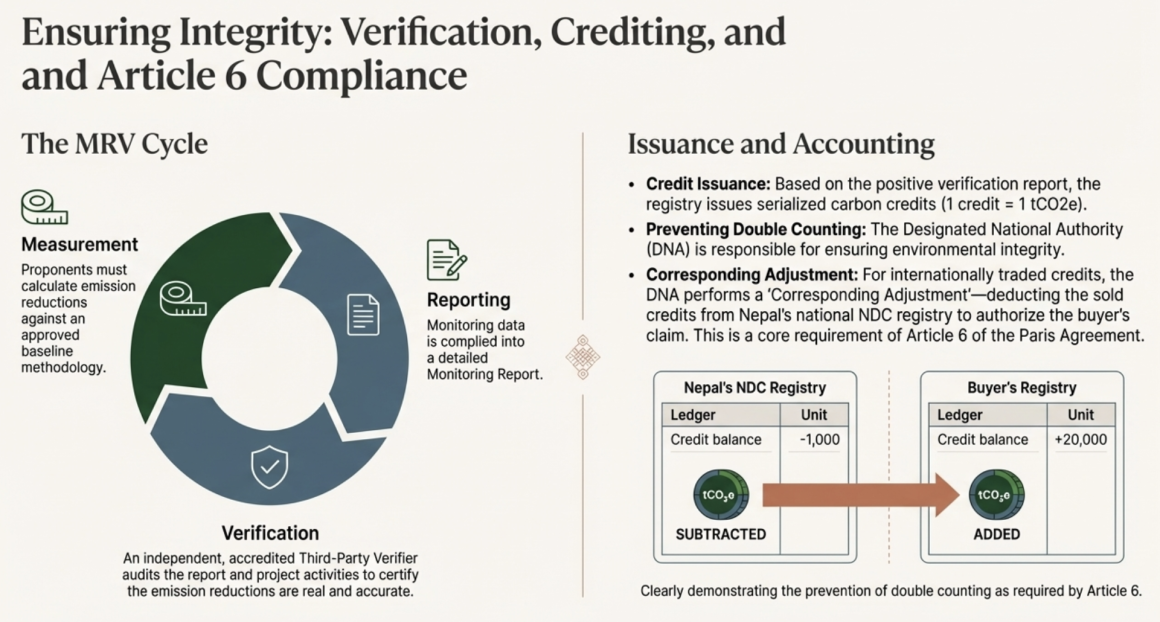
- Measurement, Reporting, and Verification (MRV) This step transforms the physical activity of a project (e.g., generating electricity from hydro, planting trees) into a tradable financial asset. It is a rigorous cycle designed to prove that the emissions reductions are real.
- Measurement (Monitoring) The proponent does not simply guess the emission reductions. They must calculate them using a specific Approved Methodology (a scientific formula accepted by the UNFCCC or the relevant standard).
- The Baseline Scenario: The proponent calculates what would have happened without the project. For example, in a biogas project, the baseline is that households would burn firewood, releasing CO2.
- The Project Scenario: The proponent measures what actually happened. For example, they count how many biogas digesters are operational.
- The Calculation: Baseline Emissions minus Project Emissions equals Emission Reductions.
- Data Collection: The proponent must continuously collect data (e.g., electricity meter readings, liters of fuel saved, forest growth rates) throughout the crediting period.
- Reporting Once the data is collected, the proponent compiles it into a Monitoring Report. This report details the performance of the project over a specific period (e.g., one year). It includes the raw data, the calculations used, and proof that the project is still operational.
- Verification (The Audit) This is the quality control step. The regulation requires an Independent Third Party to verify the report. In international markets, these auditors are often called Designated Operational Entities (DOEs) or Validation and Verification Bodies (VVBs).
- Independence: The auditor cannot be the same entity that designed or manages the project. They must be accredited to ensure they are objective.
- The Process: The auditor visits the project site, interviews stakeholders, checks the calibration of metering equipment, and recalculates the emission reductions to ensure no errors or fraud occurred.
- Submission: Once the auditor certifies the report, this Verification Report is submitted to the Designated National Authority (DNA) (in Nepal, the Ministry of Forests and Environment).
- Issuance of Carbon Credits Once the DNA receives the positive verification report, the physical emission reductions are converted into digital credits.
- The Certificate (Credit Issuance) Based on the verified quantity (e.g., 1,000 tons of CO2 reduced), the registry issues a certificate. These are essentially digital serial numbers. Each credit represents one tonne of CO2 equivalent (tCO2e) removed or avoided. Common names for these credits include CERs (Certified Emission Reductions) under the UN system, or VCUs (Verified Carbon Units) under voluntary standards like Verra.
- Prevention of Double Counting (Role of the DNA) The regulation emphasizes that the DNA must ensure no double counting occurs. This is the most critical regulatory function in the Paris Agreement era.
- The Problem: If a Nepalese hydropower project sells a carbon credit to a company in Switzerland, that emission reduction cannot be counted towards Nepal’s own national climate targets (NDC). If both Nepal and the buyer count it, it is “double counting”.
- Corresponding Adjustment: To prevent this, the DNA performs a “Corresponding Adjustment.” When a credit is authorized for international sale, the DNA subtracts that reduction from Nepal’s national ledger and adds it to the buyer’s ledger. This ensures the atmosphere only sees the reduction counted once.
- Registry Tracking: The DNA maintains a Carbon Registry to track the unique serial numbers of every credit generated. Once a credit is sold or “retired” (used to offset emissions), it is permanently removed from circulation so it cannot be sold again.