
Part 1: Foundations & Core Concepts
1. What is the economic rationale for carbon trading?
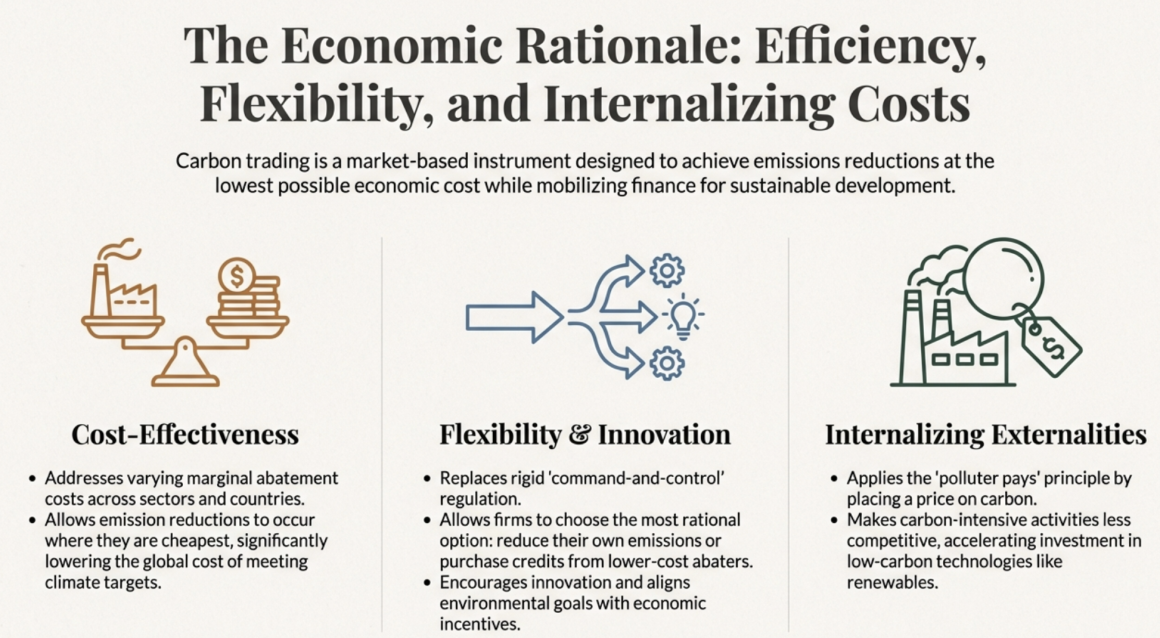
The economic rationale for carbon trading lies in its ability to reduce greenhouse gas emissions in a cost effective and efficient manner while mobilizing financial resources for sustainable development and climate resilience. It applies market principles to environmental regulation by placing a price on carbon emissions and allowing economic actors to trade emission allowances.
From an economic perspective, carbon trading minimizes the overall cost of achieving emission reduction targets. The cost of reducing emissions, known as marginal abatement cost, differs widely across countries, sectors, and firms. Some actors can reduce emissions at relatively low cost, while others face much higher costs. Carbon trading allows emission reductions to occur where they are cheapest, rather than forcing uniform reductions across all emitters. This significantly lowers the global cost of meeting climate targets.
Carbon trading also provides flexibility compared to traditional command and control regulation. Instead of mandating specific technologies or fixed emission limits for each polluter, a trading system allows firms to choose the most economically rational option. Emitters may reduce their own emissions if it is cheaper to do so, or purchase emission permits or credits from others who can achieve reductions at lower cost. This flexibility encourages innovation, improves compliance efficiency, and aligns environmental objectives with economic incentives.
Overall, carbon trading internalizes the environmental cost of emissions, promotes efficient resource allocation, and enables climate mitigation to be achieved at the lowest possible economic cost while supporting sustainable development outcomes.
2. Why is carbon trading important?
Carbon trading is important because it integrates climate mitigation with economic efficiency, development financing, and environmental accountability. It enables countries, particularly developing economies such as Nepal, to mobilize financial resources, internalize environmental costs, manage residual emissions, and generate economic value from natural ecosystems.
Mobilizing finance for development in the Nepal context
For Nepal, carbon trading is a strategic tool for mobilizing alternative sources of finance to address development and climate investment gaps. The Sixteenth Plan identifies carbon trading as a mechanism to bridge resource constraints required for sustained economic growth and graduation from Least Developed Country status. It recognizes carbon markets as a means to supplement domestic resources and attract external finance.
Nepal’s Nationally Determined Contribution 3.0 explicitly emphasizes the establishment of a national carbon market framework to generate revenue for climate mitigation and adaptation projects and to promote low carbon development pathways. In the energy sector, the Rural Energy Policy requires that revenue generated from carbon credit transactions be reinvested in the promotion and expansion of rural and renewable energy systems. International mechanisms such as the Clean Development Mechanism and cooperative approaches under Article 6 of the Paris Agreement further enable Nepal to attract foreign investment, technology transfer, and capacity building by allowing the transfer of emission reduction credits to other countries.
Internalizing environmental costs
Carbon trading addresses the economic problem of greenhouse gas emissions as a negative externality. Emissions impose social costs through climate related damage that are not reflected in the market price of goods and services. By assigning a price to carbon, trading systems operationalize the polluter pays principle and require emitters to bear the environmental cost of their activities. This creates incentives to reduce emissions, shift away from fossil fuel dependence, and improve energy efficiency.
Placing a monetary value on emissions also alters relative market prices, making carbon intensive energy sources less competitive and accelerating investment in low carbon technologies such as renewable energy, including wind, solar, and hydropower.
Managing hard to abate sectors
Carbon trading is also important for managing emissions from sectors that cannot achieve immediate or complete decarbonization. Aviation, heavy industry, and agriculture face technological and economic constraints that make rapid emission elimination difficult. Carbon markets allow these sectors to address residual emissions through the use of carbon credits that finance emission reductions or removals in other locations. This supports the achievement of net zero targets while long term technological solutions continue to develop.
Valuing forests and nature through REDD+
Carbon trading creates financial incentives to conserve forests by recognizing their role in carbon sequestration. Mechanisms such as REDD+ assign economic value to the carbon stored in forests and provide performance based incentives to reduce emissions from deforestation and forest degradation. This approach shifts forests from being viewed solely as sources of timber to being treated as long term economic and environmental assets.
Nepal’s Sixteenth Plan aims to increase the contribution of the forest sector to national GDP by linking sustainable forest management with carbon trading and results based climate finance, thereby aligning conservation objectives with economic development goals.
3. Why do carbon credit prices differ across sectors such as forestry, household devices, renewable energy, and industrial projects?
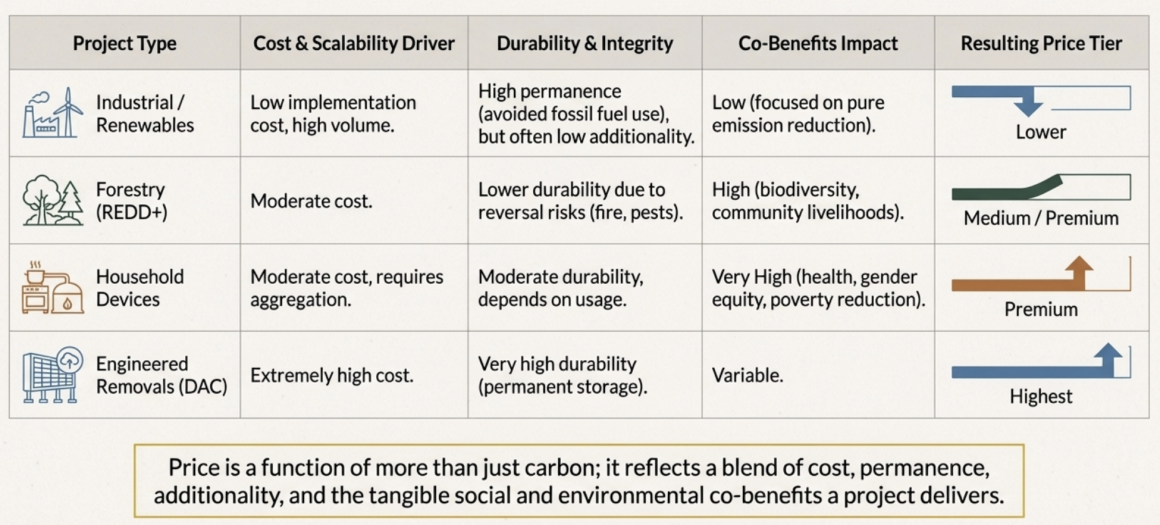
The average price of carbon credits varies by sector due to differences in implementation costs, permanence of carbon storage, co-benefits, additionality, and supply-demand dynamics.
1. Implementation Costs
- Industrial Projects: Projects like industrial gas destruction (e.g., HFC-23) generate credits at very low cost, around €0.2–0.5 per tonne CO2e, producing large volumes and lowering prices.
- Engineered Removals (Direct Air Capture, DAC): Extremely expensive due to energy intensity and infrastructure needs, currently costing over $1,000 per tonne, potentially $94–$232 at scale.
- Nature-based Solutions: Projects like reforestation are cheaper, often below $50 per tonne.
2. Permanence and Durability
- Forestry (Removals vs. Avoided Emissions): Biological sinks like forests are vulnerable to reversals from wildfires, pests, or economic pressures, leading to moderate pricing.
- Biochar and Engineered Removals: Provide long-term or permanent carbon storage, commanding higher prices ($200–$584 per tonne for biochar).
3. Co-benefits (Social and Environmental Value)
- Household Devices: Clean cookstoves and biogas digesters deliver health, gender equity, and poverty reduction benefits, increasing market value.
- Forestry Projects: Include biodiversity conservation and community support, raising their value compared to industrial projects.
4. Additionality and Market Saturation
- Renewable Energy: Wind and solar projects have become cost-competitive independently, reducing the perceived additionality of carbon credits and lowering prices.
- Industrial Gas Projects: Early CDM credits flooded the market, causing oversupply and price declines.
Summary Table of Pricing Factors
| Project Type | Cost Driver | Durability / Integrity | Co-benefits Impact | Price Trend |
| Industrial / Renewables | Low implementation cost | High permanence (avoided fossil fuel use), low additionality | Low co-benefits | Lower Average |
| Forestry (Avoided / Removal) | Moderate cost | Lower durability (reversal risk) | High (biodiversity, community) | Medium / Premium |
| Household Devices | Moderate cost | Moderate | Very High (health, gender, poverty) | Premium |
| Engineered Removal (DAC) | Very High cost | Very High (permanent storage) | Variable | Highest |
4. Real-World Comparables to Generate 1 Carbon Credit (1 tCO2e) Across Different Sectors
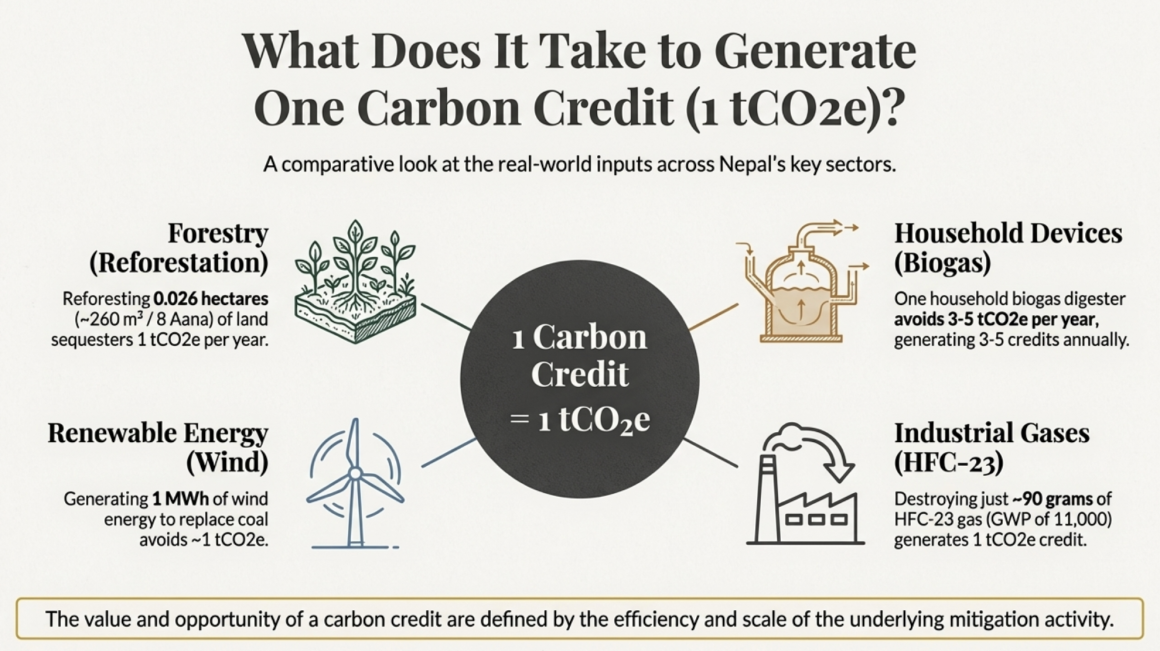
A carbon credit represents one metric tonne of carbon dioxide equivalent (tCO2e). The real-world inputs required to achieve this reduction vary by sector due to differences in sequestration rates, avoided emissions, energy displacement, and process efficiencies.
Units: 1 hectare = 19.5 Ropani = 10,000 m²
1. Forestry and Land Use: Removals (e.g., Reforestation)
- Sequestration Rate: Approximately 38 tCO2 per hectare per year.
- Comparable Area: To generate 1 tCO2e per year, about 0.026 hectares (260 m² / ~8 Aana) of reforested land is needed.
- Long-Term Stock: Over multiple years, reforestation projects sequester 55–155 tC per hectare (≈200–570 tCO2e/ha).
- Tree Count vs. Technology: Capturing 1 million tCO2/year biologically requires ~46 million trees covering 3,000–4,600 km², whereas a Direct Air Capture (DAC) plant would need 0.4–1.5 km².
2. Forestry and Land Use: Avoided Emissions (e.g., REDD+)
- Protection Potential: Preventing deforestation saves 55–220 tC/ha.
- Comparable: 1 hectare of protected forest avoids ~200–800 tCO2e depending on forest density, generating a proportional number of credits.
3. Household Devices (Biogas, Clean Cookstoves, Electric Cooking)
- Biogas Digesters: One household digester prevents 3–5 tCO2e per year, equivalent to 3–5 credits annually.
- Clean Cookstoves: Savings are roughly similar, depending on fuel substitution.
- Electric Cooking: Replacing one LPG cylinder with electric cooking avoids ~0.85 tCO2e per year.
4. Renewable Energy (Displacing Fossil Fuels)
- Emission Factors: Coal ≈ 1,001 gCO2e/kWh; Natural Gas ≈ 469 gCO2e/kWh; Wind ≈ 11 gCO2e/kWh; Solar ≈ 48 gCO2e/kWh.
- Comparable: Generating 1 MWh (1,000 kWh) of wind energy to replace coal avoids ~1 tCO2e, equivalent to 1 carbon credit.
5. Industrial Projects
- High-GWP Gas Destruction: Destroying 1 t of HFC-23 generates ~11,000 tCO2e credits due to its GWP of 11,000.
- Energy Efficiency Improvements: Retrofitting boilers or upgrading industrial processes can reduce emissions by hundreds of tCO2e per year; for example, some ammonia-urea plant upgrades reduce ~600 tCO2e annually.
Conclusion: The real-world comparables for generating 1 carbon credit vary widely: a fraction of a hectare of forest, one household biogas digester, 1 MWh of renewable electricity, or even destruction of tiny amounts of high-GWP industrial gases. These differences reflect sector-specific emission reduction potentials, technology, and project scale.
Part 2: The International Framework (Paris Agreement & Reporting)
1. What is the Biennial Transparency Report (BTR)?
The Biennial Transparency Report is a reporting instrument established under the Paris Agreement to monitor and enhance transparency in global climate action. It forms a core component of the Enhanced Transparency Framework and is designed to track how Parties are implementing their climate commitments.
Under the Paris Agreement, all Parties are required to submit their first Biennial Transparency Report to the United Nations Framework Convention on Climate Change by 2024, along with national greenhouse gas inventory data, and to continue submitting the report every two years thereafter. The framework applies universally while incorporating built in flexibility to reflect the differing capacities and national circumstances of developed and developing countries.
The Biennial Transparency Report contains information on national greenhouse gas inventories, progress toward achieving Nationally Determined Contributions, policies and measures undertaken to mitigate emissions, and support provided and received in the form of finance, technology transfer, and capacity building where applicable.
The BTR replaces earlier reporting instruments under the Convention. For developing countries such as Nepal, it succeeds the Biennial Update Report process that was previously used to report climate actions and emissions data to the UNFCCC. Nepal’s Ministry of Forests and Environment has undertaken Biennial Update Report preparation processes, including multi year projects between 2017 and 2024, to strengthen national reporting systems and prepare for the transition to Biennial Transparency Reporting.
Overall, the Biennial Transparency Report serves as the standardized periodic reporting mechanism under the Paris Agreement to ensure accountability, comparability, and trust in how countries are progressing toward their climate commitments.
2. What are Articles 6.2, 6.4, and 6.8 of the Paris Agreement?
Article 6 of the Paris Agreement outlines how countries can voluntarily cooperate to achieve their Nationally Determined Contributions (NDCs). It establishes the framework for international carbon markets and non-market cooperation.
Here is a breakdown of the three specific subsections:
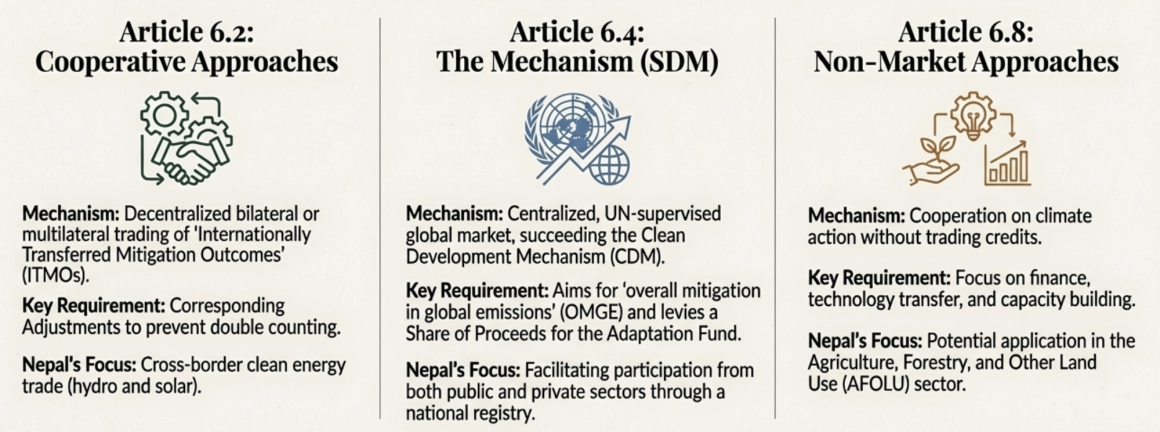
1. Article 6.2: Cooperative Approaches (Bilateral/Multilateral Trading)
This article establishes a decentralized framework for countries to trade emission reductions directly with one another through bilateral or multilateral agreements.
- Mechanism: It involves the transfer of Internationally Transferred Mitigation Outcomes (ITMOs). For example, one country can implement a mitigation project and transfer the resulting emission reductions to another country to count towards the buyer’s NDC.
- Key Requirement: To ensure environmental integrity, it requires “Corresponding Adjustments.” This means if a country sells emission reductions, it must deduct them from its own national registry so that the same reduction is not counted twice (double counting).
- Nepal Context: Nepal’s NDC 3.0 explicitly states the intent to engage in carbon trading under Article 6.2. The Long-Term Strategy (LTS) also highlights cross-border clean energy trade (hydro and solar) as a potential opportunity to engage in market mechanisms under ITMOs.
2. Article 6.4: The Mechanism (Centralized Global Market)
This article establishes a centralized global mechanism to succeed the Kyoto Protocol’s Clean Development Mechanism (CDM), commonly referred to as the Sustainable Development Mechanism (SDM).
- Supervision: Unlike 6.2, this mechanism is supervised by a UN body (Supervisory Body) appointed by the Conference of the Parties (COP).
- Participation: Both public and private sectors can participate. Projects registered under this mechanism generate carbon credits (A6.4ERs) that can be bought by countries, companies, or individuals.
- Specific Rules: It aims to deliver an “overall mitigation in global emissions” (OMGE), ensuring that it leads to a net reduction rather than just zero-sum trading.
- Share of Proceeds: A portion of the proceeds, five percent, is levied to fund the Adaptation Fund to assist vulnerable developing countries.
- Nepal Context: Nepal plans to facilitate carbon trading under Article 6.4 by establishing robust institutional frameworks, national registries, and regulations to track credits accurately.
3. Article 6.8: Non-Market Approaches
This article recognizes that countries may want to cooperate on climate action without trading emission permits.
- Scope: It focuses on non-market-based approaches to assist Parties in implementing their NDCs. This includes cooperation on mitigation, adaptation, finance, technology transfer, and capacity building.
- Goal: It aims to promote ambition without commodifying carbon, facilitating activities such as the removal of fossil fuel subsidies or joint research and development.
- Nepal Context: Nepal has identified potential engagement in non-market mechanisms under Article 6.8, particularly for the Agriculture, Forestry, and Other Land Use (AFOLU) sector, to help meet its carbon neutrality targets.
3. Which Article of the Paris Agreement envisions the Voluntary Carbon Market (VCM)?
The Paris Agreement does not explicitly establish or govern Voluntary Carbon Markets. VCMs are primarily private, market-driven mechanisms where entities voluntarily offset emissions outside of formal compliance obligations.
However, the principles and frameworks of Article 6, particularly Articles 6.2 and 6.4, provide a conceptual foundation for VCMs:
- Article 6.2: Focuses on cooperative approaches that allow the transfer of mitigation outcomes between Parties. While it is designed for compliance, the accounting principles, such as corresponding adjustments to avoid double counting, inform credibility standards in voluntary markets.
- Article 6.4: Establishes a centralized mechanism to generate emission reductions for use toward NDCs. Its rules on additionality, transparency, and environmental integrity are often adopted as best practices in VCM projects.
In practice, VCMs are not formally regulated under any specific article, but their design and credibility draw on the guidance and standards developed under Article 6 of the Paris Agreement.
4. What Is the Meaning of LOA in Carbon Credit?
In the context of carbon credits, LOA primarily stands for Letter of Approval (under the Clean Development Mechanism) or Letter of Authorization (under the Paris Agreement). It is a critical regulatory document issued by the host country’s government.
1. Letter of Approval (CDM Context)
- Framework: Under the Clean Development Mechanism (CDM) of the Kyoto Protocol, an LOA is a mandatory document issued by the Designated National Authority (DNA) of the host country. In Nepal, this role is performed by the Ministry of Forests and Environment (MoFE).
- Purpose: Confirms that the country voluntarily participates in the project and that the project contributes to sustainable development.
- Function: Without an LOA, a project cannot be registered with the UNFCCC, and the resulting carbon credits (Certified Emission Reductions or CERs) cannot be issued or traded.
2. Letter of Authorization (Paris Agreement Context)
- Framework: Under Article 6 of the Paris Agreement, the term LOA has evolved to mean Letter of Authorization. This is required for the international transfer of carbon credits, now referred to as Internationally Transferred Mitigation Outcomes (ITMOs).
- Purpose: Formally authorizes the transfer of emission reductions to another country or entity and triggers a corresponding adjustment.
- Function: Ensures that the host country (e.g., Nepal) does not claim the transferred emission reductions toward its own NDC, preventing double counting. Nepal has committed to establishing robust frameworks to facilitate these authorizations and adjustments.
5. What Is the Meaning of Conversion into ITMO?
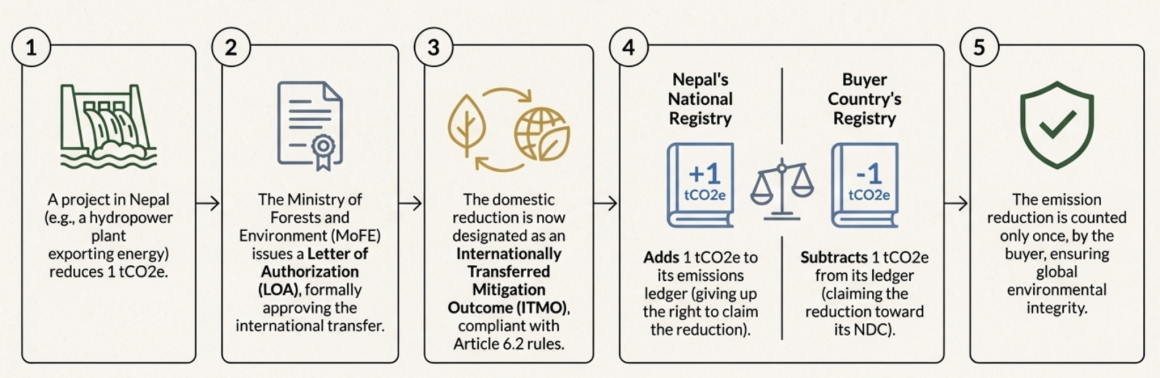
The “conversion into ITMO” refers to the process of authorizing and transferring emission reductions generated in one country to another under Article 6.2 of the Paris Agreement. ITMO stands for Internationally Transferred Mitigation Outcome. It is a carbon credit or emission reduction unit that allows countries to cooperate in achieving their Nationally Determined Contributions (NDCs) under the Paris Agreement.
The Process of “Conversion” (Authorization and Transfer)
Conversion into an ITMO transforms a domestic emission reduction into a tradable international asset. Key steps include:
- Authorization: The host country where the emission reduction occurs must formally authorize the transfer of the mitigation outcome to another country or entity.
- Corresponding Adjustment: To prevent double counting, the host country adds the sold emission reductions back to its emissions ledger (giving up the right to claim them toward its own NDC), while the buying country subtracts them from its ledger.
- Transformation of Units: The mitigation outcome (e.g., a ton of CO₂ reduced by a hydropower plant) is treated as a financially tradable ITMO compliant with Article 6.2 rules, ensuring environmental integrity and transparency.
Relation to Old Credits (CDM Transition)
- Transitioning CDM Projects: Projects under the Clean Development Mechanism (CDM), which issued CERs, may transition to the Article 6.4 mechanism. Article 6.4 credits (A6.4ERs) function similarly to ITMOs for international trade.
- Carryover: Only certain old credits (e.g., projects registered after 2013) can be converted or carried over to be used against new NDC targets, ensuring environmental integrity.
Application in Nepal:
Energy Trade: Nepal can generate ITMOs through cross-border clean energy trade (exporting surplus hydroelectricity to countries like India or Bangladesh). By exporting clean energy that displaces fossil fuels, Nepal can participate in international market mechanisms under Article 6, potentially monetizing these mitigation outcomes.
Part 3: Nepal’s Institutional & Regulatory Framework
1. What Are the Roles and Principal Differences Between the Line Ministry and MoFE in the Two-Level Review of Carbon Projects?
The two-level review process involving the Line Ministry (Sectoral Ministry) and the Ministry of Forests and Environment (MoFE) serves distinct functions to ensure projects are both technically viable sector-wise and compliant with national climate goals.
1. Line Ministry (Sectoral Ministry) Review
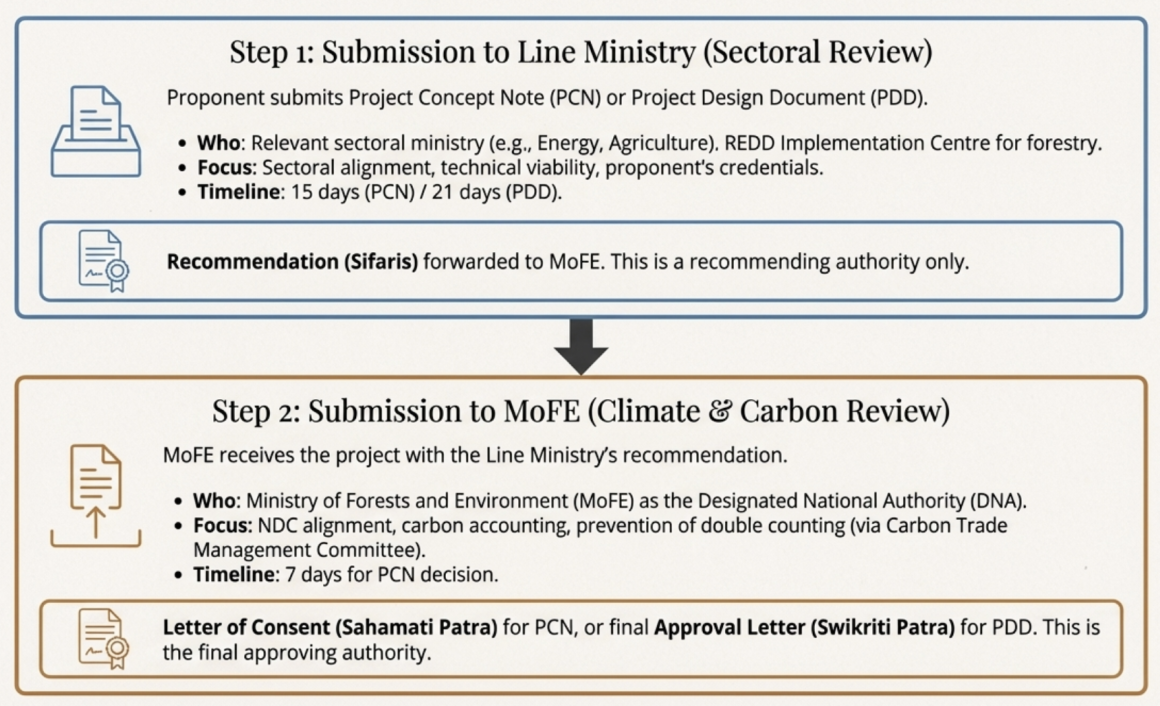
The Line Ministry (e.g., Ministry of Energy for hydropower, Ministry of Agriculture for farming projects) acts as the first point of entry and technical screener.
What they look into:
- Sectoral Alignment: Ensure the project falls within their jurisdiction (as per Schedule 1) and aligns with national sectoral policies.
- Documentation Compliance: Verify submission of required documents, such as tax clearance certificates, company registration, and local-level recommendations.
- Forestry Projects: For forestry-related projects, the REDD Implementation Centre performs this function instead of a separate line ministry.
Role & Outcome:
- The Line Ministry’s primary role is recommendation.
- They review the Project Concept Note (PCN) or Project Design Document (PDD).
- If satisfied, they forward it to MoFE with a formal recommendation (Sifaris) within 15 days for PCN or 21 days for PDD.
2. Ministry of Forests and Environment (MoFE) Review
MoFE acts as the Designated National Authority (DNA) and the final approving body. Their review is focused on carbon accounting and international compliance.
What they look into:
- National Commitments: Evaluate alignment with the Paris Agreement and Nepal’s Nationally Determined Contribution (NDC).
- Duplication Check: The Carbon Trade Management Committee reviews the PDD to ensure no double counting of projects.
- Specific Carbon Metrics: Evaluate volume of carbon credits, project timeline, geographical coverage, and climate risks associated with the project area.
Role & Outcome:
- For PCN: Issue a Letter of Consent (Sahamati Patra), allowing the proponent to proceed to the design phase.
- For PDD: Upon recommendation from the Management Committee, issue the final Approval Letter (Swikriti Patra) and register the project.
Principal Differences
| Feature | Line Ministry (Sectoral) Review | MoFE (DNA) Review |
| Primary Focus | Technical & Sectoral Compliance: Validity under sectoral laws (energy, waste, agriculture) and verification of proponent credentials. | Climate & Carbon Compliance: Alignment with NDCs, prevention of double counting, evaluation of carbon credit potential. |
| Document Stage | Reviews PCN and PDD first to validate eligibility. | Reviews PCN and PDD after Line Ministry endorsement to validate climate integrity. |
| Authority | Recommending Authority: Cannot authorize carbon trade; only recommends project to MoFE. | Approving Authority: Legal authority to grant consent to develop the project and final approval to trade carbon. |
| Timeframe | Must forward recommendation within 15 days (PCN) or 21 days (PDD). | Must issue decision/consent within 7 days (PCN) or approval after Management Committee evaluation (PDD). |
2. Why does Nepal require government approval for voluntary carbon market (VCM) projects, and is this practice followed in other countries?
In Nepal, government approval and recommendation are mandatory for voluntary carbon market projects under Carbon Trading Regulations, 2082 due to constitutional ownership of natural resources, alignment with Paris Agreement obligations, and mechanisms for equitable benefit sharing. This ensures that carbon trading supports national climate goals, safeguards public assets, and delivers social and economic benefits.
1. Reasons for Government Approval in Nepal
A. Prevention of Double Counting (Paris Agreement Alignment)
- Under Article 6 of the Paris Agreement, Nepal has Nationally Determined Contribution targets to reduce emissions.
- If a private project generates carbon credits and sells them internationally while Nepal also counts the same reductions toward its NDC, it results in double counting.
- Government approval ensures the application of a “Corresponding Adjustment,” subtracting sold credits from Nepal’s national ledger so that the buyer can claim them without compromising Nepal’s climate commitments.
B. Constitutional Ownership and Revenue Sharing
- Natural resources such as forests and water are constitutionally defined as national wealth. Carbon credits derived from these resources are therefore subject to state regulation.
- The National Climate Change Policy require that 80 percent of proceeds from international carbon finance reach local communities. Government oversight ensures proper distribution.
- Carbon Trading Regulations, 2082 (Rule 18) mandate that private entities allocate 10 percent of profits from carbon trading to the Government of Nepal. Approval and registration enable collection of this levy.
C. Quality Assurance and Fraud Prevention
- The government maintains a National Carbon Registry to track all credits and prevent issues such as double selling.
- The Ministry of Forests and Environment, acting as the Designated National Authority, validates projects to ensure they meet environmental integrity and verification standards.
2. Global Practice
- While voluntary carbon markets were historically unregulated, the Paris Agreement has prompted governments to oversee credit issuance to ensure integrity and compatibility with NDCs.
- For a credit to be recognized as high integrity internationally (e.g., under CORSIA for aviation), many countries now require a Letter of Authorization from the host government confirming a Corresponding Adjustment.
Examples from Other Countries:
- Indonesia: Requires registration of carbon projects and restricts credit exports to prioritize domestic NDC goals.
- India: Implements a domestic carbon market framework that limits international credit sales and retains revenue within national budgets.
- Brazil and China: Are establishing systems where national authorities oversee carbon credits to protect national climate interests and prevent the loss of low-cost mitigation opportunities to foreign buyers.
Conclusion: In Nepal, the voluntary carbon market is effectively a regulated mechanism. Government approval ensures that carbon sales protect national resources, benefit local communities through the 80 percent rule, generate state revenue through the 10 percent levy, and safeguard Nepal’s ability to meet its NDC targets. This regulatory approach aligns with a broader global trend among developing countries asserting sovereignty over their carbon reduction potential.
3. Who has the authority for Amendments Under the Carbon Trading Regulation?
Under the Carbon Trading Rules, 2082, the authority to amend the regulation depends on the part of the document being modified:
Amendment of the Main Regulation: The Carbon Trading Regulation is framed by the Government of Nepal (Council of Ministers/Cabinet) under the power conferred by Section 44 of the Environment Protection Act, 2076. Any amendment to the main body of the regulation generally requires a Cabinet decision.
Amendment of Schedules (Anusuchi): The Ministry of Forests and Environment is specifically authorized to alter the Schedules. Rule 35: The Ministry may make necessary alterations to the Schedule by publishing a notice in the Nepal Gazette.
Amendment of Directives/Operational Arrangements: For specific operational arrangements regarding carbon trading within Nepal, Rule 29 provides that these will be in accordance with directives approved by the Ministry.
4. Who are the parties involved in a carbon trade?
Based on the provided sources, the parties involved in a carbon trade can be categorized into regulatory bodies, supply-side participants (sellers), demand-side participants (buyers), quality assurance entities, and intermediaries.
1. Regulatory and Oversight Bodies
These entities establish the rules, issuance mechanisms, and tracking systems for carbon credits.
- Conference of the Parties (COP) / UNFCCC: Sets the global rules for international trading, such as under the Kyoto Protocol and Article 6 of the Paris Agreement.
- Supervisory Bodies:
- CDM Executive Board: Supervises the Clean Development Mechanism (CDM) under the Kyoto Protocol.
- Article 6.4 Supervisory Body: Supervises the centralized mechanism under the Paris Agreement.
- Designated National Authority (DNA): The government body in a host country responsible for approving projects. In Nepal, the Ministry of Forests and Environment (MoFE) serves as the DNA.
- Registries:
- National Carbon Registry: MoFE is mandated to establish this to record carbon credit ownership and transfers.
- Independent Registries: Systems operated by standards like Verra, Gold Standard, or ACR to track credit issuance and retirement.
2. Supply Side: Generators and Sellers
These are the entities that implement projects to reduce emissions or sequester carbon.
- Proponents/Project Developers: These can be government entities, private companies, NGOs, or community organizations that design and implement projects.
- Example in Nepal: The Alternative Energy Promotion Centre (AEPC) acts as a project developer and aggregator for biogas projects.
- Original Owners/Rights Holders:
- Households: In Nepal’s biogas program, individual households own the physical digesters but sign agreements transferring their carbon rights to the AEPC.
- Community Forest User Groups (CFUGs): Manage forest resources and are key stakeholders in REDD+ and forestry projects.
- Private Landowners: Owners of private forests who may participate in carbon trading.
3. Demand Side: Buyers and Investors
These parties purchase carbon credits for compliance or voluntary purposes.
- Annex I Parties (Developed Countries): Under the Kyoto Protocol, industrialized nations bought credits to meet binding emission targets.
- Foreign Governments: Can purchase ITMOs (Internationally Transferred Mitigation Outcomes) under Article 6.2 of the Paris Agreement.
- Corporations and Private Entities: Companies purchasing credits to meet voluntary “net-zero” or “carbon neutral” targets or compliance obligations, for example in the EU ETS or California Cap-and-Trade.
- Example: atmosfair gGmbH is a German non-profit listed as a buyer/participant in Nepal’s biogas projects.
- International Airlines: Buying credits to meet offsetting requirements under the Carbon Offsetting and Reduction Scheme for International Aviation (CORSIA).
4. Quality Assurance (The “Referees”)
These independent parties ensure the environmental integrity of the credits.
- Designated Operational Entities (DOEs) / Validation and Verification Bodies (VVBs): Independent third-party auditors accredited to validate project designs (ex-ante) and verify actual emission reductions (ex-post). They must be free from conflicts of interest.
- Standards Organizations: Independent NGOs that set quality criteria for the voluntary market, such as Verra (VCS), Gold Standard, American Carbon Registry (ACR), and Plan Vivo.
5. Intermediaries and Facilitators
- Brokers and Traders: Facilitate transactions between buyers and sellers, often for non-standardized products or small volumes.
- Aggregators: Entities that bundle many small projects (e.g., household cookstoves) into a single tradeable unit to reduce transaction costs. The AEPC performs this role in Nepal.
- Exchanges: Platforms like the European Energy Exchange (EEX) where standardized carbon contracts and derivatives are traded.
6. Financial and Beneficiary Institutions
- Financial Institutions: Banks and micro-finance institutions that provide loans or funding for the initial construction of projects, for example biogas plants.
- Adaptation Fund: A portion of proceeds, for example 2 percent under CDM, is levied to fund adaptation in developing countries.
- Local Communities: In Nepal, policies mandate that 80 percent of climate finance, often derived from such trades, must reach the local level/beneficiaries.
Part 4: Project Implementation & Sectoral Deep Dives
1. What is the scope of the hydro sector in carbon trading in Nepal, and how can baseline challenges be addressed?
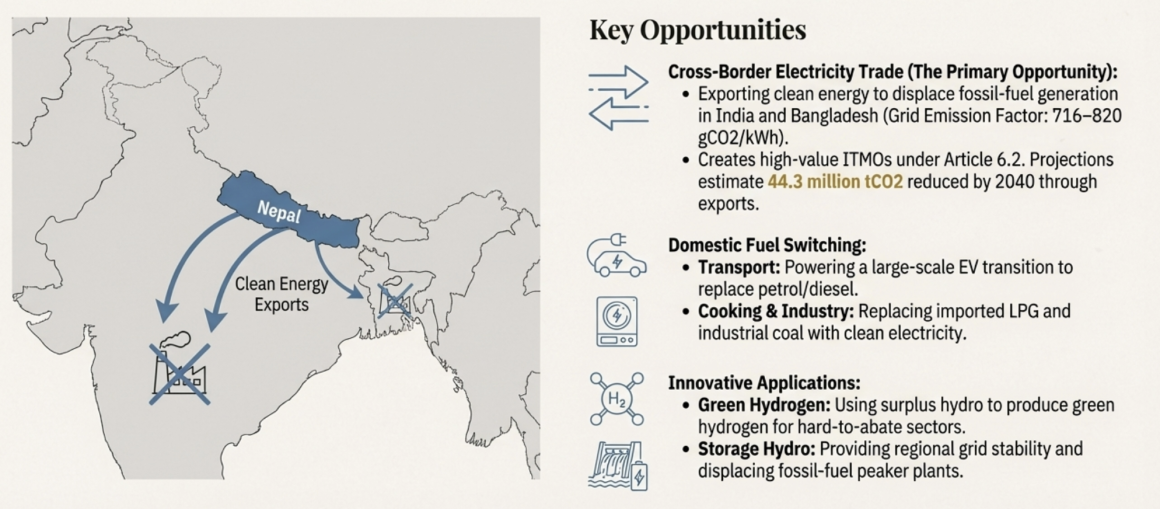
While Nepal’s domestic grid is largely powered by clean hydropower, creating challenges for proving additionality within the country, the hydro sector has significant potential in carbon trading through cross-border energy exports, sectoral fuel switching, and innovative applications such as green hydrogen.
1. Cross-Border Electricity Trade (Displacing Regional Fossil Fuels)
- Mechanism: Under Article 6.2 of the Paris Agreement, Nepal can transfer mitigation outcomes (carbon credits) by exporting clean hydroelectricity to countries like India and Bangladesh, displacing fossil-fuel-based generation in their grids.
- Potential Impact: Recognized clean energy exports could offset significant emissions regionally, potentially making Nepal’s carbon balance “negative” by a substantial margin.
- Targeted Markets: Nepal has agreements to trade power with India and Bangladesh. NDC 3.0 prioritizes climate actions for the carbon market under Article 6, including energy trade.
- Green Day Ahead Market: Participation in India’s Green Day Ahead Market (IEX) allows renewable energy trading at a premium, internalizing carbon value.
2. Internal Fuel Switching (Electrification of Other Sectors)
- Transport (EVs): Switching from diesel/petrol to electric vehicles powered by hydro reduces transport emissions, supported by NDC targets for large-scale EV adoption.
- Clean Cooking: Replacing LPG and firewood with electric cooking powered by hydropower aligns with the Renewable Energy Subsidy Policy and NDC priorities.
- Industrial Decarbonization: Industries using coal or diesel can shift to hydroelectricity, including waste-to-heat recovery and SMEs in Kathmandu transitioning to electric furnaces as per NDC 3.0.
3. Micro and Mini-Hydro Projects (Off-Grid Displacement)
- Mechanism: Small-scale hydro projects replace kerosene or diesel use in rural communities.
- CDM/Gold Standard History: Nepal has previously registered micro-hydro projects under the Clean Development Mechanism, generating carbon credits by displacing fossil fuels.
- Continued Viability: Community-owned projects with sustainable development co-benefits remain eligible for carbon financing, especially in voluntary markets.
4. Green Hydrogen Production
- Mechanism: Surplus hydroelectricity can produce green hydrogen for hard-to-abate sectors such as fertilizer production or heavy transport.
- Carbon Financing: NDC 3.0 highlights opportunities to use carbon finance for green hydrogen production and storage.
5. Storage Hydro Projects (Peak Load Management)
- Regional Grid Stability: Reservoir-based storage projects enable Nepal to export power during peak demand or dry seasons when renewable sources are limited in neighboring countries.
- Displacement of Peaker Plants: These projects can reduce reliance on coal or gas peaker plants, with carbon finance helping bridge investment gaps.
Addressing the Baseline Challenge
- The baseline challenge arises when considering Nepal’s grid in isolation, as domestic hydro already produces low emissions.
- The solution, outlined in the Long-Term Strategy and NDC, is to expand the system boundary to include cross-border and sectoral displacement: exporting clean energy or using hydro to replace fossil fuels elsewhere.
- Recognition under Article 6 agreements is necessary for Nepal to claim and trade these mitigation outcomes internationally.
Conclusion: The primary scope for Nepal’s hydro sector in carbon trading lies in exporting clean energy to fossil-fuel-dependent neighboring grids, electrifying domestic sectors to replace fossil fuels, and exploring innovative solutions such as green hydrogen and storage hydro for peak load management. These approaches allow Nepal to overcome baseline challenges and leverage its abundant hydropower for carbon finance.
2. Relevance of the Grid Emission Factor (GEF) in Carbon Trading in Nepal
The Grid Emission Factor (GEF) is a critical parameter in Nepal’s carbon trading framework. It determines both the baseline for emission reductions in domestic projects and the potential value of hydropower exports in the international carbon market.
1. Determining the Baseline for Carbon Credits
- Purpose: GEF defines the Baseline Emission, i.e., the greenhouse gases (GHG) that would have been emitted in the absence of a clean energy project.
- Mechanism: To claim carbon credits, a project must show it displaces energy from a higher-emission source.
- Calculation: GEF is calculated as the combined margin of the operating margin (emissions from existing plants) and the build margin (emissions from new plants). This is mandatory under the Clean Development Mechanism (CDM) for validating renewable energy and energy efficiency projects.
2. Domestic Context: Low GEF Limiting Internal Credits
- Negligible Domestic Factor: Nepal’s grid is dominated by clean hydropower, so its domestic GEF is near-zero.
- Implication: Projects feeding renewables into the domestic grid generate minimal carbon credits because they displace already clean electricity. Energy efficiency projects or electric cooking generate credits only when they replace fossil fuel use.
3. Cross-Border Context: High GEF Driving Export Potential
- Displacing Dirty Grids: Neighboring countries like India and Bangladesh rely on coal and gas, with grid emission factors estimated around 716–820 gCO2/kWh.
- Carbon Offset Potential: Exporting hydroelectricity displaces fossil-fuel generation abroad. Emission reductions are calculated using the importer’s higher GEF, significantly increasing carbon credit potential.
- Quantified Impact: Studies project that Nepal’s power exports could reduce approximately 44.3 million tCO2 by 2040, creating opportunities under Article 6 of the Paris Agreement, subject to mechanisms preventing double counting.
4. Application in Energy Efficiency Projects
- Technology Upgrades: For measures like efficient transformers or refrigerators, emission reductions are calculated by multiplying electricity saved by the GEF.
- Implication: Due to Nepal’s low domestic GEF, electricity-saving measures have limited direct carbon mitigation potential compared to countries with fossil-fuel-heavy grids.
Conclusion: The Grid Emission Factor serves as the quantitative foundation for Nepal’s carbon trading. While domestic GEF limits internal carbon credits, the higher emission factors of neighboring countries make Nepal’s hydropower a highly valuable resource for cross-border carbon trading and regional decarbonization.
3. How Is Forestry Differentiated Between Maintaining Existing Forests and Planting Bamboo for Carbon Sequestration? Are These Issued Different Credits, and Which Is More Expensive and Why?
The differentiation between maintaining existing forests and planting bamboo lies in the mechanism of climate mitigation (avoidance vs. removal), the classification of the activity, and the market value of the resulting credits.
1. Differentiation of Activities
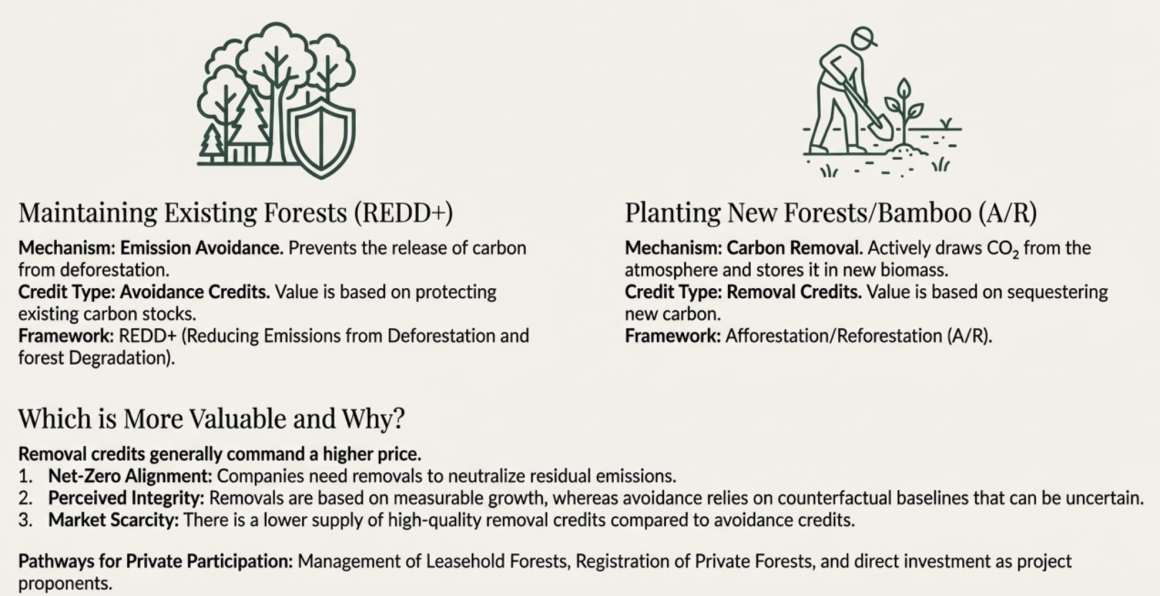
Maintaining Existing Forests (REDD+ / Forest Protection)
- Mechanism: Classified as Emission Reduction or Avoidance. The goal is to prevent the release of carbon stored in biomass and soil that would occur if the forest were deforested or degraded.
- Carbon Dynamics: Mature forests hold vast amounts of legacy carbon. While they continue to sequester carbon, their primary climate value is as a carbon reservoir. Disturbance (e.g., fire, logging) would convert this stored carbon into emissions.
- Framework: Falls under REDD+ (Reducing Emissions from Deforestation and forest Degradation), which includes conservation and sustainable management of forest carbon stocks.
Planting Bamboo (Afforestation / Sink Enhancement)
- Mechanism: Classified as Carbon Removal or Sequestration. The goal is to draw CO₂ from the atmosphere and store it in new biomass and soil.
- Carbon Dynamics: Bamboo grows rapidly and sequesters carbon faster than mature forests or conventional tree plantations. However, a bamboo forest generally stores less total carbon than a mature forest.
- Framework: Falls under Afforestation/Reforestation (A/R) or Carbon Farming. Bamboo can be planted on degraded lands to restore ecosystems and create a carbon sink where none existed.
2. Difference in Credits
Yes, these activities are issued different types of credits based on the mitigation mechanism.
- Avoidance Credits: Issued for maintaining existing forests (REDD+). Represent the emissions avoided compared to a baseline where the forest would have been cut down.
- Removal Credits: Issued for planting bamboo. Represent the physical removal of CO₂ from the atmosphere.
- Methodologies:
- Forest protection uses REDD+ frameworks focusing on deforestation rate baselines.
- Bamboo planting uses Afforestation/Reforestation methodologies (e.g., AR-AMS0003) for degraded or wetland areas.
3. Price and Value: Which Is More Expensive?
Removal credits (planting/reforestation) are generally more expensive than avoidance credits (REDD+ conservation).
Reasons:
- Net Zero Alignment: Companies and countries must neutralize residual emissions to meet Net Zero targets. Standards like SBTi prioritize removals over avoided emissions, driving demand for removal credits.
- Integrity and Measurement:
- Avoidance credits rely on counterfactual baselines, which can be uncertain (“phantom credits”).
- Removal credits are based on measurable growth of trees or bamboo, making them more credible and reliable.
- Scarcity and Cost:
- Planting projects involve higher operational costs (nursery, labor, land preparation).
- Reduced supply of removal credits compared to abundant avoidance credits increases their market price.
- Durability Perception: Bamboo stores carbon rapidly, but long-term sequestration depends on biomass use (durable products vs. burning). Despite this, nature-based removal credits generally command a price premium over avoidance credits.
4. How can existing private parties participate in the REDD+ program in the forestry sector?
Based on the provided documents, specifically the National Forest Policy (2076), Forest Act (2076), National Climate Change Policy (2076), and Carbon Trading Rules, existing private parties can participate in the REDD+ program and the broader forestry sector through the following mechanisms:
1. Management of Leasehold Forests (Kabuliyati Ban)
Private entities, such as industries, institutions, or organized groups, can lease National Forests to conduct forestry activities that contribute to carbon sequestration and sustainable management.
- Mechanism: The government may grant a part of the National Forest as a Leasehold Forest to an organized institution or industry for purposes such as producing raw materials for forest-based industries, eco-tourism, agroforestry, or wildlife farming.
- REDD+ Alignment: These activities fall under REDD+ “plus” activities (sustainable management of forests and enhancement of forest carbon stocks). The private entity must prepare and implement an operational plan approved by the Division Forest Office.
- Duration: The lease can be granted for up to 40 years, with the possibility of renewal for another 40 years.
2. Registration and Management of Private Forests (Niji Ban)
Private landowners can register their land as Private Forests to participate in carbon enhancement.
- Definition: Land with specific tree crown cover and area (minimum 0.05 to 1.0 hectare depending on the definition used) owned by an individual or entity can be registered as a Private Forest.
- Rights: The owner has the right to cut, transport, and sell forest products from these lands, as well as transfer technologies for green industries based on these forests.
- Carbon Market Access: The National Forest Policy explicitly encourages private forestry to access international assistance and payments through carbon trade mechanisms.
3. Investment in Carbon Trading and Green Finance
The National Climate Change Policy (2076) and the Carbon Trading Rules outline specific financial pathways for the private sector.
- Financial Instruments: The policy encourages private sector mobilization through Green Bonds, Blended Finance, Result-based Financing, and Carbon Offsets.
- Project Proponents: Private entities can act as proponents for carbon projects. They must register the project with the Ministry and are required to allocate 10 percent of the profits generated from carbon trading to the Government of Nepal.
- Corporate Social Responsibility (CSR): Private and commercial sectors are encouraged to invest in afforestation, urban forestry, and green parks under their CSR mandates.
4. Forest-Based Enterprises and Value Addition
Private parties can participate by establishing industries that utilize forest products sustainably, thereby adding value and reducing pressure on natural forests (a key REDD+ objective).
- Nature-Based Tourism: Private sectors can collaborate with community forests or leasehold forests to promote eco-tourism.
- Non-Timber Forest Products (NTFPs): The policy promotes private sector involvement in the branding, processing, and export of high-value medicinal herbs and NTFPs.
- Public-Private Partnership (PPP): The policies envision using the PPP model for the establishment and operation of forest-based industries.
5. Research and Technology Transfer
- Innovation: Private entities can introduce modern technologies for forest management, harvesting, and wood processing to improve efficiency and reduce waste (emissions).
- Capacity Building: They can engage in research and development to establish baselines for carbon stock and support the monitoring, reporting, and verification (MRV) processes required for REDD+.
Summary: Private parties can participate by leasing government land, managing private land, acting as project developers or investors in the carbon market, or establishing forest-based enterprises. They must comply with government regulations, including benefit-sharing mechanisms where a portion of profits is directed to the state.
5. What is Free, Prior, and Informed Consent (FPIC) in the context of carbon trading?
Free, Prior, and Informed Consent (FPIC) is a critical safeguard designed to protect the rights of Indigenous Peoples and local communities whose lands and resources form the basis for carbon sequestration projects, including REDD+ forestry projects and hydropower initiatives. FPIC ensures that affected communities participate meaningfully in decisions that impact their lands and resources.
1. Legal and International Framework
- Basis in International Law: FPIC is derived from the United Nations Declaration on the Rights of Indigenous Peoples (UNDRIP). Article 19 requires states to consult and cooperate in good faith with Indigenous peoples to obtain their free, prior, and informed consent before adopting measures that may affect them.
- ILO Convention 169: Nepal has ratified the International Labour Organization Convention 169, which mandates the protection of indigenous and tribal peoples’ rights. Development projects, particularly in the hydropower sector, are advised to apply FPIC principles from the early planning stages to obtain consent from affected communities.
2. Application in REDD+ (Forestry Carbon)
- UNFCCC Safeguards: UNFCCC decisions on REDD+ require countries to “address and respect” safeguards, including recognition of Indigenous peoples’ rights and adoption of UNDRIP principles, though FPIC is not explicitly mandated as a rigid requirement.
- Criticism and Failure: Studies, including by the Center for International Forestry Research in 2017, show that many REDD+ projects did not apply FPIC rigorously, sometimes withholding information to manage community expectations. Critics highlight risks such as land appropriation, forced evictions, and rights violations.
- “Carbon Cowboys”: Predatory actors have exploited the lack of rigorous FPIC by signing unfair contracts with Indigenous communities to acquire carbon rights for quick profits.
3. Voluntary Carbon Markets and Standards
- Gold Standard: Requires safeguarding assessments ensuring projects respect human rights, do not discriminate, and avoid involuntary resettlement. Stakeholder consultation and feedback are mandatory, though explicit mention of FPIC may vary.
- Verra (VCS): Widely used for forest credits, but reports from project sites in countries like Peru and Cambodia indicate failures to secure genuine consent, including forced evictions.
- Add-on Standards: Certifications such as the Climate, Community & Biodiversity Standards (CCB) specifically target land management projects and require robust community participation with net-positive social benefits.
4. Implementation in Nepal
- Hydropower and Infrastructure: Nepal’s Environmental Impact Assessment manual for hydropower projects requires FPIC principles in land acquisition and resettlement, emphasizing meaningful, inclusive, and culturally appropriate consultations.
- Forest Management: The National Standard for Sustainable Forest Management, 2081, includes criteria for identifying and respecting the rights of Indigenous Nationalities (Adivasi Janajati) and local communities in forest resource use.
- Biogas Projects: For household biogas initiatives under the Clean Development Mechanism and Gold Standard, stakeholder consultation is integrated into the process. Households voluntarily purchase digesters, and emission reduction rights are transferred to the Alternative Energy Promotion Centre (AEPC).
6. Why was the World Bank the buyer of the emission reductions under the REDD+ program?
Based on the provided sources, the World Bank acts as a buyer of emission reductions under the REDD+ program primarily through its role as a trustee and manager of specific climate funds, such as the Forest Carbon Partnership Facility (FCPF). The specific reasons and mechanisms are as follows:
1. Manager of Results-Based Payments
The World Bank manages the FCPF’s Carbon Fund. This fund is designed to provide results-based payments to countries that have successfully moved through the readiness phase and can demonstrate verified emission reductions from REDD+ activities.
2. Facilitating the Carbon Market
The World Bank plays a central role in the development of REDD+ activities by helping countries achieve readiness – developing strategies and monitoring systems – and then providing payments for verified results. For instance, the Carbon Fund maintains a pipeline of countries eligible for payments based on verified reductions under national or subnational programs.
3. Specific Agreements with Nepal
In the context of Nepal, the government has signed an agreement with the World Bank for carbon trade worth US $45 million. This agreement allows Nepal to monetize its efforts in forestry conservation and emission reductions.
4. Mobilizing International Finance
World Bank initiatives, alongside others such as the Green Climate Fund, serve as mechanisms to mobilize financial resources from developed countries, providing positive incentives for developing countries to reduce emissions from deforestation.
Summary: The World Bank serves as the buyer to operationalize results-based finance, ensuring that developing countries like Nepal receive financial compensation for verified climate mitigation efforts in the forestry sector.
Part 5: Transaction Mechanisms & Financial Flows
1. Carbon Right Transfer Certificate
A Carbon Right Transfer Certificate is the legal instrument that authorizes the transfer of rights to claim, market, and sell greenhouse gas (GHG) emission reductions from the original owner of a project to a project developer or buyer. It ensures the integrity and commercial viability of carbon trading by legally separating the environmental benefit from the physical asset.
1. Mechanism in Nepal (Biogas Program Example)
- Ownership: Individual households own biogas digesters, but the emission reductions from a single household are too small to trade internationally.
- Transfer Agreement: Households sign a contract transferring all legal rights, credits, benefits, and entitlements from the GHG reductions of their digesters to the Alternative Energy Promotion Centre (AEPC).
- Aggregation: AEPC aggregates reductions from thousands of households into tradable volumes. The agency then owns the certified carbon credits under standards like Gold Standard or CDM, which can be sold to international buyers.
2. Legal Framework under Carbon Trading Rules, 2082
- Issuance of Certificate: Verified emission reductions are documented through a Carbon Credit Certificate, where 1 credit equals 1 tonne of CO2e.
- Transfer of Ownership: Project developers must obtain approval from the Designated National Authority (DNA) to sell or transfer credits.
- Corresponding Adjustment: For international transfers, Nepal must adjust its national registry to prevent double counting, ensuring the credit is only claimed by the buyer.
3. Purpose of the Transfer
- Exclusive Claim: Prevents multiple claims on the same emission reduction, maintaining environmental integrity.
- Commercial Viability: Aggregation of micro-projects allows trade in volumes large enough for the international market.
- Registry Tracking: Transfers are recorded in international registries (Verra, Gold Standard) as the movement of unique serial numbers from seller to buyer.
Summary: The Carbon Right Transfer Certificate legally detaches the environmental attribute from the physical project, enabling emission reductions to be commoditized and sold in domestic or international carbon markets while safeguarding against double counting and ensuring proper aggregation and tracking.
2. How Are Household-Level Carbon Emission Reductions Aggregated Under Nepal’s Carbon Trading Regulations?
Household-level carbon emission reductions (often referred to as “carbon non-emissions” or avoided emissions) are aggregated under carbon trading regulations through a process of bundling and transfer of rights managed by a central entity. The following outlines the step-by-step mechanism, primarily illustrated by the Biogas Support Program (BSP) in Nepal:
Transfer of Legal Rights (The Contract)
Individual households generate emission reductions that are too small to be traded individually on international markets. To address this, a central aggregator is required.
- The Agreement: The owners of household technology (e.g., a biogas digester) sign an agreement transferring “all legal rights, interests, credits, entitlements, benefits or allowances” arising from the greenhouse gas emission reductions to the implementing agency, such as the Alternative Energy Promotion Centre (AEPC).
- The Exchange: In return for transferring these carbon rights, households receive financial subsidies, access to micro-credit, and after-sales technical support/quality control for the technology.
The “Programme of Activities” (PoA) Structure
To aggregate these rights into a tradable volume, Nepal utilizes the Programme of Activities (PoA) mechanism under the Clean Development Mechanism (CDM) and Gold Standard.
- The Umbrella: The PoA acts as an “umbrella program” registered by the Executive Board, allowing for the implementation of an unlimited number of sub-projects.
- Component Project Activities (CPAs): Individual households are grouped into CPAs. For example, a single CPA might bundle together 10,000 to 20,000 household biogas digesters.
- Scalability: This structure allows emission reductions to be continuously scaled up. New CPAs can be added to the PoA over time without requiring full registration for every single unit.
Quantification and Methodology
Aggregated emissions are calculated using methodologies approved by international bodies (such as UNFCCC or Gold Standard).
- Methodology: Projects often use AMS-I.E (“Switch from Non-Renewable Biomass for Thermal Applications by the User”). This calculates reductions based on the number of households, the quantity of woody biomass displaced by the new technology, and the fraction deemed “non-renewable.”
- Calculations: Baseline emissions are calculated as the number of households multiplied by the estimated average annual consumption of displaced woody biomass per household.
Prevention of Double Counting
To ensure the integrity of aggregated credits:
- Unique Identifiers: Each household unit (e.g., biogas digester) is uniquely identified in a database (e.g., by a gas pipe number or code) to prevent it from being counted in more than one CPA.
- Database Management: The project developer (AEPC) maintains a detailed database including the owner’s name, location, plant size, and commissioning date to prevent double counting and ensure transparency.
Role of the Aggregator
The Alternative Energy Promotion Centre (AEPC) acts as the “Coordinating and Managing Entity” (CME) or Project Developer.
- Coordinates subsidies and technical support.
- Manages carbon registration, monitoring, and verification processes.
- Holds ownership of the aggregated carbon credits generated under certification standards.
Summary: In practice, a household installs a clean energy device (like a biogas plant), signs over the carbon rights to the government (AEPC) in exchange for a subsidy, and the government bundles thousands of these households into a Programme of Activities (PoA) to sell the aggregated credits on the international carbon market.
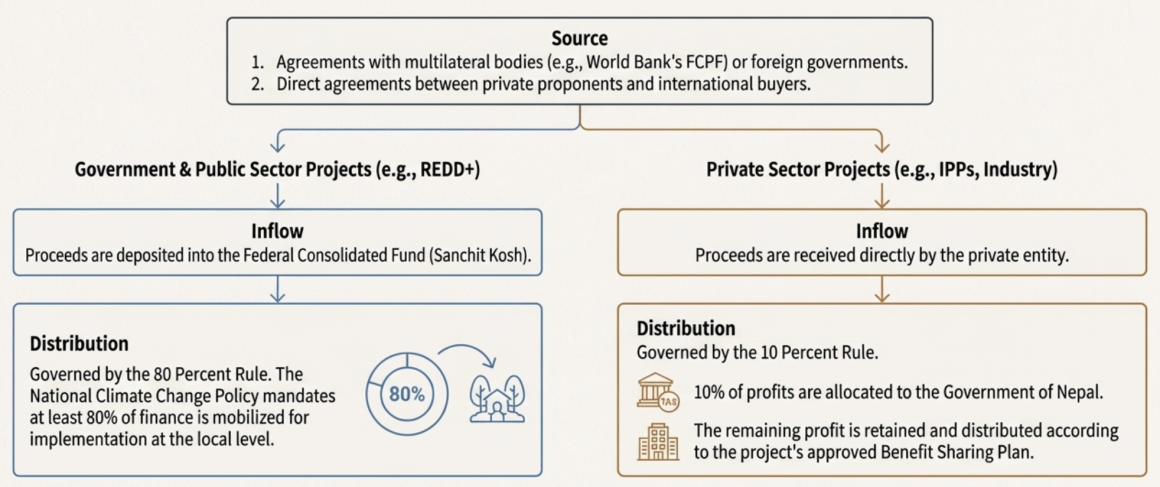
3. How do carbon trade proceeds come into Nepal and how does it work for government and private sectors?
Based on the Carbon Trading Rules, 2082, National Climate Change Policy (2019), and various project agreements, carbon trade proceeds enter Nepal through two distinct channels depending on whether the project is government-led or private-sector-led.
1. Government Sector Proceeds (REDD+ and Public Projects)
For government-led initiatives such as the REDD+ program or government-owned infrastructure, proceeds enter via the national treasury system.
Inflow Mechanism
- Bilateral/Multilateral Agreements: The Government of Nepal (GoN) signs agreements with international bodies such as the World Bank’s Forest Carbon Partnership Facility or foreign governments. For example, Nepal signed an agreement with the World Bank for carbon trade worth US $45 million.
- Consolidated Fund: Proceeds generated by government projects are deposited into the Federal Consolidated Fund (Sanchit Kosh) or a fund specifically designated in the agreement.
- Pricing: Carbon credit prices are determined through agreements between GoN and the purchasing entity or through international competitive bidding.
Benefit Sharing (The 80 Percent Rule)
- The National Climate Change Policy (2019) mandates that at least 80 percent of climate finance received from international mechanisms must be mobilized for program implementation at the local level.
- For REDD+ projects, financial benefits must be distributed fairly. For example, if the project involves the Forest Development Fund, 25 percent of income generated by communities goes to local government bodies, and 75 percent is collected as revenue by the central government, though this varies by forest management regime.
2. Private Sector Proceeds (Voluntary and Compliance Markets)
Private entities such as hydropower developers or industrial projects can participate in carbon trading but are subject to specific levies and regulatory oversight.
Inflow Mechanism
- Direct Agreements: Private proponents can sign agreements directly with national or international buyers.
- Repatriation of Funds: Foreign investors in carbon projects are permitted to repatriate 100 percent of profits, dividends, and loan repayments in convertible foreign currency.
Ownership and Rights
- Private Ownership: Carbon credits generated from projects developed by the private sector belong to the private sector.
- Hydropower Specifics: In large Project Development Agreements (PDAs) like Upper Trishuli-1, GoN technically owns the GHG reduction benefits but grants the company the exclusive right to market and sell these benefits and retain the proceeds.
- Household Aggregation: For household-level projects like biogas, individual households sign contracts transferring carbon rights to the Alternative Energy Promotion Centre (AEPC) in exchange for subsidies and after-sales support. The AEPC then sells the aggregated credits.
Government Levy (The 10 Percent Rule)
- According to the Carbon Trading Rules (2082), private sector proponents must allocate 10 percent of profits generated from carbon trading to the Government of Nepal.
- The remaining profit is distributed according to the Benefit Sharing Plan outlined in the project’s approved design document.
3. Regulatory Control and Adjustments
Regardless of sector, the inflow of proceeds is regulated to prevent double counting and ensure environmental integrity under the Paris Agreement.
- Corresponding Adjustment: When carbon credits are sold internationally, the Designated National Authority (DNA) (Ministry of Forests and Environment) must make a corresponding adjustment in the national registry to deduct those reductions from Nepal’s Nationally Determined Contribution (NDC).
- Selling Fees: Private proponents may be required to pay a fee, for example NPR 100 per ton, to the government for credits sold after accounting for the portion reserved for Nepal’s NDC.
- Approval: All international transfers of carbon credits require consent from the DNA.
4. Tax Treatment of Carbon Credits in Nepal: Income Tax and VAT
Income Tax Considerations
- Nature of Carbon Credits: Carbon credits represent a transfer of rights to emission reductions, essentially a compensation for reducing greenhouse gas emissions. They are not the sale of a conventional product but a monetization of an environmental service that avoids future social and environmental costs.
- Income Tax Act Perspective: Under the Income Tax Act, 2058 (as amended), income is generally taxable if it arises from business, employment, property, or other sources of income within Nepal.
- Source Principle: The Act taxes income based on source, i.e., where the income arises or is deemed to arise. In the case of carbon credits: If a Nepal-based project sells carbon credits internationally, the proceeds originate from the right to reduced emissions created in Nepal, but the buyer is often abroad.
- Conclusion: Income from carbon credits are currently thus subject to regular income tax. However there seems to be a need to exempt such income from taxes, when the proceeds are essentially a compensation payment for a non-market environmental service, not a profit from traditional business operations, as it is a form of compensation for social/environmental benefits, akin to grants or subsidies, and not ordinary business income. If structured as part of a registered PoA or BSP project, it is better when recognized as tax-exempt under the “environmental compensation” rationale.
Value Added Tax (VAT) Considerations
- VAT Law Principle: VAT in Nepal is generally destination / consumption based for levied on goods and services consumed within Nepal.
- Carbon Credit as a Commodity: A carbon credit is an intangible commodity representing a reduction in emissions. If sold internationally:
- This constitutes an export of a service/commodity.
- Nepal’s VAT law allows exported goods and services to be taxable at 0%, meaning VAT is technically applicable but charged at 0% for exports.
- Domestic Sales: If sold within Nepal, VAT may theoretically apply, but carbon credits (negative emissions) may also be as a part of green reform of law be considered tax-exempt goods/services thereby reducing the practical VAT impact.
5. Potential Proponents and Carbon Right Transfer Certificate Mechanism by Sector in Nepal
Based on the Carbon Trading Rules, 2082, National Climate Change Policy (2019), NDC 3.0, and Project Design Documents (PDDs) like the Biogas Support Program, all carbon right transfers in Nepal are governed by the Ministry of Forests and Environment (MoFE) acting as the Designated National Authority (DNA).
General Mechanism for Obtaining Carbon Right Transfer Certificate (CRTC):
- Project registration in the National Carbon Registry.
- Verification of emission reductions by a third-party entity.
- Issuance of Carbon Credit Certificate by MoFE.
- Consent from MoFE required for transfer/sale to ensure a Corresponding Adjustment and prevent double counting.
1. Renewable Energy Development
(Hydropower, solar, wind, biomass, rural energy systems)
Potential Proponents:
- Government: Nepal Electricity Authority (NEA) for grid-connected projects; Alternative Energy Promotion Centre (AEPC) for off-grid/rural systems (micro-hydro, solar home systems).
- Private Sector: Independent Power Producers (IPPs) and private solar/wind developers.
- Community: Community User Groups (micro-hydro).
- Trading Entities: Nepal Power Trading Company Ltd (NPTCL).
How to Obtain Carbon Right Transfer:
- Household/Small Scale: Households transfer rights to AEPC via subsidy agreement; AEPC aggregates reductions, registers the project, and receives the certificate for sale to international buyers.
- Grid Scale (NEA/IPPs): Project registered with MoFE; emission reductions verified (e.g., displacement of fossil-fuel electricity in regional grids) before the certificate is issued.
2. Energy Utilization and Efficiency
(Industrial efficiency, improved cooking stoves)
Potential Proponents:
- Industries: Private sectors like cement, brick, steel implementing energy-efficient measures.
- Government/NGOs: AEPC, Solid Waste Management Technical Support Center, NGOs promoting Improved Cook Stoves (ICS).
How to Obtain Carbon Right Transfer:
- Cookstoves/Biogas: Users sign over rights; AEPC or NGO bundles thousands of units; certificate issued to aggregator after verification.
- Industrial Projects: Proponent submits PDD demonstrating energy savings; MoFE verifies reductions and issues certificate.
3. Agriculture, Forestry, and Other Land Use (AFOLU)
(Agroforestry, afforestation, sustainable forest management)
Potential Proponents:
- Forestry: Community Forest User Groups (CFUGs), Division Forest Offices, Private Forest Owners, REDD Implementation Centre.
- Agriculture: Farmers’ cooperatives, private agri-businesses, Ministry of Agriculture and Livestock Development (MoALD).
How to Obtain Carbon Right Transfer:
- REDD+ Forestry: Carbon rights held at national/sub-national level by government (REDD IC); benefits distributed to CFUGs via a benefit-sharing mechanism.
- Agroforestry/Private Lands: Landowners register activities; carbon sequestration validated; MoFE issues certificates.
4. Waste Management
(Waste-to-energy, landfill gas management)
Potential Proponents:
- Local Governments: Municipalities responsible for waste management.
- Private Sector: Waste management companies, biogas companies, PPP operators.
- AEPC: Large-scale municipal waste-to-energy projects.
How to Obtain Carbon Right Transfer:
- Register project (e.g., methane capture, biogas plant).
- Monitor emissions avoided; verified by MoFE.
- Certificate issued to municipality or private operator.
5. Transport Sector
(EVs, public transport infrastructure)
Potential Proponents:
- Private Sector: Public transport operators, EV fleet owners.
- Government: Ministry of Physical Infrastructure and Transport (MoPIT), Municipalities managing electric buses/rickshaws.
How to Obtain Carbon Right Transfer:
- Establish baseline fossil fuel consumption.
- Quantify emissions avoided via EV adoption.
- MoFE issues certificate to fleet owner or municipality.
6. Adaptation and Resilient Benefits
(Green economy, water/food security with mitigation co-benefits)
Potential Proponents:
- Local Governments: Implementing Local Adaptation Plans of Action (LAPA).
- NGOs/CBOs: Community-based adaptation organizations.
- Private Sector: Agri-businesses investing in resilient supply chains.
How to Obtain Carbon Right Transfer:
- Quantify mitigation co-benefits (e.g., CO2 sequestered via reforestation or soil conservation).
- Certificate issued for mitigation outcomes, often labeled with co-benefit indicators (e.g., Gold Standard W+) to enhance market value.
6. Is the 80 Percent Rule applicable to private parties participating in voluntary carbon trade?
Referring to National Climate Change Policy (2019), Assessment of Climate Financing Allocation (2021), and Carbon Trading Rules (2082), the 80 Percent Rule does not directly apply to private parties in the voluntary carbon market in the same way it applies to international public finance. The detailed breakdown is as follows:
1. Scope of the 80 Percent Rule (Public/International Finance)
The 80 Percent Rule is a policy provision derived from the National Climate Change Policy (2019) and the National Adaptation Programme of Action (NAPA).
- Target: It mandates that at least 80 percent of climate finance received from international mechanisms, such as the Green Climate Fund or GEF, must be mobilized to the local level for program implementation.
- Objective: This ensures that funds reach vulnerable communities while reducing administrative costs at the federal or central level.
2. Rules for Private Parties in Voluntary Trade
Private parties participating in the voluntary carbon market, for example in biogas projects, cookstoves, or industrial efficiency, follow different provisions outlined in the Carbon Trading Rules (2082).
- 10 Percent Levy on Profits: Private sector proponents are required to allocate 10 percent of the profits generated from carbon trading to the Government of Nepal.
- Distribution Based on Project Document: For the remaining profit, private entities distribute benefits according to the Benefit Sharing Plan in their Project Design Document (PDD), which must be approved by the Ministry.
- Freedom of Transfer: Private entities can sell carbon credits internationally based on agreements with buyers. If foreign investment is involved, they may repatriate profits in foreign currency according to prevailing laws.
3. Exception: Forest-Based Projects
If a private party participates in a carbon trade project involving National Forests, including community or collaborative forests, the benefit-sharing mechanism is governed by specific federal forest laws rather than the 10 percent rule or the general 80 percent rule.
- REDD+ / Forest Carbon: Policies in the forestry sector often align with the spirit of the 80 Percent Rule. For example, financial benefits from REDD+ and CDM projects are distributed in a “just manner,” and specific forest strategies may mandate high percentages, such as 80 percent, of revenue going to local community user groups. This depends on the source of carbon (public/community land) rather than whether the trade is voluntary or compliance-based.
Summary
- 80 Percent Rule: Applies to international public climate finance (grants or loans).
- Private Voluntary Trade: Private entities must pay 10 percent of profits to the government and follow their approved benefit-sharing plans.
Part 6: Complexities, Challenges, and Advanced Topics
1. Examples of Conflict Between Two Proponents Fighting for the Same Reduced Carbon Emission
Conflicts between proponents regarding the claim to reduced carbon emissions primarily revolve around the concept of double counting or double claiming. This occurs when two different entities (e.g., a private company and a government, or two different companies) both lay claim to the same environmental benefit.
Here are theoretical and practical examples of these conflicts and how mechanisms address them:
Theoretical Conflicts
- Double Claiming (Private vs. National Targets)
This occurs when carbon credits are issued to a project for emission reductions that a government also claims toward its own national emissions target (NDC) under the Paris Agreement.- The Conflict: An energy efficiency project at a power plant obtains carbon credits to sell to a voluntary buyer. Simultaneously, the power plant (covered by national regulations) claims those same reductions to meet its mandatory emissions cap. Both the project developer and the power plant owner claim the same avoided emissions.
- Resolution Mechanism: To prevent this, Article 6 of the Paris Agreement requires “corresponding adjustments.” If a country transfers a mitigation outcome (credit) to another party, it must deduct that reduction from its own national ledger so it is not counted twice.
- Indirect Emissions Claims (Scope 3 Conflicts)
- The Conflict: A project developer implements a project that reduces emissions at a source they do not own (e.g., a logistics company installing efficiency devices on trucks owned by a freight fleet). The project developer wants to sell carbon credits for the reduction, but the fleet owner also wants to claim those reductions to lower their own carbon footprint.
- The Dilemma: It is difficult to police ownership claims when emissions occur at sources not controlled by the project developer. There is a high risk that the owner of the source (the fleet) will claim the benefit regardless of the credits sold.
- Double Issuance (Competing Registries)
- The Conflict: A project developer might register the same project (e.g., a biogas plant) under two different carbon crediting programs (e.g., Gold Standard and CDM) to erroneously generate credits twice for the same tonne of CO₂ reduced.
Practical Examples from Nepal
- Household Biogas: Individual Households vs. Government Agency
- The Conflict Scenario: Individual households install biogas plants which reduce methane emissions and replace firewood. Theoretically, the household owns the device and the resulting emission reduction. However, the government agency (AEPC) also subsidizes these plants and wants to aggregate the credits to sell internationally.
- Practical Resolution: In the Biogas Support Program (BSP-Nepal), a potential conflict over ownership rights is resolved contractually. The owners of the digesters (households) sign an agreement transferring “all legal rights, interests, credits, entitlements, benefits or allowances” connected to the greenhouse gas reductions to the Alternative Energy Promotion Centre (AEPC). This prevents the household from selling the credit independently while AEPC claims it for the Gold Standard or CDM.
- Hydropower: Private Developers (IPPs) vs. Government/NEA
- The Conflict Scenario: A private Independent Power Producer (IPP) builds a hydro plant. The government (or the Nepal Electricity Authority – NEA) might argue that because the project utilizes national water resources or feeds into the national grid, the “green attributes” belong to the state to help meet its Nationally Determined Contributions (NDCs). The IPP argues that their investment created the reduction and they should be allowed to sell the carbon credits for revenue.
- Practical Resolution: In the Upper Trishuli-1 Hydropower Project, this potential conflict was addressed in the Project Development Agreement (PDA). The agreement explicitly states that the Company (the private developer) “shall have the sole discretion to… pursue, apply for or obtain any GHG Reduction Benefits.” It clarifies that while the Government of Nepal (GON) might technically own the benefits as between the two, the Company has the exclusive right to market and sell all GHG reduction benefits and retain the proceeds.
- Cross-Border Energy Trade: Exporting vs. Importing Country
- The Conflict Scenario: Nepal generates surplus clean hydroelectricity and exports it to India, displacing coal power there. Nepal wants to claim this as a reduction to meet its own Net Zero targets or sell the “offset” value. India (the importer) counts the lower emissions in its national inventory because it is burning less coal.
- Status: This represents a significant accounting conflict under the Paris Agreement. Nepal’s Long-term Strategy (LTS) notes that emission reductions from energy trade are not currently accounted for in its national strategy due to a “lack of clarity under the UNFCCC regime” regarding carbon accounting and Article 6. If Nepal claims the reduction (as an export/offset), India cannot claim the lower emissions in its inventory; India would have to apply a “corresponding adjustment” to add those emissions back to their ledger, which they may be unwilling to do.
Practical Example: Aviation (CORSIA)
- The Conflict: An airline needs to offset its emissions to comply with the Carbon Offsetting and Reduction Scheme for International Aviation (CORSIA). It buys credits from a forestry project in a developing country.
- The Fight: The developing country also wants to count that forest protection toward its own Paris Agreement climate pledge (NDC).
- Resolution: To avoid double claiming, if the airline uses the credit for CORSIA compliance, the host country must apply a corresponding adjustment and not count that reduction toward its own NDC. This creates a “fight” for the asset: the host country loses progress toward its own goals if it authorizes the sale to the airline.
2. A benefit sharing dilemma: Competition between NEA and IPPAN for the same emission reduction and the preference of Guideline 2082
Based on the Carbon Trading Rules, 2082 and related policy documents, the dilemma between the Nepal Electricity Authority (NEA) and Independent Power Producers (IPPAN/private sector) regarding claims to emission reductions is addressed by distinguishing between investment source and regulatory authorization. The breakdown is as follows:
1. Who owns the Carbon Credit (The Preference)
The Rules 2082 prefer the investor and explicitly separate ownership based on who developed the project.
- Private Sector (IPPAN members): Rule 15(2) states that carbon credits generated from projects developed by the private sector belong to the private sector. They have the right to determine the price and sell these credits in the international or voluntary market.
- Government/NEA: Rule 15(1) states that carbon credits generated from projects developed by the Government of Nepal, provincial government, local level, or entities owned by them, such as the NEA, belong to the respective government or entity.
- Verdict: The legal framework grants the private sector primary rights to the credits generated by their own power plants, rather than allowing NEA to claim blanket rights over all power fed into the grid.
2. The Dilemma: Regulatory Control and Corresponding Adjustment
While the private sector owns the credits, they cannot sell them internationally without government permission, which creates competition for the emission reduction value.
- The Gatekeeper: The Ministry of Forests and Environment (MoFE), acting as the Designated National Authority (DNA), must provide consent for any transfer or sale of carbon credits (Rule 16).
- Corresponding Adjustment (Article 6): If an IPP sells a credit abroad, the government must subtract that reduction from Nepal’s national registry to avoid double counting. If the Government or NEA needs those specific reductions to meet NDC targets, the DNA could theoretically refuse the IPP’s request, effectively “nationalizing” the benefit for compliance purposes.
- Grid Emission Factor: A potential conflict arises if NEA claims the green attributes of grid electricity for buyers, such as green hydrogen producers or cross-border trade with India, while IPPs try to sell carbon credits for the same generation. Rule 16(1) mandates that double counting must not occur.
3. Benefit Sharing Mechanism
The rules impose a financial obligation on private proponents, balancing private profit and public benefit.
- The 10 Percent Levy: Rule 18(3) mandates that private sector proponents (IPPs) allocate 10 percent of the profits generated from carbon trading to the Government of Nepal.
- Retention of Remaining Profit: After paying the levy, private proponents retain the remaining profit to distribute according to their project documents. Government owned entities (NEA) might probably be required to direct all proceeds to the consolidated fund.
4. Competitive Context in the Power Sector
- NEA’s Position: NEA, as the single buyer for domestic power and primary exporter, bears high financial risk and may argue that it should benefit from carbon revenue to offset costs of power purchase agreements and transmission infrastructure.
- IPPAN’s Position: IPPs argue they bear the investment risk of generation. The Rules support them by defining the “Proponent” as the entity developing the project and granting them credit ownership.
Conclusion: The Carbon Trading Rules, 2082 legally resolve the ownership dilemma in favor of the developer (investor). If IPPs build a project, they own the credits. If NEA builds it, NEA owns the credits. The state retains ultimate control through the authorization process for international transfers and collects a 10 percent share of profits from private trades.
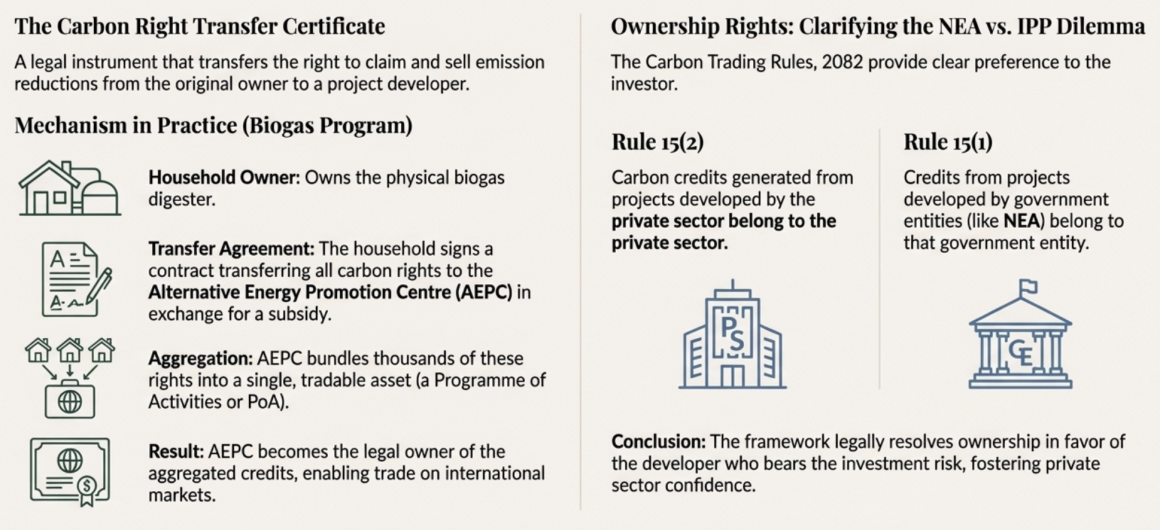
3. How has jurisdictional nesting been addressed under the carbon trading rules and regulations of Nepal?
Based on Verra – Jurisdictional and Nested Standard and the Carbon Trading Rules 2082, Nepal addresses jurisdictional nesting by defining clear layers of crediting between national/jurisdictional programs and lower-level projects, while managing ownership, double counting, and benefit sharing. Below is the analysis for each scenario:
Scenario 1: Centralized Nesting
- Mechanism: Lower-level projects (household, community, or small private projects) generate credits that are nested within a jurisdictional forest reference emission level (FREL) at the national or provincial level. Credits are issued to the registry after verification.
- Advantages:
- Aligns small projects with national emission reduction goals.
- Aggregation reduces transaction costs and ensures MRV consistency.
- Disadvantages / Risks:
- VCM-specific risks include potential money laundering or misuse of credits due to weak regulatory oversight.
- Double counting risk if projects sell credits independently before national approval.
- Small developers may face delays due to registry bottlenecks.
Scenario 2: Decentralized Nesting (e.g. REDD+)
- Mechanism: National REDD+ programs define a jurisdictional FREL, but individual projects (community forests, CFUGs, or private forestry) are credited separately. Credits are issued at all levels but are nested to avoid double counting. Benefit sharing occurs between national program and lower-level projects.
- Advantages:
- Ensures national accounting integrity while incentivizing local actions.
- Integrates results-based finance with verified local implementation.
- Disadvantages:
- Complexity in MRV: Each project must reconcile data with the jurisdictional registry.
- Potential delays in payments due to verification at multiple levels.
- Conflicts over benefit sharing may arise if local stakeholders feel national allocation is disproportionate.
- Administrative burden for DNA and local offices.
Scenario 3: Jurisdictional Program with Benefit Sharing (e.g. IPPAN / Private Sector Projects)
- Mechanism: Carbon credits from private sector projects are nested under the jurisdictional program to avoid double counting, but private developers retain primary ownership. Financial benefit sharing is mandated (10% levy to government).
- Advantages:
- Encourages private investment while maintaining national integrity for NDC accounting.
- Provides clear profit allocation between private proponents and government.
- Disadvantages:
- Potential conflict with NEA over grid emission factor claims.
- Requires strict compliance to prevent double counting.
- Additional reporting burden for private developers, especially smaller IPPs.
- Risk that government may restrict international sale if credits are needed for national NDC compliance.
Summary of Jurisdictional Nesting Approach in Nepal:
- Credits are nested to avoid double counting between national programs and lower-level projects.
- Centralized nesting (Scenario 1) is more straightforward but vulnerable to voluntary market abuse.
- Decentralized nesting (Scenario 2) provides stronger local incentives but increases administrative complexity.
- Private sector nesting (Scenario 3) balances ownership and public oversight but introduces potential conflicts and reporting burdens.
- Overall, Nepal’s approach is aligned with international standards (Verra JNR) but requires robust MRV systems and regulatory enforcement to minimize risks.
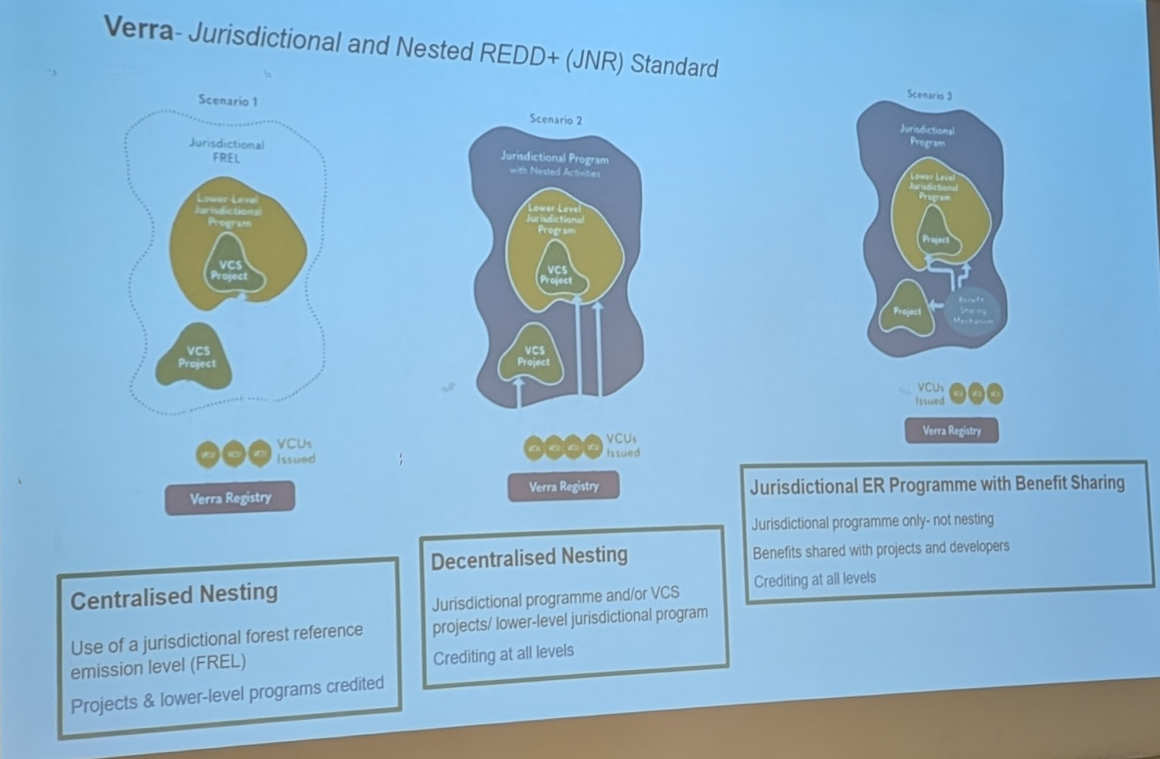
4. How Do Corresponding Adjustments (Indonesia 30%, Nepal 5%) Help Raise the Price of Nepal’s Emission Reductions?
The concept of Corresponding Adjustment (CA) combined with national retention rates (e.g., Nepal’s 5% deduction for its NDC or Indonesia’s 30%) helps increase the price of emission reductions (ERs) through scarcity, integrity premiums, and opportunity costs.
1. Creating a Premium Product (Integrity and Exclusivity)
- Guarantee Against Double Counting: Without a CA, both the host country (Nepal) and the buyer could claim the same environmental benefit. A CA ensures that Nepal subtracts the reduction from its own ledger, giving the buyer the exclusive claim.
- Compliance Grade Value: Credits with CAs are eligible under the Paris Agreement (Article 6) and international compliance schemes such as CORSIA. Because they meet stricter standards and resolve double claiming, these credits command higher market prices compared to unadjusted credits, which are often considered only voluntary contributions rather than formal offsets.
2. Supply Constriction (The 5% Retention Rule)
- Reduced Supply: Nepal mandates that 5% of generated credits be retained for its own NDC or adaptation purposes. This reduces the volume of credits available for international sale.
- Scarcity Economics: In a market where demand for high-integrity credits is increasing (driven by corporate Net Zero goals and compliance schemes), limiting supply creates scarcity, which puts upward pressure on the price per ton of remaining exportable credits.
3. Internalizing Opportunity Costs
- The Cost of Exporting: When Nepal exports a credit with a CA, it loses the right to count that reduction toward its own climate targets. To maintain its NDC, Nepal may have to generate additional reductions elsewhere, which could be more costly.
- Setting a Price Floor: To make economic sense, the export price must exceed the cost of replacement, establishing a higher floor price for Nepali credits and preventing them from being sold cheaply.
4. Avoiding the “Low-Quality” Discount
- Combatting Greenwashing: Credits without adjustments may be criticized for not representing a true net atmospheric benefit if the host country also claims them. This perception suppresses their market price.
- Higher Willingness to Pay: Buyers are willing to pay more for credits with a CA due to legal certainty and reputational assurance. Forecasts suggest prices could rise to $47–$210 per tonne for high-integrity, adjusted credits.
Summary: The combination of Corresponding Adjustments and Retention Rates (5%) transforms Nepali carbon credits from a cheap, abundant commodity into a scarce, high-integrity asset. Buyers must compensate Nepal not just for project costs, but also for the opportunity cost of the national carbon budget that Nepal sacrifices when selling the credits internationally.
5. What is the documentation cost of the MRV report and where is GoN support required?
There is no single fixed “market price” for an MRV (Measurement, Reporting, and Verification) report. Instead, costs are structured as percentage allocations within project budgets, and establishing these systems requires significant support from the Government of Nepal (GoN).
1. Estimated Documentation and System Costs
- Percentage Allocation: The National Adaptation Plan (NAP) recommends allocating at least 5 percent of the cost of each operational project to prepare robust Monitoring and Reporting (M&R) systems.
- Project-Specific Examples: In large-scale programs such as the Nepal Climate Change Support Programme (NCCSP), approximately 20 percent of the total budget (e.g., £4.6 million out of £23 million) was earmarked for administrative and technical assistance costs, covering technical expertise for monitoring and reporting.
- Proponent Liability: Under the Environment Protection Regulations, the project developer is required to estimate and disclose the “Monitoring Cost” necessary for the project and is responsible for bearing these expenses.
2. Government of Nepal (GoN) Support Requirements
This is an area where GoN support is critical to reduce the burden on individual projects. Key areas include:
- Establishing Centralized Systems: The GoN plans to establish and operationalize a Climate Change Data Management, Monitoring and Reporting Centre (CCDMMRC) at federal, provincial, and local levels to standardize data management.
- Capacity Building: Significant human and technical resources are required to operate these systems. MoFE is responsible for preparing capacity-building plans for staff on data mining, synthesis, and analysis to ensure the MR&R system functions effectively.
- Standardization: Lack of a central database and standardized data collection tools is a key challenge. The government is working to standardize mechanisms, such as through the BIPAD portal for disaster data, to ensure consistency.
- Regulatory Oversight: The Ministry of Forests and Environment (MoFE) and other agencies must facilitate the review of MRV reports to ensure alignment with national standards.
In summary, while the cost of MRV documentation is borne partly by project developers, GoN support is essential for centralized systems, standardization, capacity building, and regulatory oversight to ensure credible and efficient MRV processes.
6. The legal complexities of the payment agreement and the liabilities that arise in carbon trading
Based on the Carbon Trading Rules, 2082, Paris Agreement, and case studies from the Clean Development Mechanism (CDM) and Voluntary Carbon Market (VCM), the legal complexities, liabilities, and risks specific to carbon trading are as follows:
1. Legal Complexities of the Payment Agreement
In carbon trading, the payment agreement is typically an Emission Reduction Purchase Agreement (ERPA). Legal complexities arise from defining the intangible asset, the carbon credit, and the transfer of rights.
- Transfer of Environmental Attributes: The core complexity is establishing ownership of the carbon reduction. For example, in Nepal’s biogas program, individual households sign agreements transferring their legal rights, interests, credits, entitlements, and benefits to the Alternative Energy Promotion Centre (AEPC) so the AEPC can sell aggregated credits.
- Corresponding Adjustments (Article 6): Under the Paris Agreement and Nepal’s Rules, if carbon credits are sold internationally, Nepal must make a corresponding adjustment in its national registry. The legal agreement must clearly state which country claims the reduction toward its Nationally Determined Contribution (NDC) to avoid double counting.
- Benefit Sharing (The 80 Percent Rule): In Nepal, 80 percent of finance obtained from international climate mechanisms must be allocated to the local level for program implementation. Ensuring this flow from the federal treasury to local communities through legal contracts presents a significant compliance complexity.
2. Liabilities Arising
Liabilities in carbon trading typically arise from failure to deliver credits or the reversal of carbon storage.
- Reversal Liability (Permanence): In forestry (REDD+) or land-use projects, trees storing carbon may be destroyed, for example by fire or logging.
- Legal Consequence: The Carbon Trading Rules state that if liability arises due to the transfer of carbon credits, the project developer must bear the entire liability.
- Buffer Pools: International standards such as Verra or Gold Standard require developers to deposit a percentage of credits into a buffer pool as insurance against reversals.
- Delivery Shortfall: If a project fails to generate the promised carbon reductions, for example due to technical failure, the seller may be liable to pay delay liquidated damages or replace the missing credits.
- Double Counting Liability: If a credit is claimed by both the buyer and the host country, it breaches environmental integrity. The Rules place responsibility on the Designated National Authority (DNA) to prevent this, but the proponent can be liable for false reporting.
3. Arbitration and Dispute Resolution
Dispute resolution in carbon trading often mirrors international infrastructure contracts but with regulatory oversight.
- Regulatory Adjudication: The Carbon Trade Management Committee and the DNA (Ministry of Forests and Environment) resolve disputes regarding project approval and credit issuance in Nepal.
- International Arbitration: For cross-border sales, disputes under ERPAs are often referred to international tribunals such as the Singapore International Arbitration Centre (SIAC) to ensure neutrality for foreign buyers.
- Grievance Mechanisms: Standards such as Gold Standard require a continuous grievance mechanism where local stakeholders can raise issues regarding human rights or benefit sharing throughout the crediting period.
4. Post-Audits (MRV)
Carbon audits focus on Measurement, Reporting, and Verification (MRV) rather than financial accounting.
- Third-Party Verification: Independent auditors, Designated Operational Entities (DOEs), accredited by international standards, verify that emission reductions are real and measurable.
- Continuous Monitoring: Audits are ongoing. For biogas projects, Biogas User Surveys must be conducted at least every two years to confirm stoves or digesters are still in use. Non-functional equipment cannot generate credits.
- National Registry Tracking: The DNA must submit biennial transparency reports to the UNFCCC detailing sales and corresponding adjustments. False reporting can lead to project license cancellation.
5. Environment and Safeguards
Carbon projects are subject to strict safeguards to ensure no net harm.
- Social Safeguards (FPIC): Projects must respect the rights of indigenous peoples and local communities by obtaining Free, Prior, and Informed Consent. Failure constitutes a violation of international standards such as UNDRIP and national policies.
- Ecological Safeguards: Projects must prevent conversion of natural forests into monoculture plantations that destroy biodiversity.
- SDG Contributions: Modern credits, such as Gold Standard, require proof of contribution to at least three Sustainable Development Goals, for example health benefits from reduced indoor smoke and employment generation.
6. Real-World Risks and Examples
- Phantom Credits (Overestimation): Investigations found that up to 94 percent of rainforest offset credits certified by Verra were “phantom credits” that did not represent real carbon reductions due to inflated baselines.
- Carbon Cowboys: Instances exist where entrepreneurs signed unfair contracts with indigenous tribes, acquiring rights to their carbon for 100 years or more, illustrating the risk of exploitation without strong legal frameworks.
- Market Crash: CDM credits (CERs) fell from €20 to less than €1 in 2012 due to oversupply and EU regulatory changes, leaving many projects with stranded assets.
- Greenwashing Litigation: Companies such as Shell and Delta Airlines have faced lawsuits for claiming carbon neutrality based on flawed or non-additional offsets.
- Human Rights Violations: Some REDD+ projects, for example in Cambodia or Congo, were accused of evicting indigenous people to protect forests for carbon credits, leading to investigations by Human Rights Watch.
Part 7: Specific Programs & Registries
1. What is the LEAF coalition program?
The LEAF Coalition, or Lowering Emissions by Accelerating Forest Finance, is a global public-private partnership launched in 2021 to combat deforestation and climate change by channeling large-scale funding into tropical forest conservation. It builds on REDD+ mechanisms to generate high-integrity carbon credits, with buyers committing to pay at least $10 per ton of CO2 equivalent reduced. Countries like Ghana, Brazil, and Costa Rica have active agreements, while Nepal is advancing participation.
Nepal’s Involvement: Nepal signed a letter of intent with the LEAF Coalition at COP26 in Glasgow in 2022, targeting emissions reductions in Bagmati, Gandaki, and Lumbini provinces’ forests covering 32 million hectares. The program aims to store or reduce 30-70 million tons of CO2 equivalent from 2022-2026, potentially generating Rs 13 billion (about $100 million) at $10 per ton, with provisions for higher rates based on conditions. Preparations for a formal agreement continued into 2025, aligning with Nepal’s jurisdictional REDD+ efforts using ART/TREES standards.
Carbon Trading Context: In Nepal, LEAF supports commercial carbon trading by verifying forest-based emission reductions for sale to coalition buyers like major corporations, facilitated by Emergent as the intermediary. This complements other initiatives, such as Nepal’s World Bank ERPA for 9-34 million tons in Tarai districts, aiming for over Rs 10 billion total by 2028. Community awareness programs in 100 municipalities promote equitable benefits for forest users under this framework.
2. What kind of attributes does the registry collect?
Based on the Carbon Trading Rules, National Climate Change Policy, Gold Standard Project Design Documents (PDDs), and international standards (IPCC/UNFCCC) referenced in the sources, the carbon registry collects a vast array of attributes to ensure transparency, prevent double counting, and verify environmental integrity. These attributes can be categorized into six exhaustive categories:
1. Project Identity and Governance Attributes
The registry captures the fundamental “who” and “what” of the project to establish legal liability and ownership.
- Project Proponent/Developer: Name and legal registration details of the entity developing the project (e.g., AEPC, private companies).
- Project Title and Type: The specific name and sectoral scope (e.g., Renewable Energy, Afforestation, Methane Avoidance).
- Host Party/Country: The jurisdiction where the project physically exists (e.g., Nepal).
- Registration Date: The official date of entry into the system.
- Crediting Period: The specific timeframe during which the project is eligible to generate credits (e.g., 7 or 10 years, renewable).
- Legal Ownership: Documentation proving who owns the “environmental attribute” (e.g., a contract transferring rights from a household to the AEPC).
2. Geospatial and Technical Attributes
To ensure the project is real and unique, specific physical data is recorded.
- Geographical Boundary: Specific location details, including GPS coordinates, Province, District, and Municipality.
- Technology Type: Specifics of the hardware used (e.g., Biogas digester size: 2m³, 4m³, 6m³).
- Scale: Whether the project is micro, small, or large scale.
- Baseline Scenario: A description of what would have happened without the project (e.g., continued use of firewood for cooking).
3. Carbon Accounting and Methodological Attributes
This is the “math” of the registry, recording the specific formulas and values used to calculate credits.
- Applied Methodology: The specific UNFCCC or Standard-approved rulebook used (e.g., AMS-I.E version 09 for biogas).
- Baseline Emissions: The calculated amount of CO2 that would have been emitted in the absence of the project.
- Project Emissions: The actual emissions occurring from the project activity itself.
- Leakage: Unintended emissions occurring outside the project boundary due to the project (e.g., shifting deforestation to a neighbor’s land).
- Key Technical Parameters:
- fNRB (Fraction of Non-Renewable Biomass): The percentage of wood saved that would not have regrown (e.g., 86.1% for Nepal).
- NCV (Net Calorific Value): The energy content of the fuel replaced (e.g., 0.0156 TJ/tonne for wood).
- Emission Factor: The carbon intensity of the fuel replaced (e.g., 63.7 tCO2/TJ).
4. Credit Issuance, Serialization, and Status
These attributes track the “life” of the carbon credit as a tradable asset.
- Vintage Year: The specific year in which the emission reduction actually occurred.
- Serial Numbers: Unique identification numbers assigned to every tonne of CO2e to prevent double counting.
- Credit Status: The current state of the credit in the registry lifecycle:
- Issued: Created and sitting in an account.
- Transferred: Moved between buyer/seller accounts.
- Retired/Cancelled: Permanently taken out of circulation to claim an offset.
- Corresponding Adjustment Status: A tag indicating if the host country (Nepal) has adjusted its national ledger to allow the credit to be sold internationally under Article 6 of the Paris Agreement.
5. Social, Environmental, and SDG Attributes
Modern registries (like Gold Standard and Nepal’s National Registry) track benefits beyond just carbon.
- SDG Impacts: Which Sustainable Development Goals are supported (e.g., SDG 3 for Health, SDG 7 for Clean Energy, SDG 13 for Climate Action).
- Quantified Co-benefits: Specific metrics such as “reduction in health problems” or “time saved in firewood collection”.
- Safeguards: Confirmation that the project causes “no net harm” to the environment or society.
- Stakeholder Consultation: Records of local meetings and grievance mechanisms.
6. Buffer and Risk Management
For forestry or land-use projects that might be reversed (e.g., trees burning down), the registry tracks risk management.
- Non-Permanence Risk Rating: An assessment of the risk of reversal.
- Buffer Pool Contribution: A percentage of credits set aside in a “buffer account” to insure against future loss of carbon stocks.
3. What is Digital Tree Registry?
Data management for private forests is covered under the National Forest Information System (NFIS) and related legal frameworks have been maintained. Here is the detailed breakdown:
1. National Forest Information System (NFIS) under REDD+
- The REDD Implementation Centre (not REDIC) is responsible for strengthening the NFIS and Safeguard Information System (SIS).
- NFIS serves as a centralized digital database for all forest-related data to support emission reduction and reporting programs.
- Training and system-strengthening activities have been conducted to ensure robust data collection, management, and reporting.
2. Strategic Mandate for a National Database
- The National Forest Integrated Strategic Plan (2081–2100) mandates the maintenance and update of national-level records of private forests.
- The goal is to promote private forestry by ensuring that private forest resources are systematically documented and updated.
- Emphasis is placed on modern digital technology to facilitate tracking, production, cutting, and transportation of forest products from private lands.
3. Legal Registration of Private Forests (Niji Ban)
- Although not called a digital tree registry, the Forest Act, 2076 and Forest Regulations require formal registration of private forests.
- Registration Requirement: Owners of private forests must submit an application to the Division Forest Office detailing the area, boundaries, and estimated number of trees.
- Certificate: Authorities issue a Private Forest Certificate (Niji Ban Darta Pramanpatra) as legal proof of ownership and harvesting rights.
- Inventory for Harvesting: To cut or transport timber for commercial purposes, owners must provide species and quantity details. Unregistered forests have limited harvesting rights.
4. Measurement and Monitoring
- NLCMS (National Land Cover Monitoring System): Used to prepare maps and reports on forest cover, contributing to the national database supporting REDD+ programs.
- LiDAR Surveys: The Forest Research and Training Centre uses Terrestrial LiDAR for precise forest measurement, improving digital accuracy for private forest data.
The NFIS, legal registration under the Forest Act, and modern measurement technologies (NLCMS, LiDAR) collectively serve the function of documenting, monitoring, and digitizing private forest resources for policy, carbon trade, and benefit-sharing purposes.
4. Private Sector Engagement in Carbon Trading in Nepal
Particularly following the Carbon Trading Regulation approved in December 2025, which allows businesses, cooperatives, and NGOs to implement emission-reduction projects and trade credits internationally after government certification.
The new framework opens commercial pathways for private entities to generate revenue from verified carbon credits under standards like VERRA and ART-TREES, with a National Carbon Registry forthcoming. Previously, activities were centralized under government-led REDD+ and clean energy initiatives, limiting private involvement.
Examples:
- Yeti Airlines: Achieved carbon neutrality in 2019 by offsetting 19,665 tonnes of CO₂ emissions via UN-certified credits and fuel-efficient operations; continues environmental projects but no recent trading specifics.
- Muktinath Krishi Sahakari Sanstha, Sahara Nepal are also reported to have been involved even before the Carbon Trading Regulation, 2082.
Based on the provided sources, the private sector entities, consortiums, and organizations involved in or associated with carbon trading and clean development mechanism (CDM) projects in Nepal include:
Hydropower Developers (CDM and Carbon Rights)
Private developers dealing with large-scale hydropower projects have secured rights to “Greenhouse Gas (GHG) Reduction Benefits” (carbon credits) through Project Development Agreements (PDA). Nepal Water & Energy Development Company Private Limited (NWEDC): Developer of the Upper Trishuli-1 Hydroelectric Project. The PDA explicitly grants the company the right to market, sell, and retain proceeds from GHG Reduction Benefits. Korea South-East Power Co., Ltd.: Identified as the “Lead Sponsor” for the NWEDC project. GMR-ITD Consortium: Executing the Upper Karnali Hydropower Project. The Memorandum of Understanding emphasizes the project is export-oriented but requires the Joint Venture Company (JVC) to conduct environmental assessments, a precursor to CDM registration. The consortium consists of: GMR Energy Limited (India), GMR Infrastructure Limited (India) Italian-Thai Development Public Company Limited (Thailand)
Biogas and Renewable Energy (Voluntary & Compliance Markets)
In the biogas sector, while the government body Alternative Energy Promotion Centre (AEPC) acts as the central “Project Developer” to aggregate credits, several private and international entities act as project participants, buyers, or implementation partners.
- atmosfair gGmbH: A German non-profit providing voluntary offsets; listed as a Project Participant in Gold Standard Project Design Documents (PDD) for the Biogas Support Program (BSP-Nepal).
- First Climate Markets AG: Listed as a Project Participant alongside AEPC for BSP activities.
- Clean Energy Bank: Participated in stakeholder consultations regarding carbon financing and revenue utilization for biogas CDM projects.
- Biogas Companies (BC): Install digesters; work is subject to quality control and penalties to ensure emission reductions are valid.
- Nepal Biogas Promoters Association (NBPA): Umbrella organization for private biogas companies, actively involved in stakeholder consultations for carbon financing.
Forestry and REDD+ Sector
While much of the forestry sector is community-managed, specific private and non-governmental entities are recognized as stakeholders in the carbon trade landscape.
- Forest Entrepreneurs: The “Forestry Sector Strategy” and “National Forest Policy” envision private forest entrepreneurs managing forests and utilizing financial resources from international mechanisms like REDD+.
- Federation of Community Forestry Users Nepal (FECOFUN): Represents community forest user groups, involved in consultations regarding carbon financing.
- Private Forest Owners: Policies promote participation of family-owned and private forests in carbon markets.
- Carbon Advisory and Consulting
Several entities appear in stakeholder consultation lists for carbon projects, indicating involvement in the ecosystem.
- Carbon Watch: Listed as a participant in local stakeholder consultations.
- Winrock International Nepal: Involved in renewable energy and carbon financing consultations.
- Clean Energy Nepal (CEN): Participates in biogas CDM project consultations.
- Private Sector in General
The National Climate Change Policy (2019) and Sixteenth Plan explicitly encourage the private sector to mobilize finance through instruments like Green Bonds and Carbon Offsets. The Environment Protection Regulations allow private sector proponents to develop projects and sell carbon credits in national or international markets.
5. How Are Carbon Credits Issued, Are They Industry-Specific, What Are the Types, and What Regulations Do They Follow?
Credits in Nepal are issued, classified, and regulated under the Carbon Trading Rules, 2082, and international carbon market practices. The following outlines the process and regulatory framework:
1. How Are Credits Issued?
Carbon credits are issued following a rigorous project cycle that verifies emission reductions or removals against a baseline.
- Validation and Verification: Credits are issued only after a third-party auditor (Designated Operational Entity or DOE) verifies that the project has successfully reduced emissions or enhanced removals according to an approved methodology.
- Registration: Projects must register with the National Carbon Registry (or an international registry used by Nepal) through the Ministry of Forests and Environment (MoFE), which acts as the Designated National Authority (DNA).
- Issuance: Once verified, the regulatory body (CDM Executive Board, Verra, or Government of Nepal) issues unique serial numbers for the credits into the project developer’s registry account.
- Legal Ownership: In programs like the Nepal Biogas Support Program, individual households transfer legal rights to the credits to the Alternative Energy Promotion Centre (AEPC), which acts as the central owner and aggregator for issuance.
2. Are Credits Issued Industry-Specific?
Yes, credits are sector-specific and follow methodologies tailored to each industry.
- Methodologies: Crediting programs develop distinct methodologies for different industries to calculate baselines and monitor emissions. Examples include Aluminum, Aviation, Buildings, Cement, Forestry (AFOLU), Power, and Steel.
- Nepal’s Classification: The Carbon Trading Rules categorize projects into:
- Energy: Renewable energy development and energy efficiency.
- Agriculture, Forestry, and Other Land Use (AFOLU): Forestry, biodiversity, and soil management.
- Waste Management
- Transportation
- Specific Examples:
- Biogas: Uses methodology AMS-I.E for switching from non-renewable biomass for thermal applications.
- Hydropower: Projects like Upper Trishuli-1 include provisions in the Project Development Agreements regarding ownership and sale of GHG Reduction Benefits.
3. Are There Types of Credits?
Yes, credits are categorized by market type and nature of the reduction.
- Compliance Credits: For regulatory obligations, e.g., under the Paris Agreement or Kyoto Protocol. Examples: Certified Emission Reductions (CERs), Emission Reduction Units (ERUs), Article 6.4 Emission Reductions (A6.4ERs).
- Voluntary Credits: For voluntary climate goals by corporations or individuals. Examples: Verified Carbon Units (VCUs) from Verra, Verified Emission Reductions (VERs) from Gold Standard.
- Internationally Transferred Mitigation Outcomes (ITMOs): Under Article 6.2 of the Paris Agreement, enabling countries to trade emission reductions to meet their NDCs.
- Avoidance vs. Removal: Credits are distinguished by whether they avoid emissions (e.g., renewable energy replacing fossil fuels) or remove carbon from the atmosphere (e.g., reforestation, direct air capture).
4. Are Credits Subject to Any Regulations or Levies?
Carbon credits in Nepal and international markets are subject to regulatory and financial obligations:
- Government Fees and Levies:
- Selling Fee: NPR 100 per ton payable to the government upon selling credits.
- Profit Levy: 10% of profits from carbon trading must be allocated to the Government of Nepal.
- NDC Retention (5% Rule): 5% of total verified credits must be retained for Nepal’s own NDC before the remainder can be sold.
- Corresponding Adjustments: To prevent double counting, international sales require Nepal to adjust its national ledger so reductions are not claimed by both buyer and seller.
- Buffer Pools: Particularly in forestry projects, a portion of credits is held in reserve to insure against risk of reversal (e.g., forest loss).
- Standardized Auditing: All credits undergo Measurement, Reporting, and Verification (MRV) by accredited third-party auditors to ensure environmental integrity.