Budhigandaki and Upper Arun: Nepal’s USD 4 Billion Bet on Energy Sovereignty
This is the third in a series of posts on Nepal’s mega hydropower projects. The first covered Budhigandaki’s USD 3 billion financing architecture. The second provided a complete assessment of the 1,063 MW Upper Arun project. This post examines both projects together – as a comparative policy prescription, comprehensive technical and financial reference, and transaction advisory memorandum.
Two projects – the 1,200 MW Budhigandaki Hydropower Project on the Gandaki River system and the 1,063 MW Upper Arun Hydropower Project on the Arun River – represent the most consequential infrastructure commitments in Nepal’s post-federal history. Together, they account for a combined installed capacity of 2,263 MW, a combined project cost exceeding USD 4.14 billion, and a combined annual energy generation potential of approximately 8.06 billion units – enough to fundamentally transform Nepal’s energy balance and its position as a regional electricity exporter.
This analysis covers the technical architecture of both projects side by side; their development histories and current licensing status; the differential financing modalities under which each is being developed; the comparative power purchase agreement frameworks applicable to reservoir-based and peaking run-of-river projects respectively; the geopolitical and strategic dimensions of both projects in the context of Nepal-India water treaties, the Arun River cascade, and the India-China-World Bank triangle; downstream water benefit economics; GLOF, seismic, and sediment risk frameworks; Nepal’s fiscal capacity and the capital competition between both projects; and a final transaction advisory synthesis identifying critical missing dynamics and policy prescriptions.
The central finding is that both projects are commercially viable and nationally strategic, but they are simultaneously competing for the same constrained domestic financing pool at a moment when Nepal’s fiscal capacity is under unprecedented pressure. The simultaneous financing of both projects will absorb between 43 and 53 percent of Nepal’s entire deployable annual capital budget at peak construction overlap, and will draw upon essentially the entire investable surplus of Nepal’s major quasi-government institutions – EPF, CIT, SSF, and HIDCL – for nearly a decade. Resolving the World Bank financing pathway for Upper Arun is therefore not merely a project-specific issue; it is the critical systemic action that determines whether both projects can be financed without crowding out Nepal’s roads, irrigation, and social infrastructure investment.
Chapter 1: Nepal’s Energy Imperative – Context, River Systems, and the Strategic Case for Mega Hydropower
1.1 Nepal’s Hydropower Endowment and Economic Dependence
Nepal is one of the most hydropower-rich nations on earth, with a theoretical hydropower potential estimated at 83,000 MW and a technically and commercially viable potential of approximately 42,000 MW. Hydropower currently accounts for over 96 percent of the country’s total installed electricity generation capacity. Yet despite this extraordinary endowment, Nepal spent more than a decade – from 2006 to 2017 – enduring power outages of up to 18 hours per day, a consequence of chronic underinvestment in generation and transmission infrastructure during and after the decade-long Maoist insurgency. The elimination of load-shedding, achieved through improved management and new project commissioning, is among the most significant infrastructure policy achievements of the post-conflict period. However, Nepal now faces a structurally different challenge: the rapid accumulation of surplus electricity during the wet monsoon season (June to November) against persistent dry-season deficits (December to May), when run-of-river generation falls to as little as one-third of installed capacity. This seasonal imbalance – not capacity scarcity – is Nepal’s defining energy policy challenge for the decade ahead. As Spotlight Nepal noted in April 2026, Nepal’s energy future cannot be built on hydropower optimism alone; it requires a system-level response including storage, diversification, and structured export mechanisms.
1.2 The 28,500 MW Target and the Generation Build-Out
The Government of Nepal’s Energy Development Roadmap targets 28,500 MW of total installed capacity by 2035, of which 25,800 MW is envisioned as hydropower. As of the end of FY 2024/25, Nepal’s installed hydropower capacity reached 3,591 MW, with 434 MW added in that fiscal year alone. In the first half of FY 2025/26, the build-out accelerated further: the World Bank’s April 2026 Nepal Development Update reports that nearly 385 MW of additional hydroelectric capacity was added to the grid in H1 FY26, up from 244 MW in H1 FY25, bringing total installed capacity to approximately 3,977 MW by mid-year. The industrial sector benefited from this expansion, and growth was further supported by ongoing construction of multiple hydropower projects which boosted the construction sub-sector.
The pipeline is accelerating: Nepal currently exports an average of 1,000 MW of surplus electricity daily and earned NPR 17.47 billion (approximately USD 116 million) from electricity exports in FY 2024/25. However, this export surplus is overwhelmingly concentrated in the wet monsoon season – it is not a year-round phenomenon. Total exports reached 2.35 billion units in FY 2024/25, with India accounting for NPR 17.19 billion of purchases and Bangladesh for NPR 266.7 million. Electricity trade with India is conducted in Indian rupees (INR), while transactions with Bangladesh are settled in US dollars. During the dry season (December to May), when river flows drop by 65-70%, Nepal’s generation capacity collapses and the country still imports electricity from India to meet up to 25% of peak demand. As NEA Managing Director Hitendra Dev Shakya acknowledged in May 2026, approximately 791 MW will need to be imported in the dry season of 2025/26 and 728 MW in 2026/27 – meaning imports will not reach zero for several more years. The dry-season energy deficit remains structural and worsening as domestic demand grows at 10-12% annually. Storage hydropower – which stores monsoon water and releases it during winter – is the only technology that fundamentally resolves this imbalance at scale.
| KEY TAKEAWAY: Nepal’s Energy System Challenge Nepal has abundance in the wet season and scarcity in the dry season. Every major run-of-river project commissioned exacerbates this asymmetry. Only storage and semi-storage projects directly solve the seasonal imbalance, making Budhigandaki (full reservoir storage, 35% dry-season generation) and Upper Arun (6-hour daily peaking, reliable winter output) strategically distinct from the thousands of MW of run-of-river capacity already in the pipeline. |
Nepal’s Electricity Demand-Supply Balance and Projections
| Metric | Wet Season (Jun-Nov) | Dry Season (Dec-May) | Annual |
| Installed capacity (end FY 2024/25) | ~3,591 MW available | ~1,200-1,400 MW effective (65-70% drop) | 3,591 MW |
| Installed capacity (mid-FY 2025/26) | ~3,977 MW | ~1,300-1,600 MW effective | ~3,977 MW |
| Peak demand (FY 2024/25) | ~1,800 MW | ~2,100-2,300 MW | Growing 10-12%/year |
| Domestic consumption (FY 2024/25) | – | – | 11,319 GWh (+10.7% YoY) |
| Surplus/deficit | ~1,000 MW surplus (exported) | ~700-900 MW deficit (imported) | Net exporter since FY 2023/24 |
| Projected peak demand (FY 2028/29) | – | – | ~3,500-4,000 MW |
| Projected peak demand (FY 2033/34) | – | – | ~5,785 MW; 28,330 GWh |
| 28,500 MW target (2035) | – | – | 25,800 MW hydro + 2,700 MW other |
Sources: NEA Annual Report FY 2024/25; World Bank Nepal Development Update April 2026; NEA Demand Forecast Report; PMC – Evolution of Hydropower Nepal
1.3 The Case for Storage: Why These Two Projects Are Different
Of the projects for which NEA has signed or is preparing power purchase agreements, the overwhelming majority are run-of-river or peaking run-of-river projects. As of late 2025, NEA had signed PPAs with 392 projects for a combined generation capacity of 7,758 MW. The generation mix targets cap run-of-river PPAs at 6,750 MW and peaking run-of-river at 4,500 MW. Additionally, NEA signed PPAs for 24 solar projects with a combined capacity of 355 MW in late 2025.
NEA’s Commercial Position (FY 2024/25)
| Metric | Value | Source |
| Total PPAs signed (hydro) | 392 projects; 7,758 MW combined | Kathmandu Post |
| RoR PPA cap | 6,750 MW | NEA board decision |
| PRoR PPA cap | 4,500 MW | NEA board decision |
| Revenue from electricity sales | NPR 125.27 bn (USD 835M) | Rising Nepal Daily |
| Electricity purchase cost | NPR 77.10 bn (USD 514M) – up 11.73% YoY | Rising Nepal Daily |
| Export revenue | NPR 17.47 bn (USD 116M) | Rising Nepal Daily |
| Domestic consumption | 11,319 GWh (+10.7% YoY) | Rising Nepal Daily |
| Exports | 2.35 bn units (2,350 GWh) | Annapurna Express |
| System (T&D) losses | ~12.73% (down from 15.3% in 2018) | ADB Grid Modernization Project |
| NEA profit before tax | NPR 9.06 bn (USD 60M) – down 37.32% YoY | Rising Nepal Daily |
| Implied average purchase cost | ~NPR 5.7/unit (NPR 77.10 bn ÷ ~13,500 GWh total available) | Author calculation |
| Implied average domestic sale price | ~NPR 9.5-10/unit | Author calculation from revenue and domestic GWh |
| Number of customers | 5.71 million (+4.6% YoY) | Rising Nepal Daily |
| Residential electricity price | NPR 5.79/kWh (USD 0.038) | Global Petrol Prices Sep 2025 |
| Business electricity price | NPR 9.21/kWh (USD 0.061) | Global Petrol Prices Sep 2025 |
The gap between NEA’s average purchase cost (~NPR 5.7/unit) and the PPA rates it must pay for new storage projects (NPR 7.10-12.40/unit wet/dry under the ERC Reservoir Directive 2082) reveals the commercial pressure: every new high-tariff PPA erodes NEA’s already declining margins. NEA’s electricity purchase cost grew 11.73% in a single year – faster than revenue growth – creating a structural squeeze that will intensify as more projects commission.
Storage hydropower – plants with multi-day to seasonal reservoirs – remains critically underrepresented. Among the pipeline of nationally significant projects, only Budhigandaki (1,200 MW) offers seasonal storage at scale. Upper Arun (1,063 MW), while a peaking run-of-river project rather than a true reservoir, provides year-round firm daily peaking capacity of 697 MW for six hours daily – a capability that no other Nepalese project in the current development pipeline can match. The combination of Budhigandaki’s seasonal dispatch flexibility and Upper Arun’s reliable dry-season output is therefore not just additive in MW terms; it is transformative in terms of Nepal’s grid reliability and international energy export creditworthiness.
1.4 The Gandaki River System – Budhigandaki’s Geographic Context
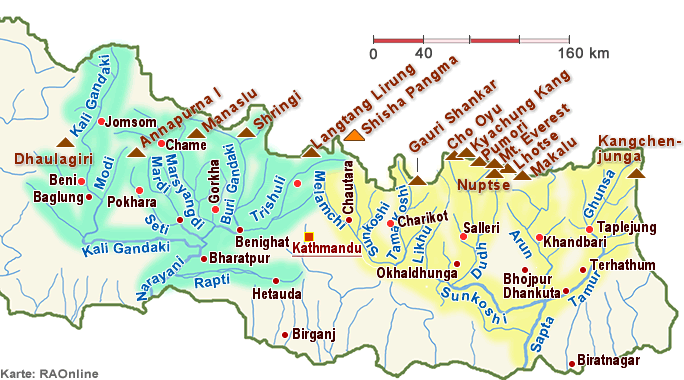
The Gandaki River system drains an approximately 46,300 square kilometre catchment in central Nepal and southern Tibet. The Budhigandaki sub-basin, where the project is sited, spans Gorkha and Dhading districts of Gandaki Province, flowing southward before its confluence with the main Narayani River near Dumre. The Gandaki basin eventually drains into India’s Ganges system, making it a transboundary river of significance under the 1959 Nepal-India Gandak Agreement. The dam site is located in a narrow gorge at the Soti Khola-Budhi Gandaki confluence, approximately 40 kilometres from the epicentre of the 2015 Gorkha earthquake – a geological fact of profound importance for dam design and seismic risk assessment. The annual average flow of the Budhigandaki at the dam site is approximately 302 cubic metres per second, with dramatic seasonal variation that storage regulation is specifically designed to buffer.
The Budhigandaki River joins the Trishuli just above Devghat in Chitwan, together forming the Narayani River. Upon entering India, the river is known as the Gandak River. The Gandak enters India through Maharajganj District of Uttar Pradesh, passes through Kushinagar District, then enters Bihar – flowing through West Champaran, East Champaran, Muzaffarpur, Gopalganj, Siwan, Saran, and Vaishali districts before joining the Ganges downstream of Hajipur and Sonpur near Patna, the state capital. The Gandak Barrage at Valmikinagar – half in Nepal, half in India – diverts water into the Gandak Eastern Main Canal and Western Main Canal, irrigating approximately 1.784 million hectares of Indian agricultural land. Under the 1959 Gandak Agreement, total water allocated to Nepal is 3.23 percent of the total design flow. India receives 96.77 percent. This treaty architecture is directly relevant to the downstream benefit analysis in Chapter 6.
1.5 The Arun River System – Upper Arun’s Geographic Context
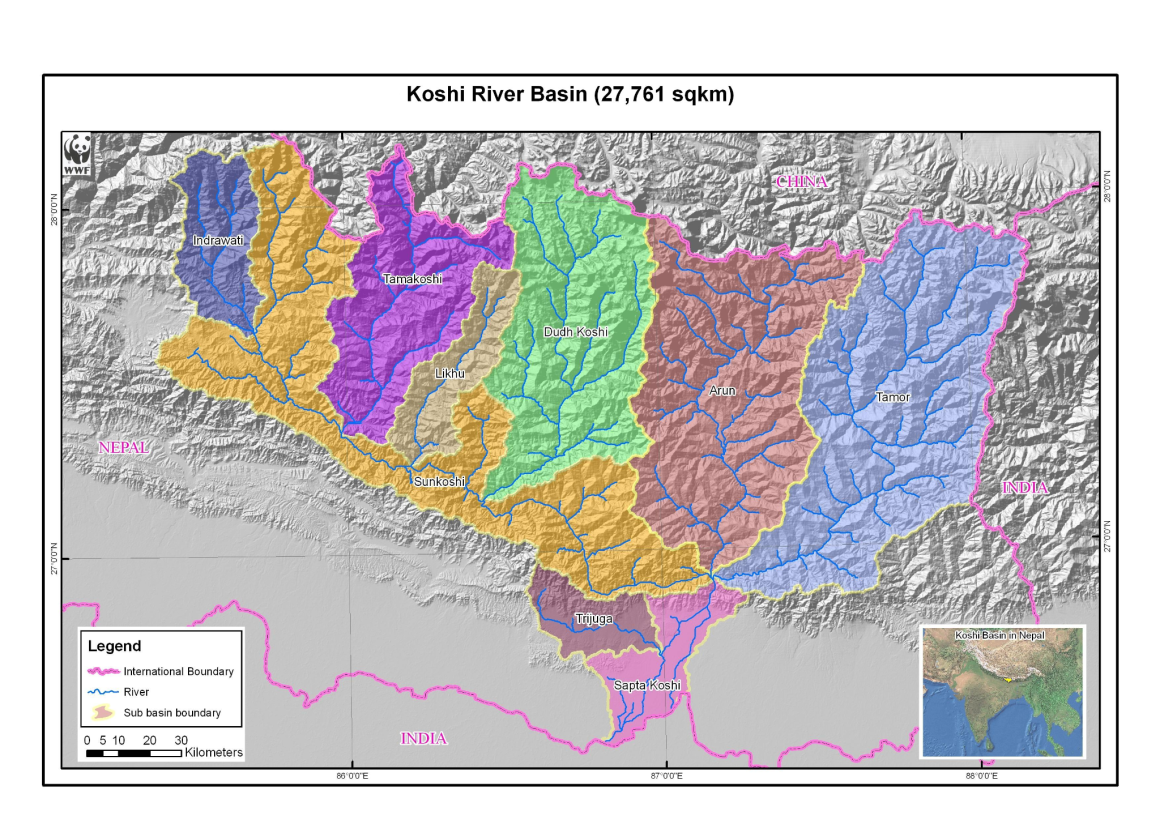
The Arun River originates near Mount Xixabangma in Tibet and flows south through one of the world’s deepest river gorges before entering Nepal at Kimathanka in Sankhuwasabha district. Its total catchment area is approximately 33,500 square kilometres, of which the majority lies in Tibet, China. The Arun is a tributary of the Koshi (Sapta Koshi) system, which discharges into India’s Ganga basin, making it the subject of the 1954 Nepal-India Koshi Agreement. The Upper Arun dam site is located approximately 15 kilometres south of the Nepal-China border, in Bhotkhola Rural Municipality, Sankhuwasabha – one of the most remote and geologically active locations in Nepal. The Arun carries an exceptionally high sediment load: estimated at 8.26 million tonnes per year, which has required the project’s designers to incorporate three underground desanding chambers and a 1.4-kilometre sediment bypass tunnel in the detailed design.
The Arun River is one of the strongest tributaries of the Koshi system because it cuts through the Himalayas in a spectacular gorge – approximately 4,000 metres deep. The Arun’s Tibetan headwaters contain hundreds of glaciers whose melt contributes to the river’s dry-season baseflow. This glacially-fed baseflow is the hydrological foundation for Upper Arun’s most commercially valuable characteristic: its reliable dry-season generation. The river at the Upper Arun site drops 508.3 metres between the intake structure and the underground powerhouse – one of the highest gross heads of any large hydropower project in South Asia, and the reason Pelton turbines (the most efficient turbine type for heads above 300 metres) were selected for the design.
1.6 Nepal’s Transboundary Rivers and India’s Ganges System
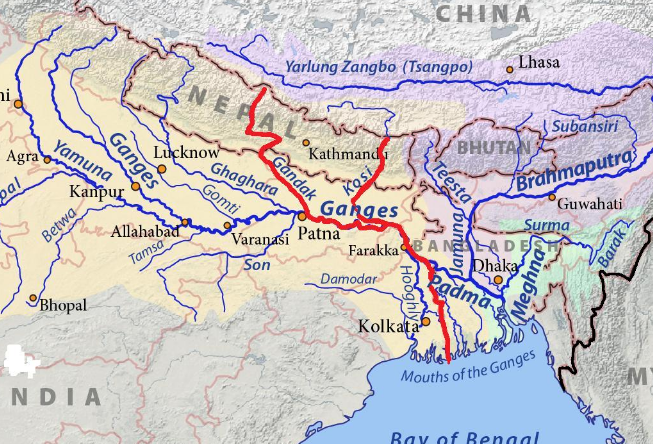
Nepal’s three major river basins – Koshi, Gandaki, and Karnali/Mahakali – all drain southward into India’s Ganges system. Understanding this geography is essential to understanding why both projects carry geopolitical weight beyond their electricity output.
The Koshi basin (eastern Nepal, where Upper Arun sits) is formed by the confluence of the Arun, Sun Koshi, and Tamur rivers at Tribeni. The Sapta Koshi enters India at Bhimnagar in Bihar, where the 1954 Koshi Barrage – built primarily for Bihar’s flood control – governs the river’s management. The Koshi irrigates approximately 1 million hectares in Bihar through its Eastern and Western Main Canals. The Koshi is the third-largest tributary of the Ganges by water discharge, and is historically known as the “Sorrow of Bihar” for its catastrophic annual flooding – a chronic source of tension that the proposed Saptakoshi High Dam (under joint investigation since 2004, DPR still incomplete) is intended to address.
The Gandaki basin (central Nepal, where Budhigandaki sits) drains through the Narayani into the Gandak in India. The 1959 Gandak Agreement governs 1.784 million hectares of Indian irrigation from this system. Nepal receives 3.23% of water. The regulated dry-season flow that Budhigandaki’s reservoir would create – 1,670 MCM annually – would directly augment the Gandak’s irrigation value to Bihar and Uttar Pradesh.
The Karnali/Mahakali basin (western Nepal) is governed by the 1996 Mahakali Treaty, which promised the 5,040-6,480 MW Pancheshwar Multipurpose Project – equal energy sharing between Nepal and India, cost apportioned by benefit. Nearly three decades later, the Detailed Project Report has not been finalised, the Mahakali Commission has never been formed, and not a single megawatt has been generated. This is the most comprehensive treaty Nepal has signed and the most comprehensively unimplemented.
These three systems collectively contribute approximately 41% of the annual flow and about 71% of the dry-season flow of the Ganges – making Nepal the single most important upstream contributor to the Ganges basin. India has historically received virtually no compensation for this.
Further east, the Teesta (originating in Sikkim, India) flows through the same Eastern Himalayan geological zone as the Arun. The October 2023 GLOF destruction of the 1,200 MW Teesta III project – at a cost of USD 1.7 billion, in terrain directly comparable to the Arun basin – is the most relevant catastrophic precedent for Upper Arun’s risk profile. And the Brahmaputra (originating in Tibet as the Yarlung Tsangpo) represents the broader regional context: China’s construction of what is reported to be the world’s largest dam on the Yarlung Tsangpo signals Beijing’s willingness to manage transboundary Himalayan flows unilaterally – a precedent that could eventually affect the Arun’s Tibetan headwaters, over which Nepal has no bilateral water notification agreement with China.
All four of Nepal’s formal bilateral water instruments with India – the Sarada Agreement (1920), Koshi Agreement (1954), Gandak Agreement (1959), and Mahakali Treaty (1996) – share a consistent pattern: India receives large-scale irrigation benefits across millions of hectares while Nepal receives marginal water allocations, typically 3-4% of design flows, with promised benefits poorly implemented over decades. The academic literature consistently characterises this as hydro-hegemony – a structural asymmetry in bargaining power reflecting India’s downstream position and historical dominance of treaty-making.
1.7 Why These Two Projects Define Nepal’s Energy Future
Budhigandaki and Upper Arun together represent Nepal’s most credible pathway toward energy sovereignty – the capacity to generate firm, dispatchable electricity year-round rather than seasonal surpluses that cannot be exported and dry-season shortfalls that require expensive Indian imports. They are also Nepal’s most significant test of sovereign infrastructure development: both are 100 percent Nepalese-owned, developed without BOOT concessions to Indian or Chinese state enterprises, and structured to maximise benefit retention within the country. This is in deliberate contrast to the three SJVN-operated projects on the Arun (Arun III, Arun IV, Lower Arun) under which Nepal receives only 21.9 percent of generated electricity free of cost while 78.1 percent of revenues flow to India for 30 years. The strategic, financial, technical, geopolitical, and fiscal dimensions of both projects are examined in the chapters that follow.
| OPPORTUNITY: The Core Strategic Case Budhigandaki (1,200 MW storage) and Upper Arun (1,063 MW PRoR) are the only two major projects in Nepal’s pipeline that are simultaneously: (a) 100% Nepalese-owned, (b) capable of generating substantial dry-season electricity, and (c) large enough to anchor Nepal’s position as a credible regional electricity exporter. Their combined 8.06 billion units of annual generation would, at full operation, eliminate Nepal’s remaining dry-season import dependency and generate approximately USD 300-400 million per year in electricity export revenues. |
Chapter 2: The Projects – Technical Specifications, Development History, and Current Status
2.1 Side-by-Side Technical Specifications
| Parameter | Budhigandaki (1,200 MW) | Upper Arun (1,063 MW) |
| Project Type | Full Storage / Reservoir Hydropower | Peaking Run-of-River (PRoR) |
| Installed Capacity | 1,200 MW (6 × 200 MW Francis turbines) | 1,063 MW (6 × 173.33 MW Pelton turbines) |
| Project Location | Gorkha and Dhading Districts, Gandaki Province | Bhotkhola Rural Municipality, Sankhuwasabha, Koshi Province |
| Distance from Border | ~150 km south of Tibet border | ~15 km south of China (Tibet) border |
| River | Budhigandaki River (Gandaki Basin) | Arun River (Koshi Basin) |
| Dam Type | 225m high Concrete Arch Dam | 100m high Roller-Compacted Concrete (RCC) Gravity Dam |
| Dam Crest Length | ~737 metres | 183 metres |
| Full Supply Level (FSL) | 540 metres above sea level | – |
| Reservoir Length | ~45 kilometres | Diurnal (6-hour) peaking reservoir only |
| Reservoir Area | 49.8 km² | Minimal – no seasonal storage |
| Live Storage | 2,755 MCM (million cubic metres) | Limited to diurnal peaking volume |
| Annual Energy Generation | 3.38 billion units (3,380 GWh) | 4,531 GWh (including 18 GWh eco-flow turbine) |
| Dry Season Generation | 1,408 GWh (41.7% of annual total) | Year-round peaking – 697 MW × 6 hours daily |
| Wet Season Generation | 1,972 GWh (58.3% of annual total) | Remainder of annual generation |
| Firm Peaking Capacity | Up to 1,200 MW (full dispatch) | 697 MW for 6 hours daily, year-round |
| Design Discharge | ~302 m³/s (average) | 235 m³/s |
| Gross Head | ~350 m (variable with reservoir level) | 508.3 metres – exceptional for Pelton turbines |
| Headrace Tunnel | ~11.6 km | 8.4 km |
| Pressure Shaft | Inclined pressure shafts | 484m vertical pressure shaft, 7.3m diameter |
| Surge Tank | – | 20m diameter |
| Underground Powerhouse | Yes | 230m × 25.7m × 59.4m (L × W × H) |
| Sediment Bypass | Not applicable (reservoir trapping) | 1.4 km sediment bypass tunnel + 3 underground desanding chambers |
| Eco-flow Turbine | – | Yes (18 GWh separate generation) |
| Displacement (households) | 1,672+ households (ongoing acquisition) | 22 households (99% compensation disbursed) |
| Reservoir Submergence | ~17 Village Development Committees | Minimal – narrow gorge site |
| Annual Sediment Load | ~1.5 million tonnes/year (Budhigandaki) | ~8.26 million tonnes/year (Arun basin) |
| Transmission | To Bharatpur 400 kV substation (~120 km) | 5.79 km 400 kV line to Arun Hub Substation at Haitar |
| Total Project Cost | USD 2.71 billion (NPR 406 billion) | USD 1.43 billion (NPR 214 billion) |
| Cost per MW | USD 2.26 million/MW | USD 1.35 million/MW |
| Construction Period | 8 years (target: commence Poush 2084 / Dec 2027) | 68 months (target: commence 2026, complete 2032) |
| License Period | 35 years from commissioning | 35 years from commissioning |
| PPA Category | Reservoir-based (ERC Reservoir Directive 2082) | Peaking Run-of-River |
| Developer | Budhigandaki Jalvidyut Company Limited (BGJCL) | Upper Arun Hydroelectric Limited (UAHEL) |
| Ownership | Government enterprise (GoN 80%, NEA 20% of BGJCL) | Government enterprise (NEA 100% parent of UAHEL) |
Table 2.1: Comparative Technical Specifications – Budhigandaki vs Upper Arun. Sources: BGJCL project documentation; UAHEL official project summary; Tractebel Engineering (2024); ERC Reservoir Directive 2082.
| KEY TAKEAWAY: Key Technical Distinction Budhigandaki’s 2,755 MCM live storage makes it Nepal’s first genuine seasonal storage project – capable of storing monsoon water and releasing it across the full dry season. Upper Arun’s 508.3m hydraulic head is among the highest in South Asia, making its 6 Pelton turbines extraordinarily efficient – producing more electricity per cubic metre of water diverted than almost any project in Nepal’s pipeline. Both projects leverage unique hydrological and topographical advantages that no other site in Nepal can replicate at comparable cost. |
2.2 Development History – Budhigandaki
The Budhigandaki Hydropower Project has one of the longest and most contested pre-development histories of any Nepalese infrastructure project. A pre-feasibility study was completed as early as 1978 as part of the Gandaki Basin Study, with subsequent detailed feasibility work conducted in the 1990s under World Bank-supported studies. The project was first identified during this period as a potential 225-metre arch dam on the Budhigandaki River – Nepal’s single most strategically located storage site due to its proximity to the country’s major load centres in Kathmandu, Chitwan, and Pokhara, with relatively low transmission costs. A final feasibility and detailed design study conducted by France’s Tractebel Engineering in 2015 proposed the current 1,200 MW configuration with six 200 MW Francis turbines.
However, the project entered its most consequential and damaging period between 2016 and 2022, when a Build-Own-Operate-Transfer (BOOT) concession was controversially awarded to China Gezhouba Group Corporation (CGGC) – and then cancelled, reinstated, and cancelled again in what became a textbook case of Nepal’s infrastructure being held hostage to India-China geopolitical rivalry and domestic political instability.
The CGGC Chronology – Four Reversals in Five Years
| Date | Action | Government | Context |
| August 2016 | CGGC expresses interest in developing Budhigandaki | Oli (UML-Maoist coalition) | CGGC stated it had “ample experience executing projects in China and across the world” |
| June 4, 2017 | Cabinet awards CGGC the contract under EPCF model | Pushpa Kamal Dahal (caretaker) | Awarded 9 days before Dahal resigned – a last-minute decision |
| November 13, 2017 | Deuba government scraps CGGC deal | Sher Bahadur Deuba (NC) | Cancelled just before Deuba’s visit to New Delhi |
| September 2018 | Oli government reinstates CGGC contract | KP Sharma Oli (UML) | Reversed the previous government’s cancellation |
| April 7, 2022 | Deuba government cancels CGGC deal for second time | Sher Bahadur Deuba (NC-led coalition) | Chinese Ambassador Hou Yanqi publicly protested |
Why the Flip-Flop? Three Concurrent Dynamics
The repeated procurement reversals reflected three distinct but overlapping forces:
First, governance failure – the absence of legal framework. Nepal had no rules governing EPCF (Engineering, Procurement, Construction and Finance) contracts at the time of the original CGGC award. The Dahal government invoked Section 35 of the Electricity Act, which allows the government to sign a contract with “any person or corporate body” for electricity generation – but lawmakers argued this could not override the general principle of competitive bidding under Nepal’s Public Procurement Act. The Parliamentary Committee on Agriculture and Water Resources had explicitly directed that Budhigandaki be built using domestic resources, and its members accused the caretaker government of being motivated by “hidden interests” in handing the national pride project to a Chinese firm without competition. The MOU was signed without following due process and breaching the set standards of competitive bidding. This governance gap – rather than pure geopolitics – gave each successive government a legitimate legal basis to reverse the previous government’s decision.
Second, CGGC’s own track record undermined confidence. CGGC had a troubled history in Nepal. The 60 MW Trishuli 3A project, being developed by CGGC, was initially supposed to be completed by June 2011 but the deadline was extended three times. Chilime Hydropower had actually terminated a construction contract with CGGC and seized the collateral. The Chameliya Hydropower Project under CGGC also faced significant delays. As one analysis noted, Chinese firms in Nepal “do not want to compete for licences, they want contracts in the form of gifts” – and have consistently failed to finish projects on time, though developers blame delays on inconsistent government policies. The Parliamentary Committee had concluded that the mega-project could be built with Nepal’s own resources through proper planning, making the CGGC award appear both procedurally irregular and substantively unnecessary.
Third, India-China geopolitical rivalry made the project a diplomatic football. Nepal’s delicate position between China and India turned the project into a symbol of how major infrastructure initiatives become entangled in regional rivalries. The timing of each reversal was revealing: the first cancellation in November 2017 came just before Prime Minister Deuba’s visit to New Delhi, widely interpreted as a signal of alignment with India. The reinstatement under Oli in 2018 reflected his government’s closer engagement with Beijing. The second cancellation in April 2022 again came under a Deuba-led coalition. As Nepal News documented, “the decision regarding the Budhigandaki Hydropower Project seems to swing between being given to a Chinese company and being taken back” depending on which government is in power and which neighbour it aligns with. Chinese Ambassador Hou Yanqi publicly stated that it was “wrong to change policy with every change of government… such actions kill the investment climate”. Former foreign affairs expert Dinesh Bhattarai cautioned that “it is not diplomatically mature to repeatedly undo decisions of preceding governments every time power changes hands.”
The cumulative cost of these reversals was a near-decade delay. But they also established a political consensus – crystallised across party lines – that Budhigandaki would be developed as a fully domestic, government-financed project with no foreign BOOT concession. This was formally confirmed in March 2026 when the Cabinet approved the domestic investment modality, designating Budhigandaki as a “People’s Hydropower” project financed through government equity, concessional loans from the petroleum infrastructure tax, energy bonds, institutional investors, and public retail equity. BGJCL has been formally established as the project company. The Cabinet decision came without a signed PPA or issued construction license – a sequencing anomaly with material implications for financing bankability.
| CAUTION: The Decade Lost to Geopolitics The CGGC saga cost Budhigandaki approximately ten years of development time and tens of billions of NPR in cost escalation. Had the project been financed domestically and commenced construction in 2015 – when the Tractebel feasibility study was completed – it would be nearing commissioning today rather than awaiting its first construction season. The lesson for Upper Arun is direct: geopolitical paralysis on financing pathways is not cost-free. Each year of delay adds approximately USD 60-70 million in construction cost inflation to the project budget. Nepal cannot afford to repeat the Budhigandaki pattern on the Arun. |
2.3 Development History – Upper Arun
Upper Arun has a comparably contested but differently structured history. The Arun River’s hydropower potential was first formally identified in 1985 when the Japan International Cooperation Agency (JICA) conducted a Master Plan Study of the Koshi River basin. A feasibility study followed in 1991 by a joint venture including Morrison Knudsen Corporation and Lahmeyer International, envisioning a 335 MW facility at USD 479 million. Then, in 1995, everything stopped.
The World Bank’s abrupt withdrawal from the downstream Arun III project – driven by civil society opposition and the arrival of a new Bank president, James Wolfensohn – killed the financial architecture that would have supported the entire cascade. Upper Arun went dormant for nearly two decades. That same Arun III project – now upgraded to 900 MW – is being completed by India’s state-owned SJVN Limited under a BOOT concession, with no Nepalese public equity and 78.1% of revenues flowing to India for 30 years. That outcome is the direct consequence of Nepal’s 1995 loss of multilateral financing. It is also precisely the scenario Nepal is determined not to repeat with Upper Arun.
The revival came in 2011, when Nepal’s NEA revisited the project amid crippling load-shedding. A 2013 cabinet decision authorised the NEA to develop it under full government ownership. NEA established UAHEL as a dedicated subsidiary on 25 January 2017, and a USD 6 million Project Preparation Facility credit was provided by the World Bank for preparatory work. Chinese engineering firms CSPDR and Sinotech, contracted for optimisation studies, recommended scaling the capacity upward – eventually crystallising at 1,063.36 MW in the 2021 Updated Feasibility Study. Free Prior and Informed Consent (FPIC) from affected communities was secured in December 2022 – a milestone achieved years ahead of many comparable South Asian projects, reflecting the project’s minimal displacement footprint of only 22 households. Notably, this is the first World Bank-financed public infrastructure project in Nepal to secure proper FPIC.
The financial closure trajectory, however, has been beset by geopolitical complications. The World Bank, having agreed “in principle” to lead a USD 1.0 billion international financing consortium in April 2024, encountered resistance from India: India claimed development rights over Upper Arun via SJVN and demanded the dam be shifted 100 metres upstream to accommodate compatibility with Arun III. India also reportedly lobbied against World Bank involvement. As a result, the original financial closure deadline of mid-2024 was missed, and the project has since been pursuing a parallel domestic financing pathway while diplomatic efforts to unlock the international route continue.
Pre-construction activities are advancing ahead of financial closure: the access road (21.19 km including a 2.03 km tunnel) is under construction by the Gayatri Projects/Kankai International Builders JV, contracted in March 2023. The 1,118-metre test adit tunnel at the headworks has been completed, proving geological feasibility. Core drilling of 4,738 metres is near complete. Tractebel Engineering GmbH (Germany), Tractebel Engineering SA (France), and WAPCOS Limited (India) have been selected as supervision consultants. The hydraulic model study calibration is complete. Grid connection agreement with NEA’s Power Trade Department has been concluded. By July 2025, UAHEL had expended approximately NPR 4.93 billion (USD 33 million) on pre-construction activities – demonstrating that the project is genuinely advancing in physical terms even as the financing architecture remains unresolved.
2.4 Current Development Status
| Status Element | Budhigandaki | Upper Arun |
| Investment Modality | Cabinet-approved March 20, 2026 | NEA-led; WB pathway unresolved; domestic fallback active |
| Power Purchase Agreement | Not yet signed | Not yet signed (in progress per UAHEL) |
| Construction License | Not yet issued | Survey license valid; construction license pending financial closure |
| EIA/Environmental Clearance | Approved | Approved (World Bank ESF compliant) |
| FPIC / Social Compliance | Land acquisition ~90% complete; resettlement contested | FPIC secured December 2022; 99% compensation disbursed |
| Detailed Engineering Design | DPR completed (Tractebel 2015); EPC contractor not yet procured | Tractebel (France/Germany) engaged for detailed design (signed Feb/May 2024) |
| Access Infrastructure | Road access exists to site area | 21.19 km access road under construction; 1,118 m test adit complete |
| Pre-construction Expenditure | ~NPR 45 bn spent (land, compensation, studies) | ~NPR 4.93 bn (USD 33M) as of July 2025 |
| Financial Closure | Not achieved – target late 2026/2027 | Missed original target (mid-2024); new target under negotiation |
| Construction Commencement Target | Poush 2084 (December 2027) | 2026 (revised – likely 2027 given financial closure status) |
| Target Commissioning | ~2035 (8 years from commencement) | ~2032 (68 months from commencement) |
| World Bank Involvement | Not applicable | In principle agreement April 2024; Board approval not achieved |
| Domestic MOU Signed | Not yet (modality only approved) | NPR 53 bn MOU with HIDCL/Rastriya Banijya Bank/Nepal Bank (August 2022) |
| Key Pending Action | Sign PPA; issue construction license; procure EPC contractor | Resolve WB/India impasse; sign PPA; achieve financial closure |
Table 2.2: Current Development Status Comparison. Sources: BGJCL; UAHEL; Nepali Times; ClickMandu; Kathmandu Post.
| CRITICAL RISK: Both Projects Lack a Signed PPA As of April 2026, neither Budhigandaki nor Upper Arun has a signed Power Purchase Agreement with NEA. A PPA is the foundational revenue contract upon which all debt financing is predicated. Without a signed PPA specifying tariff, take-or-pay obligations, force majeure definitions (which in this Himalayan context must address GLOF, seismic events, and landslide dam formations), deemed generation provisions (what happens if NEA cannot accept electricity due to transmission failure), and payment currency (all revenues are in NPR; if any debt is in USD, this creates structural currency mismatch), no lender – domestic or international – can model a credible debt service coverage ratio. Under Nepal’s legal framework for domestic investment projects, as documented by Medha Law & Partners, the PPA process – from initiation through NEA negotiation, ERC tariff approval, and formal signing – takes 12-24 months. The absence of PPAs for both projects simultaneously is the single most significant bankability gap in Nepal’s largest infrastructure pipeline. |
Chapter 3: The Arun Cascade – Strategic Geometry and Regional Hydropower Architecture
3.1 Overview of the Five-Project Cascade
The Arun River hosts one of the most strategically significant hydropower cascades in South Asia. Five major projects are under development or planned along the main stem and upper tributaries, with a combined installed capacity of approximately 3,576 MW. The cascade’s significance derives not only from its total generation potential but from its ownership structure: India’s state-owned SJVN Limited controls three of the five projects under long-term BOOT concessions, while Nepal owns the remaining two outright. Upper Arun is Nepal’s critical sovereign stake in this cascade – positioned immediately upstream of all three Indian-operated projects.
| Project | Capacity (MW) | Developer | Model | Nepal Free Power | Status |
| Kimathanka Arun | 454 | VUCL/NEA (Nepal) | GoN sovereign | 100% | Survey license; pre-feasibility stage |
| Upper Arun | 1,063 | UAHEL/NEA (Nepal) | GoN sovereign | 100% | Pre-construction; financial closure pending |
| Arun III | 900 | SJVN Arun-3 Power Dev. Co. Pvt. Ltd. | BOOT 30 years | 21.9% free | Near commissioning (2025-2026) |
| Arun IV | 490 | SJVN + NEA JV | BOOT | 21.9% free | Survey license; preliminary stage |
| Lower Arun | 669 | SJVN (India) | BOOT | 21.9% free | Survey license; preliminary stage |
| TOTAL | 3,576 | – | – | – | – |
Table 3.1: The Arun River Cascade – Five-Project Summary. Sources: SJVN Limited; NEA; Department of Electricity Development; Nepali Times.
In addition to these five main cascade projects, UAHEL simultaneously develops the Ikhuwa Khola Hydropower Project (40 MW) – a companion project explicitly designed to provide benefit-sharing and local power supply to communities of Sankhuwasabha during Upper Arun’s construction period. The Ikhuwa Khola project has received almost no strategic attention in Nepal’s policy discourse, despite its potential as a community benefit delivery mechanism, a political stabiliser during the seven-year construction period, and an institutional template for local government equity participation.
| CAUTION: SJVN’s Strategic Encirclement SJVN’s chairman has publicly stated a target of 5,000 MW in Nepal by 2030. With Arun III (900 MW), Arun IV (490 MW), and Lower Arun (669 MW) already secured, SJVN controls 2,059 MW of cascade output. Upper Arun’s 1,063 MW sits immediately upstream of all three SJVN projects. If Nepal allows SJVN to develop Upper Arun – which India demanded as a condition of withdrawing World Bank objections – India would control 3,122 MW, or 87.3%, of the entire Arun cascade. Nepal owns Upper Arun 100%. This is not merely a financing question; it is a question of whether Nepal retains operational sovereignty over its most strategically located river basin. |
3.2 Kimathanka Arun – The Uppermost Project
Kimathanka Arun (454 MW) is the northernmost project in the cascade, located in Bhotkhola Rural Municipality of Sankhuwasabha District, closest to the Chinese border. It is being developed by VUCL (Vidyut Utpadan Company Limited), a subsidiary of NEA – making it, along with Upper Arun, one of the two fully Nepalese-owned projects in the cascade. The design discharge has been fixed at 143.5 cubic metres per second, utilising a gross head of 379.52 metres to produce 454.07 MW from four Pelton turbines each generating approximately 113.5 MW in an underground powerhouse of 117.5m × 19.5m × 40.1m. The reservoir has a gross storage capacity of approximately 10.3 MCM and a live storage of about 3.24 MCM – designed to satisfy six hours of daily peaking, identical in concept to Upper Arun’s diurnal storage. Total annual energy generation is projected at 2,551 GWh. It connects to the Haitar substation hub via an 18.5 km, 400 kV double-circuit transmission line. Development stage: feasibility complete, investment modality being finalised.
3.3 Arun III – The Downstream Anchor
Arun III is the cascade’s flagship project, with an installed capacity of 900 MW operated by SJVN Arun-3 Power Development Company Private Limited, a wholly owned SJVN subsidiary. The project features a 70-metre concrete gravity dam, an 11.74 km headrace tunnel with a 9.5-metre diameter, and four 225 MW vertical Francis turbines in an underground powerhouse. The gross head is 308 metres. Annual generation is projected at 4,018.87 million units. The estimated cost is USD 1.6 billion including USD 156 million to develop the transmission line. As of June 2024, over 74% of Arun III has been completed.
The project’s power evacuation corridor – a 300 km, 400 kV transmission line from Diding (Nepal) to Dhalkebar to Muzaffarpur (India) – is SJVN-funded and operates independently of Nepal’s national grid. This is a separate, project-specific export corridor that bypasses the Haitar hub entirely, routing Arun III output directly to India.
Under the BOOT terms, Nepal receives 21.9% of electricity free of cost for 30 years. SJVN retains 78.1% of revenues. After 30 years, the project transfers to Nepal at residual book value – which after full depreciation will be near zero. Nepal’s citizens hold no equity in the project during the BOOT period. No Nepalese retail investor has benefited, or will benefit, from 30 years of 78.1% revenue generation. This is the commercial reality downstream of Upper Arun – and the precise model Nepal has deliberately rejected for its own projects.
3.4 Arun IV and Lower Arun – SJVN’s Downstream Extensions
Arun IV (490 MW) is being developed as a joint venture between SJVN and NEA under the same BOOT framework. Nepal receives 21.9% of electricity free. SJVN has proposed increasing Arun IV’s capacity from 490 MW to 630 MW – a proposal that would extend the project boundary toward the Upper Arun area. This territorial overlap between SJVN’s Arun IV expansion and Nepal’s Upper Arun has not been formally resolved. If SJVN’s proposed headworks extend upstream toward Upper Arun’s dam site or tailrace zone, the two projects’ operating ranges overlap – creating interference in diurnal flow regimes. Nepal’s Department of Electricity Development has not formally ruled on whether the Arun IV expansion to 630 MW is permissible given Upper Arun’s existing survey license. This unresolved boundary dispute should be definitively adjudicated before Upper Arun’s financial closure, because any ambiguity in the two projects’ spatial boundaries creates a future operational dispute that SJVN will use as leverage.
Lower Arun (669 MW) is entirely an SJVN project and structurally the most clever project in the cascade from India’s perspective. It is explicitly designed as a downstream extension of Arun III, utilising 344.68 cumecs of design discharge available at the tailrace outfall of Arun III. Both projects will operate in a Tandem Operation System – meaning the water exiting Arun III’s powerhouse is immediately re-used by Lower Arun. There is no additional dam of comparable magnitude – just a tailrace re-diversion. The project features a 17.4 km, 10.5-metre diameter horseshoe-shaped headrace tunnel, a surface powerhouse of 150m × 24m × 53m, and four turbine generators of 167.25 MW each. Annual generation is 2,901 million units. The generated power shall be evacuated through the under-construction 217-kilometre, 400 kV double-circuit transmission line to Sitamarhi, Bihar.
Summary of Cascade Revenue Distribution
| Project | Capacity | Annual GWh | Nepal Revenue Share | India Revenue Share | Nepal Equity |
| Kimathanka | 454 MW | 2,551 | 100% | 0% | 100% GoN |
| Upper Arun | 1,063 MW | 4,531 | 100% | 0% | 100% NEA/UAHEL |
| Arun III | 900 MW | 4,019 | 21.9% (free power) | 78.1% (SJVN 30 years) | 0% Nepalese equity |
| Arun IV | 490 MW | ~2,500 (est.) | 21.9% (free power) | 78.1% (SJVN) | JV – terms unclear |
| Lower Arun | 669 MW | 2,901 | 21.9% (free power) | 78.1% (SJVN) | 0% Nepalese equity |
| Total | 3,576 MW | ~16,500 | – | – | – |
Upon completion of all five projects, the cascade generates approximately 16,500 GWh annually – equivalent to approximately 145% of Nepal’s entire current domestic consumption. The distribution of that generation between Nepal and India is the central strategic question of the Arun basin. Nepal retains 100% of Kimathanka and Upper Arun (combined ~7,082 GWh). From the three SJVN projects (combined ~9,420 GWh), Nepal receives only 21.9% as free power (~2,063 GWh), while SJVN captures 78.1% (~7,357 GWh) for 30 years. This means that without Upper Arun and Kimathanka, India would capture the dominant share of the Arun cascade’s economic value for three decades.
3.5 Cascade Interdependencies – The Dispatch Coordination Problem
When Upper Arun releases water for six hours of peak generation daily, that pulse travels downstream and arrives at Arun III’s intake approximately four to six hours later, depending on river gradient and channel conditions. This creates a cascade dispatch interdependency: Arun III’s generation profile is directly affected by Upper Arun’s operating schedule. Two operational modes are possible. Under uncoordinated dispatch, both projects independently maximise their own generation, potentially creating flow surges that disrupt each other’s intake management. Under coordinated dispatch, the two projects stagger their peaking cycles to create a more sustained high-flow period – which is more valuable to the grid and maximises total cascade revenue.
The critical governance gap is that no bilateral protocol for coordinated dispatch exists between NEA (which will operate UAHEL’s Upper Arun) and SJVN (which will operate Arun III). There is no Nepal-India Arun Cascade Coordination Committee, no provision in the 1954 Koshi Agreement governing cascade hydropower dispatch on the Arun tributary, and no precedent in any existing Nepal-India electricity agreement for joint operational coordination. SJVN will begin generating operational data from Arun III immediately upon commissioning – expected within months. When Upper Arun is subsequently built, SJVN will possess six to seven years of baseline flow data from which to construct increasingly sophisticated technical arguments demanding operational coordination – which in practice means influence over Upper Arun’s dispatch schedule.
The entity that controls the peaking schedule of the uppermost project controls the flow regime for everything downstream. By keeping Upper Arun in NEA/UAHEL ownership, Nepal retains operational sovereignty over the most upstream major project in the Nepalese portion of the cascade. This is not just energy policy – it is water sovereignty.
There is an additional complication. Sediment flushing – opening the dam gates to discharge accumulated sediment from Upper Arun’s diurnal reservoir – creates concentrated sediment pulses downstream. These pulses can damage Arun III’s turbines, clog Arun III’s desanding basins, and create environmental impacts in the river. The coordination of Upper Arun’s sediment flushing operations with Arun III’s operations requires – again – a cascade coordination protocol that does not exist and has never been formally negotiated between UAHEL and SJVN.
| CRITICAL RISK: Nepal’s Closing Window on Cascade Sovereignty Nepal has approximately 12-18 months – from Arun III’s commissioning until Upper Arun’s construction commencement – to establish firm legal, operational, and diplomatic frameworks governing cascade dispatch before SJVN’s operational presence creates facts on the ground. After Arun III begins generating, the technical argument for cascade coordination becomes increasingly compelling and increasingly difficult for Nepal to resist. This window is Nepal’s most important near-term diplomatic action item in the energy sector. The government must establish the Arun Cascade Coordination Protocol – covering peaking dispatch schedules, sediment flushing coordination, and maintenance scheduling – unilaterally if necessary, bilaterally if possible, while it still controls all upstream cards. |
3.6 The Haitar Substation – Nepal’s Grid Sovereignty Node
All Upper Arun cascade generation from Nepal-owned projects is evacuated through the 400 kV Arun Hub Substation at Haitar, Sankhuwasabha. Upper Arun’s electricity will be transmitted via a 5.79 km 400 kV double-circuit line to the Haitar substation. The Kimathanka Arun project (454 MW) will also connect here.
Who owns Haitar? This is the single most strategically important piece of electrical infrastructure in eastern Nepal. The Haitar substation is being constructed under the Arun Hub to Tingla 400 kV transmission line project managed by NEA’s Project Management Directorate – part of the broader Sunkoshi Hub-Dhalkebar 400 kV Transmission Line Project. The main objective is to increase transmission capacity of Nepal’s Integrated National Power System to evacuate power generated from the Arun, Solu, Dudhkoshi, Likhu, Tamakoshi, and Sunkoshi river basins and corridors and strengthen Nepal’s grid system. This confirms definitively that the substation is NEA infrastructure – not SJVN. It is not jointly owned with India. It is not operated by any foreign entity.
SJVN’s own transmission corridor – the 300 km Diding-Dhalkebar-Muzaffarpur 400 kV line – is a separate, project-specific export corridor built as part of the Arun III project cost (USD 156 million of the total USD 1.6 billion). It bypasses Haitar entirely, routing Arun III output directly to India through SJVN’s own infrastructure. Even where SJVN funded an extension of Nepal’s Dhalkebar substation for Arun III’s interconnection, the Dhalkebar substation itself remains NEA property.
This separation is fundamental to Nepal’s grid sovereignty: Nepal controls the Haitar hub; India controls SJVN’s export line. Nepal must formalise Haitar’s operational protocols, metering standards, and dispatch priority rules before Arun III commissioning creates de facto precedents that blur the jurisdictional boundary.
India reportedly offered to route Upper Arun’s power through SJVN’s existing 217-kilometre export corridor – which would have made Upper Arun’s output physically dependent on SJVN’s transmission infrastructure. This would have given SJVN operational leverage – the ability to constrain Upper Arun’s dispatch by limiting access to the export corridor. Nepal correctly rejected this offer by maintaining Upper Arun’s connection to the NEA-owned Haitar hub.
| KEY TAKEAWAY: Haitar Ownership Confirmed The Haitar substation is NEA/Nepal infrastructure – confirmed by its development under NEA’s Project Management Directorate. SJVN’s transmission corridor bypasses it entirely. India offered to route Upper Arun power through SJVN’s corridor – Nepal rejected this, preserving operational independence. Maintaining Upper Arun’s connection to the NEA-owned Haitar hub is the correct strategic decision. This must be enshrined in formal operational protocols and national electricity regulations before Arun III commissioning creates facts on the ground. |
However, this advantage comes with a critical timing risk: the Haitar-to-Tingla evacuation corridor – the path that carries Upper Arun’s power southward into the national grid – must be commissioned before Upper Arun generates its first electricity. If the transmission infrastructure is delayed, Upper Arun commissions into a grid it cannot fully evacuate, creating “deemed generation” payment obligations for NEA on electricity it cannot physically receive – a liability that is not currently being modelled anywhere. The Haitar substation must eventually accommodate over 1,500 MW from Kimathanka and Upper Arun alone. If further projects on the upper Arun are developed, Haitar’s transformer capacity, busbar capacity, and protection systems must be scaled accordingly. The commissioning timeline for this transmission infrastructure must be explicitly aligned with Upper Arun’s project schedule.
Chapter 4: Financing Architecture – Investment Modalities, Equity, Debt, and Capital Sources
4.1 Budhigandaki Financing Modality – The Domestic Model
Following Cabinet approval of the investment modality on March 20, 2026, Budhigandaki is to be financed entirely from domestic Nepalese sources at a total project cost of NPR 406 billion (USD 2.71 billion at NPR 150/USD), comprising a base construction cost of NPR 374 billion and interest during construction (IDC) of approximately NPR 32 billion. The financing structure follows a 70:30 debt-to-equity ratio. No multilateral institution – World Bank, ADB, or bilateral lender – is in the financing structure. Every rupee is to come from within Nepal.
| Financing Source | Amount (NPR billion) | Amount (USD million) | % of Total | Notes |
| Government Equity (GoN direct) | 77.97 | 520 | 19.2% | 80% of BGJCL equity; from GoN consolidated fund |
| NEA Equity | 19.50 | 130 | 4.8% | 20% of BGJCL equity; NEA balance sheet |
| Government Concessional Loans | 150.00 | 1,000 | 36.9% | From petroleum infrastructure tax revenues; ~3% interest |
| Energy Bonds (SLR-eligible) | 30.00 | 200 | 7.4% | Subscribed by commercial banks; counts toward mandatory liquidity ratio |
| Bank/Institutional Consortium | 104.00 | 693 | 25.6% | EPF, CIT, SSF, HIDCL, commercial banks |
| Public Equity (IPO) | 35.00 | 233 | 8.6% | NRNs, migrant workers, general public |
| Less: Sunk Costs (Land Acq.) | (~11.00) | (~73) | – | NPR ~45 bn already spent; converted to equity |
| TOTAL | 406.00 | 2,707 | 100% |
Table 4.1: Budhigandaki Financing Structure. Source: Cabinet decision March 2026; BGJCL investment modality documentation; Ministry of Finance.
Equity Holders – NPR 121.8 billion (USD 812 million)
The government of Nepal will own 80% of the shares in Budhigandaki Jalvidyut Company Limited (BGJCL), while NEA will hold 20%. The government’s direct equity commitment is NPR 97.47 billion (USD 650 million), with 50% from the Ministry of Energy and 30% from the Ministry of Finance. Of this, NPR 45 billion has already been spent on compensation, studies, and preparatory works – distributed to approximately 3,400 affected individuals in Gorkha and Dhading districts – and will be formally converted into share capital in the project company.
The remaining equity, roughly NPR 24 billion (USD 162 million), is to come from NEA share issuance and public participation. Shares will be offered to migrant workers, Non-Resident Nepalis (NRNs), and the general public – partly a political tool to democratise ownership of a national pride project, and partly a practical funding mechanism.
The Petroleum Infrastructure Tax – The Ring-Fenced Revenue Stream
The NPR 150 billion concessional loan from the government is designated to be sourced from accumulated petroleum infrastructure tax revenues – currently NPR 10 per litre on fuel imports. By early 2026, Nepal had accumulated approximately NPR 168 billion in this fund, generating roughly NPR 12-18 billion per year (approximately USD 80-120 million per year). This provides a dedicated, ring-fenced revenue stream with a sovereign guarantee. The concessional nature of this loan – probably in the 3-6% interest range – is critical to making Budhigandaki’s economics work, as commercial rates of 9-11% would make the project unviable at current ERC-approved tariffs.
| CAUTION: The Petroleum Tax Ring-Fence The NPR 150 billion concessional loan from the government is designated to be sourced from accumulated petroleum infrastructure tax revenues. While ring-fencing is policy, the accumulated balance of NPR 168 billion represents a substantial portion of Nepal’s sovereign savings that will be fully committed to a single infrastructure project. This fund was originally established for broader infrastructure development – roads, irrigation, urban infrastructure. Its wholesale deployment into Budhigandaki eliminates the buffer for other nationally prioritised projects. If global fuel prices decline and petroleum tax revenues fall below NPR 12 billion per year, the concessional loan disbursement timeline will be directly affected – creating a financing gap that would need to be filled from the already-constrained general budget. |
Debt Structure – NPR 284.2 billion (USD 1.89 billion)
The debt architecture comprises three tranches. The government concessional loan (NPR 150 billion / USD 1.0 billion) is the single largest debt instrument – making the Government of Nepal simultaneously the largest equity holder and the largest debt provider, with combined sovereign exposure of NPR 247.47 billion (USD 1.65 billion), or approximately 61% of total project cost.
The NPR 30 billion Energy Bond is a structurally clever mechanism: these bonds are proposed to be eligible for mandatory liquidity ratio (SLR) calculations, meaning they count toward banks’ Statutory Liquidity Ratio requirements. This creates captive institutional demand – banks will actively want these bonds because holding them satisfies regulatory requirements while also earning a return. Nepal’s insurance sector now has total investments of over NPR 862 billion; NPR 30 billion represents just 3.5% of that pool. Absorption is highly feasible.
The NPR 104 billion consortium institutional loan will be raised through co-financing with major national institutions:
| Institution | Estimated Contribution (NPR bn) | Estimated (USD mn) | Capacity Assessment |
| Employees Provident Fund (EPF) | 30-40 | 200-267 | EPF has mobilised funds exceeding NPR 500 bn; invested NPR 73 bn in infrastructure. Feasible over 8 years. |
| Citizen Investment Trust (CIT) | 20-25 | 133-167 | Investable assets NPR 150-200 bn. Growth slowing due to SSF transition. |
| Social Security Fund (SSF) | 10-15 | 67-100 | Newest institution; growing rapidly but near-term liquidity needs constrain long-term commitments. |
| Commercial Banks (syndicate) | 45-80 | 300-533 | 15-20 banks at NPR 3-5 bn each. Single-obligor limit caps exposure at 25% of core capital per bank. |
There is a real precedent for the commercial bank syndicate: the private 341 MW Budhigandaki project demonstrated that ten commercial banks committed NPR 52.5 billion in loans through a consortium led by Nepal Investment Mega Bank, with Nabil, Laxmi Sunrise, and Global IME as co-leads. The 1,200 MW national project, with sovereign backing, would command even stronger participation.
4.2 Upper Arun Financing Modality – The International and Domestic Pathways
Upper Arun’s total project cost is NPR 214 billion (USD 1.43 billion), based on the 2021 feasibility study. This figure has since risen to over NPR 230 billion according to more recent estimates cited by ClickMandu, reflecting four years of construction cost inflation – a direct cost of the financing impasse. The project pursues a 70:30 debt-to-equity ratio and has two distinct financing pathways.
Pathway A: World Bank-Led International Consortium
| Lender | Amount (USD mn) | Status |
| World Bank (IDA/IBRD) | 550 | “In principle” only – not Board approved |
| European Investment Bank | Target portion of ~450 | Conditional on WB leading |
| JICA | Target portion of ~450 | Conditional on WB leading |
| OPEC Fund | Target portion of ~450 | Conditional on WB leading |
| Total International Debt | ~1,000 | Unconfirmed |
Pathway B: Domestic Fallback
| Source | Amount (NPR bn) | Amount (USD mn) | Status |
| Energy Bonds (SLR-eligible) | 50.00 | 333 | Policy stated, not issued |
| HIDCL Consortium (EPF, CIT, RBB, Nepal Bank) | 53.00 | 353 | MOU signed August 2022 |
| Commercial Banks | 42.00 | 280 | Uncommitted |
| NEA internal resources | Balance | – | Dependent on NEA profitability |
Equity Structure – NPR 64.2 billion (USD 428 million)
Upper Arun’s equity structure is significantly more sophisticated and inclusive than Budhigandaki’s. Investment has been proposed with 30% equity considered as 100%, with 51% being institutional (promoter) shares and 49% being common shares.
| Equity Holder | Share of Equity | Amount (NPR bn) | Amount (USD mn) |
| NEA (through UAHEL) | 41% | 29.49 | 197 |
| Promoter institutions (EPF, CIT, SSF, HIDCL, Nepal Telecom, provincial/local govts, insurance) | 10% | 6.42 | 43 |
| Public (NRNs, migrant workers, general public – IPO) | 49% | 31.46 | 210 |
| Total Equity | 100% | 64.2 | 428 |
A notable feature is that provincial and local governments of Sankhuwasabha are among the promoter shareholders – giving local government a direct ownership stake, creating genuine political accountability for project delivery and a financial incentive for local communities to support construction. The 49% public share component – marketed under the “Nepal ko Paani, Janta ko Lagaani” programme – will offer investment opportunities to Nepal’s Arun Valley diaspora working in the Gulf, Malaysia, and India. At NPR 150/USD, the public equity raise of approximately NPR 31.5 billion is Nepal’s largest-ever retail hydropower equity mobilisation.
A key distinction from Budhigandaki: the project chief himself confirmed – “As Upper Arun is an attractive project in itself, we may require some technical support from the government, but we do not need financial assistance for its construction; it can be built with the support of government institutions alone.” This commercial self-sufficiency means equity returns are less dependent on government subsidisation and more driven by genuine project economics.
Table 4.2: Upper Arun Financing Pathways – Combined Summary. Sources: UAHEL; ClickMandu; Nepali Times; World Bank April 2024 announcement.
| CRITICAL RISK: The World Bank “In Principle” vs. Board Approval Gap Nepal’s government and public discourse consistently conflate the World Bank’s April 2024 “in principle” agreement with actual loan commitment. An “in principle” agreement from a World Bank Vice President is an expression of non-binding interest – it is not a Board resolution, not a signed loan agreement, and not a financing commitment. Full World Bank Board approval requires: (a) completion of full project appraisal including environmental and social assessment (12-18 months minimum); (b) resolution of transboundary consultation requirements under Operational Policy 7.50, which mandates notification and non-objection from downstream (India) and upstream (China) riparian states; (c) UAHEL’s financial model confirmation and government counterpart guarantees; and (d) a formal Board vote. India has not formally withdrawn its objections. China has stated no objection to WB/ADB involvement but would oppose Indian state enterprise development near the Chinese border. As of April 2026, the “in principle” agreement is two years old and has produced no downstream progress toward Board approval. Treating “in principle” as equivalent to committed financing creates false confidence among domestic institutional investors and delays the hard decisions on the domestic fallback structure. |
4.3 The World Bank-India-China Geopolitical Triangle
The World Bank’s hesitation on Upper Arun is not primarily technical. India’s opposition stems from SJVN’s strategic interest in preventing any non-Indian entity from developing a storage or semi-storage project on the Arun tributaries in Nepal. India has reportedly lobbied against World Bank involvement directly. The World Bank’s operational guidelines require consensus with both upstream (China) and downstream (India) countries – and this standard transboundary consultation requirement created an opening for India to exercise a veto by simply not responding or responding with conditions.
India’s technical position was that if the Upper Arun dam is not shifted 100 metres upstream, it will negatively impact the 900 MW capacity of Arun III. Nepal’s own engineers dispute this claim – the Upper Arun dam site at the Chepuwa Khola gorge was selected for geological reasons, and shifting 100 metres upstream changes the geological foundation conditions, potentially requiring a more expensive dam design or creating greater seismic risk. But the technical argument is secondary to the strategic reality: India has invested USD 1.6 billion in Arun III, and Upper Arun’s dam sits upstream. Any modification of Upper Arun’s operating procedures could affect the flow regime that Arun III depends on for its generation profile.
India’s influence over the World Bank – given that World Bank President Ajay Banga is Indian-American – has been openly speculated upon in Nepalese policy circles. India reportedly even leaned on Banga to cancel a planned Kathmandu visit – a signal of how sensitive India’s position on this project has become.
India offered Nepal a concessional loan of NPR 130 billion at favourable terms to finance Upper Arun – with India effectively displacing the World Bank as lead lender. Nepal has not accepted this for several interconnected reasons. First, an Indian-financed Upper Arun would give India indirect influence over the operating parameters of a project sitting upstream of Arun III – effectively allowing India to control both projects through financing leverage. Second, the conditionality of India’s loan reportedly included requirements about dam location aligned with India’s preferences for Arun III optimisation. Third, Nepal’s energy sector officials concluded that if necessary, the project can be funded entirely domestically in the Upper Tamakoshi model.
China’s position is quieter but structurally consequential. China has stated it has no objection to World Bank or ADB involvement in Upper Arun, but would oppose Indian state enterprise development so close to the Chinese border. This creates a strategic paradox: India blocks international financing of Nepal’s sovereign project while simultaneously claiming development rights for an Indian state enterprise. China’s acquiescence to WB involvement is deliberately calibrated to deny India the SJVN option without blocking Nepal’s development. Chinese engineering firms CSPDR and Sinotech already shaped the project’s design through feasibility work, embedding Chinese technical standards into the project’s engineering documentation – though Chinese investment has been formally ruled out.
India’s January 2025 long-term energy trade deal with Nepal – targeting 10,000 MW of imports by 2034 – adds a further complication. This deal, which is the primary revenue market for both Budhigandaki and Upper Arun’s export electricity, is currently under Supreme Court challenge in Nepal by former government secretary Surya Nath Upadhyay. If Nepal’s Supreme Court strikes down or materially modifies this agreement, the export revenue assumptions embedded in both projects’ financial models are directly undermined. The financing modalities for both projects do not include any scenario analysis for this contingency.
4.4 The Domestic Fallback – Why the Economics Are Radically Different
The difference between the World Bank concessional pathway and the domestic fallback for Upper Arun is not a minor technical detail – it is a fundamental change in project economics that transforms every downstream financial calculation.
| Debt Scenario | Interest Rate | Tenor | Annual Debt Service | Revenue Cover |
| World Bank concessional | ~1-2% | 30-40 years | ~USD 35-44 million/year | Strong (~4.5-5.6x) |
| Domestic fallback | ~8-10% | 15-20 years | ~USD 108 million/year | Thin (~1.8x) |
| Difference | ~USD 64-73 million/year |
USD 64-73 million per year in additional debt service – every year for 20 years – represents roughly one-third of Upper Arun’s total projected annual revenue of approximately USD 197 million. This difference must be absorbed somewhere: either the ERC approves a substantially higher PPA tariff (potentially NPR 14-16/unit dry and NPR 6-8/unit wet, versus current approved rates of NPR 10.55/4.80), or NEA subsidises the difference from its own declining budget, or equity investors accept below-market returns that may not compensate them for the 7-8 year dividend desert and illiquidity risk.
No public analysis has quantified the IRR and returns on equity under the domestic fallback pathway versus the World Bank pathway. They are radically different financial cases. The government and NEA are presenting the domestic fallback as essentially equivalent to the World Bank pathway in financial viability – this is misleading. Nepal must conduct and publish a full financial viability analysis under the domestic pathway before any domestic institutional commitment is finalised.
The currency architecture compounds this problem if the World Bank pathway is ultimately pursued. Approximately USD 1.0 billion in World Bank/EIB/JICA concessional debt would be denominated in USD or Special Drawing Rights. The NPR has depreciated from approximately NPR 75/USD in 2010 to NPR 150.67/USD in March 2026 – a depreciation of approximately 4–5% annually over the period.
At this rate, by Year 10 of Upper Arun’s operation, the NPR cost of repaying USD 1.0 billion in international debt would be approximately NPR 231 billion – a significant increase from the NPR 150.67 billion implied at current March 2026 exchange rates. This is not a marginal risk; it represents a structural exposure of approximately NPR 80 billion in additional effective borrowing costs that typically remains unaccounted for in standard public financial models.
Nepal’s limited domestic foreign exchange hedging is costly and limited to a few years in tenure and the Hedging Regulation 2079 is not yet commercially operational. Consequently, the only viable structural solutions are World Bank lending in NPR (available under specific IDA terms) or a government sovereign guarantee against exchange rate losses or sovereign backed hedging facility – both of which significantly increase Nepal’s contingent fiscal liabilities.
| WATCH POINT: The Concessional Finance Dependency Upper Arun’s NPR 10.55/unit dry-season tariff is broadly viable under concessional World Bank financing. Under domestic financing at 9% interest, the required tariff to service debt and deliver 17% equity return is significantly higher – potentially NPR 14-16/unit dry and NPR 6-8/unit wet. This has not been publicly modelled or disclosed. Nepal must conduct and publish a full financial viability analysis under the domestic pathway before any domestic institutional commitment is finalised. If the project’s economics only work with concessional financing, that is critical information for the national policy debate – and for every institutional investor evaluating whether to commit their members’ savings. |
4.5 NEA’s Financial Health as the Dominant Equity Holder
NEA holds 41% of equity in UAHEL – a commitment of NPR 29.49 billion (USD 197 million). It also holds 20% of BGJCL equity – NPR 19.50 billion (USD 130 million). Combined, NEA’s equity commitments to both projects total approximately NPR 49 billion (USD 327 million). Against this obligation, NEA’s financial position is deteriorating:
| NEA Financial Metric (FY 2024/25) | Amount | Trend |
| Revenue from electricity sales | NPR 125.27 bn (USD 835M) | +8.46% YoY |
| Electricity purchase cost | NPR 77.10 bn (USD 514M) | +11.73% YoY – growing faster than revenue |
| Total operating expenses | NPR 97.79 bn | +10.15% YoY |
| Total expenses (incl. interest, depreciation, FX losses) | NPR 129.81 bn | Rising |
| Profit before tax | NPR 9.06 bn (USD 60M) | −37.32% YoY |
| Total assets | NPR 684.91 bn | +6.2% YoY |
| NEA equity commitment: Upper Arun | NPR 29.49 bn | Over 68 months |
| NEA equity commitment: Budhigandaki | NPR 19.50 bn | Over 8 years |
| Annual average equity call (both projects combined) | NPR 7-8 bn average; NPR 12-17 bn peak |
NEA’s entire annual profit is NPR 9.06 billion. Its combined annual equity commitments to both projects in peak construction years could reach NPR 12-17 billion – exceeding NEA’s entire pre-tax profit. The Managing Director attributed the profit decline to multiple factors including a drop in electricity selling rates on the Indian market, rising administrative expenditures, and foreign exchange losses – particularly due to the appreciation of the Japanese yen on Yen-denominated loan facilities.
NEA’s profitability decline is structural, not cyclical. As Nepal adds more run-of-river capacity, wet-season export prices on the Indian Energy Exchange will fall further as Nepal’s surplus grows but India’s own renewable energy build-out reduces its import appetite. The institution designated as the dominant equity holder in Nepal’s two largest hydropower projects is simultaneously experiencing a 37% profit decline, rising electricity purchase costs (growing faster than revenue), and growing administrative burdens.
A transaction adviser would flag this immediately: the ability of NEA to actually deploy NPR 49 billion in combined equity to both projects over their overlapping construction periods – when its entire annual pre-tax profit is NPR 9 billion and declining – requires careful stress testing. If NEA faces further financial pressure, its equity contribution timelines to both projects become uncertain, triggering financing covenant concerns for every other lender in both structures.
The NEA Managing Director’s May 2026 white paper revealed an even starker picture: NEA claims a loss of NPR 5.26 billion for the current period, with total projected revenue of NPR 199 billion against approved expenditure of NPR 228.77 billion – a cash budget deficit of NPR 29.75 billion. Of this, NPR 14.65 billion was to be reimbursed from the government for previous years (not yet received), NPR 8.26 billion from recovery of arrears (uncertain), and NPR 10 billion from bond issuance (not completed). This is the institution that must simultaneously find NPR 49 billion in equity for two mega-projects.
4.6 The Capital Competition – Both Projects Drawing from the Same Pool
The overlap between Budhigandaki’s 8-year construction period and Upper Arun’s 68-month construction period creates a 4-5 year window (approximately 2028-2031) during which both projects are simultaneously in their peak drawdown phases. As the World Bank’s Nepal Capital Expenditure Bottlenecks Analysis (October 2025) documents, Nepal’s total capital expenditure across all three tiers of government fell from 11.4% of GDP in FY21 to 7.8% in FY24, well below the 10-15% needed to close the infrastructure gap. Against this constrained backdrop, the combined peak annual capital demand from both projects during 2028-2031 will reach NPR 162-198 billion per year – approximately 43-53% of Nepal’s entire actual annual capital deployment. The full fiscal analysis is provided in Chapter 9.
| CRITICAL RISK: Simultaneous Financing Stress Both projects draw from the same domestic financing pool. The institutional investors they both target – EPF, CIT, SSF, HIDCL, commercial banks – have finite capacity. Resolving the World Bank financing pathway for Upper Arun is therefore not merely a project-specific issue: if the World Bank, EIB, and JICA combination delivers USD 1.0 billion for Upper Arun, Nepal’s domestic institutions only need to provide NPR 35-40 billion for Upper Arun rather than NPR 90+ billion – dramatically reducing competition with Budhigandaki for domestic savings. This is the highest-priority diplomatic action in Nepal’s energy sector, and the single most important structural reason to resolve the World Bank financing impasse urgently. |
Chapter 5: Commercial Framework – PPA Structures, Regulatory Regime, and Public Equity Investment
5.1 The Regulatory Architecture – ERC and the Tiered Tariff System
Nepal’s electricity purchase framework is administered by the Electricity Regulatory Commission (ERC), established under the Electricity Regulatory Commission Act 2017. The ERC classifies hydropower projects into three tariff categories: Run-of-River (RoR), Peaking Run-of-River (PRoR), and Reservoir/Storage. The Ministry of Energy endorsed these differentiated rates in 2017, establishing dry-season and wet-season rates that reflect each project type’s value to grid stability.
The standard tariff rates, applicable to Upper Arun as a PRoR project, are:
| Category | Dry Season (Dec-May) | Wet Season (Jun-Nov) |
| Run-of-River (RoR) | NPR 8.40/unit | NPR 4.80/unit |
| Peaking Run-of-River (PRoR) | NPR 10.55/unit | NPR 4.80/unit |
| Reservoir/Storage | NPR 12.40/unit | NPR 7.10/unit |
Source: Himalayan Times; ERC Reservoir Directive 2082
In February 2026, the ERC issued the Directive on Electricity Purchase and Sale from Reservoir-Based Power Plants 2082, providing Nepal’s first comprehensive regulatory framework for storage hydropower tariff determination. This directive is directly applicable to Budhigandaki; Upper Arun falls under the pre-existing PRoR regime.
The directive defines a reservoir-based project as one with at least 15 days of active storage capacity operating at full capacity, a storage capacity maintained for at least 50 years, and at least 35% of total annual production generated during the dry season. Budhigandaki meets all three criteria decisively: 2,755 MCM live storage far exceeds 15 days of capacity; the reservoir is designed for multi-decade operation; and approximately 42% of annual output (1,408 GWh of 3,380 GWh total) comes during the dry season. Upper Arun does NOT qualify as reservoir-based under this directive – its 6-hour daily storage represents less than one day of capacity, nowhere near 15 days.
Under the new arrangement, PPAs for projects up to 100 MW will be capped at a maximum of NPR 14.80 per unit in winter and NPR 8.45 per unit in the rainy season. For projects above 100 MW, the PPA rate will be determined based on the actual project costs. ERC Chairperson Ram Prasad Dhital stated the differentiated policy aims to attract investment in reservoir projects with relatively higher costs.
5.2 Comparative PPA Framework – Budhigandaki vs Upper Arun
| Element | Budhigandaki (Reservoir) | Upper Arun (PRoR) |
| ERC Category | Reservoir-based – Directive 2082 | Peaking Run-of-River – existing NEA rates |
| Dry-Season Rate (Dec-May) | NPR 12.40/unit (USD 0.083/kWh) | NPR 10.55/unit (USD 0.070/kWh) |
| Wet-Season Rate (Jun-Nov) | NPR 7.10/unit (USD 0.047/kWh) | NPR 4.80/unit (USD 0.032/kWh) |
| Required Rate (Nepal Financing) | NPR 12.64 wet / 22.12 dry (EXCEEDS approved) | NPR 10.55 / 4.80 (broadly viable under concessional debt) |
| Tariff Structure Options | Two-part (capacity + energy) OR single-part | Single-part (energy charge only) |
| Capacity Charge | Available under two-part option | Not applicable |
| Escalation | 3% per year for up to 8 cycles | 3% per year for up to 8 cycles |
| Capital Cost Escalation Cap | 25% above project cost | 25% above project cost |
| Tariff Review Cycle | Every 5 years | Every 5 years |
| PPA Duration | Tied to generation license (35 years) | Tied to generation license (35 years) |
| Currency | NPR (domestic) | NPR domestic; USD component if WB-financed debt |
| ERC Process | 180-day review, public hearing, prudence check | Standard NEA-ERC negotiation |
Table 5.1: Comparative PPA Framework – Budhigandaki vs Upper Arun. Sources: ERC Reservoir Directive 2082; Himalayan Times; ECA Storage Tariff Analysis; NEA PPA Guidelines.
5.3 The Critical Tariff Viability Gap for Budhigandaki
The most important and underreported commercial risk for Budhigandaki is that the ERC-approved tariff rates are materially insufficient to service the project’s financing under Nepal’s realistic borrowing conditions. Economic Consulting Associates (ECA), commissioned by ERC with USAID Urja Nepal support, found that Budhigandaki would require NPR 12.64/unit (wet season) and NPR 22.12/unit (dry season) to cover 70:30 debt-equity financing at 11% interest with 17% equity return. The ERC-approved rates of NPR 7.10 (wet) and NPR 12.40 (dry) are dramatically below these required levels – by 44% and 78% respectively for the two seasons.
The ERC’s own discussion paper assumed idealised financing conditions – lower interest rates, longer debt tenors – that do not reflect Nepal’s domestic capital market reality. As Hydropower and Dams International noted, the ERC was authorised to determine differentiated rates but set them at levels tied to specific – and optimistic – assumptions. The new directive’s provision that “for projects above 100 MW, the PPA rate will be determined based on the actual project costs” provides a theoretical pathway for Budhigandaki to secure a higher tariff than the standard rates – but the ERC’s prudence check process introduces a 25% capital cost escalation cap: a maximum limit of 25% has been set on the increase in capital costs that can be considered in calculating the PPA rate. If Budhigandaki’s actual construction cost exceeds the originally projected NPR 374 billion base by more than 25% – arriving at NPR 467.5 billion – the excess cost cannot be passed through to the tariff calculation. The developer absorbs that cost without tariff compensation. Given the historical pattern of 20-30% cost overruns on Himalayan hydropower projects, this cap creates a credible risk of stranded costs that cannot be recovered through the electricity sale revenue stream.
This viability gap must be explicitly resolved before financial closure: either through ERC approving substantially higher tariffs, government viability gap funding, or a subsidised interest rate on government concessional loans well below the 3-6% currently assumed.
| CRITICAL RISK: The Tariff Viability Gap – Budhigandaki The ERC-approved storage tariff (NPR 7.10 wet / NPR 12.40 dry) is insufficient to cover Budhigandaki’s financing costs at realistic Nepalese borrowing rates. The required tariff for financial viability is NPR 12.64 wet and NPR 22.12 dry – implying a gap of 78% above approved rates in the dry season. This gap must be resolved before financial closure. Options: (1) ERC revision of approved rates upward under the “actual project cost” provision of Directive 2082; (2) Government viability gap funding from general budget; (3) Ultra-concessional government loan rates below 3%. None of these has been formally committed. Without resolution, Budhigandaki either operates at sub-viable returns or requires perpetual government subsidy. |
5.4 The Two-Part Tariff Option – A Bankability Instrument for Budhigandaki
The ERC Reservoir Directive 2082 introduces an important new commercial instrument for Budhigandaki: the two-part tariff. Under this structure, BGJCL would receive a capacity charge – a fixed payment per MW of declared available capacity, regardless of actual generation – plus a variable energy charge per unit of electricity actually delivered. The capacity charge component mirrors the “availability payment” widely used in international power project financing and transforms part of the revenue stream into a fixed, predictable cash flow that is independent of hydrological variability.
For institutional lenders (EPF, CIT, commercial banks) evaluating their debt service coverage ratio, the presence of a capacity charge materially improves bankability: even in a year of drought-reduced generation, the project continues to receive capacity payments, ensuring minimum debt service coverage. This is particularly significant for a storage project in a climate-stressed Himalayan catchment where monsoon variability is increasing. Nepal’s institutional lenders should explicitly negotiate for the two-part tariff structure in Budhigandaki’s PPA, and the ERC’s prudence review should be structured to accommodate realistic capacity charge levels that reflect the full capital cost of the project.
Upper Arun, as a PRoR project, does not have access to the two-part tariff option under the current regulatory framework. Its revenue is entirely dependent on actual generation – a single-part energy charge. This means Upper Arun’s revenue is more directly exposed to hydrological variability, though the Arun’s glacially-fed baseflow provides greater natural flow reliability than most Nepalese rivers.
5.5 The NEA Monopsony Risk – A Critical Structural Vulnerability
Nepal’s entire electricity purchase framework rests on NEA as the sole off-taker (monopsony buyer) for all domestically generated power. This monopsony creates a structural vulnerability that affects both projects fundamentally.
The Take-or-Pay to Take-and-Pay Near-Reversal
In June 2025, the government budget speech introduced a shift to “take-and-pay” PPAs, meaning NEA would only pay for electricity it actually purchases – abandoning the longstanding “take-or-pay” model which guaranteed payment for contracted electricity regardless of whether NEA actually took delivery. IPPAN warned this would block construction of approximately 300 projects totalling 17,000 MW and put at risk investment of more than NPR 1.5 trillion already committed. The policy was reversed following industry backlash, but the attempt reveals something deeply important: NEA is already under sufficient financial stress that it sought – at the level of the national budget speech – to shift the risk of electricity demand shortfalls entirely onto project developers.
Why does this matter for Budhigandaki and Upper Arun? Because both projects will be completing construction and commissioning in an environment where Nepal’s electricity market will be substantially oversupplied. By 2032-2033, Nepal will have added thousands of MW of new capacity including Arun III, Arun IV, Lower Arun, Dudhkoshi, and potentially Budhigandaki itself. NEA, as the sole buyer of all this electricity, will face an acute financial squeeze – paying take-or-pay obligations for electricity it cannot use domestically or export due to transmission constraints. The political economy of that moment will create pressure – identical to the June 2025 attempt – to renegotiate or dilute the take-or-pay structure of PPAs with large public projects.
The 20% Reserve Margin – What It Actually Means
Compounding this, NEA has raised the “reserve margin” in PPAs from 10% to 20%, implemented through a board circular rather than formal regulatory revision. In practical terms, this means:
Under the previous 10% reserve margin: if a project was contracted to deliver 100 MW, it needed to demonstrate availability of 110 MW (100 MW + 10% reserve) before NEA’s full payment obligation triggered. This was a manageable operational threshold – most projects could meet it by maintaining one or two spare turbine units and keeping the plant in reasonable operational condition.
Under the new 20% reserve margin: the same 100 MW project must now demonstrate availability of 120 MW – a 20% buffer above contracted capacity. This is significantly harder to achieve because it requires the project to maintain higher spare capacity, keep more equipment in standby readiness, and absorb the costs of maintaining that excess availability without additional revenue. During periods of hydrological deficit – when river flows drop and not all turbines can run simultaneously – or during routine maintenance when one or more units are offline, the project’s declared availability may fall below the 120% threshold. When it does, NEA’s payment obligation reduces proportionally: the project generates electricity, delivers it to the grid, but receives reduced payment because its “availability” – the capacity it could theoretically produce – falls below the elevated threshold.
The effect is to shift operational risk from NEA to generators. For a project like Upper Arun with six Pelton turbines of 173.33 MW each (total 1,063 MW), maintaining 20% reserve would require demonstrating availability of approximately 1,276 MW – which is 213 MW above installed capacity. This is physically impossible for Upper Arun because the project does not have excess installed capacity beyond its design. The 20% reserve margin, applied literally, would mean Upper Arun can never fully satisfy the availability threshold – creating a permanent revenue shortfall built into the PPA structure. The practical resolution is that the reserve margin is typically applied on a contracted-capacity basis rather than installed-capacity basis, meaning the PPA would contract for a capacity lower than installed capacity to allow the margin. But this effectively means NEA is paying for less capacity than the project actually provides – a hidden discount on the project’s revenue.
No financial model for either project appears to have incorporated the impact of the 20% reserve margin increase on projected revenues.
The Domestic Investment PPA Legal Gap
For domestic investment projects like Budhigandaki and Upper Arun, the legal protection against NEA default is critically weak. Domestic investment project PPAs do not provide for compensation in the event of NEA default. The PPA only provides the right to terminate the agreement and allows NEA to permit wheeling of electricity through its transmission lines for sale to third parties, if technically feasible. But there are no third-party buyers in Nepal – NEA is the only legal purchaser of electricity – and cross-border sales to India require approvals from multiple institutions including India’s Central Electricity Authority. In practice, the “wheeling to third parties” provision is legally hollow.
This means: if NEA defaults on its PPA obligations for Budhigandaki or Upper Arun – stops paying, reduces volumes accepted, or attempts to renegotiate tariffs downward – the government-owned project companies have no contractual right to sue NEA for monetary damages in the way a private foreign developer could. This makes the domestic investment PPA materially less bankable than a foreign investment PPA under Nepal’s current legal framework – and this structural weakness applies to every rupee of institutional and retail equity committed to both projects.
| WATCH POINT: NEA’s Financial Stress as Systemic Risk NEA is simultaneously the sole buyer of both projects’ electricity, the dominant equity holder in Upper Arun (41%), a significant equity holder in Budhigandaki (20%), and an institution whose profitability has declined 37% in a single year. The take-and-pay reversal attempt, the reserve margin increase, and the PPA legal gap all point in the same direction: NEA is an increasingly stressed counterparty. Lenders and equity investors in both projects must demand contractual protections – including government guarantees of NEA’s PPA obligations, escrow mechanisms for payment security, and explicit tariff escalation provisions – before committing capital. Without these protections, the PPA for either project is a revenue contract backed by a counterparty that is actively seeking to reduce its payment obligations. |
5.6 Public Equity Investment – Risks, Returns, and the Retail Investor Reality
Both projects incorporate public equity components as part of the “People’s Hydropower” democratisation agenda. Budhigandaki plans NPR 35 billion (USD 233 million) of public equity; Upper Arun has a 49% public share structure with approximately NPR 31.5 billion (USD 210 million) from NRNs, migrant workers, and the general public. The Nepalese retail investor experience in hydropower equity, however, provides sobering context for these ambitions.
The Historical Track Record
As of the most recent data, 17 out of 31 sampled NEPSE-listed hydropower companies have failed to pay any dividends to their shareholders, and the book value of all these companies is below face value. The Upper Tamakoshi project – Nepal’s closest comparable in terms of national significance – saw its projected equity IRR fall from 15% to 12% due to construction cost overruns alone, before any operational or market risks materialised. The project has a 35-year license expiring in 2055, and the shortening remaining license period further erodes equity value with each passing year.
The Dividend Desert
Budhigandaki has an eight-year construction period. But the equity will be raised from the public well before construction even commences – potentially three to four years before commissioning. The timeline for a retail investor who subscribes to Budhigandaki’s IPO (when offered, perhaps in 2027-2028):
| Phase | Duration | Investor Receives |
| Share subscription | Year 1-2 | Nothing – no construction revenue; no dividend |
| Construction ongoing | Year 3-7 | Nothing – no electricity revenue; no dividend; loan interest accruing |
| First unit generation; testing | Year 8 | Nothing – no stable revenue; no dividend |
| Commercial operation stabilises | Year 9-10 | First dividends potentially possible |
| Mature operation | Year 10+ | Regular dividends if tariff supports returns |
A retail investor waiting ten to eleven years from share subscription to first dividend – during which period their NPR 100 per share investment earns nothing while inflation erodes purchasing power – is making an extraordinarily patient commitment. The three-year lock-in period on NEPSE-listed hydropower shares means they cannot even exit for the first three years after IPO allotment.
For Upper Arun, the timeline is somewhat better – 68 months of construction versus 96 months – yielding approximately 7-8 years from IPO subscription to first dividend. Still a long wait.
IRR Analysis – What Retail Equity Investors Can Realistically Expect
| Risk Factor | Budhigandaki | Upper Arun | Retail Investor Impact |
| Years to first dividend from IPO subscription | ~10-11 years | ~7-8 years | Long illiquidity period |
| Realistic IRR (optimistic scenario) | 12-15% | 13-16% | Marginally above FD rate of 8-9% |
| Realistic IRR (realistic scenario with cost overrun) | 9-12% | 11-14% | Barely competitive with fixed deposits |
| Construction cost overrun risk | High (complex 225m arch dam, remote site) | Moderate (underground powerhouse, remote access) | Reduces equity IRR directly |
| NEPSE lock-in period | 3 years post-IPO | 3 years post-IPO | Illiquid for early investors |
| Dividend desert (construction period) | NPR 0 dividend for ~10 years | NPR 0 dividend for ~7 years | Real return of capital eroded by inflation |
| Government equity protection | Very high (80% GoN) | High (100% NEA-owned entity) | Retail investors are minority |
| Tariff risk | High – approved tariff below required | Low – PRoR tariff broadly viable | Budhigandaki revenue uncertain |
| Terminal position (Year 35+) | Shares continue; license renewable | Shares continue; license renewable | Not “zero value” like BOOT projects |
Table 5.2: Public Equity Investment Risk Analysis. Sources: MyRepublica; EPF annual reports; ERC tariff documentation.
The ERC directive allows a maximum return of 17% on equity for reservoir-based projects – meaning the PPA tariff is calculated to deliver 17% equity return to equity holders. But this assumes no construction cost overrun, on-time commissioning, full PPA revenue, no transmission constraints, and no hydrological shortfall. Given that Upper Tamakoshi’s equity IRR fell from 15% to 12% from cost overruns alone, realistic equity IRR for Budhigandaki is likely 12-15% under optimistic scenarios and potentially 9-12% under realistic scenarios that include a 20% cost overrun, commissioning delays, the 25% cost cap limiting tariff recovery, and wet-season electricity price pressure.
The relevant comparison: Nepal’s commercial banks currently offer fixed deposit rates of approximately 8-9% per annum with full liquidity. For a retail investor to justify the illiquidity premium of holding hydropower equity for ten-plus years before dividends begin, they need to earn at minimum 11-12% IRR after the dividend desert. For Budhigandaki, this is achievable only under optimistic assumptions. For Upper Arun, the probability is higher but still not guaranteed.
The Terminal Transfer Question – Who Loses Most?
Both projects will operate for 35 years under their generation licenses. At the end of those 35 years, what happens?
For both Budhigandaki and Upper Arun, the projects are government-owned from inception. There is no transfer to a third party – the government continues to own them. License renewal for a further period (typically 25 years) is available under Nepal’s Electricity Act, though tariff terms are renegotiated entirely under the prevailing regulatory framework at that time. The retail equity holder’s shares continue to exist but the remaining license period shortens, physical assets depreciate, debt is fully repaid (actually positive for dividend capacity in later years), and the reservoir silts progressively.
The answer is counterintuitive: the retail public shareholders actually have the most protected position at terminal transfer and the most burdened position in the early years. The government – as the permanent owner – will not wind up either project at Year 35. It will renew licenses and continue operations. So the terminal “zero value transfer” concern that applies to BOOT projects (like Arun III, where SJVN gets 30 years then hands over at zero book value) does not apply to government-led projects.
Where retail investors are most exposed is in the BOOT model – but paradoxically, Nepal’s retail public has no equity participation in the BOOT projects at all. In Arun III, Arun IV, and Lower Arun, Nepal receives 21.9% of electricity free but Nepalese retail investors hold zero shares during the 30-year BOOT period. After three decades, SJVN hands over fully depreciated plants with diminished generation capacity from sedimentation – and no retail investor has benefited from 78.1% of revenue generation.
In comparative terms: most protected long-term are government equity holders (GoN + NEA) who own the revenue stream forever. Moderate risk falls on retail public equity in Budhigandaki and Upper Arun – delayed dividends but long-term participation in a government-controlled utility. Most exploited by the system are all Nepalese citizens as taxpayers, funding Arun III’s free power access through government facilitation while SJVN captures 78.1% of revenues for 30 years. Potentially most disappointed will be migrant workers and NRN retail investors who subscribe expecting 15-17% IRR and receive 10-12% while waiting ten years for first dividends.
| WATCH POINT: Retail Investor Warning – BOOT vs. Sovereign Ownership Retail public investors in Budhigandaki and Upper Arun hold equity in government-owned project companies. Unlike BOOT projects (Arun III, Arun IV, Lower Arun), these projects do not transfer to a third party – the government continues to own them. This means the terminal “zero value transfer” risk does not apply. However, the 10-year dividend desert, potential tariff shortfall, and construction cost overrun risk mean retail investors should treat these as very long-term, illiquid, infrastructure bonds – not short-term equity plays. A transaction adviser would recommend two protective mechanisms not currently in any published modality: (1) a minimum dividend guarantee of 6% annually during construction, funded from ring-fenced petroleum tax revenues; and (2) a government equity buyback commitment at fair value after the 35-year operating period, protecting the exit path for retail investors who have held through the full project lifecycle. |
Chapter 6: Downstream Water, Nepal-India Water Treaties, and Geopolitical Dimensions
6.1 Budhigandaki’s Downstream Water Value to India
One of the most consequential and consistently undervalued dimensions of the Budhigandaki project is its downstream water benefit to India. Budhigandaki’s 2,755 MCM live storage will regulate the Gandaki River’s seasonal flow, providing approximately 1,670 MCM of regulated dry-season discharge to the Gandak system in India – benefiting irrigated agriculture across Bihar and Uttar Pradesh. The Gandak Canal system in India irrigates approximately 1.784 million hectares of agricultural land that currently suffers from severe dry-season water scarcity.
Where Does This Water Flow?
The Budhigandaki River joins the Trishuli just above Devghat in Chitwan, together forming the Narayani River. Upon entering India, the river is known as the Gandak. The Gandak enters India first in Maharajganj District of Uttar Pradesh, also passing through Kushinagar District, before entering Bihar. In Bihar, it flows through West Champaran, East Champaran, Muzaffarpur, Gopalganj, Siwan, Saran, and Vaishali districts before joining the Ganges downstream of Hajipur and Sonpur – near Patna, the state capital of Bihar. The primary beneficiary states are Bihar and Uttar Pradesh – two of India’s most populous, most agriculturally dependent, and most politically important states. Combined population of these two states: over 400 million people. Combined agricultural land: tens of millions of hectares. The Gandak’s water is their lifeblood during the dry season.
The West Gandak Canal and Main Eastern Canal were built to irrigate large areas of land in Uttar Pradesh and Bihar respectively. The Gandak Eastern Main Canal and Western Main Canal offtaking from the Gandak Barrage irrigate approximately 920,520 hectares and 930,000 hectares respectively – a combined total of approximately 1.85 million hectares. The total area of land irrigated in India from the Gandak system is 1.784 million hectares. Under the 1959 Gandak Agreement, total water allocated to Nepal is 3.23 percent of the total design flow. India receives 96.77 percent.
Economic Derivation – How the USD 200-250 Million Annual Value Is Calculated
The economic value of Budhigandaki’s regulated dry-season flow to India can be derived through three complementary methodologies:
Method 1 – Agricultural Water Benefit per Hectare
The Gandak command area currently suffers from acute dry-season water scarcity. The Budhigandaki reservoir’s regulated release of 1,670 MCM during the dry season (November to May) would enable an additional full Rabi (winter) irrigation cycle across a significant portion of the command area. In the Indo-Gangetic floodplain, the value of a reliable Rabi irrigation cycle is well-documented in agricultural economics literature:
| Parameter | Value | Source |
| Gandak command area (India) | 1.784 million hectares | 1959 Gandak Agreement |
| Current Rabi coverage (estimated) | ~40-50% of command due to dry-season water deficit | FAO South Asia irrigation assessments |
| Additional hectares with reliable irrigation from regulated flow | 500,000-900,000 hectares | Conservative estimate – proportion currently under-served |
| Incremental crop yield value per hectare per Rabi season (wheat, pulses, oilseeds) | USD 250-400/ha | Based on Bihar Agricultural Statistics; World Bank agriculture sector reports for Eastern UP and Bihar |
| Annual agricultural benefit to India | USD 125-360 million | 500,000-900,000 ha × USD 250-400/ha |
| Mid-range estimate | USD 200-250 million/year | Central estimate used throughout this analysis |
Method 2 – Water Pricing Approach
At the most conservative international agricultural water pricing of USD 0.05 per cubic metre – the lower bound of what irrigation water is valued at in comparable transboundary river systems – 1,670 MCM (1.67 billion cubic metres) of regulated dry-season flow equals approximately USD 83 million per year in water value alone. At more realistic irrigation water benefit values for South Asian floodplain agriculture (USD 0.12-0.15 per cubic metre, reflecting crop yield improvements, reduced well pumping costs, and food security value), the annual figure rises to USD 200-250 million – consistent with the hectare-based calculation above.
Method 3 – Analogous Treaty Precedent
The practice of benefit-sharing in international watercourses began with the 1961 Columbia River Treaty between Canada and the United States. Under that treaty, upstream Canada received USD 64.4 million upfront from the United States as compensation for the downstream flood control and hydropower benefits that US states received from Canadian upstream reservoirs. Adjusting for inflation and scale, the Columbia River Treaty implies a compensation principle of approximately 15-25% of the downstream benefit’s capitalised value. Applied to Budhigandaki: if India’s annual downstream benefit is USD 200-250 million, the present value over 35 years at a 5% discount rate is approximately USD 3.3-4.1 billion. A 20% compensation share would be USD 660 million to USD 820 million – consistent with the USD 500 million to USD 1 billion capital contribution that a well-structured benefit-sharing negotiation would target.
Lifetime Value Summary
| Metric | Conservative | Mid-Range | Upper Estimate |
| Annual agricultural benefit to India | USD 125 million | USD 200-250 million | USD 360 million |
| Present value over 35 years (5% discount) | USD 2.1 billion | USD 3.3-4.1 billion | USD 5.9 billion |
| Undiscounted lifetime benefit (35 years) | USD 4.4 billion | USD 7.0-8.8 billion | USD 12.6 billion |
| Nepal’s construction cost | USD 2.71 billion | USD 2.71 billion | USD 2.71 billion |
| Ratio: India benefit / Nepal cost | 1.6x | 2.6-3.2x | 4.6x |
| India’s financial contribution | Zero | Zero | Zero |
Nepal is spending USD 2.71 billion to build this project. India will receive downstream benefits potentially worth two to five times that amount over the project’s life. India has contributed exactly zero dollars.
One of Nepal’s water resources experts has been directly quoted: “India is not happy with Chinese companies being involved in Nepal’s hydropower, but in Budhi Gandaki they are more than happy as India would get lean-season augmented flow for free. India is waiting for more blunders like this from Nepal on storage projects.” That assessment captures the asymmetry with brutal honesty. India’s strategic calculus is clear: stay silent, let Nepal finance and build the reservoir, and collect the downstream irrigation benefits without any investment. It is a textbook example of asymmetric benefit extraction from a transboundary river system.
| CRITICAL RISK: The Free Rider Problem India receives USD 7-14 billion in lifetime economic benefit from Budhigandaki’s regulated downstream flow. Nepal bears the entire USD 2.71 billion construction cost. India contributes nothing to construction. This is structurally analogous to Canada’s position before the 1961 Columbia River Treaty – where Canada’s upstream storage benefited the United States, and Canada received USD 64.4 million upfront as compensation. Nepal has never demanded, and India has never offered, any payment for Budhigandaki’s downstream benefits. This is Nepal’s most significant unmonetised negotiating asset in any bilateral water discussion. |
6.2 Nepal-India Water Treaties – The Legal Architecture
Nepal and India have four formal treaties and agreements on transboundary water, plus several supplementary mechanisms. Each has followed the same structural pattern: India receives large-scale irrigation benefits while Nepal receives marginal water allocations with unfulfilled promises. The treaties are examined chronologically below.
Treaty 1: The Sarada Agreement – 1920
The oldest and foundational instrument, signed between British India and Nepal’s Rana government on 23 August 1920. It was not signed with an independent sovereign Nepal – it was signed with a feudal Rana regime that had no real democratic mandate and little understanding of international water law.
The British needed land on Nepal’s eastern bank of the Mahakali River to anchor the Sarada Barrage’s eastern afflux bund. Nepal agreed to give 4,093.88 acres of land. In exchange, Nepal received an equal area of forest land. The agreement states that Nepal will have a right to a supply of 460 cusecs, and provided surplus is available, up to 1,000 cusecs during the Kharif season (15 May to 15 October), and 150 cusecs during the Rabi season (15 October to 15 May). The Sarada Barrage now irrigates approximately 396,000 hectares of land in Uttar Pradesh. Nepal gets water for perhaps 11,000 hectares – and even that was not used until 1970 as almost all land was covered by forest at the time.
Verdict: A colonial-era land-for-water swap that served British India’s irrigation interests overwhelmingly. Nepal received forest land of marginal value in exchange for riverside agricultural land and water rights that irrigated nearly 400,000 Indian hectares.
Treaty 2: The Koshi Agreement – 1954 (Amended 1966)
The Koshi Agreement was signed in 1954 to construct a barrage primarily meant to control massive floods and devastation in Bihar. The Koshi Barrage was built about 8 miles upstream of Hanuman Nagar, straddling the Nepal-India border, and completed in 1965.
The Koshi Eastern Main Canal and Western Main Canal offtaking from the barrage irrigate 612,500 hectares and 356,610 hectares of land respectively in Bihar – nearly one million hectares of Indian farmland. Nepal received an inundation canal from the left bank of Koshi at Chatra with capacity to carry 1,600 cusecs to irrigate 66,000 hectares in Sunsari and Morang districts. But the reality was worse: at the time of handover in 1977, the canal was in a state of irrigating only 20,000 hectares. Nepal had to incur substantial further cost with World Bank assistance to recover even that benefit.
The Koshi River – known as the “Sorrow of Bihar” for its devastating annual floods – remains a chronic source of tension. When the Koshi Barrage embankment breached in 2008, it caused catastrophic flooding in both Nepal and Bihar. A bilateral feasibility study for the Saptakoshi High Dam begun in 2000 is still not complete. As of October 2023, the two sides agreed to reduce the dam height to 304.8 metres from 337 metres, reducing power generation to approximately 2,300 MW from 3,000 MW.
Verdict: The entire construction cost was borne by India – one genuine concession. But the water allocation ratio – roughly one million Indian hectares irrigated versus 66,000 Nepali hectares promised, 20,000 actually delivered – tells the story of whose interests were served.
Treaty 3: The Gandak Agreement – 1959 (Amended 1964)
This is the agreement most directly relevant to Budhigandaki. Signed on 4 December 1959 and revised on 30 April 1964. The Gandak Barrage is situated half in Nepal and half in India at Valmikinagar, 1,000 feet downstream of Tribeni. Its total length is 2,425 feet with 36 gates of 60-foot span. The barrage was completed in 1968-69.
The Gandak Eastern and Western Main Canals irrigate approximately 1.85 million hectares of Indian agricultural land – the largest single irrigation system created by any Nepal-India treaty instrument. Total water allocated to Nepal is 3.23 percent of total design flow. Nepal received 625 cusecs from the Don Branch Canal for irrigation in parts of Nawalparasi, and a small powerhouse generating 10,000 kW at Surajpura – against an installed capacity of 15,000 kW that has never been fully realised. The powerhouse was supposed to produce 15 MW of electricity but has never produced more than 3-4 MW.
The 1964 revision introduced one important clause: Nepal’s right to consumptive use of the Gandak’s upstream water, which the earlier agreement had not provided. However, the Gandak Treaty also constrains Nepal from trans-valley water transfers in February to April without India’s agreement. The promise to maintain sill level has not been kept at the Gandak Barrage, and Nepal never received the specified quantity of water.
Verdict: The most lopsided of the three barrage-based agreements. Nepal provides the river basin, the territory for the barrage, and receives 3.23% of the water while 1.85 million Indian hectares are irrigated. Implementation of Nepal’s benefits has been consistently poor. And critically for Budhigandaki: the Gandak Treaty governs the natural flow. It does not automatically gift India the enhanced dry-season flow that the Budhigandaki reservoir creates. Nepal has the right to use the new water – the regulated water – within the country without violating the existing Gandak Treaty and water allocation. This is Nepal’s primary legal opening in any benefit-sharing negotiation.
Treaty 4: The Mahakali Treaty – 1996
The most comprehensive and most recent formal treaty, signed on 12 February 1996 between Prime Ministers Sher Bahadur Deuba and P.V. Narasimha Rao. Ratified by Nepal’s parliament with a two-thirds majority on 20 September 1996. The treaty has a 75-year life with a review mechanism after 10 years.
The treaty covers three components on the Mahakali River – Nepal’s western border river with India. First, the Sarada Barrage: Nepal receives 28.35 cubic metres per second in the wet season and 4.25 in the dry season. Second, the Tanakpur Barrage: formalised the contentious 1991 MOU terms; Nepal receives water for irrigation of Dodhara-Chandani area and 70 MW of electricity from Tanakpur free of charge. Third – the centrepiece – the Pancheshwar Multipurpose Project: the total energy generated shall be shared equally; the cost of the project shall be borne by the parties in proportion to the benefits accruing to them; both parties shall jointly endeavour to mobilise the finance required. Pancheshwar, if built, would generate approximately 5,040-6,480 MW – potentially transformative for Nepal.
Verdict: On paper, this is the most equitable treaty Nepal has signed – equal energy sharing at Pancheshwar, cost apportionment proportional to benefits. But the implementation has been catastrophic. The Detailed Project Report, which was to be prepared within six months of ratification, has not been finalised even after more than two decades. The Mahakali Commission mandated by the treaty was never formed. Water for the Dodhara-Chandani irrigation has not been supplied. Since the Mahakali Treaty, there has been deadlock in Nepal-India water cooperation.
Treaty Summary Table
| Treaty | Year | River | Nepal Benefit | India Benefit | Key Issue |
| Sarada Agreement | 1920 | Mahakali (Sharda) | Nepal ceded land; receives 3.23% of water | Irrigates 396,000 ha in UP | Nepal’s allocation unchanged in 100+ years |
| Koshi Agreement | 1954 (amended 1966) | Koshi/Arun | Promised 66,000 ha irrigation (achieved only 20,000 ha at handover) | India irrigates ~1 million ha in Bihar | Promises to Nepal largely unmet |
| Gandak Agreement | 1959 (amended 1964) | Gandaki/Narayani | Nepal gets 3.23% of design flow; canal head rights | India irrigates 1.85 million ha in UP and Bihar | Budhigandaki regulated flow directly increases Gandak dry-season discharge; India gets this for free |
| Mahakali Treaty | 1996 | Mahakali | Equal energy share at Pancheshwar; Mahakali Commission | Continues existing Indian diversions | Pancheshwar (6,480 MW) not started after 28+ years; Commission never formed |
| Saptakoshi High Dam | 2004 onwards | Koshi | Flood control + irrigation for Nepal | Flood control for Bihar | DPR still incomplete; dam height reduced from 337m to 304.8m |
Table 6.1: Nepal-India Bilateral Water Treaties. Sources: Nepal-India treaty texts; IWA Publishing analysis of Himalayan hydro-diplomacy; Kathmandu Post.
The overarching pattern across all five treaty frameworks is consistent: Nepal contributes water resources, land, and infrastructure that generate enormous downstream benefits for India’s agricultural and industrial sectors, while Nepal receives marginal water allocations (typically 3-4% of design flows), unfulfilled irrigation promises, and no monetary compensation for the infrastructure it constructs or the water flows it regulates. The academic literature consistently characterises this as hydro-hegemony – a structural asymmetry in bargaining power that reflects India’s downstream position, political leverage, and historical dominance of treaty-making in the region. As one comprehensive academic assessment concluded: “All the forms of cooperation in the past between Nepal and India can be viewed as the consequence of hydro-hegemony rather than mutuality.” Nepal’s rivers contribute approximately 41% of the annual flow and about 71% of the dry-season flow of the Ganges. Nepal is the single most important upstream contributor to the Ganges basin, and it has historically received virtually no compensation for this.
6.3 Budhigandaki’s Strategic Negotiating Position with India
Nepal has a narrow but genuine window of leverage in negotiating with India over Budhigandaki’s downstream benefits. This window exists precisely because financial closure has not yet occurred. Once construction begins and the dam is built, Nepal’s negotiating leverage over downstream benefit-sharing disappears permanently – India will receive the regulated flow whether it has contributed to construction costs or not.
The pre-financial-closure period is Nepal’s only opportunity to demand compensation mechanisms. The appropriate frameworks include:
Option A – Capital contribution: India contributes USD 600 million toward Budhigandaki construction costs, representing roughly 22% of total project cost, proportional to India’s share of total downstream benefit. This is structured as a direct grant or as a concessional loan at zero interest, repayable over 30 years in the form of preferential electricity purchase obligations.
Option B – Water benefit annuity: India enters a 35-year Water Benefit Agreement under which it pays Nepal USD 40-50 million per year for the dry-season regulated flow it receives. At a discount rate of 8%, the net present value of this stream equals approximately USD 480-600 million – comparable in economic terms to Option A.
Option C – Hybrid electricity-water package: India guarantees purchase of 500 MW of Budhigandaki’s peak dry-season electricity at a guaranteed tariff of NPR 12 per unit for 35 years, combined with a formal acknowledgement in a treaty instrument of Nepal’s water regulation contribution. The guaranteed electricity offtake at premium tariffs effectively monetises both the electricity and the water benefit simultaneously.
Having three concrete options signals seriousness and sophistication. It prevents India from dismissing Nepal’s position as unrealistic and forces India into a position of choosing between them rather than rejecting the concept abstractly.
Several strategic prerequisites must be in place before formal engagement:
First, Nepal must commission a comprehensive international water law opinion – from globally recognised independent water law firms in The Hague, London, or Washington – establishing Nepal’s right to compensation for downstream benefits under customary international law and the UN Watercourses Convention (1997). India has not ratified the Convention, but non-ratification does not exempt it from its principles, which are widely accepted as customary international law.
Second, Nepal should recruit Bangladesh as a strategic ally. Bangladesh, downstream of India on the Ganges, has been fighting India for decades over dry-season flow allocation. If Nepal and Bangladesh jointly approach India demanding a three-party Ganges basin benefit-sharing framework, India faces a fundamentally different political problem – it becomes the middle riparian resisting benefit-sharing from both upstream and downstream neighbours simultaneously.
Third, Nepal must negotiate numbers, not principles. India’s diplomatic playbook has always been to agree with general principles – “yes, mutual benefit is important” – while delaying concrete action indefinitely. Nepal must table specific financial instruments with specific dollar amounts.
Fourth, Nepal’s government must pass a parliamentary resolution establishing the national position on benefit sharing – cross-party, supported by all major political forces. This transforms the negotiation from a government position (which India can wait out) into a national position that any future government would find politically costly to abandon.
| OPPORTUNITY: Nepal’s Pre-Construction Leverage Nepal’s most powerful negotiating card with India on Budhigandaki is timing. India wants the regulated flow that Budhigandaki provides. Nepal can condition construction commencement on India committing to an upstream infrastructure benefit-sharing mechanism. Once built, this leverage is gone permanently. The Government of Nepal should formally table a downstream benefit-sharing negotiation with India before issuing the construction license for Budhigandaki. Parliamentary mandate for this negotiation would strengthen Nepal’s position significantly. The posture must shift from supplicant to sovereign riparian – Nepal is not asking India for anything; Nepal is informing India that it is building a reservoir that will dramatically alter the Gandak’s dry-season hydrology, and that Nepal has determined the economic value of the downstream benefit. India’s choice is which compensation mechanism it prefers. |
6.4 Upper Arun – A Fundamentally Different Downstream Equation
Unlike Budhigandaki, Upper Arun is a run-of-river project, not a storage project. This creates a fundamentally different downstream equation with India.
What Upper Arun Does NOT Do: Upper Arun does not store monsoon water for dry-season release. It does not provide irrigation augmentation in the way Budhigandaki does. The water it uses for generation is returned to the Arun River within hours – it passes through the turbines and immediately re-enters the river via the tailrace. The six-hour daily peaking storage simply redistributes the timing of daily flow, not the seasonal volume. There is no large-scale dry-season flow augmentation analogous to the 1,670 MCM regulated dry-season flow that Budhigandaki creates.
What Upper Arun DOES Create Downstream: By regulating daily flow – concentrating 6 hours of generation into peaking hours and reducing flow during off-peak periods – Upper Arun creates a modified daily flow regime. The downstream effects include more predictable daily flow variation below the powerhouse, reduced sediment transport to some degree (the desanding chambers retain sediment), and potential flood moderation during extreme monsoon events if reservoir operations are managed accordingly. The cascade of five projects on the Arun – each with small reservoirs managing daily peaking – collectively creates some moderation of extreme peak flows during monsoon floods. This is a genuine downstream benefit for Bihar that has not been formally quantified or negotiated, though it is far less dramatic than Budhigandaki’s flood control potential.
For India, the more significant downstream dynamic from Upper Arun is not water but electricity. The surplus power from the Arun cascade will be exported to India via the Dhalkebar-Muzaffarpur transmission corridor. Upper Arun’s output – once transmission capacity is expanded – would add to Nepal’s exportable surplus.
The Contrast in Downstream Benefit Profiles
| Dimension | Budhigandaki | Upper Arun |
| Downstream water benefit | Massive – 1,670 MCM regulated dry-season flow | Minimal – run-of-river, no seasonal storage |
| Indian agricultural area served | 1.784 million hectares | None directly |
| India’s annual free benefit | USD 200-250 million | Minor (no irrigation augmentation) |
| India’s lifetime free benefit | USD 7-14 billion | Negligible in water terms |
| India’s financial contribution | Zero | Zero |
| Nepal’s ownership | 100% | 100% |
| India’s commercial interest | Free water – stay silent and collect | Electricity – control cascade via SJVN |
| Nepal’s negotiating leverage | Pre-construction window (closing) | Operational sovereignty (closing window) |
This contrast explains why India’s strategic behaviour toward the two projects is so different. On Budhigandaki, India is content to remain silent – it benefits from Nepal building the dam without Indian investment. On Upper Arun, India is actively opposing Nepal’s development pathway – because Upper Arun’s value to India lies not in water but in operational control of the cascade, which Nepal retains only by keeping the project in Nepalese ownership.
6.5 Upper Arun – India’s Strategic Opposition and the SJVN Encirclement
India’s opposition to World Bank involvement in Upper Arun is, at its core, a strategic attempt to claim development rights over the only 100%-Nepalese-owned large project in the Arun cascade. India’s SJVN has proposed a joint development role for Upper Arun and demanded the dam be shifted 100 metres upstream to ensure compatibility with Arun III. SJVN has also proposed expanding Arun IV’s capacity from 490 MW to 630 MW, which would extend its project boundary toward the Upper Arun area.
The strategic logic of India’s position in the Arun cascade is elegant and concerning for Nepal simultaneously. Lower Arun is explicitly designed to operate in tandem with Arun III – using Arun III’s tailrace water. This creates operational interdependence between the two projects. Since both are SJVN projects, this is purely intra-SJVN optimisation. But it also means SJVN has a structural interest in controlling – or at minimum influencing – the operating parameters of every project upstream that affects Arun III’s flow regime. From a purely commercial perspective, SJVN would prefer to develop Upper Arun itself – bringing it under the same operational umbrella as Arun III, Arun IV, and Lower Arun, creating a fully integrated cascade managed by a single operator.
Nepal’s insistence on developing Upper Arun under full Nepalese ownership and operation is precisely the correct strategic response. If SJVN controls four of five cascade projects, it controls the river. Nepal retains only a tributary role – receiving 21.9% free electricity from Indian-operated projects and selling the output of its own project into a grid that India dominates. By keeping Upper Arun in NEA/UAHEL ownership, Nepal retains operational sovereignty over the most upstream major project in the cascade.
India’s January 2025 long-term energy trade deal with Nepal – targeting 10,000 MW of imports by 2034 – creates a bilateral interdependency that India leverages to demand preferential treatment in Nepal’s project award decisions. This deal is currently under Supreme Court challenge in Nepal by former government secretary Surya Nath Upadhyay. If struck down or materially modified, the export revenue assumptions embedded in both projects’ financial models are directly undermined. Neither project’s financing modality includes scenario analysis for this contingency.
Nepal’s resistance to India’s demands on Upper Arun is strategically correct but operationally costly. Each month of impasse on World Bank financing inflates the project cost by approximately USD 5-6 million in construction cost escalation, delays the financial model, and compresses the window before Arun III’s commissioning establishes Indian operational precedent on the Arun River. Nepal’s government must address the India impasse with urgency – not as a diplomatic formality but as a time-critical transaction necessity.
Chapter 7: Risk Landscape – GLOF, Seismic Hazards, Sediment Lifecycle, and Long-Term Viability
7.1 Glacial Lake Outburst Flood Risk – The Teesta III Warning
The catastrophic destruction of India’s 1,200 MW Teesta III hydropower project in October 2023 provides the most directly relevant cautionary precedent for both projects – but particularly for Upper Arun.
The Teesta III Event
On 3-4 October 2023, a multi-hazard cascade was triggered by 14.7 million cubic metres of frozen lateral moraine collapsing into South Lhonak Lake in Sikkim. The impact generated a tsunami-like wave, breached the moraine dam, and drained approximately 50 million cubic metres of lake water. The ensuing GLOF eroded approximately 270 million cubic metres of sediment, overwhelmed the 1,200 MW Teesta III hydropower installation, and left the project non-operational. The 60-metre high Chungthang dam was washed away entirely. The project, built at a cost of approximately USD 1.7 billion in terrain directly comparable to the Arun basin, stopped generating electricity and for all practical purposes became defunct.
The GLOF potential of South Lhonak Lake had been long identified by researchers and notified to government authorities. The lake was known to be susceptible to GLOF threat due to ice-calving, moraine failure, excessive precipitation, earthquakes, snow avalanches, and landslides. Yet no Early Warning System was installed at the lake, and dam authorities were not immediately alerted that the lake had breached. The WAPCOS consulting company that conducted the Environmental Impact Assessment of Teesta III had acknowledged the risk of GLOFs in a 2005 meeting but deliberately or otherwise chose not to assess the risk in the EIA it was preparing. The Ministry of Environment accepted such clarifications and granted environmental clearance without requiring GLOF assessment.
The Insurance Architecture – The Devastating Lesson
The insurance architecture of Teesta III reveals a critical structural vulnerability that is directly applicable to both Nepalese projects – and to Upper Arun in particular.
While the project carried total insurance of approximately NPR 11,400 crore (approximately USD 1.37 billion), the coverage for GLOF-specific damage was capped at only NPR 500 crore (USD 60 million). This created a gap of approximately USD 1.31 billion – 96% of the insured value – in GLOF-specific uninsured exposure. The full insurance breakdown:
| Insurance Element | Coverage | Adequacy |
| Total sum insured | ~NPR 11,400 crore (~USD 1.37 bn) | Covers full project cost |
| Flash flood / cloudburst coverage | 100% of sum insured | Full coverage |
| GLOF-specific coverage | NPR 500 crore (~USD 60 mn) | Only 4.4% of sum insured |
| Gap in GLOF coverage | ~NPR 10,900 crore (~USD 1.31 bn) | 96% shortfall for the most relevant risk |
Source: The Print – Sikkim Govt and Central Panel split over cause
The dispute over classification has left the insurance claim unresolved two years after the disaster. The Sikkim government contested the central government committee’s finding that the event was a GLOF, arguing instead it was a “cloudburst” – because the insurance payout for GLOF was capped at NPR 500 crore while cloudburst had full coverage. This definitional dispute – GLOF versus cloudburst – is the precise vulnerability that every Himalayan hydropower insurance contract must now address explicitly. A USD 1.7 billion project destroyed by a glacial event, insured for USD 1.37 billion total but with a GLOF sublimit of only USD 60 million. The project’s lenders – REC Limited and Power Finance Corporation – are reportedly going to bankroll the reconstruction from public sector funds, repeating the pattern of Himalayan hydropower projects destroying their balance sheets on initial construction and then being reconstructed with public money.
The Arun Basin’s Own GLOF History
The parallel to Upper Arun is exact in its geographical relevance. Two GLOF events have been recorded in the Arun basin (Barun Khola), and between 1935 and 1995, ten GLOF events originating in Tibet crossed into Nepal. In April 2017, a rockfall-triggered GLOF in the Barun valley formed a 2-3 kilometre-long temporary lake at the Barun-Arun confluence, requiring national-level emergency response. Although the lake drained spontaneously the next day, it caused nationwide concern about the vulnerability of downstream infrastructure.
Scientific research confirms that GLOF frequency has exhibited a significant increasing trend since 1980, with intensified activity specifically in southeastern Tibet and the China-Nepal border area over the past decade – precisely the region of Upper Arun’s headwaters. Approximately 6,353 square kilometres of land could be at risk from potential GLOFs, posing threats to 55,808 buildings, 105 hydropower projects, 194 square kilometres of farmland, and 5,005 kilometres of roads.
Upper Arun’s dam and powerhouse sit in precisely the Arun basin where these events occur. The dam is approximately 100 metres high – far lower than the Teesta III dam’s 60 metres, meaning it has greater structural mass to resist – but a GLOF arriving with a peak discharge exceeding the dam’s spillway capacity could still overtop and potentially damage the structure. The test adit tunnel completion and core drilling programme provide geological data about the dam site’s foundation, but they do not address the upstream hydrological risk from GLOFs originating in Tibet.
A July 2025 GLOF event struck Gyirong land port on the Tibet-Nepal border, causing at least nine deaths and significant infrastructure damage – underscoring that active glacial dynamics in the region are not theoretical but ongoing.
What Nepal Has Not Disclosed
From a transaction advisory perspective, this is a catastrophic tail risk that must be addressed in the project’s risk matrix, insurance framework, and force majeure clauses before financial closure. Nepal has not publicly disclosed:
- Whether Upper Arun’s insurance policy carries a GLOF-specific sublimit (as Teesta III’s did)
- What the design flood includes beyond probabilistic rainfall events – whether GLOF-augmented flood discharge is incorporated into the Probable Maximum Flood calculation
- Whether the project design incorporates GLOF-augmented flood discharge in spillway sizing
- Whether an operational Early Warning System is planned for upstream glacial lakes in the upper Arun catchment, linked to automatic dam safety protocols
- Whether the force majeure clause in the draft PPA has been specifically drafted to include GLOF events as qualifying
The World Bank, if it participates, will require all of these as financing conditions – because no major multilateral lender will expose itself to Teesta III-scale losses without adequate insurance or sovereign guarantee coverage. Nepal should implement these proactively rather than reactively.
| CRITICAL RISK: GLOF Insurance Architecture – An Unresolved Gap Upper Arun must not replicate Teesta III’s insurance failure. The project needs: (1) explicit GLOF coverage at full replacement value in its insurance policy – not a sublimit; (2) a government sovereign guarantee for GLOF losses beyond insurable limits; (3) an operational Early Warning System for glacial lakes in the upper Arun catchment, linked to automatic dam safety protocols; (4) the PPA force majeure clause must explicitly classify GLOF events, with clear definitions that prevent the Teesta III-type definitional dispute (GLOF vs cloudburst) from leaving the insurance claim unresolved for years. The World Bank, if it participates, will require all four as financing conditions. Nepal should implement these proactively. |
7.2 Seismic Risk – Budhigandaki’s Particular Vulnerability
Budhigandaki’s 225-metre concrete arch dam is proposed to be built approximately 40 kilometres from the epicentre of the April 2015 Gorkha earthquake (Mw 7.8) – the most powerful earthquake to strike Nepal in 80 years. The seismic design of a 225-metre arch dam in this geological zone is among the most technically demanding engineering challenges in global dam construction.
A concrete arch dam’s safety is critically dependent on the integrity of the abutment rock on both sides of the gorge – the dam transfers its entire load laterally into the rock abutments rather than vertically into the foundation (as a gravity dam does). The Gorkha earthquake demonstrated that the Himalayan collision zone can produce large-magnitude events with shallow focal depths and widespread surface deformation. The dam site at the Soti Khola-Budhigandaki confluence lies in the same geological zone – the Main Central Thrust system – that generated the 2015 earthquake.
The dam design must incorporate:
- Maximum Credible Earthquake (MCE) analysis at a return period of at least 10,000 years
- Operational Basis Earthquake (OBE) analysis for the more frequent, lower-magnitude events that could disrupt operations
- Non-linear dynamic response modelling of the arch structure under three-dimensional seismic loading
- Abutment stability analysis under combined hydrostatic and seismic loading – the most critical failure mode for arch dams
- Reservoir-triggered seismicity assessment – large reservoirs can induce seismic activity through the loading effect of 2,755 MCM of water on the underlying rock mass
Nepal’s Building Code and the International Commission on Large Dams (ICOLD) standards both mandate these assessments. The 2015 earthquake’s legacy – including residual stress in surrounding rock masses, potential for aftershock sequences extending decades, and altered groundwater conditions in the dam abutment zone – must be explicitly incorporated into the detailed design. This is a key item for the EPC contractor’s scope and should be a condition of EPC prequalification.
Upper Arun’s 100-metre RCC gravity dam faces comparatively lower seismic risk – gravity dams are inherently more resistant to seismic loading than arch dams because they rely on their own mass rather than abutment integrity. However, the dam site’s proximity to the Himalayan collision zone (approximately 15 km from the Tibet border, in one of the most seismically active zones on earth) means that robust seismic design is still essential. The underground powerhouse – 230m × 25.7m × 59.4m, excavated deep inside the mountain – actually benefits from seismic protection: underground structures experience significantly lower seismic acceleration than surface structures at the same location, because the surrounding rock mass dampens seismic waves.
7.3 Sediment Lifecycle and Long-Term Operational Viability
Both projects face sediment management challenges that will progressively affect their generation capacity and revenue over their 35-70 year operational lifecycles. The mechanisms differ fundamentally between the two projects.
Budhigandaki – Reservoir Siltation
For Budhigandaki, the primary concern is reservoir siltation: the 2,755 MCM live storage gradually reduces as fine sediment settles in the reservoir over decades. The Budhigandaki River carries approximately 1.5 million tonnes of sediment per year – substantially less than the Arun, but still significant over a multi-decade timeframe. The design has been optimised for 50+ years of adequate storage capacity, but this assumption is sensitive to changes in the river’s suspended sediment load – which will increase as the Himalayan catchment experiences more intense monsoon events and more frequent mass-wasting events driven by climate change.
Periodic sediment flushing operations – opening the dam’s bottom outlets to discharge accumulated material – are essential but create downstream environmental impacts. Communities below the dam will experience temporary sediment surges during flushing operations. Nepal has no regulatory framework governing downstream notification for sediment flushing operations – this is a governance gap that must be addressed before commissioning.
Budhigandaki’s advantage over Upper Arun on sediment is its enormous reservoir volume. At 2,755 MCM, the reservoir can accommodate decades of sedimentation before live storage is meaningfully compromised. The 45-kilometre reservoir length also means that sediment settles progressively along the reservoir’s upstream reaches – the “delta” effect – preserving storage capacity near the dam for longer than the aggregate sedimentation rate would suggest.
Upper Arun – The Acute Sediment Challenge
For Upper Arun, the sediment challenge is more acute in both the short and long term. The Arun basin’s estimated 8.26 million tonnes per year of suspended sediment load is extraordinary for a peaking run-of-river project – more than five times the Budhigandaki River’s sediment load. Tractebel’s design incorporates three underground desanding chambers and a 1.4-kilometre sediment bypass tunnel to protect the Pelton turbines from abrasive wear. The engineering is sophisticated. But sediment management in Himalayan rivers is an ongoing operational challenge, not a one-time engineering solution.
Mechanism 1 – Reservoir siltation and peaking hour degradation. The small reservoir created by the 100-metre dam – with only 6 hours of daily peaking storage – will accumulate sediment progressively. Each monsoon season deposits material that reduces live storage capacity. As live storage capacity diminishes, the project’s ability to sustain 697 MW of six-hour peaking output erodes. The project transitions gradually from a six-hour peaking project toward a five-hour, then four-hour peaking project over its operational life – unless sediment flushing operations are conducted regularly.
The revenue impact of peaking hour degradation is material:
| Peaking Duration | Capacity | Dry-Season Revenue Impact (at NPR 10.55/unit) | Cumulative Revenue Loss vs Design |
| 6 hours (design) | 697 MW | Baseline | – |
| 5 hours (Year 15-20 est.) | 697 MW | -16.7% of peak revenue | ~NPR 2.5 bn/year |
| 4 hours (Year 25-30 est.) | 697 MW | -33.3% of peak revenue | ~NPR 4.9 bn/year |
These estimates assume no sediment flushing. With regular flushing, degradation can be substantially slowed – but flushing itself creates the cascade coordination conflict discussed below.
Mechanism 2 – Pelton runner abrasion. Even with excellent desanding, fine silt particles reaching the Pelton buckets cause microscopic erosion that reduces turbine efficiency over time. The six Pelton turbine runners – each rated at 173.33 MW – are the most expensive electromechanical components of the project. Pelton runner replacement is typically required every 15-20 years at costs of USD 30-50 million per event at this scale. Between major replacements, efficiency degrades by approximately 1-3% – a seemingly small number that compounds to meaningful revenue loss over decades.
Mechanism 3 – Sediment flushing and cascade conflict. Sediment flushing – opening the dam gates to discharge accumulated sediment – creates its own problems. It releases a pulse of concentrated sediment downstream, which can damage Arun III’s turbines, clog Arun III’s desanding basins, and create environmental impacts in the river downstream. The coordination of Upper Arun’s sediment flushing operations with Arun III’s operations requires a cascade coordination protocol that does not exist.
No published Upper Arun financial model that has been made public accounts for progressive reduction in peaking capacity over the project’s 35-year operating life due to sediment accumulation. If the project’s energy production degrades by 15% over 35 years due to reduced peaking storage, the impact on NPV and debt service capacity is material. This is a standard issue in run-of-river and small reservoir hydropower – but it is nowhere in the Upper Arun financial analysis.
7.4 Climate Change as a Revenue Risk – Beyond GLOF
The financial models for both Budhigandaki and Upper Arun are based on historical hydrological data. But climate change is altering the hydrological regime of Nepal’s rivers in ways that affect generation output over a 35-70 year project life.
Upper Arun – The “Peak Water” Problem
Upper Arun’s exceptional dry-season reliability – the 697 MW for six hours even in February – is premised on the Arun River’s glacially-fed baseflow from Tibet. The Arun catchment in Tibet contains hundreds of glaciers whose melt contributes to the dry-season low flow. The IPCC’s projections for High Mountain Asia suggest that glacier melt contributions to river flow will peak between 2030 and 2060 – the “peak water” phenomenon – and then decline as glacier mass is depleted. Post-peak, the Arun’s dry-season flow could decline by 15-30% by the second half of this century.
For a project designed to generate 697 MW × 6 hours in dry season, a 20% reduction in available dry-season discharge could reduce peak generation to approximately 558 MW × 5 hours – a loss of approximately 23% of the most commercially valuable energy output. This post-peak flow decline is the central long-term revenue risk for Upper Arun that no financial model addresses.
This risk is compounded by China’s upstream hydrological control. The Arun’s Tibetan headwaters – where the river is called the Phung Chu – drain approximately 23,000 square kilometres of Chinese territory. Nepal has no bilateral water notification agreement with China on the Arun system. If China develops storage projects on the Phung Chu – as it is doing on multiple Tibetan rivers, including the massive dam on the Yarlung Tsangpo – the dry-season baseflow that gives Upper Arun its exceptional firm energy characteristic could be materially altered. Upper Arun’s design discharge of 235 cubic metres per second derives from the Arun’s glacial and precipitation-fed baseflow from the Tibetan catchment. This is an uninsurable structural risk that no treaty framework currently addresses and no current financing structure explicitly prices.
Budhigandaki – Monsoon Variability
For Budhigandaki, changing monsoon patterns are the primary climate risk. If the monsoon season becomes shorter but more intense – as climate models increasingly suggest for the Central Himalayan region – the reservoir fills rapidly during fewer weeks but total annual inflow may not change dramatically. The more concerning scenario is a shift in the monsoon’s onset and retreat dates, which could cause the reservoir to remain partially unfilled in drought years, reducing annual generation below the design 3,380 GWh. Budhigandaki’s advantage as a storage project is its buffering capacity against seasonal variability – but multi-year drought sequences, which climate models suggest will increase in frequency, could draw down the reservoir faster than it refills, creating generation deficits in consecutive dry seasons.
The 2015 Gorkha earthquake also demonstrated that mass-wasting events (landslides, rockfalls, debris flows) in the catchment above the reservoir can dramatically increase sediment load in single events – potentially delivering years’ worth of normal sedimentation in a single monsoon season. This “pulse” sedimentation risk is not captured in steady-state sediment models.
7.5 The Post-Transfer Problem – Asset Lifecycle Beyond 35 Years
Both projects are licensed for 35 years from commissioning. At the end of that period, the government of Nepal – as the ultimate owner of both project companies – will inherit physical assets that have been operating for 35 years without an accumulated rehabilitation reserve fund. This is Nepal’s long-term liability that no current policy framework addresses.
What the Plants Look Like at Year 35
For Upper Arun at Year 35 (~2067):
- Six Pelton turbine runners will have accumulated over 200,000 operational hours – well beyond standard major overhaul cycles
- The headrace tunnel lining (8.4 km) will require structural inspection and potentially steel re-lining in sections
- The pressure shaft casing (484m vertical) may need replacement or reinforcement
- The dam’s RCC concrete will show four decades of weathering in a high-humidity alpine environment, with documented carbonation and potential reinforcement corrosion
- The sediment bypass tunnel (1.4 km) will have handled 35 years of high-sediment Himalayan flows and will need structural assessment
- The reservoir’s live storage will have been reduced by sediment accumulation – potentially by 20-30%
For Budhigandaki at Year 35 (~2070):
- Six Francis turbine runners will similarly require major rehabilitation
- The 225-metre concrete arch dam will require comprehensive structural assessment – concrete dams of this height have limited global precedent beyond 40-50 years
- The reservoir will have lost meaningful storage capacity to siltation, though the 2,755 MCM starting volume provides greater tolerance than Upper Arun
- The headrace tunnel and penstock system will require inspection and potential rehabilitation
Rehabilitation CAPEX – The Unfunded Liability
Electromechanical rehabilitation (turbine, generator, transformer replacement) typically costs 15-20% of original project cost and is required every 20-25 years. The timeline:
| Project | Original Cost | Rehab CAPEX per Cycle (15-20%) | Timing | Funding Source |
| Upper Arun | USD 1.43 bn | USD 215-285 million | Year 20-25 and Year 40-50 | None identified |
| Budhigandaki | USD 2.71 bn | USD 407-542 million | Year 20-25 and Year 40-50 | None identified |
During the first 35 years, the projects’ debt is being repaid and equity holders are receiving dividends. There is typically no formal reserve fund (sinking fund) accumulated for post-license-period rehabilitation. This means:
- If Nepal wants to extend Upper Arun’s operation beyond Year 35, it must finance USD 215-285 million in major rehabilitation from government revenues
- The project’s internal cash flows during its operating period have been entirely consumed by debt service and equity distributions
- At Year 35, Nepal inherits a physical asset requiring hundreds of millions in rehabilitation with no accumulated reserve
Nepal has no established sovereign infrastructure fund, no hydropower sinking fund, and no mandatory post-license capital reserve mechanism in its current regulatory framework. When Upper Arun reaches Year 35 in approximately 2067-2068, and Budhigandaki reaches Year 35 in approximately 2070, the government will face major rehabilitation decisions without pre-accumulated financial resources – and these two decisions will arrive within three years of each other.
| WATCH POINT: The Missing Sinking Fund Nepal should require BGJCL and UAHEL to establish mandatory Rehabilitation Reserve Funds from Year 1 of operation – allocating approximately 1.5-2% of annual revenues into a dedicated, independently governed fund. For Upper Arun at ~USD 197 million annual revenue, this means approximately USD 3-4 million per year, accumulating to USD 105-140 million by Year 35 (at 5% compound return). For Budhigandaki at ~USD 228 million annual revenue, the corresponding fund would reach USD 120-160 million by Year 35. This covers a meaningful portion of rehabilitation CAPEX and avoids placing the entire burden on future government budgets. The ERC should mandate this as a regulatory requirement for all large hydropower projects above 100 MW. The trade-off is marginal dividend reduction (1.5-2% of revenue) for long-term asset sustainability – an inter-generational investment that no current policy requires but every responsible infrastructure programme should demand. |
Chapter 8: Transmission, Cascade Coordination, and Operational Sovereignty
8.1 The Haitar Substation – Nepal’s Grid Sovereignty Asset
The 400 kV Arun Hub Substation at Haitar, Sankhuwasabha, is the physical nexus through which all Nepalese-owned Arun cascade generation flows to the national grid. Upper Arun’s electricity will be evacuated via a 5.79 km 400 kV double-circuit line to the Haitar substation. Kimathanka Arun (454 MW) will similarly connect through Haitar. The Haitar substation and its onward transmission corridor (Arun Hub to Tingla Hub, 400 kV) are being developed under NEA’s Project Management Directorate – confirming NEA ownership and operation. This is Nepal’s critical infrastructure sovereignty asset: the single point through which over 1,500 MW of Nepal-owned Arun cascade generation will flow.
SJVN’s transmission infrastructure – the 300 km Diding-Dhalkebar-Muzaffarpur 400 kV line built for Arun III at a cost of USD 156 million – operates separately and bypasses Haitar entirely, routing Arun III output directly to India through SJVN’s own export corridor. The 217-kilometre transmission line that SJVN is building from Diding for Lower Arun’s evacuation to Sitamarhi, Bihar, is similarly project-specific Indian infrastructure. This separation is fundamental to Nepal’s grid sovereignty: Nepal controls the Haitar hub; India controls SJVN’s export lines. Nepal must formalise Haitar’s operational protocols, metering standards, and dispatch priority rules before Arun III commissioning creates de facto precedents that blur the boundary.
India reportedly offered to route Upper Arun power through SJVN’s existing export corridor to India – which would have made Upper Arun’s output physically dependent on SJVN’s transmission infrastructure for evacuation. This would have given SJVN operational leverage – the ability to constrain Upper Arun’s dispatch by limiting access to the export corridor – that is structurally identical to the cascade coordination problem. Nepal correctly rejected this framing by maintaining Upper Arun’s connection to the NEA-owned Haitar hub.
Even where SJVN funded an extension of Nepal’s Dhalkebar substation for Arun III’s interconnection, the Dhalkebar substation itself remains NEA property. The principle is clear: SJVN may fund project-specific infrastructure that connects to NEA’s grid, but the grid infrastructure itself – substations, backbone transmission lines, metering – remains Nepal’s sovereign asset.
| KEY TAKEAWAY: Haitar Ownership Confirmed The Haitar substation is NEA/Nepal infrastructure – confirmed by its development under NEA’s Project Management Directorate. SJVN’s transmission corridor bypasses it entirely. India offered to route Upper Arun power through SJVN’s corridor – Nepal rejected this, preserving operational independence. Maintaining Upper Arun’s connection to the NEA-owned Haitar hub is the correct strategic decision. This must be enshrined in formal operational protocols and national electricity regulations before Arun III commissioning creates facts on the ground. |
8.2 The Haitar Capacity Challenge
The Haitar substation must eventually accommodate over 1,500 MW from Kimathanka Arun (454 MW) and Upper Arun (1,063 MW) alone. If further projects on the upper Arun are developed – and the cascade planning suggests there are options – Haitar’s transformer capacity, busbar capacity, and protection systems must be scaled accordingly. The current transformer and busbar specifications for the Haitar substation have not been publicly disclosed in sufficient detail to confirm whether they are sized for the full 1,517 MW from both projects simultaneously, or only for Upper Arun’s initial 1,063 MW with Kimathanka to follow in a later phase.
The transmission evacuation corridor from Haitar southward to Tingla Hub – the path that carries Upper Arun’s power into the national grid – is currently being developed as part of the broader Sunkoshi Hub-Dhalkebar 400 kV Transmission Line Project under NEA’s Project Management Directorate. The commissioning timeline for this transmission infrastructure must be aligned with Upper Arun’s commissioning in approximately 2032-2033. If the Haitar-to-Tingla evacuation corridor is not ready when Upper Arun generates its first power, the project will produce electricity it cannot deliver – and under NEA’s “deemed generation” provisions, NEA must still pay for the electricity it cannot accept. This creates an NEA liability that is not currently being modelled anywhere in the project’s financial analysis.
This is not a hypothetical concern. Nepal has a documented history of transmission infrastructure lagging behind generation commissioning. Multiple IPP projects have experienced “deemed generation” scenarios where they generate electricity that NEA cannot evacuate due to transmission constraints – and NEA’s financial exposure from these payment obligations is a growing line item. For Upper Arun at 1,063 MW, the deemed generation payment during even a six-month transmission delay could reach NPR 7-10 billion – a material hit to NEA’s already stressed balance sheet.
8.3 Transmission Evacuation Capacity – A 2032 Bottleneck
Nepal’s primary electricity export corridor is the 400 kV Dhalkebar-Muzaffarpur transmission line – the only high-capacity cross-border line currently operational, with a rated capacity of approximately 1,000 MW. Nepal has received approval to export a combined 1,165 MW to India and Bangladesh. The New Butwal-Gorakhpur 400 kV line adds additional capacity but is not yet operational at full rating.
By 2032-2033, when both Budhigandaki (1,200 MW) and Upper Arun (1,063 MW) commission – potentially within months of each other – Nepal’s generation surplus will increase by approximately 8.06 billion units annually. This comes on top of existing surplus and the output from Arun III, Arun IV, Lower Arun, Dudhkoshi, Kimathanka, and multiple private sector projects that will have come online between 2025 and 2032.
The transmission capacity constraint is stark:
| Transmission Corridor | Capacity (MW) | Status | Market |
| Dhalkebar-Muzaffarpur 400 kV | ~1,000 | Operational | India (Bihar) |
| New Butwal-Gorakhpur 400 kV | ~2,000 (planned) | Under construction | India (UP) |
| SJVN Diding-Dhalkebar-Muzaffarpur | – | Under construction | India (SJVN export only) |
| SJVN Diding-Sitamarhi (Lower Arun) | – | Under construction | India (SJVN export only) |
| Nepal-Bangladesh (via India) | 40 MW | Operational since 2024 | Bangladesh |
| Total Nepal-owned export capacity (current) | ~1,165 MW approved | ||
| Nepal’s wet-season surplus by 2032 | Potentially 3,000-5,000 MW |
If export capacity is not developed in parallel with generation, both projects will be unable to evacuate surplus wet-season electricity – generating no revenue on what should be their most productive months. The financial models for both projects assume that all generated electricity will be either consumed domestically or exported. If 30-40% of wet-season generation cannot be evacuated due to transmission constraints, the revenue impact on project viability is severe.
This is not a future risk – it is a near-certain constraint that must be addressed in Nepal’s energy export strategy immediately. The Millennium Challenge Corporation’s 315-kilometre 400 kV transmission line currently under construction will add some capacity, but Nepal’s overall export infrastructure build-out is not keeping pace with the generation pipeline.
Nepal has been exporting electricity to Bangladesh – 40 MW since November 2024 through India’s transmission network, settled in US dollars. Scaling this to hundreds of MW would require dedicated Bangladesh-Nepal transmission – either through India’s grid (requiring Indian cooperation) or through a direct Nepal-Bangladesh interconnection (geographically challenging given the narrow Siliguri Corridor). Neither option is advanced enough to absorb significant Upper Arun or Budhigandaki surplus by 2032.
8.4 The Cascade Dispatch Coordination Void – Operational Architecture
The cascade dispatch problem was introduced in Chapter 3. Here, the operational mechanics are examined in detail.
Upper Arun’s operating schedule creates a daily flow pattern: for approximately 6 hours, the project releases its full design discharge of 235 m³/s through the turbines. For the remaining 18 hours, the release is reduced to minimum environmental flow while the diurnal reservoir refills. This creates a pulsed flow regime in the Arun River below the powerhouse.
That pulse travels downstream at a velocity determined by river gradient, channel geometry, and seasonal baseflow. Based on the approximately 70-kilometre distance between Upper Arun’s tailrace and Arun III’s intake, and typical Himalayan river velocities of 3-5 m/s in this reach, the pulse arrival time at Arun III is approximately 4-6 hours.
This creates three distinct operational scenarios:
Scenario A – Uncoordinated dispatch (current default). Both projects independently optimise their own generation schedules. Upper Arun peaks when Nepal’s grid needs it most (typically morning and evening demand peaks). Arun III also peaks when SJVN decides it is most profitable to generate for the Indian market. The two peaking periods may overlap, compound, or conflict – creating irregular flow patterns that reduce efficiency at both intakes and potentially stress Arun III’s hydraulic infrastructure.
Scenario B – Coordinated dispatch (staggered peaking). Upper Arun peaks during Nepal’s morning demand window (6am-12pm). Arun III peaks during the afternoon-evening window (2pm-8pm), catching Upper Arun’s released pulse as it arrives at Arun III’s intake 4-6 hours later. This creates a continuous 12-14 hour high-generation period across the cascade – far more valuable to both Nepal’s and India’s grids than two separate 6-hour bursts. Total cascade energy value increases by an estimated 10-15% under coordinated dispatch.
Scenario C – Conflicting dispatch (worst case). Upper Arun conducts sediment flushing during a period when Arun III is in full generation mode. The concentrated sediment pulse damages Arun III’s desanding system and turbine runners. SJVN demands compensation and operational restrictions on Upper Arun’s flushing schedule – effectively giving India a veto over Upper Arun’s maintenance operations.
The critical governance gap: there is no protocol governing which scenario prevails. No Nepal-India Arun Cascade Coordination Committee exists. No provision in the 1954 Koshi Agreement addresses cascade hydropower dispatch. No precedent in any existing Nepal-India electricity agreement covers joint operational coordination between separately-owned projects on the same river.
The entity that establishes the first operational precedent – by generating first and accumulating baseline data – gains the technical authority to define “normal” flow conditions. SJVN, through Arun III’s imminent commissioning, will establish that baseline. When Upper Arun subsequently begins operations and its peaking releases alter the flow regime SJVN has documented as “normal,” SJVN will have concrete grounds to demand operational coordination on terms that protect Arun III’s generation profile – even if those terms constrain Upper Arun’s optimal dispatch.
This is why the 12-18 month window before Arun III’s commissioning is Nepal’s most critical near-term strategic priority. Nepal must establish the Arun Cascade Coordination Protocol – covering peaking dispatch schedules, sediment flushing notification and coordination, maintenance scheduling, and emergency procedures – on Nepal’s terms, while Nepal still controls the upstream position without a downstream operational incumbency to negotiate against.
| CRITICAL RISK: Cascade Coordination – The Closing Window Nepal has approximately 12-18 months to establish firm cascade dispatch protocols before Arun III’s commissioning creates operational facts on the ground. The protocol must cover: (1) daily peaking schedule coordination – who peaks when, and how the cascade optimises combined output; (2) sediment flushing notification – minimum 72-hour advance notice to downstream operators, with agreed flushing windows that minimise downstream impact; (3) emergency procedures – how both projects respond to GLOF alerts, seismic events, or equipment failures that require rapid changes to discharge; (4) data sharing – real-time flow and generation data exchange between UAHEL and SJVN. Nepal should present this protocol unilaterally if necessary – establishing the framework before SJVN has the operational incumbency to demand its own terms. |
Chapter 9: Nepal’s Fiscal Capacity – Capital Competition and Macroeconomic Stress Test
9.1 Nepal’s Fiscal Baseline – What the Budget Actually Delivers
Nepal’s FY 2025/26 budget totals NPR 1.964 trillion, of which NPR 407.89 billion (20.8%) is designated capital expenditure and NPR 375.24 billion (19.1%) is earmarked for debt service. However, Nepal’s structural underspending on capital is the defining fiscal constraint for both projects.
Capital expenditure fell short of allocation by an annual average of 35.30% over nine consecutive years. In FY 2024/25, only NPR 143 billion of the NPR 352 billion capital budget was deployed – a utilisation rate of approximately 40%. In the first half of FY 2025/26, only 12.1% of the capital budget had been executed, partly due to disruptions from the September 2025 political unrest. Capital expenditure continues to lag behind debt servicing since H1 FY22, with the gap widening to 2.2% of GDP in H1 FY26 – meaning Nepal now spends more on servicing past debt than on building new infrastructure.
| Fiscal Year | Capital Budget (NPR bn) | Actual Capital Spend (NPR bn) | Utilisation % | Notes |
| FY 2022/23 | 380 | ~245 | ~64% | Post-COVID recovery year |
| FY 2023/24 | 302 (revised) | 191.7 | 63.5% | Budget revised downward mid-year |
| FY 2024/25 | 352 | ~143 (by May 2025) | ~40% | Further decline; lowest in recent years |
| FY 2025/26 | 408 | ~49 (by Dec 2025) | 12.1% (H1 only) | September 2025 political unrest impact |
| 9-Year Average | Various | Various | ~64.7% | Average shortfall 35.3% annually |
Table 9.1: Nepal Federal Capital Expenditure – Budgeted vs. Actual. Sources: Nepal Fiscal data; World Bank Nepal Development Update; Nepali Times.
The operational capital budget Nepal actually deploys annually is therefore approximately NPR 200-250 billion (USD 1.33-1.67 billion). This single number – not the headline budget figure – is the binding constraint for evaluating whether Nepal can simultaneously finance both projects.
9.2 The Public Debt Trajectory
Nepal’s public debt burden has nearly doubled in six and a half years, from NPR 1.433 trillion in FY 2019/20 to NPR 2,878 billion as of mid-March 2026 – equivalent to 47.13% of GDP. External debt accounts for NPR 1,530 billion (53.16%) and domestic debt NPR 1,348 billion (46.84%).
The rupee depreciated by NPR 12.79 against the USD in just eight months of FY 2025/26 – reaching NPR 150.67/USD, a historic low – adding NPR 98 billion to the debt burden purely from exchange-rate effects, without any new borrowing. This exchange-rate-driven debt inflation is a structural risk that will compound every year the NPR continues its long-term depreciation trend against the USD.
| Debt Metric | Value | Trend |
| Total public debt (mid-March 2026) | NPR 2,878 bn | +7.64% in 8 months |
| Debt-to-GDP ratio | 47.13% | Above World Bank projection of 45.5% |
| External debt | NPR 1,530 bn (53.16%) | Growing with depreciation |
| Domestic debt | NPR 1,348 bn (46.84%) | Growing with fiscal deficits |
| Debt in FY 2019/20 | NPR 1,433 bn | Baseline |
| Increase over 6.5 years | NPR 1,445 bn (+101%) | Nearly doubled |
| FX-driven debt increase (8 months FY 2025/26) | NPR 98 bn | From NPR 12.79/USD depreciation alone |
| Debt service allocation (FY 2025/26) | NPR 375.24 bn (19.1% of budget) | Exceeds actual capital spend |
Sources: Rising Nepal Daily; World Bank Nepal Development Update
The World Bank projects public debt rising to 45.5% of GDP in FY26, though the actual trajectory, incorporating both projects’ sovereign commitments, is likely to peak at 52-55% before stabilising. The actual debt-to-GDP as of mid-March 2026 already exceeds the World Bank’s projection at 47.13% – and neither Budhigandaki’s NPR 247 billion sovereign commitment nor Upper Arun’s quasi-sovereign institutional commitments are yet reflected in the debt trajectory.
Adding Budhigandaki’s sovereign exposure:
| Obligation | Amount (NPR bn) | Amount (USD mn) | Classification |
| GoN equity in BGJCL | 77.97 | 520 | Direct sovereign equity |
| GoN concessional loans | 150.00 | 1,000 | Direct sovereign debt |
| Petroleum tax diversion | (12-18/year) | (80-120/year) | Revenue foregone from consolidated fund |
| Total Budhigandaki sovereign exposure | 247.47 | 1,650 | ~9.2% of current public debt |
This is a 9.2% increase in Nepal’s current public debt stock from a single project. No published macroeconomic analysis has assessed whether adding this quantum of sovereign exposure is consistent with Nepal’s debt sustainability framework. The IMF’s Debt Sustainability Analysis for Nepal has not been updated to reflect the Budhigandaki financing commitment.
9.3 The Capital Competition – Simultaneous Peak Drawdown Analysis
The overlap between Budhigandaki’s 8-year and Upper Arun’s 68-month construction periods creates a 4-5 year window (approximately 2028-2031) during which both projects are simultaneously drawing from Nepal’s domestic capital pool at peak rates.
Construction Period Cash Flow Profiles
Projects of this scale follow an S-curve drawdown pattern:
| Phase | Budhigandaki (% of NPR 406 bn) | Upper Arun (% of NPR 214 bn) |
| Years 1-2 (Mobilisation) | 10-15% = NPR 40-60 bn | 10-15% = NPR 21-32 bn |
| Years 3-5 (Peak construction) | 50-60% = NPR 200-240 bn | 55-60% = NPR 118-128 bn |
| Years 6-8 (Completion) | 25-30% = NPR 100-120 bn | 25-30% = NPR 54-64 bn |
The peak drawdown years (2029-2031) are when both projects simultaneously demand maximum resources from the same institutions.
Combined Peak Annual Capital Demand – All Sources
| Source | Peak Annual: Budhigandaki | Peak Annual: Upper Arun | Combined Peak Annual | Notes |
| GoN direct equity + concessional loan | NPR 60-65 bn (USD 400-430M) | – | NPR 60-65 bn | Peak year ~2029-2031 |
| NEA equity | NPR 5 bn | NPR 8-12 bn | NPR 13-17 bn | NEA declining profitability is a risk |
| EPF | NPR 15-20 bn | NPR 12-15 bn | NPR 27-35 bn | EPF headroom ~NPR 35-50 bn total over 8 yrs |
| CIT | NPR 8-12 bn | NPR 6-8 bn | NPR 14-20 bn | CIT growth slowing due to SSF transition |
| SSF | NPR 5-8 bn | NPR 4-6 bn | NPR 9-14 bn | Young institution; near-term liquidity needs |
| HIDCL | NPR 8-12 bn | NPR 6-8 bn | NPR 14-20 bn | HIDCL MOU already signed for Upper Arun |
| Commercial banks | NPR 15-20 bn | NPR 10-12 bn | NPR 25-32 bn | Sector concentration and tenor mismatch risk |
| TOTAL (govt + institutional) | NPR 116-137 bn | NPR 46-61 bn | NPR 162-198 bn | |
| USD equivalent | USD 773-913M | USD 307-407M | USD 1.08-1.32 bn/yr | At NPR 150/USD |
Table 9.2: Combined Peak Annual Capital Demand – Both Projects. Sources: BGJCL investment modality; UAHEL financing documents; World Bank; EPF annual reports; NRB.
9.4 The Institutional Pool – Near Saturation
The quasi-government institutions – EPF, CIT, SSF, HIDCL – are the critical intermediary layer between the government’s consolidated budget and the commercial banking system. Their combined capacity is the binding constraint on whether both projects can be financed simultaneously.
| Institution | Total Available Over 8 Years (NPR bn) | Annual Average (NPR bn) | Capacity Assessment |
| EPF | 35-50 | 4.4-6.3 | Mobilised funds exceeding NPR 500 bn; NPR 73 bn already in infrastructure. Receives ~NPR 40-50 bn/year in new contributions. But existing commitments (Upper Tamakoshi, Tamakoshi-5, Betan Karnali, others) absorb significant capacity. |
| CIT | 15-25 | 1.9-3.1 | Investable assets ~NPR 150-200 bn. Growth decelerating as SSF absorbs new formal sector workers. |
| SSF | 20-30 | 2.5-3.75 | Newest institution; growing rapidly but accumulated assets ~NPR 100-150 bn. Near-term liquidity needs (medical claims, maternity, accident) constrain long-term commitment. From FY 2082/83, newly appointed civil servants enrol in SSF instead of traditional pension – expanding SSF but reducing EPF/CIT growth. |
| HIDCL | 25-35 | 3.1-4.4 | MOU already signed for NPR 53 bn Upper Arun consortium. Limited residual capacity for Budhigandaki. |
| Total institutional | NPR 95-140 bn | NPR 11.9-17.5 bn/yr |
Both projects together demand from these institutions: approximately NPR 104-114 billion over the overlapping construction period. Against available capacity of NPR 95-140 billion. The margin between supply and demand is critically thin – and these institutions must simultaneously serve their members’ liquidity needs, fund other national infrastructure priorities (airports, transmission lines, roads), and maintain prudential investment standards.
Asking EPF to commit NPR 27-35 billion per year during peak construction of both projects is mathematically impossible – that would represent 60-90% of its entire annual new contributions. EPF receives approximately NPR 40-50 billion in new annual contributions, but a substantial portion must remain liquid for member withdrawals, housing loans, and other statutory obligations. Its realistic annual new infrastructure commitment capacity is NPR 4-6 billion – not NPR 15-20 billion per project as the peak drawdown requires.
9.5 The Commercial Banking System’s Absolute Ceiling
Nepal’s commercial banking system has total assets of approximately NPR 6-7 trillion. But structural constraints limit what can go to both projects:
Single-obligor limit: Nepal Rastra Bank caps a bank’s exposure to a single borrower at 25% of core capital. For a large bank with NPR 20 billion paid-up capital, this means maximum NPR 5 billion per project per bank.
Sector concentration: The NRB mandates minimum agricultural lending (10%) and energy/tourism lending (15% combined). Banks’ energy sector exposure is already elevated from existing hydropower commitments.
Asset-liability tenor mismatch: Nepal’s commercial bank deposits have an average tenor of less than two years. Lending to Budhigandaki (8-year construction + 15-year repayment = 23 years) and Upper Arun (5.67-year construction + 20-year repayment) creates a structural mismatch that prudent banks must either price carefully or avoid.
The combined commercial bank ask from both projects: approximately NPR 146 billion across the construction periods. For Nepal’s 20 Class A commercial banks with combined capital of approximately NPR 400-450 billion, this represents roughly 32-37% of the entire sector’s capital base directed at two projects – while simultaneously supporting all other hydropower, infrastructure, and private sector lending requirements.
9.6 Competing Capital Priorities – What Else Needs the Same Money
Both projects compete not just with each other but with Nepal’s entire capital investment agenda.
Roads and Transport: The Ministry of Physical Infrastructure and Transport was allocated NPR 167 billion (USD 1.11 billion) for FY 2025/26 road infrastructure alone, covering the Kathmandu-Terai Fast Track (NPR 200+ billion total cost), Mid-Hill Highway (NPR 9.33 billion in FY 2025/26 alone), Postal Highway, and national highway maintenance across 27,000+ km of classified roads. Multiple tunnels, bridges, and flyovers in the national capital are underway. These road projects have their own financing commitments, contractual obligations with EPC contractors, and peak drawdown periods. The road sector cannot be stopped or deferred without economic consequences – Nepal’s entire land-based trade transits India through road infrastructure.
Irrigation: The government allocated NPR 8.50 billion for irrigation expansion in FY 2025/26. This is deeply insufficient relative to need. Nepal’s Irrigation Master Plan 2020-2045 requires tripling irrigated area from 1.6 million hectares to over 4.5 million hectares – an annual capital requirement of at minimum NPR 25-30 billion, against which the NPR 8.5 billion allocation represents only 28-34% coverage. The Sunkoshi-Marin diversion project – which would irrigate Nepal’s key agricultural districts and was explicitly tied to Budhigandaki’s water augmentation potential – has its own NPR 60+ billion capital requirement and remains half-completed.
Education and Health: The budget allocates NPR 211.9 billion for education. While much is recurrent (teacher salaries, textbooks), school infrastructure, university construction, and digital learning require substantial annual capital. Health infrastructure – hospital construction, medical equipment, rural health posts – similarly competes for capital annually.
Subnational Infrastructure: NPR 582.83 billion is allocated for financial transfers to provincial and local levels – though provinces spent only 34% and local governments only 24.4% of their capital budgets in FY 2022/23. The backlog of incomplete subnational capital projects represents a structural drag on public investment.
Debt Service – The Crowding-Out King: Capital expenditure continues to lag behind debt servicing since H1 FY22, with the gap widening to 2.2% of GDP in H1 FY26. In absolute terms, Nepal spent more on debt service in the first half of FY 2025/26 than on all capital investment combined. This structural imbalance – where debt service consumes an ever-growing share of revenues, leaving less for new capital investment – is the fiscal trap that both Budhigandaki and Upper Arun’s government financing commitments will deepen. Adding NPR 247 billion in new sovereign commitments to Budhigandaki increases future debt service while simultaneously reducing fiscal space for non-hydropower capital.
| CRITICAL RISK: Fiscal Stress Test Conclusion During peak overlap (2028-2031), both projects together will demand NPR 162-198 billion per year from Nepal’s government and institutional sources – equivalent to USD 1.08-1.32 billion annually. Against Nepal’s effective capital deployment of NPR 200-250 billion per year, this represents 43-53% of the entire annual capital budget. At peak, only NPR 52-88 billion per year remains for roads, irrigation, education infrastructure, health, urban development, telecommunications, and all other capital priorities combined. The institutional pool (EPF + CIT + SSF + HIDCL combined) can realistically provide NPR 95-140 billion over 8 years. Both projects together demand NPR 104-114 billion from the same pool. The margin is critically thin. A country that chronically underspends its capital budget by 35% cannot responsibly commit to simultaneously absorbing the largest and third-largest capital projects in its history without structural adjustment to its financing architecture. |
9.7 Three Structural Responses to the Capital Constraint
A competent transaction advisory framework presents three structural options for managing the capital competition:
Option A – Phase construction with a deliberate gap. Begin Budhigandaki’s construction in 2027 as planned (given political irreversibility and sunk costs of NPR 45 billion), but delay Upper Arun’s major construction commencement by 24-36 months. This staggers peak drawdown periods, reduces simultaneous institutional demand, and allows Nepal’s savings pool to partially replenish between the two peak demand cycles. The combined peak annual demand drops from NPR 162-198 billion to approximately NPR 116-137 billion (Budhigandaki alone in peak years, with Upper Arun in early mobilisation). This is the lowest-cost solution but requires political commitment to a delay that may be controversial – particularly given the closing window on cascade sovereignty before Arun III commissions.
Option B – Resolve Upper Arun’s international financing pathway urgently. If the World Bank, EIB, and JICA combination delivers USD 1.0 billion for Upper Arun, Nepal’s domestic institutions only need to provide NPR 35-40 billion for Upper Arun rather than NPR 90+ billion – dramatically reducing competition with Budhigandaki for domestic savings. The combined peak institutional demand drops from NPR 104-114 billion to approximately NPR 65-75 billion – well within the institutional pool’s capacity of NPR 95-140 billion. This is the highest-priority diplomatic action in Nepal’s energy sector and the single most important structural reason to resolve the World Bank financing impasse urgently: it is not just about Upper Arun’s financing on its own merits, it is about preventing the two projects from consuming each other’s financing options.
Option C – Create dedicated project-specific capital pools before construction begins. The petroleum infrastructure tax has already generated NPR 168 billion (as of early 2026). Rather than treating this as general government revenue subject to annual budget competition, earmarking the full accumulated balance and all future proceeds as a dedicated Budhigandaki Construction Fund – held separately from consolidated revenues, governed by an independent board – would insulate Budhigandaki’s financing from year-to-year budget pressures and prevent it from competing with roads and irrigation for the same annual capital allocation. This structural ring-fencing transforms a revenue stream into a capitalised fund, providing certainty to project planners and lenders alike.
Without one or more of these structural adjustments, the simultaneous pursuit of both projects as currently structured will strain Nepal’s institutional investment capacity to near-breaking point between 2028 and 2031, compress capital available for roads, irrigation, and social infrastructure to inadequate levels, add 7-8% of GDP to effective sovereign obligations that will push debt-to-GDP toward 52-55%, and ultimately risk delays in both projects as the financing queue exceeds available institutional capacity.
Chapter 10: Transaction Advisory Synthesis, Critical Dynamics, and Policy Prescriptions
10.1 Comparative Transaction Readiness Assessment
| Dimension | Budhigandaki | Upper Arun | Critical Gap |
| PPA Status | Not signed | Not signed | BOTH projects – foundational gap |
| Construction License | Not issued | Pending financial closure | BOTH – no legal authority to build |
| Financial Closure | Not achieved – modality approved | Not achieved – deadline missed (mid-2024) | BOTH – no committed financing |
| EPC Contractor | Not procured | Not required yet (pre-design) | BGJCL – pool of 3-4 global firms only |
| Tariff Viability | Significant gap (required >> approved) | Broadly viable under concessional debt | Critical for BGJCL |
| World Bank Involvement | Not applicable | In principle only – not Board-approved | Diplomatic urgency for UAHEL |
| Geopolitical Risk | Moderate (India downstream benefit) | High (India SJVN claim; China proximity) | Both – different dimensions |
| GLOF Insurance | Design stage – must incorporate | Pre-financial closure – must be required | UAHEL especially urgent |
| Cascade Coordination Protocol | Not applicable | None exists – closing window | Nepal must act before Arun III commences |
| Currency Risk | Minimal (domestic financing) | High (USD debt vs NPR revenue) | UAHEL with WB pathway |
| Fiscal Impact on Nepal | Very high (NPR 247 bn sovereign commitment) | Moderate (NEA equity only from govt) | Nepal’s macro sustainability |
| Carbon/Green Finance | Not incorporated | Not incorporated | Missed NPV opportunity: USD 600-900 mn |
| Land Acquisition | ~90% complete; resettlement contested | 99% compensation disbursed – minimal issue | BGJCL has remaining risk |
| NEA Equity Capacity | NPR 19.5 bn (20% of BGJCL) | NPR 29.49 bn (41% of UAHEL) | NEA’s combined NPR 49 bn vs NPR 9 bn annual profit |
| Construction Logistics | Road access exists; dam site accessible | 21.19 km access road under construction; single road dependency | UAHEL – remote single-road vulnerability |
| Displacement Scale | 1,672+ households – politically sensitive | 22 households – minimal social friction | BGJCL has higher social management burden |
| Retail Investor Dividend Wait | ~10-11 years from IPO | ~7-8 years from IPO | BGJCL investors more burdened |
| Post-35-Year Rehabilitation Fund | Not established | Not established | Both – inter-generational fiscal liability |
Table 10.1: Comparative Transaction Readiness Assessment. Source: Author’s synthesis based on BGJCL, UAHEL, NEA, ERC, World Bank, and Nepalese media sources.
The synthesis is clear: Upper Arun is the superior commercial project by every financial metric – lower cost per MW (USD 1.35M vs USD 2.26M), higher annual energy output (4,531 GWh vs 3,380 GWh), shorter construction period (68 months vs 96 months), higher projected returns on equity, minimal social displacement (22 vs 1,672+ households), and no downstream water obligations to third parties. But Budhigandaki has stronger political momentum, has achieved investment modality approval, and carries irreversible sunk costs (NPR 45 billion in land acquisition and compensation) that create political pressure for delivery. Budhigandaki also delivers something Upper Arun cannot – seasonal storage that addresses Nepal’s fundamental dry-season deficit structurally rather than through daily peaking.
Nepal needs both. The question is whether it can afford both simultaneously – and the evidence from Chapter 9 suggests the margin is critically thin.
10.2 Critical Missing Dynamics – The Transaction Adviser’s Checklist
Across the full analysis, the following dynamics have been consistently underaddressed in Nepal’s public discourse and policy planning for both projects:
For Both Projects
Neither project has a signed PPA – the foundational revenue contract. This is the single most critical gap. Without a PPA, there is no financial model. Without a financial model, there is no financial closure. Without financial closure, there is no construction commencement. Nepal has been running pre-construction activities – access roads, land acquisition, adit tunnels – without the foundational revenue document in place. This is sequencing risk of the first order. If the PPA negotiation encounters tariff disputes with ERC, or if NEA’s board rejects proposed tariff terms on affordability grounds, the entire financing structure collapses regardless of World Bank engagement or domestic modality approvals.
Neither project has incorporated carbon credit or green bond instruments into its financing structure. Both projects are unambiguously eligible for green finance. Budhigandaki as a reservoir storage project displaces thermal generation and provides grid stability that enables greater renewable energy penetration. Under the UNFCCC’s Article 6 mechanisms and Nepal’s Green Finance Taxonomy, Budhigandaki could credibly claim carbon avoidance credits for displaced thermal generation: approximately 3.38 billion units annually × 0.6 kg CO₂ equivalent per unit avoided = approximately 2.03 million tonnes of CO₂ per year. At USD 15-25 per tonne on voluntary carbon markets: USD 30-50 million per year in carbon revenue. Over 35 years at a 5% discount rate: NPV of carbon revenue stream approximately USD 500-900 million. Similarly, Upper Arun could claim approximately 2.7 million tonnes CO₂ per year, worth USD 40-68 million annually – an NPV of approximately USD 650-1,100 million. Combined, the missed green finance opportunity for both projects exceeds USD 1 billion in net present value. A green bond tranche – marketed to ESG-focused international investors at sub-commercial rates – could reduce blended financing costs by 50-100 basis points, saving hundreds of millions in interest over the projects’ debt periods.
Neither project has considered a mandatory rehabilitation reserve fund for post-Year-20 and post-Year-35 electromechanical rehabilitation. As documented in Chapter 7, the combined rehabilitation CAPEX for both projects at Years 20-25 and 40-50 ranges from USD 622 million to USD 827 million per cycle – entirely unfunded under current structures.
Neither project’s financial model has been stress-tested under the domestic fallback financing pathway with 9% interest rates and 20-year tenors. For Upper Arun, this omission is particularly consequential because the domestic pathway transforms the project from “broadly viable” to “marginally viable” – a distinction that EPF, CIT, and SSF board members should understand before committing their members’ savings.
Neither project has published a comprehensive GLOF risk assessment meeting the standard set by the Teesta III post-event analysis. For Upper Arun in the Arun basin – with documented GLOF history, increasing GLOF frequency, and proximity to Tibetan glacial lakes – this is an urgent gap. For Budhigandaki, which sits in a different seismic and glacial context, the risk is primarily earthquake-related rather than GLOF-related, but the insurance architecture question (sublimits vs full coverage) applies equally.
Both projects commission into an electricity market that will be structurally oversupplied by 2032-2033, with limited cross-border export capacity. By the time both projects generate power, Nepal’s installed capacity will have grown by several thousand MW from Arun III, Lower Arun, Arun IV, Dudhkoshi, Kimathanka, Tanahu, and numerous private sector projects. The wet-season surplus could reach 20,000-30,000 GWh annually – far exceeding current transmission evacuation capacity to India and Bangladesh. No formal energy banking agreement with India exists to manage this surplus structurally. India’s own renewable energy build-out – targeting 500 GW by 2030 – may reduce its appetite for wet-season hydro imports from Nepal, compressing export prices precisely when Nepal needs them most.
For Budhigandaki Specifically
The ERC-approved tariff is materially below the tariff required for financial viability under Nepal’s realistic financing conditions. The viability gap – NPR 7.10 approved vs NPR 12.64 required for wet season, NPR 12.40 approved vs NPR 22.12 required for dry season – is the most significant unresolved commercial risk. Without resolution, the project either operates at sub-viable returns (disappointing retail investors), requires perpetual government subsidy (adding to fiscal pressure), or defaults on debt service (triggering systemic financial consequences).
The EPC contractor selection process has not commenced, and the global pool of capable contractors for a 225-metre concrete arch dam in a remote Himalayan location is restricted to 3-4 firms worldwide – China Three Gorges Corporation, Webuild (formerly Salini Impregilo), Strabag, and one or two Chinese state enterprises. Chinese contractors are politically constrained after the CGGC saga. European contractors have capability but would bid substantially higher – potentially 20-30% above the NPR 374 billion base cost estimate. Nepal’s Public Procurement Act requires open international competitive bidding with rigorous pre-qualification – the entire EPC tender process typically takes 18-24 months. Any legal challenge by an unsuccessful bidder can extend this by another 12-18 months. Adding these timelines to the current position means that even if financial closure is achieved by late 2026, the EPC contractor may not be mobilised until 2029. The eight-year construction period from contractor mobilisation suggests commissioning no earlier than 2037 – not the currently stated target.
The downstream water benefit negotiation with India has not been formally initiated. Nepal’s pre-construction leverage window is closing. Once the dam is built, India receives the regulated flow regardless of contribution. The pre-financial-closure period is Nepal’s only opportunity to table compensation mechanisms – and that period is finite.
The concessional loan from petroleum tax revenues must be formally established as a dedicated ring-fenced fund with independent governance – not left as a policy intention subject to annual budget decisions.
The Water Resources Bill 2024, intended to replace the 33-year-old Water Resources Act of 1992, remains unfinished. Its provisions on water allocation rights, environmental flow requirements, inter-basin transfer permissions, and benefit-sharing mechanisms will apply to Budhigandaki upon passage. Any provision granting local governments rights to a portion of regulated reservoir water for agricultural use directly reduces water available for maximum power generation – creating a potential conflict between Budhigandaki’s electricity revenue and local irrigation demands.
For Upper Arun Specifically
India’s objections to World Bank involvement have not been formally withdrawn. The “in principle” agreement of April 2024 has not progressed to Board approval in two years. Each month of delay inflates costs by approximately USD 5-6 million. The financing impasse must be resolved urgently – not merely for Upper Arun’s sake but because it determines the fiscal viability of Nepal’s entire hydropower development agenda.
The Arun IV boundary overlap with Upper Arun’s project area has not been formally resolved. SJVN’s proposed expansion of Arun IV from 490 MW to 630 MW would extend its headworks toward Upper Arun’s operational zone. Nepal’s Department of Electricity Development must adjudicate this boundary before Upper Arun’s EPC tender is issued – because any spatial ambiguity creates a future operational dispute that SJVN will exploit.
No Arun Cascade Coordination Protocol has been negotiated with India/SJVN. Nepal’s closing window before Arun III commissioning is measured in months, not years. Once Arun III establishes baseline flow data, the technical facts shift against Nepal.
The currency mismatch between USD World Bank debt and NPR project revenues has no hedging mechanism in Nepal’s financial market. Nepal’s hedging instruments are limited to 1-3 year tenors at 8-12% annual cost – prohibitively expensive for 20-30 year obligations. This structural exposure, if the World Bank pathway is pursued, adds potentially NPR 129 billion in effective borrowing cost over the debt period.
NEA’s financial distress as the dominant equity holder (41%, NPR 29.49 billion commitment) is a transaction risk that no current analysis quantifies. NEA’s profit fell 37% in FY 2024/25 to NPR 9.06 billion – its entire annual profit represents only 30% of its equity commitment to Upper Arun. If NEA’s profitability continues to decline – which is structurally likely as wet-season export prices fall – its equity contribution timeline becomes uncertain.
The Ikhuwa Khola companion project (40 MW) is being overlooked entirely in Nepal’s strategic communications. It should be fast-tracked as a community benefit delivery mechanism and political stabiliser during Upper Arun’s seven-year construction period – demonstrating tangible local benefit while the main project is under construction. It also serves as an institutional template for local government equity participation, building community trust for Upper Arun’s ownership structure.
10.3 Policy Prescriptions – Immediate, Short-Term, and Structural
CRITICAL: Immediate Actions (Next 0-6 Months – Before Arun III Commissioning)
1. SIGN PPAs FOR BOTH PROJECTS. Nothing else is credible without signed PPAs specifying tariff, take-or-pay obligations, force majeure definitions (explicitly including GLOF events with clear definitional language preventing Teesta III-type classification disputes), deemed generation provisions, and payment currency. The ERC’s 180-day review clock should be started immediately for Budhigandaki under the Reservoir Directive 2082 process; Upper Arun’s PRoR PPA should proceed through the standard NEA-ERC channel. Both should be signed before any further institutional capital commitment is sought.
2. RESOLVE BUDHIGANDAKI TARIFF VIABILITY GAP. The ERC must convene a formal tariff review incorporating realistic Nepal financing cost assumptions – 11% interest, 70:30 debt-equity, 17% equity return – and determine whether the “actual project cost” provision of Directive 2082 supports tariff rates of NPR 12-13/unit (wet) and NPR 18-22/unit (dry). If the ERC cannot approve commercially sufficient tariffs, the government must formally commit to viability gap funding from the consolidated fund or the petroleum tax reserve. This commitment must be in writing, tabled publicly, before institutional investors commit capital.
3. ESTABLISH ARUN CASCADE COORDINATION PROTOCOL. Before Arun III begins commercial operation, Nepal must unilaterally – or in bilateral agreement with India – formalise the operational dispatch protocol for the cascade. The protocol must cover daily peaking schedule coordination, sediment flushing notification (minimum 72-hour advance notice), maintenance scheduling, emergency procedures for GLOF alerts and seismic events, and real-time data sharing between UAHEL and SJVN. Nepal sets the terms while it controls all upstream cards.
4. FORMALLY NOTIFY INDIA ON BUDHIGANDAKI DOWNSTREAM BENEFITS. The government should table a formal downstream benefit-sharing proposal with India – structured around three concrete options (capital contribution, water benefit annuity, or hybrid electricity-water package) – before issuing the construction license for Budhigandaki. This is Nepal’s closing negotiating window. The notification should be at foreign ministerial level, backed by an independent international water law opinion, and supported by a cross-party parliamentary mandate.
CAUTION: Short-Term Actions (6-18 Months)
5. RESOLVE WORLD BANK PATHWAY FOR UPPER ARUN. This is not merely a project-specific issue – resolving it reduces Nepal’s domestic institutional financing demand by NPR 55+ billion, directly protecting the capital available for Budhigandaki and other priorities. Nepal’s Ministry of Finance should make this the top diplomatic agenda item with India. If India’s objections cannot be resolved within 12 months, Nepal must formally close the World Bank pathway and proceed with the domestic fallback – but only after publishing the full financial viability analysis under domestic terms (see item 7).
6. COMMISSION INDEPENDENT GLOF RISK ASSESSMENT FOR UPPER ARUN. Meeting post-Teesta III standards, with explicit GLOF insurance architecture recommendations, Early Warning System specifications for upstream glacial lakes, and dam design verification against GLOF-augmented Probable Maximum Flood. Publish publicly. The World Bank will require this as a financing condition regardless – doing it proactively removes a bottleneck and demonstrates institutional seriousness.
7. CONDUCT AND PUBLISH DOMESTIC PATHWAY FINANCIAL MODEL FOR UPPER ARUN. Stress-test at 9% interest, 20-year tenor, with sensitivity analysis for 15% and 20% construction cost overruns, 20% dry-season flow reduction (peak water scenario), and 30% wet-season export price decline (India renewable build-out scenario). If the project is not commercially viable at current PRoR tariffs under domestic financing, this must be disclosed before institutional investors commit capital. Transparency is not optional for a project seeking NPR 31.5 billion from retail investors and NPR 53 billion from institutional lenders.
8. FAST-TRACK IKHUWA KHOLA (40 MW). Commission as a community benefit delivery mechanism during Upper Arun’s construction period. Demonstrate local government equity participation, benefit-sharing, and institutional capacity at small scale before requiring it at 1,063 MW scale. This is also a diplomatic instrument – framing Upper Arun as part of a package that delivers local energy access alongside national generation.
OPPORTUNITY: Structural Actions (1-5 Years)
9. ESTABLISH HYDROPOWER REHABILITATION RESERVE FUND REGULATION. ERC should require all large hydropower projects above 100 MW to accumulate 1.5-2% of annual revenues in a dedicated, independently governed rehabilitation fund from Year 1 of operation. This covers post-Year-20 and post-Year-35 electromechanical rehabilitation without burdening future government budgets.
10. DEVELOP GREEN BOND / CARBON CREDIT PROGRAMME FOR BOTH PROJECTS. Commission ICMA-compliant green bond framework; engage VERRA or Gold Standard for carbon credit verification. The combined NPV of green finance for both projects exceeds USD 1 billion. Target USD 200-500 million in blended green financing per project – this is real money that reduces the burden on domestic institutions.
11. FORMALISE HAITAR SUBSTATION OPERATIONAL PROTOCOLS. Enshrine in national electricity regulations – dispatch priority, metering standards, access rights, maintenance responsibilities – before SJVN establishes operational precedent through Arun III. This is a one-time regulatory action with permanent sovereignty implications.
12. NEGOTIATE FORMAL ENERGY BANKING AGREEMENT WITH INDIA. Convert the informal wet-season surplus energy banking arrangement into a structured bilateral instrument with defined volumes, prices, seasonal swap mechanisms, and dispute resolution. Nepal exports surplus wet-season electricity to India; India returns equivalent units during Nepal’s dry season. This addresses both projects’ wet-season revenue risk and Nepal’s dry-season import dependency in a single instrument. The alternative – selling wet-season surplus at near-zero marginal prices on the Indian Energy Exchange – destroys project economics.
13. ESTABLISH DEDICATED BUDHIGANDAKI CONSTRUCTION FUND. Ring-fence the NPR 168+ billion petroleum infrastructure tax accumulated balance and all future proceeds as a sovereign infrastructure fund, governed by an independent board with statutory independence from the annual budget process. This protects Budhigandaki’s financing from year-to-year budget competition, provides certainty to lenders, and prevents the petroleum tax from being diverted to other uses during fiscal stress.
10.4 Conclusion
Budhigandaki and Upper Arun are, together, the most consequential infrastructure commitments Nepal has ever made. Their combined 2,263 MW of installed capacity, 8.06 billion units of annual generation, and USD 4.14 billion in total project cost are not merely energy statistics – they represent Nepal’s national agenda for the next three decades: energy sovereignty, export revenue, regional strategic positioning, and the demonstration that Nepal can develop its own natural resources without ceding control to its neighbours.
Both projects are technically sound, strategically essential, and commercially viable – under the right financing conditions. The challenge is not whether these projects should be built, but whether Nepal has the institutional capacity, fiscal space, diplomatic sophistication, and regulatory competence to build both simultaneously, at this scale, in this geopolitical environment.
The evidence presented in this analysis suggests that simultaneously financing both projects from the current constrained domestic pool – without resolving Upper Arun’s international financing pathway and without structural adjustments to Nepal’s fiscal architecture – will strain the country’s institutional investment capacity to near-breaking point between 2028 and 2031. It will also crowd out capital for roads, irrigation, and social infrastructure at precisely the moment Nepal needs to sustain its development momentum.
The decision is not binary – build both, or build neither. It is structural: build both, but in the right sequence, with the right financing architecture, with the right geopolitical strategy, and with the right regulatory protections for all stakeholders – from retail investors who will wait a decade for their first dividend, to future generations who will inherit the assets and the obligation to rehabilitate them.
Resolving the World Bank-India impasse for Upper Arun is the single action that most improves the financial viability of Nepal’s entire hydropower development agenda. It reduces domestic institutional demand by NPR 55+ billion, unlocks concessional financing that saves USD 64 million per year in debt service, removes the currency risk of USD-denominated debt (if WB lends in NPR terms under IDA facilities), and signals to international markets that Nepal can attract multilateral capital for sovereign infrastructure.
Until that resolution happens, Nepal is attempting to finance two USD 1.4+ billion projects from the same constrained domestic pool – asking the same EPF, CIT, SSF, HIDCL, and commercial banks to fund both, while NEA’s profitability declines 37% in a single year and the government’s actual capital deployment chronically falls 35% short of its own budget. The arithmetic does not work without structural adjustment.
The policy prescriptions in this chapter provide the pathway. The question is whether Nepal’s institutions – including the new RSP-led parliament, the Ministry of Finance, the Ministry of Energy, NEA, ERC, and the Department of Electricity Development – will bring the same rigour and urgency to the transaction structure, the regulatory framework, and the diplomatic strategy that the projects’ engineering teams have brought to the dam designs and tunnel alignments. The window is real. The consequences of missing it – watching India’s operational footprint lock in the Arun cascade on terms Nepal cannot later renegotiate, watching the Budhigandaki tariff viability gap go unresolved until it is too late to attract capital, watching the institutional financing pool exhaust itself on the first project and leave the second stranded – are permanent.
Nepal has the hydropower. Nepal has the hydrology. Nepal has the project designs. What Nepal needs now is the institutional architecture to match them.
| KEY TAKEAWAY: Final Advisory Synthesis Budhigandaki is Nepal’s energy sovereignty flagship – but its financing model has a critical tariff viability gap that must be resolved before financial closure, and its downstream water benefit negotiation with India represents Nepal’s most significant unmonetised asset. Upper Arun is Nepal’s superior commercial project – better economics, minimal displacement, strategic cascade position – but it is trapped in geopolitical limbo between India’s blocking tactics and the World Bank’s hesitation. Resolving the World Bank-India impasse for Upper Arun is the single action that most improves the financial viability of Nepal’s entire hydropower development agenda. Both projects are essential. Neither is ready. The next 24 months determine whether Nepal builds them on its own terms – or watches the window close. |