
Why Nepalese law does not turn an IQ score into automatic legal incapacity
A low IQ score can be important evidence of intellectual disability. The harder legal question is whether it answers the particular capacity question the law asks – criminal responsibility, consent, contractual capacity, trial competence, or eligibility for disability protections. In Nepal, those are not the same inquiry.
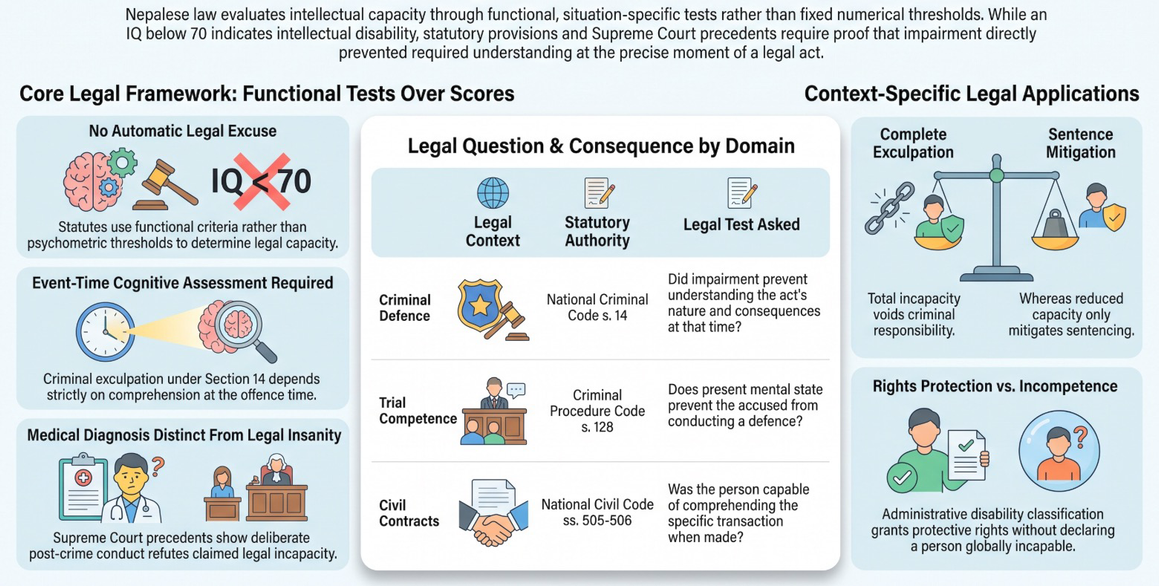
| The premise: If an IQ below 70 were itself a legal excuse, Nepalese law would be expected to use that score as a controlling threshold. The verified statutes and Supreme Court authorities do not. They use functional tests tied to a specific legal decision and, often, a specific point in time. |
Does a score below 70 itself create a legal defence?
The short answer is no. Nepalese law recognizes intellectual disability and mental incapacity, but the current statutory texts examined here do not make an IQ score below 70 a universal trigger for criminal exculpation, civil incapacity, invalid consent, or inability to work. The Rights of Persons with Disabilities Act, 2074 defines disability through long-term physical, mental, intellectual or sensory impairment, functional limitation, and barriers to equal participation. Its Schedule describes intellectual disability in developmental and functional terms: intellectual awareness does not develop in line with age, creating difficulty in activities relative to age or environment. The Act does not place an IQ number in that definition. [7]
That distinction matters because disability status and legal incapacity serve different purposes. Disability legislation is principally rights-protective: it supports identification, services, accommodation, non-discrimination and access to justice. A finding that a person has an intellectual disability does not, by itself, answer whether that person understood a particular criminal act, consented to sex, could enter a contract, or can participate in a trial. Treating an administrative disability classification as a universal declaration of incompetence would collapse several legal questions that the statutes keep separate. [7]
The strongest apparent counterexample is also the clearest reason not to adopt the numerical premise. In Nepal Government v. Krishna Bahadur Rai, Decision No. 11066, the Supreme Court stated in its discussion that an IQ below 70 is generally associated with intellectual disability. But the Court did not use 70 as the legal cutoff for sexual consent. It held that persons with mild intellectual disability may still have capacity to consent, that capacity may diminish as disability becomes more severe, and that the necessary inquiry is whether the individual can understand the nature and consequences of the sexual act. In other words, the Court mentioned the number, then decided the legal issue functionally. [5]
What does criminal law actually ask at the moment of the act?
Section 14 of the National Criminal Code, 2074 supplies the core criminal-responsibility rule. An act is not an offence when, at the time the act is done, mental ill-health leaves the person so unsound that the person cannot understand the nature, quality, defect or consequence of the act. The legal hinge is therefore not a diagnostic label and not a psychometric score. It is the cognitive effect of the condition at the relevant time. If that statutory state is established, the consequence is complete: the act is not treated as an offence under section 14. [1]
The timing language is decisive. A diagnosis made months before the incident may establish history; a diagnosis made after arrest may establish present condition. Neither automatically proves the state required by section 14 at the time of the act. Conversely, the absence of an examination at the exact moment of an offence does not make the defence impossible. The fact-finder can infer the relevant state from clinical history and from conduct before, during and after the event. The legal task is retrospective, but it remains offence-time specific. [1, 4]
Paras (Abhishek) Koirala v. Nepal Government, Decision No. 10614, shows how demanding that connection can be. Koirala relied on prior mental-health treatment and asserted schizophrenia. The Supreme Court distinguished medical illness from legal insanity and refused to treat diagnosis or medication as conclusive. It focused on whether the accused could understand the event and its wrongfulness in a legally meaningful sense, looking to purposeful conduct surrounding the offence. Planning, selective behavior, flight, changing blood-stained clothes and efforts to avoid detection were relevant because they indicated awareness and goal-directed functioning. The case does not deny that severe mental illness can excuse an offence; it insists that the evidence show the legally required incapacity at the critical time. [4]
That is where IQ testing fits. A standardized score may help establish an underlying intellectual impairment, especially when interpreted by a qualified psychologist and paired with adaptive-function evidence. But section 14 asks a narrower forensic question: what did this person understand when this act occurred? A valid IQ result can support that inference; it cannot replace it. The more directly an assessment connects cognitive limitations to the person’s actual comprehension of the act, the stronger its legal relevance.
Who must prove incapacity, and what evidence carries weight?
The Evidence Act, 2031 divides the burden in a way that prevents the incapacity defence from becoming automatic. Section 25 places the ordinary burden of proving guilt on the prosecution. When an accused relies on a fact that would bring the case within an exemption from or reduction of punishment, section 27 places the burden of proving that fact on the accused. The Koirala decision applies that logic to the insanity defence: the prosecution does not have to disprove every possible mental disorder in advance; the accused who invokes the exception must produce credible evidence connecting the condition to legal incapacity. [3, 4]
The verified materials do not support inventing a separate numerical standard of proof for intellectual incapacity. The safer statement is narrower: the prosecution retains the overall criminal burden, while the accused bears the statutory burden on the exempting facts. The quality of the defence evidence therefore matters more than the presence of a particular label. Expert opinion is admissible under the Evidence Act, and the Supreme Court has treated clinical records, expert assessment and the person’s observed conduct as parts of a single evidentiary picture rather than as self-executing certificates of incapacity. [3, 4]
For a serious incapacity claim, the most probative package will usually be cumulative: a properly administered cognitive assessment; adaptive-function evidence showing how the person manages communication, self-care, money, planning and risk; psychiatric or neurological records where relevant; a forensic opinion addressing the exact legal test; and contemporaneous lay evidence about behavior around the event. The expert’s task is not merely to name a diagnosis. It is to explain whether, and how, the impairment affected the legal capacity in issue. Courts remain responsible for the ultimate legal conclusion.
What if the impairment is substantial but not enough for a complete excuse?
Nepalese criminal law leaves room between full exculpation and ordinary sentencing, but it does so through mitigation rather than a free-standing IQ-based defence of diminished responsibility. Section 39(j) of the National Criminal Code identifies reduced capacity caused by physical, mental or disability-related reasons as a mitigating circumstance. The Criminal Offence (Sentencing and Execution) Act, 2074 separately requires sentencing to take account of circumstances that aggravate or mitigate the offence. The conceptual line is important: section 14 asks whether the act is an offence at all; section 39(j) becomes relevant after criminal responsibility remains but the offender’s reduced capacity bears on punishment. [1, 8]
This intermediate category is likely to be the legally important home for many low-functioning defendants who do not satisfy the complete section 14 test. A person may understand enough to remain responsible while having limited reasoning, judgment, impulse control or appreciation of consequences. Those limitations do not convert an IQ score into acquittal, but they can matter to culpability and sentence when supported by evidence showing an actual reduction in capacity. The distinction also explains why it is risky to ask only, “Was the IQ below 70?” The legally useful question is what the impairment did to responsibility, and whether it crossed the line from reduced capacity to the much more demanding complete-excuse test.
Can intellectual disability invalidate consent without erasing autonomy?
Consent law exposes the danger of equating intellectual disability with global incapacity. Section 20 of the National Criminal Code treats consent as invalid where mental ill-health leaves the person unable to understand the quality, defect and consequence of the consent. The rape provisions likewise treat purported consent obtained from a person in an unsound state as legally ineffective. These are protective rules, but they are still functional: the issue is whether the individual could understand and voluntarily agree to the act in question. [1]
Krishna Bahadur Rai makes that principle explicit in the sexual-autonomy context. The Supreme Court rejected the proposition that every person described as slow-minded or intellectually disabled is incapable of sexual consent. It reasoned that a person with mild intellectual disability may retain the ability to understand the nature and consequences of sexual activity, while more severe disability may diminish that ability. A blanket presumption of incapacity would itself restrict the sexual autonomy of people who can make the decision. The case therefore supplies an important boundary condition: the law may protect a cognitively vulnerable person from exploitation without declaring that person legally voiceless. [5]
The same analytical structure applies beyond sex. A cognitive impairment may invalidate a particular consent if it prevented understanding of that decision, while leaving capacity for simpler or different decisions intact. The law’s focus is decision-specific, not identity-based. That is another reason a single IQ number cannot safely answer every legal consent question.
Does civil law use the same functional logic?
Broadly, yes, although the consequences differ. Section 33 of the National Civil Code, 2074 treats a person as legally incapable where, because of unsoundness, the person cannot protect his or her rights and interests; the statutory explanation links unsoundness to an inability, in ordinary understanding, to comprehend one’s act and its consequence. The Code provides for rights to be exercised through a guardian or other lawful representative when legal incapacity exists. Again, the statute does not say that an IQ below 70 is enough. [6]
Contract law then makes the timing point concrete. Sections 505 and 506 require capacity to contract and provide that an unsound person cannot contract while unsound; a person who is ordinarily unsound may contract during a lucid interval, and a person who is ordinarily sound cannot make a valid contract while temporarily unsound. Section 517 treats a contract made by a person incapable of contracting as void. Capacity is therefore transaction-specific and time-specific. A diagnosis can persist while legal capacity fluctuates, and a disability label can coexist with valid contracting if the person understood the transaction when it was made. [6]
Family law follows a related approach. The Civil Code makes free consent central to marriage and treats marriage without the required consent as void. It separately addresses deception concerning a spouse’s unsoundness. Those rules protect the integrity of marital consent without establishing a numeric IQ test for marriage. They also underscore a recurring point: the relevant legal question is not whether the person has a disability in the abstract, but whether the person had the capacity the specific legal act required at the relevant time. [6]
What if the problem is standing trial, not responsibility for the offence?
Competence to participate in proceedings is a different question from criminal responsibility. Section 128 of the National Criminal Procedure Code, 2074 applies when there are reasonable grounds to believe that an accused, because of unsoundness, is unable to conduct a defence. The court may order examination and treatment by a licensed doctor. If examination shows that mental ill-health makes the accused unable to defend, the proceeding is stayed as to that accused. This rule asks about present courtroom functioning, not the accused’s state when the offence occurred. [2]
The separation prevents two opposite mistakes. A person may have been legally responsible at the time of an offence but later become unable to understand or participate in trial; section 128 protects the fairness of the proceeding without rewriting past responsibility. Conversely, a person may now be competent to instruct counsel even though a severe offence-time episode could support section 14. The legal system therefore needs two temporal assessments, not one global declaration that the person is “competent” or “incompetent.”
Constitutional and disability-rights guarantees reinforce the procedural side of this distinction. The Constitution protects equality and non-discrimination, and its fair-hearing provisions include access to legal assistance for indigent or incapable parties. The Rights of Persons with Disabilities Act adds equal enjoyment of rights, non-discrimination and access-to-justice protections. These guarantees support accommodation of comprehension and communication difficulties; they do not convert disability status into a presumption of criminal or civil incapacity. [7, 9]
Where, then, does an IQ score matter?
It matters as evidence and as part of clinical classification, not as a universal legal switch. An IQ result can help establish intellectual functioning. Its probative force is stronger when the test is standardized, properly administered, interpreted against cultural and educational context, and combined with adaptive-function assessment. The law, however, still asks what that impairment means for the capacity at issue. A score can be the beginning of the legal analysis; it is not the end.
Administrative disability identification illustrates the difference. Under sections 3 and 4 of the Rights of Persons with Disabilities Act, disability is classified under the statutory Schedule and a person may seek a disability identity card through the local level. When the category or existence of disability is unclear, the matter can be referred to the local coordination committee, which may require examination at a government hospital. That process establishes disability status for rights and services. It does not adjudicate whether the holder lacked criminal responsibility, contractual capacity or valid consent in a particular event. [7]
Employment law points the same way. The disability statute prohibits employment discrimination, requires employers to make work accessible for employees with disabilities, protects promotion opportunities and restricts dismissal or demotion on disability grounds. The statute can also require reassignment when an employee who acquires a disability cannot perform the existing job. These are rules about equal participation and actual work capacity, not a rule that intellectual disability or a low IQ makes a person unemployable. [7]
What changes when the legal question changes?
| Context | Authority | Legal question | Consequence |
|---|---|---|---|
| Criminal responsibility | Criminal Code s 14 | At the time of the act, did mental ill-health prevent understanding of the act’s nature, quality, defect or consequence? | Complete excuse: the act is not treated as an offence if the test is met. |
| Sentencing | Criminal Code s 39(j); Sentencing Act s 15 | Did physical, mental or disability-related impairment reduce the offender’s capacity even though responsibility remains? | Mitigation at sentencing; not automatic acquittal. |
| Trial competence | Criminal Procedure Code s 128 | Is the accused presently unable to conduct a defence because of mental ill-health? | Medical examination/treatment and stay of proceedings as to that accused. |
| Consent | Criminal Code ss 20, 219; Krishna Bahadur Rai | Could the person understand the nature and consequences of the particular decision and consent voluntarily? | Consent may be invalid; intellectual disability alone does not automatically erase autonomy. |
| Civil / contract capacity | Civil Code ss 33, 505-506, 517 | Could the person understand and protect his or her interests in the particular act or transaction at that time? | Representation/guardianship where legally incapable; a contract by an incapable person is void. |
| Disability status | Disability Act ss 2-4 and Schedule | Does the person meet the statutory disability and functional classification for identification and rights? | Identity card, services and protections; not a declaration of universal legal incapacity. |
| Employment | Disability Act s 24 | What accommodation is needed, and can the person perform the work or another suitable role? | Anti-discrimination and accommodation protections, not automatic disqualification. |
The table shows why the project premise needs qualification rather than rejection of IQ evidence altogether. The same intellectual impairment can be relevant in every row, but the law changes the question, the relevant date and the consequence. An IQ score cannot logically do all of that work by itself.
What is the most defensible rule after testing the premise?
The defensible proposition is narrower than “sub-70 IQ equals legal excuse.” Under Nepalese law, a low IQ score may be powerful evidence that a person has an intellectual impairment, and the Supreme Court has expressly discussed the sub-70 marker in an intellectual-disability case. But the legal consequence follows only if credible evidence establishes the particular incapacity that the governing rule requires. For criminal responsibility, the question is offence-time understanding under section 14. For mitigation, it is reduced capacity. For consent, it is comprehension and voluntariness regarding the specific act. For contracts, it is transaction-time capacity. For trial, it is present ability to defend. For disability rights, it is functional disability status and the need for equal participation and accommodation.
That structure also explains the evidentiary hierarchy. A number is most useful when it is anchored to a professionally administered assessment, adaptive functioning and a forensic explanation of what the result means for the legal capacity in issue. A diagnosis or disability card can establish important background facts, but neither should be mistaken for the legal conclusion. Conduct can corroborate or contradict the claimed incapacity, and the relevant conduct must be evaluated in the period the governing rule makes material. [4, 5]
The better legal question, therefore, is not “What is the person’s IQ?” It is “What could this person understand and decide, in this context, at this time – and what reliable evidence proves it?” An IQ below 70 can help answer that question. Nepalese law, on the authorities reviewed here, does not let it answer the question alone.
References
1. National Criminal Code, 2074 – sections 14, 20 and 39, and rape-consent provisions.
2. National Criminal Procedure Code, 2074 – section 128 (accused unable to defend because of unsoundness).
3. Evidence Act, 2031 – expert evidence and burden-of-proof provisions, including sections 23, 25 and 27.
4. Paras (Abhishek) Koirala v. Nepal Government, Supreme Court, Decision No. 10614, Case No. 075-CR-0219, judgment 2077/03/31.
5. Nepal Government v. Krishna Bahadur Rai, Supreme Court, Decision No. 11066, Case No. 073-CR-1289, judgment 2079/11/16.
6. National Civil Code, 2074 – legal incapacity, contracts, guardianship/representation and marriage-consent provisions.
7. Rights of Persons with Disabilities Act, 2074 – sections 2-4, 7-8, 15, 24, 51-52 and the Schedule.
8. Criminal Offence (Sentencing and Execution) Act, 2074 – section 15 (sentencing factors, including aggravating and mitigating circumstances).
9. Constitution of Nepal – equality, fair-hearing/legal-assistance and disability-rights provisions.