
The scenario is drawn from a work of fiction and transposed to Nepal for analytical purposes. Nothing in this document is legal advice on any real person’s circumstances.
1 Problem and argument
In The Godfather Part II, Kay Adams ends a pregnancy while her husband, Michael Corleone, is away. She tells him she miscarried. She later tells him that the loss was a deliberate abortion of a male fetus, undertaken because she would not bring another son into his family, and he strikes her. Transposed to Kathmandu and governed by Nepali law, the episode raises three questions that are routinely run together: whether Kay could decide alone; whether the termination itself was lawful; and what Michael, as husband and father, could do about it. This diagnostic keeps them apart, because Nepali law answers them through different instruments, different actors and different standards of proof.
The facts are treated as assumptions, not evidence. Gestational age is unknown. The pregnancy is described as visibly advanced and is treated here as probably in the second trimester (13 to 28 weeks), with the first-trimester and post-28-week variants addressed where they change the answer. Both parties are treated as Nepali national resident in Kathmandu, and the termination as having taken place there. Kay knew the sex of the fetus at some point; whether she knew it before or after the termination is not established and, as Section 4 shows, is decisive for one head of liability.
| SUMMARY Nepali law places the decision to terminate a pregnancy exclusively with the pregnant woman. No constitutional provision, statute or judgment gives a husband a right of consent, notice, veto or access to records, and the Supreme Court rejected a spousal-consent claim in 2008. Kay’s unilateral decision is therefore lawful as a decision. The lawfulness of the termination is decided elsewhere: at a provider-controlled gate of gestational age, a licensed doctor’s health opinion beyond twelve weeks, and a licensed provider in a licensed facility. If that gate was not passed, Kay herself becomes a principal offender, with the same penalty exposure as the provider but without the provider’s good-faith protection. Michael’s only effective lever is to trigger a State prosecution that tests the gate. It exposes Kay, not his own interest, while his violence exposes him. The principal legal risk to Kay is documentary, not marital. |
Four propositions carry the article.
- Decision rights are exclusive and settled. The Constitution, the Right to Safe Motherhood and Reproductive Health Act 2075 (2018), the Penal Code and two Supreme Court judgments vest the decision in the pregnant woman. None creates a spousal role, and the Court has rejected the argument that equality requires one.
- Lawfulness is produced at the provider gate. Beyond twelve weeks the woman’s reasons cease to matter and a licensed doctor’s opinion takes their place. If that opinion, a licensed provider or a licensed institution is missing, Kay becomes a principal offender exposed to the same maximum penalty as the provider, who alone benefits from a good-faith saving clause.
- Kay’s explanation creates an unresolved sex-identification exposure. Two differently worded prohibitions apply. Their effect depends on whether the fetus’s sex was identified before the termination.
- Michael’s leverage is procedural and largely adverse to his own position. He can set a State prosecution in motion within six months of learning of the termination, and may have a contested divorce ground. He cannot prevent, inspect or be compensated for the termination, and his violence gives Kay stronger remedies than his grievance gives him.
2 Decision rights: the law gives the husband no entry point
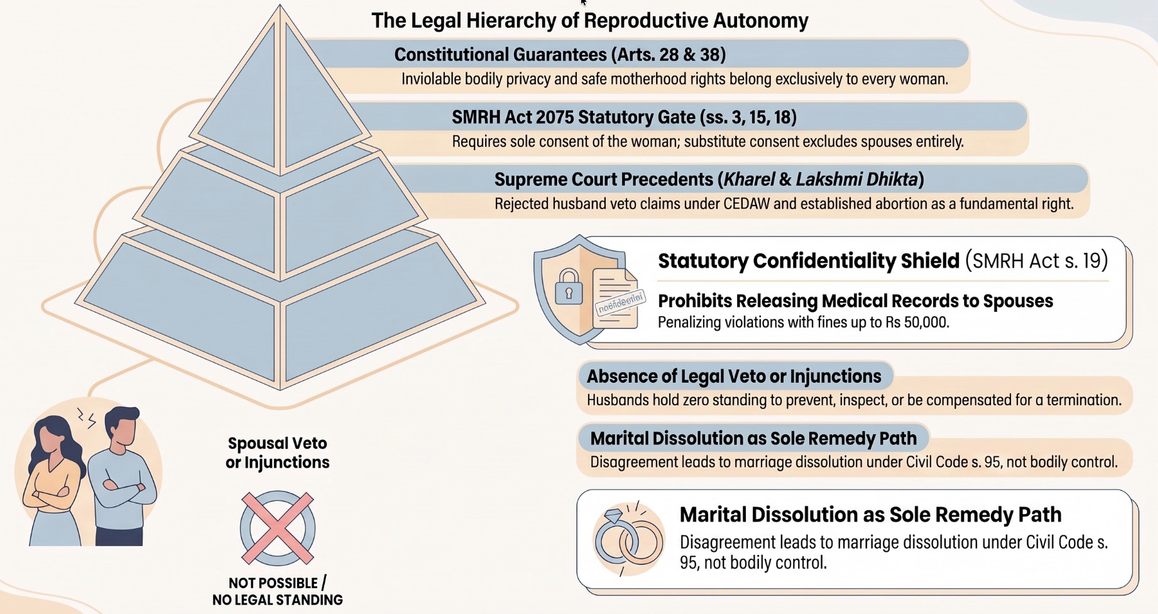
At every level of the legal hierarchy, the right to decide whether to continue a pregnancy is vested in the pregnant woman. No instrument creates a role for her husband, whether as consenting party, notified party, objector or custodian of information.
The Constitution guarantees every woman the right to safe motherhood and reproductive health (Constitution of Nepal, art. 38(2)) and makes the privacy of any person’s body inviolable except in accordance with law (art. 28). Both rights are framed by reference to “every woman” or “any person”, not “every citizen”, and therefore extend to a foreign national in Nepal as well. Article 38(3) adds a prohibition on physical, mental, psychological or other violence against women on any ground. It bears on Michael’s conduct rather than on any right of his.
The SMRH Act gives operational content to article 38. It confers on every woman the right to determine the gap between births and the number of children, and the right to obtain abortion services under the Act (SMRH Act, s. 3(3), (5)). Each of the five grounds for termination is conditioned on the consent of the pregnant woman, and on no other personal consent (s. 15(a)–(e)). The woman gives that consent herself, in the prescribed format, to the licensed institution or health worker (s. 18(3)). Substitute consent is permitted only where she is of unsound mind, cannot consent at the time, or is under eighteen, and it is then given by a guardian or curator, not by a spouse as such (s. 18(4)). The Penal Code mirrors this: each of its four exemptions turns on the pregnant woman’s consent (Penal Code, s. 189, cls. (a)–(d)).
Nor does civil law supply a rights-holder through whom a father could act. The National Civil (Code) Act 2074 recognises a person as such from birth (Civil Code, s. 30) and protects an unborn child’s share in a family partition only contingently, releasing it to the other coparceners if no live child is born (s. 206(2)–(3)). The unborn’s interests are recognised where they serve a future live person, not as a counterweight to the woman’s decision.
The Supreme Court has directly rejected the argument that equality requires spousal consent. In Kharel, a petitioner contended that the 2002 amendment permitting first-trimester abortion on the woman’s consent alone ignored the husband’s rights and conflicted with article 16(1)(e) of CEDAW, which guarantees men and women the same rights to decide on the number and spacing of their children. The Court dismissed the petition. It held that the Convention exists to protect women’s rights and cannot be read in absolute terms against them, and that in a family structure still marked by male dominance and son preference, a requirement of the husband’s or family’s consent would obstruct women’s empowerment (Advocate Achyut Prasad Kharel v. Office of the Prime Minister and Council of Ministers, Supreme Court of Nepal, Writ No. 3352 of 2061 BS, order of 20 Shrawan 2065 BS (4 August 2008), paras 15–16, unofficial translation). In Lakshmi Dhikta, the Court went further. It treated abortion as a component of the right to reproductive health, declined to recognise the fetus as a human life capable of overriding that right, and directed the Government to guarantee safe and affordable services (Lakshmi Dhikta v. Government of Nepal, Supreme Court of Nepal, Writ No. 0757, order of 20 May 2009).
For Michael, the result is a complete absence of entry points. He has no right to be asked, told or heard before the termination. He has no right to the record afterwards. Licensed institutions and health workers must keep all records of a pregnant woman’s reproductive health, counselling and services confidential (SMRH Act, s. 19(1)). They may release them only to an investigating authority or court, for de-identified research, or to the woman herself (s. 19(2)(a)–(c)), and disclosure outside those channels is an offence punishable by a fine of up to Rs 50,000 (ss. 25(j), 26(d)). He has no protectable legal interest on which an injunction could rest. He is not a victim: Chapter 13 of the Penal Code contains no compensation provision, and the Act’s compensation right runs to a person victimised by an offence under it (SMRH Act, s. 27). A lawful termination is no offence; an unlawful one is the State’s concern, not his.
The jurisprudence is not, however, indifferent to the marriage. Kharel observed that where the law gives either spouse an absolute right, its exercise is expected to rest on mutual understanding; that in practice terminations mostly occur with spousal agreement; and that a woman acting without her husband’s consent would arise only in the “rarest of the rare cases” (Kharel, paras 13–14, 16). The Court’s answer to that rare case was not a veto. It was the observation that conjugal disagreement of this kind leads towards divorce (para 13). Kay’s case is precisely the exceptional case the Court contemplated. The law leaves the decision with her and locates the husband’s remedy, if any, in the dissolution of the marriage rather than in control over the pregnancy.
Kay’s initial account that she had miscarried does not change this analysis. No provision of the SMRH Act, the Penal Code or the Civil Code imposes on a married woman a duty to disclose a termination to her husband, or makes a false account of it to him an offence. Its significance, if any, lies in family law and in evidence.
3 The provider gate: where lawfulness is produced
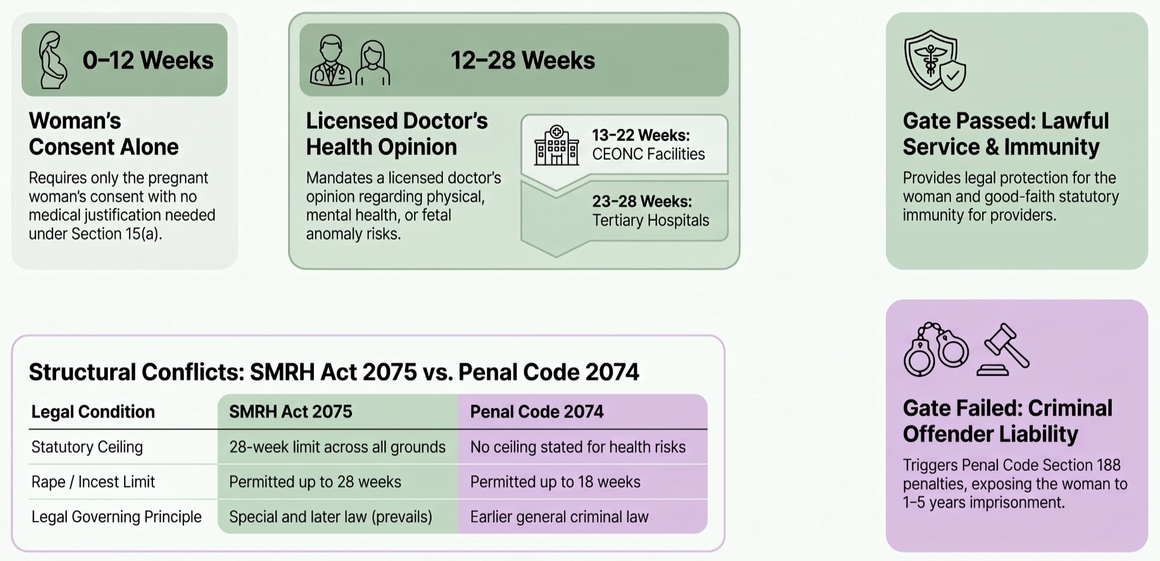
The law’s grant of decision rights to the woman is unconditional; its grant of lawfulness to the termination is not. Lawfulness is produced by conditions that the provider, not the woman, controls and documents: gestational age, a medical opinion beyond twelve weeks, a licensed provider and a licensed institution. Where those conditions fail, the consequences fall on the woman as much as on the provider.
Up to twelve weeks, the woman’s consent is sufficient and no reason is required (SMRH Act, s. 15(a); Penal Code, s. 189, cl. (a)). Between twelve and twenty-eight weeks the Act permits termination only on one of four further grounds. The one relevant to Kay is the opinion of a licensed doctor that, without termination, the woman’s life may be endangered, her physical or mental health may deteriorate, or a disabled infant may be born (SMRH Act, s. 15(b)). Every termination must be performed by a licensed health worker meeting prescribed standards, in a licensed health institution, using the prescribed technology and process (s. 18(1)–(2)). The Act defines “abortion service” in those terms (s. 2(g)), and the Penal Code confines its exemption to a doctor or health worker who has the specified qualification and a licence to perform abortion (Penal Code, s. 189, Explanation).
| LEGAL TEXT — RIGHT TO SAFE MOTHERHOOD AND REPRODUCTIVE HEALTH ACT 2075, s. 15(a)–(b) ENGLISH TRANSLATION — NEPAL LAW COMMISSION “15. To perform safe abortion: A pregnant woman shall have the right to get safe abortion performed in any of the following circumstances: (a) Fetus (gestation) up to twelve weeks, with the consent of the pregnant woman, (b) Fetus (gestation) up to twenty-eight weeks, as per the consent of such woman, after the opinion of the licensed doctor that there may be danger upon the life of the pregnant woman or her physical or mental health may deteriorate or disabled infant may be born in case the abortion is not performed, …” |
The implementing Rules then allocate second-trimester terminations by facility tier. As described, terminations from thirteen to twenty-two weeks are performed by trained obstetrician-gynaecologists or MDGP (Doctor of Medicine in General Practice) doctors at listed CEONC facilities (Comprehensive Emergency Obstetric and Newborn Care), and terminations from twenty-three to twenty-eight weeks at listed tertiary hospitals, with consultation of other specialists as necessary (Safe Motherhood and Reproductive Health Rights Rules 2077, r. 17 and Sch. 11).
Applied to Kay, the structure has a striking effect. Her stated reason, that she would not bring another son into a criminal family, is a social reason. Before twelve weeks it would be legally irrelevant. After twelve weeks the statute still does not ask for her reason. It asks for a licensed doctor’s opinion that continuing the pregnancy may cause her physical or mental health to deteriorate. The Act does not define that threshold, and its own definition of reproductive health as a “physical, mental and social health condition” (SMRH Act, s. 2(n)) supports a reading under which serious distress about the circumstances of a birth can ground the opinion. The legally decisive event is therefore not Kay’s choice, which the law already treats as hers. It is whether a licensed doctor formed and recorded the section 15(b) opinion, and whether a provider and facility licensed for that gestational band performed the termination.
If the gate was passed, there is no offence, and no one, including Michael, has a legal basis to challenge the termination. If it was not, the Act prohibits anyone from conducting, or getting conducted, an abortion outside section 15 (SMRH Act, s. 16(1)), makes that an offence (s. 25(g)), and punishes it under section 188 of the Penal Code (s. 26(c)). Section 188 punishes anyone who commits abortion, or does any act with intent to cause it, outside section 189. The maximum is one year’s imprisonment and a Rs 10,000 fine for a pregnancy of up to twelve weeks; three years and Rs 30,000 for more than twelve and up to twenty-five weeks; and five years and Rs 50,000 beyond twenty-five weeks (Penal Code, s. 188(1), (3)(a)–(c)). Chapter 13 contains no lower band and no exemption for the pregnant woman who obtains an unlawful termination. A woman who obtained a second-trimester termination without the gate being passed is therefore exposed to the same maximum as the provider who performed it.
The Act bars legal action against any health institution or health worker “for any matter of the reproductive health service provided in good faith” (SMRH Act, s. 34). The woman has no equivalent protection. A provider who performs a second-trimester termination in good faith but without a properly recorded opinion, or in a facility whose licence has lapsed, may be able to invoke section 34.
The gate is also defined twice, and the two definitions diverge between SMRH Act 2075 and Penal Code 2074.
| Condition | SMRH Act 2075 | Penal Code 2074 |
|---|---|---|
| On request | Up to 12 weeks, woman’s consent (s. 15(a)) | Up to 12 weeks, woman’s consent (s. 189(a)) |
| Risk to life or health; disabled infant | Up to 28 weeks, licensed doctor’s opinion (s. 15(b)) | No gestational ceiling stated; licensed doctor’s opinion (s. 189(b)) |
| Rape or incest | Up to 28 weeks (s. 15(c)) | Up to 18 weeks (s. 189(c)) |
| HIV or incurable disease | Up to 28 weeks (s. 15(d)) | No ceiling stated (s. 189(d)) |
| Fetal defect | Up to 28 weeks, treating health worker’s opinion (s. 15(e)) | Within 189(b) (“handicapped child”), licensed doctor’s opinion |
| Who may perform | Licensed health worker in licensed institution (s. 18(1)) | Licensed health worker (s. 189, Explanation) |
| Penalty if gate fails | Section 188 of the Penal Code applies (s. 26(c)) | Section 188(3) bands |
For a termination on Kay’s likely ground between thirteen and twenty-eight weeks, both instruments permit termination on the same opinion, and the divergence does not change the answer. It matters at the edges. Above twenty-eight weeks the Penal Code’s exemption contains no ceiling while the Act’s prohibition does, so the Act’s own offence provision would apply. Between eighteen and twenty-eight weeks in cases of rape or incest, the Act permits what the Code does not exempt. The Act provides that matters it contains are governed by it (SMRH Act, s. 38), and it was authenticated on 2075/6/2 BS (18 September 2018), after the Penal Code came into force on 2075/5/1 BS (17 August 2018). On ordinary principles of special and later law the Act should prevail.
In practice, the divergence is reported to be resolved the other way. A 2022 policy brief by CREHPA (Center for Research on Environment, Health and Population Activities) and the Guttmacher Institute records the inconsistency and attributes the incarceration of some women and providers partly to the Act’s reliance on the Penal Code for punishment (CREHPA and Guttmacher Institute, Addressing Gaps in Safe Abortion Services in Nepal, policy brief, 2022). Press reports in February 2026 describe police applying the Code rather than the Act, and hospitals requiring police registration before terminations they regard as legally exposed. These are secondary sources and describe practice, not law. They indicate that the gate is narrower in operation than on paper, and that its operators, providers and police, resolve legal uncertainty against the woman.
The gate therefore explains the case better than the marriage does. Michael’s objection is irrelevant to whether the termination was lawful. What matters is the gestational age on the day, whether a licensed doctor recorded a health opinion if that age exceeded twelve weeks, and whether the provider and facility were licensed for that band. Every one of those facts sits in the provider’s records.
4 Sex identification: the exposure Kay created herself
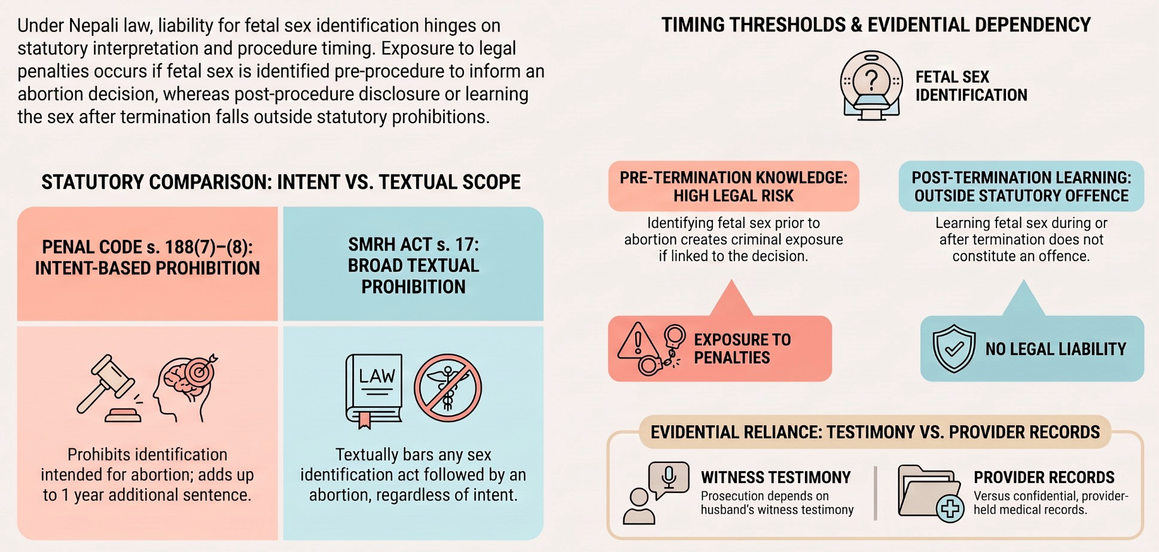
Kay’s own explanation is the most dangerous fact in the case. By telling Michael that the fetus was a son, and that she ended the pregnancy so as not to bring another son into his family, she supplied the only evidence that engages Nepal’s prohibitions on fetal sex identification. Those prohibitions are worded differently in the two governing instruments, and no judgment located has applied them to facts like these.
The Penal Code prohibits anyone, with the intention of causing abortion, from doing any act by which the sex of the fetus is identified, and from aborting following such identification (Penal Code, s. 188(7)). It punishes identification for that purpose with three to six months’ imprisonment, and adds up to one year to the ordinary section 188(3) sentence where an abortion follows sex identification (s. 188(8)(a)–(b)). The Act’s prohibition is broader on its face. No one may commit any act to identify the sex of the fetus, with no reference to purpose (SMRH Act, s. 17(1)); a pregnant woman may not be pressured to identify it (s. 17(2)); and conducting an abortion by identifying the sex under those subsections is prohibited (s. 17(3)). Each is an offence punished under section 188 (ss. 25(h)–(i), 26(c)).
Two readings are available. On the narrow reading, the Code’s composite formulation governs: liability attaches only where the sex was identified for the purpose of deciding on termination and the termination followed. On the broad reading, the Act’s unqualified section 17(1) makes any act of identification an offence, and section 17(3) attaches to any termination that follows. The broad reading proves too much. It would expose a woman who learned her fetus’s sex incidentally during routine care, and later obtained a termination on a separate lawful ground, to an aggravated sentence. That outcome is difficult to reconcile with section 15, which confers the right to terminate on stated grounds without reference to the woman’s knowledge. The narrow reading is the better view, but it is an assessment, not a holding.
On either reading, the timing of identification is decisive, and the scenario does not establish it. Both provisions presuppose identification before the termination: the Code speaks of abortion following identification, and the Act of abortion by identifying the sex. If Kay learned the sex only after the termination, from the procedure itself or from what she was told afterwards, neither provision is engaged, however her later explanation is phrased. If she knew beforehand, the question becomes one of purpose. Her stated motive concerned the continuation of a criminal family through a male heir. That is not the pattern the provisions were designed to suppress, which Kharel identified as the social preference for sons over daughters (Kharel, para 15). But the provisions are sex-neutral in their terms, and a prosecutor could argue that a termination undertaken because the fetus was male is, on its face, a termination following sex identification.
The evidential consequence links back to the gate. The only direct evidence of sex identification is Kay’s statement to Michael, which would make him the central witness. Whether an ultrasound or other test disclosed the fetus’s sex before the termination is a question the provider’s records can answer, and those records become available only to an investigating authority or court (SMRH Act, s. 19(2)(a)). Kay’s exposure under this head depends on a sequence she cannot control: Michael’s decision to report, the government attorney’s decision to charge, and what the provider recorded.
5 The husband’s real lever: the State’s prosecution, not a private right
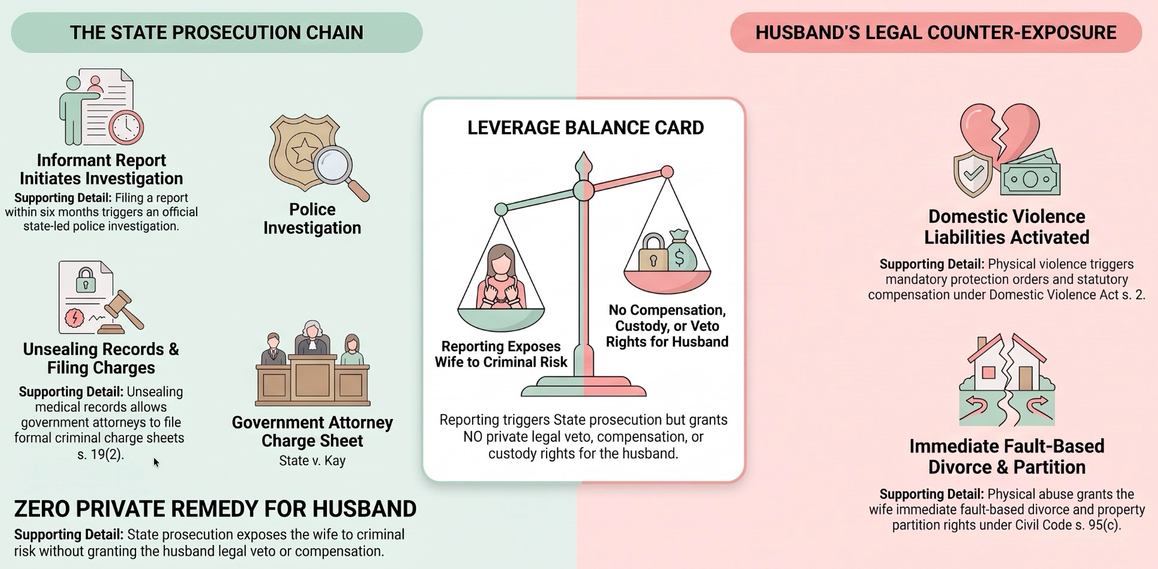
Michael has no private right in the termination, but he holds an informant’s power. He can convert a marital grievance into a State prosecution in which his wife is an accused. That is the only route by which his suspicion can reach the records that decide whether the gate was passed.
The sequence is fixed by statute, and each stage belongs to a different actor. Offences under Chapter 13 of the Penal Code are listed in Schedule 1 to the National Criminal Procedure (Code) Act 2074, and offences under the SMRH Act are deemed to be included there (SMRH Act, s. 36(2)). A person who knows that a Schedule-1 offence has been committed must make a first information report to the police (Criminal Procedure Code, s. 4(1)). The police investigate. The government attorney alone decides whether to file a charge sheet, and no Schedule-1 case may be instituted without one (ss. 43(1)(a), 52(5)). The Government of Nepal is the plaintiff (s. 56; SMRH Act, s. 36(1)). The District Court tries the case, and appeals lie to the High Court (SMRH Act, s. 35). Michael makes no decision after the report. He is an informant and, given Kay’s statement to him, the principal witness.
The window is short. No complaint lies after six months from the date of knowledge of the commission of the offence (Penal Code, s. 190; SMRH Act, s. 37). Neither provision states whose knowledge counts. If the informant’s knowledge suffices, the period runs from Kay’s disclosure to Michael, not from the termination, and a husband who learns of a termination long after the event can still trigger a prosecution.
The report changes what can be seen. Before it, Michael cannot obtain anything from the provider. After it, the investigating authority and the court can (SMRH Act, s. 19(2)(a)). Health institutions must keep a record of the women who have undergone miscarriage or abortion (s. 9(3)), consent forms in the prescribed format (s. 18(3)) and the records of counselling and services (s. 19(1)). Kay’s account that she had miscarried would not survive those records, but it is not itself an offence. What the records decide is whether the gate was passed. If they show a termination within twelve weeks, or a licensed doctor’s section 15(b) opinion with a licensed provider in a licensed facility, the prosecution has no offence to prove. If they do not, Kay is the principal accused.
The law’s protections run in one direction. It criminalises coercing a woman into an abortion by coercion, threat, enticement or temptation (Penal Code, s. 188(2); SMRH Act, s. 16(2), (3)(a)), but contains no corresponding offence of coercing her out of one. Had Michael learned of Kay’s plan and tried to stop her, his conduct would fall under general offences against the person and liberty and under the domestic violence law, not under any provision designed to protect access to a lawful termination. The closest analogue is the Act’s prohibition on discrimination in access to safe-abortion services on grounds including marital status and personal relationship (SMRH Act, s. 29), enforceable as an offence (ss. 25(l), 26(a)). It is framed against discrimination in service provision, and its application to a husband’s obstruction is untested.
Michael’s own conduct is where the law bites hardest on him. Striking Kay after her disclosure falls within the domestic violence regime, which defines domestic violence as physical, mental, sexual or economic torture by a person in a domestic relationship and includes beating within physical torture (Domestic Violence Act, s. 2). Kay may complain to the police, the National Women Commission or the local level, seek interim protection orders from the court, and obtain compensation (ss. 4, 6, 10), within ninety days of the incident (s. 14). The same act gives her a divorce ground. The Civil Code permits a wife to divorce without her husband’s consent where he commits an act likely to cause grievous hurt or other severe physical or mental pain (Civil Code, s. 95(c)). A divorce on that ground is deemed to be because of the husband, entitling her to partition before divorce (s. 99(1)–(2)).
Michael’s parallel ground is weaker. Section 94(c) permits a husband to divorce where the wife commits an act or conspiracy likely to cause grievous hurt or other severe physical or mental pain to him. He could argue that a secret termination, concealed by a false account of miscarriage, was such an act. If he succeeded, he would not be compelled to provide a partition share or alimony (s. 99(6)). The argument faces two obstacles. Characterising the exercise of a statutory and constitutional right as an act likely to cause severe pain sits uneasily with sections 3 and 15 of the SMRH Act and with Kharel. And no judgment was located that treats a lawful termination, or its concealment, as matrimonial fault. Kharel‘s observation that disagreement over reproduction leads towards divorce supports Michael’s access to divorce as such; it does not establish that the termination is a fault ground.
6 Competing interpretations and counter-evidence
The strongest legal counter-argument is constitutional. Article 38(6) gives both spouses equal rights in property and family affairs, and decisions about children are plainly family affairs. Kharel rejected the treaty version of this argument under the 1990 Constitution. The 2015 Constitution supplies a domestic textual basis that Kharel did not address. Three considerations weigh against it. Article 38(2) vests the specific reproductive-health right in every woman, and a specific guarantee ordinarily controls a general one. The SMRH Act, enacted in 2018 to implement that right, retained sole consent after article 38(6) was in force. And a reading that turned equality in family affairs into a husband’s veto over his wife’s body would collide with article 28 and with Kharel‘s reasoning, which treated such a veto as an obstacle to women’s equality rather than an expression of it.
The conclusion survives, but with a qualification. Kharel‘s statement that rights within marriage are expected to be exercised with mutual understanding leaves a court room to treat a secret termination as relevant to matrimonial fault, even while denying any veto. The law excludes the husband from the decision. It does not necessarily exclude the decision from the law of the marriage.