
Discussing what vexed Ed Sheeran recently
In September 2026, Macklemore was removed from the remaining United States dates of Ed Sheeran’s stadium tour after using his opening sets at MetLife Stadium to speak about Gaza. The immediate public question was who made the call. Legally, however, responsibility travelled down the contract chain. Sheeran said the decision belonged to the promoter because Macklemore’s contract was with the promoter rather than with him. Messina Touring Group was the concert promoter for the U.S. leg of Ed Sheeran’s Loop Tour, and Macklemore’s contract was with Messina, not directly with Sheeran. The promoter said venues had told it they would not allow a concert with Macklemore on the bill, and reported that seven stadiums were involved. Robert Kraft, owner of the New England Patriots and Gillette Stadium, publicly acknowledged his part.
That chain matters because the American commentary that followed rested on a familiar premise: private contracts largely decide the dispute; morals clauses can reach political conduct as well as personal scandal; and constitutional free-speech guarantees ordinarily become relevant only when a government-owned venue makes the decision. The useful question is what happens when the same facts are transplanted into Nepal, where the National Civil Code Act, 2017 and the Constitution of Nepal alter several of those assumptions.
The problem can be followed through three questions:
- Does Nepali law excuse a promoter who drops an artist because venues threaten to cancel?
- Does anything restrain private parties who exclude a person for political opinion?
- And does constitutional protection at public venues reach a performer?
The answers do not merely determine whether a cancellation is lawful. They move liability from one actor to another. That is why, in this kind of dispute, identifying who actually made the decision is a legal question and not only a public-relations one.
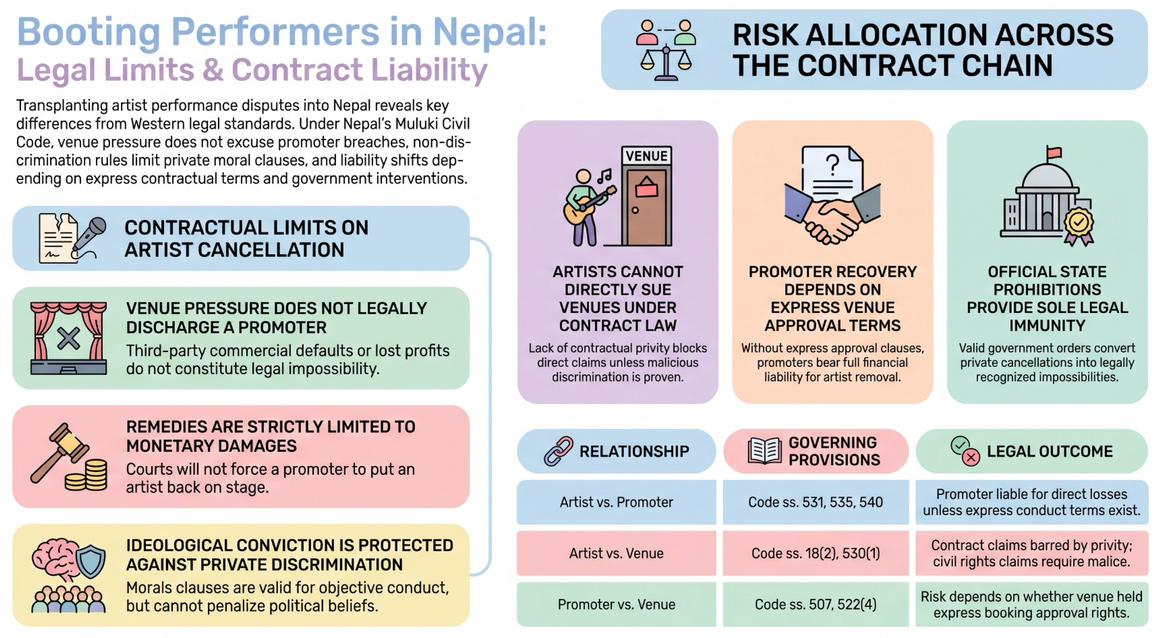
Start with the contract, not the controversy
Assume first that the promoter-artist agreement says nothing about conduct, reputation or political statements. The Code does not give a promoter a free-standing power to cancel because the engagement has become commercially uncomfortable. Cancellation rests on defined grounds: breach shown by the other party’s failure, refusal or conduct (section 535(1)-(2)), non-performance where time is of the essence (section 526), failure after a cure notice (section 525), or prevention by the other side (section 522(4)). An artist who arrives ready to perform has triggered none of them. Speaking on stage about a foreign conflict is not non-performance unless the contract itself made restraint part of the performance.
Venue pressure does not become impossibility
The promoter’s next argument would naturally be that the venues have made the engagement impossible: keep the artist and the stadiums cancel the show. Section 531 is much less accommodating than that commercial logic. It discharges a contract only on a fundamental change of circumstances that makes performance impossible, such as subsequent illegality, force majeure, destruction of the subject matter, or the performer’s death or incapacity. Section 531(3) then removes the two excuses a promoter would most want. Performance yielding “lesser profit or a loss” is expressly not a fundamental change (section 531(3)(b)), and neither is non-performance caused by the default of a third party (section 531(3)(c)).
So the first pressure point resolves sharply: without an express clause, a promoter who removes an artist because venues threaten to cancel breaches the promoter-artist contract. The venue’s leverage may explain the decision commercially; it does not, by itself, excuse the promoter legally.
Breach does not put the artist back on stage
That conclusion still does not mean a Nepali court will order the show to continue. Section 540(2)(c) bars specific performance of a contract made “to provide service of personal skill, qualification or talent”, while section 540(2)(a)-(b) also points to the adequacy of money and the court’s inability to supervise the performance. In practical terms, the artist cannot use specific performance to force the promoter to put the artist back on stage.
The claim therefore becomes monetary. It can cover actual loss or an agreed liquidated sum (section 537(1)-(2)), payment proportionate to performance already given (section 539), and restitution of benefits conferred (section 538), but not indirect or “imaginary” loss (section 537(3)). Section 543 directs the court, when fixing compensation, to consider whether the breach was intentional and what the innocent party would have obtained had the contract been performed; a deliberate removal under outside pressure is plainly intentional. The limitation period is two years (section 544). The difficult irony for a global performer is that the largest commercial harm – damage to reputation and future bookings – is precisely the type of loss least likely to be recovered in contract.
The obvious drafting response: a morals clause
Once that result is clear, the contractual response is equally obvious. A promoter will try to write the power to remove the artist into the agreement itself. Section 507 supports party autonomy: parties are “autonomous” to determine the terms of their contract and the remedies for breach, subject to the Code. A clause allowing termination for specified conduct is therefore, in principle, an agreed ground for ending the engagement.
A morals clause is a contractual provision that allows one party – usually an employer, sponsor, promoter, broadcaster or brand – to terminate or take action against the other party if that person engages in specified conduct that damages, or is likely to damage, the reputation of the counterparty or of the business or event.
Nepali law, however, does not supply a reported entertainment-contract decision answering how far such a clause can go. The nearest Supreme Court authority comes from employment and public-service disputes, and it points toward narrow construction, a factual basis and fair process. In Tara Bahadur Rana Magar v. Ministry of Health and Population (Writ No. 066-WO-1216), a “misconduct” clause was enforceable only through the steps the service manual prescribed. In Punya Prasad Nirola v. Office of the Prime Minister (Writ No. 079-WO-0337), “moral turpitude” was confined to deliberate, depraved or fraudulent criminal conduct. In Subhash Kumar Mishra v. Sino Hydro Power Corporation (Writ No. 074-WO-0948), a dispute arising from a public-sector contract, the Court cited Renard Constructions v. Minister for Public Works for the proposition that contractual powers must be exercised reasonably and not for ulterior purposes. Each case arose under labour statutes or public law, so together they indicate an interpretive direction rather than a rule for entertainment contracts.
Where Nepal changes the private-contract premise
The more consequential difference is not contractual at all. Section 18(2) of the Civil Code, in its chapter on civil rights, provides that no person shall be discriminated against “in any public and private place” on grounds that include “ideological conviction”. The Code therefore places a non-discrimination duty directly on private actors. Section 27 allows a court to award reasonable compensation where a respondent is found to have “maliciously” caused damage on a complaint under section 26. Section 7 declares any act contrary to law invalid, and section 517(2)(e)-(f) voids contracts contrary to law, public order or public interest.
That provision is the point at which the American premise stops travelling cleanly to Nepal. A promoter may have drafted a termination right, but the Code still asks what that right is being used to punish. Private ordering remains important; it is not the end of the inquiry.
The decisive line is conviction versus conduct
Two competing readings remain open. One view is that a clause conditioning performance on avoiding political statements does not offend public order. The other treats section 18(2) as a statutory limit on precisely that kind of clause. No Nepali court has resolved the question. The more defensible way to frame it is through the distinction between conviction and conduct. A clause aimed at what an artist believes, or invoked because of which side of a political question the artist takes, sits uneasily with section 18(2). A clause aimed at conduct – for example, statements amounting to offences or breaches of objectively defined production rules applied regardless of viewpoint – stands on firmer ground.
That distinction also explains why the factual characterisation of the removal matters so much. Sheeran’s own account, that the venues’ stance concerned how Macklemore conveyed part of his message rather than everything he said, places the decision on the conduct side of the line. Whether that characterisation survives scrutiny would ultimately be a question of evidence rather than wording alone.
Two qualifications narrow the protection. First, section 18(2) protects “any person”, so even a foreign artist performing in Nepal can invoke it, whereas freedom of expression under section 20(2)(a) of the Code, like Article 17(2)(a) of the Constitution, belongs to a “citizen”. Secondly, compensation under section 27 requires malice, a higher threshold than breach of contract, and whether a booking decision constitutes discrimination “in a private place” has not been tested in Nepali courts as of yet.
If the speech itself is unlawful, the analysis changes
The conviction-conduct distinction does not protect unlawful speech. The National Penal Code Act, 2017 penalises disturbing harmony among communities of Nepal (section 65) and hurting religious sentiments (section 156). In Kalpit Parajuli v. Office of the Prime Minister (Writ No. 072-WO-0394), the Supreme Court held that hate speech falls outside constitutional protection. Commentary on a foreign conflict would not ordinarily fall within section 65; section 156 is broader. Where statements cross those statutory lines, the section 18(2) argument weakens and section 501 of the Civil Code, which excuses performance of an obligation that would violate law, public order or public interest, gives the promoter a footing. Whether an allegation, as opposed to a finding, would suffice remains untested.
Can the artist bypass the promoter and sue the venue?
At this point the pressure appears to come from the stadiums, so the next instinct is to move past the promoter and sue the venue that demanded the removal. Contract law largely blocks that route. Under section 530(1), only a party to a contract may demand its performance unless the contract was made for the benefit of a third person. The artist has no contract claim against a venue merely because the venue’s decision caused the promoter to breach.
Tort law looks broader on paper. Section 672(1) treats as a tort any commission or omission, resulting from fault, negligence or carelessness, that causes loss to a “right or interest protected by law”, and section 672(2) makes clear that no prior contract between the parties is needed. Section 681 would make coordinating stadium owners liable in proportion to their share of the wrong, or equally where shares cannot be separated. Yet the research identified no Supreme Court decision recognising liability for inducing or procuring another party’s breach. In Kusheshwar Jha v. E.MA.W. Enterprises (Civil Appeal No. 071-CI-1371, decided 2076-03-01 BS), the Court restated that a non-party is not liable for another’s contractual default. In N.G.M. Engineering & Sales v. High Court Patan (Writ No. 080-WO-0781), allegations that a competitor’s influence drove the termination of a distributorship did not displace an express notice clause, and the dispute was left to arbitration or damages. A venue exercising an approval right in its own contract is especially difficult to characterise as acting with “fault”. Tort claims must also be brought within six months (section 684).
The more realistic direct route against the venue returns to section 18(2): a complaint that the venue’s demand was malicious discrimination on grounds of ideological conviction. Between promoter and venue, however, the loss allocation depends primarily on the venue contract. The chain can be seen most clearly in the table below.
How liability travels along the contract chain
| Relationship | Governing provisions | Position | Main uncertainty |
|---|---|---|---|
| Artist against promoter | ss. 535, 537–539, 540(2)(c) | Promoter liable for direct loss unless an express clause covers the artist’s conduct; venue pressure and lost profit are no excuse (s. 531(3)) | Whether a clause triggered by opinion rather than conduct survives s. 18(2) |
| Promoter against venue, no approval right | ss. 522(4), 535, 537 | Venue’s refusal may amount to prevention or breach; promoter may recover its losses, including sums paid to the artist | How the line-up was fixed in the booking |
| Promoter against venue, express approval right | s. 507 | Venue acts within its contract; promoter bears the loss and remains liable to the artist | Whether the right, exercised on ideological grounds, survives s. 18(2) |
| Artist against venue | ss. 530(1), 672, 681, 684; ss. 18(2), 27 | No contract claim; tort requires fault; civil-rights claim requires malice | No reported decision recognising inducing breach; six-month tort limitation |
Section references are to the Muluki Civil Code, 2074.
The venue agreement’s approval clause is therefore decisive for the promoter. If the venue had no approval right, its refusal may itself amount to prevention or breach, potentially allowing the promoter to recover losses, including sums paid to the artist. If the venue did hold an express approval right, the promoter may have no contractual recovery against the venue and may remain liable to the artist. The unresolved question, again, is whether an approval right exercised on ideological grounds survives section 18(2).
Now change one fact: make the stadium public
The analysis changes again when the venue is public because the dispute is no longer confined to private contracting. Article 18(2) of the Constitution prohibits discrimination in the application of general laws on grounds including ideological conviction; Article 18(3) forbids the State to discriminate among citizens on that ground; and Article 17(2)(a) and (f) guarantee freedom of opinion and expression and the freedom to practise a profession. Restrictions on expression require an Act and must rest on the grounds listed in the first proviso to Article 17(2)(a), including sovereignty, communal harmony, defamation, incitement to crime and public decency.
The Supreme Court has applied these guarantees when the State withdraws public facilities. In Jayaprakash Gupta v. Press Council Nepal (Writ No. 074-WO-0274, decided 20 April 2022), it quashed the suspension of a journalist’s press pass and the recommended withdrawal of government advertising and facilities that followed his critical reporting. In Dinesh Tripathi v. Government of Nepal (Writ No. 074-WO-0983, decided Falgun 2079 BS), it quashed orders declaring large parts of central Kathmandu indefinitely off-limits to assemblies, holding that restrictions must be grounded in law, serve a legitimate aim and be proportionate. A performer excluded from a public venue because of political opinion could seek a writ under Article 133 or 144, a remedy Article 46 makes a fundamental right.
A foreign artist has a narrower constitutional toolkit
That public-law route is still not identical for every performer. The Article 17(2) freedoms belong to “every citizen”, and Article 18(3) protects against discrimination “among citizens”; the second sentence of Article 18(1), by contrast, says that no person shall be denied equal protection of law. Supreme Court decisions such as Suman Pant v. Department of Immigration (Writ No. 073-WO-1054) treat rights framed for “every person” as extending to foreign nationals and rights framed for citizens as not. A foreign artist excluded from a public stadium therefore has a narrower constitutional claim than a Nepali artist, even though the statutory protection in section 18(2) of the Civil Code remains available.
Public ownership is not always the end of the state-action question
A second qualification concerns leased or privately operated public venues. Section 48 of the National Sports Development Act, 2077 allows private partnership in public sports infrastructure. Under Purna Maya Khadka v. Sana Kisan Krishi Sahakari Sanstha (Writ No. 073-WO-0134, decided 2079-11-02 BS), whether an operator’s conduct is attributable to the State turns on function rather than form: state ownership of capital, state funding, monopoly status, pervasive state control and the governmental character of the function. Contractual obligations otherwise remain civil rights enforced by ordinary remedies, as Siddheshwar Kumar Singh v. Government of Nepal (NKP 2066, Decision No. 8122) illustrates. An artist excluded by an operator that fails those state-action tests is therefore pushed back into the civil-law analysis above.
The one intervention that truly changes the promoter’s position
The final qualification cuts in the opposite direction. The State has lawful routes to stop a performance. Under section 6(3) of the Local Administration Act, 2028, a Chief District Officer may prohibit an act likely to cause a riot or breach of the peace, through orders lasting no more than two months at a time. Applied to a performer’s views, that power must still fit the Article 17 proviso and the proportionality reasoning of Dinesh Tripathi; a decision resting only on disagreement or a lobbying campaign would not satisfy that standard.
But if a valid order actually prohibits the performance, the contract analysis is transformed. Performance becomes legally prohibited; section 531(2)(a) and section 501 apply; and the promoter can escape the liability that private venue pressure alone could never remove. The paradox is that the legally strongest route for stopping the performance also passes through the actor whose decision is most exposed to constitutional review.
What survives the transplant to Nepal?
The original American premise survives only in a narrower form. Contracts still decide who bears much of the financial fallout, but they do not by themselves determine the legality of every removal. In Nepal, a promoter who capitulates to venue pressure remains liable to the artist unless an express clause covers the artist’s conduct or a lawful state order makes performance legally impossible. Venues remain largely beyond the artist’s contractual reach, while public venues face constitutional constraints that a foreign performer can invoke only in part.
The deeper break from the American premise is the assumption that private parties are simply free, as a matter of speech law, to exclude a performer for political views and that only drafting matters. Section 18(2) of the Civil Code removes that assumption for public and private places. No Nepali court has yet decided how the provision applies to entertainment booking decisions or exactly how an artist’s ideological conviction is to be separated from the manner of its expression. Until a Nepali court addresses the issue directly, a clause tied to objectively defined conduct rather than the artist’s political viewpoint presents the stronger case for contractual enforcement.
The practical lesson is therefore not that contracts cease to matter. It is that the contract sits inside a wider legal order. The promoter-artist agreement, the promoter-venue agreement, the Civil Code’s non-discrimination rule, constitutional limits on public power and a lawful public-order intervention can each move the loss to a different actor. The paper allocates risk only to the extent the law of the place allows it to do so.