
Does Nepal Require You to Swear to God? Oaths, affirmations, and the legal difference between solemnity and religion in Nepal
Nepalese law does require people to take oaths in important settings. That fact can make the familiar image of legal swearing – a witness invoking God, perhaps over a sacred text – seem like the natural explanation. But it combines two propositions that the law itself separates: first, that certain statements or offices must be solemnized; second, that the solemnization must be religious. The first is often true. The second is not the general rule.
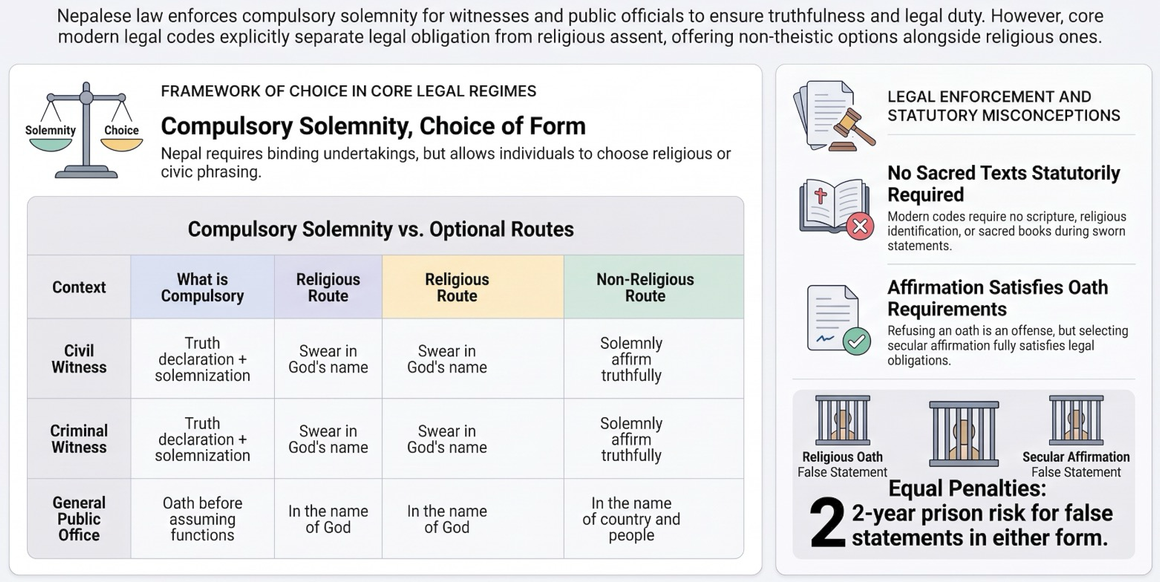
In ordinary civil and criminal testimony, the current procedural codes require a witness to commit to truthfulness, yet their schedules place a theistic formula beside a non-religious solemn affirmation. For public office, the Oaths Act, 2079 similarly makes an oath a condition of office while allowing the oath-taker to choose between invoking God and invoking the country and people. The legal mechanism is therefore compulsory solemnity with a choice of form, not compulsory theism.
| In one sentence: Nepal often requires an oath or affirmation, but its core modern witness and public-office regimes do not require belief in God as the price of legal participation. |
Does an “oath” in Nepalese law necessarily mean a religious oath?
No. The statutory vocabulary itself shows why the premise needs narrowing. A legal oath can describe the formal act that binds a person to truthfulness, fidelity, confidentiality, or public duty; the content of that act can then be religious or civic. The Oaths Act, 2079 (Section 3-6 and Schedule) is the cleanest example. It governs public-office oaths, yet its scheduled formula allows the person to use either “ईश्वरको” (God) or “देश र जनताको” (country and people) after the pledge language. The schedule directs the office-holder to tell the administering authority beforehand which expression will be used. The same Act permits an eligible office-holder to take the oath in a mother tongue after supplying a self-certified translation.
Under that structure the secular version is still legally treated as an oath. In other words, the word “oath” is a category of legal solemnization, not proof that religion is an element of the obligation. A person can be bound by the same office, truthfulness, and confidentiality duties without making any statement about God.
In reference to National Civil Procedure Code 2074, Section 184 and Schedule 16 (civil witness oath/affirmation) – courtroom testimony makes the distinction even more explicit. There, the legislation does not merely substitute a civic object for God; it expressly contrasts swearing in God’s name with a solemn affirmation. The law therefore supplies its own answer to the semantic problem: an affirmation can discharge the same procedural function without requiring religious assent.
What must a civil or criminal witness actually do?
In a civil case, section 184 of the National Civil Procedure Code, 2074 requires a witness, before giving a deposition, to declare that the witness will state the truth and to take the prescribed oath before the judge. Schedule 16 then gives the form. Its opening choice is concise: “ईश्वरको नाममा शपथ लिन्छु / सत्यनिष्ठा सहित प्रतिज्ञा गर्दछु” – in substance, swear in the name of God or solemnly affirm. The rest of the form is about evidentiary conduct: tell what was seen, known and heard; conceal nothing; lie about nothing; answer questions truthfully; accept the consequences if the statement is false.
The criminal procedure rule is materially the same. Section 106(2) of the National Criminal Procedure Code, 2074 requires a witness to announce that only the truth will be stated and to take the form in Schedule 37 audibly before deposition. Schedule 37 again gives the God/affirmation choice and ends with the consequence that, if the statement is false, punishment may follow according to law.
Nothing in either standard witness form names the Bhagavad Gita, Quran, Bible, Tripitaka, or another scripture. Nothing requires a witness to identify a religion. The statutory choice is between forms of solemn commitment, not between religious books. That does not prove that no courtroom in Nepal ever uses a book or customary ritual in practice; it does establish that such an object is not part of the general statutory form.
Where the modern rules land
| Context | What is compulsory | Religious route | Non-religious route |
|---|---|---|---|
| Civil witness | Truth declaration + prescribed solemnization before deposition | Swear in God’s name | Solemnly affirm truthfully |
| Criminal witness | Truth declaration + prescribed solemnization before deposition | Swear in God’s name | Solemnly affirm truthfully |
| General public office | Oath before assuming functions where the Act supplies the form | In the name of God | In the name of country and people |
If God is optional, can refusing an oath still be an offence?
Yes – and this is where the distinction between religion and legal solemnity does the work. Section 82 of the National Penal Code, 2074 prohibits a person who has appeared before a competent authority to state the truth from refusing an ordered oath for that purpose. The stated maximum punishment is three months’ imprisonment, a fine up to NPR 5,000, or both. Section 83 separately prohibits refusing to answer a question where there is a legal duty to state the truth, while preserving the rule that no one can be compelled to make a statement against oneself; its stated maximum is six months’ imprisonment, a fine up to NPR 5,000, or both.
But section 82 must be read with the procedural forms that define what a witness may lawfully take. Those forms include a secular affirmation. It would invert the statutory design to treat a witness who rejects the words “in the name of God” but accepts the prescribed affirmation as having refused the oath altogether.
The false-statement rule reinforces the point. Section 81 applies not only to a person who has taken an oath, but also to a person who has a legal duty to state the truth before a competent authority and to a public office-holder acting under an oath. The offence is making a false statement in that capacity, with a stated maximum of two years’ imprisonment, a fine up to NPR 20,000, or both. The legal duty therefore does not rise or fall with a theological formula. Choosing affirmation rather than God does not create a truthfulness discount.
Does the older Evidence Act pull the law back toward religion?
It complicates the language, but not the basic conclusion. Section 49(1) of the Evidence Act, 2031 uses an older expression requiring a witness to take an oath to tell the truth while “ईमान धर्म सम्झी” – language that can sound religious or conscience-inflected in modern translation. The same Act defines witness competency functionally: section 38 asks whether the person can understand the questions and give rational answers, while section 39 allows a person unable to speak to testify by writing or intelligible signs.
The important point is institutional timing and specificity. The Evidence Act supplies the older general witness framework; the later civil and criminal procedure codes prescribe the actual modern witness forms and expressly write in a secular affirmation.
Does public office change the answer?
Public office changes the object of the undertaking, not the core result. Under the Oaths Act, 2079, an oath can be a condition precedent to assuming the functions of office. Section 3 establishes the oath requirement for covered public offices; section 6 links oath-taking to assumption of office. The schedule binds the office-holder to constitutional fidelity, lawful performance, impartiality, honesty, and confidentiality. This is not the same evidentiary promise made by a witness, but it is the same legal technique: solemnization before legal status or authority is exercised.
The form is revealing because its secular route is not phrased as “no oath.” It is an oath in the name of the country and people. The schedule note requires advance notice of whether the oath-taker will use the word for God or the phrase for country and people. That choice undermines the idea that public office in Nepal rests on a religious test. The legal prerequisite is the undertaking; theism is one permitted expression of it, not its universal foundation.
Other public regimes also show that the drafting is not perfectly uniform. The research also identifies police regulations (Nepal Police Regulations 2071, Schedule 6) using a civic country-and-people formula without a God option, while court-martial forms (Court Martial Rules, 2064 Rule 18; Schedules 4-6) use a God-as-witness / truth-and-integrity alternative. Older military recruitment materials preserve more overtly religious or ceremonial language. These boundary cases are important because they defeat a different overstatement: Nepal does not have one perfectly standardized oath vocabulary across every institution and historical layer. What it does have in the central modern regimes is repeated statutory accommodation of non-theistic solemnization.
Would a compulsory “swear to God” rule fit Nepal’s Constitution?
A rule that genuinely made theistic speech compulsory would face serious constitutional questions. Article 4 defines Nepal as a secular state. Article 17 protects freedom of thought and expression. Article 18 guarantees equality before law and bars discrimination on grounds including religion and ideological conviction. Article 26 protects the freedom of a person having faith in religion to profess, practice and protect that religion, subject to specified limits. In criminal proceedings, Article 20 also protects against compelled self-incrimination and guarantees a fair hearing.
The constitutional argument should nevertheless be stated with care. Article 26 is textually framed around a person “having faith in religion”; the constitutional text alone should not be paraphrased as though it expressly contains a free-standing clause saying “freedom not to believe.” A challenge to forced theistic speech could draw strength from the Constitution as a whole – secularism, equality, thought and expression, and religious freedom – but the precise scope of a negative freedom of religion is an interpretive question, not wording that should be invented into Article 26.
More importantly, the ordinary statutes usually make the constitutional confrontation unnecessary. If a court official insisted that a civil or criminal witness invoke God despite the scheduled affirmation, the first objection would be statutory: the official would be disregarding the form Parliament has supplied. Likewise, if a covered public officer were denied the country-and-people option under the Oaths Act, the dispute would begin with the Act and its schedule note before reaching broader constitutional doctrine. The secular alternative is not merely a constitutional theory waiting for a court to create it; in the core regimes, it is already written into law.
What about an accused person – must the accused swear before speaking?
The accused is not simply another witness. The law distinguishes witness depositions from an accused person’s statement, and the Constitution of Nepal 2072, Article 20(7) provides that an accused cannot be compelled to testify against himself or herself. That distinction matters because a system that forced an accused to swear to the truth before answering could collide with the privilege against self-incrimination. The ordinary witness schedules should therefore not be casually transplanted onto the accused person’s statement.
This also helps explain why the criminal law separates refusal to take an oath from refusal to answer questions and then expressly preserves the protection against self-incrimination in the latter provision. The law can demand truthful testimony from someone who is legally bound to give it without converting the accused’s constitutional silence into an oath offence.
Do Nepalese courts require a Bible, Quran, Gita, or other sacred text?
The general statutory answer is no. The civil and criminal witness schedules name God as one verbal option, but they do not prescribe touching, holding, or swearing upon a sacred book. The Oaths Act likewise provides verbal alternatives and says nothing in its general form about a scripture. The difference is important: “religious oath available” and “religious object required” are separate propositions, and only the first is supported by the central modern forms.
The harder question is what happens in actual rooms. The published materials do not establish how frequently court staff present both alternatives aloud, whether pre-printed forms create a default, whether witnesses are informally asked about religion, or whether any court uses a scripture by local custom.
So, what in conclusion?
Nepal does require solemn undertakings. A civil witness must commit to truthful testimony. A criminal witness must do the same. Covered public officers must take an oath before exercising office. Refusing a lawfully required oath can carry criminal consequences, and knowingly false statements can be punished. These are not symbolic niceties; they are legal devices for attaching responsibility to speech and office.
In the two main courtroom codes, God is one side of an express choice and solemn affirmation is the other. In the general public-office statute, God is one selectable object and country-and-people is the other. The central legal obligation is truth, fidelity, and accountability. Religious language is permitted, sometimes historically prominent, and still visible in older or specialized instruments, but it is not the universal price of being heard or of holding office.