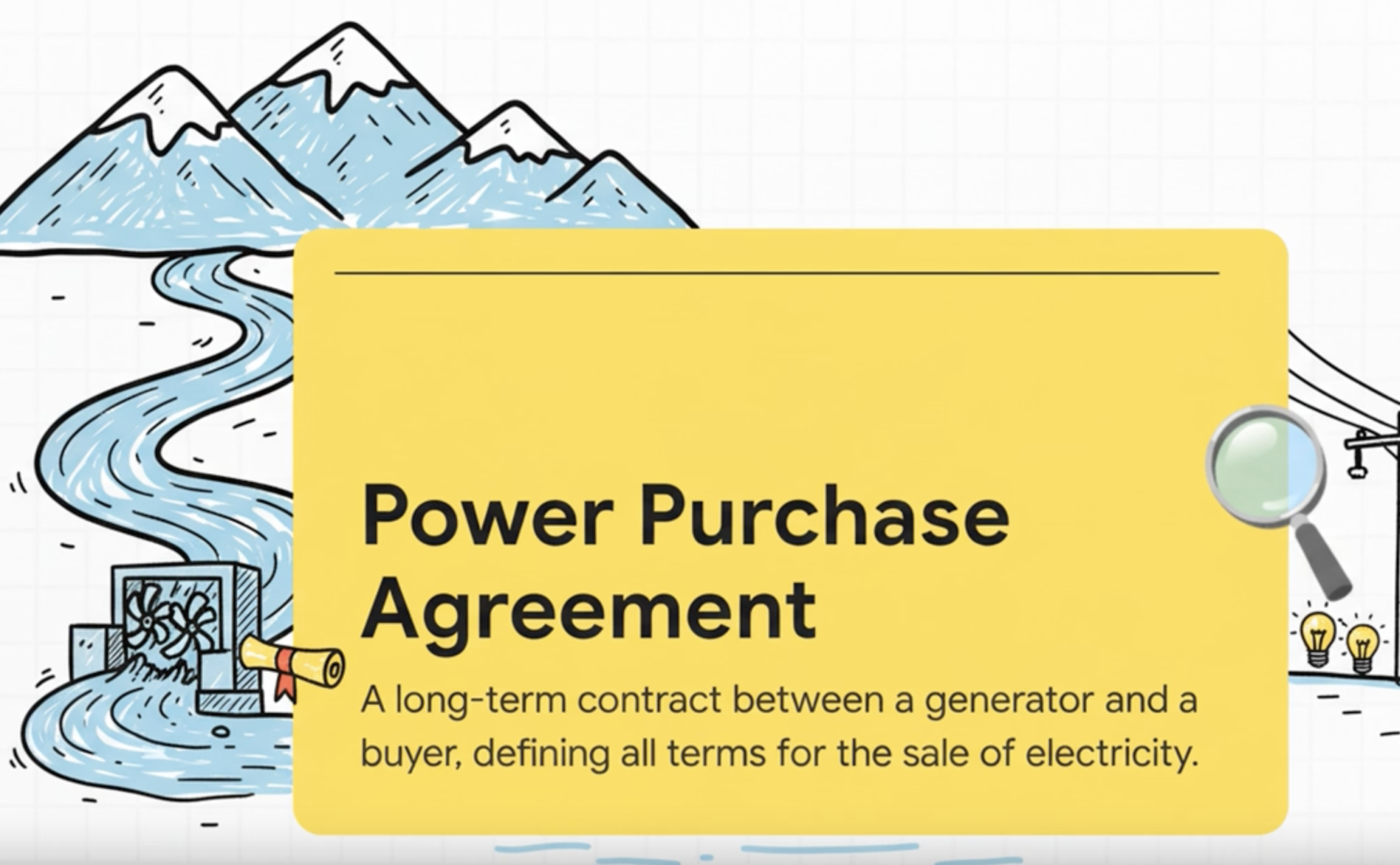
A Power Purchase Agreement (PPA) is the foundational contract for most privately-developed power projects. It is a long-term agreement between an electricity generator (the Seller) and a buyer (the Offtaker).
Its primary function is to transform a high-risk, capital-intensive construction project into a bankable asset. By guaranteeing a long-term revenue stream, a PPA enables developers to secure the financing required for construction. For the buyer, often a state utility – it is a tool for long-term energy security, locking in a predictable supply of electricity.
Example: PPA between NEA and TKJVC
Core Contractual Mechanics
1. Revenue Assurance and Bankability: The “Take-or-Pay” Principle
The financial core of a PPA is the “take-or-pay” obligation imposed on the buyer. The off-taker is contractually required to pay for a predetermined amount of energy that the plant makes available.
Crucially, if the buyer cannot accept this power due to its own grid limitations, a well-structured PPA requires it to pay compensation for the undelivered energy. This principle de-risks the project for lenders. Financiers would be hesitant to fund a project reliant on a buyer’s ad-hoc purchasing; the take-or-pay clause provides the revenue certainty needed to secure construction loans.
2. Risk Allocation
A PPA functions as a comprehensive risk-allocation framework. It anticipates potential failures and assigns liability.
· Seller Risks: Typically include construction delays, performance shortfalls, and failure to meet availability targets, often triggering financial penalties.
· Buyer Risks: Primarily involve the inability to take the power or make timely payments, which can result in compensation payments to the seller.
Shared “Force Majeure” Risks: These clauses define unforeseeable, catastrophic events (e.g., earthquakes, war, extreme weather) that suspend obligations without penalty, acknowledging external risks beyond either party’s control.
3. Operational Control and Grid Stability
The PPA grants the buyer, as the grid manager, significant control over the plant’s operation to ensure system stability.
· Dispatch Instructions: The buyer’s control center is typically given the authority to instruct the plant to increase, decrease, or shut down generation.
· Special Operations: The seller may be required to maintain capabilities like a “Black Start” (restarting without external grid power) to aid in restoring the network after a collapse.
Failure to follow these operational instructions usually results in financial penalties, ensuring the plant serves the grid’s needs.
4. Tariff Structure: Aligning with System Needs
The PPA’s tariff structure is a key commercial and policy tool.
· Seasonal or Time-of-Day Pricing: Rates are often higher during periods of peak demand or seasonal scarcity, incentivizing the seller to ensure reliable operation when power is most valuable.
· Controlled Escalation: The tariff often includes a pre-defined annual increase for an initial period. This provides a predictable, inflation-adjusted revenue ramp during the project’s most financially vulnerable period, helping service its debt.
5. Project Finance and Security
The PPA is itself a transferable financial asset that serves as collateral.
· Assignment to Lenders: A standard clause allows the seller to assign its rights under the PPA to its financing banks as security for the project loans. If the developer defaults, the bank can step in to protect its investment.
· Direct Payment: Lenders may also secure the right to receive payments directly from the buyer, ensuring loan repayments are prioritized.
Key Technical and Commercial Definitions
The PPA’s effectiveness hinges on precise definitions:
· Contracted Capacity & Energy: The specific amount of power (MW) and energy (MWh) the seller is obligated to provide, often broken down by season.
· Delivery Point: The precise location on the grid where ownership and risk of the electricity transfer from seller to buyer.
· Excess Energy: Power generated beyond the contracted amount. The buyer may have the option to purchase this, often at a discounted rate, to discourage unpredictable operation that could destabilize the grid.
A Power Purchase Agreement is much more than a contract to buy and sell electricity. It is a financial, legal, and operational framework for a power project. By allocating multi-million dollar risks, creating a bankable asset from physical infrastructure, and aligning the seller’s profit motive with the buyer’s need for reliable power, the PPA serves as the invisible architecture upon which modern private power projects are built.