| Synopsis Nepal should enable a sovereign foreign-exchange risk management mechanism, but it should not begin with a broad discretionary derivatives programme. The immediate policy need is to measure the Government’s currency exposure correctly, set explicit portfolio tolerances, align borrowing choices with those tolerances, and create a legally and operationally controlled path for hedging. Current law provides important building blocks – including Government borrowing authority, a specific sovereign hedging route under Hedging Regulation 2079, and NRB’s express power to transact in forwards, swaps and options – but the Public Debt Management Act 2079 does not yet create a comprehensive sovereign derivatives mandate. The July 2026 draft amendment expressly proposed such authority, but as of 29 August 2026 it remained a proposal rather than enacted law. The recommended programme is therefore phased: natural mitigation and currency benchmarks first; creditor-embedded conversions and tightly matched pilot hedges second; broader OTC derivatives only after explicit legal authority, budget treatment, documentation, counterparty limits, valuation, collateral/liquidity rules and segregation of duties are in place. |
The quantitative diagnosis should be supported by very sharp arithmetic. PDMO-reported external public debt reached about NPR 1,599.5 billion at mid-July 2026, or 53.77% of total public debt. Contemporary PDMO-based reporting attributes roughly NPR 167 billion of the FY 2025/26 increase in public debt to exchange-rate movements. However, this does not mean Nepal faces an imminent liquidity crisis: NRB reported gross reserves of NPR 3,897.67 billion (USD 25.31 billion) at mid-July 2026, enough for 19.6 months of prospective goods-and-services imports. It does mean that the fiscal balance sheet carries a large translation and debt-service exposure for which there is no explicit sovereign risk tolerance or portfolio hedge policy.
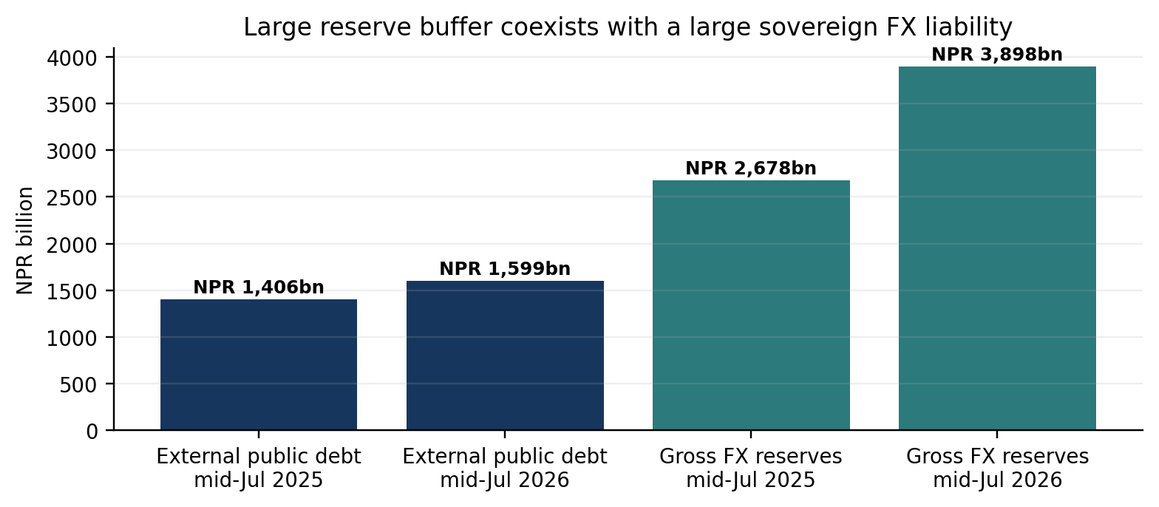
Figure: External public debt and gross foreign-exchange reserves. Sources: PDMO debt statistics; NRB annual macroeconomic release, 26 Aug 2026.
1. Assessment approach and evidence base
This report answers: exposure measurement, historical and scenario analysis, natural-hedge assessment, comparative evaluation of risk-management options and institutional/legal/governance design. The analysis distinguishes three concepts that are often blurred. First is gross contractual exposure: the foreign-currency amount of debt and debt service. Second is economic or “look-through” exposure: for example, an SDR liability is a basket exposure rather than a single-currency risk. Third is institutional net exposure: reserve assets may offset sovereign liabilities economically, but only to the extent that currency, timing, debt terms, and institutional ownership are actually aligned. The mere fact that NRB holds reserves does not legally or operationally extinguish the Government’s debt liability.
2. Sovereign foreign-exchange exposure: scale, concentration and fiscal transmission
At mid-July 2025, PDMO reported external public debt of NPR 1,405.82 billion. The portfolio was highly concentrated: SDR 72.63%, USD 19.53%, JPY 4.10%, CNY 2.42%, EUR 0.65% and small residual shares in KRW, SAR and KWD. A year earlier SDR and USD together were similarly dominant. This concentration is important because a portfolio that appears diversified by creditor is not necessarily diversified by currency.
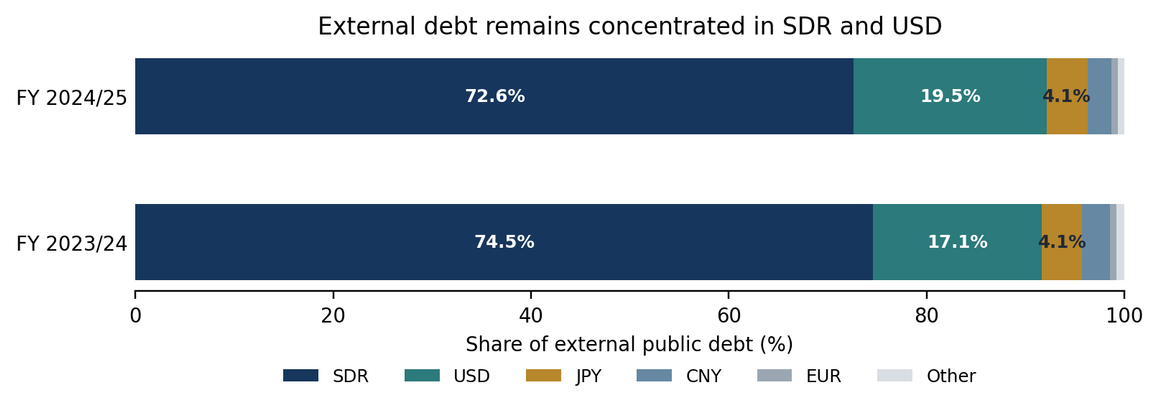
Figure: PDMO currency composition of external public debt, FY 2023/24 and FY 2024/25. Source: PDMO annual debt reports.
The SDR share needs to be decomposed before any hedge decision. The IMF’s current SDR valuation basket (effective 1 August 2022 until the next review due in 2027) weights USD 43.38%, EUR 29.31%, CNY 12.28%, JPY 7.59% and GBP 7.44%. Applying those weights to the FY 2024/25 PDMO currency mix produces an approximate economic exposure in which USD becomes just over half of the total, EUR exceeds one-fifth, and CNY/JPY/GBP become non-trivial. This is the appropriate starting point for currency-specific stress testing; hedging “SDR” as if it were one currency can otherwise conceal the underlying drivers. (IMF Executive Board, SDR Valuation Review, 14 May 2022.)
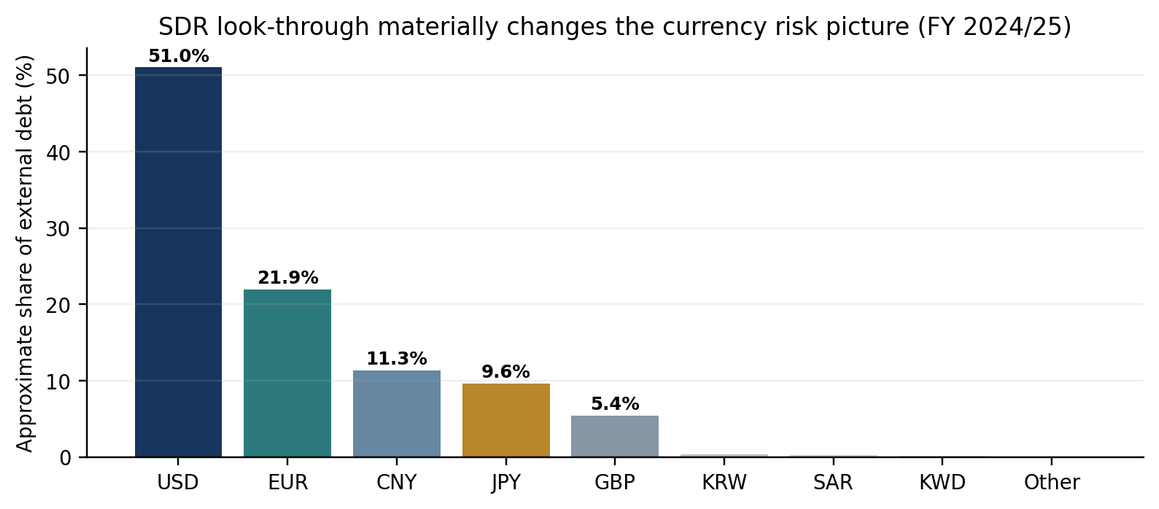
Figure: Approximate look-through currency composition of FY 2024/25 external debt after decomposing the SDR share using IMF basket weights. This is an analytical decomposition, not a PDMO accounting restatement.
The fiscal transmission occurs through two channels. An exchange-rate movement changes the NPR carrying value of the outstanding foreign-currency stock even before cash is paid; that is an unrealised revaluation effect. When principal, interest or fees are actually serviced, the exchange rate affects realised budgetary cash cost. PDMO’s annual debt reports quantify exchange-rate effects on the stock, but the evidence reviewed does not show a standing sovereign limit that assigns a maximum tolerated FX-at-risk amount, a target currency composition after SDR look-through, or a formal hedge ratio.
| Indicator | FY 2023/24 / mid-Jul 2024 | FY 2024/25 / mid-Jul 2025 | FY 2025/26 / mid-Jul 2026 |
| External public debt | NPR 1,253.2bn | NPR 1,405.8bn | NPR 1,599.5bn |
| External share of total public debt | ≈51.5% | ≈52.57% | ≈53.77% |
| Gross FX reserves | NPR 2,041.1bn / USD 15.27bn | NPR 2,677.7bn / USD 19.50bn | NPR 3,897.7bn / USD 25.31bn |
| Import cover (goods + services) | 13.0 months | 15.4 months | 19.6 months |
| Reported FX valuation effect | Gain ≈ NPR 4.23bn | Loss ≈ NPR 65.54bn | Loss ≈ NPR 167bn |
A simple stock sensitivity demonstrates why a formal FX risk study is warranted. Holding the mid-July 2026 external debt stock constant, a uniform 10% NPR depreciation against the relevant foreign-currency basket would mechanically add roughly NPR 160 billion to its NPR value; 20% would add roughly NPR 320 billion. These are not forecasts and do not represent one-year cash costs: they are first-order revaluation sensitivities before amortisation, new disbursements, cross-currency moves or any natural offsets.
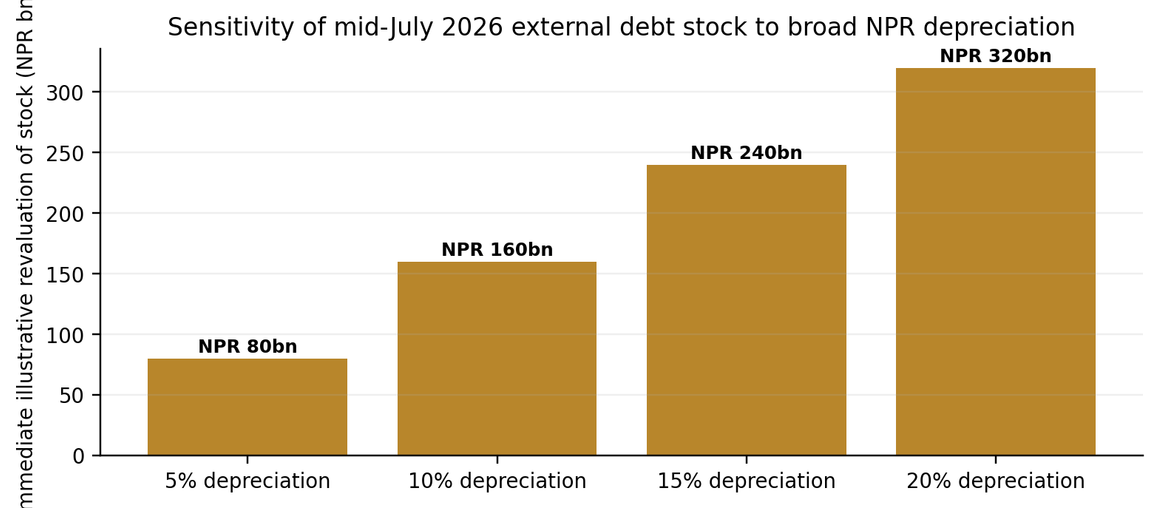
Figure: Illustrative stock sensitivity at mid-July 2026. Formula: external debt stock × assumed uniform NPR depreciation. Not a forecast or debt-service estimate.
The long-run direction is unambiguous. World Bank/IMF IFS data show an annual average around NPR 48.61 per USD in 1993, the year Nepal moved to a market-determined system for convertible currencies, versus about NPR 139.12 per USD in 2025. NRB’s posted selling rate was around NPR 153 per USD in late August 2026. The rise is not linear and, because NPR is pegged to INR, much third-currency movement is imported through INR’s movement against USD, EUR, JPY and CNY. That institutional fact makes a currency-by-currency rather than “USD-only” study essential.
3. Natural hedge: useful analytical lens, not an automatic fiscal offset
Nepal’s reserve buffer is exceptionally large relative to external debt in aggregate, but gross size is not the same as a hedge. NRB’s FY 2024/25 disclosures show a reserve portfolio dominated by USD and INR, while the Government’s debt is dominated by SDR and USD. The SDR look-through partly closes that apparent mismatch because SDR itself contains USD, EUR, CNY, JPY and GBP. Even so, exact netting requires common measurement dates, currency amounts, maturity buckets and an explicit treatment of institutional ownership. NRB reserves are managed for monetary and external-stability objectives under the NRB Act; they are not an unencumbered PDMO asset pool.
Therefore a “currency balance sheet” is necessary where two columns must remain visible: Government liabilities and NRB reserve assets. A third column should show analytical net exposure. Policy should never describe the analytical net as if the Government had a legal right to draw the corresponding reserve amount. This preserves central-bank mandate integrity while still capturing the economic fact that foreign-currency assets can cushion country-level stress.
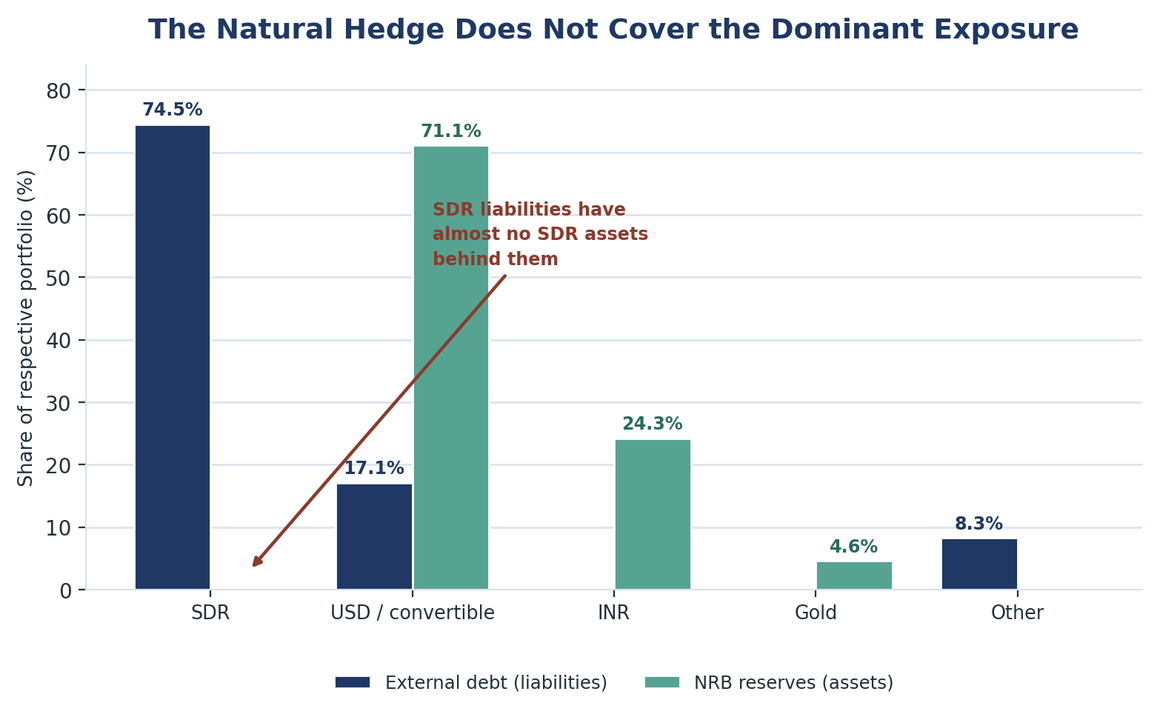
Figure: Currency composition of external debt liabilities against NRB reserve assets (PDMO and NRB annual reports). Non Pass Through Basis
4. Comparative evaluation of risk-management options
The overall objective should be to reduce unacceptable fiscal volatility at the lowest expected cost consistent with liquidity, legal capacity and operational control – not to “beat” the currency market. IMF–World Bank public-debt guidance explicitly warns that foreign-currency borrowing can appear cheap ex ante but become costly after depreciation, and that derivatives introduce counterparty, collateral, liquidity and settlement risks. A hedge is therefore justified only where the residual risk reduction is worth its all-in cost and operational burden.
| Approach | Risk reduction | Direct cost | Legal / market readiness in Nepal | Recommended use |
| Borrowing-currency choice & portfolio benchmarks | Medium–High | Low | High | Immediate core tool |
| Liability management / prepayment when economic | Medium | Deal-specific | Medium–High | Use selectively |
| Sovereign asset–liability alignment (SALM) | Medium | Low direct; governance cost | Medium | Immediate analytical framework; cautious operational use |
| Creditor-embedded currency conversion | High for selected loans | Market conversion cost + creditor fee | Medium, creditor-dependent | Priority pilot where available |
| Domestic bank forward / swap | Medium | Forward points / swap spread | Developing; tenor and depth constraints | Short-tenor pilot only after legal/limit checks |
| Offshore cross-currency swap | High | Spread + collateral/liquidity + legal cost | Low–Medium today | After explicit mandate & ISDA framework |
| Options / collars | High tail protection | Premium; can be material | Low today | Exceptional tail-risk use |
| Dedicated hedging facility under Hedging Regulation 2079 | Transaction-specific | Hedging fee under rules/agreement | Existing legal route but institutional facility must be operational | Potential bridge for eligible sovereign/project loans |
Natural mitigation should be the first line of defence. Each annual borrowing plan should be tested against a strategic currency benchmark after SDR look-through. If two concessional loans have similar development value and grant element, the currency that reduces net sovereign exposure should receive a measurable preference. Conversely, diversification for its own sake is not a sufficient objective: borrowing in a “new” currency may increase rather than reduce risk if there is no matching fiscal or reserve asset and the currency is volatile against NPR.
Market hedging should be evaluated on the effective cost of the borrowing after hedge, not on the spot depreciation that happened to occur historically. Historical back-testing is useful for calibration but cannot establish that hedging “would have saved money” in general; a hedge replaces uncertain exchange outcomes with a known or bounded cost and necessarily looks expensive in scenarios where the adverse exchange move does not occur. The correct metric is cost relative to a stated risk tolerance, including counterparty credit valuation, collateral funding, legal documentation and termination exposure.
World Bank Treasury illustrates a relevant implementation pattern: currency or interest-rate conversions can be embedded in eligible loan documentation, while free-standing swaps require a Master Derivatives Agreement/ISDA-type framework and a legal enforceability review. Nepal should first investigate creditor-embedded conversion options with each major multilateral lender because those transactions can reduce operational complexity and counterparty onboarding relative to a stand-alone offshore dealer programme. Eligibility must be confirmed transaction by transaction; Nepal should not assume that every IDA or other concessional exposure has the same conversion functionality as an IBRD Flexible Loan.
5. Legal authority and institutional architecture
The current legal picture is enabling but fragmented. The Constitution reserves foreign assistance and borrowing to the Government of Nepal and prohibits Government borrowing or guarantees except under federal law [Constitution of Nepal, art.59(6), art.115(2)]. The Public Debt Management Act 2079 gives the Government the external borrowing power and provides liability-management authority, but it does not expressly create a general derivatives mandate [Public Debt Management Act 2079, s.5(1), s.5(6)]. The Foreign Exchange (Regulation) Act requires regulated channels for foreign-exchange transactions and empowers NRB licensing and control [Foreign Exchange (Regulation) Act 2019, s.3(1), s.4(1), s.22]. The NRB Act separately gives NRB itself express authority to transact in spot, forwards, swaps, options and similar instruments [Nepal Rastra Bank Act 2058, ss.62–63, s.65(1)–(3)]. Most importantly, Hedging Regulation 2079 contains a specific sovereign provision allowing the Government to hedge a donor-country or donor-institution project loan through the designated hedging institution [Hedging Regulation 2079, r.17(1)–(2)]. These provisions can support a controlled pilot architecture, but they do not remove the need for explicit fiscal authority, appropriations and operational rules for a scalable portfolio derivatives programme.
| Constitution of Nepal – art.59(6) and art.115(2)५९. … (६) वैदेशिक सहायता र ऋण लिने अधिकार नेपाल सरकारको हुनेछ । त्यस्तो सहायता वा ऋण लिँदा देशको समष्टिगत आर्थिक स्थायित्व हुने गरी लिनु पर्नेछ । ११५. कर लगाउन वा ऋण लिन नपाइनेः … (२) संघीय कानून बमोजिम बाहेक नेपाल सरकारले कुनै ऋण लिने र जमानत दिने छैन । Convenience English rendering: “59(6) The authority to obtain foreign assistance and loans rests with the Government of Nepal; such assistance or loans must be taken in a manner maintaining macroeconomic stability. 115(2) The Government of Nepal shall not borrow or give a guarantee except in accordance with federal law.”Source: Nepal Law Commission, Constitution of Nepal, art.59(6) and Part 10, art.115(2): https://repository.lawcommission.gov.np/np/category/documents/prevailing-law/संविधान/constitution-of-nepal/ |
| Public Debt Management Act, 2079 (2022) – s.5(1)५. वैदेशिक ऋण: (१) वैदेशिक ऋण लिने अधिकार नेपाल सरकारलाई हुनेछ।Convenience English rendering: “5. External debt: (1) The authority to borrow external debt shall vest in the Government of Nepal.”Source: Nepal Law Commission, Public Debt Management Act 2079; official Act page: https://lawcommission.gov.np/content/13413/public-loan-management-act–2079/. |
| Public Debt Management Act, 2079 (2022) – s.5(6)(६) नेपाल सरकारले ऋणदातासँगको सहमतिमा ऋणको शर्त परिवर्तन गर्न, दुई वा दुईभन्दा बढी ऋणलाई एक मात्र ऋणमा समेट्न वा ऋण तथा ऋणको ब्याज तोकिएको मितिभन्दा अगाडि भुक्तानी गर्न सक्नेछ। Convenience English rendering: “With the lender’s consent, the Government may change loan terms, consolidate two or more loans into one, or prepay principal and interest before the scheduled date.”Source: Nepal Law Commission / PDMO official Public Debt Management Act 2079. This provision supports liability-management actions but does not itself say “swap”, “option” or “derivative”. |
| Intergovernmental Fiscal Arrangement Act, 2074 – s.12(1)–(2)१२. वैदेशिक सहायता लिने अधिकारः (१) वैदेशिक अनुदान वा ऋण लिने अधिकार नेपाल सरकारको हुनेछ । (२) नेपाल सरकारले वैदेशिक अनुदान वा ऋण लिँदा देशको समष्टीगत आर्थिक स्थायित्व हुने गरी लिनु पर्नेछ ।Convenience English rendering: “12. Authority to obtain foreign assistance: (1) The authority to obtain foreign grants or loans shall rest with the Government of Nepal. (2) In taking foreign grants or loans, the Government shall do so in a manner consistent with the country’s macroeconomic stability.”Source: Nepal Law Commission: https://repository.lawcommission.gov.np/np/category/documents/prevailing-law/statutes-acts/अन्तर-सरकारी-वित्त-व्यवस/ – Chapter 5, s.12. |
The most direct statutory derivatives authority belongs to NRB, not PDMO. That distinction should be noted. [Nepal Rastra Bank Act 2058, ss.62–65.]
| Nepal Rastra Bank Act, 2058 – ss.62–63 and s.65(1)–(3) (operative extracts)६२. विदेशी विनिमेय नीतिः बैंकलाई नेपालको विदेशी विनिमेय नीति निर्माण गर्न, कार्यान्वयन गर्ने र गराउने पूर्ण अधिकार हुनेछ । ६३. विदेशी विनिमय व्यवस्थापनः विदेशी विनिमयको व्यवस्थापन बैंकले गर्नेछ । यस्तो व्यवस्थापन गर्न बैंकलाई देहाय बमोजिमको अधिकार हुनेछः– (क) विदेशी विनिमय कारोबार गर्न चाहने व्यक्तिलाई यस ऐन वा अन्य प्रचलित कानूनको अधीनमा रही इजाजतपत्र जारी गर्ने । (ख) इजाजतपत्र प्राप्त व्यक्तिबाट गरिने विदेशी विनिमय कारोबार नियमित तथा व्यवस्थित गर्नका लागि नियम तथा विनियम बनाउने, आवश्यक आदेश, निर्देशन वा सूचना जारी गर्ने । (ग) इजाजतपत्र प्राप्त व्यक्तिको निरीक्षण, सुपरिवेक्षण तथा अनुगमन गर्ने । (घ) ईजाजतपत्र प्राप्त व्यक्तिको कारोबारको आधार, सीमा तथा शर्त निर्धारण गर्ने । (ङ) नेपाली रुपैयाँको विदेशी विनिमय दर निर्धारण पद्धती तोक्ने । ६५. विदेशी विनिमयको कारोबारः (१) बैंकले विदेशी विनिमय, सुन तथा बहुमूल्य धातु खरिद वा बिक्री गर्न सक्नेछ । (२) बैंकले उपदफा (१) बमोजिम गर्ने खरीद बिक्री स्पट, अग्रिम विनिमय दर, स्वाप, अप्सन वा यस्तै प्रकारका अन्य उपकरण, नगद वा कुनै पनि विनिमेय अधिकारपत्रको माध्यमबाट गर्न सक्नेछ । (३) बैंकले दफा ६६ को उपदफा (१) को प्रयोजनको लागि विदेशी विनिमय खरिद वा बिक्री गर्न सक्नेछ । त्यस्तो खरिद, बिक्री स्पट, अग्रिम विनिमयदर, स्वाप, अप्सन वा यस्तै अन्य उपकरणको आधारमा समेत गर्न सक्नेछ । Convenience English rendering: “62. Foreign-exchange policy: the Bank has full authority to formulate and implement Nepal’s foreign-exchange policy. 63. NRB manages foreign exchange and may license dealers, regulate and supervise them, set dealing bases/limits/conditions and determine the exchange-rate methodology. 65(1) NRB may buy or sell foreign exchange, gold and precious metals. 65(2) Such transactions may be conducted through spot, forward exchange rate, swap, option or similar instruments, cash or negotiable instruments. 65(3) NRB may also use those instruments for reserve-management purposes under section 66(1).”Source: Nepal Law Commission, Nepal Rastra Bank Act 2058, Chapter 7, ss.62–63 and 65: https://repository.lawcommission.gov.np/np/documents/prevailing-law/statutes-acts/नेपाल-राष्ट्र-बैंक-ऐन-२०५/परिच्छेद-७-विदेशी-विनिम/ |
| Foreign Exchange (Regulation) Act, 2019 – s.3(1), s.4(1) and s.22३. विदेशी विनिमय कारोबार गर्न इजाजतपत्र लिनुपर्नेः (१) विदेशी विनिमय कारोबार गर्न चाहने व्यक्ति, फर्म, कम्पनी वा संस्थाले बैङ्कबाट इजाजतपत्र लिनुपर्नेछ । ४. विदेशी विनिमय कारोबार गर्ने प्रक्रियाः (१) कसैले पनि बैङ्कको स्वीकृति नलिई इजाजतपत्र प्राप्त व्यक्तिसँग बाहेक अरू व्यक्तिसँग विदेशी विनिमय कारोबार गर्न हुँदैन । २२. नियमहरू बनाउने अधिकारः यस ऐनको उद्देश्य कार्यान्वित गर्नको लागि नेपाल सरकारले बैङ्कसँग परामर्श गरी नियमहरू बनाउन सक्नेछ ।Convenience English rendering: “3(1) A person, firm, company or institution wishing to conduct foreign-exchange transactions must obtain a licence from the Bank. 4(1) Without the Bank’s approval, no one may conduct foreign-exchange transactions other than with a licensed person. 22. The Government may, after consulting the Bank, make rules to implement the purposes of the Act.”Source: Nepal Law Commission: https://repository.lawcommission.gov.np/np/category/documents/prevailing-law/statutes-acts/विदेशी-विनिमय-नियमित-गर्/ |
Hedging Regulation 2079 is the clearest current bridge between sovereign borrowing and a hedge transaction. It was made under s.22 of the Foreign Exchange (Regulation) Act. Rule 6 contemplates designation by the Ministry of an NRB-licensed infrastructure development bank or commercial bank with full or partial Government investment as the “hedging institution”. Rule 17 then expressly addresses the Government itself. [Hedging Regulation 2079, rr.6, 17–18]
| Hedging Regulation, 2079 – r.17(1)–(2), official PDF p.8१७. नेपाल सरकारले हेजिङ्ग गर्न सक्नेः (१) नेपाल सरकारले कुनै परियोजना कार्यान्वयन गर्न कुनै दातृ मुलुक वा संस्थाबाट लिएको ऋणको साँवा ब्याज भुक्तानी गर्न त्यस्तो ऋण रकम हेजिङ्ग गर्ने संस्था मार्फत हेजिङ्ग गर्न सक्नेछ। (२) उपनियम (१) बमोजिम नेपाल सरकारले हेजिङ्ग गरेकोमा हेजिङ्ग शुल्क र सोको भुक्तानी तथा अन्य व्यवस्था नेपाल सरकार र हेजिङ्ग गर्ने संस्थाबीच भएको सम्झौता बमोजिम हुनेछ। Convenience English rendering: “17. Government of Nepal may hedge: (1) For payment of principal and interest on a loan taken from a donor country or institution to implement a project, the Government may hedge that loan amount through the hedging institution. (2) Where the Government hedges under sub-rule (1), the hedging fee, its payment and other arrangements shall be as provided in the agreement between the Government and the hedging institution.”Source: Official NRB-hosted PDF of Hedging Regulation 2079, p.8: https://www.nrb.org.np/lgd/हेजिङ्ग-नियमावली-२०७९/ |
Rule 17 is significant but should not be overread. It authorises a route through the hedging institution for project-related donor loans [Hedging Regulation 2079, r.17(1)–(2)]; it is not the same thing as a standing statutory mandate for PDMO to maintain an unrestricted derivatives book with offshore dealers. A scalable programme would benefit materially from the July 2026 proposed PDMA amendment, which expressly contemplated hedging to reduce exchange-rate and interest-rate risk and foreign-currency bond issuance. As of the 29 August 2026 cutoff, the Ministry had published the proposal for comments, but the Federal Parliament’s public bill records does not show a new PDMA amendment as enacted. Thus, that amendment as proposed law, not current authority.
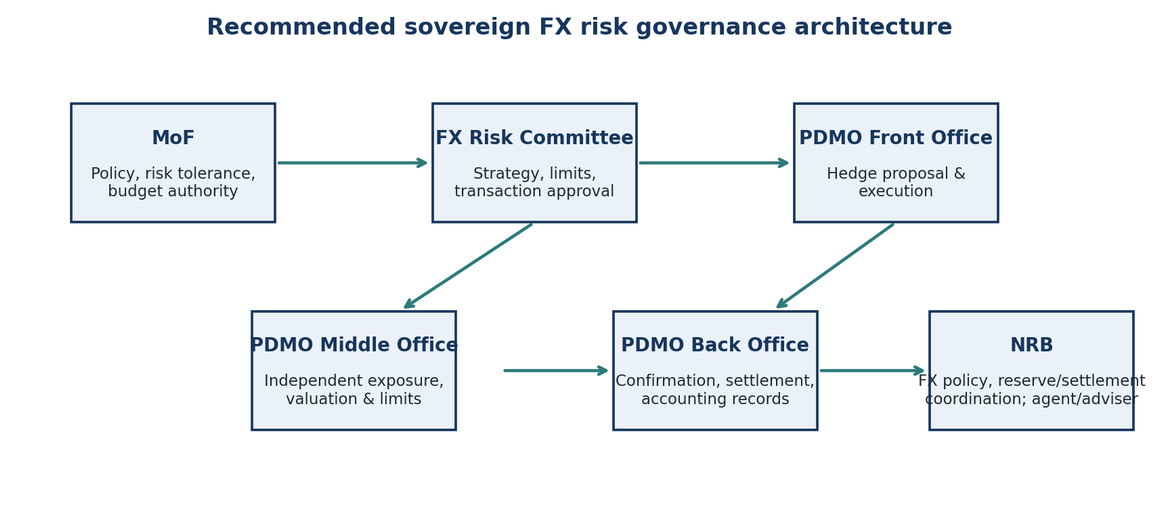
Figure: Recommended target operating model. NRB’s participation should preserve its monetary/reserve mandate and make the fiscal risk owner explicit.
MoF should own sovereign policy, risk appetite and budget consequences. PDMO should own the debt exposure dataset, strategy analytics, hedge proposals, transaction records and debt-service integration. NRB should remain the foreign-exchange authority, reserve manager, settlement institution and technical adviser, and may act as agent or transaction party only where the legal structure clearly specifies whose balance sheet bears market and counterparty risk. A Sovereign FX Risk Management Committee should coordinate the three institutions but should not blur accountability: it should recommend and approve within delegated thresholds, not create a collective “no-owner” risk position.
6. Why the Existing Regulation Has Never Been Used
The Hedging Regulation, 2079 has remained operationally dormant since enactment. The reasons are documented, and they are the most important evidence available to this assessment, because a sovereign programme built on the same instrument design would encounter them unchanged.
The first and decisive problem is pricing. The Regulation contemplates a full rate-lock: Rule 2(च) defines hedging as fixing the exchange rate so that the investor may repatriate at the rate at which the investment was made. Guaranteeing complete protection over a long tenor is actuarially expensive, and the Nepalese data make it more so. Over a 26-year trajectory the Rupee depreciated against the US Dollar at a compound annual rate of 3.07 percent, with annualised volatility of 5.20 percent and pronounced positive skew – sharp depreciation shocks of 22.3 percent in 2008, 19.0 percent in 2011, 13.2 percent in 2013 and 11.3 percent in 2022 dwarf any period of appreciation. Over a rolling twelve-year window, matching the maximum permitted hedge duration, average cumulative depreciation is 50.4 percent with a worst case of 83.9 percent. A facility offering a full rate-lock on those parameters must charge an annual premium of roughly 3.5 to 4.5 percent to remain solvent.
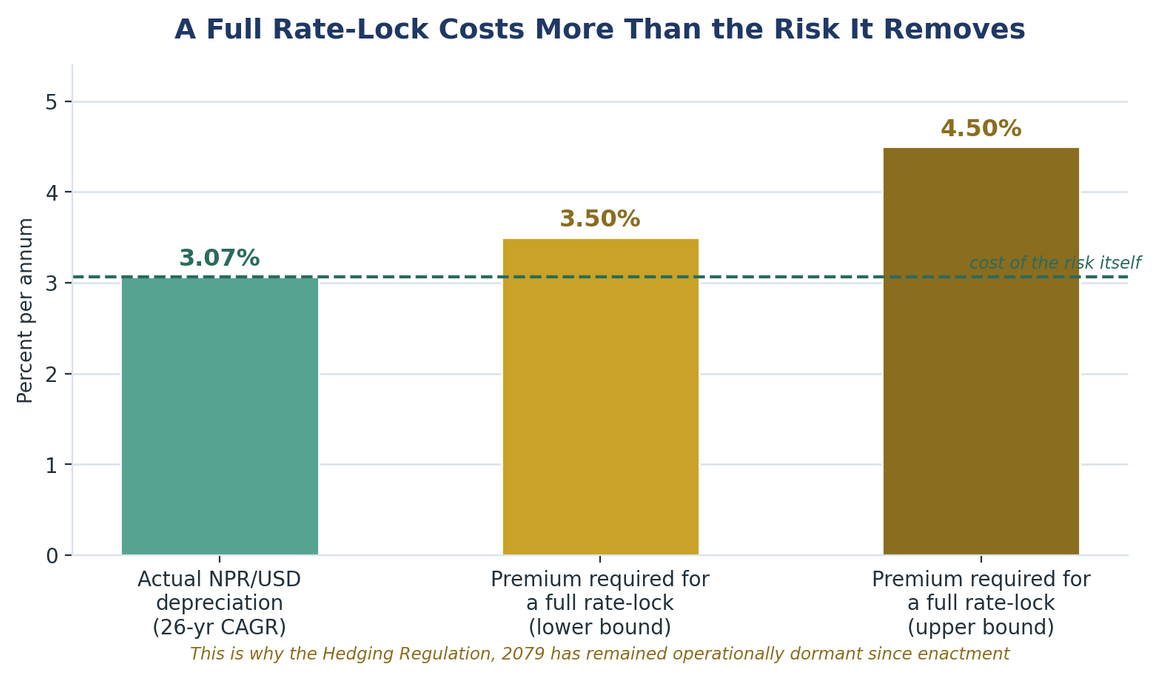
Figure: Required full rate-lock premium against realised long-run depreciation.
The comparison is unforgiving. A hedge priced at 3.5 to 4.5 percent per annum against realised depreciation averaging 3.07 percent per annum costs more than the risk it eliminates. That is not a defect of execution; it is arithmetic, and it follows necessarily from insuring the whole of a distribution whose mean is lower than the loaded premium. Any sovereign programme that offers full rate-locks on concessional SDR debt will reach the same result, and the conclusion the assessment should draw is that the honest answer for much of Nepal’s existing concessional portfolio is not to hedge it – a finding the terms of reference rightly contemplate by framing the question as including the decision not to hedge.
The second problem compounds the first: the Regulation supplies no pricing methodology. Rule 4 lists risk factors to be considered – inflation differentials, inter-currency differentials, debt-equity ratio – but provides no formula or method for converting them into a premium. Every transaction therefore becomes a bilateral negotiation without an agreed anchor, which is precisely the condition under which no transaction occurs.