
I. THE FORMAL LOCK AND THE THREE POINTS WHERE IT OPENS
A borrower who takes a home or vehicle loan from a Nepalese commercial bank today is, by regulatory default, entitled to an interest rate that cannot move for years. Nepal Rastra Bank’s Unified Directive requires banks and financial institutions to fix the rate on any personal term loan running longer than one year and prohibits any change to it “for any reason whatsoever” until the loan has run seven years, and every five years thereafter, and then only with the borrower’s written consent (Unified Directive for “A”, “B” and “C” Class Licensed Institutions, Directive No. 15, point 3(15)(ka) and (cha)). On paper, this is among the more borrower-protective interest-rate rules in South Asian banking regulation: it does not merely require disclosure of a fixed rate, it forbids the bank from touching it.
The surface explanation for interest-rate disputes reaching Nepal’s courts is that banks violate this lock – that lenders unilaterally raise rates and borrowers sue to enforce the statutory freeze. Some of the reported disputes fit that story exactly: in Rajkumari Mandal v. Shree Saptakoshi Development Bank, the High Court at Biratnagar applied the fixed-rate directive to strike down a bank’s mid-tenor increase on a personal periodic loan, holding that nothing short of the statutory seven-year/five-year review – taken with the borrower’s written consent – could justify a change. That is the law working as designed.
But most of the fixed-rate disputes that reach the High Courts and the Supreme Court do not turn on whether the bank broke the lock. They turn on whether the lock ever attached in the first place, whether it survived the borrower’s own financial distress, or whether it mattered before the collateral was sold. In Rajesh Kumar Shrestha v. Mega Bank, a borrower who had paid all 96 scheduled EMIs on a vehicle loan demanded release of title, only to be told – and have the High Court at Patan agree – that his loan had never been fixed at all: a single postscript clause in the 2071 BS sanction letter tied the rate to the bank’s Base Rate, and eight years of quarterly newspaper notices had done the rest. In Rabindra Nyaupane v. Kumari Bank and Irshad Shekh v. Global IME Bank, the same mechanism recurs: a “punascha” (postscript) line in the credit approval letter converts what a borrower experienced as a fixed facility into a contractually floating one, and the Supreme Court upholds it because the borrower signed it.
| The statutory lock on fixed-rate lending is real law – but it protects only the borrower who is correctly classified as fixed at sanction, remains solvent through the tenor, and can outlast a self-executing recovery process. |
This report’s central finding is that the fixed-rate regime in Nepal is not weak law wrapped in strong rhetoric – it is genuinely strong law that opens at three specific, identifiable points in the lending lifecycle, and that each opening is itself lawful, or at least regulator-sanctioned, rather than a violation the directive was written to prevent. The first opening is at sanction, where a boilerplate base-rate-adjustment clause reclassifies a loan before the fixed-rate protection ever attaches (Chapter II). The second is at distress, where the very directive that re-bases a struggling borrower’s rate to the Base Rate upon restructuring or rescheduling applies with equal force whether the original loan was fixed or floating, so that financial hardship is the one circumstance under which even a correctly fixed rate is designed to move (Chapter III). The third is at recovery, where Section 57 of the Banks and Financial Institutions Act, 2073 lets a bank auction collateral on 35 days’ notice – a clock that in several of the reported cases outran the borrower’s attempt to establish, through NRB’s own regulatory channel or through the courts, that a rate change was unlawful (Chapter IV).
None of these three openings requires a bank to break a rule. The sanction-stage reclassification is contractually authorised by the same borrower who later complains of it. The distress-stage re-basing is written into the directive on credit classification and provisioning, not smuggled around it. The recovery-stage auction is exactly what Section 57 authorises, on exactly the timeline the statute sets. The seam this report identifies is therefore not a compliance failure to be corrected by better supervision of banks that are already following the rules. It is a structural feature of how the fixed-rate protection interacts with the surrounding law of contract formation, credit distress management, and secured-debt recovery – three bodies of law that were not built around the fixed-rate directive and do not defer to it.
The chapters that follow trace each opening in turn, test it against the strongest contrary evidence – including several cases in which courts did enforce the fixed-rate lock and consumer-protection directives that on their face close these very gaps – and conclude that the openings survive that scrutiny substantially narrowed but intact. The report closes with a sequenced set of reforms, each addressed to one specific opening rather than to the fixed-rate rule as a whole, because widening the rule further would do little: the problem is not that the lock is too weak, but that it can be avoided before it closes, suspended when it matters most, and outrun by the time it is vindicated.
II. THE SANCTION-STAGE BOTTLENECK: HOW A FIXED LOAN BECOMES A FLOATING ONE BEFORE PROTECTION ATTACHES
The fixed-rate default applies, by its terms, to “personal periodic loans” with a repayment tenor exceeding one year – home loans, vehicle and hire-purchase loans, and comparable installment facilities extended to individuals. The directive states the rule as a mandatory floor, not a menu option: the licensed institution “shall” fix the rate for such loans, and a borrower may only take a floating rate instead by making an explicit written request. Structurally, the directive assumes that inertia favours the borrower – that unless the customer affirmatively asks for a floating rate, the fixed rate is what the bank must offer.
| LEGAL TEXT – NRB Unified Directive, Directive No. 15, Point 3(15)(ka) ORIGINAL LANGUAGE “एक वर्ष भन्दा बढी भुक्तानी अवधि भएका व्यक्तिगत आवधिक कर्जाहरुको व्याजदर परिवर्तन नहुने गरी स्थीर व्याजदर कायम गर्नु पर्नेछ।” CONVENIENCE TRANSLATION “For personal term loans with a repayment period exceeding one year, a fixed interest rate that does not change [during the repayment period] must be maintained.” |
Two features of how that rule actually operates at the point of sale explain why it produces so little practical protection for exactly the borrowers it is aimed at.
The postscript that converts the loan
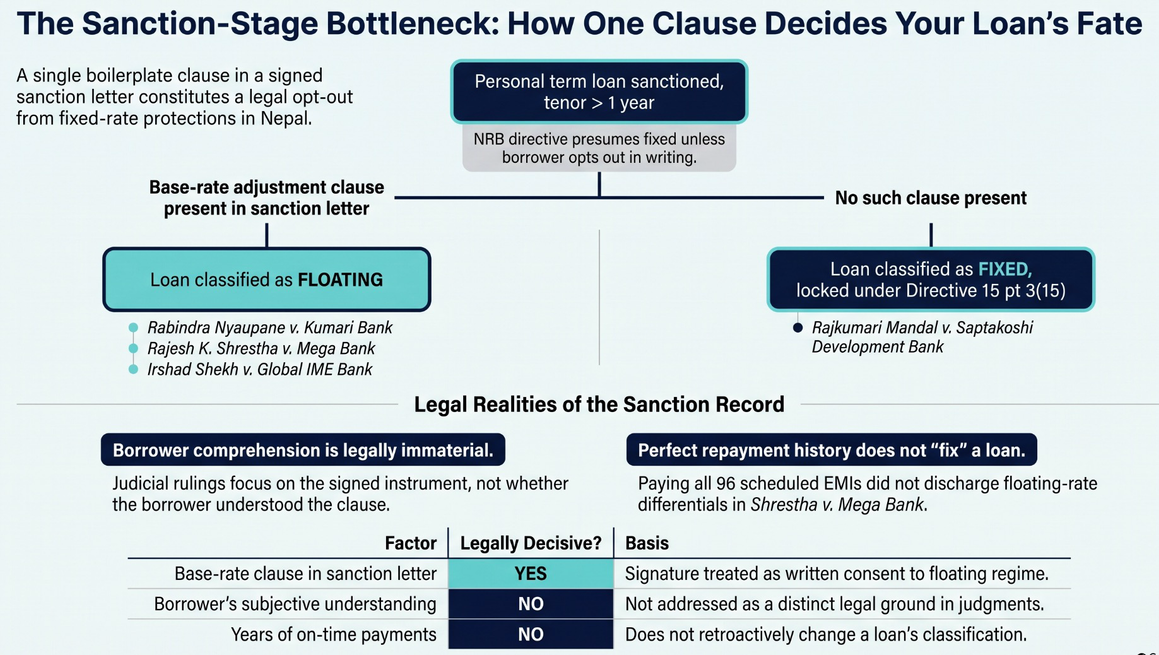
First, the directive’s opt-out is symmetrical in form but not in practice. A borrower can request a floating rate in writing; a bank can, with equal legal effect, include a floating-rate authorisation as a standard clause in the credit approval letter the borrower is asked to sign to receive the loan at all. Three reported Supreme Court and High Court decisions turn on precisely this device. In Rabindra Nyaupane v. Kumari Bank, the credit facility approval letters carried a one-line postscript – “Punascha: if the bank’s Base Rate changes quarterly, the specified interest rate will fluctuate accordingly” – and the Supreme Court held that signing the letter constituted the borrower’s written consent to a floating structure, notwithstanding that the borrower experienced the loan as fixed and that the rate rose from 15.19% to 17% over the tenor. In Irshad Shekh v. Global IME Bank, an equivalent clause allowed the bank to move the rate from 8% to 15% and layer on 2% penal interest without individual notice, and the Court again treated the signed sanction letter as dispositive. In Rajesh Kumar Shrestha v. Mega Bank, the same structure defeated a borrower who had completed all 96 scheduled EMI payments and reasonably believed the loan discharged, only to be told the accumulated variable-rate differential of roughly Rs. 6,85,000 remained outstanding.
None of these rulings is wrong on its own terms. Each rests on ordinary contract doctrine: a signed instrument binds the signatory, and the directive itself contemplates that a borrower can choose a floating rate. What the cases show, cumulatively, is that the choice the directive frames as an opt-out exercised by the customer functions, in the surviving evidence, almost entirely as an opt-out exercised by the bank through boilerplate drafting – present in the approval letter regardless of whether the borrower turns out, on the facts, to be the kind of long-tenor personal borrower the fixed-rate default was written to protect.
| Rajkumari Mandal v. Shree Saptakoshi Development Bank compared with Rabindra Nyaupane v. Kumari Bank Both cases concern personal, periodic-installment loans reaching the High Court within roughly the same period (2080/81 BS) on the same underlying question: could the bank move the rate mid-tenor? In Rajkumari Mandal (High Court Biratnagar, Case No. 079-WO-0225, Decision No. 625), the sanction record did not carry a base-rate-adjustment postscript; the loan was disbursed and administered as a fixed-rate personal facility. The Court applied the directive’s point 3(15) lock and voided the increase. In Rabindra Nyaupane (Supreme Court of Nepal, Writ No. 080-WO-0079), the sanction letters carried the “Punascha” base-rate clause described above. The Court found the loan contractually floating from inception and dismissed the challenge to the increase from 15.19% to 17%.The decisive fact in each case was not the borrower’s intent, the loan’s product category, or the tenor – it was whether a single clause had been inserted into the sanction letter at origination. Nothing in either judgment suggests the borrowers understood the distinction at the time of signing.This is not necessarily an unrepresentative pair of cases; the material search returned a similar structure in Rajesh Kumar Shrestha v. Mega Bank Nepal Ltd. (Case No. 081-DP-1428 / 080-DP-2220) and Irshad Shekh et al. v. Global IME Bank Ltd. et al. (Case No. 079-WO-0254), discussed above, drawing the same line between sanction-letter wording and outcome across multiple institutions and years. |
The premium that is fixed – until the bank decides it should not be
The second sanction-stage bottleneck concerns loans that are not personal term loans at all, and so never fall within the mandatory fixed-rate default – commercial credit, overdraft and cash-credit facilities priced as Base Rate plus a premium. The directive treats the premium component of such facilities as immutable once sanctioned: point 3(10) of the interest-rate directive prohibits a bank from raising the premium rate stated in an accepted offer letter, and bars teaser-discount structures that reduce the premium temporarily and step it back up later. In principle this creates a second, narrower fixed element – not the whole rate, but the spread the bank adds to its own cost of funds – that should be as durable as the personal-loan lock.
In practice it has proved considerably less durable at the commercial end of the lending book, for a reason distinct from the postscript-clause problem above: the directive’s own restructuring and rescheduling provisions allow the premium to be re-set the moment a facility is renewed, its limit enhanced, or its terms adjusted – events that occur routinely in commercial banking relationships and that are, on the material reviewed, treated as taking the loan outside the point 3(10) freeze rather than as circumventing it. Gami Telecom Solutions & Infrastructure Pvt. Ltd. v. NIC Asia Bank Ltd. (Writ Case No. 082-WO-0054) Judgment – High Court, Patan illustrates the resulting dispute: the bank raised the fixed premium spread on a Cash Credit and Bank Guarantee facility from 1.27% to 4.2% – more than tripling the spread – and issued a 15-day auction notice when the borrower could not absorb the increase. The High Court at Patan agreed that arbitrary premium inflation was inconsistent with regulatory guidance, but declined to stop the recovery proceeding, directing the borrower instead to the separate administrative channel at Nepal Rastra Bank – a distinction taken up in Chapter IV.
TABLE: What the sanction record determines, and what it does not
Purpose: Isolates the single documentary fact – presence or absence of a base-rate-adjustment clause in the sanction/offer letter – that the reported cases show is outcome-determinative, against the facts that the judgments treat as legally immaterial to that outcome.
| Factor | Legally decisive? | Basis |
| Base-rate/floating clause present in sanction letter | Yes – determines fixed/floating classification outright | Contract law; borrower’s signature treated as written consent to the floating regime |
| Borrower’s subjective understanding of the product as “fixed” | No | Not addressed as a distinct ground in the surviving judgments |
| Loan category (personal home/auto/installment vs. commercial) | Determines which default rule applies, but not whether it is displaced | Directive 15, point 3(15)(kha) sets the product scope of the mandatory default |
| Number of years the borrower has paid on schedule | No – does not retroactively fix a floating loan | Rajesh Kumar Shrestha: 96 of 96 EMIs paid did not discharge accumulated variable interest |
| Whether the borrower received individual notice of each rate change | No, if quarterly public notice (newspaper/website) was given per NRB rules | Constructive notice via publication satisfies the directive’s disclosure requirement |
Source: Case summaries of Rajkumari Mandal v. Saptakoshi Development Bank (079-WO-0225); Rabindra Nyaupane v. Kumari Bank (080-WO-0079); Rajesh Kumar Shrestha v. Mega Bank (081-DP-1428/080-DP-2220); Irshad Shekh v. Global IME Bank (079-WO-0254); NRB Unified Directive, Directive No. 15, point 3(15)(ka).
Consequence
The mandatory fixed-rate default is not weak on paper. What it lacks is a mechanism ensuring that the borrower it is meant to protect – an individual taking a long-tenor personal loan, precisely the population point 3(15) targets – understands, at the moment of signing, which regime the sanction letter actually creates. The directive requires the Offer Letter to “clearly state” whether the rate is fixed or adjustable, but a clear disclosure and an informed election are not the same thing when the disclosure sits inside a multi-page approval letter the borrower is signing to receive money they need. Nothing in the surviving judicial record indicates that a court has treated the imbalance between disclosure and comprehension as relevant to whether consent was validly given. The bottleneck, in short, is not that banks break the fixed-rate rule; it is that the rule’s applicability is fixed at a moment – loan origination – at which the borrower has the least capacity to evaluate it and the bank has complete control of the document.
III. THE DISTRESS EXIT: RESTRUCTURING RE-BASES EVERY LOAN TO THE BASE RATE
The second opening in the fixed-rate lock is not a gap in the interest-rate directive at all – it is a deliberate feature of a different directive that governs how banks classify and provision for loans, and it applies without regard to whether the original facility was fixed or floating.
Nepal Rastra Bank’s credit-classification directive defines two related but distinct interventions available once a borrower’s repayment capacity has weakened: rescheduling (punartalikikaran), which extends the repayment period, and restructuring (punarsanrachana), which alters the nature, terms or conditions of the facility. Both require a formal, written request and action plan from the borrower demonstrating a credible path back to viability, and both trigger a specific consequence for pricing: the interest-rate directive requires that “the interest rate on loans being rescheduled or restructured shall also be determined by reference to the Base Rate” (Directive No. 15, point 3(1)). A loan that was fixed – locked, on point 3(15), against any change for years – is, on restructuring, re-priced onto the same floating Base-Rate-plus-premium formula that governs ordinary commercial lending.
| LEGAL TEXT – NRB Unified Directive, Directive No. 15, Point 3(1) (concluding proviso) ORIGINAL LANGUAGE “…साथै, पुनरतालिकीकरण वा पुनरसंरचना गरिने कर्जाको व्याजदर समेत आधार दरलाई आधार मानी निर्धारण गर्नु पर्नेछ।” CONVENIENCE TRANSLATION “…also, the interest rate on loans being rescheduled or restructured shall likewise be determined by reference to the Base Rate.” |
This is not a loophole in the sense of an unintended gap; it follows a coherent prudential logic. A bank restructuring a distressed loan is, from a supervisory standpoint, repricing risk that has materially changed since origination, and NRB’s broader credit-classification framework treats a restructured facility as carrying elevated provisioning requirements precisely because its risk profile has shifted. Pegging the restructured rate to a current, objectively calculated Base Rate is more transparent than leaving it to case-by-case negotiation. The difficulty is distributive rather than doctrinal: the one class of borrower for whom the fixed-rate protection was designed to matter most – a household that took a mortgage or vehicle loan on the strength of a rate that could not move, and is now facing exactly the kind of income shock the lock was meant to insulate against – is the borrower who loses the lock at the moment income shock actually occurs.
Restructuring is not optional once distress is acknowledged
The mechanism does not require the borrower to request restructuring in order to lose the fixed rate; it only requires that a lender-supervised process reclassify the facility once the statutory definition of reduced repayment capacity is met. The credit-classification directive lists the qualifying circumstances broadly – cost or time overruns, cash-flow mismatch, delisting risk, or any circumstance making future scheduled payment doubtful – and conditions the restructuring on the institution’s own satisfaction that the borrower’s written plan is credible, not on the borrower’s preference to keep the original fixed terms. A borrower facing temporary hardship therefore confronts an unattractive choice: default and face Section 57 recovery (Chapter IV), or seek restructuring and, as an unavoidable incident of that relief, surrender the fixed rate that would otherwise have kept the debt affordable.
The interest-rate directive’s own point 3(15)(gha) tries to draw a line around this problem, but only for a narrower category of adjustment. It provides that changing a loan’s terms, repayment schedule, or installment amount solely to bring a pre-existing loan into compliance with the fixed-rate rule – for instance, converting a legacy floating loan to fixed at a customer’s request – is not to be treated as restructuring or rescheduling, and so does not trigger the classification and provisioning consequences that would otherwise follow. That carve-out protects the conversion mechanism itself; it does nothing for a borrower whose loan is restructured for genuine, distress-driven reasons, which is the far more common trigger for restructuring in the reported material and the one this chapter is concerned with.
What the courts have and have not tested
None of the fixed-rate cases in the judicial record squarely presents a borrower arguing that a bank improperly used restructuring as a pretext to escape the point 3(15) lock while the borrower was not, in fact, in qualifying distress. That is itself informative: the restructuring re-basing is sufficiently well-established as a matter of directive text that it does not appear to generate litigation over whether it is legally available – the disputes that do reach the courts, such as those discussed in Chapters II and IV, concern whether a loan was floating from origination or whether an auction can proceed, not whether restructuring lawfully unlocked a rate that was genuinely fixed. The absence of contested restructuring litigation is consistent with two different readings: either the mechanism is rarely invoked in a contestable way, or its legal availability is regarded as settled enough that borrowers and their counsel do not attempt to challenge it. The judicial evidence available does not allow this report to distinguish between the two.
The mandatory ten-percent interest recovery as a further pressure point
A related feature compounds the effect. Where a bank restructures or reschedules a loan under the credit-classification directive, it is generally required to have first recovered a minimum proportion – typically at least twenty-five percent – of the interest then outstanding as a condition of restructuring, and provisioning on the restructured facility is set at a minimum rate (commonly at 12.5% for a first restructuring meeting specified conditions, rising to 25% otherwise) that is markedly higher than the roughly 1% general provisioning applied to a fully performing loan. Restructuring is therefore neither costless to the bank, which must set aside substantially more capital against the facility, nor costless to the borrower, who must find cash to pay down accrued interest before relief is granted and who exits the process on a floating rate. The design gives the bank a countervailing incentive not to restructure casually, which tempers – but does not eliminate – the concern that restructuring functions as an easy route out of the fixed-rate commitment; a bank does not restructure to escape point 3(15) unless the borrower’s distress is otherwise real enough to justify the provisioning cost.
TABLE: Fixed-rate status before and after a qualifying distress event
Purpose: Traces a single hypothetical personal home loan through the point at which the directive text itself removes the fixed-rate protection, showing that the removal is a designed feature of the credit-classification framework rather than a bank-side evasion of the interest-rate directive.
| Stage | Governing provision | Rate status |
| Origination – personal home loan, tenor > 1 year, no floating clause | Directive 15, point 3(15)(ka) | Fixed; locked against change for the tenor, subject to 7-year/5-year consent review |
| Ordinary performance, no distress | Directive 15, point 3(15)(cha) | Fixed; unaffected by Base Rate or cost-of-funds movements |
| Borrower shows qualifying reduced repayment capacity | Credit-classification directive, restructuring/rescheduling trigger provisions | Eligible for restructuring at the institution’s discretion, contingent on a credible written plan |
| Restructuring approved | Directive 15, point 3(1) (proviso) | Re-priced to Base Rate plus premium; fixed status ends |
| Post-restructuring performance (two consecutive years current) | Credit-classification directive reclassification rules | May be upgraded to performing classification; rate remains Base-Rate-linked, not restored to the original fixed rate |
Source: NRB Unified Directive, Directive No. 15, points 3(1), 3(15)(ka), 3(15)(gha); credit-classification directive provisions on restructuring and rescheduling triggers and minimum provisioning.
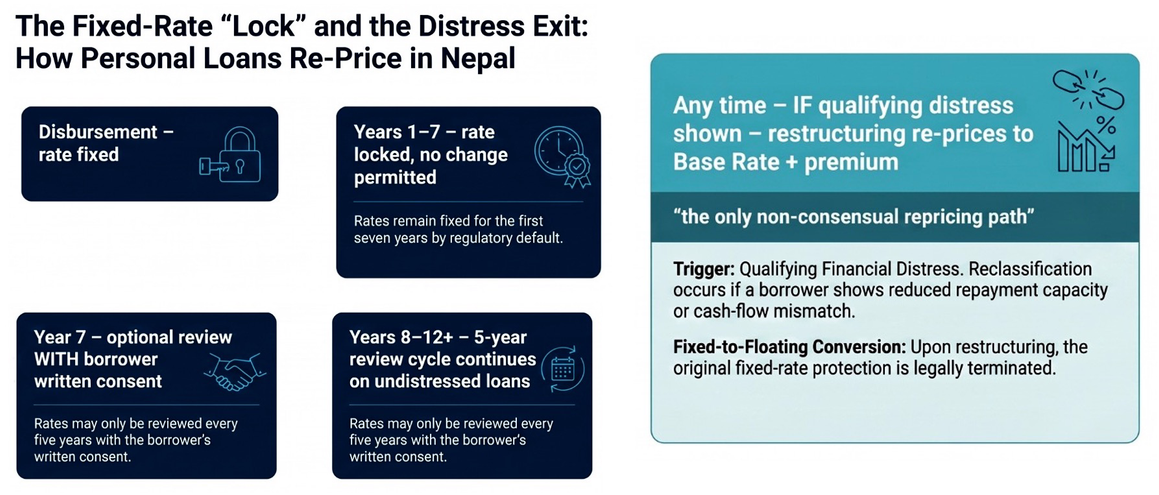
| The only circumstance in which the directive text itself contemplates moving a genuinely fixed rate – aside from the 7-year/5-year consent review – is the borrower’s own financial distress. |
Taken together with Chapter II, the picture that emerges is not of two unrelated weaknesses but of a single pattern with two triggers. At origination, a borrower’s signature on a boilerplate clause can place a loan outside the fixed-rate category before it ever benefits from the lock. During the tenor, a borrower’s own hardship can move a loan back to the floating category the directive otherwise treats as the exception. In neither case does the bank violate the fixed-rate directive; in both cases, the population the directive was written to protect – individual, long-tenor borrowers, and particularly those under financial strain – is disproportionately exposed to the process by which the protection is displaced.
IV. THE ENFORCEMENT CLOCK: SECTION 57 RECOVERY OUTRUNS CORRECTION
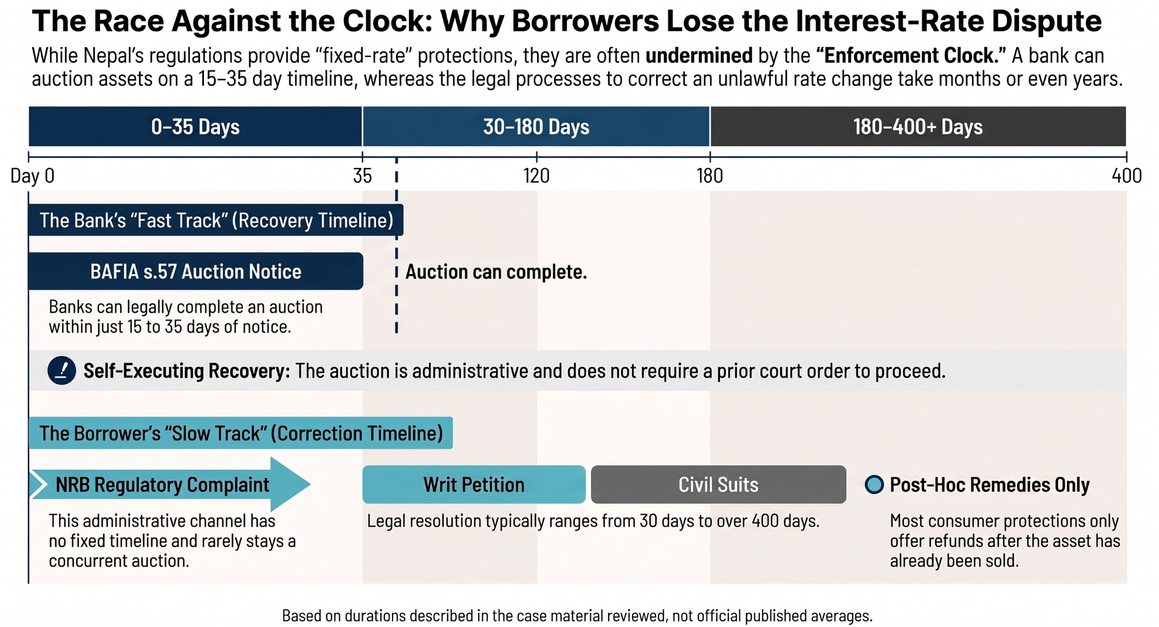
Even where a rate change on a genuinely fixed loan is unlawful on its face – not a floating loan misclassified, not a distress-driven restructuring, but a straightforward breach of point 3(15) or of the premium freeze in point 3(10) – the borrower’s practical position depends on whether a remedy can be secured before the bank exercises its recovery rights over the collateral. Section 57 of the Banks and Financial Institutions Act, 2073 authorises a licensed institution to auction mortgaged or pledged collateral after issuing a notice of a statutorily short duration – the reported cases describe both 35-day and 15-day auction notices, depending on the facility and prior demand correspondence – once a loan is in default. The auction is not conditioned on prior judicial or regulatory determination that the underlying debt figure, including any disputed rate increase, is correct.
This creates a structural race between two processes that move at very different speeds. Recovery under Section 57 is administrative and self-executing: once default and notice periods are satisfied, the bank does not need a court order to sell the collateral. Correction of an unlawful rate change, whether through a civil suit for account verification, a writ petition, or a complaint to Nepal Rastra Bank’s regulatory channel, moves through ordinary civil or administrative process, measured in months if not years. A borrower disputing the legality of a rate change has, in effect, to win that argument before or during the 15-to-35-day recovery notice period in order for a favourable outcome to mean anything for the specific asset at risk.
The regulatory forum answer and its practical effect
Gami Telecom Solutions v. NIC Asia Bank shows the High Court at Patan confronting this directly. The bank had more than tripled the premium spread on the borrower’s facilities from 1.27% to 4.2% and issued a 15-day auction notice. The Court agreed that unilateral spread inflation of that magnitude was inconsistent with regulatory guidance protecting the premium once sanctioned – vindicating the borrower’s reading of point 3(10) – but held that the appropriate forum for that grievance was Nepal Rastra Bank’s own regulatory complaint mechanism, not a writ court, and that the statutory recovery process under BAFIA Section 57 was not stayed by the existence of that separate avenue. The borrower was, in substance, told the premium increase was probably wrong, and directed to pursue that conclusion through a channel that could not itself halt the auction.
A parallel pattern appears in Sanjivani Hospital & IVF Center Pvt. Ltd. v. Jyoti Bikash Bank Ltd. et al. (Case No. 081-DP-0793) Judgment – High Court, Biratnagar, where a loan carrying an agreed contractual cap of 13% p.a. was escalated to 15.91%, the borrower defaulted, and the collateral was auctioned; the High Court, on review, acknowledged that a contractual rate cap should bind the bank but examined the auction primarily for compliance with the recovery directive and BAFIA rather than as a vehicle for reversing the completed sale. And in Piyush Bahadur Amatya v. Nepal Credit and Commerce Bank Ltd. et al. (Civil Appeal Nos. 074-CI-0040 / 074-CI-0046), the Supreme Court held in terms that reach beyond the facts of that case: filing a suit for account verification – the standard procedural vehicle for a borrower who believes a bank has charged an unagreed rate – does not, by itself, relieve the borrower of the obligation to pay, or prevent the bank from initiating Section 57 recovery while the verification suit is pending.
| Gami Telecom Solutions & Infrastructure Pvt. Ltd. v. NIC Asia Bank Limited (High Court Patan, Writ Case No. 082-WO-0054, 2082 BS) What happened: A borrower holding Cash Credit and Bank Guarantee facilities saw the fixed premium spread over Base Rate raised from 1.27% to 4.2% – a more than threefold increase – and faced refusal to renew bank guarantees plus a 15-day auction notice issued 2082/04/11. Which actors: The High Court at Patan (adjudicating); the licensed bank (setting and enforcing the revised premium, initiating recovery); Nepal Rastra Bank (designated as the body with jurisdiction to investigate the substantive pricing complaint, but not a party before the Court). What formal rules applied: NRB Unified Directive, Directive No. 15, point 3(10) (premium freeze after sanction); BAFIA 2073, Section 57 (auction recovery on default). What actually happened: The Court found the premium inflation inconsistent with regulatory guidance in principle, but declined to enjoin the recovery process, directing the borrower to NRB’s regulatory channel for the pricing dispute while leaving the Section 57 process to proceed on its own timeline. How long it took: The auction notice ran on a 15-day statutory clock; the underlying pricing grievance was, by the Court’s own disposition, left to a separate administrative process without a stated timeline. What mechanism it reveals: A finding that a rate change is probably unlawful does not, without more, stop the recovery process that the unlawful rate change helped trigger – the two questions are adjudicated on different tracks moving at different speeds. Representative or exceptional: The same sequencing – the substantive pricing question conceded or left open, the recovery process allowed to proceed – recurs in Sanjivani Hospital v. Jyoti Bikash Bank and Piyush Bahadur Amatya v. NCC Bank, suggesting a pattern rather than an isolated result. |
Financial consumer protection directive: a remedy that arrives after the fact
NRB’s consumer-protection directive does contain provisions aimed squarely at this problem. Where a bank collects a fee or charge under an unauthorised heading, or exceeds a regulatory cap, it must refund the excess plus a ten-percent penalty directly into the customer’s account (Directive No. 20, point 8(kha)(wuu)). Where a borrower prepays or transfers a loan specifically because the bank unilaterally altered the interest rate or terms without consent, the bank is barred from charging any prepayment or swap fee on that exit (point 8(jha)). Both remedies are real, and both operate after the borrower has already been forced to act – pay the excess, or exit the facility – rather than before. Neither, on the material reviewed, operates to stay a Section 57 auction that is already in motion. The consumer-protection directive compensates the borrower for having been wronged; it does not appear to function as an emergency brake on collateral recovery while the wrong is being established.
TABLE: The two clocks: recovery process against correction process
Purpose: Sets the statutory or regulatory timeline available to a bank enforcing a disputed rate change against the timeline realistically available to a borrower contesting it, to show why a substantively strong claim can still lose the practical race.
| Track | Instrument | Typical duration | What it can stop |
| Auction recovery notice | BAFIA 2073, s. 57 | 15–35 days from notice, on the case material reviewed | Nothing external; the bank proceeds unless it chooses to pause |
| Civil suit for account verification | General civil procedure | Months to years, per the ordinary pace of civil litigation | Does not itself stay recovery (Piyush Amatya v. NCC Bank) |
| Writ petition to High Court / Supreme Court | Constitutional and administrative writ jurisdiction | Weeks to months for interim relief; longer for final disposal | Interim relief theoretically available but was denied or not granted in the reviewed fixed-rate cases |
| NRB regulatory complaint | NRB Act 2058; Directive No. 20 | Not specified in the case material reviewed | Can result in a finding against the bank, but was not treated as staying a concurrent Section 57 process (Gami Telecom) |
| Post-hoc refund / fee waiver | Directive No. 20, points 8(kha)(wuu), 8(jha) | Applied once a violation is established | Compensates after the fact; does not prevent a completed auction |
Source: BAFIA 2073, s. 57; NRB Unified Directive, Directive No. 20/082, points 8(kha)(wuu), 8(jha); case summaries of Gami Telecom v. NIC Asia Bank, Sanjivani Hospital v. Jyoti Bikash Bank, and Piyush Amatya v. NCC Bank.
The consequence is not that the fixed-rate rule, or the premium freeze, is unenforceable in the abstract – courts have repeatedly agreed, in principle, that the rules mean what they say. It is that enforcement, when it comes, arrives on a timeline set by civil process and regulatory complaint-handling, while the practical stakes for the borrower are usually resolved on a timeline set by BAFIA Section 57. A rule that is vindicated after the asset securing the disputed debt has already been sold offers the borrower a damages claim, not the fixed rate the directive promised.
V. THE COMPETING VIEW: THE REGIME IS SELF-CORRECTING AND SUBSTANTIALLY WORKS
The strongest challenge to the diagnosis in Chapters II through IV is not that the cases are wrongly described, but that they are the wrong sample from which to generalise. On this view, the reported disputes are, almost definitionally, the loans where something went wrong or where the classification was genuinely contested – they say little about the much larger number of fixed-rate loans that never generate litigation because the lock functioned exactly as intended. A regime should not be judged unreliable merely because appellate courts, whose business is resolving disputes, produce a docket full of disputes.
This objection has real force, and the evidence assembled for this report supports at least part of it. Rajkumari Mandal v. Saptakoshi Development Bank is not an outlier result manufactured to balance the record: it is a High Court applying point 3(15) exactly as written, against a bank that had no floating-rate clause to point to, and ruling for the borrower. Bhim Prasad Basyal et al. v. NIC Asia Bank Ltd. (Case No. 081-DP-0538) Judgment – High Court, Tulsipur (Butwal Bench) shows a court enforcing an even more borrower-protective term – a sanction-letter covenant requiring mutual consent for any rate increase after the first two years – against a bank’s unilateral hike, on a Rs. 5 Crore, 25-year facility. NLG Insurance Co. Ltd. v. Janata Bank Ltd. (Case No. 076-DP-0325) Judgment – High Court, Patan states the underlying contract-law principle in the broadest terms: a unilateral alteration of agreed terms by one party, without the other’s consent, is simply not permitted. And the consumer-protection directive’s ten-percent mandatory penalty and fee-free exit rights, discussed in Chapter IV, are not empty gestures – they impose a real, quantified cost on banks that overreach, which should deter at least the more casual violations before they occur.
What the contrary evidence actually shows – and what it does not
Properly weighed, these authorities establish that Nepalese courts are willing, and NRB’s own directive architecture is designed, to enforce the fixed-rate lock – whenever the dispute reaches them framed as a straightforward breach of an undisputed fixed-rate contract, outside the shadow of default and collateral recovery. That is a meaningful and under-stated strength of the regime, and the diagnosis in this report would be incomplete without acknowledging it plainly: where the sanction record is clean and the borrower is not already in default, point 3(15) does what it says.
What this evidence does not show is that the three bottlenecks identified in Chapters II–IV are absent or marginal. Rajkumari Mandal succeeded precisely because there was no base-rate-adjustment clause in the sanction record to contest – the case is a clean instance of the rule working, not a rebuttal of the finding that a clause’s presence or absence is outcome-determinative in the cases where one exists. Bhim Prasad Basyal succeeded on an express mutual-consent covenant that went beyond the statutory default, which if anything illustrates how much weight the outcome placed on the specific wording banks and borrowers negotiate into the sanction letter – the same wording problem identified in Chapter II, just resolved in the borrower’s favour that time. And Gami Telecom, Sanjivani Hospital and Piyush Amatya – all decided by the same tier of courts, within a comparable period – show that even a substantively meritorious claim did not stop a Section 57 auction once default and notice conditions were met. The competing interpretation and the diagnosis in this report are not, on inspection, describing different regimes; they are describing the same regime from either side of the same dividing line: whether the dispute arrives before or after the sanction-stage clause is fixed and before or after default triggers recovery.
A genuine complication: employee and concessional fixed rates cut the other way
One further body of evidence – the line of employee concessional-loan tax cases (Everest Bank Employee Union v. Everest Bank, Nabil Bank Employee Union v. Nabil Bank, and related Supreme Court and Large Taxpayers Office disputes) – complicates the thesis in a different direction. These cases confirm that a fixed, below-market rate set by internal staff bylaws is treated by the courts as a lawful, durable form of fixed-rate lending, resistant even to a tax authority’s attempt to impute the market-rate differential as taxable income. This is a context in which the fixed-rate commitment is unusually well protected – arguably better protected than the personal-consumer fixed rate examined in Chapters II–IV – because the borrower (a bank employee) typically has continuous access to the instrument creating the rate, professional familiarity with its terms, and an ongoing employment relationship that gives the bank little incentive to force a dispute. The contrast reinforces, rather than undermines, this report’s core distinction: fixed-rate protection in Nepalese banking law functions well precisely where information asymmetry and default risk are lowest, and functions least reliably precisely where they are highest.
VI. REFORM SEQUENCING: CLOSING THE POINTS OF ENTRY BEFORE RAISING THE WALL
Because each of the three bottlenecks identified in this report is a point at which the fixed-rate protection is lawfully displaced rather than unlawfully violated, none of them is addressed by strengthening the point 3(15) lock itself – it is already, on its text, close to absolute. The recommendations that follow are targeted instead at the interface between the interest-rate directive and the three surrounding bodies of law identified in Chapters II–IV: contract formation at sanction, credit classification during distress, and secured-debt recovery at default.
Short-term measures – administrative and directive-level
The sanction-stage bottleneck (Chapter II) is the most tractable of the three because it can be addressed without amending BAFIA or the Nepal Rastra Bank Act: it requires a change to how the interest-rate directive is drafted and supervised, not a change to what it requires in substance. Two administrative interventions follow directly from the diagnosis. First, Nepal Rastra Bank could require that any floating-rate election for a personal term loan within the scope of point 3(15) – whether initiated by the customer’s written request or embedded in the bank’s standard sanction letter – be captured on a separate, single-purpose acknowledgment distinct from the general sanction letter, carrying its own signature and a plain-language statement of what the borrower is giving up. This does not change the substantive rule; it targets the specific documentary mechanism – the Punascha-style postscript buried in a multi-page approval letter – that the case record shows drives the outcome in dispute after dispute. Second, the Supervisory Information System reporting NRB already requires of rate changes could be extended to require an annual, institution-level disclosure of what share of personal term loans within scope are originated fixed versus floating, giving the regulator visibility into whether the mandatory default is being observed in substance or is being routinely displaced at origination – a pattern this report’s case evidence suggests, but which aggregate supervisory data could confirm or dispel with more confidence than case-law sampling alone.
The recovery-clock bottleneck (Chapter IV) admits of a narrower short-term fix: a procedural rule, issued as a circular under NRB’s existing directive-making power, that a Section 57 recovery notice is administratively suspended – not cancelled, but paused – for the duration of a properly filed NRB regulatory complaint concerning the legality of the specific rate or fee increase that produced the default, capped at a fixed short period (for example, 30 days) to prevent indefinite delay. This targets exactly the sequencing problem ‛Gami Telecom exposes – a regulator-acknowledged pricing violation that could not stop an auction – without touching the substantive recovery right BAFIA grants to lenders against genuinely defaulting borrowers.
Medium-term measures – statutory and institutional
The distress-stage re-basing (Chapter III) is harder to address administratively because it follows from a coherent prudential judgment – that restructured risk should be priced at a current reference rate – embedded in the credit-classification directive rather than from an oversight. A medium-term reform would not remove re-basing altogether but would narrow its automatic application: for personal, owner-occupied home loans specifically (as distinct from commercial or investment-property restructuring), NRB could consider a rule preserving the original fixed rate’s premium component on restructuring while allowing only the Base Rate component to float, mirroring the Base-Rate-plus-fixed-premium structure the directive already uses for ordinary floating loans. This would still expose the restructured borrower to some rate movement – preserving the prudential logic – while stopping short of a full reset to the currently published commercial premium, which on the case evidence in Chapter III is where much of the payment shock originates. Because this reform changes the substantive risk allocation between banks and distressed borrowers, it is more appropriately made through directive amendment following consultation than through circular, and should be sequenced after the short-term measures above, since better data on how often distress-driven restructuring actually displaces a fixed rate – the gap flagged in Chapter III’s editorial note – would materially improve the design of any such carve-out.