
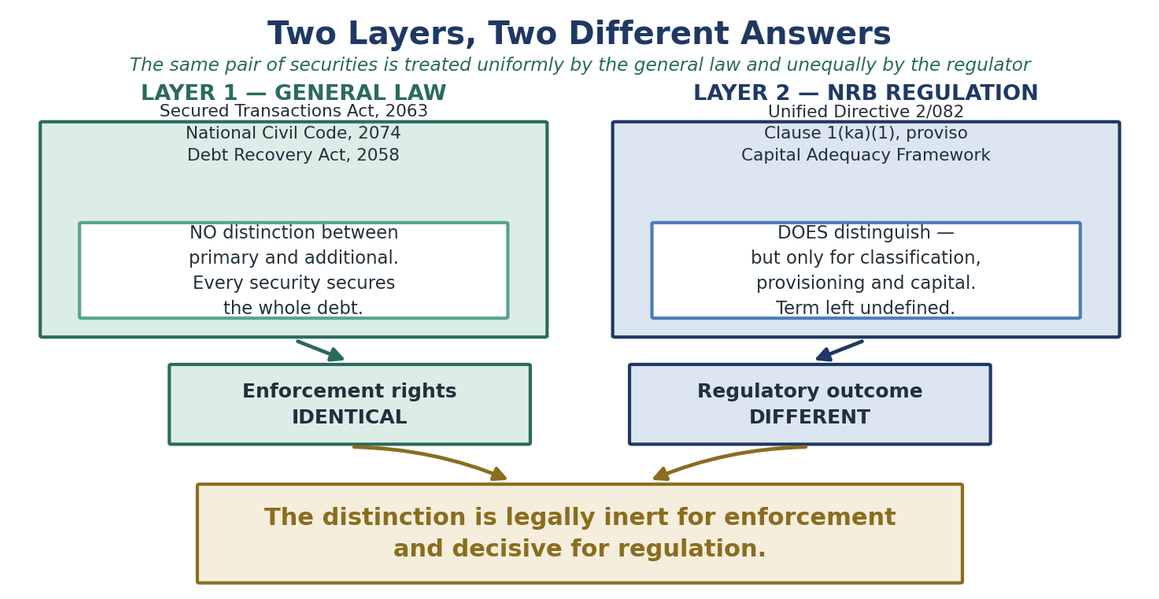
Nepalese bankers routinely describe security as “primary” (प्राथमिक धितो) or “additional” (अतिरिक्त धितो सुरक्षण), yet no Nepalese statute defines either term. This article establishes that the distinction operates on two entirely separate legal planes, and that conflating them is the source of most confusion in practice. On the plane of general law – the Secured Transactions Act, 2063, the National Civil Code, 2074, and the Bank and Financial Institution Debt Recovery Act, 2058 – the distinction does not exist: every validly created security secures the whole debt, enforcement rights are identical, and a creditor holding several securities may elect freely among them or proceed against all simultaneously, a position confirmed by the Supreme Court. On the plane of prudential regulation, the distinction is outcome-determinative: the proviso to Clause 1(क)(१) of NRB Unified Directive No. 2/082 withdraws the automatic “Pass” classification from credit where a fixed deposit receipt, Government security, or NRB bond is taken merely as अतिरिक्त धितो सुरक्षण – yet the Directive nowhere defines that expression. Reproducing the operative text of each provision relied upon, the article shows that the correct test is substantive and purposive rather than quantitative: an asset is primary if the credit was sanctioned against it, and additional if the credit was sanctioned on another basis and the asset was taken as supplementary cover. Value ratios are irrelevant, there is no threshold at which surplus primary collateral converts into additional collateral, and over-collateralisation does not change classification.
1. The Problem: A Universal Vocabulary With No Statutory Source
Every credit file in Nepal distinguishes primary from additional security. Sanction letters allocate assets between the two; credit memoranda justify the split; rating reports describe facilities by reference to it. Yet a lawyer asked to locate the distinction in Nepalese law will not find it. No provision of the Bank and Financial Institution Act, 2073, the Secured Transactions Act, 2063, or the National Civil Code, 2074 defines “primary security” or “additional security,” and the single binding instrument that uses the expression अतिरिक्त धितो सुरक्षण applies it without defining it.
That gap generates a set of practical questions that recur constantly: if a bank lends NPR 100 million against land worth NPR 200 million, is the surplus NPR 100 million of land value somehow “additional” collateral? If the bank also takes an NPR 100 million fixed deposit receipt, which security is primary? Must the bank realise the land before encashing the deposit? Can the same asset be primary in one facility and additional in another? The answers turn on a distinction that, this article argues, must be understood as operating on two separate planes with opposite answers.
On the plane of general law the distinction is inert. Security law in Nepal is uniform: it asks whether a security interest was validly created, perfected, and ranked, not whether the parties labelled it primary or supplementary. On the plane of prudential regulation the distinction is decisive, because it determines whether a loan enjoys the automatic “Pass” classification reserved for credit extended against cash-equivalent instruments. The whole subject becomes tractable once these two planes are separated.
2. The General Law Does Not Recognise the Distinction
2.1 The Secured Transactions Act treats all security interests uniformly
The Secured Transactions Act, 2063 adopts the modern functional approach: it abolishes categorisation by label and asks only whether a security interest has attached, been perfected, and where it ranks. The conditions of attachment are cumulative and identical for every asset, with no relaxed or separate criteria for security described as supplementary:
Secured Transactions Act, 2063, s. 25(1)
देहायको अवस्थामा मात्र धितोको सम्पत्तिमा धितोको हक आबद्ध भई सो सम्पत्तिका सम्बन्धमा धितो दिने व्यक्ति र तेस्रो पक्ष विरुद्ध त्यस्तो हक चलन चलाउन सकिनेछः– (क) धितोको सम्पत्तिको विवरण उल्लेख गरी धितो सम्बन्धी सम्झौता भएकोमा, (ख) धितो लिने व्यक्तिले धितो दिने व्यक्तिलाई मूल्य दिएकोमा, र (ग) धितो दिने व्यक्तिसँग धितोको सम्पत्ति उपर अधिकार रहेकोमा ।
Translation: A security interest attaches to the collateral, and may be enforced against the person granting the security and against third parties, only in the following circumstances: (a) where a security agreement specifying particulars of the collateral has been executed; (b) where the secured party has given value to the person granting the security; and (c) where the person granting the security has rights in the collateral.
Source: Secured Transactions Act, 2063 (as amended by the First Amendment Act, 2081), s. 25(1).
Nothing in the Act ranks one attached security interest below another by reason of the commercial description attached to it. Priority is determined by the statutory rules of perfection and ranking, not by the words “primary” or “additional” in a sanction letter. The consequence is that an FDR pledged as supplementary cover is, as a matter of security law, exactly as much a security interest as the mortgage over the borrower’s land.
2.2 The Civil Code makes every security answer for the whole debt
The National Civil Code, 2074 reinforces this uniformity through the doctrine of indivisibility. A mortgage is treated as a single indivisible unit securing the entire obligation; the debtor cannot demand release of part of the security on the footing that part of the debt has been paid, or that the security exceeds the exposure:
National Civil Code, 2074 – indivisibility of mortgage (बन्धकको अविभाज्यता), Section 448
Translation: The Code treats mortgaged property as a single indivisible security for the whole of the secured obligation, so that no part of the security may be released, and no part of the property treated as answering for only part of the debt, until the entire debt is discharged.
Source: National Civil Code, 2074, Section 448.
Indivisibility supplies the doctrinal answer to the over-collateralisation question posed in Section 4. If every mortgaged asset answers for the entire debt, there is no coherent sense in which part of a single mortgaged property can be “surplus” and therefore reclassified as additional security. The whole property is primary security for the whole debt.
2.3 Enforcement rights are identical, and the creditor elects
The Secured Transactions Act is explicit that a secured party may deploy its remedies cumulatively rather than sequentially:
Secured Transactions Act, 2063, Section 46(3)
(३) धितो लिने व्यक्तिले आफूलाई उपलब्ध कुनै वा सबै अधिकारहरू एकसाथ प्रयोग गर्न सक्नेछ ।
Translation: (3) The secured party may exercise any or all of the rights available to it simultaneously.
Source: Secured Transactions Act, 2063, Section 46(3).
Section 50(1) carries the same logic into disposition, permitting the secured party to sell or lease all or any selected items of collateral at its discretion. The Court also has confirmed the position at the level of principle, holding that a creditor holding several securities for one debt has the sole discretion to elect which to enforce first, and does not act unlawfully by recovering from any validly held security. The leading authority is reported at Progressive Finance Limited v. Hari Enterprises, Hari Bhajan Upreti, Yashoda Upreti, and Shrihari Khanal Case Number: ०८०-DA-०००७. The reasoning rests on the absence of any statutory hierarchy among securities and on the contractual freedom of the parties to structure security as they choose.
3. Where the Distinction Does Bite: NRB Directive No. 2/082
Against that uniform background, one binding instrument makes the primary/additional distinction outcome-determinative. Directive No. 2/082 confers automatic “Pass” status on credit extended against fixed deposit receipts, Government of Nepal securities, and NRB bonds – and then withdraws that benefit by proviso where the same instruments are taken merely as additional collateral security:
NRB Unified Directives, 2082 (Class A, B, C), Directive No. 2/082, Clause 1(क)(१) and proviso
(१) असल: (अ) भाखा ननाघेका र १ महिनासम्म भाखा नाघेका कर्जा/सापट, (आ) मुद्दती रसिदको धितोमा गएका कर्जा तथा सापट, (इ) नेपाल सरकारको सुरक्षणपत्र तथा नेपाल राष्ट्र बैंक ऋणपत्रको धितोमा गएका कर्जा तथा सापट, (ई) पर्याप्त सुरक्षण लिई प्रति ग्राहक बढीमा रु. १० लाखसम्म प्रवाह भएको सुनचाँदी कर्जा ।
तर, अतिरिक्त धितो सुरक्षण वापत मुद्दती रसिद वा नेपाल सरकारको सुरक्षणपत्र वा नेपाल राष्ट्र बैंक ऋणपत्र धितो राखी कर्जा प्रवाह गरेमा त्यस्ता कर्जा तथा सापट र रु. १० लाखभन्दा बढीको सुनचाँदी धितो कर्जालाई भने भाखा नाघेको आधारमा वर्गीकरण गर्नु पर्नेछ ।
Translation: (1) Pass: (a) loans/advances not overdue and overdue up to 1 month; (b) loans and advances taken against the security of fixed deposit receipts; (c) loans and advances taken against the security of Government of Nepal securities and Nepal Rastra Bank bonds; (d) gold and silver loans extended against adequate security up to a maximum of Rs. 10 lakh per customer.
Provided that, where credit is extended by taking a fixed deposit receipt, a Government of Nepal security, or a Nepal Rastra Bank bond as additional collateral security, such loans and advances – and gold and silver secured loans exceeding Rs. 10 lakh – shall be classified on the basis of the period overdue.
Source: NRB Unified Directives, 2082 (Class A, B, C), Directive No. 2/082, Clause 1, sub-clause (Ka)(1).
The proviso is the pivot of the entire subject, and its drafting has a conspicuous omission. It attaches a significant regulatory consequence to whether an instrument is “additional collateral security,” yet the Directive contains no definition clause for अतिरिक्त धितो सुरक्षण. The term is deployed as an established prudential concept whose operational boundary is left to the security agreement between bank and borrower and to the institution’s internal credit policy. That silence is not merely a drafting infelicity; it is what makes the test set out in Section 5 below, necessary.
4. Why the Regulator Draws the Line Where It Does
The proviso is often read as arbitrary, since the bank’s charge over an FDR is equally enforceable whether the deposit is primary or supplementary. The rationale becomes clear once it is understood that the Directive is not measuring enforceability at all; it is measuring the credit-risk character of the exposure.
A loan granted against a fixed deposit is a self-liquidating, cash-collateralised transaction. The bank holds the source of repayment itself, in its own books, in cash. There is effectively no credit risk to classify, which is why such a facility is “Pass” irrespective of ageing: the ageing of the loan tells the regulator nothing about recoverability. A loan granted on the strength of a borrower’s business, secured by land and merely margined by an FDR, is a fundamentally a different loan. Its repayment depends on business cash flow; the FDR is a fallback, not the basis of the credit. Ageing on such a facility is exactly the signal the classification system exists to capture, and suppressing it would allow a bank to conceal deteriorating commercial exposures behind a modest cash margin. The proviso therefore prevents precisely that arbitrage.
The same logic runs through the capital framework, which distinguishes eligible financial collateral from ordinary security. Under the Credit Risk Mitigation provisions of the Capital Adequacy Framework, cash-equivalent instruments are eligible financial collateral capable of netting down the exposure itself, whereas immovable property such as land and buildings cannot be used to reduce risk-weighted exposure in the same manner. The regulatory system consistently treats cash-equivalent security as changing the nature of the exposure, and physical security as merely improving recovery prospects on an exposure whose character is unchanged.
5. The Correct Test, and Why It Is Not Quantitative
It follows that the test cannot be one of value. The question is not how much security the bank holds, nor whether the security exceeds the exposure, but on what basis the credit was granted. An asset is primary security if the credit was sanctioned against it – if it is the asset whose existence and value produced the lending decision. An asset is additional security if the credit was sanctioned on some other basis and the asset was taken as supplementary cover.
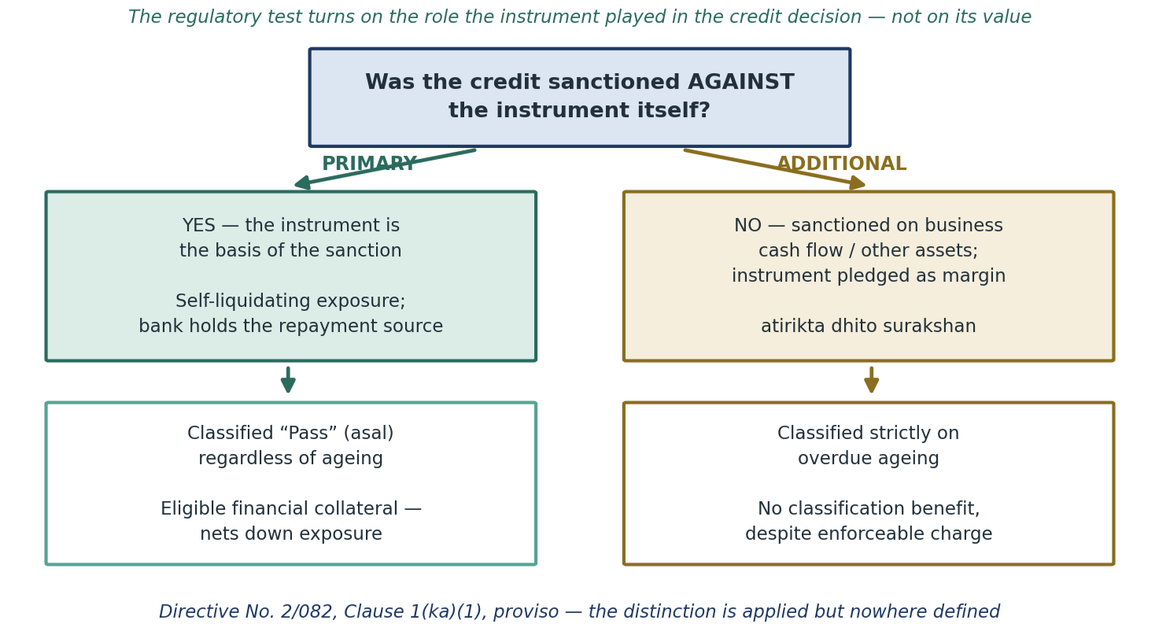
Three corollaries follow, and they dispose of the recurring practical questions.
- There is no ratio threshold. Nothing in Directive No. 2/082, or in any statute, provides that collateral becomes “additional” once its value exceeds the exposure by some multiple. The Directive’s proviso is triggered by the role of the instrument, not by any coverage ratio.
- Over-collateralisation does not convert primary into additional security. If a bank lends NPR 100 million against land worth NPR 200 million, the entire NPR 200 million remains primary security, because the whole property is the security against which the credit was sanctioned and because, under the Civil Code doctrine of indivisibility, the whole property answers for the whole debt. There is no surplus fraction to reclassify.
- The same asset type may be primary in one facility and additional in another. Classification attaches to the role the asset plays in a particular credit decision, not to the nature of the asset. An FDR is primary where the loan is a deposit-backed facility, and additional where it margins a working-capital line sanctioned on turnover.
The worked scenarios
Applying the test to the three configurations most often encountered resolves them cleanly.
| Configuration | Primary / additional | Regulatory classification outcome |
|---|---|---|
| NPR 100m loan; NPR 200m land and buildings only | The whole NPR 200m is primary security | Classified on overdue ageing in the ordinary way; no special benefit, since land is not an instrument named in Clause 1(Ka)(1) |
| NPR 100m business loan; NPR 200m land as the sanction basis; NPR 100m FDR also pledged | Land is primary; the FDR is “additional collateral security” | Proviso applies. Despite full cash cover, the facility is classified strictly on ageing – the FDR earns no classification benefit |
| NPR 100m loan granted against a NPR 100m FDR; land worth NPR 200m additionally mortgaged | The FDR is primary; the land is additional | Main clause applies. Automatic “Pass” regardless of ageing, because the credit was sanctioned against the deposit |
The second and third rows are the instructive pair. They involve the identical two assets and, on any value-based analysis, are indistinguishable – indeed the second is better secured, holding both full cash cover and double land cover. Yet their regulatory treatment is opposite, because in one the deposit produced the credit decision and in the other it did not. That asymmetry is unintelligible on a quantitative reading of the proviso and entirely coherent on a purposive one.
6. Enforcement: What Sequence Is Actually Required
Because the labels carry regulatory weight, borrowers frequently argue that they carry enforcement weight too – that a bank must realise the primary security before touching the additional. Nepalese law does not support that proposition as between the borrower’s own securities, though it does impose sequencing at two other boundaries.
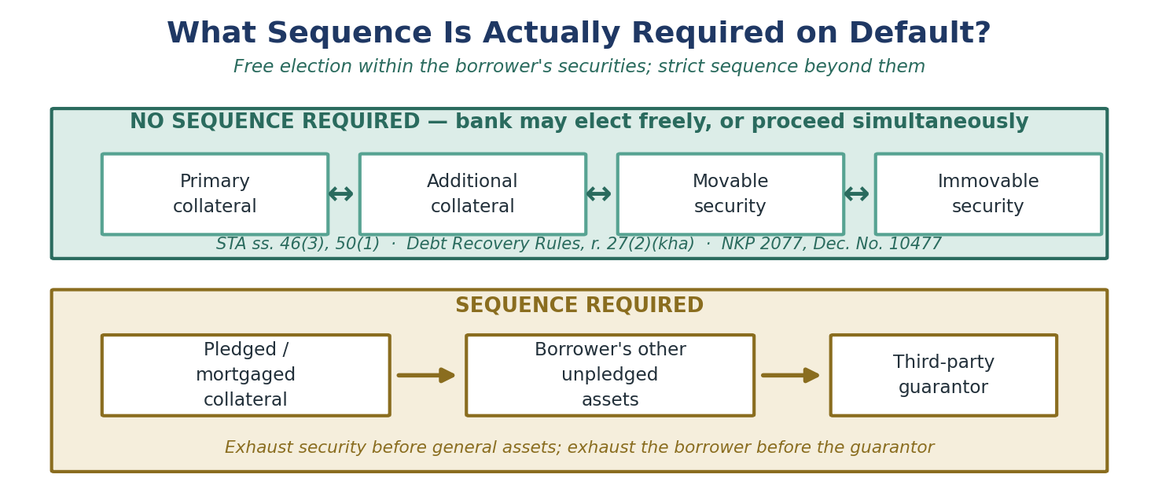
Within the borrower’s own securities there is no marshalling obligation. The Secured Transactions Act permits simultaneous exercise of any or all remedies (s.46(3)) and disposition of all or selected collateral (s.50(1)); the Debt Recovery Rules, 2059 empower the Debt Recovery Officer, once the initial repayment deadline expires, to proceed against movable and immovable collateral simultaneously under Rule 27(2)(kha); and the Supreme Court has confirmed the creditor’s right of election. Neither the Debt Recovery Act, 2058 nor the Rules mandate any sequence between classes of borrower-pledged collateral.
Two sequencing rules do exist, and they are frequently confused with marshalling. First, the bank must exhaust the specifically pledged or mortgaged collateral before proceeding against the borrower’s other, unpledged general assets. Second, it must exhaust the borrower’s own assets before proceeding against a third-party guarantor. Both sequences run between categories of obligor and asset, not between primary and additional security; a borrower cannot invoke either to compel a bank to sell his land before encashing his deposit.
Standard Nepalese security documentation reinforces the position. Facility and security documents routinely provide that the securities are independent, continuing, and cumulative, and that enforcement of one is not a condition precedent to enforcement of any other – language that is consistent with, rather than derogating from, the statutory default.
Surplus proceeds: Where enforcement realises more than the debt, the creditor’s obligations are statutory and non-waivable. Section 51(1) of the Secured Transactions Act prescribes a mandatory order of application – reasonable expenses of recovering, taking possession of, preparing for sale and selling the collateral, including reasonable legal fees and costs of proceedings, followed by the secured obligation, and thereafter subordinate interests – with any surplus accounted for to the debtor. The same principle governs auction proceeds under the debt-recovery framework. A bank that over-realises holds the excess for the borrower; over-collateralisation is therefore not a source of windfall, which is a further reason the law feels no need to police it through reclassification.
7. Additional Collateral Demanded After Sanction
A third category cuts across the primary/additional dichotomy: security demanded after the facility has been sanctioned, typically because collateral value has fallen or exposure has risen. BAFIA confers the power expressly:
Bank and Financial Institution Act, 2073, s. 57(2)
Translation: Where the value of the security furnished for credit declines, or the security is otherwise impaired, the bank or financial institution may require the borrower to furnish additional security, and the borrower shall furnish such security accordingly.
Source: BAFIA, 2073, Chapter 7, s. 57(2).
Similar powers arise from the loan-to-value regime and from margin maintenance. Directive No. 3/082 caps real-estate lending at 50 percent of fair market value, and comparable coverage margins apply across product classes; where market movement erodes coverage below the prescribed ratio, a top-up demand follows. The Working Capital Loan Guidelines produce the same effect through drawing-power discipline, since a decline in stock and receivables reduces permissible drawings and can require additional cover.
Such post-sanction security is “additional” in the ordinary commercial sense, and it will generally be additional for the purposes of Directive No. 2/082 as well, since by definition the credit was not sanctioned against it. Whether it is described as additional in the top-up documentation is not decisive, but the sequence of events almost always is: an asset taken after the credit decision cannot have been the basis of that decision.
| Category | When taken | Role in the credit decision | Typical regulatory status |
|---|---|---|---|
| Primary security | At origination | The basis on which credit was sanctioned | Primary; may attract Clause 1(ka)(1) benefit if a named instrument |
| Additional security at origination | At origination | Supplementary cover; not the sanction basis | अतिरिक्त धितो सुरक्षण – proviso applies |
| Additional security demanded later | Post-sanction, on value decline or margin call | Cannot have been the sanction basis | Additional; classification benefit unavailable |
8. Proving the Status of a Security
Because the test is substantive, the evidence is documentary, and the hierarchy of documents is reasonably settled. The credit approval memorandum and the sanction letter are the primary evidence, because they record what the bank actually relied on in deciding to lend; a memorandum that appraises business cash flow and treats a deposit as margin establishes that the deposit is additional, whatever the security schedule later calls it. The loan agreement and security documents show what was created and in what order. The valuation report shows what was appraised for the purpose of the decision, and a valuation obtained after sanction is strong evidence that the asset was not the sanction basis. Drawing-power and monitoring records show which asset the facility was actually run against.
Where documents do not use the labels at all – which is common – a regulator, court, or supervisor will look to the same substance: the stated purpose and basis of the facility, the sequence in which securities were created, whether the facility is sized by reference to one asset’s value, and how the exposure has been administered. The labels are evidence of intention, not the source of legal status. Conversely, a bank cannot secure favourable classification simply by describing a deposit as “primary” in a schedule if the credit memorandum shows the loan was granted on the borrower’s turnover; supervisors have in practice challenged classification treatment applied on that basis.
9. Conclusion: The Legally Correct Test
The distinction between primary and additional collateral has no foundation in Nepalese security law and decisive consequences in Nepalese banking regulation, and the apparent paradox dissolves once the two planes are held apart.
As a matter of general law, the distinction is inert. The Secured Transactions Act attaches, perfects and ranks every security interest by the same rules; the Civil Code makes each security answer indivisibly for the whole debt; the creditor may enforce any or all securities simultaneously or in any order it chooses, as s.46(3) provides and as the Supreme Court confirmed in Decision No. 10477; and the only mandatory sequences run from pledged to unpledged assets and from borrower to guarantor. A borrower cannot compel a bank to exhaust the primary security first, and a bank gains no additional enforcement right by labelling a security primary.
As a matter of regulation, the distinction determines classification, provisioning, and capital treatment, through a proviso that the Directive applies without defining. In that context the legally correct test is substantive and purposive: an asset is primary security if the credit was sanctioned against it, and additional if the credit was sanctioned on another basis and the asset was taken as supplementary cover. The test is answered by the credit approval and sanction documentation, not by the ratio of security value to exposure. There is no threshold at which surplus primary collateral becomes additional collateral, and no quantity of over-collateralisation converts one into the other.
The distinction therefore matters, even though the bank holds enforceable rights over both securities and need not exhaust one before the other, for a reason that has nothing to do with enforcement. It matters because it tells the regulator what kind of exposure the bank is carrying – whether the bank has lent against cash it already holds, or has lent against a business and taken cash as comfort. The first is not really a credit exposure at all; the second is, and the classification system exists to surface it. Read that way, the proviso to Clause 1(ka)(1) is not an anomaly in an otherwise uniform law of security. It is a prudential rule about the nature of exposures that happens to borrow the vocabulary of security law, and it should be construed accordingly.
References
- Bank and Financial Institution Act, 2073 (2017) – s. 57(2) (power to demand additional security on decline in value; described, text not reproduced); Chapter 7 generally (security, recovery and enforcement).
- Secured Transactions Act, 2063 (2006), as amended by the Secured Transactions (First Amendment) Act, 2081 – s. 25(1) (attachment) [reproduced]; s. 46(3) (simultaneous exercise of remedies) [reproduced]; s. 50(1) (disposition of all or selected collateral); s. 51(1) (application of proceeds and surplus).
- National Civil Code, 2074 (2017) – s. 448 (indivisibility of mortgage; described, text not reproduced); provisions on धितो, बन्धकी, guarantee and suretyship, set-off and appropriation of payments.
- Nepal Rastra Bank Act, 2058 (2002) – ss. 79 and 110 (source of the directive-making power).
- NRB Unified Directives, 2082 (Class A, B, C) – Directive No. 2/082, Clause 1(क)(१) and proviso (classification of credit against FDRs, Government securities and NRB bonds; अतिरिक्त धितो सुरक्षण carve-out) [reproduced]; Directive No. 3/082, Point 4 (loan-to-value limits for real estate).
- Nepal Rastra Bank, Capital Adequacy Framework, 2015 (Annex 1.1) and 2007 (Annex 1.2) – s. 3.4, Credit Risk Mitigation (eligible financial collateral; treatment of immovable property).
- Nepal Rastra Bank, Working Capital Loan Guidelines, 2079 (as amended) – drawing power, stock and receivable statements, and security structure for working-capital facilities.
- Bank and Financial Institution Debt Recovery Act, 2058 (2002) and Debt Recovery Rules, 2059 (2002) – Rule 27(2)(ख) (simultaneous action against movable and immovable collateral); requirement to exhaust pledged security before general assets, and the borrower before a third-party guarantor.
- Nepal Rastra Bank, Bank Supervision Reports – supervisory findings on misapplication of the favourable classification treatment and on collateral documentation deficiencies.