
Abstract: Nepal’s banking sector extends the overwhelming majority of its credit against land and buildings, and asset-light enterprises – micro, small and medium enterprises (MSMEs), startups, and service-sector and innovative ventures – report persistent exclusion from formal bank finance. This article asks a deliberately narrow legal question: does Nepalese banking law make collateral a necessary condition of bank lending? The answer, on the statute book, is no. No banking statute has ever required that every loan be secured; the Bank and Financial Institution Act, 2073 (BAFIA), the Nepal Rastra Bank Act, 2058, the Secured Transactions Act, 2063, the National Civil Code, 2074, and Nepal Rastra Bank’s (NRB) Unified Directives expressly authorise – and in places mandate – lending on personal, corporate and group guarantees, on cash flow, and against movable and intangible assets, and the courts have repeatedly held clean lending lawful and loan default a commercial rather than a criminal matter. Yet the same framework prices collateral-free and movable-asset lending far above land-secured lending: an additional 20 percent loan-loss provision on guarantee-only exposures, a 150 percent capital risk weight on claims not fully secured, a 45 percent regulatory loss-given-default floor, loan-to-value caps, intensive valuation and monitoring duties, and personal criminal exposure for misvaluation, all reinforced by a fragmented movable-asset registry, internal Civil-Code conflicts, and an insolvency hierarchy that privileges secured creditors. The result, confirmed by NRB’s own supervisory and macroeconomic data, is a system in which roughly nine-tenths of credit is property-secured and collateral has become a de facto regulatory and structural necessity even though it is not a legal one. The productive-credit exclusion the research identifies is therefore not a gap the law forgot to address but the predictable working-out of a prudential architecture that subordinates access to depositor protection. The article maps the permission, the pricing, the judicial position, the enforcement reality and the empirical outcome, and sets out the statutory and regulatory amendments needed to make responsible collateral-free lending commercially viable without weakening financial stability.
Note on Method and Sources: This is a doctrinal analysis, supported where relevant by empirical evidence, drawing on the primary statutes, NRB Unified Directives and prudential frameworks, the Secured Transactions Act and Civil Code, the debt-recovery and insolvency regimes, reported judicial and tribunal decisions, and NRB supervisory and macroeconomic reporting together with commercial-bank annual-report disclosures. Statutory section numbers, directive clauses, case names, case numbers and Nepal Kanoon Patrika (NKP) citations are given inline. Figures drawn from directives and reports should be verified against the latest circular before use, as several caps and provisioning percentages may have moved across amendment cycles.
I. The Question and the Paradox
Two facts sit uneasily together in Nepal’s credit system. The first is that its banks lend, overwhelmingly, against real estate: by mid-July 2024 property secured 89.98 percent of total commercial-bank loans and advances, up from 85.90 percent in 2009, and NRB’s macroeconomic series shows land and buildings alone accounting for between 60.8 and 68.0 percent of all credit disbursed by banks and financial institutions (BFIs) across the past decade. The second is that the enterprises most capable of generating income but least able to pledge land – MSMEs, startups, and service and knowledge businesses – are, on NRB’s own account, systematically rationed out of formal credit. The intuitive explanation is therefore that the law requires collateral. It does not.
This article tests that intuition from a banking-law standpoint. It asks whether the legal and regulatory framework governing BFIs – BAFIA, the NRB Act, the Unified Directives, the Bank and Financial Institution Debt Recovery Act, 2058 and its 2059 Rules, the Banking Offence and Punishment Act, 2064, and the adjacent Secured Transactions Act, 2063, National Civil Code, 2074, Companies Act, 2063 and Insolvency Act, 2063 – makes tangible security a necessary condition of lending, and if not, what in the framework nonetheless drives the observed concentration in immovable collateral. The distinction matters because the policy remedy for a legal prohibition (repeal the rule) is entirely different from the remedy for a set of prudential incentives (re-price the exposure).
The central finding is a paradox resolved. Collateral-free lending is lawful, expressly permitted across multiple statutory and regulatory channels, judicially affirmed, and fully enforceable through the debt-recovery machinery; no statute has ever required that a loan be secured. But the prudential architecture – provisioning penalties, punitive risk weights, loss-given-default floors, loan-to-value caps, valuation and monitoring burdens, and the personal criminal exposure of officers – systematically prices unsecured and movable-asset lending far above land-secured lending, and the surrounding registry, civil-law and insolvency infrastructure compounds the tilt. Collateral is thus not a legal necessity but a regulatory and structural default, and it is in the gap between legal permission and functional necessity that asset-light enterprises fall. The framework is doctrinally coherent and prudentially sound; the exclusion it produces is the faithful consequence of a design that, following BAFIA’s command to protect depositors, subordinates access to stability.
II. The Statutory Foundation: No Loan Must Be Secured
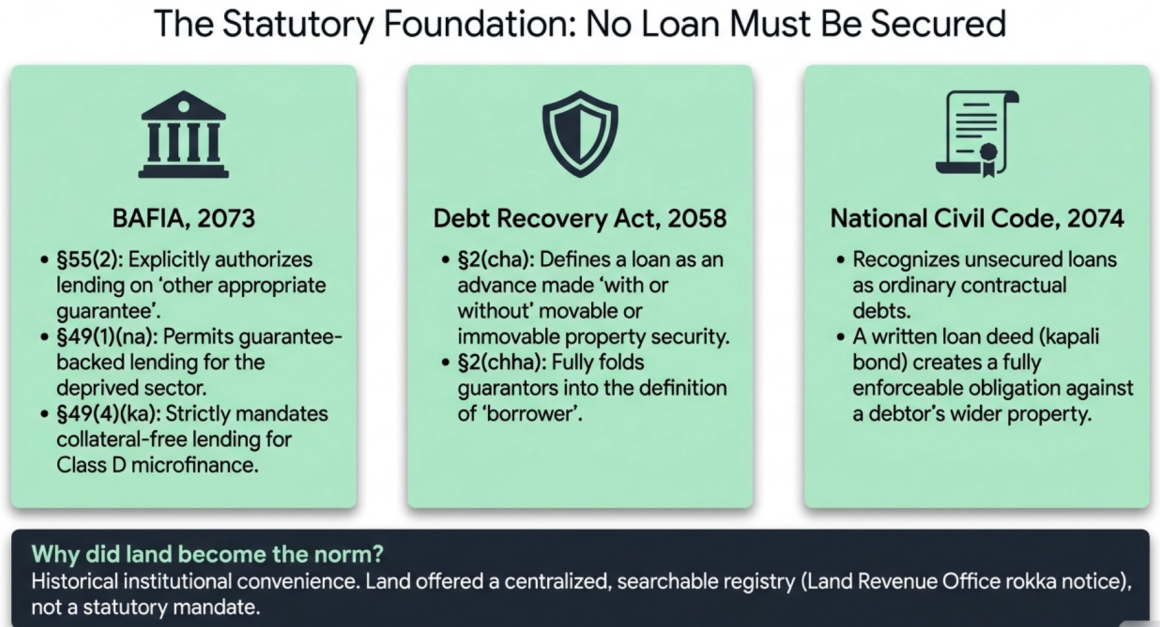
Nepalese banking legislation contains no provision – current or historical – requiring that every bank loan be secured by tangible collateral. The statutory baseline is permission, not compulsion, and it is expressed at three levels.
The enabling provisions of BAFIA: The general lending power in BAFIA §55(2) authorises a BFI to extend credit against acceptable movable or immovable property “or other appropriate guarantee”, taken “in a way that protects its interests and those of the depositors.” The phrase “other appropriate guarantee” is the textual hinge: it places personal and corporate guarantees alongside physical property as a sufficient statutory basis for lending. Class-specific mandates go further. Under §49(1)(na), commercial, development and finance companies (Classes A, B and C) may lend on personal or group guarantee for the economic upliftment of deprived-sector and low-income borrowers; under §49(4)(ka), microfinance institutions (Class D) may extend micro-credit “with or without taking any movable or immovable property security or guarantee.” The definition of “loan” in §2(ja) itself embraces guarantee-backed accommodation. Collateral-free lending is therefore not a tolerated exception to the Act but part of its express design, and for Class D it is the core mandate.
The debt-recovery statute and the Civil Code: The recovery statute confirms the point from the enforcement side. The Bank and Financial Institution Debt Recovery Act, 2058 defines a “loan” in §2(cha) as principal and interest advanced “with or without” movable or immovable property, collateral, mortgage or other security or guarantee, and §2(chha) folds any guarantor into the definition of “borrower.” Unsecured lending thus falls squarely within the jurisdiction of the Debt Recovery Tribunal. The National Civil Code, 2074 in turn recognises an unsecured loan as an ordinary contractual debt “lenden”: a written loan deed – the “kapali” bond – executed with the prescribed contents and formalities creates an enforceable obligation, and on default the creditor may recover the principal and lawful interest from the debtor’s property through attachment and auction, even reaching joint-family assets, and may prove the debt through banking records where the deed is lost. The Code’s guarantee provisions make the guarantor’s liability co-extensive with the principal debtor’s, require the guarantee to be in writing, oblige the creditor to demand performance of the debtor first, and reduce the guarantor’s exposure proportionally by any security the creditor already holds. Intangible assets – receivables, negotiable instruments, intellectual property, goodwill and franchises – are classified as movable property and may be pledged or assigned, the Code defining pledgeable “property” to include a right to property or the deed establishing it.
Why land-backed lending nonetheless became the norm: If the statute never compelled collateral, the near-universal reliance on land developed through legal and institutional convenience rather than legal command. Real estate alone enjoyed a centralised, publicly searchable title and encumbrance system – the landholder certificate “jagga dhani praman patra” and the Land Revenue Office ledger under the Land (Survey) Act, 2019, the Land Act, 2021 and the Land Revenue Act, 2034 – which let a BFI perfect a charge by lodging a freeze “rokka” notice directly with the Malpot office, and it carried a settled statutory priority in recovery and insolvency. Movable and intangible assets, lacking (until 2063) any comparable registry and carrying higher monitoring and realisation risk, could not match that certainty. The dominance of immovable collateral is, in short, a path chosen by institutions responding to the infrastructure the law happened to provide – not a requirement the law imposed.
III. What the Directives Permit: The Menu of Collateral-Free Credit
At the regulatory level, the core credit instrument is Directive No. 2 of the Unified Directives, 2081 for Class A, B and C institutions “karja prawaha, wargikaran tatha karja noksani sambandhi wyasatha”, with parallel provision for Class D. Far from prohibiting collateral-free lending, the Directives lay out an elaborate menu of permitted unsecured and partially-secured products, several of which are expressly exempt from the prudential penalties discussed below and one class of which is mandatory. The general rule is that a loan advanced solely on personal or institutional guarantee attracts an additional provision, but the Directives then carve out defined categories where that penalty is disapplied or where collateral-free lending is required.
| Permitted category | Borrower / purpose | Indicative limit | Security basis | Prudential treatment |
| Small personal loan | Natural persons; personal use | ≤ Rs 1.5 mn (OD ≤ Rs 0.5 mn within it); ≤ 7 yr | Personal guarantee + verified income | Exempt from +20% if board Product Paper, PAN, bank-statement income |
| Education loan | Higher / vocational study | Per product paper | Personal guarantee | Exempt from +20% provision |
| Credit card | Retail cardholders | ≤ Rs 0.3 mn (simplified) | Clean / unsecured | Exempt from +20%; 150% risk weight |
| Deprived-sector (direct) | Low-income, landless, micro-enterprise | ≤ Rs 0.5 mn (Rs 0.7 mn Pass) | Group / collective guarantee | Exempt from +20%; mandated lending |
| Deprived-sector (wholesale) | On-lending to MFIs / cooperatives | Institutional | Institutional guarantee | Exempt from +20% |
| SME with DCGF guarantee | Agri / IT / manufacturing SMEs | ≤ Rs 30 mn | Deposit & Credit Guarantee Fund | Reduced 60% risk weight |
| Staff loan | Own employees | Per service bylaws | Salary / terminal benefits / guarantee | Per board-approved bylaws |
| Micro-credit (Class D) | Group members | Group basis; Rs 1.5 mn if secured | Group / collective guarantee | Core statutory mandate (§49(4)(ka)) |
Sources: Unified Directives 2081 (Class A/B/C), Directive 2, cl. 10(10), 25; Unified Directive 2081 (Class D), Directive 3, cl. 2; Capital Adequacy Framework 2015 as amended 2082. Limits move across circulars and should be verified against the current issue.
Alongside these products, the Directives make cash-flow appraisal compulsory for all credit: disbursement or renewal is permitted only after analysis of the borrower’s “repayment capacity, future cash flow, and source of income”, and interest-capitalised term loans must have their repayment set by project cash-flow analysis. Working-capital facilities are financed against current assets – inventory and receivables – by hypothecation or pledge. The regulatory picture at this level is therefore permissive and even prescriptive of cash-flow lending: the Directives do not tell banks to demand land; they tell banks to assess capacity to repay and offer a range of collateral-free vehicles for doing so.
IV. What the Directives Price: The Prudential Disincentives
The permission described above is, however, layered over an incentive structure that makes collateral-free and movable-asset lending markedly more expensive to hold than land-secured lending. Three mechanisms do most of the work, and together they explain the observed bias far better than any supposed legal prohibition does.
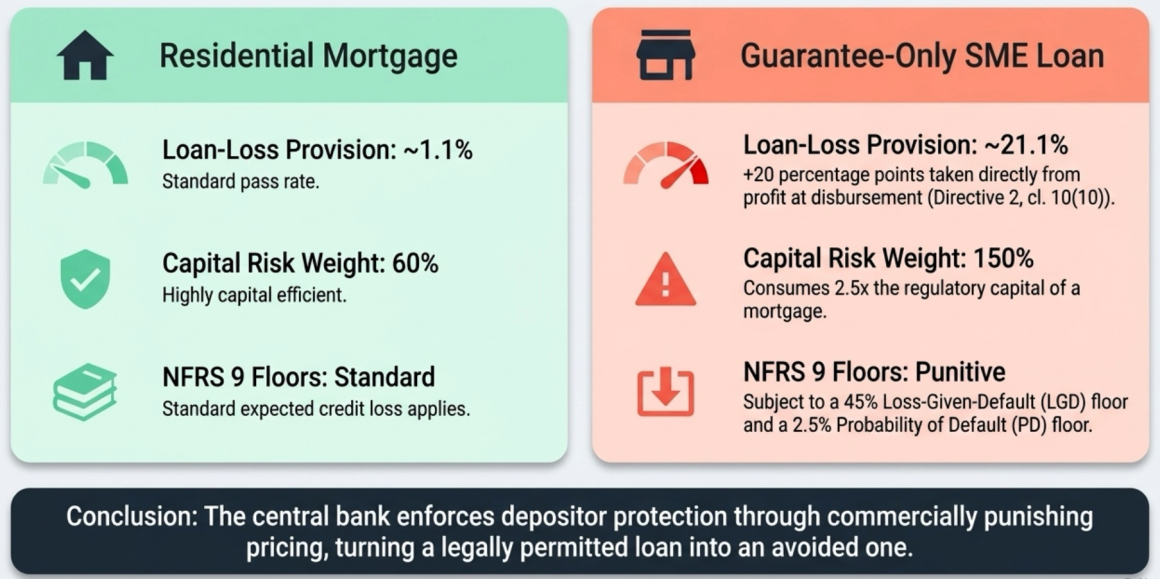
The additional 20 percent loan-loss provision: The single sharpest deterrent is Directive 2, clause 10(10): a loan advanced solely on personal or institutional guarantee must carry an additional 20 percentage points of loan-loss provision on top of the standard rate for the Pass, Watchlist, Sub-standard and Doubtful categories, and the penalty extends to the uncovered portion of a loan where physical or project security is insufficient and a guarantee is taken for the balance. The arithmetic is stark: where a Pass loan secured by land requires roughly 1.1 percent provision, the same loan on a personal guarantee requires about 21.1 percent – a charge taken directly against the bank’s profit on the day of disbursement. The penalty is disapplied only for the defined carve-outs (credit cards, education loans on guarantee, deprived-sector wholesale to MFIs, and small personal loans within the board-approved product-paper regime), and NRB has separately waived it for loans up to Rs 10 million backed by leased property running commercial agriculture. Outside those windows, the 20 percent add-on renders unsecured lending to ordinary SMEs and corporates commercially punishing.
The 150 percent capital risk weight: The second mechanism operates on capital rather than profit. Under the Capital Adequacy Framework, 2015, §3.3(i)(4), “the claims which are not fully secured or are only backed up by personal guarantee shall attract 150% risk weight.” Because risk-weighted exposure determines how much scarce, costly regulatory capital a bank must hold against a loan, this classifies cash-flow and guarantee lending as high-risk and forces the bank to hold 2.5 times the capital it would against a residential mortgage, which attracts only a 60 percent weight under §3.3(f). The preference for real estate has if anything deepened: a July 2026 amendment grants productive-sector SMEs (agriculture, IT, manufacturing) the favourable 60 percent weight only where the loan is “fully secured by land and/or building” or by a state-backed guarantee fund – so a genuinely cash-flow-based SME loan is denied the capital relief that the same loan secured by land would enjoy. Personal overdrafts, credit-card receivables, venture capital, private equity and unlisted equity all carry the 150 percent weight, and only guarantees from an eligible protection provider – the Government of Nepal, a multilateral development bank, or a bank rated A− or better – qualify as credit-risk mitigants capable of reducing it.
| Exposure | Risk weight | Capital / provisioning consequence |
| Residential mortgage (owner-occupied, fully secured) | 60% | Least capital consumed; favoured |
| SME agri/IT/mfg – fully secured by land/building or DCGF | 60% | Relief only if land-secured or fund-guaranteed |
| Regulatory retail portfolio (≤ Rs 25 mn, granular) | 75% | Moderate |
| Unrated / ordinary corporate claim | 100% | Baseline |
| Not fully secured / personal-guarantee-only claim | 150% | 2.5× residential; high-risk category |
| Personal OD, credit card, venture capital, private/unlisted equity | 150% | Penalised growth-risk finance |
| Guarantee-only loan (any Pass/Watch/Sub/Doubtful) | As above | Additionally: +20 percentage-point provision on top of standard LLP |
Sources: Capital Adequacy Framework 2015, §3.3(f),(i),(j) and Annex 1.1, as amended by the merged circulars of July 2026; Unified Directives 2081, Directive 2, cl. 10(10).
The accounting floors, loan-to-value caps and the guarantor asset test: Three further layers reinforce the tilt. First, under the NFRS 9 expected-credit-loss regime as applied in Nepal, NRB imposes a prudential minimum loss-given-default (LGD) floor of 45 percent on unsecured or under-collateralised exposures, a minimum probability-of-default floor of 2.5 percent on all exposures regardless of a bank’s internal model, and a “higher-of” rule requiring banks to book the greater of the NFRS 9 and the rule-based NRB provision – so a bank cannot use a favourable internal model to lower the cost of asset-light lending. Because an unsecured loan has no asset to realise, the 45 percent LGD floor forces heavy provisioning at origination; some banks disclose credit-card ECL coverage rising to 82 percent at the impaired stage. Second, loan-to-value and debt-to-income caps constrain the clean-lending space directly: personal loans are capped at 50 percent LTV, the debt-service-to-income ratio at 50 percent for non-business personal loans and 70 percent for housing, and the aggregate personal-loan exposure per borrower across all BFIs is capped (currently Rs 10 million, raised from an earlier Rs 5 million), with any excess attracting full provisioning. Third, before it may rely on a guarantee at all, a BFI must obtain a statement of the guarantor’s claim-free assets equal to the guaranteed amount – a documentary demand that, in practice, pushes lenders back toward the very tangible security the guarantee was meant to replace.
The stated rationale, and the honest reading: None of this is arbitrary. The rationale is depositor protection: BAFIA §55(2) itself requires security to be taken “in a way that protects… the depositors,” and the heavy provisioning and capital charges function as buffers against the higher default probability and lower recovery of clean loans, as instruments of lending discipline, and as a response to information asymmetry (hence the guarantor asset statement). Taken together, however, the framework’s own drafters make the design explicit: the statutes and directives create no prohibition on collateral-free lending but permit it “while imposing prudential consequences that make such lending… commercially unattractive.” That is the honest reading. Collateral is not forbidden to be dispensed with; dispensing with it is simply made to cost so much in capital and provisions that, for all but the carved-out micro-products, banks rationally decline. The disincentive is real, deliberate, and – on the depositor-protection premise – defensible; but it is a price, not a rule, and it is the price that produces the exclusion.
V. Movable and Intangible Collateral: A Modern Law Left Underused
If collateral-free lending is priced out, one might expect banks to pivot to movable-asset lending – receivables, inventory, equipment, agricultural produce – and Nepal has, on paper, a modern legal infrastructure for exactly that. The Secured Transactions Act, 2063 defines movable property broadly to include tangible and intangible assets and future property, and expressly brings within its scope accounts and receivables, inventory, equipment, agricultural products including future crops and unborn livestock, and intellectual-property licence rights (§2). A security interest attaches on a security agreement, value and debtor rights (§25) and is perfected against third parties by registering a notice in the electronic registry or by possession (§26); it may secure future obligations (§21(3)) and extends automatically to proceeds (§33). Priority runs first-in-time among perfected interests and a perfected interest outranks an unperfected one and unsecured claims (§§28, 29ka), with purchase-money interests taking special priority (§34). Enforcement is expedited: on default the secured party may repossess without judicial process (§48), collect assigned receivables directly (§§42ka, 46(4)) and sell the collateral on reasonable notice, applying proceeds to expenses, then the debt, then subordinate interests, with any surplus returned (§§50–51). This is, in form, precisely the machinery needed to lend against a going concern’s business assets rather than its owner’s land.
It is nonetheless little used for primary lending, for reasons that are partly prudential, partly operational, and partly the product of unresolved conflicts among statutes. The prudential reasons are those already described: movable-secured lending that does not fully cover the exposure still draws the 20 percent provision and, unless “fully secured,” the 150 percent weight, so the modern law delivers no capital or provisioning advantage over clean lending. The operational reasons are specific to the asset class: the Working Capital Guidelines, 2079 oblige banks to inspect physical stock quarterly, audit VAT, excise, debtor and creditor registers, and reconcile borrower stock-and-receivables statements against sanctioned drawing power – a continuous monitoring burden absent from land lending, where the collateral is valued perhaps once in two years. The Secured Transactions Act itself contains gaps that unsettle collateral: it excludes certain machinery from being treated as a stable “fixture” (§2(wyan)), so factory plant is financed as floating movable property that can be moved or concealed; and a purchase-money interest in equipment must be perfected within five days of the debtor taking possession (§34) or lose priority. Overlaying all of this is the personal criminal exposure of officers under the Banking Offence and Punishment Act, 2064: because the value of inventory, crops or livestock can fall quickly, an officer who accepts movable collateral that later proves insufficient is exposed to allegations of “wrong valuation” under §13, and §8 criminalises loan misuse – and stock and cash flow are, as supervisors note, easier for a borrower to siphon “apachalan” than a building is to remove.
Conflicts among the statutes: The framework’s treatment of movable and intangible collateral is further undercut by conflicts among the very statutes that are meant to enable it. The Secured Transactions Act’s first-in-time registration priority (§28) collides with §589(1) of the Civil Code, which makes multiple pledges of the same movable rank equally (pari passu) unless otherwise agreed – leaving the priority of competing movable-security claims genuinely uncertain. More fundamentally, §435(4) of the Civil Code prohibits the mortgage or encumbrance of property not currently owned, i.e. future property “bhawisyama prapta hune sampati”, which sits in direct tension with the Secured Transactions Act’s recognition of security over future assets and cash-flow streams and with the whole premise of receivables and future-crop financing. Registration is fragmented: Share pledges recorded in the company’s share register (§42), while security over the same movable assets must be noticed in the Secured Transactions Registration Office under the 2063 Act – with no unified or cross-indexed registry, so a diligent lender cannot search a single source to establish priority. And the Civil Code’s general interest cap of 10 percent per annum with its prohibition on compound interest (§478) sits awkwardly over risk-priced institutional cash-flow lending and invoice discounting. The upshot is that a modern movable-collateral statute is neutralised in practice – not by its own text, which is sound, but by prudential pricing, operational cost, and a surrounding legal infrastructure that has not been harmonised to support it.
VI. Guarantees, Cash Flow and the Credit-Guarantee Substitute
The objective of this article also asks the framework to be assessed across the several forms that credit support can take other than immovable property – personal, corporate, promoter, group and third-party guarantees; hypothecation; assignment of receivables; cash-flow-based repayment; and institutional credit enhancements. The framework recognises each of them, but assigns to each a distinctly secondary status.
- Guarantees are a permitted substitute for tangible security but the framework treats them as second-best: a guarantee-only loan draws the 20 percent provision and, unless from an elite provider, does not reduce the 150 percent weight, and the Civil Code makes the guarantor’s liability co-extensive with the borrower’s while requiring the creditor to demand payment of the principal debtor first. Group and social guarantees are the operative security in deprived-sector and microfinance lending, where they are not merely permitted but mandated.
- Hypothecation and receivables assignment are available under the Secured Transactions Act and are financed under the working-capital regime, but carry the monitoring, valuation and priority frictions just described.
- Cash-flow-based lending occupies a paradoxical place: it is mandated as the appraisal basis for every loan and judicially recognised as a valid security structure (below), yet it earns no capital or provisioning relief – as noted, even a verified cash-flow SME loan is denied the 60 percent weight reserved for land-secured SME loans.
The Deposit and Credit Guarantee Fund: the one genuine substitute: The nearest thing to a true collateral substitute is the Deposit and Credit Guarantee Fund (DCGF), operating under the Deposit and Credit Guarantee Fund Act, 2073 and the Credit Guarantee Rules, 2075.
Rule 35(1) impliedly that member institutions can lend on collective or group guarantee, or against project collateral – without taking collateral, across microfinance and deprived-sector, SME, agricultural, educational, export and – under Rule 49A – women-entrepreneurship, startup and green-technology categories, with the guarantee acting as a deliberate substitute for real-estate collateral for borrowers who lack land. It is a genuine risk-sharing mechanism: the Fund absorbs 70–80 percent of the net loss on default (75 percent for microfinance and deprived sector; 80 percent for SME, agriculture, education and export within standard thresholds; 70 percent for higher-limit facilities), and an SME loan backed by the Fund earns the reduced 60 percent risk weight. It is, in other words, the mechanism by which the framework most directly enables lending without land. Its limits, however, keep it from displacing collateral at scale. The guarantee is compensatory: a payout reimburses loss after default and does not, in itself, discharge the borrower’s debt and recovery duties, which run in parallel. And the Rules load the scheme with friction that falls hardest on exactly the asset-light borrowers it targets – a claim is barred unless at least 25 percent of principal and interest was repaid by maturity (which excludes the early-stage defaults typical of startups and new micro-enterprises), total annual payouts to a single bank are capped at roughly double its guarantee-fee volume (so portfolio-wide distress cannot be recovered), payment is released in two tranches with the final 30 percent withheld until blacklisting and full legal recovery are complete, claims must be filed within two years of maturity, a bank that absorbs collateral as a non-banking asset must refund 100 percent of the payout within 35 days, and a guaranteed loan cannot be written off without the Fund’s consent and a five-year wait after final decree. The substitute exists, and it is the most important single tool for collateral-free lending in the system; but it is ex-post, capped and friction-laden, and it does not neutralise the capital and provisioning penalties that make clean lending unattractive in the first place.
VII. The Judicial Position: Clean Lending Is Lawful; Liability Requires Fault
If banks were deterred from collateral-free lending chiefly by fear of legal or criminal exposure, the courts would be the place that fear was generated. They are, in fact, the place it has been dispelled. Across the reported decisions, the Nepalese judiciary has consistently held that lending without immovable collateral is lawful, that loan default is a commercial and civil matter rather than a criminal one, and that officers incur liability only for fault – fraud, collusion, dishonesty, breach of duty or breach of regulatory limits – and not for the mere fact that a loan was unsecured or later went bad.
The legality of clean lending: The leading authority is the Apex Development Bank line. In Nepal Government v. Naresh Jung Shah (High Court Tulsipur, Nepalgunj Bench, Case No. 075-FJ-0009 and connected cases, decided 2078/11/26 BS), bank officers were prosecuted under the Banking Offence and Punishment Act, 2064 on the footing that loans had been disbursed without adequate physical collateral and outside the procedural steps of NRB’s directives. The Court acquitted, holding that extending credit to trusted borrowers on personal creditworthiness and personal guarantee, without physical or immovable collateral, is legally valid and an established banking practice under BAFIA §55, and that procedural deviations from NRB directives do not amount to criminal banking offences absent proof of dishonest intent (mens rea) to cause loss or secure illegal gain – such lapses falling within NRB’s administrative and supervisory domain under §100 of the NRB Act, not the criminal law. The wider survey of the case law confirms that no Nepalese court has ever held that a bank is legally required to obtain collateral before lending, and that directives issued by the regulator cannot narrow the statutory lending powers Parliament conferred. The same distinction – between commercial misjudgment and culpable wrongdoing – runs through the officer-liability decisions. In Nepal Government v. Ajay Shrestha (Bank of Kathmandu; High Court Patan Case No. 076-CB-0572), a chief executive who approved a loan in reliance on a listed valuer’s certified report and a credit committee’s recommendation was acquitted when the collateral proved fraudulent, primary liability resting on the borrower and the valuer who produced the false report. The Mahalaxmi Development Bank gold-loan (High Court Patan, Case No. 077-CB-1054) cases applied the same logic, convicting the gold tester who falsely certified fake metal under §13 while acquitting the branch managers who relied in good faith on his certification. The Manjushree Finance (Supreme Court, Case No. 072-RB-0143) precedents hold that where a loan is fully repaid before or during trial, the element of criminal loss “bigo” is extinguished and the officers must be acquitted. The line is crossed only by genuine fraud: the Capital Merchant Banking case (fictitious borrowers and siphoned funds, Supreme Court, Case No. 072-RB-0147), the Civil Bank forged-document case (Supreme Court, Case No. 076-CS-0340), and the H&B Development Bank cheque-fraud case (Supreme Court, Case No. 075-CI-1024) all produced convictions, and in Gorkha Development Bank (Case No. 068-CI-1355) the Supreme Court upheld personal administrative fines (Rs 500,000 per director) and disqualification where directors approved credit in breach of the single-obligor limit and without risk appraisal – a regulatory liability under NRB Act §100, distinct from the criminal law. Amber Kumar Khadka v. Nepal Bank (Supreme Court, Writ No. 3431 / 2061 BS) confirms that gross negligence – approving loans without the mandatory stock inspection and on inflated valuations – sustains departmental dismissal alongside any criminal corruption sanction.
Guarantees, cash-flow structures and documentation: The guarantee jurisprudence, while strict on the lender, confirms that guarantees are enforceable security. The capped-liability principle of Sangita Tripathi v. Lumbini Bank (Supreme Court, Full Bench, NKP 2073, DN 9646) – that a guarantor’s liability is limited to the sum stated in the deed and the collateral must be released once that sum is paid, applied in Sushil Chaudhary v. Nepal Bank and Punya Prabha Devi Bisht v. Gorkha Development Bank – sits alongside Kamala Amatya v. Himalayan Bank (NKP 2070, DN 8997), which holds that a promoter who signs a personal guarantee cannot hide behind corporate limited liability, and Dr. Anju Dev v. Saptakoshi Development Bank and Manoj Kumar Khadka v. BFC Poultry, which hold that resigning or transferring shares does not discharge a guarantor without the bank’s written consent. Guarantees are discharged on settlement of the underlying facility (Shanta Subedi v. Global IME Bank) and are strictly construed, so a bank cannot recharacterise a limited buy-back guarantee as a general corporate guarantee (International Construction v. Global IME Bank). Crucially for this article, the courts have recognised cash-flow and receivables structures as valid and enforceable security: appraisal on auditor-certified projected financials is lawful and protects the approving officer, a hypothecation charge over current stock and receivables creates an enforceable primary charge over present and future business assets, and financing repaid from contract running-bill proceeds is a recognised credit structure – with a failure of projected cash flow treated as commercial default, not invalidation of the loan. The documentation cases mark the outer boundary: an unregistered security interest is unenforceable (Durga Devi Shrestha v. Lumbini Bank), a deed executed by an impersonator is void ab initio (Prakash Lamichhane v. ADBN), and a post-execution insertion of new debtors into blank spaces is forgery and void (Nirmal Enterprises v. Nepal Bank), while a borrower who voluntarily signs a standard-form deed is estopped from later disowning it under §34 of the Evidence Act.
The significance of this body of law for the present question is decisive in the negative. The judiciary has removed the “criminalisation risk” that might otherwise explain banks’ reluctance to lend clean: unsecured lending is lawful, guarantees and cash-flow structures are enforceable, and officers who lend prudently and in good faith are protected even when the loan defaults or the borrower’s collateral turns out to be fraudulent. Whatever drives the concentration in immovable collateral, it is not a judicial signal that clean lending is illegal or that bankers will be prosecuted for it. That leaves the prudential pricing as the operative cause.
VIII. Recovery and Insolvency: Enforceable in Law, Uneven in Outcome
The recovery machinery reinforces, rather than qualifies, the conclusion that unsecured credit is legally valid – while showing why, in realised outcomes, secured and immovable exposures still fare better. A BFI may bring an unsecured claim before the Debt Recovery Tribunal, because the loan definition in §2(cha) of the Debt Recovery Act covers credit advanced “with or without” security and §2(chha) treats a guarantor as a borrower; and where no specific collateral exists, the Tribunal’s Debt Recovery Officer may locate, attach and auction the borrower’s unpledged movable and immovable assets and enforce directly against guarantors up to the guaranteed amount (§26). Unsecured lending is thus fully recoverable in principle.
The frictions lie in the realisation. The Tribunal’s jurisdiction of four-year limitation runs strictly from contractual default and cannot be reset by internal board resolutions or unilateral extension letters; compound interest is barred and unilateral premium increases are struck down. Enforcement against movable and intangible security is harder still: hypothecated stock is often concealed or depleted, perishable inventory must be auctioned on interim orders before it spoils, receivables can be defeated by third-party set-off or the debtor’s own insolvency, and unsold collateral absorbed by the bank becomes a non-banking asset carrying its own provisioning and capital drag. Insolvency then completes the asymmetry: under the Insolvency Act, 2063, a secured creditor stands outside the liquidation estate for its mortgaged asset and controls its sale, joining the unsecured pool only for any shortfall, while preferential payments have been abolished – so a secured, land-backed creditor is structurally advantaged over an unsecured one in the one situation where recovery matters most. The law recognises the unsecured claim at every stage; it simply rewards the secured, immovable one in the outcomes, and that expected-outcome differential feeds back into the origination decision.
IX. The Empirical Reality: The Bias Made Visible
The doctrinal tilt is not merely theoretical; it is visible in the aggregate data and in banks’ own disclosures, and NRB’s supervisors name it explicitly. Two official series measure it. NRB’s bank-supervision reports group fixed and current assets together as “collateral of properties” and show that share rising almost monotonically – 85.90 percent of commercial-bank loans in 2009, dipping to about 81 percent in the mid-2010s, then climbing through 86.66 percent in 2016 and past 88 percent in 2018 to 89.98 percent by mid-July 2024, with development banks at 89.61 percent – while loans against fixed-deposit receipts and against guarantees each remain a minor fraction (fixed deposits about 0.73 percent in 2024). NRB’s macroeconomic series isolates land and buildings specifically, and shows them securing between 60.8 and 68.0 percent of all BFI credit across the decade against only 11.6 to 15.2 percent secured by current assets such as inventory, produce and receivables.
| Fiscal year (BS) | Secured by land & buildings | Secured by current assets |
| FY 2015/16 (2072/73) | 60.8% | 15.2% |
| FY 2017/18 (2074/75) | 61.7% | 14.4% |
| FY 2019/20 (2076/77) | 65.7% | 13.0% |
| FY 2021/22 (2078/79) | 66.4% | 12.3% |
| FY 2022/23 (2079/80) | 68.0% | 11.6% |
| FY 2024/25 (2081/82) | 64.7% | 14.5% |
Source: NRB macroeconomic reporting on the collateral composition of outstanding BFI credit. Land-and-building share is consistently 4–6× the current-asset share throughout.
The bank-level disclosures tell the same story from the bottom up. Even the banks with the largest clean books hold only a sliver unsecured – Prime Bank 2.56 percent of its portfolio, Nabil Bank 2.22 percent – while most report well under one percent and several (NIMB, Kumari, NMB, Everest, Nepal Bank, Prabhu) report no unsecured exposure at all, classifying every loan against some tangible security or third-party guarantee; Nepal SBI’s entire unsecured book is staff loans. Large lenders disclose 94–98 percent of their loans secured by movable or immovable property (for example, NIMB Rs 328.26 billion of Rs 348.42 billion; NMB Rs 240.96 billion of Rs 245.18 billion). Most tellingly, NRB’s own inspectors record that “over reliance on projected financials and collateral based lending are common,” that banks lean on the real-estate safety net instead of analysing business cash flow, and that borrowers routinely divert short-term and working-capital facilities into land and buildings – an outcome in which collateral does not merely accompany credit appraisal but substitutes for it. The consequence at the level of the real economy is the “missing middle”: because startups, service and knowledge firms and informal enterprises hold cash flow and moveable assets rather than land, they are, in NRB’s own framing, systematically rationed out of formal commercial credit. The Alternative Development Finance Mobilisation Act, 2082 responds to part of the resulting gap – an estimated Rs 100 trillion decade-long deficit – through an Alternative Development Finance Fund deploying project bonds, blended finance and project hypothecation, but it is directed at large-scale infrastructure and expressly excludes startups, MSMEs and small collateral-free borrowers, leaving the asset-light enterprise gap untouched. The empirical record, in short, confirms the doctrinal analysis: an incentive structure that prices immovable collateral cheapest produces a system in which roughly nine-tenths of credit is property-secured and asset-light enterprise is the residual.
X. Assessment: Is Collateral Necessary?
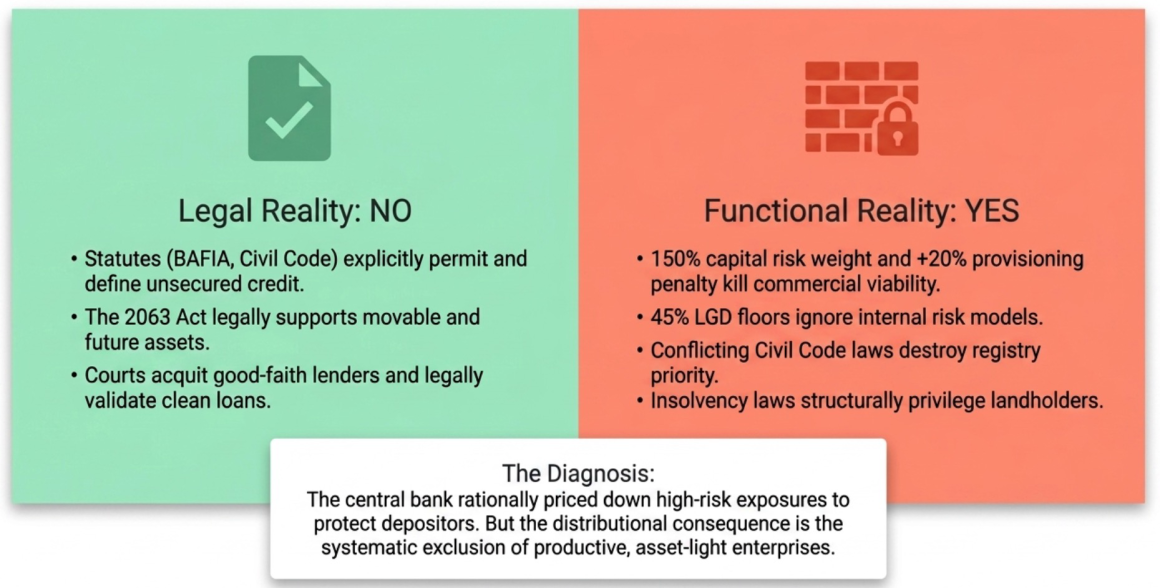
The question the title poses can now be answered on two levels, and the two answers diverge. As a matter of law, collateral is not necessary. No banking statute requires it; BAFIA, the NRB Act, the Debt Recovery Act and the Civil Code all contemplate lending without tangible security; the Directives expressly permit an array of collateral-free products and mandate it for microfinance and deprived-sector credit; the Secured Transactions Act supplies a modern movable-collateral regime; the courts have held clean lending lawful and default non-criminal; and unsecured claims are fully recoverable through the Tribunal. A bank that lends without collateral, prudently and in good faith, acts entirely within the law.
As a matter of functional reality, collateral has become a necessity of a different kind – a regulatory and structural one. The additional 20 percent provision, the 150 percent risk weight, the 45 percent LGD floor, the loan-to-value caps and the guarantor asset test make collateral-free and movable-secured lending so much more expensive in capital and provisions than land-secured lending that, outside the carved-out micro-products, banks rationally decline it; the Secured Transactions Act is neutralised by that same pricing, by operational monitoring cost, by the criminal-misvaluation exposure of officers, and by unresolved conflicts with the Civil Code and the fragmentation of the movable-asset registry; the DCGF substitute is ex-post, capped and friction-laden; and the insolvency hierarchy rewards the secured creditor in the outcomes that matter. The empirical record shows the result: a banking system that is, in practice, built on immovable property. Collateral is not required by the law; it is required by the incentive structure the law creates and the infrastructure the law has failed to harmonise.
On the objective’s further question – whether the framework strikes an appropriate balance between prudent risk management and access to finance – the honest conclusion is that it is calibrated firmly toward prudence and depositor protection, faithful to BAFIA §55(2), at a real and measurable cost to access. That is a defensible choice, not a drafting error: a central bank charged with protecting deposits and financial stability will rationally price down the exposures with the highest default probability and lowest recovery. But it is a choice whose distributional consequence – the systematic exclusion of exactly the productive, asset-light enterprises a developing economy most needs to finance – the research objective is right to interrogate. The framework does not fail to address collateral-free lending; it addresses it and, in the same breath, prices it out of the mainstream. Whether that balance remains appropriate is the question its incentive structure squarely raises.
XI. Reform: Toward Responsible Collateral-Free Lending
Because the barrier is incentive and infrastructure rather than prohibition, the reform agenda is one of re-pricing verifiable cash-flow lending and harmonising the surrounding law – not of authorising something the statute currently forbids. The measures below, several of which track NRB’s and the framework’s own identified reform points, are designed to open space for collateral-free credit to enterprises whose repayment capacity can be independently verified, while retaining the prudential floors that protect depositors against genuinely unmonitored risk.
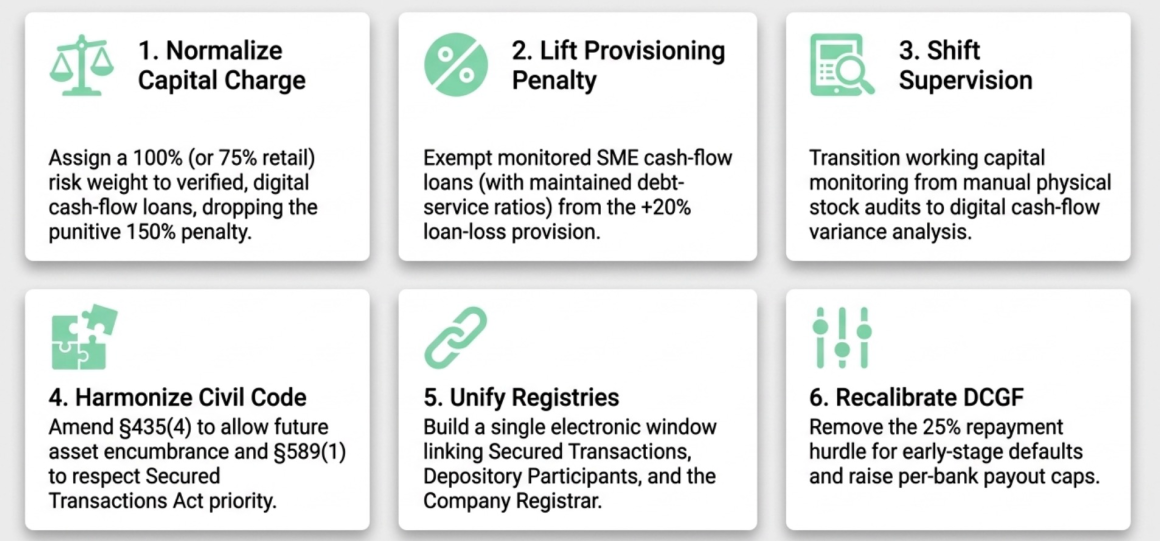
• Normalise the capital charge for verified cash-flow lending. Amend the Capital Adequacy Framework 2015, §3.3(i)(4) to remove “verified cash-flow-based enterprise loans” from the high-risk (150 percent) category and assign a standard 100 percent weight – or a 75 percent regulatory-retail weight where the granularity criteria are met – for loans backed by formalised, digitally verifiable cash flows such as corporate supply-chain payments or verified digital point-of-sale revenues.
• Lift the provisioning penalty for monitored cash-flow loans. Insert into Directive 2, clause 10(10) a blanket exemption from the additional 20 percent provision for SME and corporate loans disbursed under a board-approved “Cash-Flow Lending Product Paper,” conditioned on a maintained debt-service coverage ratio serviced entirely through formal banking channels – extending the logic of the existing small-personal-loan carve-out to productive enterprise credit.
• Shift working-capital supervision from stock audit to cash-flow analysis. Amend the Working Capital Guidelines, 2079 to create a “pure cash-flow track” for collateral-free borrowers, replacing mandatory physical inventory inspection and drawing-power reconciliation with variance analysis of verified receipts through the banking system.
• Harmonise the movable-collateral law. Amend Civil Code §435(4) to permit security over future assets and cash-flow streams (aligning it with the Secured Transactions Act); amend §589(1) to subordinate general civil pledges to notice-based first-in-time priority; and clarify §478 to exempt regulated banking, risk-priced institutional cash-flow financing and invoice discounting from the general interest cap and the bar on compound interest.
• Unify the security registry. Create a single electronic window or automated cross-index between the Secured Transactions Registration Office, Depository Participants and the Office of the Company Registrar so priority can be established from one search; resolve the “fixture” gap for plant and machinery; and ease the five-day purchase-money perfection deadline.
• Recalibrate the DCGF to reach early-stage and asset-light borrowers. Relax the 25 percent minimum-repayment condition for genuine early-stage default, raise the annual per-bank claim cap so portfolio-wide distress is recoverable, compress the two-tranche settlement timeline, and shorten the five-year post-decree write-off wait – so the one genuine collateral substitute in the system carries less friction for the borrowers it exists to serve.
• Build the enabling data and insolvency infrastructure. Advance NRB’s own recommendations on SME credit scoring, movable-collateral registries, alternative and digital transaction data, and risk-based rather than collateral-based supervision; and pair them with an efficient corporate-restructuring process, so that enterprise viability and future cash flow – rather than the borrower’s land – can safely anchor a lending decision.
None of these measures dispenses with prudence. Each is conditioned on verifiability – digitally traceable cash flow, formal banking channels, maintained coverage ratios – and each retains a prudential floor for exposures that cannot be independently monitored. What they do is remove the penalty the framework currently imposes on lending that can be verified without land, and repair the statutory conflicts and registry fragmentation that today defeat the movable-collateral regime the legislature already enacted. That is the path from a system in which collateral is a functional necessity to one in which it is genuinely, and only, a choice.
XII. Conclusion
Nepalese banking law does not make collateral a condition of lending, and it never has. The statutes permit and in places mandate lending without tangible security; the Secured Transactions Act supplies a modern regime for movable and intangible collateral; the DCGF offers a genuine, if friction-laden, substitute; the courts have held clean lending lawful and loan default a commercial rather than a criminal matter; and unsecured claims are fully recoverable. The productive-credit exclusion the research identifies is therefore not the product of a legal prohibition. It is the product of an incentive structure – the additional 20 percent provision, the 150 percent risk weight, the loss-given-default and probability-of-default floors, the loan-to-value caps, the guarantor asset test, the valuation and monitoring burdens, and the criminal exposure of officers – layered over a movable-collateral law that unresolved Civil-Code conflicts and a fragmented registry have left underused, and an insolvency hierarchy that privileges the secured creditor. That structure prices collateral-free and movable-asset lending so far above land-secured lending that banks rationally build their books on immovable property, and NRB’s own data confirm the outcome: close to nine-tenths of credit secured against property, and asset-light enterprise as the residual. Examined from a banking-law standpoint, collateral is not a legal necessity in Nepal but a regulatory and structural one – and closing the gap between the two, by re-pricing verifiable cash-flow lending and harmonising the law that surrounds it, is the reform the productive-credit gap requires. The framework has not neglected collateral-free lending; it has permitted it and, through its prudential design, priced it out of the mainstream. Rebalancing that design – without abandoning the depositor protection that justifies it – is the task the evidence sets.
References
Statutes: Bank and Financial Institution Act, 2073 (2017) (BAFIA), ss. 2, 49, 50, 52, 55, 56, 57, 114, 124, 131, 133. Nepal Rastra Bank Act, 2058 (2002), ss. 79, 100. Bank and Financial Institution Debt Recovery Act, 2058 (2001), ss. 2(f), 2(g), 15, 25, 26; Debt Recovery Rules, 2059 (2002). Banking Offence and Punishment Act, 2064 (2008), ss. 5, 7, 8, 12, 13, 15. Secured Transactions Act, 2063 (2006), ss. 2, 7, 20, 21, 25, 26, 28, 29ka, 33, 34, 42ka, 46, 48, 50, 51. National Civil Code (Muluki Dewani Samhita), 2074 (2017), ss. 435(4), 478, 563–564, 589(1) and provisions on loan (लेनदेन), guarantee, pledge and assignment. Deposit and Credit Guarantee Fund Act, 2073 (2016); Credit Guarantee Rules, 2075 (2018), rr. 35(1), 42–49A. Companies Act, 2063 (2006), ss. 36, 42; Insolvency Act, 2063 (2006), s. 7 and priority provisions. Alternative Development Finance Mobilisation Act, 2082; Land (Survey and Measurement) Act, 2019; Land Act, 2021; Land Revenue Act, 2034.
NRB directives, frameworks and guidelines: Nepal Rastra Bank, Unified Directives, 2081 (Class A, B, C): Directive 2 (credit flow, classification and loan-loss provisioning), cll. 1, 10(10), 25, 44; Directive 3 (single-obligor and concentration limits), cll. 2, 10. Nepal Rastra Bank, Unified Directives, 2081 (Class D microfinance): Directive 3 (micro-credit limits and group guarantee). Nepal Rastra Bank, Capital Adequacy Framework, 2015 (as amended 2082 and by the merged circulars of July 2026), §3.3(f), (i)(4), (j); Annex 1.1. Nepal Rastra Bank, Working Capital Loan Guidelines, 2079, cll. 3.3, 6.1, 6.2. NFRS 9 expected-credit-loss regime as applied under NRB / ICAN guidance (prudential LGD floor 45%, PD floor 2.5%, “higher-of” provisioning).
Judicial and tribunal decisions: Nepal Government v. Naresh Jung Shah (Apex Development Bank), High Court Tulsipur (Nepalgunj Bench), Case No. 075-FJ-0009 (and connected 0013/0017/0018), decided 2078/11/26 BS. Nepal Government v. Ajay Shrestha (Bank of Kathmandu), High Court Patan. Nepal Government v. Padam Chandra Gyawali et al. (Mahalaxmi Development Bank gold-loan cases), High Court Patan. Nepal Government v. Bharat Raj Paudel et al. (Capital Merchant Banking & Finance). Nepal Government v. Ram Krishna Rai et al. (Civil / Pashupati Development Bank forged-document case). Dhan Prasad Rai / Nirmal Gurung / Ramesh Bahadur Tamang v. Nepal Rastra Bank (Gorkha Development Bank director-liability cases), Supreme Court. Amber Kumar Khadka v. Nepal Bank Ltd., Supreme Court. Sangita Tripathi v. Lumbini Bank Ltd., Supreme Court (Full Bench), NKP 2073, DN 9646. Kamala Amatya v. Himalayan Bank Ltd., Supreme Court, NKP 2070, DN 8997. Sushil Chaudhary v. Gyanendra Shrestha & Nepal Bank Ltd., High Court Patan, Case No. 076-DP-0650; Punya Prabha Devi Bisht v. Gorkha Development Bank Ltd. Shanta Subedi v. Global IME Bank Ltd.; Samrat Shamsher J.B.R. v. Nepal Bank Ltd.; International Construction Pvt. Ltd. v. Global IME Bank Ltd. (High Court Patan). Dr. Anju Dev v. Saptakoshi Development Bank Ltd.; Manoj Kumar Khadka v. BFC Poultry & Prabhu Bank Ltd.; Dharmendra Agarwal v. Prime Commercial Bank Ltd. & Greenlife Hydropower Ltd. Sama Rajya Laxmi Singh v. Nepal Investment Bank Ltd.; Nepal SBI Bank Ltd. v. Tej Karan Jain; Durga Devi Shrestha v. Lumbini Bank Ltd.; Prakash Lamichhane v. Agriculture Development Bank; Nirmal Enterprises v. Nepal Bank Ltd. Himalayan Bank Ltd. v. Nepal SBI Bank Ltd.; Triveni Distillery / Bank v. Inland Revenue Department; and the Debt Recovery Appeal Tribunal precedents on unsecured and guarantee-backed recovery (FY 2077–2080).
Data and supervisory sources: Nepal Rastra Bank, Bank Supervision Reports (2009–2024): collateral composition of loans; “over-reliance on projected financials and collateral-based lending.” Nepal Rastra Bank, macroeconomic reporting (FY 2015/16–FY 2025/26): collateral composition of outstanding BFI credit (land & buildings vs current assets). Commercial-bank annual reports (latest): “Analysis of Loans and Advances – By Collateral” and unsecured-exposure disclosures (Prime, Nabil, Nepal SBI, NIMB, Kumari, NMB, Everest and others); NFRS 9 ECL and LGD/PD floor disclosures.