
This post assesses whether prediction markets, event contracts, and comparable outcome-based financial instruments could lawfully operate in Nepal, either as a domestically licensed exchange or through resident participation in offshore platforms such as Kalshi or Polymarket. It examines the interaction of criminal law, civil contract law, constitutional economic rights, securities and commodities regulation, banking and payment-system directives, foreign exchange controls, and Supreme Court jurisprudence to establish where the law clearly prohibits such markets, where genuine ambiguity exists, and where a defensible path to legality might be constructed. The post concludes that, on the law as it currently stands, no version of a prediction market: whether structured as a bookmaker-style wager, an exchange-traded bilateral contract, or an offshore account accessed by a Nepalese resident – can operate lawfully without a new Act of Parliament, and that administrative designation by a financial regulator, while theoretically available, cannot by itself immunize the activity from criminal exposure.
The Question
Prediction markets invite participants to buy and sell contracts whose value is fixed by the outcome of a future, verifiable event – an election result, a central bank decision, a weather threshold, a sporting score. Platforms such as Kalshi operate as regulated derivatives exchanges under U.S. commodities law; Polymarket operates as a decentralized, offshore, largely unregulated market settled in stablecoins. Both models sit deliberately at the edge of the line separating financial risk-transfer from wagering, and both have been the subject of sustained regulatory contest even in jurisdictions with mature derivatives law. Nepal’s legal system was not designed with this instrument in mind, and no statute, directive, or judicial decision names “prediction markets” as such. The question this article addresses is therefore not whether Nepalese law contains an answer on point, but whether the existing, general-purpose framework – criminal, civil, constitutional, financial-regulatory, and foreign-exchange – nonetheless yields a determinate answer once each layer is worked through in sequence. It does, and the answer is largely unfavourable to the immediate operation of such a market, though not without an identifiable, narrow route toward eventual legality.
The Criminal and Civil Code Baseline
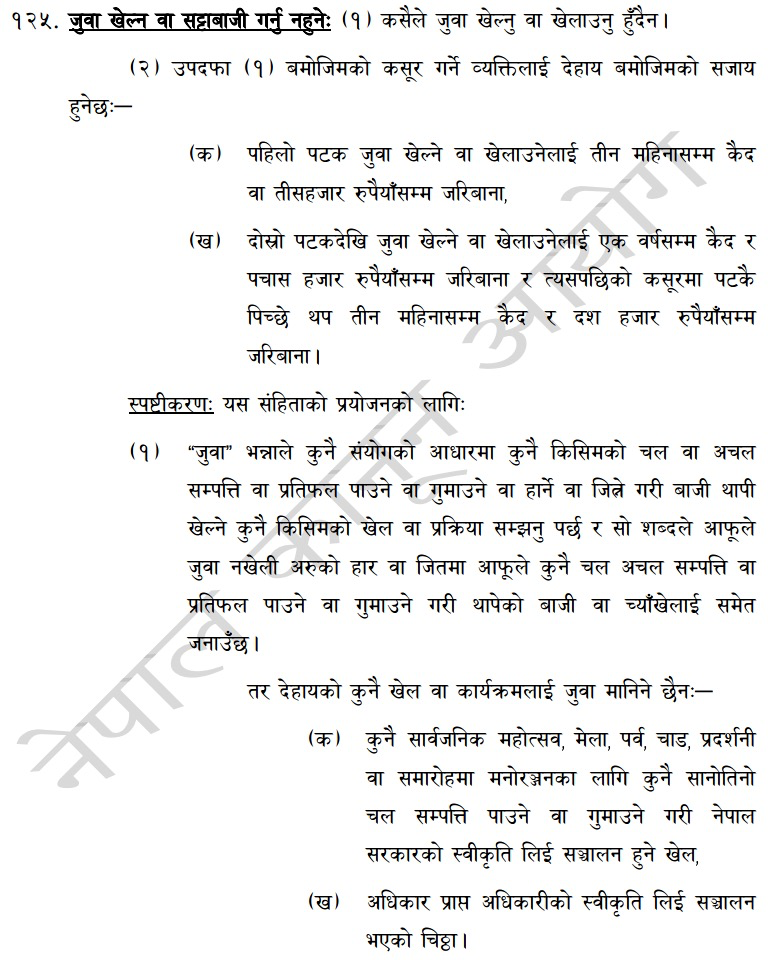
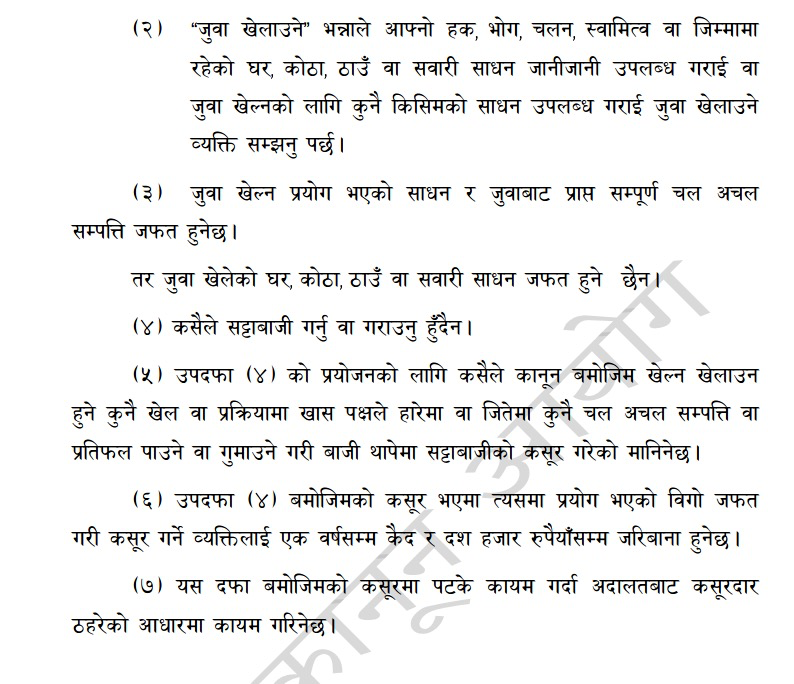
The starting point is Section 125 of the National Criminal (Code) Act, 2074, which defines gambling (Juwa) as any game or process played for the winning or losing of property or returns based on chance, and which separately, under Section 125(4), criminalizes betting (Sattabaji) – staking property on whether a party wins or loses in a game or process that is otherwise lawful. This second limb is the one that matters most for prediction markets, because it does not require the underlying event itself to be illicit or even random in any meaningful sense: staking money on the outcome of an election, a football match, or a court judgment is captured precisely because those processes are lawful, and the wager sits on top of them. A platform that lets users buy “shares” predicting who will win an election, or whether a central bank will raise rates, is functionally indistinguishable from the conduct Section 125(4) targets, regardless of how the platform brands itself. The Code’s only carve-outs are narrow and administrative: small-stakes festival games with government approval, and lotteries operated under the approval of an authorized officer. Neither describes an exchange-traded event-contract market, and the statute contains no general exemption for instruments with an investment or hedging character.
Juwa (Gambling): “Juwa” generally refers to participating in a game for money or valuables where winning depends predominantly on chance. The activity itself is the game.
Sattabaji (Betting/Wagering): “Sattabaji” means staking money on the occurrence or non-occurrence of an uncertain event. Here, the bettor is not necessarily participating in the underlying event – they are merely predicting its outcome.
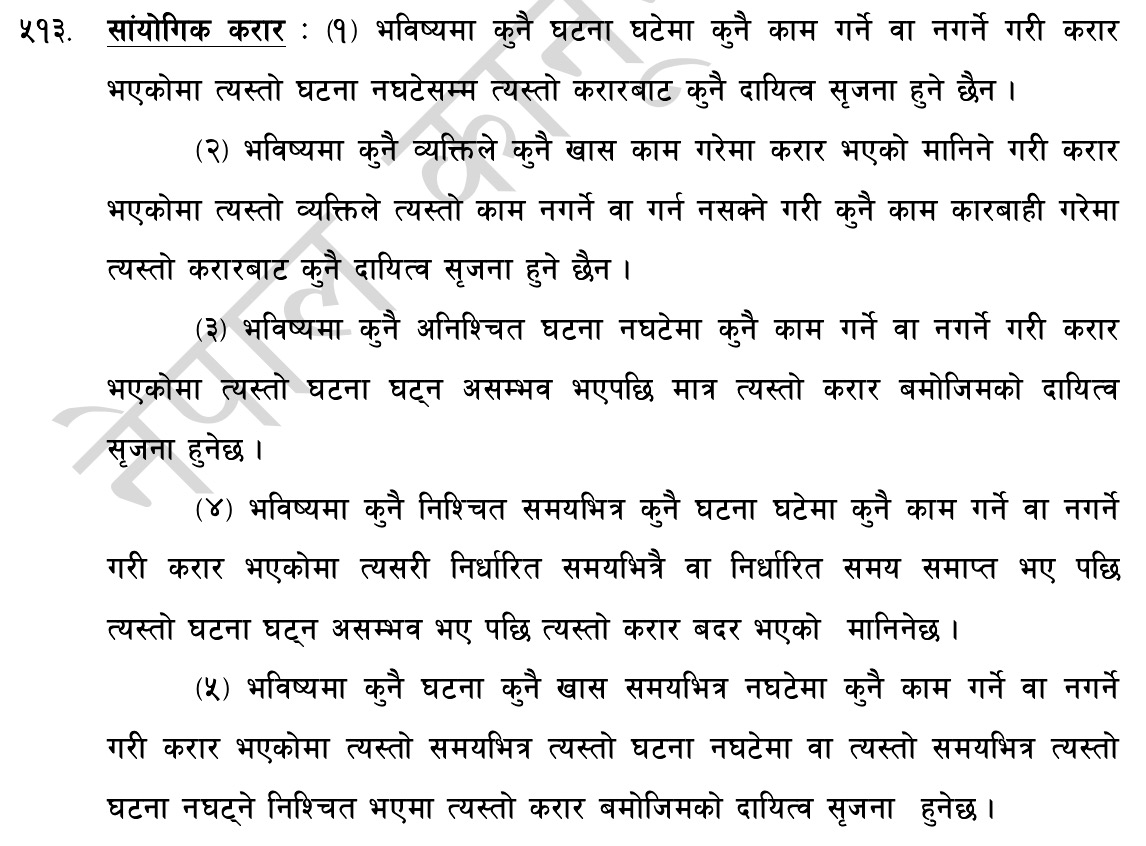
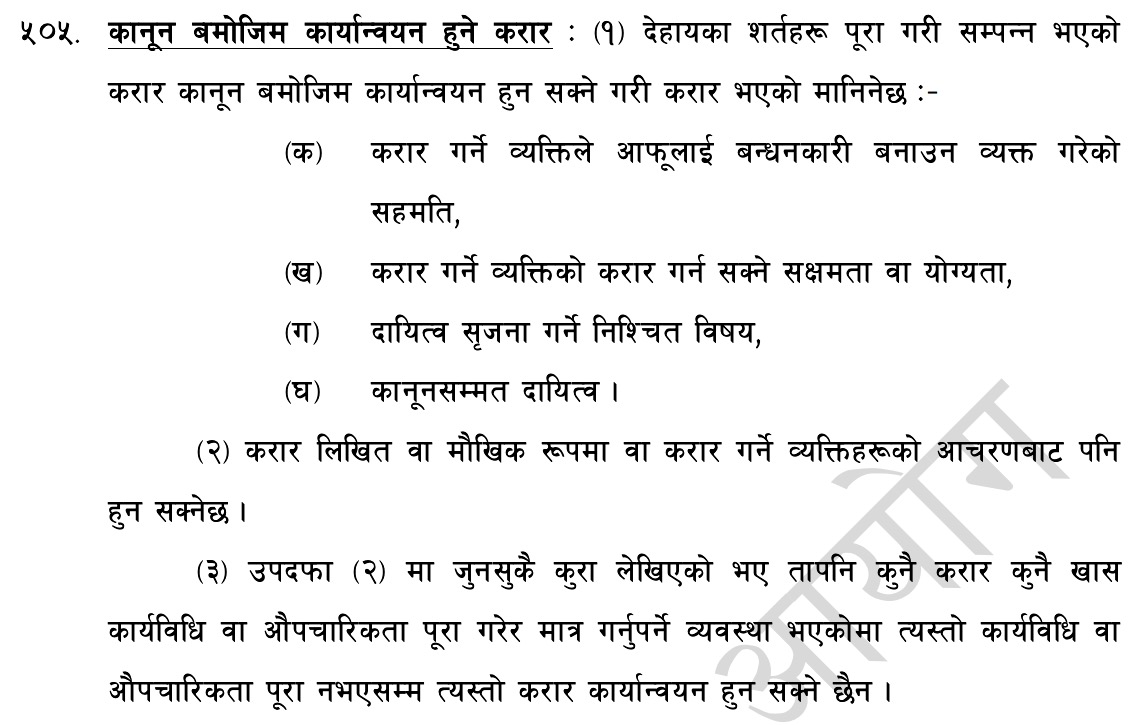
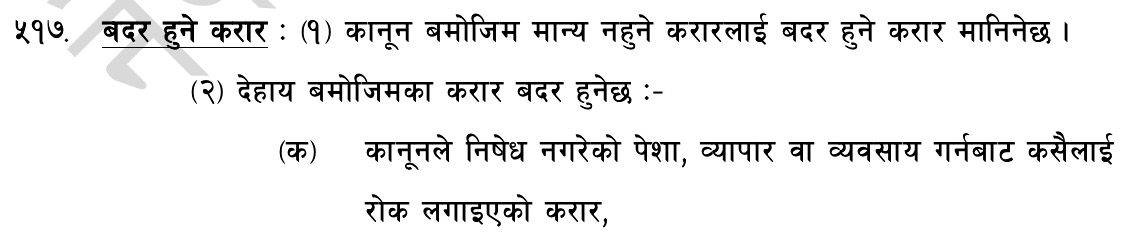
Civil law reinforces rather than tempers this position. The National Civil (Code) Act, 2074 recognizes contingent contracts under Section 513 – agreements to perform or not perform an act if a future event occurs – and this is, structurally, exactly what a prediction-market contract is. But recognition of the contingent-contract form is not the same as enforceability. Section 505 requires every contract to have a lawful purpose, and Section 517(2) voids contracts that are immoral, contrary to public interest, or whose subject matter is uncertain. Because betting is a criminal offence under Section 125, a contingent contract whose real character is a wager on that event has an unlawful purpose and is void ab initio; no Nepalese court would order specific performance of it, and Section 10 of the Civil Code – the principle that no one may profit from their own wrong – would bar a claim for “winnings” even if a platform tried to frame the dispute as an ordinary breach of contract. The structural resemblance between a contingent contract and a prediction-market share is therefore a false friend: it explains why the instrument looks financial, but it does not rescue it from the criminal characterization that determines its enforceability.
Constitutional Protection Is Real but Conditional
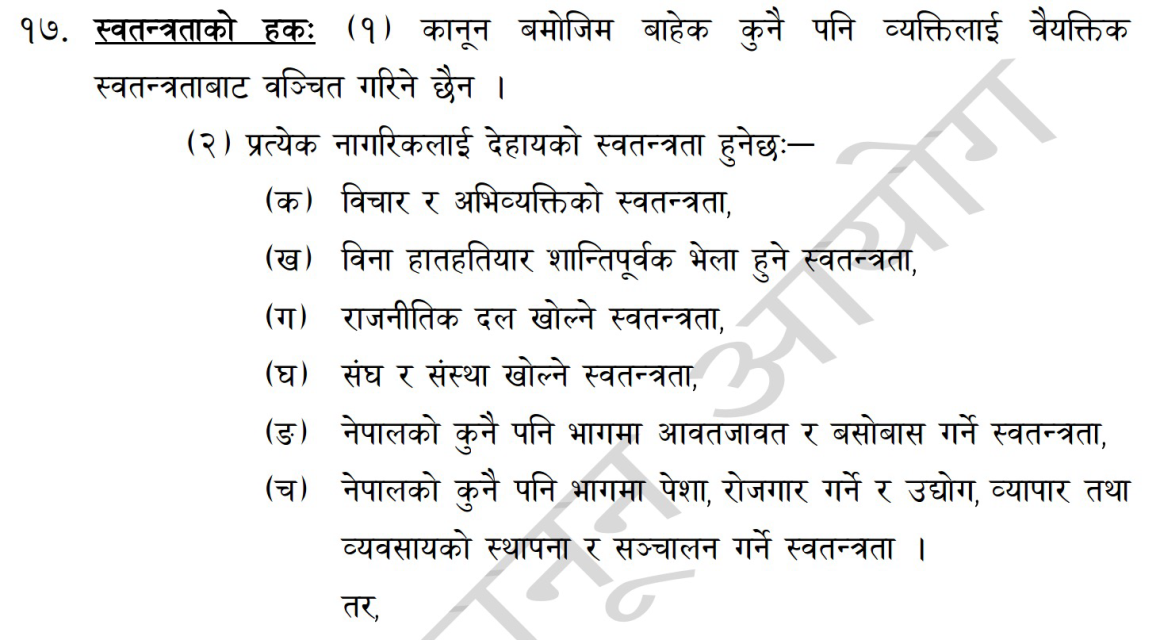
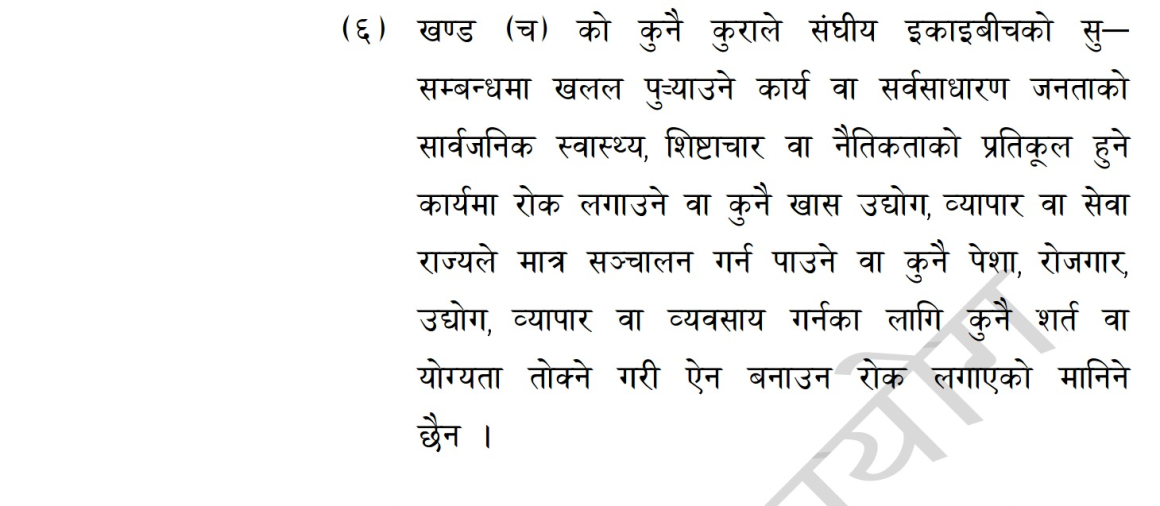
Article 17(2)(f) of the Constitution guarantees every citizen the freedom to establish and operate any industry, trade, or business, and this is the provision a prediction-market operator would invoke if challenged. The guarantee is genuine, but it is expressly qualified: the sixth proviso to Article 17(2) allows Parliament to impose reasonable restrictions on economic activity in the interest of public health, decency, or morality, and even permits the state to reserve certain activities to itself entirely. Article 25 extends a similar, conditional protection to property and commercial gain, but only “subject to law” – meaning a citizen cannot claim a constitutional right to profit from property or contracts that a validly enacted statute has already outlawed.
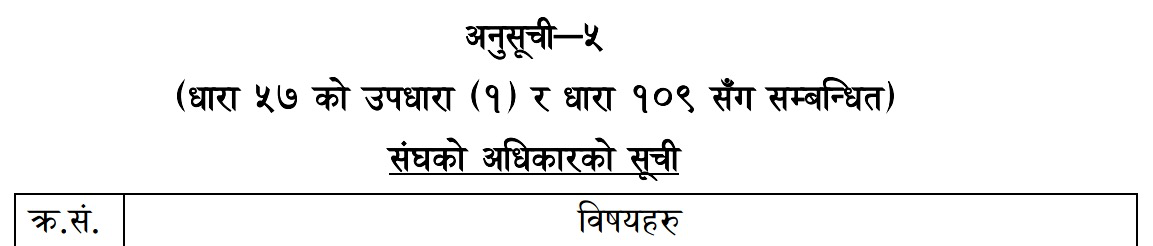
The Supreme Court’s own doctrine on how it reviews restrictions of this kind is unusually well developed for a jurisdiction without a dedicated prediction-market case, because it has already confronted the closely analogous question of cryptocurrency. In Sagar Baral v. Nepal Rastra Bank (2022) – ०७९-WO-०१४७, the Court upheld Nepal Rastra Bank’s blanket ban on cryptocurrency, reasoning that because virtual assets threaten monetary sovereignty and facilitate capital flight, the central bank’s pre-emptive, theory-based risk assessment was entitled to near-total deference – a notably more deferential posture than the Indian Supreme Court took in Internet and Mobile Association of India v. RBI (2020), where the ban was struck down for lack of empirical proof of harm. This “calibrated deference” doctrine – strict scrutiny for direct violations of individual rights such as employment, but high deference on questions of macroeconomic or systemic risk – maps onto prediction markets in an unfavourable way: a regulator’s argument that unregulated event-contract trading threatens capital flight, financial stability, or public morality would likely receive the same deferential treatment the cryptocurrency ban received, rather than the strict scrutiny reserved for direct rights infringements. Finally, Schedule 5 of the Constitution places central banking, securities regulation, and the criminal and civil codes exclusively within federal jurisdiction, foreclosing any possibility of a sub-national or provincial “prediction-market haven” within Nepal.


The Financial-Regulatory Pathway – and Its Two Hard Limits
The most promising route toward legality, on paper, runs through the Securities Board of Nepal (SEBON). Section 2(ch) of the Securities Act, 2063 defines “securities” to include any instrument the Board designates as tradable through a securities market, a genuinely open-ended catch-all that does not require new primary legislation to invoke.
A parallel route exists under the Commodities Act, 2074, whose Section 2(dh) defines a “commodity contract (derivative)” as an agreement between a buyer and seller to trade a commodity, with price, quantity, quality, and delivery date fixed at least thirty days in advance – a definition structurally compatible with an event contract, and one that already recognizes licensed “market makers” as a regulated category of intermediary.

If SEBON were to designate event contracts as securities, or to use its Rule 57 power to add non-physical events to the list of eligible commodities in Appendix 13 of the Commodities Exchange Market Rules, 2074 (currently limited to agricultural goods, metals, and oil), a Kalshi-style exchange would acquire a plausible statutory home.



Two structural features of the same framework, however, work directly against this outcome. First, Section 94 of the Securities Act deems a transaction “fake” or “artificial” if it does not result in a change of actual ownership – a rule aimed at preventing exchanges from becoming venues for pure price-difference betting, and one that sits uneasily with any cash-settled, binary-outcome contract unless SEBON is prepared to treat the contract itself as the property being owned and transferred.
Second, both the Compliance Guidelines for Securities Brokers and the Commodities Exchange Market Rules impose an explicit regulatory mandate to minimize speculation, which is in obvious tension with an instrument whose entire commercial value lies in facilitating speculation on an outcome. Neither obstacle is fatal in principle – SEBON could, through directive, reframe event contracts as risk-management or hedging instruments and define the contract as the ownable asset – but neither has happened, and more importantly, neither administrative fix would resolve the deeper problem: SEBON’s designation power is a tool for classifying financial instruments, not a tool for decriminalizing conduct that the National Criminal Code independently prohibits. A regulator cannot, through a notice or directive, exempt an activity from a parliamentary criminal statute; only Parliament can do that. This is precisely the conclusion the constitutional and jurisdictional material converges on: any regulatory sandbox or licensing regime for prediction markets would itself be vulnerable to challenge as ultra vires unless grounded in a new enabling Act that expressly reconciles the designation with the Criminal Code’s betting provisions.
Banking, Payments, and Foreign Exchange
Even setting the criminal and securities-law questions to one side, a prediction-market operator or user in Nepal runs into an independent and, in some respects, more immediate obstacle: access to the banking system. BAFIA, 2073, Section 49 provides an exhaustive list of activities licensed banks and financial institutions may undertake, and facilitating betting platforms or event-contract exchanges is not on it; Section 99(2)(kha) empowers Nepal Rastra Bank to sanction any institution that steps outside that list. NRB’s Unified Directive No. 20/081 goes further, expressly limiting the services a licensed institution may offer a customer to deposit-taking, payments, credit, and remittance – a closed list that has no room for escrow, custody, or settlement services for a wagering platform. Directive No. 19/081, governing anti-money-laundering compliance, categorizes casino and internet-casino operators as high-risk customers requiring enhanced due diligence and, where appropriate, a Suspicious Transaction Report filed through the goAML system – a classification prediction-market operators would almost certainly inherit by functional analogy. The Banking Offence and Punishment Act, 2064 separately criminalizes both the operation of informal financial pools (Section 14ka, aimed at Dhakuti-style schemes) and unauthorized banking generally (Section 14kha), either of which could capture a domestic exchange collecting and disbursing stakes outside the licensed banking perimeter.
For a Nepalese resident who instead tries to route around the domestic system by funding an offshore account on Kalshi or Polymarket, the foreign exchange regime closes that door independently. The Act Restricting Investment Abroad, 2021 (2064) imposes an absolute prohibition on Nepalese citizens making any investment abroad, a definition broad enough to capture depositing funds on a foreign platform to acquire event contracts. The Foreign Exchange (Regulation) Act, 2019, Sections 4 and 9(ga), requires any cross-border payment to be routed through an NRB-licensed dealer and criminalizes payments to unlicensed foreign entities – a category that includes every major offshore prediction market, none of which holds an NRB licence. Holding a balance in an offshore wallet or platform account without prior NRB approval independently breaches Section 16. Where the platform settles in stablecoins or other digital assets rather than fiat, NRB’s Unified Circular on Foreign Exchange removes any ambiguity by explicitly declaring virtual assets illegal for use in Nepal, closing off the one channel – decentralized, crypto-settled markets – that might otherwise have seemed to sit outside the reach of conventional foreign exchange law. Violations of these provisions carry fines of up to three times the amount involved, asset confiscation, and, for larger sums, mandatory imprisonment.
What a Nepalese Court Would Most Likely Do
The Supreme Court has not yet ruled on a prediction market, but its treatment of analogous disputes over gambling regulation, financial innovation, and digital platforms gives a reasonably confident basis for prediction. In a sequence of cases concerning licensed mini-casinos and electronic gaming Rock International Pvt. Ltd. v. Ministry of Tourism and Civil Aviation, Writ No. 067-WO-1038, the Court showed real solicitude for operators holding valid licenses and substantial sunk investment, protecting them under the doctrines of legitimate expectation and promissory estoppel – but crucially, that protection ran only to businesses already operating under a lawful permit; it offers nothing to an unlicensed platform seeking to establish a new right to operate. In cases testing the state’s police power over casinos (Maly Links Pvt. Ltd. Casino Venus v. Ministry of Culture, Tourism and Civil Aviation, Writ No. 072-WO-1069/073-NF-0044; Maajong Entertainment), the Court upheld sweeping restrictions, including an outright ban on citizen participation, as valid exercises of the state’s authority to protect public morality and financial discipline – precedent squarely applicable to any argument that banning citizen access to prediction markets is disproportionate. At the same time, the Court’s more recent engagement with genuinely novel technology platforms – Pathao’s ride-sharing model, e-commerce delivery during the COVID lockdowns, and the PUBG gaming-restriction case – shows a consistent pattern: the Court declines to permanently outlaw an innovative business model operating in a regulatory vacuum, but it does not grant it an unrestricted right to operate either. Instead it issues a directive order compelling the government to draft a dedicated regulatory framework, while typically leaving the activity constrained or suspended in the interim.
Applied to a Kalshi-style platform, the most probable outcome is a composite of these threads: the Court would decline to accept a “hedging” or “information-aggregation” label at face value, applying the substance-over-form and economic-reality analysis to look past the platform’s branding to its functional character as event-based wagering; it would treat the absence of SEBON or NRB licensing as dispositive against any claim of a present legal right to operate, consistent with its general deference to financial regulators’ exclusive licensing authority; and it would most likely quash the platform’s current operations while – echoing Pathao and the e-commerce cases – inviting or directing the Ministry of Finance, SEBON, and NRB to study whether a dedicated legislative framework should be created. That is a meaningfully different outcome from a simple, permanent prohibition, but it does not amount to a green light in the interim, and operators proceeding on the strength of that possibility would remain exposed to prosecution under the Criminal Code and the Banking Offence and Punishment Act while any such study proceeded.
Market Structure Matters, but Cannot Substitute for Legislation
Let’s also discuss whether structuring a platform as an exchange-traded bilateral contract with licensed market makers, central clearing, and collateral margining – rather than as a bookmaker-operated pool – would materially change this analysis. It would, but only at the margin. Such a structure aligns cleanly with the “buyer and seller” language of the Commodities Act’s derivative definition and with the Act’s existing recognition of market-maker intermediaries, and it supplies the kind of systemic-risk safeguards (a settlement guarantee fund, mandatory clearing) that distinguish a regulated exchange from an informal wagering pool. These features would strengthen SEBON’s hand if it chose to exercise its designation power, and they would likely feature prominently in any legislative drafting exercise. But they do not, by themselves, cure the two hard limits identified above – the ownership-transfer requirement under Section 94 of the Securities Act and the speculation-minimization mandate – and they do nothing to alter the underlying Criminal Code characterization of betting on lawful processes. A well-designed exchange is a necessary condition for eventual legality; it is not a sufficient one, because the legal obstacle is not the platform’s market microstructure but the criminal-law status of the activity it facilitates.
The regulatory landscape is correspondingly fragmented rather than unified. No single institution owns the question, and any operator would need to satisfy several of the following simultaneously rather than any one of them alone.
| Regulator / Body | Governing Law | Relevance to Prediction Markets |
| Nepal Rastra Bank (NRB) | NRB Act, 2058; BAFIA, 2073; FERA, 2019 | Blocks unlicensed payment/settlement rails; bans virtual-asset settlement; controls cross-border capital flow |
| Securities Board of Nepal (SEBON) | Securities Act, 2063; Commodities Act, 2074 | Sole body able to designate event contracts as securities or prescribed commodities |
| Ministry of Finance | Constitution Art. 115(2); Government Work Division Rules | Must sponsor any bill amending the Criminal Code or creating a licensing regime |
| Ministry of Home Affairs / Nepal Police | National Criminal (Code) Act, 2074; BOPA, 2064 | Investigates and prosecutes unlicensed platforms as illegal betting operations |
| Office of the Company Registrar | Companies Act, 2063 | May refuse incorporation absent prior SEBON/NRB clearance for the proposed objects |
A Brief Comparative Note
The fork Nepal faces mirrors, in broad outline, choices other jurisdictions have already made. In the United States, Kalshi operates as a Designated Contract Market regulated by the Commodity Futures Trading Commission under the Commodity Exchange Act – the derivatives-based route that Nepal’s Commodities Act structurally resembles but has never extended to non-physical, event-based underlyings. The United Kingdom instead absorbed betting exchanges directly into its gambling law, licensing operators such as Betfair under the Gambling Act rather than pretending the activity was something other than wagering – an approach with a rough analogue in Nepal’s licensed-casino model, which permits regulated wagering for a narrowly defined, tourist-facing sector while banning citizen participation outright. Singapore maintains a comparable dual track, routing genuine derivatives through the Monetary Authority of Singapore while keeping wagering-type contracts under its Gambling Control Act regime. What unites all three is that none of them purported to solve the classification question through the derivatives regulator’s administrative discretion alone; each rests on an explicit statutory choice, made by the legislature, about which regime a given instrument falls under. That is precisely the step Nepal has not yet taken, and precisely the step every path canvassed above eventually reaches as a precondition.
Bottom Line
As of July 2026, a Kalshi or Polymarket-style prediction market cannot be operated lawfully in Nepal, in any of its plausible forms. A domestically hosted exchange, however sophisticated its market-making, clearing, or collateral architecture, faces an unbroken chain of obstacles: the underlying contracts are void and unenforceable under the Civil Code because their purpose is criminal betting under Section 125(4) of the Criminal Code; no bank or payment service provider may lawfully process funds for it under BAFIA and NRB’s Unified Directives; and SEBON’s designation powers, while real, cannot lawfully be used to immunize conduct the Criminal Code independently prohibits. Resident participation in an offshore platform fares no better: the Act Restricting Investment Abroad and the Foreign Exchange (Regulation) Act criminalize both the outward payment and the offshore custody of funds, and NRB’s 2081 circular forecloses the stablecoin-settlement workaround entirely. The constitutional freedom of trade offers no rescue, because Nepal’s Supreme Court has already shown, in the cryptocurrency context, that it will defer heavily to the state’s public-morality and financial-stability justifications for exactly this kind of restriction.
This is not, however, a case of permanent or immovable prohibition. The legal architecture – the Securities Act’s designation clause, the Commodities Act’s derivative and market-maker definitions, and the Supreme Court’s demonstrated pattern of directing rather than permanently banning novel technology platforms – describes a workable, if narrow, route to eventual legality. That route runs through Parliament, not around it: a purpose-built Act, or a targeted amendment carving prediction markets or event contracts out of the Criminal Code’s betting provisions while placing them under SEBON’s supervision, sponsored by the Ministry of Finance and vetted by the Ministry of Law, is the only mechanism capable of resolving the conflict between the Criminal Code and any financial-regulatory designation on a durable footing. Until that legislative step is taken, every version of a prediction market examined in this article – bookmaker-style, exchange-traded, domestic, or offshore – remains outside the boundary of lawful commercial activity in Nepal, and any entrepreneur, investor, or platform proceeding on the assumption of regulatory ambiguity should treat that assumption as, at best, temporary and untested rather than as a defensible legal position.