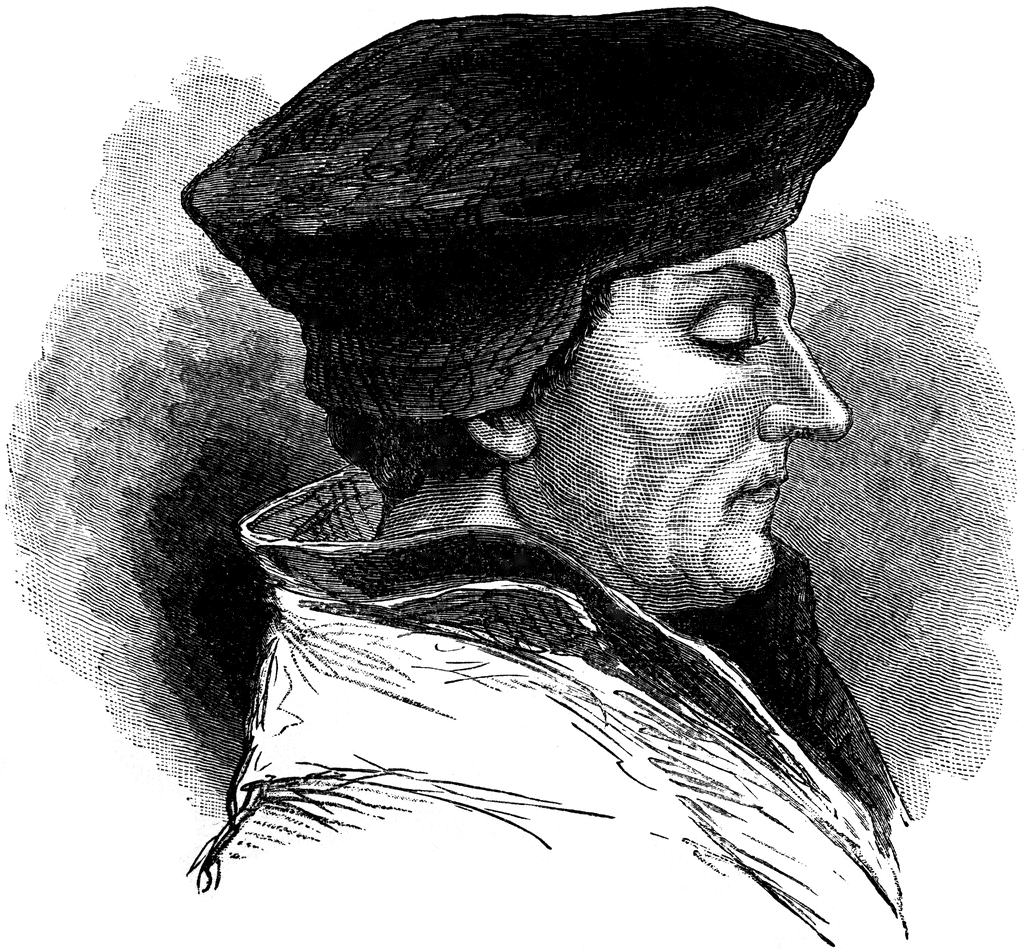
It appears there is a term for these S-tier individuals who emphasize the value, dignity, and potential of people, often focusing on reason, education, and ethics rather than relying solely on authority or tradition: it’s called “humanist.”
I was preparing an RSVP (Rapid Serial Visual Presentation) app, and after it was ready, I got stuck trying to name this tool, just for URL purposes. That’s when I discovered that the scholarship program where you change your university every six months, called Erasmus, actually takes its name from the great Dutch thinker and humanist Desiderius Erasmus Roterodamus, who expressed humanist ideas that Nikolayevich Tolstoy, a few centuries later, would draw on in writing his great novels.

From c. 5th – 4th century BCE, classical philosophers first explored the idea that strong attachments or habits are altered not by reasoning alone, but by redirecting focus toward higher pursuits. Plato, in works like Symposium and Phaedrus, examined how desire can be shifted from immediate, physical gratifications toward higher ideals, while Aristotle (Nicomachean Ethics, 4th c. BCE) emphasized that character and habits are transformed through the formation of new, positive practices. By the 1st century BCE – 1st century CE, Ovid in Remedia Amoris and Ars Amatoria articulated this principle in a psychologically vivid, practical manner, showing that human passions and attachments shift when attention and energy are directed toward new, compelling focuses. In the 4th – 5th century CE, Christian thinkers such as Augustine in Confessions moralized the idea, demonstrating that sinful tendencies are mitigated when replaced by devotion to higher spiritual aims.
During the Renaissance (15th – 16th century), humanists like Erasmus (c. 1466–1536) collected and popularized classical sayings, emphasizing that vice is best displaced by virtue through education and ethical cultivation. In the 17th – 18th century, writers like Montaigne and Pascal reinforced the observation that the heart follows its own logic, often responding to substitution rather than argument. From the late 18th to 19th century, literary figures such as Goethe, Jane Austen, Victor Hugo, and Tolstoy (1828–1910) dramatized the human experience of shifting attachments and moral transformation through new pursuits, illustrating the principle narratively and psychologically.
By the late 19th – 20th century, psychologists formalized the concept: William James emphasized habit formation (c. 1890), Freud analyzed displacement in the psyche (c. 1900s), and behavioral science demonstrated that old behaviors are modified or extinguished when reinforced by new patterns. In the 21st century, cognitive-behavioral therapy, neuroscience, and social psychology continue to validate this principle as a mechanism for changing human behavior, demonstrating an unbroken intellectual thread from classical philosophy (5th century BCE) to modern science.
But the best version to be ever versioned was from Desiderius Erasmus Roterodamus, who simply said “Novus Amor Veterem Pellit” – and in saying so, Erasmus becomes a solid S-tier humanist.