
The blacklisting of loan defaulters in Nepal – a sanction chosen by the creditor, recorded by a company that cannot refuse it, and adjudicated only after it has taken effect
SUMMARY: Inclusion in the blacklist maintained by Credit Information Bureau Ltd. is legally distinct from credit reporting, watchlisting, non-performing classification, provisioning and recovery action. It is a sanction, and Nepal’s courts describe its consequences as “nagarik adhikarbihinta” – civil death. Yet no one adjudicates it. The Supreme Court has held that the Bureau is a facilitator, not an adjudicator: the “verification” required of it by s. 88(1)(e) of the Nepal Rastra Bank Act, 2058 is identity-checking, not the determination of liability. The decision is therefore made by the creditor, and NRB Act s. 99(1) fines a bank that fails to recommend listing an amount equal to the borrower’s outstanding dues. No comparable penalty attaches to listing someone who should not have been listed. The safeguards in Directive 12/082 are real; the incentive to apply them runs the other way; and the only forum that weighs the sanction against the default is a court, reached by writ, after the account and rights has already been frozen.
Sources. Synthesised from research across – the NRB Unified Directive 2082 (principally Directives 12/082 and 2/082) and subsequent circulars, the Nepal Rastra Bank Act 2058 and its Credit Information Bylaws 2059, BAFIA 2073, the Debt Recovery Act 2058, the Companies Act and insolvency legislation, the National Civil Code 2074, the Constitution of Nepal, the Nepal Law Commission archive and the Nepal Gazette, Supreme Court, High Court and Debt Recovery Tribunal decisions, NRB annual and supervision reports, commercial bank annual reports, credit-rating reports, securities and NIFRA regulation, and one class-A bank’s internal blacklisting manual and credit policies.
I. Seven concepts, and only one of them is a sanction
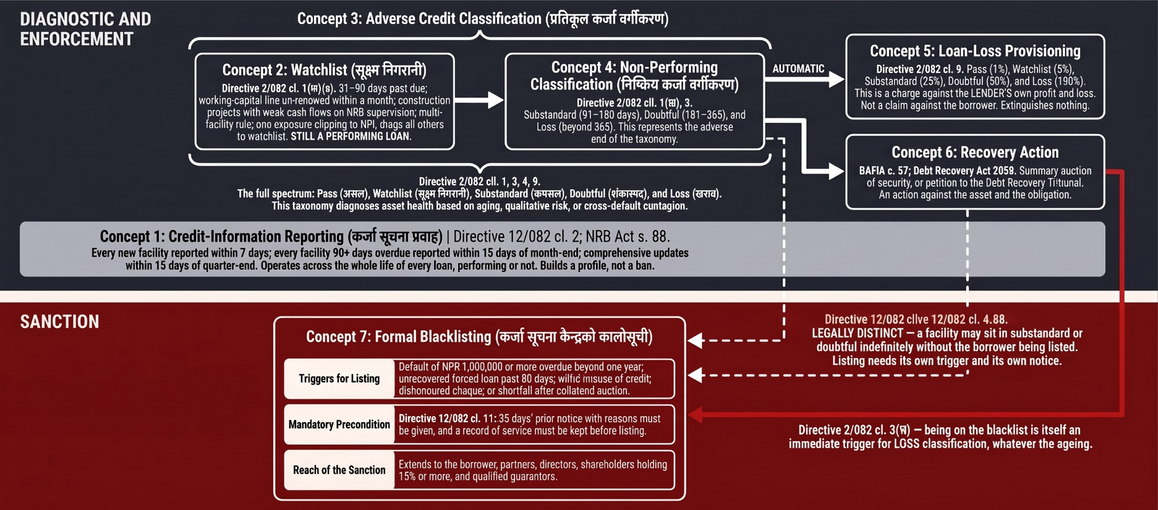
Nepali banking practice runs together a set of ideas that the directives keep carefully apart, and almost every dispute in this area begins with the conflation. A borrower whose facility has been reported to the Bureau has not been blacklisted. A borrower on the watchlist has not been blacklisted. A borrower whose loan is classified as loss and provisioned at a hundred per cent has not been blacklisted. A borrower whose collateral is under auction has not been blacklisted. Each of those is a distinct legal event with its own instrument, its own trigger and its own consequences. The seven are these.
- One – credit-information reporting, under Directive 12/082 cl. 2 and s. 88 of the NRB Act. A continuous statutory data-transmission obligation: every newly disbursed facility reported within seven days, every facility more than ninety days overdue reported within fifteen days of month-end, comprehensive updates within fifteen days of quarter-end. It runs across the whole life of every loan, performing or not, and it builds a credit profile rather than a ban.
- Two – watchlist treatment, under Directive 2/082 cl. 1(ka)(2). An early-warning classification within the performing category, triggered by principal or interest overdue between thirty-one and ninety days, by a short-term or working-capital line un-renewed within a month, by projects under construction whose cash flows NRB supervision deems weak, or by the multi-facility rule that drags every other exposure of a borrower to watchlist once one facility slips into non-performing. A watchlisted loan remains a performing loan; it does not signify default, does not stop banking access, and requires no Bureau measure at all.
- Three – adverse credit classification, under Directive 2/082 cll. 1, 3, 4 and 9. The overarching supervisory taxonomy covering the whole spectrum from pass and watchlist through substandard, doubtful and loss, grading exposures by ageing, qualitative risk or cross-default contagion. It diagnoses the health of the asset.
- Four – non-performing classification, the adverse end of that taxonomy: substandard from ninety-one to a hundred and eighty days, doubtful to a year, loss beyond it.
- Five – loan-loss provisioning, under Directive 2/082 cl. 9, which follows classification automatically at one, five, twenty-five, fifty and a hundred per cent. Provisioning is a charge against the lender’s own profit and loss. It is not a claim against the borrower, and it extinguishes nothing.
- Six – recovery action, under s. 57 of BAFIA or by petition to the Debt Recovery Tribunal: the enforcement of security and the pursuit of judgment. It is an action against the asset and the obligation.
- Seven – formal blacklisting, under Directive 12/082 cll. 4, 9, 11, 16 and 20 with s. 88 of the NRB Act. Inclusion in the national database maintained by Credit Information Bureau Ltd. It is the only one of the seven that is a sanction against a person rather than a treatment of an asset, and the corpus describes it as the most severe administrative and civil sanction in Nepal’s financial sector.
The first six are diagnostic, accounting or enforcement measures. The seventh is punitive, and it is governed by its own directive, requires its own thresholds – a default of NPR 1,000,000 or more overdue beyond a year, an unrecovered forced loan past ninety days, wilful misuse of credit, a dishonoured cheque, or a shortfall after auction – and demands its own thirty-five days’ notice. The corpus is explicit that non-performing classification does not blacklist: a facility can sit in substandard or doubtful indefinitely without the borrower being listed, because listing requires that separate trigger and that separate notice.
The relationship runs the other way as well, and asymmetrically. Under Directive 2/082 cl. 3(cha) the fact that a borrower already appears on the blacklist is itself an immediate trigger for loss classification, regardless of how many days the facility is overdue. Classification does not produce listing; listing produces classification.
| WHICH DIRECTIVE GOVERNS WHAT Two instruments do most of the work. Directive 2/082 (कर्जा प्रवाह, वर्गीकरण तथा कर्जा नोक्सानी) governs disbursement, classification and provisioning. Directive 12/082 (कर्जा सूचना तथा कालोसूची) governs credit information and blacklisting. |
II. Who decides, and who cannot refuse
Section 88(1) of the Nepal Rastra Bank Act, 2058 empowers the central bank to establish a credit information bureau, and sets out six functions. Clause (c) requires banks compulsorily to supply the list of defaulting borrowers and borrowers misusing credit. Clause (e) then requires the Bureau, having verified – यकिन गरी – the names received under clause (c), to place them on the blacklist and take necessary action. That single word is where the entire architecture of this subject turns, because everything depends on whether “verify” means to check an identity or to determine a liability.
The institution doing the verifying is not a regulator. Under Bylaw 3 of the NRB Credit Information Bylaws, 2059 the Bureau was incorporated as a public limited company under the Companies Act, operating as Credit Information Bureau Ltd. from Heritage Plaza, Kamaladi. It is owned by the institutions whose recommendations it processes. And Bylaw 6 describes its function in mechanical terms: on a letter from a bank requesting listing, it lists; on a letter requesting removal, it removes.
The Supreme Court has construed the arrangement authoritatively, and against the Bureau having any adjudicative role at all. In Kiran Bahadur Khadki, Babu Raja Shakya and Mangal Man Shakya v. Nepal SBI Bank Ltd., NIDC Development Bank Ltd. and Credit Information Bureau Ltd. – a Division Bench of Justices Cholendra Shumsher JBR and Jagdish Sharma Paudel, Nos. 071-CI-0830 and 071-CI-0831, decided 2073-02-11 – the Court analysed Bylaw 6 and held that a coordinating role exists between the Bureau and the banks, and that the Bureau acts as a facilitator among member institutions. The facts are worth stating because they show what that means in practice. Color Scan Nepal Ltd. (Case No: 071-CI-0830) defaulted on consortium loans; the Debt Recovery Tribunal adjudicated the directors’ personal liability and confined it to their unpaid share capital under s. 53(3) of the Companies Act; the directors paid it in full; and the consortium banks nonetheless refused to write for delisting, on the footing that directors must remain listed until the company’s entire residual debt is cleared. The Bureau, in its own written statement, pleaded that it had no independent power to remove a name without a bank’s recommendation. The Supreme Court overturned the High Court and issued mandamus ordering immediate delisting.
| A tribunal had determined the liability. The directors had discharged it. The blacklist stayed in place anyway, because the only two institutions able to lift it were the creditor that wanted it there and CIBN that had told the Court it could not act alone. |
The corollary is that a defective recommendation produces a defective listing, and the Court has acted on both. In Cube Intercontinental Pvt. Ltd. and its directors v. Citizens Bank International Ltd. and Credit Information Bureau Ltd. – Chief Justice Ram Kumar Prasad Shah and Justice Jagdish Sharma Paudel, writs 069-WO-0077 and 069-WO-0341, decided 2071-08-17 (3 December 2014) – a dealer for Eicher Motors had facilitated retail vehicle financing by Citizens Bank. When the retail customers defaulted, the bank recommended blacklisting the dealer and its directors as “guarantors.” The Bureau’s written response set out its own position squarely: under cl. 4 of the then Directive 12/068 it was legally bound to treat information supplied by licensed banks as authentic and official, and to enter recommended defaulters within fifteen days. The Court held that the bank held no written guarantee deed and no blacklisting consent from the dealer or its directors, that cl. 13 of the directive required such a deed, and that an unlawful recommendation cannot found a lawful listing. It quashed by certiorari the bank’s recommendation letter, the Bureau’s decision, and the Bureau’s listing notifications.
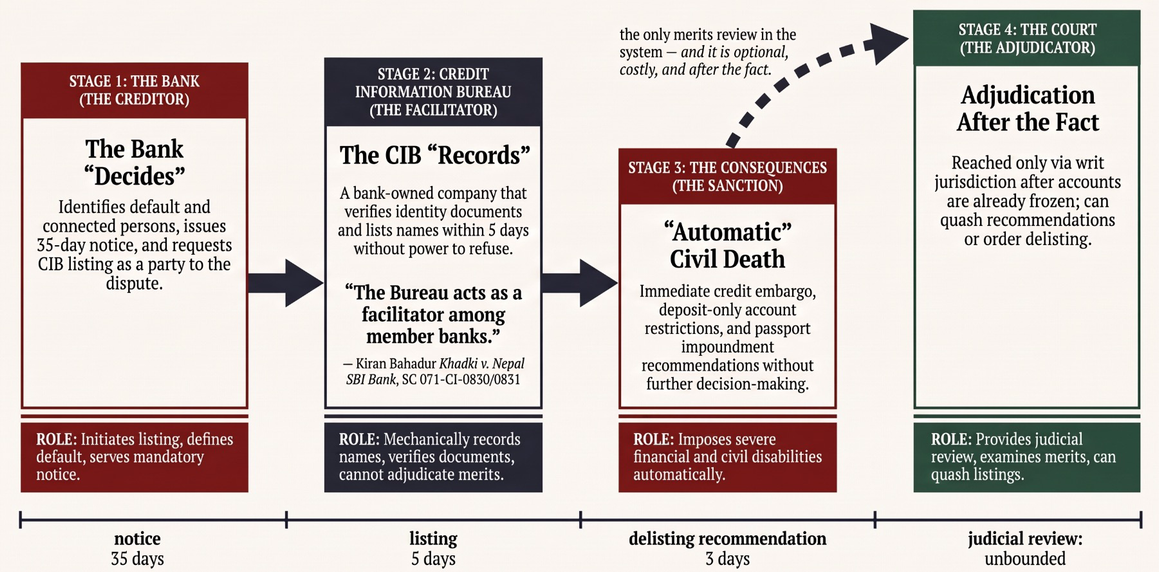
| NRB Unified Directive 2082, Directive 12/082 – Clause 4(2): listing within five days कर्जा सूचना तथा कालोसूची सम्बन्धी व्यवस्था › cl. 4(2) |
| ORIGINAL TEXT (२) इजाजतपत्रप्राप्त संस्थाको सिफारिसमा केन्द्रले व्यक्तिको हकमा आधिकारिक परिचय खुल्ने प्रमाणपत्र (नागरिकता/राहदानी आदि) र फर्म, कम्पनी वा संस्थाको हकमा दर्ता प्रमाणपत्र, स्थायी लेखा नम्बर लगायतका विवरण यकिन गरी पाँच दिनभित्र कालोसूचीमा समावेश गर्नु पर्नेछ । |
| ENGLISH – CONVENIENCE RENDERING (2) On the recommendation of a licensed institution, the Bureau shall, having verified the particulars – in the case of an individual, the certificate disclosing official identity (citizenship, passport and the like), and in the case of a firm, company or institution, the registration certificate, permanent account number and other details – include the name on the blacklist within five days. |
| EDITORIAL NOTE This is the whole of the verification the statute’s word यकिन गरी is given. It is an identity check. Nothing in the clause requires the Bureau to examine whether the debt is owed, whether the notice was served, or whether the person recommended is in fact a guarantor or director – which is precisely why the Supreme Court in Cube Intercontinental had to quash the Bureau’s listing along with the bank’s recommendation rather than expecting the Bureau to have caught the defect. |
| Source: NRB Unified Directive 2082 for class “क”, “ख” and “ग” institutions, Directive No. 12/082, cl. 4(2), at p. 105. |
III. What listing does
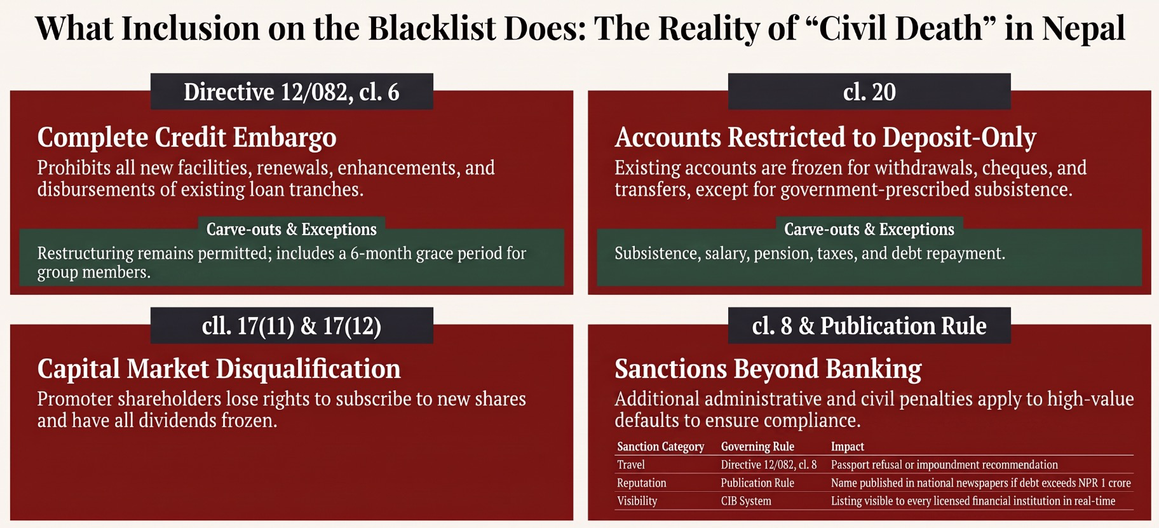
The consequences of inclusion are set out across Directive 12/082 in clauses that are rarely read together, and reading them together is the only way to see the scale of what is being imposed. They fall into four groups.
The credit embargo comes first, under cl. 6. A listed person, firm, company or organised institution may not be granted any new credit facility, may not have an existing facility renewed, may not be given additional credit, may not receive the remaining instalments of a facility already sanctioned, and may not have a guarantee accepted from them. Because “सुविधा” covers funded and non-funded limits alike, the bar extends to letters of credit and bank guarantees, including the rollover of existing ones. Two carve-outs survive: cl. 6(ka) preserves the bank’s ability to restructure and reschedule what is already outstanding, and cl. 6(kha) gives other members of a connected borrowing group who are servicing their own obligations regularly a six-month exemption, extendable once by the board.
Second, the accounts. Under cl. 20(ka) no new account of any kind may be opened in a listed name, save for the receipt of social security allowance, salary or pension. Under cl. 20(kha) an existing account may receive deposits and do nothing else – no withdrawal, no cheque, no electronic transfer, no third-party payment. The exceptions to that rule are the most revealing provision in the whole directive, because of what they concede.
| NRB Unified Directive 2082, Directive 12/082 – Clause 20(ख): the deposit-only rule and its exceptions कालोसूचीमा समावेश भएकाहरुको खाता संचालन सम्बन्धी व्यवस्था › cl. 20(ख) |
| ORIGINAL TEXT (ख) कालोसूचीमा रहेको व्यक्ति, फर्म, कम्पनी वा संस्थाको कायम रहेको खातामा रकम जम्मा गर्न बाहेक अन्य बैकिङ्ग कारोबार गर्न पाइने छैन ।तर, दैनिक जीवनयापनको लागि चाहिने आधारभूत आवश्यक खर्चका प्रयोजनको लागि नेपाल सरकारबाट तोकिएबमोजिमको हदसम्मको रकम निकाल्न, कानून बमोजिम प्राप्त भएको पारिश्रमिक, सामाजिक सुरक्षा भत्ता, पेन्सन लगायतका रकम निकाल्न, … नेपाल सरकारलाई बुझाउनु पर्ने कर, शुल्क, दस्तुरआदि तिर्न … यस व्यवस्थाले बाधा पुगेको मानिने छैन । |
| ENGLISH – CONVENIENCE RENDERING (kha) In an existing account of a person, firm, company or institution on the blacklist, no banking transaction other than the deposit of money may be carried out.Provided that this provision shall not be deemed to bar the withdrawal of an amount up to the limit prescribed by the Government of Nepal for the basic necessary expenses required for daily living; the withdrawal of remuneration lawfully received, social security allowance, pension and similar amounts; … the payment of taxes, fees, charges and the like payable to the Government of Nepal; … |
| NOTE: The ellipses mark matters – principally the allowance for withdrawing government and provincial grants up to the amount granted, the allowance for operating the account solely to repay bank debt, and the joint-venture exception. Note what the proviso concedes: a person on the blacklist requires an express regulatory exemption, capped at a figure the Government prescribes, in order to withdraw money to live on. |
| Source: NRB Unified Directive 2082, Directive No. 12/082, cl. 20(ख), at p. 118 (directive p. 113); read with cl. 9(3)(घ) at p. 109 and cl. 20(क) at the same page. |
Third, the securities consequences, which reach beyond banking into the capital market. Under cll. 17(11)(ka) and 17(12)(ka) a promoter shareholder of any bank or financial institution who is on the blacklist may not subscribe to rights shares, preference shares or debentures – of the institution he promoted or of any other licensed institution – with a proviso allowing the entitlement to be claimed on proof of delisting, but only if the securities have not already been auctioned, sold, allotted or forfeited. Under cll. 17(11)(kha) and 17(12)(kha) the dividends of a listed shareholder are frozen, and on proof of arrears from any lender the issuing institution must remit them to that lender rather than to the shareholder. A blacklisted shareholder therefore forfeits both the right to participate in a capital raise and the income from shares already held.
Fourth, the sanctions that leave the financial system altogether. Under cl. 8 a bank may recommend, through Nepal Rastra Bank to the Government of Nepal, that a listed person’s passport be refused or impounded; the bank cannot do this itself, but it initiates it. Where the dues exceed one crore rupees the name is published in a newspaper. And the listing is visible to every licensed institution in the country in real time.
IV. How it actually happens
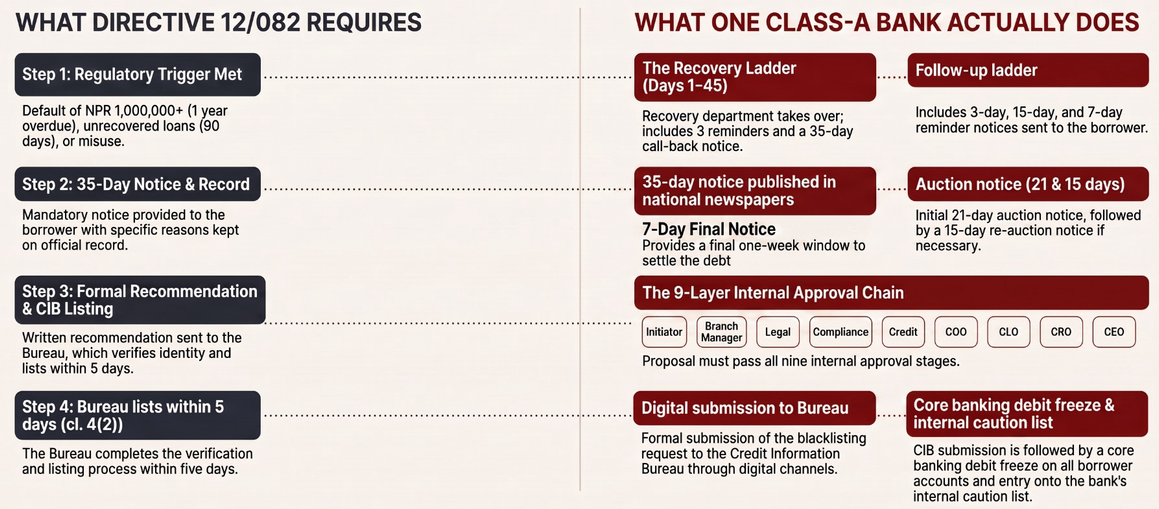
The directive describes what must occur. One class-A bank’s internal documents describe what does occur, and the comparison is instructive in both directions – the internal process is considerably more elaborate than the regulator requires, and it is elaborate in ways that protect the bank rather than the borrower.
Blacklisting at that institution is governed by four instruments: a Credit Manual and Credit Policy, a Blacklisting Manual establishing a centralised web application for memo routing and document ingestion, an Operation Manual which allocates duties between branches, the credit information cell and the centralised account opening unit, and Loan Write Off By-Laws which make blacklisting a prerequisite to writing off a non-performing loan. That last provision deserves a moment: a bank cannot clear a bad debt from its own books until it has listed the debtor. The internal incentive to list therefore compounds the regulatory one described in Part VI.
The workflow runs in eight stages. The recovery department assumes direct management of any loan more than forty-five days overdue and circulates daily overdue reports. A structured follow-up ladder begins with a telephone call within three days of the first missed instalment, proceeds to a first reminder giving fifteen days and a second giving seven, and culminates in a third letter in the form of a thirty-five day facility call-back notice, published in national newspapers on the chief executive’s approval routed through the Loan Recovery Committee and delivered in writing to the borrower and guarantors within three working days of publication. A seven-day final notice follows, then a twenty-one day auction notice, then a fifteen-day re-auction notice.
Only after that does the blacklisting proposal begin, and it passes through nine hands: initiator, branch manager, legal, compliance, head of credit or deputy chief operating officer, chief operating officer, chief legal officer, chief risk officer, and chief executive. The proposal is then entered into the blacklisting application, which auto-extracts the customer information file and requires citizenship documents, the notices served and the loan particulars to be uploaded. The credit information cell reviews the file and submits it to the Bureau’s portal. On confirmation the cell downloads the inclusion letter and the centralised account opening unit imposes the debit freeze in the core banking system. The name is added to an internal caution list reviewed quarterly by the Credit Review Committee. Delisting reverses the chain: full settlement, a memorandum approved by the chief executive through the Loan Recovery Committee, and a release submitted by the cell.
| ON USE OF ONE CLASS-A COMMERCIAL BANK’S DOCUMENT The material in this Part comes from a single class-A commercial bank, anonymised throughout. It is used to show what a well-documented lender does, not what the market does, and no inference should be drawn from it about institutions whose internal procedures are not in the corpus.The comparison nonetheless carries weight in one direction. Where an institution with a nine-signature approval chain, a dedicated automation platform and quarterly committee review still produces no step at which anyone independent of the creditor weighs the merits, the deficiency is structural rather than a matter of institutional diligence. |
V. The safeguards, and the incentive that runs against them
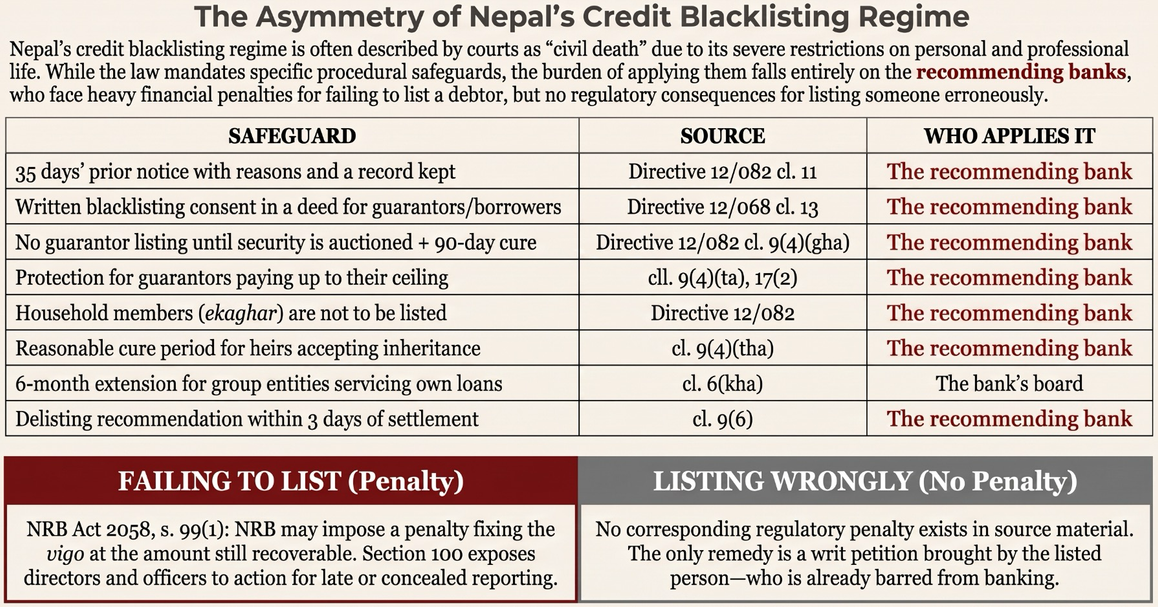
It would be wrong to describe the framework as lacking protections. Directive 12/082 contains a considerable number, and several are more generous than a creditor would choose. The difficulty is not their absence but their custody: every one of them is applied by the bank that benefits from not applying it, and the only regulatory penalty in this area points in one direction.
The principal safeguard is the pre-listing notice under cl. 11. At least thirty-five days before recommending anyone – the borrower or any other party connected with the loan – the bank must give notice stating the reasons, must state in that notice that listing will follow if the debt is not cleared or regularised within the stated period, and must keep a record of having done so. Service on the person, on a member of their household or at an institution connected with their business will do; failing that, publication in a national daily.
| NRB Unified Directive 2082, Directive 12/082 – Clause 11: notice before inclusion कालोसूचीमा समावेश गर्नुपूर्व सूचना दिनु पर्ने › cl. 11 |
| ORIGINAL TEXT ११. कालोसूचीमा समावेश गर्नुपूर्व सूचना दिनु पर्ने: कुनै पनि ऋणी वा ऋणसँग सम्बन्धित अन्य सबै पक्षलाई कालोसूचीमा समावेश गर्नुपूर्व सम्बन्धित इजाजतपत्रप्राप्त संस्थाले कालोसूचीमा समावेश गर्नुपर्ने कारणसहित कम्तीमा पैंतीस दिन अगावै सूचना दिई सो को अभिलेख राख्नु पर्नेछ । उक्त सूचना प्रदान गर्दा तोकिएको म्यादभित्र ऋणीले कर्जा चुक्ता वा नियमित नगरेमा कालोसूचीमा समावेश गरिने व्यहोरा उल्लेख भएको हुनु पर्नेछ । |
| ENGLISH – CONVENIENCE RENDERING 11. Notice to be given before inclusion in the blacklist: Before including any borrower, or any other party connected with the loan, in the blacklist, the licensed institution concerned shall give notice at least thirty-five days in advance, together with the reasons for which inclusion is to be made, and shall keep a record of the same. When giving such notice, it must state that if the borrower does not clear or regularise the loan within the stated period, inclusion in the blacklist will follow. |
| Source: NRB Unified Directive 2082, Directive No. 12/082, cl. 11. |
Beyond notice, the directive carves out a series of persons and situations. A guarantor may not be listed until the borrower’s security has been auctioned and the proceeds applied; if a shortfall remains, the guarantor must be given ninety days to pay it, and only after that period may the guarantor be listed – with newspaper publication required if the written notice cannot be delivered. A guarantor who pays up to the ceiling of the guarantee is protected from listing for the borrower’s remaining balance, and must be delisted if already listed. Members of the undivided family household “ekaghar” of a listed person are not to be listed merely for that relationship. The heirs of a deceased borrower who accept the inheritance are given a reasonable period to clear or restructure before any listing. Group entities servicing their own obligations get six months. And a joint venture is not disabled merely because one partner is listed.
Set against all of that is a single provision that explains why the safeguards underperform. Where a bank ought to have recommended a person for listing under the directive and has not done so, Nepal Rastra Bank may impose a penalty under s. 99(1) of the NRB Act, 2058 calculated by fixing the disputed amount “bigo” at the amount still to be recovered from that borrower. A further provision exposes the institution and its directors and officers to action under s. 100 for failing to supply particulars to the Bureau in time, or concealing facts and extending further credit. There is no corresponding penalty anywhere in the corpus for recommending a person who should not have been recommended.
| A bank that under-lists faces a fine measured by the whole outstanding debt. A bank that over-lists faces nothing, unless the person it wrongly listed can afford to litigate. The safeguards are administered by the party for whom only one kind of error is expensive. |
VI. Connected persons: the veil lifted without a hearing
Blacklisting does not stop at the borrower, and this is where its administrative character does the most work. Who else is listed depends on the legal form of the borrowing, and the directive prescribes the answer rather than leaving it to be litigated.
| Borrower’s legal form | Who is listed with it | The legal problem |
|---|---|---|
| Sole proprietorship (प्रोप्राइटरसीप फर्म) | The firm and the natural person registered as proprietor, simultaneously. Personal accounts, personal assets and personal credit are frozen with the business. | None in principle – proprietor and firm are the same legal person. The severity is the issue, not the attribution. |
| Partnership (साझेदारी फर्म) | The firm and every active partner. Each partner’s personal accounts are restricted and personal borrowing capacity suspended across the system. | Partnership liability is joint and several as a matter of general law, but the directive lists partners without any finding on their individual participation. |
| Private or public company | The company, its directors, and shareholders holding 15 per cent or more, together with any guarantors who executed the required deed. | The corporate veil is set aside administratively. No adjudication establishes that the director caused, permitted or benefited from the default. |
| Any borrower, on a dishonoured cheque | The issuing entity and, personally, the natural person who signed the cheque, after seven days’ notice excluding public holidays and on the holder’s request. | A signatory may be an employee acting on instruction. Listing follows the signature, not the responsibility. |
| Deceased borrower | Heirs who accept the inheritance, and only after a reasonable period to clear or restructure, and only if they refuse the liability or fail to pay. | This is the directive’s most careful provision – and shows it can distinguish culpability when it chooses to. |
| Household of a listed person | Not to be listed. Members of the undivided family household are expressly excluded from listing merely by reason of the relationship. | An express exclusion, and evidence that the drafter understood the risk of contagion by association. |
Table: Who is listed alongside the borrower, and on what basis. Compiled from Directive 12/082, principally cll. 9 and 16.
The director case is the one that has repeatedly reached the courts, and Khadki is the authority. There the Debt Recovery Tribunal had done precisely what no part of the blacklisting pipeline does: it heard the parties, applied s. 53(3) of the Companies Act, and fixed the directors’ personal liability at their unpaid share capital. They paid it. The Supreme Court held that once a competent judicial forum has determined an individual’s liability and that liability has been satisfied, neither the banks nor the Bureau may keep the individual listed against the company’s residual debt. That holding is narrow on its facts and enormous in its implication: it concedes that the administrative listing had attributed to the directors a liability that no forum had found them to bear.
VII. Insolvency: the stay that does not reach the listing
Where the borrower is a company that enters insolvency, the Insolvency Act, 2063 imposes an automatic moratorium the moment the court orders proceedings to commence under s. 10(2). Section 19(1) suspends, by operation of law, the transfer of the company’s shares, the transfer sale pledge or mortgage of any of its property, the attachment of its assets or enforcement of security under any judgment or order, the recovery of leased property by a lessor, the payment of any debt outstanding or payable at the commencement date or the furnishing of security for it, and the transfer or withdrawal of funds from the company’s accounts. Section 11(2) allows the court, while the petition is pending, to restrain any creditor from commencing or continuing proceedings against property in the company’s possession. The summary auction power in s. 57 of BAFIA is suspended along with everything else.
| Insolvency Act, 2063 – Section 19(1): actions automatically stayed दामासाही सम्बन्धी ऐन, २०६३ › s. 19(1), clauses (क) to (च) |
| ORIGINAL TEXT दफा १० को उपदफा (२) बमोजिम अदालतले दामासाहीसम्बन्धी कारबाही प्रारम्भ गर्ने आदेश दिएको मितिदेखि देहायका कामकारबाही स्वतः स्थगित हुनेछन् :– (क) कम्पनीको शेयर हस्तान्तरण गर्ने, (ख) कम्पनीको कुनै पनि जायजेथा हस्तान्तरण, बेचबिखन गर्ने वा कुनै किसिमले धितो वा बन्धक राख्ने, (ग) कुनै फैसला वा आदेश अनुसार कम्पनीको कुनै जायजेथा जायजात गर्ने वा धितोको सम्पत्ति चलन चलाउने, (ङ) … भुक्तानी गर्न बाँकी रहेको वा भुक्तानीयोग्य भएको ऋण भुक्तानी गर्ने वा सोबापत सुरक्षण दिने, र (च) कम्पनीको कोषको रकम हस्तान्तरण गर्ने वा फिर्ता लैजाने। |
| ENGLISH – CONVENIENCE RENDERING From the date on which the court issues an order to commence insolvency proceedings under sub-section (2) of section 10, the following actions shall be automatically stayed:– (a) transferring the shares of the company; (b) transferring or selling any property of the company, or placing it in any manner under pledge or mortgage; (c) attaching any property of the company pursuant to any judgment or order, or taking possession of mortgaged property; (e) … paying any debt outstanding or payable, or furnishing security therefor; and (f) transferring or withdrawing the funds of the company. |
| Source: Insolvency Act, 2063, s. 19(1), as carried in the research corpus together with the treatise दामासाही सम्बन्धी कानून prepared under the auspices of the Asian Development Bank and FNCCI, and the company law treatise of the late Bharat Raj Upreti. |
The omission matters in two directions. Nothing in s. 19 stays a blacklisting recommendation or requires an existing listing to be lifted, so a company in court-supervised restructuring may remain listed – and its directors with it – while every enforcement step against its assets is frozen. And clause (nga) produces a genuine conflict with the delisting rule: the moratorium prohibits the company from paying any debt outstanding at commencement, while cl. 9(6) of Directive 12/082 makes payment of the overdue principal and interest the primary route off the list. The company is forbidden by one statute from doing the thing the other requires of it in order to be released.
| Insolvency freezes the debt and leaves the sanction running. The company cannot lawfully pay, and cannot be delisted without paying, and its directors remain excluded from the banking system throughout a process designed to rehabilitate the business. |
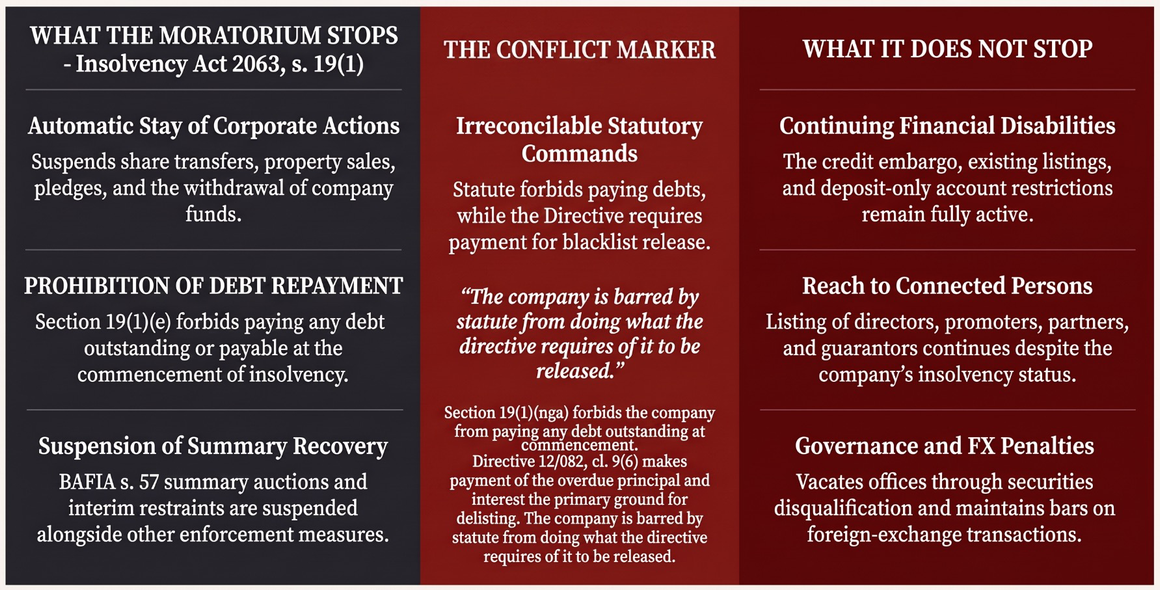
| AN OPEN QUESTION, FLAGGED RATHER THAN ANSWERED The conflict between s. 19(1)(nga) of the Insolvency Act and cl. 9(6) of Directive 12/082 is real on the face of the two instruments. No decisions were found resolving it, and no record on whether NRB has issued guidance treating a commencement order as a ground for suspending a listing.The directive’s other delisting grounds – including the taking over of security as a non-banking asset in full satisfaction – might be argued to remain open during a moratorium. Alternatively, a court might treat the s. 19 stay as impliedly suspending the listing itself. |
VIII. The only forum that weighs it
Everything described so far happens without anyone asking whether the sanction fits the default. That question is asked in exactly one place, and it is asked late. Nepal’s courts have taken jurisdiction over blacklisting through writ, and they have done so on an expressly constitutional footing: because inclusion curtails the freedom to practise any profession, trade or business under Article 17(2)(cha), the right to property under Article 25, and individual dignity under Article 16, they treat a recommendation not as a routine administrative entry but as a drastic measure – the decisions record the courts describing its consequences as “nagarik adhikarbihinta” – a civil death, and treating blacklisting as a measure of last resort.
The remedies granted follow the two defects the pipeline structurally produces. Where the recommendation itself was unlawful, certiorari issues against both the bank’s letter and the Bureau’s listing – Cube Intercontinental, where no guarantee deed and no blacklisting consent existed. Where the listing has outlived the liability, mandamus issues to compel delisting – Khadki, where a tribunal had fixed and the directors had discharged the only liability they bore. A third line, recorded in the Tribunal material, holds that where the underlying debt is judicially determined to be unenforceable and time-barred, maintaining a lifetime administrative listing offends the constitutional protection of trade and profession and grounds writ intervention.
The jurisdiction is Article 133 of the Constitution, and the rights the Court has identified as engaged are the freedom of profession, trade and business under Article 17(2)(cha), the right to property under Article 25, individual dignity under Article 16, and equality under Article 18. In assessing whether to restrain a listing pending final adjudication the Court applies the classical tripartite test – a strong prima facie case, irreparable injury, and the balance of convenience – under rule 49 of the Supreme Court Rules, 2074 and s. 158 of the Muluki Civil Procedure Code, 2074. Two of those limbs have acquired a settled content in this field. A prima facie case is made out where there is a patent procedural error on the face of the record, such as total omission of the thirty-five day notice, or where the person listed was never a borrower or guarantor and never executed a deed consenting to be listed. And irreparable injury is established by the stigma itself: the Court has drawn on Erusian Equipment & Chemicals Ltd. v. State of West Bengal (AIR 1975 SC 266) for the proposition that blacklisting inflicts civil consequences that money cannot repair – immediate loss of institutional banking, frozen business lines, public reputational destruction through newspaper publication, the threat of passport impoundment, and statutory disqualification from standing in elections.
Beyond quashing and delisting, the decisions records a third layer of remedy in principle: private law claims in tort and defamation for wrongful, negligent or malicious listing, alongside the constitutional and regulatory routes. The Court has framed the remedial architecture as spanning public law, statutory regulatory delisting, and private law.
| Case | Forum and citation | Holding |
|---|---|---|
| Kiran Bahadur Khadki, Babu Raja Shakya and Mangal Man Shakya v. Nepal SBI Bank Ltd., NIDC Development Bank Ltd. and Credit Information Bureau Ltd. | Supreme Court, Division Bench (Cholendra Shumsher JBR and Jagdish Sharma Paudel JJ), Nos. 071-CI-0830 and 071-CI-0831, decided 2073-02-11. | The Bureau is a facilitator among member banks, not an adjudicator. Where the Debt Recovery Tribunal has fixed a director’s personal liability under Companies Act s. 53(3) and it has been paid, neither the banks nor the Bureau may keep the director listed against the company’s residual debt. High Court reversed; mandamus for immediate delisting. |
| Cube Intercontinental Pvt. Ltd. and its directors v. Citizens Bank International Ltd. and Credit Information Bureau Ltd. | Supreme Court, Division Bench (Ram Kumar Prasad Shah CJ and Jagdish Sharma Paudel J), writs 069-WO-0077 and 069-WO-0341, decided 2071-08-17 (3 December 2014). | A bank holding no written guarantee deed and no blacklisting consent cannot lawfully recommend listing; cl. 13 of the then Directive 12/068 required such a deed. An unlawful recommendation cannot found a lawful listing. Certiorari quashing the bank’s recommendation letter, the Bureau’s decision and its listing notifications. |
| Sunil Kumar Karna v. Rastriya Banijya Bank | Supreme Court, recorded as among the certiorari line. | Cited in the decision as a further instance of certiorari against a defective listing. |
| Debt Recovery Tribunal and High Court practice on time-barred debt | Recorded across the Tribunal decisions; Constitution of Nepal, Art. 17. | Where the underlying debt is judicially determined unenforceable and time-barred, maintaining a lifetime administrative blacklist violates the constitutional protection of trade and profession and grounds writ intervention before the High Court. |
Table: The three routes by which a listing has been undone. Note what they share: each required the listed person to bring proceedings, and each corrected a defect that no step inside the administrative pipeline was designed to catch.
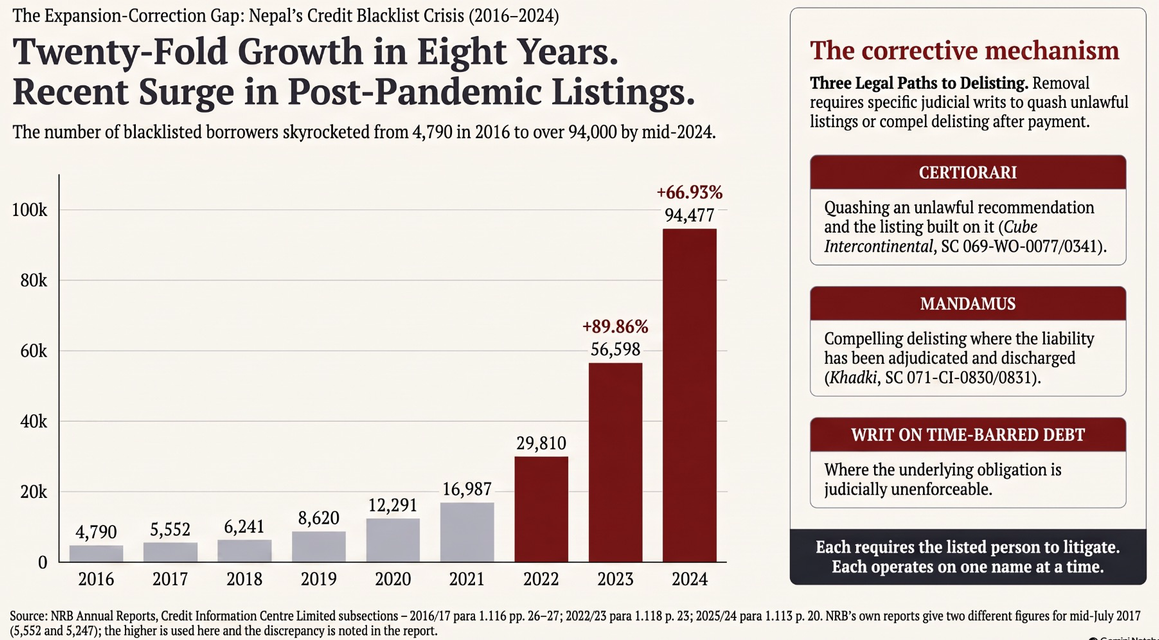
The scale on which that correction operates should be set against the scale of the listing itself. Nepal Rastra Bank publishes the number of blacklisted borrowers annually, and the series in the corpus runs from mid-July 2016 to mid-July 2024: 4,790 at the start, 56,598 at mid-July 2023 after an increase of 89.86 per cent in a single year, and 94,477 at mid-July 2024 after a further 66.93 per cent. The blacklist grew roughly twenty-fold in eight years, and by more than half in its final two.
Conclusion
The blacklisting regime is not badly drafted. Directive 12/082 distinguishes carefully between reporting and sanction, sets thresholds, requires thirty-five days’ notice with reasons, protects households and heirs and solvent group members, sequences guarantor listing behind auction of the borrower’s security and a further ninety days, caps guarantor exposure at the guaranteed sum, and requires delisting to be recommended within three days of settlement. Read on the page it is a proportionate instrument.
What it lacks is an adjudicator. Section 88(1)(e) of the NRB Act asks the Bureau to verify, and cl. 4(2) of the directive tells us what verification means: match the citizenship certificate, match the registration number, list within five days. The Supreme Court has confirmed that the Bureau coordinates rather than decides, and the Bureau itself has pleaded as much in two reported cases. So the only party that assesses whether the default warrants the sanction is the creditor, and s. 99(1) of the NRB Act fines that creditor for hesitating. There is no answering penalty for listing someone who should not be listed. A regime whose protections are administered exclusively by the party for whom only one direction of error carries a cost will fail in the direction that is free.
The consequences that follow are not calibrated to that thin process. A listed person cannot borrow, renew, or have a guarantee accepted anywhere in the system; cannot open an account except to receive a pension or a salary; cannot withdraw from an existing account beyond a subsistence figure the Government prescribes; cannot subscribe to a rights issue and cannot receive a dividend, which is instead remitted to a lender; may have a passport refused or impounded on a recommendation routed through the central bank; and may be named in a newspaper. The courts’ phrase for this is civil death, and having adopted that characterisation they have also accepted the constitutional premises that follow from it – Article 16, Article 17(2)(cha) and Article 25 are engaged, and a measure engaging them is a measure of last resort.
Which leaves judicial review carrying the entire weight of proportionality in a system of ninety-four thousand names. It has carried it well in the cases the corpus records: certiorari where the recommendation was unlawful, mandamus where the liability had been adjudicated and paid, writ relief where the debt was time-barred. But writ jurisdiction is an individual remedy, exercised after the sanction has taken effect, by a petitioner whose account is frozen. It cannot be the primary control on a mass administrative process, and it is currently the only one.
If a single change would do most of the work, it is not a new right of appeal but a symmetry of consequence. The regime already knows how to price the failure to list. Until it prices the failure to list correctly – by making a defective recommendation a supervisory matter with its own penalty, and by requiring the recommending bank to certify compliance with cl. 11, cl. 13 and cl. 9(4) as a condition of the Bureau accepting the recommendation at all – the safeguards will continue to read well and perform poorly, and the courts will continue to do one at a time what the pipeline should have done at the outset.