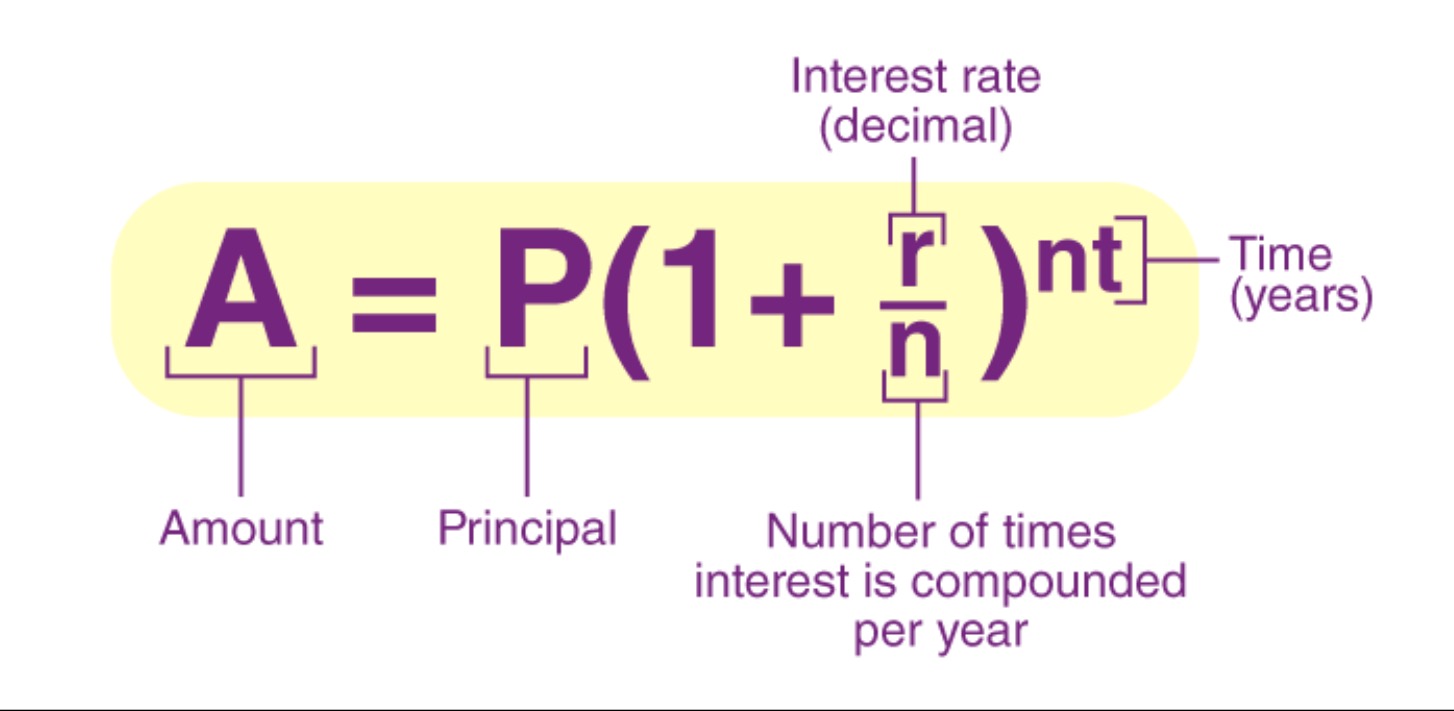
SUMMARY. Section 480(1) of the National Civil Code, 2074 prohibits a creditor from taking interest upon interest, in eight unqualified words, and s. 480(2) makes the remedy self-executing: sums so taken are credited against principal and refunded if the principal is discharged. Section 55(6) of BAFIA 2073 displaces the Civil Code’s rate ceiling (s. 479(2)) and its aggregate ceiling (s. 481) for licensed institutions. It does not displace s. 480. A Nepali bank may therefore charge whatever rate it negotiates – on the outstanding principal, and only on the outstanding principal. An ordinary instalment loan complies, because each instalment extinguishes that period’s interest before any of it can become a base. The prohibition acquires work to do at the first missed instalment, and it is there that ledgers cross it.
Sources. Synthesised from primary-source research records – the National Civil Code 2074, BAFIA 2073, the Debt Recovery Act 2058, the Cooperatives Act 2074, the NRB Unified Directive 2082 and its circulars, the Nepal Law Commission archive and Nepal Gazette, Supreme Court, High Court and Debt Recovery Tribunal decisions, NRB annual and supervision reports, commercial bank annual reports, and one class-A bank’s internal credit manuals and EMI procedures.
I. The prohibition, and the exemption that did not reach it
Chapter 7 of Part 5 of the Civil Code governs “lenden” and fixes three separate limits on a lender. Two are limits on amount: s. 479(2) caps interest at 10% a year of the principal, and s. 481 provides that notwithstanding anything else in the chapter interest may never exceed the principal. The third, s. 480, is not a limit on amount at all. It is a limit on method, and it is the only one of the three that survives contact with the banking statute.
| National Civil Code, 2074 – Section 480: Interest upon interest not to be taken Part 5 › Chapter 7 (लेनदेन) › s. 480(1) and (2) |
| ORIGINAL TEXT (१) साहुले ऋणीबाट ब्याजको ब्याज लिन पाउने छैन । (२) उपदफा (१) विपरीत कुनै साहुले ऋणीबाट ब्याजको ब्याज लिएको रहेछ भने साँवामा कट्टी हुनेछ र साँवा चुक्ता भईसकेको रहेछ भने त्यो ब्याज फिर्ता गर्नु पर्नेछ । |
| ENGLISH – CONVENIENCE RENDERING (1) A creditor shall not take interest upon interest from a debtor. (2) If, contrary to sub-section (1), a creditor has taken interest upon interest from a debtor, it shall be deducted from the principal; and if the principal has already been paid off, that interest must be refunded. |
| Source: National Civil Code, 2074, Part 5, Chapter 7, s. 480. |
The provision is unconditional – it carries none of the “except as otherwise provided in the contract” formula the Code uses when it means a rule to be defeasible by agreement – it is self-executing under sub-section (2), it operates over the whole life of the account, and no limitation runs against a suit complaining of it.
Banks plainly do not lend at 10%; the research records disputed contractual rates of bank lending well above or below the 10%. What licenses that is s. 55(6) of BAFIA, and it is narrower than is usually assumed. It provides that the terms, tenor and interest of a bank loan are as stated in the deed or contract. It names three things – terms, tenor, interest – and method is not among them. A provision entitling a lender to agree a price is not a provision entitling it to change the base on which that price is charged. That is the Debt Recovery Tribunal’s own reading: s. 55(6) grants a special exemption from the standard 10% civil ceiling, but grants no exemption or right to levy compound interest, and where a bank includes compound interest in a ledger claim the Tribunal excises the capitalised portion and reduces the enforceable claim.
Parliament has shown it legislates expressly when it means to prohibit capitalisation by name: s. 50(5) of the Cooperatives Act, 2074 bars a cooperative from capitalising interest into principal and charging interest on that basis. No equivalent clause was written into BAFIA. The inference is not that banks were left free, but that no clause was needed to restrict capitalizaiton, because s. 480(1) already applied and continued to.
| Provision | Operative effect | Function in the argument |
|---|---|---|
| Civil Code 2074, ss. 478, 479(2) | Rate as stated in the deed; 10% where interest is mentioned without a rate; मुनाफा unquantified treated as interest. Interest capped at ten per cent a year of principal. | Displaced for banks by BAFIA s. 55(6). The exemption everyone knows about. |
| Civil Code 2074, s. 481 | Notwithstanding anything else in the chapter, interest may never exceed the principal (damdupat). | Also displaced. A bank may recover interest exceeding principal. |
| Civil Code 2074, s. 480(1)–(2) | Reproduced above. No limitation period runs against a suit alleging interest upon interest. | Not displaced by anything. The spine of this brief, and available however old the account. |
| Civil Code 2074, ss. 483, 484 | Where suit is filed in time, the court may award interest to the date of actual satisfaction. | Supplies the litigation interest at issue in Mega Bank v. Dhakal – and the base it runs on. |
| BAFIA 2073, s. 55(6) | The terms, tenor and interest of a bank loan are as stated in the deed or contract. | The exemption. Covers rate and term; silent as to method. |
| BAFIA 2073, s. 55(8) | Loan amount, interest, हर्जाना and repayment schedule to be stated clearly and disclosed to borrower and guarantor. | The disclosure duty against which a one-page summary statement fails. |
| BAFIA 2073, s. 57(1) | Summary auction of security on default, without recourse to a court. | Triggers the Somraj Gautam bar and closes off any audit of the arithmetic. |
| Debt Recovery Act 2058, s. 2(f) | “ऋण” means the principal and interest of credit extended by a bank. | Interest is recoverable as debt – but recoverability does not convert it into principal. |
| Unified Directive 2082, Directive 15/082, cll. 3(2), 3(7), 4(2) | Clause 3(2) reproduced in Part III. Rates within one product may not differ by more than two points; maximum spread 4.0% (class A), 4.6% (classes B and C). | Fixes the penal base and bars interest on penal interest; and bounds the rate the contract may set under s. 55(6). |
| Unified Directive 2082, Directive 2/082, cll. 8(17), 45(1)–(7) | Clauses 8(17) and 45(5) reproduced in Part IV. Clause 45(1)–(7) permits moratorium capitalisation for long-term projects on express contractual terms, with a written procedure and separate ICTL accounting. | Bars capitalisation where there is default; permits it where there is none – the same boundary s. 480 draws. |
| Cooperatives Act 2074, s. 50(5) | A cooperative shall not capitalise interest into the principal loan and charge interest on that basis. | Proves Parliament legislates expressly when it wants a sector ban. It wrote none for banks. |
Table: Every instrument relied on, and what each does in the argument. Provisions marked “reproduced” appear in full elsewhere; the rest are cited and described, not quoted. The appropriation rule discussed in Part III is described there rather than listed here.
II. Why an instalment loan is lawful
Almost all retail lending in Nepal is by equated monthly instalment, and an EMI facility looks like compounding (and for theoretical mathematical purposes it actually is): the formula producing the instalment contains a geometric series, and the lender’s realised yield exceeds the rate in the deed. If that were compounding, s. 480(1) would invalidate the retail book of the entire banking system, which no court has held. The answer is that the compounding sits in the derivation of the payment, not in the charging of interest.
A class-A bank’s Credit Manual states the method: interest is calculated on the loan amount utilised daily by the borrower at the rate specified in the approval letter; for EMI facilities that interest is paid within the equated monthly instalment; and on repayment principal and interest are both discharged in full. Working that through on the bank’s own published calculator parameters – NPR 100,000 at 13.00 per cent over twelve months, instalment NPR 8,931.73 – produces the following.
| Month | Opening principal | Interest | Instalment | Principal repaid | Closing principal |
|---|---|---|---|---|---|
| 1 | 100,000.00 | 1,083.33 | 8,931.73 | 7,848.40 | 92,151.60 |
| 2 | 92,151.60 | 998.31 | 8,931.73 | 7,933.42 | 84,218.18 |
| 3 | 84,218.18 | 912.36 | 8,931.73 | 8,019.37 | 76,198.81 |
| ⋮ | ⋮ | ⋮ | ⋮ | ⋮ | ⋮ |
| 11 | 17,577.28 | 190.42 | 8,931.73 | 8,741.31 | 8,835.97 |
| 12 | 8,835.97 | 95.72 | 8,931.69 | 8,835.97 | 0.00 |
| Total | – | 7,180.72 | 107,180.72 | 100,000.00 | – |
Table: Each month’s interest is the opening principal multiplied by 0.0108333 – one twelfth of 13 per cent – and nothing else. The instalment exceeds that interest in every month, so the liability is extinguished on each due date and the following month’s base is the reduced principal. Months 4–10 follow the same pattern and are elided. Month 12 carries a one-paisa rounding adjustment ordinary in core banking implementations.
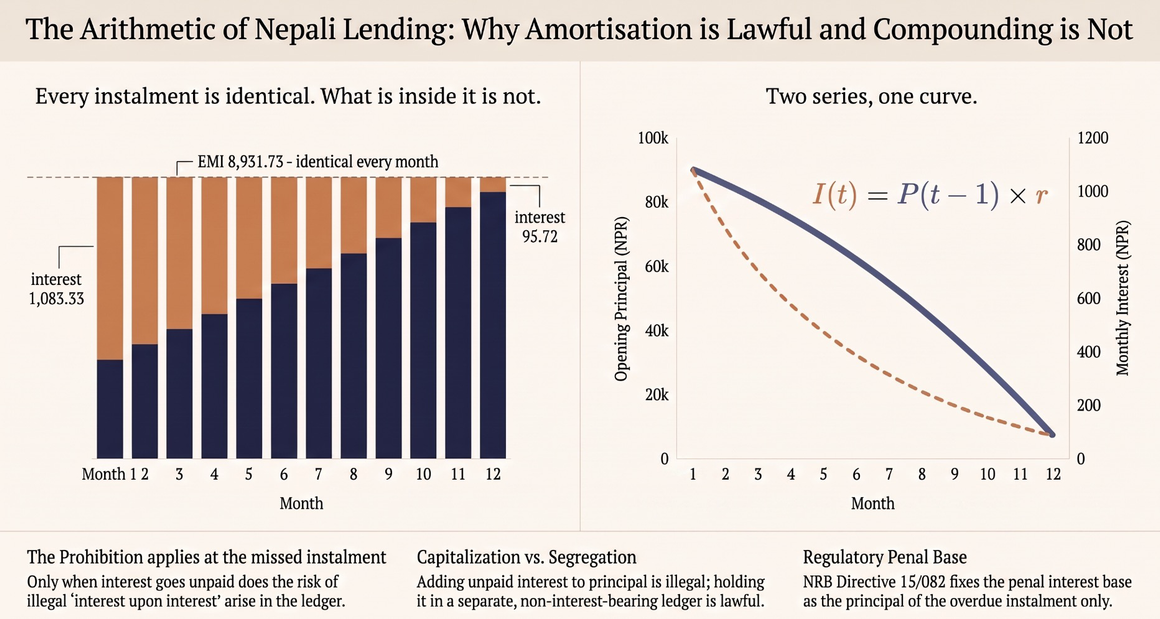
Two things nevertheless make an EMI loan feel like compounding, and both are real without being unlawful. The instalment formula genuinely is derived from a geometric series – but it is used once, to fix a level payment, and is not the method by which each month’s charge is computed. And the lender’s effective annual yield is 13.803 per cent against a nominal 13.00, because of the compounding effect. That eighty-basis-point gap is the bank’s effective yield due to compounding effect. But this is a practical computation difficulty that seems to have been accepted “not-compounding” for practical purposes.
III. The missed instalment
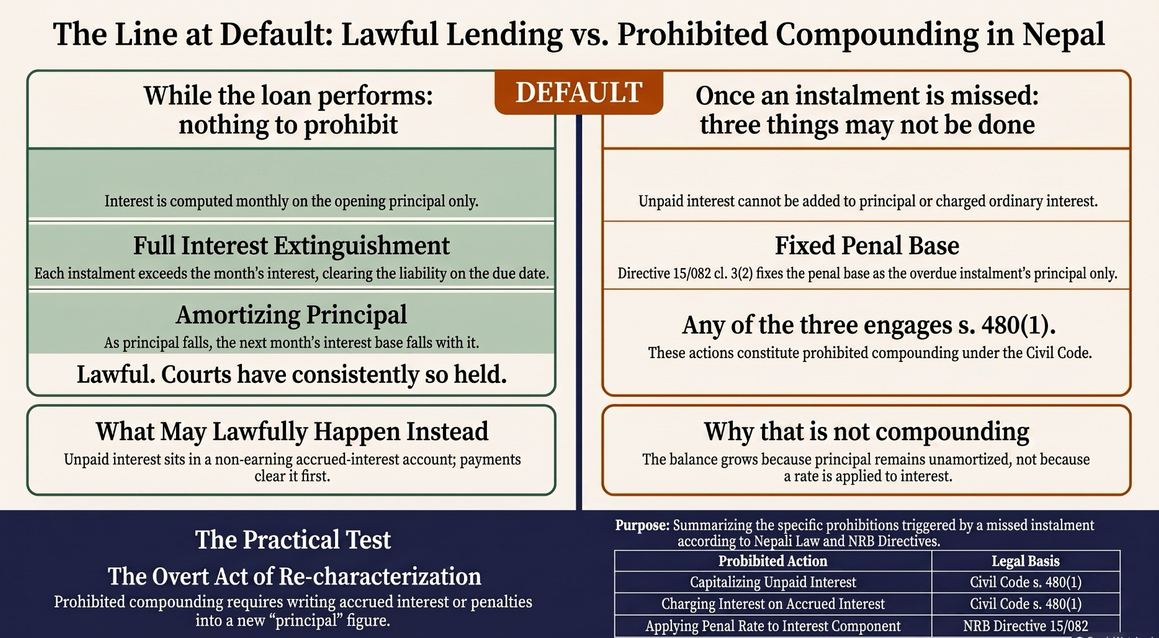
Everything changes at the first default, for one reason: unpaid interest now exists. Until then s. 480(1) has nothing to operate on. From then it does, and three operations close.
| NRB Unified Directive 2082, Directive 15/082 – Clause 3(2): the penal interest base इ.प्रा. निर्देशन नं. १५/०८२ को बुँदा नं. ३ को उपबुँदा (२), at p. 133 |
| ORIGINAL TEXT कर्जा प्रवाह गर्दा ऋणीसँग गरिने सम्झौतामा वार्षिक पेनाल ब्याजदर २ प्रतिशत विन्दु भन्दा बढी नहुने गरी उल्लेख गर्नुपर्नेछ । पेनाल ब्याज गणना गर्दा म्याद नाघेको किस्ताको साँवा रकममा वार्षिक पेनाल ब्याजदरले विलम्ब भएको समयावधिका लागि कायम हुन आउने रकमभन्दा बढी लिन र पेनाल ब्याजमा ब्याज लाग्ने गरी रकम असुल उपर गर्न पाइने छैन । |
| ENGLISH – CONVENIENCE RENDERING When extending credit, the agreement made with the borrower must state an annual penal interest rate not exceeding 2 percentage points. In computing penal interest, no amount may be taken exceeding that which arises by applying the annual penal interest rate to the principal amount of the overdue instalment for the period of delay, and no amount may be recovered in such a way that interest accrues on penal interest. |
| Source: NRB Unified Directive 2082 for class “क”, “ख” and “ग” institutions, Directive No. 15/082, cl. 3(2). Materially identical wording appears in the NIFRA Unified Directive, Directive 15, cl. 3(2), and in the microfinance directive at cl. 2(च). |
That clause does three things in one sentence. It caps the penal rate at 2% points; it fixes the assessment base as the principal amount of the overdue instalment – not the instalment, and not the arrears; and it closes the recursion by forbidding any recovery structured so that interest accrues on penal interest. A bank charging 2% on the whole overdue instalment, interest component included, has exceeded the permitted amount whatever the contract says.
| Once an instalment is missed | Lawful? | Why |
|---|---|---|
| Continue charging contractual interest on the unpaid principal | Yes | The principal remains outstanding and remains the base. |
| Hold the unpaid interest in an accrued-interest ledger | Yes | It is a receivable pursued as one. No rate is applied to it. |
| Apply a partial payment to accrued interest before principal | Yes | The regulatory appropriation waterfall. It slows amortisation; it does not compound. |
| Charge penal interest on the principal of the overdue instalment, up to 2 points | Yes | Expressly authorised, and expressly bounded, by Directive 15/082 cl. 3(2). |
| Add the unpaid interest to principal on restructuring | No | Directive 2/082 cll. 8(17) and 45(5); Civil Code s. 480(1). |
| Charge contractual interest on the unpaid interest | No | The core of s. 480(1). Sums taken are credited against principal under s. 480(2). |
| Charge penal interest on the overdue interest | No | Directive 15/082 cl. 3(2) fixes the base as principal and bars interest on penal interest. |
| Aggregate principal, interest and fees into a revised principal in a plaint | No | Struck out in Mega Bank Nepal v. Yagya Bahadur Dhakal; interest confined to the true principal. |
Table: The four lawful operations share one feature: none applies a rate to a sum that is itself interest.
The third entry is what borrowers most often challenge. Where a partial payment is applied first to accrued interest, a borrower paying less than the accrued interest reduces principal by nothing, so the full principal continues generating interest in the next period. The balance grows and the payments appear to achieve nothing. The courts have consistently held this is not compounding: the unpaid interest sits in its own ledger without bearing secondary interest, and the accumulation happens because the principal is unamortised, not because a rate has been applied to interest. The test is not whether the balance grew. It is whether the lender moved interest into the base.
IV. Capitalisation: one line, drawn twice
Capitalisation is the operation s. 480(1) most directly forbids, and it is also one the central bank expressly permits in defined circumstances. That looks like a conflict between primary legislation and a subordinate instrument. It is not.
| NRB Unified Directive 2082, Directive 2/082 – the two prohibitions on capitalisation cl. 8(17); and cl. 45(5), as amended by Circular No. 17/082/83 |
| ORIGINAL TEXT ८. (१७) कर्जा पुनरतालिकीकरण वा पुनरसंरचना गर्दा असुल हुन बाँकी ब्याजलाई पूँजीकरण गर्न पाइने छैन । ४५. (५) पुनरसंरचना वा पुनरतालिकीकरण गरिएको कर्जाको भाखा नाघेको ब्याजलाई पुँजीकरण गर्न पाइने छैन । |
| ENGLISH – CONVENIENCE RENDERING 8(17) When rescheduling or restructuring a loan, interest remaining to be recovered may not be capitalised. 45(5) Overdue interest on a loan that has been restructured or rescheduled may not be capitalised. |
| Source: NRB Unified Directive 2082, Directive No. 2/082, cl. 8(17), and cl. 45(5) as amended by Circular No. 17/082/83. A materially identical bar appears in the NIFRA Unified Directive, Directive No. 2, cl. 20(3). |
Against that, cl. 45(1) permits capitalisation in one situation: where a licensed institution has lent to a long-term project and said so in the loan agreement, interest accruing during the grace or moratorium period – before commercial operation generates any cash inflow – may be capitalised. Clause 45(2) requires a written procedure, cl. 45(3) allows partial capitalisation for a hydropower project held back by incomplete transmission works, cl. 45(6) requires separate accounting as an Interest Capitalized Term Loan, and cl. 45(7) leaves the ICTL repayment period to the institution after cash-flow analysis. Clause 45(4) puts the boundary beyond argument: even where force majeure has damaged a project so that resumption will take more than two years, all overdue principal and interest must be recovered first before a grace period may be granted and its interest capitalised.
Read together the two halves draw a single line, and it is s. 480’s line: capitalisation is permitted where nothing is overdue and the borrower has not failed – there it finances construction against future cash flows, agreed in advance – and barred the moment there is a default to absorb. The High Court has upheld both halves. In B&C Medical College Teaching Hospital v. Global IME Bank (Patan, writs 081-WO-0598 and 081-WO-0602, order of 2081/10/06), capitalisation under cl. 2.02 of a syndicated loan agreement until the commercial operation date was held valid and distinct from prohibited moneylender compounding, the consortium having wrongly applied the restructuring bar to a situation that was not a restructuring.
V. Ledgers, forums, and what follows
The framework is coherent. What is not coherent is its enforcement, and the gap opens in ledgers rather than in contracts.
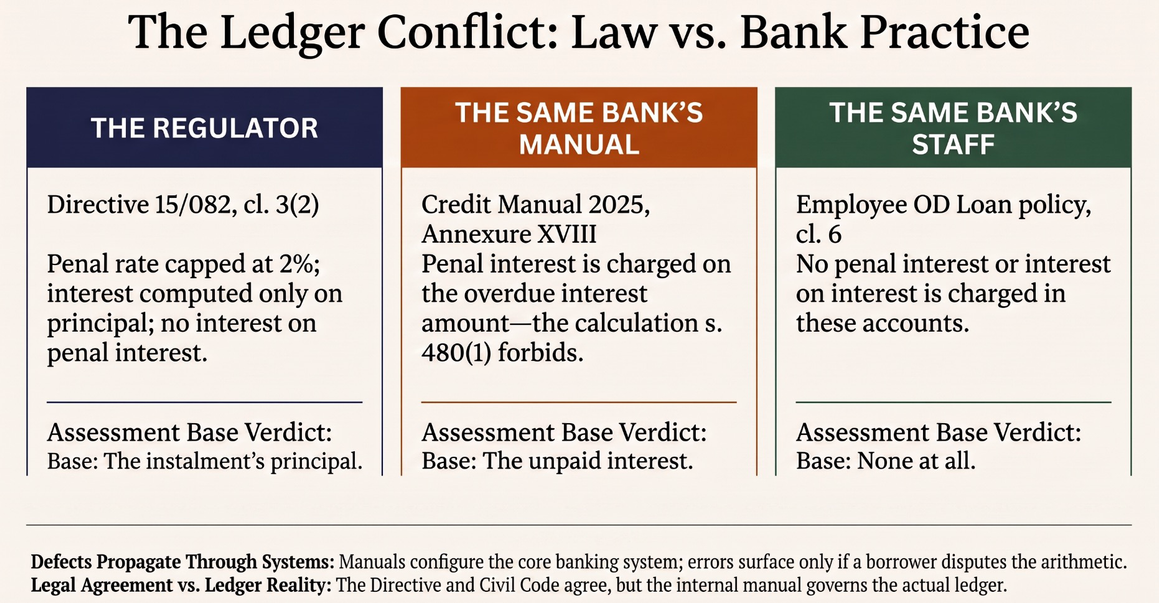
The same class-A bank whose compliant interest clause appears in Part II also directs, at the same annexure and the same page of its Credit Manual, that where an instalment is unpaid penal interest of two per cent is charged on the overdue interest amount – the calculation Directive 15/082 cl. 3(2) forbids and s. 480(1) prohibits. Clause 6 of the same bank’s Employee Overdraft policy provides that no penal interest or interest on interest will be charged in that account. The phrase is used correctly and deliberately: the institution understands the distinction exactly, and applies the protection to its own staff. This is an example of only one bank, and a manual is not a contract – but manuals are what core banking systems are configured from, and the ledger a core banking system produces is what a court is later asked to accept.
Whether the arithmetic is ever examined turns on which procedure the bank chose, and this is the most consequential practical finding here. Where a bank proceeds by summary auction under BAFIA s. 57, the borrower’s path is largely closed by Somraj Gautam: a defaulting borrower cannot stall a statutory auction by demanding a judicial accounting, and the certified ledger carries a presumption of regularity rebuttable only by fraud or patent illegality. Where the same bank instead sues or petitions the Tribunal, the arithmetic is audited and what fails is struck.
| Case | Forum and citation | What was struck, and why |
|---|---|---|
| Mega Bank Nepal Ltd. v. Yagya Bahadur Dhakal | High Court Patan, 079-DP-1207 (decision no. 263), on appeal from Kathmandu District Court, judgment of 2079/05/12. | Principal NPR 99,296.74, interest NPR 50,601.55 and fees NPR 11,500 aggregated into a “revised principal” of NPR 1,61,398 carrying further interest. Held contrary to s. 480(1); interest confined to the original principal. |
| Atika Cosmetic Shop; Atif Cosmetic Collection; Sehnaz Provision Stores v. Machhapuchchhre Bank | High Court Pokhara, 078-DP-0040, 078-DP-0041 and 078-DP-0039, all decided 2080-01-24. | Continuing interest claimed on a post-auction residue composed entirely of overdue and penal interest, evidenced by a one-page statement. Held to be compounding under s. 480; itemised accounts required. |
| B&C Medical College Teaching Hospital v. Global IME Bank | High Court Patan, writs 081-WO-0598 and 081-WO-0602, order of 2081/10/06. | The other direction: pre-commercial-operation capitalisation under cl. 2.02 of a syndicated loan agreement upheld as valid and distinct from prohibited compounding. |
| Somraj Gautam v. Nepal Industrial Development Corporation | Supreme Court, NKP 2044, vol. 5, decision no. 3063. Reaffirmed in Infonet Solution v. Siddhartha Bank and Prabhu Chandra Jha v. Gorkha Development Bank (072-WO-0298). | Nothing struck. A defaulting borrower may not stall a summary auction by demanding a judicial accounting; the certified ledger carries a presumption of regularity. |
| Debt Recovery Tribunal practice | Recorded across multiple Tribunal decisions. | Where a bank includes compound interest in its ledger claim, the Tribunal excises the capitalised or compound portion and reduces the enforceable claim accordingly. |
Table: Where the line has been drawn. The same calculation is unexaminable in one forum and fatal in another, and which forum applies is decided by the bank when it chooses whether to auction or to sue.
Somraj Gautam is a rule about the integrity of summary recovery, not a ruling that bank ledgers are correct. Faced in the same period with a challenge to systemic penal and contractual rate increases, the Supreme Court computed nothing itself and directed Nepal Rastra Bank to operate grievance-redressal units – identifying the regulator, not the court, as the appropriate auditor of loan arithmetic. For a borrower facing a summary auction, the practical position is that the audit does not happen and s. 480(2)’s self-executing credit goes unapplied.
Three consequences follow. For a lender, the exposure is the base rather than the rate, and larger than it looks: s. 480(2) credits sums taken against principal with no limitation period running, so a defect in the penal base on a facility restructured once and run for years produces a substantial recalculation – and the audit worth doing is of the core banking configuration, not the loan documentation. For a borrower’s adviser, the operative question is which base each charge was computed on; seek the itemised ledger early, and where a choice exists prefer the forum that will examine it. For the regulator, the gap is not in the rules – Directive 15/082 cl. 3(2) caps the rate, fixes the base and closes the recursion in one sentence – but in verification. Nothing indicates that supervisory examination tests the configured penal base, and the one manual available for inspection (discussed above) specifies it incorrectly.
| LIMITS OF THIS ANALYSIS 1. The bank exemption from the Civil Code ceilings is an inference from BAFIA s. 55(6); no provision says in words that ss. 479(2) and 481 do not bind licensed institutions. The inference is strong – the alternative would make most bank lending unlawful – but it remains an inference. 2. No Supreme Court decision in the research squarely construes s. 480(1) in a bank lending context, or resolves the relationship between Chapter 7 of the Civil Code and BAFIA. The substantive holdings relied on here are High Court and Tribunal decisions. 3. Overdraft and working-capital facilities are where this analysis is weakest. They have no instalment discharging interest on a fixed date, so a period-end debit sits in the same running balance as principal; nothing here resolves how that debit is characterised under s. 480(1). Floating-rate repricing is likewise not covered – the treatment of accrued but unbilled interest at a repricing date is not established by the material. |