
Summary: Nepali law has two settled answers to the question of when a bank may take a guarantor’s property, and they are not the same answer. At the point of adjudication the guarantor is the borrower’s equal: the Bank and Financial Institutions Debt Recovery Act, 2058 defines the word “debtor” so as to include him, joins him to the petition, serves him the same summons, subjects him to the same thirty per cent pre-deposit on appeal, and – in a non obstante clause – declares that his liability may be recovered from him directly. At the point of execution he is something else entirely: a residual obligor at the fourth tier of a waterfall, reachable only after the borrower’s pledged collateral has been auctioned, the borrower’s unencumbered estate has been seized, and a shortfall has been arithmetically demonstrated. The guarantee is procedurally primary and economically last.
That gap between the two positions is the subject of this post. It is not a drafting accident that anyone has yet corrected, and it is not confined to a single instrument. It runs through the whole architecture: between a parent Act and its own subordinate rules, between the Civil Code’s refusal of a benefit of discussion and the central bank’s insistence on one, between what a bank’s standard-form guarantee deed says and what a tribunal will actually let the bank do with it. The central claim advanced here is that Nepal has acquired, without ever legislating it, a functioning benefit of discussion – a rule that the creditor must discuss the principal debtor’s assets before troubling the surety. It came not from the Code, which expressly withholds it, but from the accretion of a subordinate rule, a Full Bench mandate which later transcribed into prudential regulation, and two decades of execution practice. Four further propositions follow.
First, the protection is real but it is a protection of realisation only, and not of restraint. Section 16(1) of the Debt Recovery Act permits the Tribunal to freeze a guarantor’s land on the day the petition is registered, concurrently with the borrower’s and years before any shortfall is proved. A guarantor sitting comfortably at the fourth tier of the waterfall may nonetheless have every parcel he owns tied up from the first week of the case. Sequencing governs what may be sold; it says nothing about what may be immobilised.
Second, the protection fails at the moment of maximum stress. The Insolvency Act, 2063 stays enforcement against an insolvent company but says nothing whatever about its guarantors – and the very order that freezes the borrower’s estate is the cleanest possible proof that the estate cannot cover the debt. Insolvency does not suspend the guarantee. It accelerates it.
Third, where guarantors actually escape liability before the Tribunal, they escape on paperwork rather than on principle. Of the sixty-one appellate judgments surveyed across 2077 to 2080 B.S., guarantors were joined in fifty-eight and held liable in forty-two of the forty-five cases where anything was decreed at all. The three complete discharges each turned on a documentary failure by the bank: a guarantee not re-executed on renewal, another not re-executed on restructuring, and a third that could not be produced in its original form. No guarantor in the sample succeeded on a substantive defence of variation, extension of time, or impairment of security, although the Civil Code supplies all three.
Fourth, the practical constraint on recovery is no longer legal. It is the market. Rating agencies describe Nepali collateral enforcement as comparatively unobstructed, and the statutory powers bear them out; but roughly two-thirds of the system’s collateral sits in real estate, and when banks turn simultaneously to auction it they find no buyers. Non-banking assets on commercial bank balance sheets rose from Rs. 2.58 billion in mid-July 2018 to Rs. 30.15 billion in mid-July 2024. The waterfall’s lower tiers are being reached more often not because the law has changed, but because the tiers above them have stopped producing cash.
I. What the Code Actually Says
The contract of guarantee is codified in Part 5, Chapter 7 of the National Civil Code, 2074, at sections 563 to 570, with a limitation provision at section 574. The architecture is compact and, read on its own, tolerably clear. Section 563 defines the contract by its effect rather than its form: where parties agree that a third person will pay or perform if the principal does not, a contract of guarantee is deemed to exist. Two features of that section matter more than they first appear. Sub-section (3) makes the terms of the guarantee whatever the contract says they are, which is the doorway through which every waiver clause in every bank’s standard form subsequently walks. Sub-section (4) requires writing, which is the hook on which three of the sixty-one appellate cases in this study were ultimately decided.
| National Civil Code, 2074 – Section 563: Contract of guarantee to be deemed Part 5 (Contracts and Other Liabilities) › Chapter 7 (Contracts of Guarantee) › s. 563(1)–(4) |
| ORIGINAL TEXT ५६३. जमानत सम्बन्धी करार भएको मानिनेः (१) कुनै एक व्यक्तिले लिएको ऋण वा कबुल गरेको दायित्व चुक्ता नगरेमा वा पूरा नगरेमा तेस्रो पक्षले चुक्ता वा पूरा गरिदिने गरी करार भएकोमा जमानत सम्बन्धी करार भएको मानिनेछ । (२) उपदफा (१) बमोजिम तेस्रो पक्षले जमानत दिएकोमा ऋण तिर्नु पर्ने व्यक्तिले नतिरेमा वा पूरा गर्नु पर्ने दायित्व पूरा नगरेमा करार बमोजिमका शर्त त्यो ऋण वा दायित्व जमानत (Guarantee) दिने व्यक्तिले पूरा गरिदिनु पर्नेछ । (३) जमानतका शर्तहरू करारमा निर्धारण भए बमोजिम हुनेछन् ।(४) जमानत सम्बन्धी करार लिखित रूपमा भएको हुनु पर्नेछ । |
| ENGLISH – CONVENIENCE RENDERING 563. Contract of guarantee to be deemed: (1) Where a contract is concluded to the effect that if a person fails to repay a debt borrowed or to discharge a liability covenanted by him or her, a third party shall repay or discharge it, a contract of guarantee shall be deemed to have been concluded. (2) Where a third party has given a guarantee pursuant to sub-section (1), if the person who is to repay the debt fails to repay it or fails to discharge the liability to be discharged, the person giving the guarantee shall fulfil the terms of the contract or discharge such debt or liability. (3) The terms of guarantee shall be as determined in the contract. (4) The contract relating to guarantee must be in written form. |
| Source: National Civil Code, 2074, Part 5, Chapter 7, s. 563. |
Section 564 is where the substantive position is fixed, and it is a provision that pulls in two directions at once. Sub-section (1)(a) sets the moment of accrual: the guarantor’s liability arises “from the very moment” the principal fails to perform – not on demand, not on decree, not on exhaustion. Sub-section (1)(b) makes that liability co-extensive with the principal’s and keeps it alive until the principal is discharged. Sub-section (1)(c) goes further still: the guarantor is not released merely because the principal has been discharged by operation of law, which is the provision that keeps a corporate guarantee alive after the borrowing company has been struck off. Read to this point, section 564 is as pro-creditor as any surety provision in the common law world.
Then sub-section (2) arrives with a non obstante clause of its own and takes a great deal of it back. Where a debt is secured by both security and a guarantee, the guarantor has no liability to the extent of the value the security covers. This is not a sequencing rule and it should not be mistaken for one; it is a rule about the quantum of the obligation. But its practical effect in a market where almost every commercial facility is secured on land is close to a sequencing rule, because the guarantor’s liability cannot be quantified at all until the security has been realised and its actual yield is known. Sub-section (4) then adds the one genuine condition precedent the Code contains: before claiming against the guarantor, the creditor must give notice to the debtor to perform.
| National Civil Code, 2074 – Section 564: Liability of the person giving a guarantee Part 5 › Chapter 7 › s. 564(1)(a)–(c), (2), (3), (4) |
| ORIGINAL TEXT ५६४. जमानत दिने व्यक्तिको दायित्वः (१) करारमा अन्यथा व्यवस्था भएकोमा बाहेक जमानत दिने व्यक्तिको दायित्व देहाय बमोजिम हुनेछः(क) दायित्व पूरा गर्नु पर्ने व्यक्तिले त्यो दायित्व पूरा गर्न नसकेको बखतदेखि नै जमानत दिने व्यक्तिको दायित्व सृजना हुने,(ख) जमानत दिने व्यक्तिको दायित्व ऋण तिर्नु पर्ने वा दायित्व पूरा गर्नु पर्ने व्यक्ति सरह हुने र तिर्नु वा पूरा गर्नु पर्ने दायित्वबाट निज मुक्त नभएसम्म जमानत दिने व्यक्ति जिम्मेवार रहने,(ग) कानूनको परिचालनबाट ऋण तिर्नु पर्ने वा दायित्व पूरा गर्नु पर्ने व्यक्ति दायित्वबाट मुक्त हुँदैमा जमानत दिने व्यक्तिको दायित्व समाप्त नहुने, (२) उपदफा (१) मा जुनसुकै कुरा लेखिएको भए तापनि कुनै ऋण वा दायित्व वापत कुनै सुरक्षण र जमानत दुवै दिएको रहेछ भने त्यसरी दिएको सुरक्षणले खामेको हदसम्म जमानत दिने व्यक्तिको दायित्व हुने छैन । (३) साहुलाई तिर्नु वा पूरा गर्नु पर्ने दायित्व तिर्नु वा पूरा गर्नु पर्ने व्यक्तिबाट उल्लङ्घन हुनासाथ जमानत सम्बन्धी करार प्रभावकारी हुनेछ र साहुले जमानत दिने व्यक्तिबाट त्यो दायित्व पूरा गराउन सक्नेछ । (४) उपदफा (३) मा जुनसुकै कुरा लेखिएको भए तापनि जमानत करार बमोजिम जमानत दिने व्यक्तिबाट करार बमोजिम पूरा नभएको रकम वा दायित्व पूरा गर्न दाबी गर्नु अघि साहुले ऋणीलाई करारका शर्त वा बन्देज अनुसार करार परिपालन गर्न सूचना दिनु पर्नेछ । |
| ENGLISH – CONVENIENCE RENDERING 564. Liability of the person giving a guarantee: (1) Except as otherwise provided in the contract, the liability of the person giving a guarantee shall be as follows:(a) the liability of the person giving the guarantee shall be created from the very time the person who is to discharge the liability becomes unable to discharge it;(b) the liability of the person giving the guarantee shall be the same as that of the person who is to repay the debt or discharge the liability, and the person giving the guarantee shall remain responsible until that person is released from the liability to pay or perform;(c) the liability of the person giving the guarantee shall not be extinguished merely because the person who is to repay the debt or discharge the liability is released from the liability by the operation of law; (2) Notwithstanding anything contained in sub-section (1), where both security and a guarantee have been provided for any debt or liability, the person giving the guarantee shall not have liability to the extent of the value covered by the security so provided. (3) Immediately upon a breach by the person bound to pay or discharge the liability to the creditor, the contract of guarantee shall become effective, and the creditor may cause that liability to be discharged by the person giving the guarantee. (4) Notwithstanding anything contained in sub-section (3), before making a claim against the person giving a guarantee to recover the unfulfilled amount or discharge the liability under the contract of guarantee, the creditor must give notice to the debtor to perform the contract in accordance with the terms or conditions of the contract. |
| Source: National Civil Code, 2074, Part 5, Chapter 7, s. 564. |
The corpus is explicit that this combination does not amount to a general benefit of discussion. The Code does not require a creditor to exhaust the debtor’s unencumbered estate, to sue him to judgment, or to litigate him to insolvency before turning to the guarantor. What it requires is notice under sub-section (4), and what it withholds is the secured portion under sub-section (2). Everything else – the whole apparatus of tiered realisation described later in this report – comes from somewhere other than the Civil Code.
Discharge: seven grounds, none of them used
Section 565(1) enumerates seven circumstances in which the guarantor is discharged, and it is a generous list by any comparative standard. Material variation of the principal contract without consent discharges the guarantor as to transactions after the variation. A contract releasing the principal discharges him. An act of the creditor that discharges the principal, or a remission of the debt, discharges him. Composition for a lesser sum, an extension of time, or a covenant not to sue discharges him. Any act of the creditor that prejudices his own remedy against the principal discharges him. Loss, impairment, or return of the security discharges him pro tanto. And payment by the principal discharges him to the extent paid.
| National Civil Code, 2074 – Section 565(1): Circumstances discharging the guarantor Part 5 › Chapter 7 › s. 565(1), clauses (a) to (g) |
| ORIGINAL TEXT ५६५. जमानत दिने व्यक्ति दायित्वबाट मुक्त हुने अवस्थाः (१) करारमा अन्यथा व्यवस्था भएकोमा बाहेक देहायका कुनै अवस्थामा देहायको हदसम्म जमानत दिने व्यक्ति आफ्नो दायित्वबाट मुक्त हुनेछः–(क) ऋण तिर्नु पर्ने वा दायित्व पूरा गर्नु पर्ने व्यक्तिले जमानत दिने व्यक्तिको सहमति बिना करारमा तात्त्विक असर पर्ने गरी करारका शर्तहरू हेरफेर गरेमा त्यो हेरफेर पछिको हुने कारोबारमा,(ख) जुन विषयमा जमानत दिइएको हो त्यो दायित्वबाट त्यो पूरा गर्नु पर्ने व्यक्ति मुक्त हुने गरी करार भएमा,(ग) साहुको काम कारबाहीले ऋण तिर्नु पर्ने वा दायित्व पूरा गर्नु पर्ने व्यक्ति मुक्त हुने भएमा वा ऋण मिनाहा भएमा,(घ) साहुले ऋणीबाट लिनु पर्ने रकमभन्दा कम रकम लिई दायित्व मुक्त गर्ने वा निजलाई ऋण चुक्ता गर्न थप समय दिने वा मुद्दा नचलाउने गरी सहमति भएमा,(ङ) साहुको कुनै काम कारबाहीबाट जमानत दिने व्यक्तिको ऋण तिर्नु पर्ने वा दायित्व पूरा गर्नु पर्ने व्यक्ति उपरको कानूनी उपचारमा प्रतिकूल असर परेमा,(च) ऋणीबाट लिएको कुनै सुरक्षण साहुले हराएमा, बिगारेमा वा ऋणीलाई त्यो फिर्ता दिएमा त्यो सुरक्षणको मूल्य बराबरको हदसम्म,(छ) साहुलाई करार बमोजिम तिर्नु पर्ने रकम वा पूरा गर्नु पर्ने दायित्व त्यो तिर्नु वा पूरा गर्नु पर्ने व्यक्तिले जुन हदसम्म तिरेको छ वा पूरा भएको छ त्यो हदसम्म । |
| ENGLISH – CONVENIENCE RENDERING 565. Circumstances where the person giving a guarantee is discharged from liability: (1) Except as otherwise provided in the contract, the person giving a guarantee shall be discharged from his or her liability to the following extent in any of the following circumstances:–(a) if the person bound to repay the debt or discharge the liability varies the terms and conditions of the contract so as to materially affect the contract without the consent of the person giving the guarantee, in respect of transactions taking place after such variation;(b) if a contract is entered into to the effect that the person bound to perform the liability is released from the liability for which the guarantee was given;(c) if the person bound to repay the debt or discharge the liability is discharged by an act or conduct of the creditor, or if the debt is remitted;(d) if an agreement is made whereby the creditor discharges the liability by accepting an amount less than that due from the debtor, or gives additional time to the debtor to repay the debt, or agrees not to institute a lawsuit;(e) if any act or conduct of the creditor prejudicially affects the legal remedy of the person giving the guarantee against the person bound to repay the debt or discharge the liability;(f) if the creditor loses, impairs, or returns to the debtor any security taken from the debtor, to the extent of the value equal to that security;(g) to the extent that the amount payable or the liability to be discharged to the creditor under the contract has been paid or performed by the person bound to pay or perform. |
| Source: National Civil Code, 2074, Part 5, Chapter 7, s. 565(1). |
Four qualifications immediately narrow the list. Sub-section (2) provides that mere delay – the creditor’s failure to sue in time or to make recovery efforts – does not discharge the guarantor. Sub-sections (3) and (4) deal with co-guarantors: releasing one does not release the others from their own shares, and where shares cannot be separated, a purported release of one does not take effect at all. Sub-section (5) provides that a dispute between the principal parties about the underlying contract does not excuse the guarantor from performing. And the opening words of sub-section (1) – “except as otherwise provided in the contract” – make the whole list defeasible by agreement. Since every institutional guarantee deed in Nepal is a standard form drafted by the lender, this is not a small carve-out. It is the carve-out that swallows the section.
| ON THE REACH OF SECTION 566(3) Section 566(3), prohibits altering the object, form, or terms of a purpose-specific debt without the guarantor’s consent – “कुनै खास प्रयोजनको लागि ऋण वा दायित्व लिई त्यस वापत जमानत दिएको भए त्यसरी जमानत दिने व्यक्तिको मञ्जुरी बिना … हेरफेर गर्न सकिने छैन्”. Read with s. 565(1)(a), this appears to make any unconsented restructuring of a purpose-specific facility ineffective against the guarantor. |
Subrogation, and where it goes to die
Section 567(1) gives the paying guarantor everything the theory requires. He is substituted in the place of the creditor – “साहुको रूपमा प्रतिस्थापन हुनेछ” – and may recover from the debtor or proceed against him exactly as the creditor could. Section 569 read with section 529(5) gives co-guarantors a proportionate right of contribution. On paper the guarantor who pays is made whole.
| National Civil Code, 2074 – Section 567(1): Substitution of the guarantor in place of the creditor Part 5 › Chapter 7 › s. 567(1) |
| ORIGINAL TEXT ५६७. जमानत दिने व्यक्ति साहुको रूपमा प्रतिस्थापन हुनेः (१) जमानत दिने व्यक्तिले ऋणीको तर्फबाट तिर्नु पर्ने ऋण वा करार बमोजिम पूरा गर्नु पर्ने दायित्व साहुलाई तिरे वा पूरा गरेपछि त्यो ऋण वा दायित्वका सम्बन्धमा जमानत दिने व्यक्ति साहुको रूपमा प्रतिस्थापन हुनेछ र निजले साहु सरह निजबाट ऋण असूल गर्न वा ऋणी उपर कानूनी कारबाही चलाउन सक्नेछ । |
| ENGLISH – CONVENIENCE RENDERING 567. Substitution of the person giving a guarantee in place of the creditor: (1) After the person giving a guarantee pays to the creditor the debt payable by the debtor on his or her behalf, or performs the liability to be performed under the contract, the person giving the guarantee shall be substituted in the place of the creditor in respect of that debt or liability, and he or she may recover the debt from the debtor or initiate legal action against the debtor in the same manner as the creditor. |
| Source: National Civil Code, 2074, Part 5, Chapter 7, s. 567(1). |
The difficulty is jurisdictional, and it is severe. Section 15(1) of the Debt Recovery Act confines the right to petition the Tribunal to licensed banks and financial institutions. A guarantor who has just satisfied a decree therefore holds a statutory right of subrogation that he cannot exercise in the same forum where the debt was adjudicated, against a debtor whose assets that forum has already inventoried. He must begin again in the District Court under the Civil Procedure Code, paying fresh court fees, serving fresh process, and running a fresh limitation clock – two years from the date of his payment under section 574 – while the Recovery Officer continues to dispose of the very assets he would want to reach. The corpus records the outcome directly: in Civil Bank v. Gear Venture Bike (079-DA-0001) a guarantor who settled his share for Rs. 6,500,000 had that sum deducted from his own exposure and nothing more. The Tribunal could not give him a decree against the company or against his co-guarantors.
The incentive this creates runs directly against the interest of every party. A guarantor who pays early gets no summary path to recover; a guarantor who litigates to the end at least delays. Banks accordingly find that guarantors do not settle, and the sequencing rules that make guarantor recovery slow are compounded by a subrogation regime that makes guarantor cooperation irrational.
The continuing guarantee, and the thing that actually decides cases
Section 570 provides for the continuing guarantee: where a guarantee extends to a series of transactions it remains in force for the whole period, the guarantor is liable for the unpaid balance up to the guaranteed ceiling however many times the transactions occur, he may revoke as to future transactions on three months’ notice, and his death terminates it automatically as to transactions thereafter unless the contract says otherwise. This is the instrument on which overdraft and working capital lending depends, and it is also the instrument around which the single most consequential practical rule in Nepali guarantee law has developed – a rule that appears nowhere in section 570.
| National Civil Code, 2074 – Section 570(1)–(4): Continuing guarantee Part 5 › Chapter 7 › s. 570(1), (2), (3), (4) |
| ORIGINAL TEXT ५७०. निरन्तर जमानतः (१) कुनै शृङ्खलाबद्ध कारोबार विस्तार हुने गरी जमानत दिइएको भएमा निरन्तर जमानत कायम रहेको मानिनेछ । (२) उपदफा (१) बमोजिम जमानतको व्यवस्था भएकोमा त्यो कारोबार जतिसुकै पटक भएको भए तापनि जमानत करार बहाल रहेको अवधिभर जमानत दिएको रकमको हदसम्म भुक्तानी हुन नसकेको रकम वापत जमानत दिने व्यक्ति जिम्मेवार हुनेछ । (३) जमानत दिने व्यक्तिले साहुलाई कम्तीमा तीन महिनाको पूर्व सूचना दिई भविष्यमा हुने कारोबारका सम्बन्धमा निरन्तर जमानत बदर गर्न सक्नेछ ।(४) करारमा अन्यथा व्यवस्था भएकोमा बाहेक जमानत दिने व्यक्तिको मृत्यु भएमा त्यसपछिका कारोबारका लागि निरन्तर जमानत स्वतः अन्त्य भएको मानिनेछ । |
| ENGLISH – CONVENIENCE RENDERING 570. Continuing guarantee: (1) Where a guarantee is given extending to a series of transactions, a continuing guarantee shall be deemed to exist. (2) Where provision of a guarantee has been made pursuant to sub-section (1), irrespective of how many times such transactions have taken place, the person giving the guarantee shall be liable for the unpaid amount up to the limit of the amount guaranteed throughout the period during which the contract of guarantee remains in force. (3) The person giving a guarantee may revoke a continuing guarantee with respect to future transactions by giving at least three months’ prior notice to the creditor. (4) Except as otherwise provided in the contract, upon the death of the person giving a guarantee, the continuing guarantee shall, ipso facto, be deemed to have terminated for transactions taking place thereafter. |
| Source: National Civil Code, 2074, Part 5, Chapter 7, s. 570. |
The rule that decides cases is this: the appellate tribunals treat the annual renewal of a facility as a novation requiring a fresh guarantee deed.
So when it’s not a continuing guarantee, banks that renewed facilities on the strength of a guarantee executed at inception have lost their guarantors outright. In Civil Bank v. Alpine Card Service (078-DA-0008) the corporate guarantor Alpine Finco was discharged because no fresh institutional guarantee deed was taken on renewal. In Civil Bank v. Ishan Infosys (078-DA-0006) two personal guarantors went the same way on restructuring. The doctrinal route typically runs through section 565(1)(a) and section 566(3) rather than through section 570, and its operational lesson is also blunt which the market has absorbed. Most commercial bank’s own Credit Manual now classifies every personal and corporate guarantee as a “close-ended security document” that must be re-executed at each annual renewal, with failure to do so within thirty days blocking limit implementation in the core banking system and triggering a downgrade to watch-list status.
II. The Act That Says “Directly” and the Rule That Says “Last”
The Bank and Financial Institutions Debt Recovery Act, 2058 is not a codification of guarantee law. It is a summary recovery statute, and it treats the guarantor the way summary recovery statutes tend to treat inconvenient distinctions: by abolishing them. Section 2(chha) defines “debtor” to include the person giving a guarantee. That single deeming phrase does an enormous amount of work. It makes the guarantor a proper respondent to the recovery petition, brings him within the summons machinery of Rule 8, exposes him to interim attachment under section 16, and – because section 22 speaks of an appeal by “the debtor” – requires him to deposit thirty per cent of the decretal sum in cash before his appeal will even be registered. A guarantor who wishes to argue that he was never liable at all must first pay nearly a third of the liability he denies.
| Debt Recovery Act, 2058 – Section 2(chha): Definition of “debtor” Bank and Financial Institutions Debt Recovery Act, 2058 › Chapter 1 › s. 2, clause (छ) |
| ORIGINAL TEXT (छ) “ऋणी” भन्नाले बैङ्क वा वित्तीय संस्थाबाट ऋण लिने व्यक्ति, फर्म, कम्पनी वा प्रचलित कानूनबमोजिम स्थापना भएको संगठित संस्था सम्झनु पर्छ र सो शब्दले जमानत दिने व्यक्ति समेतलाई जनाउँनेछ । |
| ENGLISH – CONVENIENCE RENDERING (chha) “Debtor” means a person, firm, company, or organised institution established under prevailing law that borrows a loan from a bank or financial institution, and the term also denotes a person who gives a guarantee. |
| Source: Bank and Financial Institutions Debt Recovery Act, 2058, s. 2(छ). |
Section 26 then supplies the substantive rule, in two sub-sections that between them generate most of the difficulty in this area. Sub-section (1) caps the guarantor’s liability at the sum named in the guarantee deed. Sub-section (2) declares, notwithstanding anything in prevailing law, that this liability may be recovered directly – “सोझै” – from the guarantor. The word carries its ordinary force: straight away, without intermediation. There is no textual qualification, no proviso, and no cross-reference to any sequencing requirement.
| Debt Recovery Act, 2058 – Section 26: Liability of the person giving a guarantee Bank and Financial Institutions Debt Recovery Act, 2058 › s. 26(1) and (2) |
| ORIGINAL TEXT (NEPALI) २६. जमानत दिने व्यक्तिको दायित्वः (१) ऋणीको निमित्त जमानत दिने व्यक्तिको दायित्व जमानत दिएको रकमको हदसम्म मात्र सीमित रहनेछ । (२) प्रचलित कानूनमा जुनसुकै कुरा लेखिएको भए तापनि उपदफा (१) बमोजिम दायित्व जमानत दिने व्यक्तिबाट सोझै असुलउपर गर्न सकिनेछ । |
| ENGLISH – CONVENIENCE RENDERING 26. Liability of the person giving a guarantee: (1) The liability of a person giving a guarantee on behalf of a debtor shall be limited only to the extent of the amount guaranteed. (2) Notwithstanding anything contained in prevailing law, the liability pursuant to sub-section (1) may be recovered directly from the person giving the guarantee. |
| Source: Bank and Financial Institutions Debt Recovery Act, 2058, s. 26. |
Section 25(2) sets out the Recovery Officer’s methods of execution and does nothing to disturb this. Clause (ka) permits seizure and auction of the debtor’s mortgaged or unmortgaged property; clause (kha) permits seizure and auction of the guarantor’s movable or immovable property; clause (ga) permits civil detention of either. The clauses are listed, not ordered. On the face of the Act, a Recovery Officer could proceed under clause (kha) on the day the decree reaches him and never trouble clause (ka) at all.
And then the Rules made under the Act say something quite different. Rule 27(2) prescribes a sequence and makes the guarantor’s exposure conditional. Clause (ka) requires a demand of up to seven days on the judgment debtor. Clause (kha) directs seizure of the debtor’s property, pledged or unpledged. Clause (ga) permits seizure of the guarantor’s property only where the debtor pledged no collateral, or where the property pledged cannot cover principal and interest. The condition is expressed in the text itself, and it is the single most consequential sentence in Nepali guarantor law.
| Debt Recovery Rules, 2059 – Rule 27(2)(ga): Conditional seizure of the guarantor’s property Bank and Financial Institutions Debt Recovery Rules, 2059 › Chapter 6 › r. 27(2), clause (ग) |
| ORIGINAL TEXT (ग) ऋणीले धितो नराखेको वा त्यस्तो धितो राखेको चल अचल सम्पत्तिले साँवा व्याज रकम खाम्न नसक्ने भई कसैले जमानत दिएकोमा त्यस्तो जमानत दिने व्यक्तिको चल अचल सम्पत्ति कब्जा गर्ने |
| ENGLISH – CONVENIENCE RENDERING (ga) Where the debtor has furnished no collateral, or where the movable or immovable property furnished as collateral is insufficient to cover the principal and interest, and some person has given a guarantee, to take into possession the movable or immovable property of the person giving such guarantee. |
| Source: Bank and Financial Institutions Debt Recovery Rules, 2059, r. 27(2)(ग). |
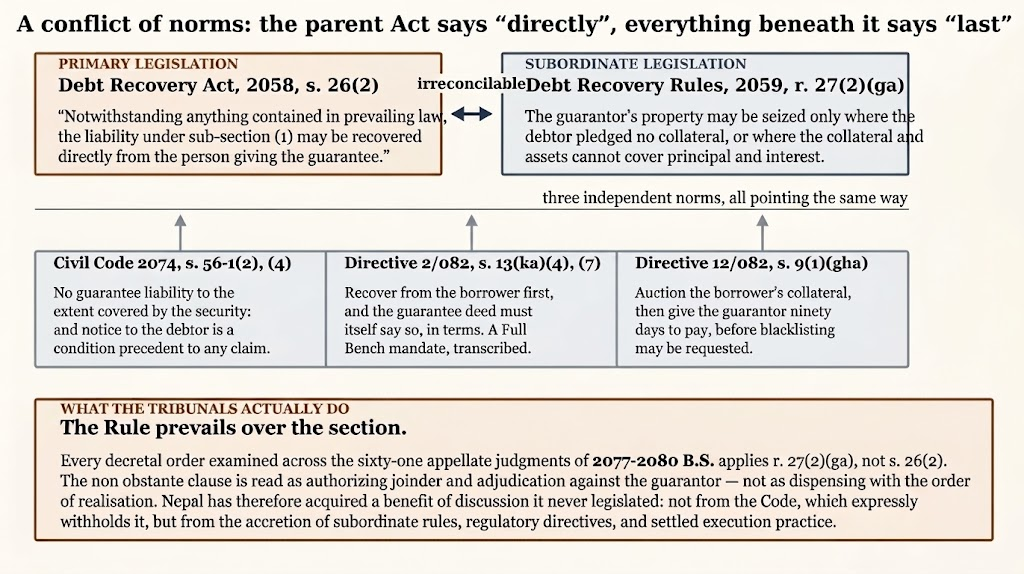
Figure: The hierarchy-of-norms problem at the centre of Nepali guarantor liability. The parent Act contains an unqualified non obstante direct-recovery clause. Three separate instruments beneath it – a rule made under the same Act, and two provisions of the NRB Unified Directive- all impose sequencing. In practice the subordinate norms govern.
A subordinate rule cannot lawfully cut down its parent, and if the question were argued cleanly the outcome would be uncertain. It is not argued cleanly, because the tribunals have found a reading that lets both survive. Section 26(2) is treated as a rule about standing and adjudication: it entitles the bank to name the guarantor without first obtaining a decree against the borrower, and it displaces any general-law requirement of prior proceedings. Rule 27(2)(ga) is treated as a rule about realisation: it governs the order in which the Recovery Officer converts a decree into money. On this reading “directly” means “without a prior judgment against the principal” rather than “without regard to the principal’s assets”, and the two provisions occupy different stages of the same proceeding.
Whether that reading is faithful to the word सोझै is doubtful. Whether it is settled is not. The existing laws and rules shows the sequencing formula appearing in the operative part of decree after decree, in nearly identical language: recover first from the mortgaged land standing in the borrower’s name; if that does not satisfy the claim, from the borrower’s other movable and immovable property; and if that too does not satisfy it, from the personal guarantors, “निजहरुले गरिदिएको व्यक्तिगत/संस्थागत जमानीको लिखतको अधीनमा रही” – subject to the terms of the guarantee instrument they executed.
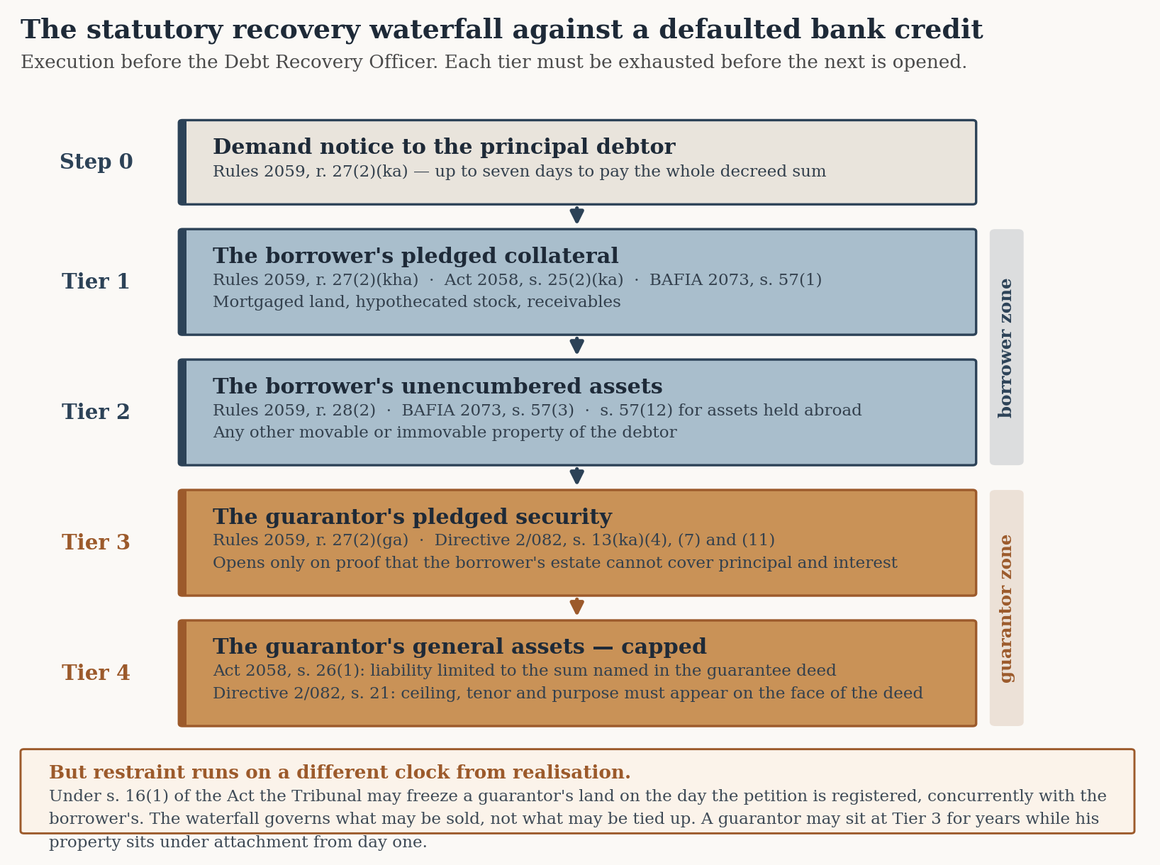
Figure: The four-tier waterfall as actually applied in execution. Collected from Rules 2059, rr. 27–30; Act 2058, ss. 25–26; BAFIA 2073, s. 57; and NRB Unified Directive 2082, Directive 2/082, s. 13(ka). The tiers are cumulative conditions, not options.
What the Act leaves out
The Act’s silences are as consequential as its provisions, and the corpus identifies them with some precision. The word “guarantor” is never defined; it appears in sections 16, 25 and 26 without ever being given a meaning, so the statute has no vocabulary for distinguishing a personal guarantor from a corporate one, a continuing guarantee from a specific one, or – most damagingly – a third-party mortgagor from a personal surety. That last conflation is a live source of injustice: a person who has pledged one parcel of land to secure another’s debt and undertaken nothing further is routinely pleaded against as a general guarantor, with freezing orders sought over his unrelated assets under section 16. In Nepal CSI Development Bank v. S.K. Enterprises (077-DA-0007) the bank pursued an alleged guarantor personally and was eventually obliged to concede that no personal guarantee deed had ever been executed at all.
Subrogation is absent entirely, as described above. Undivided family property is absent: the Act says nothing about what happens when a coparcener objects to the attachment of land standing in a guarantor’s name, and the tribunals have had to improvise a rule restricting attachment to the debtor’s or guarantor’s undivided share – “निजको हकहिस्सासम्म मात्र” – which protects the family at the cost of rendering the parcel practically unsaleable at auction. The death of a guarantor is absent: Rule 40(1)(cha) allows heirs to be substituted, but nothing states whether the guarantee survives or how far the heirs are liable, so the appellate tribunal has imported succession principles from the Civil Code and confined execution to what the heir actually inherited.
| Gap or inconsistency | Provisions in issue | Effect on banks | Effect on guarantors |
|---|---|---|---|
| “Guarantor” undefined; status on novation unclear | Act ss. 2, 26; Rules r. 2 | Claims against institutional and personal guarantors dismissed where fresh deeds were not taken on renewal | Treated as primary debtors in public defaulter lists before any adjudication |
| Sequencing: concurrent under the Act, sequential under the Rules | Act s. 25(2) vs. Rules rr. 27(2)(ga), 28(2) | No execution against guarantor assets until the borrower’s estate is exhausted; liquidation delayed | Pre-judgment freezing under s. 16 ties up property for years while the borrower litigates |
| Silence on subrogation and indemnity | Act ss. 15(1), 26 | Guarantors have no incentive to settle or pay voluntarily during proceedings | A paying guarantor cannot obtain a cross-decree; he must start again in the District Court |
| Third-party mortgagor conflated with personal guarantor | Act ss. 16, 25(2), 26 | Confusion over the scope of the remedy; claims dismissed where no guarantee deed exists | Non-borrower mortgagors face freezing of unencumbered assets they never pledged |
| Silence on undivided family property | Act ss. 16, 25 | Enforcement stalled by parallel partition suits; co-owned parcels are hard to auction | Innocent family members face blanket freezing until the Tribunal narrows it to an undivided share |
| Silence on post-mortem liability of a guarantee | Act s. 26; Rules r. 40(1)(cha) | Difficulty tracing and proving what the heirs actually inherited | Heirs face execution attempts against their own self-acquired property |
| Contractual interest terms against regulatory caps | Act ss. 15(1), 26(1) vs. NRB Unified Directive | Decrees reduced by millions where compound or excess penal interest was claimed | Guarantors must litigate to final appeal to have unlawful charges struck out |
Table: Structural gaps in the Debt Recovery Act, 2058 and Rules, 2059 as they bear on guarantors, with the practical consequence for each side. Compiled from the research corpus, Debt Recovery Tribunal Decisions notebook, record 65.
The parallel route, and a statutory conflict
A bank facing default in Nepal has two recovery routes and no statutory rule telling it which to take. Section 57(1) of the Bank and Financial Institutions Act, 2073 confers a summary, extrajudicial power: on breach of the loan deed, failure to pay within the tenure, or misuse of the credit found on monitoring, the bank may auction the security written over or mortgaged to it and recover principal and interest – notwithstanding anything in the loan deed or in prevailing law, and without approaching any court. Section 57(3) extends the recovery of any shortfall to other property of the borrower. Neither the Act nor the Debt Recovery Act contains an election-of-remedies clause, so banks routinely auction under BAFIA and file before the Tribunal for the residue at the same time.
| BAFIA, 2073 – Section 57(1) and (2): Recovery of credit and additional security Bank and Financial Institutions Act, 2073 › Chapter 8 (Credit Disbursement and Recovery) › s. 57(1), (2), at pp. 65–66 |
| ORIGINAL TEXT ५७. कर्जा असुली सम्बन्धी व्यवस्थाः (१) ऋणीले कर्जा लेनदेन सम्बन्धी लिखत वा करारमा उल्लिखित शर्त कबुलियतको पालना नगरेमा वा लिखत वा करारको भाकाभित्र कर्जा र सोमा लागेको ब्याज वा हर्जाना चुक्ता नगरेमा वा दफा ५६ बमोजिम अनुगमन गर्दा ऋणीले जुन प्रयोजनको लागि कर्जा लिएको हो सो प्रयोजनमा नलगाई दुरुपयोग गरेको देखिएमा कर्जा लेनदेन सम्बन्धी लिखत वा प्रचलित कानूनमा जुनसुकै कुरा लेखिएको भए तापनि ऋणीले बैङ्क वा वित्तीय संस्थालाई लेखिदिएको वा धितो राखेको सुरक्षणलाई लिलाम बिक्री गरी वा अन्य कुनै व्यवस्था गरी सम्बन्धित बैङ्क वा वित्तीय संस्थाले आफ्नो साँवा, ब्याज असुल उपर गर्न सक्नेछ । (२) प्रचलित कानूनमा जुनसुकै कुरा लेखिएको भए तापनि ऋणीले बैङ्क वा वित्तीय संस्थालाई लेखी दिएको वा धितो राखेको सुरक्षण कुनै किसिमले कसैलाई हक छोडी दिएमा वा अन्य कुनै कारणबाट सुरक्षणको मोल घट्न गएमा बैङ्क वा वित्तीय संस्थाले निश्चित म्याद दिई त्यस्तो ऋणीलाई थप धितो सुरक्षण राख्न लगाउन सक्नेछ र ऋणीले बैङ्क वा वित्तीय संस्थाले तोकेको म्यादभित्र थप धितो सुरक्षण राख्नु पर्नेछ । |
| ENGLISH – CONVENIENCE RENDERING 57. Provisions relating to credit recovery: (1) If a borrower fails to abide by the terms and covenants stipulated in the deed or contract relating to the loan transaction, or fails to pay the credit and the interest or penalty accrued thereon within the tenure specified in the deed or contract, or if, on monitoring pursuant to section 56, the borrower is found to have misused the credit by not applying it to the purpose for which it was borrowed, then notwithstanding anything contained in the deed relating to the loan transaction or in prevailing law, the concerned bank or financial institution may recover its principal and interest by selling at auction the security written over or mortgaged to the bank or financial institution by the borrower, or by making any other arrangement. (2) Notwithstanding anything contained in prevailing law, if the borrower in any manner relinquishes title over the security written over or mortgaged to the bank or financial institution, or if the value of the security falls for any other reason, the bank or financial institution may, by specifying a deadline, require such borrower to furnish additional security, and the borrower shall furnish additional security within the deadline prescribed by the bank or financial institution. |
| Source: Bank and Financial Institutions Act, 2073, s. 57(1)–(2). |
Section 57 is drafted around the borrower and is largely silent as to the guarantor. It gives no fixed notice period – only “निश्चित म्याद दिई”, a specified deadline – leaving the timetable to the contract and to the Unified Directive. It imposes the duty to furnish additional security on the borrower alone. Its shortfall power under sub-section (3), its extraterritorial reach under sub-section (12), its passport and state-facilities sanction under sub-section (13), and its mandatory blacklisting duty under sub-section (11) are all expressed by reference to the borrower. A bank that has taken only a personal guarantee, unsupported by a mortgage, therefore cannot use BAFIA against the guarantor at all; it must go to the Tribunal, where section 26(1) will cap what it recovers.
The Act is not, however, silent about the guarantor at the front end. Section 55(7) requires the bank to obtain identification particulars of the guarantor along with the borrower, its directors, its substantial shareholders and their families, together with beneficial ownership details and the evidence of identity needed to take legal action later. Section 55(8) goes further and is the clearest statement of a guarantor’s informational entitlement anywhere in Nepali primary legislation: the loan amount, the interest, the penalty and the repayment schedule must be stated clearly in the deed and communicated to the borrower and, where there is a guarantor, to the guarantor as well.
| BAFIA, 2073 – Section 55(7) and (8): Guarantor identification and disclosure of terms Bank and Financial Institutions Act, 2073 › Chapter 8 › s. 55(7), (8), at p. 64 |
| ORIGINAL TEXT (७) ऋणी, जमानतकर्ता वा फर्म, कम्पनी वा संस्था ऋणी भए सोका सञ्चालक, राष्ट्र बैङ्कले तोकेको प्रतिशतभन्दा बढी शेयर लिने शेयरधनी, साझेदार वा अन्य कुनै प्रकारको स्वामित्व हुने व्यक्ति, उल्लिखित सबै व्यक्तिका परिवार तथा निजहरू कही कतै हितअधिकारी भए सोको विवरण तथा प्रचलित कानून बमोजिम कारबाही गर्नु पर्दा आवश्यक परिचय खुल्ने प्रमाण समेत बैङ्क वा वित्तीय संस्थाले लिनु पर्नेछ ।(८) बैङ्क वा वित्तीय संस्थाले कर्जा प्रदान गर्दा ऋणीलाई प्रदान गरेको कर्जा रकम र सोमा लाग्ने, ब्याज, हर्जाना तथा सो तिर्नु बुझाउनुपर्ने समयतालिका समेत लिखत वा करारमा स्पष्ट रुपमा खुलाई सोको जानकारी ऋणी तथा जमानतकर्ता भए जमानतकर्ता समेतलाई दिनु पर्नेछ । |
| ENGLISH – CONVENIENCE RENDERING (7) The bank or financial institution shall obtain the particulars of the borrower, the guarantor, or where a firm, company or institution is the borrower, its directors, shareholders holding shares exceeding the percentage prescribed by Nepal Rastra Bank, partners or persons having ownership of any kind, and of the families of all such persons, together with details of any beneficial ownership they may hold anywhere, and also the evidence disclosing the identity necessary for taking action under prevailing law.(8) While extending credit, the bank or financial institution shall clearly state in the deed or contract the amount of credit extended to the borrower, the interest and penalty accruing thereon, and the schedule for its repayment, and shall give information thereof to the borrower and, where there is a guarantor, to the guarantor as well. |
| Source: Bank and Financial Institutions Act, 2073, s. 55(7)–(8). |
There is a real conflict in this area, and it concerns the third-party pledgor of movables. Directive 2/082, s. 21 and BAFIA s. 55(8) proceed on the footing that a person’s exposure is confined to what he has expressly undertaken in writing. The Secured Transactions Act, 2063 takes a different view of the same person. Sections 48(1) and 50(1) allow a secured creditor to repossess and dispose of collateral without legal proceedings; section 51(2) then makes the “person giving the security”- responsible for any deficiency remaining after the sale. Because that phrase does not distinguish a borrower who pledges his own machinery from a third party who pledges his, a person who has secured another’s debt with a single movable asset and undertaken nothing more may find himself personally liable for the shortfall under the Secured Transactions Act while being insulated from exactly that liability under the Directive and under the Debt Recovery Act’s ceiling.
| Secured Transactions Act, 2063 – Sections 48(1), 50(1) and 51(2) Secured Transactions Act, 2063 › ss. 48(1) at p. 37, 50(1) at p. 38, 51(2) at p. 40 |
| ORIGINAL TEXT ४८. (१) धितो दिने व्यक्तिले दायित्वको परिपालन नगरेको अवस्थामा कानूनी कारबाही बिना नै धितो लिने व्यक्तिले धितोको सम्पत्ति आफ्नो कब्जा वा नियन्त्रणमा लिन सक्नेछ । ५०. (१) दायित्वको पालना नभएमा धितो लिने व्यक्तिले कुनै वा सबै धितोको सम्पत्ति बिक्री गर्न, भाडामा दिन, इजाजतमा दिन वा अन्य कुनै पनि तवरले बेचबिखन गर्न सक्नेछ । ५१. (२) … नपुग रकमको हकमा धितो दिने व्यक्ति जिम्मेवार हुनेछ । |
| ENGLISH – CONVENIENCE RENDERING 48. (1) Where the person giving the security fails to perform the obligation, the person taking the security may, without any legal proceedings, take the secured property into his or her possession or control. 50. (1) Where the obligation is not performed, the person taking the security may sell, lease, license or otherwise dispose of any or all of the secured property. 51. (2) … as regards any deficiency, the person giving the security shall be responsible. |
| Source: Secured Transactions Act, 2063, ss. 48(1), 50(1), 51(2). |
| AN UNRESOLVED CONFLICT ON THE THIRD-PARTY PLEDGOR The legal text identifies s. 51(2) of the Secured Transactions Act as conflicting with BAFIA s. 55(8) and Directive 2/082, s. 21, which insulate a third-party asset pledgor from deficiency liability beyond the express written commitment. The conflict is real on the face of the instruments. The court decisions record no instance of resolving it. The practical exposure is not trivial. A third-party pledgor of movables in Nepal may be in a materially worse position than a third-party mortgagor of land, who has the full protection of Lumbini Bank Decision (discussed below) – and worse than a personal guarantor, whose liability is capped by statute. |
III. What the Courts Did About It
The judicial record between 2012 and 2026 looks, at first reading, irreconcilable. One line of authority holds that a creditor must exhaust the principal debtor before touching the surety. Another holds that he need not. Both lines are current, both are cited, and both are applied. The reconciliation the Supreme Court has effectively adopted is the same one the tribunals use to manage section 26(2) against Rule 27(2)(ga): substance is separated from sequence, and the apparent conflict resolves into a division between when liability arises and how it is realised.
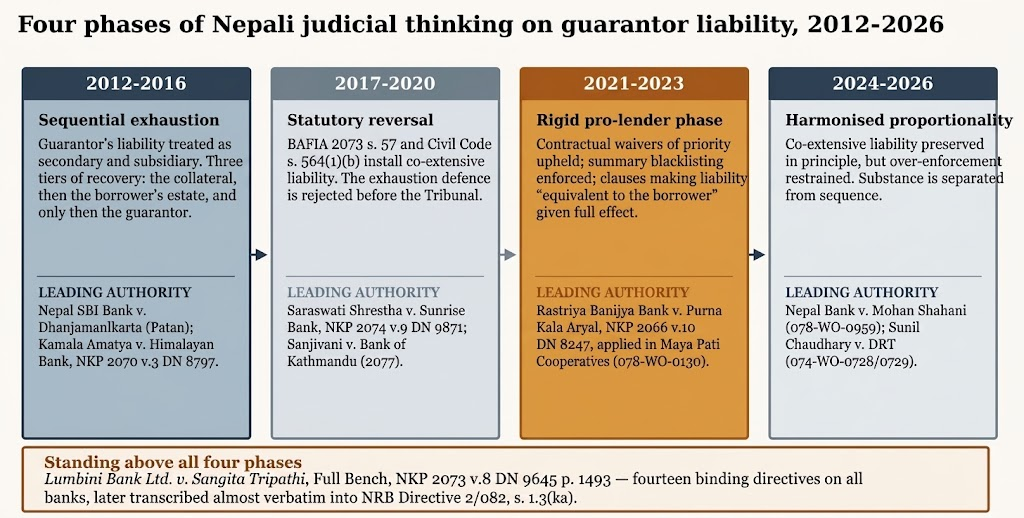
Figure: Four phases in the judicial treatment of guarantor liability, 2012–2026. The arc runs from an exhaustion doctrine inherited from the Muluki Ain, through a statutory reversal driven by BAFIA 2073 and the Civil Code, into a strongly pro-lender phase, and out into the current settlement.
The controlling authority is Lumbini Bank Ltd. v. Sangita Tripathi, decided by a Full Bench of Chief Justice Kalyan Shrestha with Justices Sushila Karki and Devendra Gopal Shrestha on 31 December 2015, reported at NKP 2073, vol. 8, decision no. 9646. Harati Wire Industries borrowed from the bank; Sangita Tripathi, a third party, mortgaged her land in Kathmandu as security up to an expressly stipulated ceiling of NPR 2,400,000. On default the bank gave her no individual notice, made no attempt to recover from the company, undervalued the land, and appropriated the whole property to itself on the first auction call. The Court held that the first obligation to pay principal and interest rests on the borrower, and that liability shifts to the surety, up to the sum stated in the deed, only where the debt cannot be recovered from the borrower. It then issued fourteen binding directives regulating every bank and financial institution in the country.
| “The first obligation to repay the principal and interest of a loan taken from a bank rests with the concerned borrower; only where the loan cannot be recovered from the borrower does liability pass, in respect of the sum stated in the guarantee instrument, to the person who gave the guarantee.” Lumbini Bank Ltd. v. Sangita Tripathi, Supreme Court of Nepal, Full Bench, 2072-09-16 B.S. (31 December 2015). NKP 2073, vol. 8, decision no. 9646. |
The significance of Lumbini Bank is not only its holding but its afterlife. Its fourth and seventh directives were transcribed, almost word for word, into the central bank’s own rulebook. Directive 2/082 of the Unified Directive 2082 now carries a section headed – in terms – “implementation of the decision of the honourable Supreme Court”, and its sub-clauses require the bank to recover first from the borrower, to write that undertaking into the guarantee deed itself, to notify the guarantor with a specified deadline before auctioning his security, and to deliver him a copy of the auction notice if he does not pay. A judgment has become a compliance obligation enforceable by supervisory sanction, which in a heavily supervised banking system is a considerably sharper instrument than a precedent.
| NRB Unified Directive 2082, Directive 2/082 – s. 13(ka)(4), (7), (11) and (12) Directive on credit classification and provisioning › s. 13(क): implementation of the Supreme Court decision of 2072-09-16 › sub-clauses (4), (7), (11), (12) |
| ORIGINAL TEXT (NEPALI) (४) जमानतकर्ताले कबुल गरेको दायित्व बमोजिमको रकम सर्वप्रथम सम्बन्धित ऋणीबाट नै असुल उपर गर्ने, सम्बन्धित ऋणीबाट असुल उपर हुन नसकेमा जमानतकर्ताले कबुल गरेको सीमा हदसम्मको रकम निज जमानतकर्ताले दिएको सुरक्षण धितोबाट कानुन बमोजिम लिलाम गरी असुल गर्न सकिने भनी जमानतको शर्तनामामा उल्लेख गर्ने । (७) जमानतकर्ताले कबुल गरेको दायित्वको रकम सम्बन्धित ऋणीबाट असुल उपर हुन नसकेमा मात्र जमानतकर्ताले दिएको सुरक्षणबाट असुलीको प्रक्रिया अगाडि बढाउने । (११) जमानतकर्ताले धितो सुरक्षणमा दिएको सम्पत्ति लिलाम गर्नुपर्ने भएमा सो पूर्व जमानतकर्तालाई निजले स्वीकार गरेको अङ्क हदको रकम दाखिला गर्नको लागि समय किटान गरी सूचना दिने । (१२) जमानतकर्ताले तोकिएको सूचनाको समय सीमाभित्र जमानतपत्रमा आफूले मञ्जुर गरेको रकम दाखिला गर्न नल्याएमा धितो सुरक्षणको सम्पत्ति लिलामको सूचना प्रकाशित गरी जमानतकर्तालाई समेत सोको सूचना प्रदान गर्ने । |
| ENGLISH – CONVENIENCE RENDERING (4) The amount of the liability undertaken by the guarantor shall first be recovered from the concerned borrower; and it shall be stated in the terms of the guarantee that, where recovery cannot be effected from the concerned borrower, the amount up to the limit undertaken by the guarantor may be recovered by auctioning, in accordance with law, the security furnished by that guarantor. (7) Only where the amount of the liability undertaken by the guarantor cannot be recovered from the concerned borrower shall the process of recovery from the security furnished by the guarantor be taken forward. (11) Where the property furnished as security by the guarantor is to be auctioned, prior notice shall be given to the guarantor, specifying a time, to deposit the amount up to the limit accepted by him or her. (12) Where the guarantor does not deposit the amount consented to in the guarantee instrument within the time specified in the notice, the notice of auction of the security property shall be published and notice thereof shall also be provided to the guarantor. |
| Source: Nepal Rastra Bank Unified Directive 2082 for class “A”, “B” and “C” institutions, Directive 2/082, s. 13(क), sub-clauses (4), (7), (11), (12). |
Against Lumbini Bank stands a substantial body of Division Bench authority reaching the opposite practical result. In Saraswati Shrestha v. Sunrise Bank (NKP 2074, vol. 9, decision no. 9871) the guarantee deed stipulated that the guarantor’s liability would be equivalent to the borrower’s, and the Court held that by executing it the guarantors had contractually accepted primary liability; the bank was entitled to proceed directly and to recommend them for blacklisting. In Sushil Chaudhary v. Debt Recovery Tribunal (074-WO-0728 and 0729, decided 17 January 2024) the same reasoning was applied to guarantors who had divested their shares and resigned as directors: personal guarantee liability is personal, it does not transfer with the shares, and section 26(2) permits direct recovery. In Rastriya Banijya Bank v. Purna Kala Aryal (NKP 2066, vol. 10, decision no. 8247) the Court reversed an appellate holding that the bank must first attempt recovery from the debtor, observing that guarantees are taken precisely because the creditor does not wish to rely on the borrower’s creditworthiness alone, and that if a surety had no immediate standing on default there would be no reason to take one at all.
Set against these are decisions running the other way on facts that are harder to defend. In Nepal Bank Ltd. v. Mohan Shahani (078-WO-0959, decided 23 May 2023) the bank, instead of tracing and auctioning the hypothecated buses and the borrowers’ properties, moved directly to seize NPR 67,941,073 of surplus bail deposits belonging to a property guarantor, lying in the Kathmandu District Court from an unrelated corruption proceeding. The Court called this an illegal inversion of the statutory recovery sequence, citing Lumbini Bank, and set out the order plainly: primary collateral, then the principal debtor’s general assets, then the surety’s pledged collateral, then the surety’s general assets.
The pattern that emerges is not doctrinal confusion but categorial sorting. Three categories of instrument are being governed by three different rules, and the disagreement largely dissolves once the categories are kept apart. An independent demand guarantee issued by a bank is autonomous: the beneficiary may call it without pursuing the contractor at all, subject only to fraud, as held in Bank of Kathmandu v. Melamchi Water Supply Project (071-WO-0869) and Lama Construction v. Nepal Investment Bank (073-CI-0647 and 0648, decided 24 February 2025). A personal guarantee containing an express primary-liability covenant is enforceable directly, because the guarantor has contracted out of the protection. A third-party collateral mortgage attracts the full Lumbini Bank protection: default by the principal must be established, individual notice must be given, the right to redeem must be offered, and unrelated assets are shielded.
| Category of instrument | May the creditor proceed directly? | Governing authority |
|---|---|---|
| Independent or demand bank guarantee | Yes, without qualification. The demand is conclusive proof of default; the underlying dispute is irrelevant. Subject only to proven fraud or irretrievable injustice. | BOK v. Melamchi Water Supply Project (071-WO-0869, 2018); Lama Construction v. NIBL (073-CI-0647, 0648, 2025) |
| Personal guarantee with an express “liability equivalent to the borrower” covenant | Yes, for adjudication and blacklisting. The guarantor has contracted for primary liability and cannot compel the bank to litigate the company first. Realisation still follows r. 27(2). | Saraswati Shrestha v. Sunrise Bank, NKP 2074 v.9 DN 9871; Sushil Chaudhary v. DRT (074-WO-0728, 0729, 2024); RBB v. Purna Kala Aryal, NKP 2066 v.10 DN 8247 |
| Third-party collateral mortgage without a personal covenant | No. Default by the principal must be established and recovery attempted first; individual notice and a right to redeem are mandatory; unrelated assets are shielded; liability is capped at the deed ceiling. | Lumbini Bank v. Sangita Tripathi, Full Bench, NKP 2073 v.8 DN 9646; Nepal Bank v. Mohan Shahani (078-WO-0959, 2023); China International & Gorkha Construction v. Global IME (071-CI-1225, 072-CI-1353) |
Table: The three-category settlement of Nepali suretyship enforcement. The apparent conflict in the case law is largely a function of failing to distinguish these instruments. Compiled from Court Decisions.
One consequence of this sorting deserves emphasis, because it undoes much of what Lumbini Bank achieved. The protection that survives for third-party mortgagors and for guarantors generally is defeasible by contract, and the contract is always the bank’s. Section 565(1) of the Civil Code opens with “except as otherwise provided in the contract”. The Saraswati Shrestha line gives full effect to a single sentence in a pre-printed deed. Let’s be candid about what followed thereafter: standard bank templates classify the guarantor as a co-borrower with joint and several liability, incorporate waivers of the right to require prior exhaustion, and waive defences arising from changes in rate or term. Directive 21 requires loan and security documents to be in Devanagari so that they are readable, and Directive 2/082, s. 21 requires the ceiling, tenor, purpose, principal debtor and witnesses to be stated on the face of the deed; but nothing requires the guarantor to have understood any of it, and the deed is presented as a non-negotiable package with the signature lines already marked.
| A GAP BETWEEN THE REGULATION AND THE PAPER The regulator has built a careful sequencing and notice regime for guarantors. The standard-form deed is drafted to disapply it. Because the Civil Code makes the discharge grounds contractual defaults rather than mandatory rules, and because the Supreme Court has given effect to primary-liability covenants, the regulatory protection is strongest exactly where it is least needed – for the guarantor who signed a bare deed – and weakest where the exposure is largest, for the director or promoter who signed the bank’s full-form guarantee.Theare are no record any decision holding a waiver-of-exhaustion clause void as against Directive 2/082, s. 13(ka). The question appears not yet to have been squarely litigated. |
IV. What Actually Happens: Sixty-One Judgments
Doctrine is one thing and outcomes are another. The published decisions contain a complete text of the Debt Recovery Appellate Tribunal’s decisions across four years – four judgments in 2077 B.S., six in 2078, twenty-eight in 2079 and twenty-three in 2080, sixty-one in all. The distribution of outcomes is the most striking single finding in this study, and it is not the distribution the doctrine would predict.
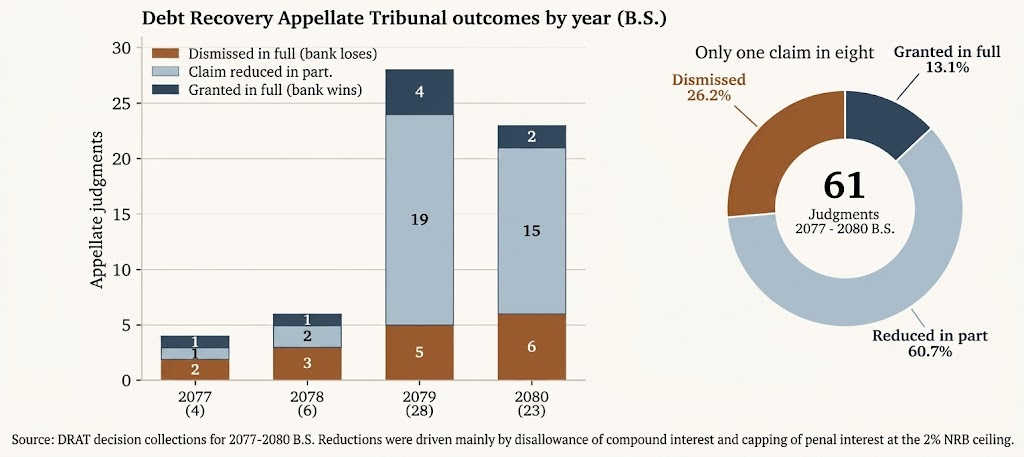
Figure: Appellate outcomes in bank recovery proceedings, 2077–2080 B.S. In only eight of sixty-one judgments did a bank recover its claim as pleaded. In sixteen the claim failed entirely. In thirty-seven the tribunal upheld the debt in principle and reduced the money.
Sixteen claims – just over a quarter – were dismissed outright, and the grounds were almost entirely jurisdictional or temporal rather than substantive. The proviso to section 3 of the Act denies the Tribunal jurisdiction where the outstanding principal is under NPR 500,000, and banks that had taken collateral onto their books as non-banking assets or credited partial auction proceeds repeatedly filed where the residual principal had fallen below that line, even though accumulated interest and expenses carried the total well above it. The tribunal dismissed these in limine – Lumbini Bikas Bank v. Surendra Kumar Pradhan (077-DA-0003), Everest Bank v. Badimalika Pratibha Traders (078-DA-0002), Prabhu Bank v. Bishal Developers (078-DA-0004), NIC Asia Bank v. Asmita Khatri (080-DA-0024) and several more. The remainder failed on limitation under section 15(1)(kha): the four-year period runs strictly from the contractual maturity date in the loan deed, and not from an internal board resolution or a unilateral bank letter, a point settled in Nepal Investment Mega Bank v. Shivalaya Trading Group (079-DA-0012) and applied in Global IME Bank v. Shushila Gauchan (079-DA-0020) and Prabhu Bank v. R.K. Agro Centre (079-DA-0028).
The dominant category, however, is neither victory nor defeat but arithmetic correction. In thirty-seven cases – sixty per cent of the sample, and a still higher proportion in 2079 and 2080 – the tribunal affirmed the debt and cut the money. Three reductions recur. Compound interest and the capitalisation of accrued interest into principal were struck down as void, with the tribunal relying on section 480 of the Civil Code together with the central bank’s rules: NPR 1,566,468.54 disallowed in Nepal SBI Bank v. Badimalika Pratibha Traders (080-DA-0009), NPR 883,367.82 in Nepal SBI Bank v. Uttam Kumar Chaudhary (080-DA-0010), NPR 287,920.93 of capitalised interest in Nepal Investment Mega Bank v. Northpole Outwear (080-DA-0005). Penal interest claimed at four to six per cent on the strength of sanction letters was reduced to the two per cent regulatory ceiling. And in a long run of appeals by NIC Asia Bank and Prabhu Bank seeking post-default rates of fourteen to sixteen and a half per cent, the tribunal held that under Directive 15 the premium over base rate agreed at inception is frozen and cannot be raised without written consent, recalculating the debt at the base rate prevailing at filing plus the original contractual premium.
Against that background, the guarantor statistics are stark. Guarantors were joined as co-defendants in fifty-eight of the sixty-one cases, some ninety-five per cent. In the forty-five cases where recovery was decreed at all, guarantors were held liable alongside the borrower in forty-two – ninety-three per cent of decreed cases. Three guarantors were discharged while the borrower remained liable, and each of the three turned on the bank’s own documentation rather than on any principle of suretyship: Alpine Finco discharged because no fresh institutional guarantee was executed on renewal (078-DA-0008); Shishir Upadhyay and Kanta Jain discharged because no fresh deeds were taken on restructuring (078-DA-0006); Hosiyar Singh Gurung discharged because the bank could not produce an original signed guarantee deed at all (077-DA-0007).
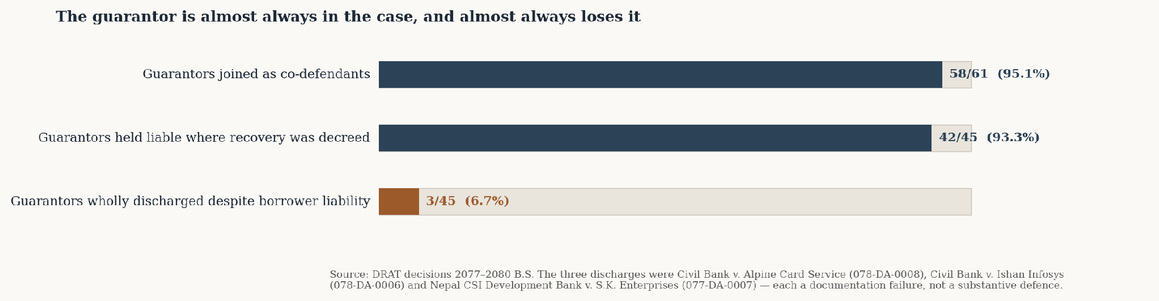
Figure: Guarantor exposure across the sixty-one appellate judgments. The three discharges are the entire universe of guarantor success in the sample, and none rests on a substantive defence under s. 565 of the Civil Code.
The implication is worth stating plainly, because it inverts the way the doctrine is usually taught. The Civil Code’s seven grounds of discharge – variation, release, remission, composition, extension of time, prejudice to the guarantor’s remedy, impairment of security – did not save a single guarantor in four years of appellate decisions. What saved guarantors was the absence of a properly executed, currently dated piece of paper. Nepali guarantee law, as practised, is a law of documents rather than a law of equities. For a guarantor’s adviser the operative questions are not whether the facility was varied but whether the deed was re-executed at the last renewal, whether the original can be produced, and whether the sum, tenor and purpose appear on its face as Directive 2/082, s. 21 requires.
| NRB Unified Directive 2082, Directive 2/082 – s. 21: Liability limited to the sum stated in the guarantee instrument Directive 2/082 › Point 21, at p. 26 |
| ORIGINAL TEXT २१. जमानत दिएको अवस्थामा जमानीपत्रमा उल्लेख गरेको रकमसम्म मात्र जिम्मेवार हुने : जमानत दिएको अवस्थामा जमानीपत्रमा उल्लेख गरेको रकमभन्दा बढी रकमको लागि जमानी दिने व्यक्ति/फर्म/कम्पनी/संस्थालाई कुनै पनि अवस्थामा जिम्मेवार नगराउन जमानीपत्र तयार गर्दा नै जमानी रकम, ऋणको अवधि, ऋणको प्रयोजन, प्रमुख ऋणी, साक्षी, जमानतकर्ताको नाम, ठेगाना, सो को सनाखत लगायतका विषयहरु स्पष्ट रुपमा उल्लेख हुनु पर्नेछ । |
| ENGLISH – CONVENIENCE RENDERING 21. Liability only up to the sum stated in the guarantee instrument: Where a guarantee has been given, in order that the person, firm, company or institution giving the guarantee shall in no circumstance be made liable for an amount exceeding the sum stated in the guarantee instrument, the guarantee amount, the tenor of the loan, the purpose of the loan, the principal debtor, the witnesses, and the name, address and attestation of the guarantor, among other matters, must be clearly stated at the time the guarantee instrument is prepared. |
| Source: Nepal Rastra Bank Unified Directive 2082, Directive 2/082, Point 21. |
The clock, and the counter-clock
The corpus permits a fairly precise reconstruction of the elapsed time from a borrower’s first missed instalment to the point at which a guarantor’s assets become realisable. The statutory contributions are modest – a thirty-five day recall notice, auction notices at thirty-five, fifteen and seven days, a fifteen-day summons to file a defence, a seven-day demand from the Recovery Officer, a ninety-day pre-blacklisting notice to the guarantor. It is the internal policy layer that stretches the calendar. Most commercial bank’s Credit Manual requires an account to be at least ninety days overdue before the thirty-five day call-back notice may be published, and more than six months overdue before an auction notice may issue at all; then a four-stage escalating ladder of calls and letters runs ahead of both.
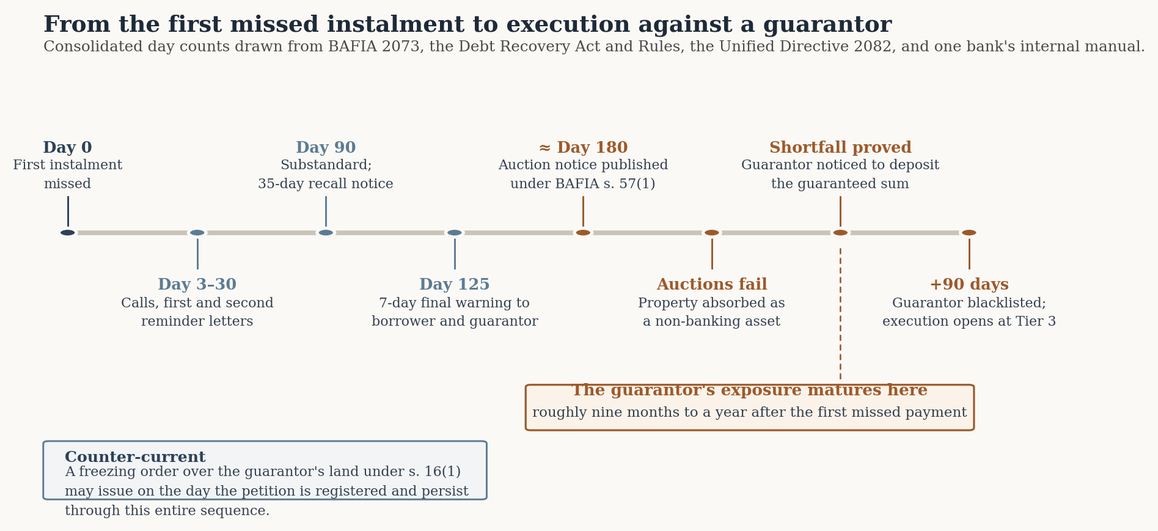
Figure: From first default to guarantor execution: a consolidated day count. Statutory periods from BAFIA 2073 and the Debt Recovery Act and Rules; ageing thresholds and the notice ladder usually practiced by most commercial banks in Nepal.
Against this stands section 16(1), and it is the single most important qualification in this report. The Tribunal may issue interim orders restraining the sale or transfer of property owned or possessed by the debtor or by the person giving the guarantee, and it may do so from registration of the petition. The decisions records that the tribunals exercise this power freely over guarantors’ unencumbered land – in Civil Bank v. Alpine Card Service and Civil Bank v. Gear Venture Bike freezing orders reached parcels standing in the names of guarantors’ mothers and wives, and the tribunal was obliged to develop an ad hoc rule confining the attachment to the guarantor’s undivided coparcenary share. The result is that a guarantor whose liability will not mature for a year, and may never mature at all, has his property immobilised from the first week – and, once the attachment is confined to an undivided share, immobilised in a form that no auction purchaser will bid for. Both sides lose: the guarantor cannot deal with his land, and the bank cannot sell it.
| ON THE PRACTICAL ASYMMETRY OF SECTION 16 The sequencing protection and the attachment power are not symmetrical, and the asymmetry runs entirely one way. Rule 27(2)(ga) delays the moment the guarantor must pay. Section 16(1) advances the moment he stops being able to use what he owns. A regime that combines a slow waterfall with fast, broad, pre-judgment restraint produces the worst available combination for the guarantor: the burdens of enforcement arrive years before the adjudication that would justify them.Neither the Act nor the Rules provide a summary procedure by which an affected guarantor or a non-party family member may apply to release or narrow such an order. The tribunals have supplied one by practice. That is a gap that could be closed by amendment without disturbing anything else in the statute. |
V. Where the Protection Fails
Three situations dissolve the sequencing protection, and they are the three situations in which a guarantor is most likely to find himself. The first is insolvency of the borrower. The second is the shortage of buyers for the collateral that stands ahead of him. The third is the blacklist, which operates on a logic of its own.
Insolvency: the shield that exposes
Section 19(1) of the Insolvency Act, 2063 imposes an automatic moratorium once the court orders the commencement of insolvency proceedings. Its clauses are comprehensive as to the company: no transfer of shares, no transfer or mortgage of company property, no execution of a decree against company assets and no enforcement of security over them, no repossession of leased property, no payment of pre-commencement debt, and no commencement or continuation of legal proceedings against the company. Section 57 of BAFIA – the bank’s summary auction power – is suspended along with everything else.
| Insolvency Act, 2063 – Section 19(1): Actions to be stayed Insolvency Act, 2063 › s. 19(1), clauses (ka) to (cha), at pp. 12–13 |
| ORIGINAL TEXT दफा १९. काम कारबाही रोक्का रहने : (१) दफा १० को उपदफा (२) बमोजिम अदालतले दामासाहीसम्बन्धी कारबाही प्रारम्भ गर्ने आदेश दिएपछि अदालतको अनुमति विना देहायका कुनै काम गर्नु हुँदैन र त्यस्तो कुनै काम भएको रहेछ भने सो काम स्वतः स्थगित हुनेछ :–(क) कम्पनीको शेयर तथा अन्य धितोपत्रको हक हस्तान्तरण गर्ने वा सो कम्पनीको शेयर वा धितोपत्र दर्ता किताबमा कुनै संशोधन गर्ने,(ख) कम्पनीको कुनै पनि जायजेथा हस्तान्तरण, बेचबिखन गर्ने वा कुनै किसिमले धितो वा बन्धक राख्ने,(ग) कुनै फैसला वा आदेश अनुसार कम्पनीको कुनै जायजेथा जायजात गर्ने वा धितोको सम्पत्ति चलन चलाउने,(घ) कम्पनीले पट्टा (लिज) मा लिएको कुनै सम्पत्ति पट्टा दिने व्यक्तिले फिर्ता लिने वा तत्सम्बन्धी कुनै कानूनी कारबाही गर्ने,(ङ) दफा १० को उपदफा (२) बमोजिम अदालतले दामासाहीसम्बन्धी कारबाही प्रारम्भ गर्ने आदेश दिँदाका बखत भुक्तानी गर्न बाँकी रहेको वा भुक्तानी योग्य भएको ऋण भुक्तानी गर्ने वा सोबापत सुरक्षण दिने, र(च) कम्पनीका विरुद्ध कुनै कानूनी कारबाही प्रारम्भ गर्ने वा जारी राख्ने । |
| ENGLISH – CONVENIENCE RENDERING Section 19. Actions to be stayed: (1) After the court issues an order commencing insolvency proceedings pursuant to sub-section (2) of section 10, none of the following acts shall be done without the permission of the court, and if any such act has been done, that act shall be automatically stayed:–(a) transferring title to the shares or other securities of the company, or making any amendment in the share or securities register of the company;(b) transferring or selling any property of the company, or placing it in any manner under pledge or mortgage;(c) attaching any property of the company pursuant to any judgment or order, or taking possession of mortgaged property;(d) the lessor taking back any property leased to the company, or taking any legal action in that regard;(e) paying any debt outstanding or payable at the time the court issues the commencement order pursuant to sub-section (2) of section 10, or furnishing security therefor; and(f) commencing or continuing any legal action against the company. |
| Source: Insolvency Act, 2063, s. 19(1). |
Every clause names the company. None names a guarantor. There is no equivalent of the phrase “against the guarantors” anywhere in the section, and the corpus is unambiguous that no bar exists on a bank proceeding against personal or corporate sureties during the moratorium. Recovery proceedings before the Tribunal, and auction of security furnished by a guarantor, continue uninterrupted.
That much is a familiar feature of insolvency systems. What is distinctive in Nepal is the interaction with Rule 27(2)(ga). The Rule opens Tier 3 when the borrower’s collateral and assets cannot cover principal and interest. A commencement order under section 10(2) is close to conclusive evidence of exactly that proposition, and it simultaneously prohibits the bank from doing anything about the borrower’s assets. The condition precedent to reaching the guarantor is therefore satisfied by the same judicial act that removes every alternative. Insolvency does not suspend the guarantee. It matures it.
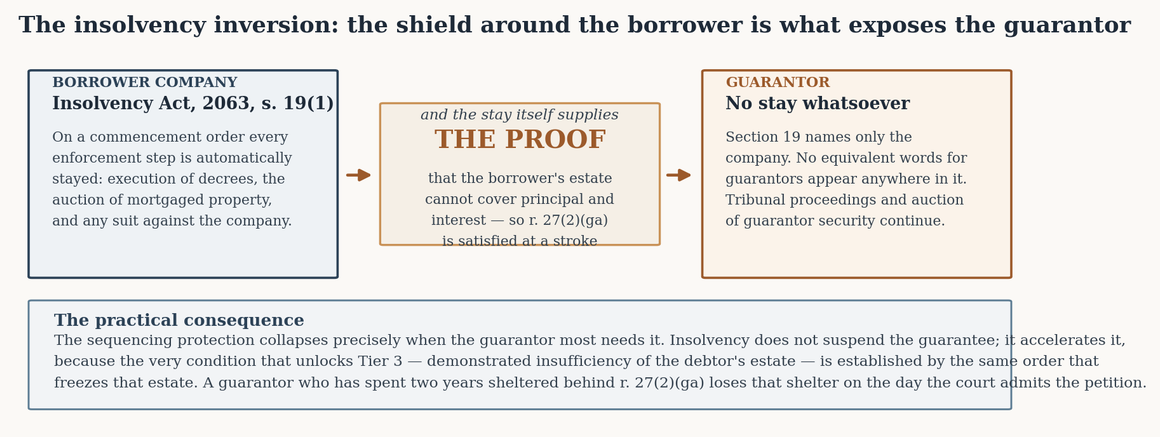
Figure: The insolvency inversion. Section 19 of the Insolvency Act, 2063 and r. 27(2)(ga) of the Debt Recovery Rules, 2059 interact so that the order protecting the borrower is the proof that unlocks the guarantor.
Two related points follow. Where a restructuring scheme under the Insolvency Act reduces or reschedules the company’s debt, that reduction does not automatically reduce the guarantor’s liability – section 564(1)(c) of the Civil Code expressly preserves the guarantor’s obligation where the principal is discharged by operation of law, and the corpus records the same position in the doctrinal literature. And where a company is struck off under the Companies Act, 2063, its personal guarantors remain liable after it has ceased to exist. As the late Justice Bharat Raj Upreti put it in his treatise on company law, a shareholder or director who has given a personal guarantee cannot escape the obligation on the ground that the company’s liability is limited – limited liability protects the shareholder from the company’s debts, not from his own promise.
The collateral that will not sell
The second failure point is economic rather than legal, and it has grown sharply worse over the reporting period. Rating agencies have long described Nepal as a comparatively creditor-friendly enforcement environment, and the statutory powers bear them out: ICRA Nepal’s sector reviews attribute the system’s historically low non-performing loan ratios partly to good collateral practice and to regulations permitting relatively unobstructed liquidation of that collateral. The agencies also record the limit of that observation. Around two-thirds of the system’s collateral is concentrated in real estate. Legal power to auction is worth what the auction realises, and the agencies note that recovery depends on the liquidity and depth of the property market rather than on legal rights alone, that between borrowers deleveraging and banks enforcing there is now a disproportionate rise in sellers relative to buyers, and that forced liquidation risks depressing the very valuations on which the recovery depends.
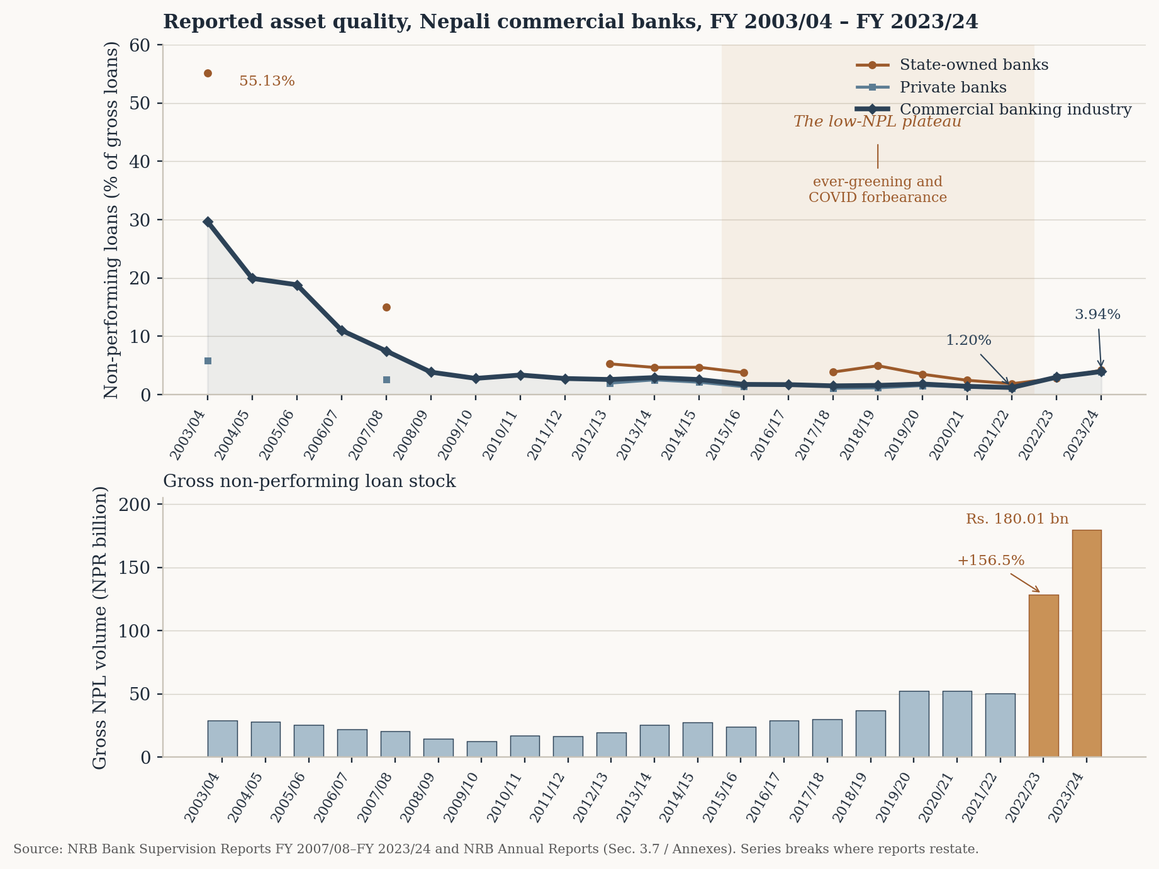
Figure: Reported asset quality and the gross non-performing loan stock, FY 2003/04 to FY 2023/24. The long decline from the 2003/04 peak reflects the restructuring of the state-owned banks. The supervisor’s own reports attribute part of the subsequent plateau to ever-greening; the reversal from 2022/23 is attributed to post-pandemic slowdown, over-financing, and diversion of working capital into real estate and equities.
The supervisor has been notably candid about what the low-NPL plateau concealed. The Bank Supervision Report for 2013 stated in terms that the decline could not be explained by restructuring and better regulation alone, that on-site inspection found banks using high volumes of revolving loans, overdrafts and working capital facilities to ever-green exposures, that credit was being extended to settle past loans and interest, and that the practice continued notwithstanding the central bank’s efforts, resulting in understatement of non-performing assets and overstatement of capital. When the plateau broke, it broke hard: gross NPLs rose 156.53 per cent in FY 2022/23 to Rs. 128.64 billion, and a further 39.93 per cent in FY 2023/24 to Rs. 180.01 billion.
What happens to the collateral behind those loans is visible in the non-banking asset series. When a bank auctions security and no bidder appears at or above the reserve, it may take the property onto its own books. Non-banking assets held by commercial banks rose from Rs. 2.58 billion in mid-July 2018 to Rs. 30.15 billion in mid-July 2024, a rise of ninety-seven per cent in the final year alone. The supervisor’s own explanation is direct: around two-thirds of collateral is concentrated in real estate, banks follow auction to recover, and the slowdown in the property sector has made such collateral difficult to dispose of.
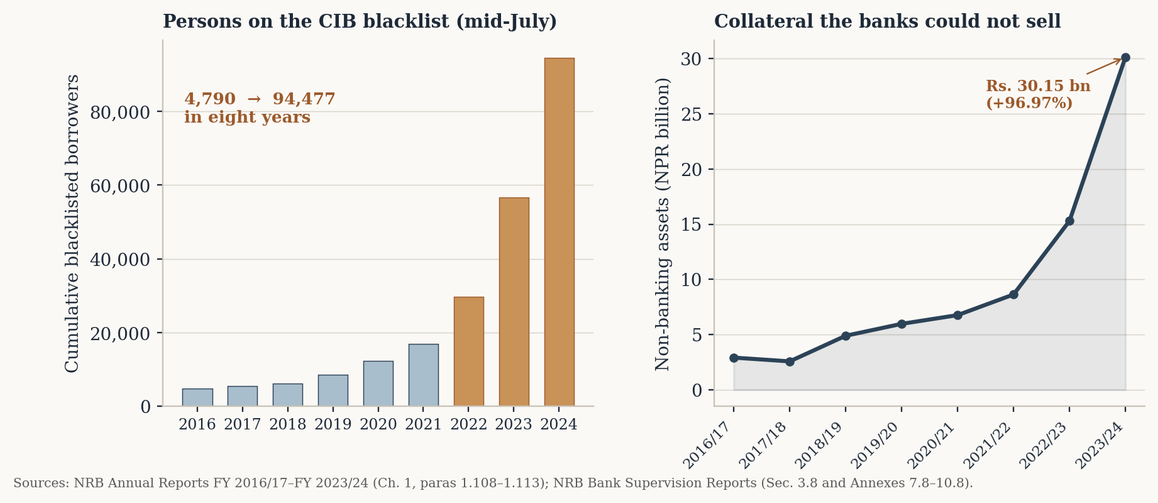
Figure: Two consequences of the same problem: blacklisting and unsold collateral. Blacklisted persons rose roughly twenty-fold in eight years. Non-banking assets – collateral the banks bid in themselves because no one else would – rose more than tenfold over a comparable period.
For the guarantor the consequence is direct and adverse. Tier 1 and Tier 2 of the waterfall exist to absorb the loss before it reaches him. When those tiers produce a property the bank cannot sell rather than cash, the shortfall that unlocks Tier 3 is established sooner and is larger. There is a further complication in the accounting. Where a bank bids in the property itself and holds it as a non-banking asset, the value at which it is taken over determines the credit given against the borrower’s liability and therefore the size of the residue for which the guarantor answers. The corpus records that a takeover value is fixed by a panel valuation, and most bank’s manual constitutes an eight-member panel for that purpose – land revenue office, local government, branch manager, province head, legal department, police, district administration and a consultant engineer. The guarantor is not a member of that panel and has no procedural route to challenge the figure it produces, yet the figure directly determines his exposure.
| AN UNADDRESSED QUESTION ABOUT NON-BANKING ASSET VALUATION Where collateral is taken over rather than sold, the take-over value sets the credit against the borrower’s account and therefore the guarantor’s residual liability. The credit manuals in practice by BFIs establishes the existence of the panel valuation process and the provisioning and disposal rules that follow, but records no provision – statutory, regulatory or internal – giving a guarantor notice of the valuation, a right to be heard on it, or a right to challenge it before the shortfall is computed against him. Nor does the court texts record any decision in which a guarantor challenged a take-over valuation on that basis. |
The blacklist, which follows its own logic
The third failure point is not about money at all. Blacklisting through the Credit Information Bureau is an administrative consequence, and it reaches guarantors on a timetable quite different from the execution waterfall. The number of blacklisted persons rose from 4,790 in mid-July 2016 to 94,477 in mid-July 2024, and the categories reported include personal and corporate guarantors alongside principal borrowers, joint venture partners and wilful defaulters.
The regulatory protections here are the most explicit in the whole framework, and they sequence more tightly than anything in the Debt Recovery Rules. Directive 12/082, s. 9(4)(gha) provides that before a guarantor may be included in the blacklist the borrower’s security must first be auctioned and recovery attempted; if a balance remains, the guarantor must be given ninety days to pay; and only after that period may a blacklisting recommendation be made. Where the written notice does not reach the person, it must be published in a newspaper. Section 11 of the same directive requires, separately, at least thirty-five days’ advance written notice with reasons before any borrower or associated party is blacklisted, and requires the bank to keep a record of it.
| NRB Unified Directive 2082, Directive 12/082 – s. 9(4)(gha): Precondition to blacklisting a guarantor Directive on credit information and blacklisting › s. 9(4), proviso to clause (घ) |
| ORIGINAL TEXT तर, जमानतदातालाई कालोसूचीमा समावेश गर्नुपूर्व ऋणीले सुरक्षणस्वरुप राखेको धितो लिलाम गरी असुली गर्नुपर्नेछ । यस्तो सुरक्षणबाट भएको असुली पर्याप्त नभई बैङ्कको लेना रकम बाँकी रहेमा सोको भुक्तानीका लागि जमानतदातालाई ९० दिनको समय प्रदान गर्नुपर्नेछ । सो सूचना अवधिपछ्रात मात्र जमानतदातालाई कालोसूचीमा समावेश गर्नुपर्नेछ । लिखित सूचनाको पत्र सम्बन्धित व्यक्तिको ठेगानामा नपुगेमा सो सूचना पत्रिकामा सार्वजनिक गर्नु पर्नेछ । |
| ENGLISH – CONVENIENCE RENDERING Provided that, before including a guarantor in the blacklist, the security furnished by the borrower must be auctioned and recovery effected. Where the recovery from such security is not sufficient and a balance remains due to the bank, the guarantor must be given a period of 90 days for payment thereof. Only after that notice period may the guarantor be included in the blacklist. Where the letter of written notice does not reach the address of the person concerned, that notice must be published in a newspaper. |
| Source: Nepal Rastra Bank Unified Directive 2082, Directive 12/082, s. 9(4)(घ). |
The problem is not the rule but its position in the sequence. Ninety days after a failed auction is early in the life of a recovery action – well before the Tribunal has ruled on whether the guarantor is liable at all, and well before any question of quantum has been resolved. The consequences of listing are immediate and severe: loss of access to credit across the entire system, and, on the corpus’s own account, publication of names in public defaulter lists alongside wilful defaulters. A guarantor whose liability may ultimately be reduced to nothing on appeal, or discharged for want of a re-executed deed, will in the meantime have been excluded from the banking system for the duration.
Directive 2/082 addresses the tone of recovery in unusually explicit language, instructing banks that it is not appropriate to assume every defaulting borrower took the loan with intent to defraud, that borrowers and their families should be treated with respect and sympathy, and that recovery should be arranged so as not to affect adversely the social standing and honour of family members. These are real provisions in a binding instrument. Whether they are enforceable against a recovery department working to a non-performing loan target is a different question, and in the practicing banker’s own assessment – that they are largely aspirational rather than contractually enforceable – is difficult to dispute when set against a blacklist that grew twenty-fold in eight years.
VI. Two Positions, Side by Side
It is worth setting the borrower’s position and the guarantor’s position against each other directly, because the differences are not where intuition places them. The guarantor is not a lesser defendant. He is an equal defendant with a smaller and later-maturing debt, and a narrower set of statutory tools pointed at him.
| Principal borrower | Guarantor | |
|---|---|---|
| Source of liability | Contract of loan. Liability from disbursement.BAFIA 2073, s. 55(6); Civil Code s. 504. | Contract of guarantee, in writing. Liability created at the moment of the borrower’s default.Civil Code ss. 563(4), 564(1)(a) |
| Extent of liability | The whole debt: principal, lawful interest, charges, without ceiling.BAFIA s. 57(1); Act 2058 s. 15(1) | Capped at the sum named in the deed; and no liability at all to the extent the security covers the debt.Act 2058 s. 26(1); Civil Code s. 564(2); Directive 2/082 s. 21 |
| Status in the recovery petition | Respondent.Act 2058 s. 15(1); Rules rr. 3, 4 | Respondent, on identical terms – “debtor” is defined to include him.Act 2058 s. 2(chha); Rules r. 8 |
| Pre-judgment attachment | Available from registration of the petition.Act 2058 s. 16(1) | Equally available from registration, notwithstanding that liability has not matured.Act 2058 s. 16(1) |
| Order of realisation | First: pledged collateral, then all other property.Rules r. 27(2)(kha), 28(2); BAFIA s. 57(3) | Last: only on proof that the borrower’s estate cannot cover principal and interest.Rules r. 27(2)(ग); Directive 2/082 s. 13(ka)(4), (7) |
| Extraterritorial reach | Foreign assets may be attached.BAFIA s. 57(12) | Not conferred. BAFIA does not extend s. 57(12) to a guarantor.- |
| Coercive state sanctions | Passport impoundment and denial of state facilities may be requested.BAFIA s. 57(13) | Not conferred by BAFIA. Civil detention remains available through the Tribunal.Act 2058 s. 25(2)(ga); Rules r. 30ka |
| Additional security on demand | Statutory duty to furnish more security if the value falls.BAFIA s. 57(2) | No corresponding duty. The undertaking is fixed at execution.- |
| Blacklisting | Mandatory statutory duty to report to the CIB.BAFIA s. 57(11) | Not under BAFIA. Only after auction of the borrower’s security, a 90-day notice, and a 35-day notice.Directive 12/082 ss. 9(4)(gha), 11 |
| Appeal | 15 days; 30 per cent of the decretal sum in cash as a condition of registration.Act 2058 ss. 19, 22 | Identical. The 30 per cent applies to the sum decreed against him, up to his ceiling.Act 2058 ss. 19, 22 read with s. 2(chha) |
| Effect of insolvency of the company | Automatic moratorium on all enforcement.Insolvency Act 2063 s. 19(1) | No stay. Proceedings and auction of guarantor security continue.Insolvency Act 2063 s. 19(1), by omission |
| Rights after payment | – | Subrogation to the creditor’s position and full indemnity – but only in the District Court, not the Tribunal.Civil Code ss. 567(1)–(3), 574; Act 2058 s. 15(1) |
Table: The borrower and the guarantor compared across the recovery process. Each entry carries the instrument relied upon. Compiled from the research across the Civil and Criminal Code, Debt Recovery Tribunal Decisions, and NRB Directives.
Two entries in that table deserve to be read together, because their combination is the practical heart of the matter. The guarantor’s realisation sits last, and his pre-judgment attachment sits first. Every other asymmetry in the table is defensible; that one is not. It produces a class of respondent who bears the full burden of enforcement from the opening of the case while carrying a liability that may never mature, and who, if it does mature and he pays, must go to a different court to get his money back.
A second observation concerns the direction of the internal policy layer by the banks. It might be expected that a bank’s own recovery manual would take every advantage the statute allows. The evidence shows the opposite. One commercial bank’s Credit Manual (that was referred to for the research) restricts recourse against a guarantor’s assets until the primary collateral has been auctioned twice and absorbed as a non-banking asset and a deficiency has been mathematically established; requires ninety days of ageing before the thirty-five day recall notice and six months before an auction notice; requires a minimum of three bids before a first auction can be concluded; prohibits set-off against a guarantor’s own deposit without his express consent; and classifies every guarantee as close-ended, requiring re-execution at each renewal. Each of these is stricter than the law requires. The last is a direct operational response to the line of appellate cases discharging guarantors on renewal.
| The tightest constraints on recovery from guarantors in Nepal are not in the statute. Strangely, they are in the tribunals’ execution practice, the central bank’s directives, and the banks’ own manuals – in that order. |
Conclusion
Nepal’s law of guarantor recovery is not incoherent, but it is assembled rather than designed. The Civil Code supplies a classical accessory obligation with a generous list of discharges, then makes the whole list contractually defeasible. The Debt Recovery Act overrides the classical position with a deeming definition and a direct-recovery clause, then its own Rules restore something close to the classical position at the execution stage. A Full Bench decision about a third-party mortgagor gets transcribed into prudential regulation and thereby becomes binding on institutions that were never party to it. The Insolvency Act protects the borrower and in doing so removes the guarantor’s shelter. Nothing in this is contradictory once the layers are kept apart, but no one designed it, and the seams are where the litigation happens.
The central finding of this study is that Nepal has a benefit of discussion in fact without having one in law. The Civil Code refuses it: its text is explicit that there is no general beneficium excussionis, that a creditor need not sue the debtor to judgment or exhaust his unencumbered estate. Section 26(2) of the Debt Recovery Act refuses it in the strongest terms available to a drafter. And yet the sequence is enforced, consistently, in every execution order the corpus records, because Rule 27(2)(ga) says so, because Directive 2/082, s. 13(ka) says so, because a Full Bench said so in 2015, and because most banks’ own recovery manuals now say so too. The protection is real. Its foundations are subordinate.
That matters because subordinate foundations can be moved. A single amendment to Rule 27, or a redrafting of Directive 2/082, would remove the sequencing without touching a line of primary legislation and without any parliamentary process. Conversely, the protection could be put beyond doubt by amending section 26(2) itself – by adding to the direct-recovery clause a proviso in the terms the tribunals already apply. The study suggests four points at which the framework could be repaired without disturbing its architecture: defining “guarantor” in section 2 and separating the third-party mortgagor from the personal surety; giving a paying guarantor a route to subrogation within the Tribunal rather than referring him to the District Court; supplying a summary procedure for a guarantor or an affected coparcener to narrow or discharge a section 16 attachment; and stating expressly whether and to what extent a personal guarantee survives the guarantor’s death, rather than leaving the tribunals to import succession law.
For the practitioner the operative conclusions are narrower and more immediate. A bank that wants a guarantee it can actually enforce should treat the deed as a perishable instrument: re-executed at every renewal and every restructuring, with the ceiling, tenor, purpose, principal debtor and attestation on its face, held in a custody regime that can produce the original in evidence, and pleaded with the sequencing formula already built into the prayer. A bank that pleads its own interest schedule rather than the regulatory ceiling should expect to lose the difference. And a guarantor’s adviser should look first at the paper and only second at the equities: on four years of appellate evidence, the deed that was never refreshed is worth more than every ground of discharge in section 565 combined.