
The Loan Recovery Pathway for Banks and Financial Institutions in Nepal – a legal and procedural map from borrower default through complete section 57 enforcement, the Debt Recovery Tribunal and Appellate Tribunal, to constitutional writ review, illustrated by the internal recovery policy of a licensed commercial bank
Abstract. This article maps Nepal’s bank-loan recovery pathway from default to decree and evaluates its coherence, legal certainty and efficiency. It adopts a strict reading of section 14(7) of the Bank and Financial Institution Debt Recovery Act, 2058, read with Rule 4 of the 2059 Rules: a bank may approach the Debt Recovery Tribunal (DRT) only after genuine settlement efforts, internal recovery and complete exhaustion of the bank-executable remedies under section 57 of the Bank and Financial Institution Act, 2073 (BAFIA). Exhaustion requires the pledged security to be taken through the mandatory enforcement sequence-including at least three completed public-auction processes before an unsold asset may be accepted as a non-banking asset-every sale or takeover value to be credited, and the borrower’s and guarantor’s other assets to be pursued through all lawful pre-decree means. Only a genuine residual claim then passes to the DRT. The Tribunal adjudicates liability and preserves assets; the Debt Recovery Officer executes the decree; the Debt Recovery Appellate Tribunal (DRAT) hears the statutory appeal; and the higher courts intervene only through exceptional writ review. Blacklisting, criminal prosecution and insolvency remain separate tracks and do not dilute the exhaustion gate. A commercial bank’s internal credit policy is used as a policy case study, not as proof of uniform implementation. The analysis finds substantial clarity on auction safeguards, redemption, guarantor limits, appellate structure and the civil–criminal boundary, but continuing friction around the Rs 500,000 jurisdictional threshold, the insolvency interface and institutional delay. The article closes with a revised roadmap, jurisdictional matrix and process diagram built around complete section 57 exhaustion.
Keywords: banking law; loan recovery; BAFIA section 57; DRT; DRAT; non-banking assets; Nepal
Note on method and sources. This is a doctrinal and procedural analysis supported by institutional and reported-case material where it bears on efficiency and bottlenecks. The law is stated as at 8 August 2026. Regulatory references are to the NRB Unified Directives, 2082, read with the circular archive current to that date. The article uses the authoritative Nepali statutes and rules, with English descriptions as working translations. The commercial-bank material is a board-approved Credit Policy and Credit Manual used to illustrate the bank’s prescribed internal framework, not to establish that every bank follows the same in practice. The jurisdictional-threshold discussion draws on published DRAT decisions and a secondary synthesis that links directly to the decisions. Monetary thresholds, time limits and prudential percentages are therefore tied to the law-as-at date rather than to earlier directive cycles.
References
Primary legislation and rules
Bank and Financial Institution Act, 2073 (BAFIA), especially sections 56–57.
Bank and Financial Institution Debt Recovery Act, 2058, especially sections 3, 14–17, 19, 22–28.
Bank and Financial Institution Debt Recovery Rules, 2059, especially Rules 4, 5, 20 and 27–31 and the prescribed petition and appeal schedules.
National Civil Code, 2074 and National Civil Procedure Code, 2074 – provisions on loan, guarantee, pledge, mortgage, set-off, appropriation, limitation and residual civil procedure.
Banking Offence and Punishment Act, 2064; Secured Transactions Act, 2063, sections 48–51; Insolvency Act, 2063, sections 11 and 19; Companies Act, 2063; Arbitration Act, 2055, section 30(3)(a).
Constitution of Nepal, 2072, articles 1(1), 128(2), 133, 144 and 152(1).
NRB and market infrastructure
Nepal Rastra Bank, Unified Directives, 2082 for Class A, B and C institutions, Directive No. 2 (classification, provisioning, restructuring, write-off and non-banking assets) and Directive No. 12 (credit information and blacklisting).
Nepal Rastra Bank, circular archive for FY 2082/83 (law-as-at verification).
CDS and Clearing Ltd., Settlement Procedure (secondary-market settlement operates on T+2).
Judicial and tribunal decisions
Sangita Tripathi v. Lumbini Bank Ltd., Supreme Court (Full Bench), NKP 2073, Decision No. 9646 (multi-stage auction; no first-attempt self-acquisition).
Pushpa Rawal Rayamajhi v. Nepal Bank Ltd., Supreme Court, NKP 2069, Vol. 7, Decision No. 8861; Deepak Prasad Shrestha v. NRB & Mahalaxmi Development Bank Ltd., Case No. 074-WO-0615 (redemption until third-party transfer).
DRAT Case No. 077-DA-0001 and DRAT Case No. 077-DA-0003 (original-principal baseline for the Rs 500,000 gateway).
DRAT Case No. 078-DA-0002 (contractually defined ancillary advances and principal).
DRAT Case No. 080-DA-0026 and DRAT Case No. 080-DA-0028 (mandatory NBA credit and residual principal below threshold).
Ravindra Bahadur Singh v. Debt Recovery Tribunal, Kamalpokhari, Case No. 070-WO-0772 (natural justice and ex parte decree); Pradeep Kumar Agarwal v. Custom Office Morang, NKP 2052, Decision No. 6032; Piyush Bahadur Amatya v. Nepal Rastra Bank, NKP 2064, Decision No. 7872.
Government of Nepal v. Sher Bahadur Thapa / Laxmi Prasad Acharya, NKP 2066, p. 860; Govinda Prasad Joshi / Min Bahadur G.C. v. Government of Nepal, Case No. 075-NF-0005 (mere default is not a crime absent bad faith).
Mahalaxmi Development Bank Ltd. v. Dinesh Gopali, DRAT Case No. 077-DA-0005 (section 22 appellate deposit); Civil Bank v. Ishan Infosys, DRAT Case No. 078-DA-0006 (fresh guarantee for materially modified facilities); Lumbini Development Bank Ltd. v. Champadevi Foothill Resort, DRAT Case No. 076-DA-0001 (illustrative duration).
“Debt Recovery Litigation DRAT” (last updated 2 July 2026) – secondary synthesis of published DRAT decisions with links to the underlying case files.
Institutional and internal materials
Recent Board-approved Credit Policy and Credit Manual of a licensed commercial bank, cited generically: recovery responsibilities, mortgaged-real-estate workflow, margin regularisation and margin-call annexures, write-off byelaw and delegated authority.
NRB Annual and Bank Supervision Reports and commercial-bank annual reports, used for institutional-coordination, data and collateral-market observations.
Source note. The commercial-bank policy is anonymised and used only as a policy illustration. Hyperlinks are provided to the principal online sources.
I. The Recovery Question
When a bank in Nepal is not repaid, the law offers an escalating sequence rather than a single remedy. The bank classifies and provisions the exposure; pursues correspondence, negotiation and compliant restructuring; enforces pledged security under BAFIA section 57; credits the proceeds or non-banking-asset value; pursues the borrower’s wider estate and guarantors through every lawful pre-decree avenue; and only then seeks adjudication of the genuine residual before the DRT. The DRT is the first-instance specialised forum, the DRAT is the statutory appellate forum, and the High Courts and Supreme Court remain available only through constitutional writ jurisdiction on exceptional grounds.
The point of transition is not a matter of lender preference. On the interpretation adopted in this article, section 14(7), read with Rule 4, creates a strict exhaustion condition: the petition must demonstrate not merely that recovery was discussed or an auction was advertised, but that settlement, internal recovery and the mandatory section 57 process have been carried to their lawful endpoint. A bank cannot treat the DRT as an alternative to unfinished self-help; it invokes the Tribunal because self-help has been completed and has still left a legally recoverable shortfall.
The article therefore evaluates the regime against three stated criteria-coherence, legal certainty and efficiency. Its organising thesis is that the architecture is coherent in its intended sequence and substantially clarified on several recurring issues, but not free from uncertainty. The threshold calculation, insolvency interaction and some implementation questions remain contested, while institutional delay, weak data and a distressed collateral market prevent the formal sequence from delivering prompt cash recovery.
II. The Constitutional and Statutory Architecture
Recovery is governed by principal instruments and related statutes within a constitutional frame. BAFIA supplies the monitoring duty in section 56 and the self-help enforcement code in section 57. The Bank and Financial Institution Debt Recovery Act, 2058 and its 2059 Rules establish the DRT and DRAT, the monetary gateway, limitation, procedure and post-decree execution. The National Civil Code and Civil Procedure Code provide the general law of loan, guarantee, mortgage, pledge, set-off, appropriation, limitation and residual civil procedure. The NRB Unified Directives regulate classification, provisioning, restructuring, non-banking assets and blacklisting. The Banking Offence and Punishment Act creates the distinct criminal track, while the Secured Transactions Act, Insolvency Act, Companies Act and Arbitration Act govern movable security, corporate insolvency, corporate charges and non-arbitrability.
Allocation of jurisdiction. The DRT has original jurisdiction over a qualifying recovery petition by an eligible bank or financial institution when the operative principal satisfies the Rs 500,000 threshold and the section 14(7) exhaustion gate. The DRAT hears the statutory appeal. A claim below the threshold belongs in the District Court, which also remains competent for independent title or general civil disputes not entrusted to the recovery tribunals. Corporate insolvency and its moratorium belong to the Commercial Bench of the High Court (Patan, Biratnagar, Janakpur, Pokhara, Tulshipur / Butwal Bench, Surkhet, Dipayal / Nepalgunj Bench); banking offences belong to the criminal courts; and cooperative recovery follows its separate statutory framework under Cooperative Debt Recovery Tribunal under the Cooperative Rules, 2075. The threshold is explained in Part IX because the DRAT decisions distinguish ordinary partial recovery from the legally operative credit created by a pre-suit non-banking-asset takeover.
Constitutional supremacy, non-arbitrability and compromise. Specialised jurisdiction excludes a parallel ordinary merits suit, but it cannot exclude constitutional review. Articles 1(1), 128(2), 133, 144 and 152(1) preserve the hierarchy under which a tribunal remains reviewable for jurisdictional excess, gross denial of natural justice, constitutional invalidity or infringement of fundamental rights. A private arbitration clause likewise cannot displace a statutory DRT claim that satisfies the Act. Negotiated settlement, however, remains available: under Rule 20 the DRT or DRAT may allow and record a joint compromise when the prescribed conditions and fee are satisfied; the power is permissive, not automatic.
III. Stage One – Default, Classification and the Character of the Default
Recovery begins when a scheduled payment is missed, but the missed payment does not necessarily produce an immediate category downgrade. It begins overdue ageing and monitoring. Under the current Directive No. 2/2082 framework, loans progress through Pass (not overdue or overdue up to one month), Watchlist (more than one and up to three months), Sub-standard (more than three and up to six months), Doubtful (more than six months and up to one year) and Loss (more than one year). The corresponding general minimum loan-loss provisions are 1%, 5%, 25%, 50% and 100%. BAFIA section 56 separately requires the bank to monitor whether the facility is being used for its sanctioned purpose, because misuse can itself trigger enforcement.
Two event-based rules matter to the recovery pathway. First, commencement of a collateral auction or the pendency of a recovery suit itself drives the exposure into the Loss category even before the one-year age-based threshold; a bank cannot enforce aggressively while retaining a flattering classification. Second, current Directive No. 2/2082, Point 9(2), for an ordinary NPL other than a restructured or rescheduled loan, payment of all overdue principal and interest followed by three months of regularity keeps the loan in its existing NPL class during that observation period; only after that may it be upgraded to Watchlist. The article therefore distinguishes the one-year age-based Loss threshold from the separate event-triggered Loss classification caused by enforcement.
Character of default. The wilful/circumstantial distinction informs recovery choices, especially blacklisting and restructuring, but it should not be used as a single switch for every sanction. A wilful defaulter is generally one who has capacity but deliberately refuses to pay, diverts funds, conceals assets, obstructs collateral sale or uses false documentation. A circumstantial defaulter intends to pay but is prevented by external events such as disaster, conflict, compulsory acquisition or severe economic disruption. Blacklisting, guarantor blacklisting, passport-related state action and criminal prosecution each have their own additional triggers and procedures; bad-faith conduct may support several tracks, but the categories should not be collapsed.
IV. Stage Two – Internal Recovery, Restructuring and Write-Off
Internal recovery is the ordinary prudential starting point and an essential component of DRT admissibility, not an absolute statutory bar to every external section 57 step. The bank should document reminders, demand letters, public demand notices, meetings, restructuring discussions and asset inquiries, while arranging collection activity so that the borrower’s family dignity and social standing are not improperly harmed. BAFIA section 57 becomes available upon breach, non-payment or misuse, but a DRT petition is premature until the internal and self-help sequence has been fully completed.
Restructuring, rescheduling and reclassification. Where repayment capacity has genuinely declined but the business remains viable, Directive No. 2 permits restructuring or rescheduling on documentary proof of adequate security, a credible recovery and continuity plan, and satisfaction of the prescribed interest-recovery conditions. The grounds must be placed on file and anti-evergreening controls observed. The framework generally requires at least 12.5% provision for a compliant first restructuring in the specified cases, at least 25% where the restructuring falls outside those cases, retention of heavier existing provisions for NPLs, and no capitalisation of unpaid interest into principal. A restructured loan must ordinarily demonstrate sustained regularity before upgrade; it does not become performing merely because the repayment schedule is rewritten.
Write-off, waiver and compromise. A write-off is accounting derecognition, not extinction of the debt. The bank must maintain a recovery unit and separate records and continue enforcement. The directive framework requires a board-approved and NRB-compliant byelaw, Loss classification with full provision, completion of the lawful collateral-sale process, takeover of unsold collateral where required and the applicable blacklisting steps, subject to limited low-value exceptions. A waiver, by contrast, releases all or part of the legal liability and therefore requires the competent authority under a transparent policy. Once litigation begins, the bank and the borrower or guarantor may jointly seek a court compromise under Rule 20; the Tribunal may permit and record it on payment of the prescribed fee.
Policy governance inside the case-study bank. The internal materials are made consistent by distinguishing legal waiver from accounting write-off. The Board approves the write-off byelaw and retains authority over waiver of principal and ordinary interest. Under the Board-approved byelaw, operational write-off approval is delegated by amount: the Chief Executive Officer acts within the stated limit, while the Board or its designated subcommittee acts above that limit. The delegation does not convert a write-off into a waiver; recovery continues through the Central Recovery Unit. Penal-interest or fee concessions and one-time settlements remain subject to their separate delegated authorities and disclosure controls.
V. Stage Three – Complete Section 57 Self-Help Enforcement
If internal recovery does not resolve the default, BAFIA section 57 gives the bank an exceptional self-help remedy exercised by the bank itself, not by the DRT or a Debt Recovery Officer. On breach, non-payment within time or misuse, the bank may auction or otherwise realise pledged security. The power is available without first obtaining a decree and is justified as a means of protecting depositors, liquidity and the integrity of the credit system; nevertheless, because it permits a private institution to affect property rights, the statutory and judicial safeguards must be observed strictly.
Enforcement procedure. Before sale, the borrower must receive the final opportunity and public notice prescribed by law and directive, ordinarily including the 35-day demand/cure notice used in the regulatory and bank-policy framework. Movable collateral may be repossessed and sold under the Secured Transactions Act subject to reasonable advance notice. For collateral that attracts Directive No. 2/2082, Point 11, at least three public-auction processes must be completed before an unsold asset may be accepted as a non-banking asset. The takeover value is the lower of prevailing market value and total outstanding dues as of the day before takeover; any shortfall is recognised in the accounts and the asset must be disposed of as early as practicable. Sale proceeds or takeover value must be credited, enforcement expenses applied lawfully and any surplus returned to the debtor.
Section 57(3) and the borrower’s other assets. Subsection 57(3) supplies the substantive right to recover an unsatisfied balance from the borrower’s other movable and immovable property “according to prevailing law”; it does not grant the bank an unrestricted private power to seize every unpledged asset. For the strict exhaustion approach used here, the bank must identify and pursue those assets through every lawful pre-decree mechanism available to it-such as demand, set-off against funds lawfully held, enforcement of any additional registered security, asset inquiry and notices-and must document why direct realisation succeeded only partly or was legally unavailable. The DRT and the Debt Recovery Officer enter only when the remaining asset reach requires adjudication, attachment, possession, auction or other coercive powers that the bank cannot exercise on its own.
Judicial safeguards and redemption. Valuation must be fair and supported by the required Panchakrit Valuation process; a bank may not depress value to acquire the property cheaply or favour a buyer. Sangita Tripathi v. Lumbini Bank Ltd. confirms that self-acquisition cannot occur on the first attempt, a principle now reinforced by the three-auction directive. The borrower or guarantor retains the right to redeem by paying the full recoverable amount until title passes to a third-party purchaser, including after the bank has accepted the asset as a non-banking asset. Accordingly, a bank policy stating that an auction will not be stopped must recognise two exceptions: full lawful redemption before third-party transfer and a binding stay from a competent court or authority. For example, a borrower who tenders the entire recoverable amount after bank takeover but before third-party title transfer may still redeem; after title has passed, the right ends.
VI. Policy Case Study – A Commercial Bank’s Prescribed Recovery Framework
The statutory and regulatory rules establish the outer limits of recovery; the board-approved Credit Policy and Credit Manual of a licensed commercial bank illustrate how one institution prescribes the operational sequence. The materials show policy design, approval thresholds and required steps. They do not, without file sampling or interviews, prove that every branch implemented the framework consistently or that the stated steps produced the reported outcomes in every case.
Early-recovery mandate. The policy directs management to begin prompt and appropriate action when an account becomes Sub-standard. With Pass, Watchlist and Sub-standard bands mapped to the regulatory ageing structure, this means active recovery begins at roughly three months of delay, well before the one-year age-based threshold for Loss. Once the bank initiates an auction, however, the loan is immediately classified as Loss by the event-triggered rule; the correct claim is therefore that the bank acts before age alone would make the loan Loss, not that it completes auctions before Loss classification altogether.
Escalating notices and three auctions. Telephone follow-up begins shortly after the first missed instalment, followed by three reminder letters, a 35-day facility call-back notice once the account enters Sub-standard, and an auction notice after the policy’s later overdue trigger. For standard mortgaged real estate, the policy requires committee and CEO approval, expiry of the call-back period, a seven-day final notice to the borrower and guarantors, a first public auction with the stated bidding period, a re-auction if no acceptable bid is received, and then the mandatory third auction required by Directive No. 2/2082 before any Board-approved takeover as a non-banking asset.
Faster tracks and suspension. Vehicle collateral may be repossessed while demand and auction steps proceed in accordance with the applicable law and policy. Share-backed lending is driven by margin deficits, with escalating calls and, after the prescribed approvals and cure period, force-sale of pledged securities through the broker. Secondary-market settlement is stated on the current T+2 cycle. Once an auction starts, the policy may ordinarily keep it moving, but it must stop or adjust where the borrower completes lawful redemption before third-party title transfer or where a competent authority issues a binding stay.
What the case study establishes. The policy translates the legal framework into an internal ladder of notices, approvals and bidding periods. It confirms an institutional preference for front-loaded recovery and shows how the bank intends to operationalise the 35-day notice, the three-auction rule, valuation controls and Board approval for takeover. It does not independently prove actual recovery practice, and its timing must always be read subject to the directive rule that auction commencement itself produces Loss classification.
VII. Stage Four – Guarantors and Third-Party Security
Substantive liability. A written guarantee becomes enforceable on the principal debtor’s default, but liability is bounded by the guarantee instrument and may be reduced or discharged by recognised defences, including material variation, release of security or failure to obtain a fresh guarantee for a materially renewed facility. A third-party mortgagor who pledged property for another person’s loan is ordinarily exposed only to the secured property unless the person also assumed a separate personal guarantee. A guarantor who pays acquires the corresponding rights of subrogation and indemnity.
Recovery and execution sequence. The DRAT decisions commonly order recovery first from the borrower’s movable and immovable property and only then, for the unsatisfied balance, from the guarantor within the amount and terms of the deed. This subsidiary sequence should be kept distinct from the abstract proposition that liability arises on default. It also fits the strict exhaustion thesis: the bank must demonstrate what the borrower’s assets and pledged security yielded before it asks the DRT to impose residual liability on a guarantor or the Debt Recovery Officer to execute against the guarantor’s property.
Blacklisting sequence. Blacklisting is a separate regulatory sanction rather than a measure of civil liability. Directive No. 12 requires the borrower’s pledged collateral to be auctioned before a guarantor is recommended for blacklisting. The rule does not enlarge the guarantee amount or eliminate contractual defences; it merely controls when the reputational and credit-market sanction may be applied.
VIII. The Transition to the Tribunal – Complete Exhaustion as the Gate
This is the pivot of the regime. Section 14(7), read with Rule 4, is interpreted here as requiring a completed recovery record before the DRT will entertain the residual claim. Rule 4 requires the petition to disclose repeated correspondence, discussions or negotiations, restructuring or rescheduling efforts, the public demand and auction notices, whether the auction process was conducted and whether the collateral sold, and any other litigation undertaken. Those disclosures are not treated as a descriptive checklist only; they are the evidential means by which the Registrar and Tribunal determine whether the bank has exhausted the preceding rungs. A petition that cannot demonstrate the gate is liable to administrative rejection “darpith” under Rule 5.
| Complete exhaustion: the pre-filing dossier Complete exhaustion means that all settlement and extra-judicial powers the bank itself can lawfully exercise have been brought to an endpoint. It does not require the bank to exercise Tribunal-only attachment or detention powers before filing. The bank should be able to show: documented settlement activity, demand letters, discussions and any viable restructuring analysis;completion of the collateral process-sale to a third party or at least three completed auction processes followed, if still unsold, by lawful non-banking-asset takeover;credit of all sale proceeds or takeover value as of the legally relevant date and a transparent residual calculation;documented pursuit of the borrower’s other identifiable assets through every lawful pre-decree avenue, together with the debtor-first sequence and the limited pursuit of guarantors and third-party security;a reason why recovery still failed: insufficient sale value; no bidder; an NBA credit lower than the dues; absence or insufficiency of other assets; prior charges or bona fide third-party rights; inability to obtain possession or effect a lawful pre-decree sale; or a guarantor exposure that is insufficient or capped by the deed;confirmation that the remaining claim requires adjudication and coercive execution rather than completion of an unfinished bank-run auction. |
The consequence is strict sequencing, not civil concurrency. The bank should not file a DRT petition while a mandatory auction, takeover calculation or pre-decree asset pursuit remains incomplete. Section 57(14) does not supply a contrary civil-concurrency rule: it preserves proceedings for an offence and belongs in the criminal discussion. After the exhaustion gate has been crossed, the DRT may issue interim orders under section 16 to prevent transfer of the borrower’s, guarantor’s or security provider’s property while the residual claim is pending. If an already acquired non-banking asset is later sold during the litigation, that later realisation must be disclosed and credited; it is an accounting adjustment against the residual, not permission for double recovery or evidence that the mandatory pre-filing process was unfinished.
Ordinary civil courts cannot be used to re-litigate the debt or obstruct a lawful section 57 process merely because the borrower prefers a different forum. The statutory merits route is DRT to DRAT. There is no further ordinary merits appeal under the Recovery Act; a High Court or the Supreme Court may intervene only through constitutional writ jurisdiction on the recognised exceptional grounds. Independent title, ownership or forgery disputes that fall outside the DRT’s debt-recovery competence may still belong to the ordinary courts.
IX. Stage Five – Proceedings Before the Debt Recovery Tribunal
After complete self-help, three functions remain for the DRT. First, it adjudicates the genuine residual money claim-principal, contractually supportable interest, penal interest and recoverable expenses after all mandatory credits. Second, it converts the substantive recourse recognised by section 57(3) into an executable decree capable of reaching the wider estate through attachment, possession and auction by the Debt Recovery Officer. Third, it determines contested liability, including the quantum of debt, the applicable interest rate, the validity and scope of guarantees, and the responsibility of co-obligors. These are the reasons the DRT exists after, rather than instead of, complete section 57 enforcement.
Jurisdictional threshold. The decided logic is best expressed as a two-step rule. Ordinary partial payments, collateral proceeds or interest-accounting entries do not permit either side to redefine principal “sawa” as an artificial book figure: DRAT Case No. 077-DA-0001 and DRAT Case No. 077-DA-0003 treat the original principal advanced as the baseline, rejecting an approach that reduced a multi-crore loan to a nominal residual for jurisdictional purposes. Contractually defined ancillary advances may form part of principal where the agreement and NRB-approved policy so provide, as discussed in DRAT Case No. 078-DA-0002. A formal pre-suit self-acquisition, however, creates a legally operative credit: DRAT Case No. 080-DA-0026 and DRAT Case No. 080-DA-0028 require the officially assessed takeover value to be credited as of the acquisition date and reject later charges added merely to climb back above Rs 500,000. The operative principal at filing is therefore the original contractual principal correctly adjusted for legally mandatory pre-suit credits, especially an NBA takeover, rather than whichever figure is convenient to the party. This line is synthesised, with links to the decisions, in other post Debt Recovery Litigation DRAT.
| Worked example. Suppose the original principal was Rs 2,000,000 and, after three failed auctions, the bank lawfully accepted the collateral as an NBA at Rs 1,700,000. The mandatory credit leaves Rs 300,000 of genuine principal. On the later DRAT logic, that residual falls below the Rs 500,000 gateway and the claim belongs in the District Court. If the legally credited value left Rs 600,000 of principal, the DRT threshold would be met, subject to limitation and complete exhaustion. |
Limitation, institution and statutory timetable. Section 15 requires a post-commencement default claim to be filed within four years from the date the loan became overdue; the transitional rule is five years for loans already overdue when the Act commenced. The petition is filed in the prescribed form with the advance recovery fee of 0.25% of the amount claimed. Within fifteen days of receiving the petition, the Tribunal is to issue the defendant a fifteen-day period to submit a defence with evidence, subject to a possible further fifteen days where circumstances beyond the defendant’s control are satisfactorily shown. Section 17 then requires final disposal within 150 days from filing of the defence or expiry of the defence period, while protecting the additional-defence window. These are stage-specific adjudicative periods, not a promise that cash will be realised within 150 days.
Procedure, evidence and defences. The Registrar scrutinises compliance with Rule 4, the limitation statement, fee and recovery-fee payment, copies for each defendant and the supporting loan, security and account documents. A compliant petition is registered; a defective one may be rejected by darpith. The DRT may preserve property under section 16, receive certified statements and electronic records, entertain set-off or counterclaim, and allow third parties to intervene where their rights are affected. Common defences include limitation, incomplete exhaustion, defective notice, forgery or want of authority, invalid or discharged guarantees, incorrect interest calculations and failure to credit sale or takeover value. Fundamental title questions remain for the ordinary courts where they exceed the Tribunal’s specialised competence.
X. Stage Six – Execution by the Debt Recovery Officer
A DRT decree is executed by the Debt Recovery Officer (DRO), not by the bank and not by the adjudicating members of the Tribunal. This post-decree distinction prevents the Rules 27–31 execution powers from being read backwards into the bank’s self-help phase. The DRO may identify and freeze assets, take possession in the presence of local witnesses and a bank representative, prepare the required inventory and deed, value and auction pledged or unpledged property, require police and administrative assistance, and invoke contempt consequences for obstruction. Where lawful conditions are met and assets are insufficient, the statutory execution machinery includes arrest and civil detention. Execution remains bounded by protections for exempt property, inherited-asset limits on heirs and the guarantee-deed cap.
XI. Stage Seven – Appeal to the Debt Recovery Appellate Tribunal
An aggrieved bank, borrower or guarantor may appeal from the DRT to the DRAT. The fifteen-day period runs from receipt of the duplicate or certified copy of the decision, not simply from the date on which the decision was pronounced. A debtor-appellant must deposit in cash 30% of the amount ordered to be recovered before the appeal is entertained; the deposit is credited against the decree if liability is affirmed and returned to the extent the appeal succeeds. The DRAT may affirm, reverse, vary or remand. Section 23 sets a 90-day target measured from submission of the appellate defence or expiry of the period for submitting it. Like the DRT’s 150-day target, this is a stage-specific decision period, not the full duration from default to actual recovery.
XII. Stage Eight – The Higher Courts and Writ Review
The DRAT is the final statutory merits forum. The High Courts and Supreme Court do not sit as an additional ordinary appeal tier. Because the Act supplies a dedicated appeal, a party ordinarily must exhaust the DRAT remedy and cannot use a writ petition to revive a lapsed appeal or avoid the 30% deposit. Constitutional review nevertheless remains available where the tribunal or officer acts without or beyond jurisdiction, grossly denies natural justice, applies an unconstitutional law or infringes a fundamental right. Certiorari and mandamus may quash a void auction or ex parte decree, release property unlawfully frozen or compel lawful action, but the writ court ordinarily will not reweigh the debt, interest calculation or evidence. Independent title disputes remain distinguishable from a prohibited attempt to re-litigate the debt.
XIII. Parallel Tracks – Blacklisting, Criminal Prosecution and Insolvency
Blacklisting, criminal prosecution and insolvency may arise while the recovery spine is unfolding, but each has a separate legal trigger. None converts an incomplete section 57 process into an admissible DRT petition. Their interaction must therefore be analysed without weakening the strict exhaustion gate.
Blacklisting under Directive No. 12. Blacklisting is a regulatory and reputational sanction, not a substitute for auction or adjudication. The directive distinguishes wilful from circumstantial default, sets the relevant reporting thresholds and consequences, and permits relief in specified genuine hardship cases. A blacklisted person may be restricted from new facilities and acting as guarantor, while removal generally follows full settlement or compliant restructuring. Guarantor blacklisting has its own sequence: the borrower’s pledged collateral must first be auctioned. Passport-related action is separate again and arises only through the later BAFIA section 57(13) process after the other section 57 measures have failed, on a bank request through NRB to the Government.
Criminal prosecution and section 57(14). Section 57(14) is correctly used to preserve proceedings for an offence notwithstanding civil recovery; it does not authorise a simultaneous unfinished section 57 auction and DRT claim. Civil recovery and criminal prosecution serve different purposes and may coexist where there is independent evidence of a banking offence. Mere non-payment, an unrecovered balance or an appraisal error does not itself establish criminal bad faith. Evidence of fictitious transactions, knowingly worthless security, deliberate diversion or another statutory offence may support criminal proceedings without waiting for civil execution to finish.
Government of Nepal v. Sher Bahadur Thapa / Laxmi Prasad Acharya and the Full Bench decision in Govinda Prasad Joshi / Min Bahadur G.C. v. Government of Nepal protect the civil–criminal boundary by requiring proof of bad faith. The correct sequencing proposition is therefore evidential, not jurisdictional: ordinary contractual default remains civil, while independently provable fraud or another offence may proceed on the criminal track at the same time as the bank completes its civil recovery obligations.
Insolvency. Commencement of insolvency proceedings can stay individual action against the corporate debtor’s estate, but the effect should not be stated categorically without reference to the statutory secured-creditor exceptions and the Commercial Bench’s orders. A section 57 sale or DRO execution against the debtor’s property may be stayed or require leave, while the treatment of a pending DRT adjudication should be distinguished from execution of a decree. Claims against guarantors may remain available where the guarantee and the scope of the moratorium permit. A bank should therefore seek directions within the insolvency proceeding rather than assume that every recovery step automatically terminates or automatically continues. This interface remains one of the regime’s clearest needs for legislative harmonisation.
XIV. The Recovery Roadmap, Jurisdictional Matrix and Process Flow
The revised roadmap treats complete section 57 exhaustion as the non-negotiable transition point. The tables distinguish bank-run self-help from post-decree execution and keep the DRT, DRAT and writ jurisdictions in their proper sequence.
Stage-by-stage recovery roadmap
| Stage | Legal trigger / required completion | Actor or forum | Borrower / guarantor rights and controls |
| 1. Default and classification | Missed payment begins ageing; Pass / Watchlist / Sub-standard / Doubtful / Loss; general provisions 1% / 5% / 25% / 50% / 100%. | Bank; monitoring under BAFIA §56. | Accurate status, fair collection and dignity protections. |
| 2. Internal recovery / restructuring | Correspondence, demand, negotiation and viable restructuring; documentary anti-evergreening controls. | Bank recovery and credit units. | Reasoned restructuring; no artificial capitalisation or evergreening. |
| 3. Section 57 security enforcement | Breach, non-payment or misuse; final notice; repossession or auction where law permits. | Bank-not the DRO. | Notice, fair Panchakrit valuation, redemption and surplus return. |
| 4. NBA takeover and credit | At least three completed auction processes; asset remains unsold. | Bank / Board under Directive 2. | Lower of market value or dues; mandatory credit; prompt disposal. |
| 5. Section 57(3) and guarantor pursuit | Residual remains; other borrower assets pursued through lawful pre-decree means; debtor first, guarantor residual. | Bank, to the extent extra-judicial law permits. | Title defences; guarantor deed cap; third-party mortgagor limited to security absent personal guarantee. |
| 6. Exhaustion gate | Settlement + internal recovery + complete section 57 process + residual calculation proved under §14(7) and Rule 4. | Registrar / DRT at filing. | Premature or incomplete petition may be rejected by darpith. |
| 7. Threshold and limitation | Operative principal after mandatory credits is at least Rs 500,000; filing within four years (subject to transition rule). | DRT; District Court if below threshold. | Threshold, limitation and crediting defences. |
| 8. DRT adjudication | Compliant petition; 0.25% advance recovery fee; §16 interim protection; §17 150-day decision target. | Debt Recovery Tribunal. | Defence, set-off, counterclaim, intervention and possible compromise. |
| 9. DRO execution | Final decree or order for recovery. | Debt Recovery Officer. | Exempt-property rules; heir and guarantor caps; lawful process and review. |
| 10. DRAT and writ review | Appeal within 15 days from receipt of copy; 30% debtor deposit; 90-day appellate target; exceptional writ grounds. | DRAT, then High Court / Supreme Court on writ only. | Merits appeal in DRAT; writ only for jurisdiction, natural justice, vires or rights. |
Sources: BAFIA §§56–57; Recovery Act §§3, 14–17, 19, 22–28; Rules 4, 5, 20 and 27–31; Secured Transactions Act §§48–51; Unified Directive No. 2/2082 and Directive No. 12; and the decisions cited in the text.
Jurisdictional and interaction matrix
| Forum / track | Trigger | Scope | Review | Key boundary |
| Bank – BAFIA §57 | Default / breach / misuse plus required notice. | Pledged security, NBA takeover and documented pre-decree pursuit of the wider estate. | Writ for illegality or unfairness. | Mandatory process must be completed before DRT filing; no private use of DRO powers. |
| Debt Recovery Tribunal | Complete exhaustion; operative principal ≥ Rs 500,000; limitation satisfied. | Residual adjudication, interim preservation and executable decree. | DRAT. | Not a first resort and not available while auctions or mandatory credits remain incomplete. |
| District Court | Operative principal below Rs 500,000 or independent title / residual general civil dispute. | Civil debt and matters outside specialised DRT competence. | Ordinary appellate hierarchy. | Cannot be used to re-litigate a DRT debt or obstruct lawful self-help without an independent cause. |
| Debt Recovery Appellate Tribunal | Appeal from DRT within 15 days from receipt of copy; debtor deposit. | Affirm, reverse, vary or remand. | Constitutional writ only. | No further statutory merits appeal. |
| High Court / Supreme Court | Jurisdiction, gross natural-justice failure, vires or fundamental rights. | Certiorari, mandamus and constitutional remedies. | Constitutional hierarchy. | Not a substitute merits appeal. |
| Commercial Bench – insolvency | Commencement of insolvency proceeding. | Moratorium, restructuring, liquidation and secured-creditor directions. | As provided by insolvency law. | Effect on section 57, DRT adjudication, execution and guarantors must be analysed separately. |
| Criminal courts | Independent evidence of a Banking Offence. | Punishment and criminal restitution mechanisms. | Criminal appellate process. | Mere default is insufficient; §57(14) preserves offence proceedings only. |
The forums are sequential and complementary, not alternative: complete section 57 enforcement precedes the DRT; the DRT precedes the DRAT; and the constitutional courts review legality rather than rehear the merits. Parallel tracks remain subject to their own triggers and do not dilute that sequence.
The recovery pathway and its parallel tracks
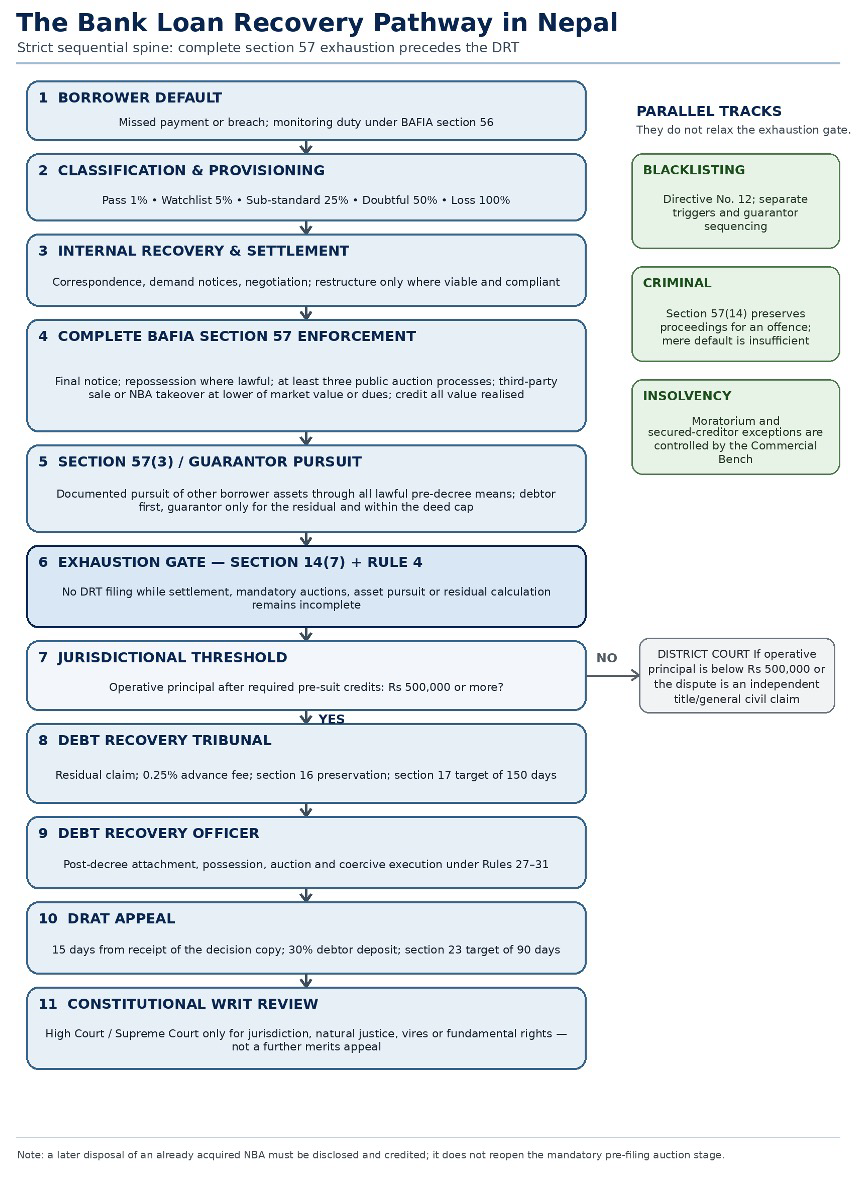
The main spine is strictly sequential: the bank completes internal recovery and all bank-executable section 57 measures before it files the residual claim. The DRT adjudicates; the DRO executes; the DRAT hears the statutory appeal; and the higher courts exercise writ review only. Blacklisting, criminal prosecution and insolvency remain separate tracks.
XV. Assessment – Efficiency, Coherence and Legal Certainty
Coherence and certainty. As a legal design, the regime is coherent when read as a gated escalation: internal recovery and complete self-help first, the DRT for the residual, the DRAT for the statutory appeal and the constitutional courts for defect. The three-auction rule, mandatory credits, redemption, guarantor limits, the 30% appellate deposit and the civil–criminal boundary have substantial doctrinal support. The article should not, however, describe every recurring issue as settled. The threshold cases require a fact-sensitive distinction between ordinary accounting movements and a legally operative NBA credit, while the insolvency interface and the exact evidential content of complete exhaustion still generate room for dispute.
Efficiency. The statutory periods are specific and should be compared like with like: section 17 targets a DRT decision within 150 days after the defence or expiry of the defence period, and section 23 targets a DRAT decision within 90 days after the appellate defence or expiry of that period. Reported decisions in the reviewed sample nevertheless show litigation lasting roughly three to twelve years when measured from different starting points such as default, petition, first-instance decision or final appellate disposition. Those figures demonstrate reported litigation duration, not necessarily the time to actual cash recovery. Reliable assessment requires separate data for default-to-filing, DRT registration-to-defence, defence-to-decision, appeal-to-decision and decree-to-realisation.
Operational delay is intensified by unsold collateral and non-banking assets, title disputes, stays, limited institutional capacity and the absence of published DRT/DRAT data on case value, age, disposal and actual recovery. Jurisdictional litigation over the Rs 500,000 gateway and uncertainty at the insolvency boundary further weaken predictability. The strongest conclusion is therefore one of substantial-not absolute-legal clarity combined with weak measurement and slow enforcement.
Balance between recovery and borrower rights. The regime favours creditor recovery and financial stability through self-help, blacklisting, coercive execution and the appellate deposit. Borrower and guarantor protection is concentrated in notice, fair valuation, redemption, the debtor-first and guarantee-cap rules, protection of heirs and third-party owners, natural-justice controls and writ review. Those protections are meaningful but often depend on the affected person’s ability to contest the process. The 30% cash deposit remains the clearest access-to-justice tension: it secures the decree and discourages delay, but conditions the only merits appeal on substantial liquidity.
XVI. Recommendations
The core escalation can be retained, but its exhaustion record, institutional capacity and interaction with neighbouring regimes should be made clearer and more measurable.
- Codify the exhaustion dossier. Amend the Rules and petition form to require a standard schedule of discussions, demand notices, three auction attempts, sale or NBA credit, searches for other assets, guarantor steps and the residual-principal computation. This would turn the strict section 14(7) interpretation into an auditable filing test.
- Develop distressed-asset and securitisation infrastructure. A functioning market for non-performing loans and non-banking assets would reduce the accumulation of unsold collateral and permit banks to convert enforced assets into cash more quickly.
- Resource and modernise the DRT and DRAT. Maintain filled appointments, adequate benches and Debt Recovery Officers; use digital filing, searchable orders, case-management milestones and transparent e-auction; and monitor the 150-day and 90-day statutory targets separately.
- Publish recovery data. NRB and the tribunals should publish the number, value, age and outcome of DRT and DRAT cases, together with decree-to-realisation time and bank-level recovery rates, so delay can be diagnosed rather than inferred from isolated decisions.
- Clarify the Rs 500,000 gateway. Legislation or authoritative rules should state the operative date, treatment of original principal, partial payments, ancillary contractual advances, sale proceeds, NBA credits and post-acquisition charges.
- Harmonise recovery and insolvency. The law should distinguish the effect of a moratorium on section 57 self-help, pending DRT adjudication, DRO execution and claims against guarantors, and should identify when leave of the Commercial Bench is required.
- Graduate the appellate deposit and standardise valuation. A proportionate or hardship-sensitive mechanism could preserve the deposit’s deterrent function, while independent Panchakrit valuation and transparent e-auction would reduce avoidable reversals and disputes.
- Strengthen the surrounding infrastructure. Better secured-transactions registration, credit information, title verification, cross-default rules and wilful-defaulter standards would reduce both the incidence of default and the friction of recovery.
XVII. Conclusion
Nepal’s bank-loan recovery law is best understood as a gated escalation. A defaulted exposure is classified and provisioned; internal recovery and compliant restructuring are attempted; pledged security is taken through the complete section 57 process, including at least three auctions before any non-banking-asset takeover; all realised value is credited; and the borrower’s wider estate and guarantors are pursued through the lawful pre-decree avenues available to the bank. Only when those measures have reached their endpoint and a genuine residual remains does section 14(7), read with Rule 4, permit the bank to invoke the DRT. The DRT adjudicates and preserves assets, the Debt Recovery Officer executes, the DRAT hears the only statutory merits appeal, and the High Courts and Supreme Court intervene on writ only for exceptional legal defects.
This strict sequence reconciles section 57(3) with the Tribunal’s role. Subsection (3) supplies substantive recourse to other assets, but coercive attachment, possession, auction and detention belong to the post-decree machinery when extra-judicial recovery has failed or cannot lawfully reach the asset. Section 57(14) does not create civil concurrency; it preserves criminal proceedings where independent evidence of an offence exists. Later disposal of an NBA must be credited but does not excuse an incomplete pre-filing auction process.
The framework is substantially coherent and clearer than a simple list of remedies suggests, yet its certainty is not complete and its efficiency remains weak. The one-year age-based Loss threshold must not be confused with the immediate Loss classification caused by auction; the current ordinary NPL regularisation rule is three months in the existing NPL class before upgrade to Watchlist; securities settle on T+2; and the statutory 150-day and 90-day decision periods should not be compared directly with unsegmented years-long recovery narratives. A more effective system requires a codified exhaustion dossier, reliable tribunal data, institutional capacity, an active market for distressed assets, clearer threshold arithmetic and a harmonised insolvency interface.