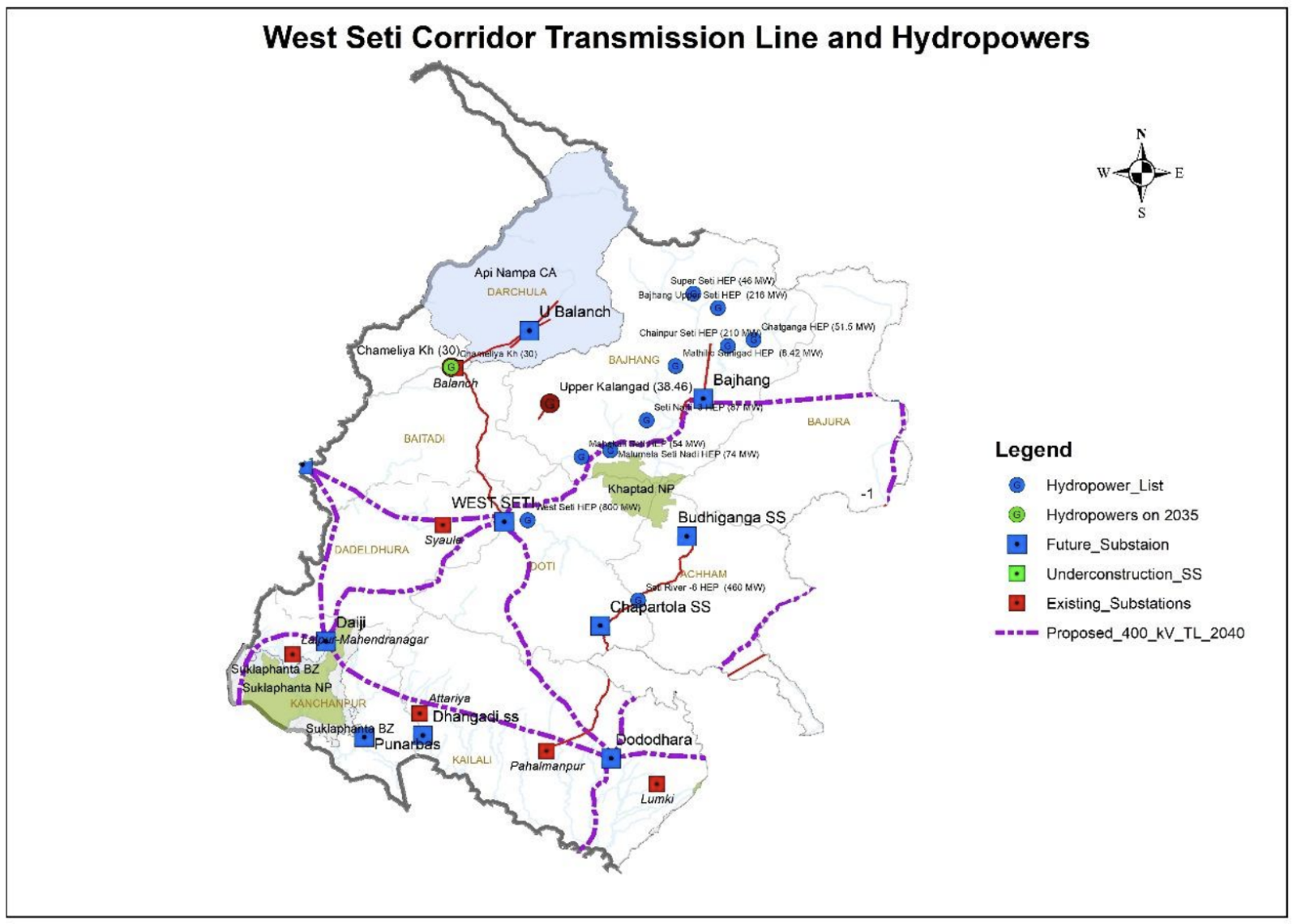
Important Links:
- Could not find the GIS coordinates for the project but maybe this map can be traced with the help of QGIS: Transmisison Line Network of Nepal
- West Seti Corridor Project Brief by RPGCL
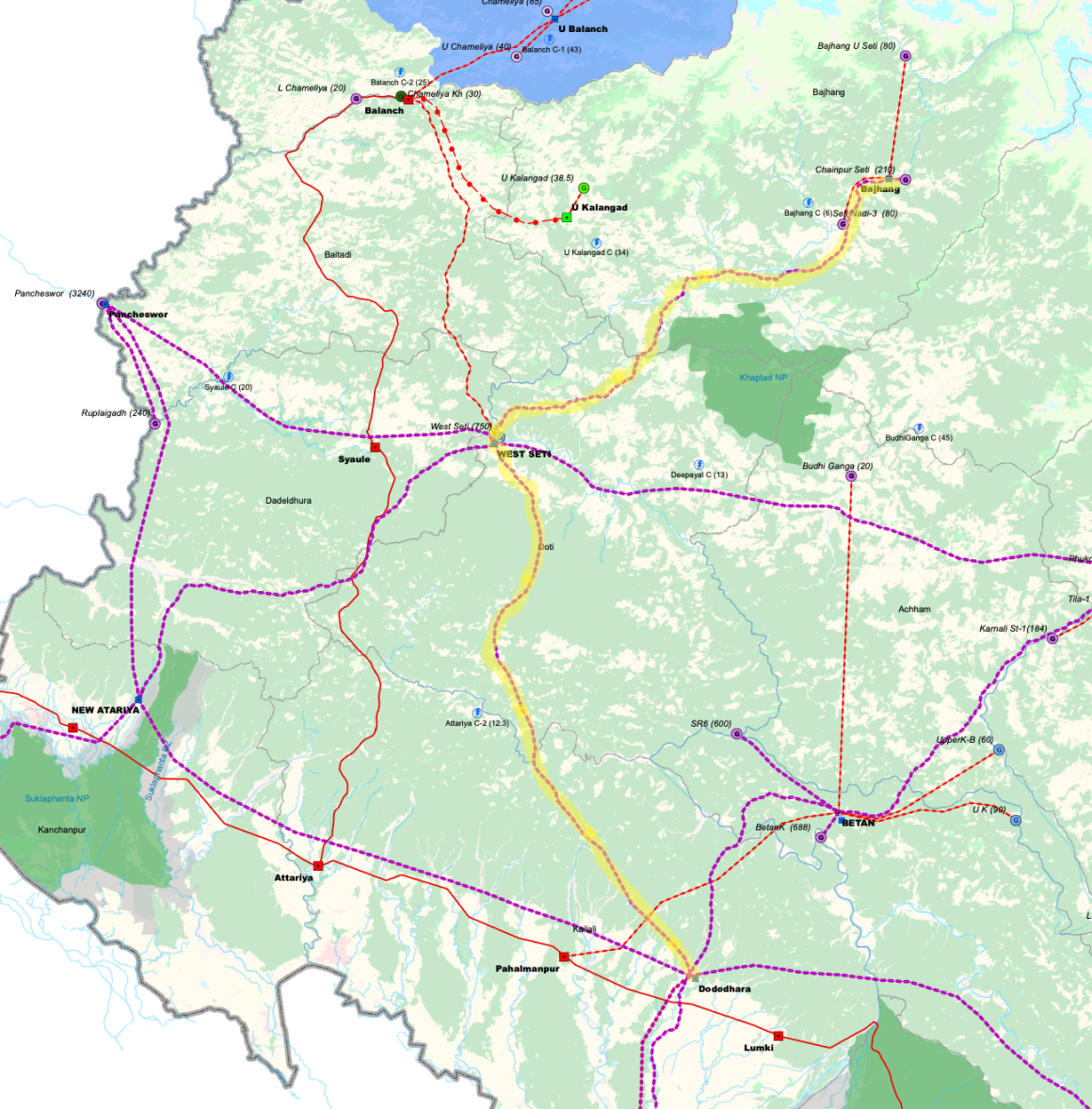
The line highlighted in yellow is the West Seti 400 kV TLP: Section 1 (Bajhang to Banlek West Seti Segment) and Section 2 (Banlek West Seti to Dododhara Segment)
1. Introduction: The Strategic Imperative of the West Seti Energy Corridor
The fundamental architecture of Nepal’s power sector is currently undergoing a profound structural paradigm shift. Historically, the nation’s electrification journey – which began with the commissioning of the 500 kW Pharping Hydroelectric Plant in 1911 and saw systematic, albeit slow, growth through successive Five-Year Plans starting in 1956 1 – has been heavily constrained by a reliance on localized, run-of-river (RoR) generation portfolios. While run-of-river projects are relatively cost-effective to construct, they suffer from severe seasonal output fluctuations. During the dry season (December to May), the diminished hydrological flows in the Himalayan river basins cause domestic electricity generation to plummet to a fraction of the installed capacity, forcing the Nepal Electricity Authority (NEA) to rely on expensive cross-border power imports from India to fulfill domestic demand.2
To cure this structural vulnerability and transition toward an interconnected, storage-integrated network capable of lucrative cross-border energy trading, the Government of Nepal has prioritized the development of reservoir-based mega-projects and the ultra-high voltage (UHV) transmission backbones required to evacuate their power.4 At the absolute epicenter of this macroeconomic transformation within the Sudurpaschim Province (Far-Western Development Region) is the West Seti 400 kV Transmission Line Project.6
This high-capacity energy conduit is designed to act as the primary evacuation artery for the West Seti Corridor, a hydro-electric generation hub anticipated to inject upwards of 2,500 Megawatts (MW) of power into the national grid.7 The strategic necessity of this specific transmission infrastructure is paramount. The anchor project of this corridor – the West Seti Hydropower Project – is designed as a massive storage scheme capable of accumulating monsoon flows to ensure steady, dispatchable, peaking electricity generation throughout the dry months.8 However, the geographic isolation of the Seti River basin in far-western Nepal dictates that without a dedicated 400 kV UHV backbone, the immense peaking power generated in this region can neither reach the primary domestic load centers in Bagmati Province nor be exported to the Indian energy market.10
Historically plagued by decades of delays, shifting foreign development partners, and localized financing deficits, the West Seti 400 kV line has evolved from a conceptual point-to-point export line into a deeply integrated domestic grid backbone managed by the state-owned Rastriya Prasaran Grid Company Limited (RPGCL).7 Recent critical developments – including the January 2026 call for private sector participation under a Public-Private Partnership (PPP) model 6 and the October 2024 cancellation of sovereign Indian lines of credit 14 – have brought the project to a definitive inflection point. This exhaustive report provides a multi-dimensional analysis of the West Seti 400 kV Transmission Line, evaluating its electromechanical architecture, macroeconomic structuring, socio-environmental parameters, grid stabilization impacts, and the complex geopolitical landscape governing its realization.
2. Historical Evolution and Geopolitical Shifts in Project Ownership
Understanding the current configuration of the West Seti 400 kV Transmission Line requires a detailed examination of the troubled history of the generation asset it is designed to serve. The transmission corridor cannot be analyzed in a vacuum; its routing, capacity, and financing modalities have morphed in direct response to the revolving door of international developers attempting to harness the Seti River.
2.1 The SMEC Era: The Export-Oriented Vision
The concept of harnessing the West Seti River for mass power generation was first formally proposed in the 1980s and gained commercial traction in the 1990s.2 In 1994, the Government of Nepal signed an agreement with the Snowy Mountain Engineering Corporation (SMEC), an Australian engineering firm, to develop the West Seti Hydroelectric Project as a 750 MW Build-Own-Operate-Transfer (BOOT) scheme.12
During the SMEC era, the project was entirely conceived as an export-driven asset. A Power Purchase Agreement (PPA) was initialed in 2003 with the Power Trade Corporation India Ltd (PTC India Ltd) to export an estimated 3,636 GWh of electricity annually.16 Consequently, the transmission infrastructure proposed by SMEC was a dedicated, 230.5-kilometer, 400 kV double circuit line bypassing the Nepalese domestic grid entirely.12 This original route commenced at the Talkot switchyard in Doti District, ran 132.5 kilometers through Nepalese territory across Dadeldhura, Kailali, and Kanchanpur, crossed the border at Mahendranagar, and extended a further 98 kilometers to terminate at the Atamanda substation (north of Bareilly, Uttar Pradesh), which was owned and operated by the Power Grid Corporation of India Ltd (POWERGRID).12
Despite securing a survey license for this transmission line from the Ministry of Water Resources in April 2006 12, SMEC ultimately failed to arrange the multi-billion-dollar financing required for the reservoir and dam.2 Facing insurmountable hurdles related to cross-border power negotiations, Maoist insurgency risks, and lack of equity, SMEC’s construction license was formally revoked by the Government of Nepal in 2011.2
2.2 The China Three Gorges Corporation (CTGC) Interlude
Following the collapse of the SMEC initiative, the Investment Board Nepal (IBN) pivoted geographically and geopolitically, signing a Memorandum of Understanding (MoU) in 2012 with the China Three Gorges International Corporation (CTGI), a subsidiary of the state-owned China Three Gorges Corporation.2 Under this arrangement, the project was envisioned as a joint venture, with the Nepal Electricity Authority (NEA) expected to take a 25 percent equity stake financed through concessional loans from the China EXIM Bank.17
However, the Chinese developers rapidly encountered the same economic realities that thwarted their Australian predecessors. The core issue was the financial viability of a highly capital-intensive storage-type hydropower plant. CTGI conducted extensive technical and financial reviews and concluded that the project was fundamentally unfeasible under the proposed terms.2 The Chinese firm demanded a Return on Equity (ROE) of 17 percent to justify the massive hydrological and geological risks, whereas the financial modeling indicated an ROE of only 12.5 percent.18 Furthermore, India’s evolving cross-border power import regulations began to explicitly restrict the import of electricity generated by projects with Chinese equity or Chinese engineering, procurement, and construction (EPC) contractors.17 Recognizing that the primary export market was now legally sealed off to them, CTGI formally withdrew from the US$ 1.2 billion project in 2018, leading to the collapse of the second iteration of the West Seti mega-project.2
2.3 The NHPC Era and the Shift to Domestic Grid Integration
The vacuum left by the Chinese withdrawal was eventually filled by Indian state-backed capital, aligning the project with New Delhi’s strategic interest in maintaining hegemony over Himalayan river basins. In August 2022, the IBN signed an MoU with India’s National Hydroelectric Power Corporation (NHPC) Limited to study and develop a combined hydro-complex comprising the 750 MW West Seti project and the adjacent 450 MW Seti River-6 (SR6) project, creating a massive 1,200 MW generation hub.9
This geopolitical pivot fundamentally altered the transmission strategy. Rather than relying on a private developer to build a point-to-point export line, the Government of Nepal mandated the newly established Rastriya Prasaran Grid Company Limited (RPGCL) to design the transmission line as a domestic backbone.7 Under RPGCL’s mandate, the line would no longer bypass Nepal; instead, it would connect the West Seti generation hub to the domestic East-West transmission network at Dododhara and Attariya, ensuring that while excess power could be exported to India, the peaking capabilities of the reservoir could also be utilized to stabilize Nepal’s internal grid.7
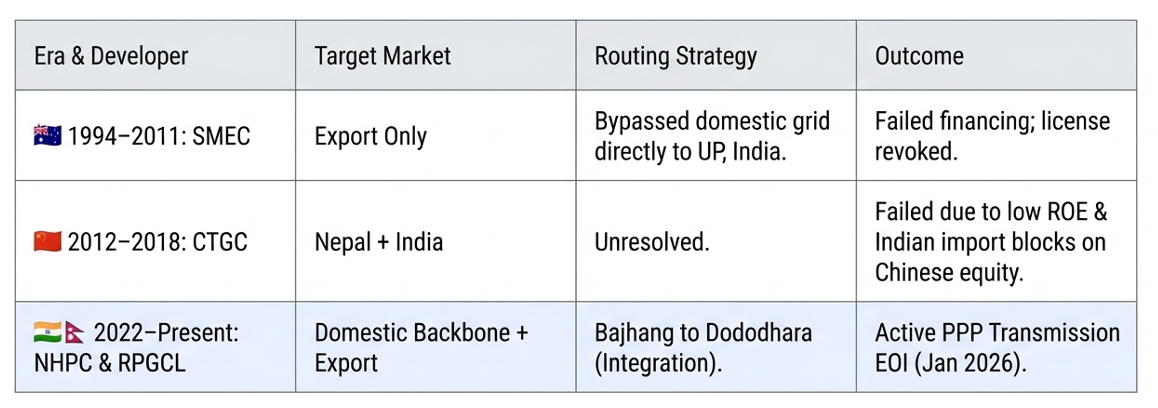
| Development Phase | Lead Developer | Target Market | Transmission Routing Strategy | Primary Cause of Failure / Status |
| 1994 – 2011 | Snowy Mountain Engineering Corp (SMEC) | India (Export Only) | Talkot (Nepal) to Atamanda (India) bypassing the domestic grid. | Inability to secure financing; revoked in 2011. |
| 2012 – 2018 | China Three Gorges Corp (CTGC) | Nepal / India | Unresolved due to Indian regulations restricting Chinese-backed power imports. | Financial unviability; low ROE (12.5%); withdrawn in 2018. |
| 2022 – Present | NHPC Limited (India) & RPGCL (Nepal) | Nepal (Domestic) & India (Export) | Bajhang to Dododhara (Domestic Backbone integration). | Currently in DPR phase; PPP transmission EOI active as of Jan 2026. |
Table 1: Historical evolution of the West Seti Project and its corresponding transmission routing strategies.7
3. Electromechanical Architecture and UHV Transmission Physics
The engineering design of the West Seti 400 kV transmission system is predicated on maximizing power transfer capability while ensuring stringent redundancy, minimizing technical line losses, and maintaining system stability across highly rugged, geologically fragile Himalayan and sub-Himalayan terrains.
3.1 Transmission Line Specifications and Conductor Physics
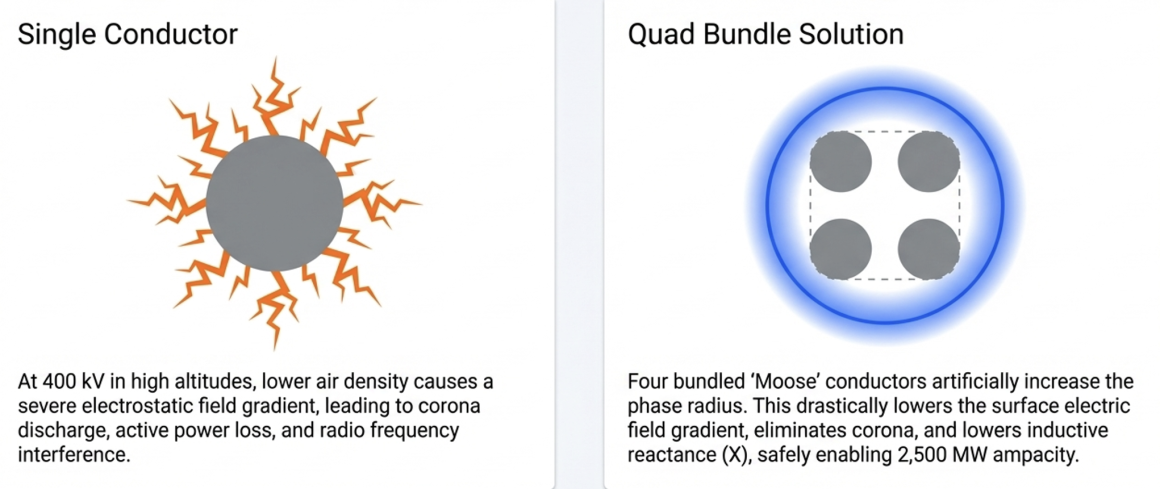
The transmission corridor is engineered as a 400 kV Double Circuit line, utilizing an ACSR (Aluminum Conductor Steel Reinforced) Quad Moose configuration.21 The selection of a Quad Moose conductor bundle is a precise engineering calculation specifically suited for ultra-high voltage (UHV) transmission over long distances in high-altitude environments.
In a Quad Moose configuration, each electrical phase is carried by a bundle of four individual Moose conductors separated by physical spacers. Bundled conductors are utilized primarily to significantly reduce the electric field gradient at the surface of the conductor.12 At 400 kV, single conductors experience an intense electrostatic field that ionizes the surrounding air, leading to corona discharge. Corona discharge is highly detrimental as it results in active power losses, generates severe radio frequency interference (RFI), and produces audible noise.12 This effect is dramatically worsened at high altitudes where the air density is lower and the dielectric breakdown strength of the atmosphere is reduced. By employing a quad-bundle, the effective radius of the phase is increased, thereby lowering the surface electric field gradient below the critical disruptive voltage and mitigating corona effects – a critical factor when routing UHV lines through the populated mid-hill regions of Doti and Bajhang.12
Furthermore, the Quad Moose configuration drastically increases the thermal limits and current-carrying capacity (ampacity) of the line, enabling it to safely handle the estimated 2,000 to 2,500 MW of power evacuation required by the corridor without suffering from excessive resistive () heating.7 The fundamental power transfer capability (
) of an alternating current (AC) transmission line is governed by the standard power flow equation:

Where and
are the sending and receiving end voltages,
is the total inductive line reactance, and
is the power angle between the two ends. By utilizing a quad-bundle configuration, the geometric mean radius (GMR) of the phase is maximized, which naturally lowers the inductive reactance (
) of the transmission line. According to the equation, a lower
value allows for a higher active power transfer (
) for any given power angle (
).7 This inherently maximizes the power evacuation capacity while maintaining a stable, small power angle, thereby reducing the risk of transient instability following grid disturbances, such as the sudden tripping of a turbine at the West Seti powerhouse.10
3.2 System Stability and N-1 Contingency Compliance
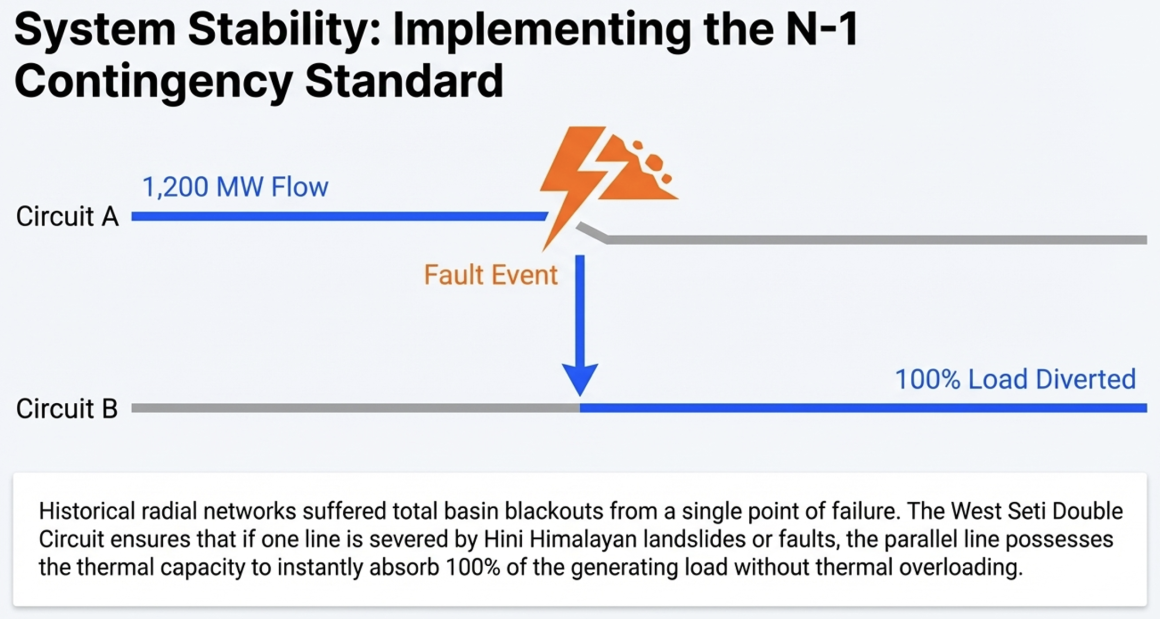
The NEA has committed to upgrading Nepal’s transmission infrastructure to meet 2030-2050 demand projections with strict compliance to the “N-1 contingency” standard.23 N-1 contingency implies that the power system must be capable of withstanding the unexpected failure or outage of any single primary component (such as one circuit of a double-circuit transmission line, or one large transformer bank) without causing cascading power outages, severe voltage deviations, or the thermal overloading of remaining parallel lines.
The deployment of a Double Circuit 400 kV line for the West Seti corridor is a direct implementation of this N-1 standard.21 If a severe landslide, tower collapse, or localized electrical fault trips one of the circuits, the parallel circuit possesses the thermal capacity to instantaneously absorb the power flow from the 1,200 MW NHPC hydro complex 9, ensuring that the generation cluster is not completely isolated from the national grid. Historical grid architecture in Nepal heavily relied on radial configurations where a single line failure resulted in the total blackout of entire river basins 24; the double-circuit design of the West Seti line eradicates this single point of failure.
4. Route Alignment and Topographical Engineering
The spatial routing of the West Seti transmission corridor requires navigating some of the most challenging topography in South Asia. The revised alignment managed by RPGCL traverses a total of approximately 145 circuit kilometers, functioning as a high-capacity domestic backbone rather than a mere export tether.7
4.1 Segmental Breakdown of the Transmission Corridor
The routing is strategically divided into highly distinct geographical segments, reflecting the transition from the high-altitude Middle Mountains down to the flat plains of the Terai region.
- Bajhang to Banlek (West Seti) Segment: This northernmost section originates at the Chainpur substation in Bajhang District and traverses approximately 60 kilometers of steep, rugged, and geologically sensitive Himalayan terrain to reach the Banlek substation in Doti District.7 This segment is characterized by severe altitude variations and requires highly customized tower engineering to handle massive span lengths between mountain ridges.12
- Banlek (West Seti) to Dododhara Segment: Serving as the primary evacuation artery out of the middle hills, this 85-kilometer stretch descends from Doti, navigating through the fragile Churia (Siwalik) hills, before entering the flatlands of Kailali District to terminate at the Dododhara Substation.7
- Dododhara to New Attariya Linkage: While technically a separate contractual phase, the broader Transmission System Development Plan incorporates an additional 68-kilometer 400 kV quad moose double-circuit linkage from Dododhara to the New Attariya substation.10 This extension is vital as it completes a highly resilient ring network within “Zone 1” (Far-Western Nepal), allowing bidirectional power flows that enhance grid stability.10
4.2 Tower Pad Engineering and Terrain Adaptation
The construction of this 145-kilometer corridor necessitates the erection of hundreds of heavy-duty lattice steel towers. Based on comparable 400 kV double-circuit infrastructure constructed by the NEA (such as the Hetauda-Dhalkebar-Inaruwa line), standard 400 kV towers reach an average height of 45 meters and require massive reinforced concrete foundations spanning an area of 17.17 to 29.29 square meters.25
However, the West Seti alignment cannot rely on standardized tower spacing. Through the rugged terrain of the Middle Hills and the Siwaliks, variable span lengths are mandatory.12 Engineers must strategically locate tower pads on geologically stable ridges, avoiding active landslide zones, deep river gorges, and heavily populated village clusters. This requires rigorous geotechnical investigations at every proposed tower location to ensure foundation integrity against seismic activity and monsoon-induced soil liquefaction.12
5. Substation Infrastructure: The Nodes of Power Transfer
A transmission line is functionally useless without the highly complex step-up and step-down substation infrastructure required to inject and extract power from the grid. To facilitate gigawatt-scale power wheeling, the West Seti project includes the construction of state-of-the-art Gas Insulated Substations (GIS) at critical nodes.7
5.1 Gas Insulated Switchgear (GIS) vs. Air Insulated Switchgear (AIS)
The RPGCL has mandated the use of Gas Insulated Substation (GIS) technology for both the Chainpur and Banlek substations.7 In conventional Air Insulated Substations (AIS), the high-voltage conductors are separated by atmospheric air. At 400 kV, the minimum clearance distances required between live phases to prevent electrical arcing are massive, necessitating switchyards that consume vast tracts of flat land.7
Finding vast, flat, and geologically stable land in the mountainous districts of Bajhang and Doti is virtually impossible. GIS technology solves this spatial constraint by utilizing pressurized sulfur hexafluoride (SF6) gas as the primary dielectric insulator.7 Because SF6 gas has a dielectric strength nearly three times that of air, the high-voltage components can be safely positioned much closer together, shrinking the physical footprint of the substation by up to 70% compared to an AIS equivalent. Furthermore, because GIS equipment is entirely enclosed within grounded metal capsules, it is highly resilient against the severe weather, high humidity, dust, and lightning strikes prevalent in the Himalayan foothills, drastically reducing routine maintenance requirements.7
5.2 Substation Specifications and Switching Schemes
The detailed engineering parameters for the primary substations highlight a focus on extreme grid reliability and massive power handling capacity.
| Substation Node | Geographic Location | Operating Voltage | Capacity & Transformer Specs | Switchyard Configuration |
| Chainpur Substation | Bajhang District (Jayaprithvi Municipality-1) | 400/132 kV GIS | 160 MVA Total Capacity; Four 53.33 MVA, 400/132 kV, 1-phase autotransformers. | 400 kV: One-and-a-half breaker scheme; 4 line bays, 2 transformer bays, 1 auxiliary bus. |
| Banlek (West Seti) Substation | Doti District (Shikhar Municipality-10) | 400/132 kV GIS | 315 MVA Total Capacity; Two banks of 400/132 kV, 53.33 MVA, 1-phase transformers (7 units total including 1 spare). | 132 kV: Double Main (DM) bus scheme; 3 line bays, 1 transformer bay, 1 bus coupler bay, 1 auxiliary bus. |
| Dododhara Substation | Kailali District (Bardagoriya Rural Municipality-2) | 400 kV | Point of interconnection with the national East-West grid backbone. | Integrates power flows toward Attariya and the proposed Lamki-Bareilly cross-border line. |
Table 2: Technical specifications of the primary substations along the West Seti Corridor.7
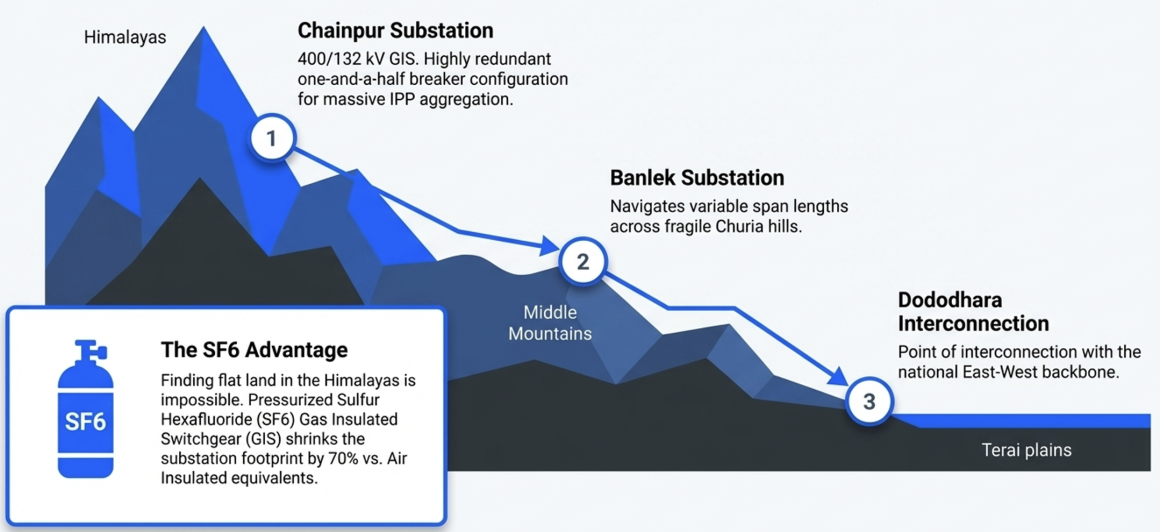
The 400 kV switchyard at Chainpur is engineered with a one-and-a-half breaker configuration.7 This sophisticated electrical switching scheme provides an exceptionally high degree of redundancy. In this arrangement, three circuit breakers are connected in series between two main high-voltage buses, with two outgoing circuits connected between the breakers. A fault on any single main bus does not interrupt power to any circuit, as power can still flow from the secondary bus. Furthermore, any individual breaker can be isolated for routine maintenance or repair without disrupting electrical service to the connected transmission lines. For a critical evacuation node handling gigawatt-scale power from multiple independent power producers (IPPs), this redundancy is mandatory to prevent localized faults from causing systemic grid collapse.7
Similarly, the 132 kV side utilizes a Double Main (DM) bus scheme, ensuring that incoming power from smaller regional hydropower projects can be reliably aggregated and stepped up to 400 kV without interruption.7
6. The Hydrological Anchor: Generation Assets of the Seti Basin
Transmission infrastructure does not exist independently; it is entirely reliant on the generation assets it serves. The immense scale and capital urgency behind the West Seti 400 kV line is driven by the density, scale, and specific hydrological characteristics of the hydropower projects currently under development in the Seti River basin.
6.1 The Economics of Storage and Peaking Power
Nepal’s electricity generation portfolio is heavily skewed toward Run-of-River (RoR) facilities.8 RoR plants depend on immediate, unregulated river flows. Consequently, during the dry season, generation plummets, causing a severe mismatch between electricity supply and peak domestic demand.2 To bridge this gap, Nepal is forced to import highly expensive thermal-generated electricity from India.27
The West Seti Hydropower Project represents a structural, long-term remedy to this macroeconomic imbalance. Designed as a massive storage scheme, the project features a 195-meter-high concrete-faced rockfill dam (CFRD) equipped with an ungated chute spillway.8 This colossal structure creates a reservoir that extends 25 kilometers upstream along the Seti River, inundating parts of the river valley and surrounding tributaries (Chama Gad, Dhung Gad, Saili Gad, Nawaghar Gad, and Kalanga Gad).9
The reservoir boasts a full supply level (FSL) elevation of 1,284 meters above sea level, harboring a total storage capacity of 1,566 million cubic meters.9 Of this, 926 million cubic meters represents “live storage” that can be actively drawn down to generate power, leading to massive seasonal water level fluctuations of up to 59 meters.22 During the monsoon, excess floodwaters are impounded. During the dry season, this stored water is released through a 10-meter diameter, 6.7-kilometer-long headrace tunnel, plummeting down a 167-meter vertical pressure shaft into a subterranean powerhouse.9 Located 300 meters underground at Bausi Gara, the powerhouse contains four Francis-type vertical shaft turbines, each capable of generating 187.5 MW at the rated net head.22
This configuration allows West Seti to operate as a “peaking plant.” Rather than generating a constant low output during the dry season, the plant can hold water and dispatch massive bursts of power precisely when the grid demands it most (e.g., during evening peak hours), yielding an estimated annual energy generation of 3,636 GWh.8 This high-value peaking power is exactly what justifies the massive expense of a 400 kV UHV evacuation line.
6.2 The Broader Generation Ecosystem and Mutual Dependency
While the NHPC-led West Seti (optimizing up to 800 MW) and Seti River-6 (450 MW) projects represent the core anchor generating 1,200 MW 9, the transmission line is designed to evacuate power from a much broader consortium of regional projects.
In July 2024, recognizing the necessity for coordinated development, a multilateral Memorandum of Understanding (MoU) was executed among five key institutions: the Hydroelectricity Investment and Development Company Limited (HIDCL), RPGCL, Chainpur Seti Jalbidhyut Company Limited (CSJCL), Chilime Seti Hydropower Company Limited (CSHC), and Samriddhi Engineering Limited.28 This MoU targets the synchronized development and financial mobilization of the transmission line alongside three specific mid-sized hydro projects:
- Chainpur Seti: 210 MW
- Bajhang Upper Seti: 216 MW
- Seti River-3: 87 MW.28
This clustered development approach highlights a critical macroeconomic insight: the financial viability of both the generation projects and the transmission line are mutually codependent. Without guaranteed power evacuation via the 400 kV corridor, commercial banks and institutional lenders will refuse to grant financial closure to the hydro projects, leaving them stranded. Conversely, without legally binding commitments from these generation assets to wheel power through the line, the transmission infrastructure risks becoming a highly expensive stranded asset. This precise codependency has profoundly influenced the financial modeling and the investment modality chosen by the government for the transmission project.28
7. Macroeconomic Structuring: The Public-Private Partnership (PPP) Model
The financing and execution of 400 kV UHV transmission lines is a tremendously capital-intensive endeavor, traditionally monopolized by state-backed utility companies. However, constrained by widening fiscal deficits, competing infrastructure priorities, and an exhausted sovereign borrowing capacity, the Government of Nepal – acting through the National Transmission Grid Company (RPGCL) – has opted to break from tradition. It aims to execute the West Seti 400 kV line via an innovative Public-Private Partnership (PPP) framework.6
7.1 The Special Purpose Vehicle (SVP) Mechanics
As of January 7, 2026, the government formally initiated the PPP procurement process, publicly inviting Expressions of Interest (EOI) from the private sector within a tight 15-day submission window.6 The project is to be structured using a Special Purpose Vehicle (SVP/SPV) model.13 An SPV is a distinct legal entity created specifically for this project, serving to ring-fence the financial risks away from the parent entities (like NEA or RPGCL) and providing a clean balance sheet for commercial lenders to evaluate.
The financial architecture outlined in the EOI is highly specific:
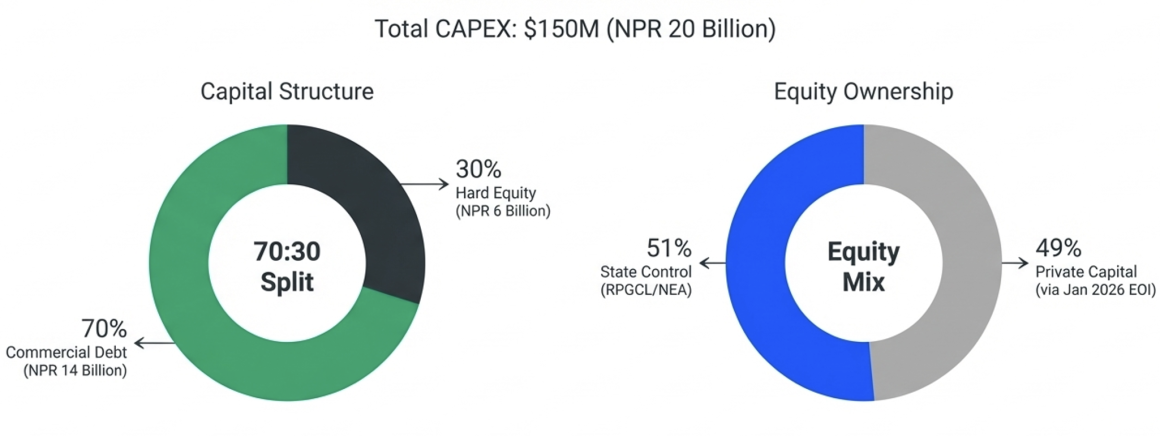
- Estimated Total Capital Expenditure (CAPEX): NPR 20 billion (approximately USD 150 million), encompassing the 145 km transmission line and the construction of the Chainpur and Banlek GIS substations.6
- Debt-to-Equity Ratio: The project will be capitalized with a highly leveraged 70:30 debt-to-equity ratio.13 This implies that NPR 14 billion will be raised through commercial or syndication loans, while NPR 6 billion must be injected as hard equity.
- Equity Ownership Split: To ensure the State maintains controlling authority over a critical piece of national security infrastructure, 51 percent of the equity (NPR 3.06 billion) will be held by government entities. The remaining 49 percent (NPR 2.94 billion) is offered to private sector promoters and public companies.6
7.2 Market Realities and Private Sector Hesitancy
While the financial structuring appears sound on paper, it faces severe headwinds in the actual capital markets. It is crucial to note that the January 2026 EOI is not the first attempt to solicit private capital for this corridor. An earlier EOI was issued by RPGCL on September 8, 2023, but it failed to attract any viable proposals from the private sector, forcing the government to restart the process.6
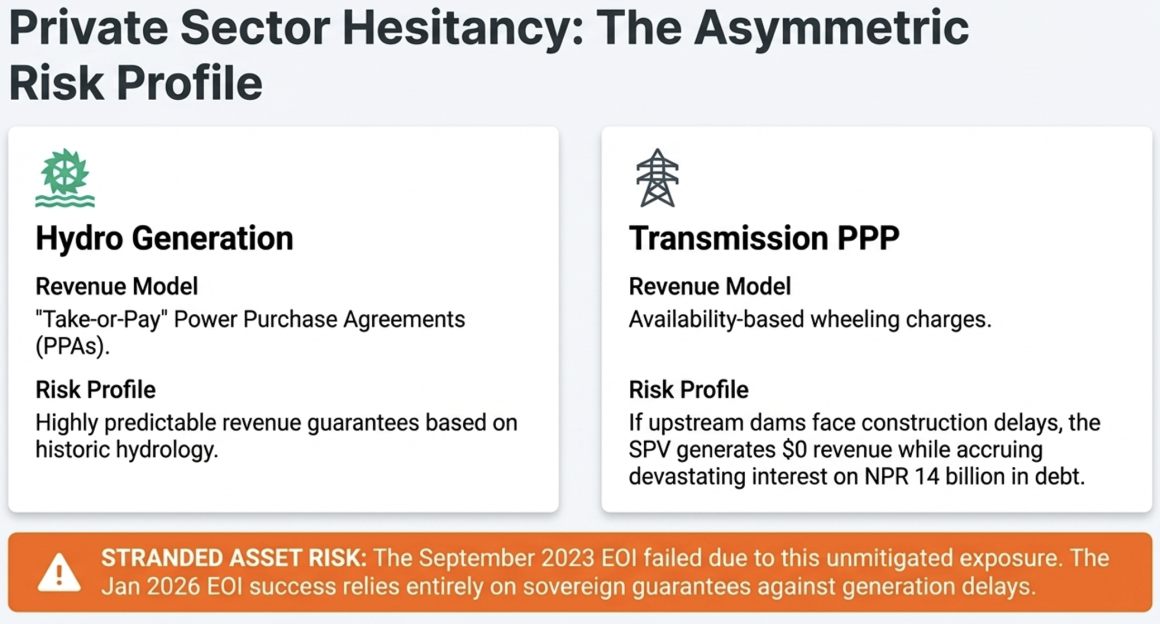
The underlying reasons for this profound market hesitancy are rooted in the highly asymmetric risk profile of transmission infrastructure compared to generation assets. Private hydro developers rely on Power Purchase Agreements (PPAs) signed with the NEA on a “take-or-pay” basis, which offer highly predictable revenue forecasts based on historical hydrology data.24 Conversely, transmission revenues in a PPP model are traditionally derived from availability-based wheeling charges.24
If the associated hydro projects (such as West Seti or the NHPC complex) face multi-year construction delays – a historic norm in Nepal’s infrastructure sector – the completed transmission asset may sit idle. In such a scenario, the SPV generates zero revenue, yet massive debt servicing obligations (interest on the NPR 14 billion loan) continue to accrue, rapidly leading to corporate default.14 Furthermore, the private sector argues that the immense, localized risks of land acquisition, Right of Way (RoW) disputes, and navigating labyrinthine bureaucratic forest clearances are extremely difficult to quantify and accurately price into a financial model.24 The ultimate success of the January 2026 EOI will depend entirely on how the Nepalese government has contractually restructured these risk allocations – perhaps through sovereign guarantees on wheeling revenues regardless of generation delays – within the proposed SPV concession agreements.
8. Geopolitics of Infrastructure Financing: The Line of Credit Crisis
The pivot toward a domestic PPP model was not the original, preferred strategy of the Nepalese Ministry of Finance. For years, the government sought to finance the transmission corridor through external sovereign debt, specifically via highly subsidized concessional loans from the Government of India. The total failure of this bilateral financing mechanism offers profound insights into the geopolitical undercurrents shaping South Asian energy infrastructure.
8.1 The Cancellation of LOC 3 and 4
In July 2023, the Government of Nepal formally proposed the construction of the West Seti-Dododhara transmission line using Indian concessional funding, seeking USD 150.42 million (approximately NPR 20.90 billion).14 To secure these funds without taking on new debt limits, the Ministry of Finance proposed drawing down from the remaining USD 900 million available under pre-existing Line of Credit (LOC) agreements (specifically LOC-3 and LOC-4) signed with India’s Export-Import (EXIM) Bank.14
This proposal was formally transmitted to the Indian government through the Ministry of Foreign Affairs and the Indian Embassy in Kathmandu.14 Despite official diplomatic channels and repeated subsequent requests from Nepal’s Ministry of Energy, Water Resources, and Irrigation throughout late 2023 and early 2024, the Government of India provided zero response regarding the approval of the funds.14
Faced with an indefinite diplomatic gridlock and the necessity to advance the project, the Nepalese Cabinet took a decisive and politically charged step on October 29, 2024: it unilaterally decided to formally cancel the remaining USD 900 million loan facility under LOC-3 and LOC-4.14 While RPGCL project officials have suggested the funding might theoretically be re-applied for under a future LOC-5 agreement, the timeline remains entirely uncertain, prompting the immediate shift to the domestic PPP framework to keep the project viable.14
8.2 Regional Frustration and Bureaucratic Pathology
The stagnation of the Indian LOC cannot be viewed merely as an administrative oversight; it is symptomatic of broader geopolitical friction and the bureaucratic pathology inherent in India’s regional lending framework. India’s LOC mechanisms across South Asia have faced intense, systemic criticism for glacial disbursement rates. For instance, in neighboring Bangladesh, over USD 7.36 billion in Indian LOCs were promised, yet historical data indicates a disbursement rate of roughly 10.5% overall, and an abysmal 1% over six years for massive rail infrastructure projects.32 These delays are frequently attributed to stringent Indian approval requirements and the mandated use of Indian contractors, whose performance has occasionally been characterized by slow execution.33 The cancellation of the LOCs by Nepal reflects a growing regional frustration with the efficacy of Indian bilateral financial instruments, highlighting that promised capital does not always equate to deployed infrastructure.32
8.3 Geopolitical Inference: The 21.9% Free Power Dispute
To understand why New Delhi may have stonewalled the LOC request for the transmission line, one must look at the generation asset it serves. Currently, the primary developer for the 1,200 MW West Seti hydro-complex is India’s own state-backed NHPC.5 Securing this basin was a strategic victory for India, ensuring a Chinese state-owned enterprise did not gain a foothold in a massive hydrological system merely tens of kilometers from the Indian border.19
However, the Power Development Agreement (PDA) negotiations between the Investment Board Nepal (IBN) and NHPC have been highly contentious.20 A fundamental pillar of the initial agreement mandated that Nepal would receive 21.9 percent of the total installed capacity (roughly 262 MW) completely free of cost.5 During the drafting of the final PDA, NHPC expressed severe reservations regarding this clause, arguing that providing nearly a quarter of the power for free destroys the commercial viability of a highly complex, reservoir-based mega-project with estimated costs escalating to nearly NPR 200 billion (USD 1.5 billion).20
In this highly politicized context, the withholding of Indian LOC funding for the transmission line – an absolute prerequisite for the generation project to ever sell a single megawatt of power – can be interpreted as a strategic lever of geopolitical pressure. By stalling the transmission funding, New Delhi may be indirectly forcing Kathmandu to renegotiate the PDA and dilute the 21.9% free energy requirement, demonstrating how bilateral infrastructure financing is routinely weaponized in South Asian hydro-politics.5
9. Grid Synchronization and Domestic Load Management
From a systemic engineering perspective, the West Seti 400 kV line is not an isolated, radial corridor; it is a vital nodal artery designed to seamlessly interface with Nepal’s East-West high-voltage backbone and transform domestic energy distribution.
9.1 Empowering the Load Centers: The Bagmati Connection
Nepal’s highest electricity demand, industrial consumption, and revenue generation are overwhelmingly concentrated in Bagmati Province, which encompasses the densely populated Kathmandu Valley.11 The geographical distance between the Far-Western generation hubs (Zone 1) and the central load centers (Zone 3) requires a robust, exceptionally low-loss UHV transmission network to wheel power across the country.10
The successful evacuation of West Seti’s highly valuable peaking power relies on a series of cascading transfers. Power will flow from the high-altitude West Seti Substation down the 400 kV corridor to Dododhara.10 From Dododhara, it integrates into the broader East-West grid, specifically linking to the Lamahi-Kohalpur-New Attariya 400 kV corridor currently under development.10 Once power reaches the central regions of the country, it will utilize the critically important Hetauda-Dhalkebar-Inaruwa 400 kV transmission line to reach the capital region.27
9.2 The Hetauda-Dhalkebar-Inaruwa Backbone Integration
The completion of the Dhalkebar-Bara section of the Hetauda-Dhalkebar-Inaruwa line in March 2025 marked a historic milestone for Nepal’s overall grid resilience.27 This project faced nearly fifteen years of delays due to relentless forest clearance and RoW disputes, but its completion establishes a 100-kilometer 400 kV linkage spanning from the Dhalkebar substation in Dhanusha through Mahottari, Sarlahi, and Rautahat to the Bara-Makwanpur border.24 To alleviate immediate infrastructural bottlenecks and facilitate the westward flow of electricity, the NEA strategically tapped this line near Chandranigahapur and temporarily charged a 60-kilometer segment at 132 kV.27
The integration of the West Seti 400 kV line into this broader national backbone ensures that the massive water storage capabilities of the far-west can actively participate in peak load management in Kathmandu.27 By wheeling surplus peaking power from West Seti across the Dhalkebar-Bara corridor, the NEA can mitigate the daily evening supply deficits, optimize national grid frequency, and reduce reliance on imported Indian thermal power during the winter dry season.11
10. Cross-Border Energy Trade and the Indian Market Integration
While achieving domestic supply security and stabilizing the Kathmandu load center is a paramount political priority, the raw financial architecture of the 2,500 MW West Seti Corridor is fundamentally predicated on the export of massive quantities of surplus electricity to India.5 The economics of the region demand it; the Indian government has publicly committed to importing up to 10,000 MW of power from Nepal over the next decade to fuel its rapidly expanding, energy-hungry economy and meet renewable energy transition goals.38
10.1 The Lamki-Bareilly 400 kV Synchronous Interconnector
To facilitate this gigawatt-scale cross-border trade, dedicated synchronous UHV interconnections are mandatory. A definitive breakthrough occurred on October 29, 2025, when a landmark Joint Venture and Shareholders’ Agreement (JV&SHA) was signed in New Delhi between the NEA and the Power Grid Corporation of India (POWERGRID).38 This agreement formalized the creation of two joint venture entities (one registered in India, one in Nepal, with an ownership split of 51% POWERGRID and 49% NEA) to construct two massive high-capacity cross-border lines.38
One of these critical projects is the Lamki (Dodhara) to Bareilly (India) 400 kV Double Circuit (Quad Moose) Transmission Link.38 This line will extend approximately 33 kilometers within Nepalese territory and traverse 185 kilometers into India, ultimately connecting the Nepalese grid directly into the heart of Uttar Pradesh’s power infrastructure.38
This bilateral agreement acts as the definitive commercial and technical catalyst for the domestic West Seti 400 kV project. The West Seti line physically terminates at the Dododhara (Lamki) substation.21 In this configuration, the West Seti line effectively functions as the ultra-high voltage domestic collector network, aggregating power from Bajhang and Doti and feeding it directly into the Lamki-Bareilly international interconnector.10
The dependency is absolute: without the West Seti line, the generation from the NHPC complex cannot reach the border; without the Lamki-Bareilly line, the power cannot enter the lucrative Indian energy exchange market.10 The synchronization of these two specific infrastructure developments is therefore an absolute technical necessity and the bedrock upon which the financial viability of the entire far-western hydro-economy rests.
11. Socio-Environmental Dynamics and Right of Way (RoW) Mechanics
High-voltage transmission line development in the fragile Himalayan topography is notoriously vulnerable to severe social, ecological, and environmental friction. The legal acquisition of land, the management of the Right of Way (RoW), and the execution of compensatory environmental mitigation remain the most persistent, project-killing bottlenecks in Nepal’s energy sector.24
11.1 Land Acquisition and Resettlement Impacts
The physical footprint required for a 400 kV UHV line is vast. Based on exhaustive Environmental Impact Assessments (EIA) conducted during the SMEC era for similar alignments in the region, a transmission corridor of this magnitude requires an estimated 609 hectares of land solely within its designated RoW.12 Of this, approximately 5.1 hectares are subject to permanent acquisition to lay the concrete foundations for the massive steel tower pads.12
The route alignment intersects with highly diverse, socio-economically vital land classes utilized by rural communities.16 These include Khet (highly valued, irrigated agricultural land in valleys primarily used for paddy and wheat), Bari (rainfed crop land situated on hill slopes), and Kharbari (grasslands utilized for harvesting thatching materials).16 The permanent acquisition of Khet land, in particular, profoundly impacts the agrarian livelihood of affected households, triggering the necessity for comprehensive Resettlement Action Plans (RAP).16
Current reports from the RPGCL regarding the January 2026 PPP EOI indicate that “land acquisition for the project has already been completed, and survey work has also been finalized”.13 However, maintaining social stability during the impending construction phase requires rigid adherence to compensation frameworks. Standard compensation matrices mandate full market-price remuneration for permanently acquired tower pads, and cash compensation – usually heavily contested, but typically ranging from 10% to 30% of the land’s assessed value – for the restrictive use of land falling under the RoW corridor, where the owner retains the deed but faces severe usage limitations.12
11.2 The November 2025 Land Subdivision Policy Reform
A massive, pivotal shift in national regulatory land management occurred in November 2025, fundamentally altering the socio-economic dynamics of the West Seti line and all future transmission projects. The Nepalese government published a highly anticipated gazette notification formally permitting the legal subdivision (parceling) of land situated under transmission line RoWs.3
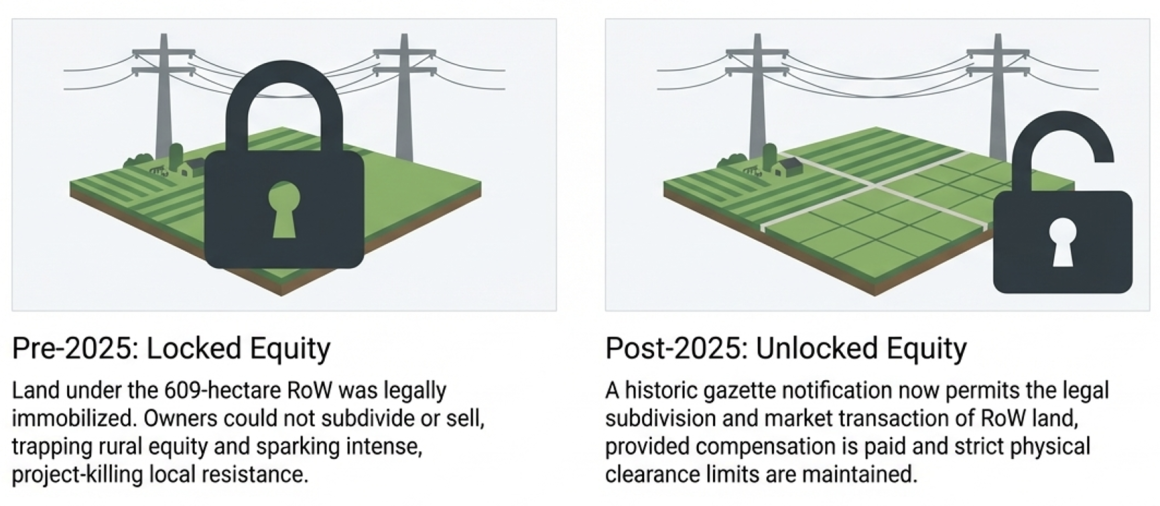
Historically, once a high-voltage line was routed over a property, the land beneath it was virtually immobilized by the state. Landowners were legally prohibited from subdividing, parceling, or selling fractional plots, which trapped their equity and fueled intense, organized, and often violent local opposition to transmission projects nationwide.24
Under the revolutionary new regulatory framework, provided the landowner has received documented, written proof of compensation from the transmission project authority, the land can be legally parceled and transacted on the open market.45 Crucially, rigorous safety restrictions prohibiting the construction of physical structures (houses, sheds) or the planting of tall timber trees within the right-of-way remain strictly enforced to prevent electrical flashovers and ensure public safety.45 This policy reform acts as a strategic pressure-release valve, legally unlocking the frozen equity of rural landowners while preserving the necessary physical clearances required for 400 kV operations. It substantially mitigates one of the core socio-political risks that previously deterred private sector investment in the PPP model.45
11.3 Forest Clearances and Ecological Mitigation
Given the route alignment descending through the Middle Mountains and the biologically dense Siwalik (Churia) range, the transmission corridor inherently intersects with extensive tracts of national and community-managed forests.9 The procedural delays associated with obtaining Cabinet approval for large-scale tree felling and the use of national forest land have historically stalled projects; for context, the Hetauda-Dhalkebar-Inaruwa line faced delays of nearly a decade over forest clearance disputes, and environmental enumeration for transmission projects often involves hundreds of thousands of trees (e.g., 215,000 trees enumerated for related lines).23
While recent Cabinet decisions in late 2025 demonstrated a clear willingness to fast-track forest land use approvals for critical energy infrastructure (such as the Kerabari-New Marsyangdi corridor) 46, the execution of these clearances for the West Seti line will require sustained, high-level inter-ministerial coordination between the Ministry of Energy and the Ministry of Forests and Environment. Approval is universally contingent upon strict adherence to environmental impact mitigation measures, most notably the mandatory execution of compensatory tree plantation ratios to offset the ecological footprint of the 145-kilometer RoW clear-cut.23
12. Strategic Conclusions and Systemic Implications
The West Seti 400 kV Transmission Line Project is fundamentally more than a physical assembly of lattice steel towers and high-capacity Quad Moose conductors; it is the central nervous system of Nepal’s future hydro-economy. The exhaustive synthesis of engineering, economic, and geopolitical data reveals several critical, interconnected imperatives:
- The Primacy of Synchronous Regional Development: The success of the transmission line is inextricably and completely linked to the NHPC-led generation assets (West Seti and SR6) at its origin, and the NEA/POWERGRID Lamki-Bareilly cross-border link at its terminus. A delay in any single node of this infrastructural triad fundamentally compromises the financial architecture and technical utility of the entire corridor, risking the creation of multi-billion rupee stranded assets.9
- The Paradigm Shift from Sovereign Debt to Domestic Financial Engineering: The politically charged cancellation of the USD 900 million Indian LOC forces Nepal to innovate structurally.14 The deployment of the SVP PPP model – leveraging a 70:30 debt-equity split – represents a necessary maturation of Nepal’s domestic capital mobilization strategy.13 However, it remains highly sensitive to private sector risk-aversion regarding RoW disputes and the peril of generation-driven delays.24
- Geopolitical Financing as a Lever of Statecraft: The withholding of bilateral Indian credit cannot be divorced from broader regional power dynamics and the contentious negotiations surrounding the 21.9% free power clause demanded from NHPC.5 It emphatically underscores the vulnerability of relying on single-source sovereign financing for critical national security infrastructure, fully validating the Ministry of Finance’s pivot toward public-private syndication.
- Systemic Grid Modernization and Resilience: By routing highly valuable peaking power from the Far-Western storage assets through Dododhara and successfully injecting it across the newly energized East-West 400 kV backbone (via Dhalkebar-Bara) 10, Nepal is actively curing the severe spatial and temporal imbalances of its national grid. This modern architecture enables a future where the Kathmandu Valley’s peak industrial and domestic demands are seamlessly stabilized by waters stored hundreds of kilometers away in the Himalayas.11
To ensure the successful realization of this mega-project, project proponents must embed explicit contractual mitigations against stranded-asset risks to secure private equity for the January 2026 EOI, aggressively finalize the Power Development Agreement with NHPC to provide certainty to commercial lenders, and immediately leverage the November 2025 land parceling regulations to secure unencumbered RoW access. The West Seti 400 kV Transmission Line stands as the ultimate litmus test for Nepal’s ability to execute complex, multi-stakeholder mega-infrastructure; its successful commissioning will not merely illuminate the national grid, but will permanently and fundamentally alter the energy economics of the entire South Asian subcontinent.
Works cited
- Enhancing Capacity and Reliability of National Grid – Independent Power Producers’ Association, Nepal, accessed on March 12, 2026, https://www.ippan.org.np/6340
- The West Seti fiasco – Kathmandu, accessed on March 12, 2026, https://kathmandupost.com/editorial/2018/09/21/the-west-seti-fiasco
- Infrastructure – power – Nepal Research, accessed on March 12, 2026, https://nepalresearch.org/infrastructure/power.html
- Present Situation and Future Roadmap of Energy, Water Resources and Irrigation Sector (White Paper) | ICIMOD, accessed on March 12, 2026, https://www.icimod.org/wp-content/uploads/2021/07/White-Paper-of-Ministry-of-Energy-Water-Resources-and-Irrigation-2018.pdf
- West Seti Hydropower Project – Clarity UPSC, accessed on March 12, 2026, https://clarityupsc.com/news/article/west-seti-hydropower-project-1237
- 400 kV West Seti Line: Public–Private Partnership Process Restarted | NepalEnergyForum, accessed on March 12, 2026, http://www.nepalenergyforum.com/400-kv-west-seti-line-public-private-partnership-process-restarted/
- WEST SETI CORRIDOR – Rastriya Prasaran Grid Company Limited, accessed on March 12, 2026, https://www.rpgcl.com/storage/listies/September2025/west-seti-400-kv-project-brief-report.pdf
- WEST SETI HYDROPOWER PROJECT – Sanskriti IAS, accessed on March 12, 2026, https://www.sanskritiias.com/current-affairs/west-seti-hydropower-project
- West Seti Hydropower Project: Key Facts, Timeline, and Significance – Nepal News, accessed on March 12, 2026, https://english.nepalnews.com/s/nepal-facts/west-seti-hydropower-project-key-facts-timeline-and-significance/
- TRANSMISSION SYSTEM DEVELOPMENT PLAN OF NEPAL, accessed on March 12, 2026, http://nepalindata.com/media/resources/items/15/bTransmission-System-Development-Plan-of-Nepal.pdf
- Power Surplus Problem: Nepal’s Transition from Blackouts to Energy Waste, accessed on March 12, 2026, http://www.nepalenergyforum.com/power-surplus-problem-nepals-transition-from-blackouts-to-energy-waste/
- NEP: WEST SETI HYDROELECTRIC PROJECT Talkot-Mahendranagar 400 KV Transmission Line Resettlement Planning Document – Asian Development Bank, accessed on March 12, 2026, https://www.adb.org/sites/default/files/project-documents//40919-01-nep-rp.pdf
- Govt to build West Seti transmission line with private sector, calls for expression of interest, accessed on March 12, 2026, https://myrepublica.nagariknetwork.com/news/govt-to-build-west-seti-transmission-line-with-private-sector-calls-for-exp-57-91.html
- West Seti Transmission Line Construction in Jeopardy Amid Investment Issue, accessed on March 12, 2026, http://www.nepalenergyforum.com/west-seti-transmission-line-construction-in-jeopardy-amid-investment-issue/
- Prioritise West Seti Hydropower Project – The Rising Nepal, accessed on March 12, 2026, https://risingnepaldaily.com/news/52210
- WEST SETI HYDROELECTRIC PROJECT Reservoir Area and Downstream Project Components Resettlement Planning Document – Asian Development Bank, accessed on March 12, 2026, https://www.adb.org/sites/default/files/project-documents/40919-nep-rp.pdf
- Hype to hush | The Annapurna Express, accessed on March 12, 2026, https://theannapurnaexpress.com/story/14813/
- China Three Gorges pulls out of US$1.2bn West Seti hydro project (Nepal) | Enerdata, accessed on March 12, 2026, https://www.enerdata.net/publications/daily-energy-news/china-three-gorges-pulls-out-us12bn-west-seti-hydro-project-nepal.html
- Geopolitics of Nepal’s rivers | Nepali Times, accessed on March 12, 2026, https://nepalitimes.com/here-now/geopolitics-of-nepal-s-rivers
- PDA drafting for West Seti Hydro begins | The Annapurna Express, accessed on March 12, 2026, https://theannapurnaexpress.com/story/57807/
- West Seti – Dododhara Transmission Line Project – RPGCL, accessed on March 12, 2026, https://rpgcl.com/projects/west-seti-dododhara-transmission-line-project
- NEP: WEST SETI HYDROELECTRIC PROJECT Resettlement Planning Document – cmlarr, accessed on March 12, 2026, https://cmlarr.org/images/southasia/VCDP%20West%20Seti%20Hydro%20Project%20RAP.pdf
- Transmission Directorate and Project Management Directorate – NEPAL ELECTRICITY AUTHORITY, accessed on March 12, 2026, https://www.nea.org.np/admin/assets/uploads/annual_publications/Transmission_Directorate_2082.pdf
- Transmission Infrastructure in Nepal – Sushil P., accessed on March 12, 2026, https://sushilparajuli.com/transmission-infrastructure-nepal/
- Nepal-India-Electricity-Transmission-and-Trade-Project-Resettlement-Action-Plan.docx – Documents & Reports, accessed on March 12, 2026, https://documents1.worldbank.org/curated/en/138811629730936524/Nepal-India-Electricity-Transmission-and-Trade-Project-Resettlement-Action-Plan.docx
- Inaruwa Anarmani 400 KV TL | PDF | Electric Power Transmission – Scribd, accessed on March 12, 2026, https://www.scribd.com/document/873020926/Inaruwa-Anarmani-400-KV-TL
- Dhalkebar–Bara transmission line completed – Kathmandu, accessed on March 12, 2026, https://kathmandupost.com/national/2025/03/23/dhalkebar-bara-transmission-line-completed
- Five organisations agree for construction of power projects, transmission line in West Seti Corridor – The Rising Nepal, accessed on March 12, 2026, https://risingnepaldaily.com/news/65482
- Govt to build West Seti transmission line with private sector, calls for expression of interest, accessed on March 12, 2026, https://www.myrepublica.nagariknetwork.com/index.php/news/govt-to-build-west-seti-transmission-line-with-private-sector-calls-for-exp-57-91.html
- West Seti Hydroelectric Project, accessed on March 12, 2026, https://lib.icimod.org/records/4pa10-p7w79/files/6218.pdf
- Construction of West Seti transmission line uncertain due to lack of investment – कान्तिपुर, accessed on March 12, 2026, https://ekantipur.com/business/2025/02/25/en/construction-of-west-seti-transmission-line-uncertain-due-to-lack-of-investment-39-15.html
- India is struggling to keep its financial promises to South Asia – East Asia Forum, accessed on March 12, 2026, https://eastasiaforum.org/2021/10/02/india-is-struggling-to-keep-its-financial-promises-to-south-asia/
- Govt considers withdrawing 3 rail projects from delayed Indian LoC | The Business Standard, accessed on March 12, 2026, https://www.tbsnews.net/bangladesh/infrastructure/govt-considers-withdrawing-3-rail-projects-delayed-indian-loc-1083756
- Nepal Electricity Authority – Regulatory Indicators for Sustainable Energy, accessed on March 12, 2026, https://rise.esmap.org/sites/default/files/library/nepal/Electricity%20Access/Nepal_Annual%20Report_2021.pdf
- Hetaunda-Dhalkebar-Inaruwa 400 KV transmission line: Bara-Dhalkebar section completed, accessed on March 12, 2026, https://ekantipur.com/business/2025/03/21/en/hetaunda-dhalkebar-inaruwa-400-kv-transmission-line-bara-dhalkebar-section-completed-54-28.html
- Construction of Hetauda-Bara section of transmission line completes – The Rising Nepal, accessed on March 12, 2026, https://risingnepaldaily.com/news/59058
- West Seti hydroelectric project: Assessment of its contribution to Nepal?s economic development – HimalDoc, accessed on March 12, 2026, https://lib.icimod.org/records/4pa10-p7w79
- India and Nepal Signs Agreements to Boost Cross-Border Energy Transmission, accessed on March 12, 2026, https://affairscloud.com/india-and-nepal-signs-agreements-to-boost-cross-border-energy-transmission/
- Nepal, India sign deal to build two 400kV power lines – Kathmandu, accessed on March 12, 2026, https://kathmandupost.com/money/2025/10/29/nepal-india-sign-deal-to-build-two-400kv-transmission-lines
- India and Nepal Strengthen Power Sector Cooperation: Nepal’s Minister of Energy H.E. Kulman Ghising meets Union Minister Shri Manohar Lal – PIB, accessed on March 12, 2026, https://www.pib.gov.in/PressReleasePage.aspx?PRID=2183654
- India, Nepal Sign Agreements to Boost Power Cooperation and Cross-Border Transmission, accessed on March 12, 2026, https://www.newsonair.gov.in/india-nepal-sign-agreements-to-boost-power-cooperation-and-cross-border-transmission/
- Nepal Electricity Authority, accessed on March 12, 2026, https://www.nea.org.np/admin/assets/uploads/supportive_docs/Annual_Report_2021-22.pdf
- RAP – Ethiopian Electric Power Hurso – Harar IV – Jigjiga II 400 kV Transmission Line Project – African Development Bank Group, accessed on March 12, 2026, https://www.afdb.org/sites/default/files/final_rap-report_for-hhj-400kv-tl-project-17042023-1.pdf
- Right-of-Way Issues Hit 14 Interstate Transmission Projects – Mercom India, accessed on March 12, 2026, https://www.mercomindia.com/right-of-way-issues-hit-14-interstate-transmission-projects
- New land regulation to ease transmission line construction – The Rising Nepal, accessed on March 12, 2026, https://risingnepaldaily.com/news/73204
- Government Allows Three Transmission Line Projects to Use National Forest Areas, accessed on March 12, 2026, http://www.nepalenergyforum.com/government-allows-three-transmission-line-projects-to-use-national-forest-areas/
PILLAR 1: LEGAL & CONSTITUTIONAL FRAMEWORK FOR LAND ACQUISITION
Question 1.1: What is the constitutional basis for land acquisition in Nepal? How does the State acquire private property for infrastructure projects?
The Constitutional Foundation: Eminent Domain
The Constitution of Nepal (2015) establishes both the right to property and the State’s sovereign power to acquire it. This is not a simple purchase negotiation – it is a constitutional doctrine called Eminent Domain.
Article 25 – Right to Property establishes:
- Citizens have the right to acquire, own, use, sell, and transfer property
- The State cannot acquire property except in public interest
- If property is acquired, compensation must be provided according to law
The Three Constitutional Pillars of Legal Acquisition
| Pillar | Requirement | Legal Implication |
| 1. Public Purpose | The project must serve a demonstrable public interest | Hydropower, transmission lines, and roads qualify as public purpose |
| 2. Legal Procedure | Acquisition must follow the exact process prescribed by statute | Any deviation renders the acquisition voidable in court |
| 3. Just Compensation | Landowners must receive fair market value | Courts interpret this as actual market rates plus damages |
Judicial Interpretation
The Supreme Court of Nepal has consistently ruled that:
- Compensation must reflect actual market value at the time of acquisition
- Associated losses (crops, structures, livelihood disruption) must be compensated
- Procedural violations invalidate acquisition even if public purpose is proven
Question 1.2: What are the major laws governing land acquisition for transmission lines?
The Statutory Framework
Land acquisition in Nepal is governed by a hierarchy of laws, with the Land Acquisition Act as the primary procedural statute.
Primary Legislation
| Law | Year | Purpose |
| Land Acquisition Act | 2034 (1977) | Historical framework still referenced |
| Land Acquisition Act | 2076 (2019) | Current procedural law for public purpose acquisition |
Sector-Specific Laws
| Law | Relevance to Transmission |
| Electricity Act 2049 | Governs transmission licenses and rights |
| Electricity Regulatory Commission Act | Tariff and wheeling charge approval |
| Hydropower Development Policy 2001 | Sectoral priorities and incentives |
| Investment Board Act | Large project approval (>Rs 6 billion) |
Environmental & Social Laws
| Law | Requirement |
| Environment Protection Act 2076 | Mandatory EIA/IEE for transmission lines |
| Environment Protection Rules | Procedural compliance for forest clearance |
| Forest Act | Clearance if line passes through forest land |
Land Use & Administration
| Law | Function |
| Land Use Act 2076 | Regulates conversion of agricultural land |
| Land Use Regulation 2079 | Zoning and classification rules |
| Local Government Operation Act | Role of local bodies in acquisition |
Question 1.3: What is the step-by-step legal procedure for acquiring land for a 400 kV transmission line?
The Complete Procedural Chain
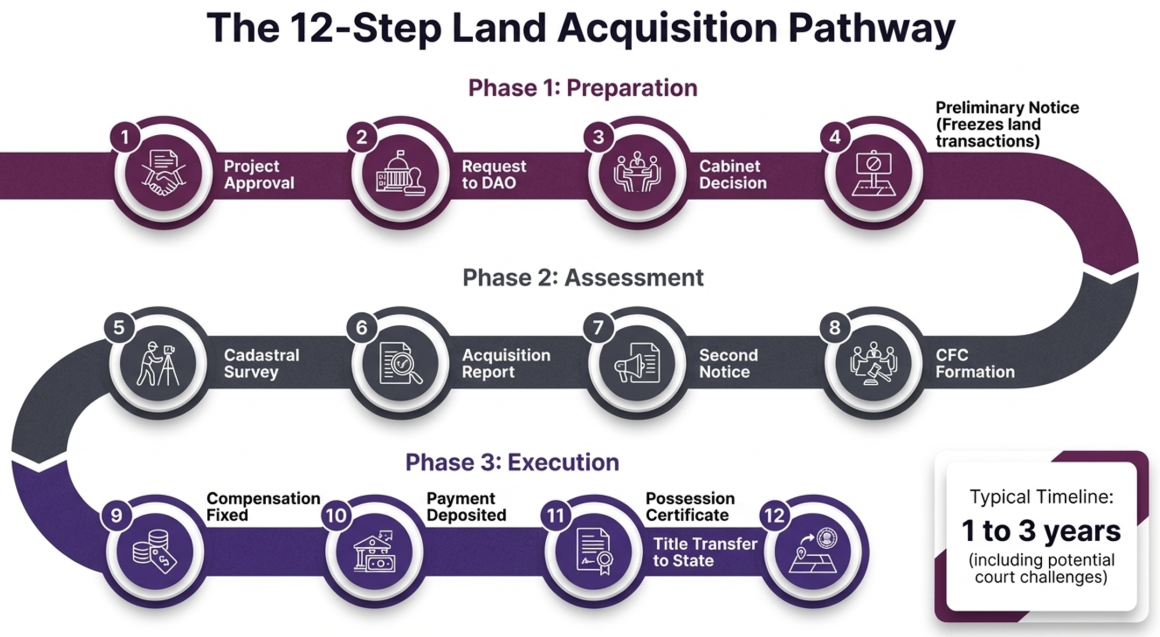
Under the Land Acquisition Act 2076, the process follows a strict sequential order. Any deviation can be challenged in court.
STEP 1: Project Approval
- Authority: Government of Nepal / Investment Board / Ministry of Energy
- Deliverable: Formal project approval resolution
- Timeline: Variable (3–12 months)
STEP 2: Request for Acquisition
- Applicant: Project developer (SPV, NEA, or promoter)
- Recipient: District Administration Office (DAO)
- Required documents:
- Project plan and feasibility study
- Detailed land requirement map
- Cost estimates
STEP 3: Government Decision to Acquire
- Authority: Cabinet or delegated ministry
- Form: Formal acquisition decision order
- Legal effect: Initiates the acquisition process
STEP 4: Preliminary Notice (Suchana)
- Publisher: DAO
- Method: National newspapers, local offices, public announcement
- Content: Description of land, purpose of acquisition, invitation for claims/objections
- Legal effect: Freezes land transactions; prohibits new construction
STEP 5: Land Survey and Measurement
- Team: Survey officer, Land Revenue Office rep, local government rep, project rep
- Activities: Cadastral survey, ownership verification, measurement of structures/trees/crops, identify affected families
STEP 6: Preparation of Acquisition Report
- Contents: Ownership schedule, land classification, inventory of structures/trees, social/economic impact, preliminary compensation
STEP 7: Second Public Notice
- Publisher: DAO
- Content: Specific parcels and kitta numbers, owners’ names, proposed compensation, objection filing date (15–30 days)
STEP 8: Compensation Fixation Committee (CFC) Formation
| Member | Role |
| Chief District Officer | Chairperson |
| Land Revenue Officer | Member |
| Local Government Rep | Member |
| Project Rep | Member |
| Affected Community Rep (invited) | Observer |
Functions: Hear objections, determine final compensation, approve awards
STEP 9: Compensation Determination
| Component | Nepali Term | Basis |
| Land value | मुआब्जा | Market value from registered transactions |
| Structure value | संरचना | Depreciated replacement cost |
| Tree/crop value | बाली/रूख | Productive value |
| Relocation cost | स्थानान्तरण | Actual moving expenses |
| Livelihood compensation | जीविकोपार्जन | Loss of income (emerging practice) |
STEP 10: Compensation Payment
- Method: Direct deposit to landowner account
- Timing: Before possession
- Dispute mechanism: If owner refuses, amount deposited in court
STEP 11: Possession of Land
- Action: DAO hands over land to project
- Documentation: Possession certificate executed
- Condition: Only after compensation paid/deposited
STEP 12: Title Transfer
- Authority: Land Revenue Office
- Action: Registration in name of Government of Nepal
- Subsequent: Lease/assignment to project SPV
Typical Timeline
| Phase | Duration |
| Preliminary notice to possession | 6–18 months |
| Full process including court challenges | 1–3 years |
Question 1.4: What is the distinction between Full Acquisition, Right-of-Way, and Temporary Use? Which law defines these?
The Three Legal Regimes for Land Access
1. Full Land Acquisition (पूर्ण अधिग्रहण)
- Definition: Complete transfer of ownership from private owner to the State.
- When used: Tower pads, substation sites, switching stations, permanent access roads
- Legal effect: Title transfers to Government of Nepal; owner receives full compensation; owner has no residual rights
- Compensation: 100% of land value + structures + trees + relocation
2. Right-of-Way (ROW) / Easement (सेवाहक अधिकार)
- Definition: Land remains privately owned but use is restricted to protect transmission infrastructure.
- When used: Corridor beneath conductors (30–60 m), tower shadow areas, approach paths for maintenance
- Restrictions: No permanent structures, no tall trees, no excavation affecting towers, no fire hazards
- Owner retains: Ownership title, right to cultivate, sell subject to restrictions, use for agriculture
- Compensation: Typically 10–25% of land value + crop/tree/structure compensation
- Legal basis: Land Acquisition Act (implied), Electricity Act 2049, Transmission Line ROW Guidelines
3. Temporary Use (अस्थायी उपयोग)
- Definition: Land used for a limited period, then restored to owner.
- When used: Construction camps, material storage, temporary access roads, stringing sites
- Legal effect: Ownership unchanged, governed by lease, land restored after use
- Compensation: Lease rental + crop damage + restoration costs
- Legal basis: Contract law; Lease Agreement
Comparison Table
| Feature | Full Acquisition | Right-of-Way | Temporary Use |
| Ownership | Transfers to State | Remains with owner | Remains with owner |
| Possession | Permanent | Permanent (restricted) | Temporary |
| Use allowed | Project use only | Agriculture, restricted | As per lease |
| Compensation | 100% value | Partial (10–25%) | Lease rental + damages |
| Title transfer | Yes | No | No |
| Legal permanence | Perpetual | Perpetual | Fixed term |
Question 1.5: What are the specific legal issues with transmission line ROW in Nepal?
Practical Challenges in ROW Implementation
- Compensation Disputes
- Landowners often argue 10–25% is inadequate because restrictions reduce land value permanently, selling becomes difficult, development potential lost
- Court trend: Compensation should reflect actual diminution in value, not fixed percentage
- Encroachment and Violations
- Construction under lines, tall trees, flammable materials
- Enforcement difficulty: DAO and NEA lack resources for continuous monitoring
- Multiple Owners, Multiple Claims
- Corridor may cross hundreds of parcels, requiring individual negotiation, separate compensation, possible court cases
- Forest Land Complications
- Forest Act clearance required
- Compensatory afforestation mandated
- Additional delays (6–24 months)
PILLAR 2: FINANCIAL MODELING & WHEELING CHARGE DYNAMICS
Question 2.1: How is the wheeling charge for a transmission SPV mathematically determined?
The Cost-of-Service / Annual Revenue Requirement (ARR) Model
This is the standard regulated utility model used by the Electricity Regulatory Commission (ERC) and internationally.
The Fundamental Formula
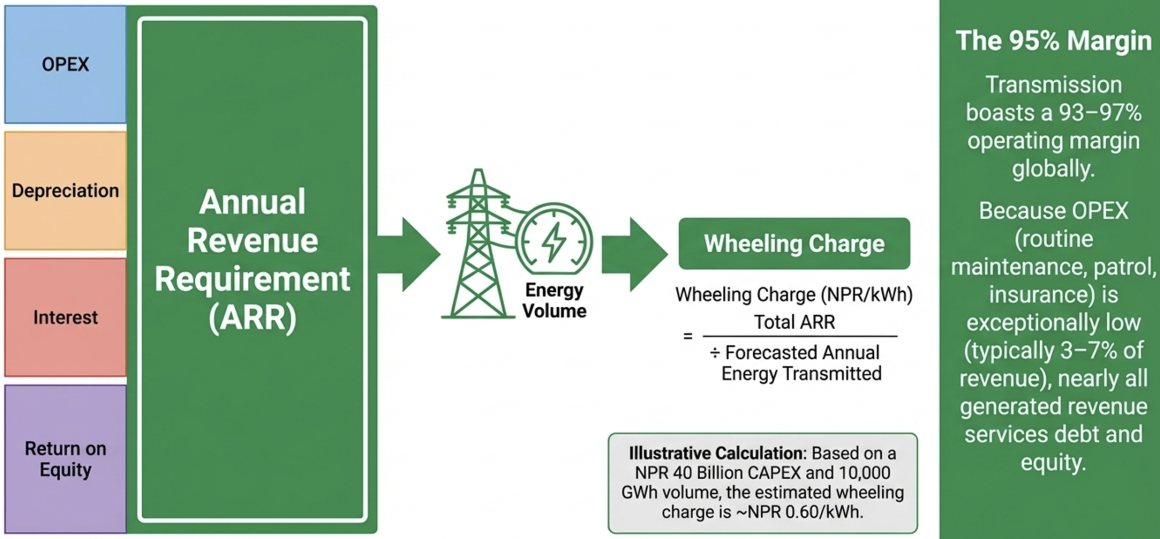
ARR = OPEX + Depreciation + Interest + Return on Equity
Where:
- ARR = Annual Revenue Requirement (total revenue the SPV needs to collect)
- OPEX = Operating Expenditure (maintenance, patrol, insurance, staff)
- Depreciation = Recovery of capital cost over asset life
- Interest = Debt servicing cost
- Return on Equity = Allowed profit for shareholders
The Wheeling Charge Calculation
Wheeling Charge (NPR/kWh) = ARR (NPR) / Forecasted Annual Energy Transmission (kWh)
Worked Example (Illustrative)
| Parameter | Value |
| Project CAPEX | NPR 40 billion |
| Debt (70%) | NPR 28 billion |
| Equity (30%) | NPR 12 billion |
| Interest rate | 8% |
| Loan tenure | 15 years |
| Allowed ROE | 16% |
| Annual OPEX | NPR 800 million (2% of CAPEX) |
| Depreciation (40 years) | NPR 1 billion/year |
| Forecast energy | 10,000 GWh/year |
ARR Calculation:
| Component | Amount (NPR million/year) |
| OPEX | 800 |
| Depreciation | 1,000 |
| Interest (year 1 avg) | 2,240 |
| Return on Equity (16% of 12,000) | 1,920 |
| Total ARR | 5,960 |
Wheeling Charge:
5,960,000,000 ÷ 10,000,000,000\ kWh = NPR\ 0.596/kWh
Regulatory Review
The ERC examines:
- Is CAPEX reasonable? (benchmarked)
- Is OPEX efficient? (not padded)
- Is ROE within allowed band? (15–18% typical)
- Are utilization forecasts realistic?
Question 2.2: What is the “95% operating margin” assumption? Is it realistic for a 400 kV line?
Understanding Operating Margin in Transmission
Operating Margin = (Revenue – OPEX) / Revenue
Transmission lines have low operating costs, so the margin is high.
Cost Component Typical % of Revenue
- Routine maintenance: 1–2%
- Vegetation management: 1–2%
- Insurance: 0.5–1%
- Staff/administration: 1–2%
- Total OPEX: 3–7% → Operating margin ≈ 93–97%
Global Benchmarks
| Region | Typical Operating Margin |
| India (private 400 kV SPVs) | 94–97% |
| United States (regulated utilities) | 90–95% |
| Europe (TSOs) | 92–96% |
| Nepal (NEA transmission) | 90–95% |
Cautionary Factors:
- Extreme terrain
- High lightning/weather risk
- Complex substations
- Security costs
Question 2.3: What happens if fewer generators connect than expected? How is “volume risk” addressed?
The Stranded Asset Problem
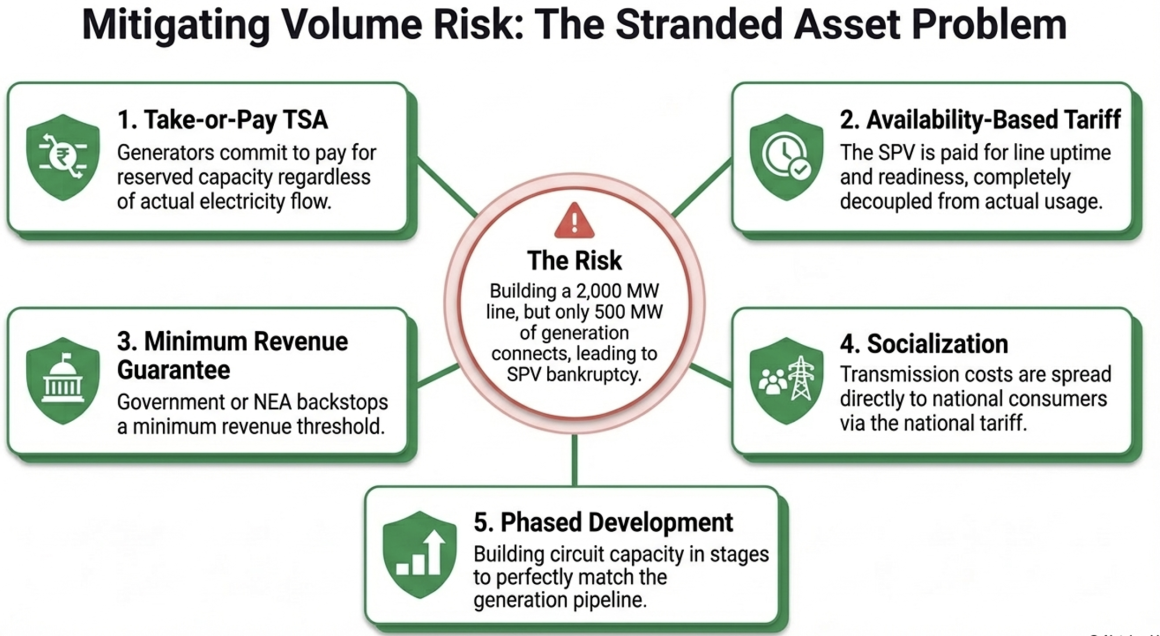
Risk: Building 2,000 MW line but only 500 MW connects → potential SPV bankruptcy.
Mechanism 1: Take-or-Pay Transmission Service Agreements (TSA)
- Generators commit to pay for reserved capacity, regardless of actual flow
- Example:
| Generator | Reserved Capacity | TSA Rate | Annual Payment |
| Project A | 400 MW | NPR 0.5M/MW/year | NPR 200M |
| Project B | 300 MW | NPR 0.5M/MW/year | NPR 150M |
- Legal basis: Bi-lateral contract; enforceable under Nepali contract law
Mechanism 2: Availability-Based Tariff (ABT)
- SPV paid for line availability, not flow
- Example:
| Parameter | Value |
| Approved ARR | NPR 5 billion |
| Actual availability | 98.5% |
| Revenue earned | NPR 4.925 billion |
Mechanism 3: Minimum Revenue Guarantee (MRG)
- Government or NEA guarantees minimum revenue
- Example:
| Parameter | Value |
| Minimum guaranteed revenue | NPR 4 billion |
| Actual revenue | NPR 3.2 billion |
| Government pays | NPR 800 million |
Mechanism 4: Socialization of Transmission Costs
- Transmission cost spread across all consumers
| Parameter | Value |
| National transmission cost | NPR 50 billion |
| Total electricity consumption | 25,000 GWh |
| Transmission tariff component | NPR 2.0/kWh |
Mechanism 5: Phased Development
- Build capacity in stages matching generation pipeline
- First phase: 1,000 MW
- Second phase: add circuit when generation reaches threshold
Question 2.4: If more generators connect later, does the wheeling charge decrease? What happens to existing generators’ rates?
Scenario A: Regulated Cost-of-Service Model
- Tariff = ARR ÷ Total Energy Transmitted
- New generators → total energy increases → tariff decreases
- Example:
| Phase | Energy | Tariff (ARR = NPR 5B) |
| Initial | 5,000 GWh | NPR 1.00/kWh |
| Year 3 | 7,500 GWh | NPR 0.67/kWh |
| Year 5 | 10,000 GWh | NPR 0.50/kWh |
Scenario B: Fixed Contract Model (Generator-Specific TSA)
- Each generator pays agreed tariff → existing contracts unchanged
| Generator | Contract Tariff | Energy | Revenue |
| A (existing) | NPR 0.60/kWh | 500 GWh | NPR 300M |
| B (new) | NPR 0.55/kWh | 400 GWh | NPR 220M |
Scenario C: Hybrid with Tariff Reopening
- Regulator reviews tariffs periodically → rates may reset
Question 2.5: What pricing model is Nepal currently using? What is it moving toward?
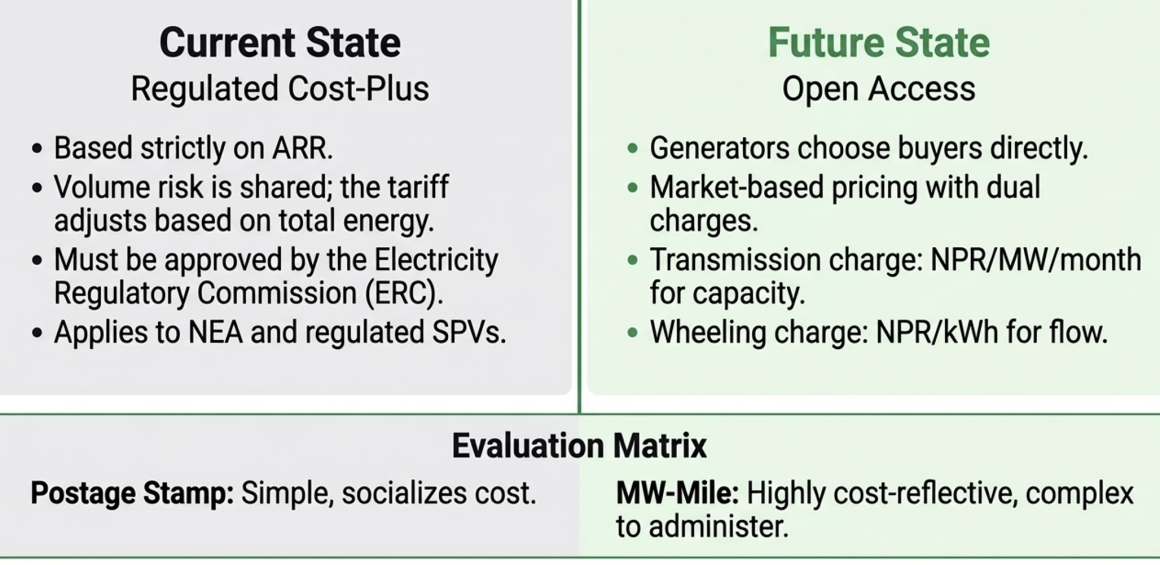
Current System: Regulated Cost-of-Service (Cost-Plus)
- Legal basis: Electricity Regulatory Commission Act; Tariff Directives
- Features:
| Feature | Current Practice |
| Pricing basis | ARR ÷ forecast energy |
| Return allowed | ~8% IRR (regulated) |
| Risk allocation | Volume risk shared; tariff adjusts |
| Tariff approval | ERC approval required |
| Applicable to | NEA transmission, regulated SPVs |
Future System: Open Access + Market-Based Pricing
- Generators choose buyers, traders operate, large consumers procure directly
- Transmission pricing:
| Component | Basis |
| Transmission charge | NPR/MW/month |
| Wheeling charge | NPR/kWh |
| Cross-subsidy surcharge | If applicable |
| Deviation settlement | Penalties for schedule violations |
- Draft: Long-term access ~NPR 283,842/MW/month; Short-term ~NPR 0.39/kWh
Evaluation
| Model | Pros | Cons |
| Postage Stamp | Simple; socializes cost | Less granular |
| MW-Mile | Cost-reflective | Complex to administer |
| Hybrid | Balances simplicity and accuracy | Requires regulatory capacity |
Question 2.6: How does the wheeling charge affect a generator’s PPA with NEA? Who pays whom?
Scenario 1: Generator Connected to Independent SPV
- Agreement: Generator ↔ NEA (PPA), Generator ↔ TL SPV (TSA)
- Payment: PPA revenue from NEA, wheeling charge paid to SPV
- Net Revenue: ( (PPA\ Price × Energy) − (Wheeling\ Charge × Energy) )
Scenario 2: Generator Connected to NEA-Owned Transmission
- PPA: Generator ↔ NEA
- Transmission cost absorbed internally by NEA
Comparison Table
| Feature | Independent SPV | NEA-Owned Line |
| Who pays transmission? | Generator pays SPV | NEA internalizes |
| Who receives transmission revenue? | SPV shareholders | NEA |
| PPA rate impact | Higher PPA needed | PPA unaffected |
| Transparency | Transmission cost explicit | Transmission cost “hidden” |
| Regulatory approval | ERC approves wheeling tariff | NEA internal cost allocation |
PILLAR 3: PROJECT STRUCTURING & PPP STRATEGY
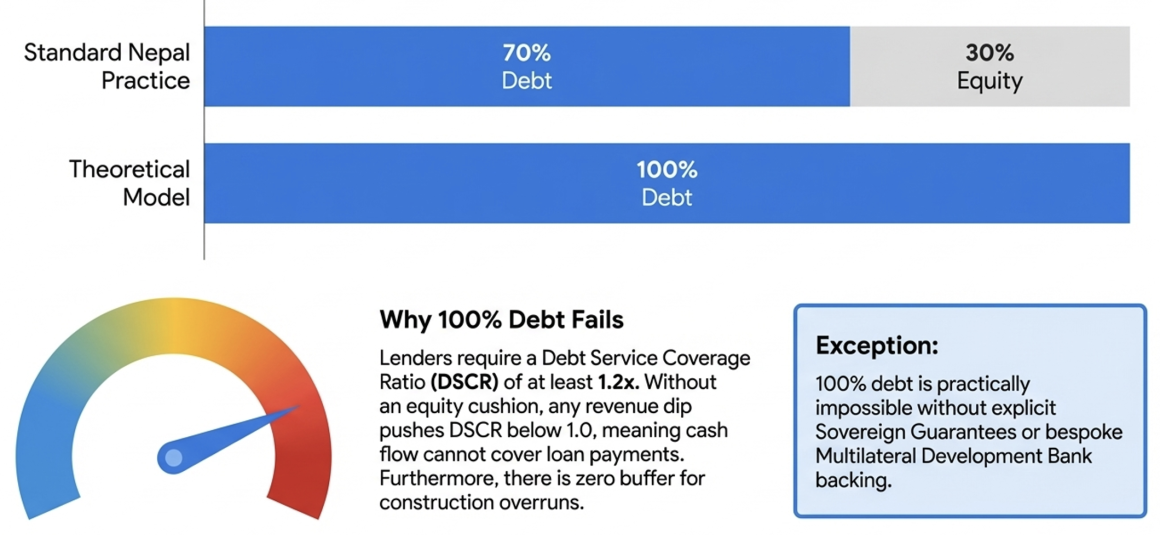
Question 3.1: Can a transmission project be built with 100% debt? What are the challenges?
The 100% Debt Model: Theoretical Possibility vs. Practical Reality
- Theory: 100% of CAPEX funded by loans; no equity; returns through interest only.
Why 100% Debt is Extremely Rare
| Challenge | Explanation |
| No risk cushion | Lenders require equity to absorb initial losses/delays |
| Debt Service Coverage Ratio (DSCR) | DSCR = Cash Flow ÷ Debt Payment. Without equity, DSCR is lower |
| Covenant requirements | Loan agreements require minimum equity for borrower commitment |
| Regulatory expectations | Regulators expect equity to align interests |
| Construction risk | If costs overrun, no equity to cover – project fails |
DSCR Calculation Example
| Project | Annual Cash Flow (NPR billion) | Annual Debt Payment (NPR billion) | DSCR |
| Example | 5 | 4 | 1.25 |
Lenders typically require DSCR ≥ 1.2–1.5. 100% debt → DSCR may drop <1.0 if revenues fall.
When 100% Debt Might Be Possible
| Condition | Explanation |
| Sovereign guarantee | Government guarantees debt repayment |
| Availability-based tariff | Revenue guaranteed regardless of flow |
| Take-or-pay contracts | Generators committed to fixed payments |
| Multilateral development bank | ADB/World Bank may accept different structures |
Standard Practice in Nepal: 70–80% debt, 20–30% equity
Question 3.2: Should a transmission SPV be publicly listed? What are the risks?
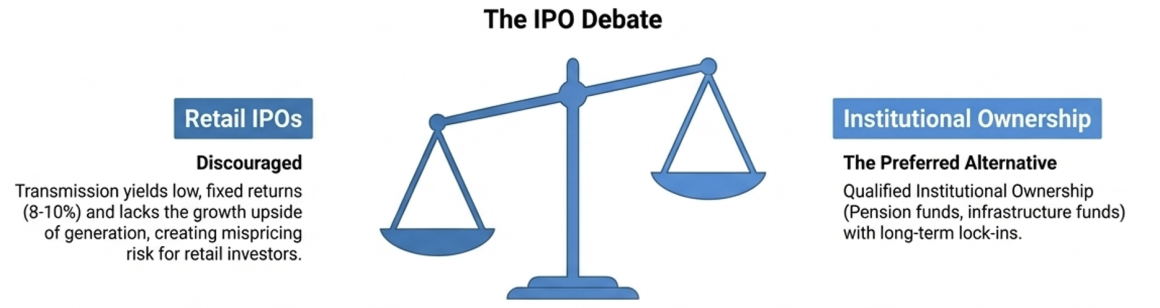
The IPO Debate for Transmission Assets
- Promoter exit strategies are a significant regulatory concern.
The Promoter Exit Abuse Pattern
- Minimal equity, IPO at high premium, promoters offload shares → public left with low-return shares
Why Transmission SPVs Are Different
| Factor | Transmission SPV | Generation Project |
| Return profile | Regulated, capped (8–10%) | Variable, potentially high |
| Growth potential | Limited (fixed tariff) | Expansion possible |
| Volatility | Very low | Moderate-high |
| Retail investor appeal | Low (fixed returns) | High (upside story) |
| Speculative trading | Unlikely | Common |
The Case Against Public Listing
| Argument | Explanation |
| Mispricing risk | Retail investors may overpay expecting generation-like returns |
| Promoter opportunism | Promoters exit early, leaving public with low-return asset |
| Regulatory complexity | SEBON oversight adds compliance burden |
| Lender discomfort | Lenders prefer stable, committed shareholders |
| Market liquidity | Single-asset SPV will have low trading volume |
Preferred Alternative: Institutional Ownership
- Pension funds, insurance companies, sovereign wealth funds, development finance institutions, strategic infrastructure funds
- Exit: secondary sale to another qualified institutional investor
Regulatory Approach
- Restrict shareholding to qualified institutional investors
- Require promoter lock-in for project life (≥15 years)
- Prohibit transfer without ERC approval
- Require shareholder agreements aligned with project longevity
Question 3.3: What is the license period for a transmission line? What happens after expiry?
License Duration Under Electricity Act 2049
| License Type | Maximum Term |
| Survey License | 5 years |
| Transmission License | 50 years |
Renewal Requirements
- If issued for shorter term: apply ≥1 year before expiry
- Failure to renew → license void
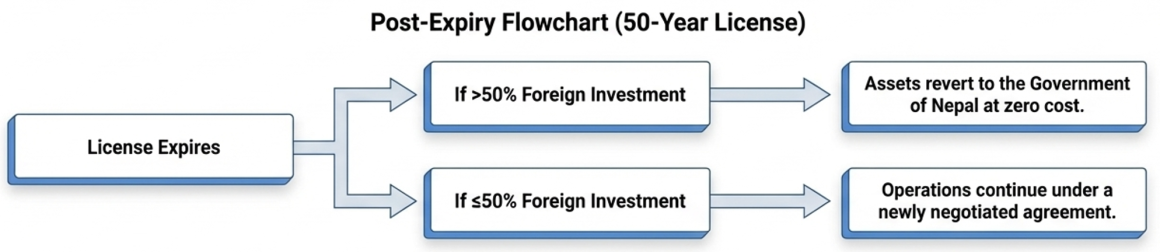
Post-Expiry Ownership: Two Regimes
Regime 1: >50% Foreign Investment
- Land, buildings, transmission structures revert to Government of Nepal at zero cost
- Prior licensee may purchase assets at assessed value
- New agreement required for continued operation
Regime 2: ≤50% or No Foreign Investment
- Transmission line continues under prior licensee
- New agreement executed with government
- No automatic transfer
Practical Implications
| Structure | Post-Expiry Position |
| Foreign-led SPV (>50%) | Asset reverts; may rebid |
| Domestic SPV (≤50%) | Continues with new agreement |
| Joint venture (50-50) | Agreement terms determine |
PILLAR 4: TAX, BANKING & REGULATORY INTERPLAY
Question 4.1: What tax benefits apply specifically to transmission lines under Nepal’s laws?
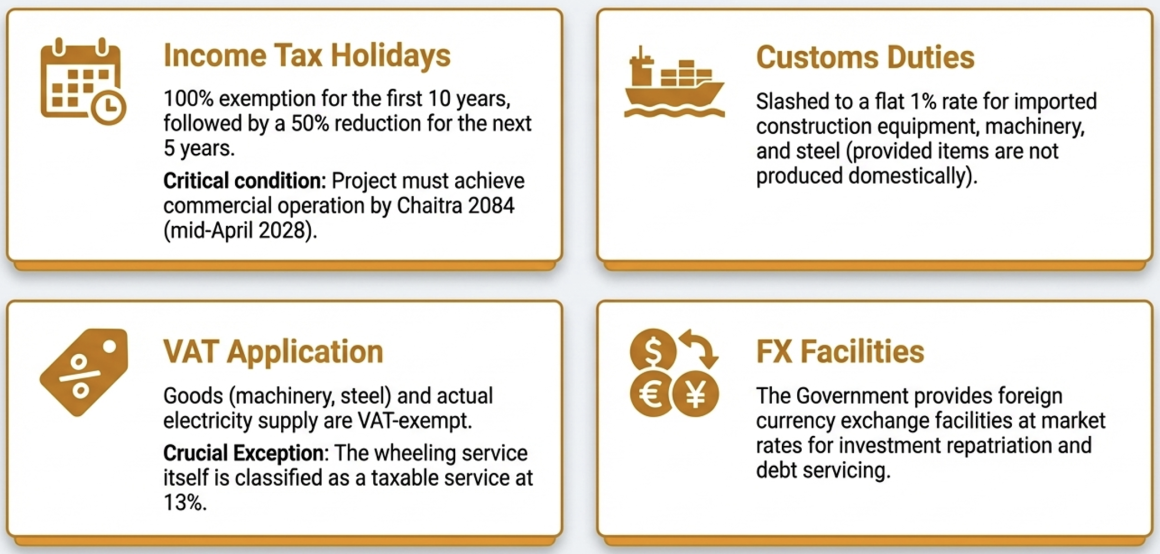
Income Tax Benefits
- Tax Holiday: 100% exemption first 10 years; 50% next 5 years
- Applies if commercial operation by Chaitra 2084 (mid-April 2028)
- Reduced Rate: Beyond holiday period → 10% lower than standard corporate rate
- Reinvestment Benefit: Deduct 50% of new fixed asset cost if ≥25% capacity expansion or modernization
Customs Duty Benefits
| Import Category | Duty Rate |
| Construction equipment | 1% (vs 5–30%) |
| Machinery and tools | 1% |
| Spare parts | 1% |
| Steel sheets | 1% |
Condition: Not produced in Nepal; recommended by DoED/IBN/AEPC
VAT Exemptions
- Goods: construction equipment, machinery, storage batteries, spare parts, steel sheets
- Electricity supply: exempt
- Wheeling service: taxable at 13%
Why Wheeling is Taxable
| Category | Treatment | Reasoning |
| Electricity (good) | VAT exempt | Schedule 1, Group 2 (basic necessity) |
| Wheeling (service) | VAT applicable | Not in exempt list; service defined broadly |
Foreign Exchange Facilities
- Government provides foreign currency for investment and repayment at market rate
Question 4.2: Do banking directives apply equally to transmission and generation?
Provisions That Apply Equally
| Provision | Transmission | Generation |
| Single Obligor Limit | Up to 50% of core capital | Up to 50% of core capital |
| Interest capitalization | Allowed during construction | Allowed during construction |
| Loan classification | 90-day overdue rule | 90-day overdue rule |
| Energy sector target | Counts toward 10% | Counts toward 10% |
The Critical Distinction: Base Rate + 1% Cap
- NRB directive: Base Rate + max 1% premium for reservoir-based hydropower and export-oriented projects (first 5 years)
- Transmission projects not automatically eligible → priced based on risk, market, bank rating (typically 2–4% above base rate)
Special Relief for Generation Awaiting Transmission
- Partially capitalize interest if transmission line delays operation
Question 4.3: What are the mandatory energy sector lending requirements?
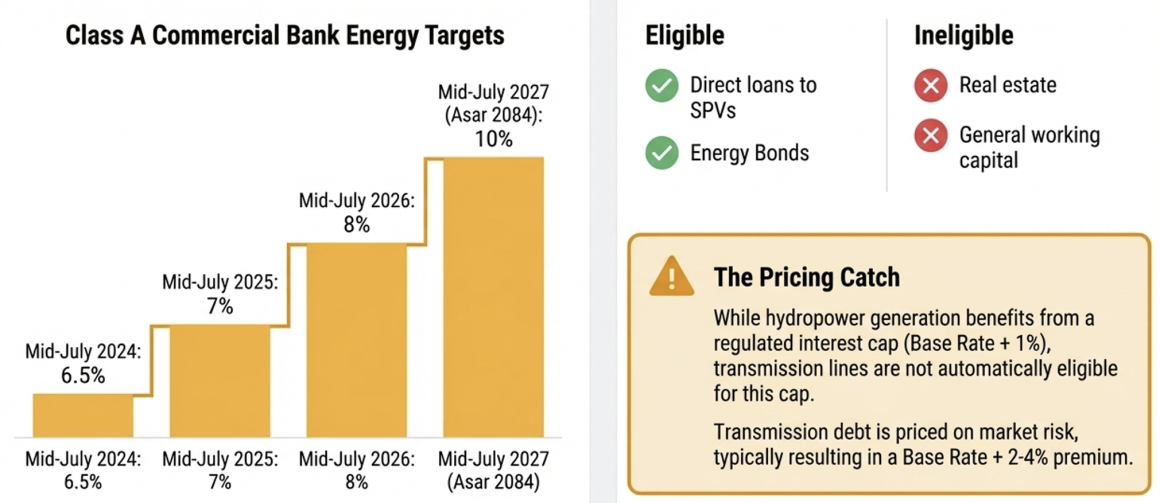
Class “A” Commercial Banks
| Deadline | Required Portfolio % |
| Mid-July 2024 (Asar 2081) | 6.5% |
| Mid-July 2025 (Asar 2082) | 7% |
| Mid-July 2026 (Asar 2083) | 8% |
| Mid-July 2027 (Asar 2084) | 10% |
Class “B” (Development Banks)
- Combined target (Agriculture + SME + Energy + Tourism): Min 20% by 2084
Class “C” (Finance Companies)
- Combined target: Min 15% by 2084
Eligible vs Not Eligible
| Eligible | Not Eligible |
| Direct loans to transmission SPV | Personal loans unrelated |
| Loans to hydropower generators | Real estate loans |
| Investment in Energy Bonds | General working capital for non-energy |
| Loans for renewable energy | – |
Energy Bonds
- Counts toward target
- Issued by authorized entities or PLCs
PILLAR 5: TECHNICAL & GRID DYNAMICS
Question 5.1: What does a “400 kV transmission line” actually mean? How do kV, MW, and kWh relate?
Understanding the Units
| Unit | Measures | Analogy |
| kV (kilovolt) | Electrical pressure | Water pressure in pipe |
| MW (megawatt) | Power capacity | Flow rate (liters/sec) |
| kWh (kilowatt-hour) | Energy volume | Total water delivered |
The Power Equation
Three-phase AC transmission:
P = √3 × V × I × PF
Where: P = MW, V = kV, I = kA, PF = Power factor (0.9–0.95)
Why High Voltage?
- More power with same current
- Lower losses (∝ I²)
- Longer distances viable
Typical Capacity of 400 kV Lines
| Configuration | Typical Capacity |
| Single circuit | 700–1,000 MW |
| Double circuit | 1,500–2,500 MW |
| With series compensation | Up to 3,000 MW |
Relationship Example
- Generation: 2,000 MW
- Transmission: double circuit 400 kV
- Energy/year: (2,000 MW × 8,760 h × 60% utilization = 10,512 GWh)
- Wheeling revenue at NPR 0.45/kWh: (10,512,000,000 × 0.45 = NPR 4.73B)
Question 5.2: Is there a mathematical relation between generation forecast and required transmission voltage?
No single formula – Use Engineering Rules
- Thermal Limit:
Pmax = √3 × V × Imax - Empirical Planning Rule:
V ∝ √(P × D) - Economic Voltage Formula:
V = 5.5 × √(L + P/100) - Practical Planning Table
| Power Range | Typical Voltage | Typical Distance |
| 100–300 MW | 132 kV | 50–150 km |
| 300–800 MW | 220 kV | 100–300 km |
| 800–2,000 MW | 400 kV | 200–600 km |
| 2,000–6,000 MW | 765 kV | >500 km |
- West Seti Context: 2,000 MW, 300 km → 400 kV double circuit
Question 5.3: How does transmission capacity determine wheeling revenue?
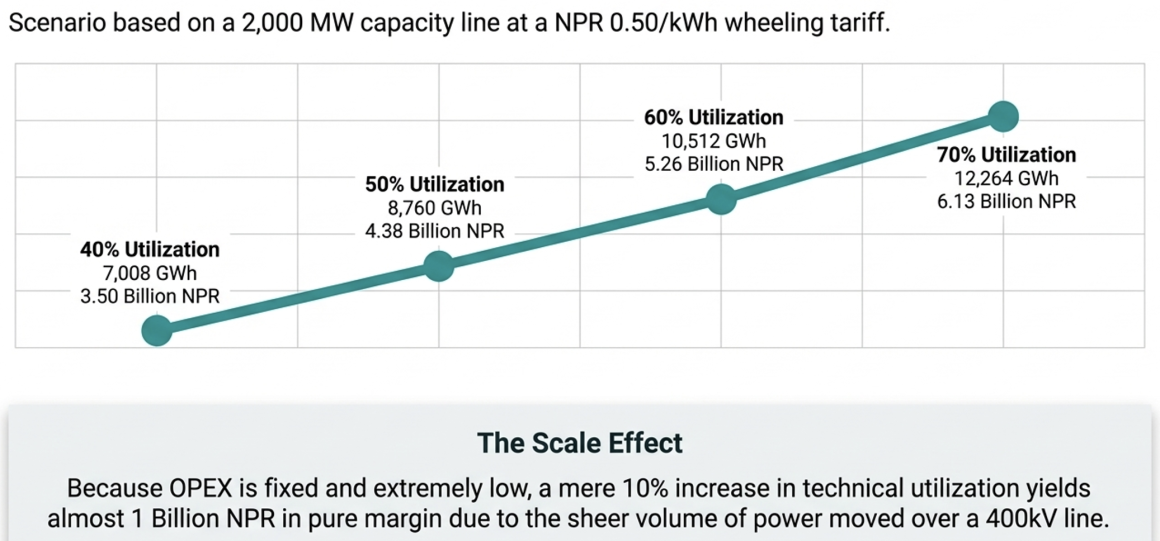
Annual Revenue = Σ (Wheeling Charge × Energy)
Key Variables: line capacity, utilization factor, connection rate, approved wheeling tariff
Utilization Sensitivity Example
| Capacity | Tariff | Utilization | Energy (GWh) | Revenue (NPR B) |
| 2,000 MW | 0.50/kWh | 40% | 7,008 | 3.50 |
| 2,000 MW | 0.50/kWh | 50% | 8,760 | 4.38 |
| 2,000 MW | 0.50/kWh | 60% | 10,512 | 5.26 |
| 2,000 MW | 0.50/kWh | 70% | 12,264 | 6.13 |