As institutions in Nepal navigate the complexities of the 21st-century economy, the financial sector has moved beyond simple profit-and-loss statements. Today, the conversation often includes two acronyms that every business leader, banker, and investor must understand: ESRM and NGFT. Together, they represent Nepal’s commitment to the Green, Resilient, and Inclusive Development (GRID) approach and its international climate commitments (NDCs).
ESRM as a Mandatory Regulatory Reality
For Banks and Financial Institutions (BFIs) in Nepal, environmental and social consciousness is no longer a “nice-to-have” corporate social responsibility initiative; it is a legal requirement. The Guideline on Environmental & Social Risk Management (ESRM) 2022, issued by Nepal Rastra Bank (NRB), serves as the mandatory bedrock for credit operations.
Unlike many international guidelines that act as suggestions, the ESRM is integrated into the Unified Directives. This means that failing to evaluate the environmental impact of a loan is legally equivalent to failing to check a borrower’s collateral.
Compliance is enforced through several layers of scrutiny. Under the Nepal Rastra Bank Act, 2058, specifically Sections 99 and 100, the central bank holds the authority to impose significant sanctions. These range from formal warnings and cash fines against the institution to personal penalties against directors and executive officers. Furthermore, non-compliance can lead to operational bottlenecks, such as restrictions on dividend distributions or the inability to expand branch networks.
The ESRM framework forces a shift in how loans are priced. In the standard “Base Rate + Premium” model, the premium is now inextricably linked to E&S risk. A high-risk project – perhaps one with significant waste management issues or labor concerns will naturally trigger a higher risk rating, leading to a higher interest rate. Conversely, low-risk “green” projects, such as reservoir-based hydro, often benefit from capped premiums, proving that sustainability can be a competitive advantage.
There are several practical impact on lending provision due to the requirements of the ESRM guidelines
- Exclusion Lists: BFIs are strictly prohibited from financing activities on the “Exclusion List,” such as illegal trade or projects impacting UNESCO World Heritage sites.
- Covenants and Defaults: E&S requirements are now written into legal loan agreements. A material breach of environmental standards can be classified as an “Event of Default,” allowing a bank to demand immediate repayment.
Escalation: The framework introduces a hierarchy of risk. Any project flagged as “Medium” or “High” risk must be escalated to a higher level of credit approval authority, ensuring that large-scale risks are seen by the highest level of leadership.
NGFT as a Strategic (and Soon-to-be) Mandate
While the ESRM focuses on “doing no harm” by managing risk, the Nepal Green Finance Taxonomy (NGFT) is about “doing good” by defining what actually constitutes a “green” investment.
Currently, the NGFT is a voluntary framework. There are no immediate legal penalties for a merchant bank or an insurance company that ignores it. However, viewing it as “optional” is a risky strategy. The NGFT is designed to prevent greenwashing – the deceptive practice of labeling standard projects as “eco-friendly” to gain public favor or cheaper capital.
While the ESRM is primarily for NRB-regulated banks, the NGFT is a universal dictionary for the entire financial ecosystem:
• Capital Markets: Regulated by SEBON.
• Insurance: Regulated by the Nepal Insurance Authority (NIA).
• Private Sector: Including pension funds, venture capital, and MSMEs.
There is a growing consensus that the NGFT will not remain voluntary forever. Regulators are already discussing the transition to a mandatory framework. When this shift occurs, institutions that have not aligned their portfolios with the taxonomy may face “future shocks.” These could include sudden, stringent disclosure requirements or a competitive disadvantage when international investors who demand transparent green reporting – look for partners in Nepal.
If mandated, the NRB could use the taxonomy to offer specific relaxations in directives for “Green Aligned” projects, essentially creating a fast lane for sustainable capital. These could include:
1. Preferential Risk Weighting (Capital Adequacy)
2. Extension of Single Obligor Limits (SOL)
3. Capped Interest Rate Premiums
4. Flexible Loan Classification and Provisioning
5. Expansion of Interest Capitalization Eligibility
6. Enhanced Loan-to-Value (LTV) Ratios
Comparative Overview: ESRM vs. NGFT
|
Feature |
ESRM Guideline (2022) |
Green Finance Taxonomy (NGFT) |
|
Legal Nature |
Mandatory |
Voluntary (Transitioning to Mandatory) |
|
Primary Goal |
Risk Mitigation & “Do No Harm” |
Capital Mobilization & Defining “Green” |
|
Regulatory Hook |
NRB Unified Directives / Act |
National Climate Goals (NDC/GRID) |
|
Consequences |
Fines, LFAR Audit Disclosures, Operational Restrictions |
Greenwashing risk, Competitive Disadvantage |
|
Primary Audience |
Banks & Financial Institutions (BFIs) |
Entire Financial Ecosystem (SEBON, NIA, Private) |
NGFT Hydroelectricity Production Criteria
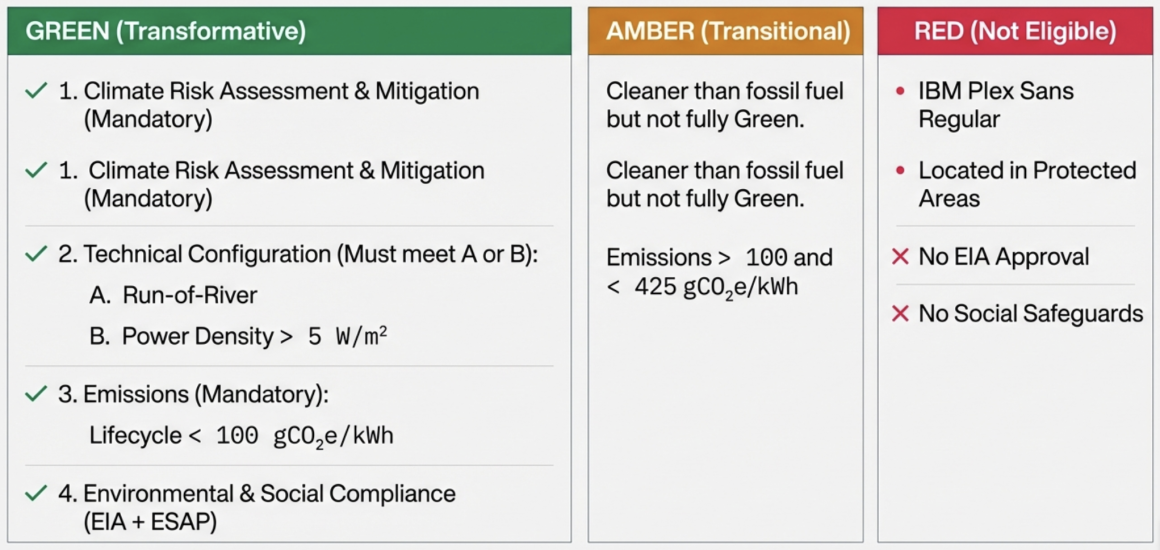
Nepal’s Green Finance Taxonomy (NGFT) provides strict criteria for hydroelectricity production under three categories: Green (Transformative), Amber (Transitional), and Red (Not Eligible / Unsustainable). The criteria are explicitly defined and include mandatory conditions, technical thresholds, emissions limits, environmental safeguards, and social compliance requirements.
|
GREEN (Transformative) |
AMBER (Transitional) |
RED (Not Eligible / Unsustainable) |
|
ALL mandatory conditions must be fulfilled: |
ALL mandatory conditions must be fulfilled: |
ANY ONE of the following conditions makes the project RED: |
|
1. Climate Risk and Environmental Safeguards (Mandatory) |
1. Technical configuration condition (Mandatory) Project must meet: (a) Run-of-river WITHOUT artificial reservoir OR (b) Power density > 5 W/m² |
1. Location restriction violation |
|
2. Technical Configuration AND Emissions Threshold (Mandatory) Project must meet: (a) Run-of-river WITHOUT artificial reservoir OR (b) Power density > 5 W/m² AND (in BOTH cases): (c) Lifecycle emissions < 100 gCO₂e/kWh |
2. Lifecycle Emissions Threshold (Mandatory) Lifecycle emissions must be: >100 AND <425 gCO₂e/kWh |
2. Environmental compliance violation |
|
3. Lifecycle Emissions Measurement and Verification (Mandatory) |
(Note: Amber category recognizes projects that are cleaner than fossil fuels but not fully aligned with green threshold) |
3. Failure to implement mitigation measures |
|
4. Environmental and Social Compliance (Mandatory) |
||
|
5. Energy Storage Eligibility (Additional Eligible Green Category) |
Key Climate and Technical Indicators
Power Density (W/m²)
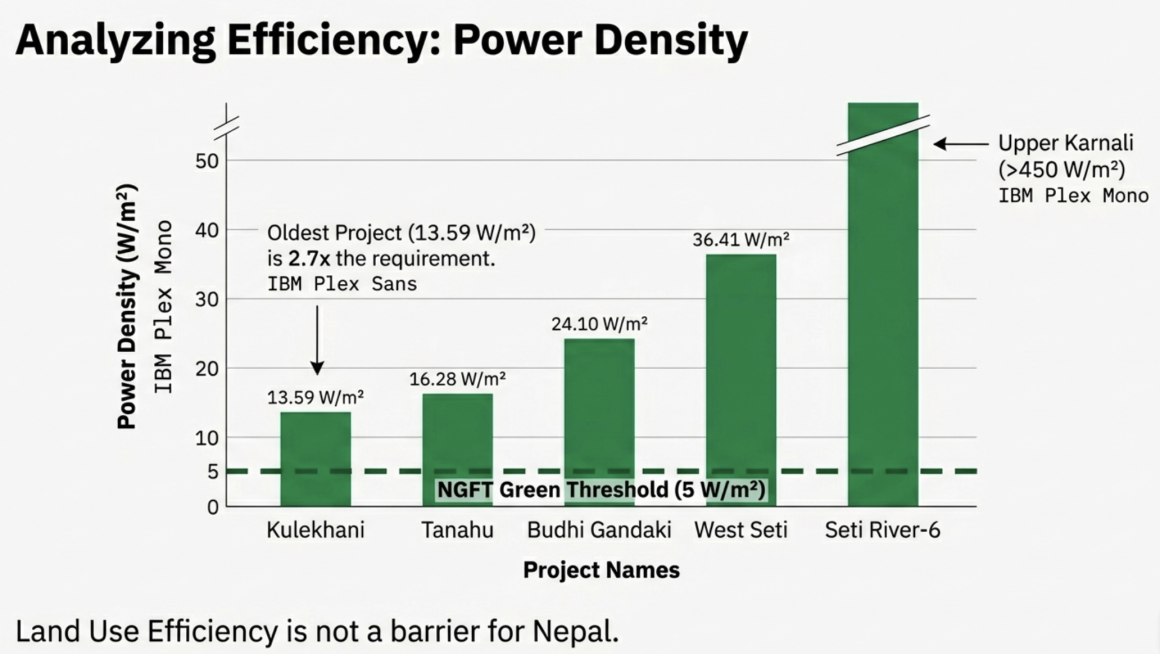
Power density measures how efficiently a reservoir uses land. It is a key indicator of environmental efficiency, as a higher power density typically correlates with less land submerged and lower methane emissions.
- Higher Power Density: Indicates better environmental efficiency.
- NGFT Threshold: To be eligible for the Green category, a project must have a power density > 5 W/m².
Lifecycle Emissions (gCO₂e/kWh)
This metric assesses the total greenhouse gas impact of a project relative to its energy output over its entire lifespan.
Included Emissions:
- Construction Phase: Embodied carbon in cement and steel, transportation, and construction equipment.
- Reservoir Methane Emissions: GHG releases from submerged organic matter.
- Operation and Maintenance: Ongoing emissions during the plant’s active life.
- Decommissioning: Optional and typically considered a minor factor.
Technical Lifetime:
Emissions are calculated over the technical life of the project, rather than the concession life. For hydropower in Nepal, the standard technical life is 100 years, consistent with the following international guidelines:
- G-RES (Greenhouse Gas Reservoir Tool)
- ISO 14067 and ISO 14064
- IHA (International Hydropower Association)
Nepal Reservoir-Based Hydropower Projects Data
The following table consolidates project characteristics, power density, capacity factor, lifetime generation, estimated lifecycle emissions, and NGFT Green classification:
|
Project Name |
Status |
Installed Capacity (MW) |
Reservoir Surface Area (m²) |
Power Density (W/m²) |
Capacity Factor (%) |
Lifetime Generation (GWh, 100 yrs) |
Lifetime Emissions (million tCO₂e) |
Lifecycle Emissions (gCO₂e/kWh) |
Taxonomy Category |
|
Kulekhani I, II & III (System) |
Existing |
106 |
7,800,000 |
13.59 |
40 |
37,142 |
0.39 |
10.5 |
GREEN |
|
Tanahu Storage Hydropower Project |
Under Construction |
140 |
8,600,000 |
16.28 |
45 |
55,188 |
0.44 |
8.0 |
GREEN |
|
Budhi Gandaki Hydropower Project |
Proposed |
1200 |
49,800,000 |
24.10 |
50 |
525,600 |
2.49 |
4.7 |
GREEN |
|
West Seti Storage Hydropower Project |
Proposed |
750 |
20,600,000 |
36.41 |
45 |
295,650 |
1.03 |
3.5 |
GREEN |
|
Seti River-6 Storage Project |
Proposed |
308 |
8,700,000 |
35.40 |
45 |
121,396 |
0.45 |
3.7 |
GREEN |
|
Upper Karnali Storage Project |
Proposed |
900 |
1,960,000 |
459.18 |
50 |
394,200 |
0.54 |
1.4 |
GREEN |
|
Pancheshwar Multipurpose Project |
Proposed |
6480 |
116,000,000 |
55.86 |
50 |
2,838,240 |
6.12 |
2.2 |
GREEN |
|
Sapta Koshi High Dam Project |
Proposed |
3600 |
196,000,000 |
18.37 |
50 |
1,576,800 |
9.98 |
6.3 |
GREEN |
|
Karnali Chisapani Multipurpose Project |
Proposed |
10800 |
339,000,000 |
31.86 |
50 |
4,730,400 |
17.55 |
3.7 |
GREEN |
|
Naumure Storage Hydropower Project |
Proposed |
245 |
14,400,000 |
17.01 |
40 |
85,848 |
0.73 |
8.5 |
GREEN |
Assumptions used for computations:
• Technical life: 100 years
• Capacity factor (annual operation %): 35–50% depending on project type
• Reservoir emission factor: 500 gCO₂e/m²/year (mountain reservoir)
• Construction emissions: 50 kg CO₂e/kW installed
Observations from the Data
- All reservoir projects have power density > 5 W/m²: NGFT requires either run-of-river or power density > 5 W/m². All major Nepal reservoirs satisfy this threshold.
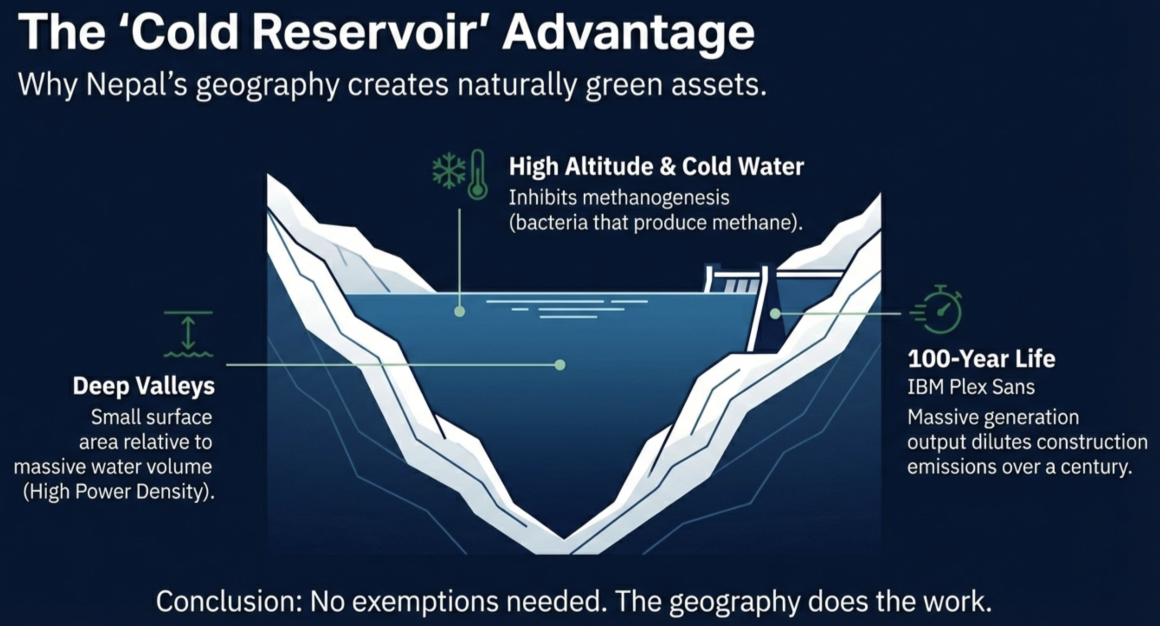
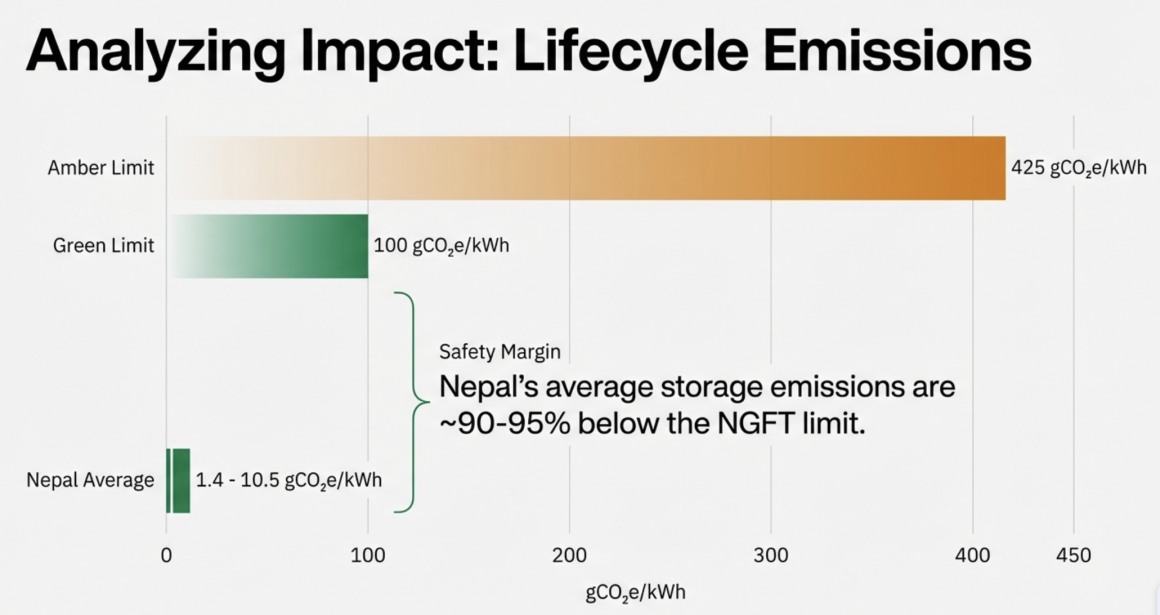
- Lifecycle emissions are extremely low (< 100 gCO₂e/kWh): Even for large reservoirs like Budhi Gandaki, Pancheshwar, or Sapta Koshi, emissions remain well below 50 gCO₂e/kWh. This is due to: Mountainous, cold reservoirs. Deep valleys → smaller flooded area → lower methane emissions per kWh. Large electricity output over a long project life (100 years)
- Environmental and social compliance potential: Nepal projects follow EIA/IEE regulations under the Environment Protection Act. ESG gaps can be addressed via Environmental and Social Action Plans (ESAP). Climate risk assessments (e.g., GLOF, landslides) are increasingly conducted for major storage projects.
- Energy storage eligibility: Pumped storage projects (like Tanahu) or projects integrating storage batteries qualify as additional Green category under NGFT.
NGFT Exemption Requirement Analysis
Based on technical data, lifecycle emissions analysis, NGFT criteria, and environmental safeguards, the reservoir-based hydropower projects in Nepal are already likely to qualify as Green:
• No specific exemption is needed for these projects under the NGFT Green category.
• These projects can be directly considered eligible for green finance instruments, including green bonds, concessional climate finance, and ESG-aligned investments.
This aligns with Nepal’s strategic advantage in clean hydropower, where mountainous storage reservoirs provide both high efficiency and extremely low emissions, making them globally competitive in the renewable energy sector.