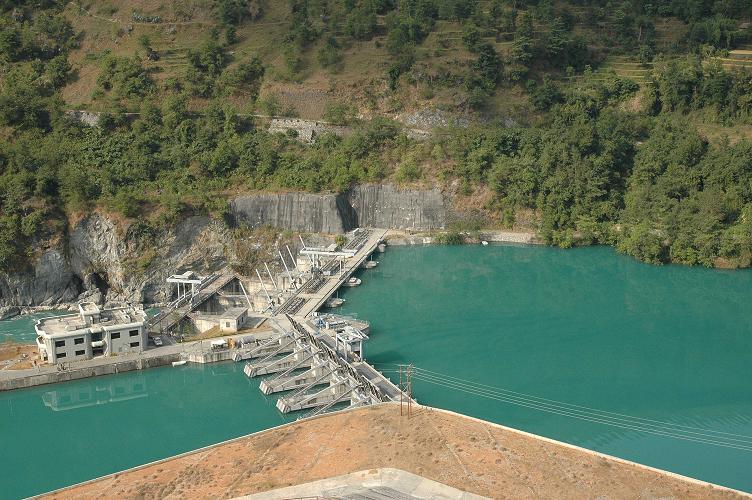
Read my other post which describes the problem – Nepal’s doomed BOOT Model Hydro SPVs. This one is more focused on possible solutions.
History of Independent Power Producers in Nepal’s Hydropower Development
1. Early foundations and the era of state monopoly (1911–1990)
Nepal’s hydropower journey began in 1911 (1967 BS) with the commissioning of the 500 kW Pharping Hydroelectric Plant, also known as Chandra Jyoti (named after PM Chandra Shamsher). Despite this early start, progress over the subsequent decades remained slow and uneven. Hydropower development was entirely state led, shaped by limited fiscal capacity, weak institutional depth, and the absence of a private investment framework. Until 1990, the sector functioned as a government monopoly, with no meaningful role for private capital, domestic or foreign. By the end of this period, Nepal’s vast hydropower potential remained largely untapped, constrained by the state’s inability to mobilize the scale of capital required for large infrastructure development.
2. Liberalization and the legal opening of the sector (1992 onwards)
The restoration of democracy in 1990 marked a structural break in Nepal’s economic governance, including in the energy sector. Recognizing that public resources alone were insufficient to develop hydropower at scale, the government adopted an open and liberal policy framework aimed at attracting private investment.
This shift was formalized through the Hydropower Development Policy, 1992 (2049 BS), which opened electricity generation to private developers, both domestic and foreign, and allowed them to sell power commercially. The Electricity Act, 1992 (2049 BS) provided the legal foundation for this transformation, establishing licensing procedures, defining the rights and obligations of developers, and formally enabling private sector participation in generation and transmission. Institutional responsibility for implementation rested with the Department of Electricity Development, which was tasked with assisting the ministry, issuing licenses, and providing one window services to private developers.
Together, these reforms dismantled the state monopoly and laid the groundwork for the emergence of Independent Power Producers as a central pillar of Nepal’s hydropower sector.
3. Emergence of pioneer IPPs and early private investment
Following liberalization, the first wave of IPP activity emerged in the 1990s, driven primarily by foreign direct investment and institutional private capital. These early projects played a foundational role in proving the bankability of Nepal’s hydropower sector.
Butwal Power Company stands out as a landmark case. Backed by a consortium of Nepali and Norwegian investors, BPC developed and operated the Andhi Khola project with a capacity of 5.1 MW and the Jhimruk project with a capacity of 12 MW. This represented one of the earliest examples of institutional private sector involvement in Nepal’s hydropower development.
The commissioning of the 60 MW Khimti Hydropower Project in July 2000 marked a decisive turning point. Developed with private investment and foreign direct investment, Khimti was the first large-scale privately developed hydropower project in Nepal and fundamentally altered perceptions of infrastructure risk in the country. It was followed by the Upper Bhote Koshi project, initially developed at 36 MW and later expanded to 45 MW, involving US private investment through Panda Energy Corporation. These projects demonstrated that private capital could finance, build, and operate complex hydropower assets in Nepal.
Alongside foreign investment, domestic private participation also began to take root. Indrawati III, with a capacity of 7.5 MW, became the first hydropower project developed entirely with domestic private investment, signaling the gradual localization of capital and expertise.
4. Institutional mechanisms governing IPP participation
Independent Power Producers in Nepal operate within a structure of regulatory and contractual framework. Developers are required to obtain three distinct licenses from the government through the Department of Electricity Development: a survey license, a generation license, and where applicable, a transmission license.
The Nepal Electricity Authority functions as the sole off taker of electricity. IPPs sell power to NEA under Power Purchase Agreements that define tariff structures, payment conditions, and contractual obligations. These PPAs are the financial backbone of project bankability.
Most projects are developed under the Build Own Operate Transfer model. Generation licenses are typically granted for periods of up to 50 years, after which the project assets must be transferred to the Government of Nepal in good operating condition. In addition, IPPs are required to pay royalties to the government, calculated on the basis of installed capacity and energy generation, with differentiated rates for projects serving domestic consumption and those oriented toward export.
5. Expansion and current contribution of IPPs
Over the past three decades, IPPs have transformed Nepal’s hydropower sector from a state dominated system into a competitive, privately driven industry. Their contribution now exceeds that of the public utility in both generation and installed capacity.
As of fiscal year 2024/25, IPPs generated 8,606 GWh of electricity, significantly surpassing the Nepal Electricity Authority’s generation of 2,953 GWh. The number of operational IPP projects has continued to grow rapidly. By the end of fiscal year 2024/25, the total number of operational IPP-owned projects reached 204, with a combined installed capacity of 2,929.7 MW,.
The construction pipeline remains substantial. As of fiscal year 2024/25, 142 IPP projects were under construction following financial closure, representing an additional 4,303 MW of capacity. Furthermore, another 148 projects totaling 4,203 MW are in various stages of development awaiting financial closure. The total number of Power Purchase Agreements (PPAs) signed with IPPs has reached 494, with a combined capacity of 11,436 MW. The shift toward mobilizing domestic capital through banks, financial institutions, and public equity continues to drive this expansion.
6. Structural and operational challenges faced by IPPs
Despite their growth, IPPs face persistent structural challenges. Transmission bottlenecks remain one of the most serious constraints. Delays in constructing high voltage transmission lines, including 220 kV and 400 kV corridors, have prevented timely evacuation of generated power, resulting in spillage and forced underutilization of operational plants.
Hydrological risk is another defining challenge. Most projects are run of river schemes, making generation highly sensitive to seasonal flow variations. Climate change, floods, landslides, and other natural disasters further compound operational and financial risks.
Uncertainty in Power Purchase Agreement terms, particularly debates around take or pay versus take and pay provisions, has historically affected revenue predictability. Procedural delays related to land acquisition, environmental approvals such as EIA and IEE, and forest clearance have also imposed significant time and cost overruns on projects.
7. Public participation, export orientation, and future direction
The sector is increasingly characterized by broader public participation and an outward looking orientation. The concept of People’s Hydro has promoted equity participation by the general public, with hydropower companies required to allocate a portion of shares, often around 10 percent, to local communities affected by project development.
As domestic electricity demand approaches saturation during certain periods, policy attention is shifting toward exporting surplus power to neighboring markets, particularly India and Bangladesh. Regulatory and policy frameworks are being adjusted to facilitate cross border electricity trade and long term export oriented development.
In sum, Nepal’s hydropower sector has evolved from a slow moving, state controlled initiative into a dynamic industry driven largely by Independent Power Producers. Liberalization in the early 1990s catalyzed this transformation, enabling private companies to now account for the majority share of electricity generation in the country and setting the stage for the structural challenges and financing questions that define the sector today.
The context of the problem
The core problem lies in a fundamental and systemic structural contradiction in Nepal’s hydropower financing model. The legal and regulatory framework compels the convergence of three incompatible elements: the Build Own Operate Transfer concession, which grants a private entity a time bound license, typically 30 to 35 years, after which the project must be transferred to the state for zero compensation; the Special Purpose Vehicle model, which creates a single asset, legally isolated company whose entire value is derived from that finite life project; and the public listing of perpetual equity on the Nepal Stock Exchange, which treats these SPVs as going concerns with indefinite existence. The result is a cliff edge in which a perpetual financial instrument, the share, is backed by an asset that is legally required to disappear. The terminal value of the equity is therefore guaranteed to be zero. The market, however, prices these shares on the basis of dividend yields and growth assumptions, creating a widespread valuation distortion that ignores the embedded expiration date.
This structural flaw is intensified by financial and governance practices that systematically shift long term risk from sophisticated insiders and promoters to retail investors. Promoters, typically supported by bank debt, de-risk projects through the construction phase and early operations, and then use the expiry of securities locked in periods to exit their holdings through the secondary market, effectively monetizing future cash flows. Retail investors are left holding what is treated as perpetual equity while the BOOT clock continues to run down. At the same time, listed SPVs often engage in aggressive capital raising, particularly through high ratio rights issuances, to repay bank loans or to invest in new and riskier subsidiary SPVs. These inter SPV investments undermine the ring fenced nature of the original project, diverting cash flows and retained earnings into new construction risks without shareholder consent, even as the original asset moves closer to its mandatory transfer date with no mechanism for capital redemption.
The crisis is further amplified by a regulatory vacuum that focuses almost entirely on capital mobilization and construction progress while ignoring the end of life scenario. Securities regulations permit initial public offerings even when projects have as little as ten years remaining on their license, and there are no requirements for a sinking fund, a capital redemption reserve, or clear disclosure of the BOOT countdown in financial statements. As a result, the market operates under a going concern illusion. Neither the Securities Board of Nepal nor the Electricity Regulatory Commission has put in place oversight frameworks or mechanisms for an orderly wind down, effectively embedding the eventual collapse of equity value into the system and exposing thousands of retail investors to a predictable terminal loss.
Main post: https://sushilparajuli.com/nepals-doomed-boot-model-hydro-spvs/
How Retail Investors Will Be Burnt
Nepal’s hydropower sector has undergone explosive growth in the past five years, transforming from a peripheral segment into a dominant force in the Nepal Stock Exchange (NEPSE). This growth has been driven largely by retail investors chasing high returns, often without appreciating the structural risks inherent in the Build-Own-Operate-Transfer (BOOT) model. The sector’s systemic dominance, sheer scale of equity, frenzied trading patterns, misaligned dividend incentives, repeated rights share issuances, and promoter exit strategies collectively expose retail investors to a significant risk of principal loss.
1. Quantifying Retail Exposure & Market Dominance
The rise of the hydropower sector can be observed in four dimensions: market capitalization, paid-up capital, trading turnover, and retail float.
1.1 NEPSE Total Market Cap vs. Hydropower Sector Cap
|
Fiscal Year |
Total NEPSE Market Cap (Rs. Millions) |
Hydropower Sector Cap (Rs. Millions) |
Systemic Weight (%) |
|
2020-2021 |
4,010,957.81 |
222,066.06 |
5.54% |
|
2021-2022 |
2,869,344.17 |
358,672.16 |
12.50% |
|
2022-2023 |
3,082,519.56 |
426,021.69 |
13.82% |
|
2023-2024 |
3,553,677.24 |
709,117.91 |
19.95% |
|
2024-2025 |
4,656,989.36 |
2,064,673.02 |
44.33% |
Insights:
- Explosive Growth: Hydropower’s share of total market capitalization increased nearly 8-fold from 5.54% to 44.33%.
- Resilience in Downturns: In 2021-2022, total market cap fell, yet hydropower grew from Rs. 222 billion to Rs. 358 billion, more than doubling its systemic weight.
- Market Dominance: By 2024-2025, hydropower alone controls almost half of NEPSE’s total capitalization, surpassing traditional heavyweights like commercial banks.
1.2 Number of Listed Hydropower Companies & Combined Paid-Up Capital
|
Fiscal Year |
No. of Listed Companies |
Combined Paid-Up Capital (Rs. Millions) |
Key Observation |
|
2020-2021 |
40 |
69,678.67 |
Moderate base with 40 companies |
|
2021-2022 |
51 |
71,306.10 |
Steady growth; 11 new companies added |
|
2022-2023 |
80 |
42,602.17* |
Listing surge (+29 companies); capital temporarily adjusted downward |
|
2023-2024 |
91 |
70,911.79 |
Continued listing boom (+11 companies) |
|
2024-2025 |
100+ |
206,467.30 |
Explosive growth: equity float nearly tripled (+191%) |
Insights:
- Tripling of Equity (2024-2025): Combined paid-up capital surged from Rs. 70.91 billion to Rs. 206.46 billion, indicating massive new share issuance.
- Listing Boom: Number of companies more than doubled from 40 to 91 in four years.
- Sector Depth: With 2.06 billion share units, hydropower has become a high-volume heavyweight in NEPSE.
1.3 NEPSE Turnover vs. Hydropower Turnover
|
Fiscal Year |
Total NEPSE Turnover (Rs. Millions) |
Hydropower Turnover (Rs. Millions) |
% Contribution |
|
2020-2021 |
1,454,444.24 |
222,066.06 |
15.27% |
|
2021-2022 |
1,202,101.40 |
358,672.16 |
29.84% |
|
2022-2023 |
467,126.94 |
130,231.67 |
27.88% |
|
2023-2024 |
734,684.46 |
207,684.92 |
28.27% |
|
2024-2025 |
2,188,476.24 |
822,997.89 |
37.61% |
Insights:
- Frenzied Trading: Even when the broader market cooled in 2021-2022, hydropower turnover grew 61%, reflecting a migration of retail traders into the sector.
- Volume Dominance: In 2024-2025, hydropower accounted for 42.6% of traded shares.
- Liquidity Driver: The sector dictates NEPSE’s sentiment, fueled by high-frequency retail participation.
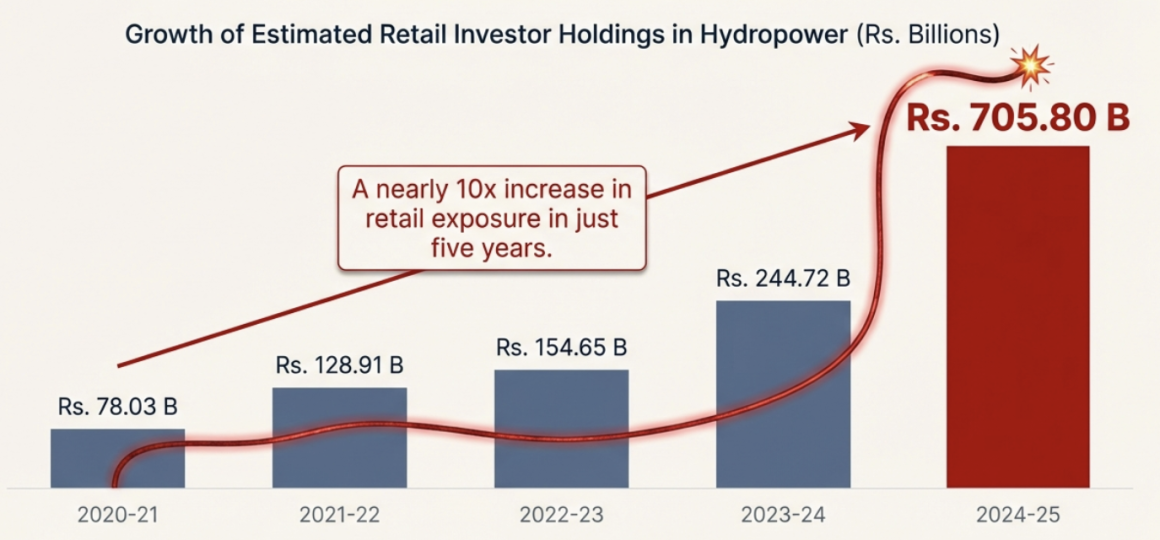
1.4 Estimated Retail Investor Holdings (Principal at Risk)
|
Fiscal Year |
Hydropower Sector Cap (Rs. Millions) |
Market-Wide Float % |
Est. Retail Holdings (Rs. Billions) |
|
2020-2021 |
222,066.06 |
35.14% |
78.03 |
|
2021-2022 |
358,672.16 |
35.94% |
128.91 |
|
2022-2023 |
426,021.69 |
36.30% |
154.65 |
|
2023-2024 |
709,117.91 |
34.51% |
244.72 |
|
2024-2025 |
2,064,673.02 |
34.18% |
705.80 |
Insights:
- 10x Retail Risk Growth: Retail exposure soared from Rs. 78 billion to Rs. 705 billion in just five years.
- 2024-2025 Surge: Rs. 461 billion added in a single year, driven by IPOs, rights shares, and bonus issuances.
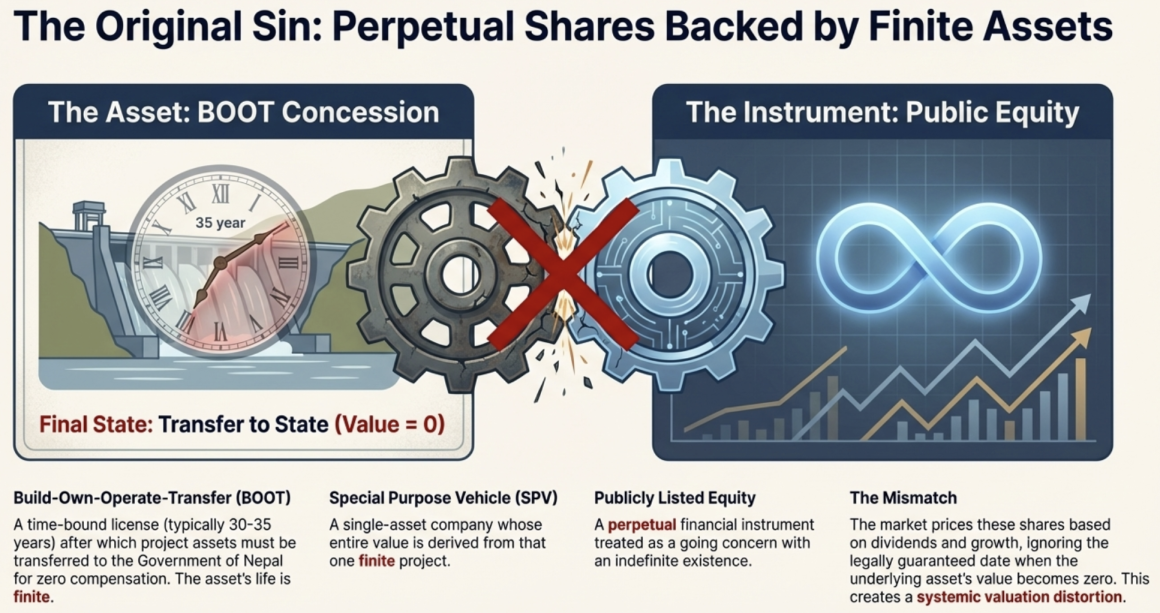
2. Pinpointing the "Cliff Edge": BOOT Transfers
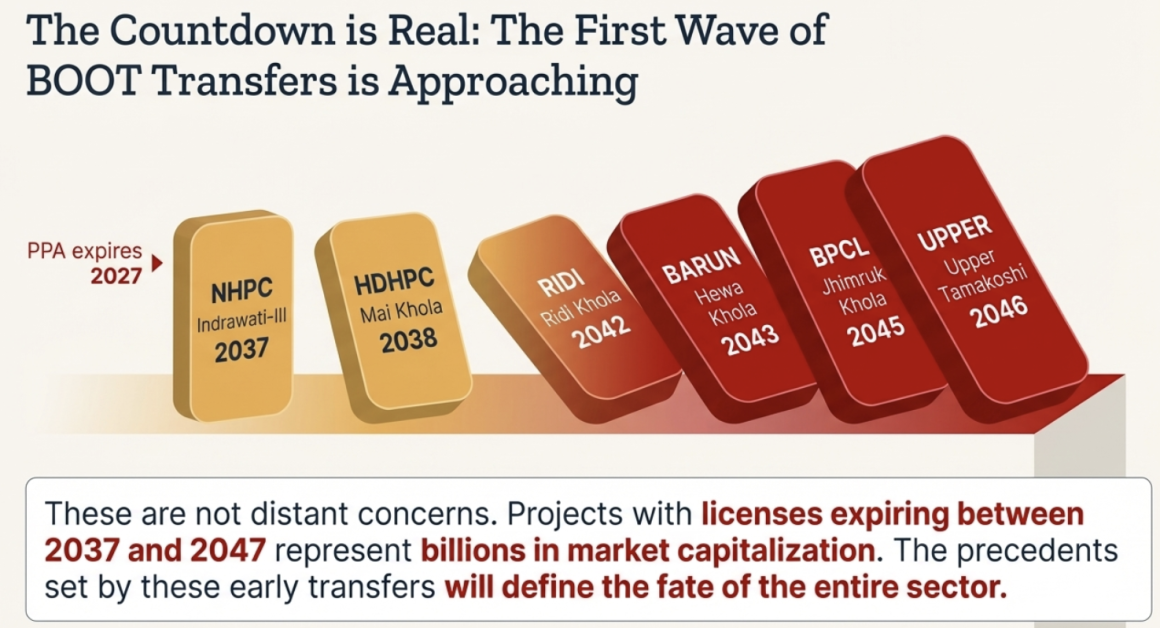
Many hydropower projects are approaching the end of their 30–35 year licenses, at which point their primary asset will revert to the state under the BOOT model. Retail investors are heavily exposed to this terminal risk.
|
Company Symbol |
Project Name |
Capacity (MW) |
COD (AD) |
License Expiry (B.S.) |
Est. Expiry (AD) |
Project Status & Risk |
|
BPCL |
Andhi Khola |
9.4 |
1991-07-01 |
2075/02/13 |
2018 |
Initial license expired; 9.4 MW upgrade in 2072 |
|
NHPC |
Indrawati-III |
7.5 |
2002-10-07 |
2094/06/21 |
2037 |
License valid; PPA expires 2027 |
|
HDHPC |
Mai Khola Small |
4.5 |
2011-02-13 |
2095/04/14 |
2038 |
High terminal risk for early project |
|
RIDI |
Ridi Khola |
2.4 |
2009-10-26 |
2099/02/16 |
2042 |
Small, high-risk asset |
|
NYADI |
Nyadi HEP |
30.0 |
2022-05-10 |
2099/12/06 |
2043 |
Large asset nearing 20-year mark |
|
BARUN |
Hewa Khola |
4.5 |
2011-02-13 |
2100/01/21 |
2043 |
First of 2100 B.S. wave transfers |
|
BPCL |
Jhimruk Khola |
12.0 |
1994-08-01 |
2101/12/30 |
2045 |
Critical legacy portfolio |
|
MODI |
Tallo Modi-1 |
20.0 |
2021-09-30 |
2102/05/20 |
2045 |
Mid-life asset |
|
SANJEN |
Upper Sanjen |
14.8 |
2023-10-08 |
2103/08/11 |
2046 |
Subsidiary of Chilime Group |
|
UPPER |
Upper Tamakoshi |
456.0 |
2021-07-05 |
2103/08/17 |
2046 |
Debt-heavy, default risk |
|
CHCL |
Chilime HEP |
22.1 |
2003-08-25 |
2104/11/30 |
2047 |
Holding company; diversified |
|
UNHPL |
Lower Likhu |
28.1 |
2022-11-04 |
2104/10/20 |
2047 |
Early lifecycle project |
|
MANDU |
Bagmati Sana |
22.0 |
2019-04-02 |
2105/12/28 |
2049 |
Reconstruction after floods |
|
SAYAPATRI |
Daram Khola-A |
2.5 |
2016-06-25 |
2105/02/01 |
2048 |
Small-scale, stable |
Insights:
- Early-mover projects (pre-2100 B.S.) set regulatory precedent.
- BPCL and NHPC illustrate legacy and PPA mismatch risks, respectively.
- Smaller SPVs (HDHPC, Ridi) face structural terminal value decay.
3. Valuation Bubble & Misallocation
Hydro stocks are often traded for yield, masking the terminal BOOT risk.
Dividend Yield Comparison
|
Company/Bank |
Trailing Dividend Yield |
Observations |
|
CHCL |
0.40% |
Below historical median (1.24%), inflated stock price (~Rs. 498) |
|
Nabil Bank |
2.01% |
Lower P/E risk, higher sustainable yield |
Rights Share Issuances (Last 3 Years)
|
Company Name |
Ratio (Right Type) |
Shares Issued (Units) |
Issue Price |
Opening Date (B.S.) |
Primary Purpose / Utilization of Funds |
|
Ankhu Khola Jalvidhyut Co. Ltd. |
1 : 1.5 (150%) |
12,000,000 |
Rs. 100 |
2081/04/27 |
• Invest in Ankhu Khola-2 HEP (20 MW).• Pay off bank loans. |
|
Peoples Power Ltd. |
1 : 0.5 (50%) |
3,163,000 |
Rs. 100 |
2081/04/31 |
• Repay loans to Prime Commercial Bank Ltd. |
|
Joshi Hydropower Dev. Co. Ltd. |
1 : 0.65 (65%) |
2,414,100 |
Rs. 100 |
2081/04/15 |
• Repay bank loans (NMB Bank). |
|
Terhathum Power Company Ltd. |
1 : 1 (100%) |
4,000,000 |
Rs. 100 |
2081/04/05 |
• Repay bank loans.• Construct Khorunga Tangmaya Cascade (2 MW). |
|
Upper Solu Hydro Electric Co. Ltd. |
1 : 1 (100%) |
13,500,000 |
Rs. 100 |
2081/01/22 |
• Repay long-term bank loans. |
|
Dordi Khola Jal Bidhyut Co. Ltd. |
1 : 1 (100%) |
10,542,604 |
Rs. 100 |
2081/02/10 |
• Repay bank loans (Sanima Bank consortium). |
|
Ngadi Group Power Ltd. |
1 : 1 (100%) |
18,512,792 |
Rs. 100 |
2080/10/14 |
• Invest in Siuri Khola HEP (Strategic Partner).• Repay bank loans. |
|
Singati Hydro Energy Ltd. |
1 : 1 (100%) |
14,500,000 |
Rs. 100 |
2080/11/02 |
• Repay loans (Kumari Bank).• Invest in Upper Hongu Khola (14.15 MW). |
|
Ridi Power Company Ltd. |
1 : 0.5 (50%) |
7,744,506 |
Rs. 100 |
2080/11/18 |
• Invest in Tallo Balephi HEP (20 MW) (via Sajha Power).• Repay loans. |
|
Arun Valley Hydropower Dev. Co. |
1 : 1 (100%) |
18,679,626 |
Rs. 100 |
2080/11/17 |
• Invest in PK Hydropower (Likhu Khola).• Pay off loans for Kabeli B-1. |
|
Ghalemdi Hydro Limited |
1 : 2 (200%) |
11,000,000 |
Rs. 100 |
2080/09/10 |
• Invest in Chhujung Khola Hydropower (63 MW). |
|
Balephi Hydropower Limited |
1 : 1 (100%) |
18,279,700 |
Rs. 100 |
2080/08/21 |
• Repay bank loans (Global IME, Kumari, etc.). |
|
Upper Tamakoshi Hydropower Ltd. |
1 : 1 (100%) |
105,900,000 |
Rs. 100 |
2080/05/18 |
• Repay short-term loans.• Construct Rolwaling Khola HEP (22 MW). |
|
Arun Kabeli Power Limited |
1 : 1 (100%) |
18,552,105 |
Rs. 100 |
2080/05/11 |
• Repay bank loans related to Kabeli B-1 construction. |
|
Synergy Power Development Ltd. |
2 : 1 (50%) |
4,032,875 |
Rs. 100 |
2080/05/03 |
• Invest in Apex Makalu Hydro Power (22 MW). |
|
Himalaya Urja Bikas Company Ltd. |
1 : 1 (100%) |
9,900,000 |
Rs. 100 |
2080/04/24 |
• Pay loans for Upallo Khimti (12 MW) & Upper Khimti-II (7 MW). |
|
Rapti Hydro & General Construction |
1 : 1 (100%) |
6,127,938 |
Rs. 100 |
2080/03/29 |
• Repay bank loans.• Working capital management. |
|
National Hydro Power Company |
10 : 5 (50%) |
8,221,459 |
Rs. 100 |
2080/03/29 |
• Invest in Lower Erkhuwa Hydropower (14.15 MW). |
|
Himal Dolakha Hydropower Co. |
1 : 0.75 (75%) |
12,000,000 |
Rs. 100 |
2080/02/22 |
• Repay Bridge Gap Loan.• Invest in Mai Khola Small Hydro. |
|
Radhi Bidyut Company Ltd. |
1 : 1.47 (147.52%) |
9,535,760 |
Rs. 100 |
2079/06/05 |
• Invest in Kasuwa Khola Hydropower (45 MW). |
|
Ngadi Group Power Ltd. (Previous) |
1 : 1.5 (150%) |
10,603,986 |
Rs. 100 |
2079/04/18 |
• Repay loans.• Invest in other projects. |
|
Api Power Company Ltd. (Issuance 1) |
1 : 0.39 (39.36%) |
10,860,000 |
Rs. 100 |
2078/12/25 |
• Invest in/Construct Upper Chameliya HEP (40 MW). |
|
HIDCL |
1 : 1 (100%) |
110,000,000 |
Rs. 100 |
2078/04/05 |
• Equity investment in various hydro projects (subsidiaries). |
|
Api Power Company Ltd. (Issuance 2) |
1 : 0.29 (29.38%) |
5,670,000 |
Rs. 100 |
2078/02/20 |
• Invest in/Construct Upper Chameliya HEP. |
|
Arun Valley Hydropower (Previous) |
1 : 0.5 (50%) |
5,241,197 |
Rs. 100 |
2077/12/06 |
• Construction of Kabeli B-1 Cascade HEP. |
Key Patterns:
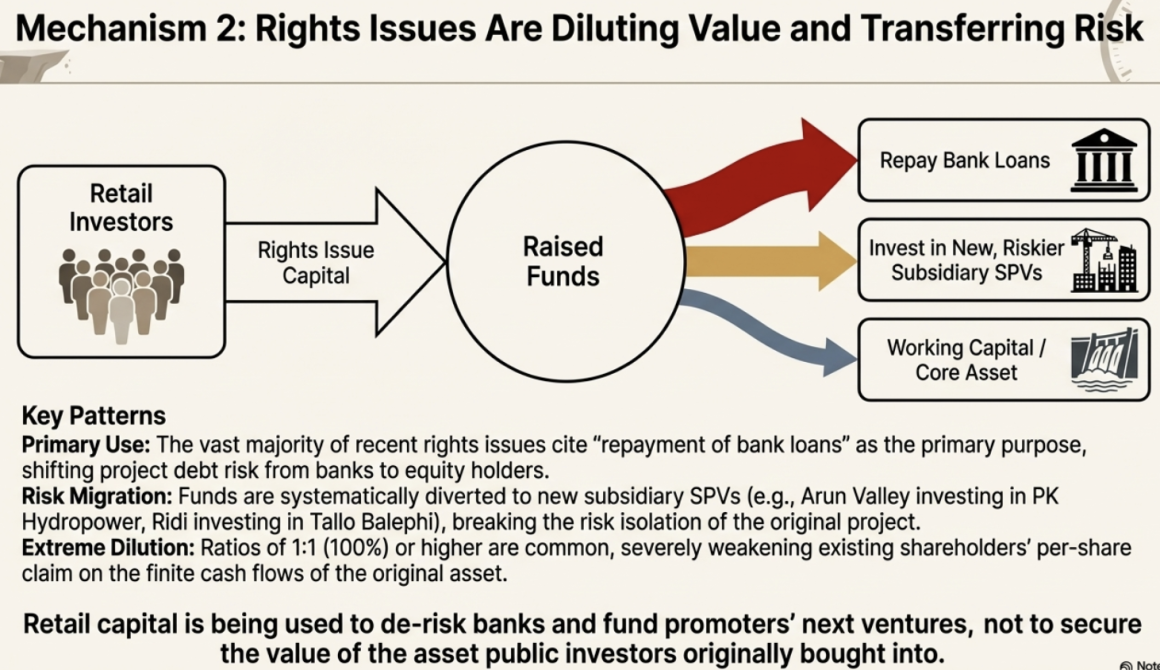
- Funds frequently redirected to new projects/subsidiaries.
- Majority used to repay bank debt → shifts risk to retail investors.
- Extreme dilution (>100%) weakens per-share claims.
4. Governance Risk & Promoter Exit
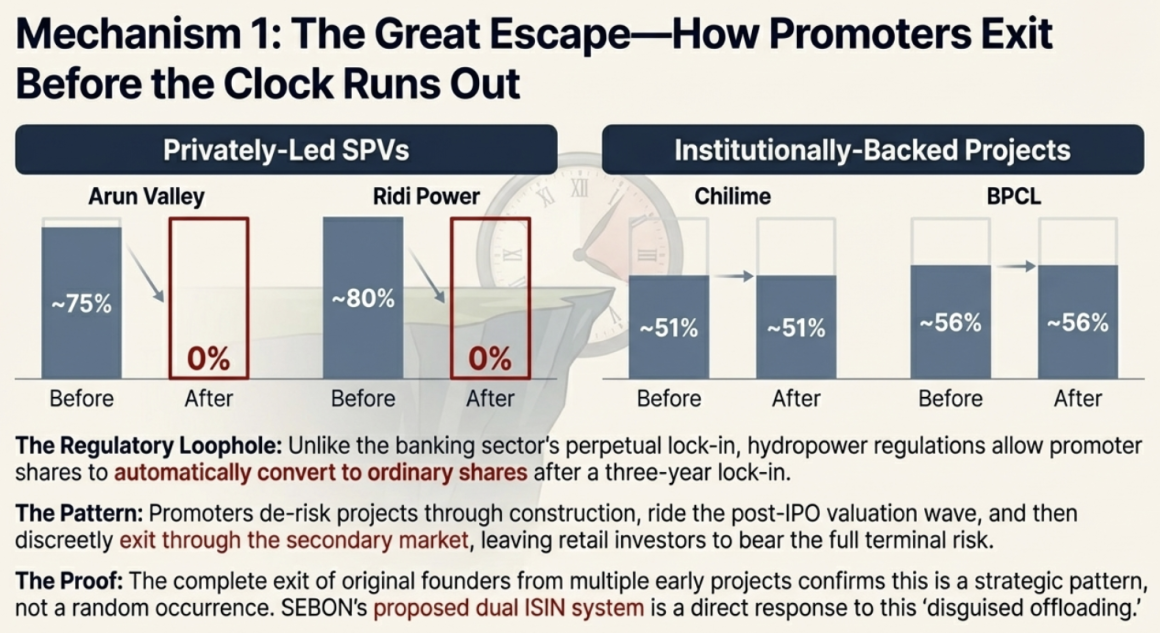
Based on the analysis of Nepal’s oldest listed hydropower companies, a clear pattern emerges: there is a significant and systematic drop in promoter shareholding for privately-led projects immediately following the expiration of the mandatory three-year lock-in period. This trend substantiates the hypothesis of early insider exits.
The data from key case studies reveals a stark divergence. Companies like Arun Valley Hydropower (AHPC) and Ridi Power (RIDI), which began with typical promoter holdings of 70-80%, now report 0% promoter holding, indicating a complete reclassification and exit of the original founders. Conversely, institutionally-backed projects show stability; Chilime Hydropower (CHCL), with the Nepal Electricity Authority as its anchor promoter, has maintained a consistent 51% holding, while Butwal Power (BPCL) retains a 56.27% stake under its strategic private promoter, Shangri-La Energy. This contrast highlights that the drop is not universal but is prevalent in privately-developed Special Purpose Vehicles (SPVs).
The significant drop in promoter shareholding is directly facilitated by a critical regulatory disparity unlike in the banking sector. In Nepal, the Bank and Financial Institution Act (BAFIA) typically mandates that bank promoters maintain a minimum shareholding (often 51%) indefinitely to ensure long-term commitment and financial system stability. Conversely, the hydropower sector operates under securities regulations that allow for an automatic conversion of promoter shares into ordinary shares immediately after the three-year lock-in period expires. This loophole means that once converted, the shares of the original founders become indistinguishable from those of the public on the trading floor, enabling discreet liquidation at market peaks without the transparency of a formal reclassification process. This mechanism, observed in the complete exit of promoters from companies like Arun Valley (0% holding) and Ridi Power (0% holding), confirms a strategic pattern of early departure. It allows promoters to capitalize on secondary market valuations and recycle capital into new ventures, leaving retail investors holding assets whose original creators have exited.
The recent push by SEBON for dual ISINs (International Securities Identification Numbers)—a system that would assign unique codes to separate promoter shares from public shares, thereby preventing them from being traded invisibly after the lock-in period—is a direct regulatory response designed to close this loophole and end the practice of “disguised offloading” that has characterized the hydropower sector.
Observations from Older Hydro Companies:
- Privately-led SPVs (Arun Valley, Ridi Power) show 0% promoter holding post-lock-in.
- Institutionally-backed projects (Chilime, BPCL) retain 51–56% stakes.
- Regulatory loophole allows promoter shares to automatically convert post-lock-in → early exits without disclosure.
- SEBON’s dual ISIN initiative seeks to prevent disguised offloading.
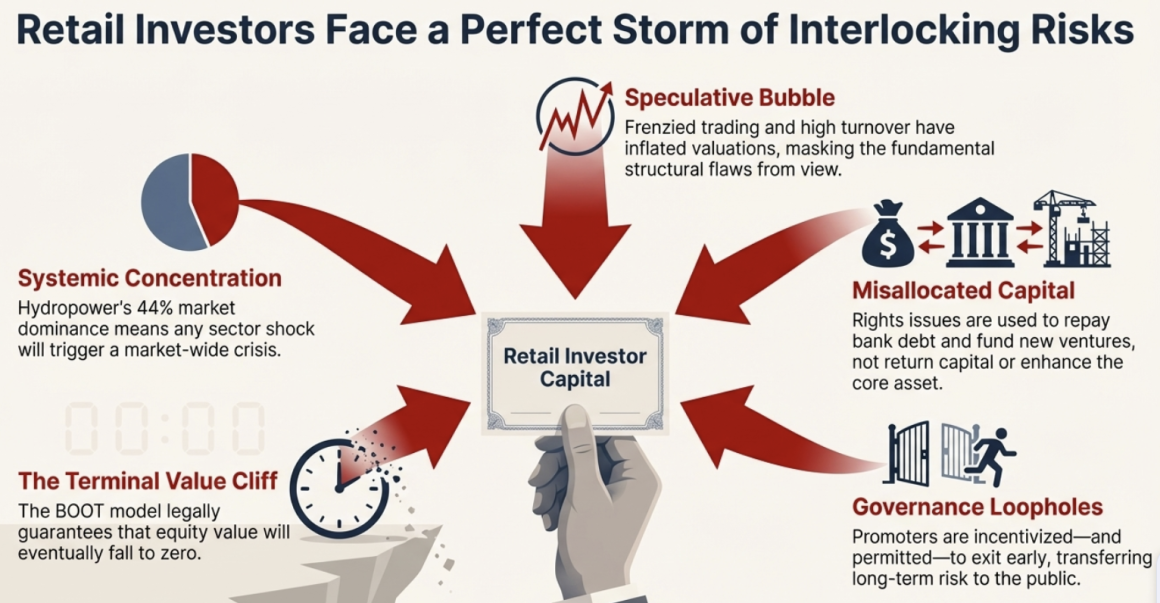
Therefore retail investors are exposed to a perfect storm:
Systemic Concentration: Hydropower now dominates nearly half of NEPSE, magnifying any sector shock.
Terminal Risk Cliff: Many projects will revert to the state under BOOT, rendering future equity essentially worthless.
Misallocated Capital: Rights issues largely recycle money to pay banks or fund new high-risk projects, rather than securing original asset value.
Governance Loopholes: Promoters can exit early, leaving retail holders to bear the terminal value and dilution risk.
Speculative Trading: Surging turnover and high valuations create a bubble that disguises the real risks.
Retail investors have collectively placed over Rs. 705 billion in a sector with finite asset life, rising leverage, and systemic structural risks – effectively setting the stage for a massive financial loss when BOOT expiries coincide with market corrections or rights issue failures.
Status of Listed Hydropower Companies and Mandatory Public Share Issuance
Nepalese hydropower companies, classified as “organized institutions” for securities law purposes, are subject to a legal and regulatory framework governing public share issuance and subsequent listing on NEPSE. These requirements are not merely procedural but are linked to statutory obligations designed to protect public investment, ensure capital mobilization, and promote local participation.
At the core, hydropower companies are compulsorily required to issue a portion of their shares to the public and list them, provided certain project milestones are met. This obligation arises from the intersection of the Securities Act, Securities Registration and Issuance Regulation, and specialized government programs, such as the People’s Hydropower Program (Janata ko Jalvidyut Karyakram).
1. Compulsory Public Share Issuance
1.1 Threshold-Based Requirement
Hydropower companies intending to raise capital via an Initial Public Offering (IPO) must adhere to Rule 9(1) of the Securities Registration and Issuance Regulation, 2073. This rule stipulates that 10% to 49% of the issued capital must be offered to the public unless otherwise specified by regulatory authorities like the Electricity Regulatory Commission.
- Purpose: Mobilize equity from a wider investor base while ensuring promoters retain controlling stakes (minimum 51%).
- Project Milestones: Only companies that have achieved at least 75% physical construction progress, secured financial closure, and have a valid Power Purchase Agreement (PPA) are eligible for registration and public issuance.
1.2 Local and Diaspora Participation
Hydropower projects must reserve a portion of equity for local residents and Nepalese working abroad:
|
Shareholder Category |
Mandatory Allocation |
Legal Source |
Notes |
|
Project-Affected Local Residents |
Up to 10% of issued capital |
Rule 9(4), Securities Regulation, 2073 |
Allocation based on Environmental Impact Assessment (EIA) classifications; unsold shares added to general public pool |
|
General Public |
Remaining portion up to statutory limit |
Securities Act, 2063 & Rule 9(1) |
Can include local and foreign-employed Nepalis |
|
Nepalese Abroad |
10% quota within general public offering |
Securities Regulation, 2073 |
Only valid labor permit holders |
This structure ensures that resource utilization benefits are shared broadly, while still allowing promoters and founder groups to maintain effective control.
1.3 Price Inflation and BOQ Adjustments
An important, and very important aspect of development of hydropower is the adjustment in project costing and BOQ (Bill of Quantities):
- Public issuance requires disclosure of project cost, construction schedule, and projected returns in the IPO prospectus.
- Developers unofficially defend that to ensure regulatory compliance and maintain investor confidence, they need to inflate BOQ and project costs, reflecting contingency, statutory approvals, and public offering expenses – as a need to meet the statutory obligations of public issuance and protect retail investors by aligning share pricing at par with the true cost of equity mobilization. Of course, this is a topic that warrants a separate research.
In short, price and cost adjustments are directly linked to the legal mandate of public issuance, a step intrinsic to hydropower company operations under current law.
2. Compulsory Public Listing
Once a hydropower company has issued shares to the public, it is mandated to list those shares on the stock exchange:
- Listing Requirement: Rule 3(1) of the Securities Listing and Trading Regulation, 2075 states that any organized institution issuing securities to the public must list those securities on NEPSE.
- Timeline: Rule 3(2) requires that a listing application be submitted within seven days of prospectus approval.
- Secondary Market Access: Section 43 of the Securities Act, 2063 obligates companies to facilitate market arrangements via a licensed stock exchange, ensuring liquidity for public investors.
Prerequisites for Listing:
- Minimum 75% construction completion.
- Full financial closure.
- Signed PPA with the energy offtaker.
- At least ten years of remaining license validity.
3. Lock-in Periods for Shares
Lock-in provisions are designed to stabilize ownership during early public stages and protect investors from premature promoter exits or speculative trading.
|
Shareholder Group |
Lock-in Duration |
Key Points |
|
General Promoters/Founders |
3 Years |
Applies to original and bonus/right shares; prevents early selling post-IPO |
|
Specialized Investment Funds (PE/VC) |
1 Year |
For registered funds, either domestic or government-approved foreign entities |
|
Project-Affected Local Residents |
3 Years |
Ensures locals retain investment for meaningful period; includes bonus/right shares |
|
Reserved Employees |
3 Years |
Shares issued to employees or as incentives are restricted |
|
Directors/Executives |
Tenure + 1 Year |
No buying/selling during tenure and for 1 year post-retirement; applies to immediate family members as well |
Special Notes:
- Shares under phased payments (“call for capital”) are only tradable after full subscription payment.
- Lock-in restrictions do not apply in the event of a shareholder’s death or the purposes of legal transfers.
- SEBON may grant exceptions for corporate necessity, e.g., intra-group transfers to maintain operations.
Hydropower companies in Nepal are legally bound to issue public shares and list them, with clear rules on local participation, diaspora quotas, and promoter retention. Meanwhile, lock-in periods act as a safeguard against premature promoter exits, speculative trading, and excessive short-term volatility. Collectively, these regulations aim to balance public investment protection with operational flexibility for project developers, creating a structured framework that governs both capital mobilization and market behavior.
Potential Solutions for Nepal’s Hydropower Terminal Value Crisis
Nepal’s hydropower’s problem: publicly listed BOOT SPVs are finite-life assets, but investors treat them as perpetual equities. The mismatch between instrument form (perpetual shares) and asset reality (fixed-term license with zero-compensation transfer) has created systemic risks, threatening retail investors and market stability. This chapter evaluates potential solutions across disclosure, capital structure, corporate governance, market structure, contractual arrangements, and capital market development.
|
Solution Category |
Specific Solution(s) |
Problem Addressed |
Mechanism / How It Works |
Effect / Outcome |
|
1. Disclosure-Based Reforms |
Mandatory BOOT Countdown & Reclassification |
Information asymmetry; perpetual-equity illusion |
Display license expiry in reports, prospectuses, and NEPSE; reclassify equity as finite-life infrastructure |
Forces rational pricing, destroys false perpetuity narrative |
|
2. Capital Structure Reforms |
Mandatory Capital Redemption Reserve / Sinking Fund; Instrument Conversion near License Maturity; Replace Equity Issuance with Redeemable/Fix-Yield Instruments |
Zero terminal value; late-stage investor risk; instrument mismatch |
Accumulate reserves for redemption; convert ordinary shares into preference/fixed-yield instruments near expiry; issue debt-like instruments instead of perpetual equity |
Ensures capital return, reduces late-stage risk, aligns investment instrument with finite asset life |
|
3. Corporate Governance Reforms |
Promoter Lock-in Redesign; Strict Ring-Fencing of Inter-SPV Investments |
Premature promoter exit; risk migration through cross-SPV investments |
Extend promoter holding periods toward license expiry; limit inter-SPV investments, require approvals and reporting |
Aligns promoter incentives, prevents cross-subsidization, maintains SPV risk isolation |
|
4. Market Structure Reforms |
Sectoral Consolidation Through Mergers; Conversion into Listed Holding Company Structures |
Single-asset SPV vulnerability; terminal value collapse |
Merge SPVs into diversified portfolio companies; shift SPV equity into holding companies with multiple subsidiaries |
Spreads license expiry risk, creates rolling-horizon infrastructure vehicles, preserves listed entity value beyond individual project expiry |
|
5. Contractual Solutions |
Post-BOOT Operator / Management Contracts; Optional Buyback / Redemption Windows |
Terminal value and liquidity risk |
Enable SPVs to continue as O&M service providers post-transfer; create structured buyback/redemption windows before expiry |
Maintains revenue and listed status post-transfer; provides orderly exit for late-stage investors |
|
6. Capital Market Development |
Project Bond Market Development; Preference Share / Participating Debenture Framework |
Asset-liability mismatch; finite-life financing gap |
Develop project-level or corporate-level bonds with maturity aligned to license; issue preference shares/debentures instead of perpetual equity |
Aligns financing with asset life, provides long-term, maturity-matched capital market instruments, deepens investor base |
Here is the detailed list of potential solutions:
|
Option |
What It Is |
What It Solves and How |
How It Could Be Implemented in Nepal |
Implementation Challenges |
|
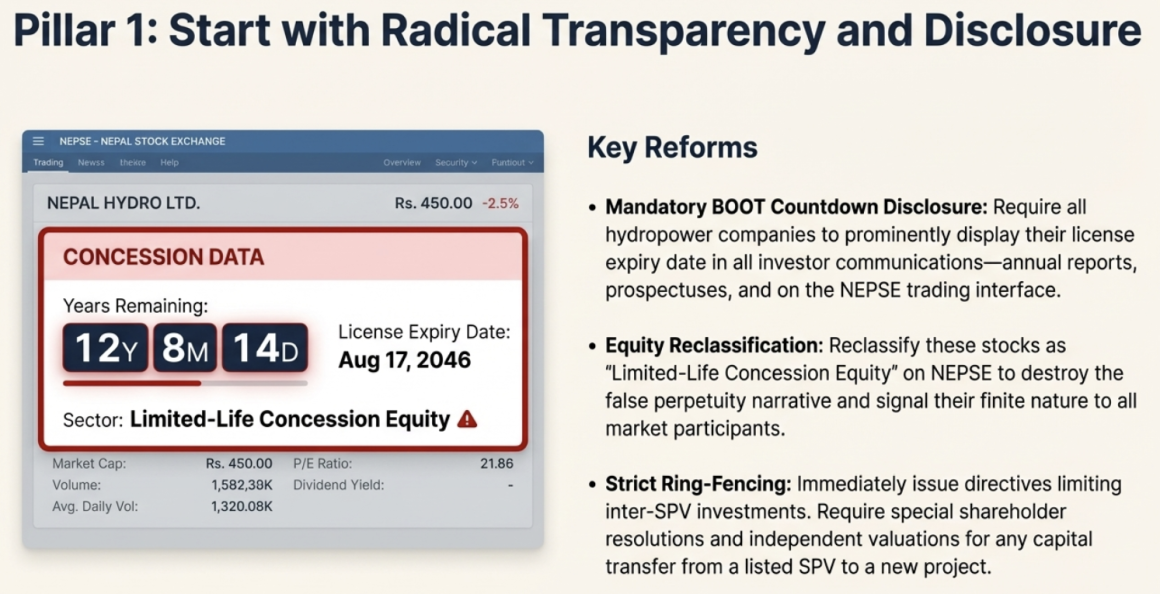
Mandatory BOOT Countdown (Doom Clock) Disclosure & Equity Reclassification |
A regulatory requirement that all listed hydropower companies prominently disclose their license expiry dates in all investor communications (annual reports, prospectuses, trading screens, promotional materials), accompanied by mandatory reclassification of such stocks as “Limited-Life Concession Equity” or “Finite-Life Infrastructure Equity” distinct from standard perpetual equities. This transforms informational disclosure into a structural market reclassification that forces rational pricing. |
This solution addresses the fundamental information asymmetry and perpetual-equity illusion that has allowed hydropower stocks to trade as if they possess infinite terminal value. By mandating a “BOOT Countdown Clock” in annual reports, IPO/FPO prospectuses, and NEPSE trading interfaces, the solution forces market participants to confront the legally predetermined zero-compensation transfer obligation embedded in every project’s lifecycle. The reclassification into a separate equity category destroys the false perpetuity narrative that has enabled speculative trading at prices disconnected from underlying asset economics. The solution is particularly effective because it operates through disclosure rather than prohibition, making it politically feasible while still achieving substantial market correction. Historical precedent from China’s toll road sector demonstrates that mandatory disclosure of finite concession terms, even without structural reform, has gradually shifted investor behavior and valuation methodologies. |
Implementation requires coordinated action by SEBON, NEPSE, and the Electricity Regulatory Commission. SEBON would need to issue a directive amending to include Schedule for Concession Disclosure Requirements, mandating specific disclosure formats, font sizes, and placement for license expiry information. NEPSE would need to modify its trading systems to display remaining license life as a data field alongside current price and volume, similar to how derivative contracts display expiry dates. The reclassification would require amendments to NEPSE Listing Rules to create a new sector or classification category, potentially “Limited-Life Infrastructure,” with distinct trading, margin, and investment guidelines for institutional investors. Implementation timeline could be rapid—90 to 120 days for regulatory amendments, with system modifications at NEPSE requiring an additional 60 to 90 days. The cost to companies is minimal (primarily disclosure formatting), making compliance burden low. |
The primary challenge is regulatory capture and political economy resistance. SEBON has historically been accommodating to hydropower promoters, and the securities industry benefits from high trading volumes in hydropower stocks regardless of fundamental value. There is genuine risk that the disclosure requirements, if implemented, would be weak—permitting small-font footnote disclosures rather than prominent dashboard-style presentations that actually influence investor behavior. A second challenge involves definitional complexity: determining the “true” license expiry date when many projects have received extensions, upgrades, or amendments. The Andhi Khola case (BPCL), which received a license extension following its 2072 upgrade from 5.1 MW to 9.4 MW, demonstrates that license life can be extended through capital investment, creating uncertainty about expiry dates that sophisticated parties can exploit. Finally, disclosure alone does not solve the terminal value problem—it merely reveals it—meaning retail investors may still purchase shares at inflated prices while fully aware of the expiry risk, preferring speculation to alternative investments in a market with limited options. |
|
Mandatory Capital Redemption Reserve / Sinking Fund |
A regulatory requirement that listed BOOT SPVs retain a specified portion (typically 15% to 25%) of annual Net Distributable Cash Flow into a restricted Capital Redemption Reserve or Sinking Fund, which can only be used to repurchase or redeem public shares at par value (NPR 100) upon license expiry. This transforms perpetual equity into a de facto amortizing instrument by legally obligating companies to accumulate capital for shareholder return. |
This solution directly addresses the guaranteed zero terminal value problem by creating a statutory mechanism for capital return. Under current law, shareholders face certain total loss at license expiry with no redemption pathway. The mandatory sinking fund requirement forces companies to systematically repay public capital during the operational phase, ensuring that the par value of shares is returned before the asset transfers to the state. The mechanism is economically equivalent to amortization—each year of operation sees a portion of share value “extinguished” through reserve accumulation rather than through share buybacks at market prices. The solution is particularly powerful because it targets the specific timing mismatch: retail investors provide permanent capital for finite assets, and the sinking fund corrects this by ensuring permanent capital is not required. International precedent from project finance structures in the UK and Australia demonstrates that mandatory reserve requirements for infrastructure with state reversion prevent the “zombie equity” scenario where shares become worthless shells after asset transfer. |
Implementation requires SEBON to promulgate the Hydropower Capital Redemption Regulations establishing mandatory reserve percentages, calculation methodologies, and restricted use provisions. The regulations should specify: (a) minimum annual contribution based on calculation methodology considering the remaining license life to ensure full accumulation by expiry; (b) prohibition on using reserve funds for inter-SPV investments, dividends, or debt substitution; (c) trustee oversight through an independent financial institution; and (d) clear waterfall for distribution at license expiry. The implementation should be phased: Phase 1 (immediate) requires new issuers to establish reserves from first year of commercial operation; Phase 2 (within 2 years) requires existing listed companies to begin accumulation, with catch-up provisions for late-stage projects. Nepal Rastra Bank would need to issue guidelines for trustee banks on reserve account management and reporting. The total cost to the sector is substantial but manageable: approximately NPR 10 to 15 billion annually across 91 listed companies, funded through modest dividend reduction rather than operational impact. |
The most significant challenge involves cash flow adequacy for late-stage projects. Companies with fewer than 10 years remaining on licenses cannot accumulate sufficient reserves to return full par value even at 100% cash flow retention. For hydros nearing expiry the accumulation requirement would be a substantial portion of the paid-up capital per year, which may exceed free cash flow after debt service and royalties. A second challenge involves promoter resistance and political economy dynamics. Promoters currently benefit from the zero-compensation transfer—they invest construction capital, extract dividends during operation, and exit before expiry with no obligation to return public capital. The mandatory sinking fund fundamentally alters this calculus, reducing promoter net present value and likely triggering industry opposition. |
|
Sectoral Consolidation Through Mandatory or Incentivized Mergers |
A regulatory-driven consolidation of the listed hydropower SPVs into approximately 15 to 20 portfolio companies through mandatory mergers for closely-related projects (common river basins, geographic proximity) and incentivized mergers for unrelated companies through tax benefits, expedited approvals, and simplified regulatory processes. The resulting entities would hold diversified portfolios of projects with staggered license lives, enabling portfolio NAV logic rather than single-asset terminal value collapse. |
This solution addresses the structural vulnerability of single-asset SPVs by creating diversified entities where license expiry risk is spread across multiple projects with different handover dates. Under current structure, each listed company faces a binary outcome: either the license is extended (value preserved) or it expires (value destroyed). A diversified portfolio company with 10 projects, each expiring in different decades, provides continuous revenue generation as older projects transfer while newer projects remain operational. The solution transforms the market from 100+ “cliff edge” listed investments into a smaller number of “rolling horizon” infrastructure vehicles. International precedent from Australia’s Spark Infrastructure and even Nepal’s Chilime Holding Company model demonstrates that diversified holding structures successfully maintain listed entity viability beyond individual project lifecycles. The consolidation approach is particularly effective for Nepal because it leverages existing market structures—listed entities remain listed, regulatory relationships continue, and investor portfolios merely rebalance—while fundamentally addressing the finite asset problem through portfolio construction. |
Implementation requires SEBON to promulgate the Hydropower Capital Redemption Regulations establishing mandatory reserve percentages, calculation methodologies, and restricted use provisions. The regulations should specify: (a) minimum annual contribution based on calculation methodology considering the remaining license life to ensure full accumulation by expiry; (b) prohibition on using reserve funds for inter-SPV investments, dividends, or debt substitution; (c) trustee oversight through an independent financial institution; and (d) clear waterfall for distribution at license expiry. The implementation should be phased: Phase 1 (immediate) requires new issuers to establish reserves from first year of commercial operation; Phase 2 (within 2 years) requires existing listed companies to begin accumulation, with catch-up provisions for late-stage projects. Nepal Rastra Bank would need to issue guidelines for trustee banks on reserve account management and reporting. The total cost to the sector is substantial but manageable: approximately NPR 10 to 15 billion annually across 91 listed companies, funded through modest dividend reduction rather than operational impact. |
The most significant challenge involves cash flow adequacy for late-stage projects. Companies with fewer than 10 years remaining on licenses cannot accumulate sufficient reserves to return full par value even at 100% cash flow retention. For hydros nearing expiry the accumulation requirement would be a substantial portion of the paid-up capital per year, which may exceed free cash flow after debt service and royalties. A second challenge involves promoter resistance and political economy dynamics. Promoters currently benefit from the zero-compensation transfer—they invest construction capital, extract dividends during operation, and exit before expiry with no obligation to return public capital. The mandatory sinking fund fundamentally alters this calculus, reducing promoter net present value and likely triggering industry opposition. |
|
Sectoral Consolidation Through Mandatory or Incentivized Mergers |
A regulatory-driven consolidation of the listed hydropower SPVs into approximately 15 to 20 portfolio companies through mandatory mergers for closely-related projects (common river basins, geographic proximity) and incentivized mergers for unrelated companies through tax benefits, expedited approvals, and simplified regulatory processes. The resulting entities would hold diversified portfolios of projects with staggered license lives, enabling portfolio NAV logic rather than single-asset terminal value collapse. |
This solution addresses the structural vulnerability of single-asset SPVs by creating diversified entities where license expiry risk is spread across multiple projects with different handover dates. Under current structure, each listed company faces a binary outcome: either the license is extended (value preserved) or it expires (value destroyed). A diversified portfolio company with 10 projects, each expiring in different decades, provides continuous revenue generation as older projects transfer while newer projects remain operational. The solution transforms the market from 100+ “cliff edge” listed investments into a smaller number of “rolling horizon” infrastructure vehicles. International precedent from Australia’s Spark Infrastructure and even Nepal’s Chilime Holding Company model demonstrates that diversified holding structures successfully maintain listed entity viability beyond individual project lifecycles. The consolidation approach is particularly effective for Nepal because it leverages existing market structures—listed entities remain listed, regulatory relationships continue, and investor portfolios merely rebalance—while fundamentally addressing the finite asset problem through portfolio construction. |
Implementation requires a two-track approach: mandatory consolidation for projects with obvious synergies (same river system, shared transmission infrastructure, geographic proximity) and incentivized voluntary consolidation for unrelated projects. For mandatory consolidation, SEBON and the MoWERI, ERC should jointly issue the Hydropower Consolidation Directive, identifying clusters of projects suitable for merger based on: (a) common river basin or hydrological system; (b) shared transmission infrastructure; (c) geographic proximity enabling operational synergies; and (d) promoter commonality. The directive would establish timeline for merger completion (24 months), governance framework for merged entities, and dispute resolution mechanisms for minority shareholders. For incentivized consolidation, the Ministry of Finance could offer: (a) corporate tax reduction for merged entities meeting diversification thresholds; (b) expedited approval for right share issuances and inter-SPV investments; (c) exemption from recharacterization taxes such as deemed disposals under Income Tax Act, 2058 – like those offered to the BFI sector, (d) NEPSE fee waivers for merger-related transactions. The merger implementation should be supervised by ERC with authority to appoint provisional management and resolve disputes. Implementation timeline is 36 to 48 months for full sector consolidation, with initial mandatory clusters completed within 24 months. |
The primary challenge involves valuation disputes and minority shareholder protection. When two listed companies merge, minority shareholders of both entities must receive equivalent value, but project-level valuations for finite-license assets are inherently contentious. The party receiving lower valuation will claim expropriation, potentially triggering litigation that delays consolidation. A second challenge involves promoter incentives—many current promoters built their reputations and extracted fees through single-project structures. Consolidated entities reduce individual promoter influence and may trigger resistance from established figures in the sector. Third, Nepal’s legal framework for mandatory mergers is underdeveloped. Drafting enabling regulation would require time and political consensus that may be time taking. Fourth, scale economies from consolidation must be genuine—merged entities must achieve cost savings through shared overhead, coordinated maintenance, and optimized dispatch. If merged companies merely replicate existing structures with added management layers, consolidation creates cost rather than value. Finally, the concentrated ownership resulting from mergers reduces market liquidity and may create “too-big-to-fail” dynamics that increase systemic risk rather than reducing it. |
|
Conversion into Listed Holding Company Structures |
A structural transformation where existing single-asset SPVs become subsidiaries of newly-formed or existing holding companies, with public equity shifted from project-level to corporate-level trading. The listed holding company holds stakes in multiple unlisted operating subsidiaries, each with its own BOOT license, and the consolidated entity survives beyond any single project’s license expiry through dividend income from remaining subsidiaries. |
This solution addresses the finite asset problem by aligning listed entity structure with the underlying asset reality. Under current structure, a listed company IS a project—license expiry equals entity death. Under the holding company model, the listed entity is a corporate shell that owns project stakes; when one project transfers, the entity continues because it owns other projects. The solution is structurally identical to sectoral consolidation but operates through market transactions (share swaps, asset sales) rather than regulatory mandates. The Chilime Hydropower (CHCL) model—where the 22.1 MW Chilime plant is one asset among a portfolio including Rasuwagadhi (111 MW), Sanjen (14.8 MW), and Madhya Bhotekoshi (102 MW)—provides proof of concept in Nepal’s market. Chilime’s equity value survives its own license expiry because dividends flow from subsidiary stakes. The holding company structure is internationally validated: Australian infrastructure trusts, European utilities, and Indian InvITs all operate on this principle. For Nepal, the solution offers the additional benefit of preserving the “perpetual entity” assumption embedded in securities law while making that assumption accurate through portfolio construction. |
Implementation operates through two pathways: organic conversion and acquisition-based conversion. For organic conversion, existing listed companies with sufficient capital and project pipelines would establish wholly-owned subsidiaries for new projects, gradually shifting their asset base from single-project to multi-project. SEBON would need to amend listing rules to permit (and eventually require) holding company classification for entities meeting portfolio thresholds. For acquisition-based conversion, smaller SPVs would be acquired by larger holding companies through share-for-share exchanges, with the acquired entity becoming a subsidiary. The Securities Registration and Issuance Regulation would need amendments to create streamlined approval processes for holding company formations and acquisitions. Implementation timeline is 24 to 36 months for regulatory framework development, with market-driven conversion proceeding over 5 to 10 years as companies pursue commercial advantages of holding company status. |
The fundamental challenge involves the zero-sum nature of holding company creation. When Company A acquires Company B, Company B shareholders become Company A shareholders. No new value is created—only transferred. Promoters of target companies may resist acquisition if they believe their stakes are undervalued, or may demand premium prices that reduce acquisition benefits. A second challenge involves corporate governance complexities. Holding company structures create agency problems between parent management and subsidiary minority shareholders, potential for related-party transactions that disadvantage subsidiaries, and opacity in consolidated financial statements. Nepal’s track record on related-party transaction oversight is poor, and extending this to holding company structures risks amplifying existing governance failures. Third, the solution requires sophisticated financial management capabilities that many current hydropower promoters lack. Managing a portfolio of projects with different hydrological profiles, license expiries, and capital requirements demands financial expertise beyond single-project development. Fourth, the regulatory framework for listed holding companies must address consolidated leverage limits, cross-guarantee prohibitions, and inter-company financial support rules. Finally, there is timing risk: if consolidation occurs slowly and the first BOOT transfers occur before the market has diversified sufficiently, the crisis may unfold before the solution takes effect. |
|
Post-BOOT Continuity Through Operator / Management Contracts |
A regulatory framework and contractual mechanism that enables listed SPVs to transition from asset ownership to asset operation upon license expiry, continuing as listed entities through O&M contracts with the government (or its designated entity) rather than through asset ownership. The listed company becomes an O&M service provider earning management fees, preserving a revenue stream and listed status after asset transfer. |
This solution addresses the terminal value problem by creating an alternative business model for post-transfer periods. Current law (Clause 6.5.1 of Hydropower Development Policy, 2001) grants the previous operator priority for continuing operations after transfer, but this provision has no regulatory framework or listed company adaptation. The operator contract solution explicitly structures this priority right into a continuing listed entity: when the asset transfers, the entity continues as an O&M contractor earning fees based on capacity, energy generation, or availability. The solution is elegant because it leverages existing legal provisions rather than requiring new legislation, transforms a forced transfer into a negotiated continuation, and preserves both investor capital and listed entity status. International precedent from airport and toll road concessions demonstrates that operator models successfully maintain private sector participation after public reversion. The solution is particularly appropriate for Nepal’s context because the private sector has developed operational expertise over 30+ years of BOOT projects—the same entities that built the assets are best positioned to operate them efficiently. |
Implementation requires coordinated regulatory action across multiple ministries and agencies. The Ministry of Energy should issue the BOOT Transition Framework Regulations, establishing: (a) standard O&M contract terms for post-transfer operations; (b) fee calculation methodology (capacity-based, energy-based, or availability-based); (c) contract duration (typically 10 to 15 years with renewal options); (d) performance standards and penalty provisions; and (e) dispute resolution mechanisms. SEBON should issue listing rule amendments permitting listed entities to continue trading after asset transfer if O&M contracts are in place, with appropriate disclosure requirements for contract terms and fee projections. The Nepal Electricity Authority should develop standardized O&M procurement processes for transferred assets, with priority to previous operators who built operational familiarity. Implementation should begin with pilot projects: companies with licenses expiring in the next 10 to 15 years should begin government negotiations now, establishing template contracts that other projects can follow. The Hydropower Association should develop industry-standard O&M contract templates to reduce negotiation costs and establish market norms. Implementation timeline is 12 to 18 months for regulatory framework, with company-specific negotiations proceeding over the remaining license life. |
The primary challenge involves government capacity and willingness to negotiate. The MoEWRI, NEA and ERC have limited experience with O&M contracting, and government bureaucracy may resist taking on procurement responsibilities that were previously unnecessary (assets transferred automatically). Political risk is significant: successive governments may refuse to honor predecessor commitments, particularly if O&M fees appear excessive in retrospect. A second challenge involves fee adequacy. O&M contracts generate substantially lower margins than asset ownership—the return on equity for a pure O&M business is typically lower than 8% compared to 15% to 20% for ownership operations (along with equity upside). This margin compression reduces shareholder returns and may not preserve par value. Third, the solution creates dependency on government procurement decisions. If the government chooses to operate transferred assets directly rather than contracting the previous operator, the continuity mechanism fails. Fourth, the priority right in Clause 6.5.1 is not exclusive—the government can choose any operator, not necessarily the previous one. Securing actual contracts requires competitive positioning and relationship management, not merely relying on legal priority. Finally, listed entity viability after transfer depends on O&M fee volume. Small projects may not generate sufficient fees to justify listed entity maintenance, leading to delisting and forced shareholder liquidation even with O&M contracts in place. |
|
Strict Ring-Fencing of Inter-SPV Investments |
A regulatory framework limiting the amount and conditions under which listed hydropower SPVs can invest retained earnings or raised capital into new subsidiary SPVs, affiliated projects, or related-party ventures. Limits would be expressed as percentages of free cash flow rather than equity, require shareholder approval for investments above thresholds, mandate separate financial reporting for invested entities, and establish clear ring-fencing to prevent cross-subsidization and risk contamination. |
This solution addresses the systematic risk migration from inter-SPV capital flows that currently transforms mature, low-risk operating assets into construction-risk funding sources. Under current practice, companies like Arun Valley (AHPC), Ridi Power (RIDI), and Api Power (API) have redirected substantial capital from operational projects into new construction through rights issuances and retained earnings. This practice breaks project-level risk isolation, misleads investors who purchase shares expecting stable dividend yields, and creates opacity that prevents accurate valuation. The strict ring-fencing solution restores the intended function of SPV structures: each listed company should stand on its own project economics, with diversification achieved through holding company structures (requiring investor consent) rather than through cross-investment (which often occurs without full disclosure). International precedent from infrastructure finance demonstrates that strict ring-fencing is essential for project finance viability—cross-subsidization between projects violates the risk allocation principles on which lender pricing depends. The solution is particularly urgent in Nepal because inter-SPV investment has become the dominant capital strategy, with over 70% of recent rights issuances indicating “new project investment” as a primary use of funds. |
Implementation requires SEBON and NRB joint action: SEBON and ERC through amendments in its regulations establishing inter-SPV investment limits, and NRB through Unified Directive amendments establishing banking limits on cross-SPV exposure. The regulatory framework could specify provisions along the line of: (a) maximum inter-SPV investment of 30% of free cash flow (not paid-up capital) per fiscal year; (b) mandatory special resolution approval for investments exceeding 10% of free cash flow; (c) requirement for independent valuation opinion for invested SPVs; (d) prohibition on guaranteeing subsidiary debt using parent assets; and (e) public disclosure of investment rationale, projected returns, and risk factors. |
The most significant challenge involves definitional complexity: distinguishing “inter-SPV investment” from legitimate business development activities. Companies legitimately expand into new projects, and distinguishing growth-oriented investment from risk-diversion requires careful regulatory design. Overly restrictive rules may prevent efficient capital allocation; under-restrictive rules fail to address the core problem. Secondly, the solution conflicts with the holding company development pathway that many companies are pursuing. If Chilime (CHCL) is the successful model, preventing other companies from following similar paths may limit future market development. Thirdly, companies may structure around limits through off-balance-sheet arrangements, related-party loans that technically fall outside “investment” definitions, or corporate restructurings that create affiliated entities outside regulatory scope. Finally, the aggressive rights issuance pattern suggests companies face genuine capital requirements—debt repayment, working capital, construction financing—that may not be satisfiable without inter-SPV fund flows. Simply prohibiting the behavior without addressing underlying capital needs may trigger liquidity crises. |
|
Instrument Conversion Near License Maturity |
A regulatory mechanism mandating automatic conversion of public ordinary shares into redeemable preference shares or fixed-yield instruments once remaining license life falls below a specified threshold (typically 10 to 15 years). The converted instruments would carry guaranteed dividends, priority in liquidation, and defined redemption values, gradually removing equity-like risk as terminal risk increases. |
This solution addresses the late-stage exposure problem by structurally transforming the investment instrument as license expiry approaches. Under current structure, retail investors hold perpetual ordinary shares regardless of remaining project life—someone purchasing shares in a project with 5 years remaining faces identical instrument risk as someone purchasing shares in a project with 25 years remaining. The equity conversion solution creates a graduated risk reduction: early-stage investors enjoy equity upside and dividend growth; late-stage investors receive preference shares with guaranteed yields and defined redemption values. The mechanism is conceptually similar to amortizing bonds, where principal is systematically returned over the instrument’s life rather than all at maturity. International precedent from infrastructure finance in developing markets demonstrates that maturity-contingent instrument structures successfully manage terminal risk—Mexico’s renewable energy certificates and Chile’s mining royalties both incorporate maturity-based transformations. The solution is particularly effective because it operates at the instrument level rather than requiring fundamental restructuring of project economics or corporate governance. |
Implementation requires SEBON to issue the Concession Equity Conversion Regulations, establishing: (a) trigger threshold (10 years remaining license life); (b) conversion ratio (par value preservation or slight premium); (c) preference share terms (dividend rate, cumulative vs. non-cumulative, redemption schedule); (d) conversion mechanics (automatic upon regulatory certification of license status); and (e) trading restrictions post-conversion (preference shares may trade on separate market or with price bands). The regulations should specify transition provisions: for existing listed companies, conversion would occur on the later of regulatory effective date or the 10-year threshold date. For new listings, conversion would occur automatically at the threshold date regardless of subsequent market conditions. ERC should issue guidelines for institutional investor treatment of converted preference shares, including capital adequacy and concentration limits. The conversion mechanism should be tested through pilot implementation with companies having licenses expiring in 2035 to 2038. |
The primary challenge involves market acceptance. Preference shares with guaranteed yields and defined redemption values are a fundamentally different investment proposition than ordinary equity. Retail investors accustomed to dividend growth and mainly capital appreciation may resist conversion, particularly if preference share pricing implies significant value reduction. A second challenge involves conversion pricing and valuation disputes. Determining fair conversion ratio requires projecting remaining cash flows, discounting at appropriate rates, and allocating value between ordinary and preference shareholders. Sophisticated parties will dispute these calculations, potentially triggering litigation that delays implementation. Third, the solution may create perverse incentives. If companies know conversion is mandatory at 10 years, they may accelerate value extraction in years 11 through 20, reducing long-term project maintenance or deferring necessary capital expenditure to maximize short-term dividends. The conversion trigger creates a “use it or lose it” dynamic that may harm long-term asset quality. Fourth, the preference share market in Nepal is underdeveloped. Creating a viable secondary market for converted instruments requires similar market makers, and sufficient trading velocity all of which are currently absent. Finally, regulatory complexity is substantial: the conversion mechanism must address multiple edge cases including license extensions, partial transfers, and corporate restructuring during the conversion window. |
|
Replace Equity Issuance by Redeemable Preference Shares or Fixed-Yield Instruments |
A structural shift from ordinary equity IPOs and rights issuances toward preference shares, participating debentures, or other fixed-yield instruments for retail investor capital raising. These instruments would carry defined maturity dates (aligned with license life), guaranteed or participating dividends, priority in liquidation, and mandatory redemption at par or premium upon license expiry. The solution transforms the fundamental instrument structure from “perpetual ownership” to “maturity-matched debt-like investment.” |
This solution addresses the core instrument mismatch by replacing the inappropriate equity form with a more suitable instrument. Perpetual ordinary shares are appropriate for businesses with indefinite life; finite-concession hydropower assets require instruments with defined maturities and redemption mechanisms. Preference shares and participating debentures provide guaranteed returns, priority liquidation treatment, and maturity features that align investment economics with asset reality. The solution is conceptually simple but structurally transformative: rather than fixing the equity instrument through disclosure or conversion, it replaces equity with more appropriate instruments. International precedent from project finance globally demonstrates that debt instruments (bonds, debentures, project finance loans) are the appropriate form for finite-life infrastructure—equity is used only when residual value exists after debt repayment. Nepal’s Hydropower Development Policy, 2001 explicitly mentions mobilization of capital markets through “bonds as well as other financial instruments,” providing policy foundation for the solution. The UK PFI model and Luxembourg infrastructure bonds both demonstrate successful debt issuance for finite-concession assets. |
Implementation requires coordinated regulatory action: SEBON must develop preference share and participating debenture frameworks for hydropower issuers; Ministry of Finance should provide tax treatment clarity and waivers (e.g. preference dividends are not tax-deductible, affecting cost of capital); and NEPSE and SEBON must strengthen market for trading fixed-yield instruments. The implementation pathway should be: Phase 1 (immediate): Allow preference shares as alternative to ordinary equity for new issuers, with enhanced disclosure requirements and regulatory approval. Phase 2 (within 18 months): Require preference shares for projects with less than 20 years remaining license life. Phase 3 (within 36 months): Permit ordinary equity only for holding companies meeting diversification thresholds; single-asset SPVs must use preference shares or debt instruments. |
The most significant challenge involves investor expectations and market culture. Nepal’s retail investor base has been conditioned to expect ordinary equity with dividend growth potential. Preference shares with fixed yields represent a fundamentally different value proposition that may not appeal to the same investor base. If retail investors reject preference shares, companies may face capital-raising difficulties that slow hydropower development. A second challenge involves cost of capital. Preference dividends are not tax-deductible (unlike interest payments), making preference shares more expensive than debt. For projects already facing cost challenges, this increased financing cost may affect viability. Third, the solution may reduce promoter control. Preference shareholders arranged to receive governance rights including board representation and veto powers over certain transactions reduces the promoter control. Promoters accustomed to unfettered control may resist instruments that constrain their autonomy. Fourth, secondary market development currently designed for equity trading requires exchange modifications, market maker networks, and price discovery mechanisms. Fifth, the solution applies only to new issuances—existing ordinary shares remain outstanding, creating parallel markets and potential regulatory complexity. |
|
Promoter Lock-in Redesign |
An extension and restructuring of the existing three-year promoter lock-in period to create graduated lock-in that increases as projects approach license expiry. Early-stage promoters (construction phase) would face shorter lock-ins to facilitate capital recycling; late-stage promoters (operational phase) would face extended lock-ins or prohibited exits to prevent strategic abandonment of aging assets. The redesign aligns promoter incentives with long-term project stewardship rather than early exit. |
This solution addresses the promoter exit problem that systematically transfers terminal risk from insiders to retail investors. Under current regulations, promoters hold shares for three years from IPO, then can freely sell regardless of remaining project life. This creates perverse incentives: promoters invest construction capital, de-risk the project, extract maximum value through share sales at market peaks, and exit before the BOOT transfer date leaves retail investors holding doomed equity. The redesigned lock-in creates alignment: promoters who benefit from the project’s operational cash flows must remain invested through those flows, rather than monetizing future cash flows through secondary market sales. International precedent from infrastructure finance demonstrates that sponsor retention requirements—extended hold periods, clawback provisions, and minimum ownership thresholds—are essential for preventing adverse selection. The solution is particularly relevant for Nepal because the three-year lock-in has been systematically ganged: promoters time their exits precisely when construction de-risking aligns with market enthusiasm, leaving retail investors as “greater fools” who purchase at peak valuations. |
Implementation requires SEBON to amend Rule 38 of the Securities Registration and Issuance Regulation, 2073 to establish graduated lock-in provisions. The framework should specify: (a) minimum promoter holding requirement; (b) prohibition on promoter share sales in final 10 years of license life; (c) graduated lock-in for new issuers based on license maturity at listing; (d) clawback provisions for promoter shares sold at prices exceeding fair value (as determined by independent valuation); and (e) exception for transfers to affiliated entities meeting the same holding thresholds. The dual ISN system currently being developed by SEBON would support implementation by tracking promoter share locations separately from public float even when trading under the same parameters. |
The primary challenge involves definition and enforcement of “promoter” status. Complex corporate structures with multiple layers of holding companies, investment vehicles, and individual shareholders make it difficult to identify ultimate beneficial owners and enforce holding requirements. Sophisticated promoters may structure around limits through exempt entities, related-party transactions, indirect transfers, PE/VC route (which generally have relaxed provision relating to lock-ins), or offshore holdings. A second challenge involves constitutional and property rights concerns. Forced retention of shares beyond contractually agreed lock-in periods may face legal challenge on takings grounds, though securities regulation typically survives such challenges under police power rationales. Third, extended lock-in may reduce project bankability. If promoters cannot exit, they may be unwilling to invest, particularly in long-gestation infrastructure projects. The balance between promoter retention and capital attraction must be carefully calibrated. Fourth, the graduated lock-in creates edge cases and transition complexity. Companies with intermediate license remaining (10 to 20 years) face unclear treatment; companies with licenses extended after initial listing face retroactive application concerns. Finally, the solution does not address the underlying terminal value problem—promoters remain incentivized to maximize early value extraction even if they cannot sell shares, potentially through excessive dividends, related-party transactions, or underinvestment in maintenance. |
|
Optional Buyback / Redemption Windows Near BOOT Expiry |
A regulatory requirement that listed hydropower companies establish mandatory buyback or redemption windows in the final 5 to 10 years of license life, enabling shareholders to sell shares back to the company at prices determined through independent valuation, regulatory formula, or predetermined multiples. The solution creates an organized exit mechanism for late-stage investors rather than forcing them to trade in an illiquid market as expiry approaches. |
This solution addresses the terminal liquidity problem by creating structured exit opportunities before license expiry. Under current structure, shareholders have no mechanism to exit positions as license expiry approaches—market liquidity dries up as rational investors refuse to purchase shares with guaranteed zero terminal value, leaving late-stage investors unable to sell without accepting near-zero prices. The buyback window solution creates an alternative: shareholders can require the company to repurchase shares at fair value (determined through independent valuation) during defined windows. This transfers terminal risk from late-stage shareholders back to the company (and ultimately to promoters who control the company), creating incentives for earlier resolution of the expiry problem. International precedent from infrastructure finance demonstrates that exit mechanisms—put options, buyback provisions, and forced sale rights—are standard features of finite-life investments. The solution is particularly effective because it creates market discipline: companies anticipating buyback obligations will manage the expiry problem proactively to limit valuation exposure. |
Implementation requires SEBON to issue the Hydropower Buyback Regulations, establishing: (a) mandatory buyback windows opening 10 years before license expiry and closing 2 years before expiry; (b) valuation methodology (independent valuer appointment, regulatory formula, or discounted cash flow with specified parameters); (c) funding source requirements (sinking fund, reserve account, or external financing); (d) shareholder election procedures (opt-in for individual sale, opt-out for collective continuation); and (e) company obligations and timelines for share repurchase. The regulations should permit two structural approaches: company-funded buyback (where the SPV uses accumulated reserves or external financing to repurchase shares) and trust-funded buyback (where an independent trust manages buyback using accumulated funds). |
The primary challenge involves funding adequacy. Many projects will lack sufficient accumulated reserves to buy back all shares at fair value. If buyback obligations exceed available funds, companies may face liquidity crises or be forced into fire sales of assets at suboptimal prices. A second challenge involves valuation disputes. Determining “fair value” for shares in a company whose asset will transfer for zero compensation is inherently contentious. Shareholders will argue for valuations based on historical prices, dividend yields, or replacement cost; the company will argue for valuations based on remaining cash flows, adjusted for terminal transfer. Independent valuation provides legitimacy but does not eliminate dispute risk. Third, the solution may trigger anticipatory behavior: knowing buyback windows are mandatory, rational investors may refuse to purchase shares except at deep discounts, knowing they can exit at fair value later. This would reduce market liquidity and pricing far in advance of actual buyback windows. Fourth, promoter incentives are misaligned. Promoters who control companies will resist buyback obligations that return capital to shareholders rather than accumulating for their benefit. Enforcement requires regulatory capacity to compel compliance against well-resisted opposition. Fifth, the solution creates potential for selective buyback—companies may repurchase shares from friendly parties at favorable prices while treating hostile shareholders poorly. Anti-avoidance provisions are essential but difficult to draft comprehensively. |
|
Project Bond Market Development |
The development of a domestic project bond market where hydropower companies issue debt instruments with maturity dates aligned to license terms, replacing or supplementing equity financing. Bonds would be issued at the project level (single-asset financing) or corporate level (portfolio financing), with statutory protection for bondholders including security interests, covenants, and trustee oversight. The solution aligns capital structure with asset life—debt is repaid from project cash flows before transfer, eliminating equity terminal value risk. |
This solution addresses the fundamental asset-liability mismatch by replacing inappropriate perpetual equity with maturity-matched debt. The core problem is financing 30 to 35 year assets with infinite-life equity; the solution is financing finite assets with finite-maturity debt. Project bonds provide known repayment schedules, fixed or floating interest obligations, and secured claims on project cash flows. When the license expires, bondholders have been fully repaid and bear no residual loss. The solution is internationally validated: UK PFI projects, Luxembourg infrastructure bonds, and emerging market project finance all demonstrate successful debt issuance for finite-concession assets. The Hydropower Development Policy, 2001 already mentions mobilization of capital through “bonds as well as other financial instruments,” providing policy foundation. For Nepal, the solution offers additional benefits: domestic bond development deepens capital markets, provides institutional investors with appropriate-duration assets, and reduces dependence on bank financing that crowds out other borrowers. |
Implementation requires coordinated action across multiple regulatory domains. The MoF and SEBON should issue the Infrastructure Bond Guidelines, establishing: (a) eligibility criteria for hydropower project bonds; (b) approval process and regulatory oversight; (c) disclosure requirements for bond prospectuses; (d) trustee appointment and responsibilities; and (e) default and enforcement mechanisms. NRB should issue guidelines for bank investment in hydropower bonds, including capital adequacy treatment, concentration limits, and valuation methodologies. SEBON should clarify the boundary between securities regulation (for bonds offered to public) and debt financing (for privately placed instruments). The initial issuers should be larger, more established projects to establish market credibility. Tax incentives—exemption from capital gains tax for bondholders, deductibility of interest and issuance cost for —would accelerate market development. |
The most significant challenge involves market infrastructure. Nepal’s bond market is underdeveloped, with limited trading liquidity, few market makers, and no established yield curves for infrastructure credit. Investors accustomed to equity returns may find bond yields unattractive; issuers accustomed to equity dilution may find covenant requirements burdensome. Building market infrastructure requires coordinated effort over multiple years. A second challenge involves credit quality. Most hydropower projects carry BB-range credit ratings (CARE-NP / ICRA NP), indicating moderate default risk. Investors may demand yields that make bond financing more expensive than equity, reducing project viability. Third, the solution addresses only new financing—existing equity remains outstanding and unaddressed. Fourth, bond covenants may be incompatible with BOOT structures. If bonds require security interests in project assets, but those assets must transfer to the state at license expiry, the security value is inherently limited. Fifth, currency and interest rate risks create additional complexity. Nepal’s bond market operates in NPR with limited hedging instruments; projects with foreign currency debt (from development finance institutions) face additional complexity. Finally, the solution requires sophisticated investor education. Bond investing is fundamentally different from equity investing—investors must understand yield, duration, credit risk, and covenant protection rather than dividend growth and capital appreciation. Building investor sophistication requires time and sustained educational effort. |
Solution that is easiest to implement and one that solves the problem forever
1. Existing Listed SPVs
Easiest Route: Mandatory BOOT Countdown Disclosure with Equity Reclassification
The most pragmatic first step for addressing the 91 already-listed hydropower SPVs is implementing a mandatory BOOT Countdown Clock with corresponding equity reclassification. This solution requires only amendments to the Securities Registration and Issuance Regulation, 2073, can be enacted through existing SEBON institutional capacity, and demands minimal compliance burden from listed companies—primarily the addition of prominent disclosure in annual reports, prospectuses, and trading interfaces. By forcing the reclassification of hydropower stocks as “Limited-Life Concession Equity” rather than treating them as standard perpetual equities, this disclosure reform destroys the false perpetuity narrative that has enabled speculative trading at prices disconnected from underlying asset economics. The solution is politically feasible precisely because it operates through information rather than prohibition, making it acceptable to incumbent promoters while still achieving substantial market correction. While disclosure alone does not prevent loss, it fundamentally alters market behavior by ensuring retail investors purchase shares with full awareness of the terminal date, effectively shifting litigation and reputational risk to promoters who cannot claim ignorance of the expiry consequences. Implementation can proceed within 90 to 120 days for regulatory amendments, with NEPSE system modifications completed within an additional 60 to 90 days, making this the lowest-hanging fruit in the regulatory toolkit.
Route That Solves the Problem Forever: Mandatory Sinking Fund with Statutory Capital Redemption
The comprehensive, permanent solution for existing listed SPVs is the establishment of a mandatory Capital Redemption Reserve or Sinking Fund that legally obligates companies to accumulate sufficient capital to return public investment at par value before license expiry. This solution directly addresses the guaranteed zero terminal value problem by transforming perpetual equity into a de facto amortizing instrument—each year of operation sees a portion of share value “extinguished” through reserve accumulation rather than through market-priced buybacks that would devastate late-stage investors. The mechanism is conceptually simple but structurally transformative: by requiring retention of 20% of Net Distributable Cash Flow into restricted reserves, overseen by independent trustees and prohibited from use for dividends, inter-SPV investments, or debt substitution, the regulation ensures that the NPR 705 billion in retail investor exposure is systematically protected rather than systematically destroyed. International precedent from UK and Australian infrastructure finance demonstrates that mandatory reserve requirements prevent the “zombie equity” scenario where shares become worthless shells after asset transfer. The solution is permanent because it operates at the capital structure level—once implemented, every subsequent license expiry is automatically addressed through accumulated reserves, requiring no further regulatory intervention regardless of how many projects approach transfer. The implementation challenge for late-stage projects (fewer than 10 years remaining) can be addressed through catch-up provisions and supplementary funding mechanisms, ensuring no project escapes the redemption obligation.
2. Future SPVs
Easiest Route: Preference Shares and Fixed-Yield Instruments with Regulatory Framework
For new hydropower projects, the simplest implementation pathway is developing a comprehensive regulatory framework for preference shares and participating debentures that can replace or supplement ordinary equity offerings. This solution requires SEBON to issue detailed preference share guidelines—including minimum dividend rates, redemption mechanisms, priority in liquidation, and trading provisions—while NRB establishes banking sector treatment for these instruments. The approach is enabled by existing policy: the Hydropower Development Policy, 2001 explicitly mentions mobilization of capital markets through “bonds as well as other financial instruments,” providing legislative foundation without requiring new primary legislation. The implementation pathway is clear: Phase 1 permits preference shares as alternatives to ordinary equity with enhanced disclosure; Phase 2 mandates preference shares for projects with less than 20 years remaining license life; Phase 3 restricts ordinary equity to holding companies meeting diversification thresholds. This graduated approach allows market adaptation while progressively eliminating the perpetual equity mismatch for new projects. The solution is particularly compelling because it addresses the root cause—wrong instrument for finite asset—while preserving capital formation for hydropower development, ensuring Nepal’s energy transition continues without the regulatory disruption that blanket prohibitions would cause.
Route That Solves the Problem Forever: Project Bond Market Development with Maturity-Matched Debt
The definitive long-term solution for future hydropower projects is the development of a domestic project bond market where debt instruments are issued with maturity dates precisely aligned to license terms. This solution fundamentally corrects the asset-liability mismatch by replacing infinite-life equity with finite-maturity debt—30-year assets financed through 30-year bonds that are fully repaid before the state takes ownership at zero compensation. The approach is internationally validated: UK PFI projects, Luxembourg infrastructure bonds, and emerging market project finance all demonstrate successful debt issuance for finite-concession assets, proving that debt instruments—rather than equity—are the appropriate form for BOOT-style projects. The solution creates permanent structural transformation because it operates at the capital formation level: once the bond market is established, every subsequent hydropower project automatically benefits from maturity-matched financing, eliminating the terminal value problem for all future projects regardless of how many are developed. The implementation requires coordinated effort across the Ministry of Finance (infrastructure bond guidelines), NRB (bank investment parameters), SEBOB (securities regulation boundary), and the Nepal Bankers Association (standard documentation), but the payoff is permanent: Nepal’s hydropower sector transitions from a market plagued by structural fragility to one operating with internationally best-practice capital structures. The bond market development also provides ancillary benefits—deeper domestic capital markets, appropriate-duration assets for institutional investors, reduced dependence on bank financing that crowds out other borrowers—making it not merely a crisis solution but a foundational infrastructure development that serves Nepal’s financial system broadly.
But the best solution could be mass mergers?
Nepal’s regulatory framework explicitly provides for mergers, amalgamations, and acquisitions of hydropower and other electricity-related companies. While earlier policies emphasized joint ventures, the current regime prioritizes operational efficiency, market consolidation, and investor protection. The Electricity Regulatory Commission (ERC) serves as the central authority overseeing these activities, ensuring competition, transparency, and compliance with statutory provisions.
1. Statutory Authority for Mergers and Acquisitions
The Electricity Regulatory Commission Act, 2074 (2017) is the primary law governing mergers, amalgamations, and acquisitions of licensees. Section 14 empowers the ERC to:
• Approve mergers and amalgamations between licensees or with their subsidiaries.
• Authorize acquisitions or takeovers, including purchase of more than 50% of shares, acquisition of assets or plants, or complete control of another licensee.
• Grant consent if such actions are necessary to reduce electricity tariffs or make electricity trading more efficient.
The ERC Rules, 2075 (2018) operationalize these provisions, detailing the processes, fees, and compliance requirements.
2. Requirement of Regulatory Consent
• Licensees (entities licensed for generation, transmission, distribution, or trade) cannot merge or acquire other entities without ERC consent.
• Consent covers mergers, separations, acquisitions, takeovers, and the sale of plant or assets.
• Non-Delegable Authority: Under the Act, the power to grant consent cannot be delegated to the Chairperson, Members, Secretary, or any sub-committee; it must be exercised by the ERC collectively.
3. Share Structure Changes and Prior Approval
To facilitate mergers, changes in shareholding structures require ERC approval:
Directives on Prior Approval and Regulation of Public Offerings of Shares of Electricity Related Companies, 2021 and ERC Regulation, 2075 stipulate:
• Prior approval is required for any change in shareholding or promoter share transfer.
• Companies must submit detailed applications including board resolutions and justifications.
• Lock-in periods apply: three years for local promoters; ERC may approve modifications if conditions are met.
• Stock Exchange Exception: Prior approval is not required for ordinary secondary market trading of shares listed on the Nepal Stock Exchange; strategic block transfers for mergers still require ERC consent.
4. Professional Advisory and Due Diligence
Guidelines for Mergers and Acquisitions of Securities-Registered Institutions, 2079 and Merchant Banker Regulations, 2064 (Second Amendment) mandate professional oversight:
• Institutional consultants (merchant bankers) must supervise mergers, including valuation, business planning, and restructuring services.
• Due Diligence Audit (DDA): Independent evaluators assess the assets, liabilities, and business operations of involved entities.
5. Fast-Track Approval Mechanism
The Guidelines on M&A of Securities-Registered Organized Institutions, 2079 provide a fast-track process:
Preliminary Approval: SEBON grants approval within 3 working days if the primary regulator has given preliminary consent.
Final Approval: Following general assembly approval of the swap ratio, SEBON grants final approval within 7 working days (or 3 days if sectoral approval is already granted).
6. Trading Liquidity and Market Resumption
Mandatory resumption of trading: merged entity shares must trade on the stock exchange on the same day or within 15 working days.
Limited suspension: re-registration-related suspension is capped at 15 working days.
7. Ownership Flexibility and Capital Structure
Mergers are permitted between public and private hydropower companies.
Entities have one year to align ownership structures with prevailing laws.
PE and VC funds have a one-year lock-in, compared to three years for general promoters.
8. Administrative Procedures for Delisting
The stock exchange may automatically delist absorbed companies to complete a merger or form a new integrated entity.
9. Service Fees for Mergers
ERC is entitled to collect fees under ERC Act and Rules, 2075: Up to NPR 10 Crores net worth: NPR 100,000. Above NPR 10 Crores: additional NPR 50,000 for each extra NPR 10 Crores of net worth.
10. Objectives of Merger Regulation
The regulatory framework ensures:
Maintaining Competition: Prevent monopolies or syndicates in tariffs.
Corporate Governance: Standards for internal control, accounting systems, and auditing methods.
Investor Protection: Transparent approval, structured due diligence, and market continuity.
Nepal’s current energy sector regulations provide a framework for mergers, acquisitions, and amalgamations, prioritizing efficiency, investor protection, and market transparency. The ERC serves as the central authority, ensuring that mergers comply with statutory provisions, professional due diligence, and fair trading practices, while facilitating fast-track approvals and ownership flexibility.
Does the new Electricity Bill address this problem in any way?
The Electricity Bill, 2080, does not include provisions for financial market solutions such as Infrastructure Trusts (InvITs), finite-life equity, or mandatory conversion into holding companies. Its primary focus remains on licensing and technical governance of projects, rather than securities market regulation. However, the Bill contains clauses that partially address concerns about “Promoter Early Exit” and the “Empty Shell” scenario, although they do not fully resolve the terminal value problem through financial engineering.
Promoter Lock-in Redesign (“Anti-Exit” Clause)
Section 11(7) mandates that for projects receiving specific concessions, domestic investors must maintain at least 51% ownership of shares from project inception until handover to the government.
Impact: This provision effectively prevents early exit by promoters, aligning their interests with the project’s operational efficiency. Promoters cannot sell their shares prematurely, ensuring they “go down with the ship” and cannot abandon retail investors as the license approaches expiry.
Asset Management / Operation Contracts for Original Developers
Section 23(4–6) outlines post-handover management:
• Section 23(4): Operation and management of a project after handover can be assigned to an organized institution through competitive selection.
• Section 23(5): If no suitable institution is selected, the original license holder may continue operations, based on operational costs and general expenses.
• Section 23(6): For other assets not handed over, the license holder retains management responsibilities.
Impact: The original company does not automatically retain operational rights. If it loses the competitive bid, the company loses its revenue stream entirely, confirming the “empty shell” risk.
Statutory BOOT-Expiry Disclosure
Section 23(2) requires license holders to submit a “Handover Plan” at least one year before expiry.
Impact: While this provides a statutory disclosure, the one-year notice is likely insufficient for retail investors to amortize equity risk if they have not been actively tracking the license period.
Solutions Not Addressed by the Bill
The following solutions, which fall under SEBON, ERC or Companies Law jurisdiction, are absent from the Bill:
• Ban on listing single-asset BOOT SPVs
• Permit only portfolio / holding company listings
• Encourage project bonds over public equity
• Introduce finite-life equity
• Infrastructure Trusts (InvITs)
• Equity amortization
Structural Doom Confirmation
The Bill explicitly reinforces the zero terminal value mechanism:
• Section 23(1): Upon license expiry, the hydropower generation center, transmission lines, and infrastructure must be handed over to the Government of Nepal free of charge.
• Section 53: Requires 10% of shares to be offered to local residents, with any unsold shares made available to the general public, expanding retail exposure to a zero-terminal-value asset.
The Electricity Bill, 2080 does not solve the terminal value problem for retail investors; it solidifies the legal basis for zero terminal value. However, the Bill imposes a significant penalty on domestic promoters via Section 11(7), preventing early exit. The “solution” offered does not protect retail capital but forces promoters to share the loss by locking 51% of their equity until the asset is surrendered. Post-expiry, the only potential lifeline is winning a competitive bid to operate the plant under Section 23(4).
International Lessons
To better understand how Nepal can address the terminal value problem in its hydropower sector, it is instructive to examine international experiences with infrastructure financing. Across Asia, Europe, Australia, and the Americas, jurisdictions have encountered similar challenges arising from finite-life assets being marketed as perpetual equity instruments. Some countries proactively designed financial and regulatory structures to mitigate the risk, while others experienced catastrophic failures due to structural mismatches or regulatory instability. The following comparative table summarizes key cases, highlighting the structural approaches, regulatory mechanisms, market outcomes, and lessons most relevant for Nepal’s 100+ listed hydropower SPVs.
|
Jurisdiction |
Context / Structural Problem |
Regulatory / Structural Solution |
Market Outcome |
Key Lessons for Nepal |
|
India (InvIT) |
Massive infrastructure gap; single-asset SPVs create terminal value risk |
SEBI InvIT Regulations 2014: Portfolio trusts; ≥80% in completed assets; mandatory 90% NDCF distribution; RoC accounting; sponsor lock-in ≥15% for 3 years |
Successful capital mobilization; sustainable yield with transparency; >$10B raised |
Aggregate assets into portfolio trusts; ensure cash flow distribution and transparency; adapt existing SPVs into InvIT-style structures |
|
Singapore (Business Trust) |
Finite-life infrastructure assets; “cash trapping” due to accounting profits |
Business Trusts Act 2004: Cash flow-based distributions; independent trustee; asset recycling; portfolio diversification |
Sustained DPU; perpetual listed structure survives finite concessions |
Perpetual listed structures can work via asset recycling and diversification; requires sophisticated management |
|
Thailand (IFF) |
Finite concessions for roads, utilities; retail investor exposure |
SET Infrastructure Fund rules: Close-ended funds; capital reduction mechanism; NAV adjusted to zero; mandatory return of capital |
Orderly wind-down; amortized investor returns; risk of terminal value mitigated |
Direct solution: return capital during asset life; could be adapted to Nepali hydropower SPVs |
|
Europe (UK, France, Germany, Netherlands) |
Avoided retail equity for BOOT assets |
Debt financing; project bonds; institutional ownership; SPVs not listed |
Stable infrastructure financing; no retail equity losses |
Retail equity is unsuitable for finite assets; use project bonds or holding companies for diversified portfolios |
|
Australia (Toll Roads – RiverCity, BrisConnections) |
High-leverage single-asset SPVs listed; overly optimistic traffic forecasts |
Disclosure-based listing rules (post-crisis) |
Complete equity wipeout; retail investors lost 100% |
Warning for Nepal: high leverage + single-asset SPVs = systemic risk; retail exposure should be limited |
|
Spain (Renewables 2008–2013) |
FiT regime changes; portfolio aggregation without regulatory certainty |
Retroactive policy adjustments; fiscal corrections |
Investor destruction; asset value collapse |
Regulatory stability is critical; diversification alone does not protect investors |
|
China |
Fragmented provincial SPVs; retail equity risk |
State-led consolidation into national champions; SPVs remain state-owned |
Problem prevented; retail investors never exposed |
Design out the problem: prevent single-asset retail IPOs; consolidation creates institutional resilience |
|
Philippines (PPP Code 2023) |
BOT projects; private capital risk |
Standardized PPP agreements; enhanced disclosure; clear transfer conditions |
Improved transparency; private capital participation |
Lifecycle regulatory oversight is key; define expiry and handover rules |
|
United States (YieldCo collapse) |
Renewable YieldCos misaligned with finite asset life |
Disclosure & institutional oversight (insufficient) |
35% stock price plunge; litigation |
Even sophisticated financial engineering cannot fix structural mismatch; need fundamentally different financing |
|
United Kingdom (FCA marketing rules) |
High-risk infrastructure instruments |
Restrict retail investor access; suitability requirements; disclosure mandates |
Reduced mis-selling; limited retail participation |
Restrict access of high-risk SPVs to accredited investors if structural mismatch persists |
|
United States (Interval Funds) |
Retail access to private infrastructure |
Closed-end interval funds; periodic liquidity; NAV-based pricing |
Emerging alternative structure |
Consider Hydropower Interval Funds for retail investors; periodic liquidity aligns with finite asset life |
|
Australia / Early Institutional Ownership |
Infrastructure held by diversified utilities or state-owned corporations |
Institutional ownership; portfolio diversification |
Concessions expire within stable entities; continuity preserved |
Terminal value problems are mitigated via institutional or diversified ownership, not retail SPV listings |
Immediate Actions
Mandatory disclosure reform: BOOT countdown clocks, license expiry notice, and equity risk communication for retail investors.
Medium-Term Actions
Introduce a mandatory sinking fund / capital return mechanism (Thai capital reduction model) to amortize investment before concession expiry.
Require lock-in periods for promoters if restructuring occurs.
Long-Term Strategy
• Transition SPVs into portfolio structures:
Indian InvIT-style trusts – aggregate multiple hydropower assets with staggered expiry.
Singapore Business Trust model – cash-flow-based distributions and active asset recycling.
• Gradually shift retail participation to interval / closed-end funds, limiting high-risk exposure and aligning terminal value expectations.
The comparative analysis illustrates that the terminal value problem is not an unavoidable consequence of hydropower investment but rather a function of corporate structure, regulatory design, and investor access. Jurisdictions like India, Thailand, and Singapore demonstrate that proactive regulation, portfolio aggregation, and cash-flow-aligned instruments can sustainably manage finite-life infrastructure assets. Conversely, the failures in Australia, Spain, and the US show the systemic risks of exposing retail investors to single-asset SPVs without appropriate safeguards. For Nepal, these lessons underscore the urgent need for disclosure reform, sinking fund mechanisms, and long-term transition to portfolio-based or trust structures to protect retail investors, ensure market stability, and align investment instruments with the legal realities of BOOT concession expiry.