
This posts asks and answers: Can one be ugly, legally?
Ordinary people feel they are not allowed to be plain: that a face, a body, a complexion or a hairline must be managed, corrected and presented, and that failing to do so carries a price. The question “why can’t I be ugly?” takes that compulsion as given and asks where it comes from.
If plainness is prohibited, there should be rules that require attractiveness of ordinary people: in employment contracts, service regulations, recruitment standards or public codes of conduct. If plainness is penalised, the law should tolerate disadvantage on grounds of appearance, leaving the plain without remedy when they are excluded or mocked. If plainness is merely priced, the pressure should sit outside formal rules altogether: in advertising, in products and services sold to correct the body, and in the money people spend. Each reading calls for a different response: repeal, anti-discrimination protection, or consumer and advertising regulation together with honesty about who bears the cost of being “ugly”.
The psychological and biological sides of the question (why people notice faces at all, and why some features attract) are under discussion here. What is being discussed is the institutional side, because institutions leave records. If a society makes it costly to be unattractive, some of that cost should be visible where rules are written down: in statutes and service regulations, court decisions, tariffs and tax schedules, insurance wording, audit reports and import data. The evidence in Nepal is unusually rich: a criminal code that uses the word for “ugly” as an element of a crime, a Supreme Court that has ruled on fairness-cream advertising and forced haircuts, and an airline that told the Court its cabin crew must be beautiful.
Does any rule require an ordinary person to be attractive?
The most direct test of the premise is to look for rules that demand good looks of people who are not in the business of being looked at. The employment rules of a large commercial entities, the statute governing civil servants and the standards for hospitality workers are the clearest evidence. None of them asks for attractiveness.
Most huge corporation’s employee regulation contains one provision on appearance. The provision that allows the entity to determine office attire, obliges staff “designated” to wear it to come to work in it, and requires the entity to pay those staff an annual dress allowance. Such entity level regulation typically says nothing about hairstyle, make-up, jewellery, facial hair, tattoos or grooming; a uniform breach is handled like any other breach of conduct rules. The entity specific health and safety guidelines might also ask staff to keep their work areas clean and, where the job requires it, to wear protective equipment but are equally silent on looks.
The public sector rule is similar in kind. The Good Governance (Management and Operation) Act 2064 [Section 11(2)-(3)] requires civil servants to wear “dignified” attire (maryadit kisimko poshak) and, where an office has prescribed a uniform, to wear it during office hours or when representing the office. Financial administration law lets the government prescribe uniforms, identity cards and rank insignia for departmental staff. Tourism and hotel standards require hospitality employees’ clothing to be “clean, neat and uniform”.
What these rules demand is: cleanliness, decorum and conformity to an issued standard. These are properties of maintenance, which anyone can meet with effort and a dress allowance. They are not properties of endowment (the shape of a face, the evenness of skin, height or symmetry), which effort cannot supply.

Two qualifications prevent this from settling the matter. First, “personality” and the interview are exactly where unwritten judgments about looks can enter, and normally documentary evidence provide no way to see whether they do. The absence of a written appearance criterion is evidence about rules, not about practice. Second, the most entities employees & training material lists, among the “sales skills” expected of relationship staff, a “smiling face with strong teeth”, alongside business knowledge, negotiation and avoiding mis-selling. That is generally the nearest any of corporate documents comes to describing how an employee should look, and it describes expression, not features. Unsolicited remarks about a colleague’s appearance or clothing, including demands that someone dress to look attractive, as workplace harassment. The institutions therefore asks staff to present warmly to customers and forbids colleagues from judging each other’s looks.
Where institutions do screen bodies, what are they screening for?
There are places where the State and employers do examine bodies directly. They are the strongest evidence for the premise, and they show how the courts test appearance-based selection.
The security forces publish physical standards in the Nepal Gazette. Army officer cadets and soldiers must meet minimum heights of 5 feet 3 inches for men and 5 feet 0 inches for women, minimum weights of 50 kg and 40 kg, a male chest measurement of 32 inches unexpanded and 34 expanded, and eyesight within plus or minus 2 dioptres. Police and Armed Police Force notices set comparable minimums for different ranks. One Army requirement goes further than measurement: candidates must pass the military medical board and have no visible bodily deformity or disfigurement, expressed in the notices as angabhanga wa kurup nabhaeko, and speech must be clear, without slurring or stammering. Kurup is the ordinary Nepali word for ugly or disfigured. Here, and only here in the evidence examined, the State writes into a recruitment rule that a candidate must not be kurup.
The courts have treated such standards as lawful in principle. In Parvati Budha Magar v. Army Headquarters, the Supreme Court accepted minimum height, weight, chest and endurance requirements as a valid “reasonable classification” for physically demanding work, while refusing to let the Army remove a candidate who had met every standard. In the Armed Police Force colour-vision cases (Bhupendra Singh Dhami v. Armed Police Force Headquarters, Writ Nos. 079-WO-1060 and 079-WO-1081) decided in 2082 BS, it affirmed strict entry standards but held that recruits appointed after passing every examination, and trained for eleven months, could not then be dismissed on re-examination. Bodily screening is permitted where it is tied to the job and applied at the gate; the State may not move the gate once a candidate is through it.
The same doctrine cuts against blanket exclusions. When the government amended the Mountaineering Expedition Rules to bar double amputees and blind people from receiving climbing permits, the Constitutional Bench struck the amendment down: presuming that everyone with a given impairment is incapable failed the test of reasonable classification, and equality required assessing individual functional capability (pharak kshamata, “different capability”) rather than paternalistic bans. (Madhav Prasad Chaulagain v. Office of the Prime Minister and Council of Ministers, and Amit KC v. OPMCM, Writ Nos. 074-WC-0039 and 074-WC-0046 Constitutional Bench)
A statutory bar on deaf people obtaining driving licences fell for the same reason. (National Federation of the Deaf Nepal v. Police Headquarters, Writ No. 068-WO-0818)
The Court’s question in all these cases is whether a bodily criterion is rationally connected to what the person will have to do.
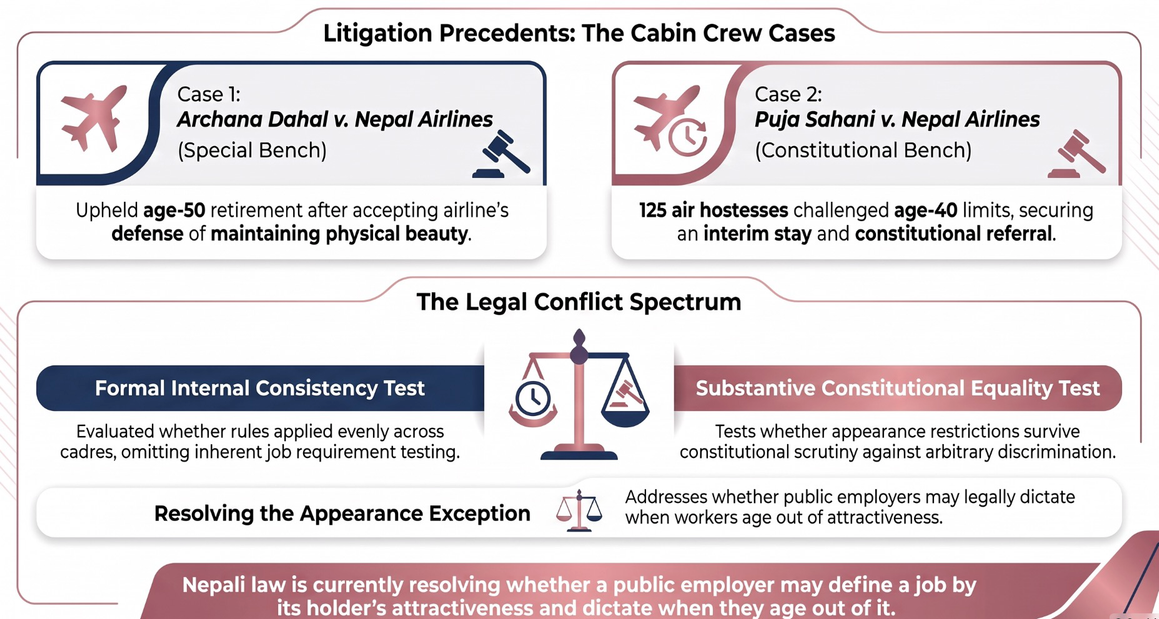
That question is harder to apply when the criterion is beauty itself, and the one case in which an employer pleaded beauty openly shows the limits of the doctrine. Nepal Airlines Corporation’s service bylaws retired cabin crew at 50, while other staff served until 58. When a flight attendant, Archana Dahal, challenged the rule, the airline’s written defence argued that cabin crew must maintain an “attractive physical appearance”, “physical beauty”, balanced weight and a particular demeanour to compete in commercial aviation. (Archana Dahal v. Nepal Airlines Corporation, Writ No. 071-WS-0036 Special Bench). The Special Bench upheld the rule. It reasoned that equality applies among equals, that cabin crew form a distinct functional cadre with in-flight safety and service duties, and that because the age ceiling applied to male flight attendants and female air hostesses alike it was not discrimination on grounds of sex.
The reasoning matters more than the result. The Court tested whether the classification was internally consistent; it did not test whether physical beauty was a legitimate occupational requirement in the first place. An employer that defines a job by the attractiveness of the people who do it, and applies that definition evenly, passed the test the Court applied. This is the clearest evidence in favour of the premise: a public corporation argued that its workers could not be allowed to age out of beauty, and the argument was not rejected.
The question is not closed. A later collective petition by 125 air hostesses challenged contractual tenure, a retirement age of 40, summary termination and the denial of pension and gratuity, arguing that women were being discarded on grounds of age and appearance while pilots and administrative staff served until 58 with full benefits. The Supreme Court issued interim orders restraining enforcement of the forced-retirement rule and referred the case to the Constitutional Bench to decide whether appearance- and age-based restrictions on cabin crew survive constitutional scrutiny. The constitutional bench has not reached a final decision. (Puja Sahani and others v. Nepal Airlines Corporation, Writ Nos. 080-WO-0640 and 080-WO-0747)
Is plainness itself a protected condition?
The second reading asks whether the law nonetheless leaves the plain exposed: free to be excluded, ridiculed or treated as inferior without remedy. The evidence shows a law that protects many named differences, and protects people against humiliation, but does not name “appearance” as such.
The Constitution’s equality clause is broad. Article 18(2) prohibits discrimination in the application of general laws on grounds of origin, religion, colour (varna), caste, tribe, sex, physical condition, disability, health condition, marital status, pregnancy, economic condition, language, region, ideological conviction “or on similar other grounds”. Article 24 bars untouchability or discrimination in any public or private place on grounds that include physical condition, and forbids presenting any person or community as superior or inferior on that basis. Article 16 guarantees the right to live with dignity; Article 28 makes the privacy of a person’s body (jiu) inviolable except in accordance with law; Article 38(3) prohibits physical, mental, psychological or other violence or exploitation against women on grounds of social or cultural tradition “or on any other grounds”.
A careful reading shows a narrowing that is easy to miss. Article 18(3), the clause that directly binds the State in its treatment of citizens, lists origin, religion, colour, caste, tribe, sex, economic condition, language, region and ideological conviction, but not physical condition, disability or health condition, which appear only in 18(2). The catch-all “similar other grounds” appears in both, so the omission may matter little in litigation, but the text itself is less protective of bodily difference in the State’s direct dealings than in the application of general law.
Ordinary statutes follow the constitutional pattern without extending it to appearance. The Labour Act 2074 forbids employers from discriminating on grounds of religion, colour, sex, caste, origin, language or ideological belief “or other similar grounds”, with fines of up to NPR 100,000, while permitting preference based on the inherent requirements of a job.
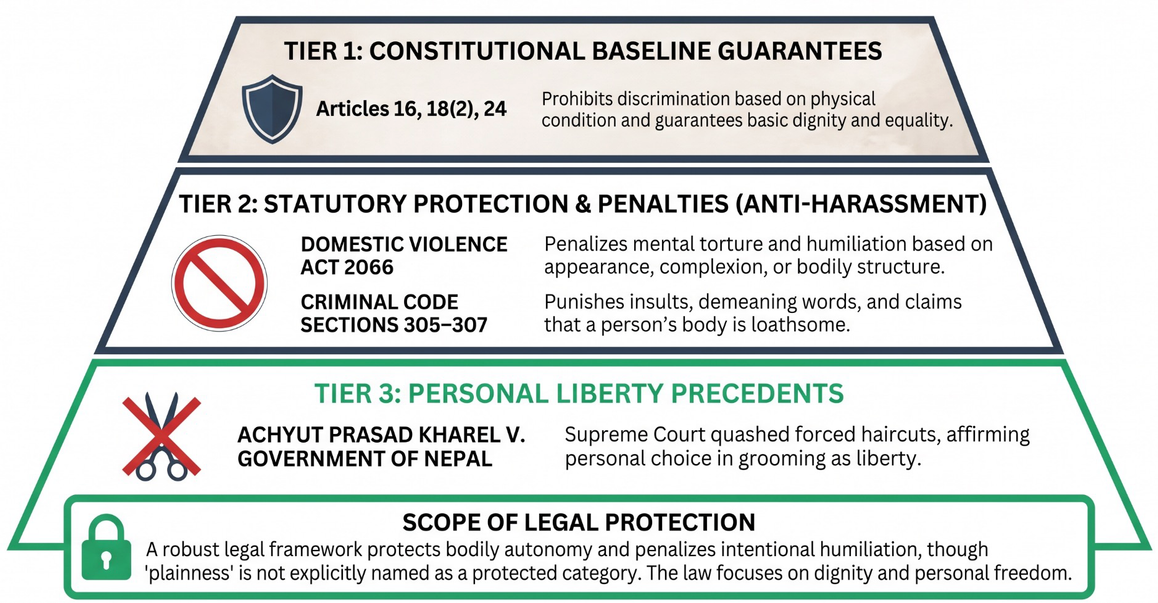
Only one statute names looks directly. The Domestic Violence (Offence and Punishment) Act 2066 defines mental torture to include humiliating a person on the basis of rup, rang, sharirik banawat (appearance, complexion, bodily structure) or illness, with penalties of NPR 3,000 to 25,000 or up to six months’ imprisonment for this category of domestic violence, doubled for repeat offences. The protection is real but confined to the domestic setting. Elsewhere, ridicule of appearance is reached through general offences. The National Criminal Code 2074, Section 305 punishes insult, defined as using demeaning words with intent to belittle, with up to a year’s imprisonment or a fine of NPR 10,000. Its defamation provision under Section 306 and 307 – expressly includes causing others to believe that a person’s body is in a “generally loathsome” condition, with up to two years and NPR 20,000, an additional year and NPR 10,000 if the defamation is spread through electronic or mass media, and mandatory compensation. The Rights of Persons with Disabilities Act Section 53 and 55 punishes hatred, scorn, mockery or contempt directed at a person with a disability with three to nine months’ imprisonment or a fine of NPR 30,000 to 90,000.
Against the State itself, the strongest protection is not equality but liberty. Under a police “crime control strategy”, officers detained young men in public for having long hair, beards or earrings and cut, shaved or removed them without consent, on the theory that such men were more likely to be criminals. The Supreme Court under Advocate Achyut Prasad Kharel v. Government of Nepal, Writ No. 072-WO-1114 held that whether to grow hair, keep a beard or moustache, or choose particular dress, ornament or make-up is a matter of personal desire and individual liberty; that the police had shown no social harm from any of it; and it ordered that no one be arrested for such appearance and that forced cutting and shaving stop. Disciplined forces stand on different ground: the Court has upheld uniform and conduct rules for police and armed police on the basis that members accept them by joining. (Bhakta Bahadur Tamang v. Armed Police Force and Dipendra Raj Awasthi v. Nepal Police)
The evidence also shows where protection runs out. No Supreme Court decision in the material addresses discrimination on grounds of skin colour, albinism or general unattractiveness as such; the leading dignity-and-equality cases concern disability, psychosocial conditions, gender identity and acid disfigurement. The disability statute’s schedule names limb loss, short stature, leprosy effects and other physical impairments, but not albinism or vitiligo, whose coverage depends on whether they cause functional limitation or barriers to participation. A person who is simply plain falls outside the named categories; a person whose difference is visible but not functional sits at the edge of them.
Who controls how a face is seen?
Part of what makes plainness feel impermissible is exposure: a face is photographed, circulated and commented upon, increasingly online, by people its owner never meets. If the premise were right, one would expect the law to treat a face as public material. It does the opposite.
The National Civil Code 2074 Section 20 guarantees the privacy of a person’s body and information, and treats as a violation, unless done with consent or in accordance with law, taking a person’s photograph or imitating their name, figure, photograph or voice and making it public; literary, artistic and public-interest uses are excused. Courts may restrain a threatened violation and must order compensation for malicious harm, but the claim must be brought within six months.
Criminal and regulatory law add sharper tools. The Right to Privacy Act 2075 prohibits publishing, distributing, selling or otherwise using a person’s photograph for commercial gain without consent, with up to three years’ imprisonment or a fine of NPR 30,000. The National Criminal Code prohibits photographing a person without permission and distorting a photograph or combining it with another’s image. In 2026 the Constitutional Bench under Advocate Monika Dhakhwa and others v. Office of the Prime Minister and Council of Ministers, Writ No. 082-WC-0001 rejected a challenge that this offence unduly restricted photojournalism, holding that a person’s face, body and image are intrinsic to personality, autonomy, dignity and privacy, and that press freedom does not extend to circulating unauthorised or morphed images.
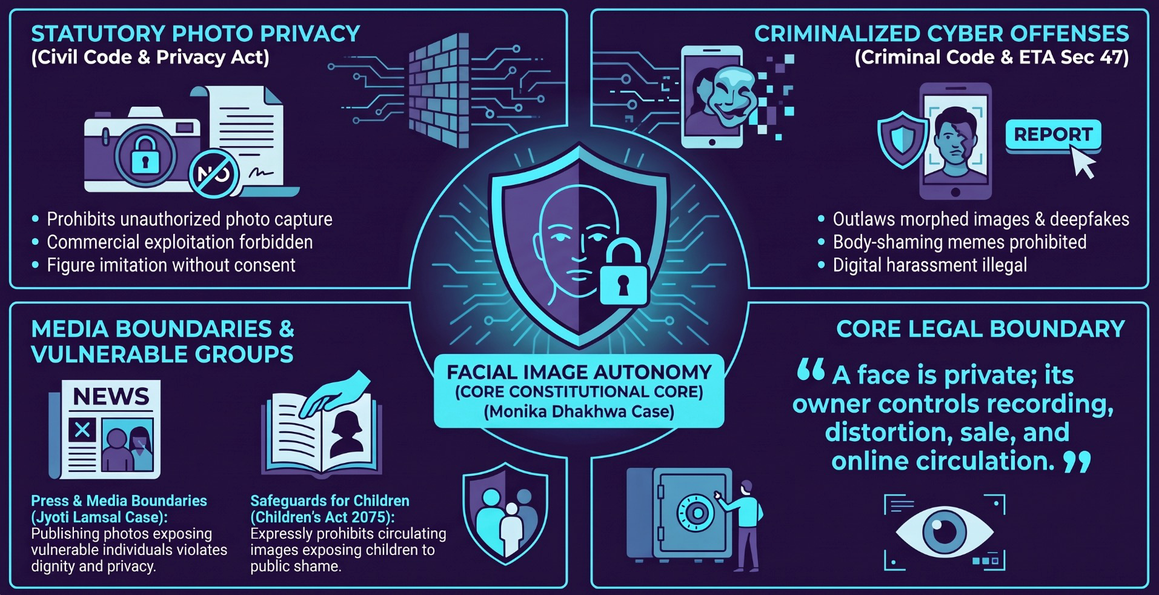
In a separate challenge to the Electronic Transactions Act’s offence of publishing material online that harasses, insults or demeans, including content directed at women, the Court under Advocate Pratyush Nath Upreti v. Office of the Prime Minister and Council of Ministers, Writ No. 072-WS-0013 upheld the provision, holding that digital platforms cannot be used for body-shaming, cyberbullying or the unauthorised circulation of private images. A 2080 government directive on social media prohibits editing or distorting photographs and videos without consent, including through deepfakes and memes, to harass or degrade.
The Court has applied the same idea to the press. When a national daily published the name, photograph, former occupation and children’s school details of a Badi woman who had left sex work, it held that this violated dignity and privacy and directed the government to enact a comprehensive privacy law. (Advocate Jyoti Lamsal and others v. Kantipur Media Group and others, Writ No. 073-WO-1058)
The Children’s Act 2075 prohibits circulating images that expose a child to shame or contempt. On images that persist online, the Court directed the government to examine a removal mechanism, without itself creating a right to erasure. (Advocate Shailendra Upreti and Advocate Srijana Adhikari v. Ministry of Communication and Information Technology, Writ No. 075-WO-0676)
The construction is coherent: a face is private in the law’s sense, and its owner decides who may record, distort, sell or circulate it. The weakness lies in the remedies, which are reactive, depend on the person bringing a claim within a short limitation period, and include no working mechanism for removing harmful images. The law protects against particular exposures; it cannot protect anyone from being looked at and judged.
What does the law treat as the injury: being ugly, or being made ugly?
If the law does not require beauty, it does something more revealing: it treats a person’s natural appearance as a protected possession, and the face as the most valuable part of it. The clearest evidence is in the criminal provisions on disfigurement.
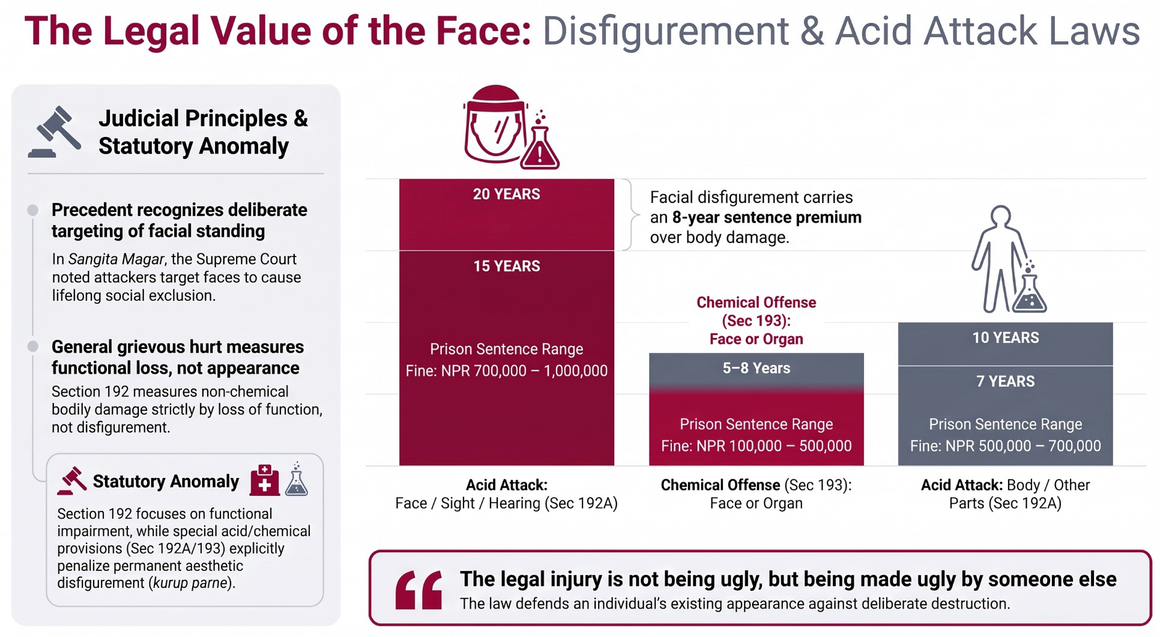
Section 193 of the National Criminal Code prohibits using or splashing acid or other chemical, biological or toxic substances on a person, or burning, branding or rubbing the body with them, so as to cause pain or to kurup parne, to make the face or any organ ugly or disfigured. Disfiguring the face carries five to eight years’ imprisonment and a fine of NPR 100,000 to 500,000; disfiguring another part of the body carries three to five years and NPR 50,000 to 300,000. The whole fine goes to the victim as compensation. A later amendment, introduced by ordinance in 2077 BS and later carried into statute, inserted Section 192A for acid specifically. Where acid disfigures the face, or destroys sight in both eyes or hearing in both ears, the punishment is 15 to 20 years and NPR 700,000 to 1,000,000; disfigurement or injury elsewhere carries seven to ten years and NPR 500,000 to 700,000; an attempt that misses carries five to seven years. Courts must presume intent to kill or cause grievous harm once the throwing is proved, must give acid cases first priority, must order the offender to bear medical costs and interim compensation, and may not reduce, suspend or remit the sentence.
Two features of this scheme bear directly on the premise. The first is the face premium. At every level, disfiguring the face is punished more heavily than disfiguring the rest of the body: by three years at the lower bound under Section 193 and by eight under Section 192A. The law places a higher value on the face than on any other part of the body’s surface, which is to say it encodes, in sentencing ranges, the same social fact this article describes: that a face carries more of a person’s standing than an arm or a back.
The Supreme Court has said this in terms. In the public interest petition brought by Sangita Magar, attacked with acid at 16 while attending tuition classes in Kathmandu, and by Rehana Shesh Dhapali, a survivor of burning, the Court described the lifelong consequences of disfigurement: chronic pain, repeated treatment, loss of self-esteem, psychological trauma, social exclusion and the destruction of life plans, all of which it held to violate the right to live with dignity. (Sangita Magar, Rehana Shesh Dhapali and others v. Government of Nepal, Writ No. 073-WO-0244)
It observed that whereas a person injured by other means may recover their appearance, an acid survivor can never regain their former physical form. In the related petition (Advocate Shashi Basnet and others v. Government of Nepal, Writ No. 073-WO-0181) on unregulated acid sales, it found that attackers deliberately target the faces of young women and girls in order to destroy their appearance and social standing. An attacker who chooses the face is exploiting precisely the value that the premise says society places on appearance. The law’s response is not to diminish that value but to defend the individual’s hold on it.
The second feature cuts the other way. Outside chemical attack, the law measures bodily injury mostly by function. The general definition of grievous hurt in Section 192(2) lists loss of sight, smell, hearing or speech, the cutting of a woman’s breast, infertility or impotence, fractures or dislocations that render a limb or the spine useless, and injuries that leave a person unable to follow their occupation. It does not list disfigurement. Permanent damage to appearance appears as an element only in the chemical-substance offences. A face scarred with a blade or by a botched procedure, without loss of function, would have to be brought within some other provision; the evidence does not show a decision on the point, and this reading is an inference from the statutory text.
Insurance follows function too. Accident policies compensate unlisted injuries as “any other loss of organ”, defined as complete or permanent loss of use certified by a specialist, and pay a proportional share of the sum insured. A scar that impairs nothing is hard to fit within that definition. The exception is again chemical: critical illness guidelines for life and non-life insurers list “chemical burn disfiguring to face” as a major burn. Across criminal law, insurance and disability, the body’s worth is mostly what it can do; the face becomes valuable in itself mainly when someone has deliberately ruined it.
Civil law reinforces the pattern. Tort compensation is limited to actual loss, and courts consider loss of income and additional loss but not remote or “imaginary” harm. A disfigurement that costs no income or further treatment is hard to price within that frame. Criminal courts, by contrast, must weigh mental and emotional harm and, in acid cases, the severity of the disfigurement. A damaged appearance is most fully compensated when it was damaged by a crime.
The State’s practical commitment to restoring disfigured faces lags its legal rhetoric. The Supreme Court’s directives in the acid cases required, among other things, burn units in public and private hospitals, free emergency and ongoing treatment, upfront State funding of medical costs where the offender cannot pay, and vocational and psychosocial rehabilitation. The Auditor General’s reports show the distance between those directives and delivery. In Madhesh Province, eleven budgeted health programmes worth Rs 20 crore, including the operation of a burn centre, were not implemented at all. At the National Trauma Center, which provides burn and plastic surgery services to patients from all 77 districts, the post of consultant plastic surgeon was among the vacant specialist positions. An earlier provincial report found Rs 7.47 million in cabinet-approved assistance distributed to 97 people, among them female acid-attack victims and people with disfigurement, without objective criteria, and recommended that such discretionary payments be controlled. The legal injury, then, is not being ugly but being made ugly by someone else. The law defends the face a person has, more fiercely than any other part of the body, against deliberate destruction. Where it fails is in paying for repair.
If the rules do not demand beauty, who does?
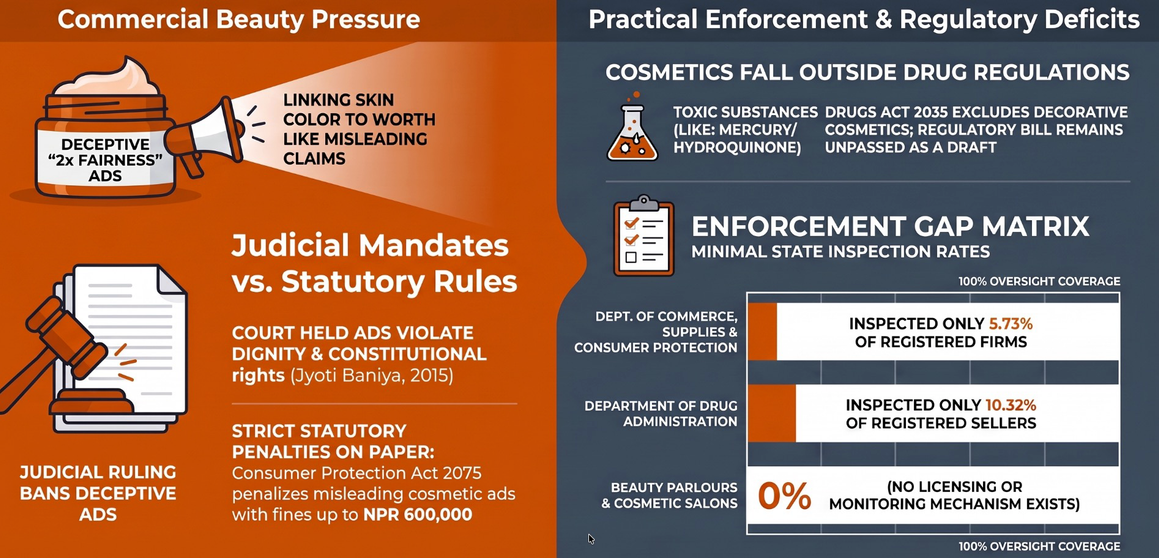
In a public interest petition (Advocate Jyoti Baniya and others v. Office of the Prime Minister and Council of Ministers and others, Writ No. 070-WS-0052) decided on 2072-01-03 BS (April 2015), advocates challenged advertisements carried in newspapers, on television and on radio for fairness creams, slimming and body-alteration devices, supplements and energy drinks. The fairness advertisements promised “2x fairness”, whole-body whitening, greater attraction and better marriage prospects; the petition argued that they propagated the claim that “being fair is the very symbol of beauty” (goro hunu nai sundartako pratik ho), left dark-skinned people with feelings of inferiority and humiliation, and exposed users to ingredients such as hydroquinone and mercury that can damage skin, kidneys and heart. Devices and capsules were advertised to change weight, height and breast, hip and thigh measurements without prescription. As the decision is reported, the Court held that deceptive advertising which objectifies women’s bodies, enforces colour-based standards of beauty or endangers health violates the constitutional guarantees of dignity, equality and consumer protection then in force, and directed the government to create a mechanism to vet advertisements for cosmetics, beauty products and slimming devices before broadcast, to require scientific substantiation of claims, and to prohibit advertisements that exploit insecurity about body image or promote discrimination by colour or gender.
A court did not merely observe that beauty pressure exists; it attributed it, by name, to commercial messaging, and characterised the message (fair is beautiful, dark is inferior, bodies can be bought into shape) as a constitutional harm. Three years later, in a case concerning alcohol advertising that used semi-nude models with slogans such as “Get sexy”, the Court held that depicting women as sexual objects in marketing offends dignity and ordered a ban on such advertisements, guidelines for gender-friendly advertising and an advertising review board. (Dhanraj Badi and others v. Adhrit Films Pvt. Ltd. and others 2075 BS)
The statutory tools are substantial on paper. The Advertisement (Regulation) Act 2076 prohibits advertisements that are obscene, offend public decency, encourage gender discrimination or discriminate on grounds including disability. It contains no provision on beauty claims or body image, and its general penalty for prohibited content is up to a year’s imprisonment and NPR 10,000. The Consumer Protection Act 2075 is sharper. It treats misleading advertising, claims of undelivered benefits and guarantees made “without factual basis” as unfair trade practices, alongside the use of harmful chemicals, with on-the-spot fines of NPR 200,000 to 300,000 and court penalties of two to five years or NPR 400,000 to 600,000. Labels on beauty products (saundarya samagri) must disclose ingredients, side effects and health warnings, and Gazette notices ban eleven azo dyes and extend labelling duties to cosmetics.
The weakest point is the legal status of the products themselves. The Drugs Act 2035 defines a drug to include substances intended to affect the structure or function of the body, and requires registration, quality and labelling for drugs. Decorative cosmetics fall outside that definition; skin-lightening preparations with active pharmacological ingredients arguably fall within it, but the Act does not say so, and no Gazette notice or provision in the evidence sets limits for mercury, hydroquinone or steroids in cosmetics. The Law Commission has drafted a bill that would bring cosmetics expressly under the drug regulator, defining counterfeit cosmetics to include those containing harmful chemicals and requiring permits for their manufacture, import and marketing. It remains a draft. Its Consumer Protection study cited the United States’ single food, drug and cosmetics statute as a model for unifying the field.
The market sells correction as well as messages, and the law on who may perform it is general rather than specific. The National Criminal Code bars anyone without a medical qualification and licence from providing medical services, operating on the body or administering medicine, with up to fifteen years’ imprisonment where grievous hurt results; it also punishes gross negligence and treatment without informed consent. Only registered practitioners may practise modern medicine, and health institutions need an operating licence. Nothing names aesthetic procedures. Whether an injection, peel or laser treatment in a salon is “medical service” depends on reading these general provisions, an inference that has not been tested: the Supreme Court’s medical negligence decisions in the evidence concern orthopaedic, obstetric and eye surgery.
The pressure the courts have recorded also falls unevenly. The fairness-cream petition concerned dark-complexioned women and their marriage prospects; the alcohol case concerned women’s bodies used to sell; the acid cases found that attackers target the faces of young women; the challenges to cabin-crew retirement rules were brought by women. The airline’s rule, as the Court read it, applied to men and women alike, and the evidence does not measure how appearance pressure is distributed in the population. But in every case where a court described the harm, the person bearing it was a woman, and Article 38(3) of the Constitution gives that observation a specific legal footing.
Responsibility is also divided. Under the Allocation of Business Rules 2083, drugs and health products belong to the Ministry of Health and Food Hygiene; consumer protection and the supply and quality of consumer goods to the Ministry of Industry, Commerce and Supplies; national advertising policy and standards to the Ministry of Information and Communication; and gender equality and the prevention of gender violence to the Ministry of Women, Children, Gender and Sexual Minorities and Social Security. Each has a piece of the problem the Court described in 2015; none owns it.
Enforcement capacity is thin. The Auditor General’s 61st annual report found that the Department of Commerce, Supplies and Consumer Protection inspected 818 of 14,266 registered and renewed firms in FY 2080/81, 5.73 per cent and down from 2,448 the previous year; it fined 753 of them a total of Rs 1.74 crore, of which Rs 21.01 lakh remained uncollected. No separate inspection officers had been appointed under Section 32 of the Consumer Protection Act, the consumer courts required by Section 41 had not been established, and the department did not receive records of inspections carried out by the hundreds of local officials designated as market inspectors. The Department of Drug Administration inspected 3,455 of 33,474 registered drug sellers, 10.32 per cent, while 10,944 authorised sellers were operating without renewed licences. And no licensing or monitoring mechanism exists for cosmetics, beauty products or beauty parlours at all.
The beauty contest, the most visible institution of judged appearance, attracts little regulation of its own. The Supreme Court dismissed a challenge to a state-owned bank’s payment of NPR 300,000 plus VAT to appoint Miss Nepal 2018 as brand ambassador, treating it as ordinary business promotion. (Advocate Dilli Prasad Neupane v. Office of the Prime Minister and Council of Ministers and others, Writ No. 075-WO-1298). The Law Commission’s 2080 study on limitation periods for sexual offences discussed a 2014 pageant participant’s later allegation of rape by an organiser, and recommended longer limitation periods for sexual violence against minors. The risk the State has identified in pageants is abuse of participants, not the judging of their bodies.
How does the State classify the money spent on looking better?
If plainness is priced, the price should show up in spending, and the State’s treatment of that spending reveals what it thinks beauty is: a necessity, a health matter or a private indulgence. The evidence is consistent on this point across customs, tax, foreign exchange, insurance and industrial policy.
Nepal’s imports of cosmetics and beauty goods, as reported by the central bank, rose from Rs 627.0 crore in FY 2079/80 (2022/23) to Rs 780.3 crore in 2080/81 and Rs 887.2 crore in 2081/82, increases of 24.4 and 13.7 per cent, or 41.5 per cent over two years. Imports from China nearly doubled in the first of those years, up 84.5 per cent. (Nepal Rastra Bank, Current Macroeconomic and Financial Situation reports). The central bank’s narrative reports do not comment on what drives this demand; the figures are reported in commodity tables, and the totals here are sums of the India, China and third-country series.
The years just before that rise show how the State classified the same goods under pressure. In December 2021, with foreign-exchange reserves falling after COVID-19 and the war in Ukraine, Nepal Rastra Bank required importers to deposit 50 to 100 per cent cash margins when opening letters of credit for 47 categories of goods, which, as the central bank’s measures are described, included cosmetics, perfumes and toiletries alongside vehicles, alcohol and electronics. From April 2022 the government banned imports of a list of luxury goods by Gazette notice, extended and modified in July, August and October. Imports of cosmetic goods from third countries fell 17.6 per cent in FY 2022/23, from NPR 1,996.1 million to NPR 1,643.9 million. The bans and margin requirements were lifted from the middle of 2022/23 as reserves recovered, and the import growth shown above followed. In a crisis, the State placed beauty products with luxury vehicles, not with medicines; when the constraint lifted, demand returned strongly.
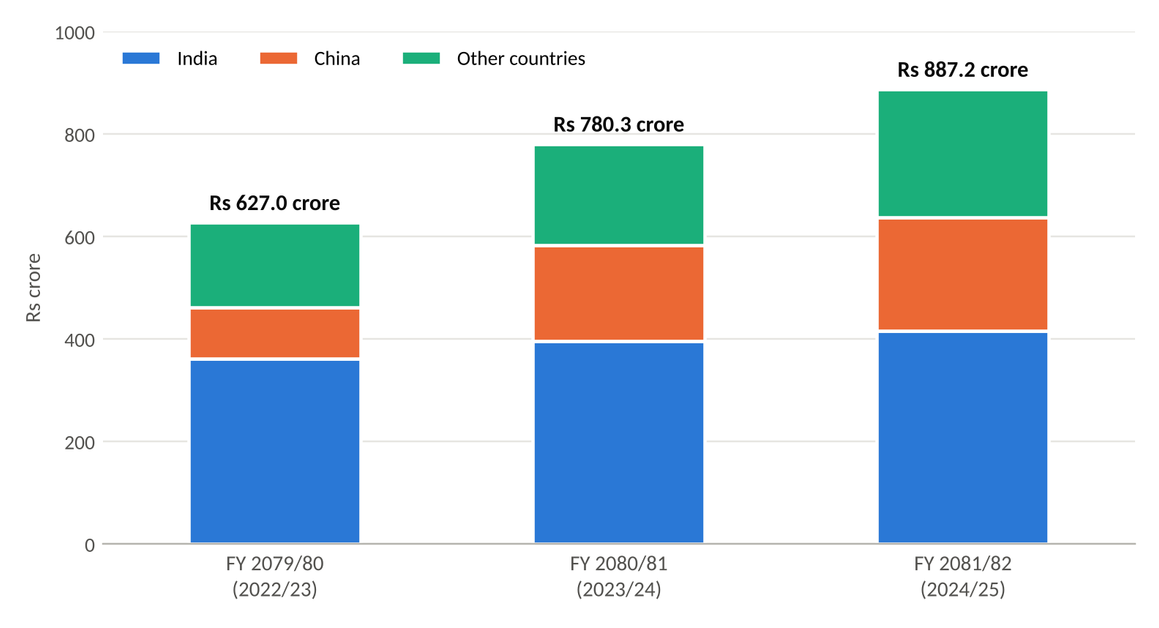
Source: Nepal Rastra Bank, Current Macroeconomic and Financial Situation, commodity import tables. Totals are the sum of the India, China and other-country series. 1 crore = 10 million rupees.
The ordinary tax treatment is milder but points the same way. Most cosmetic, skin-care, hair and shaving preparations under Chapter 33 of the customs tariff attract 15 per cent duty, personal deodorants 20 per cent, razors 5 per cent and electric hair dryers 15 per cent, with 13 per cent VAT on import. Customs duty and VAT compound, so where VAT is charged on the duty-inclusive value a cream at the 15 per cent rate carries about 30 per cent in import taxes on its customs value (1.15 × 1.13 = 1.30), before any excise. The Finance Act 2083 levies its 2 per cent luxury tax only on five-star hotel services and imported liquor, not on cosmetics or grooming services. Beauty parlours, salons, spas and fitness centres are not exempt from VAT, unlike health services; Finance Act 2076 removed the provision that had singled out beauty parlours for compulsory VAT registration regardless of turnover, leaving them to the general thresholds. The State taxes beauty as an ordinary consumer good, neither punishing it as a luxury nor relieving it as a necessity.
The line becomes sharp where health and appearance meet.
- The Income Tax Rules exclude cosmetic surgery from the expenses that qualify for the medical tax credit.
- The foreign-exchange rules allow banks to provide up to USD 15,000 a year for treatment abroad, but only on a Nepali doctor’s recommendation that overseas treatment is appropriate, with payment sent directly to the hospital and accounts settled within 15 days of return; elective aesthetic procedures are not recognised as qualifying treatment.
- The hospital-admission micro-insurance policy excludes, in its own words, “any medical treatment done for beauty” (saundaryaka lagi garine aushadhi upacharharu), while accident and critical illness cover extends to reconstruction after injury and burns.
Classification disputes show that the line carries money and is contested.
- The Revenue Tribunal refused, without laboratory evidence, to let customs reclassify a face wash from skin-care (15 per cent) to skin-washing preparations (20 per cent), but upheld the reclassification of intimate-hygiene products from tax-exempt medicaments to cosmetics. (Revenue Tribunal, S.R. Distributors Pvt. Ltd. v. Customs Clearance Verification Office, 078-RB-0227; Brand Bucket Firm v. Customs Clearance Verification Office, 079-RB-0039)
- The Supreme Court held that health tonics registered with the drug regulator were not “medicines for human treatment” for VAT exemption. (Dabur Nepal Pvt. Ltd. v. Large Taxpayers Office) The boundary is pushed consistently one way: treating disease or injury is health; maintaining or enhancing the body is consumption.
The structure of the industry draws the hygiene–beauty line once more. The domestic manufacturers whose finances are reported by credit rating agencies make laundry and toilet soap, detergents, sanitary pads, diapers and sanitisers: Himgiri Hygiene; Jasmine Hygiene, A.G. Health Industries, Kwality Chem and others, several of them highly leveraged and one, Dinesh Soap, rated in default. The beauty brands, by contrast, arrive mainly through importers and distributors: Nivea and Sebamed, Olay and Pantene, Dove and Pond’s, Livon and Set Wet, Cetaphil and Johnson & Johnson. The Investment Board’s Health Profile reports that domestic demand for cosmetic surgery is “not developed well”, while offering rhinoplasty in Nepal at about USD 3,000, against USD 4,000 in India and USD 8,000 in the United States. Across customs, tax, insurance and industry, the pattern that holds is: the State does not demand beauty, and it does not pay for it.
So, can you be ugly, legally?
As discussed above – “I am not allowed to be ugly, legally” describes a prohibition that the written rules do not contain and a legal exposure that the law does not leave open. What institutions ask of an ordinary face is upkeep and constancy, and what the law does with a face is defend it. Those findings are robust across employers, statutes, courts and insurers, and nothing in the evidence contradicts them.
Two narrower versions where you cannot be ugly still survives:
The first is occupational. Where the body is the job, an employer may select on it, and Nepali law has not yet decided whether beauty can be one of the things selected for. Functional screening is settled and, on the evidence, mostly what the State does. The open question is the airline’s: whether a public employer may define a role by its holders’ attractiveness and, by retiring them early, decide when they have stopped being attractive enough. The Special Bench let that rule stand on a consistency test; the Constitutional Bench has the question now.
The second is commercial, and it is the stronger. The pressure not to be plain is generated mainly by a market that the State has condemned in principle and left largely unpoliced in practice, and the cost of responding to that pressure is assigned to the individual. The condemnation, the statutes and the thin enforcement are each established above; what they establish together is a division of labour. The public sphere, through the courts and the constitution, says that dignity does not depend on looks. The private sphere, through advertising, products and procedures, says it does. The State stands between them with tools it rarely uses, and taxes, excludes and, in a crisis, rations the goods people buy to close the gap.
So, the question we could be asking is not “why can’t I be ugly?” but “why does it feel as though I can’t, when almost no rule says so?”.
Ultimately, the strongest answer is to wear a cheerful face and pay no mind to judgment.