Remote vehicle immobilisation and the limits of state power under Nepalese law
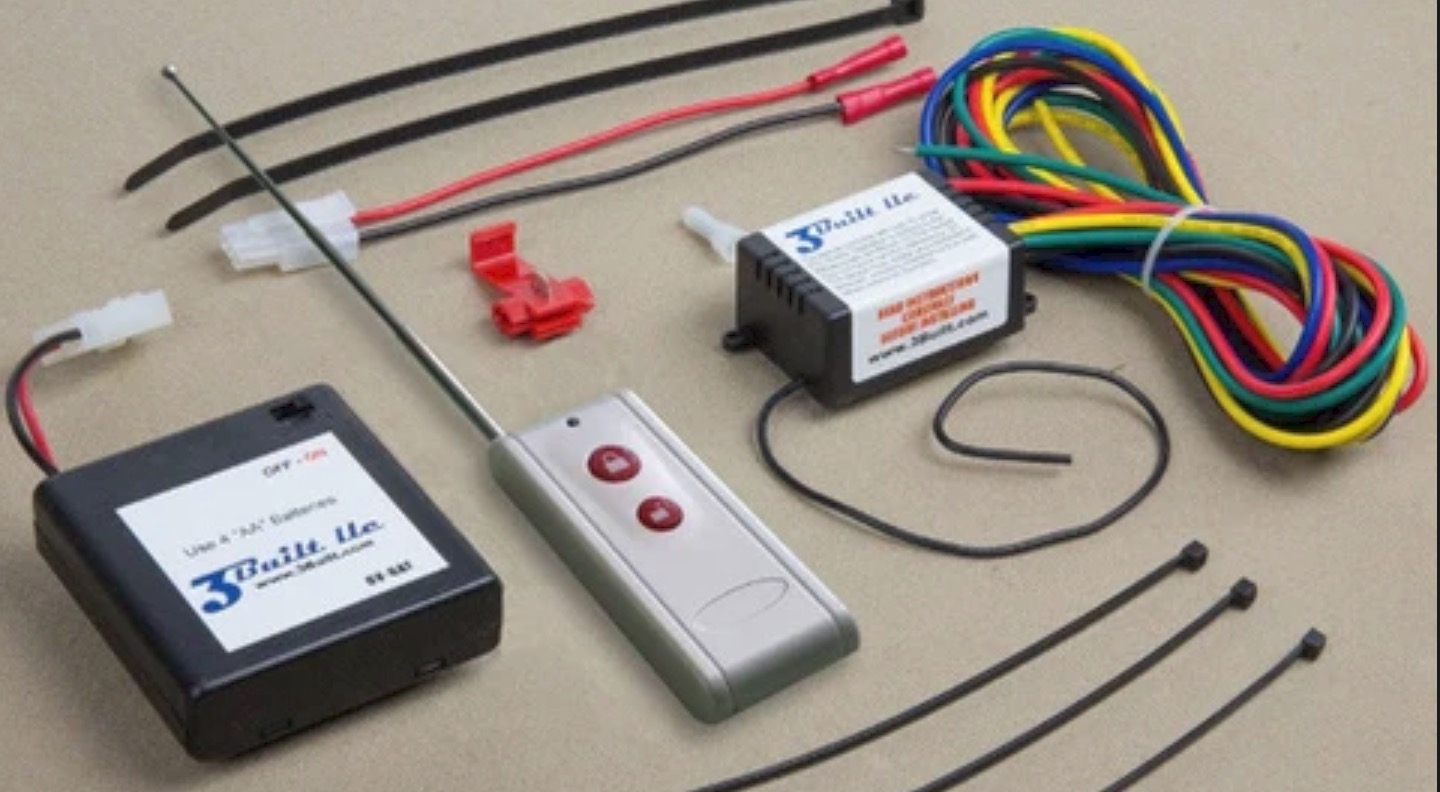
A vehicle “kill switch”, in the sense used here, is any mechanism that allows a public authority to stop a privately owned vehicle from starting or from continuing to run, without the owner’s contemporaneous consent, by sending a command over a cellular, satellite or other network to the vehicle’s electronics. The technology is commercially familiar. Owners use remote immobilisers against theft; lenders and fleet operators write them into contracts. The question for here is different: whether the Government could require such a mechanism in every private vehicle and then use it.
Legally that’s three questions.
- Can the state require the device to be fitted, as a condition of import, type approval, registration or renewal?
- Can it require the device to stay connected to a server that the state or its contractor controls?
- And can a public official press the button?
The answers differ, and the difference matters, because the regulatory powers the Government already holds over vehicles bear heavily on the first question and hardly at all on the third.
The short answer is that no Act, rule, Gazette notice or technical standard currently authorises any public body to disable a private vehicle remotely, and none of the general powers that might be stretched to cover it, whether in transport, criminal procedure, disaster management, public security or telecommunications law, survives scrutiny. An installation mandate is more genuinely contested. The Government has already compelled private vehicles to carry electronic hardware through delegated instruments, and the Supreme Court has accepted that practice on conditions. But a kill switch differs in function from every existing precedent: it exists to coerce rather than to identify a vehicle or test its fitness, and that difference breaks its link to the powers the Government would have to rely on. Activation would require an Act of Parliament, and the Constitution dictates much of what that Act would have to contain. Even with such an Act, the range of lawful uses would be narrow.
1. What do the Government’s existing powers over vehicles actually reach?
The Motor Vehicles and Transport Management Act, 2049 (the Transport Act) and its Rules of 2054 give the state two families of power over private vehicles. The first operates before and around registration. Section 23(1) allows the Government to prescribe standards for deciding whether a vehicle is fit to be driven, under four heads: size, weight and form; length, width, height, structure or design; pollution; and operational lifespan. Section 24(1) requires an officer to refuse registration to a vehicle that fails those standards, and section 24(3) lets the Government bar registration of classes of vehicle on grounds of pollution, traffic pressure or road conditions. Section 39 prohibits owners from altering a vehicle’s colour, seating, form, engine or chassis without approval. Section 168A provides for fitness and emission testing, and section 168B for an integrated electronic record system linking vehicle, licence and revenue data.
The second family operates after registration. Section 40 lets an authorised officer suspend a registration certificate, either until a dangerous vehicle is repaired or, for non-compliance with the Act or Rules, for up to six months; the order must state its reasons (s 40(2)) and the owner must surrender the certificate within seven days (s 40(4)). Section 118 lets the Department of Transport Management restrict driving in a public place for public security and general welfare, by a notice posted at that place. Section 132(a) obliges drivers to stop when a police officer or transport inspector signals. Section 134 allows police to require a vehicle involved in an accident to be brought in. Section 160(1) mandates confiscation of a vehicle driven with false plates. Section 164 empowers officers of at least Assistant Sub-Inspector rank, and transport inspectors, to impose on-the-spot fines, and escalates unpaid fines into suspension (s 164(5)) and then cancellation (s 164(6)) of the licence or permit. Decisions are appealable within 35 days (ss 171–172).
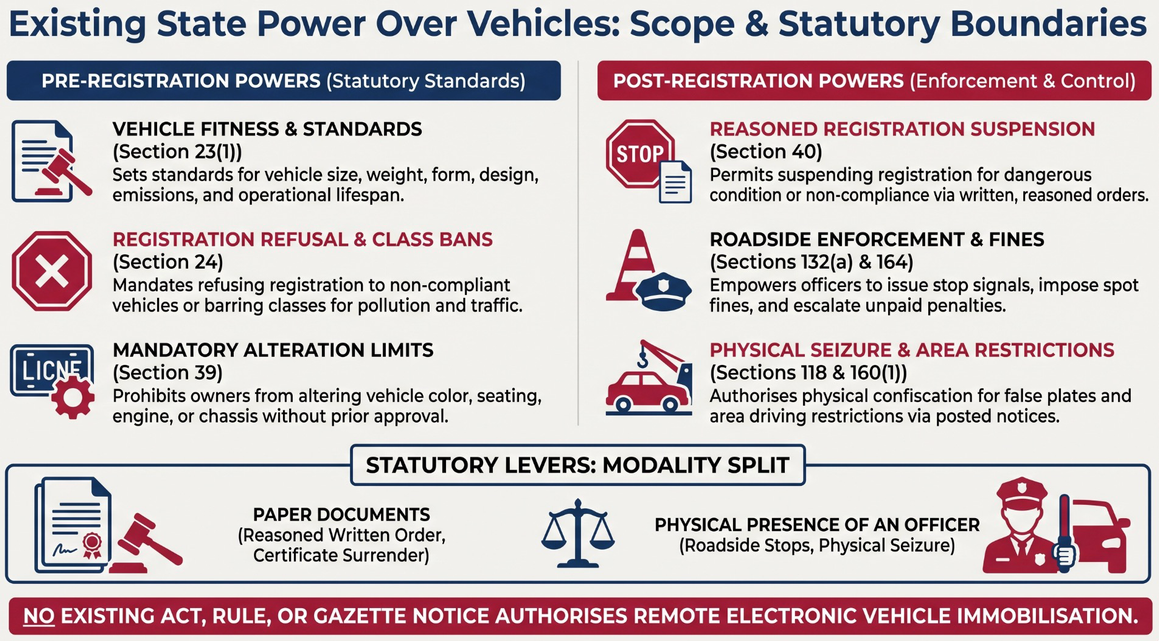
Every coercive lever in this structure works through one of two modalities: a legal prohibition on operating the vehicle, enforced by documents, or physical custody executed by an officer who is present. The Act assumes a human being at the roadside. The table below sets out the pattern.
| Power | Source | Trigger | Modality |
|---|---|---|---|
| Suspension of registration | Transport Act s 40 | Dangerous condition; non-compliance | Paper: reasoned order, surrender of certificate |
| Area restriction on driving | Transport Act s 118 | Public security, general welfare | Physical: notice posted at the place |
| Stop on signal; spot fine; detention | Transport Act ss 132(a), 164 | Traffic and fitness violations | Physical: officer present |
| Escalation for unpaid fines | Transport Act s 164(5)–(6) | Non-payment | Paper: suspension, then cancellation |
| Confiscation | Transport Act s 160(1) | False or substituted plates | Physical seizure |
| Order prohibiting use; detention; auction | Road Board Act ss 28–29 | Unpaid tolls | Paper order and physical detention |
| Interception; firing at tyres | Customs and revenue-leakage law | Refusal to stop at a customs barrier | Physical force, expressly authorised |
| Requisition of vehicles | Disaster Act s 33(1)(f) | Declared disaster crisis zone | Physical custody and use, with rent (s 38) |
Two features of the wider statute book reinforce the point. First, a search of Gazette-published transport instruments finds none that authorises electronic or remote enforcement; where a suspension is ordered, the law still requires the owner to hand over the physical certificate or licence. Second, where Parliament has wanted officials to disable a moving vehicle, it has said so expressly and tied the power to a defined trigger. The customs and revenue-leakage provisions that allow officers to fire at the tyres of a vehicle that refuses to halt at a customs barrier are the clearest example. That express, narrowly triggered grant is the model of how Nepalese law confers a power to immobilise. The absence of any equivalent for electronic means is not a gap that regulation can fill. It is the absence of a power.
2. Could the Government require the device through standards or registration conditions?
This is where the Government’s position is strongest, and where the research is least unanimous.
The precedents for mandated electronic hardware
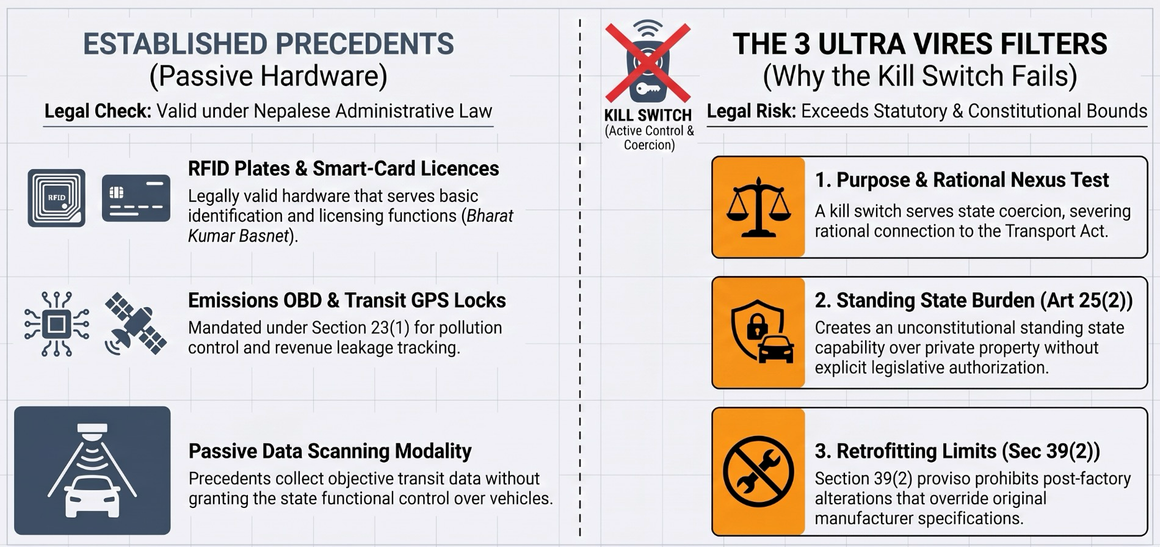
The Government has already required private vehicles to carry electronics without a dedicated Act. High-security embossed number plates, mandatory for private as well as public, government and diplomatic vehicles, carry a radio-frequency identification (RFID) tag that gate readers can scan at 8 to 10 metres; the instruments cite section 178 and Schedule 2 of the Transport Act and Rules 4 and 4A. Electronic smart-card licences were introduced by amending Rule 20A under the general rule-making power in section 179. The 2082 national vehicle emission standards require on-board diagnostic systems. In freight, commercial vehicles must carry operational GPS devices registered with the Department of Revenue Investigation under section 13G of the Revenue Leakage (Investigation and Control) Act, 2052, and transit containers carry customs-controlled electronic GPS locks.
The Supreme Court has engaged with the most relevant of these. In Bharat Kumar Basnet v Office of the Prime Minister and Council of Ministers (Writ No 074-WO-0554), a privacy challenge to RFID plates, the Court is reported to have accepted the scheme on three conditions: the tracking must rest on clear legal authority for vehicle identification, crime prevention and traffic management; it must capture objective vehicle-transit data rather than occupants’ conversations or activities; and the data must be held in state-controlled data centres inside Nepal with safeguards against third-party access. Separately, the Court has treated technical and mechanical specifications for registering vehicles as a legitimate regulatory function where they serve roadworthiness, safety and pollution control (Nirmal Kumar Shrestha v Ministry of Physical Infrastructure and Transport, Writ No 077-WO-0605).
The proposition that the Government can never require electronic devices in private vehicles without a new Act is therefore too strong. It has done so, and the Court has not stopped it.
Why those precedents do not carry a kill switch
Three considerations separate a kill switch from the existing mandates.
The first is purpose. Each precedent fits an existing statutory head. Plates serve registration and identification; diagnostic systems serve the pollution head of section 23(1); smart cards are licence documents. A kill switch makes a vehicle neither fitter, cleaner nor easier to identify. Its only function is to give someone other than the owner the power to stop it. The Supreme Court’s test for conditions attached to a licence or registration asks whether the condition has a rational connection to the purpose of the parent Act. In Shiva Chandra Poudel v Office of the Prime Minister (Writ No 066-WS-0033, Special Bench, NKP 2069 DN 8777), a rule requiring construction firms to join a private federation as a condition of licence renewal was struck down because the parent Act did not authorise it and it bore no connection to construction quality or safety. In Airline Operators Association of Nepal v Government of Nepal (Writ No 080-WO-0169), a regulator’s circular curtailing pilot-licence privileges was quashed. And in Vishnu Prasad Ghimire v Federal Parliament (Writ No 074-WC-0020), the Court invalidated a rule that contained provisions absent from the parent Act, holding that subordinate instruments may not supply what Parliament did not enact. A kill-switch requirement presented as a “technical standard” would be close to the paradigm of a condition imposed for a purpose foreign to the statute under which it is made.
The second is the nature of the burden. An RFID tag is passive: it answers when read and does nothing to the vehicle. The conditions in Basnet presuppose exactly that, since they speak of objective transit data and secure storage. A kill switch must be capable of acting on the vehicle on command. Its installation gives the state a standing capability over the owner’s property whether or not it is ever used, which the constitutional analysis in the research classifies as the creation of a right over property within Article 25(2). That provision permits the state to create such a right only for public interest, and Article 25(1) makes property rights subject to law. A Gazette notice amending a schedule is a thin basis for creating a standing state capability over every private vehicle in the country.
The third concerns section 39(2) of the Transport Act, whose proviso forbids approval of alterations that change the detailed specification fixed by the vehicle’s manufacturer. Several research answers treat this as a statutory bar on any kill-switch mandate. That reading is stronger than the text supports. The proviso governs approvals of alterations to registered vehicles; it does not obviously constrain the Government’s power to set conditions for import or type approval, and a device fitted at the factory would alter nothing the manufacturer specified. Where the proviso does bite is on a retrofit mandate for the existing fleet, which would require devices to be spliced into ignition or power systems after manufacture. It is a constraint on retrofitting, not a general bar.
The fair conclusion is that an installation mandate made by rule, notice or standard would be legally exposed, on substantive ultra vires and nexus grounds, but not frivolous, given the RFID precedent. A court would be likely to look past the label to the function. More importantly, even a valid installation mandate would confer no power to use the device. Installation and activation are separate legal acts. Authority for the first does not imply the second, and the Supreme Court has rejected exactly that kind of inference in the transport context, as the next sections show.
3. Is there any existing power to press the button?
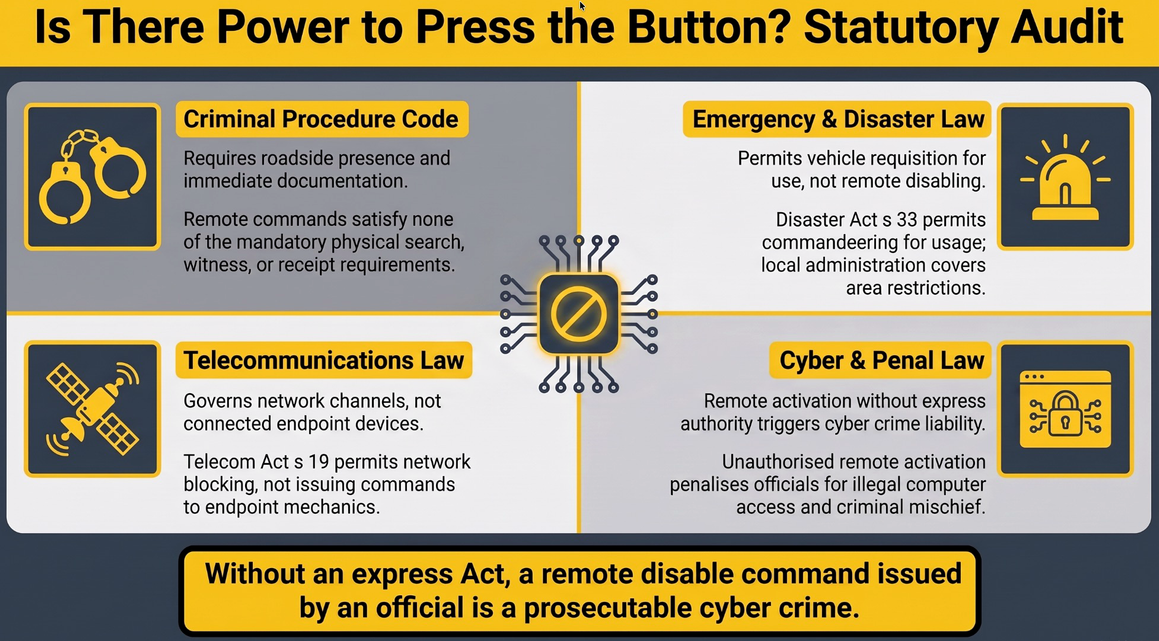
The transport powers have been covered. The remaining candidates are criminal procedure, emergency and public-security law, and telecommunications and cyber law.
Criminal procedure
The National Criminal Procedure (Code) Act, 2074 is the most promising analogy, because it already permits restraint of a vehicle without a prior warrant in urgent cases. Section 8 requires an investigator to secure a crime scene and take custody of evidence, including vehicles, against a receipt. Section 9 requires a written application for an arrest warrant, but allows emergency action where there are reasonable grounds to believe a suspect will escape or destroy evidence; the proviso to section 9(7) permits immediate search of a suspect’s person, belongings, vehicle or premises where evidence is at risk, with the search and seizure papers then submitted to the adjudicating authority for approval. Section 18 permits search and seizure on reasonable suspicion for scheduled offences, with written notice and reasons, local witnesses (s 19), a two-copy seizure memorandum and a receipt, and with an exception to the sunrise-to-sunset rule where delay would allow evidence to be lost or a suspect to flee (s 18(11)). Section 25 requires a contemporaneous investigation diary.
These are real powers over vehicles, and they show that Nepalese law accepts urgent restraint followed by judicial control. But every safeguard they contain presupposes that an officer has the vehicle in hand: witnesses who watch the seizure, a memorandum describing the vehicle’s condition and location, a receipt handed to the person from whom it was taken. A command issued from a control room to a vehicle no officer can see satisfies none of these elements. The Code contains no mechanism for electronic restraint of a vehicle at a distance, and its emergency provisions cannot be read to create one.
The Supreme Court has policed vehicle and property restraint strictly. In Singh & Brothers Construction v District Police Office, Dailekh (Writ No 080-WO-0405), police held a private vehicle in their yard without statutory authority or a court order; the Court called this a mockery of the rule of law and ordered release by mandamus. A blanket police order freezing an accused’s property across the country was quashed in Yam Kumar Shrestha v District Administration Office (decided 2082 Case No 077-WO-1079), and restraint of a non-accused person’s property without notice and hearing was held to violate Article 20 in Sushmita Thapa (Bista) v Land Revenue Office (Writ No 073-WO-1219). Maya Kusule v District Forest Office (Civil Appeal No 071-CI-0736) established that a vehicle cannot be confiscated from an owner who had no knowledge of or involvement in its illegal use. That last principle matters for any kill-switch design, because vehicles are routinely driven by people other than their registered owners.
Emergency and public-security law
The Disaster Risk Reduction and Management Act, 2074 allows the Government to declare a disaster crisis zone by Gazette notice (s 32) and then to order that private vehicles be recorded, taken into control and used for a specified period (s 33(1)(f)), and that transport and movement in the affected area be prohibited or restricted (s 33(1)(j)), with rent at market rates for requisitioned vehicles (s 38). The phrase “take into control” might seem capacious, but in context it is paired with “use” and with rental compensation. The power is to commandeer vehicles for rescue and relief, which is close to the opposite of disabling them. Clause (j) is an area-wide restriction on movement, not a power over the machinery of particular vehicles.
The Local Administration Act, 2028 lets a Chief District Officer issue prohibitory orders restricting movement and assembly in defined areas, with written reasons (s 6(4)) and appeal to the District Court within 35 days (s 6(6)). The Public Security Act, 2046 provides for preventive detention and movement-restriction orders against persons. Section 118 of the Transport Act allows area restrictions by posted notice. None of these targets an individual vehicle’s systems, and none supplies the procedural elements a remote command would require.
Article 273 of the Constitution is the exception. During a declared emergency, the President may issue orders having the force of law (Art 273(9)) and may suspend specified fundamental rights, including the property and movement freedoms engaged here (Art 273(10)). The declaration must be laid before Parliament within one month and approved by a two-thirds majority; it lasts three months and may be extended once for three more. A person harmed by an official’s bad-faith act may claim compensation within three months after the emergency ends (Art 273(12)). A presidential order could therefore, in principle, authorise temporary remote immobilisation in a declared emergency. Two limits follow. The power is confined to genuine constitutional emergencies of the kind Article 273(1) lists, under parliamentary supervision. And it can only use devices that already exist: an emergency order cannot conjure a nationwide installed base of kill switches.
Telecommunications and cyber law
Section 19 of the Telecommunications Act, 2053 allows the Government, in an emergency or for national security, to take temporary control of telecommunication lines and systems operated by licensees and to order interception, tracing or blocking of messages, returning the systems afterwards. The power runs against carriers’ networks. It would let the state block a kill switch’s communication channel; it would not let the state command a device connected to that channel.
The Electronic Transactions Act, 2063 grants no command powers at all. It works in the opposite direction. Section 45 penalises accessing a computer without the authorisation of its owner or responsible person, with a fine of up to Rs 200,000, imprisonment of up to three years, or both; section 46 penalises destroying, altering or impairing information in a computer system with intent to cause loss. The National Penal (Code) Act, 2074 penalises unauthorised access to information flowing through electronic media (s 298) and criminal mischief, which expressly includes obstructing the use or operation of a means of transportation (s 285, up to three years’ imprisonment and a Rs 30,000 fine, with compensation).
This inverts the usual framing of a regulatory gap. Without statutory authority, a disable command sent by an official to a vehicle’s electronic control unit is not merely ultra vires. It is a candidate for prosecution, and the law provides that the government sanction ordinarily required to prosecute officials does not extend to acts beyond official duty. Any Act authorising activation would therefore also have to supply the “authorisation” that the cyber and penal provisions recognise, and would need to make clear that commands outside its terms remain offences.
4. What kind of state action is remote immobilisation?
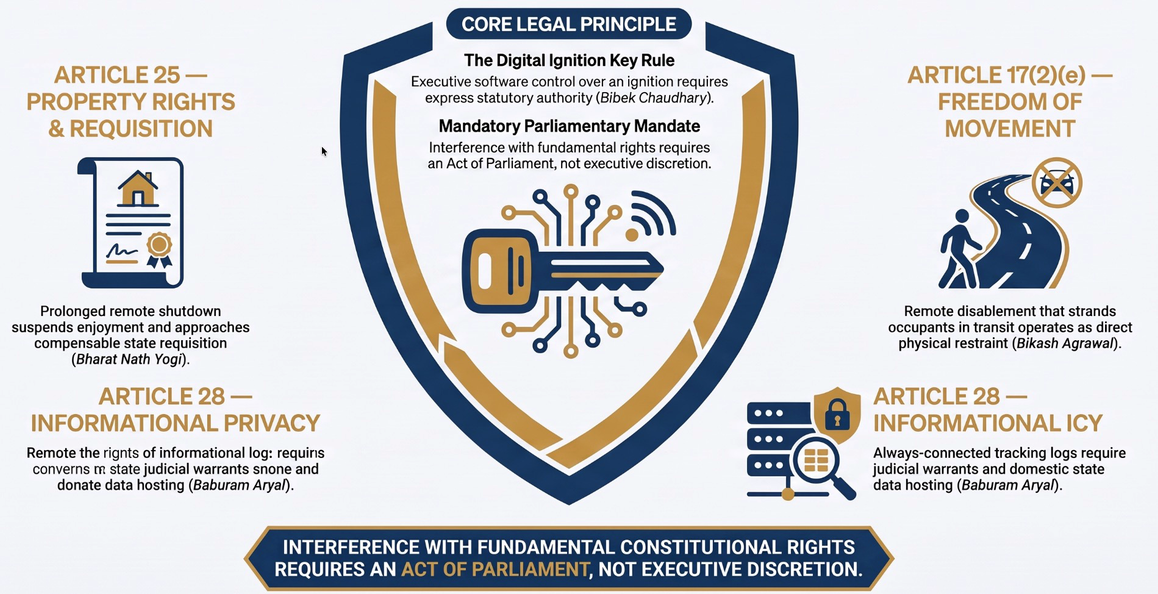
Classification matters because each constitutional right engaged makes its own textual demand for legislation. Remote immobilisation is at once a restriction of property, in some circumstances a restriction of movement, and, because of how the technology works, a form of surveillance infrastructure.
Property
Article 25(1) gives every citizen, subject to law, the right to acquire, enjoy, sell, gain business profit from and otherwise deal with property, and its Explanation confirms that “property” includes movable property. Article 25(2) bars the state, except for public interest, from requisitioning, acquiring or creating any right over a person’s property. Article 25(3) requires that the basis and procedure of compensation for a public-interest requisition be set by an Act.
Immobilisation leaves title untouched but suspends enjoyment, the attribute of ownership an owner actually experiences. A single short activation is a restriction on use. Repeated or indefinite activation approaches requisition in substance: the owner keeps the paper while the state decides whether the asset functions. The Supreme Court has recognised that state control short of a taking is compensable. In Bharat Nath Yogi v District Administration Office, Dang (Writ No 074-WO-0403, decided 2078), security forces had held private buses without legal procedure and returned them ruined; the Court ordered full compensation for the period of enforced state control and disuse. The Full Bench in Sanu Shrestha v Government of Nepal (NKP 2075 DN 9986) held that the state’s power over private property is not unlimited and must observe statutory limits, procedure and compensation.
Movement
Article 17(2)(e) guarantees freedom to move and reside in any part of Nepal, and Article 17(1) protects personal liberty. Neither guarantees a right to use a particular vehicle. Disabling a parked car leaves its owner free to walk, take a bus or borrow another car, so most immobilisation scenarios engage property rather than movement. The position changes where shutdown strands occupants on a highway or in a remote area, which operates as physical restraint, or where immobilisation is targeted to stop a particular person reaching an assembly or a lawyer. The proviso to Article 17(2) permits restrictions on movement only by an Act and only as reasonable restrictions on enumerated grounds, which include the interest of the general public.
One decision shows that the Court treats restrictions produced by software as seriously as those imposed by officers. In Bikash Agrawal v Transport Management Office, Ekantakuna (Writ Nos 079-WO-0175 and 081-WO-1338, decided 2082), errors in the transport department’s electronic licence and registration system had blocked licence renewals. The Court linked driving and licensing to Article 17(2)(e) and (f) and granted mandamus. An automated enforcement system that wrongly disables vehicles would face the same scrutiny, with the added difficulty that the error would strand people in real time rather than delay a renewal.
Privacy, and why a “pure” kill switch is not privacy-neutral
Article 28 makes the privacy of a person’s body, residence, property, documents, data, correspondence and character inviolable except in accordance with law. There needs to be a distinction between a device that merely immobilises the vehicle, which it treats as engaging property and movement, and one that continuously tracks location and status, which engages informational privacy. The distinction is useful but partly illusory. A device that can be disabled remotely must be reachable: it needs a network identity and must maintain, or periodically establish, a connection with a command server, and that server must know which device sits in which vehicle and who owns it. Even with no GPS module, the system generates a register of addressable vehicles linked to owners, records of connection and, above all, a log of every state command. All of that is personal information. The real design choice is between a data-minimal system and a data-rich one, not between a privacy-neutral system and a privacy-engaging one.
The Individual Privacy Act, 2075 would govern that data. It requires consent to collect personal data (s 12(2)), confines collection to officers authorised by law (s 23(1)), limits use to the purpose of collection (s 12(3)), requires notice of the time, nature, purpose and security of collection (s 23(4)), imposes security duties (s 25), and bars disclosure without consent except on specified grounds, including a written request from an investigating officer and a court order (s 26(1)(b)–(c)). Violations carry up to three years’ imprisonment, a fine of up to Rs 30,000, or both (s 29), and victims may claim compensation (s 31) within three months (s 30(2)).
There is a tension here that a kill-switch statute would have to resolve. On its face, section 26(1)(b) allows disclosure on an investigator’s written request. The Supreme Court has demanded more. In Baburam Aryal v Office of the Prime Minister (Writ No 069-WO-0268, NKP 2072 DN 9740), after police had gathered over 500,000 call-detail records and 30,000 SMS records without warrants during a murder inquiry, the Court held that communications metadata falls within Article 28 and cannot be collected without legal authority, judicial authorisation and safeguards. In Vishnu Prasad Ghimire v Office of the Prime Minister (Writ No 077-WO-0254, decided 2077), it read the Privacy Act as permitting collection of operational communications data only for specific investigations under specific judicial authorisation, rejecting blanket permissions. A statute that let the police both locate and disable a vehicle on a written request alone would sit uneasily with that line of authority.
The Court has also been alert to who holds citizens’ data. Beyond the domestic-storage condition in Basnet, it has held that exposing personal data to foreign contractors without statutory regulation violates Article 28 (Bhakti Ram Ghimire v Ministry of Physical Infrastructure and Transport, Writ No 073-WO-1097, decided 2074, concerning smart-card licences) and that state utilities must prevent supplier access to subscriber data (Rita Karki v Nepal Telecom, Writ No 080-WO-1299, decided 2081). For a kill switch the vendor question is sharper than for any database. Whoever operates the command server, whether a manufacturer, a telematics firm or a telecom operator, holds not just information about vehicles but a physical capability over them.
Legality: the digital ignition key
Across all three rights the controlling principle is the same: interference requires a clear legal basis, not general regulatory authority. The decision closest to a kill switch in substance is recent. In the Bibek Chaudhary writs against the Ministry of Home Affairs and the Ministry of Physical Infrastructure and Transport (Writ Nos 081-WO-0455 and 081-WO-0500, decided in Magh 2082), the Court is reported to have held that traffic police could not retain driving licences, registration certificates or ignition keys during enforcement without express authority in the Transport Act, because what cannot be done directly by law cannot be done indirectly through administrative practice. A kill switch is, functionally, a digital ignition key held by the state. If the Court will not allow an officer standing beside the car to pocket the key without an express statutory power, it is difficult to see it allowing a control room to disable the ignition by software on the strength of general powers.
The constitutional text points the same way. The movement proviso and Article 25(3) both require an Act, not merely “law”, and the Court’s delegated-legislation cases hold that subordinate instruments may be void on substantive, procedural or constitutional grounds (Srijana Adhikari v Office of the Prime Minister, Writ No 081-WC-0045). Remote immobilisation is the kind of policy choice that belongs to Parliament.
5. In what circumstances could activation ever be justified?
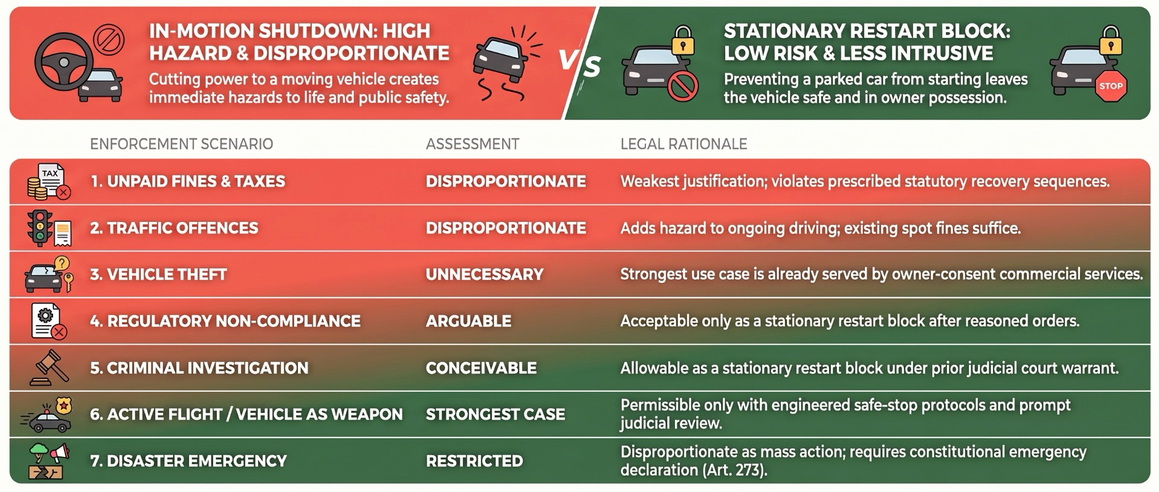
Suppose Parliament legislated. Proportionality would then decide which uses survive. The Court has asked whether a restriction rests on law, answers a pressing need, goes no further than necessary and is subject to effective remedies (Bikash Simkhada v Office of the Prime Minister, reported under Writ Nos 073-WO-1243); it has struck down extreme measures where a less disruptive option would achieve the same end (Santuana Subedi v Ministry of Urban Development, Writ No 074-WO-0520); and it applies balancing and necessity inquiries (Gita Lamichhane v Asitabh Lamichhane, Writ No 079-WO-1177). For each candidate use, the question is what lawful tool already exists, what remote immobilisation would add, and at what cost.
The variable that changes the proportionality answer
The research consistently ranks remote immobilisation as the most intrusive enforcement measure, above physical impoundment, chiefly because cutting power to a moving vehicle on a highway can kill its occupants and others. That ranking is right for a power to stop a running engine. It does not hold for a narrower power to prevent a stationary vehicle from restarting. A restart block on a parked car leaves the vehicle in the owner’s possession and avoids towing, yard fees and the damage risk of impounding. Measured against the physical detention that section 164 already permits, it may be the less intrusive option.
Proportionality is therefore not a fixed property of the technology. It depends on whether the statute confines activation to stationary vehicles, how long the block lasts, and how quickly it can be reversed. A statute permitting only restart blocking, with an engineered interlock against in-motion shutdown, would face a materially easier proportionality case than one permitting remote engine cut-off.
There is a countervailing consideration that the at-rest argument does not dispose of. Physical enforcement is costly: it needs an officer on the spot, witnesses and paperwork, and that cost is itself a brake on overuse. A remote command costs almost nothing and can be repeated across thousands of vehicles. The risk shifts from the severity of each intervention to the scale and selectivity of intervention. That brings the Court’s equality jurisprudence into play. In the challenge to the 2076 Cabinet decision phasing out public vehicles more than 20 years old (reported under Writ No 076-WO-0806), it struck down an exemption favouring one brand operating under identical conditions; and it has required regional registration restrictions to rest on statute and on objective road-capacity and safety grounds (Writ No 072-WO-0294). Activation that varied by person, region or vehicle class without an objective, safety-related basis would be vulnerable under Article 18.
The candidate uses
The table below applies these considerations to the circumstances this article identifies.
| Circumstance | Existing lawful route | What remote immobilisation adds | Assessment |
|---|---|---|---|
| Vehicle theft | Complaint (CrPC s 4); search and seizure (ss 8, 18); restoration on conviction (Penal Code s 247). Owner or contracted provider may immobilise with consent; police may request location data in writing (Privacy Act s 26(1)(b)). | Little: the owner can already act through a consent-based service. | State activation unnecessary. The strongest use case is already served by the consent model. |
| Traffic offences | Spot fines (Transport Act s 164); licence suspension (s 60); detention. | Nothing for completed offences. For ongoing dangerous driving, in-motion shutdown adds hazard. | Disproportionate. |
| Unpaid fines, vehicle tax, fees | Escalating suspension and cancellation (s 164(5)–(6)); registration suspension (s 40(1)(b)); demand, attachment and auction. | Coercive leverage outside the prescribed recovery sequence. | Weakest justification. Vehicle tax is also a provincial competence. |
| Regulatory non-compliance (expired registration, permit) | Reasoned suspension order; physical impounding if the vehicle is driven. | Automatic enforcement of a paper suspension. | Arguable only as a restart block after a reasoned order and appeal window; automation errors are a known risk. |
| Criminal investigation (vehicle as evidence) | Physical seizure with memorandum, witnesses and receipt (CrPC ss 8, 9, 18). | Preservation of a parked vehicle before officers arrive. | Conceivable as a restart block under prior court order, or with 24-hour ratification; innocent-owner protection needed. |
| Active flight; vehicle used as a weapon | Physical pursuit and interception; no remote power. | Ending a dangerous pursuit. | The strongest case for state activation, but only with an engineered safe-stop and prompt judicial review. |
| Disaster or public-security emergency | Area restrictions (Disaster Act s 33(1)(j); Local Administration Act s 6); requisition for use (s 33(1)(f)). | Mass immobilisation across an area. | Hard to reconcile with individualised justification. Only under Article 273 with parliamentary approval. |
Three observations follow from the table. Theft, the use most often offered to justify kill switches, is the one where state control adds least: the lawful path today is for the owner or the owner’s contracted provider to immobilise, the police to obtain location data, and officers to make a physical recovery. Revenue and traffic enforcement, the uses most likely to tempt an administration because they would scale, are the uses proportionality most clearly rules out, because the law already provides graduated tools and the Court has insisted that coercive recovery follow statutory sequence and notice. The tax cases are emphatic on this. The Court has quashed fees imposed by budget speech and directive rather than statute (District Forest Office, Panchthar v Manakamana Plywood Industries, Civil Appeal No 069-CI-0440) and account freezes made without the prior written notice required by section 104 of the Income Tax Act, 2058 (Global Construction v Inland Revenue Department, Writ No 076-WO-0413). And the uses that survive, ending a dangerous flight or preserving a vehicle as evidence, are exactly those where the criminal-procedure template of urgent action followed by judicial ratification already exists and can be adapted.
Necessity is not a substitute for authority
It might be argued that emergency activation could rest on necessity without legislation. Section 23 of the National Penal Code exempts an act done in good faith, without criminal intent, to avoid a probable greater harm to body, life or property that would certainly occur unless the act were done immediately, and section 25(1)(a) withdraws the right of private defence where there is time to obtain the protection of public authorities. The Supreme Court has held that necessity can justify emergency action only where harm is immediate and unavoidable and there is no lawful alternative, and that executive authorities may not invoke it to bypass constitutional and statutory procedure (Hikmat Kumar Karki v Province Head, Koshi Province, Writ No 080-WF-0012). Natural justice may be postponed to a post-decisional hearing where prior notice is genuinely impracticable, but a prior hearing can be excluded only by express statute (Mansingh Lama v Appellate Court Patan, NKP 2065 DN 7970). Necessity may excuse an individual act in an extreme case. It cannot supply a standing governmental power or the infrastructure that power would need.
6. What would legislation have to contain, and what could be left to regulations?
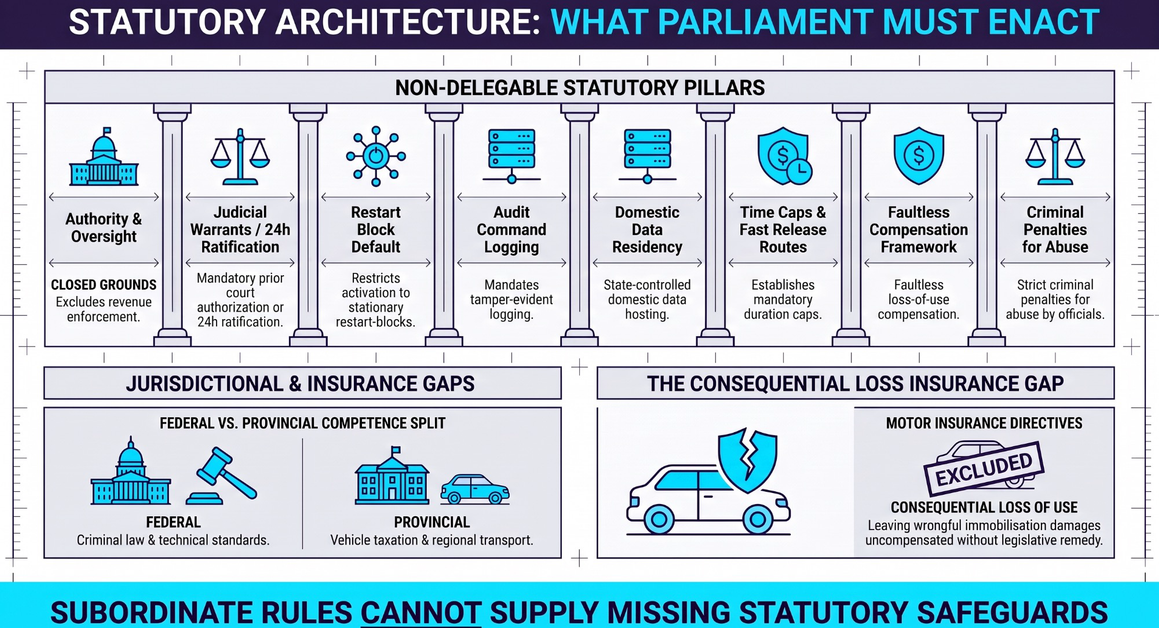
If Nepal wanted a lawful remote-immobilisation power, the Constitution and the case law leave little discretion about where its essential elements must sit. The movement proviso and Article 25(3) require an Act. Article 28 requires law, and the privacy decisions require specific judicial control of access. The delegation cases forbid subordinate instruments from supplying what the parent Act omits. Technical specifications, interface standards and reporting formats can be left to rules. The elements in the table below cannot.
Elements that would need to sit in the Act itself
| Element | What the Act would need to say | Why it cannot be left to rules |
|---|---|---|
| Grounds | A closed list of purposes, such as active flight endangering life or preservation of evidence in serious offences, excluding revenue and routine traffic enforcement. | Movement proviso and Art 25(2); absence-in-parent-Act doctrine. |
| Authorisation | Prior court order as the rule; emergency activation by a designated senior officer, submitted to a court within 24 hours, mirroring CrPC s 9(7). | Baburam Aryal; Vishnu Prasad Ghimire; exclusion of prior hearing requires express statute. |
| Mode and safety | Restart blocking as the default; in-motion intervention only by engineered safe-stop, for defined emergencies. | Proportionality; endangerment and negligence liability. |
| Duration and release | Maximum duration, automatic re-enablement, and a same-day route to a decision-maker. | 35-day appeals (Transport Act ss 171–172) are unfit for a disabled vehicle. |
| Logging and oversight | Tamper-evident record of each command: operator, authority, ground, time, vehicle state. | The investigation diary (CrPC s 25) is a physical record; ETA s 6 sets only general retention rules. |
| Data and vendors | Data minimisation; domestic, state-controlled hosting; limits on manufacturer, vendor and carrier access. | Art 28; Basnet; Bhakti Ram Ghimire; Rita Karki. |
| Compensation | Basis and procedure for compensation, including loss of use, without proof of fault for wrongful activation. | Art 25(3) requires an Act; existing remedies leave loss of use uncovered. |
| Offences | Specific offences for unauthorised, extended or malicious activation by officials, contractors or intruders. | General cyber and mischief offences do not reflect the danger to life. |
The remedies gap
Existing remedies show why compensation must be designed rather than assumed. An owner whose vehicle was wrongly disabled could seek certiorari, mandamus and interim orders under Articles 133 and 144. Damages would have to be pursued through instruments built for other harms. The Privacy Act’s compensation claim (s 31) addresses privacy injuries and must be brought within three months. A tort claim under section 672 of the National Civil Code requires proof of fault and must be brought within six months (s 684). Manufacturers and software suppliers face strict liability for defective products and services under section 685, with a one-year limit, and section 681 apportions joint tort liability by degree of fault. Under section 266 of the National Civil Procedure Code, compensation covers actual loss, loss of income and additional loss, but not remote losses. An official who acts beyond competence or dishonestly may be personally liable (Civil Code s 51 proviso), and losses caused by bad-faith or negligent officials may be recovered from them (Good Governance (Management and Operation) Act, 2064, s 22(7)).
Insurance does not close the gap. The Motor Insurance Rate Directive, 2073 excludes consequential loss and electrical or mechanical breakdown, so a vehicle that is wrongly immobilised and simply sits idle generates no claim for lost earnings. Crash damage from a sudden shutdown would likely be covered as an accidental external cause, and malicious remote interference only under the riot, strike and malicious-damage endorsement. The Property Insurance Directive, 2080 excludes loss caused by an authorised public body; how far comparable reasoning would apply to a lawful government activation under a motor policy is something that needs further research. Third-party cover is mandatory under section 163 of the Transport Act, and the Insurance Authority’s decisions treat it as non-waivable, so insurers would pay victims of a crash caused by an activation and then pursue the responsible party by subrogation. A kill-switch statute would therefore need to allocate liability among the state, the system operator and vendors in advance. Otherwise the most common harm, loss of use, falls on the owner, and the largest, crash losses, reaches the state indirectly through insurers’ recovery claims.
Who would legislate
The constitutional division of powers adds a further constraint. Telecommunications and radio frequency are federal (Schedule 5, item 8), as are national standards (item 13), national transport policy (item 20) and residual powers (item 35). Vehicle tax and transport are provincial (Schedule 6, items 4 and 20); peace and security is concurrent (Schedule 7, item 3); and municipal police are a local competence (Schedule 8, item 1). Executive responsibility is split between the Ministry of Physical Infrastructure and Transport (vehicle standards and road safety), the Ministry of Communication and Information Technology (telecommunications), the Office of the Prime Minister and Council of Ministers (cyber and data security) and the Ministry of Home Affairs (internal security and police), under the Allocation of Business Rules, 2083.
A federal Act could set technical, telecommunications and data rules and confer an activation power for criminal and security purposes. But any activation tied to provincial vehicle tax or provincial transport permits would engage provincial competence, and the question of which police force may issue a command to a vehicle registered in one province and travelling in another would need federal law under Article 268. That is a further reason to keep any power confined to criminal and security purposes, where federal competence is clearest.
The legislative trajectory
Nepalese legislation has already answered the analogous question for electronic devices. The research identifies provisions in organised-crime and money-laundering legislation, including amendments in 2080 and 2081, under which intercepting telecommunications or accessing the system of a computer or other electronic device requires prior permission from a court. A command that disables a vehicle’s electronic control unit is a form of access to an electronic system. The statutory template Parliament has chosen for that kind of intrusion is prior judicial permission under an express Act, not executive discretion under a general power.
7. So, can the Government install a kill switch in your ride?
Not under current law, and not by regulation. The Government’s general regulatory authority over vehicles is substantial: it can set standards, refuse and suspend registration, require identification hardware, stop, fine, detain and confiscate. What it lacks is a specific power to disable a privately owned vehicle at a distance, and none of the general powers can be converted into one. An installation mandate imposed by rule or standard would be vulnerable as a condition with no rational connection to the fitness, emissions and identification purposes of the Transport Act, although the RFID precedent means the challenge would be contested rather than certain. A power to activate would require an Act of Parliament, and until one exists an official who sent a disable command could face liability under the cyber and penal provisions that protect every other computer system.
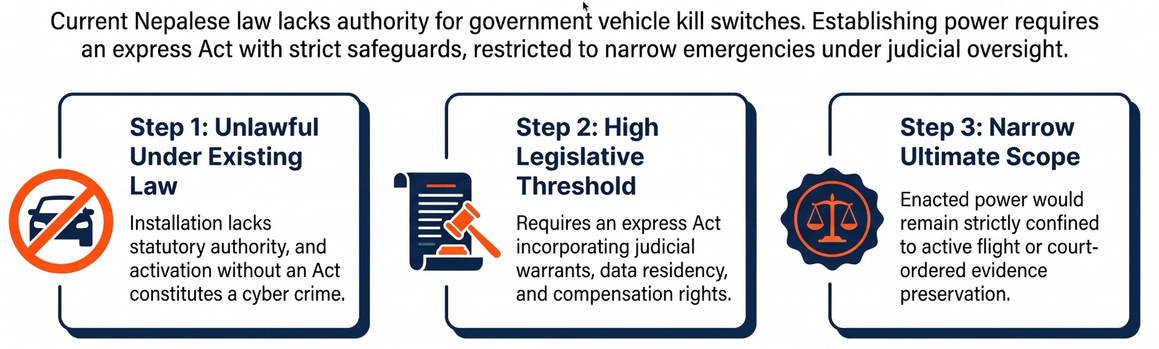
If Parliament acted, the Constitution would narrow the result sharply. A defensible statute would exclude revenue collection and routine traffic enforcement, default to restart blocking rather than engine cut-off, require prior judicial authorisation or prompt ratification, cap duration, log every command, keep data and control inside the state, and provide compensation for loss of use. What would remain is a narrow tool for ending dangerous flights and preserving evidence: a modest gain over the physical powers the police already hold, and a long way from a switch in every vehicle that the state could use at will.