
1. The Practical Problem and the Argument in Brief
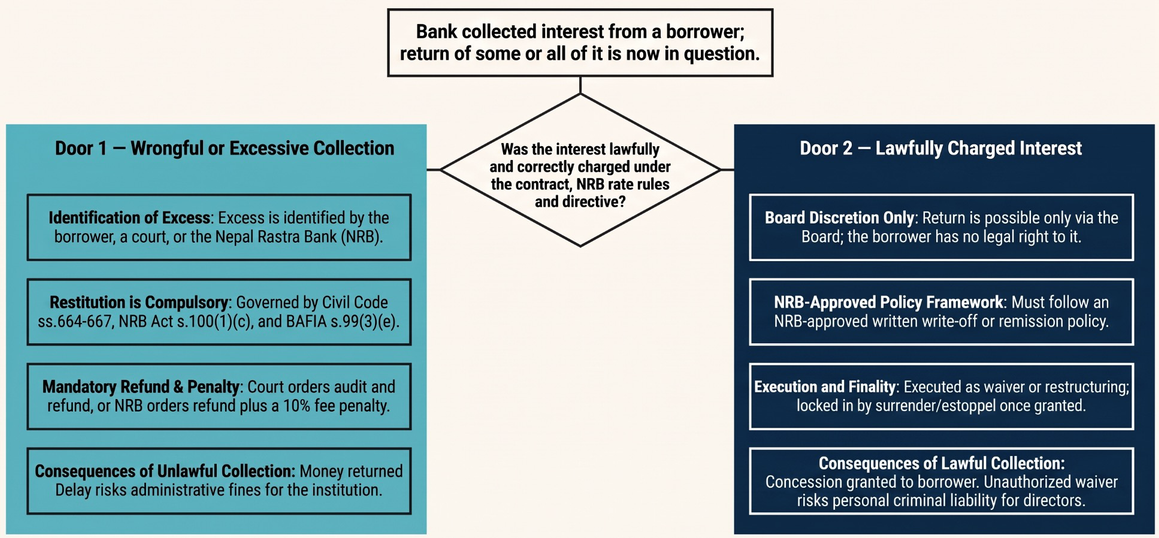
A borrower who has been charged too much interest and a borrower who wants relief from interest correctly charged present a bank with what looks like the same request: give some of the interest back. Nepali banking practice treats them as opposite events. The first sits inside a body of compulsory law that the borrower can force into motion through a court, a tribunal, or a regulatory complaint. The second sits inside a body of permissive law that only the bank’s own board can activate, and only inside a procedural frame the regulator built specifically to stop that discretion from being used loosely. The distinction sounds technical. It is in fact the hinge on which most disputes about interest in Nepal turn, and it explains outcomes that would otherwise look inconsistent – a borrower who obtains a full refund with interest from a chartered-accountant audit ordered by the Supreme Court, and another borrower whose demand for exactly the same relief is dismissed because the interest he wants waived was never unlawfully charged to begin with.
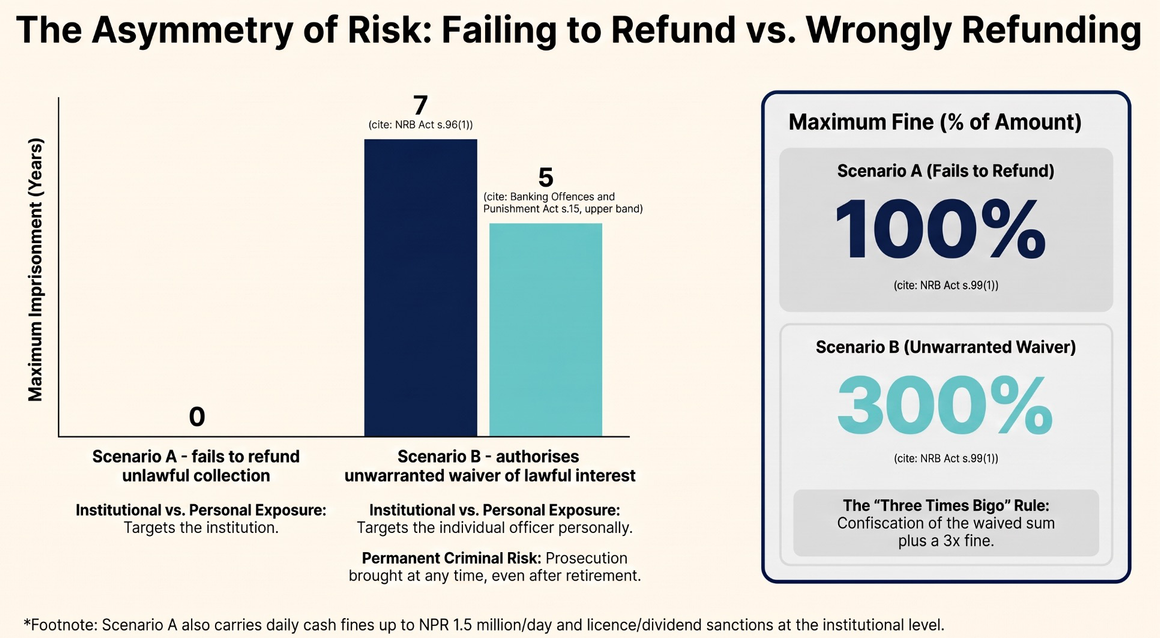
The surface explanation for why banks resist returning interest is that they have a commercial incentive to keep it. That explanation is incomplete, and it cannot account for two things the evidence shows plainly. First, NRB directives now compel banks to return overcharged fees automatically, with an additional ten per cent penalty credited to the customer’s account without any need to litigate – the regulator has converted part of the compulsory door into a self-executing rule that no longer depends on bank willingness at all. Second, and more tellingly, the law makes it more dangerous for a board to authorise an unwarranted waiver of interest correctly and lawfully charged than to withhold a refund the bank was never entitled to keep. An officer who approves an improper waiver faces confiscation of the waived sum, a fine of up to three times that amount, and imprisonment of up to seven years; an institution that merely fails to refund an overcharge faces administrative fines and corrective orders that do not carry the same personal criminal exposure. A commercial incentive to retain interest cannot explain why boards would rather refuse a sympathetic borrower than risk being wrong about their authority to help.
What is actually happening is that Nepali banking, tax, and civil law have built two structurally different regimes for the same economic act – the transfer of money from a bank back to a borrower – and attached radically different consequences to misclassifying which regime applies. The first regime, restitution for unlawful or excessive collection, treats withholding as the wrong and return as the correction; it is enforced by courts applying unjust-enrichment doctrine from the Civil Code, by Nepal Rastra Bank’s supervisory and corrective powers, and now by a self-executing directive-level refund-plus-penalty rule for fee overcharges. The second regime, discretionary return of lawfully accrued interest, treats the interest as the bank’s own asset; giving it away is legally possible only through a Board-approved, NRB-vetted written policy adopted precisely because the regulator judged that undocumented discretion over write-offs and remissions invites abuse. Between these two regimes sits a third, quieter mechanism – the prudential reversal of accrued interest income into a regulatory reserve when a loan turns non-performing – which looks like a refund in a bank’s financial statements but does nothing at all to the borrower’s outstanding debt.
This report argues that the practical shape of interest-refund practice in Nepal is set less by which of these regimes formally applies than by the asymmetric liability a bank faces for getting the classification wrong, and that restructuring – not waiver – has become the dominant channel through which lawfully accrued interest is actually reduced for distressed borrowers, precisely because restructuring converts a discretionary concession into a provisioned, reportable, rule-bound transaction that a board can defend. Four propositions carry the argument. First, restitution for wrongful or excessive collection is a compulsory legal duty, enforced through courts and now partly automated by directive, and its scope is expanding faster for fees than for interest itself. Second, discretionary waiver of lawfully charged interest is deliberately narrowed by governance architecture designed to eliminate unstructured judgment, and once exercised through a negotiated settlement it is locked in by the doctrines of surrender and promissory estoppel. Third, the liability regime attached to the two doors is asymmetric in a way that pushes banks toward inaction rather than generosity in ambiguous cases. Fourth, restructuring functions as a conditional, provisioning-triggering substitute for waiver that shifts the cost of relief onto the bank’s own capital position rather than treating it as a free-standing entitlement, which is why the scale of relief available to any one borrower is bounded by the bank’s provisioning capacity rather than by the merits of the request.
2. The Compulsory Door: Restitution for Unlawful or Excessive Collection
Where a bank has collected interest it was never entitled to charge, Nepali law does not treat repayment as a favour. It treats the retention as the violation, and restitution as the remedy that follows automatically once the overcharge is established.
The clearest statement of this principle comes from the Supreme Court’s treatment of Purna Bahadur Ghimire v. Himalayan Bank Ltd., Dharan Branch, Supreme Court, Case No. 071-CI-1397/073-CI-0728. The borrower had serviced an overdraft and service loan of roughly NPR 14,75,000 for years before the bank, on final settlement, demanded an additional Rs 81,000 in back-dated penal and double interest tied to a period when the loan had briefly been classified as bad debt. The borrower alleged Rs 62,845 of the demand was unjustified – comprising duplicated interest, penal interest, and closing fees – and sued for judicial re-accounting. The Supreme Court did not simply adjudicate the dispute on the pleadings; it ordered an independent chartered-accountant audit of the loan ledger and held that whatever excess the audit uncovered “must be retroactively refunded to the borrower with interest.” An execution decree later fixed the excess at Rs 9,071.59. The remedy the Court reached for was not damages, and not a negotiated settlement – it was the plain restoration of money the bank should never have taken, calculated by an independent auditor rather than left to the parties’ competing arithmetic.
TABLE: What Changes, Legally, Once a Collection Is Classified as Wrongful Rather Than Lawful
Source: Purna Bahadur Ghimire v. Himalayan Bank Ltd. (Case No. 071-CI-1397/073-CI-0728); Anil Kumar Chhetri v. Rastriya Banijya Bank (Case No. 069-WO-1430); National Civil Code, 2074, ss. 664, 667; BAFIA, 2073, s. 99(3)(e).
| Dimension | Wrongful or Excessive Collection | Lawfully and Correctly Charged Interest |
|---|---|---|
| Legal basis for return | Violation of contract, NRB rate caps, or accounting error (Civil Code s.664; BAFIA s.99(3)(e)) | Valid credit contract, published base rate, BAFIA framework |
| Borrower’s status | Enforceable legal right to restitution (कानूनी अधिकार) | No legal right; may only request a discretionary concession (तजविजी सहुलियत) |
| Bank’s obligation | Compulsory duty to audit, recalculate, and refund with interest | Commercial discretion of the Board, exercisable only under an NRB-approved written policy |
| Who can compel action | Borrower (via court or tribunal), or NRB on its own supervisory authority | No one; the Board alone decides whether to act |
| Effect once acted upon | Restitution restores the position that should always have existed | Waiver, once granted and relied upon, is locked in by surrender/estoppel doctrine for both sides |
That reasoning is not confined to one case. In Shanti Maharjan v. Agriculture Development Bank Ltd. et al. (Case No.: 080-DP-2487), the High Court in Patan enforced an NRB directive compelling refund of interest collected above rate caps or base-rate spread limits, holding that banks are “legally obligated to credit or refund such overcollections to the borrower’s account.” In Ratna Hotel Private Limited v. Sunrise Bank Limited (Case No.: 081-DP-0332)- High Court, Biratnagar, a bank had debited a 0.5 per cent management fee on a Rs 35 crore facility that was never disbursed; the court treated retention of a fee for a loan that never existed as per se illegal and ordered a full refund. Across these decisions the same structure recurs: courts do not ask whether the bank wishes to return the money; they ask only whether the collection exceeded what the contract, Nepal Rastra Bank’s rate rules, or an applicable directive permitted, and if it did, restitution follows as a matter of course rather than of discretion.
The statutory basis for treating this as compulsory rather than discretionary long predates any individual judgment. The Nepal Rastra Bank Act, 2058 gives NRB power to fix interest-rate policy (s. 5(1)(g)) and to require that any entity taking deposits or making loans set interest strictly in line with NRB’s prescriptions (s. 77); it backs that power with authority to fine an institution up to the full value of any violation (s. 99(1)) and to issue binding written orders requiring “corrective steps” to end a repeated violation (s. 100(1)(c)). BAFIA, 2073 goes further, giving NRB an explicit restitutionary power: under section 99(3)(e), where a bank has taken or given anything contrary to the Act, NRB may order recovery of “such service, facility, or the amount thereof, together with interest as per prevailing law” from the person who benefited. Section 99(3)(e) is restitution-shaped rather than merely punitive, and supplies exactly the “undo the wrong” power that a stop-the-violation order under section 100(1)(c) would otherwise lack.
| LEGAL TEXT – Bank and Financial Institutions Act, 2073 (2017), s. 99(3)(e) ORIGINAL LANGUAGE “यस ऐन विपरीत वा अस्वाभाविक तलव भत्ता तथा अन्य सुविधा कुनै बैंक वा वित्तीय संस्थाले लिएको वा दिइएको भएमा त्यस्तो सम्पूर्ण सेवा सुविधा वा सो बापत लाग्ने रकम तथा प्रचलित कानून बमोजिमको ब्याज त्यस्तो सेवा सुविधा दिने व्यक्तिबाट असुल उपर गर्ने।” CONVENIENCE TRANSLATION “If any bank or financial institution has taken or given any remuneration, allowance, or other benefit or facility contrary to this Act, or has taken or given an unnatural [i.e. excessive/unwarranted] payment, such entire service or facility, or the amount payable therefor together with interest as per the prevailing law, shall be recovered from the person who provided such service or facility.” |
At the level of ordinary civil law, the same result follows from general obligations doctrine rather than banking-specific statute. The National Civil Code, 2074 recognises unjust enrichment as an independent source of civil liability (s. 664), requires a person who receives money by mistake to return it (s. 665, solutio indebiti), and requires a debtor who discovers he paid a sum he did not owe to be repaid once he proves the debt was not payable (s. 666). Where the recipient acted in bad faith – arguably true whenever a bank charges a rate it knows or ought to know exceeds NRB’s rules – section 667 requires return of the principal together with interest chargeable from the date of receipt to the date of refund, plus compensation for any loss the retention caused. None of this depends on banking regulation at all; a bank that overcharges interest is, in Nepali civil law, simply a person unjustly enriched, and the Code’s answer to unjust enrichment is restitution, not discretion.
| LEGAL TEXT – National Civil Code, 2074 (2017), ss. 664(1) and 667(1) ORIGINAL LANGUAGE स. ६६४(१): “कुनै व्यक्तिले कानूनसङ्गत काम गर्नु पर्ने वा दायित्व पूरा गरिदिनु पर्ने कारण बिना कसैबाट कसैले कुनै लाभ वा सुविधा प्राप्त गरेमा त्यसरी लाभ वा सुविधा प्राप्त गर्ने व्यक्तिले अनुचित समृद्धि प्राप्त गरेको मानिनेछ।”स. ६६७(१): “कसैले आफ्नो दाबी नपुग्ने कुनै रकम वा वस्तु कसैबाट बदनियतपूर्वक प्राप्त गरेमा निजले त्यो रकम वा वस्तु र त्यो रकम वा वस्तु प्राप्त गरेको दिनदेखि फिर्ता गरेको दिनसम्म त्यो रकममा कानून बमोजिम लाग्ने ब्याज वा त्यो वस्तुबाट प्राप्त गरेको लाभ वा प्रतिफल समेत फिर्ता गर्नु पर्नेछ।” CONVENIENCE TRANSLATION s. 664(1): “If any person receives any benefit or facility from another without a lawful act to be done or a liability to be performed, the person so receiving the benefit or facility shall be deemed to have acquired unjust enrichment.”s. 667(1): “If any person in bad faith receives any amount or thing from someone to which he or she has no valid claim, he or she shall return such amount or thing along with interest legally chargeable on that amount, or the benefit or yield derived from that thing, from the date of receipt until the date of refund.” |
The Civil Code contains one further provision whose significance is easy to miss: section 480(2) states that where a creditor takes compound interest in violation of the prohibition on interest-on-interest, the excess “shall be set off against the principal sum, and if the principal has already been settled, such interest must be refunded” – and section 492(1) then removes any statute of limitation for a suit to recover compound interest or interest above the ten per cent statutory ceiling. Ordinary civil claims in Nepal are time-barred; a claim to recover unlawfully compounded or excessive interest is not, at least under the general Code. The clearest sign that Nepali law treats wrongful collection as a continuing wrong rather than a completed transaction is that it declines to let the passage of time cure it.
Nepal Rastra Bank’s own directive-making power has, in the years covered by Unified Directive, begun to convert part of this compulsory-restitution logic into something closer to a self-executing rule that no longer requires a lawsuit at all. Directive No. 20 provides that where a fee is collected under an unauthorised heading, or in excess of the prescribed ceiling, the institution “must refund the fee to the customer’s account together with an additional 10 per cent penalty” – and the same 10 per cent surcharge applies where a service was provided, and charged for, without the customer’s consent. A processing fee collected on a loan application that is later rejected must be refunded immediately, without any customer complaint or audit being necessary. This is restitution built into the ordinary operation of the regulatory system rather than restitution that has to be litigated case by case, and it marks a genuine shift from the older model – visible in the court decisions above – in which a wronged borrower had no choice but to sue and wait for a judicially ordered audit.
What the directive does not yet do, on the evidence available, is extend the same self-executing formula to interest itself, as opposed to fees. NRB’s authority to order a bank to recalculate and refund overcharged lending interest – as against an unauthorised fee – rests on inference from the general corrective-order power in section 100(1)(c) of the NRB Act and the restitutionary power in section 99(3)(e) of BAFIA, not on express directive language naming “interest” as a refundable category in the way Directive No. 20 names “fees.”
The distinction matters because it marks the outer edge of the compulsory door: a borrower who has been charged an unauthorised fee can point to a rule that requires refund automatically; a borrower who has been charged interest above a lawful cap must still, in practice, rely on a court’s willingness to read the general corrective-order power as reaching that far – which, as the cases above show, courts have consistently been willing to do, but only after litigation, not by operation of the directive alone.
3. The Discretionary Door, Narrowed by Design
Where interest has been charged exactly as the contract, the published base rate, and NRB’s directives permit, Nepali courts draw the opposite conclusion from the one they draw for wrongful collection: the borrower has no legal right to have any of it returned. The Nepali term the courts and the regulatory material use for this – तजविजी सहुलियत, discretionary concession, as against कानूनी अधिकार, legal entitlement – marks the line precisely.
The leading authority is direct on the point. In a dispute over an overdraft and demand loan, the court held expressly that “a borrower cannot demand an interest waiver as a matter of right,” and that whether to grant a rebate “rests entirely within the discretion of the Bank’s Board of Directors.” Refusal to concede does not excuse the underlying debt, and it gives the borrower no cause of action. Two further decisions, examined as a case study in Chapter 5, confirm that the discretionary door swings freely only up to the moment a concession is actually granted and accepted: once a Board-approved concession is executed, the Principle of Surrender (समर्पणको सिद्धान्त) bars the borrower from reopening it, and once a written waiver is communicated and relied upon, promissory estoppel bars the bank from revoking it. Estoppel and surrender, in other words, lock both sides into the bargain the moment it is struck – for better or worse.
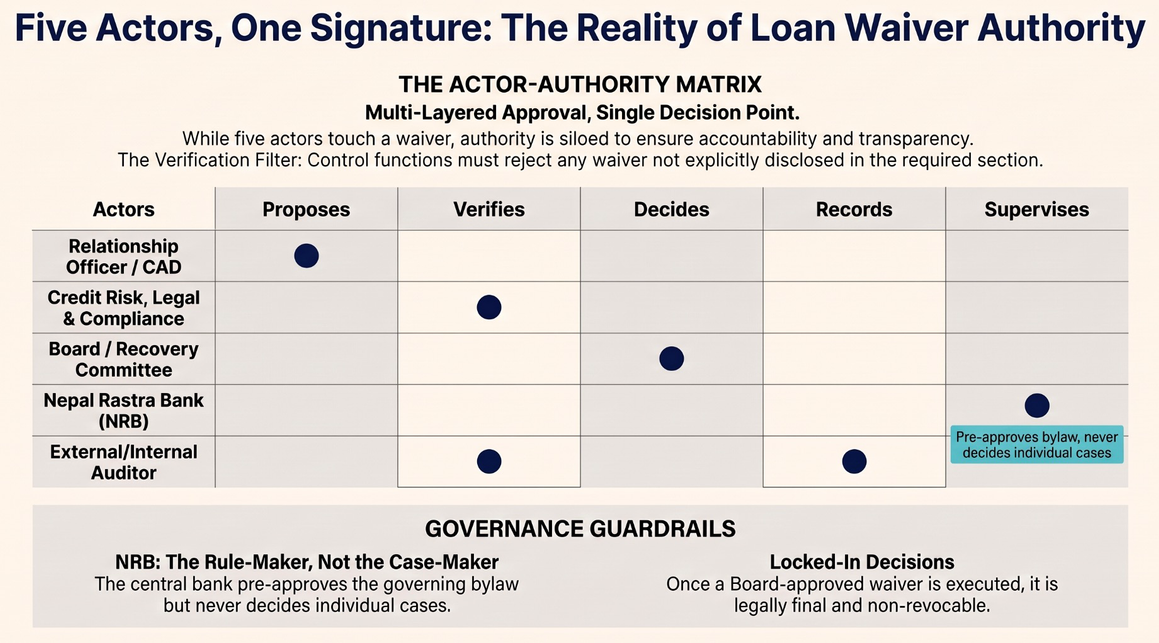
The reason the discretion is confined so tightly to the Board is not incidental; it is the express purpose of the governing directive. Directive No. 2, clause 12(8) requires every licensed institution to adopt “a clear and transparent policy” on loan write-off and interest remission, submitted to and approved by NRB before it can be used, specifically because unstructured discretion over remission and write-off, in the regulator’s own words, risks “excessive authority resting with the decision-maker” (निर्णयकर्तामाथि अत्याधिक अधिकार रहन जाने सम्भाव्यता).
The rule does not merely permit a written policy; it exists because the regulator judged that discretion exercised outside a pre-cleared written framework is itself the risk to be managed, independent of whether any particular waiver turns out to be justified on the merits.
TABLE: Five Mechanisms Often Loosely Called ‘Giving Interest Back’, Compared
Source: Internal credit and write-off policy documentation reviewed for a major Nepali commercial bank (Credit Manual; By-Law for Loan Write-Off; Credit Policy; Operation Manual).
| Mechanism | Legal Effect on Borrower’s Liability | Approval Authority |
|---|---|---|
| Loan write-off | Does not extinguish liability; recovery efforts and legal suits continue | CEO (up to NPR 1.5 million) or Board of Directors (above that threshold) |
| Waiver / remission / rebate | Legally extinguishes liability for the waived portion; bank surrenders the right to collect it | Board of Directors, or a delegated Recovery Sub-Committee under Board-approved authority |
| Settlement concession (one-time settlement) | Extinguishes the full debt once the negotiated lump sum is paid on approved terms | Escalating internal recovery/credit chain culminating in CEO approval |
| Accounting reversal | Corrects an accounting error; does not represent forgiveness or reduce a legitimately owed balance | Head of Country Operations or Branch Manager, under ordinary expense-authority limits |
| Cash refund to borrower | Direct cash payout, e.g. of surplus auction proceeds after all bank dues are satisfied | Recovery/collateral-management function, following auction settlement procedure |
That architecture is visible, concretely, in how an individual commercial bank actually operationalises it. Internal credit documentation at one major Nepali commercial bank requires that “all concession/waivers… be explicitly mentioned in the appropriate ‘Concession/Waiver Section’” of the credit proposal, with the consequence that any discount or waiver mentioned anywhere else in the file, however clearly documented, “shall be treated as invalid.” Control functions – credit administration, legal, and compliance – are instructed not to entertain an undisclosed waiver at all. The internal document also fixes a floor below which no interest reduction may go: an applied rate cannot fall below the bank’s own three-month average base rate, regardless of what a relationship manager and a distressed borrower might otherwise be willing to agree between themselves. The effect is to convert the Board’s discretion into something closer to a licensing decision, made against a fixed template, rather than a case-by-case act of commercial judgment – precisely the outcome the directive’s underlying rationale sought.
Corporate and securities-governance layers reinforce the same narrowing from a different direction. Because loan-interest terms are, under the general Companies Act, 2063 s. 34(3), a matter “governed by a deed or contract concluded between the creditor and the borrower,” a decision to give some of that contractual entitlement away is, on its face, an ordinary commercial decision for the company’s board. But section 16(5) of the same Act removes any doubt that this contractual framing displaces regulatory control: “nothing in this Section shall be deemed to limit the direction given by any regulatory body… under the prevailing law.” A listed bank’s waiver of a material amount of interest is accordingly not merely a private contractual choice dressed up as governance; it sits inside NRB’s directive-level pre-clearance regime by express statutory instruction, and a board that treated it as purely a matter of commercial discretion under company law alone would be proceeding on an incomplete reading of its own governing statute.
The narrowing is deliberate, and on the evidence it works: none of the “lawful interest” cases surveyed here show a court second-guessing a Board’s decision not to grant a concession, and every successful challenge to a granted concession turns on the bank trying to withdraw a benefit already promised in writing, not on a borrower trying to compel one that was never offered. The discretionary door opens only from the inside, and only through the specific, pre-cleared, NRB-vetted mechanism the regulator built to prevent it opening any other way.
4. The Asymmetry That Explains Bank Behaviour
If the substantive law stopped at the two doors described above, a rational bank facing a borderline case – is this collection technically excessive, or is it a lawful charge the borrower merely wants reduced – would simply pick whichever characterisation the facts more plausibly supported and act accordingly. The evidence suggests something different happens in practice, and the reason lies in how differently Nepali law punishes a bank for choosing wrongly, depending on which way it errs.
TABLE: The Two Ways a Bank Can Be Wrong About Interest, and What Each Costs
Purpose: To set the exact statutory consequences of failing to refund an unlawful collection against those for an unauthorised waiver of lawful interest, showing the two are different in kind, not only in degree.
Source: Nepal Rastra Bank Act, 2058, ss. 95, 96, 99, 100, 107; Bank and Financial Institutions Act, 2073, ss. 99, 100, 114; Banking Offences and Punishment Act, 2064, ss. 7, 9, 12, 15, 17.
| Dimension | Scenario A: Fails to Refund Unlawful Collection | Scenario B: Waives/Refunds Lawful Interest Without Authority |
|---|---|---|
| Institutional fine | Up to 100% of the violation amount (NRB Act s.99(1)) | Confiscation of the waived sum plus a fine of up to 300% of that sum (NRB Act s.96(1)) |
| Individual officer liability | Not inherently personal unless bad faith/negligence is shown (BAFIA s.99(4)–(6)) | Personal by design; the officer who authorised the waiver is the object of the offence (NRB Act s.95(1)) |
| Imprisonment | None identified for the institutional failure itself | Up to 7 years (NRB Act s.96(1)); up to 5 years under Banking Offences and Punishment Act s.15 for related asset misuse |
| Removal / disqualification | Possible under BAFIA s.99(3)(c) if linked to a wider compliance failure | Same removal and five-year sector-wide ban (BAFIA s.99(3)(c)), triggered directly by the unauthorised act |
| Limitation period | Ordinary limitation applies to civil claims; NRB corrective action not time-barred | None – prosecution may be brought at any time, including after retirement (Banking Offences and Punishment Act s.17(2)) |
Failing to refund an overcharge exposes a bank to an administrative regime: NRB can order the fee returned with the ten per cent surcharge, fine the institution up to the full amount of the violation under NRB Act section 99(1), and – if non-compliance continues – impose escalating daily cash fines that rise from roughly NPR 1 million to NPR 1.5 million per day under BAFIA section 100(1). These are severe consequences for the institution, but they are civil and administrative in character, and they attach to the bank rather than, in the first instance, to any individual officer.
Authorising an unwarranted waiver of interest that was in fact lawfully owed exposes the individuals who approved it to something categorically different. NRB Act section 95(1) makes it an offence to take or give interest contrary to the bank’s own approved policy; section 96(1) then prescribes confiscation of the waived amount, a fine of up to three times that amount, or imprisonment of up to seven years. BAFIA section 114 separately allows the institution to recover, from the director personally, any amount taken for personal benefit in the course of the bank’s business, and BAFIA section 99(3)–(6) permits NRB to order recovery of any loss caused by a director’s bad faith or negligence directly from that individual’s personal and family property, treated as government arrears if unpaid. The Banking Offences and Punishment Act, 2064 adds a further layer: unauthorised financial concessions can constitute misuse of banking assets under section 9, triggering restitution of the full amount, a fine equal to that amount, and imprisonment – and, under section 17(2), prosecution can be brought “even after retirement,” with no limitation period at all.
| LEGAL TEXT – Nepal Rastra Bank Act, 2058 (2002), s. 107(1) ORIGINAL LANGUAGE “…तर जानाजान वा गलत मनसायबाट गरिएको कुनै कामको सन्दर्भमा भने निजहरु व्यक्तिगत रूपमा जवाफदेही हुनेछन्।” CONVENIENCE TRANSLATION “…but in respect of any act done knowingly or with wrongful intent, they [officials and employees of Nepal Rastra Bank] shall be personally liable.” |
Set the two exposures side by side and the asymmetry is stark. A bank that wrongly keeps money it should have refunded faces institutional fines and corrective orders. A director who wrongly authorises the return of money the bank was entitled to keep faces personal criminal liability, treble confiscation, and up to seven years in prison, with no limitation period and no shelter once he or she has left the institution. Section 107(1) reinforces the point on its face: officials are protected from liability for acts done in good faith, but not for acts done knowingly or with wrongful intent – and the burden of showing that a discretionary waiver was not merely well-intentioned but affirmatively authorised under a pre-cleared policy falls on the officer who approved it, not on the regulator who later questions it.
| A director who wrongly withholds a refund faces a fine. A director who wrongly grants one can face imprisonment for it. That asymmetry, not the substantive law, is what actually shapes a board’s answer to a borrower asking for help. |
This is not a claim that any court or regulator has stated in these terms; no judgment or directive in the material reviewed for this report frames the two liability regimes as a deliberate design for shaping bank behaviour, and the inference that the asymmetry actually deters marginal, good-faith waivers is this report’s own reading of the incentive structure rather than a documented finding. This is only an analytical inference.
But the structure itself is not in doubt, and it predicts a specific and testable pattern: banks should be more willing to litigate or audit their way toward a wrongful-collection refund – where the downside of inaction is institutional, bounded, and administrative – than to exercise discretionary waiver authority in a borderline case where the downside of getting the classification wrong is personal, unbounded in practice, and criminal. Every mechanism examined in the next chapter is consistent with exactly that pattern: relief for distressed, but not clearly wronged, borrowers flows almost entirely through restructuring – a channel that is expensive to the bank in provisioning terms but cheap to the individual officer in liability terms, because it is executed under a pre-approved, quantified, NRB-reportable formula rather than under open discretion.
A second, quieter confusion compounds the asymmetry rather than resolving it. When a loan turns non-performing, NRB’s accounting directives require a bank to move any interest income accrued but not received in cash within fifteen days of fiscal year-end out of distributable retained earnings and into a Regulatory Reserve – an “interest reversal” that appears in the bank’s own financial statements and, on cursory reading, looks exactly like the interest being given back. It is not. The reversal is an internal transfer between two equity accounts inside the bank’s own balance sheet; it has zero effect on the amount the borrower still owes, and the amount is transferred straight back to retained earnings the moment the interest is actually collected in cash. A genuine customer refund, by contrast, is a cash or account credit that directly reduces the borrower’s outstanding liability.
| An interest reversal that never reaches a customer’s account is not a refund – it is a balance sheet protecting itself from its own unrealised profit. |
TABLE: An ‘Interest Reversal’ on a Balance Sheet Is Not Always a Refund to a Customer
Purpose: To resolve a distinction market disclosure routinely blurs – between an internal accounting entry protecting solvency and an actual payment reducing what a borrower owes.
Source: NRB Unified Directive, Directive No. 4 (Accounting Policies) and Directive No. 20 (Financial Consumer Protection); Guidance Note on Interest Income Recognition.
| Dimension | Prudential Accounting Reversal | Customer Refund |
|---|---|---|
| Nature | Internal transfer between Retained Earnings and the Regulatory Reserve (or Interest Suspense/ICR) | Direct cash or account credit paid to the borrower |
| Trigger | Interest accrued on an NFRS basis but not collected in cash within 15 days of fiscal year-end | Excess/unauthorised fee collection; unsolicited-service charge; rejected loan-application fee |
| Effect on borrower’s liability | None – the borrower still owes the full principal and accrued interest | Directly reduces the amount the borrower owes, or adds cash to the borrower’s account |
| Reversal mechanism | Automatically re-credited to Retained Earnings once the interest is actually collected in cash | Not reversible in the same sense – the refund is final once paid |
| Regulatory purpose | Protects capital adequacy by preventing dividends from unrealised paper profit | Compensates a specific borrower for a specific overcharge or unauthorised deduction |
5. Restructuring as the De Facto Relief Channel
If discretionary waiver is narrowed almost to the point of disuse and the asymmetric liability regime pushes bank officers away from exercising it in doubtful cases, distressed borrowers still need some route back to a lower interest burden that does not depend on proving the original charge was unlawful. Restructuring and rescheduling supply that route – but they supply it on terms that convert what looks like regulatory generosity into a transaction the bank pays for out of its own capital.
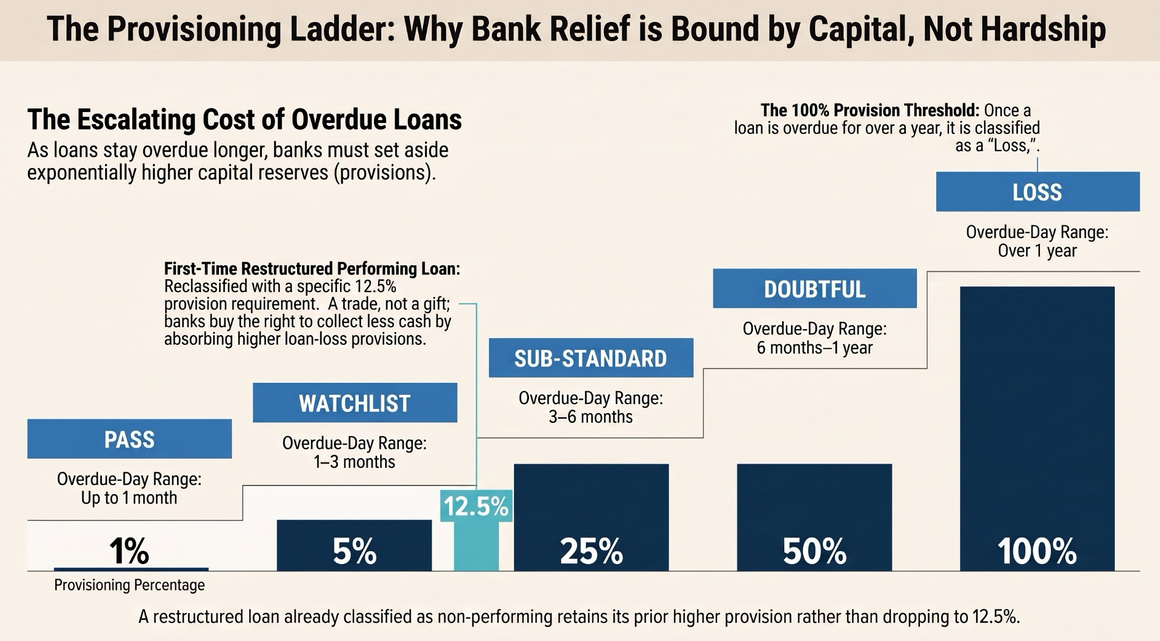
The general rule under Unified Directive is that a loan cannot be restructured or rescheduled at all unless the bank first collects at least 25 per cent of the outstanding accrued interest, and a first-time restructuring of a performing loan requires the bank to hold a minimum 12.5 per cent loan-loss provision against it – rising to 25 per cent where the restructuring does not meet standard conditions, and remaining at whatever higher provision already applied if the loan was already classified as non-performing. Sector-specific relief has, in recent circulars, lowered the cash-collection threshold for particular categories of hardship – to ten per cent of accrued interest for contractors awaiting delayed government payment and for businesses displaced by highway expansion, and to as little as five per cent for borrowers affected by earthquakes, floods, or landslides – but the underlying mechanics are unchanged: a bank does not simply agree to accept less interest, it buys the right to collect less cash up front by setting aside a specified proportion of the loan as a provisioned, capital-absorbing loss.
TABLE: Restructuring Relief Is a Graduated Schedule, Not a Single Rule
Purpose: To show that the cash a bank must collect up front, and the provision it must hold, move together and vary systematically by borrower category.
Source: NRB Unified Directive, Directive No. 2 (Loan Classification & Provisioning).
| Borrower / Loan Category | Minimum Accrued Interest Collected Up Front | Minimum Loan-Loss Provision | Classification Effect |
|---|---|---|---|
| Standard restructuring (first-time, performing loan) | 25% | 12.5% (25% if non-standard conditions) | Reclassified as Restructured |
| Existing non-performing loan, restructured | 25% (general threshold) | Retains prior higher provision (25/50/100%) | Reclassified as Restructured; provisioning unchanged |
| Contractors awaiting delayed government payment (Circular 19/082/083) | 10% | 5% | Retains Mangsir-end 2081 classification; no penal interest |
| Businesses displaced by highway expansion (Circular 11/082/083) | 10% | Not separately specified | Retains classification as of the restructuring date |
| Earthquake, flood or landslide-affected borrowers | 5–10% | Not separately specified | Restructured on hardship-linked concessional terms |
| Force-majeure moratorium capitalisation (Circular 17/082/083) | Not a cash threshold – capitalises moratorium interest | 12.5% minimum | Classified as Restructured |
The prohibition that runs through unified directive is on capitalising unpaid interest into principal on a restructured or rescheduled loan. The one significant exception concerns interest accruing during a construction-period moratorium on long-term priority-sector project loans, where a Board-approved policy may permit capitalisation into a separate reserve account that is only released back to the bank’s distributable earnings once the project reaches a defined stage of completion or begins commercial operation. Even here, the concession is not a waiver in any ordinary sense: the interest is not forgiven, merely deferred and quarantined, and the bank recovers full economic value once the underlying project performs.
Read against the two doors described earlier, restructuring occupies a distinctive middle position. It does not require the borrower to prove the original interest was unlawfully charged – the mandatory door does not apply, because nothing about the charge itself is being challenged. Nor does it require the kind of open-ended Board discretion the second door was built to prevent – the relief is delivered through a standardised, quantified formula (collect X per cent of accrued interest, hold Y per cent provision, retain the existing asset classification) that a bank can apply consistently and report to NRB on a quarterly return, rather than through a bespoke judgment call that exposes the approving officer to the liability regime described in the previous chapter. This is precisely why restructuring, rather than waiver, has become the practical instrument through which lawfully accrued interest is actually reduced for distressed but not clearly wronged borrowers: it lets a bank deliver real relief while keeping the individual decision-maker inside a pre-cleared, auditable formula rather than inside personal discretionary exposure.
| A restructuring concession is not a gift; it is a transaction in which the bank buys a lower cash-collection threshold from the borrower and pays for it in loan-loss provisions. |
| CASE STUDY – Two Banks, Two Directions, One Doctrine: What Happens After a Concession Is Granted What happened. In Anil Kumar Chhetri v. Rastriya Banijya Bank (Supreme Court, Case No. 069-WO-1430), RBB’s Board resolved to collect principal plus a 50 per cent surcharge while waiving the remaining accrued interest on an overdrawn facility; the borrower paid, obtained release of the mortgaged collateral, then filed a writ demanding a refund of the 50 per cent surcharge, arguing the waiver should have covered that sum too. In NB Hospital & Medical Research Center Ltd. v. Nabil Bank Limited (High Court Patan, Case No. 080-DP-2820), Nabil Bank issued a written commitment offering a 75 per cent waiver of accrued interest conditional on full principal settlement; the borrower settled on that basis, and the bank subsequently attempted to revoke the waiver and reassert the full interest claim. Which actors. In both matters, a single decision-maker – the Board of Directors in the RBB case, the bank’s authorised officer issuing the written commitment in the Nabil case – fixed the terms of a concession, and a court was later asked to reopen those terms after the borrower had already acted on them. What formal rules applied. The Principle of Surrender (समर्पणको सिद्धान्त) and the doctrine of promissory estoppel, both drawn from general contract and equity principles Nepali courts apply to negotiated banking settlements rather than from any single banking statute. What actually happened. The Supreme Court dismissed the borrower’s attempt to reopen the RBB settlement, holding that once a negotiated concession is accepted and executed, the borrower surrenders the right to challenge its terms. The High Court in the Nabil Bank matter reached the mirror-image result against the bank, holding that a formally communicated waiver relied upon by the borrower could not be unilaterally withdrawn once accepted. What mechanism it reveals. The discretionary door, once opened, closes immediately and symmetrically. Neither party can treat the concession as provisional once the other side has relied on it – a structural feature that gives banks a strong incentive to word any waiver offer precisely, since imprecision cuts against whichever side later wants to depart from it. Both matters proceeded through appellate or High Court litigation rather than through any NRB-ordered correction, consistent with the pattern (developed throughout this report) that disputes over the discretionary door are resolved by courts interpreting what was actually promised, not by regulatory intervention. |
The price of this substitution is that the scale of relief available to any one borrower is set by the bank’s own provisioning capacity and asset-classification consequences, not by the severity of the borrower’s hardship or the merits of the underlying case. A bank that is already thinly capitalised, or that is managing a large restructured-loan book, has every institutional incentive to hold the cash-collection threshold at its maximum rather than extend the sector-specific concessions available to other institutions, because each restructuring event consumes provisioning capacity that could otherwise support new lending. Relief under this channel is accordingly rationed by capital, not by law – a genuinely different bottleneck from anything the wrongful-collection or waiver chapters above describe, and one that the formal legal framework, taken on its own terms, does not obviously anticipate or address.
6. The Competing Interpretation: A Coherent Framework, Not a Bottleneck
The strongest challenge to the reading developed above is that there is no distortion here at all – only prudent, internally consistent regulation doing exactly what banking regulation is supposed to do. On this view, the asymmetric liability regime is not an accidental side-effect that deters legitimate relief; it is a deliberate design choice reflecting the fact that unauthorised dissipation of a bank’s assets is a more serious wrong, from a systemic and depositor-protection standpoint, than an isolated failure to refund an individual overcharge. A bank that habitually fails to refund overcharges damages individual borrowers and can be corrected through supervisory and civil channels; a bank whose officers can waive assets at will without personal consequence risks the kind of insider abuse and capital erosion that banking regulation exists specifically to prevent. Treating the two asymmetrically, on this reading, is not evidence of a bottleneck – it is evidence that the regulator has correctly identified which of the two risks is systemically larger.
This objection has real force, and the evidence supports it in places more than a critic of the framework might expect. NRB’s own directive architecture shows real sophistication in distinguishing genuine hardship from opportunistic demand: sector-specific restructuring relief is narrowly targeted (highway-displacement, earthquake and flood victims, delayed government payment to contractors), time-bound to fiscal deadlines, and conditioned on a minimum cash-collection threshold precisely so relief is not simply given away to any borrower who asks. The related-party and connected-lending restrictions examined in Chapter 3 – the prohibition on credit facilities to directors or firms they control, and the tight percentage bands on fee and spread variance across similarly situated borrowers – are calibrated controls against a real and well-documented risk (insider self-dealing), not arbitrary constraints on commercial flexibility. And the doctrine of surrender and promissory estoppel cuts in the borrower’s favour just as often as the bank’s: once a written concession is granted, the bank cannot walk it back, a protection a purely discretionary regime with no governing framework would not necessarily supply.
Where the objection runs into difficulty is explaining the specific severity gap identified in Chapter 4 – not the existence of an asymmetry, which the objection defends persuasively, but its scale. A fine of up to three times the waived amount plus up to seven years’ imprisonment for an unauthorised waiver, set against administrative fines and corrective orders for a wrongful failure to refund, is a difference of kind, not just degree: one exposure is institutional and correctable, the other personal, criminal, and permanent. Nothing in the material reviewed demonstrates that the case NRB actually wants to deter – a bad-faith, self-dealing waiver to a connected party – is more common or more costly than the case the asymmetry also happens to suppress: a good-faith concession to a genuinely distressed, unconnected borrower that a risk-averse board declines because the downside of being wrong is unbounded. The objection defends a stricter regime for waiver than for wrongful-collection failure. It does not fully answer why that regime fails to distinguish, on its face, between the self-dealing case it plainly targets and the good-faith case it may be catching as a side-effect.
On balance, the thesis survives, but narrowed. The claim that Nepal’s framework produces an institutional bottleneck stands with respect to good-faith, borderline waiver decisions specifically – the cases where a Board would need discretionary comfort to act and the liability regime denies it that comfort regardless of the underlying merits. It does not stand, and should not be read to stand, as a claim that the connected-lending restrictions, the NRB pre-clearance requirement for write-off and remission bylaws, or the asymmetry’s existence in principle are themselves poorly designed; the evidence supports those as calibrated responses to a genuine and well-documented insider-abuse risk.