
The Locked Premium and the Moving Floor
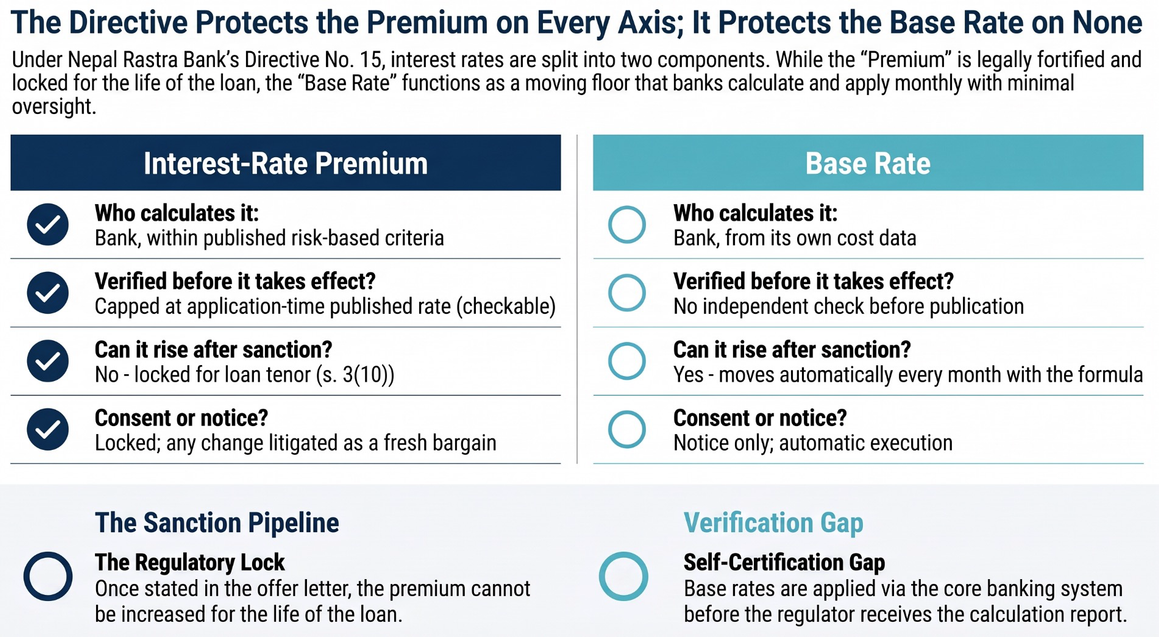
Every loan a licensed bank in Nepal extends carries two prices, not one. The first is the premium: a margin, expressed in percentage points, that the bank adds to a benchmark and states in the borrower’s offer letter. The second is the benchmark itself – the base rate – a figure each bank calculates from its own cost of funds, mandatory reserve costs, statutory liquidity costs and operating costs, republishes every month, and applies automatically to every floating-rate borrower on its book. Nepal Rastra Bank’s regulatory architecture treats these two components asymmetrically, and that asymmetry is the central fact this report sets out to explain.
The premium is the most heavily fortified term in Nepalese consumer and commercial lending law. Once stated in the loan offer letter, Directive No. 15 of the Unified Directive locks it for the life of the loan: a bank that raises it unilaterally violates a directive the Supreme Court has repeatedly held to carry the force of delegated legislation, and Directive 20 on financial consumer protection converts any unauthorised collection into a mandatory refund plus a ten percent penalty paid directly into the borrower’s account. Courts and the Debt Recovery Appellate Tribunal reinforce the same rule from the opposite direction, placing the burden of proving any premium change squarely on the bank and disallowing internal ledger entries as sufficient proof.
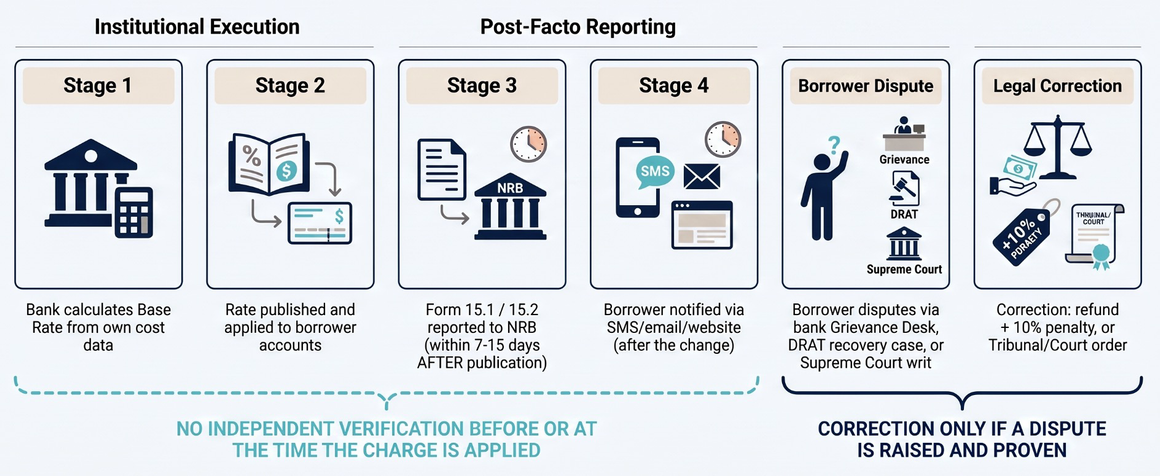
The base rate receives none of this scrutiny before it takes effect. A bank calculates its own base rate monthly, using a formula NRB prescribes but does not itself compute, and reports the resulting figure to NRB only after publishing it – within seven days of month-end, under cover of Form No. 15.1. There is no pre-clearance step for this report, no independent recalculation by the regulator before the rate reaches borrowers, and no institution-level audit trail in the public record showing how any individual bank’s core banking system actually executes the monthly reset it is required to perform. Once published, the rate binds every floating-rate borrower automatically; the directive requires notice, not consent, and the notice a borrower receives is confirmation that a change has occurred, not an opportunity to object before it does.
This is not, on its face, a story about a permissive law being exploited by an aggressive lender. The formal rules are unusually protective: a two-percentage-point ceiling on how far any bank may differentiate pricing between similarly situated borrowers of the same loan type, a floor preventing any loan from pricing below the average base rate, an explicit prohibition on teaser-and-step-up schemes, a seven-year lock on fixed-rate housing and auto loans before the first permitted review, and a Supreme Court that has quashed a bank’s attempt to collect additional interest after a borrower completed a fully scheduled repayment plan. The problem this report identifies is narrower and, for that reason, more durable: the protective architecture is concentrated on the one number banks have the least practical need to move – because the base rate, which every bank sets for itself and which drives the great majority of month-to-month change in what a borrower actually pays, sits almost entirely outside that architecture’s reach until a dispute is already underway.
The premium is locked, litigated and penalised. The base rate is calculated, published and applied by the same institution, before anyone outside that institution checks the arithmetic.
Four propositions organise the analysis that follows. First, the formal architecture governing rate-fixation at sanction is genuinely restrictive on the premium and genuinely permissive on the benchmark, and the difference is structural rather than incidental – it follows from treating the base rate as a cost-based fact each institution is uniquely positioned to compute, rather than as a price each institution has an interest in shading upward. Second, the repricing regime that governs a loan after disbursement preserves that asymmetry: floating-rate loans reprice automatically and without consent, fixed-rate loans are protected but only until a scheduled review window opens, and the set of events that count as a “new pricing event” permitting a fresh premium is narrow and specific rather than open-ended. Third, the mechanism that is supposed to catch a bank that miscalculates or misapplies its own base rate is almost entirely reactive: supervisory reporting is self-certified and after the fact, and the only forum shown in the evidence base to have corrected a bank’s rate calculation is a tribunal or court reached years after the disputed charge, on a complaint the borrower had to bring and prove. Fourth, the judiciary has articulated a doctrine broader than the directive regime it sits alongside – a doctrine of mutual consent for any change to loan terms – but the leading precedent establishing that doctrine arose from a fixed-instalment contract in which a bank tried to add a charge after full repayment, not from a challenge to the automatic, benchmark-driven repricing that governs the ordinary floating-rate loan; the doctrine’s reach into that more common scenario remains, on the evidence available, untested.
The chapters that follow examine each proposition in turn: the formal design of rate-fixation at sanction (Chapter II); what changes, and does not change, once a loan is disbursed (Chapter III); the self-certification gap that separates the rules on paper from any independent verification that they are followed (Chapter IV); and the judiciary’s broader but incompletely tested doctrine, set against the narrower, evidence-driven correction that the Debt Recovery Appellate Tribunal actually performs case by case (Chapter V). Chapter VI turns to what a targeted reform agenda would need to address, in what order, and Chapter VII draws the distinction between what the evidence establishes and what is a considered judgment beyond it.
Fixing the Rate: A Formula the Regulator Does Not Compute
The rate a borrower agrees to at sanction is built from five components that Nepal Rastra Bank’s Unified Directive defines in a strict hierarchy, each one legally derived from the one before it. The base rate incorporates a bank’s cost of funds, the cost of maintaining mandatory reserves, the cost of statutory liquidity, and operating costs; the directive itself is explicit that the base rate is not a lending rate but only the basis for calculating one (Unified Directive, Directive No. 15, s. 2; Annex 15.1, ss. 1-2). That base rate then serves, by operation of the same directive, as the reference rate against which every credit facility is priced by adding a risk- and tenor-specific premium (Unified Directive, Directive No. 15, Annex 15.1, s. 1). The resulting lending rate is the figure a borrower actually pays; the spread is a portfolio-level constraint on the gap between what a bank earns on credit and pays on deposits; and penal interest is a separate, capped surcharge triggered only by default on a specific overdue instalment.
| LEGAL TEXT – Unified Directive, Directive No. 15, Annex 15.1, s. 2 – Base Rate Formula ORIGINAL LANGUAGE आधार दर = कोष लागत प्रतिशत + अनिवार्य मौज्दात लागत प्रतिशत + वैधानिक तरलता लागत प्रतिशत + सञ्चालक लागत प्रतिशत CONVENIENCE TRANSLATION Base Rate = Cost of Funds (%) + Cost of Mandatory Reserve (%) + Cost of Statutory Liquidity (%) + Operating Cost (%). |
Two features of this design matter more than the formula itself. The first is that Class A, B and C institutions must recalculate the base rate every month and submit the underlying working, on NRB Form No. 15.1, within seven days of month-end – but that submission is a report of a rate already published and already applied, not a request for approval before publication (Unified Directive, Directive No. 15, s. 2). NRB defines the formula; the bank supplies every input to it, from its own books, and NRB’s involvement before the rate takes effect is confined to prescribing the formula’s structure, not verifying its arithmetic. The second is that the base rate operates as a floor as much as a benchmark: no bank may extend any loan at a rate below its own average base rate for the preceding three months (Unified Directive, Directive No. 15, s. 3(6)), which means that a bank’s self-calculated cost figure sets not only what borrowers may be charged above it but the lowest rate any borrower – however creditworthy – may lawfully receive.
| LEGAL TEXT – Unified Directive, Directive No. 15, s. 3(6) – Base Rate Floor ORIGINAL LANGUAGE कुनैपनि कर्जा पछिल्लो तीन महिनाको औसत आधारदर भन्दा कम ब्याजदरमा प्रवाह गर्न पाइने छैन ।CONVENIENCE TRANSLATION No loan shall be extended at an interest rate lower than the average base rate of the preceding three months. |
Against that permissive treatment of the benchmark, the directive is unusually specific about the premium. Three rules work together to constrain it at the moment of sanction. First, the premium a bank states in a borrower’s offer letter cannot exceed the premium rate the bank had published at the time the loan application was received – a bank cannot quote one premium to attract an application and fix a higher one at approval (Unified Directive, Directive No. 15, s. 3(9)). Second, premiums must be set by objective, published criteria – loan product, maturity, borrower and sector risk – rather than case-by-case discretion, and the directive requires separate, published premium schedules differentiated on those factors (Unified Directive, Directive No. 15, s. 3(3)). Third, and most consequentially for what follows in Chapter III, once the premium is fixed and stated in the offer letter, the directive prohibits the bank from increasing it for the remaining life of the loan, and separately prohibits “teaser” schemes that offer an initial discount on the understanding that it will later be withdrawn (Unified Directive, Directive No. 15, s. 3(10)).
| LEGAL TEXT – Unified Directive, Directive No. 15, s. 3(9) – Premium Capped at Application-Time Rate ORIGINAL LANGUAGE ऋणीलाई दिइने कर्जा प्रस्ताव पत्र (Offer Letter) मा आधार दरमा थप गर्ने प्रिमियम दर स्पष्ट रुपमा उल्लेख गर्नु पर्नेछ। प्रिमियम दर तय गर्दा कर्जाका लागि आवेदन प्राप्त हुँदाको बखत प्रकाशित प्रिमियम दर भन्दा बढी तय गर्न पाइने छैन । CONVENIENCE TRANSLATION The loan Offer Letter given to the borrower must clearly state the premium rate to be added to the Base Rate. In fixing the premium rate, it shall not be fixed higher than the premium rate published at the time the loan application was received. |
A separate, quantitative non-discrimination rule reinforces the premium lock across a bank’s borrower base rather than merely within a single loan: the directive caps at two percentage points the permissible gap between the rates charged to any two borrowers holding loans of the same nature (Unified Directive, Directive No. 15, s. 3(7)). If a bank later publishes a lower premium for new borrowers in the same product category, and the resulting gap against an existing borrower’s locked premium would exceed two percentage points, the directive requires the bank to bring the older borrower’s rate back within the band – not because the directive imposes a general duty to pass on better pricing, but because the two-point ceiling operates as an independent constraint that happens to catch that case.
A Framework Consolidated Recently, on Foundations Laid Decades Earlier
The base-rate concept itself is not new. NRB introduced a base-rate determination methodology through guidelines issued in 2069 BS, well before the current consolidated directive which codifies and extends that methodology rather than inventing it, alongside a lineage of statutory interest-rate authority that traces back through successive Nepal Rastra Bank Acts to the Muluki Ain’s earlier, more rudimentary treatment of lending. The practical effect of this history is that the self-certification design examined in this chapter is not a recent oversight in an otherwise modernised framework; it is a structural feature that has persisted through many full consolidation of the directive architecture, alongside genuine tightening of the premium-side protections – the offer-letter lock, the two-point non-discrimination ceiling, and the Directive 20 refund-and-penalty remedy all sit within the same 2082 consolidation that left the base-rate verification gap untouched.
Who Sits Above Whom
None of this operates as ordinary contract. The Supreme Court has repeatedly held that NRB directives, issued under Nepal Rastra Bank Act, 2058, ss. 79(1)-(2), 110 and 111, and BAFIA, 2073, s. 131, constitute delegated legislation carrying the force of law, so that a contractual term inconsistent with a mandatory directive provision is void to the extent of the inconsistency (Nepal Rastra Bank v. Shankar Man Shrestha, Writ No. 071-CI-1204, decided 2076-12-02 (15 March 2020); Madhu Kumar Chaulagai v. Government of Nepal, NRB et al., Writ No. 077-WO-0198, decided 2078-05-23 (8 September 2021)). That overriding force runs only one direction up the hierarchy, however: a directive that itself narrows or contradicts BAFIA or the Nepal Rastra Bank Act is, on the same doctrine, invalid to that extent (National Employees Welfare Organization, NRB v. Nepal Rastra Bank Central Office et al., Writ No. 071-WO-0654 / 069-WO-1181, decided 2073-11-01 (12 February 2017)). BAFIA, 2073, s. 55(8), sits underneath and alongside this structure as an independent statutory floor: whatever a directive permits by way of variable pricing, a bank must still disclose the credit amount, the interest rate, the penal interest and the repayment schedule in writing to the borrower and any guarantor.
TABLE: Rate Components in Unified Directive – Definitions, Legal Basis and Function
Purpose: To show that the five rate components sit in a strict, one-directional legal hierarchy, and that regulatory constraint tightens sharply only at the premium and spread stages.
| Component | Legal basis | Who sets it | Constraint before it takes effect |
|---|---|---|---|
| Base Rate | Directive 15, s. 2; Annex 15.1 | Each bank, from its own cost data | Formula prescribed by NRB; monthly self-report due after publication, not before |
| Reference Rate | Directive 15, Annex 15.1, s. 1 | Equals the Base Rate by operation of the directive | None independent of the Base Rate calculation |
| Interest-Rate Premium | Directive 15, s. 3(3), (7), (9), (10) | Bank, within published, risk-based criteria | Capped at application-time published rate; 2-point non-discrimination ceiling; locked after sanction |
| Lending Rate | Directive 15, s. 3(1), (6) | Base Rate plus Premium, by formula | Floored at the 3-month average Base Rate; cannot go below it |
| Interest Rate Spread | Directive 15, s. 4; Annex 15.2 | Portfolio-level outcome of a bank’s pricing book | Capped at 4.0% (commercial banks) / 4.6% (development banks and finance companies) |
| Penal Interest | Directive 15, s. 3(2); Directive 2, s. 46 | Bank, subject to a hard ceiling | Capped at 2 percentage points p.a.; calculated only on the overdue instalment; compounding prohibited |
Source: Unified Directive ABC, Directive No. 15, ss. 2-4 and Annexes 15.1-15.2.
Repricing After Sanction: What Changes, What Cannot, and What Counts as New
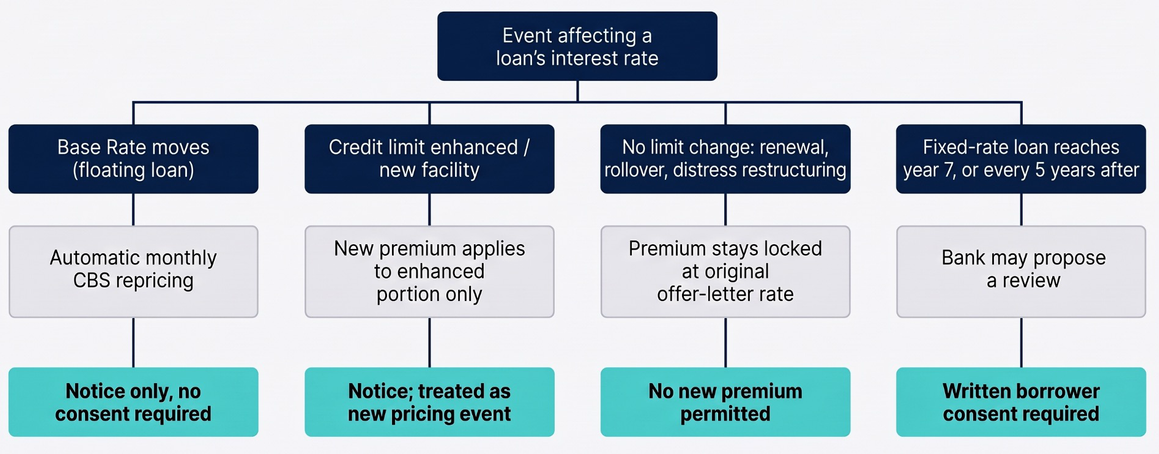
Once a loan is disbursed, the directive regime distinguishes sharply between two kinds of change: a change in the benchmark, which is designed to occur automatically and often, and a change in the premium, which is designed not to occur at all outside a small set of enumerated events. Understanding which category a given adjustment falls into is the single most consequential classification question in the entire regime, because it determines whether a borrower is entitled to advance notice and an opportunity to object, or only to after-the-fact confirmation that a change already took effect.
Floating-Rate Loans: Automatic, Monthly, and Consent-Free
For Class A, B and C institutions, a floating lending rate must be adjusted monthly, to the extent of the movement in the preceding three months’ average base rate, and that adjustment must be executed automatically through the bank’s core banking system (Unified Directive, Directive No. 15, s. 3(13)). Class D microfinance institutions reprice on a quarterly cycle against their own base rate (Unified Directive-D, Directive No. 14, s. 2(2)(ja)); Infrastructure Development Banks reprice quarterly under the parallel NIFRA directive. In every class, the mechanism is the same in kind: publication in advance of the coming period, automatic system-level execution at the start of that period, and notice to the affected borrower once the change has occurred, typically by SMS or email alongside public disclosure on the bank’s website and in national media. Borrower consent, written acceptance, or execution of an amended agreement is not required for this category of change, because the directive treats the repricing mechanism itself – not each individual application of it – as the thing the borrower agreed to when signing the original offer letter.
| LEGAL TEXT – Unified Directive, Directive No. 15, s. 3(13) – Automatic Monthly Repricing ORIGINAL LANGUAGE कर्जाको व्याजदर परिवर्तन गर्दा पछिल्लो तीन महिनाको औसत आधार दरमा भएको थपघटको सीमासम्म मासिक रुपमा परिवर्तन गर्नुपर्नेछ । … परिवर्तनीय ब्याजदर आधार दरसँग आबद्ध गर्दा इजाजतपत्रप्राप्त संस्थाको Core Banking System मार्फत पछिल्लो तीन महिनाको औसत आधार दरमा भएको परिवर्तनअनुसार स्वतः व्याजदर परिवर्तन हुने प्रणालीको व्यवस्था गर्नु पर्नेछ । CONVENIENCE TRANSLATION When changing loan interest rates, the change shall be made monthly, to the extent of the fluctuation in the preceding three months’ average Base Rate. … In linking a floating rate to the Base Rate, the licensed institution must configure a system through its Core Banking System that automatically changes the interest rate in accordance with the change in the preceding three months’ average Base Rate. |
Within this automatic mechanism, the directive gives institutions one asymmetric discretion, and only one: a bank may reduce the lending rate by more than the fall in the average base rate, or decline to pass through a rise, or fix the rate by mutual written agreement – but any such discretionary reduction or freeze must be extended uniformly to all similarly placed borrowers, not offered selectively (Unified Directive ABC, Directive No. 15, s. 3(14)). The discretion therefore runs only in the borrower’s favour; there is no equivalent discretion to pass through less of a rate decrease than the formula would produce, or to apply a rise more aggressively to one borrower than another.
Fixed-Rate Loans: Locked, Then Reviewable, Never Reset Ad Hoc
Personal term loans exceeding one year – principally housing and vehicle loans – carry a materially different regime once a fixed rate is elected. The directive locks that rate absolutely for an initial seven years; only after that period, and every five years thereafter, may the bank review and adjust it, and every such review requires the borrower’s written consent (Unified Directive ABC, Directive No. 15, s. 3(15)). Outside those windows, changing a fixed rate for any reason is expressly prohibited, subject only to a narrow carve-out permitting an added penal margin where the borrower diverts loan funds from their approved purpose or damages the pledged collateral.
This is the one context in the entire repricing regime where the directive itself requires affirmative borrower consent before a rate changes, rather than notice after it has. The distinction is not incidental: a fixed-rate loan is, by definition, a facility in which the borrower has purchased certainty for a stated period, and the directive treats disturbing that certainty as a fresh bargain requiring fresh assent, in a way it does not treat the routine operation of a floating-rate formula the borrower agreed to at the outset.
What Counts as a New Pricing Event
Between these two poles sits a set of transactions – renewal, rollover, enhancement, restructuring, conversion – where the question is not whether the base rate has moved but whether the transaction itself entitles the bank to set a fresh premium. The directive answers this narrowly and consistently: only an increase in the sanctioned credit limit, or the origination of an additional facility, is treated as a new pricing event permitting a new premium, and even then only on the enhanced or additional portion (Unified Directive ABC, Directive No. 15, s. 3(11)). Routine annual renewal of a revolving facility, maturity extension without a limit increase, and conversion from floating to fixed rate at the borrower’s request are all expressly excluded from that category; a floating-to-fixed conversion is additionally excluded from being classified as restructuring or rescheduling, so that it does not trigger the punitive loan-loss provisioning that classification would otherwise require. Restructuring or rescheduling driven by borrower distress is treated the same way: the directive requires the restructured loan’s rate to remain benchmarked to the base rate and prohibits an arbitrary premium increase on account of the distress itself, while specific regulatory forbearance programmes – for example, the temporary relief extended to businesses affected by Gen Z Civil Unrest in 2082 – impose their own premium ceilings (Base Rate plus a maximum of 0.5 percentage points) rather than leaving pricing to ordinary discretion.
TABLE: Does the Transaction Permit a New Premium?
Purpose: To show that the directive treats most post-sanction events as continuations of the original bargain, and reserves the right to set a fresh premium for a narrow, enumerated set of transactions.
| Transaction | New premium permitted? | Basis |
|---|---|---|
| Monthly base-rate movement (floating loan) | No – automatic pass-through only | s. 3(13); mechanism pre-agreed at sanction |
| Credit-limit enhancement / new facility | Yes, on the enhanced or additional portion only | s. 3(11) |
| Routine renewal or rollover (no limit change) | No | s. 3(11), by omission; general lock under s. 3(10) |
| Floating-to-fixed conversion at borrower request | No – excluded from restructuring classification | s. 3(11) |
| Distress restructuring / rescheduling | No arbitrary increase; base-rate link preserved | General prohibition on unilateral hikes; forbearance circulars may cap, not raise, pricing |
| Scheduled fixed-rate review (year 7, then every 5 years) | Only with the borrower’s written consent | s. 3(15) |
Source: Unified Directive ABC, Directive No. 15, ss. 3(10), 3(11), 3(13), 3(15).
Penal Interest Is a Separate Track, Narrowly Bounded
Default pricing operates on rules distinct from ordinary repricing and, on the evidence reviewed, among the most tightly drawn in the directive. The agreed penal rate cannot exceed two percentage points per annum over the ordinary rate, must be pre-disclosed in the loan agreement, and can be calculated only on the overdue instalment of principal for the period of delay – not on the full outstanding balance and not on unpaid interest (Unified Directive ABC, Directive No. 15, s. 3(2)). Charging interest on penal interest is prohibited outright, as is capitalising accrued interest during a project loan’s grace period outside a defined list of priority sectors – hydropower, cement using domestic inputs, pharmaceuticals, cable cars, sugar, dairy, government-endorsed medical colleges, star-rated hotels, hospitals, long-term agricultural projects and pulp and paper using domestic raw materials (Unified Directive ABC, Directive No. 2, s. 45(1)). A borrower who repays an overdue instalment within thirty days of the due date is exempt from penal interest altogether under Directive No. 2, s. 46, though the same provision confirms that missing that thirty-day window restores the bank’s right to charge penal interest for the full period of delay.
Nothing in the directive lets a bank convert a struggling borrower’s distress into a pricing opportunity – except by classifying the transaction, correctly or not, as one that resets the premium.
| CASE STUDY – Dr. Prakash Regmi v. Global IME Bank Limited – A Fixed-Instalment Dispute Facts: The petitioner took an auto loan of NPR 1,740,000 from Global IME Bank in 2073 BS at 9.5 percent per annum, structured as 84 equal monthly instalments of NPR 28,439 over seven years. After the borrower completed all 84 instalments, the bank declined to release the vehicle and demanded a further NPR 372,042.81, invoking a standard clause (cl. 3(11) of its own agreement) reserving the bank’s right to alter the interest rate at any time, with or without notice, and asserting that market rates had fluctuated over the loan’s term. Which actors: The Supreme Court of Nepal, Joint Bench of Justice Prakash Man Singh Raut and Justice Dr. Abdul Aziz Musalman, deciding Writ No. 080-WO-0748 on 2080-12-02 BS (15 March 2024). NRB appeared and submitted, in its own defence of the regulatory framework, that a bank cannot lend below the base rate and that the premium above it depends on mutual agreement between bank and customer, and that absent an express fixed-rate agreement a loan’s interest rate is presumptively floating. What the rules said: BAFIA, 2073, s. 55(8) required the bank to disclose the loan amount, interest rate, penal terms and repayment schedule in writing; the bank had done so, specifying 84 fixed instalments of a stated amount. What happened: The Court held that a bank cannot vary a signed loan’s terms – including its interest rate – without informing the borrower and securing mutual agreement to the change, and that Global IME Bank’s demand for an additional sum after full repayment of a specified instalment schedule was accordingly unlawful. It issued a writ of certiorari (utpreshan) quashing the demand and a writ of mandamus directing the bank to transfer the vehicle. Time and representativeness: The dispute arose from a loan originated in 2073 BS, several years before the Unified Directive provisions examined in Chapters II and III, and from a facility structured with a fixed instalment schedule rather than an explicit floating-rate mechanism referencing a published, resettable base rate. The bank’s own contractual clause purported to permit a unilateral change “with or without notice,” which is considerably broader than anything the current directive permits even for floating loans – the Court had no occasion to test, and did not purport to test, whether the automatic, base-rate-linked monthly repricing that Directive 15 now prescribes for floating loans would itself satisfy a “mutual consent” standard, because no such mechanism was the transaction before it. What it reveals: The case is the clearest and most frequently cited authority for the proposition that a Nepalese bank cannot alter a loan’s economic terms without the borrower’s informed agreement, and it is a genuine, binding check on the kind of open-ended discretionary variation clause the bank relied on here. Whether its reasoning extends to invalidate – or to require individualised consent for – the routine, pre-disclosed, base-rate-triggered monthly adjustment that governs most floating-rate lending today is a distinct question the case does not answer, because the loan before the Court was not that kind of facility. |
The Self-Certified Benchmark and the Missing Audit Trail
The directive regime assumes a bank’s core banking system will do three things correctly and without external prompting: calculate the monthly base rate from the bank’s own cost data, apply the resulting figure automatically to every floating-rate account, and generate the notices, logs and reports the directive requires as it does so. Nothing in the evidence reviewed for this report shows an independent party verifying any of the three before it happens, and – on the specific evidence gathered about one licensed commercial bank’s internal implementation – nothing in the public record shows how any individual institution’s systems actually perform this sequence at all.
Reporting Runs After the Fact, Not Before It
NRB’s own reporting architecture confirms the sequencing described in Chapter II. Class A, B and C institutions submit their monthly base-rate calculation, on Form No. 15.1, within seven days of month-end; Class D institutions submit within fifteen days; Infrastructure Development Banks submit within fifteen days of month-end (Unified Directive ABC/D/NIFRA, Directive No. 15). The monthly net interest-rate spread return, Form No. 15.2, follows the same pattern. Each of these is a report of a rate already published and already applied to borrowers’ accounts – a record NRB can use to detect a violation after it has occurred, not a filing NRB reviews and clears before the rate takes effect. The spread ceiling itself – 4.0 percent for commercial banks, 4.6 percent for development banks and finance companies (Unified Directive ABC, Directive No. 15, s. 4(2)) – operates at the portfolio level and constrains a bank’s aggregate book, not the rate any individual borrower is charged; a bank could, in principle, remain within its spread cap while pricing individual borrowers at the outer edge of the two-percentage-point non-discrimination band discussed in Chapter II, and nothing in the reporting architecture reviewed would flag that as a problem before a borrower complained.
| LEGAL TEXT – Unified Directive ABC, Directive No. 15, s. 4(2) – Spread Cap ORIGINAL LANGUAGE २०८० असार महिनाबाट “क” वर्गका वाणिज्य बैंकहरुको हकमा ४.० प्रतिशत र “ख” र “ग” वर्गका संस्थाको हकमा ४.६ प्रतिशत भन्दाबढी नहुने व्यवस्था गर्नु पर्नेछ । CONVENIENCE TRANSLATION From the month of Ashad 2080, the average interest rate spread shall not exceed 4.0 percent for Class “A” commercial banks and 4.6 percent for Class “B” and “C” institutions. |
What Happens When a Violation Is Caught
The consequence regime that applies once a violation is identified is genuinely severe on paper. Directive 20, on financial consumer protection, requires a bank that collects interest or fees under an unauthorised title, or in excess of a prescribed cap, or without the borrower’s prior consent, to refund the full unauthorised amount plus an additional ten percent penalty directly into the customer’s account, reverse the erroneous entry in its core banking system, and write back any improperly recognised income from its profit-and-loss statement into regulatory reserves. Beyond restitution, NRB can invoke Nepal Rastra Bank Act, 2058, ss. 99-100 to impose progressive supervisory restrictions – freezing branch expansion, restricting dividend distribution, and, at the most severe end, more intrusive supervisory action – against an institution found in breach.
The severity of this consequence regime, however, is not evidence of how often it is actually triggered, nor of how a violation is typically detected in the first instance. Every mechanism described in the underlying research for identifying a miscalculated or improperly applied rate is reactive: a borrower complaint through the bank’s own Information and Grievance Desk or Grievance Officer (required under Directive 20 for Class A, B and C institutions, Directive 19 for Class D, and Directive 18 for Infrastructure Development Banks); a dispute that escalates to the Debt Recovery Appellate Tribunal in the course of a recovery action the bank itself initiated; or a writ petition to the Supreme Court. None of these is triggered by NRB’s own monthly review of the Form 15.1 and 15.2 filings it receives; none of them operates before the disputed charge has already been applied to a borrower’s account, often for months or years.
A refund plus a ten percent penalty is a serious remedy for the borrower who discovers the error, proves it, and survives the wait. It says nothing about the error nobody discovered.
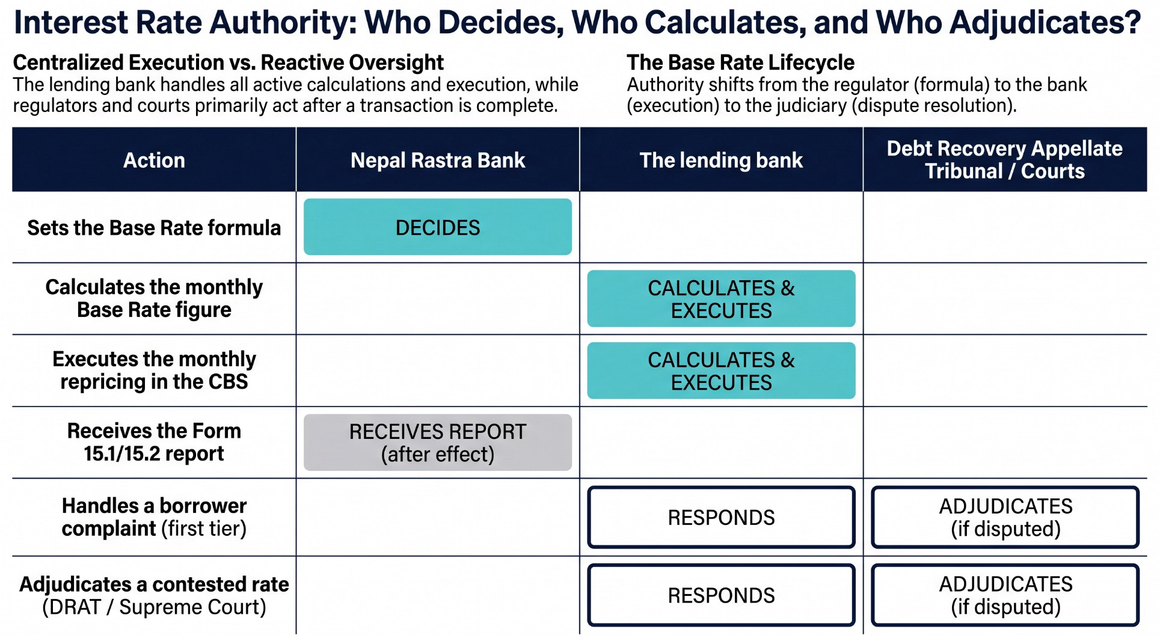
TABLE: What NRB’s Monthly Reporting Regime Actually Reviews
Purpose: To distinguish reports that inform NRB after a rate has taken effect from any step that would catch an error before a borrower is charged.
| Filing | What it reports | Timing relative to borrower impact | Reviewed before rate applies to borrowers? |
|---|---|---|---|
| Form No. 15.1 (Base Rate calculation) | Monthly base-rate working, Class A/B/C | Due within 7 days after month-end publication | No |
| Form Gh 14.1 (Base Rate, Class D) | Monthly base-rate working, microfinance | Due within 15 days after month-end publication | No |
| Form No. 15.2 (Net Interest Rate Spread) | Monthly weighted-average spread | After the month it covers | No |
| Borrower complaint to Grievance Officer | Individual disputed charge | Whenever the borrower raises it, typically after the charge | Yes, but only for the specific charge raised |
| DRAT / Supreme Court proceeding | Individual disputed rate, premium or penal charge | Months to years after the disputed charge | Yes, but only for the specific dispute litigated |
Source: Unified Directive ABC, Directive No. 15, s. 2; Directive No. 9 (Statistical Returns); Directive No. 20 (Financial Consumer Protection).
A Broader Judicial Doctrine, and a Narrower Test of It
The strongest challenge to the thesis developed in Chapters II through IV is not that the directive regime is misdescribed, but that the directive regime may not be the last word. Nepal’s Supreme Court has, across several decisions, articulated a doctrine considerably broader than anything Directive 15 requires: that any change to a loan’s terms, including its interest rate, requires informing both parties and securing their mutual agreement before the change acquires legal validity, and that a decision adversely affecting a borrower’s economic position must be preceded by an opportunity to be heard. If that doctrine applies with full force to the ordinary, base-rate-triggered monthly adjustment described in Chapter III, then the automatic, notice-only mechanism this report treats as the operative rule may already be constitutionally and doctrinally vulnerable, regardless of what the directive itself permits.
The Doctrine as Stated
Three decisions, read together, are cited in the underlying research as establishing this doctrine. In Lal Bahadur Basnet v. Government of Nepal, Office of the Prime Minister and Council of Ministers et al. (Special Bench Writ No. 067-WS-0074), a public-interest challenge to the statutory delegation of rate-setting to commercial banks under the predecessor BAFIA, 2063, the Court upheld the delegation as constitutional but held that banks must develop a practice of consulting borrowers and obtaining their prior consent before increasing an agreed rate, grounding the requirement in the principle of audi alteram partem. In Shobhendra Raj Joshi v. Nepal Rastra Bank et al. (Writ No. 070-WO-0584 / 070-WO-0384), the Court went further procedurally, issuing a directive order requiring NRB itself to establish enforceable mechanisms preventing banks from arbitrarily altering loan terms. And in Dr. Prakash Regmi v. Global IME Bank Limited, examined as a case study in Chapter III, the Court held that a bank’s unilateral alteration of a loan’s rate or repayment terms without prior notice and mutual consent is unlawful and unenforceable, and that contract terms bind both lender and borrower equally.
Synthesised across these three decisions, the language is unqualified: any revision, including an interest-rate increase, “acquires legal validity only when both parties are informed of the modification and mutually agree to it.” Taken at face value, that formulation does not distinguish between a bank’s open-ended discretion to vary a rate “with or without notice” – the clause actually at issue in the Regmi case – and a pre-disclosed, formula-driven, base-rate-linked adjustment of the kind Directive 15 prescribes for the ordinary floating-rate loan.
Why the Doctrine Has Not Yet Been Tested Against the Mechanism This Report Describes
Three features of the case record limit how far that broad language can safely be read into the specific mechanism examined in Chapter III. First, the loan in Regmi originated in 2073 BS on a fixed 84-instalment schedule, predating the current consolidated Unified Directive framework this report examines; the bank’s own clause purported to allow a rate change “with or without notice,” a discretion considerably broader than the notice-with-automatic-execution mechanism the current directive permits. Second, NRB’s own submission in that litigation – quoted in the case synthesis – was that a loan’s rate is presumptively floating unless a fixed rate is expressly agreed, and that the premium above the base rate depends on “mutual understanding” between bank and customer; the Court’s holding responded to a bank trying to add a charge after a fixed, fully performed instalment schedule had run its course, not to a floating-rate borrower challenging a mid-tenor, base-rate-triggered adjustment executed exactly as the offer letter described. Third, none of the underlying research identifies a Supreme Court or Debt Recovery Appellate Tribunal decision that squarely presents the question this report treats as central – whether the automatic, CBS-executed, notice-only monthly repricing that Directive 15 prescribes currently for an ordinary floating-rate loan satisfies, or fails, the mutual-consent standard the Court has articulated in adjacent cases.
That absence cuts in two directions at once, and this report does not resolve it. It is possible that the automatic mechanism has simply never been challenged because it operates as designed and borrowers have no grievance to litigate – in which case the doctrine and the directive coexist without real tension, because the directive’s own pre-disclosure requirement (Chapter II) is itself a form of the “informing” the Court’s language demands, satisfied once, at sanction, rather than needing to be repeated at every monthly reset. It is equally possible that the mechanism has simply not yet produced a borrower with the resources or occasion to litigate it, and that a case squarely testing automatic base-rate pass-through against the audi alteram partem standard would produce a different result from anything decided so far. The Debt Recovery Appellate Tribunal’s own practice offers a partial answer, addressed below, but it is a partial answer only.
What the Tribunal Actually Does
Where the Supreme Court has spoken in broad doctrinal terms, the Debt Recovery Appellate Tribunal’s day-to-day practice, drawn from its own decisions, is narrower and more procedural – and, on the specific point of automatic base-rate repricing, more consistent with the directive regime than with an unqualified consent requirement. The Tribunal draws an explicit distinction between the adjustable base rate and the contractually fixed premium: it treats a bank’s unilateral premium increase as presumptively invalid and places the burden on the bank to prove, through the loan offer letter, the agreement and dated notices, that any change complied with NRB directives and with BAFIA, 2073, s. 55(6) and (8) – but it does not, on the evidence reviewed, treat the base rate’s ordinary monthly movement as itself requiring individualised borrower consent, consistent with the directive’s own notice-only design. The Tribunal disallows compound interest, interest on penal interest, and capitalisation of interest outside the narrow project-finance exceptions described in Chapter III; it requires documentary evidence of any relied-upon rate change rather than accepting internal ledger or core-banking-system entries as self-proving; and it orders account recalculation, restitution and correction of unsupported charges as a matter of course rather than dismissing a claim outright for an accounting defect.
TABLE: Judicial and Tribunal Treatment of Post-Sanction Rate Changes
Purpose: To set the Supreme Court’s broad doctrinal language against the Debt Recovery Appellate Tribunal’s narrower, evidence-driven practice on the same underlying question.
| Forum | Stated standard | Applied to | Reach into automatic base-rate repricing |
|---|---|---|---|
| Supreme Court (doctrine, as stated) | Mutual consent required for any rate or term change; audi alteram partem | Open-ended discretionary variation clauses; a fixed-instalment loan | Not squarely tested; language would, if applied literally, cover it |
| Supreme Court (Regmi, on the facts) | Bank cannot add a charge after a fixed schedule is fully performed, without consent | A 7-year, 84-instalment fixed loan predating current consolidated Directive | Facts do not involve base-rate-linked floating repricing |
| Debt Recovery Appellate Tribunal | Burden on bank to prove any rate change by documentary evidence; premium lock strictly enforced | Individual recovery disputes, evaluated case by case | Treats base-rate movement as distinct from premium change; consistent with directive’s notice-only design for the base rate itself |
Source: Lal Bahadur Basnet v. GoN, OPMC et al. (067-WS-0074); Shobhendra Raj Joshi v. NRB et al. (070-WO-0584 / 2070-WO-0384); Dr. Prakash Regmi v. Global IME Bank Ltd. (080-WO-0748); Debt Recovery Appellate Tribunal decisions on unilateral premium change, penal interest and evidentiary burden.
Does the Thesis Survive?
On balance, the thesis set out in Chapter I survives, but narrowed rather than unqualified. The Debt Recovery Appellate Tribunal’s actual practice – the forum that resolves the overwhelming majority of contested bank-lending disputes below the level of a Supreme Court writ – treats the base rate and the premium exactly as the directive does: a locked, consent-adjacent premium and a self-executing, notice-only benchmark. The Supreme Court’s broader language has not, on this evidence, been applied to displace that distinction in a case actually presenting it. What the competing evidence establishes is narrower than a live legal conflict: it is a doctrinal gap – a body of language broad enough to unsettle the automatic mechanism if a suitable case reached the Court, sitting alongside a lower tribunal’s settled practice of not reading that language so broadly, with no decision yet resolving the difference. That gap is itself a feature of the architecture worth naming, not a reason to abandon the diagnosis in Chapters II through IV.
Reform Options and Sequencing
The diagnosis in Chapters II through V points toward a specific class of intervention rather than a general call for stricter rules. The premium is already tightly regulated; adding further restriction there would address a problem the evidence does not show to be large. The gap sits upstream, at the point where a bank’s own cost calculation becomes a published, binding benchmark without independent verification, and downstream, in the fact that the only bodies shown in this evidence to correct a miscalculated or misapplied rate are reached only after a borrower has litigated a dispute. A reform agenda should therefore prioritise closing the verification gap before the rate takes effect, and shortening the distance between a borrower’s grievance and a correction, in that order – because a verification step that catches an error before it reaches a borrower’s account prevents the harm the tribunal and complaint mechanisms currently exist only to reverse.
A verification step placed before publication prevents the harm the Tribunal currently exists only to reverse.
Short-Term: Administrative and Procedural
Three measures require no legislative change and could be implemented through NRB’s existing directive and circular power. First, NRB could convert the monthly Form 15.1 and 15.2 filings from a post-publication report into a pre-publication submission with a short, fixed clearance window – even a narrow, formula-compliance check performed before a bank’s new base rate takes effect would close the most consequential part of the gap identified in Chapter IV, without requiring NRB to second-guess a bank’s underlying cost data. Second, NRB could require every licensed institution to publish, on a standard template, the specific cost inputs behind its monthly base-rate calculation, not merely the resulting figure – a transparency measure that would let borrowers, competitor banks and civil-society monitors cross-check a bank’s arithmetic without waiting for a supervisory audit. Third, NRB could require institutions to retain and, on request, produce to NRB a running log of individual borrower notices sent at each monthly repricing, closing the evidentiary gap the Debt Recovery Appellate Tribunal currently has to fill case by case by demanding documentary proof from a bank years after the fact.
Medium-Term: Structural and Statutory
Two further measures would require more sustained institutional investment. First, a periodic, risk-based supervisory audit of individual banks’ core-banking-system repricing logic – sampling actual account-level execution against the published base rate and premium, rather than relying solely on the aggregate Form 15.1/15.2 filings – would supply the institution-level verification that Chapter IV shows to be entirely absent from the public record. Second, given the genuine doctrinal gap identified in Chapter V, NRB and the judiciary each have reason to want the automatic, base-rate-triggered repricing mechanism tested and either confirmed or reformed through a squarely presented case, rather than left to accumulate broad language in adjacent decisions that never quite reaches it; NRB could support this by formally codifying, in the text of Directive 15 itself, that the borrower’s original written acceptance of the base-rate-linkage mechanism at sanction constitutes the “informing” and “agreement” the Supreme Court’s doctrine requires – a clarification that would either resolve the tension or invite the court challenge that would resolve it definitively.
Sequencing matters here specifically because the short-term measures address the root cause – an unverified benchmark – while the medium-term measures address symptoms that persist even after the benchmark itself is fixed: a supervisory audit only has value once there is a verified base rate to audit against, and a doctrinal clarification only reduces litigation risk once the underlying mechanism it describes is itself more transparent. Reversing the order would leave NRB auditing a number it has never independently checked, and inviting judicial scrutiny of a mechanism whose main defect – self-certification before publication – would still be unaddressed.