
The base rate is the pivot on which all bank credit pricing in Nepal turns: a regulator-defined cost floor that every licensed institution must compute from its own balance sheet, publish monthly, and beneath which it may not lend. This article maps the mechanism end to end – the statutory authority under which Nepal Rastra Bank prescribes it, the four-component formula of Annexure 15.1 (Base Rate Determination Procedure, 2069), the precise numerators, denominators, exclusions, and minimum-balance assumptions governing each component, the distinction between the monthly base rate and the three-month average that operates as the binding regulatory floor, and the premium-based translation of that floor into the rate a borrower actually pays. It then tests the framework against eight years of NRB data on deposit, base, and lending rates, decomposing the borrower’s rate into cost of deposits, regulatory cost layers, and lending premium, and traces the transmission chain from policy rate through interbank and deposit markets into the base rate itself. The conclusion is that Nepal’s methodology is analytically coherent and genuinely transparent in its architecture, but that it measures average rather than marginal funding cost, embeds smoothing that necessarily delays monetary transmission, and leaves the borrower with a published number that anchors pricing without revealing the premium that determines it.
1. Why Nepal Regulates the Cost Floor at All
Before 2069 BS, loan pricing in Nepal rested on negotiation and opacity. A borrower could not know what portion of the rate quoted reflected the bank’s genuine cost of money and what portion reflected margin, and the central bank could not reliably predict how a change in its policy stance would reach the credit market. NRB’s stated diagnosis, recorded in the preamble to the base-rate procedure itself, was that a transparent interest-setting process would improve banks’ operational efficiency and competitive capacity while strengthening the monetary transmission mechanism and thereby the effectiveness of monetary policy. The Monetary Policy for FY 2069/70 accordingly announced the base rate, and the framework has governed credit pricing ever since.
The instrument NRB chose is unusual in its ambition. Rather than fixing a single administered rate, or leaving pricing to the market subject only to disclosure, NRB requires each bank to compute its own cost floor from its own audited balance sheet, using a formula the regulator prescribes in full. The base rate is therefore neither a market rate nor an administered rate but a regulated accounting construct: bank-specific in its inputs, uniform in its method, and binding in its effect. Understanding it requires reading it simultaneously as law, as arithmetic, and as economics – which is how this article proceeds.
2. The Legal Foundation and Hierarchy
The authority runs in a clean line from statute to loan agreement. At the apex, the Nepal Rastra Bank Act, 2058 vests the central bank with its objectives of monetary and price stability and financial-sector stability (s.4), and – decisively for this subject – Section 79(1) confers full authority to regulate the functions and activities of licensed institutions, with Section 79(2) making compliance with directives a legal duty and Section 110(3) empowering the Governor to issue implementing procedures and guidelines. BAFIA, 2073 supplies the parallel operational hook, its Section 131 authorising directives on the conduct of banking business. Beneath the statutes sit the Unified Directives, of which Directive No. 15 (Provisions Regarding Interest Rates) governs credit pricing. And beneath that sits the technical instrument that does the actual work: Annexure 15.1, the Base Rate Determination Procedure 2069, which prescribes the formula, the component definitions, the data sources, and the calculation assumptions. Class D microfinance institutions are governed by a functionally identical procedure at Annexure 14.1 of their own compilation.
The practical significance of this hierarchy is that almost everything analytically important – the formula, the exclusions, the minimum-balance rule, the floor – lives in an annexure to a directive rather than in primary legislation, and is therefore amendable by the central bank without recourse to Parliament. That has made the framework responsive, as the amendment history in Section 8 shows, but it also means the pricing of every loan in the country rests on delegated technical rule-making.
3. The Formula
Section 2 of Annexure 15.1 states the equation as a strict summation of four proportional cost components, with no residual, no profit margin, and no discretionary adjustment:
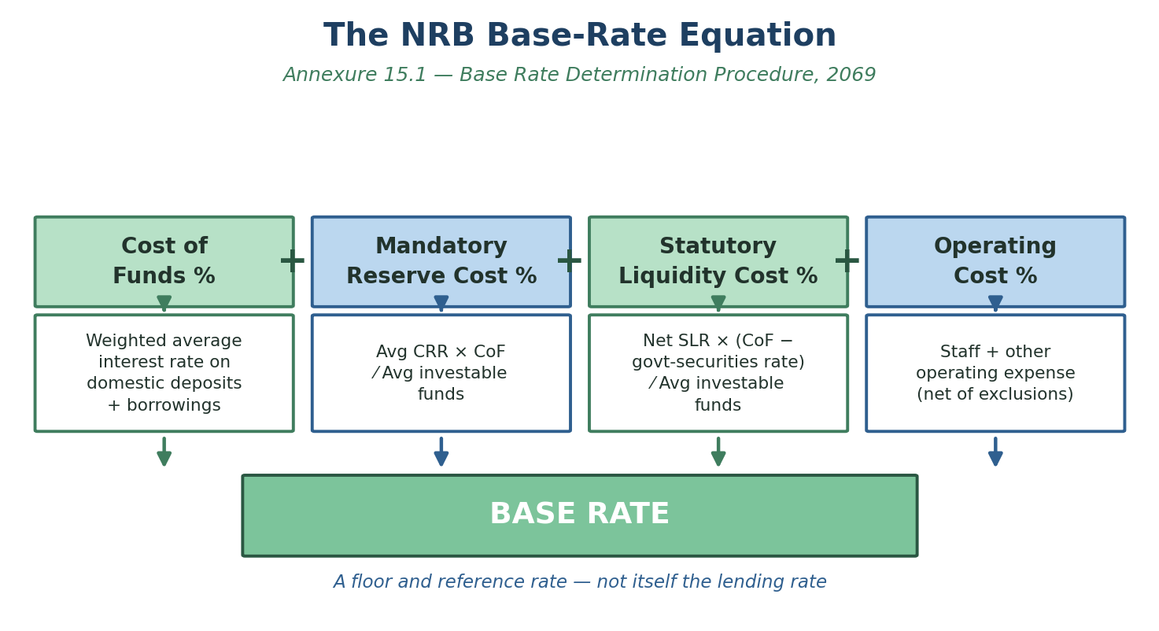
Base Rate = Cost of Funds % + Mandatory Reserve Cost % + Statutory Liquidity Cost % + Operating Cost %
The architecture is deliberate and worth pausing on. The first component captures what the bank actually pays for money. The second and third capture what regulation costs the bank – the return foregone on balances it is compelled to hold sterile or in low-yielding government paper. The fourth captures what it costs to run the institution. What the equation conspicuously omits is any allowance for profit, credit risk, or capital cost: those belong to the premium, which sits outside the base rate entirely. The base rate is thus a pure cost-recovery floor, and the regulatory logic follows directly – a bank lending below it is, by construction, lending below cost.
4. Component One: The Cost of Funds
The first and largest component is defined with brevity: कोष लागत प्रतिशत = स्वदेशी निक्षेप र ऋण तथा सापटीको भारित औसत ब्याजदर – the cost of funds percentage is the weighted average interest rate on domestic deposits and borrowings. Three features of that definition drive everything downstream. It is weighted, so a bank’s deposit mix matters as much as the rates it quotes: an institution funded largely by low-cost current and savings balances will compute a materially lower figure than one dependent on expensive institutional fixed deposits, even where both offer identical headline rates. It is domestic, excluding foreign-currency funding from the calculation. And it is an average of the existing book rather than the marginal rate on new money – a distinction that Section 10 shows to be the methodology’s most consequential economic weakness.
For microfinance institutions the formulation is functionally identical, extending to deposits, savings, and borrowings. Because the cost of funds also enters the numerators of the second and third components, an increase in deposit rates propagates through the equation three times over, amplifying its effect on the final base rate well beyond its own weight.
5. Components Two and Three: Pricing the Cost of Regulation
The second and third components monetise the burden of prudential requirements, and their construction is the most technically interesting part of the framework. The mandatory cash reserve a bank holds with NRB earns nothing; the funds tied up in it were nevertheless raised at the bank’s cost of funds. Section 2.2 therefore prescribes:
Mandatory Reserve Cost % = (Average CRR balance × Cost of Funds %) ÷ Average investable funds
Statutory liquidity is treated differently, because government securities held to satisfy the SLR are not sterile – they yield a return, merely one below the bank’s funding cost. Section 2.3 accordingly prices only the shortfall, the negative carry:
Statutory Liquidity Cost % = Net SLR amount × (Cost of Funds % − weighted average government-securities rate) ÷ Average investable funds
Two definitional refinements prevent double counting and manipulation respectively. First, the net statutory liquidity amount is defined as average statutory liquidity minus average mandatory reserve (खुद वैधानिक तरलता रकम = वैधानिक तरलताको औसत रकम − अनिवार्य मौज्दातको औसत रकम), so the CRR balance is not charged twice under two headings. Second, and more importantly, Section 3.2 commands that when computing both the average statutory liquidity and the average mandatory reserve, institutions must use the minimum amounts required to be maintained under NRB directives – not the balances they actually hold. This is a genuine anti-inflation safeguard: without it, a bank sitting on large voluntary excess reserves during a period of surplus liquidity could book that idle money as a regulatory cost and inflate its base rate, passing the price of its own conservatism to borrowers. The rule confines the cost to what regulation genuinely compels.
The shared denominator ties both components to the productive balance sheet. Average investable funds is defined as average domestic deposits plus average domestic borrowings minus average statutory liquidity – the money actually available to lend. Because that denominator shrinks as reserve requirements rise, an increase in CRR or SLR raises the base rate twice: directly, by enlarging the numerators, and indirectly, by contracting the base over which the cost is spread.
6. Component Four: Operating Cost, and What May Not Be Charged to Borrowers
The fourth component admits the institution’s running costs, drawn under Section 3.3 from staff expenses and other operating expenses as classified in the NRB-prescribed profit-and-loss format – so the input is the audited statement, not a management estimate. The analytically revealing part is the exclusions, which the Clarification to Section 2.4 sets out. Finance Expense under NFRS is removed, since that is a funding cost already captured in the first component and would otherwise be double counted. Employees Bonus is removed, on the reasoning that a profit-share distribution is not a cost of intermediation. And, most pointedly, expenses directly connected with deposit collection – insurance and medical facilities provided to depositors are the examples given – may not be included at all.
That third exclusion carries a clear regulatory philosophy. A bank competing for deposits by offering non-interest inducements is making a commercial choice about its own funding strategy; NRB declines to let the cost of that choice be recovered from borrowers through the mandatory floor. The exclusions together define the base rate as recovering the cost of intermediation proper and nothing else – a boundary that also constrains the accounting arbitrage discussed in Section 9.
7. From Computed Rate to Contracted Rate
A published base rate is not yet a price. Two further regulatory steps convert it into the number in a loan agreement, and the distinction between them is frequently misunderstood.
The first is temporal smoothing. Section 3.1 requires the monthly base rate to be computed on the latest period’s financial statements and data, producing a point-in-time figure that moves with monthly funding conditions. Alongside it, banks compute and publish a three-month average of those monthly rates. The monthly figure is the transparency instrument; the three-month average is the binding one. Directive 15, Point 3(6) states the floor without qualification: कुनैपनि कर्जा पछिल्लो तीन महिनाको औसत आधारदर भन्दा कम ब्याजदरमा प्रवाह गर्न पाइने छैन – no loan may be extended at an interest rate below the average base rate of the preceding three months. Averaging absorbs short-term volatility in the cost of funds before it reaches borrowers, which protects customers from month-to-month shocks and, as Section 10 argues, simultaneously slows the transmission of policy.
The second step is the premium. Directive 15, Point 3(1) requires that the interest rate on loans and advances be linked to the base rate computed under Annexure 15.1, and expressly extends that requirement to rescheduled and restructured loans, closing an obvious avenue for pricing outside the framework. Points 3(4) and 3(5) then require that the premium added to the base rate be stated clearly by loan category when rates are published, and that an individual borrower’s offer letter state the arithmetic explicitly in the prescribed form: loan interest rate = base rate + x percentage points. For some specified sectors and loan portfolios the percentage points that can be charged over the base rate are explicitly defined. For Class D microfinance institutions the premium is not merely disclosed but capped: Directive 14, Point 2(kha) permits a maximum of 3% points over the three-month average base rate, the framework’s only absolute ceiling on lending margin.
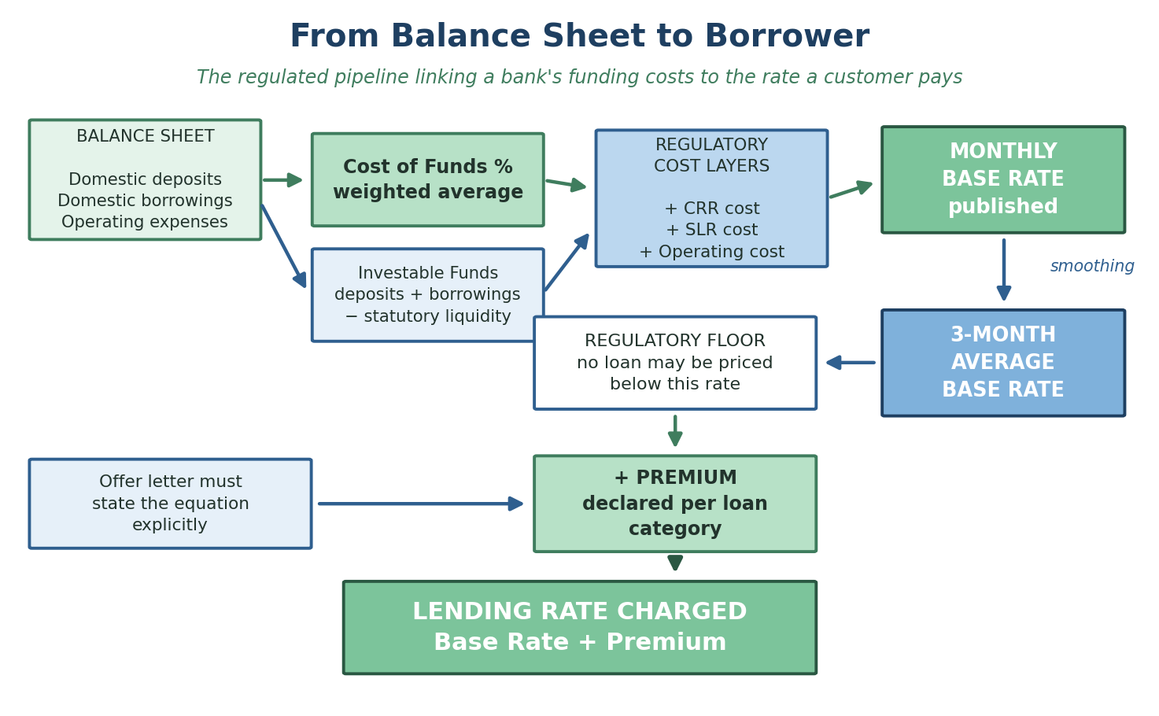
The floor admits narrow exceptions, and they are policy-driven rather than commercial. Point 3(6) permits lending below the three-month average base rate for loans operated under programmes of the Government of Nepal, provincial governments, or local levels, and for lending funded by concessional assistance or grants received from donor agencies and channelled through banks to specified sectors and classes. The logic is coherent: where the state or a donor is subsidising the credit, the below-cost price is not predatory pricing funded by cross-subsidy from other borrowers but a transfer the framework should not obstruct.
| Concept | What it is | Regulatory function |
|---|---|---|
| Monthly base rate | Point-in-time computation on latest financials (s.3.1) | Transparency and disclosure |
| Three-month average | Mean of the three preceding monthly rates | Binding floor for lending (Dir. 15, 3(6)) |
| Premium | Margin added per loan category | Risk, capital, and profit – outside the formula |
| Lending rate | Three-month average base rate + premium | The contracted price |
| Below-floor lending | Government / donor-funded programmes only | Narrow policy exception |
8. How the Framework Has Changed
The base-rate regime has been amended rather than rewritten, and the direction of travel is consistent: from a transparency measure applied to commercial banks toward a binding price-control architecture applied across the licensed system. Introduced through the Monetary Policy for FY 2069/70 and given technical form in the Base Rate Determination Procedure, 2069, it addressed what NRB identified as a lack of transparency and competitiveness in loan pricing. The methodology was subsequently extended to Class D microfinance institutions in 2077 and refined in 2079, closing a regulatory gap in which the most vulnerable borrowers faced the most opaque pricing – and going further for that sector than for any other by capping the permissible premium outright.
Read as a sequence, the amendments reveal a regulator progressively less content with disclosure alone. The original instrument told borrowers how a rate was built; the current framework additionally fixes a floor beneath which it cannot fall, requires the premium to be declared by category and stated in the offer letter, caps that premium absolutely in microfinance, and extends the base-rate linkage to restructured credit. Transparency was the entry point; price discipline became the objective.
9. Discretion, Verification, and the Scope for Arbitrage
Because each bank computes its own floor, the integrity of the system depends on how little latitude the formula leaves. On the whole it leaves remarkably little. The formula itself is fixed; the components are defined; the data source is the NRB-prescribed financial statement format rather than management accounts; the reserve and liquidity inputs must be the regulatory minima rather than actual balances; and the operating-cost exclusions are enumerated. Banks must publish monthly and three-month average rates, disclose premiums by loan category, and report to NRB in a prescribed form, which makes the published figure reconstructible from the underlying returns and therefore auditable in supervision.
Residual discretion nonetheless exists, and it clusters in three places. The first is classification: the boundary between an expense that is a cost of deposit collection (excluded) and one that is general operating cost (included) is a judgement, as is the allocation of shared overheads. The second is averaging: the procedure requires use of the latest period’s data without exhaustively specifying every averaging convention, so timing choices can shade the result at the margin. The third is the deposit book itself – a bank can lower its computed base rate genuinely, by shifting its funding mix toward low-cost current and savings deposits, which is precisely the efficiency incentive the framework intends. The line between legitimate funding-structure optimisation and presentational arbitrage is real but thin, and it is policed by supervision rather than by the formula. Misreporting or lending below the applicable floor attracts the standard enforcement consequences: correction directives, penalties under Section 100 of the NRB Act against the institution and personally against responsible officers, and the supervisory escalation available under BAFIA.
10. Does It Work? The Empirical Record
Eight years of NRB data allow the framework to be tested rather than merely described, and on the most basic question – does the base rate actually track funding costs, and do lending rates actually track the base rate – the answer is clearly affirmative. Across the period from mid-July 2017 to mid-July 2024 the three series move in tight synchrony through a full liquidity cycle: the deposit rate falls from 6.15 to a historic low of 4.65 percent under pandemic liquidity injection by mid-July 2021, dragging the base rate from 9.89 to 6.86 and the lending rate from 11.33 to 8.43; the post-pandemic liquidity crunch then forces deposit competition that lifts the deposit rate to 7.86 percent by mid-July 2023, pushing the base rate to 10.03 and lending to 12.30; and the subsequent easing brings all three down again, with lending falling below double digits to 9.93 percent by mid-July 2024.
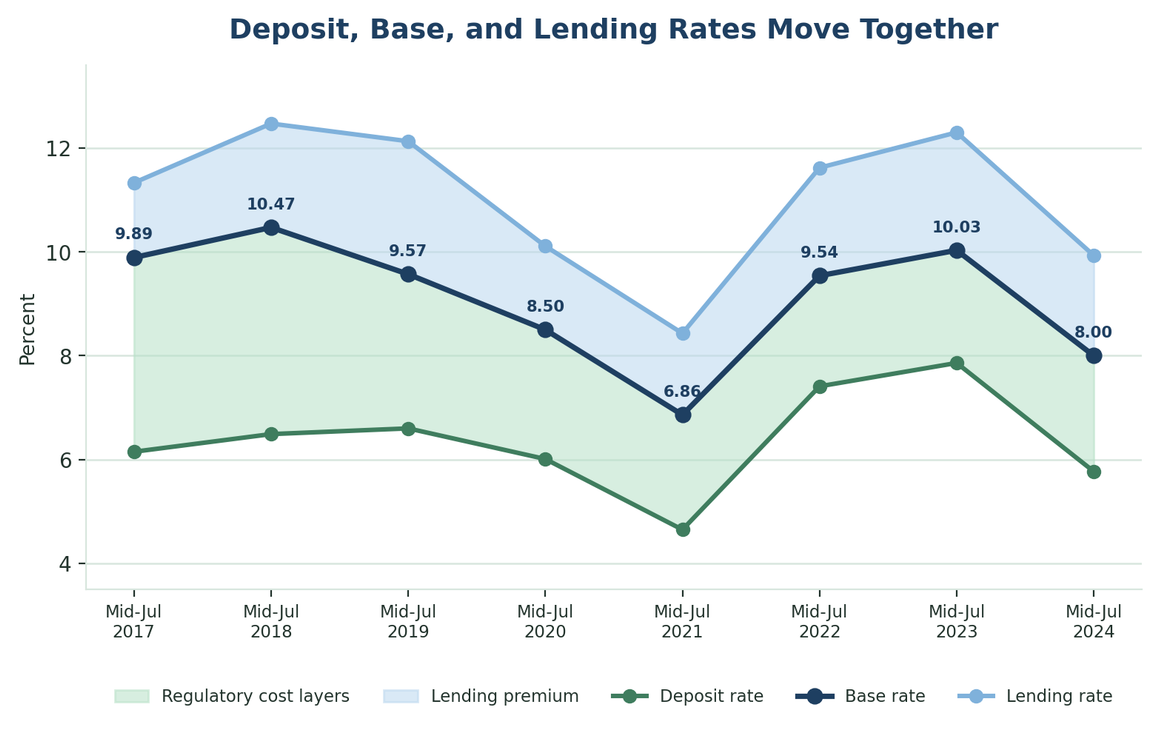
One episode is especially instructive because it isolates the regulatory components from the funding component. Between mid-July 2018 and mid-July 2019 the deposit rate rose slightly, from 6.49 to 6.60 percent, yet the base rate fell sharply from 10.47 to 9.57. The explanation lies in NRB’s structural reduction of statutory reserve requirements over that period: with lower compelled balances, the second and third components of the formula contracted and the denominator of investable funds expanded, more than offsetting the higher cost of deposits. This is the clearest available demonstration that the framework’s regulatory-cost layers are not decorative – a change in prudential requirements transmits directly and measurably into the price of credit.
Deposit Rate (+0.11%)⟹Pushed Base Rate UP slightly
CRR SLR Cuts⟹Pulled Regulatory Costs DOWN significantly
Net Effect⟹Base Rate fell by 0.90%
Decomposing the borrower’s rate into its constituent layers makes the underlying stability visible. The cost of deposits does almost all the moving; the regulatory cost layers and the lending premium are comparatively stable bands sitting on top of it.
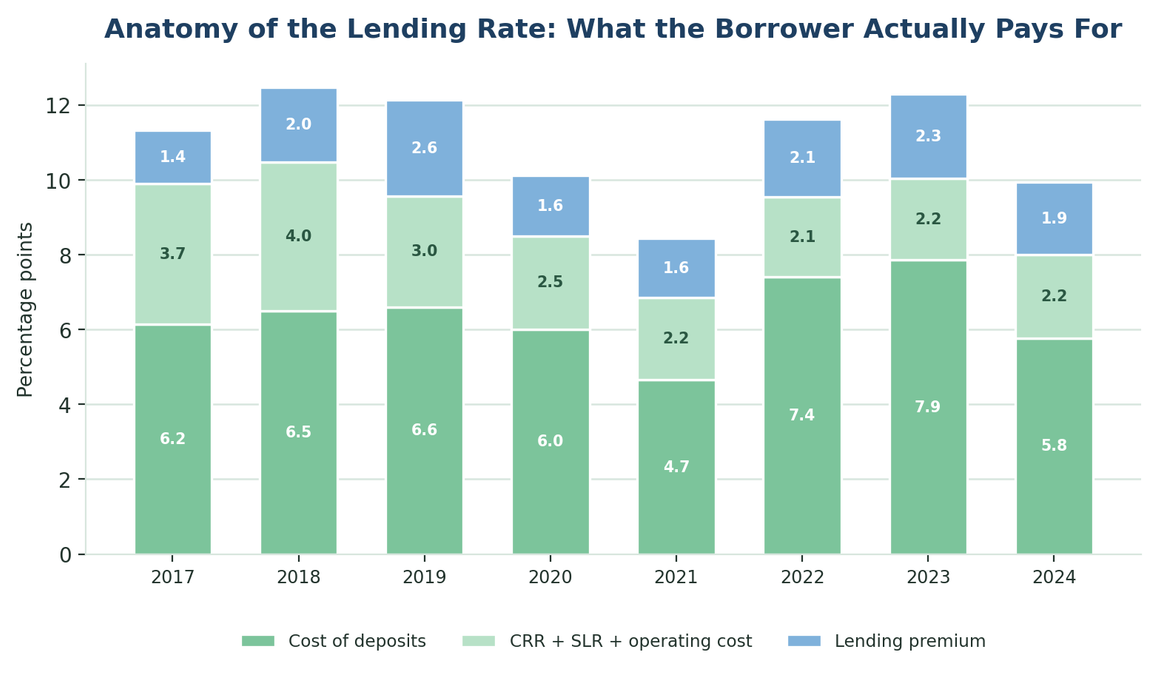
The decomposition also exposes what the published base rate does not tell a borrower. The premium band – the difference between the base rate and what is actually charged – has ranged from roughly 1.4 to 2.3 percentage points across the period, and it is determined by the bank, not the formula. A borrower comparing two banks’ published base rates is comparing their cost structures, which is genuinely useful; but the number that determines what he pays is the sum of that figure and a premium set by commercial judgement and disclosed only by loan category. Transparency of the floor is not transparency of the price.
11. Transmission: Where Policy Reaches the Borrower, and Where It Stalls
The base rate is also the channel through which monetary policy is meant to reach credit, and the formula determines the shape of that channel. NRB’s own analysis identifies the weighted average deposit rate and the interbank rate as the dominant determinants of banks’ base rates, which follows mechanically from the equation: policy actions influence the base rate almost entirely through the cost-of-funds term, since the reserve and liquidity components move only when NRB changes CRR or SLR, and the operating-cost component is essentially inert over policy horizons.
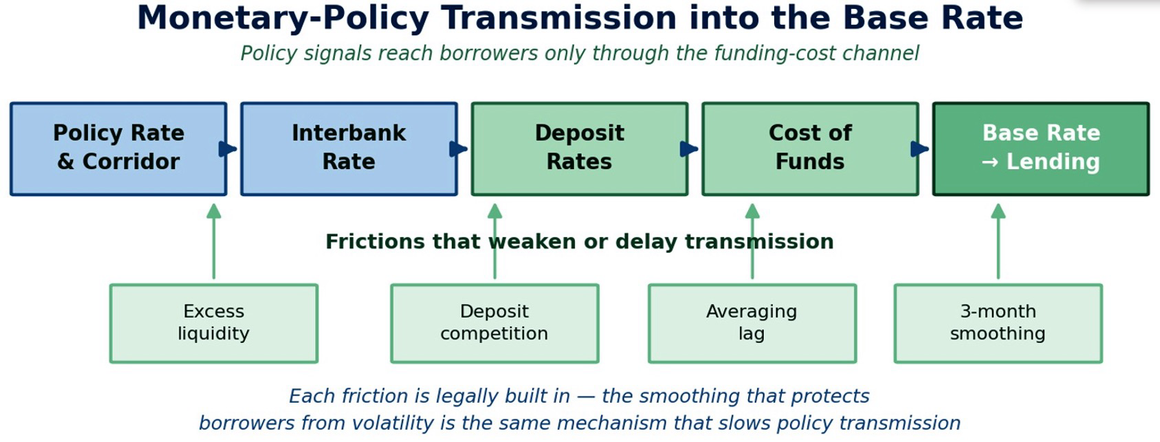
Each friction in that chain is instructive because each is a design consequence rather than a market failure. Excess liquidity severs the first link, since a banking system with surplus funds does not need to bid for money and interbank rates detach from the corridor. Deposit competition dominates the second, so that in a liquidity crunch deposit rates can rise irrespective of the policy stance – precisely what occurred in 2022 and 2023. The averaging convention introduces a lag at the third, because the formula uses the average cost of the existing deposit book rather than the marginal cost of new money, so a policy change reaches the base rate only as the stock of deposits gradually reprices. And the three-month averaging requirement adds a final, deliberate delay at the point of application.
The last two frictions deserve emphasis because they are the same mechanism viewed from opposite ends. Averaging and smoothing are what make the base rate stable, predictable, and fair to a borrower who would otherwise face repricing on every monthly fluctuation in his bank’s funding costs. They are also, unavoidably, what make the base rate a lagging indicator of monetary conditions. NRB cannot have both instantaneous transmission and borrower protection from volatility from a single averaged instrument; the framework has chosen the latter, and the incomplete and delayed transmission NRB documents in its own reports is the price of that choice rather than evidence of malfunction.
12. Assessment
Judged against its stated objectives, Nepal’s base-rate methodology succeeds substantially on transparency and competition, partially on fair pricing, and only conditionally on monetary transmission. Its architecture is genuinely transparent: the formula is public, the components are defined, the inputs are drawn from prescribed statements, the reserve and liquidity assumptions are locked to regulatory minima, and the outputs must be published monthly and reconstructible in supervision. It creates a real efficiency incentive, since a bank that mobilises cheap deposits and controls operating costs computes a lower floor and can price more competitively – the mechanism working exactly as intended. And by excluding deposit-acquisition inducements, employee bonuses, and NFRS finance expense, it prevents the floor from becoming a vehicle for recovering costs that are not costs of intermediation.
Three weaknesses qualify that assessment, and they are conceptual rather than administrative. The first is that the formula measures average, not marginal, cost of funds. It answers the question of what a bank’s existing liabilities cost, when the economically relevant question for pricing a new loan is what the next rupee of funding costs. In a stable rate environment the divergence is trivial; in a turning cycle it is not, and it is the principal reason the base rate lags. The second is the tension between smoothing and transmission examined above – a genuine trade-off rather than a defect, but one that limits how much monetary-policy work the instrument can be asked to do. The third is the transparency gap at the point of sale: the framework makes a bank’s cost structure legible while leaving the premium, which is the difference between that cost and the borrower’s price, to commercial discretion disclosed only at category level and capped only in microfinance.
The deeper observation is that the base rate is being asked to serve two purposes that pull against each other. As a prudential and competition instrument it should be stable, auditable, and anchored in verified historical accounts – which is exactly what an averaged, statement-based formula delivers. As a monetary-transmission channel it should be fast and forward-looking, which an averaged, statement-based formula structurally cannot be. Nepal has built a very good version of the first instrument and is relying on it to perform the second. That is not a failure of the methodology so much as a limit on what a single number, computed from last period’s balance sheet and smoothed over three months, can be expected to do.
References
Nepal Rastra Bank Act, 2058 (2002), ss.4, 79(1)-(2), 100, 110(3).
Bank and Financial Institution Act, 2073 (2017) (BAFIA), ss.49, 99, 131.
Nepal Rastra Bank, Unified Directives (Class A, B, C) – Directive No. 15 (ब्याजदर सम्बन्धी व्यवस्था), Points 3(1), 3(4), 3(5), 3(6).
Nepal Rastra Bank, Annexure 15.1 – आधार दर निर्धारण सम्बन्धी कार्यविधि, २०६९ (Base Rate Determination Procedure, 2069), ss.2, 2.1, 2.2, 2.3, 2.4 (Clarification), 3.1, 3.2, 3.3.
Nepal Rastra Bank, Unified Directive for Class D Microfinance Institutions, 2082 – Directive No. 14, Point 2(ख); Annexure 14.1, ss.1, 1.1, 1.3, 1.4.
Nepal Rastra Bank, Monetary Policy for FY 2069/70 (introduction of the base rate).
Nepal Rastra Bank, Unified Directive No. 4 – prescribed financial statement format (Schedule 4.36, Finance Expense under NFRS).
Nepal Rastra Bank, Annual Reports, FY 2016/17 through FY 2023/24 (weighted average deposit, base, and lending rate series).
Nepal Rastra Bank, Macroeconomic and Financial Situation reports (interest-rate corridor, interbank rates, liquidity conditions).
Nepal Rastra Bank, Bank Supervision Reports (cross-bank funding structures, operating efficiency of state-owned and private banks).