This analysis traces the evolution, legal underpinnings, and global proliferation of a potent political strategy: the use of repetitive, negative nicknames to define opponents. We examine its historical roots, its masterful execution by Donald Trump, and its fascinating adaptation in Nepal’s media landscape by commentator Bodhraj Neupane, all through the lens of comparative law and political communication theory.
Introduction: Beyond Insult, Towards Doctrine
The label “Teflon Don” aptly describes a political phenomenon – the ability to deflect scandal. But this passive descriptor misses the aggressive, strategic genius of Donald Trump’s political communication. His true innovation lies not in evasion, but in attack: a systematic method of branding adversaries with simple, memorable, and devastatingly effective nicknames.
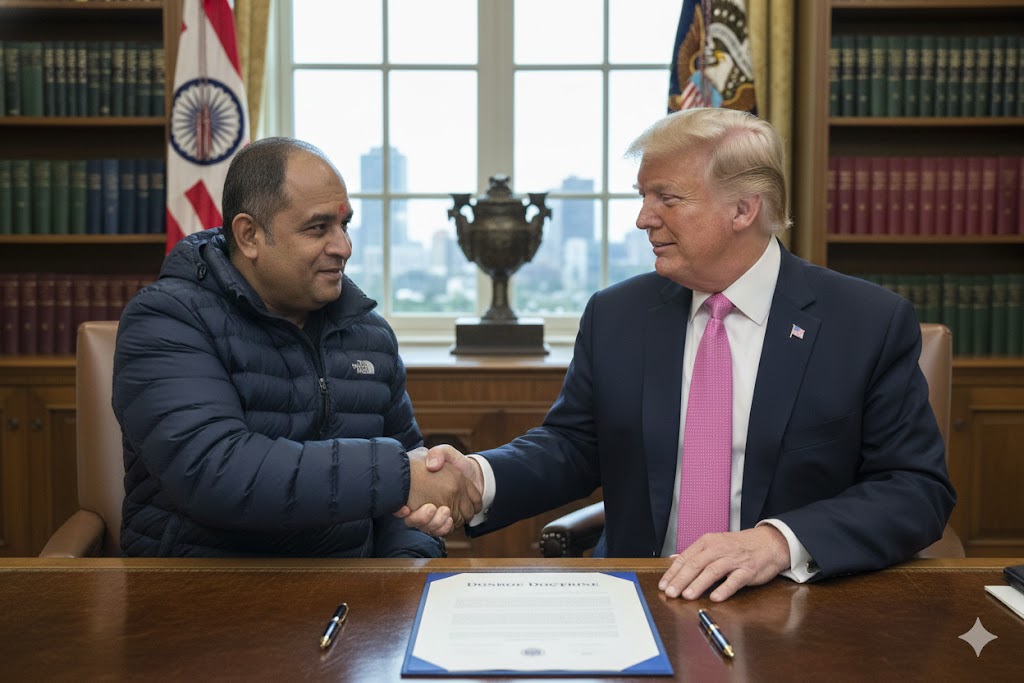
This is not mere schoolyard taunting. It is a calculated and sophisticated political strategy. We can term this the “Donroe Doctrine.”
The Doctrine is a communication framework designed to achieve specific political ends: to frame the narrative around an opponent, simplify complex personas for mass consumption, and dominate the media cycle through repetition. Its efficacy has reverberated globally, finding a unique expression, which I recently discovered in the political commentary of Nepal’s Bodhraj Neupane. This article deconstructs the Doctrine from its ancient origins to its modern-day implications, assessing its legality, its mechanics, and its profound impact on democratic discourse.
Historical Precedent: The Ancient Roots of Political Branding
While the scale and speed of the Donroe Doctrine are modern, its tactical essence is ancient. Political figures have long understood the power of reducing an adversary to a caricature.
- Cicero in the Roman Republic (106-43 BC): The famed orator’s prosecution of Gaius Verres is a classic case. Cicero relentlessly used puns on the name “Verres” (which means “boar” or “pig”) to paint the corrupt governor as a filthy, greedy plunderer. This was not just an insult; it was a strategic, repetitive branding effort.
- Andrew Jackson and 19th-Century America: Jackson’s opponents branded him “King Andrew the First,” a brilliantly effective nickname that framed his assertive use of presidential power as monarchical and anti-republican.
- Theodore Roosevelt and the “Muckrakers”: Roosevelt’s term for investigative journalists was initially pejorative, suggesting they focused only on the “muck.” While it was later co-opted, its intent was to frame and control the narrative around his critics.
The critical difference in the 21st century is the media environment. The 24-hour news cycle and the viral nature of social media act as a force multiplier, turning a strategically chosen nickname into a global narrative almost instantly.
Deconstructing the Doctrine: The Pillars of Trump's Rhetorical Efficacy
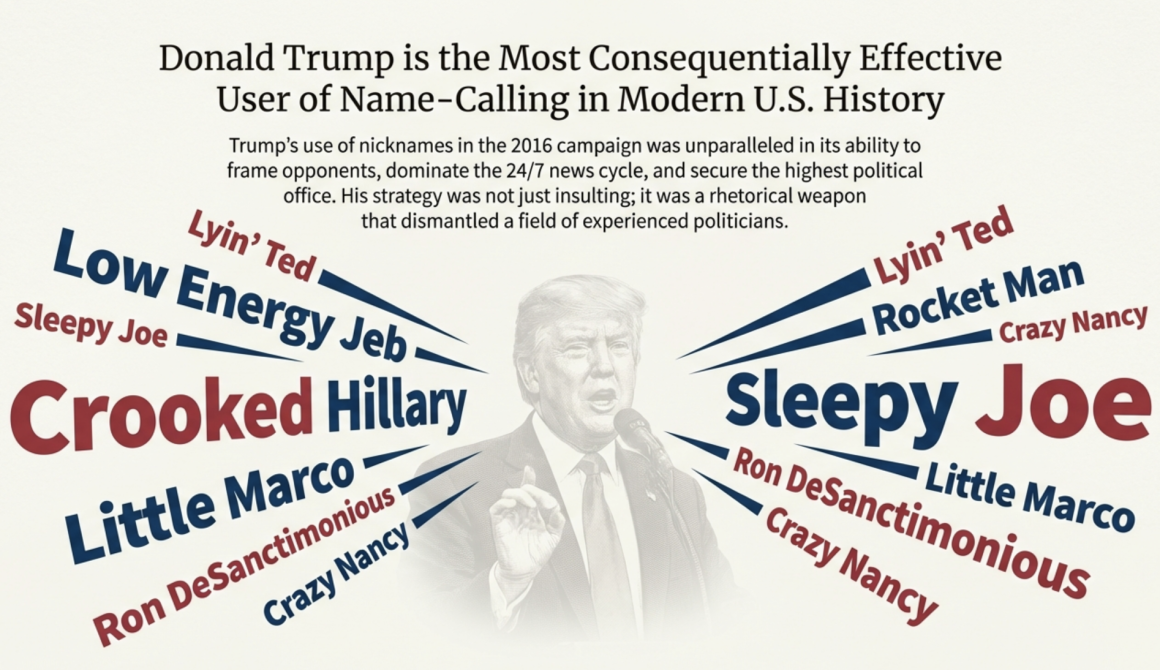
Donald Trump’s application of the Doctrine is unprecedented in its consistency and impact. His arsenal – “Crooked Hillary,” “Sleepy Joe,” “Lyin’ Ted,” “Low Energy Jeb,” “Little Marco,” “Ron DeSanctimonious” – is a case study in political framing. Its effectiveness rests on four foundational pillars:
- Cognitive Simplicity and Memetic Stickiness: The Doctrine reduces a multifaceted political career into a two- or three-word phrase. “Low Energy Jeb” instantly communicated a lack of dynamism, bypassing complex policy debates. This simplicity makes the label highly memorable and easily transmissible, functioning as a perfect political meme.
- Strategic Narrative Framing: Each nickname is engineered to attack a perceived core vulnerability. “Crooked Hillary” amplified pre-existing doubts about trustworthiness, while “Sleepy Joe” directly targeted concerns about age and vitality. The Doctrine allows the name-caller to define the terms of the political battle.
- The Performance of Anti-Establishment Authenticity: The deliberate violation of political decorum is a key feature. For supporters, this childishness signals an authentic outsider unbound by the “politically correct” rules of the elite establishment they distrust. It is a performative rejection of the status quo.
- Media Dominance and Distraction: The outrage and novelty of a new nickname guarantee media amplification. This repetition embeds the label in public consciousness and often serves as a powerful tool to shift the news cycle away from unfavorable stories about the name-caller themselves.
This strategic offensive is the true source of the “Teflon” effect; by constantly attacking, you control the battlefield and minimize the time your opponent has to mount a counter-offensive.
The Legal Shield: Why the Donroe Doctrine Thrives in the U.S.
A critical question is the legality of such rhetoric. In the United States, the Doctrine operates behind an immense legal fortress: the First Amendment. The U.S. legal framework is uniquely protective of hyperbolic political speech.
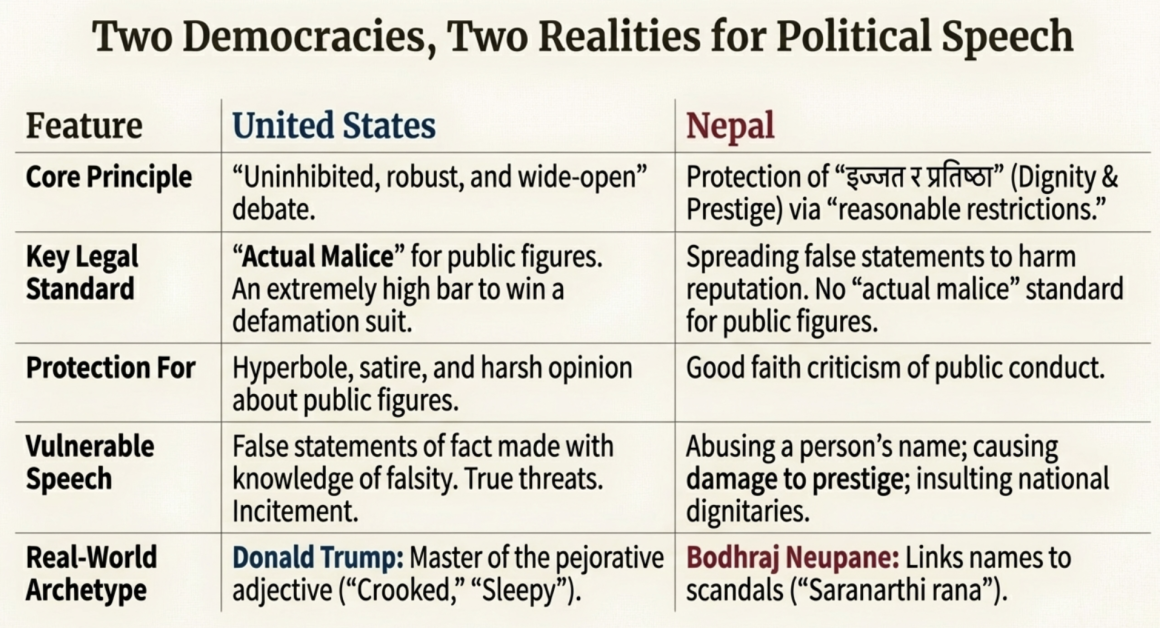
- The Foundation: New York Times Co. v. Sullivan (1964): This landmark case established the “actual malice” standard. For a public figure to win a defamation lawsuit, they must prove the speaker knew the statement was false or acted with reckless disregard for the truth. This is a prohibitively high bar for opinion-based nicknames.
- The Doctrine’s Legal Bedrock: Hustler Magazine, Inc. v. Falwell (1988): This case is paramount. The Supreme Court unanimously held that a public figure cannot recover damages for intentional infliction of emotional distress for a publication without proving it contained a false statement of fact made with “actual malice.” The parody of Jerry Falwell was deemed so outrageous that no one would take it as fact, thus protecting it. This ruling solidifies the protection of political hyperbole and satire, which is the legal category for most of Trump’s nicknames. “Crooked Hillary” is an opinion, not an assertion of verifiable fact, and is therefore shielded speech.
In essence, U.S. law prioritizes uninhibited political debate over protection from personal insult, creating a perfect environment for the Donroe Doctrine to flourish.
|
Unprotected Category |
Legal Requirement to Win a Lawsuit |
Application to Trump’s Nicknames |
|
Defamation (Libel/Slander) |
The statement must be a false assertion of fact (not opinion) that harms the target’s reputation, and the target must prove actual malice (knowledge of falsity or reckless disregard for the truth). |
The most difficult hurdle to clear. If he called an opponent a “convicted thief” when they had no conviction, it’s a false fact. But proving he knew it was false or recklessly disregarded the truth would still be necessary for a public figure to win. |
|
Incitement to Imminent Lawless Action |
The speech is directed to inciting or producing imminent lawless action and is likely to incite or produce such action. |
This is the very high standard set in Brandenburg v. Ohio (1969). General angry rhetoric, even with insults, rarely meets the imminent and likely criteria. |
|
True Threats |
The speaker communicates a serious expression of intent to commit an act of unlawful violence to a particular individual or group. |
Insults are not threats. Even highly aggressive name-calling would need to transition into a direct, specific, and credible threat of violence to meet this high standard. |
Nepal's Legal Landscape: A Higher Bar for Rhetoric
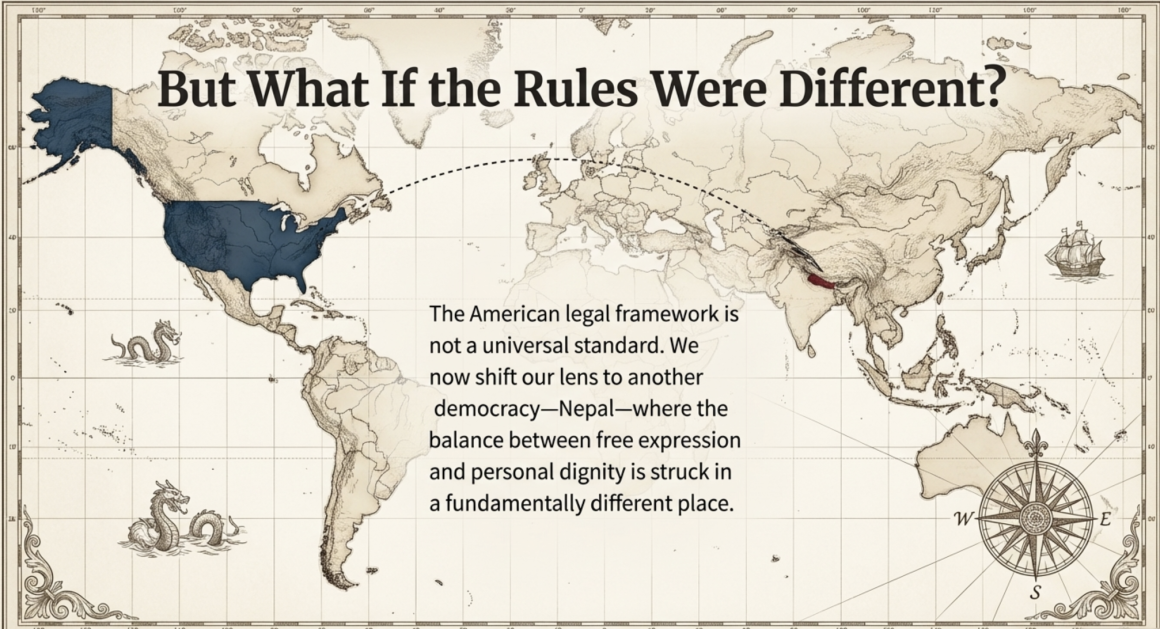
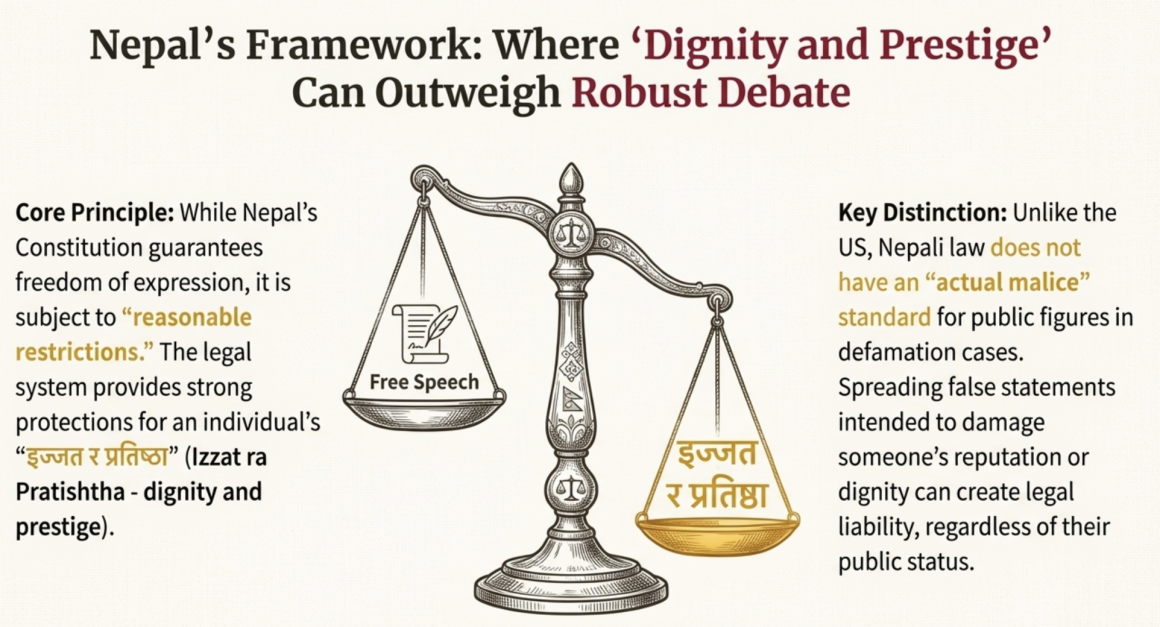
The legal context in Nepal presents a stark contrast. While the Constitution of Nepal guarantees freedom of expression, it is subject to “reasonable restrictions” that place a higher value on personal dignity and public order.
- The Muluki Civil Code, 2074 (2017): This code explicitly protects an individual’s reputation.
- Section 9: Prohibits any act that causes “nuisance, annoyance or damage to prestige, reputation or property of another person.”
- Section 31(3): Explicitly states, “No person shall be allowed to abuse another’s name.”
- Violations can lead to civil liability for compensation (Section 8).
- The Muluki Criminal Code, 2074 (2017): The restrictions are more severe.
- Section 152: Criminalizes spreading “hatred, insult or defamation” against National Dignitaries, with penalties of imprisonment up to six months or a fine.
- Section 51: Prohibits acts that “insult, ridicule or spread hatred” against Nepal’s sovereignty or dignity, carrying penalties of up to five years imprisonment.
This legal framework means that a Trump-style nickname in Nepal could more easily cross the line into a legally actionable offense of defamation or even a criminal act, especially if aimed at a high-ranking official.
Nepal's Legal Landscape: A Higher Bar for Rhetoric
It is against this restrictive legal backdrop that the Donroe Doctrine finds a bold practitioner in Nepal: political commentator Bodhraj Neupane. An institutional skeptic and a vocal critic of neopatrimonialism, Neupane has adapted the Doctrine to Nepal’s context of scandal-driven politics through his platforms on Mountain TV and PNP Media.
Neupane’s ingenuity lies in his specific adaptation. His nicknames are not just insults; they are mnemonic devices that surgically tie politicians to specific allegations:
- Scandal-Based Branding: Names like “Saranarthi Rana,” “Bhutani Khand,” and “Balmandir Singh Shtretha”function as public shorthand, permanently linking individuals to the corruption scandals they are associated with. This is a direct application of the Doctrine’s simplification principle.
- Cultural Deconstruction: Nicknames like “Chala Jutta Chaudhary,” “Scount Khadka,” and “Dhanalaxmi Gurung” use humor and local cultural references to demystify and ridicule powerful figures, breaking down their aura of authority and revealing the scandals they are associated with.
Neupane is executing the core tenets of the Donroe Doctrine – simplification, repetition, and narrative control – with precision. However, he does so in a legal environment that offers far less protection than the U.S. First Amendment, making his commentary a politically significant and legally risky endeavor.
Conclusion: Strategic Ingenuity vs. Civic Discourse
The long-term impact of the Donroe Doctrine is the central democratic dilemma it presents. Critics argue it permanently lowers the bar for civil debate, normalizes hostility, and displaces substantive policy discussion with personal vitriol. It risks reducing governance to a contest of caricatures.
However, an analysis of its strategic efficacy reveals why it persists. For its practitioners and their supporters, the Doctrine is not a degradation of politics but a necessary tool of democratic accountability. It is seen as a way to cut through bureaucratic obfuscation and elitist gatekeeping to expose what they believe are fundamental truths about corrupt or incompetent systems.
The “Donroe Doctrine” is therefore a double-edged sword of formidable sharpness. Its strategic ingenuity in framing opponents and mobilizing bases is undeniable. Yet, its ultimate effect – whether it strengthens democracy by holding power to account or weakens it by eroding the foundations of civil discourse – remains an open and critically important question. Its adoption in diverse political landscapes like Nepal proves that the Doctrine is not an American anomaly, but a potent and evolving feature of modern political warfare.