
I. The Cognition Trap: Problem Statement and the Argument in Brief
A woman who kills her children while psychiatrically unravelling after childbirth presents every legal system with the same question: was she too sick to be held responsible, or only sick enough to be judged less harshly? Nepalese law answers that question with an instrument built for a narrower case than the one it is asked to decide.
On the surface, Nepal appears well equipped to try such a case. The National Penal Code, 2074 contains an express exemption from criminal liability for a person who, at the time of the act, was by reason of mental unsoundness incapable of knowing its nature, quality, wrong or consequence. Nepal’s criminal procedure law empowers courts, prosecutors and the defence to obtain a psychiatric examination. Its constitution guarantees dignity, equality, health and due process to the mentally ill. On paper, the doctrinal apparatus of an insanity defence exists in full.
The surface explanation is that a woman presenting Lindsay Clancy’s facts – a documented, months-long psychiatric collapse; repeated hospitalisation; a reported command hallucination; a suicide attempt immediately after the killing of her three children – could be a strong candidate for exactly the exemption Section 14 provides. If severity of illness were the test, this could be among the more sympathetic cases a court could see.
That explanation is incomplete, and the reason it is incomplete is what this report sets out to show.
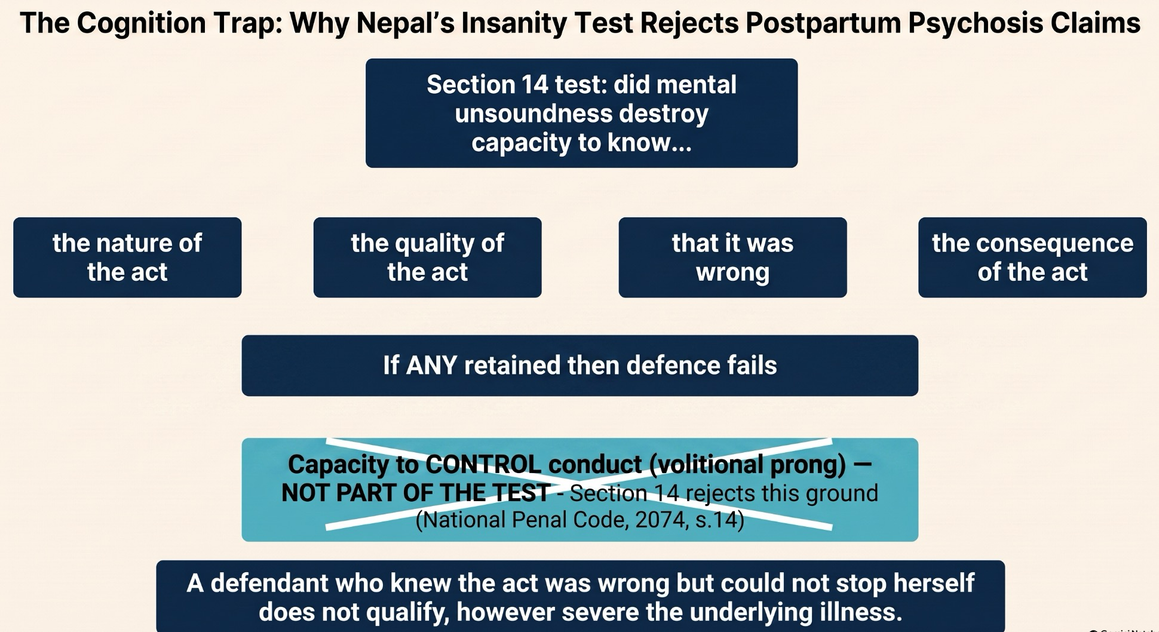
Severity of illness is not the test Nepalese courts apply, and cognition is not the only faculty the M’Naghten Rules – derived language of Section 14 was built to measure. The provision asks a single, narrow question – did mental unsoundness destroy the defendant’s capacity to know the nature, quality, wrongfulness or consequence of the act – and it answers that question by looking almost entirely at conduct: what the accused did in the minutes before, during and after the killing. A defendant who fled, who gave a coherent account to police, who resumed an ordinary routine, or who took any step suggesting an intact sense of cause and effect has, in the pattern of the Supreme Court’s reasoning examined in Chapter II, already lost the argument regardless of the psychiatric history behind her. The doctrine has no room for a defendant who retained every cognitive faculty the test measures while losing the one faculty it does not measure: the capacity to control what she did. Nepal has expressly and repeatedly declined to recognise an irresistible-impulse or volitional branch of the insanity defence. A command hallucination that a defendant obeyed while fully aware that killing was wrong and illegal – precisely the scenario the defence in the Clancy case argued – describes a woman Nepalese doctrine would not exempt, because Nepalese doctrine was never built to ask whether she could stop.
This is not a hypothetical gap. It is confirmed by the absence of a case on the other side of it. Nepal’s Supreme Court has never delivered a decision recording a complete acquittal on grounds of insanity in a homicide matter. Every documented instance in which a mentally disturbed defendant received relief took one of two forms: a downgrade of the offence itself, where extreme mental disturbance was treated as negating premeditation and reducing murder to a lesser homicide with a fixed term; or a discretionary reduction of an already-imposed life sentence, exercised under a now-repealed provision of the old Muluki Ain rather than under the insanity defence at all. Neither outcome is an acquittal. Both leave the underlying conviction for homicide intact.
Nepal’s courts have shown mercy to mentally disturbed killers many times. They have never once agreed that a mentally disturbed killer was not a killer.
The second half of the surface explanation is procedural, and it compounds the first. Even a defendant whose psychiatric collapse might, on close examination, meet some version of a legal-insanity threshold depends on that collapse being documented, tested and placed before a court by people with both the duty and the tools to do so. Nepal has no standalone mental health act. Its principal maternal-health statute defines reproductive-health morbidity in exclusively physical terms, so that a psychotic postpartum breakdown falls outside the categories of illness the law was built to detect. Postnatal follow-up visits are mandated at fixed intervals, but the mandate is for family and psychosocial counselling, not for a validated psychiatric screening instrument. No statute defines or licenses a joint mother-and-infant psychiatric ward of the kind used elsewhere to treat postpartum psychosis without separating a mother from the infant she may be at risk of harming. Forensic psychiatric assessment exists as a procedural mechanism a court may order, but nothing in the statutory scheme obliges a treating clinician, a family member or a police officer to trigger that mechanism before a killing occurs, only after.
What is actually happening, then, is not that Nepalese law is unusually harsh toward mentally ill defendants. It is that Nepalese law was built around a cognitive test that the paradigmatic case of postpartum psychosis – retained awareness of wrongdoing, lost capacity for self-control – was never designed to satisfy, and around a health system with no statutory trigger for finding that collapse before it turns violent.
The distinction matters because it changes where the reform conversation belongs. If Nepalese law were simply too harsh, the answer would be to soften the insanity test. But the evidence examined in this report does not support that framing cleanly: Nepal’s courts have shown a real, repeatedly exercised capacity for mercy toward mentally disturbed defendants, exercised through sentence mitigation rather than acquittal, and there is a serious argument – developed in Chapter V through a case decided in the same period this report was researched – that Nepalese due-process doctrine is moving toward a broader duty to investigate mental illness before punishing conduct attributable to it. The more consequential failure is upstream of the courtroom: a woman experiencing the trajectory described in the introduction to this report would very likely never have her psychiatric collapse documented to a standard any court could act on, because no institution was under a legal duty to look for it.
This report establishes five propositions in support of that diagnosis. First, that Section 14 of the National Penal Code, 2074 imposes a strict cognitive test that expressly excludes volitional incapacity, foreclosing acquittal for a defendant whose illness destroyed self-control while leaving her awareness of wrongdoing intact. Second, that no Supreme Court decision has ever recorded a complete insanity acquittal in a homicide case; the two most factually proximate precedents – both involving mothers who killed newborns conceived through rape – resulted in discretionary sentence reductions under a provision of the 2020 Muluki Ain that has since been repealed, but the discretionary provision as survided under the current 2074 code as well. Third, that Nepal’s statutory health framework contains no mandated mechanism for detecting postpartum psychiatric emergencies before they become criminal ones, and no dedicated Mental Health Act to anchor involuntary treatment, third-party protection or continuity of care. Fourth, that a competing and more recent line of due-process jurisprudence – which required a public employer to investigate a claimed psychiatric condition before imposing a severe sanction – suggests that Nepalese courts may be more receptive to procedural protections for the mentally ill than the rigidity of Section 14 alone would suggest, though this line of authority has not yet been tested against a completed homicide. Fifth, that the reforms capable of changing this outcome are concentrated upstream of the trial – in screening, in a mental health act – rather than in the insanity test itself, which would require a more fundamental legislative choice to import a volitional standard Nepal has so far declined to adopt.
II. The Threshold That Cannot Be Crossed: Section 14 and the Rejection of Volition
Nepal’s insanity defence asks only whether the accused understood what she was doing. It has never asked, and by its drafting history expressly declines to ask, whether she could stop herself from doing it.
1. The statutory text
The exemption from criminal responsibility for mental unsoundness is codified in Part-1, Chapter-2 of the National Penal Code, 2074, immediately among the general exceptions to criminal liability rather than as a specialised defence provision. Its placement signals that the drafters treated it as conceptually adjacent to necessity, mistake and consent – a threshold condition for criminal responsibility to attach at all – rather than as an affirmative defence of the kind raised after the elements of an offence are otherwise proved.
| LEGAL TEXT – National Penal Code, 2074, s.14 – Act of a Person Not of Sound Mind Not to Be an Offence ORIGINAL LANGUAGE “१४. होस ठेगानमा नरहेको व्यक्तिले गरेको काम कसूर नमानिने : कुनै काम गर्दाका बखत मानसिक अस्वस्थताको कारणले त्यस्तो कामको प्रकृति, गुण, दोष वा परिणाम बुझ्न नसक्ने गरी होस ठेगानमा नरहेको व्यक्तिले गरेको काम कसूर मानिने छैन ।” CONVENIENCE TRANSLATION “14. Act of a person not of sound mind not to be an offense: No act done by a person who, at the time of doing it, by reason of mental unsoundness, is incapable of knowing the nature, quality, wrong, or consequence of the act, shall be deemed to be an offense.” |
2. Four cognitive branches, and only cognitive branches
The provision names four discrete objects of awareness the accused must have been incapable of grasping: the nature of the act, its quality, its wrongfulness, and its consequence. Nepalese commentary treats these as cumulative safeguards against a narrow reading of “nature” alone – a defendant who did not know she was killing a person rather than, in the classic illustration, chopping wood in the dark, fails on the first branch; a defendant who understood the physical act but had no grasp that it was prohibited fails on the third. Satisfying any one branch is sufficient to defeat the defence: the accused need only retain awareness of nature, quality, wrongfulness, or consequence, and the exemption falls away.
This structure was a deliberate legislative choice, not an oversight. The official commentary records that the drafting committee substituted “mental unsoundness” (मानसिक अस्वस्थता) for the narrower “mental disease” (मानसिक रोग) precisely so that the provision would reach both clinical psychiatric illness and intellectual or developmental incapacity. That breadth on the causal side is not matched by any corresponding breadth on the test itself: whatever caused the incapacity, the incapacity that matters is still confined to the four cognitive branches.
3. The volitional prong, considered and rejected
Where common-law systems have sometimes supplemented a cognitive test with a volitional one – asking not only whether the defendant knew right from wrong but whether she could conform her conduct to that knowledge – Nepal’s commentary addresses the question directly and answers it in the negative.
The commentary to Section 14 states in terms that the mere presence of mental unsoundness, imbalance, or an impulse-control deficit does not by itself trigger the exemption; the unsoundness must have produced the specific cognitive incapacity the section names. A defendant who suffers a severe psychiatric disorder that leaves her intact capacity to know the nature, quality, wrongfulness or consequence of her conduct, but destroys her capacity to resist an urge to act on that knowledge, does not qualify for exemption under Section 14. Nepalese doctrine channels that category of impairment into sentencing rather than liability: a documented loss of self-control, described in the case law as acting while one’s “state of mind was not calm” (मनस्थिति स्थिर नभएको), is treated as a mitigating circumstance under the sentencing provisions of the Criminal Offences (Sentencing and Execution) Act, 2074, capable of reducing a fixed-term sentence, but incapable of producing an acquittal.
This is the single most consequential doctrinal fact this report identifies, because it maps with unusual precision onto the specific psychiatric account at the centre of the comparative case examined in this report’s introduction. A command hallucination that a person experiences as external and compulsory – hearing an instruction and feeling driven to obey it while remaining aware that obeying is wrong – is a volitional account, not a cognitive one. The defendant in such an account is not confused about what killing is, or that it is against the law; she is describing an inability to do otherwise. Nepalese law has a name for that account. It is not insanity. It is a state of unstable mind, and it belongs in a sentencing hearing, not an acquittal.
| NOTE: INFERENCE, NOT EXPRESS RULE No Supreme Court decision in the material underlying this report states in terms that a command-hallucination account specifically, as distinct from volitional impairment generally, would be treated as insufficient for acquittal. The conclusion above is an inference from the commentary’s general rejection of volitional incapacity combined with the structure of Section 14’s four cognitive branches, not a holding on facts resembling a command hallucination. No Nepalese case reproducing those specific facts has been identified. The inference is nonetheless a secure one: a command hallucination obeyed by a defendant who is not shown to have misunderstood the nature, quality, wrongfulness or consequence of the act falls squarely within the volitional category the commentary excludes, and nothing in the case law examined below suggests an exception would open for it. |
4. The presumption of sanity and the burden the defence carries
Nepalese law starts from a presumption of sanity that the defence must displace. The commentary to Section 14 states that, absent satisfactory proof otherwise, every person is presumed to be of sound mind, to possess sufficient reasoning capacity, and to be responsible for her own actions. The defence bears the burden of providing clear and satisfactory proof that, at the time of the offence, the accused suffered a cognitive deficit meeting the statutory description.
This allocation departs sharply from the procedural posture of the comparative case discussed in this report’s introduction, in which Massachusetts law places the burden on the prosecution to prove the defendant’s criminal responsibility beyond a reasonable doubt once the issue is properly raised. Under Nepalese procedure, the defence’s task is the affirmative one of persuading the court, not the prosecution’s task of disproving insanity beyond doubt. The practical consequence is that ambiguity in the psychiatric record – a diagnosis of major depression without psychosis, a treating clinician who observed no hallucinations, a gap between a family member’s account of intrusive thoughts and any clinician’s contemporaneous documentation of them – tends to resolve against the defence rather than in its favour, because it is the defence’s proof that must be clear and satisfactory, not the prosecution’s proof that must eliminate reasonable doubt.
5. Conduct as the operative evidence: how the Supreme Court actually decides these cases
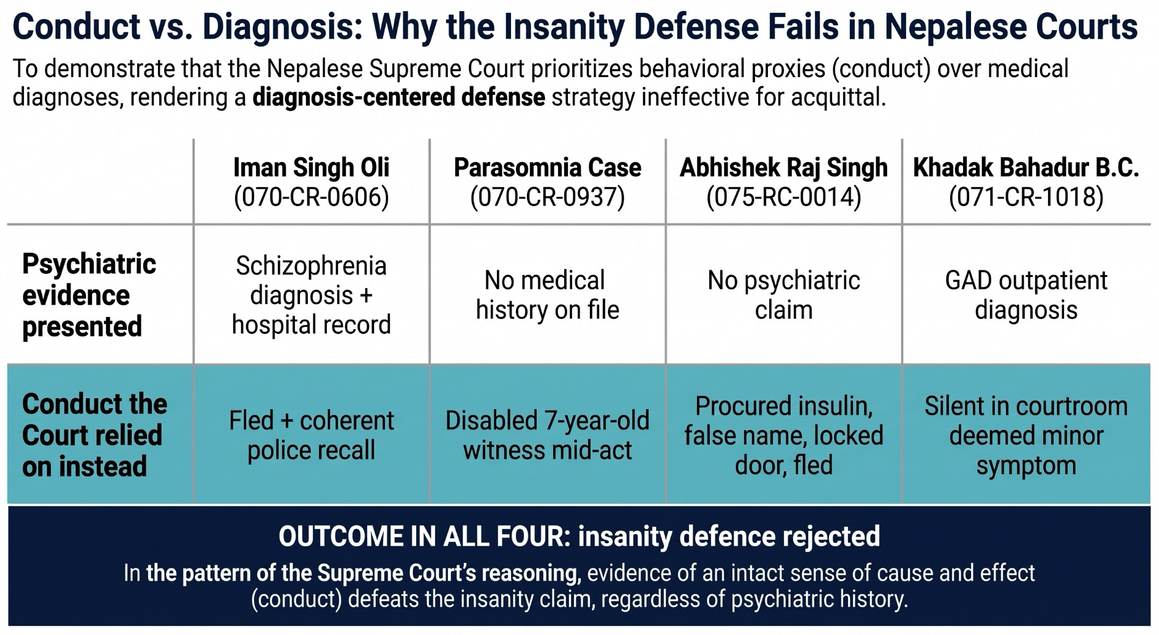
In practice, the Supreme Court’s insanity jurisprudence is built almost entirely on inference from conduct before, during and immediately after the killing, not on retrospective psychiatric reconstruction of the defendant’s inner state.
Three decisions, considered together, describe the pattern with unusual consistency. In Iman Singh Oli v. Government of Nepal (Case No. 070-CR-0606, decided 3 July 2015), the accused held a certified diagnosis of schizophrenia, supported by a district hospital prescription record and a regional psychiatric-camp certificate documenting active antipsychotic treatment, and a witness described him wandering the village in an unresponsive, dazed state in the hours before the killing. The Supreme Court nonetheless rejected a complete acquittal, because after striking the victim the accused abandoned his weapon and fled when children began screaming, and he later gave police a coherent account of the confrontation. The court treated flight and coherent recall as proof of what the commentary calls active, self-preserving, goal-directed cognition – proof, in other words, that at least one of the four cognitive branches of Section 14 remained intact. The certified schizophrenia diagnosis was not disregarded; it secured a downgrade of the homicide charge from premeditated murder to a killing committed with an “unbalanced brain,” carrying a ten-year sentence rather than life. But it did not secure acquittal.
A comparable pattern appears in the rejection of a parasomnia (sleep-state unconsciousness) defence in Case No. 070-CR-0937, where the accused, after striking his wife, redirected targeted physical violence against his intervening seven-year-old son specifically to render the child unconscious and prevent him from raising an alarm. The Court held that modifying one’s conduct in real time to neutralise a witness demonstrates active, goal-directed cognition inconsistent with genuine unconsciousness, and the absence of any pre-existing medical record of a sleep disorder compounded the failure. In Government of Nepal v. Abhishek Raj Singh (Case No. Supreme Court 075-RC-0014), an amnesia defence failed for the same reason on more elaborate facts: the accused had purchased lethal insulin from a hospital the day before the killing, booked a guest-house room under a false name, administered the fatal dose after serving alcohol to the victim, and locked the room from outside before fleeing. Each step – procurement, deception, execution, concealment – was treated as affirmative evidence of a functioning, forward-planning mind, foreclosing any argument that the accused lacked awareness of what she or he was doing.
Minor psychiatric symptomatology fares no better. In Government of Nepal v. Khadak Bahadur B.C. (Case No. 071-CR-1018), silent courtroom behaviour and an outpatient diagnosis of generalised anxiety disorder were held to be minor psychiatric symptoms carrying no legal effect on criminal responsibility, on the reasoning that anxiety of that character does not approach the destruction of cognitive capacity the statute requires.
TABLE: Formal legal test against the pattern of conduct the Supreme Court has actually treated as decisive
| Formal statutory question (s.14) | Evidentiary proxy the Court actually relies on | Effect on the defence when present |
|---|---|---|
| Did the accused know the nature of the act? | Whether she selected a time, place or method requiring situational awareness | Presence defeats the defence |
| Did the accused know the act’s quality? | Whether she distinguished the victim from an inanimate object or non-human target | Presence defeats the defence |
| Did the accused know the act was wrong? | Concealment, flight, false explanation, or destruction of evidence after the act | Presence defeats the defence |
| Did the accused know the act’s consequence? | Choice of a method understood to be lethal (strangulation, poisoning, a weapon) | Presence defeats the defence |
| (Not part of the statutory test) | Certified diagnosis, hospitalisation history, documented hallucinations | Relevant to sentence mitigation only, per Chapter III |
Purpose: Resolves whether Nepal’s insanity doctrine is genuinely a medical inquiry into diagnosis or an inference from behaviour, and shows why a defendant’s ordinary-seeming conduct hours before a killing, defeats an insanity claim regardless of a documented psychiatric history.
6. What this means for a Clancy-type fact pattern
Measured against this doctrine, several of the specific facts that dominated the comparative American proceeding cut against, rather than for, an insanity exemption in Nepal, whatever their significance to a jury weighing capacity to conform conduct to the law. A defendant who timed the killing to a narrow window when she would be alone, who had that morning conducted an ordinary errand and a paediatric appointment, who spoke coherently to a family member by telephone during the relevant window, and who is later found to have made a considered choice of method, would – under the conduct-based inference pattern in Iman Singh Oli, the parasomnia case and Abhishek Raj Singh – supply exactly the evidence of intact situational awareness the Supreme Court has repeatedly treated as fatal to an insanity claim. This would be true even where, as in Iman Singh Oli, a certified psychiatric diagnosis and hospitalisation record exist and are accepted as genuine. The diagnosis secures sympathy and, as Chapter III shows, a materially reduced sentence. It does not secure an acquittal, because acquittal requires proof that at least one of four specific cognitive capacities was absent, and the same conduct offered as evidence of severe illness is, under this doctrine, read as evidence that those capacities were present.
III. The Only Mercy on Record: Sentence Mitigation Instead of Acquittal
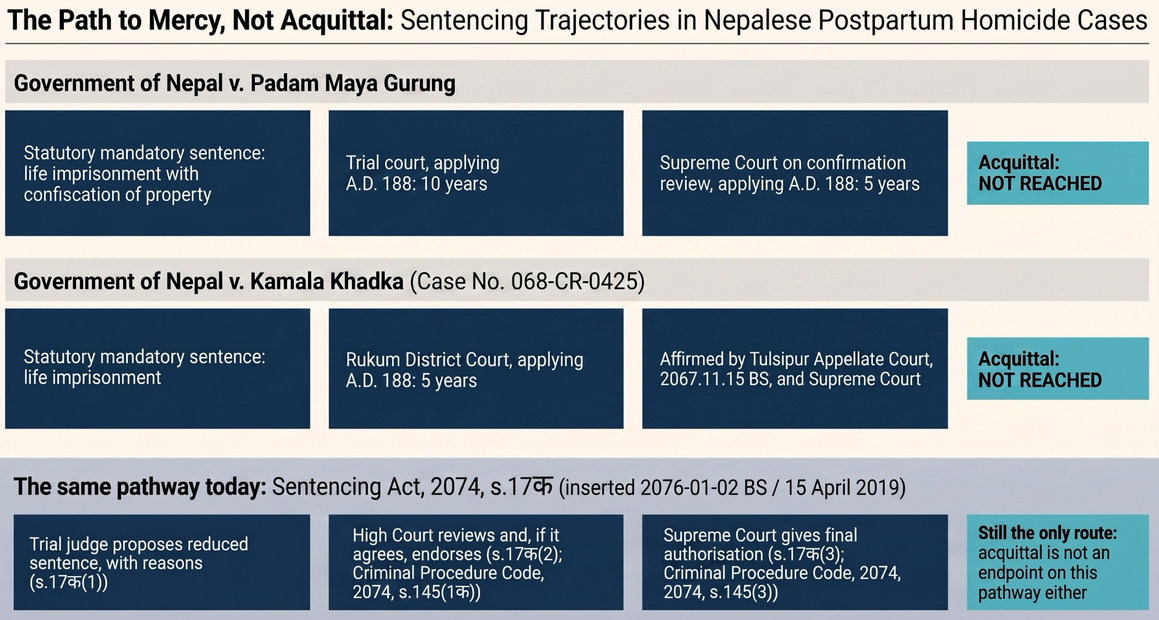
Every documented instance of judicial compassion toward a mother who killed her newborn in psychiatric or traumatic extremity in Nepal has taken the same form: a life sentence reduced to five years. None has taken the form of an acquittal.
1. The precedent, in full
The nearest analogues in Nepalese jurisprudence to a postpartum psychiatric filicide are two Supreme Court matters, decided a generation apart, involving mothers who killed infants conceived through rape. Neither case pleaded or turned on a clinical diagnosis of postpartum psychosis; both turned on the mother’s psychological state in the acute aftermath of a traumatic, socially catastrophic childbirth. Read together, they are the only judicial statement Nepal has produced on how the law treats a mother’s mental collapse at the moment of killing her own child, and their reasoning has been treated in subsequent cases as the template for that category of homicide generally.
| CASE STUDY – Government of Nepal v. Padam Maya Gurung – the reduction, and the reckoning that followed In Falgun 2047 BS, Padam Maya Gurung was raped by a fellow villager while working alone in a forest near her family’s fields. Abortion was then illegal in Nepal under all circumstances, and she carried the pregnancy to term, giving birth on 2048.8.24 BS. In a state the courts below and the Supreme Court both described as one of acute post-delivery psychological collapse driven by the trauma of the assault and the social ruin she anticipated as an unmarried mother of a child conceived by rape, she killed the infant shortly after birth.The Dhankuta District Court convicted her of homicide under the Muluki Ain’s homicide chapter, which mandated life imprisonment with confiscation of property. Exercising its discretion under Section 188 of the Adalati Bandobast, the trial court reduced the sentence to ten years; the appellate court affirmed. On final confirmation review, the Supreme Court went further, holding on 2051.2.5 BS that even ten years was disproportionate given her documented victimhood and psychological state, and reduced the sentence again, to five years – the floor the same provision permitted. A second injustice followed the first. Padam Maya should have been released on 2053.9.1 BS; administrative failure in transmitting her amended commitment order kept her in custody for a further five years, six months and seven days. Decades later, in a constitutional writ decided on 2074 Falgun 13 BS (25 February 2018), the Supreme Court held that this over-incarceration was an unlawful seizure of her personal liberty, ordered the state to pay compensation of NPR 603,600 – calculated at the unskilled daily wage rate of NPR 300 for each day of unlawful excess detention – and issued a directive order to the legislature to enact a general law governing compensation for wrongful confinement, since none existed at the time. That directive has since been codified, though not through a standalone statute of the kind the Court’s order contemplated: the Prisons Act, 2079, s.14(5) now obliges the Chief District Officer to secure immediate release and prescribed compensation for a prisoner held beyond a lawfully ordered release date, and the National Penal Code, 2074, s.204 separately mandates court-ordered compensation from an official who unlawfully keeps a person detained after a release order under s.202. A woman in Padam Maya’s position today would have a codified compensation pathway that did not exist for her at the time. |
Government of Nepal v. Kamala Khadka, decided by the Rukum District Court and affirmed on appeal in the Tulsipur Appellate Court’s decision of 2067.11.15 BS (Case No. 068-CR-0425), followed the same pattern on closely comparable facts. Kamala Khadka was raped by an intoxicated villager in Ashadh 2065 BS while her husband worked abroad; the assailant refused to acknowledge the pregnancy and told her to kill the child once born. Nine days after the birth, overwhelmed by fear of her husband’s return and social exposure, she smothered the infant. The trial court convicted her of homicide and applied Section 188 of the Adalati Bandobast to reduce what would otherwise have been a life sentence to five years, a reduction the appellate court and, on review, the Supreme Court sustained.
2. The mechanism: Section 188 of the Adalati Bandobast
| LEGAL TEXT – Muluki Ain, 2020, Adalati Bandobast Chapter, s.188 (repealed) ORIGINAL LANGUAGE “ऐनले सर्वस्वसहित जन्मकैद वा जन्मकैद गर्नुपर्ने भएका मुद्दामा सावित ठहरे पनि इन्साफ गर्ने हाकिमका चित्तले भवितव्य हो कि भन्न हुनेसम्मको शंकाले वा अपराध गरेको अवस्था विचार गर्दा कसुरदारलाई ऐन बमोजिमको सजाय दिँदा चर्को हुने भई घटी सजाय हुनुपर्ने चित्तले देखेमा ऐनले गर्नुपर्ने सजाय ठहराई आफ्नो चित्तले देखेको कारणसहितको खुलासा राय पनि साधक तोकमा लेखी जाहेर गर्नुपर्छ । अन्तिम निर्णय दिनेले पनि त्यस्तो देखेमा ऐनले हुने सजायमा घटाई तोक्न हुन्छ ।” CONVENIENCE TRANSLATION – NOT OFFICIAL “188. Even where a case is proved in which the Act requires a sentence of life imprisonment with confiscation of property or life imprisonment, if the deciding officer’s conscience is troubled by a doubt as to whether the outcome was truly inevitable, or, considering the circumstances in which the offence was committed, forms the view that the sentence prescribed by the Act would be excessively harsh and that a lesser sentence ought to be imposed, the officer shall record the sentence the Act requires together with a reasoned opinion disclosing the grounds of that view, and shall report the matter for confirmation review (sadhak). The authority delivering the final decision may likewise, upon reaching the same view, reduce the sentence below what the Act would otherwise impose.” |
Section 188 was not an insanity provision. It said nothing about mental state, diagnosis or capacity. It was a general judicial-mercy valve, available in any case carrying a mandatory sentence of life imprisonment with or without confiscation of property, that allowed a trial judge who doubted the moral inevitability of the maximum sentence to record a lesser one and refer the question for confirmation on review. Its use in the two filicide cases discussed above was a discretionary act of judicial compassion exercised through a general sentencing safety valve, not a specialised finding about postpartum psychiatric collapse.
TABLE: The evidentiary formula the Supreme Court accepted as sufficient for sentence mitigation, set against what Section 14 would require for acquittal
| Evidentiary element | Role in securing sentence mitigation (s.188, Adalati Bandobast) | Role in a Section 14 acquittal claim |
|---|---|---|
| Traumatic origin of the pregnancy (rape) | Central: established the compelling circumstance the Court cited as grounds for mercy | Not relevant to any of the four cognitive branches |
| Isolation, absence of support, social terror (loklaj) | Central: described as the source of the “compelling state of mind” | Relevant only if shown to have destroyed cognition, which neither case held |
| Absence of prior criminality or calculated design | Supportive: distinguished the killing from cold premeditation | Supportive of, but not sufficient for, cognitive incapacity |
| Immediate grief and submission after the act | Supportive: read as proof the act was panic-driven, not calculated | Under the conduct-based pattern in Chapter II, could cut either way |
| A specific psychiatric diagnosis of psychosis | Not present in either case; not required | Necessary but, per Chapter II, still not sufficient on its own |
Purpose: Demonstrates that the facts which persuaded the Court to show mercy were never framed, argued or evaluated as facts capable of producing acquittal – the two tracks require different evidence and lead to structurally different outcomes. Source: Government of Nepal v. Padam Maya Gurung; Government of Nepal v. Kamala Khadka (Case No. 068-CR-0425); National Penal Code, 2074, s.14.
3. The uncertain survival of the mitigation route
A functional successor to Section 188 of the Adalati Bandobast exists, and has existed since April 2019. The three-month gap between the old Muluki Ain’s repeal and the successor’s enactment does not describe the law as it stands today.
The National Penal Code, 2074 and its companion codes took effect on Bhadra 1, 2075 BS (17 August 2018), repealing the Muluki Ain, 2020 in full, including Section 188 of its Adalati Bandobast chapter. On initial commencement, the replacement codes omitted an equivalent judicial-mercy mechanism – a gap this report’s earlier drafting treated as unresolved. It was not left unresolved. The legislature corrected the omission through the Act to Amend Some Nepal Acts Relating to the Muluki Codes, 2075 (मुलुकी संहिता सम्बन्धी केही नेपाल ऐनलाई संशोधन गर्ने ऐन, २०७५), gazetted on 2076-01-02 BS (15 April 2019), which inserted Section 17Ka into the Criminal Offences (Sentencing and Execution) Act, 2074 and a corresponding provision, Section 145(1Ka), into the National Criminal Procedure Code, 2074.
| LEGAL TEXT – Criminal Offences (Sentencing and Execution) Act, 2074, s.17क(1) Imposing a Lesser Sentence and Presenting an Opinion ORIGINAL LANGUAGE “१७क. कम सजाय तोक्ने र राय पेश गर्नेः (१) प्रचलित कानून बमोजिम जन्मकैद गर्नु पर्ने मुद्दाको अभियुक्तले कसूर गरेको कुरामा अदालतमा साबित भएको र मिसिल संलग्न प्रमाणबाट त्यस्तो साबिती साँचो देखिएमा निजलाई जन्मकैदको सजाय दिंदा त्यस्तो कसूर गर्दाको परिस्थितिलाई विचार गर्दा न्यायको रोहमा बढी पर्ने भई न्यायाधीशले घटी सजाय गर्न उपयुक्त देखेमा सोको कारण खुलाई राय सहितको फैसला गर्न सक्नेछ ।” CONVENIENCE TRANSLATION – NOT OFFICIAL “17a. Imposing a lesser sentence and presenting an opinion: (1) Where the commission of the offence by the accused in a case carrying a mandatory life sentence under the prevailing law has been proved before the court, and that proof is found to be true from the evidence on the case file, if the judge – considering the circumstances in which the offence was committed – finds that imposing a life sentence would be excessive in the interest of justice and considers it appropriate to impose a lesser sentence, the judge may render a judgment disclosing the reasons, together with an opinion to that effect.” |
Subsections (2) and (3) of Section 17Ka preserve, almost procedure for procedure, the confirmation pipeline that Section 188 of the Adalati Bandobast used: a trial judge who proposes a reduced sentence must forward the case file and the proposed sentence to the High Court within thirty-five days; the High Court, if it agrees the reduction is justified, must in turn forward the case to the Supreme Court for final authorisation. Section 145(1क) of the National Criminal Procedure Code, 2074 restates this same thirty-five-day referral duty from the procedural side, and Section 145(3) confirms that an appellate endorsement must still go to the Supreme Court before a reduced sentence takes effect.
| LEGAL TEXT – National Criminal Procedure Code, 2074, s.145(1क) and (3) – Referral of a Proposed Reduced Sentence ORIGINAL LANGUAGE “(१क) प्रचलित कानून बमोजिम जन्मकैद गर्नु पर्ने मुद्दाको अभियुक्तले कसूर गरेको कुरामा अदालतमा साबित भएकोमा त्यस्तो कसूर गर्दाको परिस्थितिलाई विचार गर्दा जन्मकैदको सजाय गर्नु न्यायको रोहमा बढी पर्ने भई न्यायाधीशले कारण सहित घटी सजायको राय प्रस्ताव गरी राय सहित फैसला गरेकोमा त्यसरी फैसला भएको मितिले पैंतीस दिनभित्र मिसिल सहित पुनरावेदन सुन्ने अदालतमा राय पेश गर्नु पर्नेछ ।” “(३) उपदफा (१क) बमोजिम राय पेश भएकोमा पुनरावेदन सुन्ने अदालतले त्यसरी गरिएको घटी सजायलाई सदर गरेकोमा सर्वोच्च अदालतमा राय पेश गर्नु पर्नेछ ।” CONVENIENCE TRANSLATION – NOT OFFICIAL “(1a) Where, in a case carrying a mandatory life sentence under the prevailing law, the commission of the offence has been proved before the court, and the judge – considering the circumstances of the offence – proposes a reduced sentence with reasons and renders a judgment with an opinion to that effect, the judge shall submit the opinion, together with the case file, to the appellate court within thirty-five days of the date of that judgment.” “(3) Where an opinion has been submitted under sub-section (1a) and the appellate court endorses the reduced sentence so proposed, it shall submit the opinion to the Supreme Court.” |
The statutory ground that triggers this pathway is separately codified. Section 39 of the National Penal Code, 2074 lists diminished capacity due to physical or mental impairment – “शारीरिक, मानसिक तथा अपाङ्गताको कारणले गर्दा कसूरदारको क्षमता ह्रास भएको” – as a mitigating circumstance a sentencing court must weigh, alongside voluntary acceptance of the offence and genuine remorse under the same section. Read together, Sections 39 and 17क give a modern defendant essentially the same two-step argument Padam Maya Gurung and Kamala Khadka succeeded on: a documented mental-capacity impairment as the substantive ground, and a structured judge-to-High-Court-to-Supreme-Court referral as the procedural vehicle for translating that ground into a sentence below the statutory floor.
IV. The Upstream Failure: A Health System With No Duty to Find Her
Before a court can ever be asked whether a mother’s mental collapse excuses or mitigates a killing, someone has to have found the collapse. Nepal’s statutory health framework imposes no duty on anyone to look for it in the specific form postpartum psychosis takes.
1. Maternal health law that does not see psychiatric illness
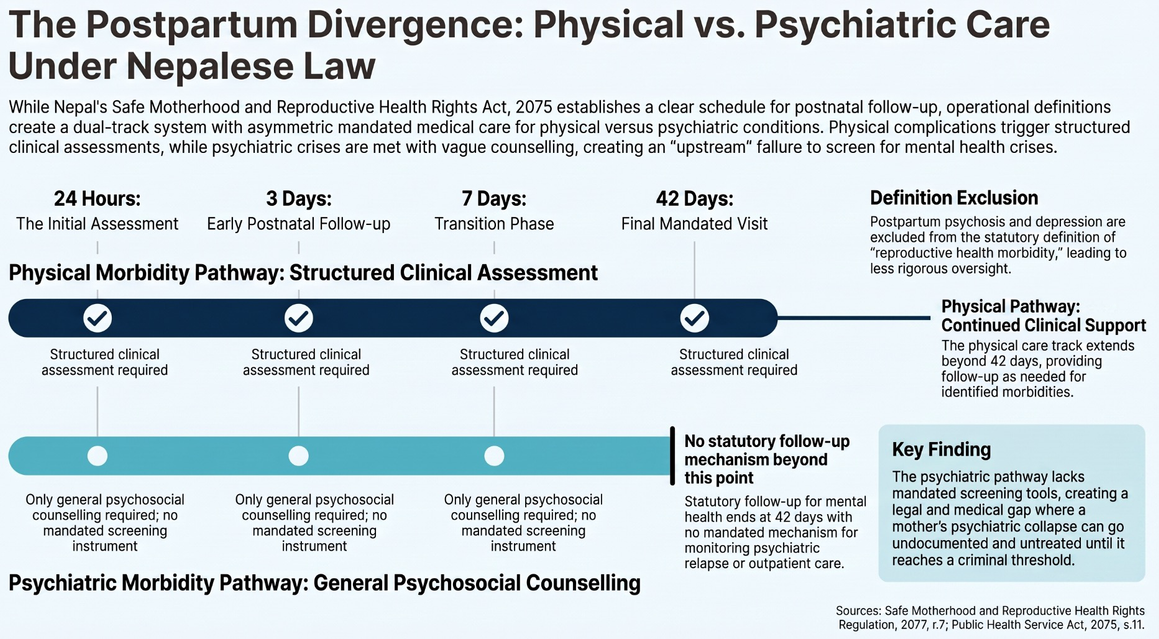
The Constitution of Nepal guarantees every woman the right to safe motherhood and reproductive health, and the Safe Motherhood and Reproductive Health Rights Act, 2075 gives that guarantee statutory content by defining reproductive health to include mental and social, not merely physical, well-being. The definition is generous in principle. It is narrowed sharply, however, at the point where the Act defines the category that triggers services and protections: “reproductive health morbidity.” That definition is built around physical conditions – uterine prolapse, obstetric fistula, infertility, cervical cancer – and does not extend to postpartum depression, anxiety or psychosis. A woman whose crisis is psychiatric rather than physical is, on the face of the operative definition, outside the category the Act was built to address, regardless of the mental-health language in the Act’s general purpose clause.
This narrowing has a direct downstream effect on screening. The Safe Motherhood and Reproductive Health Rights Regulation, 2077 mandates postnatal follow-up contact at fixed intervals – 24 hours, 3 days, 7 days and 42 days after delivery – and requires that those contacts include family and psychosocial counselling. Nothing in the Regulation mandates the use of a validated psychiatric screening instrument, such as the Edinburgh Postnatal Depression Scale, at any of those checkpoints. Whether a mother is examined for the early signs of postpartum psychosis or major depression with psychotic features during the very follow-up visits the law requires is therefore left to the individual clinician’s initiative rather than to a statutory standard of care.
| LEGAL TEXT – Public Health Service Act, 2075, s.11(3)(gha) – Emergency Exception to Informed Consent ORIGINAL LANGUAGE “देहायको अवस्थामा सेवाग्राहीको सुसूचित सहमति विना स्वास्थ्य सेवा प्रदान गर्न सकिनेछः- … (घ) स्वास्थ्य सेवा उपलब्ध गराउन ढिलाई गरिएमा सम्बन्धित बिरामीको मृत्यु हुन सक्ने वा निजको स्वास्थ्यमा अपूरणीय क्षति पुग्न सक्ने सम्भावना रहेकोमा” CONVENIENCE TRANSLATION – NOT OFFICIAL “Health services may be provided without the informed consent of the service recipient in the following circumstances: … (d) where delay in providing the health service may result in the death of the patient concerned or may cause irreparable harm to his or her health.” |
This provision is the entire statutory basis on which a Nepalese clinician could act without a psychotic patient’s consent, and it is built for a physical medical emergency, not a psychiatric one. It authorises emergency intervention once death or irreparable harm is imminent; it does not authorise, and nothing else in the statutory framework authorises, an outpatient commitment order, a mandatory follow-up requirement, or any structured mechanism for compelling continued psychiatric care for a patient who has been stabilised once but remains at risk of relapse – the precise trajectory a waxing-and-waning illness like postpartum psychosis follows. A woman who presents to an emergency department in acute crisis, is treated, and is discharged once the immediate danger has passed can decline further psychiatric follow-up, and no statutory mechanism compels continuity of care into the period when her risk may re-emerge.
2. No Mental Health Act to anchor any of it
Nepal has no standalone Mental Health Act. Every protection this chapter describes is assembled from fragments of general health, disability and reproductive-health legislation, none of which was drafted with a psychiatric emergency in mind.
This is not merely an inference from the absence of a citation in the material underlying this report; it is independently confirmed by the contemporary public-health literature on Nepal’s mental health system, which as of 2025 describes the statutory foundation for mental health services as resting on the general Public Health Service Act, 2075 and a non-binding National Mental Health Policy and Strategic Action Plan dating to 2020, rather than on dedicated mental-health legislation of the kind most comparable jurisdictions have enacted.
3. No infrastructure for the specific clinical answer postpartum psychosis requires
Even where postpartum psychosis is recognised and treated, a central clinical difficulty is that separating a psychotic mother from her infant can worsen her condition, while leaving them together unsupervised can be dangerous. The internationally recognised answer is a joint mother-and-baby psychiatric inpatient unit, staffed for twenty-four-hour supervision of both patient and infant together. Nepal’s hospital licensing framework, including the schedules to the Public Health Service Regulation, 2077 that set standards for different classes of health institution, contains no licensing category, staffing standard, or physical-infrastructure requirement for such a unit. A hospital wishing to establish one would have no regulatory template to follow, and a woman in acute postpartum psychosis has no statutory entitlement to be treated in one, because none is legally defined to exist.
TABLE: What the law requires for a physical postpartum complication, set against what it requires for a psychiatric one
| Postpartum checkpoint | Statutory treatment – physical morbidity | Statutory treatment – psychiatric morbidity |
|---|---|---|
| Definitional coverage | Expressly named in the statutory definition of reproductive health morbidity | Excluded from that definition; addressed only in the Act’s general purpose language |
| Mandated screening at 24hr/3-day/7-day/42-day checks | Structured clinical assessment protocols apply | Only a general duty of “family and psychosocial counselling”; no mandated screening instrument |
| Emergency treatment without consent | Available once irreparable harm is imminent (s.11(3)(gha)) | Same threshold applies, but no mechanism addresses relapse after initial stabilisation |
| Specialised inpatient facility | Licensing standards exist for maternity and obstetric wards (Schedules 7-8) | No licensing category exists for a joint mother-and-baby psychiatric unit |
| Continuity of care after discharge | Follow-up visits scheduled under the postnatal protocol | No statutory outpatient-commitment or mandated follow-up mechanism for psychiatric relapse |
Purpose: Makes concrete, checkpoint by checkpoint, the asymmetry between Nepal’s statutory treatment of physical and psychiatric maternal morbidity – the same law, applied at the same moments in a woman’s postpartum course, produces materially different levels of protection depending on which kind of illness she has.
Source: Safe Motherhood and Reproductive Health Rights Act, 2075, s.2; Safe Motherhood and Reproductive Health Rights Regulation, 2077, r.7; Public Health Service Act, 2075, s.11(3)(gha); Public Health Service Regulation, 2077, Schedules 7-8.
4. The trigger that does not exist: from disclosed risk to legal action
The Clancy narrative underlying this report’s comparative frame turns in part on a documented pattern familiar to any reading of the underlying medical record: a mother repeatedly disclosed thoughts of harming her children to her husband and, in general terms, to treating clinicians, months before the killing, without those disclosures triggering compulsory intervention, child-protective referral, or a structured risk assessment specifically calibrated to postpartum intrusive thoughts as distinct from ordinary parental anxiety. Nepal’s statutory framework offers no reason to expect a different outcome. Child-protection legislation authorises removal or protective placement where a parent poses an immediate danger, but operationalising that authority depends on someone – a treating clinician, a family member, a local child-welfare officer – recognising the disclosure as the trigger for it, and nothing in the health-sector statutes discussed above imposes an affirmative duty on a treating clinician to escalate a disclosure of intrusive thoughts about harming a child to a formal risk assessment or a child-protection referral. The duty, where it exists at all, is general professional judgment rather than a specific, legally mandated protocol.
V. The Competing Interpretation: Procedural Due Process as a Counterweight
The strongest challenge to this report’s thesis is not a different reading of Section 14. It is a separate and more recent line of authority holding that a decision-maker who disciplines someone for conduct potentially attributable to an unexamined mental illness has acted unlawfully – a principle that, if it migrated from the administrative context in which it was decided into the criminal one, could change how a court approaches the threshold question of whether a defendant’s mental state was ever properly investigated at all.
1. The case
| CASE STUDY – Keshav Bahadur K.C. v. Karnali Province Armed Police Force Headquarters – a duty to examine before punishing A constable dismissed from the Armed Police Force for alleged repeated on-duty intoxication challenged his dismissal by writ, arguing that the disciplinary process changed the charge against him four times within seventeen days, that the intoxication allegation rested on a single supervisor’s report rather than any medical or scientific evidence, and that his disclosed depression was never medically examined before the service imposed its most severe sanction. The Supreme Court quashed both the original dismissal and the appellate decision affirming it. It held, first, that repeatedly widening the charge against an employee within a short window without giving him a genuine opportunity to respond to a single, complete accusation violated natural justice. Second, and more significantly for this report, the Court held that an allegation of repeated substance use requires objective medical or scientific proof – citing the evidentiary standard for intoxication applied by the Indian Supreme Court in Bachubhai Hassanalli Karyani v. State of Maharashtra – and cannot rest on an unsupported supervisory report alone. Third, and most significantly, the Court held that where an employee has raised a mental-health condition as relevant to the conduct alleged against him, the decision-maker bears a duty to investigate whether the condition is genuine before proceeding to the harshest available sanction, rather than dismissing the claim as a pretext without examination. The Court invoked Nepal’s ratification of the Convention on the Rights of Persons with Disabilities, 2006 and the reasoning of the Indian Supreme Court in Ravinder Kumar Dhariwal v. Union of India, which held that conduct attributable to a genuine psychiatric condition calls for treatment and accommodation rather than punishment. The Court ordered the constable reinstated with back pay and benefits. |
2. Why this challenges the thesis
If Nepalese courts are willing to hold, in the employment-disciplinary context, that a decision-maker who ignores a disclosed psychiatric condition and proceeds straight to the most severe sanction has acted unlawfully, the same reasoning could in principle be extended to a homicide investigation and prosecution: a prosecutor or investigating authority that had before it a documented history of psychiatric hospitalisation, medication changes and disclosed intrusive thoughts, and that proceeded to charge and try a case without ordering the psychiatric examination Nepal’s criminal procedure law already permits, could be argued to have failed a comparable duty to investigate before punishing. On this reading, the upstream failure identified in Chapter IV is not simply a legislative gap; it is a duty the judiciary itself might be willing to enforce against investigating and prosecuting authorities, given the right case and the right advocacy.
3. Why the thesis substantially survives, narrowed
The Keshav K.C. principle is real, but it answers a different question from the one Section 14 asks, and nothing in the decision suggests the Supreme Court intended it to alter the substantive insanity test.
Three distinctions confine the reach of the analogy. First, Keshav K.C. is an administrative-law case reviewed under the Court’s extraordinary writ jurisdiction against a departmental disciplinary decision, not a criminal case reviewed under the National Penal Code, 2074. The remedy the Court granted – quashing an administrative order and directing reinstatement – has no direct criminal-procedure analogue; there is no equivalent order a court could issue mid-homicide-trial that would function as reinstatement. Second, the duty the Court articulated is a duty to examine a claimed condition before imposing a sanction attributable to it, which most naturally maps onto Nepal’s existing criminal-procedure mechanism for ordering a psychiatric examination before or during trial – a mechanism this report’s underlying material confirms already exists in Nepalese law independent of Keshav K.C. What Keshav K.C. adds, if it transfers at all, is pressure on a court or investigating authority to invoke that existing mechanism where a disclosed history makes it obviously relevant; it does not create a new substantive ground for acquittal, and it does not touch the cognitive-versus-volitional boundary that Chapter II identifies as the operative barrier. A defendant whose sanity is properly examined, and whose examination confirms that she retained cognitive awareness of wrongfulness even though she could not control her conduct, gains a documented, professionally verified psychiatric record from a Keshav K.C.-style duty to investigate – but Section 14 still would not exempt her once that record exists, for exactly the reasons developed in Chapter II. Third, the stakes and institutional posture differ: a departmental disciplinary body deciding an employment sanction is not weighing the same evidentiary and public-safety considerations as a court trying a completed triple homicide, and Nepalese courts have historically shown far greater reluctance to extend procedural solicitude to the mentally ill defendant once death has already resulted, as the conduct-based case law in Chapter II demonstrates.
TABLE: What Keshav K.C. would and would not change if extended to a homicide investigation
| Question | Effect of extending Keshav K.C. reasoning to a homicide case | Governing authority unaffected by the extension |
|---|---|---|
| Must a disclosed mental-health history be investigated before the case proceeds to judgment? | Plausibly yes – pressure to invoke the existing psychiatric-examination mechanism | N/A – this is the question the extension would answer |
| Does volitional incapacity (inability to control conduct) qualify for acquittal once documented? | No effect – Keshav K.C. does not address the cognitive/volitional distinction | National Penal Code, 2074, s.14, and the commentary’s rejection of the volitional test (Chapter II) |
| Does conduct before/during/after the act still defeat the defence if cognition is shown? | No effect – the conduct-based inference pattern is untouched | Iman Singh Oli v. Government of Nepal; parasomnia case (070-CR-0937); Abhishek Raj Singh |
| Does documented illness still route to sentence mitigation rather than acquittal? | No effect – this remains the ceiling described in Chapter III | Padam Maya Gurung; Kamala Khadka; unresolved successor to A.D. s.188 |
Purpose: Isolates precisely which part of a Clancy-type case the competing authority could plausibly affect (the adequacy of the pre-trial psychiatric investigation) from the part it does not touch (the substantive test for criminal responsibility once that investigation exists).
Source: Keshav Bahadur K.C. v. Karnali Province Armed Police Force Headquarters (Writ No. 077-WO-1001); National Penal Code, 2074, s.14.
4. Verdict on the thesis
The thesis survives, but narrowed: Keshav K.C. strengthens the case that a properly conducted Nepalese prosecution would be under real institutional pressure to order a psychiatric examination it might otherwise have skipped, which could improve the documentary record available to a sentencing court. It does not disturb the central finding that the documentary record, however complete, would still be evaluated against a cognitive-only test that a volitional account of postpartum psychosis is structurally unlikely to satisfy.