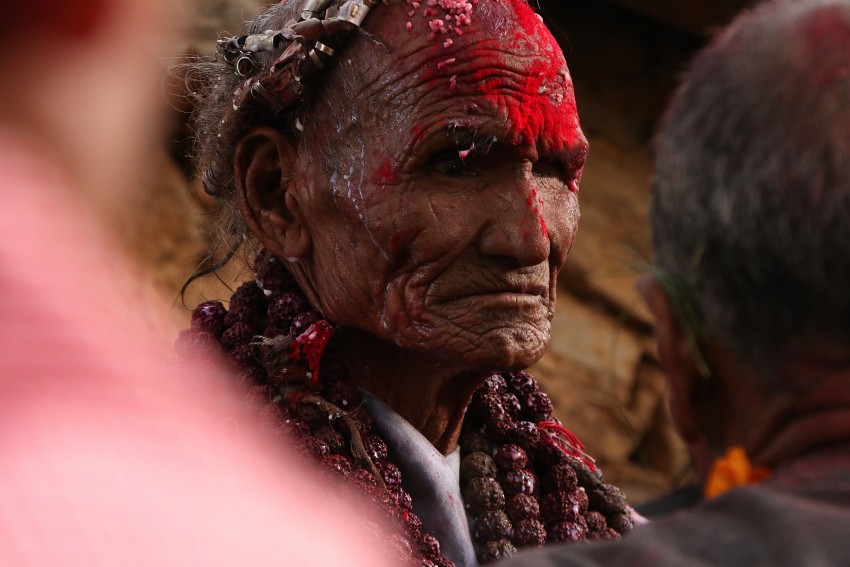
Masto Deities are Nepali’s actual roots and some other Moral Romanticisms towards the end of year 2025
We all have our names and surnames. Eg. I am a “Parajuli”. On my mother’s side, the blood is “Chaulagain”. These are, in the modern, simplified anthropological / social ledger of Nepal, simply surnames but hold some connection to the ancient civilizations. They carry something vast and dissonant from the official narrative that recently led me to rethink where the roots of most Nepalese actually are, and also in terms of my evolutionary place in the world.
The source book is खस जातिको इतिहास by Historian बालकृष्ण पोखरेल – which tells me that the gods our people carried to these old hills in Nepal were not the gods of the Vedas or the Puranas. They were fashioned in a different place entirely. They are the Masto deities, and their home was Babylon, not Banaras. And I could not be more happier – I have a strong distaste for the new gods in Hinduism, or any other religion for that matter.
Historian Balkrishan Pokharel makes it clear from the start: the Masto tradition is not a sect of Hinduism. It is the indigenous, pre-Vedic era spiritual bedrock of the Khas people (to which most Nepali belong to but don’t admit). When Pokharel calls the Khas a migrating race, he is pointing to a migration that brought West Asia to the Himalayas. Our primary identifier is our language, Khas-kura, the mother tongue that eventually evolved into the language called Nepali. Every native speaker of this tongue, from the hill Brahmin to the Chhetri, is ethnically Khas or linked to. Like it or not, we share our roots back to Mesopotamia. We are the Kassites, the Saka, the Partha tribes who ruled and lived in the plains of Babylon and Assyria, through the Hindu Kush, through Kashmir (which we aptly called Khashameru, the Khas fortress), into the Himalayan realm of Sapadalaksha. We did not come empty-handed. We packed our gods with us. Because that’s the way we dealt with our old gods. We had a different way of summoning and treating our gods – just like you do with your parents. You heed them but you talk and negotiate with them.
And our old gods were unique. The name, Masto, has a Himalayan echo (with Persian origin) and Assyrian Mazda, meaning “head” or “chief.” This is our cultural DNA. The pantheon of the Twelve Masto Brothers is a direct inheritance. Babiro Masto is Babylon itself, the city fossilized in divine nomenclature. Banni Masto (colloquially known as Bindemasto) – is Assyria, from kings like Ashurbanipal (Bannipal), a localized form of Ahura Mazda (Asur-mast). Khaapar Masto was the contribution of the Hephthalite horsemen in the Khaptad region. Others like Budamasto (the Sumerian sun god Utu) and Kawamasto (from the Kabul region) are geographic markers on our long journey. Their worship, the ancient Goat Worship, centered on sacrifice at sacred Thans, links us to Mesopotamian goat deities like Enki. This is our oldest ritual: the goat led to the shrine, the offering made, the prasad consumed, binding the community. It is a practice that existed long before we were slotted into the Hindu varna system.
But the Khas integration into the Hindu fold is where the story comes to a complex social drama, a drama written into our own ancestries. As Khas society solidified in Nepal, it organized itself, but internal fissures were engineered and exploited for social and political reasons. The Brahmin community, the so called “intellectual” class of the Khas civilization was split into Purbiya and Kumai (Easterners and those from Kumaon) on geographical basis, and, more profoundly, into Upadhyaya and Jaishi on social basis. The Jaishi status, arguably, assigned by the circumstances of one’s parents’ union, or the practice of Upanishad and Jyotisashtra, was once fluid. Before Prithvi Narayan Shah unified Nepal, a Jaishi could be “made” an Upadhyaya through ritual. But that mobility was deliberately erased. Again that is a stupid practice, which I don’t condone. As they say, history and tradition were made by people as flawed as we are in the present. I am more interested in socio-political and philosophical discourse. The Rana regime, particularly Jung Bahadur, saw a unified Brahmin class as a threat. By legally codifying these divisions under King Surendra, they made the hierarchy rigid, a permanent fracture to ensure political control. All were subject to these political prunings.
And we were not alone in this land. The non-Khas peoples – the Magar with their Sherabha dragon-god from Lycia, the Kirat with their Mundhum tradition and taboo on goat meat (a fascinating contrast to our Goat Worship within the Khas), the Newar, the founders of Nepal’s urban civilization from the Manav people of West Asia – each have their own profound, distinct histories. But my lineage, the Parajuli (from my fathers’s side) and Chaulagain line (from my mother’s side), also falls into this overall anchor point in the timeline of the Khas country. It was a figure like Bandhudatta Acharya – a name that resonates with my own Acharya-connected lineage, who, during the reign of the Licchavi King Narendra Deva, is said to have brought Machchindranath to appease the gods and end a drought. This isn’t just a legend; it’s a record. It places my ancestors (Acharyas) as original dwellers, in the spiritual and civic life of this Masto deity ruled region centuries ago. The Parajulis and Acharyas, sharing the Koundinya gotra, were already here, serving as the high class thinkers (which I only mention as a homage to my ancestors, I for one, am a dilapidated biological idiot – who my ancestors would have proudly cast out from the village) were quick in adapting the Mahanta and Pujari roles in the Khas kingdoms of Jumla and Dullu. So this proves that we are not recent arrivals, and not related to Hinduism at all, which was later adopted as a social weaving and a slick practice of opportunism. But hey, what the hell, I don’t care !! They did what they could. All of us are eventually as faithful as our options are.
But the interesting thing is that my fascination with Masto history forces me to go on a Kantian philosophical drive. It lies bare and naked showing the difference between what I call the “Old Gods” and the “New Gods.” The Masto are Old Gods. They are like the Vedic deities (again feel free to interpret Vedas as you like, to me it’s only a source material, I have no religious liability towards it) or the village gramdeuta: flawed, grounded, peer-like. They are summoned. They are equals we bargain with. Their morality is not one of surveillant perfection but of durable bonds. It is the morality of ritual > intention and presence > belief. You don’t prove your devotion by having a pure thought; you prove it by showing up, by keeping the pact, by performing the sacrifice even when your faith is weak. This is the same ethic we apply to our parents – we serve out of duty and love, not because we feel devout every single day, although it’s hard not to be devoted to your parents and guardians but it is an assimilation of an ethical adulthood that understands that “habit sustains love when emotion falters”.
The New Gods, the Puranic deities, the likes of your Vishnus, Krishnas and Devis are different. They are moralistic, perfect, demand surrender and your “sudhariyeko practices” unlike the old gods like India, Agni, Varun etc. I will never heed to these new gods unless I have a contract with them, and even then that would not count as devotion, it’s just showing up to fulfill your liabilities. Because showing up matters not because it proves faith, but because it keeps bonds and contracts alive, because you never know when emotions and devotion falters. I feel these new gods that are constructed, polished, and unnecessarily defended, whose contradictions are brushed away as leela whenever explanation becomes uncomfortable in an utter intellectual dishonesty.
My argument is that that extreme devotion often comes from people who outsource their moral responsibility. True integrity (the real devotion), for me, comes from acting according to conscience, even if that means standing alone, eating from the ground, or dying without cosmic guarantees to get to worship your ego in some some unearthly place such as baikunthadham. Just as ancient gods were replaced, today’s “new gods” will also age badly. What feels sacred now may feel absurd in 200 years – when people start worshipping “furries”. And oh those pretentious and performative purity these people exercise, mostly common in dietary or ritual purity, purely dramatic rather than ethical or health-based. I am not against the act, I am just against the self-righteous narrative attached to it and the self adulations and accolades they give themselves. These new gods prioritized inner intention and purity. This shift, in Hinduism and also in other religions around the same time, was a political and social necessity for building empires and enforcing social control. It creates a god who is a watchful sovereign, not a peer. It replaces the messy, reciprocal sacrifice and at times your peer god with the clean, internalized guilt of devotion.
I think Kant would partly agree with the ‘duty’ part – he’d say any action, even a Masto ritual, has moral worth if done from a conscious sense of duty. But he’d reject the ‘ritual > intention’ part, and that’s where I leave him behind.” But really, I don’t care if Kant agrees or not, I will choose to side with the older wisdom of Masto tradition. A morality that cannot survive the failure of feeling is a frail morality indeed.
Which is why, the next time I stand before the shrine (thaan) in my ancestral home and before Bindamasto, which I promise to, I will not be reciting verses of prayers to a distant, perfect deity. I will be making a request. I will call upon Bindamasto, a name known to my lineage, and I will ask not for obedience, but for partnership. I will ask to become a Dhami (the human-vessel who does Masto rituals). I want to feel the old connection, to interact with these occult gods on a name basis, as our ancestors did. I want a morality that is worn into the bones through practice and duty, however limited or unlimited that may be, not such a god who constantly interrogates in the mind for all of those constructed values of idealism like a dystopian surveillance state. My old gods allow me to preserve dignity; the new gods breed shame and pretension through surveillance theology, and I have inadvertently allowed myself for it to have left a very bad taste in my mouth.
I love that our gods are flawed, like us. They are grounded. They did not demand surrender; they offered a contract, and as Masto worshippers, we intended to honor it. We were taught not to take gods as an excuse to outsource your conscience, don’t trust gods (or any one for that matter) who demand obedience. Make a pact, sign a contract and honor it because that way, even when beliefs, feeling, emotions, love and purity fails, the duty under the contract still survives.
Duty precedes feeling and morality, everywhere that matters, this is how we actually live, not how moral theories pretend we live. We don’t care for parents because we feel like it every day. We show up even when love is tired, angry, resentful, bored. We don’t wait for purity of intention to act – WE ACT. And that is not hypocrisy, that is being human, that is ethical adulthood and self-respect. If you wait for the correct intention, duty will collapse and die.
And if I presented this to Kant he would probably ask – then who guarantees your intentions? I would probably reply that “my intentions will be guaranteed by my capacity to constantly self-interrogate myself and the environment I live in” which I know Kant would agree with, because that was his moral metaphysics as well – “A Conscience for Good Without Cosmic Guarantees”.
Conclusion: Seems, I have the luxury of forever to whine about the correct version of gods. Thanks for reading !!